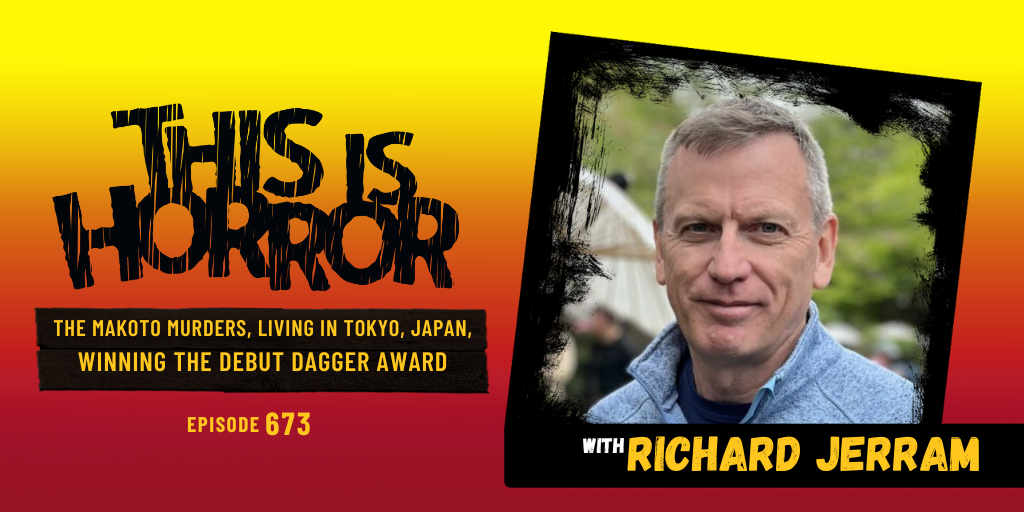
In this podcast, Richard Jerram talks about The Makoto Murders, living in Tokyo, Japan, winning the Crime Writers’ Association’s Debut Dagger Award, and much more.
About Richard Jerram
Richard Jerram was raised in the north, but long ago ventured south in search of education and employment. He lives near a park in London with his wife and, at times, children. Runs slowly. Swims enthusiastically. Plays chess competently. Reads. The fertile soil of the UEA’s crime fiction MA gave rise to The Makoto Murders, Richard’s first novel. A noir thriller, set in Tokyo, it won the Crime Writers’ Association’s Debut Dagger award in 2024.
Timestamps
Thanks for Listening!
Help out the show:
- Support This Is Horror on Patreon
- Listen to This Is Horror Podcast on Apple
- Listen to This Is Horror Podcast on Spotify
- Rate and review the This Is Horror Podcast on Apple Podcasts
- Share the episode on Facebook and X
- Subscribe to This Is Horror podcast RSS Feed
Let us know how you enjoyed this episode:
- Write a comment below.
- Follow us and get in touch on Instagram @thisishorrorpodcast
- Subscribe and comment on YouTube @thisishorrorpodcast
- Follow us and get in touch on TikTok @thisishorrorpodcast
- Tweet us @thisishorror.
Resources
- Richard Jerram
- Watch the video version of This Is Horror Podcast episodes, including our conversation with Chuck Palahniuk on YouTube.
House of Bad Memories by Michael David Wilson
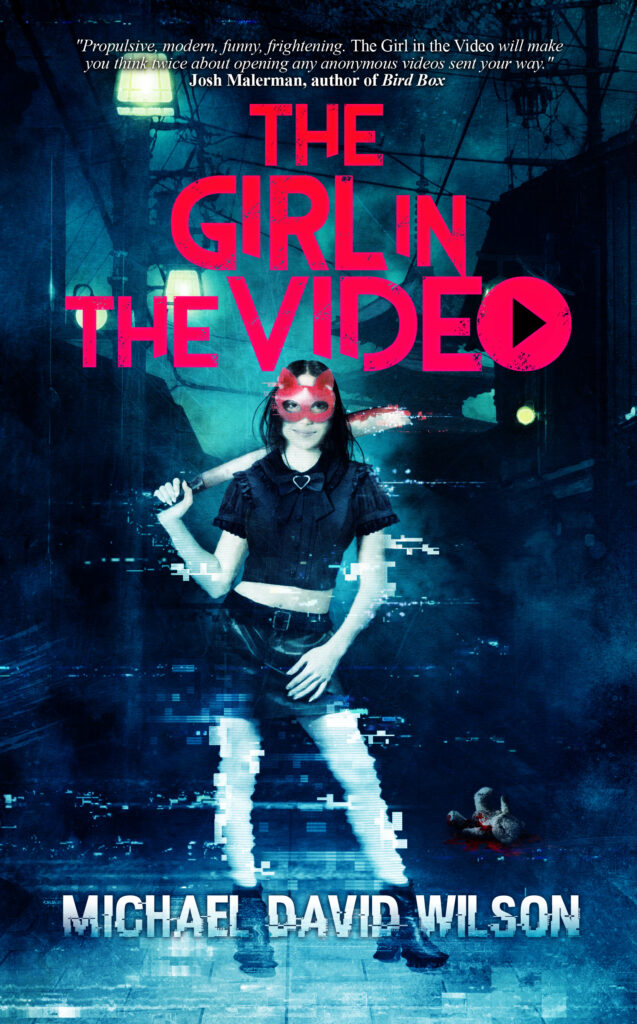
From the author of The Girl in the Video comes a darkly comic thriller with an edge-of-your-seat climax.
Denny just wants to be the world’s best dad to his baby daughter, but things get messy when he starts hallucinating his estranged abusive stepfather, Frank. Then Frank winds up dead and Denny is held hostage by his junkie half-sister who demands he uncovers the cause of her father’s death.
Will Denny defeat his demons or be perpetually tortured for refusing to answer impossible questions?
House of Bad Memories is Funny Games meets This Is England with a Rosemary’s Baby under-taste.
Buy House of Bad Memories from Cemetery Gates Media
Buy the House of Bad Memories audiobook
They’re Watching by Michael David Wilson and Bob Pastorella
From the hosts of This Is Horror Podcast comes a dark thriller of obsession, paranoia, and voyeurism.
After relocating to a small coastal town, Brian discovers a hole that gazes into his neighbour’s bedroom. Every night she dances and he peeps. Same song, same time, same wild and mesmerising dance. But soon Brian suspects he’s not the only one watching and she’s not the only one being watched.
They’re Watching is The Wicker Man meets Body Double with a splash of Suspiria.
Buy They’re Watching in paperback and eBook right now.
Michael David Wilson 0:28
Welcome to This Is Horror, a podcast for readers, writers, and creators. I'm Michael David Wilson, and every episode, alongside my co-host Bob Pastorella, I chat with the world's best writers about writing, life lessons, creativity, and much more. Today, I am chatting with Richard Jerram, the author of The Makoto Murders, a noir thriller set in Tokyo that won the debut dagger award and was recently published by Titan. Now, as with many of the This Is horror conversations, this is a two-parter. So, in this first part, we find out a little bit about Richard's early life and writing background, and then in the next installment we dive even deeper into the Makoto murders. So a lot of exciting things coming up, but before we get to our chat with Richard, a quick advert break.
Bob Pastorella 1:36
House of Bad Memories, the debut novel from Michael David Wilson, is out now via Cemetery Gates media. Denny just wants to be the world's best dad to his baby daughter, but things get messy when he starts hallucinating his estranged, abusive stepfather Frank. Then Frank winds up dead, and Denny is held hostage by his junky half sister, who demands he uncovers the cause of her father's death. Will Denny defeat his demons, or be perpetually tortured for refusing to answer impossible questions. Clay McCloud Chapman says, "House of Bad Memories hit so hard you'll spit teeth out once you're done reading it. House of Bad Memories by Michael David Wilson, available now in paperback, ebook, and audio. From the host of this isora podcast comes a dark thriller of obsession, paranoia, and voyeurism. After relocating to a small coastal town, Brian discovers a hole that gazes into his neighbor's bedroom. Every night, she dances and he peeps. Same song, same time, same wild and mesmerizing dance. But soon, Brian suspects he's not the only one watching, and she's not the only one being watched. Their watching is The Wicker Man meets Body Double with a Splash of Suspiria. Their watching by Michael David Wilson and Bob Pastorella is available from This Is Horror.co.uk, Amazon, and wherever good books are sold.
Michael David Wilson 3:00
Okay, without saying, here it is. Richard Jerem on This Is Horror. Richard, welcome to This Is Horror.
Richard Jerram 3:13
Thank you very much. Great to be here.
Michael David Wilson 3:15
Yes. So to begin with, I want to start all the way back at the beginning because I want to know what were some early life lessons that you learned growing up.
Richard Jerram 3:27
So long ago for me, less longer ago for me than for you, I guess. But I think probably the main one was the value of education. You know, that was really instilled in us from an early age, and so I've been in and out of education pretty much all my life, and I think now I've acquired five degrees, which is probably a few more than is strictly necessary. But I have three in economics, and then I decided to become a writer, and I now have two MAs in in creative writing, and so I sort of got a fairly nice selection of graduation photographs on my on my mother's mantelpiece. You know, so in terms of the MA in creative writing, I know you got an MA in crime fiction at UEA, but you said you've got two MAs. So was the other preceding it? Was it after? What was the impetus for getting both? Well, rather foolish. It was coincidental with with the one. So there's one at City University, which is in London, where I live, and that's one you'd sort of show up for classes two or three times a week, do do projects, and and the and it was a generalist creative writing MA. I did have a thought at some point I should write a like an economics airport book. You know, my kids were always saying, yeah, you know about this. You can give things in ways that people can understand. Write one of these. You know, 10 things about economics that change your life, or one of these sort of trashy things you pick up at the airport. Anyway, I have given up on that idea, but at the same time, the the one in UEA is obviously the really prestigious one. They've got a great track record of people getting published out of that MA. But that you do three residentials a year, and then the rest of it is all online. So it seemed quite practical to do two different things. And I figure, well, two different courses, learn twice as much. You know, what's what's wrong with that? So I signed up. Benefit of hind side, it does look a bit foolish, but at the time, it seemed like a sensible idea. And I I met some interesting people and different things from both courses. So yeah, it seemed to work,
Michael David Wilson 5:42
and so I wonder what were some of the best and the worst things about taking the MA, and that's kind of brushing aside the fact that you were potentially doing two of them simultaneously, because that that lesson probably doesn't apply to most people.
Richard Jerram 6:00
Yes, I think I think probably two best things. I think perhaps the best thing was actually learning that you can learn how to be a writer. You don't just have to. You can't. Well, you can just read books and then write stuff. But it seemed to me that was quite a difficult way to get to where you wanted to be. It seemed easier to learn from people who know how to write, how to teach creative writing, and skip some of the fairly dumb mistakes that I guess a lot of people make. You know, it's not to say you can't do it that way, but it didn't really work for me to try to do it without any great education, I think the second thing is that you just meet like a great bunch of people who really constructively help you to develop your story. So there's a lot of workshopping, there's a lot of you know feedback from your peers, and that's quite intimidating in many ways because it's something that's sort of a part of you, and you're putting it out there for people to read, and they go, "Ah, yeah, this just didn't work for me at all. Then they can give you reasons why it didn't work, but it's still well. This is this is quite. You feel very vulnerable. Whereas, you know, for 30 years of my life, I was an economist, and I was always this is this is the situation. This is why I'm right. We've got a lot of facts. We've got a lot of theory behind what I'm doing. You know, you might not like it, but I'm right about this. And when you're doing creative writing, you've really got to walk away from that attitude of being very, almost perhaps defensive or very not quite arrogant, but confident in your opinion, and you have to be much more humble, I suppose, in it. I mean, the worst stuff you're sort of made to read some stuff that you don't like reading, I suppose. But even that can be educational. You've got to think about why it is you didn't like it, what what wasn't resonating with you, but otherwise, I mean, you can learn from bad stuff as well as you can learn from good stuff. I suppose that's the way I look at it.
Michael David Wilson 8:11
And so I'm wondering too. I mean, did you always have aspirations to be a storyteller? Was this something that featured into your life, and were you perhaps writing or dabbling creatively, even alongside being an economist?
Richard Jerram 8:30
Not really. I mean, I had a draft of a novel in my 20s, but there was never any time to pursue it. And then you get a job, you get a family. You know, life sort of takes over really, and there's no time for anything more creative. I mean, obviously, some people would say writing economics is creative, but I like to think there's a bit more rigor in it than that. But certainly, there's some some similarities because when you're writing economics, at least in the financial market, you're writing something. There's 10 other people writing something similar. If you want people to read your stuff, it's got to be punchy. You try to put a bit of humor in it, maybe it's got to be snappy, and you've got to write it pretty quick as well. So I think that was all quite a practical training in terms of becoming a fiction writer. So even though it doesn't seem as if there's a direct overlap, I think it was a good training in terms of simply stylistically writing short sentences, grabbing people's attention. You know, this type of almost journalistic, I suppose, in some ways as well, and I think you find journalists make pretty good creative writers. Lawyers tend to make pretty good crime fiction writers as well, because I suppose they have lots of bad stuff they see, but they're also very good at presenting an argument. And I think, to a degree, an economist may be. Into that category as well,
Michael David Wilson 10:03
and so did you know as you were approaching retirement that you were going to begin writing fiction, or was this something that came a little later?
Richard Jerram 10:14
Well, I I sort of quit my proper job, if you like, and came back to the UK, and then was sort of, I guess, looking around for something I might do. I toyed, toyed with something in politics. I toyed with going back to teach because I used to teach a course at the LSE, and the guy used to teach it with was saying, "Yeah, come back and let's teach the course again. We'll revive it. And I thought, well, I sort of done that and didn't really have the same appeal, and then obviously for a lot of people during lockdown, thought, oh, this is quite interesting. I can sit and I can create something and try it, and it seemed to be great. I enjoyed it, and so I thought, okay, I'll pursue this. I took a short course, and so had the confidence that I wasn't completely dreaming, and so, and I fell into this, and it's it's a it's a great way to spend your time, and getting a book out of it. It's it's a it's a fabulous feeling.
Michael David Wilson 11:14
Yeah, and of course the book in question is the Makoto Murders, and I mean that kind of takes us all the way back to after you got your economics doctorate from LSE. You arrived in Tokyo in 1987. So as the Makoto murders is set in Japan, I thought it would be interesting to talk a little bit about that chapter of your life, what brought you to Japan, and how that has factored into things.
Richard Jerram 11:47
Yeah, I mean, going to Japan in in hindsight was all just a bit of a mistake. In that, 1987 is such distant memory, but Japan was sort of the booming economy taking over the world. There were these books. Japan is number one. All the Americans were worried about you know being bought by the Japanese miracle. They were buying the Rockefeller Center and all this stuff. And I thought, well, this is great. I was a young, ambitious economist. I got myself a job in Tokyo, and of course, once you've made the investment of learning about it, learning the language, setting up networks, then it becomes you become reasonably locked in, I guess. And so, and it's a as people are increasingly discovering, it's a great place to live. It's a really lovely Tokyo is a great city. All sorts of things to do. The food's great. The beach is an hour away. The skiing is a couple of hours away. It's terrific lifestyle, and so once you're there, it's pretty hard to leave. I mean, I did leave in the end, almost out of desperation, just because the economy was so terrible and they would never seem like they wanted to fix it, and so I moved to Singapore instead, which is obviously a far more vibrant region, but the quality of life is nothing compared to the quality of life in in Japan. So, I mean, the book came out of that really. So, it seemed to me an obvious place to set a novel because it's a very safe place. I mean, people steal umbrellas. People might steal your bicycle if you're a bit unlucky. If they're drunk on the way home at night and they don't want to walk, but basically, it's a very safe place. I think the murder rate in America. I think you kill more people in a day, even adjusted for population, than Japan does in a month, so it's a really very very safe place. I think last year something like five times as many people got killed by bears as were shot to death in Japan, which sort of suggests to me they probably need more guns. They need a few people out there with guns shooting the bears and make it safer for everybody. But there's not many places in the world you say actually need more guns rather than than fewer, and so I thought it's it's interesting because if you set a crime novel in a really safe place, then of course the transgressions are all the more shocking and horrifying, and I think that's what I tried to achieve. I mean, they tend to say write what you know, so it seemed obvious to set it in Tokyo rather than setting it somewhere, you know, either familiar like London or somewhere I didn't really know, and so yeah, so it came out. I mean, this is this is my book. This is what we launched yesterday, and so I'm very pleased to get a you know hard copy in my hand. It makes the whole project feel really really tangible and worthwhile.
Michael David Wilson 14:43
Yeah. So I wanted to ask you off air, but I said I'd save it until we were recording. So, how did the launch go? What did it involve? What was that experience like?
Richard Jerram 14:54
Yeah, launch party. I mean, I've been to a few of some friends and other other. Novelist. I rented a part of Hatchard's, which is well, they claim to be London's oldest book shop. I think it's perhaps a bit like claiming to be London's oldest pub. I think there are about 20 different pubs that claim to be London's oldest pub. But anyway, this one's got a reasonable claim to be London's oldest bookshop. It's right next to Fortnum and Masons on Piccadilly, which I guess a lot of tourists will know because everybody goes in there to buy very expensive tea and cookies and that sort of thing. So we just rented a room, invite your family, invite your friends, invite your fellow students, invite a few people from the publishing business, give them all a bit of wine and sake, and and off you go. And they all bought lots of books. That was good. The the Stafford Hatchard say we've never sold as many books in a book lunch, so that was that was lovely. And then once that's over, you go to the pub. So I think it wasn't the oldest pub in London, but it's a nice old pub just around the corner. So it's basically just a celebration, and it's one of those things. So much effort goes into it. So much time goes by trying to get a book out. The end of it, you really feel like you want to celebrate when it comes out, and I still feel thrilled by by the overall process.
Michael David Wilson 16:16
And I wonder too, as part of the launch, did you do some readings from the book, and if so, I wonder which part did you read? Because there's so many interesting parts, but of course, it's all part of the wider piece. I don't know which bit you take out of context.
Richard Jerram 16:35
Yeah, I'm. I did have a few pieces lined up. I could read this. I could read read that. Mainly having the merit of being fairly short and reasonably shocking as well to give people a taste of what they might be getting. But on the day, I just thought everybody's having a good time. I'll just you know say a few words of welcome and crack a couple of jokes, and then we'll just get back to drinking the wine, and I think that was probably the right thing to do.
Michael David Wilson 17:04
Yeah, I mean that that sounds perfect to me. And as you sold many copies of the book, then they get to read it anyway. So job done, I think. So just to give people a sense as to the story, could you give us the elevator pitch for the Makoto murders?
Richard Jerram 17:25
Yeah, of course. So there's a photojournalist in Tokyo. He's a mixed race guy, so he feels a little alienated, but at the same time, doesn't feel bound by the rules of society. He hit the big time in the tsunami that hit Japan in 2011, when he took a photograph of a boy drowning in the tsunami, could have saved him, but decided to go for the the prize-winning photograph instead. Four years later, his life has been stagnating. His wife's left him. He's probably going to get fired from his job, so he needs some good copy to to make an impact, and he comes upon a scheme where he goes around, starts murdering people. He shows up, takes the photographs. His magazine publishes the photographs, and of course, there's a sensation of this of the impact of all of this, he's an equal opportunity murderer in that he kills men and women alike. He's not a well. He's a misogynist, but that's not his prime failing in in life. He's a sociopath and a murderer, and so he starts murdering these people alternately men, women, and women, and then of course, it all sort of spirals out of control, and there's a really quite a nasty, messy ending to it. But it's it's told from the the point of view of the the protagonist. So he's a basically an amoral, ambitious sociopath with no conscience whatsoever. So you're basically going right inside his head, getting all of the darkness out of his out out from inside his head, and it's in some ways it's a bit of a challenging read for people. You know, a lot of people like a Jack Reacher sort of heroic figure, and he's exactly the opposite. But he doesn't see any fault in what he's doing. It's the other people that are always wrong. He's infallible, and he's obviously not a particularly decent person. So there are maybe echoes of American Psycho in this, in terms of his attitudes of perhaps Dexter, Nightcrawler, Ripley as well. I suppose, but yeah, pick your pick your bag, guys. Really,
Michael David Wilson 19:43
well, you've just picked all of the ones that I had written down to bring up because I mean, he he's not, of course, considered a relatable, hopefully, or likable character to many people, but he is engaging. There, I. I mean, there's almost something when you have someone who's Patrick Bateman-esque. You want to see what are they going to do next? How far are they going to take it? So, I mean, with that in mind, what were some of the things that you put in place to ensure that readers would stick with him for the entire ride? Yeah,
Richard Jerram 20:22
I think it is challenging. It's challenging because people do want to get ah this guy is so horrible. You know, I I'm not going to finish. So you you always want to be I guess raising the stakes, pushing you know keeping the tension, keeping the question of what is he going to do next? What dreadful thing will he do? Will he get caught? Will he face justice, and sometimes I think also just shocking people and almost making them laugh by the pure horror of it all. In one of my perhaps favorite scenes, I'm not sure I should say favorite, but he shows up at a woman's house that he's lined up to to murder, and he's just getting his scarf ready to wrap around her neck, and then he hears a baby crying from inside, and he goes, "I can't murder her because then the baby will cry and attract people, and before I can come back and take photographs, and then he goes, 'Wait a minute, I could murder the baby too. You can just sort of imagine this sort of completely disgraceful guy not having any qualms at all about murdering. Then you think, oh, and I can't do that because the the public will turn against the killer if he's murdering baby. So, just from a purely practical point of view, he makes his decisions rather than any moral conscience at all, and hopefully that sort of thing, I suppose, shocks the reader, but also in some ways just amuses them by the pure horror of the the idea that you you might just ah yeah add a baby to the list doesn't matter.
Michael David Wilson 21:54
Yeah, I mean this scene perhaps encapsulates the most the dark comedy and that comedic nature of the book, because as a reader, as I'm experiencing it, you know, initially it feels like okay. So he does have some moral boundaries. There's a baby, and it's like, oh no, he he doesn't. He's up for murdering the baby. The only reason he won't is purely because of public perception against him. So, yeah, I mean, if if I think of the the entire book, that there is no point really where I would say, okay, this is his moral line. No, he's not just crossed it. He's obliterated the line. There is no line anymore.
Richard Jerram 22:41
Yeah, there's no line. He'll basically do whatever he thinks is worthwhile doing for his own personal benefit. I mean, it's not just him though. I'm also interested in the idea of the people who facilitate this as well. So his editor, in particular, has his suspicions about who is really doing all these murders that his ace photographer is is capturing, but the sales are booming. He's getting on TV. His the magazine's future is secure because of the extra copies they're selling, the advertising they're pulling in, and yeah, I worked in finance, and obviously there is this issue as well. I mean, we saw it in the 2008 crisis. It's not just the people that are doing illegal stuff. It's also the people that they know they're doing illegal stuff, but they're getting a bonus out of this as well. They're getting paid, and when it comes, when the whole thing melts, and the people who were at the front doing the bad stuff get caught. You know the other people that you should have known. You must have known. You should be going down with these guys. I go. Oh no no no! I couldn't possibly have known what these terrible people were up to. And there's that deniability, I think, and the culpability of people who are facilitating wrongdoing that runs well beyond simply the the protagonist, and I think you see that in. Well, I saw it in finance. I think you see it in a lot of walks of life where, well, I can I can win by letting this pass, and therefore I'll sort of look the other way, turn a blind eye.
Bob Pastorella 24:18
See, I think that's where this this story kind of differs from the other characters that Michael mentioned and you mentioned earlier. You know your Dexter's and your Patrick Bateman's is because there's no complicity with with them. Dexter does occasionally run into another serial killer who you know that they they kind of collaborate, but Patrick Bateman. I mean, every time he's even tried to tell anybody the truth, they don't believe him. So there's no complicity there, and that was to me with the most interesting thing about this book here is because we we have people who are complicit. They they are like you said, just as guilty, but they can. They basically can write it off because of their position and things like that, and so that adds another layer of of just transgression that we we all know, and sometimes we can't even put our finger on it, but we feel it. We feel it because people do get away with shit, and so that's that that was very very interesting to me in in the whole book.
Richard Jerram 25:24
Yeah, and there are people that there's a question they should be asking, and they always just back away from asking that final question to try to that might pin him down, but would also as a result ruin their scoops, ruin their business if if it came out, and to me that's a very real world phenomenon. Definitely. So obviously, I mean, the nice thing about it, in in some ways, is that people don't really work like this. This is complete fiction, and so you're you're very much escaping anything real, but at the same time, I'm trying to highlight some real issues. I mean, the bloodthirsty nature of media-that you you will take a maybe a heroic figure, you'll try to smash him. If there's something gory taking place, you'll try to extract all the gory details for the benefit of the viewers. So we're a very voyeuristic public, I suppose. And in this book, the public is basically demanding more. It's almost demanding another killing so that it can feast on the photographs. And I think the parallels in life with that as well, and then there's also the question of what will you do for ambition, and obviously taking it to the extreme, you're not going to go around murdering people for ambition. Well, hopefully not, but it's it's sort of drawing out the the question through excess, I suppose, and so hopefully people pick up on some of these themes and don't just see it as a bad guy doing bad stuff, but actually think about you know where are your boundaries, how far are you prepared to transgress, and obviously that applies to pretty much any society that you you have in the world.
Michael David Wilson 27:17
Yeah, I think as you and Bob have said that if we look at the characters, we can see that it's certainly not just one. You know, you've got the editor, you've got Hayashi's involvement, and just yeah, it's a landscape where everything is so murky morally, and you know, murky is completely understating it. And as you said, to set that in Tokyo as well, where the most likely crime that will be committed against you is someone stealing your umbrella. It's yeah, it's shocking. It's stark. And I I feel in terms of the location. I mean, in the same way that Breaking Bad had to be set in America because of how health insurance works, really, yeah, it was so heightened to set this in Japan.
Richard Jerram 28:14
Yeah, I mean, I think you could have set it pretty much anywhere. It's also useful to have places where the front door doesn't lock when you close it, so that's quite a useful feature. In most places, you're actually physically locking your door, but you could have said it. You could have said it in London or Glasgow or New York City, but it's sort of where yeah, people get murdered in all sorts of bad ways in New York City on a daily basis, so what's the big deal? But if you sit in a city where there's a few murders, but they tend to be inter-family murders, or certainly murders of people you know, the murders between two people who are strangers to each other almost never happen. And so, when it when it does happen, I think it's credible that there's a real media frenzy about it.
Michael David Wilson 29:07
So I mean, we we've seen the setting, we've seen how some of your experiences in the financial world played into the characters, but I want to know what did the planning and the logistics look like in terms of coming up with the Makoto murders? I mean, did you plan it initially scene by scene, chapter by chapter? What was the writing process like?
Richard Jerram 29:34
Well, it started out with a guest speaker who came to talk to us at the UEA, who said she's interested in protagonists who can sort of go anywhere and without raising any suspicion. So policemen, doctors, these sort of people. I thought, yeah, photojournalist has that sort of excuse to be anywhere and is able to blur the. Boundaries a little bit, of course. In in in New York, whatever 60 years ago, you had Ouija who would tune into the police radio and show up at the like the mafia hits before the police were there and take the photographs before the police were there. So you had this sense of okay, I've got a I've got a character here. Then you think, well, what sort of position could I put him in where he's so under stress that he's forced to do some some bad stuff? Okay, so he's you know achieved fame, he's on his downers, and he's trying to survive. And then the rest of it sort of just came out from there. I mean, I should say Makoto is a name. It's a bit like sort of Francis or Jerry or this sort of name that it could be male, could be female, and so I thought this is quite nice because then I can murder men and women equally with the same name, and the theme really is that there's a woman he's obsessed with. She's called Makoto as well, and so okay, that ties it together, and then you have a bit of fun thinking about yeah, how am I going to murder the next one? What point are the police going to get involved? And I mean, there are well, they say in especially in crime fiction, they say there are two types of writers. There are they say plotters and pantsers. So there are plotters, as in you know where you're going. You've you've got a plan how to get there. Then there's pantsers who just sort of make it goes along, and then you try to find an ending that works. So I guess Elmore Leonard was probably a pantser that really worked. He just used to follow the characters that he found most interesting and come the story out of this, that's not really my mind works. I guess you know I can't get away from being an economist and having a fairly logical process to the way I think. So I did have a. I'm almost embarrassed to admit it, but I do have an Excel spreadsheet where I sort of plot out. Yeah, this is going to happen. This is going to happen a quarter of the way through. You need to have a sort of a key turning point, and have a sense of where you're going. I mean, certainly not detail about everything that happens in every chapter, but just a sense of yeah, I need to achieve this. He needs to get into this situation. The one bit where I wasn't entirely sure of how to write it was the very ending. So there's the question of: Do you have a conventional resolution where he gets what he deserves at the end of it, or do you have a Ripley-like solution where he gets away with it and he lives to, you know, murder or transgress another day? And I wrote actually I did write two endings and tried to see which of the two was more satisfactory, but certainly I think I found if you're writing you need the germ of an idea you need the sense of stress and then you do need a question of where the whole thing's going. Otherwise, I I couldn't and I I really hate novels that do this that yeah they go along they oh it turns out they were twins separated at birth or oh it turns out you know three massive coincidences happen in the final 10 pages and that resolves the whole plot. Come on, I can't read that sort of stuff, and so I I'm really uncomfortable with not knowing how it's going to progress, And so, doing a part of the UEA course, you submit chapters frequently to the to your professor and to the other students, discuss the chapters. So there was always that sense of discussion. Where are you going next?
Richard Jerram 33:38
You know, where does this fit in with the story, you know, basically where, why have you written this? Where is it taking us? So it forces you to think about the overall structure, and rather than just I've written this chapter, I've written another chapter. There's no connection between them. I'll try to find somewhere to stick them together. That's not really the way my my mind works. I say some people can do it. I mean, I'm a huge fan of Elmo Leonard. I think he did it wonderfully well. But I think also there's a lot of people that really can't do it very well, and it's frustrating to read those books.
Michael David Wilson 34:12
Yeah, I would say. I mean, really, right up until the end, I wasn't sure which direction you were going to go in. I mean, you kind of without giving spoilers, you teased both directions and then ultimately had to go with one of them. And I mean, you said that was a difficult decision in terms of how to ultimately end it. So I'm wondering again, dancing around spoilers, what was it that allowed you to make the decision? I mean, you said you wrote both of them out. Was it simply a case of showing them to an editor and seeing which one would you like to go with, or what happened?
Richard Jerram 34:56
I mean, I did workshop the two. Different endings, and showed it to my professor as well. But in the end, I think it's just what what are you comfortable with, and what seems to work most consistently with the way the book has progressed as well. So yeah, you just-I mean-you're having fun writing it. You hope that people are having fun reading it, and you hope that they buy into the way that it's that it ends. But I-I'm sure some people aren't. But you know, that's-I think the end is coherent, which is what you're looking for. You're not looking for people going. Wait a minute! I was expecting all of this, and all of a sudden, something just completely unbelievable has happened. I think either ending could have would have been coherent in simply choosing the one which I found more more satisfying, without wanting to do too many spoilers. But but I think a lot of books, maybe Agatha Christie. You know, you're reading it for the ending. But I think a book like this, I hope people aren't reading it for the ending. I hope people are reading it for the ride. You know, just the ride of being inside this guy's head and seeing just the terrible things he thinks and the terrible stuff he does, and just enjoying the ride. And you know the ending isn't isn't the ultimately important part of the book.
Michael David Wilson 36:27
Yeah, for me, a lot of it was the journey. It was the protagonist. It was also the highly specific details you gave of Japan, which is someone living in Japan. That was particularly exciting for me, and of course you've got the brands of whiskey. You've got at one stage somebody is drinking the sports drink Aquarius, but perhaps the one detail where I thought, okay, this is someone who intimately knows Japan is you were talking about how mild seven cigarettes have now rebranded to to Mevias, and I thought, well, this is someone who knows Japan.
Richard Jerram 37:09
Yes, and certainly the thing that my classmates always enjoyed was the food. Yeah, they always enjoyed the food references, and they say we need more, you know, need more Japanese food. I think the scene I really liked was the one in a jazz club, and there used to be this jazz bar I used to go to quite a bit. I thought I'll find a way of getting that into the story as well. So I was quite pleased to to get that in, where he tries to pick up a couple of girls in the in the jazz bar, and they they basically blow him off. So I I think yeah, putting a bit of local color, and I love reading these books with local color. You know, books about John Burdett in Bangkok or Donna Leon in in Venice, and some of these books just you get the local color. I just find it it takes you away, and I mean, books are supposed to transport you, and hopefully, giving people that color of Tokyo. Obviously, everybody's visiting these days. Just a sense of oh yeah, you know this was in the book, or I recognize this, or as you say, maybe the whiskey or whatever it might be. And I always think that gives an extra depth to something you're reading. If it's unfamiliar, there's some sense of learning or experience in in putting it into an interesting setting. So yeah, plenty of food as well.
Michael David Wilson 38:29
Do you think will you be writing other books set in Japan? Will you be writing other books set within this universe, or do you now have an inkling to maybe branch into Singapore, as you've got the experience there. I mean, what what are you thinking in terms of next projects?
Richard Jerram 38:49
So I do have another book set in Tokyo, which my agent has just sent to the publisher, trying to get them to buy. It's another crime book. There's more food in this one. A bit less killing. A bit less bloodshed, I would say, and yeah, hopefully it's about as as dark and satirical as the as the first one. I have thought about setting books in Singapore. There are a few that have been set there. I find it's not great because again, Singapore's a very safe place, so you should say, "Well, that's good place to set a crime novel. The problem is that, I mean, it's not a police state, but they're going to catch you pretty quickly if you start doing bad stuff, and so the idea that you might have some guy running around doing a whole lot of bad stuff and never getting caught is fairly far-fetched, and so it doesn't work as well. I would say as a source for a crime novel in places like Bangkok are great because Bangkok's this lovely chaotic city, and so all sorts of bad stuff can go on there. The police are all corrupt. You can do all sorts of wonderful characters, foreign or or domestic. But no, Singapore to me doesn't really have that earthiness that you might want if you're going to write write anything with crime in it.
Bob Pastorella 40:10
See, and I would think just the opposite. I would think that if it's an extremely safe place, that if you're a wily, you know, criminal, then you could probably. I mean, I just feel like you could get away with it. It's like, especially if you respond, you have to stay one step ahead of the law, and I think that would be an interesting, you know, juxtaposition between having somebody who has a criminal bent to a government that has a high level of moral integrity. It's part of the reason why this book that you work works in Tokyo because the the it seems like the government does have some a higher moral you know integrity than the other people that are possibly complicit in this whole thing. Whereas if you set the same story in America, no, there's no more there's no moral integrity in the government. Sorry, I live here, so Mitch McConnell. But anyway, just you know, to throw that in, I think that that would work perfectly in Singapore because it's like you'd have to really, really, really come up with some crazy shit. But it would be like just somebody would just be one step ahead every single time. I would read the hell out of that. You know,
Richard Jerram 41:26
I think it would be really hard. I I think Singapore, like Tokyo, the the police and the authorities they are honest, and the difference probably is that the Japanese ones are rather less competent. Maybe there are fewer of them because it's non it's an honest place, so that you don't need many many police. Whereas Singapore, there's quite a lot of police, and there's also quite a lot of neighborhood watchy type of stuff as well. So I think getting away with anything for very long would be would be hard. I mean, I remember when I was there, there was a like a big political conference taking place at the Shangri-La Hotel, and there were the two guys who were had whole bunch of drugs in their car, which of course is a real real big problem if they catch you with drugs. And they were sort of casually driving along. Then all of a sudden, there's a police roadblock because there's this political conference on these guys panic. They try to get away. All the police go after them. They end up, I think, you know, bending their car around a lamp post or something. They're both dying. And I thought these guys were the unluckiest guys in town. Really, they just should have read the newspaper and realized there was a going to be a lot of police around this hotel, and then they'd have been all right. But I think your ability to get away with stuff is is really really limited in Singapore, so maybe it's interesting because it's more of a challenge, and you've got to come up with an even more ingenious plot to make it work. But I think I suppose also I don't quite have the same pull towards Singapore. I lived there for eight years. It's a fine place. It functions well, but it's just not as interesting a place as Tokyo or Osaka or some of the Japanese cities. It doesn't have the depth, doesn't have the variety, doesn't have the culture. I would say. So I just find Tokyo is a more fun place to to write about.
Michael David Wilson 43:21
Yeah. So, as someone who's lived in Singapore, who's lived in Japan, who's living in London, because we're always interested in the life lessons as well as the writing, I'm wondering what do you think of some of the advantages and disadvantages of both places? And I mean, it is London where you're ultimately hoping to settle. Is is the concept of ultimately set linger a bizarre notion anyway? And you'd rather just travel around?
Richard Jerram 43:54
Yeah, I mean, I find that London's a great place to live, and there's so much going on in London. We live pretty central, very near to the park. You can walk into the middle of town in 30 minutes. Art galleries everywhere. Theater. You know, I was at the theater last week. I was at the Tate at the weekend. There's so much to do in a in a cultural sense. Japan has that as well, not to the same extent. Obviously, the food's better in Japan. It's an awful lot cheaper. I I visit for a couple of months a year, so we go and stay in in a place just outside Tokyo on the beach, next to Kamakura, which is one of the old capital cities. So it's lovely. You got the beach there. It's an hour into Tokyo to see your friends, but it feels like you're living there. So for me, this is a nice combination that you can spend most of your time in one place. Oh, to go on holiday different places, spend a reasonable amount of time in Tokyo, so you're you're not a stranger. You know, you're regularly catching up with people. I mean, you must have plenty of friends you probably only see once every six months anyway, and so. If I'm back in Tokyo every six months to see your friends, it doesn't feel like there's a big gap in that. I think that's a great quality of life. I feel very lucky that I can I can live that sort of life. But to me, London is it's it's a fabulous city. It's it's just really got everything.
Michael David Wilson 45:18
And I wonder too, how did you become fluent in Japanese, or when did you become fluent in Japanese? I mean, I guess those are two different questions.
Richard Jerram 45:29
Well, and it's always a very poorly defined term as well. I mean, some people take you know a sort of a term of Spanish classes, and they can order a beer and they claim that they're fluent. You know, dos the vesta por favor or something, and I think that's my Chinese as well. I can order two bottles of beer. If I need four bottles of beer, I've just got to say two bottles of beer twice. But I think it was just gradual. I moved there and I was fairly young, so my brain hopefully was still reasonably malleable, and I could absorb some new information. I mean, these days, I've been trying to learn Spanish, but it's really pretty difficult to get anything to to stick. And just by being there, I took lessons. I spent a month here and a month there, sometimes intensively studying. Had the fortune to marry a Japanese lady, as many foreigners who show up in Japan do, and that probably helped as well. So, you know, have a couple of kids in the rather unfortunate position where my my children make fun of my Japanese accent, and they also make fun of my English accent because I've got a like northern short a's, and they think this is quite amusing as well. That I say, bath rather than bath, or laugh rather than laugh. So whichever way it works, they think I'm, you know, pretty clumsy. And yeah, I think you just you just pick it up, and you're surrounded by it. I mean, mainly I worked in an English-speaking environment, but you still you watch the TV, you talk to people, and I used I could read the Nike when I was there working. I think I'd struggle to read the well Nike like the Wall Street Journal, I guess, the Financial Times. I'd struggle to read it these days because your retention of the characters deteriorates when you you don't practice it, but it's always it's always a bit of a struggle. But you keep at it. Yeah, children making fun of any any accent, any language that you speak. Well, yeah, I I would have asked why you went from the north to London? But I'm assuming because there are more job opportunities than to go to university there. Well, I mean, when I was yeah early s, basically Manchester was an industrial wasteland. The textile industry had gone, and so you you go to London University, and then you just you never go back, and all your friends leave because they can't get jobs in Manchester either. And so yeah, it just depopulates, and and then you think, well, actually, I think Manchester these days is a great place to live. I think it's really become revitalized, partly thanks to our new prime minister, I suppose, or at least the story that he tells, but certainly it's become revitalized. But once you move to London, I think it's pretty hard to to go back again.
Michael David Wilson 48:31
So I want to talk about the wonderful juxtaposition between your life and the art, because you've got Ken Kathe, who won an award for his photography, which is kind of the start of the Makoto murders, and then your writing career, in a sense, began with the Crime Writers Association Debut Dagger Award. So, I mean, what was it like to have life and art imitating one another, and what did winning the award do for your writing and for your life?
Richard Jerram 49:12
I would say really transformed it. I mean, the the Crime Writers Association prizes are basically the most prestigious awards for the for the business in in the UK at least, and I entered for the they call it a debut dagger now. It's an emerging author dagger, but basically it's for people who haven't got a book, haven't got representation, and I entered sort of fairly speculatively, thinking I probably won't have a chance this year, but maybe next year when I finish my course at the UEF, I've I've got a chance, and got long listed. I was amazed. I got short listed. I was even more surprised. And then it was on election night, actually two years ago, when they had the awards. And I, this is the this is the thing. So you get this nice sort of logo and a little dagger on the side. Weighs a weighs an absolute ton, and and this was fabulous because if you look historically, most of the people who've won it have been able to get a publishing deal. I was lucky enough that the person who's now my agent was actually sitting on my table at the dinner, so you know that was just a huge stroke of fortune because for most people, you do your creative writing course. You send off submissions. You send off first chapters of your books to 10 different agents. If you're lucky, two of them will write back and say no, thank you, and the other eight will ignore you. And then you send off another 10 letters and another 10 letters, and it can be a horribly depressing process. I think, and I was very fortunate that I basically shortcut that whole misery effectively by winning this prize, and then by basically my agent picking me up from from that whole event, I mean, out of the UEA cohort of my classmates, there were I think a dozen of us, and three others also have publishing deals as well. But that's just an amazing hit rate for a creative writing course, you know, part of it is it's the most prestigious one, and so they attract good people, and then you also get a nice sort of brand name recognition from it as well. But yeah, so that I think without that, it's it's very really very hard to get a to get a deal, and it's quite funny because you know I won the dagger on election night. Kierstarma took over as prime minister the next day, and then I had my launch party on Tuesday, and Kirstarmer resigned as prime minister the day before that. So I feel my career as a writer has sort of been coincided with Keith Starmer. It's just that you know he started up here and went like this, and I started here and went like this. I think so. It's my only fear now is that he's going to start to become a crime fiction writer as well as many celebrities and ex politicians seem to do. I mean, even Bill Clinton wrote a book, didn't he, with James Patterson? So everybody's at it, and well, I'm not sure anybody would pay money to read his books, but we'll have to see about that.
Michael David Wilson 52:26
Well, I mean, maybe he will, maybe he won't, but I mean, ultimately, you've got the Japan niche. I don't think that Keith Starmer has that experience.
Richard Jerram 52:39
Nobody could write a political thriller, but yeah, I I think the the thing I probably hadn't realized when I got into it was just how incredibly difficult it is to get picked up by an agent to sell your book to a publisher. I thought, ah, I sort of write stuff, and people are going to want it, and it'll all be fine. And then you just realize, oh, it's not. This isn't the way it works. There's 1000s and 1000s of people trying to achieve this, and it really is a struggle. And you do need something differentiating. So, obviously, having a degree from the UEA is differentiating. Winning the dagger is massively differentiating. And I guess that, in the end, and of course, you've got to have a decent book. So, hopefully, I've got a decent book as well. And that's, I guess the things add up. But I feel, I mean, there's a lot of subjectivity in this. There's a lot of fortune in it, and I feel just dice rolled my way. So it's been great.
Michael David Wilson 53:34
And so at the dinner, you're sitting on the same table as the person who would become your agent. Did the conversation of representation turn up at that dinner, or was it a a later date? I'm wondering logistically how that happened and how it went from having the awards dinner to having your agent.
Richard Jerram 53:58
And well, at the agent, I was actually dinner. I was sitting next to another lady who she'd written quite a lot of the speeches for the for the MCs and this sort of thing, and talking to her. And she was a client and a great friend of Lisa Moylett, who's now my agent, and I think she's written sort of 20 books, and so she basically said to Lisa, "You know, you want to you want to check this this guy's book out. And the next day, she wrote to me and said, "I'd love to see your book. You know, love to talk about representing you. And I thought, you know, that was easy, wasn't it? And of course, it isn't. You know, usually you're submitting huge numbers of of queries to to agents. So you know, we had a conversation after the dinner. I hadn't quite finished my degree, so I said, you know, let me concentrate on finishing my degree and then come back to you in a couple of months. Like a couple of months later, we we talked. She saw she. Saw the finished version of the book, thought it was thought it was good, and yeah, signed up. So it was it was terrific, and then worked with her a little bit in terms of getting the book in shape, and then we put it out for submission. And first round of submissions, yeah, Titan picked it up with really heartwarming enthusiasm. I would say. You know, the the guy that read it, he said, "All my colleagues have read it. The boss has read it. The managing director for the company have read it. We all love your book. Well, great. You know, that's the sort of thing you want to hear, right? If you're a if you're a writer, that sort of enthusiasm. So I was very yeah happy to sign sign up with them. I'm sort of shocked about how long it all takes. You know, you're working in finance. We sort of let's do this and let's do it by Friday, but Friday is actually too late. Let's do it on Thursday, and this is sort of yeah, you know, we'll sign in. I can't remember when it was like April 25. We think we'll be able if we rush, we can probably get it out in July 26. I'm like, what do you mean, rush? I'm like, why can't you just? Oh, it's done. Why don't you just read it and edit a bit, and then we'll publish them. We can get it done by June or this year, and it doesn't work like that. We've got to think about. We've got to market it. We've got to, you know, do all this stuff. So it's a world I know nothing about. So I'm not really in a position to complain or argue. I figure, okay, that they say, actually, this is really unusually fast for publishing a debut novel. Fast, like 1515 months. That doesn't sound very fast to me. And of course, they give you this quite reassuring schedule of when everything is going to happen. So you know, July the second, you give us the book. July the 23rd, we'll get the first edits back to you, August the 15th. You get your and had all this stuff mapped out. Yeah, July the second comes, nothing happens. You know, July the 23rd comes, nothing happens. So the the schedule basically means nothing at all. But they're sufficiently, I guess, experienced that they know that by this time, it's all got to be done, and one way or another, they make sure it's all done by by this date. And everything that happens before then is tremendously flexible. I guess I've come to learn, and and of course that drives me crazy because as a guy, an economist in financial markets, I'm so focused on process and you know meeting deadlines and all this sort of stuff. It's like ah, deadlines doesn't matter at all. So it was quite a quite a learning experience to adjust your way of thinking for a publishing world that was quite alien to me. But it's been fun. You know, you meet all different people, you learn all different things, and in the end, it happens when it's supposed to happen, and so I can't argue with that at all.
Michael David Wilson 57:47
Oh yeah, the publishing world is particularly slow, but you know, if the film option gets picked up, then you're going to experience a whole other level of slowness. So
Richard Jerram 58:00
yes,
Michael David Wilson 58:01
and I hope that you will. I think this would translate enormously well for the screen. Have there been discussions on that front?
Richard Jerram 58:10
Well, you know, I did have mr. Spielberg on the phone earlier, but I had to cut him off because I was going to talk to you guys. No, I mean that we do have a an agent who tries to sell the TV or the the film rights, but nothing's happened on that front yet, as far as I know. But I think you're right. I mean, it's quite a visual book. You know, the guy's curating the murders so he can take photographs. Yeah, they're sort of scooting around Tokyo and all the beautiful visuals you get from that as well, so I think it probably works as a visually works as a film, and the plot's got reasonable pace in it. Not sure who'd be Ken Kato, you know. You've got to think about who might have, but I should do with a friend who's a very famous Japanese actress. She was in a very popular drama a long time ago called Tokyo Love Story, which people around Asia have all loved. And she says, "I want to part in your. If you know, it's if they're going to make a film, I want to part in it. So I I did have a lawyer in in the book who originally was a man. I thought it doesn't have to be a man. This could just as equally be a woman. So the the lawyer became a woman, thinking, yeah, if you if it ever gets made into a Netflix show or something, I've I've got a role for my for my friend in there. So she she's keen to sign up for it. So that'd be lovely.
Michael David Wilson 59:36
I love it. You haven't even sold the rights yet, but you have cast one.
Richard Jerram 59:41
I've casted.
Michael David Wilson 59:43
Yeah, yeah.
Richard Jerram 59:44
Well, you've got you've got to think positively in this sort of thing. You know, you've got to plan forward. You've if you've got a dream. I mean, if you don't dream, you're not even ever going to try to get a book out, let alone dream you of getting a movie.
Michael David Wilson 59:56
Oh yeah.
Richard Jerram 59:57
Of course, my kids are my kids are very keen on that. They say when. Get a Netflix deal. I can I can buy them a an apartment just round the corner or something. So they've got their teeth into that
Michael David Wilson 1:00:09
one. Yeah. Well, again, depends on who you've got negotiating the deal. But hope hopefully, hopefully, and I think as well. You know, a few years ago there was the TV series Tokyo Vice, so there is an appetite, particularly you know, for for almost like Western Japanese crossover shows and having that appeal. So yeah, BBC did a show.
Richard Jerram 1:00:37
BBC did a show Giddy Hadji a few years. They did. It was
Michael David Wilson 1:00:41
fantastic. Yeah,
Richard Jerram 1:00:42
mostly set in London and partly set in in Japan. That worked pretty well, I thought. So yeah, yeah. I mean, you never know. I mean, I think quite a common experience is that people get their books optioned, so they give you a small amount of money to option the book, and then it just sits there and nothing happens. So I think you have to control yourself not to get too excited if your book ever does get optioned, and and really get excited if somebody starts to make a film out of it. But yeah, this I mean, this wasn't ever part of my dream, really. My my basic dream was I want to write a book, I want to get a book on the bookshelf, and I've achieved that. So for me, everything on top of this is is a bonus. Of course, we dream about it, so you've got to dream about it. But I keep telling myself I've basically achieved what I set out to achieve, and everything else on top of that is is just a topping. So now I'm thinking, oh, I need to get a review in this newspaper, or I need to get you know sort of on the on the prime table in the airport bookshops. Like no, I I don't need that. I've it would be nice, but I've really I've I've achieved what I tried set out to do.
Michael David Wilson 1:01:55
Yeah, I think that's a very grounded and sensible approach, really, because I mean, the trouble just with the human condition is once we have achieved a dream, there's a real tendency to almost forget that, to not celebrate it fully, and then look at like, well, what's the next dream? And it's like, well, if you live like that, then you will never be content. And I think there is, yeah, that's kind of the secret to a good life, really. Not necessarily being happy, but just being content, feeling like this is enough.
Richard Jerram 1:02:30
Yes, I think that's perhaps one of the things that comes from you know being a bit older is that you realize I'm never going to play cricket for England. I'm never going to be running the central bank, but I'm actually pretty happy with my lot. I mean, I think I'm in a fortunate position where I can still buy the groceries tomorrow, whether the book sells or not. So I'm not really dependent on making a movie out of this or something, so I'm just enjoying the ride basically, and it's a it's a fabulous ride.
Michael David Wilson 1:03:10
Thank you so much for listening to Richard Jerem on This Is Horror. Join me again next time for the second and final part. But if you would like that and every other episode ahead of the crowd, please become a patron at Patreon.com forward slash This Is Horror. Not only do you get early access to each episode, but you can submit questions to each and every interviewee. So if that sounds good to you, if you want to support the show, it's Patreon.com forward slash This Horror. Okay, before I wrap up, a quick advert break.
Bob Pastorella 1:03:53
From the host of This Is Horror Podcast comes a dark driller of obsession, paranoia, and voyeurism. After relocating to a small coastal town, Brian discovers a hole that gazes into his neighbor's bedroom. Every night, she dances and he peeps, same song, same time, same wild and mesmerizing dance. But soon, Brian suspects he's not the only one watching, and she's not the only one being watched. Their watching is The Wicker Man meets Body Double with a splash of Suspiria. Their watching by Michael David Wilson and Bob Pastorella is available from This Is Horror.co.uk, Amazon, and wherever good books are sold. House of Bad Memories, the debut novel from Michael David Wilson, is out now via Cemetery Gates Media. Denny just wants to be the world's best dad to his baby daughter, but things get messy when he starts hallucinating his estranged, abusive stepfather Frank. Then Frank winds up dead, and Denny is held hostage by his junky half sister, who demands he uncovers the cause of her father's death. Will Denny defeat his demons, or be perpetually tortured for refusing to answer impossible? Questions. Clay McLeod Chapman says, "House of Bad Memories hit so hard you'll spit teeth out once you're done reading it. House of Bad Memories by Michael David Wilson available now in paperback, ebook, and audio.
Michael David Wilson 1:05:15
Well, that almost does it for another episode of This Is Horror. But before we go, as always, I would like to end with a clip from a previous podcast, and today's clip is taken from episode 536 with Chuck Paulnick, in which he talks about why AI can't write stories like *Gone with the Wind* So, here we go.
Chuck Palahniuk 1:05:47
You know, one thing I really love about that kind of trolling with having a character say something completely wrong is that AI can't do it. AI is always about getting everything right according to its own set of rules, and so it can't intuitively make the reader write. And so, if you can make the reader write, then the reader suddenly feels superior to the character. You know, my favorite example is always the first page of Gone with the Wind. The first thing that Scarlett O'Hara says is, "War, war, war. There will not be a war, and we, as the reader, we know that there's going to be a really giant fucked up war, and that everything is going to be destroyed, including Scarlett O'Hara. And right now, she's such an innocent idiot that we, our heart kind of goes out to her because we know what she's in for, and we feel superior, and we feel almost custodial, like she's our child in that moment. She becomes our child in the moment that she demonstrates her her dumbness. And so, when you have a character sort of state something that that the reader knows is wrong, then the reader's heart goes out and really cares about, becomes sympathetic towards that character. If
Michael David Wilson 1:07:08
you want to listen to the full episode with Chuck, you can listen to episode 536 of the Sahara podcast, or if you want the video version, it is available on YouTube, youtube.com forward slash at This Is Horror Podcast, and if you want other inspirational clips from past episodes, please do follow us on TikTok and Instagram at This Is Horror Podcast. Recently on TikTok we uploaded the almost entire conversation with Joe Hill. So, if for some reason you want to watch the video version on TikTok, it's available there. Well, okay, that does it for another episode of the Susor. So, until next time for part two with Richard Yerem. Take care of yourselves. Be good to one another. Read horror. Keep on writing, and have a great, great day.