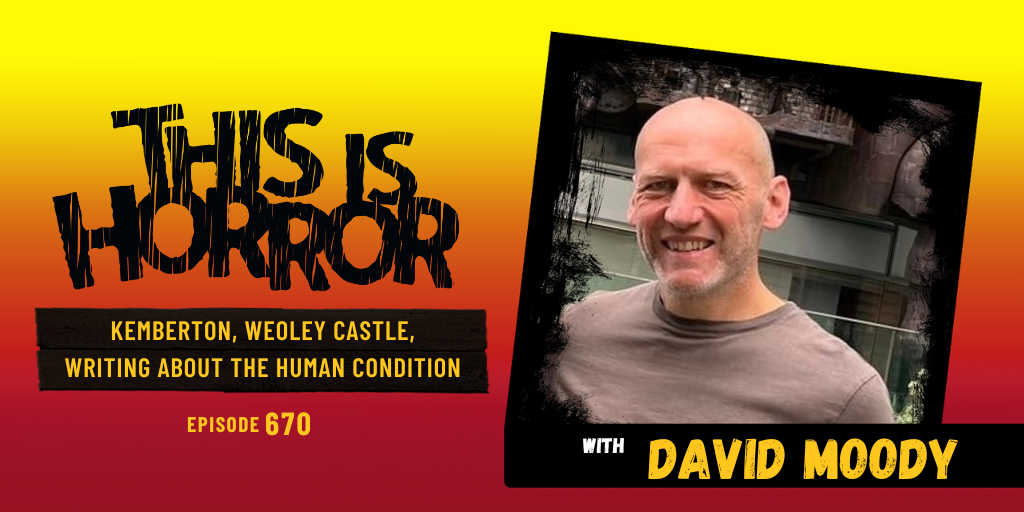
In this podcast, David Moody talks about Kemberton, Weoley Castle, writing about the human condition, and much more.
About David Moody
David Moody first self-published Hater in 2006, and without an agent, succeeded in selling the film rights for the novel to Mark Johnson (producer, Breaking Bad) and Guillermo Del Toro (director, The Shape of Water, Pan’s Labyrinth). His seminal zombie novel Autumn was made into an (admittedly terrible) movie starring Dexter Fletcher and David Carradine. Moody has an unhealthy fascination with the end of the world and writes books about ordinary folks going through absolute hell. His latest book is Kemberton.
Timestamps
Thanks for Listening!
Help out the show:
- Support This Is Horror on Patreon
- Listen to This Is Horror Podcast on Apple
- Listen to This Is Horror Podcast on Spotify
- Rate and review the This Is Horror Podcast on Apple Podcasts
- Share the episode on Facebook and X
- Subscribe to This Is Horror podcast RSS Feed
Let us know how you enjoyed this episode:
- Write a comment below.
- Follow us and get in touch on Instagram @thisishorrorpodcast
- Subscribe and comment on YouTube @thisishorrorpodcast
- Follow us and get in touch on TikTok @thisishorrorpodcast
- Tweet us @thisishorror.
Resources
- David Moody
- Watch the video version of This Is Horror Podcast episodes, including our conversation with Chuck Palahniuk on YouTube.
House of Bad Memories by Michael David Wilson
From the author of The Girl in the Video comes a darkly comic thriller with an edge-of-your-seat climax.
Denny just wants to be the world’s best dad to his baby daughter, but things get messy when he starts hallucinating his estranged abusive stepfather, Frank. Then Frank winds up dead and Denny is held hostage by his junkie half-sister who demands he uncovers the cause of her father’s death.
Will Denny defeat his demons or be perpetually tortured for refusing to answer impossible questions?
House of Bad Memories is Funny Games meets This Is England with a Rosemary’s Baby under-taste.
Buy House of Bad Memories from Cemetery Gates Media
Buy the House of Bad Memories audiobook
Cosmovorous by R.C. Hausen
The debut from R.C. Hausen, available now. Now also available as an audiobook.
Michael David Wilson 0:29
Welcome to This Is Horror, a podcast for readers, writers, and creators. I'm Michael David Wilson, and every episode, alongside my co-host, Bob Pastorella, I chat with the world's best writers about writing, life lessons, creativity, and much more. Today is the second part of our conversation with David Moody, in which we deep dive into his forthcoming novel, Kemberton, and for those of you unfamiliar, David is the author of the popular Autumn and Hater series. He is from Birmingham, England, and he is a good friend of the podcast, having first appeared on the show in episode two and having been the author who we had for the first chapbook, Joe and me, which was over 10 years ago now, so get ready for another delight of a conversation with David Moody, but before that, a quick advert break,
RC Hausen 1:41
Cosmovores, the debut cosmic horror novel by RC Housen, is now available as an audio experience featuring an original dark synth wave score. This story will take you to the next level of terror. Come hear the story that readers are calling Barker meets Lovecraft, a phantasm-style cosmic horror adventure and a full bore, unflinching, nihilistic nightmare, Cosmovores, the audio book by RC House. Come listen if you dare.
Bob Pastorella 2:14
House of Bad Memories, the debut novel from Michael David Wilson, is out now via Cemetery Gates Media. Denny just wants to be the world's best dad to his baby daughter, but things get messy when he starts hallucinating his estranged, abusive stepfather, Frank. Then Frank winds up dead, and Denny is held hostage by his junkie half-sister, who demands he uncovers the cause of her father's death. Will Denny defeat his demons or be perpetually tortured for refusing to answer impossible questions. Clay McLeod Chapman says, House of Bad Memories hit so hard you'll spit teeth out once you're done reading it. House of Bad Memories by Michael David Wilson, available now in paperback, ebook, and audio.
Michael David Wilson 2:57
Okay, with that said, here it is. It is David Moody on This Is Horror. So I want to talk in more depth about Kemberton. So I think to begin with, I quite like you to give the elevator pitch for Kemberton, but then almost paradoxically, when I started reading it, I didn't read the blurb, I didn't read the pitch, I didn't know what it was about at all, and actually I think that was to its great benefit, because it meant that let's say the other elements beyond the domestic trouble. I didn't know that they were going to show up, so with that, I'll let you decide how much to and how much not to say about the book.
David Moody 3:56
Well, I'm very conscious that our last conversation, about a year ago, was about left turns in home, yeah, and this, this one, I think, is one of my bigger left turns, so I could take, I could tell you very, I could tell you about the inspiration from it, which, for it, which might be useful, so my youngest daughter, Zoe, she, when she was, I think it was when she was two, maybe a little bit older. We had very, we've got very complicated family, got three stepdaughters, two daughters. There was a lot of family issues, as you'd expect from a, like, what do they call it now, a blended family like that back in the day. We weren't, we weren't too blended, or we'd been through the blender, one of the two, I'm not sure which. Anyway, there were there was one of the older girls decided she didn't want to see her dad anymore. Her older sister then was persuaded by her dad that she didn't want to see us anymore. So poor little Zoe was waiting in her bedroom for her big. Sister to come home from school because they got loads of stuff planned and she didn't come home and one of her friends, one of her sister's friends put a letter through the door, which we then read, and it said basically I'm not coming back again, I'm going to live with my dad, which was kind of it was like par for the course for the amount of grief that we were getting back in the day, but in little Zoe's world, little two year old Zoe's world, it was absolutely traumatizing, because she thought that she'd been sent off, that her big sister had been sent off to this place, and she was never coming back, she thought something terrible had happened, and basically, as a result, she developed something called Selective Mutism, which I know we've spoken about before. See, Zoe now tells me that it's more politically correct to call it situational mutism, because to call it selective implies that the person who's suffering with this anxiety condition has got a choice, but it's a phobia of speaking in public, and it's.. it doesn't sound so bad when you say it like that, but for the person who.. the usually the child, and more often than not, it's a girl, but the person who suffers with this, it absolutely is traumatizing, it absolutely affects every single aspect of their life. So, for our little girl, Zoe, she didn't speak for five or six years at school. She didn't speak outside the house for five or six years. This is a very long-winded elevator pitch. It's not the elevator pitch at all, really. It's the background. So, the background was just thinking about everything that Zoe went through. I thought we were quite fortunate in that she had a stable family, you know. She didn't go off to another parent every weekend, she was just with the with me and Lisa and other sisters. But I thought, well, what would have happened if she was the one who was getting passed from person, what if she was the one going to off to a step parent who didn't understand her, because it is a really strange condition, a strange condition, I guess that's the right word, disorder, I was going to say, but that sounds wrong, in that people don't understand it, they don't, because a child with selective mutism, situational mutism is quiet. They just, they often get overlooked. They often get thought of being no problem at all, because they're not making any noise. Or, alternatively, a parent, or, sorry, an adult will decide that they're going to be the ones that fix them, so they're going to make them talk, and then they put more pressure on them, and it's a very, it's a very complicated thing that took us many years to resolve, with the help of psychologists and the school, etc. etc. So, basically, the idea for the story came from that, just just imagining the worst case scenario for our little girl, if that had happened. So I came up with this little boy, Kemberton, who witnesses something horrific when he's four years old, and as a result of what he sees, he becomes situationally mute, selectively mute, whatever is the right, is the right terminology for it.
David Moody 8:15
His mom's life moves on, and she meets a kind of low-level entry-level gangster, I think we'll call him, his name's Aidan Carter, who thinks he's a much bigger deal than he is, and he gets mixed up with some top level gangsters, which is why I kind of describe this book as Gangs of London or The Sopranos meets Pet Cemetery, because as Aiden gets in more and more of a mess with his situation and the mob that he's got involved with, he takes it out more and more on Kemberton to the point where something breaks, and that's that's this is the point where I'll stop talking about what happens in the story, because it does take the most brutal of left turns at a certain point when things go too far between Aiden and Kemberton. It's, yeah, I'm really pleased with how it's turned out. It's, it's an interesting read, I have that, and I think everybody who's read it so far has been shocked in a good way, I hope, by by the turn that it takes and where it ends up, but actually think that the ending is quite, is very sad, you know. I think if you see beyond all the gore and the violence, I think it's pretty heartbreaking, and it's, yeah, I'm happy to have written my most disgusting and most emotional scenes. I'm happy for them to be the same scenes, if you know what I'm saying.
Michael David Wilson 9:55
You will let, let me read you my initial reaction. Which I obviously sent to Dan Howarth immediately, having finished reading Kemberton, and so I mean, if you're really spoiler averse, you might want to just skip like one minute, but I tried to keep it, you know, as free of spoilers as one can, so I wrote what an absolutely mad ending. Kemberton begins as a domestic novel in the vein of we need to talk about Kevin, then becomes this bloodbath of chaos and brutality, and then becomes rather poignant and sad, echoing the lights of Frankenstein under substance,
David Moody 10:45
God, you know, I'll take that. Thank you. Honestly, you two have both mentioned in tweets and Blue Sky posts today, and it's absolutely made my day. The reaction that you've had, I've just been really, really heartened by the way people have enjoyed this little story until they don't enjoy it anymore, and then they're just kind of by that point they're strapped in, and they just see it through to the conclusion. I think it's, yeah, it's surpassing my expectations so far, and I'm really pleased. So, thank you both,
Bob Pastorella 11:21
and gonna say that, that if you, if you're listening to this, I'm gonna tell you my experience reading this book. I was bullied a really, really bad when I was a kid, and so there were some scenes at the very beginning of the book, especially dealing with, you know, a stepfather, I don't have a stepfather, but my father, some of the things I went through, he was.. it took a while for him to realize that there was, you know, some some other issues going on, and those scenes hurt me, it made me not want to read the book, and so, but I'm like, well, I'm gonna, I need to read this book. I can't stop reading it, because as much as I'd feel like that, I might get emotionally damaged from it. I'm kind of hooked, and so I was like, that you know, you set the hook, and I couldn't stop reading it in every single turn, every single twist is earned, is organic. It comes from the characters, it doesn't come from any other source but the characters and their their way of living and their desires and their goals and things like that, and you know, Kimberton's just caught in the middle of this, and in literally something like what you said, it breaks, and the left turn is so earned, it is so organic that it's like, and I think I said this on the blue skies, like, there are scenes in there I will never forget. I will never forget. And when you write something like that, you know, there's, there's some, there's some books I've read this year that, while they were good, I can't remember them, and Kimberton, yeah, I'm never gonna forget some of the stuff that's in this book ever,
David Moody 13:24
that's very cool. Thank you.
Bob Pastorella 13:26
And the word brutal is like that's that's the one word blurb, it's brutal,
David Moody 13:34
but it's really heartening to hear you talk about it like that, because the one thing I wanted to, wanted it to be, I knew that it was going to be a very pretty extreme horror novel by the time you get to the end, but I wanted it to feel like it wasn't an abrupt, okay, there's a scene that changes everything, but I didn't want it to be that, oh, now we're going down that road, I wanted it to be, oh shit, we're not going down the road I thought we were going down, I mean?
Bob Pastorella 14:01
Yes,
David Moody 14:02
it's great to hear you saying that. I think I actually tempered it down from the original version of the book, because there's, I think, another, another inspiration for it was there are so many horror stories here in England about families that have slipped under the radar, that have, you know, that social services haven't responded to the triggers, or they've just never been reported, or they've just been lost in paperwork, or whatever, and they only find out about the abuse and the grief that a child has gone through when it's too late, sadly, so I almost went down that road, but I just wanted to make it a little bit more, little bit lighter by involving gangsters and things. I don't think it is lighter at all, but you know, I'm getting that. It's a little..
Bob Pastorella 14:54
I didn't want it to be.. I'm sorry to hear about the stuff that you went through, Bob. I didn't want it to be trauma. Housing for anybody who'd been in a similar situation. Yeah, you know, I mean, and I didn't1, did, did, did not go through anything like Kimberton did at all, but I was bullied, and some of the things that that I needed to do early on, it took me a long time to realize that, you know, I had to finally, you know, Dad had to kind of like set me down and go, "Look, the reason I'm telling you, you need to fight back is because they're not going to stop until you fight back. If you think they're going to stop and you're going to be able to be funny and make them like you, they're not. And so he goes, and I don't know what it's going to take. It's probably going to take you getting hurt before you get mad, and you can fight back. He goes, but I promise you, if you fight back, he goes, they'll leave you alone. I promise you. He goes, I know you don't believe me, and I went through years of that, Newton, and finally something snapped, and I fought back, and things changed, and he was right, but it's like you got to have that tough love, and reading those scenes, those, those kind of bullying scenes with those kids, it was, it was kind of, you know, I guess the word triggering, you know, I was like, man, I don't know if I can, I don't know if I can handle this, and you know, and we, we had this concept to work, we're tough. I'm a horror writer, man. I'm a horror writer. I'm a horror reader. I'm gonna read through this. There's some shit that gets to us, you know.
David Moody 16:32
Yeah, and
Bob Pastorella 16:33
I powered through, boy, I'm glad I did, because that book, that book kicked me in the ding ding, man. It was good.
David Moody 16:42
I could have that as a blurb. It kicked me in the ding ding.
Bob Pastorella 16:44
Yeah, you can. I like my one word, my one word blur better, brutal. But yeah,
David Moody 16:53
yeah, I think that a lot of it as well came from my daughter's experience. Unfortunately, she wasn't bullied like the character is in the book, but it's just it's the cruelest of conditions: elective mutism, selective mutism, situational mutism. Sorry, there's so many different terms, because the more pressure there that the kids are under to come out of this to break free, you know, the equivalent of what your dad said to you, about you know, fighting back, but the more pressure there is on somebody who's situationally mute, the more they'll with will withdraw into themselves, and the darker the pit will get, and the more they'll be pushed down. I think, yeah. Fortunately, with Zoe, you know, she had great support. Lisa was absolutely brilliant. She was going into school every week, and sorry, every day, and they had this thing called sliding in, which was where they'd gradually engineer a situation, so that she'd talk to Lisa, and then she'd talk to a friend, and then by the end of the year, they got a teacher in there as well, and it was just this gradual, ongoing thing, but I can imagine that if she hadn't had the help in the way that Kemberton doesn't get the help in the book, that there would have come a point where something would snap, and I think I just imagine that with a child who's unable to express themselves like that, there must be so much of that hurt, so much of that anger built up inside of them that when it does go, you know, it really goes.
Michael David Wilson 18:22
Yeah, I mean, we're talking about the realism of the bullying, and I wanted to talk about something that is similar but slightly different, and that's that there's a lot of domestic violence and bad parental figures in Kemberton, but the depiction of childhood terror is so accurate, especially, you know, things that could even be seen as quite innocuous from people who haven't experienced this kind of thing, like hearing the car pull up on the driveway and that anticipation for violence, then the hiding away in your room, waiting for that bad parental figure to show up and to potentially hurt you, and I just felt reading it, there were moments that they just felt too specific and too depressingly true to reality for you not to have drawn on real life experience in some way, so if you're willing, I'd love to know where does this aspect come from.
David Moody 19:35
That's a really interesting question, because I can honestly say my parents were absolutely sound, and I never experienced any of the things that Kemberton does in the book. Also, I'm fortunate to be big, so I didn't really get bullied very much at school, I. I had my fair share of grief, but it was, it was never, it wasn't constant, because people just assumed I could fight back, and they didn't know that I was a wimp at the end of the day, when I was little, and I would never punch anybody, so you know, I think I was fortunate in my childhood in that I didn't go through anything like that. I think sadly that the experiences that I drew on for the book were from my own kids, not necessarily what they experienced in our family unit, but just hearing the stuff that they, the older girls, had to deal with with their own dad, who I guess I have to be careful. The chances of him listening to This Is Horror Podcast are exceptionally slim, but just in case I try and be a bit, bit, bit vague. But yeah, he, he would put a lot of emotional pressure on them to make certain decisions or act in certain ways. If one of them accidentally called him Dave, they'd go, he'd go absolutely crazy at them and freeze them out and not talk to them for weeks, and so on and so on. And it's so really it was looking at looking at the stuff that my family has experienced, but also going back to some of the stuff that I've, I've heard on the news, and some of the stuff that I've spoken to other people about. I've got a very good friend who's, who's, who was a social worker for a long, long time, and he's told me, without going into specifics, about the kind of things that he's had to deal with, and it was really trying to take those experiences and not trivialize them, but take them to an extreme, a different kind of extreme. The one thing I was very, very aware of when I was writing this book, and I hope I didn't step over the line, was I really didn't want to trivialize any of the issues that Kemberton goes through. I didn't want to trivialize the bullying or the the mistreatment that he gets or try and exploit that at all, it was it was there for a reason in the book, because it explains it's it's driven because of how his character develops and the things that he saw when he was little, when it, when he, when he, when he, the things that he witnesses right at the beginning of the book, and yeah, I hope that I haven't gone too far with some of that. Hearing your reactions tonight, I think maybe I have
Michael David Wilson 22:31
no.. I mean, for it's weird being horror fans and fans of dark fiction, because you know what you delivered was so realistic, it was, you know, almost traumatic, and I'm trying to be careful in terms of what I even say on the podcast, because I don't particularly want to publicly bring up, you know, things from my past, but
David Moody 22:58
yeah,
Michael David Wilson 22:59
if people have read my book, House of Bad Memories. They could get a sense as to the kind of things that I'm talking about, but it, yeah, it was so realistic, it was so traumatic. But as a horror fan, I then mean that as a compliment. It's so weird, it's like, wow, you kind of traumatized me. Good job. Cool. Good writing
David Moody 23:22
again. I'll take that. Thank you.
Michael David Wilson 23:24
Yeah, maybe that's not the blurb to use. You traumatized me. Good job. I'll have
David Moody 23:32
all of these.
Bob Pastorella 23:33
I've been traumatized for life. Yeah, you know, and I definitely don't want to get into any type of spoiler territory or anything like that. I'm trying to figure out a way to say this, but I feel like that after we hit the left turn, to me, to me, to me, and maybe it's just my skewed perspective on the world, but I feel that when something gets basically gets broken, and there's a doctor involved, and there's a fix that there's a not necessarily a supernatural element, but a science fictiony element.
David Moody 24:16
Yeah,
Bob Pastorella 24:17
very ambiguous, very well done. If I'm the only one who catches that, then that's great, because that's I can hold on to it, that's mine. But I gotta ask, was that was that something that was kind of intentional?
David Moody 24:36
Yeah, it's an interesting question. Again, I probably will go into spoiler territory a little bit here, but in the original drafts of the book of the original plans for the book, when I was dealing with a family, because you know Aidan's a low-level gangster, but he's doing okay, he's got plenty of cash, they've just moved into a big house, everything seems on the outside, everything looks great. But the original plans I had, they were going to be living in a very squalid little council flat, it was just too, too, too grim, but in the original version that I had in my head before I actually wrote anything, when the thing that happens to Kemberton happens, rather than take him to the doctor, as you've mentioned in the original one, they went to members of Nana Jones' family who were into voodoo and black magic, and that was what was used to put him on the right path again, but this to me, I've always. I've never been. I'm not. I always talk about I'm an atheist through and through. I don't believe in ghosts, goblins, demons, gods, any of that. So I find it hard to put any supernatural elements in the book, but at the same time, there are things that we don't know about science, obviously things that we're yet to discover, and so it doesn't seem beyond the realms of possibility to me that the treatment that is given to Kemberton does have what appears to be an almost supernatural effect on him. I got a lot of feedback, actually, from that, from the beta readers, and Dan Howarth was a was a great beta reader, he came back with a lot of stuff about, I think, what had, what, what was it that caused the thing that happens to him to happen, and also he was, he gave me a lot of really good feedback about, I mentioned it earlier, I think, about the mom's motives and how she behaves in the book, and just going on the back of the of the feedback that I got, I did tweak it a little bit to kind of put Kemberton back in control, because rather than it all being down to what the doctor does or doesn't do to him or for him, again, like skirting on spoiler territory here, he gets such a buzz and it affects his life, it changes his life so much when he's had that treatment that he just thinks, come on, I want war, and that's what pushes things over the edge,
Bob Pastorella 27:10
it's, it's in, I have read accounts, and I've seen video footage, obviously we all have of people who are basically on on some type of chemical, who be come monstrous right before your eyes. They don't really change their physical demeanor, but like having police officers having a very, very difficult time with the individual that they've tased, you know, there should be immobile, and they're like, you know, this guy is is causing a lot of problems, and so I know that there's chemicals that can, that can do that, and they're probably, if you're cognizant, you know, if you're cognitive of what they can do, the need to take those again very quickly, because they make you feel good, is addictions a bitch, man, and it can happen so fast, and I think that that's that's was I found that be a very interesting faucet of the story. I was like, wow, this is it's, it's, it's, it works on so many different levels, but the way it is, is in is handled really, really well. So, when you, I love, I love ambiguity, people, there's people out there who's gonna hate it, and, oh, well, you need to get over yourself, but it's I love that kind of shit. I love it.
David Moody 28:46
And again, just going back to Zoe, my daughter, I mean, it says a long time ago now, she's 20, she was born in 2000 so she's she's coming up to 26 So this was happening a long, long time ago, but as I mentioned, she had, I think, five or six silent years, and the amount of stuff that was built up inside her. I just remember once she'd started to talk, picking her up from school, as I was writing full time by then. So I was doing the end of day school run, and I remember just standing in the playground and thinking, Whose kid is that, making all that bloody noise? Because there was just this one child, and her voice was booming across the playground, and all the kids were laughing, and it was Zoe. She'd gone from like all these years of absolute silence to thinking, I've got a voice, I'm going to use it, and so I tried to use that as well, the excitement that, oh, I finally broke out this spell. I'm really going to make the most of this now. So, I think it's, yeah, it's that combined with the addiction that you say, Bob, because he did. I think that's what gives him that in it, in his young mind. He thinks, well, that's what's got me, so. Far, so if I just take more of it, I'm just going to feel even better.
Bob Pastorella 30:05
Oh yeah,
Michael David Wilson 30:06
I think this move from initially having the change of care because of voodoo to it then happening via a doctor was such a good choice for the book on multiple levels, I mean, firstly, I could see how using Voodoo in 2026 in the context could generate some shit and be problematic in some ways, so I think avoiding that happening was a good move. I think. Also, it may have rather than developed almost lessened the character of the grandmother and made her almost a parody. So those are the bad points to voodoo, but then the great points to the doctor, and I mean he's an off the books doctor used by high up criminals and so this is a man who his morality is questionable but then we see you know how multifaceted and how layered the doctor is because even his morality has a line, and then that reflects on some of the other characters again, skirting around the issues here, but I thought that was very effective, particularly for Kemberton's mother, and now how she reacts and how she sees kind of who she is and her own complicity in seeing someone else's reaction to Kemberton so it it was such a good move and
David Moody 31:55
that's cool it's great that you picked up on that actually because that's that was a conscious thing again, based on the feedback I got from Dan and others, that there had to come a point where she thought that's enough, no more, and obviously that's it's way too late, but that is the point, and yeah, the doctor is kind of ambiguous because ultimately he is a doctor, so at some point he did sign on to the Hippocratic Oath, but at the same time he's been paid by a high up mob boss, and all he wants to do is get this kid off his books as quickly as possible. So yeah, none of these people you'd want to be friends with, really. Would you?
Bob Pastorella 32:38
I think that there's possibly an argument to be made is like I was reading something, it's interesting how you say that, this is, I guess, your comp, one of your comps was Pet Cemetery, but I was reading something, and there's there's a whole conspiracy theory that Judd in Pet Cemetery killed church to start the ball rolling, and so to me, I feel like there's possibly an argument to be made. The doctor kind of knew what was going to happen,
David Moody 33:09
yeah, and said, you know what, these
RC Hausen 33:12
weren't these
Bob Pastorella 33:12
sorry fuckers deserve every ounce of pain coming to them if they fucked us up,
David Moody 33:20
and you know, again, veering very delicately around spoiler territory here, he, it's, it's possible that he sent the kid off with enough medication to get him to the right point, but then what happened afterwards, you know, with, with Kemberton taking more than he should have done, it was out of his control, so he did do that with the best of intentions to get these kids back, to get this kid back on track, and yeah, what happened after that was, yeah, not part of the plan.
Bob Pastorella 33:51
Yeah,
Michael David Wilson 33:52
I think the way that the doctor is painted from, for me, I felt that everything he did for Kemberton was with the best of intentions, you know. Of course, he didn't want to see him again. He didn't want to see them again, but he clearly saw he's actually one of the few people who saw Kemberton as a victim and someone who desperately needed help. So,
David Moody 34:18
yeah, yeah,
Michael David Wilson 34:19
I don't think he envisioned what happened happening.
David Moody 34:26
No, I think I'm sure you're right. Yeah, as you said, I think he did what he did with the best of intentions, unaware of how things could develop, but it's kind of.. I have.. I have a recurring nightmare about being involved with the Mafia, weirdly enough, and maybe it's because we, we binged The Sopranos again last year, and I don't know, but it must just be the most awful life, don't you think? Just all right, there's financial reward. Forward, and if you're at the top of the heap, then that's great, but if you're not at the top of the heap, you're constantly looking over your shoulder, you say the wrong thing to the wrong person, that pressure just must be incredible. So, I think again, for the doctor who's on the right side of the mob boss, because he's doing a job for him, but at the same time he's thinking, I don't want to get involved in any of this, let's get this kid gone,
Bob Pastorella 35:23
and this.. I don't know, it's.. I think that casino, not casino, Goodfellas kind of gives you a really, really good picture. If you're not.. if you weren't made, quote unquote, then you constantly had to work. You were always working, you were always looking over your shoulder. You had to have every single thing had to be perfect to the tee, no mistakes. And you had guys like Tommy, who didn't, who could just do whatever he wanted to do, because he was made, and those were the ones that would get, you know, taken out because their fuck-ups were monumental, you know, and so they, they had to, they would be the ones taken out. I think that's, you know, I don't know if I could ever handle being a mop in the mob, wouldn't want to.
David Moody 36:16
No, I'm exactly the same, that's why I think I imagine the aid in character thinking, yeah, I want all the glory, but then realizing very soon on that, you know, the risks outweigh that, and it's that pressure that he's not at all equipped to deal with, which is why Kemberton bears the brunt of it.
Bob Pastorella 36:39
Now, Wilson is all about the mob. I can tell from the look in his face, he's like mob ready.
David Moody 36:46
Yes, it's not the mob where you are, though, is it? Have you got your little fingers still?
Michael David Wilson 36:51
Well, never shown on camera, so no, no one creating them mystique there, although if I am in the Yakuza, then I've done very well to get in, because they typically don't take a lot of people who aren't 100% Japanese, and given that I'm 0% Japanese,
David Moody 37:15
very true. Yeah,
Michael David Wilson 37:18
I mean, something I wanted to talk about was, I mean, even though you were initially known for writing about zombies, your work has always been more concerned with the human conditions than you know monsters, and so I wonder, even though zombies or monsters are there. The heart of the story is always about humanity and relationships, and with Shadow Locked, and then with the first 50 to 70% of Kemberton, this seems to be even more apparent than ever, that this is about humans, this is about relationship dynamics. So, has it been liberating to drop that zombie window dressing for want of better phrasing, and
David Moody 38:08
yeah, is
Michael David Wilson 38:09
this part of you just writing about what you want to write about and giving less of a shit about marketing and all of that?
David Moody 38:19
Definitely. Oh, I still always sound weird when I say this, but I do love zombies. I can't.. I will never stop loving zombies, if you know what I mean. But, and they were always.. I always wrote about zombies and zombie-esque things, because that was that was always a foil, because there's no better way to talk about the human condition, I think, than by making half of the humans something else. Scott Sigler gave me a great, a great quote once you could remember it, but it was about Moody, says so much about people by making people something else, and that was always that always stuck in my mind, that just adding a different dimension to people, but I think what's happened in the years. I think when I, when I started writing, I was very, I was young, I was naive, and I've been through the mill a little bit now, and it's easier to see the monsters around, like it sounds very pretentious. Don't have to look as hard as I used to for them, and I think that's why I typically write about these flawed people, and I like a good, unreliable narrator who, yeah, I'm as in shadow light, oh, I'm I'm I'm great, I'm going to sort this out, and by the end of the book, you realize actually you're the problem, pal. You know it's, yeah, there's.. there is a large element of just writing what the hell I want now, and it's similar with dirty day as well. It's a guy who's absolutely.. he's a failure on every level. He's a young. Father, unexpected baby out of work, lost the house, and they're in the mess because he's an idiot, basically. And he, the book is about him trying to resolve that and trying to show how actually he's quite smart when really he isn't. So I do. There are a lot of flawed people about, and I do like picking holes in them,
Michael David Wilson 40:21
I should say, too. As we mentioned, Dan Howarth, when I started reading,
David Moody 40:26
talking about flawed individuals,
Michael David Wilson 40:28
as we're talking about individuals, Dan Howarth, most flawed individual I know, but he, when I started reading Kemberton, it did remind me a little bit, or I felt there was a parallel between Kemberton and Dan Howarth's Lionhearts, you know, in that it's set in this almost broken Britain, this poverty kind of crime-riddled Britain, and I do
David Moody 41:00
love like Lionel, yeah, and I can see what you're saying there. I'm really pleased. I owe Dan an email, haven't spoken to him for a bit, but I know it's been, it's been, he's on the list for the British Fantasy Society,
Michael David Wilson 41:16
yeah, yeah, BFS Award, yeah,
David Moody 41:20
and I listened, obviously, to the interview that he did with you very recently. That Lionhearts is a phenomenal book, and I think, yeah, they absolutely do exist in the same world. And I don't think that Britain is as broken as people would have you believe, but there's a lot of discontent under the surface, there's a definite swathe of society that do feel hard done by and do feel forgotten, and who are prone to violence and to kickin out. So, yeah, that's an interesting thought. I'll put it to Dan next time. Do I speak to him? Does Kemberton and Lionheart exist in the same universe? We could create a shared grim cinematic universe, couldn't we?
Michael David Wilson 42:09
Yeah, yeah. So you've got Kemberton in Wheelie Castle, and then you've got Lionhearts a little bit further up north, and I mean I love that it was set in Wheelie Castle, because it's such a specific Birmingham area, so I wondered, and this is a bizarre question to be asking, but what inspired the Wheelie Castle setting, and what is your relationship with Wheelie Castle?
David Moody 42:37
I grew up there, unsurprisingly, and yeah, so Kemberton is Kemberton Road is on one side of Wheelie Castle Square, and we lived kind of the same distance on the other side of Wheelie Castle Square, and my parents were quite snobbish. Oh, we don't live in Wheeler Castle. We live in Northfield, which is no better, but you know, I love Wheeler Castle. I'm expecting if anybody from Wheeled Castle reads the book and takes objection, then then that'll be a real shame, because it's such a funny little area. It literally is the square, the shopping center, the square that's an oval, and it, and it is, it's not an impoverished area, but it's not a very well-off area, and it's, it's been in the news recently, because I don't know if you've heard of the raise the flags nonsense that's gone on over here with people sticking union jacks on lampposts all around the country, but that, that started in Wheelie Castle, and it's just, it's just a funny little place, it's a little bubble, but it's, it's where I grew up, and yeah, I've got very specific memories of it, and I'm still not too far from there, I just thought it would be interesting to shove Kemberton in there, particularly as I knew that he was his life with his mum and Aiden would be a real contrast. Now we're talking, he's probably in Sutton Cold, I don't think I actually say where he may live, but it's going to be like Sutton Coalfield, Four Oaks, the other side of the city, and it was the contrast, really, which, which kind of drew me back to Wheelie Castle, but it's always nice to weave in somewhere that you've, that you know, I mean, Kiddie Minster, you know, you, you, you went, went, literally went down on Kiddminster, didn't you, in, in Daddy's Boy, so I just thought it would be cool,
Michael David Wilson 44:40
yeah, no, I did feel that you were doing for Wheatley Castle what I did for Kiddimins. I'm not sure what we did, but whatever we did, we both did it.
David Moody 44:52
Yeah,
Michael David Wilson 44:53
yeah,
David Moody 44:54
yeah. I'm not sure. I'll be.. if the book takes off, I'm not sure if I'll be doing like guided tours and things. And this is the shop where Kemberton lived. No, thank you.
Michael David Wilson 45:04
So, then the name Kemberton came from a road in Wheelie Castle.
David Moody 45:10
Yeah, yeah, yeah, that's it. And yeah, and the logic was, I think, as it explains in the first chapter, his dad, Eddie, was one of several Eddie's in the class at school, so he always wanted his child to have a fairly distinctive name, and he thought Kemberton sounded quite fancy, and he knew there wouldn't be another Kemberton in the class, so yeah, Kemberton Road,
Michael David Wilson 45:34
yeah,
David Moody 45:35
it's a very nondescript Birmingham Council house lined road, Michael. You know exactly what I'm talking about. I
Michael David Wilson 45:43
do. Yeah, sort
David Moody 45:45
of post, post World War Two. They're okay, quite, quite nice, but there are lots of little bubbles like this around, and within those bubbles you can get a bit of discontent and trouble.
Michael David Wilson 45:59
Oh yeah, and Kemberton, the name, it, it feels aristocratic, almost as something quite important, and you know you're not gonna forget it, much like the name Nosferatu, or Nostradamus, yeah, the Nostradamus, yeah, different figure,
David Moody 46:24
yeah,
Michael David Wilson 46:25
you know, if you did just called him Dan, you might not have had the same same impact, but
David Moody 46:32
yeah, the book wouldn't have been such a good title for the book, would it, Dan or Phil
Michael David Wilson 46:37
wasn't it? Romero did a film called Martin, so that worked out. Yeah,
Bob Pastorella 46:45
that area kind of reminds me where I grew up, and which it's a lot nicer now, but I remember growing up, and we had, like, it was there, was a lot of things, especially like the couple greats older than me, they were into, you know, robbing stores and robbing cars, and so there was a lot of crime. They call themselves the Groves Outlaws with an e, kind of gives you an idea of the education level. Outlaws does not have an e in it, so spray painted that on the on the Grove sign, Groves Outlaws, and it's just like, y'all guys are stupid. It went away.
David Moody 47:29
It sounds very familiar, because in the book it describes the shops where Kemerton lives as being like a little bit newer than the rest of the buildings around the square, and then they're made out of concrete blocks, and there are spaces underneath that were designed originally for people to stop and talk to their friends, but it turns out they've become these pretty damn horrible spaces where you're not going to stay, and when I was growing up, that's where there was a gang called the Wheelie Skins, who just a bunch of skinheads who just went around beating people up, and that's where they used to hide out in the under these under the terraces of these buildings, and it's a shame. I think it happens quite a lot with some, some areas, particularly inner city areas. I think that they're they're often designed with the best of intentions, but going back historically there maybe the the the experience wasn't there. There's an area very close to where I live here called Frankly, and again I mentioned that earlier, my friend, who's who used to be a social worker, he used to work in Frankly, and so they built this little development, very nice houses, right on the edge of Birmingham City, but apparently when it was finished, they realized that the roads were too narrow for the refuse, the garbage lorries to get down, so piles of rubbish built up, and they became very isolated, because it's right on the edge of the city, and it's not that easy to get around. You can only go into the city, you can't really go to any other suburbs. So it became quite isolated, and it doesn't take a lot for a place that was built with the absolute best of intentions to become almost a ghetto. It's not, it's much better now, but you can see how the urban planning mistakes that people were made back in the post-war period kind of resulted in these little areas springing up.
Bob Pastorella 49:34
Yeah, that's, you know, the bigger the city, the worse it was, too. Yeah, they had, you know, gentrification happening in New York City, you know, late 70s, early 80s, and I don't know if you've ever seen the film Wolff in which was based upon Whitley Streamer's novel, but yeah, in the film, some of those scenes they didn't have to do anything, those were buildings that were being demolished in the middle of New York. And they just had a unique, you know, shooting opportunity to give a very kind of apocalyptic landscape to, you know, like basically urban decay, that's a very wolf, and it's a very.. it's.. it's.. if you've never read it, I'm not trying to spoil anything, but it's.. it's about, you know, super intelligent wolves, and, but it deals a lot with society. It's very, very, very deep, and it's one of my favorite, favorites. It's just, but I love the fact that they just didn't have to really do anything. It's like these, these streets are messed up. We can use this.
David Moody 50:38
Yeah. No, I love it when, when a neighborhood can be used like that in a film. Another great one is what a film that I always talk about, Threads, the BBC nuclear drama in Sheffield. Apparently, they were the estate where they filmed the Kemp family, I think it is. Have I got it wrong? Way around, I can't remember. One of the families in threads they live in, very typical for the UK Victorian terrace houses, but they were scheduled for demolition, so they shot the film and then blew them up and had the people then acting in the ruins of them, and it just adds a sense of realism to it, doesn't it? When you've got a very tangible, realistic backdrop like that,
Bob Pastorella 51:21
yeah, that's like in the road, a lot of the exterior scenes they shot where they were shot a couple years before from Katrina in Louisiana during hurricane, so they got some really, really excellent, you know, end of the world looking stuff, because this stuff was like there was no one there, and the guy who made the film, he knew he was going to use it for something, he just didn't know what, when he shot those pictures, and said, Well, I figured out what I'm going to use it for, yeah, yeah, and so pretty cool.
Michael David Wilson 51:56
Well, I wanted to return to talking about the ending again to as much of a point as we can without spoiling it, so another kind of dancing around spoilers, but as you said before, and I'm so glad that you felt this way too. I think in many ways this is one of your saddest endings, because there are things that we want for Kemberton. There are things that I think he deserves, and I wanted him to get, but I would say, you know, he gets about 50% of the things that you'd want for him, and then he doesn't get the other 50% and I mean, from a story perspective, the ending is absolutely perfect, but my goodness, did it leave me feeling a little bit sad and numb, and so I wonder, how hard was it for you to nail that ending, and did you go back and forth in terms of how much you were and weren't going to give Kemberton?
David Moody 53:06
I think I always knew it was going to end that way. I always knew that the two characters that are left at the end would be those two characters, and it would bring their story like full circle. I think I surprised myself with how extreme it gets in the scenes leading up to that again, skirting around the scenes in question here, but there I think there's one in particular, and the tragedy of it, I think, is that what Kemberton does, he does for the absolute right reasons. He sees his mom in pain, and he wants to help her, and he remembers what happened right at the very beginning of the book, where his mom sadly loses a baby, and he's in quite a parallel kind of situation towards the end of the book. He knows that she's, he can, he can see that she's struggling, and so he wants to help her, and he, he helps her in a childlike kind of way, I think, and that to me was the toughest part to write. Yeah, and there are a few few things there, I think. What one thing I tried to do in the book I really wanted, I really enjoy writing in the kind of tense that I do it. It's like it's it's third person, but it's kind of immediate. So, Kemberton does this, he sees that, and I need to do it with this book, because I think that allows you to get into the heads of each of the characters that you're focusing on. So, I don't know if you notice, but when, when you get to the bits that it's when we're following Kemberton. Turn, it becomes a bit more childlike and a bit more chatty, a bit more conversational, and it's Aiden and the gangsters, it becomes more aggressive and there's more swearing, and so on and so on, and I just thought, as we were getting to the end, that he's, he's got such, such limited experience, he's so naive, he's so young, but he knows what he thinks he needs to do, and it's when he does it, and I'm desperately trying to avoid telling listeners the one thing, the what, the one line in that, that that really, that really broke me. I can't, I'm not going to talk about it, but there's just one thing he does to show his mom, and the effect of that is absolutely tragic, and I think it's that, that's that's what I'm proud of with this book, that everything that he goes through, no matter how extreme things get, it's still him at the end of the day, still trying to do the right thing, still trying to find that voice that he'd lost. So, there, I think I skirted around that. Okay, there,
Michael David Wilson 56:09
I think so too. And just,
Bob Pastorella 56:12
yeah, the
Michael David Wilson 56:12
absolute tragedy of it all is, you know, just as we think he's free of his situation, and what was holding him back after he seen the doctor.
David Moody 56:26
Yeah,
Michael David Wilson 56:26
actually, as we progress, particularly on the playground, let's say we realize that he's even more trapped than ever, and that, that you know, that that was, you know, part of what made it so sad. It's like this person is just looking for acceptance, and he thinks that he's got the solution, but and also just the way that you made it clear that, again, How am I going to even say this without spoiling it, but I don't know if I can. Actually, I don't know how, but but Kemberton is aware of what he wants to communicate, but
David Moody 57:12
yeah,
Michael David Wilson 57:13
it's being received differently. Let's put it like that. That is the best way I can say it without completely spoiling it, and then you couple that with, you know, the other sad part, as you alluded to before, is just his absolute naivety and his lack of experience and his innocence. He believes that everything that he is doing is the right thing to do, if you think about all the things that he does, it sounds insane to say it, but he actually has a heart of gold. He has a heart of gold, in spite of the absolute abhorrent actions that are ultimately taken,
Bob Pastorella 57:59
and like trying to avoid spoil territory, but I mean it's like the people that that take advantage of that are not good people, and I know it's like there's someone who takes advantage of of that, they they they've seen what what's cape, what you know what can happen, and they take advantage of it, and it's like,
David Moody 58:22
yeah,
Bob Pastorella 58:23
that dichotomy is, I'm telling you, if y'all are listening to this, I'm talking to the audience out here, and if you're not picked, and you don't want to read this book, then I don't know what the hell you think you're doing, I mean, y'all need to get on it and get this damn book, this thing is awesome,
David Moody 58:40
that's really cool for you to say. Thank you. It's meant this sounds really corny, but it's meant the world talking to you two about it tonight, because obviously I trust your opinions, and then to have you come back with the kind of feedback that you give me today is brilliant. It's filled, it's filled with a lot of confidence for the book, and yeah, I'm very proud of it. It's great to hear that what I was trying to do, particularly at the end, which is controversial, it is extreme, but it sounds like it's landed, so that's that's great. Thank you. But yeah, please, please buy it.
Michael David Wilson 59:15
I said on social media, but this is my favorite book of the year thus far easily by a considerable margin.
David Moody 59:25
Thank you.
Michael David Wilson 59:26
Right, you know, I'm always reluctant to put those things out on social media, because it's quite a strong statement. And then other people who is like, hang on a minute, you read my book this year, but it's like, well, yeah, I did. I haven't revealed, you know, what else is in the top five. So, if you're feeling bad and you think, oh, you read my book, it could be number two. That's, that's really good ranking, so don't worry about it. But, yeah, easily number one, and. Um, it's
David Moody 1:00:00
cool. Thank you.
Michael David Wilson 1:00:01
Goodness, what? What was I gonna say about it? I mean, the, the thing that Kemberton does to try and take his mother out of pain, right towards the end, that is probably the most extreme thing you've done in any of your books,
David Moody 1:00:22
yeah. What's the
Michael David Wilson 1:00:23
reluctance to do that?
David Moody 1:00:30
I think there was an inevitability to it. So I think to have not done that would have really felt like a cop out, I think, from the very first scene where she, she lose his mom, loses a baby, I think it was kind of building up to that, because it is a lot about his relationship with his mom and how he'd fit in with other siblings, yeah, but no, ultimately his mom, despite the fact that she's with a very questionable bloke, and you know, indirectly ends up with a son being in a lot of pain, I think she, she, she genuinely loves her son and would do anything for him, and he's just this is his opportunity to repay that, so I think it, as I said, I think it felt kind of inevitable, but yeah, I did. I did kind of write it with type with one hand and have the other hand like that, because it's pretty grim.
Michael David Wilson 1:01:33
Yeah, I think you got the balance right with the mother character, and you know, knowing people who have been in that situation, it's a really tricky one, because, of course, if your partner is abusive to let you know one of your children, and you see that if you don't do anything, you are in a sense complicit,
David Moody 1:02:03
absolutely, yeah,
Michael David Wilson 1:02:04
but you know you can see the the conundrum and the kind of division of love and the dilemma and what on earth to do, because I do think you know in in this situation she both loves her son and loves her despicable partner.
David Moody 1:02:25
Yeah, and she certainly loves the life that she's, she's got coming from Wheelie Castle to where she is now, with the fancy house with the big garden and everything.
Michael David Wilson 1:02:37
Yeah, that's it too. So, there's the, there's a parallel between, you know, Kemberton is trapped, but she's trapped in a way as well.
David Moody 1:02:46
Yeah, yeah, she's, she's definitely boxed herself into a corner in the relationship, I guess, in the same way that Aiden has as well, signing up with the mom, yeah, because he, you know, he can't, he can't get off the merry-go-round, and neither can she know
Bob Pastorella 1:03:02
everybody's trapped,
David Moody 1:03:04
yeah, it's horrible in it,
Michael David Wilson 1:03:06
yeah. What a lovely note as we come towards the end of the of the podcast, and I mean, I, I want to know, like, so you said that at the moment you are just prioritizing your enjoyment when it comes to your writing. You said this has been quite a pivotal year, just in terms of that revelation for you. So, what is the writing to day job balance looking like at the moment, what is the writing to writing tangent or things such as marketing, such as promotion looking like? What, what has this realization done in terms of your routine and your life?
David Moody 1:03:57
I am spending a lot more time writing now, which is good, because it's so easy to get preoccupied with all the other things that you're doing, particularly when you've got a new release out and you're doing it all yourself, just trying to coordinate it all and get it all put together. I learned that, yeah, I've absolutely got to spend more time just just write in the damn stuff, and it's like when I go out for a run, it's I never want to go out for a run, but as soon as you take one step, you're running, and that's fine, and you'll keep going, and I find writing can be the same, any excuse that I'll find first thing, because I need to update that spreadsheet, or just check that file, or just see how many copies of this have sold, or whatever. It's also easy to fall down that trap. So I make a conscious effort now of just opening the Word document and just going for it, and just just writing as much as I can. So I've. Yeah, I'm trying to get a couple of novels in advance of, so I've still got Dirty Day. We'll see what goes on with that. I'm when I'm clear, because I'm also working on a 20th anniversary edition of Hater, which will be hopefully out in September, and I'm writing some additional material for that, which has been a lot of fun. I'm doing, I'm writing two new shorts for it, an essay about the book, and another short story, which is it's kind of tangential to the book. So, there's a key scene in Hater, the key scene in Hater, I think that where everything changes, and for those who haven't read it, it splits a family, and so in the book we follow Danny McCoy in through the rest of the story, and then meet up with Lizzy, his partner, in a future book, in another, in a sequel, so I've taken that scene as my start point, and I've now written Lizzie's version of events, which has been really interesting. So, yeah, I'm just always hesitant to say churning out the stuff, because I said that to James Herbert once, and he had a right go at me, so you don't churn it out. I guess what I'm saying is, it's just it flows more easily now, you know. It's, and I'm really enjoying, enjoying doing it, and if other people enjoy it as well, then that's amazing, that's fantastic. But I'm not putting, I'm not just writing for me, but I'm just, I'm just writing. I'm also conscious that I'm getting older. I know, okay, I've mentioned that a few times, but it's only because, like, it's, it's 15 years since we first met, I think, Michael, or more than that, and I've been this, and haters, 20 years old, and you know, I'm mid 50s now, I was mid 30s when all of this started, and I'm just aware that I'm not suggesting time's running out, and I'm almost done. It is for this podcast, I know, because it's half past two and still 23 degrees, but I know that I'm not going to go on forever, and I've got this ideas document that's full of stuff that I've got. If I, if I've managed to write it all, it would take me another century. So I just want to get as much of that written as I can, and I guess that's the real fire that's that's keeping me going at the moment. I'm intending on spending all my money, so this is the kid's inheritance. I'll leave them with a pile of finished manuscripts. There you go, get on with that, girls.
Michael David Wilson 1:07:42
You go, they can become publishers due to circumstances, and yeah, I understand the pressure that you're feeling in terms of time and things like that, and I've really tried to make this to be the year where I can effectively full time write and edit and podcast, I don't want to go back to teaching, I don't want to do anything else, and I'm working hard to make that happen, and there's a few things that are in the pipeline, some things that I've mentioned to you before, and I'm,
David Moody 1:08:25
yeah, I'm
Michael David Wilson 1:08:25
cautiously optimistic that, goddamn it, this could actually be the year, but we will see what happens, yeah. All right. Well, do you have any final thoughts to leave everyone with,
David Moody 1:08:43
I think that the obvious final thought would be just to say I would love for you to order Kemberton, and then you can try and go back to this podcast episode, and then work out what it was we were skirting around so much in the second half, so yeah, it's out on the 28th of July,
Michael David Wilson 1:09:04
yeah,
David Moody 1:09:04
in print and ebook and audiobook, should follow around about the same time,
Michael David Wilson 1:09:11
yeah,
David Moody 1:09:12
Aubrey doing the narration again,
Michael David Wilson 1:09:13
oh yeah, Aubrey Parsons,
David Moody 1:09:16
yeah,
Michael David Wilson 1:09:17
quite the character,
David Moody 1:09:18
he certainly is,
Michael David Wilson 1:09:20
and I, I should say, too, just because, so Kev Harrison actually asked me when I was about 40% through Kemberton, and so bear in mind, as I said, he, I hadn't read the back cover blurb, and he, he asked me, oh, is is it, is it really extreme, and I said no, not so far, because, like, I think I think Kev is a little bit averse to really just like extreme horror. I don't know if it's like when it's gratuitous or when it's explicit, but I don't know, this is. Dealing with some domestic violence and some tough social issues, but no, it's not extreme at all. And I said, "Don't tell me anything you know about it, but I'm.. this is almost a confusing question for you to get. Yeah, then I got to the 70% mark, and it's like, okay, so now there is extreme horror, but I, I don't know what I would say to people who, you know, are averse to extreme horror. Probably what I would say is this is so much more than an extreme horror book. I don't even know if I clan, I wouldn't classify it as extreme horror. I would say that this is a horror thriller with extreme violence elements, particularly in the latter half, but it's never gratuitous, and everything serves the story, so give it a shot.
David Moody 1:11:03
No, I think I think that's really fair, and that's the key thing for me. It's not, it's not gore for gore's sake, it's gore because that's what happens in the story. This, the story, this, the story is not driven by the gore, it just every every
Bob Pastorella 1:11:22
extreme scene in it is earned, and that's, you know, to me that that's important. You have to earn it if you're going to do it. You have to earn it if it's not earned, and it becomes gratuitous, and that extremely horror thing that nobody really likes, but yeah, whatever. There's some people like it, but I don't like it. But I'm with Michael, I don't think it gets there.
David Moody 1:11:50
That's cool. I'm glad you've mentioned Kev as well, because for the last couple of, I don't know if we'll do it this year, but for the last couple of years, Dan and Kev and a couple of others have come down to Birmingham, and we've gone for a bit of a mini pub crawl on a Saturday afternoon, and yeah, I was planning on giving him all a copy of Chemerton, so he'd be able to make his own mind up, won't he?
Michael David Wilson 1:12:15
There you go, you heard it here first, specifically Kev, everyone else now knows. Careful, get a copy. What they'll do with that information.
David Moody 1:12:27
Yeah, probably cancel the pub crawl now.
Michael David Wilson 1:12:31
Where can listeners and viewers connect with you?
David Moody 1:12:35
The best place is David moody.net and you can find all my socials from there as well. Yeah, I am on all the socials because I'm a saddo, but I usually try and just produce one bit of content and then repurpose it around all the different sites, so just follow me on one of those.
Michael David Wilson 1:12:55
All right,
David Moody 1:12:55
but yeah, David David moody.net is the best place. Please sign up for my mailing list because you can get discounts on signed books and these free serialized novels. The original version of Kemberton is going to be disappearing soon, but there's another book, which has been serialized at the moment, called DS EV, and we'll find out in a couple of months. Hi, Jasper. We'll find out in a couple of months what it stands for.
Michael David Wilson 1:13:21
All right. Thank you for joining us.
David Moody 1:13:25
Thank you both for having me again.
Michael David Wilson 1:13:30
Thank you so much for listening to David Moody on This Is Horror. If you liked the episode and would like to support the podcast and get to hear every episode ahead of the crowd. Please do become a This Is Horror patreon@patreon.com forward slash This Is Horror. Not only will you get early access to each and every episode, but you'll be able to submit questions to every guest. So once again, that is patreon.com forward slash This Is Horror. It's the best way to support us. It's the best way to keep the show alive. Well, okay. Before I wrap up, a quick advert break.
Bob Pastorella 1:14:17
House of Bad Memories, the debut novel from Michael David Wilson, is out now via Cemetery Gates Media. Denny just wants to be the world's best dad to his baby daughter, but things get messy when he starts hallucinating his estranged, abusive stepfather, Frank. Then Frank winds up dead, and Denny is held hostage by his junkie half-sister, who demands he uncovers the cause of her father's death. Will Denny defeat his demons or be perpetually tortured for refusing to answer impossible questions. Clay McLeod Chapman says, House of Bad Memories hit so hard you'll spit teeth out once you're done reading it. House of Bad Memories by Michael David Wilson, available now in paperback, ebook, and audio. The
RC Hausen 1:15:01
Cosmovores, the debut cosmic horror novel by RC Housen, is now available as an audio experience featuring an original dark synth wave score. This story will take you to the next level of terror. Come hear the story that readers are calling Barker Meets Lovecraft, a phantasm-style cosmic horror adventure and a full bore unflinching nihilistic nightmare Cosmovores, the audio book by RC Housel. Come listen if you dare.
Michael David Wilson 1:15:35
Well, as always, I would like to end with a clip from a previous This Is Horror episode, and today is from episode 655 with CJ Lead, in which she talks about writing American Rapture. So here we go.
CJ Leede 1:15:58
When I started writing this book, I wanted it to be just really like a retelling of Inferno and The Divine Comedy, and I kept thinking about this idea of like the lover's whirlwind, and sort of like bodies in the wind, and I knew that there were illnesses that can sort of like attack parts of our brains, right, we know this, that can kind of change behavioral patterns, and I think I thought early on it would be crazy to have, you know, as a young person, a young woman or young person in a religious environment, like the scariest idea is possession, but also any other kind of forced physicality, you know, obviously like sexual assault, anything where, like, your body is kind of taken from you, and so I put that into zombies. I made, you know, this fear of sexuality into something like very kind of literal and, and physically omnipresent, and so that was kind of my working through it. The part that changed was with Covid, that I thought there would be vaccine backlash. I grew up in the land of don't tell me what to do, and so I suspected that people would not like being told to get vaccines, and I thought there would be religious, religious figures weighing in on things, so all of that was always there. The only thing that changed with COVID was, like, I didn't realize, first of all, masks - I didn't think masks would be such a big part of things, and which is funny, because, like, of course they would, but also I couldn't really predict what the internet would be like in Covid times, like the way that people kind of turned on each other, and even forums like Nextdoor, the Next Door app was like brutal in our neighborhood, just neighbors being horrible to each other and yelling at each other about shots or masks, or it was just like everybody became everybody's enemy, and that was that was what I couldn't predict, but the actual virus shots, all that, that was all there the whole time,
Michael David Wilson 1:18:17
and if you want to listen to the full episode with CJ, you can listen to episode 655 of This Is Horror Podcast, or if you want the video version, it is available on youtube@youtube.com forward slash at This Is Horror Podcast, and if you would like other inspirational clips from past episodes. Please do follow us on TikTok and Instagram at This Is Horror Podcast. Alright, that about does it for another episode of This Is Horror. So until next time, take care of yourself, be good to one another, read horror, keep on writing, and have a great, great day.