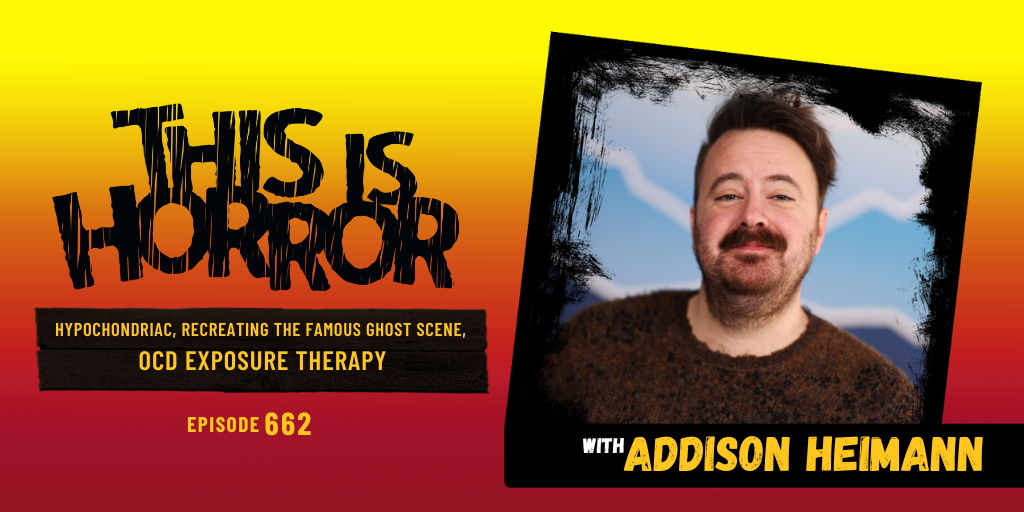
In this podcast, Addison Heimann talks about Hypochondriac, recreating the famous Ghost scene, OCD exposure therapy, and much more.
About Addison Heimann
Addison Heimann is known for Hypochondriac (2022), Touch Me (2025) and Jeff Drives You (2019).
Timestamps
Thanks for Listening!
Help out the show:
- Support This Is Horror on Patreon
- Listen to This Is Horror Podcast on Apple
- Listen to This Is Horror Podcast on Spotify
- Rate and review the This Is Horror Podcast on Apple Podcasts
- Share the episode on Facebook and X
- Subscribe to This Is Horror podcast RSS Feed
Let us know how you enjoyed this episode:
- Write a comment below.
- Follow us and get in touch on Instagram @thisishorrorpodcast
- Subscribe and comment on YouTube @thisishorrorpodcast
- Follow us and get in touch on TikTok @thisishorrorpodcast
- Tweet us @thisishorror.
Resources
- Addison Heimann
- Watch the video version of This Is Horror Podcast episodes, including our conversation with Chuck Palahniuk on YouTube.
The Girl in the Video by Michael David Wilson, narrated by RJ Bayley
Listen to The Girl in the Video on Audible in the US here and in the UK here.
They’re Watching by Michael David Wilson and Bob Pastorella
From the hosts of This Is Horror Podcast comes a dark thriller of obsession, paranoia, and voyeurism.
After relocating to a small coastal town, Brian discovers a hole that gazes into his neighbour’s bedroom. Every night she dances and he peeps. Same song, same time, same wild and mesmerising dance. But soon Brian suspects he’s not the only one watching and she’s not the only one being watched.
They’re Watching is The Wicker Man meets Body Double with a splash of Suspiria.
Buy They’re Watching in paperback and eBook right now.
Michael David Wilson 0:20
Welcome to This is horror, a podcast for readers, writers and creators. I'm Michael David Wilson and every episode, alongside my co host, Bob Pastorella, we chat with the world's best writers about writing, life lessons, creativity and much more. Today, we are welcoming back Addison Heimann to talk about his 2022 film, hypochondriac, and to go deeper into his 2026 film, touch me, which we previously spoke to Addison about alongside Justin Benson and Aaron Morehead just a few weeks ago in Episode 657 157 so a lot that we're going to get into, but before any of that, a quick advert break. It was as if the
RJ Bayley 1:30
video had unzipped my skin, slunk inside my tapered flesh, and become one with me.
Bob Pastorella 1:38
From the creator of this is horror, comes a new nightmare for the digital age. The girl in the video by Michael David Wilson, after a teacher receives a weirdly arousing video, his life descends into paranoia and obsession. More videos follow, each containing information no stranger could possibly know, but who's sending them and what do they want? The answers may destroy everything and everyone he loves. The girl in the video is the ring meets fatal attraction for the iPhone generation, available now in paperback, ebook and audio from the host of this is horror podcast, comes a dark thriller of obsession, paranoia and voyeurism. After relocating to a small coastal town, Brian discovers a hole that gazes into his neighbor's bedroom every night she dances and he peeps same song, same time, same wild and mesmerizing dance. But soon, Brian suspects he's not the only one watching and she's not the only one being watched. Their watching is The Wicker Man meets body double with a splash of Suspiria. Their watching by Michael David Wilson and Bob Pastorella. Is available from this is horror.co.uk, Amazon and wherever good
Michael David Wilson 2:46
books are sold. Okay? With that said, Here it is. It is Addison Heimann on this is horror. Addison, welcome back to this is horror. Thank you.
Addison Heimann 3:04
Thank you so much for having me
Michael David Wilson 3:06
so the last time that we were talking, we spoke about your first experiences with story, but this time, I want to go back even further, because I want to know what were some of the early life lessons that you learned growing up?
Addison Heimann 3:25
Whoa, oh, my, that's so funny. Oh, I'll do one. I remember this specifically because it haunts me. So in, gosh, fifth grade, I got the lead, the lead role of the musical Guys and Dolls. Well, not the lead, Nathan Detroit, the guy, the other lead. It was a big deal because there's a K through eight school, and so a fifth grader got it, and I was like, feeling like, really, really into myself. But so that's, that's it where it kind of the end of the story hits, but cut to fourth grade, and I have, I have, like, a group of guy friends who love to rag on each other. And I was like, Okay, this is fun, but they always seem to be bragging on me. And it was a Catholic school, and, you know, everybody was saying gay then, as, you know, as a way to insult people. And I remember this one day, I was out in the playground, and everybody decided to play a trick on me. We're playing tag, and they're like, instead of tagging him just like, full force, just drop kick him in the ass. And I was like, and I didn't know this, so we're going around tagging, and then all of a sudden I could just get a full fucking hit in the ass. And I was like, that hurt. And then they kept doing it and doing it and doing it. And then I started crying. And then all those motherfuckers got sent to the principal's office, and then come the rest of the school year, they decided to ostracize me and make sure that none of the kids would play with me during during recess, and so I would hide in I'm okay. Now this is, this sounds like really traumatic, but you know, I was 11, and we. Move on. But, you know, like, I was just like, ostracized, and the teacher starting to notice, Till one day, they started playing with me again, because the teachers forced them to. And I, you know, they didn't want to. And then they just kept going for me to make sure I was it. And I was kind of a little like, slow and not that athletic. And, yeah. And then I just was like, No, I'm not going to do this again. Then cut to fifth grade. I'm the lead of the musical, and for some reason, we really like theater in there. So all my friends, friends were also with me too, and they just decided to be friends with me again, like nothing happened. And I was just like, okay, cool. And I did it that year because I had no other choice, because I had no friends, and we just like existed, like nothing had happened. And then I was like, I never will be friends with this people again. And I left the Catholic school and I met went to public school. I think the lesson there is that, like, you know, there are certain things that, like, we, you know, kind of accept with friends that we especially when we've had them for a long time, and the forgiveness like of it, or really just kind of the like, pushing it down, and the placating of it, like, really leads to this, like, you know, nasty friendship that I guess I'm connecting this to touch me. This is crazy. I, like, really didn't think that was gonna happen, but we found our way in, you know, kind of, like, this idea that, like, friends, just because they've been your friends, like, doesn't mean that they will, one, they will be your friends forever. Two, they're good for you. And the continuation of proximity to friendship like is really real, especially when you're younger, and then sometimes when you're older, as you know, as like, you stay in the same city, or like, even when you first move to a city and you find these friends, and then all of a sudden you're like, oh, this doesn't have to happen. And it's not like you have to be like all like Tiktok therapy, about it being like you're not serving me. It's just like sometimes friendships fall away, and you kind of realize who we people are, and that's okay, too. And you know, also you're probably at fault, although I don't think I was fault at fault in fourth grade. I was kind of like a loser kid who just like Pokemon and in 64 but you know, it is one of those things where it's like, you know, friends, sometimes friends aren't your friends, and sometimes friends aren't meant to be there forever, and both are okay. And then when I grew up and started experiencing Friendship Breakups, I was like, you're probably at fault too. But the biggest thing that I've found that leads to the deterioration of relationships is just the lack of communication because people don't want to have hard conversations, especially in the friendship arena, because they feel like they don't need to, because you don't see them as much. But that just leads to resentment, and then it leads to a blow up, and then it leads to a breakup, or that could have been solved if you had just talked, which essentially is kind of what touch me, kind of originated touch me and what I was exploring in the movie. So they're full circle. Yeah, you
Michael David Wilson 8:11
know, I thought to begin with, we'd probably talk a little bit about your previous movie, hyper. You've linked it so well to touch me that we're gonna have to kind of reverse, like in some
Addison Heimann 8:27
Yeah, I mean, hypochondria can touch me are connected, maybe not obviously stylistically, but they're definitely connected kind of in my own mental health journey. So, like, they definitely speak to each other a lot. So we can even go back and forth whatever you want.
Michael David Wilson 8:42
Yeah, well, it's interesting. You know, you mentioned about the connection, and I think they're almost both part of the same piece, but you've got hypochondriac is the super pitch black, dark version, and then touch me has a little bit more playfulness and lightness to it, which is, of course, not to say there aren't jokes and there's not humor in hypochondriac. I mean, for goodness sake, there's a Donnie Darko massive wolf throughout the whole thing, and you've got a Homeward Bound
Addison Heimann 9:14
reference, yeah, not only not only that, but, like, the funniest scene for me in hypochondriac is when they're making pottery together, and there's the ghost sequence, like people were like, Oh, I laughed at that. I'm like, Yeah, that was intentional. It's ridiculous. Like he's making pottery with his with his inner child as he's, like, dressed as a Danny Darko Wolf.
Michael David Wilson 9:34
So, yeah, no, I wanted to talk about that. I mean, at what point? So we are going into hyper contract.
Addison Heimann 9:43
We found our way back in right? But we could start touching people. Then all of a sudden, hey, we were we brought back to the first so let's see,
Michael David Wilson 9:53
and at what moment did you know you were going to recreate the famous pottery scene from Ghost? I'm. What was that kind of part of the reason as to why you made, will a potter to begin with, to get that scene in.
Addison Heimann 10:10
I wish I could say, you know, like, like, now that I, you know, I made that movie. Well, we filmed that movie five years ago, which is crazy, but I the answer, it's always, it's always dumb, because the answer is no, but like, it's because usually, usually when I do things like I write, I find them that I find funny, I put them in and then kind of try to connect them later. But the real reason will was a potter is because no one wants to originally. So the in the original, original draft of hypochondriac was written and was written in the throes of my mental breakdown, as I was recovering and getting functioning of my arms back, I decided to do just like in just like a very like, like, shot for shot, word for word, exactly what happened to me, which made it a very messy and unmakeable film, because it was about my mother. It was about a friend who died. Is about him thinking he had Luke eggs disease. It was about, you know, the American medical care system. It was, you know, it was about, like, moving to a new city and then having something go wrong, and losing all of your friends because you're not good enough friends for them to care for you. Like, it was just like all these things that I was kind of experiencing at the time, and at the in the movie, he was just a writer, and that's, like, boring. No one wants that. So I basically, you know, a buddy of mine was like, hey, like, you shouldn't be this. And I was like, obviously, it was just kind of, you know, but what I really like about art and Potter like, pottering, or however you like, is that, like, I lost functioning of my arms for six months after an injury at work with a really terrible boss who was making me do things above my pay grade. And so I was like, What is the most devastating art form that wouldn't that? That would that like with if you lost functioning of your arms that? And that just happened to me a potter, you know? And so I watched a lot of the like, I can't remember the show now, but the British, like the British Bake Off, but for pottery, like, there was very specifically that that show, and I learned about it, and I was like, oh yeah, this is exactly right. And I was able to, like, create, kind of the Met, like the, not the metaphor, but like, the real version. Turned it actually led itself really well to the world of high high concept or high price pottery, because they do have a lot in common, in a way. And then I was like, well, now we get to do the ghost sequence. So now that I was like, so Potter came first, and I was like, Well, clearly we have to have a pottery sequence in which he makes pottery with with his man in a wolf costume, and then we can have his throat slit and be like this, Insanity type, type, type scene. And I was really, really, really proud of that scene. So, so, yeah, no, you
Michael David Wilson 12:53
absolutely should be. And you know, it's so kind of shot for shot ghost that anyone who's familiar with ghosts, which you'd be everyone really, they know exactly what you're doing from
Addison Heimann 13:05
the like, even in the modern sense, it's been mean to death, like there's been so many videos. It's like we know that scene.
Michael David Wilson 13:12
And so, I mean, for people who aren't familiar with hypochondriac, I suppose we should start with giving them the elevator pitch?
Addison Heimann 13:21
Oh, sure. Honestly, the i It's been so long since I have said the actual outline or the log line, but the way I describe it, it's just a gay horror movie about my mental breakdown. That's really what it is, a guy who whose mother almost kills him in a psychosis when he was a kid, cuts to 18 years later, and he starts exhibiting symptoms of both mental illness and physical illness. And as he goes down into the spiral that is psychosis, he tries to solve it himself, while hiding it from everyone else. And as he gets down into the darkness, he starts being visited by a man in a wolf costume who's haunting his dreams and his reality.
Michael David Wilson 14:07
That is a succinct and very accurate way of putting it. And I mean, you mentioned that you lost full function of your arms for six months after a workplace injury. I'm not sure if you've ever given the kind of graphic tell it all version as to what actually happened. So, oh yeah, yeah.
Addison Heimann 14:31
So essentially, the place that I was working at, which I won't name, but I was working as a production assistant, just a PA, on commercial sets, and they they paid us, like, over market rate. So I was just like, wow, this is great, but I had a really terrible boss who was nice, but one of those people that, like, made you do things that were clearly not in your job description, like as a production assistant on set, I wasn't supposed. Us to, like, drive away and get her vitamin B 12, or pick up her laundry or do any of these things. Like, once in a while is a favor. It's just like, yeah, no problem. Like, I'm on the clock, and honestly, like, I get paid for when I drive, so not a big deal. But what they actually started doing was deliberately not hire people that were way more expensive to pay daily, and started using me as that job. So, for example, like, for what's called prep and wrap before and after a shoot, you have what's called, you know, a grip. Or anybody in the G and E team who handle the lights and the equipment that use the lights have to lift and use all these really, really heavy everything, you know, like, anywhere from like c stands to like what are called Ari sky panels that look like giant widescreen TVs that are like 90 to 100 pounds, huge metal bars, like all these things. And they had them in the studio, but the only way you can get them upstairs was to walk them upstairs. And usually you have, like, three four people in the setup using freight elevators and things to lift, and I had none of that, and I was the only one doing the work. And there was even somebody whose job it was to help everybody there who decided he just wanted to make music by himself in the corner and just tell me where things go. So overall, I was just like, I was dealing with like, a culture of like, of being underpaid, not being unionized, and not really understanding that this was a bad thing. And also, while this was happening, I won't credit I won't just be like, This job was the reason everything happened. But I also my mother is bipolar, and she's been bipolar since I was 12. I mean, she's been bipolar probably her whole life, but it really started manifesting when I was 12 years old, and she's been through like, like, you know, episode after episode after episode, specifically manic episodes, in which she gets very paranoid The longer she goes off of her medication. And what she does for me is she starts leaving these, like, kind of mentally abusive voicemails that, like, like that, like, run the gamut of, like, of everything that really fuck with your brain. So it's like, my best friend at the time, he told she told me that I shouldn't trust but wouldn't give me a reason. And these were voicemails, and then then you would call, and you would ask, and she would never remember why. Like, she was obsessed with, like, thinking, like, when I was a kid that there'd be a bomb in the Pool Heater. Or, like, there was somebody was going to blow up the school, so she would pull my sister's out of school. Or she thinks the CIA is after her, and therefore they're trying to use me to get to her. Like, you know, like pick, pick, a pick, a pick, a site, like, psychotic thought and like, she had them over the course of the, like, 20 years that, like, we experienced it also. And to be clear, it's like, my mother is not a bad person. It's like, literally, Jekyll and Hyde. Hyde takes over her body, and she's just kind of like taken over, almost like a marionette, and like, says all these things, and when she's lucid, she's a very lovely mother. But the problem is, when my dad and I my mother are separated, like my mother was left alone, and the worst of it happened, like, during the pandemic, which I guess is, like, right around the time I was going to make this movie, or, like, rewriting this movie. And so I took legitimate copies, like, direct to text voicemails of my mother and the voicemails that you listen to in the movie, or my mom's actual words, and so, so yeah, so that was happening, and I started exhibiting these symptoms of, just like nausea and dizziness. And I started Googling my symptoms, and I was convinced that, like, you know, and then, of course, the like, the thing about the algorithm is, once you click on one disease, it just starts to, like, kind of center you towards there. So I decided to my brain, decided to hyper focus on ALS or Lou Gehrig's disease, where, you know, you just slowly have your body fail you, and your muscles, like shut down, until you eventually can't breathe and then you die. So I was like, I probably have this, but I'm also trying to prove to myself that I don't. So if I wasn't trying to prove myself, I probably would have spoken up to my boss and be like, Hey, you kind of are taking advantage of me. You're having no one here, and I'm getting paid like 200 bucks, 250 bucks for 12 hours. Like, and I'm lifting all these heavy equipment up and down stairs, like, with no with no help, and no freight elevator, no nothing. So I'm doing all these things. And I'm, you know, not exactly at the time, the fittest guy, you know, I have a good metabolism, but like, I just, like, you know, I just wasn't, I wasn't the type that could just rip through these things. And I just, you know, one day I was lifting like a 90 pound light, and I felt something pull in both of my arms. And then slowly but surely, I started to lose function. And it got so bad to the point where I was supposed to work for them again, and I was in so much pain and could, like, barely lift food with a fork that I had to be like, Hey, I can't do this anymore. And I didn't really give a reason. I just said I can't. And by this point, I'm convinced I have ALS I've been to a lot of doctors, like, kind of funneling through my insurance and realizing that, like most doctors in Los Angeles don't even take anything from Obamacare. Not to, like, get into, like, the failures and the functionality of the failing American healthcare system, but it is what it is, you know. And so I got it got so bad that my roommate was like, Addison, I think you need to go home. And I was like, Yeah, you're probably right. And my arms were not getting better. And I was convinced I was dying. I was having panic attacks left and right. And then I went home to my dad, my like, completely not no understanding of mental illness. Father, who I'm, you know, who has grown now, but at the time, it was like an incredibly useless and unhelpful month as Thank God, I had a therapist who was like, I'm talking to you every day. You really need help, and which prevented me from going in the hospital. And I got on antidepressants, and I was on a shit ton of Xanax, and then I went to see my dad's doctor, who, again, didn't really give me a straight answer on what was happening. You know, I'd wake up in the middle of the night because I convinced my my convinced myself, that I couldn't focus on my breathing, that I would stop breathing. And when you do that, you have these like gasps of, like, feeling like you're drowning, you know, when I was watching movies like, you know, I would go, I would just shoot into panic attacks where my entire body would just feel like it was hot and like lasers were shooting up my body while I was watching Tom Cruise's the mummy. And like, you know, it was just like, it's just like, a ridiculous, like, you know, landscape of amalgamation of bullshit. And so after a month, like, I fixed my brain a little bit. My body was still broken because I was like, it was that stupid thing where it's like, you're like, don't use your arms. And I'm like, Well, if I don't use my arms, like, I can't drive, like, I can't type, I can't do any of these things. You have to use them a little.
But, you know, I got there, I couldn't stand my dad anymore. I love him. Now. This is not a shit like a shading on my dad. He told me I got one movie to make about him, so we're all good. But, like, I so I went back and I, gosh, this is like, you're taking me down memory lane. And so I my friend was like, why don't you see a massage therapist? And I did, and he massaged it so bad that I re injured them even further, and I got even more hurt. So So I stayed on the couch for four weeks. I finally got a prescription for physical therapy, but I had to wait until the swelling had gone down and I decided to stop moving, which was the dumbest thing I could have done, because you can't just stop moving, if you have an injury, you can rest it for a few days, but I just stopped moving, and I was on the couch for 12 hours, so everything seized up. So by the time I got to physical therapy, I was in so much pain at that it took, like, it took, like, three months before I was finally able to regain full function. And a lot of that was finally basically be them being like, you just have to do functional movement, even if it hurts. And I was like, okay, and that started getting back. But while that was happening, I was going through intense symptoms of like brain fog and panic and all this stuff that came rushing back. So I finally was able to see a neurologist who gave me an MRI of my brain, and then the MRI came back clean, and then all my symptoms went away. So the thesis, I guess, behind the movie hypochondriac, is you'd be shocked how the mind can affect the body, because it literally does, and it happens all the time. At the time, I had undiagnosed obsessive compulsive disorder, and if I had known that, that probably would have helped, because, like my OCD, that I was hyper focusing on was dying of Lou Gehrig's disease. And it doesn't help, you know, it's like, this was before AI, right? So I couldn't go to a chat button being like, I'm dying, I'm dying, I'm dying. And at least with that the you know, like your chat, GBT, they'll be like, No, you're not, you know, at least I could be like, No, which makes it a little more, I don't know, but like, at the time, I was just like, looking at Google, and then at one point I was like, looking at fucking message boards about preparing for the end of life, for like, people with MS or ALS. And I was like, What are we doing? So anyway, once I got the MRI, everything went back, went away, and that's and I also, at the time, was writing the very original script that was hypochondriac that became the version that is now so over the collection of, like, you know, whatever it was six months. I say it six months because yet, like, when I injured myself, but it was, it was like, getting bad, like, about a month before, because right then, I'd also visited my mother and stayed with her for three, three days. And, like, had to just listen to all these, like, you know, conspiracy theories about how I shouldn't trust anybody, and that, like, I'm, I'm a terrible person, like, all these, all this stuff. And so, yeah, that's the story, and that's how, that's how, that's what everything hypochondriac is based off, of,
Michael David Wilson 24:37
oh my goodness. I mean, what? What are things to live through? And, I mean, thank goodness you did live through it, because for some people, you know that might be the end right there. And, yeah, no.
Addison Heimann 24:52
I mean, I know. And, like, I talk about this more so now that I, like, know I have obsessive compulsive disorder, and I've gone through a lot of OCD. Therapy. It's called exposure and Response Prevention therapy. But, like, people with OCD is when some of the highest suicide rates amongst, like, the nerve divergent disorders and stuff, and so, like, you know, there's definitely, I mean, there's, like, a, you know, I never, you know, because in the movie, there's a pretty, really dark moment where will almost like, you know, sits the wrist, and he's with his wrists and and he's with, with, with the wolf, and there's that moment where you, like, sit there and you're like, and that's the thing. It's like the whole movie, the whole movie for me, because it ends positively, spoiler alert, but like, sometimes you have to tell people that when you're like, you're gonna go down this rabbit hole, but you're gonna come out the other side. Because that was, like, the whole point of that movie for me was it's like, it's not about, like, you know, you know, failing because you're going through something hard. And like, that's the message of mental illness. It's like, no, it's just really fucking hard. And we're sorry that it's hard. I'm sorry that it's hard. But like, if you are willing to put in the work, and it's real work, because it's not fun, it's not painless, it's real and honest fucking work with therapy and and like, you know, journaling and and and accepting the fact that your illness is going to going to handicap you for a bit, but if you can do the work and push through it, you will come out The Other Side, a person who is capable of immense empathy, and also, like, you know, you will have the tools that allow you to move forward, not necessarily in the perfect way, but a way that's manageable. And that was, like, my whole point with that movie, because by the time we got to filmmaking, I was I was through it. And, like, I couldn't tell a movie about me where, like, you know, I think some people like, I It's funny because it's like, so long ago now. Like, none of the any critique of it just bounces off me. But a lot of people were like, I hate the fact that it was all in his head. I hate the fact that no one died and he didn't any there weren't real consequences to his mental illness. And I'm just like, that's not the point. This is a, this is like, in my attempt to recreate a factual way of what it's like to live with something like this. Live with something where you think you're dying the whole time and you're not going to kill someone. I mean, you might. I mean, that's like, that's like, a very like, like, you know, the like the deep dark is saying, but like, really, like, people with schizophrenia and bipolar are not as violent as media kind of claims that they are to other people, and so it's not about that, but like, the war in your head is scarier because you're fighting demons that no one can see, and the only person that's at risk of dying is you. And that, to me, was kind of like the whole thesis and the whole exploration of that film,
Bob Pastorella 27:40
and that's one of the things that we learned when I was in college. I have a Bachelor's Science degree in psychology. Yeah, we went through, you know, three semesters of abnormal psychology, and it's like, the final semester, they're like, hey, the thing you have to realize is you're when, when people are sick, and they say, Hey, do I want to, you know, am I ever going to be better? They're thinking that they're going to get cured. Yeah, and you're not going to get cured, you're going to get better. But better doesn't mean cured. Better means that, like we said, you can you learn how to manage it, and you learn how to to not necessarily control it, but live with it. And I think that's important, because a lot of people think, well, this is the only thing that's wrong with me. And it's like, no, there's probably a lot of things wrong with everyone. We just learn, we have to learn how to cope with things. Yes, the toughest journey in the fucking world?
Addison Heimann 28:39
Yeah, I it is so unbelievably painful, especially when you're in it, because you never you can't see the light, and that's and that's like, you just can't you just you're stuck there, and you're at the bottom of the pool, and the light's not shining, it is just darkness, and you feel like you're drowning. And I will say the really wonderful thing about making art, about this, is the ability to foster community through the active collective like, you know, consumption. So it's like going at the best the most gratifying parts of touring with hypochondriac and the film festival scene and then doing, like my release, and going to a few cities and doing talk backs and talking with press and doing podcasts, is that, like, you find a lot of people who have gone through bizarrely hyper, specifically same experiences as you, like, obviously this, like, well, everybody suffers from anxiety, or everybody, a lot of people suffer from, like, medical, like medical psychosis and all this kind of stuff. But then I started finding people who were like, people were like, I lost functioning of my arms for six months, very specifically, and couldn't get out of it or like, because it's like, you know, and also this is the idea like I've done, you know, especially like in like, the disability community, it's just like, it is one of those things where it's like, you become, like, invisible. Because no one wants to acknowledge that you are this close from having some part of your body shutting down. And so it's easier to ignore an entire subsection of people than face it and accept it. Because, for some reason, like, I guess ignorance is bliss, and that could be, you know, for a lot of the world, that kind of is but in reality, like to take it a step further, if you just acknowledge like everybody's kind of issues that they're having and worked with each other to foster a sense of community and support so when something does happen again, you are not shunned, but rather accepted, and you have done the work to where, let's say no, Long gone are the days of having a mental breakdown for six to one months to a year, but maybe it gets to the point where you take a couple days and you come out and you're through the other side, because you have the tools already given to you. And so it was really lovely talking to other people and, like, you know, realizing that, like the movie, like, spoke to them, because, like, art speaks to me. That's how I got become an artist. Like, I don't think, like we're changing the world, like, you know, like certain other jobs, I think, like, do more of but like, art does have a profound sense of telling stories about people's other perspectives that we don't experience on a day to day, and could foster a sense of empathy that, like, truly changes people's minds. I go back to this, the second season of Glee, which is so funny to say, like Glee changed the world, but like, at the time, like America was really wrestling with the idea of like, of like, making gay marriage legal. And here's a show on prime time network television that had a really honest and specific gay bullying storyline that most people who were watching it had never seen in real life, and it spoke to people. And then more media started coming out that was talking about the experiences, and they kind of shifted the landscape of people's opinions on these things. And so, like, that's why I always want to tell stories that like, especially in the genre space, because I think in the genre space, you have a easier way to speak to people, because you're also, like, scaring them or making them laugh or or, you know, like talking about it through the side. And, you know, that's always what I want to do with my art. That's like, I guess, my calling or my purpose, as
Michael David Wilson 32:14
it were, yeah, do you think in kind of communicating these messages through genre and through horror, you can actually be more honest and more authentic than if it were to be, you know, a non genre story,
Addison Heimann 32:31
you know, I think like, I don't want to say it's easier or better. I just say like it's different. And I feel like, you know, like I was trying to find an example, like Hamnet, for example, which is like dealing with the grief, but it's very much a drama and to and if somebody who like is maybe at the start of their journey about dealing with the profound grief of someone may not want to watch a movie about the death of a child right off the bat. So it's like, but like, and maybe, maybe you will but like, it's more of like, you potentially have the sense to, like, work yourself up if you're not ready for something like that. But I think it's why, for example, something like stand up comedy can, like, lead to healing as well. Because there is, there is a certain subsection of like, things of like, well, you know, like, you're talking about only, like, only someone who's been through the death of a child, can can stand up and do a stand up comedy routine about it, and then that makes you feel seen in that kind of sense. So that's what I kind of feel like with horror, right? Is it's like it might be an easier, more palatable thing to kind of get people into the into seats or to watch them. It doesn't mean that the journey isn't necessarily any less, any any less kind of affecting. In fact, sometimes it can be more so just with the fact that we are going larger than life. But actually this kind of connects to hypochondria to touch me now that I'm talking about it, because, in a way, it's a form of exposure therapy, watching horror because and it's like of a lesser one than watching, let's say Hamnet, if you're going through the death of the child, because going through, like, the, you know, the aggrieving process, because in exposure and Response Prevention therapy for OCD, you're supposed to or one, one kind of thing that you can do is, like, write about the worst fear that you have through a like, completely fantastical and hilarious way. So it's like, you know, for a guy, you always use, I use a couple examples of, like, thinking my boyfriend is going to break up with me and then my life is going to be ruined because all his friends are going to leave me, since they are my only friends, and my other friends who are on my side were like, Oh, you didn't want to be friends with us before, so we're not going to be friends with you now. So to be friends with you now. So I'm going to have no friends, and then all my collaborators are going to leave, and then I'm going to be alone in my house. I'm going to lose my house because I can't get a job, because none of my friends or or collaborators want to work with me anymore, and someone have to sell the house, and then no one's going to want me to go back home. I can't start over, so I'm going to take a knife. I'm going to slip my. A son, I'm gonna die like that is how far you go when you have obsessive compulsive disorder. You go so far down the rabbit hole. So in an attempt to prevent that, you write stories like kind of exposing yourself to what your boyfriend could say that hits you the hardest. But in the background, unicorns are fully having an orgy and orgy, and they're coming oodles and oodles of just icing with sprinkles. And so every time your boyfriend is telling you what a piece of shit you are, or very specific terrible things you view about yourself, like you get shot with with with like icing and sprinkles, which is just unicorn come. And so you start, I know this is ridiculous, but you start, you start kind of shifting your perspective on it, because what OCD is, which is not what like, what OCD is, it's like, the thoughts you have are antithetical to reality. There's a difference of like, being like, like, there are people who really want to murder people, and then there's somebody who is OCD, who's afraid of murdering someone, even though they would never, in their mind, murder someone, and so and so, yeah, that's what you do. Is so and in a way, that's kind of how I view what horror and genre and science fiction that's about, things are essentially, are they're they're little exposure therapies for people that, like, may or may not be dealing with something hard. And so if they watch that movie, it's easier for them to kind of to kind of like take that on without being so incredibly, incredibly anxiety ridden, because the roller coaster is fun. And while it may be about something serious, it's still fun. And so you connect, kind of like your terrible memories to like this, like this, like cathartic release, or something that you were holding on to for so long. And it allows you to grieve and allows you to accept and allows you to move forward, and that's what I think art does, right? And so and so. That's kind of long, long, long winded answer to say that like that's why I think horror is is profound, has a profound sense of a way to speak to people that may not be ready or prepared for something that directly deals with something in a very straightforward way. Yeah, so I
Michael David Wilson 37:04
was going to ask what tools you have for dealing with, you know, when you find like an OCD episode is coming on, and it sounds like, obviously, exposure therapy is one of the best tools in that kit, are there other things that you kind of use, sure, sure.
Addison Heimann 37:23
I mean, I mean, I mean, it all kind of ties around exposure therapy. What I just talked about is, like one example of how you do it. So another example would be, I do these things called loop tapes, where you basically write, like, a short little blurb of all of the fears that you have, like, you know, you know. Like, maybe, like, you know. Say you're afraid of driving across a bridge, you know, and you because you're afraid the bridge is going to collapse, and you just can't so you're like, all right, you know, you start with being like, I may or may not, like, you know, the bridge may or may not collapse. While I am driving over the bridge, I may or may not be forced to drive, to drive across the bridge, because there I'm in a city in which there is no connections to anywhere else but a bridge I will get in front of the bridge, and because of me, the bridge may or may not collapse, killing 1000s of people and immediately causing my like my myself, to hit my head and go unconscious. And I may or may not wake up under the weight, wake up in under the water, and the glass may or may not break as the water fill slowly fills up in the in the car, and my seat belt may or may not become undone as the water slowly flows, as my lungs and I suffocate and I die. And the very distinct, you know, and I'm not a therapist, so like, this is, this is just like, specifically what works for me. I advise you, if you think you have obsessive compulsive disorder, to seek out a professional from who does ERP therapy. But so this is what I do. Is like, I record myself, like, that's not my exact fear, because I don't, I'm not too I'm not so comfortable that I'm going to tell you, because they're so viciously terrible, right? They're so antithetical to who you are, like, the worst kinds of things, it really scares people, because when you first have these intrusive thoughts, you think that because you thought this, you're this person, right? And so it's very reassuring, in a way, that even though OCD is like literally, reassurance is the devil of OCD, because you'll never be able to 100% be sure of anything. So it's trying to be comfortable in the uncertainty. So what I said when I was talking about that may or may not loop tape, you have to keep saying this may or may not happen, because then you're never 100% sure. And when you're listening to it, they have what's called a sudden scale. It's just like a one through 10 scale of like something that makes you anxious, generally, for me, that makes me incredibly anxious, because I start imagining exactly my truth. And so I would listen to that and will my anxiety into existence. And then I would just sit there and listen to it, tell myself this may or may not happen and don't. Engage in what's called the reassurance practices, which are for me, let's say, like, I think someone hates me, so I'm gonna see if they follow me on Instagram or, like, you know me, me. Like, convince people hate the movie. So I'm gonna, like, aggressively check letter box and IMDb over and over and over again and really focus on the negative reviews, like stuff like that. Like, there are more, you know, serious versions of that, but you basically don't engage in the things that cause you to spiral. And you sit there with your anxiety for 45 minutes as you listen to yourself on the loop tape telling you the things that may or may not happen. And eventually your anxiety dissipates and and you get from you try to, like, track the scale of when it kind of dissipates. You're kind of tracking your anxiety and riding the wave down until you get to below a certain number, and then you can stop. And then you do it every day for a long time, until the thing stops giving you, until you're, you know, until your fight or flight starts triggering every time you have one intrusive thought. Because, like, you know, like we were talking about earlier, is it's like the the the intrusive thoughts will never disappear, but you can definitely
train yourself in a way to make them to know that they're just intrusive thoughts and don't matter, and to let them just flow out just as they went back in. It doesn't mean they won't come back. You can backside at any moment, but like, those are like, just two different examples of how you expose yourself to get yourself through that kind of like, intense thing. And in fact, some of the exposures are like, let's say you're like, Oh, I'm afraid. Like, you know, I'm gonna kill a kid in a car crash. And then you like, literally, it gets to because you build yourself up, right? You start with, like, reading articles about people getting killing kids and car crashes. It's like the lower end of it, and you work your way that, but like, maybe something in the mid tier and the upper tier is like you watching movies about kids that die, like dying in car crashes, and sitting there in your anxiety for that long, like you do this. It sounds horrific. It's like exposing you. It's like us as kids going on a rotten.com to see, like, terrible shit. But like, it is that, you know, especially when you've got this kind of constant brain, because your only other choice is to live on the verge of a panic attack for the rest of your life. And that is a huge No no, no, thank you. So yeah, everyone, every time I describe it, people are like, that sounds like hell. And I'm just like, Yeah, but the other option is death. So what else? What else do you do? And and I'm like, it works. It really does. It works more than I can't do cognitive behavioral therapy, because it's all that's all about logic and it's all about looking at the facts. And my brain doesn't care about facts, because even if I'm 100% sure that I did not have a bad interaction, and I talked to that person, and I'm like, everything is fine, right? They're like, Yeah, I'm convinced that that's not true. Anyway, my brain will always find a way around it. So the goal is to be comfortable in the not knowing, and that is basically its entire, the entire process of ERP.
Michael David Wilson 42:53
And how does this fit in with your creative process and writing? And I mean, I have to imagine that there are kind of some episodes or sometimes where it's not as conducive to writing, or it's easier to be drafting than to be creating original material. So how does this all fit in? You know,
Addison Heimann 43:21
I usually so if I'm in the deep throes of something bad which has only happened, you know, I would say it got like, you know, so like for the month of December of last year, for example, after I was down in the film festival circuit, I went through a huge, deep throes of just like, astronomically terrible depression over the holidays, which is no surprise, because my mom was manic every fucking December. So it's like, it happens. It's inevitable. I did a couple mistakes that made me really backslide, and those are the times where, like, you don't need to. It's like, that's the thing is, it's like a lot the negative feedback loop when you're in that hardcore of a depression, which OCD often triggers, is that you're such a piece of shit for letting yourself succumb to the sadness again, and that kind of prevents you from doing anything, whereas, like the reality is, it's about creating very, very specific and short and doable tasks that give you a little bit of dopamine that allow you to push forward. It happened. It happened to me, really terribly, like right before we got into Sundance with touch me, where I almost didn't get almost didn't finish the movie because I was spending eight hours in the edit with my with Olivia, our lead, John, my producer, and Jess, our editor, and I was fucking useless. Just in the throes of a panic attack for weeks, I forgot all I mean, this is before I started OCD therapy, and then Olivia, which is the reason, like we both bonded so much. And I think one of the reasons She's so good in this and touched me is because we bonded over our obsessive compulsive disorder. And while I knew I had it, I hadn't gone through this specific type of therapy, and I. I became, like an overnight, like an overnight person where I was I would wake up at 7pm and stay up till like 10am because it felt safer, because no one was up, and no one felt like they could judge me and and I could, I could barely edit the film, because I was on such lack of sleep when I had to be there. And so they finished it for me. I'm honest about that, like, you know, like, the last, like, because it happened, like, about the last week before we before we finished. So it wasn't like, I wasn't apps. I was absent the whole time, but they had to bring it to lock for me, and then I find and then I started OCD therapy, but I wasn't well enough to do, to do the work, because I would just do it when I had my therapy session, but you really have to do it every day. So I would say, like for me, you know, not that I wish or hope that I have like a new breakdown, but you know, the thick the cycle of mental illness means it's inevitable that you will have it. It's just the hope is that you do enough work on yourself that that becomes shorter and shorter. So you you know that they're more like colds than, like, a three hour bout, a three month bout of like, you know, I don't know, pick or choose some illness that lasts that long. So, you know, I tend to, but the weirdest thing, and this is the thing, is, like, I would never do this. It's a bit like, it's a bit like a phantom thread where, like, the guy who works so hard needs to be made sick by his partner in order for him to feel better about himself. And I don't treat these health, mental health moments as vacations. But you know, from time to time, there is some kind of what brings you outside this? What brings you out of it, or brings me out of it, is you start finding purpose and meaning in life again by by doing these, like, very specific tasks, and then I'm able to, from there, take that experience, and then narrative is it, and then start outlining, because that's what brings me out of it. It's like the wants or the need to create after I've, like, realized something during the throes of my, my, I don't know what they you know, like, it's like, I'm dying of consumption, like, of my consumption, and all of a sudden I'm out, and it's like, oh shit. Like, you know, now I have the breath of fresh air to understand it. But I would say, like, regardless of whether this happened or not, my entire life, my entire goal is to try to understand the illnesses that I suffer from. So all my movies will be about that, really, right? So it's like, you know, usually when I'm getting out of, like, a throw of it, like a new, kind of, like, interesting way to explore, it will come through. And I think that's kind of where I take it, and then I get excited and right through it, and then, you know, inevitably will go back down again. But it's kind of when, like, things get rocky. And I also have ADHD, which, like ADHD and OCD, is a
nuclear bomb waiting to blow up, because not only do you have OCD, but then your your inability to do basic stat tasks gives you so much shame that other people can just do naturally. So then I've started doing, you know, like, body doubling, like, with my therapist and my boyfriend, where it's like, if someone's just there, I can do a lot of stuff, and I'm starting able, because this happened to me. It's like, after the release of touch me, which just happened, you know, like, two or three weeks ago, like, I like, I think I couldn't wake up and brush my teeth. And I was like, You're such a fucking piece of shit, you can't stand up and brush your teeth. And now, three weeks later, with my therapist, and like, I'm able to brush my teeth, floss my teeth, wash my face, make breakfast, drink coffee, start my day. Have a full day of work, but like it you you don't get there overnight. You start by doing the babiest of tasks, and that leads you again to be creative and find purpose in life. I went about to run a different places, but, yeah, that's essentially kind of, you know, how I find it in my writing. It's always like a retrospective that gives me a new idea in and then that allows me, gets me excited to move forward.
Michael David Wilson 48:52
You mentioned bonding with Olivia Taylor Dudley over your shared OCD. And I mean, you can just tell from the start, from that eight minute monolog, that she absolutely nails in touch me, just how much she intimately understands the material. And I fell in love with the film from that opening scene.
Addison Heimann 49:20
Yeah, yeah. I and that, you know, bringing back to talking about exposure and Response Prevention therapy, it's such a shame, but also highly necessary when a film comes out and you have to start telling people the synopsis, because no one's gonna watch a movie with a very basic poster that goes two best friends go to the house of someone who claims they're gonna change their lives, and people are like, pass but it was written in a way that you don't know that Brian is an alien until the end of the first act, when you know, Craig sees the clip of her fucking the alien, and she goes and he, you know, it's like, that's when you find out. And so that monolog is written as an as an exposure. Response Prevention exercise, where the monolog is being told as if this woman was abducted by an alien. But in reality, it was, kind of like used as an exposure to make things more fantastical for what we can kind of glean to be some type of abusive relationship. But then the kind of like twist of it all is the reality is like, of course, like, it's real, but And so like that, I think was like, for me, that was like, Olivia's in but also because she understood, like, kind of everything that was happening. And kid kind of experienced certain things in terms of having, you know, a narcissistic personality disorder, you know, person or, like, somebody who gets you, they're like, having a relationship with, you know, anything. It's like a person who, like, you know, is bad for you, or heroin or cigarettes or alcohol, or, you know, video games, whatever you want to take, whatever gets you addicted, or whatever makes you avoid your problems. That's what this whole monolog is about. And it was the first day on set. It was the first thing that we shot. She had shot a movie like, just finished shooting movie like, six days prior. And never mind the fact that this was not the original Joey. The original Joey I developed this movie with for two years, and then Olivia stepped in, and it turns out, like she fit the part like a glove and and was able to create such a and it's like, there's no shade, because this happens all the time with actors, because they they don't have the kind of like career that way they do is, like, we spend like, three years on a project, they just need jobs, like, in like, a very different world. So when, like, Hollywood calls and it's something much bigger, like, there's no Matt, there's no, you know, like, maybe there's a little bitterness, but then you get over it, because it just happens. But things sometimes work out for a reason. Because we found Olivia, and seeing her do that monolog, and seeing her really, truly live and go to those places, it's my opinion, one of the only reasons the movie, like the movie, kind of connects itself because of her performance. And it's just astounding that that was the very first thing she shot, and it was a very first take that we used, and
Michael David Wilson 52:03
it's so perfect how you're also playing with the reliability and unreliability of the narrator of mental health, of intrusive thoughts. It's like everything is packed in. And you know, that's even before we've mentioned it actually what she says in eight minutes, yeah, kind of spoiler is the plot
Addison Heimann 52:25
of the literally, yeah, no, I know. And it's like, that's the thing is to me, I knew I wanted to do it that way because, like, my, my concept and my, the filmmaking of it was going to be so astoundingly, like, like, homage, in of a lot of the different things we were going to go through so many tonal mashups, like, I didn't want to also add the fact that, like, all of a sudden, I'm just going to thrust you into world in which there is, like, practical tentacles and all this stuff. And I think what that monolog does, Olivia does with it is, like, immediately puts you, like, head first, like, in the thing in a very palatable way. And by the time the monologs over, you're like, Oh, I think I know what movie I'm going to be in, and I'm ready for the fucking ride. And like, it also is used as a like, you know, the hint of like is everything in that monolog essentially happens again, like, it's just a repeat or retread, it's or set up, of like, everything that's going to happen, despite it being a story that happened in the past, and you know, the movie, then when the book ended by the therapist, becomes a story within a story. And that, I think, is what allowed us to kind of take more of like like liberties and risks with the stylistic nature of what is reality, by treating this movie as a story within a story, and then getting to do very theatrical style lighting, even when we're not on the sets, specifically in the alien world that are practical and 70s inspired, you know, kabuki theater, ask sets and and visuals that monolog sets, everything fucking up. And I'm really glad we did it. I got a lot of pushback on it, but then everybody saw it and went, I get it. That's actually the only way this movie can move forward. But can you imagine, all of a sudden, like, five minutes, and they're like, Oh yeah, there's a porn sex tape with the dude fucking in, like, with the girl fucking a technical monster. And we're just like, Yep, all right, Jesus fucking Christ. Here we go. But yeah,
Michael David Wilson 54:19
I mean, if anyone were to do that five minutes, and it would be you, Addison, I think you made the right choice, the eight minute monolog.
Bob Pastorella 54:28
Yeah, yeah. The thing that really kind of blows me away is that, and I love it when, when, when any artist does, as a writer, a musician, or anything like that, it's like you have these unwritten rules that you're like, and one of them, you don't, you don't, you don't open with a monolog. And my thing is, this is like, if you're gonna do something like that, you knock it out of the fucking Park. That way, no one can complain about it at all. Yeah, and that's exactly what you did. It's like, whenever it's like, if you have to know what you can't do. And. And go, You know what, I'm gonna do it, but I'm gonna do it so well that there'll be no complaints. And I mean, anyone complaining about this, they probably the movie's just not for them.
Addison Heimann 55:11
And that's like, something I realized too, right? You know, like, I, you know, there was, like, you know, we were always good. This is why I, like, had to get off letterbox. But it's fine, because I'll talk about it, because it like, I went through a whole, whole questioning of myself as an artist as I was going through the release. Because, like, as you know, i The goal of this movie, for me was, it's like, all right, I made my first feature. Now the second feature, I'm already going buck wild, but I'm going buck wild, so I can't pull my punches here. I can't make a kind of this. I can't make a kind of this. This has to be the most the boldest choices that you can make throughout the film. But in my mind, I'm like, when we got into Sundance, I was like, we made it, baby. I got to the top of the mountain. It is like, my life is my world is gonna change. And I really had these moments of like, oh my God, my world's gonna change. I made it to the top of the mountain, and then I got to Sundance. And then the clouds cleared from that mountain, and then the scariest fucking mountains with, like, willed the beasts and like, fucking demons, all of a sudden showed up. Then they're like, Oh no, no, now you have to climb that. And I went, oh shit. And then, like, the like, a lot of people loved the movie, but then there was, like, you know, user related backlash to it as well. And then I started especially like, with people being very like, and I don't think it's unfair criticism, especially if you don't like, kind of lock into the movie of like, the tonal visions of like, trying to, like, make light of certain things, and then immediately kind of abut it with something that is dark, and I started really questioning myself as an artist. I was traveling the world, and it was so fun, and I had met so many friends, and it was so cool to see audiences from different countries react to the movie. But at the back of my mind, I stopped watching watching it, because I was kind of embarrassed that like this was how I chose to explore topics of of mental health and sexual trauma that like, like happened to me and and like, some of like, some of the people closest to me, and I was like, Did I do something wrong? And especially during the dramatic scenes, I would watch it and like, get really uncomfortable. But then later in the the festival world, when I started getting towards release, I kind of sat down and forced myself to watch it again, and I'm like, no Addison, the reason you're getting uncomfortable with this parts is because these are the parts that are necessary for the rest of the film to work. You can't have these ridiculous kind of tentacle fucking movie like movie tropes and like the colors without the like deep and utter groundedness that is these people's lived experience in their traumas, and you're getting uncomfortable because they're speaking to you and they're getting close to home, but if you sit through that, don't worry, there's going to be a laugh later. And that, to me, makes me go, finally, you know, 14 months later, I go, No, I set out to make the exact movie I was meant to make or wanted to make. And I'm very proud of all of us, because it's not just me that made this film. Every single person on this film had a direct impact on its artistry. And from now on, it's like, you know, we'll see if I stick to this, because my brain could backslide. But it's like, you know, it people have I'd rather be nine people's favorite thing than 100 people's ninth favorite thing is one of my favorite quotes from title of SHOW MUSICAL. And that should be what I want to be like myself as a career, is like speak to like every ninth person who goes, Oh, dude, yeah, that's exactly what it feels like to go through an OCD breakdown. Or that's exactly like the kind of thing that, like, you know, makes it ring true what it was like to go through trauma like that as a child or even now, and like that's happened to me over the course of this run. And it's like, those are the freaks that I found, and those are the freaks that I will continue to listen to, because there are enough of us, and that made the whole process completely worth it, and I'm glad I went through this journey. I'm not, like, happy that I kind of abandoned my own film at one point, but like, looking back on it now, like I'm through the like, kind of looking glass and know that, like, this is the kind of shit that I want to make, and I'm not going to please everybody, and that's okay.
Michael David Wilson 59:19
Yeah, I think a lot of the things that you were worried about are the things that I perceive to be the strength of Touch Media, exactly. Yeah, and I wanted to know how on earth you balance the comedy, the wildness, the over the top nature, with these heavy thematic concerns.
Addison Heimann 59:41
I think it's going to be a little bit of a retread of a former answer, but I'll try to build on it. Is that's like, that is what's helpful with the trauma that I've gone through. It's what help helps me cope. It's what ERP is all about. You know, another example of like an exposure is like. Being afraid that I'm going to kill myself. I'm not suicidal, but I'm afraid that I'm going to do it. And so I imagine myself holding the knife as Elmo from from Sesame Street, touches my arm and goes, Don't kill yourself. Addison or Rocco will win. And I go. And so every time I think about suicide, I just imagine Rocco winning and Elmo being really mad about it. And that is, in a sense, is the tone of touch me, right? Is it's like, like, you have these, like, really devastating moments. And like, you know, I'll take, for example, like, you know, like, it usually gets a huge laugh in the theater when Craig goes, um, hi, I was molested by my uncle. And then we do this, like, kind of fun bit, and then you watch him talk about the story that happened, and he realizes that it's not fucking funny, and doesn't know where to go, because he's using humor as that's his whole thing. He's using this, what I did the whole time. He's using humor as a defense mechanism. And in reality, it's not humor first and then trauma. It's trauma and then exposing yourself to that trauma through funny ways that allows you to become a little more comfortable moving day to day, but like starting with the humor first as a cover for your trauma, allows you essentially to make jokes that aren't jokes. And I am so guilty of it, and I was guilty of it for so long, and I'm probably still a little guilty of it, jokes that are true but that you use in like the humorous landscape, when in reality, you should have just communicated that you were upset or that you're not okay. And I'm just as a person now, like who has gone through all of this stuff, I'm tired of lying to people. I think when it gets particularly bad, that's where I go away in my whole and I deal with it with my therapist. But like, if somebody, like, says, How are you like, you know, like, you know, and they're not like, like, they're not like, a stranger, like, I'm not gonna go, like, how are you? And I'm just like, well, let me tell you my life story. It's more just like, you know, you're talking with a friend and you're just honest about it, rather than, like, making jokes about why you're upset with somebody, and then people giggle, but you know, they're not jokes. And so it's like that, to me, is like the journey, right? It's like, like, Don't cover it with humor. Like, like, like, change your perspective on it, so you're less affected, in a way, by the things that happen to you. At least it's what ERP, kind of like does. And so that, to me, feels like the tone of touch me, it's like, we start humor, and it's the wrong way. Then we get drama, and then we, like, turn it into humor. Then, in a way, is kind of the right way of like, existing within the landscape of of the of the cosmos that is fucking OCD and depression and anxiety.
Michael David Wilson 1:02:39
I relate to so much that you're saying here. And you know, whenever I'm talking about traumatic things that I've gone through, it's really difficult for me to not make a joke, or to add some humor, or to try and inject some lightness. I can't just kind of up front, be like that. This was terrible. Make jokes and, yeah,
Addison Heimann 1:03:05
it's funny. I got there's like, a different it's like, it's like, there's something, there's something that like, is like, the like, there's something that's changed with me. It's also interesting too, right? Is it's like, when you've gone through, like, I'm not saying this is a beautiful thing. It's like, I think the unhealthy thing about dealing with your trauma and you're not kind of over it, is thinking that the worst things have happened to you and nobody else can kind of understand you, versus understanding that, like a lot of people can understand you, but like you can't when I'm going through this, because I've had to talk about my life, my trauma, because I can't not do it in press, because it is just What the movies are about. And I can't be like, I don't know, and it's just like, because I just write from a very personal place. And not everybody does, and some people do and don't want to talk about it, and that's okay. And some people don't write about personal and then they find success, and they write really honestly too. It's like, there's all different versions of creation. But for me, personally, it's like, now this is part of it. For me, I also have to find a way to make it palatable. But it's like, a different thing, right? Is it's like, it's like, but this is also like, once I have been through it and gone to the other side, you know, when I'm dealing with something like really specifically of the moment, like my perspective changes, and actually, that's when people know that I'm really down, because I will stop making jokes, and it'll just be really flat and honest. And I like doing that with people, because it leads to more like, you know, grounded and connected conversations with like real, with like, specific and real friends that I have in my life. But, you know, on the other side, like, it's like, I'm, I'm on a stage doing a Q and A you have to make it palatable, because no one wants to. Let's like, Listen. I mean, people do like, if they're right mode for it, but in a movie about tentacle fucking, like we ride the wave in my Q and, as in my intros, much like we ride the wave in the movie, so there's like, this, like, kind of protection there for me that allows me to talk about it. But I've been, I've done it so many times, and I've done the work that, like, it's no longer affecting i. And so that's like the different perspective that I have on it. Now, if that makes sense,
Michael David Wilson 1:05:07
thank you so much for listening to this is horror. Join us again next time for the second and final part of the conversation with Addison Hyman. But if you would like to get that and every other episode ahead of the crowd, please become our patreon@patreon.com forward slash, this is horror. You'll also be able to submit questions to every single interviewee, and very soon, we will be chatting with Jad Shepherd, the writer, director and producer responsible for a number of films, including host and dash cam. And in addition to that, we will be welcoming back Dan Howarth, the former This is horror podcast co host to talk about his forthcoming novella drone. So once again, if you like the sound of either of those episodes, head over to patreon.com forward slash This is horror and pledge your support today. Okay, before I wrap up, a quick advert break
Bob Pastorella 1:06:19
from the host of this is horror podcast, comes a dark thriller of obsession, paranoia and voyeurism. After relocating to a small coastal town, Brian discovers a hole that gazes into his neighbor's bedroom every night she dances and he peeps same song, same time, same wild and mesmerizing dance. But soon Brian suspects he's not the only one watching she's not the only one being watched. Their watching is The Wicker Man meets body double with a splash of Suspiria. Their watching by Michael David Wilson and Bob Pastorella is available from this is horror.co.uk, Amazon and wherever good books are sold. It was
RJ Bayley 1:06:58
as if the video had unzipped my skin, slunk inside my tapered flesh and become one with me.
Bob Pastorella 1:07:06
From the creator of this is horror, comes a new nightmare for the digital age. The girl in the video, by Michael David Wilson, after a teacher receives a weirdly arousing video, his life descends in a paranoia and obsession. More videos follow, each containing information no stranger could possibly know, but who is sending them and what do they want? The answers may destroy everything and everyone he loves. The girl in the video is the ring meets fatal attraction for the iPhone generation, available now in paperback, ebook and audio.
Michael David Wilson 1:07:36
As always, I would like to end with a clip from a previous episode, and today is taken from Episode 536 in which Chuck Palahniuk talks about mainstream entertainment.
Chuck Palahniuk 1:07:53
My job isn't to fix anything, but my job is to kind of look around and try to fix myself. And whenever I look at things mainstream entertainment on streaming and through the sort of conventional channels, it's always seems so tepid and seems so audience tested. It seems so completely, so disappointing. Ultimately, it never really emotionally or psychologically exhausts me. It never takes me to a place that that cathartically completes something in me. So I always find myself just watching 500 hours of it because I'm hoping to get burned out by what good entertainment used to do in half an hour. You know, a good short story will will give you that complete exhaustion and peace in an hour. But bad entertainment, you have to binge watch it for 100 years, and you still don't feel that kind of complete catharsis. And so in my work, I'm trying to give people a much more complete catharsis, because I think what they're getting from the mainstream channels is so tepid and so watered down to try to build as large an audience as possible. And so I think that's why people have to watch so much of it for a continually diminishing margin of returns. They're getting very little for their time and attention, and so they're forced to watch more and more of it. And so I will take the gamble of offending them and really pissing them off over I will take that any day over making them bored and making them, you know, read 800 pages for a really marginal payoff,
Michael David Wilson 1:09:42
if you would like to listen to the full episode with Chuck paulahnique, you can listen to episode 536 so this is horror podcast, or if you want the video version, it is available on YouTube, youtube.com, forward slash at this is horror. Podcast, and if you would like other inspirational clips from past episodes, then please do follow us on Tiktok and Instagram at this is horror podcast. Well, that does it for another episode of This is horror so until next time for the second and final part with Addison Heimann, take care of yourselves. Be good to one another. Read horror. Keep on writing and have a great, Great Day.