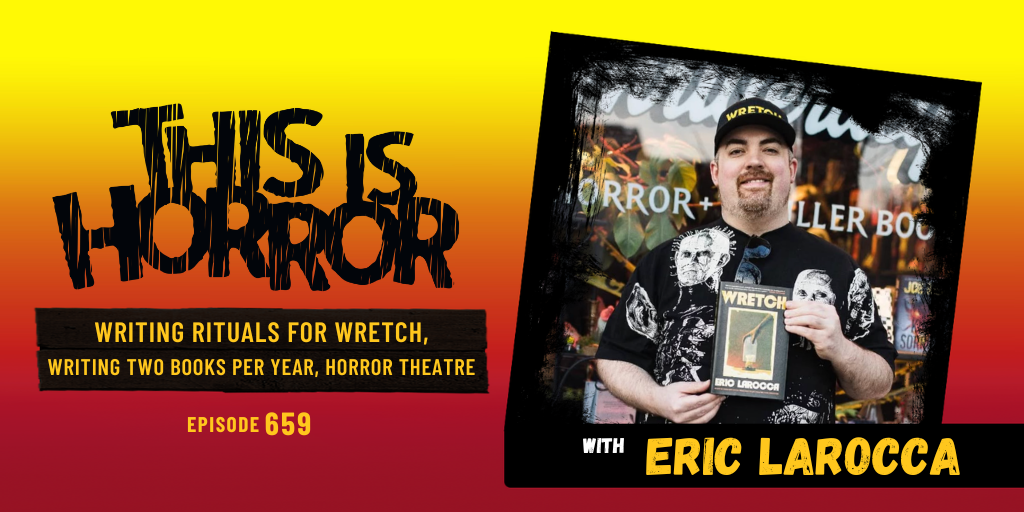
In this podcast, Eric LaRocca talks about his writing Rituals for Wretch, writing two books per year, horror theatre, and much more.
About Eric LaRocca
Eric LaRocca is a 2x Bram Stoker Award finalist and Splatterpunk Award winner. Named by Esquire as one of the “Writers Shaping Horror’s Next Golden Age” and praised by Locus as “one of the strongest and most unique voices in contemporary horror fiction,” LaRocca’s notable works include Things Have Gotten Worse Since We Last Spoke, Everything the Darkness Eats, The Trees Grew Because I Bled There: Collected Stories, and You’ve Lost a Lot of Blood. His latest novels are At Dark, I Become Loathsome, which has already been optioned for film by The Walking Dead star Norman Reedus, Burnt Sparrow – We Are Always Tender with Our Dead, and Wretch.
Timestamps
Thanks for Listening!
Help out the show:
- Support This Is Horror on Patreon
- Listen to This Is Horror Podcast on Apple
- Listen to This Is Horror Podcast on Spotify
- Rate and review the This Is Horror Podcast on Apple Podcasts
- Share the episode on Facebook and X
- Subscribe to This Is Horror podcast RSS Feed
Let us know how you enjoyed this episode:
- Write a comment below.
- Follow us and get in touch on Instagram @thisishorrorpodcast
- Subscribe and comment on YouTube @thisishorrorpodcast
- Follow us and get in touch on TikTok @thisishorrorpodcast
- Tweet us @thisishorror.
Resources
- Eric LaRocca fiction
- Watch the video version of This Is Horror Podcast episodes, including our conversation with Chuck Palahniuk on YouTube.
The Girl in the Video by Michael David Wilson, narrated by RJ Bayley
Listen to The Girl in the Video on Audible in the US here and in the UK here.
Cosmovorous by R.C. Hausen
The debut from R.C. Hausen, available now. Now also available as an audiobook.
Michael David Wilson 0:20
Welcome to This is horror, a podcast for readers, writers and creators. I'm Michael David Wilson and every episode, alongside my co host, Bob Pastorella, we talk to the world's best writers about writing, life lessons, creativity and much more. Today is the second part of our conversation with Eric larocker, in which we talk about his brand new novel. Wretch for those not in the know, Eric larocker is a free time Bram Stoker Award finalist, a Shirley Jackson Award nominee and a splatter punk award winner. Larocca's notable works include, things have gotten worse since we last spoke, everything the darkness eats at dark. I become loathsome, the burnt Sparrow trilogy, and, of course, the aforementioned wretch. So before we get Eric on the podcast, a quick advert break.
RC Hausen 1:47
Cosmovorous, the debut cosmic horror novel by RC Hausen, is now available as an audio experience featuring an original Dark synth wave score. This story will take you to the next level of terror. Come hear the story that readers are calling Barker meets Lovecraft, a Phantasm style cosmic horror adventure and a full bore, unflinching, nihilistic nightmare. Cosmovorous the audio book by RC Hausen. Come listen, if you dare.
RJ Bayley 2:21
It was as if the video had unzipped my skin, slunk inside my tapered flesh and become one with me.
Bob Pastorella 2:30
From the creator of this is horror, comes a new nightmare for the digital age. The girl in the video, by Michael David Wilson, after a teacher receives a weirdly arousing video, his life descends in a paranoia and obsession more videos follow, each containing information no stranger could possibly know, but who's sending them and what do they want? The answers may destroy everything and everyone he loves. The girl in the video is the ring meets fatal attraction from iPhone generation, available now in paperback, ebook and audio.
Michael David Wilson 2:59
Okay? With that said, Here it is. It is Eric La Rocca on this is horror. So we were talking before about how you have specific rituals or customs when writing each book. So I'm wondering, what did the routine and what did the rituals look like, specifically for rich?
Eric LaRocca 3:32
That's a great question. You know, I found myself this book was really dark and took me to some really uncomfortable places, as I mentioned, you know, just kind of being vulnerable with myself. And I spent a lot of time like reading really dark, depressing books to kind of get into that mindset. I spent a lot of time just like reflecting on the interactions I had with that very kind, loving mentor I had when I was younger, and but also like ruminating maybe a little bit too much on the relationship. And, you know, did it mean more to me than it meant to her? Those were all really important things for me to do during the writing of this book, and I feel like it contributed to the the sort of Bleak hopelessness that's just like echoing throughout the pages of this novel. Um, but as far as like specific ritual things, I mean there, there are like rituals that I do every time I'm working on a new project that are like the same no matter what like I'll do my morning, sort of like make my tea. I. I'll do my like, walk around the neighborhood, I'll take a shower, and then I'm like, down at my desk, and just like sitting here thinking about what I want to create, what I want to write. But then, you know, for wretch in particular, like I said, I did spend a lot of time, just like reflecting on past experiences and those losses that I've I've experienced, and just like unpleasant memories of even like my my grandparents when they passed away, like I remember distinctly, like specific moments I had shared with with both of them before they passed that were somewhat unpleasant. You know, them being in hospital rooms, and that, to me, was never like a really safe space. Hospitals are really uncomfortable for me to be in, so I spent a lot of time like ruminating on that. And, you know, at the end of this, at the end of creating this book, I really felt, I felt like I purged a lot of it out of me. I felt like I had exorcized a lot of those demons. But I also felt like spent in a lot of ways. I felt like I had given so much that I really needed, like, to reset and like, recalibrate. And I had never really felt that way before with any of my other books that I had written. I never really felt the same level of like, like, just feeling like you had given, like, your entire world. And it's not that I had nothing to show for it. I had a beautiful novel that I had created and written, but I just really needed, like, a like, a couple months to, like, reset and, like, recalibrate everything. And I remember I took, like, a lot of time off after I wrote the first draft of wretch, and I just sort of like collected myself and like composed my my thoughts and my feelings and and what I wanted to work on next. And I sometimes will take breaks between projects, but never, like, more than a month or so, because I really it's really difficult for me to just, like, sit on my hands. I'm a really fast, quick writer, and I like writing. I mean, I love writing. I love creating. I love the act of creating and writing new books, new literature. But this book, like, really sapped a lot out of me, and was really arduous to create during, like, the the gestation of it, and then even, like, the actual, actual execution of it. So it felt, it felt good to, like finally have it out of my system and be focusing on different things and, you know, care for myself in a way that maybe like I wasn't really caring for myself before.
Michael David Wilson 8:15
And when you're taking a break between books, I'm wondering what this logistically looks like, because, as you said, when you're writing, you have very much this morning routine of showing up at the computer and getting the work done. So I'm wondering, are you still kind of showing up at the computer, but then you're doing writing tangential work, or are you actually saying, You know what? This is a holiday. This is holiday mode, and I'm not going to be anywhere near a computer. I'm just going to take this time for me and for my loved ones and for whatever it is that's important.
Eric LaRocca 8:59
It depends. I mean, there are some days where I'm like, You know what, I'm not I don't feel like forcing it today, I don't feel like writing. So I'm I'm going to just take a mental health day and just focus on, you know, me and my partner doing our thing, or me with my parents, whatever. But you know, if I'm taking a break, if I'm in between novel projects, there are times when I'm like, you know, I really want to work on a short story for this anthology call that I was invited to. I want to work on this. Maybe I want to work on, like, a short play, because I really started writing when I was really young, like writing plays, writing for the theater, and that, to me, is like still calling my name. It's like still beckoning me. So I think actually, in between the the time that I finished writing wretch and then started writing my next novel project, I. Wrote like a little play, and just like worked on that. And I don't know if it'll ever see the light of day or anything, but, you know, it's good to show up and just still create no matter what, even if it's not going to get published or not going to get produced or performed, it's just good to like exercise that muscle. You know, it's good to to keep developing your skill set and keep just keep creating. That's really all, all we can do. That's the only thing we can control. There are so many variables in this business that are just completely out of our control. I mean, there's like just being in publishing. It's like waiting for emails, waiting for people to sign off on things, waiting for people to say, like, Yes, we love this. We want to publish this. Like, you know, the only thing we can really control is our our self and our art, like the quality of our art, so I think it's important to just, like focus on that. But like I said, I mean, I definitely believe in taking time and just enjoying myself and not putting a ton of pressure on myself. But in those moments, I'm kind of thinking, you know, it's fine if this isn't my best material that I'm working on, because maybe no one will ever see this. It's good to just like practice
Michael David Wilson 11:27
speaking of writing plays. I mean, I recall from our first conversation, this is very much where you started. This is where you got your start. You've also been greatly influenced by people like Tennessee Williams and Sarah Keene. I'm wondering, logistically, when you write a play, when you finish a play, what do you do next in terms of getting it put on? Because, I mean, I know when it comes to your books, you've got your literary agent. You've got contacts in film as well, but do you still have connections within theater? Would it be something where you would have to independently put it on or what happens?
Eric LaRocca 12:15
Yeah, put the theater world is still very much a mystery to me. I mean, it's funny, like I did a lot of community theater growing up, but that was like in my very small town, very rural town in northwest corner of Connecticut, so I'm not really connected with that scene much anymore, but the last time I had something produced was at the Westport library in Connecticut, and that was a staged reading of a play I had written called gentle hacksaw. And that play was like a 6075, minute drama with two characters and just like one limited location. And it was just a reading that I sort of organized with the organizers of story fest, which is this great festival that occurs, usually every September or October at the Westport library in Connecticut. And I just approached them and I said, like I'd love to do, like a stage reading of one of my plays. And we could get, like a director, we could get some actors involved, and they were like, absolutely like, let's do it. So I find that my luck in theater is usually me going about doing it and me getting it done. But it's not for the it's not for the weak, it's not for the faint hearted. It's, it's really grueling and challenging work, but it's also like so rewarding, because it's a really collaborative process, and writing fiction is so solitary. You know, it's, it's lonely, sometimes, in a lot of ways, to just be seated here at my desk, just like alone with my thoughts and my ideas. It's where I'm comfortable, of course. But I do, I do like being around people sometimes, you know, and I like, I like interacting with other artists, and I like collaborating, and I do miss theater in a lot of ways. I miss the, you know, the rehearsal process. I miss, like, talking with actors and working with the director. So I'm hoping that, like, the more I develop my skill set as writing fiction. I hope I keep, I hope I keep trying to write plays and get them out there into the world, because theater is just like so special to me and just remains like my one true, true love. I spoke
Michael David Wilson 14:59
about that. Yeah. Juxtaposition of the cover and the title for rich. But I mean when you look at gentle hacks, or what a juxtaposition of words you've got right there, and I wonder with your players, have you ever then taken them and made them into books or short stories. Have you ever shopped them around for the film rights? I mean, basically, I suppose I'm trying to ask, is there a way that I can experience gentle hack so without actually flying to America?
Eric LaRocca 15:39
I mean, I've, I've thought about publishing a collection of plays, you know, I've thought about, we had approached Titan at one point about doing like, a collection of plays. And they were game, they were definitely, like interested, and thought it would be interesting to to publish a, like, an assortment of my works for the stage. I just want to make sure whatever I put out is like my best work possible, and usually the best way to like, find out if dialog is ringing true, if things are working like on stage, if a script is working as effectively as it could be, is to have like rehearsals of it, you know, is to have like a workshop of it. So I've really only had one play in the past couple years reach that workshop level, that like staged reading level, and that was gentle hacksaw. So I have a few other plays in my repertoire that you know are ready for for production and ready for workshopping, but I just haven't had the opportunity yet to really delve into them yet with actors and a director. You know, my one of my goals this year. Actually, you had asked earlier in the first part what one what my goals are for this year, and I've lived in Boston for a couple of years now, and I really want to get more involved in, like, the theater scene here, you know, I really want to meet more actors, more writers, more directors, and just kind of like workshop plays and workshop like creative pursuits, I feel like that would be really special. And you know, Boston has a really vibrant theater scene. A lot of plays come through here. And you know, we have the Citizens Bank opera house that a lot of like the Broadway shows come to and like they tour. But there are also a lot of theaters that do equity productions that eventually go on to Broadway, like, I think they're doing a production of Black Swan, the musical at one of the theaters here in Boston. And, yeah, it just seems like a really great like space for sharing ideas and creating new material for the stage. So that's that, that's what I should have answered earlier on, when we were chatting earlier today about what I want to do this year? I really want to get more involved in in theater here in Boston.
Michael David Wilson 18:26
Yeah, well, these conversations never have to be linear, so he can always jump back and it's like, right? Here's the answer to your question from one hour ago. Yeah. And yeah, I suppose living in Boston but not being involved in the theater scene is is almost a missed opportunity. So I do hope that, yeah, you get to make that a reality.
Eric LaRocca 18:52
I think I will. I think I will. I I have some friends that are, like, involved in certain spaces here in Boston. I think I just need to, like, pursue it more, more earnestly. The thing is, like, I'm, I'm really preoccupied most of the time with writing fiction, because that's my job now, and I've been trying to publish two novels every year, because that's, like, what I'm that's the contracts I have, like, I have a novel usually in the spring, in like March or April, and then a novel in the fall, so like September or October. So it's like, you know, it's, it's difficult to get that done. And then also try to work in theater here in Boston, but I could probably make it work if I just don't sleep.
Michael David Wilson 19:50
Yeah, and when you are contracted to have two novels out per year, does that force you? To be quicker with your writing. I mean, you said before that you're a relatively quick writer. But I wonder, does it mean that each novel has to go through less drafts? You can't obsess over it for so long because you have to ship it to someone?
Eric LaRocca 20:19
No, my I have to do so many drafts of my books. I'll tell you the book that really challenged me the most was burnt Sparrow, the book two which is coming out September this year. It's called we turn gruesome at night, and it's the follow up to my first novel in the burnt Sparrow trilogy, called we are always tender with our dead. The second book in the trilogy was probably one of the most difficult books I've ever written, and it just like it mutated so much throughout that process, it became something totally different. It was one thing one minute. And then my editors at Titan, because I work with Kathe truckman and George Sanderson at Titan, they're both like working on the books with me together. They just like, they give such insightful, clear, cogent notes. But the books, the book for the second book in the trilogy, just became something else entirely. Just deviated from the outline completely. And was I kind of like, lost my way for a little bit, and I kind of like, almost like fell out of love with the book in this way, because I was just like, so unsure. I was so wanting it to be one thing, and it was becoming something else, but I went through like, draft after draft of that book. And I mean, we worked on that book for almost like a year. I've been working on it since last, last, like June, June or July, and we just finished copy edits on it, like a week ago from recording this, you know, like it, it was, it was an arduous process. So I don't think like it's changed the draft process of of me writing these books at all. It's made it a little bit more stressful. But that's about it.
Michael David Wilson 22:39
Yeah, I'm not sure if that's good or not for your health and well being to be quite honest, but it's good to have so much commissioned. I suppose it's good to have these publishing deals, but sleep and minimizing stress is also important.
Eric LaRocca 23:00
So yeah, that's true, but you know, I it's it's like great work to have, and it's a great problem to have. And my worst day as a full time author is still better than my worst day as like, an administrative assistant, or, like, working at whatever, like a, like, working retail, you know, when I was, like, in college, so I would take these problems any day over anything else.
Michael David Wilson 23:34
Yeah, oh yeah, I hear you on that one. And of course, you mentioned with Titan having George and Kathe both editing, we spoke a little bit about that last time. But of course, this time around, with red, you've got saga and you've got Titan, so completely different publishers. How on earth does the editorial process work?
Eric LaRocca 24:05
Yeah, I mean, it's, it's pretty much just saga, working on the manuscript with me. So my editor, Tim O'Connell, has an assistant editor with him named Caroline, and she's wonderful. She's also incredibly insightful and just very sweet. And will call me on my bullshit when you know I'm writing something and she's like, this isn't working, like we can't have this, like we need to do something else. And she's just, like, very thoughtful and just and very sweet. So yeah, it's primarily just Tim and Caroline working with me on the saga books. And then everything that we work on together, like the files, get put together, packaged, and then they ship them. Off to Titan for, you know, for Titan to put together, like the the arcs for the UK edition. But it's, it's primarily just like working with Tim and Caroline, but then on my books with Titan, where they have the rights in the US and the UK, I'm working just with Kathe and George, of course, yeah.
Michael David Wilson 25:25
So in terms of the rights that Titan have for rent, it is essentially to publish what you are publishing with saga. So if they don't like an edit, or they don't like a way in which the story goes, it's like, we you've bought the rights for that doesn't, yeah,
Eric LaRocca 25:47
I didn't even think of that, like, there's never been that issue, thankfully. I mean, this is the first time we've all, like, collaborated together, so it might change with brute next, but we'll see. But, yeah, I didn't even really think of that. I I can't imagine a situation where they would come back and be like, we want this changed? Or, I mean, maybe it could. I don't know. But, you know, for the for the most part, it's, it's really just like, what goes through saga, like the font the funnel into saga is just like me, Caroline and Tim working together, and then all of that, all of that labor, gets transmitted over to Titan for the final version, where it's like, this is what we're publishing.
Michael David Wilson 26:37
Maybe Titan are happy with that arrangement, because it's pretty easy work for them as well. Like, here are the files. It's edited. It's good to go.
Eric LaRocca 26:48
So yeah. So, I mean, I have, like, a really great, close relationship with Kathe and George, so I think they do miss working on new material with me, but you know, they have the burnt Sparrow trilogy, and they have the other standalone book that we're going to be working on together for 2028 so, yeah, I think, you know, we'll work on more together with all of them, for Sure.
Michael David Wilson 27:18
Yeah, yeah. And we spoke before about it being important, in a sense, for you to be uncomfortable when writing. You spoke about getting into that headspace, ruminating on grief before writing read, just so that you could be in the right frame of mind. But there's also a lot of shame that's in reg. So it's a bizarre question, really, but is it important for you to feel shame or to get into that headspace for writing? Because it's a completely different emotion and experience, but it's so authentically done within wretch,
Eric LaRocca 28:07
I appreciate that. It's funny. I was interviewed a few weeks ago about wretch and about, you know, grief in particular, and it made me reflect on how I view grief in a general sense, and it made me realize that I associate grief with a lot of shame, and I associate, I don't think of grief as something like noble, something like, that's something that's like, it is like human about us. It brings us together for our humanity. But it's not necessarily something that's like righteous or noble. In my mind. It's something that, instead, is like polluted or tainted in some way, and it makes me feel like rotted from the inside out, when you know I'm suffering from grief and I'm experiencing like a tragic loss of a loved one. So shame for me was a really big component of grief when I was experiencing that really tragic loss at such a young age, when I was, like 13 or 14, when I lost my really dear friend. So I wanted to incorporate that into the book, and I wanted Simeon to kind of go on his own journey through this like labyrinth of shame and regret and humiliation. And yeah, I think grief and shame, you know, they're both very different, but for me, in my mind, they're linked together, and they have components that they share in in the way I view and the way I process loss. So. For me, it was like a no brainer to include that in this book and explore those uncomfortable topics and those weird areas like that sort of gray area between like losing someone and feeling this intense, awful, debilitating shame.
Bob Pastorella 30:20
It is a very human thing being like, I'm in retail, I deal with different people every day, and one of the things that that really kind of put me off on a person is if I detect that they have the inability to feel shame, because shame is want the most human emotion, and if you have the inability to or you have the inability to feel shame, that means that you lack empathy, and therefore you are psych fucking codic, and I probably do not Want to deal with you on a human level, because part of what I do involves emotions. I make you want to buy things and so but just dealing with people like that in general is I find very, very difficult to do because I almost can't relate. We have an entire population of people in that states that have no shame. Yeah, they've lost the ability to have shame when they when they realize that and they find shame, it is going to be a wailing so loud that will we will not be able to comprehend it so but yeah, it's that avoid people, that if you detect that there's no shame in their game. I just avoid them because they're not human. There's something wrong with them. I think you're right.
Michael David Wilson 31:59
Well, I wonder, what did you learn while writing this, either about writing the human condition or indeed yourself?
Eric LaRocca 32:13
I think what I learned most is that even though I write horror and I devoted so much of my life to horror, I don't need to live it. You know what I mean? Like, I can enjoy this and be invested in the genre, but I don't have to pretend that my life is a horror movie or pretend, my book, or my life, is a book by like Poppy Z bright or Dennis cooper or Michael McDowell. You know, I think I was so invested in writing wretch and and finding the truth of losing a loved one and grieving and mourning a loss that I almost like, I almost became like a method actor, where I was like, really immersed in, like, the sadness and the sorrow of losing someone and but then, like questioning myself and feeling so much doubt, like, did I misremember moments that that wonderful person and I shared together that I lost, but I don't need to inflict and I don't need to like suffer so much in order to create something meaningful in this world. That's I think that's what I learned most of all with writing reg. But in the same breath, I feel like leaning into those ruminations and exploring those ideas and grieving, like grieving that loss made for really interesting and compelling work for me, you know, in the same respect, like, it's difficult to say, like, I don't want to live a horror movie life, but I want to be true to my art, you know, and it's a balance. I think that's what I learned, more than anything like it's such a balance. It's such a fine line between creating this really disturbing, transgressive work and then actually living it.
Michael David Wilson 34:36
Yeah, method acting is exactly what I was thinking when you were describing your routine and getting into that space, yeah, and I mean that the book that you're writing at the moment is that brute or is it one of the burnt Is it the third burnt Sparrow book? What are you writing now?
Eric LaRocca 34:59
I'm writing on. I'm working on brute at the moment. I'm I'm deep in developmental edits for brute. So the first draft was written. I'm on the third draft right now of brute.
Michael David Wilson 35:13
And so in terms of the method acting, for want of better terminology, what kind of space would you have to occupy to be able to method act for brute and how much of that are you and aren't you doing seeing as you were talking about getting the balance and realizing that you don't actually have to experience so fully what the character is.
Eric LaRocca 35:43
Yeah, I mean, brute is interesting because it it shares a lot of the same DNA that, at dark eye become loathsome has, and that wretch has. So it's about a, I can give you kind of like a pitch right now, like it's basically, it's essentially about a wedding planner, a very successful wedding planner, who is secretly nurturing an unhealthy obsession with the art of public executions. And that's like the that's the whole gist of of the story, the narrative. I don't want to give too much away, because we're still, like, fine tuning certain things. But it's a little bit more of, I hate to say like fun, but it's like a little bit more more in the vein of like, what things have gotten worse was it's more like punchy and quick and sparse. It's not too like dense with like the ruminations and the interior monolog like, it has a lot more breathing room. So in a lot of ways it feels lighter to work on even though I'm discussing really unpleasant subject matter, like public executions. You know, this is not polite dinner conversation. Usually, I it still feels like joyful in a way, to work on some of this. And I think maybe it was just like me altering my perspective a little bit and realizing like this is how I want this book to be. Because the original draft I had written of brute, like the first draft I wrote that I submitted to Tim and that he gave these extensive notes on was just full of these, like dense paragraphs of him ruminating and reflecting, and Tim came back to me and was like, we have to alter this. I want it more like sparse, more like quick, punchy, more like plot driven, more forward, propulsive, and I've been going back and forth with him just on notes and just incorporating other elements into the narrative, like found footage, sort of stuff. So like a lot of chat logs and video descriptions, like diary entries, stuff like that. So it kind of adds like breath. It breathes like new life into it, and that's what's made it like, really exciting. The first draft I wrote of brute was really, it was. It was almost the same sort of energy that I had had with retch, in that it was really like slow and thoughtful and meditative. And now that Tim has sort of opened it up for me and kind of exposed what it could be, it's, it's a much more different vibe. It's like quick and like energetic and depraved, but also like really exciting and compelling and all of those things that I I really wanted it to be from the get go,
Bob Pastorella 39:23
I gotta say that that main character sounds like something Vincent Price would play in a Carman film. It has that same punchy, demented Vincent Price. And I can't do the impression. I won't even try, but it's like you accidentally do it sometimes, but, but you know what? I mean? It's like he's like, totally demented and people, but people love him because he can plan a fucking wedding. You know,
Eric LaRocca 39:53
that's such a great that is such a great comparison, because I love Vincent Price. That is such a great comparison. Send Bob,
Bob Pastorella 40:01
well, use it. Use it. I'm getting my credit card ready. Yes, yeah.
Michael David Wilson 40:10
As soon as you spoke about an unhealthy obsession with public executions, it brought to mind, what would a healthy obsession with public executions. When do we jump from wine to unhealthy? Yeah, and, I mean, I think maybe you know, you said it's more fun, just the fact that it's a wedding planner, by their nature, that makes it a little bit more fun. It's kind of fun occupation, so I'm, yeah, I'm really intrigued to see where this one goes.
Eric LaRocca 40:51
I'm excited to share it with you. I mean, my my editor, Tim, has been so respectful throughout the entire process, and like I said, the first version I sent him was very different than this new version that I'm working on, and we're hopefully going to have it wrapped up in like a month or two. So it's in time for March of next year for pub date. But I think it was he gave me the notes, the exact notes that I needed. And there, you know, there were also elements from the first draft that were just like, too I hate the word gratuitous, but they were, they were like, way too extreme for what we were trying to go for and what, probably saga is allowed to publish. I mean, I think there are some things that are just like off limits, unfortunately. But yeah, I I'm really excited to share it with you guys once it's ready.
Michael David Wilson 41:50
And if we shift back to wrench and we talk about also some of your other short stories and books in the last five years, I would say Parenthood has come up with increasing frequency. So I'm wondering, is this something that you're personally ruminating on or obsessing about? Where is parenthood fitting into what you're doing?
Eric LaRocca 42:21
I think parenthood is something I definitely ruminate on in that it something that unsettles me quite a bit. It's something that I feel I'm really not capable of performing that task. The really like demanding, arduous task of caring for, like a precious life, the where you know this child completely depends upon you for literally everything that, to me, is such a huge responsibility, and I worry that I'm Just like, not capable of ever committing to that. So it's something I think about. It's something that unsettles me, and I, yeah, I find myself writing about it quite a bit. It's interesting. Even the second book of the burnt Sparrow trilogy that's coming out in September this year focuses a lot on parenthood and, you know, intrusive thoughts again, and unpleasantness surrounding like caring for a small child. So it's something that disturbs me quite a bit, and I think the only way I can work it out is by writing about it. I mean, it's like free therapy to, like, write this, write this stuff down and and try to make sense of it. And that's really what a lot of my books are like. My books are just like me working through whatever internally I'm obsessing over and what I'm struggling with, with at dark I become loathsome. I was really struggling with just compartmentalizing and, like understanding the years of, like, internalized homophobia that I had developed ever since, like, I was a pre teen, you know, I was struggling with that, with we are always tender with our dead. I was struggling with thoughts about, you know, public, public spaces and like, being caught off guard by like violence in American culture, but also like being desensitized by it. And then wretch, of course, I'm discussing again, like intrusive thoughts and grief and loss. But you know, every book I write is almost like a therapy session in a way. Yeah. And of
Michael David Wilson 44:57
course, in wretch, there's a lot about. Gay identity and intrusive thoughts pertaining to that, and even Simeon kind of come into terms with this idea that, like, life would be easier if he wasn't gay. And you know, what does he even do with that thought? And to add even more to the pot of confusion. He has an ex wife and a son from that relationship.
Eric LaRocca 45:27
Yeah, yeah, it definitely. He has a lot going on in this book. And I think you know he, he is, like, I've said like, he is a difficult character to like, but what I hope is that people find him compelling, and that's the important thing that you know Bob had mentioned, even like about like Kathe Koja, like, specifically her characters, especially in the cipher, like, they're not people that you want to engage with day to day, but they're people that you really are just like compelled to follow. And I hope that Simeon is that for people like anyone who picks up this book, I hope that they find him at least somewhat interesting, to follow him down into this like nether world of depravity and unpleasantness.
Bob Pastorella 46:28
That's That's what you do with your intrusive thoughts and all of your stories, is you give us like this, this ledge to hang off of, and we follow these intrusive thoughts down, down a path, and there's they're relatable, because we we do have our own intrusive thoughts, and we follow them until it's too late, and then we can't get out. And so that's like the joy of the fiction. It's like we can take this thing as far as we can go, and we can always, in the story, we can't get out, and in real life, we can, we put the book down and go, fool man, I need a shower, but, yeah, but that's, that's why we read, you know, yeah, is. It's as dangerous as it can get with the safety net. And, you know, that's that I love the intrusive start. Dot stuff. As soon as that starts happening in one of your stories, I'm like, oh, here we go. Here we go.
Michael David Wilson 47:30
Yeah, and it certainly happens more often than not with an Eric larocker story. I don't know if you've ever written a story that didn't have intrusive thoughts at least factor into the story a little bit.
Eric LaRocca 47:44
Yeah, I mean, it's almost like a signature now for me. I mean, I was doing a book club for burnt Sparrow book one a couple months ago, and someone said something really fascinating to me that kind of restructured the way I think of the book in general, but it made me feel so stupid, because I was like, Oh, it was about this the whole time. I didn't even think of it like that. But they said that the book, to them felt like every intrusive thought come to life and it's like, wow, yeah, it is that the book is all about every intrusive thought that Rupert, the main character, experiences it comes to life. That's what that book is about, and that's why I love interacting with readers so much. And I love, I honestly love reading reviews of my work, because I will learn things about my subconscious mind that I didn't even really, didn't even like register to me, because so much of writing for me is just like vomiting it all out and Like purging it and just creating something. But sometimes, like the readers, the very kind hearted and and thoughtful readers, will bring their own experiences and baggage and whatever to the to the novel, and they'll be like, oh, like, this is what I think it is. And it's like, oh, that's an interesting way of looking at it, I think you might be right. It is referring to that. You know, there is no correct definitive answer, but it's interesting to interact with with that kind of thinking. And I
Michael David Wilson 49:34
suppose there's a unique quality of interacting with the review and the thoughts of other readers, when what they are reviewing is something that is part of an ongoing trilogy. So there's always the possibility that something that they say could indirectly, actually unlock something in you that then might go into the book.
Eric LaRocca 50:00
Book? Yeah, absolutely. I mean, that book club I did a few months ago was really eye opening and really interesting to listen to what they thought of of the book, that it was a really great discussion. Only, I think everybody in the group, there was like 20 or 30 of them, and they all, like, loved the book. I think there was one person that was, like, on the fence about it, but other than that, like, everyone was just so thoughtful and so respectful and yeah, it, there were moments that definitely unlocked doors for me and in my mind. And I was like, oh, that's an interesting way to take this, and that's probably why some of the the structure of burnt burnt Sparrow Book Two shifted a little bit because I was interacting with their thinking of the first book. I was like, oh, like, what if I went down this path instead and tried this in place of that? Yeah, it's, it's interesting how things take take shape eventually.
Michael David Wilson 51:07
Yeah, I'm intrigued to see what you do with the second burnt Sparrow book, particularly because the first just seemed to throw everything into the pot at once. Whereas, you know, you look at wretch and you look at loathsome. It was much more a singular point of view. Whereas, you know, we're always tender with our dead, it's like, here's every point of view, here's every element. So are you kind of continuing along those lines a more, I suppose, maximalist approach, or is this going to have more in common with wretch and loathsome?
Eric LaRocca 51:51
Well, it becomes a little bit more claustrophobic in Book Two, because at the end of book one, they're at end house, and they're, you know, effectively trapped there. So in Book Two, it takes place 10 years later, after the events that happened in book one. And we're dealing with Rupert Cromwell and Gladys usherwood, the main characters from the first book, and we're following their like day to day, like the monotony of them trapped in this house, and from there, they interact with a town courier named Pierce, who introduces them to this Really strange society known as the perdido society, and this group of people have senders and receivers, and the senders write out confessions like their most depraved, disgusting things going through their head, or things that they've done, and they send them to an anonymous then anonymously, they send them to a receiver in town in burnt Sparrow. And that's kind of like the just, that's the the elevator pitch of of that book. But it's, it's a very like claustrophobic novel. It kind of narrows in more on Rupert, especially him going through, like the novel, and his experience throughout the book. So it doesn't have that like max of like Max effect of like everybody in town, it's a little bit more confined because of the circumstances that he's like suffocating in.
Michael David Wilson 53:49
All of that has brought a load more questions to my mind, but I am going to be restrained here and hold back, because otherwise we won't be able to talk to you about the second book, because I'll have just asked you all the questions at the end of this conversation. But as always, I mean, I'm greatly looking forward to it and intrigued to see okay, how does this logistically work? What did pieces look like on the page.
Eric LaRocca 54:22
Thank you. Yeah, no, I'm so excited to share it with you. I mean, like I said, I worked really hard on it. It was a really difficult labor with that book. It was really challenging to bring it into the world. So we actually just got our first blurb for it from Jennifer MC man, who's an amazing horror author. She has a great book coming out in a few months called stay buried, which I read and blurbed. It's like her, you know, zombie novel, and it's just so brilliantly done. She is just such a talent, and she. She said really lovely things about Prince Sparrow book too. So I'm really relieved that she liked it.
Michael David Wilson 55:08
Yeah, and, you know, another good zombie novel coming. It feels like it's been a while since we've had a really good zombie novel, so I'm looking forward to that. So something that we spoke about at the start of last year was, of course, not, yeah, at dark I've become loathsome came out via Norman Redis press, yes, I'm wondering is anything else happening on the Norman readers front, whether it's another book, whether it's a film adaptation, because obviously that is very exciting and interesting.
Eric LaRocca 55:53
Yeah, no, I'm so excited about that. I mean, they still have the rights to it for the film adaptation. I haven't heard anything recent with that. We've really been trying to get the film version of things have gotten worse since we last spoke, off the ground, more than anything else. So I've been really focused on that the script for that is already written, and some things, some people are attached to it. So that's really exciting. And then, you know, Blackstone, they they said they would love to do another book with me, another couple of books, they said. So I think what I'm trying to do, and what my agent is really trying to do, is take my time more with making these decisions, and then also just seeing how wretch performs with the release this coming Tuesday, just seeing how things play out. And you know, because it's such a waiting game, publishing is such a waiting game, and it's so it like nothing happens overnight. There is no like, in like, immediate sure fire. Like, this is going to work. This is going to be great. It's a long game. So I think we're just trying to, like, take our time, see what our options are, and just like, kind of go from there. But I would absolutely work with Blackstone again. They were very respectful and very wonderful to work with. And they treated me so so well. And they really got behind the book, even though it was so vile and gross and unpleasant. You know, I was really impressed how much they got behind that book and and showed up for
Michael David Wilson 57:44
it well as a final appeal, why should people listening to this go out and buy rich
Eric LaRocca 57:55
I think they should go out and buy it because it's my best book I've written so far. I'm really proud of it. I worked so hard on this book. I poured so much of myself into it. It's, I think it's a really interesting, unique take on grief. It's my favorite thing I've written so far. I think it'll speak to a lot of people, I think it'll upset a lot of people, but I also think there's a lot of beauty in that. There's a lot of beauty in the discomfort, in the unpleasantness. So I really hope people just like, give it a chance and see what they see, what they think. And I think it's a, it's a really just smart, interesting, compelling take on loss and love, and I'm just so proud that it's finally now going to be out in the world, and I'm able to give it over to everybody and share it with them.
Michael David Wilson 58:58
Yeah, I mean, I would definitely second all of that, I was reluctant to say, but I think Rich is my favorite thing that you have written, which, you know, I've enjoyed the vast majority of things. It's very is a huge high standard, but I think it has to be it almost feels like the most complete larockian vision of a book thus far. I think
Eric LaRocca 59:29
so too. I think it's, you know, Tim gave me a lot of great notes on it. So did Caroline, his assistant editor. So I think, yeah, I'm really, really proud of it.
Bob Pastorella 59:42
Yeah, I feel the same way it was. It's, it's like, once you, once you start, you're compelled to finish it. It's, it's because you got to find out what happens next. The intrusive thoughts just tangle themselves in bring you in deep. Paper. I mean, you just, you can't. It could where you can't escape, and then, you know, we go into an ending that felt very I could see, I could see Cronenberg adapting this film. I don't think, I don't think he would. It's not an idea that he would have come up with. But I think if he reads this book, he would probably be like, I want to make this movie, because happy.
Bob Pastorella 1:00:29
Then I really, I really feel that way, because it, it kind of, there's, there's a lot of of what he does in it, and, you know, but you've taken it to another level, and that's, you know, and it's definitely, it's, I don't think a film could capture it, but I mean shit, let's give it a shot. Let's try.
Michael David Wilson 1:00:59
Yeah, I think the ending, it was shocking, but as Bob often says, it was logical but unpredictable. And that's exactly what you need in good storytelling. But my goodness, when it hits, it hits, it's, yeah, I don't, I don't think we can really say any more about the ending, because we want people to read the book, and we want them to have the full impact of that ending. Yeah, you want them
Eric LaRocca 1:01:35
to be shocked. Yeah,
Michael David Wilson 1:01:36
yes. So where can our listeners and viewers connect with you?
Eric LaRocca 1:01:43
So I'm on blue sky@ericla.com and also on Instagram. Eric underscore, Larocca, Facebook too. Yeah, I please come find me. I'm also on sub stack too.
Michael David Wilson 1:02:02
All right. Do you have any final thoughts
Eric LaRocca 1:02:08
just that I'm so grateful for both of you. I really appreciate all the love and support you've given me over the years, and I'm just really honored that you keep inviting me back. That means a lot to me. So thank you. Thank you so much for like offering your platform to me and and spotlighting work by marginalized authors in the horror genre. It's it's so beautiful and so lovely, and so kind of you. So thank you from the bottom of my heart, wow.
Michael David Wilson 1:02:44
I mean, thank you. You keep writing these amazing stories. We always have very thought provoking and interesting discussions, and it's an absolute pleasure. Thank you very much. Thank you. Thank you so much for listening to Eric larocker on this is horror join us again next time when we will be chatting to Kylie Lee Baker about our brand new novel, Japanese Gothic. But if you would like to get that and every other episode ahead of the crowd, become our patron@patreon.com forward slash, this is horror. You can also submit questions for every writer we interview, and if you're quick, you can submit a question for Kylie Lee Baker, as there are still a few days until we chat with her. So once again, if you want to support over 13 years of this as horror podcast, patreon.com, forward slash. This is horror, okay, before I wrap up a quick advert
RJ Bayley 1:04:08
break, it was as if the video had unzipped my skin, slunk inside my tapered flesh and become one with me.
Bob Pastorella 1:04:18
From the creator of this is horror comes a new nightmare for the digital age. The girl in the video by Michael David Wilson, after a teacher receives a weirdly arousing video, his life descends into paranoia and obsession. More videos follow, each containing information no stranger could possibly know, but who's sending them and what do they want? The answers may destroy everything and everyone he loves. The girl in the video is the ring meets fatal attraction for iPhone generation, available now in paperback, ebook and audio.
RC Hausen 1:04:49
Cosmovirus, the debut cosmic horror novel by RC housing, is now available as an audio experience featuring an original Dark synth wave score. This story will take you to the next loop. Bubble of terror. Come hear the story that readers are calling Barker meets Lovecraft, a Phantasm style cosmic horror, adventure and a full bore, unflinching, nihilistic nightmare. Cosmo vorce, the audio book by RC Housen. Come listen, if you dare. You
Michael David Wilson 1:05:23
I would like to end the episode with a quote. And this is something Eric larocker alluded to the chuck for Linux said in Episode 536 of this is horror podcast. And rather than have me read it to you, we're just gonna play you that extract from Chuck. So here it is. This is Chuck paulahnik talking about how you should depict violence.
Chuck Palahniuk 1:05:52
If you're gonna write about these really extreme things, you have really got to go there. I am just so tired of seeing these kind of lukewarm, these very two dimensional depictions of what are really horrific acts, and I think that's why, in a way, violence escalates in the culture. Because throughout my childhood, anytime someone got shot with a gun, they fell down dead and there was no blood, and they died instantly. When it's much more the case, there's a good there's going to be a lot of blood, and it's going to take them 20 minutes or longer to die. When my father was shot and killed by the man who murdered him, it took him at least 20 minutes to die, and I had to know exactly, from the coroner, from the coroner, what each one of those 20 minutes was going to be like? What did my father experience moment to moment as he died? What was his experience of the physical process of death? And so when I see someone being shot or some violent action in in a narrative, if it is not unpacked if it is shown in that very clean, shortcut, cheating way. I am enraged, enraged that they would depict violence that cavalierly, that that casually, that unauthenticity, that bullshitting. Lee, you know it's bullshit if you're going to depict violence, then you're going to depict violence in its full form exactly the way it should be. It should not be this little shortcut that makes everything look so peaceful and clean. Because I think that's why the culture becomes more violent, is because people really aren't given a kind of cathartic, real version of violence.
Michael David Wilson 1:07:44
Well, as always, incredibly powerful stuff from Chuck Palahniuk. Now, if you want to listen to the whole conversation, it's episode 536, it's available both in audio and on YouTube in video form, and if you want more quotes, tips and inspiration, like what you just heard from Chuck, follow us on Instagram, Tiktok or YouTube at this is horror podcast, all right. Well, that does it for another episode of This is horror so until next time with Kylie Lee Baker, take care of yourselves. Be good to one another. Read horror. Keep on writing and have a great, Great day.