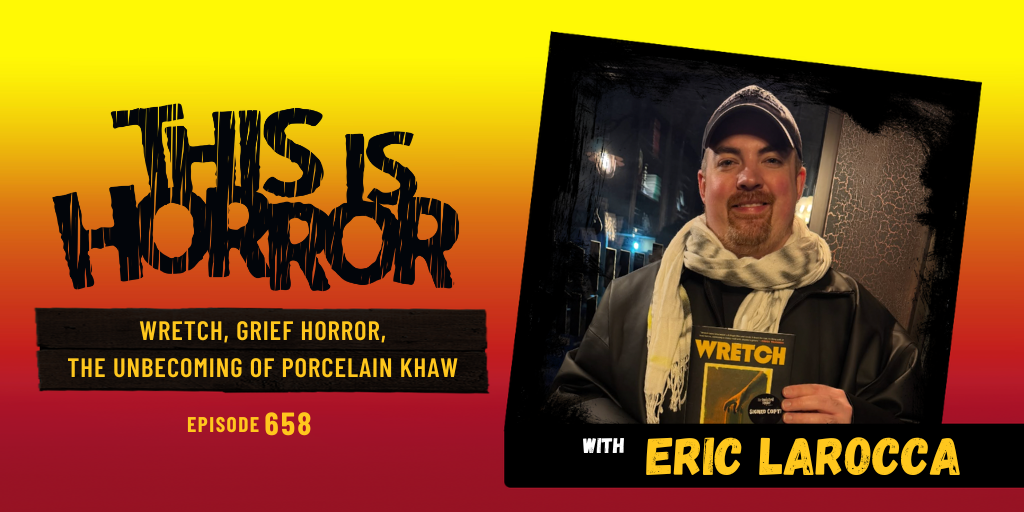
In this podcast, Eric LaRocca talks about Wretch, The Unbecoming of Porcelain Khaw, grief horror, and much more.
About Eric LaRocca
Eric LaRocca is a 2x Bram Stoker Award finalist and Splatterpunk Award winner. Named by Esquire as one of the “Writers Shaping Horror’s Next Golden Age” and praised by Locus as “one of the strongest and most unique voices in contemporary horror fiction,” LaRocca’s notable works include Things Have Gotten Worse Since We Last Spoke, Everything the Darkness Eats, The Trees Grew Because I Bled There: Collected Stories, and You’ve Lost a Lot of Blood. His latest novels are At Dark, I Become Loathsome, which has already been optioned for film by The Walking Dead star Norman Reedus, Burnt Sparrow – We Are Always Tender with Our Dead, and Wretch.
Timestamps
Thanks for Listening!
Help out the show:
- Support This Is Horror on Patreon
- Listen to This Is Horror Podcast on Apple
- Listen to This Is Horror Podcast on Spotify
- Rate and review the This Is Horror Podcast on Apple Podcasts
- Share the episode on Facebook and X
- Subscribe to This Is Horror podcast RSS Feed
Let us know how you enjoyed this episode:
- Write a comment below.
- Follow us and get in touch on Instagram @thisishorrorpodcast
- Subscribe and comment on YouTube @thisishorrorpodcast
- Follow us and get in touch on TikTok @thisishorrorpodcast
- Tweet us @thisishorror.
Resources
- Eric LaRocca fiction
- Watch the video version of This Is Horror Podcast episodes, including our conversation with Chuck Palahniuk on YouTube.
The Girl in the Video by Michael David Wilson, narrated by RJ Bayley
Listen to The Girl in the Video on Audible in the US here and in the UK here.
They’re Watching by Michael David Wilson and Bob Pastorella
Read They’re Watching by Michael David Wilson and Bob Pastorella right now or listen to the They’re Watching audiobook narrated by RJ Bayley.
Michael David Wilson 0:30
Welcome to This is horror, a podcast for readers, writers and creators. I'm Michael David Wilson, and every episode, alongside my co host Bob Pastorella, we chat with the world's best writers about writing, life lessons, creativity and much more. Today, we are welcoming back Eric larocker to talk about his brand new book, wretch. And to get you in the mood, here is the blurb from rising Horror Star and award winning author of things have gotten worse since we last spoke, comes a nightmarish, haunting, tech, Gothic frill ride about sorrow, memory and the unabashed complexity of love as a transgressive act. After his husband dies, Simeon link finds himself overcome by grief and seeking comfort in an unusual support group called the wretches, who offer an addictive and dangerous source of relief, they introduced Simeon to a curious figure known as porcelain car, a man with the ability to let those who are grieving have one last intimate moment with their beloved for a price, hallucinatory, fiendish and destructively beautiful wretch transports us to a world where not everything is as it seems, and those we love may be the ones who haunt us most. So that is wretch. And soon we will chat with Eric, but before then a quick advert
RJ Bayley 2:22
break, it was as if the video had unzipped my skin, slunk inside my tapered flesh and become one with me.
Bob Pastorella 2:32
From the creator of this is horror comes a new nightmare for the digital age. The girl in the video by Michael David Wilson, after a teacher receives a weirdly arousing video his life descends into paranoia and obsession. More videos follow, each containing information no stranger could possibly know, but who's sending them and what do they want? The answers may destroy everything and everyone he loves. The girl in the video is the ring meets fatal attraction for the iPhone generation, available now in paperback, ebook and audio from the host of this is horror podcast, comes a dark thriller of obsession, paranoia and voyeurism. After relocating to a small coastal town, Brian discovers a hole that gazes into his neighbor's bedroom every night she dances and he peeps same song, same time, same wild and mesmerizing dance. But soon, Brian suspects he's not the only one watching. She's not the only one being watched. Their watching is The Wicker Man meets body double with a splash of Suspiria. Their watching by Michael David Wilson and Bob Pastorella is available from this is horror.co.uk, Amazon and wherever good books
Michael David Wilson 3:40
are sold. Okay? With that said, Here it is. It is Eric larocker on this is horror. Eric, welcome back to this is horror. Hello.
Eric LaRocca 3:55
Thank you so much for having me. I'm so honored to be back and chat with both of you. This is like my favorite podcast, so I'm so so excited to be here.
Michael David Wilson 4:05
Well, it is always wonderful to have you here. And the last time we spoke was right at the end of 2025 so I want to know what have been the biggest changes or moments for you in 2026 so far, both personally and professionally, the good and the bad.
Eric LaRocca 4:30
Oh, great question. You know, 2025 was a great year for me. I had two books come out. I had a dark eye become loathsome come out in January, and we are always tender with our dead come out in September, and I did little tours for both of them. I really pushed myself a lot last year, and I really just want to do the same this year. And really. I challenge myself, meet more readers, broaden my readership. I feel like that's really important as a as a newer writer, you know, coming in and trying to, you know, we're all kind of competing for attention, right, like in in the the fiction sphere. So it's, it's wonderful to be able to, like, get out there and go on the road and, like, meet readers. But I think, like, the biggest change that's happened for me in 2026 is, I mean, the reason why we're here to chat today is my very first novel with a big five publishing imprint. You know, wretch is coming out in just a couple of days, and it's being published by saga press. And saga is an imprint of Simon and Schuster, which is one of the big five publishing houses. And I am like, so excited and so nervous for this, because a lot's like, riding on it, and a lot of you know, a lot of people have put a lot of faith in me, so I want to honor that, and I want to, I want to deliver, of course, but I also want to be like, kind to myself, and remember that you know, nothing's written in stone, and you know things are going to be what they're going to be. But I am really excited about this book in particular, and I really just want this year to be about more creativity. I want it to be me continuing to develop my voice as a as an author, you know, developing my skill set. Because even though people have, you know, I've chatted a lot recently with different readers and other authors, and a lot of told me, you know, when I open one of your books, like, I know, I'm reading, you, you know, and like, that's great. I love that people know, think I have, like, a distinct style, but I myself feel like I'm still growing and still learning, and I feel like I'm going to be growing and learning as long as I'm breathing, you know, I read a lot. I read a lot of different kinds of books. And I love picking up, like, tricks from different authors, and just like learning, like, okay, maybe I could do this. Maybe I could play with formatting this way, like, you know, to me, that's really exciting. So I want this year to be fun for me. I want to meet more people. And I also want to be, like, gentle on myself, like, not, not too crazy about, like, deadlines and pushing myself too hard. You know, how's the going?
Michael David Wilson 7:55
Gentle on yourself going. Because, historically based on previous conversations, that is not something that you're always so good at.
Eric LaRocca 8:05
Yeah, it's not going that great, so I'm trying, but it's not going as well as I want it to be. But that's fine. You know, I need to be gentle on myself, that realizing that I'm not gentle on myself, but that's totally fair. But yeah, I mean, I I'm just excited. I'm just honored that I'm able to write and do this for a living and and tell stories and interact with amazing people like you and Bob. So to me, it's, it's all really worth it, you know, it's, it's great.
Michael David Wilson 8:45
And of course, one of the big things you mentioned was now having this been picked up by saga press, one of the biggest presses in the world, you know, via Simon and Houston. So that begs the question, how did that come about? And is this a bit of a unique one in the sense that I believe you've got the UK edition from Titan and then the American edition via saga? Yes.
Eric LaRocca 9:19
So this came about, really. It started a couple years ago, back when I released things have gotten worse since we last spoke, through weird punk books, like the original the OG like 2021, edition with the iconic Kim Jacobson, like blue, surreal cover. This editor named Tim O'Connell, reached out to me, and at the time he was working at Knopf, which is another, like, big five publishing house, and he expressed, like, how much he loved the book. Things have gotten worse. Like, really appreciated it. Thought it was really compelling. Really interesting. Said he would love to see me do novel length work eventually. So flash forward a few years, and he approaches me and my agent, and is like, you know, he's now at saga. He's the publisher at saga, and he says, I would love to commission you to write a book for saga. And it could be anything you want it to be in the horror genre, horror thriller, fantasy, you know, that sort of dark fiction area that I'm known for. And of course, my agent and I were so excited, so overjoyed at the prospect of partnering with saga. So I went back to, you know, my desk, and was right here, and sat down and started to come up with different ideas. Things I wanted to say with this book, ideas I wanted to explore themes I wanted to examine. And I came up with rech and submitted a proposal to Tim not long after that, and he loved it. He said it was very Edgar Allan Poe esque, and very like Barker esque, very Clive Barker esque. And, you know, he had notes. He had things he wanted me to sort of refine and change throughout the process of actually writing it. But it was really helpful to have his expertise and his notes early on in the process, because I could kind of shape the narrative to what he saw the book being. And, you know, I shouldn't say like it was his vision entirely, because it was my vision of the book. He just really helped in the editorial process of, like, guiding me throughout that. And it's, it's been wonderful to collaborate with him. He is just like one of the most respectful editors I've ever worked with. I've gotten really lucky in that I've worked with amazing editors across the board. Every single one of them has been so influential and so helpful for me, while I continue to develop my skill sets as a writer, but Tim is just like a genius, like some of his notes and his insights are so so just beautiful and and astute. He's just so interesting, and he doesn't just work in horror. He works across the board. He does like literary fiction, he does science fiction, he does fantasy, he does horror. He is just like to me, he's like a renaissance man. He's just capable of so many things. And he actually edits Chuck palahniuks books for for for Simon and Schuster. So it's just really exciting to partner with him. He's just like a really great guy, and I'm really glad that it worked out that saga is publishing the US edition, and then Titan is publishing the UK edition. They've just been brilliant to work with both of them, and I'm really hoping that we can continue that partnership and just continue to release really dark, disturbing books into the world.
Michael David Wilson 13:33
Okay, so there's so many questions that I now have, but to keep it really simple, when you sat down to write the pitch and the proposal, what was the first element that you had?
Eric LaRocca 13:51
The first element I had for this book, I mean, the crux of the novel is essentially the idea of pursuing a dead loved one, someone who's departed so feverishly, so forcefully, that their spirit, their ghost, literally wants nothing to do with you. That's the that's the whole, that's like the main concept that I wanted to play with. And the genesis for this book really began back when I was like a teenager. I had been thinking of this book for so long, and I didn't even realize it. When I was like 1314, I developed a really close friendship slash mentorship with a very famous Hollywood actress who lived in my hometown in rural northwest corner of Connecticut, and this, this wonderful woman was a very decorated um. A actress who was on Broadway was nominated for like Emmys, I think she was even nominated for an Oscar at one point. She's She was so talented, so wonderful, and she like, took me under her wing and showed me what life could be like for me, if I stayed militant about my art and pursuing a life in the creative arts, you know, and it was wonderful. It was, it was some of the, you know, she took me to plays in Hartford, Connecticut, at like Hartford Stage. She took me to concerts in mass Massachusetts, like we, we went everywhere, and she just, like, showed me, like I said, like she showed me what life could be like if I stayed dedicated to my craft. And a few years later, after we first met and after we, you know, she was mentoring me, she passed away from breast cancer, so it was a really difficult and challenging time for me, just as a young person, you know, I was still discovering myself, like my identity, my like gender identity, my sexual identity, and To lose this person that was so important to me, so significant in my life, that had just like offered her friendship and her mentorship so selflessly, to watch her first deteriorate in a in a really unpleasant way right before my eyes, and then to eventually to lose her was so debilitating and so just grotesque, like I can't even describe it how awful it was to to witness it. It was so upsetting. And years after her death, I would reflect back on moments we shared together, and I would wonder if I was remembering them correctly. I was I was thinking like, you know, did I assign more worth to this relationship than she viewed, than she thought of me? You know what I mean? I really was so filled with with such self doubt about her mentorship and what she really thought of me and and that unsettled me quite a bit. And when I sat down to write what became wretch, I was really mindful of those, those doubts I had about this person that was no longer here, that I could no longer talk to, and I was wondering if I was misremembering them, and I was wondering if I put more worth into that relationship than was actually there. And that, to me, is really terrifying. That to me, is, like, really scary. And I think, you know, it's horror is, I'm desensitized to a lot of horror, so not a lot scares me, but things like that really do creep in and unsettle me. When I'm left alone and I'm left to, like, ruminate, that's that's what really frightened me. And I thought that's also like something that is accessible for a lot of people. I feel like a lot of people could identify with that, with losing a loved one, and the way grief can kind of distort memory and warp it in this really rotted, polluted way. And that's what I wanted wretch to be. I wanted it to be this like dark meditation on memory, grief and loss and the ways in which our loved ones, like pull away from us, the further we get away from their demises.
Bob Pastorella 19:04
Yeah, I think that you could even say that you didn't have to be a loss of a loved one. It's the loss of a relationship. Yeah? Because, you know, I mean that to me, that would be the most relatable thing. Yes, I've experienced from loss, losing loved ones and things like that, yeah, but, well, I felt that the most was having a relationship with a woman who, years later, while talking with her, thinking that we were still in a, you know, in a friendly way, you know her just basically says, I don't know why you put so much faith in me. I cheated on you every chance I had. And I'm like, oh so. And it's like, everything I felt was not reciprocated, yeah. And that's, that's, that's like, boom, that'll. Hurt your heart, man, you know. And I'm like, Damn, what did I do? You know? And it's like, it wasn't you. She's like, it's me, you know, yeah, but you and then you're left alone with your thoughts to ruminate. And so that's, that's where I got into wretch was, that's where the relatable was for me, is like the devastation that things were not reciprocated totally, and we feel we only see things from our side. Yeah, it's our perspective, yeah. And so our perspective is, is that we feel that everything should be equal, or there should be a equilibrium, an equity that is not sometimes it's not there, it's just not there.
Michael David Wilson 20:48
Yeah, yeah, the reliability, or the unreliability of memory and of past experience, is one of the most terrifying things. And you know, the more time passes between this moment and any moment, it's harder for me to know if what I'm remembering is a real memory or a distorted version, and edit a cut of that memory. And then, when you you know, when I was younger, if somebody said how I was remembering wasn't how it happened, I'd be adamant, no, it was, and I'd have trust and faith in that memory. But the older I get, the more it's like, whoa, shit. Maybe it didn't happen like that. You know, I don't know. And you can almost kind of start gaslighting or questioning yourself, particularly if you have very destructive thoughts about you know who you are, and it's like, I I just don't know. And yeah, that terrifying capacity to misremember or to put faith in people. And that brute or line that the woman said to Bob as well, I mean, you convey that remarkably within Reg,
Eric LaRocca 22:13
I appreciate that. You know, I this book is really difficult to write in a lot of ways, because it was very personal, and it was me revealing parts of my myself, my my character, my being. But I think, I think both of you are correct in this assessment that like perspective can be so skewed and it can be really difficult to parse through, like, what's the truth? And is there even a truth? You know, there's three sides to every story. There's your explanation, my explanation, and what actually happened, right? You know, so it's, it's, it's terrifying to think about how our memory and our sense of self can be, like, distorted in a way. And I feel like retch really plays into that. It really leans into that, that fear of like, Oh, am I? Am I misremembering everything? And is my perspective so? Am I so full of myself and so like convoluted that I'm that I'm assigning worth to something that's basically meaningless. And I
Michael David Wilson 23:28
mean, I wonder, when we're talking about wretch, it is very much a book of reflection of interiority, of character. And so you said, you know you were pitching it, you were presenting it to saga, but when the book relies almost more on character than plot, and you know that there is plot here, but what makes it special is this almost soliloquy, like quality from the protagonist. How did, how do you? How did you convey that in a pitch, and how much of it was character, character, and how much of it was plot beats. What was it you presented to them,
Eric LaRocca 24:21
I presented them a pretty thorough rundown of what I wanted this book to be, but I'll be honest with you, the original proposal that I sent was very different from what ended up being the final product that's being published on Tuesday This week. The ending was completely different. There were other elements there that I was playing with. I went in, like, a different direction in, like, the second act that my editor was like, I don't know if we should go this way, and it's like a little maybe too much for readers. And I really. Refined it quite a bit. So it was me kind of breaking down the plot, the arc of Simeon, going through his his descent into like, utter madness and depravity. But it was also the the interiority that you had mentioned like it was describing like his thoughts. It was describing what he was thinking, how he was ruminating. I think I even included like little snippets of like sentences that I wanted to write in certain sections. And, yeah, I I submitted as well, like, I think I submitted the first, like, couple pages of chapters one and two to my editor, and just to to, kind of like, gage what he thought of it. Um, the PROLOG was, like, really long at one point, and that had to be trimmed quite a bit, because my editor was like, we can't really have a 45 page prolog. That's just like, not possible. So I had to, like, edit that. But it was just like, you know, the every book is different. Every book takes its shape, its form, in a different manner. You know, I'm very ritualistic when it comes to writing, and I like to have certain rituals. But every book kind of tells me what it needs to be and how I need to serve it best when I'm when I'm writing. And I think even, like, I'd listen to Josh Malerman talk about that at one point, I think it was on this is horror, and he says that, like, he'll he'll work on books at certain times. Like, he'll work on, like, maybe this book he's working on, he'll work on, like, in the afternoon, because that's when it suits him best to work on that, and then maybe another book he'll work on, like, early in the morning, you know? So it's just like about finding my rhythm and finding what what is best for me. But I really do feel like the outlining process is really helpful for me to kind of gage where I'm going with this, what I want it to be, and then I can get off the leash and just like, do whatever I really feel like doing, and leave myself open for those organic moments when I think to myself, all right, let's see where this character is going to take me. And maybe I go off path a little bit, and maybe I, you know, divert down this way the ending sort of changed, like the very last minute while I was writing it. I don't know if we want to get into like, spoiler territory or anything, but maybe the second part of the episode we can get into that. But yeah, the ending, like, really shifted quite a bit during the during the actual writing process.
Michael David Wilson 28:01
Yeah, and as you know, we're always interested in the writing process and the mechanics and the routine. And I mean, when you pitched it, did you have a complete version of the book? Because you said that you submitted the first two chapters, you're saying that the ending changed. So did you actually have a full manuscript at that stage?
Eric LaRocca 28:29
No, I didn't have a full manuscript. I had the outline and, like, a few chapters, and that's basically how saga bought the book they I mean, my editor trusts me. He knows that if he buys a novel for me, I'm gonna deliver, and he's gonna get a novel at the end of however many months. You know, the contract states my book that's coming out in March of next year, 2027 is called brute, and it's the it's the same situation, like, I submitted a proposal and I submitted the first two chapters of that book, and it was the same sort of situation. He gave me notes. He's like, I really like this. I actually sent him two proposals for for the second book that I, I'm going to do with him. I sent him another concept that I didn't have, uh chapters written for. I just had, you know, the proposal, the outline for it, and then I had the proposal and the first few chapters of brute written, and my editor was like, Well, it seems like you're really invested in this one concept called brute and I really like what I've read from you so far with this. I really think it's an interesting idea. So let's go for it. But it all comes down to like, the hook. You know what? Really hooks you. And for my editor, that's really important. He loves, like, he loves, like, a really clean, interesting, compelling hook. I mean, don't we all? And he really wanted me to, like, go big with with both of these books. He wanted me to to really, like, try to stretch myself artistically. And, yeah, it's it's been a great process so far,
Michael David Wilson 30:28
and we will, perhaps towards the end of the conversation, talk a little bit more about brute but I do love how you've gone from having these poetical, ornate titles to just these one word titles, wretch and brute, and it really conveys something different. But on the strength of rich, it completely fits the
Eric LaRocca 30:56
reason we did that was because I'm publishing simultaneously with Titan books, like Titan books has the rights for several of my novels still in the United States and the UK. And what we wanted to do, Tim and I really wanted these books that we partnered together on at saga to have a different sort of esthetic and feel and vibe. So we, I, I approached him and I said, like, I really think we should do, like, a one word title for the books that we do together. While Titan is publishing like the burnt Sparrow trilogy, they're also publishing another book of mine in like 2028 called each living thing is here to suffer that's going to come out in the US and the UK through Titan. So I love those, like long, wordy, Baroque, poetic sounding titles. I love, I love any title that sounds like a Jalo film title. You know that, to me, is just like, really cool, and I feel like I'm known for that now, but I really wanted these books to separate themselves and be like their own thing and be I wanted it to be like a level up too, like I wanted it to be like a new level, for me, a new like artistic era, in a way.
Michael David Wilson 32:19
And I think, to coupling wretch with the cover and just with the character name porcelain core, there's almost a juxtaposition. And it really did for me, create immediate intrigue, because I feel that something called wretch and that cover and porcelain core, they shouldn't coexist. They shouldn't go together. It was almost a contradiction. So I had no idea what I was going to read when I opened it up. But I also would say, I mean, it was one of the one of your books that I instantly just got and got into and was hooked from the off. So it was interesting for me to read that in some of the literature that it was described as a slow burn, because for me, I felt instantly at home from the start. Oh, I love
Eric LaRocca 33:21
to hear that. I mean, I think of it as sort of like a slow burn someone, someone, a friend of mine described it recently to me as, like my most patient novel. And I like that. I think that that kind of that illustrates what I'm going for. I think some people maybe are turned off by the phrase slow burn. But for me, a slow burn usually means like a really good reward at the end of it. And I feel like this book, hopefully, I feel like it has a really great reward at the end of it. For readers,
Bob Pastorella 33:59
I don't feel that slow burn is, like a derogatory term. It is complimentary. When I when I say anything is slow burn, people go, they go, and I'm like, What are you talking about? It's, it's a slow burn its own category. Yeah, yeah. I was trying to think of what the classic Eric Larocca title would have been for rich. When I haunt you, I become wretched, or something like that. What would be the what would be? But that's, that's like, damn near gives the book away.
Eric LaRocca 34:31
That's a good one. Though I like that. I like it,
Bob Pastorella 34:34
but, yeah, that's, I wanted to comment on that, because that going to those one word titles is, is is like, I don't know it is. It's leveling up. It's not like, Hey, I'm streamlined, I'm I'm, I'm at the net, I'm at the next level, you know? And it's like, I didn't feel that. It was a slow burn. And I mean this complimentary, I got invested pretty quickly. As well, anytime that you get into an online group that is the wretched that meets, because they're they might see, you know, I don't know if I'm getting into spoiler territory here, but I think that basically, you know, they in imagery, they see pictures of their departed loved ones. I'm like, fuck dude that's make a movie about that. Like, I'm in. The hook was you were reeling me in by then, I was like, Man, that's tight. I like it.
Eric LaRocca 35:32
Thank you. Thank you. I appreciate that. I mean that that was a really early component of the book I wanted to explore, like the idea of this, this group of people that, like, obsess over photographs of inanimate objects. I think it's a really striking image, literally, you know. And I love, I incorporate, like, subcultures in my novels and short stories quite a bit like the short, the novella, all the parts of you that won't easily burn from the skin was once mine is about like a group of glass fetishists who think, like, believe that transcendence comes from like, inserting little bits of glass into themselves, Like, I love any sort of small group or like little community that just shares this weird delusion with one another. I think that that's really terrifying in a lot of ways.
Michael David Wilson 36:32
Yeah, definitely, yeah for me, wretch is for fans of Lars von Trier, Clive Barker and Chuck and Chuck Palahniuk. And you know the Chuck Palahniuk element that's particularly relevant is what you're talking about, the grief photography therapy group, the wretches. So did you draw any real life therapy groups as inspiration for this.
Eric LaRocca 37:02
I don't think I really drew from anything like real life. I think what I was really fascinated by was the idea of a group of people, like I said, like sharing this really strange, peculiar delusion with one another. I think that that's really fascinating and really interesting in horror, when people become so convinced of something, and it's like that film st Maude. I don't know if you've seen st Maude, but st Maude was such a great film from a couple years ago, and she's just like, so convinced that she needs to, like, save the soul of this one woman that she comes in contact with. And I love anything that interrogates that and kind of showcases people behaving really poorly because of their own like, way of thinking and and, and how they kind of reason and think they think they're being logical, but they're really not. You know, it's just like so fascinating to watch that dissent. And yeah, I think the wretches, they're obviously like a very big part of the book. And I wanted them to have, like, a lot of page time. I wanted to keep porcelain Kathe kind of, like backstage, like off the stage as much as possible, almost like Dracula from Bram Stoker's novel, like, you know, he doesn't appear much throughout the course of that novel at all. And same with the hell priest in Clive Barker's the hell bound heart, he's not really in it that much. I think there's something to be said about any sort of like villain or like evil entity that is the main focal point of a book, but not being present as much as possible, even the new remake of Nosferatu like he's not really in it that much. He doesn't have, like, a huge amount of screen time, but he his his presence throughout that movie is like nearly suffocating. Even when he's not on screen, you're still thinking about him, and you're you're still seeing like little bits of him in, like the scenery and like the background.
Michael David Wilson 39:31
There was a real Mystique surrounding poor Celine car that meant that really up until towards the end, it's like, is porcelain car real? Is porcelain car an entity? Is porcelain car a kind of mythology. What is porcelain car? And I mean, I think particularly the intraday. Production with a a story involving, let's say, a slave boy. And actually that that story was perhaps the bit where I felt most uncomfortable when you realize what could happen to that child at the time and what they could be brought up in. And that was very confusing too, because it starts off as if this is real, then you're told, okay, but this is just a story. But then you remember, I'm reading an Eric laro book. I'm not so sure. You know there was real, just unreliability, with the narrator not knowing what is and what isn't real.
Eric LaRocca 40:49
And it worked. I mean, that was intentional. I mean, I wanted this book to be a mind fuck. Obviously. I wanted it to be one of those books where you're like, What the hell is happening? Almost like a David Lynch film. There's one book that I mentioned in the like afterward of wretch where I recommend, like all of the different books and films and music that I really like, sought out and enjoyed while working on this novel, and one of them is called the dumb house by John Burnside, and that features a very unlikeable, really unreliable narrator. And I really wanted to echo that book with with wretch and Simeon and how unreliable and how deviant he is. I think it's interesting. Sometimes people, you know, they're they're really uncomfortable about following an unlikeable narrator, but I don't know, I find unlikeable narrators, like really fascinating and compelling no matter what. And I think there are writers who do them really well, like Chuck Palahniuk does an unlikeable character really brilliantly. Poppy. Z bright does, of course, Kathe Koja, you know? I mean, the list goes on and on, and it's funny, I kind of had a moment this past January, December, the end of last year, beginning of this year, where I was kind of getting a little burned out with horror in general. And was just like not, not really finding anything that was speaking to me, that was really challenging me. And I thought, you know, I'm going to go back and reread some Kathe Koja books, and just kind of relight, reignite that fire, that like spark of interest in the genre. And I reread Bad Brains, and I reread strange angels, and I reread skin and I reread the cipher, like back to back to back. And it was just like a master class in unlikable, terrible characters and how to write them like in this compelling, propulsive way. I mean, she is just such a master at writing the most loathsome people possible. But you can't help but you can't help but follow them into the darkest pits possible. You know, to me, she is just like an absolute icon and a genius. So for anybody listening, if you haven't read any of those books, I highly recommend them. They are like the high watermark of the horror genre. I think
Bob Pastorella 43:43
you hit the nail right on the head with compelling we hear this a lot, and you see it on social media with writing groups and things like that. They talk about lying. What a likable character. No, you don't. You really don't. We read, we read the cipher partly, part of the reason why we read that book is because we can't stand Dakota. So, you know, I mean, and it's like, we want to know what the fuck she's gonna come up with next, right? And so, but in real life, it'd be like, I don't hang around with that girl. No, yeah. No, no way, yeah. I mean, we would love to have Hannibal Lecter cook us dinner, as long as we brought him the food, right? Okay, yeah. So in other words, like, but, but when knowing what we know, it's like, no, I'm not gonna go there. Neat. I'm bringing you the meat, and you're gonna cook this meat for me, you know. And I'm not gonna become dinner. So, yeah, we don't need likable characters. We want compelling characters that we cannot stop thinking about. Those are the ones that we can scare the shit out of. And if you're in, if you have, if you're a normal person, and you. Of empathy, then you will also feel scared. And that's how you write scary shit, you know. But, I mean, that's to me, I can't think of any other way. You can't write a jump scare on a page unless you're Stephen Graham Jones, so. But, you know, compelling you hit, that's it, right there.
Michael David Wilson 45:21
Yeah, and when you talk about having an effect on the reader, I mean, in some ways, this has that Texas Chainsaw Massacre effect, or this not forever, but for now that there's almost a trick that you're feeling, that you've seen more brutality than you actually have. I mean, you've got, as we said, this interior agony. So I mean, talk us through creating this effect where you want the reader to feel as if they've really been pulverized with everything that's happened, but actually holding back, because this does hold back for Eric larocker story, yeah,
Eric LaRocca 46:09
that's true. I'm glad you mentioned that. I mean, there are elements that are very dark and visceral and disturbing in this book, but it's not my usual splatter punk fare. You know, it's very much like in a different sort of lane. It still has elements of like body horror and psychological horror throughout, like, laced throughout the narrative, and especially toward the end, when things get really unhinged. But yeah, I mean, as far as, like, crafting this character and what I wanted people to feel throughout the course of the book, like I definitely wanted people to feel like suffocated while reading this novel. I wanted people to, you know, almost feel like they were like, trudging through like, this black goo that they just, like couldn't escape from that like, you know, every time they would wipe themselves and, like, try to clean themselves from it, like it would just get stickier on them and just like, kind of weigh them down. And by doing that, I mean, I think, like, repetition plays into that, which is something I did with a dark eye become loathsome, just like repeating the same mantra over and over again. But in retch, I really feel like he kind of has these like spiraling thoughts that just sort of like circulate in his head, and he just goes over them, and he like perseverates like again and again and again. And I feel like that, hopefully that helps people kind of feel that, like suffocating dread that I want people to feel. I mean, I feel like this book has, like a lot of it has like a lot of atmosphere, but it also has like, a lot of dread and unnerving qualities to it. And it is, you know, I do feel like it is a little bit of a slow burn in some areas, because it is more him, like ruminating, him being very introspective, being very, you know, he's meditating on these things that are horrible in his life, and these losses that he's faced. So I think for me, it was really important to kind of illustrate him as this broken person. And I don't expect people to like him. I don't expect readers to to you want to like go out for drinks with him. I don't think he's necessarily like a good, upstanding person, but I really hope that people have, like, a sense of empathy for him, because he is someone who suffers from these, like horrible, intrusive thoughts. And, you know, sometimes I feel like I feel like we misplace our empathy sometimes, and I feel like we, we expect the worst from people more than anything else. You know, we don't, we don't have a lot of grace for one another. And I feel like reading, reading literature, just any kind of literature. I think it broadens your horizons, and I think it makes you more empathetic for people who you don't really understand, but you can at least say, like, you know, I I can appreciate your circumstances, what you're going through. I totally see and validate you. And I think that that's really important. That's why I think it's important to read broadly and like outside of your preferred genre.
Michael David Wilson 49:42
Yeah, we've mentioned a couple of times, and you just mentioned now at dark I become loathsome. And I feel, in many ways, wretch is a companion piece to at dark I become loathsome. I mean, they're both firmly in this group. Horror camp, they both are ruminating on grief, on sexuality, on the human condition. And so I wonder, do you also see these as companion pieces? And if so, did you know from the off just how linked these pieces were going to be,
Eric LaRocca 50:22
I think I knew that they were going to share, like, similar DNA. I didn't realize, like, how much they were going to be, like in conversation with one another. And I think that that's, that's not necessarily a bad thing, that being said, I feel like I've said pretty much all I have to say about grief and loss in this book. And I my my future books don't deal as heavily with grief, because I really feel like I kind of got it all out of my system with this book in particular. But that being said my I almost view it as like a unofficial trilogy, like at dark I become loathsome wretch and then brute coming out next year. They're all about queer men who are suffering these like really horrible intrusive thoughts and these obsessions. And I really feel like all three of those books share the same sort of DNA. And I think it's, I think it's interesting when authors do that, when I, when I think of authors who, like, explore the same sort of like themes and obsessions that they come back to, like, pretty frequently, but in like, different books, right? Like, I think that that's really interesting. And, yeah, I think that it's this like unofficial trilogy that I've unwittingly created, like, with starting with that dark I become loathsome, and then going into wretch, and then finally, brute. So I'm, I'm definitely excited to see how, how these these novels are received, like, further down the line, I mean, they're not like I said, like, they're not likable characters, but I hope that they're compelling for people to pick up and and empathize with them a little bit.
Michael David Wilson 52:23
I mean, you're just selling me more and more on brute even though you've technically not said a lot about it thus far. And yeah, I definitely think that they're compelling characters. I think as well, they're intriguing characters you want to find out what happens next. What did they do next? What other parts of them unravel? And I was actually, before this interview, trying to think about, why do I love wretch, and why do I love at dark I become loathsome, because you know what on the surface? I mean, you could say, well, these are horrible novels. There's been horrible themes and the worst aspects of humanity, but I think probably it's because of their unflinching honesty. It's because they don't shy away from the ugliness, because they are authentic, because they're giving us something real. You're not trying to, you know, to use awful analogies to sugar coat or to make things any more palatable. It's like, this is the human condition. This is what's going on.
Eric LaRocca 53:38
I think it was Chuck Palahniuk who was on your podcast, and said something along the lines of, like, if you're going to write about violence, you have to go there. You have to really go there and not sanitize it and be unflinching. Like, don't fucking flinch when you write about this stuff. And it's so true. I mean, it's something I hold in my heart whenever I'm creating. And it's funny like I a reviewer posted on Instagram recently about this book, and they wrote this really eloquent review about wretch and what it meant to them and how they felt validated and seen for their own grieving process. But they said something along the lines of, like, I'm paraphrasing so it's not exactly what they said, but they said something along the lines of, like, Eric isn't asking you to sympathize or like, condone these things that happen in these books, especially wretch, but he's asking you To simply look and sit with the discomfort you know, like that's so important to me to just look and not flinch and not look away. That, to me, is, is what horror does best. Horror makes us look at the wreckage and the the brutality UNFOLD THE. Play and not shy away from it.
Michael David Wilson 55:03
I mean, that's a beautiful way of putting it. And I mean, you've said before as well that there is a need, almost, for you to be uncomfortable when you're writing, to feel that discomfort. I'm wondering, along those lines, how do you balance your own personal comfort and discomfort in both writing and life?
Eric LaRocca 55:34
I think it's a bunch of different things. I mean, I have a lot of things in my toolkit that help me, but I mean, first of all, just having, like, I think I've said this before to you, like, having a really support, a really great support system behind you is so important. You know people who are in your corner, who are cheering you on, who are maybe they're not going to read what you write, because it's too much for them, but they love you unconditionally, and they want the best for you. That, to me, is really important. I mean, there are other things too, like my writing ritual, like I love getting my cup of tea in the morning, you know, scrolling for a little bit on my phone, doing a walk around the neighborhood, and then coming sitting here at my desk and starting to work on whatever project I'm going to be working on for today, I mean that to me, is really comforting. The the act of writing is comforting for me. You know, the actual act of sitting down in this chair and typing away at this keyboard and knowing that the ideas, the concepts I have in my brain are transmitted through these hands down onto this keyboard while I'm creating, you know that to me, is a comfort. It's uncomfortable when I'm writing about things that are very personal, very vulnerable to share with people, but in a weird way, like the actual act of writing is a balm for me and a way to exercise a lot of these demons, this unpleasantness that's like festering inside me, and it feels A bit like a purge, getting it all out. It's, it's like, the best feeling in the world when you do it right, when you sit down at your computer and you get a scene done, you get a chapter done, and you're like, Wow, I feel like, 10 pounds lighter. You know that, to me, is like, really worthwhile.
Michael David Wilson 57:42
Thank you so much for listening to the first part of our conversation with Eric larocker. Join us again next time for the second and final part, in which we dive even deeper into wretch and learn a little bit more about both brute and the second burnt Sparrow book. But if you would like to get that and every other episode ahead of the crowd, and you want to support the longest running horror fiction interview podcast, then become a patron a patreon.com forward slash This is horror, as well as early access to each episode, you get to submit questions to each interviewee, as well as bonus patron exclusive episodes. Now, before I wrap up a quick advert break
Bob Pastorella 58:36
from the host of this is horror podcast, comes a dark driller of obsession, paranoia and voyeurism. After relocating to a small coastal town, Brian discovers a hole that gazes into his neighbor's bedroom every night she dances and he peeps same song, same time, same wild and mesmerizing dance. But soon Brian suspects he's not the only one watching. She's not the only one being watched. They're watching is The Wicker Man meets body double with a splash of Suspiria. Their watching by Michael David Wilson and Bob Pastorella, is available from this horror.co.uk Amazon and wherever good books are sold.
RJ Bayley 59:15
It was as if the video had unzipped my skin, slunk inside my tapered flesh and become one with me.
Bob Pastorella 59:23
From the creator of this is horror, comes a new nightmare for the digital age. The girl in the video by Michael David Wilson, after a teacher receives a weirdly arousing video, his life descends into paranoia and obsession. More videos follow, each containing information no stranger could possibly know, but who's sending them and what do they want? The answers may destroy everything and everyone he loves. The girl in the video is the ring meets fatal attraction for the iPhone generation, available now in paperback, ebook and audio.
Michael David Wilson 59:53
Well, to conclude the episode, I would like to end with a quote, and this is take. And from Sayaka murata's Life ceremony. I mean, normal is a type of madness, isn't it? I think it's just that the only madness society allows is called normal. And on that note, I will see you in the next episode for part two with Eric larocker, but until then, take care of yourself. Be good to one another. Read horror. Keep on writing and have a great, Great Day.