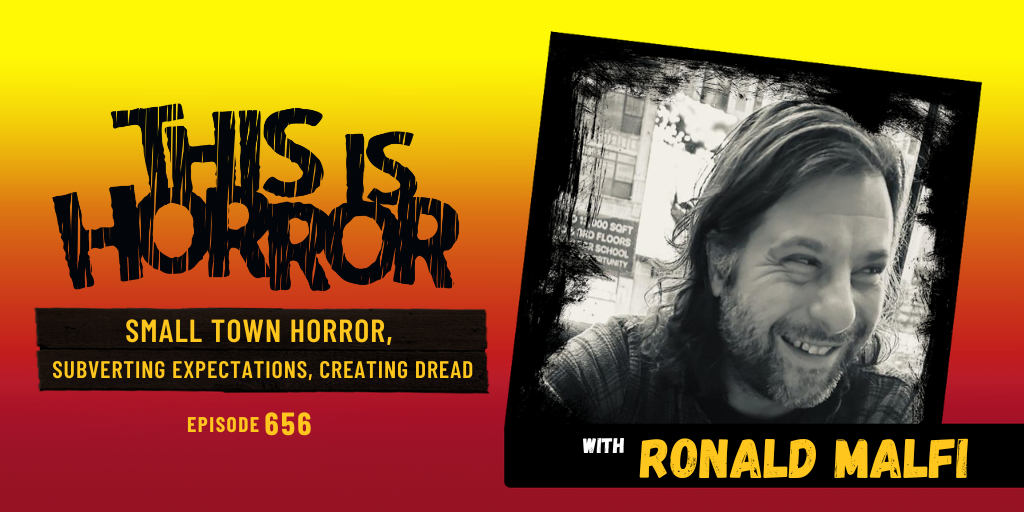
In this podcast, Ronald Malfi talks about Small Town Horror, subverting expectations, creating dread, and much more.
About Ronald Malfi
Ronald Malfi is a New York Times and USA Today bestselling author of horror novels and thrillers. He is the recipient of two Independent Publisher Book Awards, the Beverly Hills Book Award, the Vincent Preis Horror Award, the Benjamin Franklin Award for Popular Fiction, and his novel Floating Staircase was a finalist for the Bram Stoker Award. In 2024, the Maryland Library Association presented Malfi with the prestigious William G. Wilson Award for Adult Fiction. Most recognized for his haunting, literary style and memorable characters, Malfi’s dark fiction has gained acceptance among readers of all genres. When he’s not writing, he’s fronting the rock band VEER.
Timestamps
Thanks for Listening!
Help out the show:
- Support This Is Horror on Patreon
- Listen to This Is Horror Podcast on Apple
- Listen to This Is Horror Podcast on Spotify
- Rate and review the This Is Horror Podcast on Apple Podcasts
- Share the episode on Facebook and X
- Subscribe to This Is Horror podcast RSS Feed
Let us know how you enjoyed this episode:
- Write a comment below.
- Follow us and get in touch on Instagram @thisishorrorpodcast
- Subscribe and comment on YouTube @thisishorrorpodcast
- Follow us and get in touch on TikTok @thisishorrorpodcast
- Tweet us @thisishorror.
Resources
- Ronald Malfi fiction
- Watch the video version of This Is Horror Podcast episodes, including our conversation with Chuck Palahniuk on YouTube.
The Girl in the Video by Michael David Wilson, narrated by RJ Bayley
Listen to The Girl in the Video on Audible in the US here and in the UK here.
They’re Watching by Michael David Wilson and Bob Pastorella
Read They’re Watching by Michael David Wilson and Bob Pastorella right now or listen to the They’re Watching audiobook narrated by RJ Bayley.
Michael David Wilson 0:20
Welcome to This is horror, a podcast for readers, writers and creators. I'm Michael David Wilson, and every episode, alongside my co host, Bob Pastorella, we chat with the world's best writers about writing, life lessons, creativity and much more. Today we are chatting to Ronald Malfi, who wonder this is horror novel of the year 2024, for small town horror. Now, as well as small town horror, we talk about Ron's early life. His writing influences, his writing routine, and a lot, lot more. Now, for those of you unfamiliar with Ronald Malfi. He is a New York Times and USA Today, Best Selling Author of horror novels and thrillers, including small town horror, December Park come with me and black mouth, to name but a few, he is most recognized for his haunting literary style and memorable characters, and malfie's Dark fiction has gained acceptance among readers of all genres. When he is not writing, he is fronting the rock band via so that is a little bit about Ronald Malfi before we get him on the show. A quick advert break.
RJ Bayley 2:11
It was as if the video had unzipped my skin, slunk inside my tapered flesh, and become one with me.
Bob Pastorella 2:18
From the creator of this is horror, comes a new nightmare for the digital age. The girl in the video by Michael David Wilson. After a teacher receives a weirdly arousing video, his life descends into paranoia and obsession. More videos follow, each containing information no stranger could possibly know, but who's sending them and what do they want? The answers may destroy everything and everyone he loves. The girl in the video is the ring meets fatal attraction for the iPhone generation, available now in paperback, ebook and audio from the host of this is horror podcast, comes a dark thriller of obsession, paranoia and voyeurism. After relocating to a small coastal town, Brian discovers a hole that gazes into his neighbor's bedroom every night she dances and he peeps same song, same time, same wild and mesmerizing dance. But soon Brian suspects he's not the only one watching and she's not the only one being watched. Their watching is The Wicker Man meets body double with a splash of Suspiria they're watching by Michael David Wilson and Bob Pastorella is available from this is horror.co.uk, Amazon, and wherever good books are sold.
Michael David Wilson 3:29
Okay, without said, Here it is. It is Ronald Malfi on this is horror.
Ron Ronald, welcome to this is horror.
Ronald Malfi 3:44
What's up, fellas? Thanks for having me on. This is great.
Michael David Wilson 3:48
Yeah. It is a pleasure to have you here, and we are going to be talking about small town horror, which won the this is horror novel of the year award for 2024 but before we do that, I want to go all the way back to your early life lesson. So I'm wondering, what did you learn growing up? Nothing.
Ronald Malfi 4:14
I didn't learn anything growing what I learned growing up? I mean, I'm the oldest of four kids. My parent, we grew up in, you know, it was born in Brooklyn, New York. We were because my mom had her hands full with a lot of kids. You had to occupy yourself. And I was an avid reader, you know. So I gravitated towards, you know, books. I love horror movies, music. I was a big music guy. You can see my guitars back there, you know. So my early life was really spent dealing with family, negotiating with family, working, you know, becoming very, you know, I'm very close with my parents, my siblings. Yeah, but it was also an exercise in finding myself and what, where I found joy doing things on my own. Because a lot of times when you're in a big family, you know, you seek out those moments where you can just be by yourself. And I did a lot of stuff like that. I mean, writing, drawing, just learning to play music, or just listening to music, anything to kind of like escape and be alone for a bit and with, you know, and with your thoughts and and my dad was a secret service agent, so we traveled. We he relocated a lot when we were younger, so I lived in about four or so places before I was like, the age of 10. You know, I know some military folks have got me beat, but for me, it seemed like a lot, and then we ultimately settled in Maryland. And, you know, from 10 years old on, this has been my home, and most of my fiction is set here. I know this area. You know, inside and out that the people, the culture, the climate, you know, the vibe of living here, I'm right on the Chesapeake Bay, so it's got that kind of lackadaisical boater vibe thing going. I don't put on pants if I don't have to. So, yeah, I mean, that sums me up right there. I think I gave you everything, everything about my life, right? You can just, it's a very short autobiography, but yeah,
Michael David Wilson 6:30
yeah, if you're
Ronald Malfi 6:31
gonna laugh that loud, Bob, you got to unmute yourself. I can see you, that
Michael David Wilson 6:38
is. And I mean, when you were kind of growing up and you were absorbed in art and music, what were some of the stories and the films and indeed, some of the bands that you were listening to?
Ronald Malfi 6:52
I mean, everything was all over the place. As far as bands I was listening to, man I listened to like, I'm 48 so, like growing up, I listened to everything from the 1950s on like I was listening, I was listening to Jerry Lee Lewis when I was in high school, just because I was fascinated with the sound of the piano. You know, I love 90s alternative rock, like grunge. You know, when that movement hit that like really spoke to me. You know, I love Instrumental Jazz, you know, I listened to a lot of that when I was a kid, classical music, movie scores, you know, all I listened to, everything I remember, and I would get fix it. I used to write a lot when I was younger, too. And some of the things I wrote were sort of first drafts of what, years later became some of the novels of mine. And like, I wrote a book called The Narrows. But when I was a kid, like in high school, the first draft of that book was, you know, was the Narrows. It had a different name at the time, but I remember writing it furiously listening to John Cougar Melvin camp's scarecrow album, front to back, over and over again on repeat. So the music was all over the place. Movies were, man, I, you know what? I loved 80s horror. I loved 80s slasher films, 80s you know, anything from the from Gremlins to the movie house with with William Kathe. You know, everything from that. I my greatest joy was like when mom said, Hey, we can go to the video store on a Saturday night, pick out whatever you want. It wasn't even blockbuster. Video is a local place called arrows video, and they had these big Styrofoam containers these movies were in. I just remember, like looking at all the all the movie covers. And I, you know, just summon the courage to pick the one cover that scared the hell out of me. And I'm like, Alright, I'm gonna sit through this movie and watch it. So I loved all that stuff. And then, and then with books, you know, Stephen King was like my gateway drug to reading, really, like adult fiction I was a kid, and the first book of his I read was eyes of the dragon, which is a weird place to start, but I didn't know anything about him. And and then I read a couple of his other books after that. And then I after that, I just started reading anything I get my hands on. I mean, my grandparents had a box of like Readers Digest versions of books in their their garage. I read those. I remember finding a copy of Lolita. I read that. I was like 12. I didn't understand it, but I'm I would just devour these books. Yeah. I mean, so like all of that stuff, I think was really it was very eclectic, because I think in each of those avenues, I was always looking for to max out the input right, like I wanted to get, I wanted to get as much of what I could that was out there in me to kind of learn from it. And it just excited me. I really enjoyed. I love to I always love to read. I love to listen to music. And I and movies were always a blast. So, yeah. I mean, everything is the answer. Yeah.
Bob Pastorella 10:05
I remember those Readers Digest books, and when my when I was younger, just like you, I was reading them, and I didn't realize that they were like condensed versions of the books. And I would reread a book, going, there's a lot more in this paperback than there was in the Reader's Digest version. They skipped me.
Ronald Malfi 10:24
I do, and I have a love hate relationship with that, because I did find a bunch of them early and read a lot, and then when I learned what condensed, you know, or abridged novels were, I'm like, fuck this, you know. Like, yeah, I mean, and the same thing with audiobooks. I don't know if they do that anymore, but it used to be, back in the day, like, you know, recorded books would put out these books on tape, and some of if you weren't careful and didn't read the binding, you didn't know if you were getting an abridged book. And I remember listening to Carl sagan's contact, and I didn't realize it was abridged until I also then got the novel and read it. I'm like, what, what is, what is this nonsense? Who does this? What monster cuts out pages from a book? Yeah. So I think it was fine.
Bob Pastorella 11:13
I think that with, like, some of the the audiobooks, I think, like, Peter's drops the throat, yeah, I think there's an abridged version of that. I think that's the only audio book version of it, and so it's like the throat in like four hours. I'm Dude, this is the 800 page novel. There's no way you know, do that.
Ronald Malfi 11:35
That's monstrous, monstrous.
Michael David Wilson 11:38
Yeah, I think we're fortunate that we don't see a lot of that these days. There's not so many abridged versions. When you go in on Audible or whatever audio,
Ronald Malfi 11:51
play them faster so you don't need the abridged version. You can just hear them talk. Yeah, yeah. It comes to the same thing, yeah.
Michael David Wilson 12:02
I wonder. You know, how on earth they make the decisions which parts to cut out? Because it's like, Well, this has already been through an editorial process. If there were things to cut, it was cut exactly.
Ronald Malfi 12:15
Who knows? You're at the behest of some knucklehead over it recorded books going, you know what? I got lunch in an hour. Let me I don't know they don't need this chapter like I don't trust it. So read your bindings, kids, yeah,
Michael David Wilson 12:29
and to have been writing from such an early age, and to have written, you know, a version of the narrows in high school, I mean, does this mean that you always wanted to be a writer was that something that you set your mind to from an early age?
Ronald Malfi 12:46
I did, you know, I got my first typewriter at a yard sale when I was like 10 or 11 or so, and I just wrote short stories on it. And those short stories progressively got longer and longer, and I remember when I hit the double digits, and I remember when I wrote my first 100 pager, you know, and making my poor, you know, parents and my friends read this stuff and but I know I did. I always, I did, always want to be a writer. And when I got older, there are a couple of books of mine that I wrote when I was in high school. The first draft of the narrows is one of them, another book December Park I wrote when I was originally the first draft of that was in high school. It was different title, different story, totally revamped. But the seed of what that was was was written back then. And really, why I wrote December Park was, it's just about a group of friends who are trying to track down a killer in their town, and I wanted my friends to read the stuff I was writing. And, you know, these are high school boys, they don't want to read, especially over summer break, so I put them all in the book, and I'm like, You're all a character. Read the book, so that's how I got them to read it. But yeah, I did. I've always wanted to write. I went to, you know, by the time I graduated college, I had, I don't remember, anywhere from four to six novel length manuscripts written. And I just chose the, what I thought was the best one, and shopped it around and eventually sold it to a small press. And that kind of set me on, you know, sort of the path of doing it. I kind of half heartedly joke and say I was able to achieve that because I was too naive to think it was impossible. Like I just assumed, well, I'm going to be a writer some day, so I'll just get there. And I stupidly did, somehow, not realizing that it's impossible to do. But yeah, so it was a, I think, had I been a little more worldly and intelligent and maybe just even older, I would have, you know, I could have given it up, but I was, I started so young that it never dawned on me that I wouldn't be a writer. So I guess could. Goes to the stupidity of youth.
Michael David Wilson 15:02
Well, what you're saying here seems to be a recurring pattern that we hear with people where there is naivety, and it's like if we realized the absolute amount of work and the relative lack of payment, at least early on, none of us would set out to be a writer. It is a foolish endeavor, and yet, here we are,
Ronald Malfi 15:27
yeah, and you know, and I remember, you know, I remember thinking when I was younger, late teens, early 20s, college age, whatever, if I could just survive writing and have that be my thing, then I would be very happy. And I recognize that it's, it's tough to do, you know at the time, I recognize it, but I also, like I said, I was, I was naive. I didn't understand, really, what it entailed. And you see these other writers doing it. You read books written by authors you like that are about writers, and these writers are always successful. So it just seems like, well, that's the way to go. And to this day, like I'll talk to you, I'll go to a book signing, and I'll meet readers, and they'll come to the table and they talk to me as if they assume I live on a castle, in a castle somewhere, and I'm just pumping out these books. And life is like, life is grand, you know, it's hard. It's, you know, it isn't the glory that I think people from the outside think it has, and it is a lot of hard work, and it's a lot of, it's a lot of, it does become a job, and you lose perspective of the love you had for it to a degree. And I know I'm sounding a little jaded now, but from when I was younger. So there are moments where now, at my age, where I have to, I do, take a pause and go, you know, hey, look, I'm in a bookstore. I'm signing books. There's a whole shelf over there in the Barnes and Noble I've got all my books on the shelf, and 15 year old Ron would be doing backflips right now to know this is where he ended up. So I try not to get too jaded and go, Well, now I got to drive here like we were talking earlier. Before the show starts, I got to get up early, and I got to drive to this place, and I got to go here, and I got to do this event. It is work. It because it becomes a job. But I try not to lose sight of I'm also toting around the kid inside me who is very happy to be able to do this. I'm very lucky to be able to do this as well. So yeah,
Michael David Wilson 17:29
what do you think the defining moment or the defining release was for you, where this became a job, or where you thought, you know, shit, I'm not just telling stories. There are other elements to this career,
Ronald Malfi 17:44
you know. I mean, I think it's two parts. I think it's a gradual process that you kind of look back on and go, Oh, okay, yeah, that's how it went. But there's also a sudden moment too, where, you know, for me in my career, where I went from doing a lot of small press work to doing, you know, getting mass market deals and stuff like that. And the money changes, and the sales change. The the you start to see this, the books all over the place, and you recognize that you've achieved a different level. And as as, you know, just a simple guy who just loves to write and loves to tell stories, but also wanted to be a writer, a published novelist. You know, there are those mile markers where it's like, okay, well, I got my first, you know, royalty check. That's more than 10 bucks. Or I got my or I walk into a bookstore and there, there's the book on the shelf. I didn't have to put it there myself. It's there, you know, you know, there are all those little things. You know, your you know, your first foreign sale, your first limited edition, you know, the first all that stuff. And it's so that's what I mean by it's all kind of gradual, but it's also kind of sudden, too, when you think, think in the moment of going, Oh, wow, I've arrived. Because now, now, here I am. You know, I remember going to like the Book Expo in New York at the Javits Center in, let's say, 2009 or so. I had a book called shamrock alley that was released, and the publisher sent me there as my first expense paid trip to New York City as a writer on the government or on the publisher's dole. And I'm like, This is great. And I walk in there and there's a giant banner of me over the table, and I'm like, All right, I've arrived. You know, maybe I'll buy myself a sports jacket with suede patches and smoke a pipe. I don't know, but, like, it was moments like that where you kind of, you know, because you're working, I don't want to, I don't I tried to get lost in it. But it's, take a breath, look around and go, ah, you know, that's, it's kind of cool that life has and, you know, put me here in this moment in time. I think it's.
Michael David Wilson 20:00
Me, and so we are now gonna fast forward about 16 books, because we have to talk about small town. Look this, this is the abridged interview. This right here, because we need to talk about small town horror. And I mean, I understand that typically, when you're writing, you don't plan your stories. Yeah, you have an idea and you go with it. But perhaps what might be distinct is if I have done my research correctly. This one started off as a pitch for television, so I'm wondering, yeah, what was your why for writing small town horror, and what did that process look like?
Ronald Malfi 20:47
Yeah, so you're right, it did start. So I was I my book contract obligated me to write a book a year. So I was writing a book at the time that I was also pitching TV series at the time I was writing the novel black mouth, and that is about a group of children who are taken advantage of and manipulated by an adult figure, and the trauma that that's that causes them in their adult life, and but they're innocent kids who are manipulated and do something terrible, but they're but they're essentially innocent. And as I'm writing this, I I am also writing the pilot script and doing the pitches for small town horror. Small Town horror got picked up by at the time, I think it was Fox 21 and Disney picked it up through Warren littlefield's company, and I wrote the pilot for it. They brought on a co show runner. We worked on the script. I had a story outline. And my idea with small town horror was because I was writing black mouth. I took that same concept for small town horror, but as I was writing black mouth, I thought, What if these kids weren't innocent, what if they were terrible people, and that's what small town horror basically became. So when the TV show ultimately fell apart and all the rights reverted back to me and I wrote small town horror as a novel, that's how I pursued it. I made it like the sister novel to black mouth, where it's the I almost look at them as like photo negatives of each other, where it's here's the story that it unfolds if these kids are good kids that are wrongfully manipulated and groomed, but here's the story if these kids are just terrible people. And I it's a similar story line, right? And I know I've had readers who have picked up both books back to back, and they're like, oh, malfie just he's using the same plot over Yeah, I did. It's on purpose, fellas, it's on purpose. It's the same idea told from two different lenses. And in fact, I think the characters, there's a scene where the characters in small town horror do their terrible thing and refer to the kids from black mouth over in West Virginia, saying, Oh, well, this happened to these kids when this happened. So they I'm nodding to myself, going, Yeah, I recognize but I'm my goal in exploring the the human psyche of of both of those books is completely different, so that's where, that's where it comes about. But yeah, it did start out as a TV show. Lot of cooks in the kitchen. I could see the wheels coming off, and I was kind of happy that it went back to me so I could write the book the way I wanted to write it. So, yeah, it was, it was an experience.
Michael David Wilson 23:32
And when, when you got those rights back and you sat down to write it as a novel, I'm wondering having that pitch, already having that outline, having done so much work on it. Did this make it restrictive, or did it make it freeing in terms of because it sounds like it was very different to how you would ordinarily write a novel.
Ronald Malfi 23:58
It was very different. So what I wrote for the TV show was a pilot episode, I think was an hour long, so 60 something pages of a script, and then a season outline of what season one would look like, and then a briefer, more condensed version of what season two would look like, because that's what they kind of want to see. So I had that outline. So when the rights came back to me, I thought for once, wow, I've actually got an outline to work off of. This is going to be easy. I threw the whole thing out because it was stifling. It didn't go in the direction I wanted it to go. Nothing felt organic. The characters didn't feel real. I sweated over like I kept forcing myself to use it. I'm like, until I realized, oh, I don't have to use this. You know, I didn't once I realized that it felt free. And I and I went about the process like I normally do, which is to make shit up as I go. But you. The beats were kind of all there. I understood the characters. I understood the where the story wanted to take them. I know I had five main characters. They're dealing with a tragedy in their in their teen years, and I knew that I was representing each of those five characters at each one of them was one of the five stages of grief. So I wrote them that way in the novel. You know, those elements were there from the outline stage that I had, that I had to present to sell the show. But when it came time to writing the book, man, I threw it all out the window because I just cannot write like that. It just just like you said. It just feels, I think it's, I think it was Alfred Hitchcock who says he loved he he used to meticulously storyboard his movies before he shot them, and then he hated shooting the movies because it's already done in his head, like he's already made the movie in his mind after doing all the that prerequisite work. So that's how I feel about outlining. I just can't do it once. If I outline everything, I feel like it's done. I don't need to write the book, so I can't do that.
Bob Pastorella 26:08
Yeah, I'm exactly the same way. Yeah, I can't it is. It is very restrictive now i I'm also very gracious to be able to to have an open mind. I've collaborated with with Michael before on they're watching who he will not work without an outline. And so I any outlining skills that I've learned, I've learned through him, it's his fault, but, but it's, I don't know. It's something about the previous project I was working on an outline on it and and I started, I started the story, like, way before the outline even started. Like younger you know.
Ronald Malfi 26:50
But I also think that if you're going to collaborate with somebody, to some degree, there needs to be some kind of outline to under so you're on the same page. I a good friend of mine, Greg gueune, great, great, great author. I love his work. Years ago, we attempted to collaborate on a novel. We got about 150 200 pages deep into this book, but we both don't outline, and we're both writing like a different character in each chapter. And it got to the point like when I write a book by myself, I recognize that there may be a moment where I have to go all of this is crap, and I have to rewrite 250 pages, and I've done that, it's a different feeling when you have to say that to the other guy you're working with. So it got without having an outline or stuff it does. It becomes daunting. And I recognize the need for some sort of, you know, road map or primer, just to say, hey, here's where we're going. But, and I'm also, I'm also a dick to work with, so I don't blame Greg. Like it was great story idea. We may revisit it someday. We keep talking. Every time I talk to him, he's like, Oh man, we gotta, we gotta pick it up. But, yeah, that was fun. He's a great writer. Greg, yeah,
Michael David Wilson 28:04
oh, yeah. And I think too, when you call a book small town horror, you create a set of expectations, not just in terms of the type of novel, but also to a point in terms of how the story might play out, but then in this you proceed to challenge and subvert the vast majority of these expectations. So did you know from the off that you were going to be this playful and if not, at what point during the writing did this become apparent?
Ronald Malfi 28:43
Michael, I love you for asking that that that it was exactly my intention with that is, is to subvert what first of all, I was shocked that title hadn't been used for a book yet, and it's a sub genre of itself. But instead of like being so saccharine and sentimental and falling into what we think that is. I wanted to use that as the trope doorway to say, you think you know what this story is about, but you don't, and you know, and that kind of it was, it was fun to do, and that was totally, totally my intention. I love that idea of just taking those and I do that with a lot of my stuff, we're all. We're all. I'll take a concept that, you know, I think it's, I think it's what resonates, I see is that you take a something that's familiar, but you add a unique twist to it that makes it its own thing. So people are comfortable with what it is. They think they understand it, they follow you along, and then you throw them for a loop somewhere in that process where they go, Oh, well, I'm surprised by this. It's interesting. I didn't expect that. And that's kind of, and I do that a lot with some of my stuff, where, where I do kind of lean into those tropes, so much so. That it's like I'm almost winking at you, going, you know, I'm not really doing this right, you know, I'm I'm recognizing that I'm setting you up. You know, so and small town horror is a perfect example of that. That is exactly what I did with that, with the title, with how that book presents, with the outcome of it, all the twists and everything should go against type, even, even though I've named it the most generic title you could name a book that was, that was the goal. Yeah, I love that you asked that question, Michael, I love it.
Michael David Wilson 30:31
And and so I wonder as well. I mean, you you say about the title on on one hand, it's generic. On one hand, it's, you know, instantly recognizable to the point where, you know, you were surprised. How has there not been a book with this title? I mean, it sounds like it sounds like it's the title of one of the first stories to ever exist, doesn't it?
Ronald Malfi 30:53
There are like 50,000 Reddit threads where you can go through and it's like, I'm looking for small town horror, like as a genre, and the first recommendation is try Ronal Malfoy small town horror. It actually has that title in the Title, like, that's the title. So, yeah, it's, it's, it's like, when John Carpenter realized there was no movie called Halloween, right? It's like, Wow, no one used that. Yeah.
Michael David Wilson 31:16
It's cool, yeah. Oh my god. I mean, I guess Friday the 13th is another one. Has to
Ronald Malfi 31:23
be, right? Yeah, well,
Bob Pastorella 31:27
Peter straub's ghost story, I mean, well, so
Ronald Malfi 31:30
straw went on a kick. So he did ghost story, and then he he, then he kind of said, well, you know, I can lean into that trope as well. So that he did mystery, right? So now he's like, I'm just going to sub genre my book titles, you know, I think I'm a I love straw. He was one of my he was my, probably my favorite horror writer. You know, I am. And I don't know what the this talisman Book Three is gonna look like, if his name is on the cover, just out of sentimentality, or if he actually wrote anything, but I'm saddened that that, as far as I know, we're not getting another Straub novel. So the guy was great. The guy was great,
Michael David Wilson 32:09
yeah, well, I certainly wanted to bring up Peter Straub, because, I mean, the influence is so apparent within your work, and I think much like Straub, you could remove the supernatural element from small town horror, and the story would stay largely intact. Yeah. And I think too, this is so character driven. It's about character dynamics. I mean, it's very much about family dynamics. You've got Ruth and Robert, you've got Daniel and Cynthia Tia and her daughter tick TIG, not Tia. Who the fuck is Tia TIG and her daughter Bonnie? So, I mean, a lot of this is about the family dynamics and the characters. And I imagine that that, of course, came early. But I imagine also that might have made it a logistical nightmare to track when you're, you know, pantsing it to use the terminology,
Ronald Malfi 33:11
yeah, I mean, so I think it was Straub who said, I'm not interested in writing books about ghosts. I'm interested in writing books about people who believe in ghosts, and that's a distinction for me as well, like I and you're right. I do think a lot, a lot of my books can kind of you pull the horror element out of it, or whatever the supposed horror elements are, and the story still hangs together. And that's important for me, because I, you know, I feel for these characters. I feel for the story that's going on, and I want them to be their own entity, that that stands on their own. Just because the stories take a dark bend, does shouldn't lessen their Regency as as as people in in a story. So I meant to say agency, but yes, Regency, I suppose, works. That doesn't listen their agency in the story. But I, but I Yeah, but so I, so I do take a lot from, Look, I get a lot of Stephen King comparisons online and whatever. And I do tend to write in that wheelhouse, but Straub was my biggest influence. I mean, reading his stuff, Stephen King taught me that books are fun and scary and a good time. Straub taught me, hey, you could also do this in a book, and that as a writer, you go, wow, I didn't know you could just cut the leash and be anyone you want to be as an author, to write this story, any way you want to write it. And I love that about his work. The guy was a poet. He was just brilliant. So, yeah, I do. I do. I do. Take a lot of influence from from strap.
Michael David Wilson 34:57
Yeah, I can understand the Stephen King. Comparisons, but it's almost too easy to make a Stephen King comparison. Everything is a
Ronald Malfi 35:06
Stephen King comparison. You write about kids on riding a bicycle down the road, and it's like, well, that's like Stephen King. I'm like, again, I'm 48 years old. My friends and I wrote rode bicycles down the road. That's what we did. If I write a quasi autobiographical novel, and the main character is based on me, and he's going to be a writer. It's not ripping on Stephen King, it's ripping on me, because that's what I became. So, yeah, it's all like, I get, I get the there's a readership out there that tends to be, be fairly myopic and feel that? Well, they don't. They only read this person in this genre, and that's all they know. And they don't, you know, everything is related to Stephen King in some fashion, in their eyes. Well, you have a teapot. It must be from the store in needful things. So this book sounds like needful things. You know? It's like, No, it's not. It can also be fucking Beauty and the Beast Man like I'm not, you know, it's but I don't know. I That's just my take. Bob, you got to unmute if you're gonna laugh hysterical. I'm throwing out gold here, Bob, I just, I get the comparison thing I, you know, but it's funny because I never saw that in my own writing. I always had other influences. I'm a huge Ernest Hemingway fan, so I try to, but I don't write like Hemingway. I'm much more verbose. But what I, what I take from Hemingway, and what I, what I appreciate, is his whole, that whole Iceberg Theory of telling a story. Hey, show them the tip of the iceberg. Let the reader fill in the rest. Right? Don't over explain. Don't, don't hammer these ideas into people's heads. Keep it vague. Let it move on. And you know what, if you lose some people along the way, well, they weren't meant to be on the ride in the first place, maybe. But the people who get it really, really get it. And that's the point. You know, that's what I'm looking for. It's that kind of connection. So, yeah, no, I love look King. King is King man, like I wouldn't be a writer if, if there was no Stephen King. But I don't, I don't personally see the the connection between my work and his work. Even though I wrote a story for that, I wrote a story for the Stephen King anthology. I said, Well, I guess I'm in it now. But yeah, okay, well,
Michael David Wilson 37:30
yeah, I think Stephen King is in every writers, every horror writer's DNA, which is why it almost becomes a bit futile and too obvious to point it out. But I mean in terms of more interesting comparisons, Gabino Iglesias described you as Horace felkner and Josh Malerman described you as a modern day Elgin on Blackwood. I'm wondering in terms of those comparisons, which do you think resonates with you more in terms of your writing ascetic right now in 2026
Ronald Malfi 38:09
I love Josh's thing about black wood, Josh is crazy. I love Josh. Josh. I love Josh. I would give the Faulkner quote from Gabino. Touched touched me a little bit, because it's kind of going back to what you said. These are genre aside. These are stories about people, situations, relationships, and over what I, you know, for a lot of my books, is sort of an epic scale, and that's really what he did, Faulkner and Gabino and, you know, so for him to say something like that was, was kind of, yeah, it was touching to me, like I appreciated it. But I won't lie to you, I pretended to read all of Faulkner's books in high school. It wasn't until years later, I actually read them as a human being. So I don't same with Steinbeck, same with same with Great Gatsby, all those guys I had no interest when I was younger, and I went back and they read them later in life, and loved all of that stuff. So, yeah, they're very generous. I'm friends with these guys. So they're very nice. They're very kind to me, very kind.
Bob Pastorella 39:31
I was gonna say, I always kind of wonder, if Faulkner or Blackwood were alive today, what would they be writing? You know, would they be writing the same type of stories? And I feel like that they would, but maybe they would, I don't know. It's hard to say would be, how would you, how would you see that? How could you, how could you see like William Faulkner writing, you.
Ronald Malfi 40:00
Today? Well, I don't know what. I don't know if they'd write the same stuff today. I think a better question is, what would you want to see them write today? If those artists were alive now, those writers were like, yeah, what would you want to see them do? And I think you could look at like, careers like, you know, Tony Morrison, Barbara, Kingsolver, you know people whose careers have spanned and have touched on different cultural touchstones that they've witnessed personally in their lives, where they can, they can address these things in their books. I think to me, that's fascinating. And I would like to see any, you know, I mean, we're talking, you know, hypothetical, but just take, take any author of that ilk and just put them, I mean, just like Kurt Vonnegut, like, what would, what would a new Kurt Vonnegut novel look like right now, in today's society? Or Thomas Pynchon, I know he's, I didn't read his last book, but there was a period of his career where he was, it was of its time, you know. And I'd like to see
Bob Pastorella 41:13
he was trying to get to to our time within a little decade or two, yeah, yeah. But a decade a
Ronald Malfi 41:23
brilliant, a brilliant writer. I mean, Mason Dixon is one of gravity's rainbow V, which I believe is his first novel. Is my favorite of his books. They're, they're fucking bizarre, but they're great, you know. And I love, I love writers like that, you know. And as a writer, like when I was growing up and stuff, and I would read all this, this stuff, I would try to emulate styles. Like I'd go, Okay, well, all right, Chuck Palahniuk writes like this, very, very concise, very terse, very ironic with and witty. Okay, let's, let's try some of that, see how that works. It wasn't really my voice, and after a while, what you do as a writer. It's the same thing with being a musician. Is you gravitate you want to you, you take in everything, you try to play, you do everything, and then you go, All right, here's the the elements of what I've taken in that speak to me. And this is, this is the sound that my personal music becomes, this is the tone that my personal writing takes on based on everything I've learned before them, the standing on the show, the shoulders of giants theory, right? It's that. It's, it's what we're taking from who came before us and piecing it together and making it our own thing. And it's kind of the, there's a beauty in doing that as an artist, is being able to to look at those things and to to sort of cultivate from an amalgam of sources your own, you know, floral arrangement. I guess, you know, however you want to phrase it,
Bob Pastorella 43:03
I don't know. It's like we use like playing guitar, for example. You learn through technique, but you're trying. What you're trying to do is you're trying to imitate your idols, you know. And, you know, I played guitar when I was younger. I don't. I can't play much. I have carpal tunnel, and I like to be able to hold a fork when I eat, so I don't, I don't play as often as I'd like to. But, you know, it's like, when I was younger, playing in bands, and you see some, some kid like, playing, ain't talking about love by Van Halen, and you're like, going, Dude, this it's a chord. It's just a chord with the other finger. Stuff you're doing is just, it's, it looks great if that's your style, that's your style, but you got to know the technique. And it's like we learn on technique to develop style. And same thing goes for writing.
Ronald Malfi 43:56
Yeah, I mean, and that's look. And to go off of your analogy, I've played music for years. My first band. I don't think there's a first band out there that didn't start by playing a cover song, right? Nobody comes up and just learns the guitar goes well, I just wrote this, let's play. Everybody plays something else. And I'm always, I'm one of these guys. I listen to, like, audio books of like, you know, the autobiographies of different musicians and stuff. I'm fascinated by the first songs that they learn to play from other music like it. It's such a window into the to them as artists, who the first artists were that they copied before they became their own thing. And it's, it's telling, you know, it shows, you know, just, just a sense of that, that that pure, zealous eagerness to grab whatever's out there in the effort and take it all in and go, Okay, I could hear everything. I play everything. What? Where do I sit? You know, what do I want to do? What speaks to me the most, and that sort of thing, and that's why I think I did. I listened to a lot of different music. I like, liked a lot of different music. The first song my band played, and I was in this was, would have been 1994 so I was in high school. The first song my band played was twist and shout the Beatles version in 94 that's what we that was the first thing we learned, you know. But what does that say for you know, we weren't playing fucking Green Day. It was. It was just whatever spoke to all of us into and goes, Okay, well, here's how our hands work on these guitars, and here's how we make this sound and you know, you know it's, it's, I'm fascinated by it, and that's why, like, if I walk down a mall, if there are still malls anywhere, I don't know, and some persons playing a piano. This is a true story. I'm gonna throw you this out. This is an exclusive for you right now, but I walked down a mall years ago. There's a woman playing a piano. I am fascinated by the sound of piano. I will stop and I will watch somebody play the piano. And I can stand there for hours until somebody grabs my sleeve and says, We gotta, we gotta go. And I'm watching her play. I'm standing there for like, a weird amount of time. She keeps looking over at me and smiling, looking over and smiling. And finally, at some point, I'm like, I'm creeping this lady out. I'm gonna leave. I turned to leave. She stops playing, and she goes, Ron, I was your creative writing teacher in high school. You don't remember me. So she's also the piano player at the mall that this was, like, gazillion years ago. But I mean, I'm like, Look, this person was my writing teacher, and now I just infatuated with I should have married her, now that I think about it, she was like 80, but man, those fingers when they were working, they were working, I don't know that was a roundabout kind of way to get there.
Michael David Wilson 46:57
What an absolutely surreal experience and kind of feels serendipitous, really, you know, with you being a musician and a writer, and, I mean, I'm wondering, how does your band, how does via fit in to well, to your life and to your creative process? I mean, to take it, I suppose, really back to bare bones. What does a typical week or a typical month look like for you? Where does the music fit in? Where does the writing fit in?
Ronald Malfi 47:33
Yeah, you know, I don't know if there's a typical week. I could narrow it down to a month. I mean, the band rehearses every Monday. We go, we play, we play minimal shows in our region. We're not, we're basically a regional act. So we'll get calls to open for nationals when they come through Baltimore, DC, Virginia, New York, Pennsylvania, those areas, and we'll take those shows. We also do. We also headline our own shows. We own our own record label. So we put out our own albums through our own stuff. And as far as you know, so the traveling for the band and the playing shows. It's that's the fun stuff. The rehearsals are the rehearsals. The we're in a we're recording our we're about to record our third album right now. So we're in the writing stage of this, of this, of these songs. I am I primarily write the music for the band and the lyrics. But I say that tongue in cheek. I Some, some songs I bring to the band, I'm like, here's what it is, and that's what it stays. Some songs I bring to the band, they're like, and they rework it, and it becomes a completely different animal, which is great because that, you know, I'm writing books on the side, and it's a very insular, you know, process. So I like the creative involvement of other people. But with the band, my brother is the drummer. I love the he's my best friend. I love the guy to death the my other best two best friends are the guitar player in the bass player in the band. I mean, it's the four of us, you know, that have been doing this for it's been, actually that, that that this band has been together for 10 years this year, so we're doing, like, a lot of 10 year anniversary stuff, but it's, it's a there's not a lot of crossover between the book writing and the music. They actually serve to distract from one another, but in a good way, if I hit a snag in writing a novel, I'll set it aside, and I'll play guitar for a week, and that, for whatever reason, frees up the, you know, the train tracks to go in a different direction, and the book starts to flow. But I get a lot of good crew. Creative stuff out of the music that way, vice versa. Like, you know, I'm jammed up with the music and, like, Screw this, but my head's boiling. I sit down, I hammer out a bunch of chapters, and the book is moves forward. So they're all they both kind of move incrementally with each other and feed off each other, even though there are not a lot of creative crossover between the two. I'll say this, I tend to write my novels, my I tend to write my books and stuff with a focus on meter, measure, beat, how language sounds. And that's a music thing, and that's what I learned from that. And conversely, when I write music, the lyrics are the last thing I come up with. It's it's generally rhythm, melody, chord, structure, how the band sounds. And I will sing from day one over whatever we're playing, but it's nonsense. I'm singing garbled nothing. And it's just to get the sibilance and the and the cadence and the and the melody in there right, and then later, like at the very sometimes in the studio, I'm like, All right, here's the words, and I drop them in. I know that sounds sort of reductive for someone who writes for a living, but musically, that seems to be the way I work. I have never, ever written lyrics to a song that hasn't existed like I know some people do that. I can't do that. That makes that's, that's like writing a fortune cookie. That's poetry. I don't, I don't know. I need to have the music, and I need to hear that rhythm with it. And normally it all comes together, and then I plug the lyrics in after that. But it, I'm sure inside me, there's, there's one thing that's working correctly that is spawning off all this stuff. I just don't know. I don't know where it is. I don't know where to find it. It's probably under this, this meaty section in my rib cage, that booze, that booze soaked a long part. I don't know.
Michael David Wilson 52:16
Yeah, if you're gonna get to that, that's gonna be a very different type of horror, just like cutting yourself open to find the creativity that is correct. Yeah, you mentioned your friendship with Josh Malerman before, and of course, there's a lot of commonalities between the two of you and so I mean, as well as Josh being a successful horror writer, he's got his band, the high strung, which begs the question, really, do you think we are we gonna see a gig between via and the high strung? At some point, everybody asks
Ronald Malfi 52:56
about this. There's nothing planned. I'm always down for whatever it's there's more involved than the general public realizes about getting a band to schlep halfway across the country for one gig. So, but I Josh. Josh is it is in, in, in the ball talent. The guy is brilliant. He is. The world is better for Josh Malerman because he is. He is just doing stuff that people just did not think of to do until Josh Malerman did. I think the guy is great, and he is a blast to hang out with, and he's just a good dude. So yeah, and I look, you set you set up a gig and Veer, and the high strung will come out.
Michael David Wilson 53:50
Now, he's great. You heard it here, that's right, Josh, yeah, yeah, well, I mean, something that you do tremendously well with your writing is create dread and frighten the reader. And I mean, I suppose it's no more apparent than in small town horror, where you've got a curse and you've got a ghost element. So I'm wondering, how do you go about creating dread?
Ronald Malfi 54:29
I don't know how I do it. I know that I am as a reader. If you want to turn me off real fast, tell me. Tell me your book is a fast paced action romp, you know, whatever I'm like, Nah, that's not why I read books. I read books for language, I read books for atmosphere. I read books for character. I read books for a sense of plot and story and my plot. I don't mean plot. I mean I. Let it unfold naturally and you know, and I appreciate all of those aspects in writing. If I want a car chase, I'll fucking watch the fucking born identity movie, I don't know, but like I love I love language. I love a surety of voice, if that makes any sense, I love an author who has such a surety of voice where you are just kind of hypnotized by the language they use, and they will drag you through any story that they want to tell. Those are the things that appeal to me. So I think as a writer, because I like that sort of stuff. It's ingrained in me to to emulate it, or just just naturally do it that way. But like, I think it's, I think you if you want the full impact of especially in the horror genre, if you want a full impact of telling a story that's going to frighten, disturb, unsettle, make you uncomfortable, whatever it is you need to lay the foundation in order to lull your reader into Following you along, so now you can make them uncomfortable. I don't I hear over and over again this book wasn't scary. Well, look, we're all freaking adults like I'm not scared by books. I'm not books don't scare me. Nothing scares me. But I will say I've read a lot of books that unsettle me, that create this sense of dread that make me uncomfortable, that make me turn those pages quicker. I'm not. There's no jump scare in a novel. I'm not turning the page the clown appears. No, I'm not doing that. It's It's so really, for for what we do in this genre, for that to work most effectively, it's not to be scary. It's to create this impending sense of doom, of dread, of atmosphere that the reader doesn't even realize they're now sucked into. And now you've created an emotion for that reader that that settles on them like cobwebs when they're reading these books. And that is an effective book. Don't, don't give me your Facebook posts and your and your Reddit posts about, oh, this book didn't scare me. Well, you're a fucking adult. A book is not going to scare you. You know, I get out. Get out of that. You're looking for the wrong thing. What you're looking for is to be sucked in by emotive writing that's going to carry you along. And what's frightening about that is you realize you've let a part of yourself get sucked into that, like, like, hypnotism, because that's how they do it. And those are the writers I love to read, and that's the stuff I try to do. So, you know, I don't know, I can't say better than that, but that's, that's my take.
Bob Pastorella 58:02
Yeah, one of the things that think your your major strength is that you give us characters that we give a damn about, and if you don't give a damn about the character, then you can't scare the character. And therefore, if you don't have any empathy, you're not going to get scared either. And so it all has to go hand in hand, and it starts with the language. It starts with the foundation, like you said, but you've got to have people that you give a shit about in your stories, or you can't. If you can't scare them, you're never scared the reader. And I love it when when a character gets scared, because I can't help but to go, oh shit. Things are getting real now, you know, Oh, wow. I can't believe what's gonna what's about to happen. I dread what I think is about to happen, because I care about these people, like they're real people. And that's, that's, that's a talent, and you got it, you know, that's what I one thing I found in all your stories.
Ronald Malfi 58:57
No, I appreciate it, but you know, it's there's an element to write, and you're right, Bob, there's an element to writing when you're doing that, that the writer needs to be cognizant of what it is that how they present the material to your reader and through, through the character's lens, that that that invite, because the character is the doorway for your reader to experience those, those emotions, right? And I equate to this. I hate when horror movies will show the main character doing something, you know, they're washing dishes in the kitchen, and in the background, there's a dark shadow that floats there, and it moves past and, you know, it just, it's just there. It's there strictly for the viewer, like that main character did not see it. And I'm constantly every horror movie does this, and I don't get why. No one has said, What are you doing? Like you're just scaring the person. In the theater, you're not scaring your your character, who is the eyes of your viewer, that what are you doing? And I never understood that books don't do that. If you read, you know, everything you read from a book is from the point of view of the character. And they, they, they carry you through that. So it's a we like that whole thing is kind of weird to me, but, yeah, I mean, it is. It's about setting that emotive vibe, getting them to fall through. And also, on top of that, I know that, like this kitchen, it's like a kitschy thing to say for the past, whatever years now, like, I don't like this book. The characters were all unlikeable. Well, fuck you. Like characters can be unlikable. I mean, don't don't tell like nobody. I'm not gonna go have drinks with Patrick Bateman from American Psycho, because he's a good guy. It's a great book. He's a great character. What they need to be is understandable, not even you don't even need to be empathetic with them. You need to understand their plight, and if the writer does their job, doesn't matter if they're likable or not. You're in you're invested, because you want to see where this goes, like this whole Well, the characters aren't likable. What a sad state of affairs. I don't even know the people who the reviewers who say that. I doubt they even have friends that they're that are likable in real life, but they're gonna say that about books that they read. It's crazy. I just don't get it. I don't get
Bob Pastorella 1:01:29
it either. Man, most of the people that I know are unlikeable. Yeah, you don't. You spend 24 hours with me, you'll change your mind, Mike.
Ronald Malfi 1:01:42
Michael is pretty cool. Michael is cool.
Michael David Wilson 1:01:48
I was gonna say apart from Josh mana. Man, is there a fucking likable person in the universe anyway?
Ronald Malfi 1:01:56
I mean, there are a lot of sweetheart writers. Man, I love there's a lot of guys I love a lot of gals who are fantastic people, but they're also writing really edgy, you know, not typical stuff. And I think that, you know, I mean, that was the thing with small town horror. A lot of the criticism on small town horror was these, well, the characters weren't likable. Well, true. They're not supposed to be necessarily likable, but they're supposed to be people. And, you know, I don't think you go about your day going to the post office and the grocery store and wherever else you go and go. That's a likable person, that person who waited, no one does that. These are people who have got their foibles, who have got who are who are gray characters. And I believe that every character is a gray character. They're just in that middle zone, and they make decisions on a minute by minute basis, on where they're going to go in their lives that dictate who they are as people. And that's how we live in reality, and I'm fascinated by that. So, you know, to the readers who need likable characters, watch a Disney movie, man, I don't know what to tell you. Like real life is real life. Don't read. Don't read my shit. Watch Snow White. That's not very likable either, I guess.
Michael David Wilson 1:03:23
I mean it, this is what makes it interesting, and this is why we relate to them, because they are all morally gray. I mean, the most morally virtuous is probably TIG, but they were all, yeah,
Ronald Malfi 1:03:39
and you know, not to give. I mean, not to give, not to give stuff away. But it's, it's the characters. At the end of the novel. There is a, there is a sick like a cyclical nature. Well, none, and that's not even the right word. They all get kind of what's coming to them, right? And with TIG in that story, being the one character who, back when they were kids, says, Hey, let's not do it this way. Let's help. Let's, you know, I'm trying to give shit away, but like, Let's do and then, as an adult, trying to be the person to go, I want to fix this. I want to she was always trying to do the right thing. Her story ends. She's really the only one who kind of gets out right. Everybody else is kind of, you know, again, not giving it away, but, but everybody else has their own demons to deal with because of how they've behaved. So while you may, as a reader, say, I don't like these characters. Take a step back and go for who these characters are. Do you appreciate their outcomes? Do you appreciate where they end up in this story? And I think that's a better, more fair question to ask as a reader and say, Oh. Okay, well, now this whole Shakespearean tragedy makes sense when I look at it that way. I think readers, you know, writers, have learned to write. I think we've gotten to a point in this society where readers need to learn how to read again. I see so many readers who pick up a book, it's like I read the first page. I don't know if I'm gonna like this Well, I like this book and they post this thing, or it's like, you know, I picked this up and it didn't meet. It wasn't what I expected. And that always shocks me, because I don't know if I ever expected anything in a book I've ever picked up, ever like, it's a name on a cover. It's a title. I don't know. Maybe I'll read the back flap and I'll take it home and see what is I never went into that going this better have unicorns, because if it doesn't one star and readers, they just don't know how to do this anymore, like people can't read anymore. They don't know how to read. That's sad. It's you imagine going in and picking up a book with an expectation. Shame on you. Shame on you if you have an expectation picking up a novel. God damn it like now I'm pissed.
Bob Pastorella 1:06:13
I've always said that sometimes a book didn't I thought it was going to be different. Okay, that's on me. That's not as like an expectation. It's like, Well, based upon what I said on the back lap, I thought that's gonna be a little bit different. I wasn't expecting shit. But going back to where you're talking about characters, I love the word, like, describing characters that we want to read is compelling because it is not a neutral word. It is not negative or positive. It is higher up than that. It's like, that's, that's what I want to read. I want if I encounter a compelling woman, I'm probably going to try to meet her, you know, because that's somebody who I'm going to be interested in. I like seeing people who are compelling. They're interesting, that that, that I can relate to. It's, yeah, it's crazy. Think about it. Think about your
Ronald Malfi 1:07:02
friend circle. Think about the people that have been in your lives. Think about your relationships with people. Likability, honestly, is pretty low. It's commonality, it's intrigue, it's attraction, it's degradation, it's all that fun shit. Likability is out the window. So every idiot who writes in into fucking good reads, and it's like these characters aren't likable. Well, I don't know what your friends circle looks like, bro, but like, clearly not good if you're writing 15 pages about why you don't like my novel on Goodreads, I don't know you get my point, right? Like, people don't work like that. Don't expect characters to work like that, right? Geez, I'm in a mood right now,
Michael David Wilson 1:07:51
I think, as well as a kind of response to people who say, this isn't what I expected, it's like, okay, we'll fucking Write what you expect you fucking do that, then
Ronald Malfi 1:08:04
bringing expectation. Like, what do you want me to do? Like, yeah, I've written, I don't know, man. Like, what is it? 20 novels. People read my books. People will comment. They're like, I read 16 of this, of Ronald malvise novels, and this one's a bit of a slow burn character story. I'm like, where are you coming from? I'm not writing, like, high end science fiction tentpole Hollywood concept novels. Like, I'm fucking slow burn character story. That's what I do. You know, you've read all my books. You know that going in it's crazy. Learn to Read this is, you do like that. Remember when we were kids, I used to have that little rainbow star that said, the more you know, like this is, this is my public service announcement, I think, to the the middle aged youth of America, and
Bob Pastorella 1:08:56
they did the same thing with movies. They did the same thing with movies. This movie was bad. It's like, Oh yeah, 200 people got together and spent a million dollars to go. Let's make the shittiest fucking film we can think of. No, you didn't like it. That's all that matters is that you didn't like it. It was still, it may not be a good film, but it wasn't bad. You just didn't like it. I probably won't like it either, but now I'm really interested in checking it out.
Michael David Wilson 1:09:25
Well, we are coming up to the time that we have together today, but I wonder, as one of the final questions, what is the best and what is the worst writing advice that you've ever been given?
Ronald Malfi 1:09:40
The best and the worst writing advice I've ever been given is write every day. It's the same for both. I mean, I say that kind of tongue in cheek, but it's I used to write every day. Now i i. Don't and I will, like I said earlier, I have I do about a book a year on my my contract, I will squander eight months of that just sitting and thinking about stuff, and then I burn out the novel and what's what's left out of eight months four so do the math, I guess, you know. So I write it like that. You know, I think writing advice in general can be kind of shitty, because everybody's got to work on their own thing. And I, and I'm, I'm always a little bit loath to give writing advice, because I don't want to disenfranchise any one person by saying something that doesn't comport with the way they do something I read. I read voraciously. I've always read voraciously. I read bad books, I read good books, I read mediocre books. I reading bad books is great because you learn what a bad book is and what not to do, right? And I and I and when I write, I've been doing this for 20 something years. I did. Used to write every day, and I used to work a day job, and I would come home and I'd sit down at the end of the night, and I would write 2530 pages a night and realizing, Oh, if I did, you know, if you just do 10 pages a night for a month, that is a 300 page novel at the end of the at the end of the month, in a month just 10, just do it, do the math. I think I'm I think I'm right. But my point is like, if that's where you are in your life and in your your burgeoning career, that's the advice I would say to you, if you're someplace else, you know it's it's different from what I don't think I'm giving advice to anybody who's mid career, right? So the advice would be for somebody who's starting out, and that's what I would say, you're young, you got time write as much as you can, read as much as you can, and just learn your craft. You cannot build a house if you don't know how to hold a hammer, right? You can't fucking pave a driveway if you don't know how to use I don't I don't know. That's a bad now. I don't know how to do that. I guess I'm a paving machine, whatever, right? We put quarters in it, but you get my point like, this is your trade. So treat it like that, and respect it, and be the best that you can be in it. And motherfucker, if you're going to self publish something, hire an editor, I think we get all cheers to that, right? Like editors are, come on. You need to you need an editor. So I could talk about that forever, but
Michael David Wilson 1:12:59
that's my thing. Yeah, wow. Oh yeah. Well, the next book that you have coming out is the hive. So we're hoping to chat again in a few months about that. But as way of a preview, why should people pre order it? And what is it about?
Ronald Malfi 1:13:18
You should definitely pre order the hive. It is my most ambitious book. It is a rambling, 760 page novel. So here's where the here's where the hive is. It's a it's about a suburban community that, after a storm, comes through and scatters these like random household items on people's lawns, they begin obsessing over these things. And the novel really intrinsically is about obsession, addiction, this sort of addictive culture that we live in now about about focusing on things that we have in our hands. And what they do is they realize that the end game of what they're doing is to bring all these items together to create a machine that will do something I won't give I won't give away the end of the book, but that's really where it focuses on And again, this is a novel that I wrote 1213, years ago. I wrote a, it was 1000 page draft novel. I sent it to my agent. She read, and this is a terrible marketing I'm not selling it here. She read like, you know, the first quarter of it. She's like Ron. This is not working for me. Put it in a drawer. So I stuck it in a drawer. It sat there. And over the years, I've had friends of mine who are in the industry read the book, and they're like, You got to do something with this. So I realized it needed to be reworked in it, but, but I always did have an affinity for the story, and I always kept thinking about the characters in it, and it's a it's. Like 10 main characters you're in their point of views throughout the whole novel, and then they develop this sort of hive mind, where then the chapters start to blend, where their their chapters, and their minds and their thoughts bleed into each other's chapters. It's pretty, pretty unique, and it just got to a point where I felt comfortable and confident that I am the writer to write it better, and that's what I did. I think it's better now. Hopefully. I hope it's better now. But, yeah, so the hive, it comes out April 14. There's, you know, it's on Net Galley, so you can get the the arcs there and review it. If you're a Net Galley person, I think it's on Italy's as well. But yeah, I mean, this is, I'm very excited about it. It's i This story was with me for like, over a decade, so I'm happy to have it finally out there. And it's so big you can hit your kids with it. So it's nice.
Michael David Wilson 1:16:04
It sounds fascinating, and certainly not a fast paced action novel. So for those expecting
Ronald Malfi 1:16:13
extremely boring, extremely boring,
Michael David Wilson 1:16:18
all right, well, where can our listeners and viewers connect with you?
Ronald Malfi 1:16:24
I am on all the social media platforms. My website is Ronald malfi.com if you're interested in checking out the band stuff that is Veer band.net, and you can buy a CD and a T shirt there, and then show up to a book signing. And anybody who shows up with veer gear at a book signing gets a special treat. Usually they have to buy me a drink. But yes,
Michael David Wilson 1:16:54
yeah. I mean, who would not want to buy you a drink? Yeah?
Ronald Malfi 1:16:59
I mean, that's become the thing, so we'll see.
Michael David Wilson 1:17:04
All right. Well, do you have any final thoughts to leave our listeners with?
Ronald Malfi 1:17:12
Oh, gee, no, I think I rally the troops. We've gone out there. Bob, silently laughing. He's like a mute in a box of glass. I could see him there laughing, not with his mute button on. It's great. No, we're good. You know what? This was great. I and also, thank you guys for this award for this book. This is very nice. Yeah.
Michael David Wilson 1:17:36
Thank you for writing an amazing book, and thank you for taking the time to chat with us. You got it. Let's do it again. Well, thank you so much for listening to Ronald Malfi on this is horror. Join us again next time when we will be chatting to Justin Benson, Aaron Morehead and Addison Hyman about their brand new movie. Touch me, and if you would like to get that and every episode of This is horror podcast ahead of the crowd, please do become a patron@patreon.com forward slash, this is horror. Not only do you get early bird access to each and every episode, but you can submit questions to every interviewee, and at the moment, you can become a patron for as little as $3 but soon, we will be raising the prices just a little bit to help keep the lights on at this is horror and to help me do what I do. But if you lock in today, you will be able to become a patreon for the original price, and you will be able to keep that price for as long as you are this is horror podcast. Patreon, we have plenty of exciting conversations coming up on this this horror a number of returning guests like Eric larocker and CJ lead, as well as some brand new interviewees that we will be announcing very shortly. So if you like the podcast, and if you want to help support the podcast and help me do more this is horror podcast, the best way to do so is patreon.com, forward slash This is horror Okay, before I wrap up a quick advert break
Bob Pastorella 1:19:37
from the host of this is horror Podcast, comes a dark driller of obsession, paranoia and voyeurism. After relocating to a small coastal town, Brian discovers a hole that gazes into his neighbor's bedroom every night she dances and he peeps same song, same time, same wild and mesmerizing dance. But soon Brian suspects he's not the only one watching. She's not the only. One being watched. Their watching is The Wicker Man meets body double with a splash of Suspiria. Their watching by Michael David Wilson and Bob Pastorella, is available from this is horror.co.uk, Amazon and wherever good books are sold.
RJ Bayley 1:20:16
It was as if the video had unzipped my skin, slunk inside my tapered flesh and become one with me.
Bob Pastorella 1:20:24
From the creator of this is horror, comes a new nightmare for the digital age. The girl in the video, by Michael David Wilson, after a teacher receives a weirdly arousing video, his life descends in a paranoia and obsession more videos follow, each containing information no stranger could possibly know. But who's sending them and what do they want? The answers may destroy everything and everyone he loves. The girl in the video is the ring meets fatal attraction for the iPhone generation, available now in paperback, ebook and audio.
Michael David Wilson 1:20:54
That about does it for another episode of This is horror. But before I go, I would like to end with a quote, and today's quote is from Octavia e Butler. You don't start out writing good stuff. You start out writing crap and thinking it's good stuff, and then gradually you get better at it. That's why I say one of the most valuable traits is persistence. So there you go. Keep writing, keep getting better. Don't give up. And when that said, I will see you in the next episode with the incredible Justin Benson, Aaron Morehead and Addison Heimann. So until then, take care of yourselves. Be good to one another. Read horror. Keep on writing and have a great, Great Day.