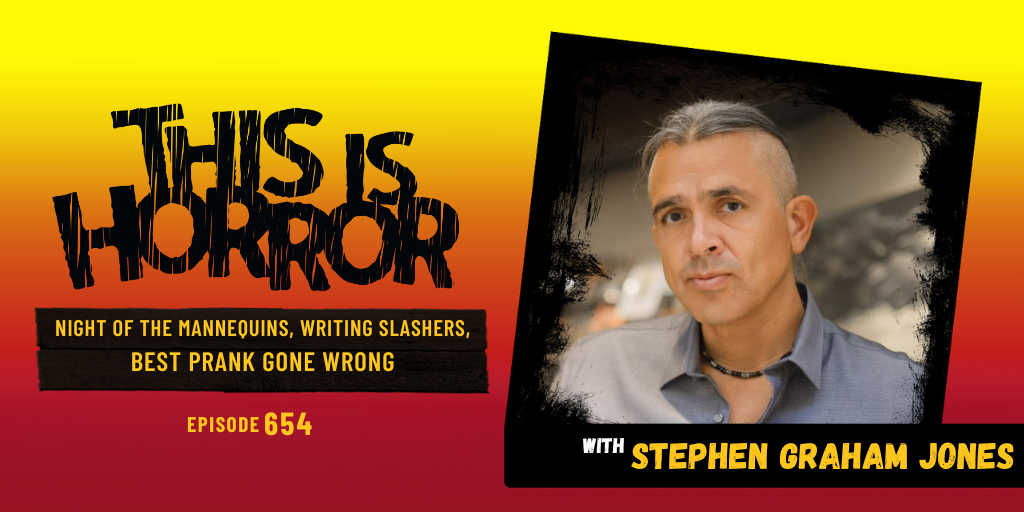
In this podcast, Stephen Graham Jones talks about Night of the Mannequins, writing slashers, his best prank gone wrong, and much more.
About Stephen Graham Jones
Stephen Graham Jones is a Blackfoot Native American author of experimental fiction, horror fiction, crime fiction, and science fiction. His books include Don’t Fear the Reaper, My Heart is a Chainsaw, The Only Good Indians, Mongrels, and The Elvis Room.
Timestamps
Thanks for Listening!
Help out the show:
- Support This Is Horror on Patreon
- Listen to This Is Horror Podcast on iTunes
- Listen to This Is Horror Podcast on Spotify
- Rate and review the This Is Horror Podcast on iTunes
- Share the episode on Facebook and X
- Subscribe to This Is Horror podcast RSS Feed
Let us know how you enjoyed this episode:
- Write a comment below.
- Follow us and get in touch on Instagram @thisishorrorpodcast
- Subscribe and comment on YouTube @thisishorrorpodcast
- Follow us and get in touch on TikTok @thisishorrorpodcast
- Tweet us @thisishorror.
Resources
- Mick Garris
- Watch the video version of This Is Horror Podcast episodes, including our conversation with Chuck Palahniuk on YouTube.
The Girl in the Video by Michael David Wilson, narrated by RJ Bayley
Listen to The Girl in the Video on Audible in the US here and in the UK here.
They’re Watching by Michael David Wilson and Bob Pastorella
Read They’re Watching by Michael David Wilson and Bob Pastorella right now or listen to the They’re Watching audiobook narrated by RJ Bayley.
Michael David Wilson 0:20
Welcome to This is horror, a podcast for readers, writers and creators. I'm Michael David Wilson and every episode, alongside my co host, Bob Pastorella, we chat with the world's best writers about writing, life lessons, creativity and much more. To day, we are chatting to Stephen Graham Jones about the RE release of his fantastic book, Night of the mannequins. Now this marks the first time in over three years that Stephen has been on the podcast for an in depth conversation. And let me tell you, we need to talk more often, because this was fantastic. Now, for those of you not in the know, Stephen Graham Jones is a Blackfoot Native American author of experimental fiction, horror fiction, crime fiction and science fiction. His books include, don't fear the Reaper. My heart is a chainsaw, the only good Indians, mongrels, the Elvis room, which we released at this is horror as a special limited edition chapbook, and, of course, the aforementioned night of the mannequins. So we will get Steven on the show in a moment, but before then, a quick advert break
Bob Pastorella 1:59
from the host of this is horror podcast, comes a dark thriller of obsession, paranoia and voyeurism. After relocating to a small coastal town, Brian discovers a hole that gazes into his neighbor's bedroom every night, she dances and he peeps same song, same time, same wild and mesmerizing dance. But soon Brian suspects he's not the only one watching. She is not the only one being watched. Their watching is The Wicker Man meets body double with a splash of Suspiria. Their watching by Michael David Wilson and Bob Pastorella is available from this is horror.co.uk, Amazon and wherever good books are sold.
RJ Bayley 2:38
It was as if the video had unzipped my skin, slunk inside my tapered flesh and become one with me.
Bob Pastorella 2:47
From the creator of this is horror, comes a new nightmare for the digital age. The girl in the video, by Michael David Wilson, after a teacher receives a weirdly arousing video, his life descends into paranoia and obsession. More videos follow, each containing information no stranger could possibly know, but who's sending them and what do they want? The answers may destroy everything and everyone he loves. The girl in the video is the ring meets fatal attraction for the iPhone generation, available now in paperback, ebook and audio.
Michael David Wilson 3:16
Okay, without said. Here it is. It is Steven Graham Jones on this is horror, Steven, welcome back to this is
Stephen Graham Jones 3:30
horror, man, I'm thrilled to be here. Thanks for having me.
Michael David Wilson 3:33
Yes, I believe the last time that we spoke, it was around two and a half years ago, so I wonder what have been the biggest changes for you, both personally and professionally, in that time?
Stephen Graham Jones 3:50
Man, yeah, that's a let me think, um, accrued various injuries. That's probably the personal thing, you know. Okay, I'm always in ice and all kinds of pills and drugs. You know, just when you do, when you do stupid stuff, you get hurt. So I get hurt a lot professionally. Let me think I'm teaching at Stanford right now. That's different. I was at CU Boulder last I talked to you. I'm just, I'm just out here a spot teaching for a while, but it's pretty cool living in California.
Michael David Wilson 4:19
Yeah, what brought you to Stanford.
Stephen Graham Jones 4:22
Oh, just to come teach the they have these, this program, the like the Wallace Stegner program, and they have Stegner fellows. It's kind of like a post doc in fiction and and so it's students who generally already have a terminal degree coming to write a book, basically. And so I work with them. It's a good time.
Michael David Wilson 4:44
So how much of your time are you spending in Stamford, kind of area, and how much are you then spending back in Boulder, Colorado? None of
Stephen Graham Jones 4:53
none in Boulder. I haven't been in Boulder for a while. I won't be back in Boulder, okay, yeah, until, I mean, I think I get back there. Or May, maybe the end of April, something like that.
Michael David Wilson 5:03
So you are you now living in California? I am, yeah, okay, and yeah, does that as well as the teaching? Does that bring any other opportunities regarding the writing? I mean, obviously California and Hollywood is the capital in terms of film and cinema.
Stephen Graham Jones 5:21
Yeah, it's just different people I have lunch with. Because, you know, it seems like I have so many friends who live in all these little towns around here, the San Jose, San Carlos, all the everything is saying something out here. And I keep finding more and more people that I know. So it's a good time. And I'm doing, I'm doing a little, kind of like a mini tour out here on the West Coast, starting, I don't know, a week and a half or something like that, for mannequins,
Michael David Wilson 5:44
yeah, yeah. And I mean in terms of mannequins, so this, it originally came out a few years back, and now it's been re released with a brand new cover, which looks awesome, by the way. Yeah, yeah. I'm wondering why is it being re released? Then why now?
Stephen Graham Jones 6:05
I guess anytime a publisher does something, it's because they think there's a market for it. You know, they think that this book can find a new audience. We can repackage it. It's got the same, everything in the same, same on the inside. It does have that new the new rapper, the new cover, and it was tor.com and now it's night fire, so it's got a different team behind it as well. I'm actually lucky. I get to work with Kelly. Kelly lonesome, she was my editor for mongrels back in 2016 so that's really cool.
Michael David Wilson 6:34
So does this mean that there were some editorial changes that were made?
Stephen Graham Jones 6:39
I don't think we. We we didn't. I mean, mannequins was in place already, and it's kind of like a Jenga tower of a book. And I'm afraid if I pull one thing out, it's gonna fall down, you know,
Michael David Wilson 6:49
yeah, yeah. Now I can certainly see that. And there's a lot of meta layers to it. There's a lot of there's a hell of a lot of misdirection. And goodness, we're gonna get into all of that. But I suppose to set the stage, what is the origin story? Why did you originally sit down and write this one?
Stephen Graham Jones 7:14
You know, I wrote mapping the interior for Alan Datlow in 2016 and it took me four days. And so in 2017 maybe 2018 probably 2018 she called me up. Ellen detlow called me up, and she said, Hey, why don't you do another novella for me? Mapping did pretty well. And I looked at my calendar, I thought I got four days, you know? And so I sat down to jam out another novella real fast, but I screwed up, and I went four weeks instead of four days, and I wrote a novel, and that novel was killer on the road. No, that was, I think it was I think it was babysitter lives. First I wrote babysitter lives in that month, and I thought, well, that was weird. So I push it to the side and said, time to write a novella for Ellen detlow. And so I screwed up again. Instead of going four days, I went four weeks, and I wrote killer on the road. And I was, I was thinking, Man, if I lost my novella muscles, I don't understand what's going on. So I pushed it to the side and I told myself, this time, you're gonna stop at 115 pages, whether it's over or not, you're gonna call it a novella. And so I wrote for 115 pages and stopped and found a line that was like a kind of a graceful exit and a ramp and and, but then I realized I could add one more line to this novella and would open up into a novel. And so I called up my literary agent, BJ Robbins, and I said, Hey, I just wrote that thing for Ellen detlow. Do you want me to keep it a novella or turn it into a novel? And she said, go ahead and turn it into a novel. Those are easier to sell. So I wrote the rest of that book. Probably, it probably took, like, I don't know, six weeks, eight weeks total, and that was the only good Indians. But then I pushed it to the side immediately. And I said, I got to get that the house. I was still way before deadline, but I was way late for me, you know, for getting Ellen Datlow this novella. And so then I sat down, and the title night of the mannequins came to me, and I thought, I'll do a, I'll do a version of not a living dead just with mannequins. It'll be fun. But then that first line happened, and I realized this was not a, not a living dead type story. This is not like a horde of shambling mannequins coming up Main Street or anything. This is kind of a slasher from the other side, and it was really fun. I liked I liked it a lot, and I probably, it probably did take me, I don't know, three weeks. I have no memory. It's been so long, but it was probably like a two or three week book.
Michael David Wilson 9:16
I bet I love that. The origin story basically starts with you inadvertently writing free novels before you could write this novella. And I mean, I think something that will be particularly interesting, as you know, we delve into the craft here is you're talking about writing novellas in four days. You're talking about writing novels in four weeks. So can we get a little bit more detail as to what that looks like? Are you planning them? Are you just kind of going for it, as you would on your motorcycle?
Stephen Graham Jones 9:55
I'm just or my bicycle? Yeah, I'm just going for it. I have no like none of those books I wrote, I. Um, babysitter lives killer on the road, the only good Indians. I had zero idea where any of those are going, like good Indians. I thought it was novella, until I had to write two more parts for it, you know. And none of the mannequins. I had no idea how that was going to go. And I knew that, since there were, like a, there was kind of a small friend group, you know, I thought, Well, that'll be like my like my supports throughout the timeline of this novel, like, we'll have somebody die here, die here, die here. But I had no idea who's gonna die next, how they were gonna die. Yeah, so I know I have no planning whatsoever. And tell you truth, I don't write that much like I don't sit at a computer for eight hours and right? I found that my ideal writing session time is about maybe an hour and 40 minutes. After that, I can keep writing for 10 hours, no problem, but I'm gonna have to throw like eight and a half hours away or just do so much work to rehab it that it's not worth it. You know, I'm so I'll write for an hour and a half, then I'll go ride my bike for two or three hours, and I'll come back and write for another hour and a half, then I'll go play pool for for a couple hours. And just I like to cut it up and do other stuff. Or I like, really, when I'm writing books, I like to watch Megan pi and Rockford Files. That's my two favorite things.
Michael David Wilson 11:10
So I mean, really, what we're talking about for a novelid, and I'm guessing we're looking at between four and a half or six hours per day, depending on how you've kind of split? Yeah, yeah. And then does that get you your first draft or a week? Or have we, because I know that you write quickly, is this multiple drafts that you've done in those four days? No, it's
Stephen Graham Jones 11:36
not multiple drafts, but both mapping the interior and none of the mankind's came out pretty much whole, um, I believe Ellen dello had a few questions for me that I answered in the story of mapping the interior. And there were probably some little things with night of the mannequins. But there was no, no big overhauls at all. It was, it was what it was like when something's that short to me, I think, um, well, if it's broken, I'll just throw it away. You know, I don't, I don't need to put all the work into fixing it. I'm Not, not. I mean, I do revision. I'm in revision right now for another thing, but I so prefer to write new things and revising, revising, to me, is just torture. I don't like it even a little bit.
Michael David Wilson 12:12
Man, yeah. And I would certainly say as well, from my experience and from chatting to other people, it just seems the more that we write, the less we have to revise anyway, because we kind of get a sense as to rhythm and composition and how to put all of this together.
Stephen Graham Jones 12:30
Yeah, but it's not to say I don't screw up every single paragraph, because I do, you know, not just, not just typos, but like, I make bad decisions, and so, like, I might write 120 page novella, but talking about like revising while you go, which I always kind of question that people say they edit as they go, understand what they're saying, but I just call that writing. I don't call it revising as I go. You know, it's just how you it's just how you get forward. But since I don't know where I'm going in a story, then I have to try every alley, and some of those alleys are going to be dead ends, and so I have to back out of it and go back 12 pages and cut that out, and then go forward again from that last branch point. So there's a whole lot of that in my in my novels and novellas and my stories as well. But the result of that is it's really it, I don't know it helps me flesh out the world, because those dead ends let me explore other parts of the story that didn't kind of exert a gravity on the main line and make it more real and stable. And I think it's all good. It seems. It's a lot of work, you know, but nobody said it'd be easy. I just try to keep it fun, you know.
Bob Pastorella 13:33
I feel like that, especially with this one here, that you always have the sense of momentum that if I could capture, and if I could capture it and bottle it, I probably wouldn't sell it. I'd drink it all myself. But to me, it's like the revision process would ruin that sense of momentum. It's like you have to pop back and go, Wait a second. I have to fix this. And I'm a discovery writer just like yourself. And so I loved it. To me, that's like, that's like, Zen is when I don't even have to think, when the words are just flowing. Now, obviously you're going to go back and reread it, and a lot of times you might go, Wow. Man, what the hell was I think? What was I doing? But, man, that that moment, that momentum you have to, you have to capture it. Oh no, kill it every time
Stephen Graham Jones 14:22
it can't, yeah, if you slow down, if you ever start, like, second guessing yourself, then you might as well just go do something else for the day. I think because you've got to, like, pretend like you're good enough to do this, that's, that's what I've always found. Like you put a foot pump on your ego, and you pump it up, and it'll, it'll last as long as, like, an hour and 40 minutes. And then you write something and then it deflates, and you have to go do something else. And you find the pump again, and pump it up like you're big enough to wrestle with beauty or art or whatever you want to
Bob Pastorella 14:46
call it, you know. Yeah, that's something I was telling someone else a couple months ago, is that, you know, the writers that I admire, they put their whole chest into it. And so that's, you know. And. That's you can sense it when you, when you see it on the page, it's like, man, they are going into this, yeah, 100% and you have to have that confidence, yeah.
Stephen Graham Jones 15:10
That's why, you know, I think that's why Philip K Dick is usually my favorite writer. Because everything he does, I feel like he put his whole heart, his whole heart into it. Everything feels sincere, you know, like, I think he started like he started out. He he would get an assignment to write a novel over the next three days that he had to turn in really quick, you know, 60,000 words or something. And so he, he, you know, jump into that with both feet. And he'd think, this is just going to be a lark, but then it feels like 25 pages in, he's like, Oh no, it's real again. I got to write my way out of this, you know. And I really appreciate that a lot. That's what I always feel like in my in my things I'm writing is I've got to keep going fast because it's collapsing behind me, and I just got to run, you know.
Michael David Wilson 15:48
And I think something as well that we should note is, I mean, you're talking about the way you divide your day up, but we've said so many times that these times when we're not writing, or we're taking a breather, even if you're not conscious of it, there's things going on in the background and in the unconsciousness. I've actually found before that the days where I try to do like an eight hour slog. I mean, slog is the right word. It is not easy, and I'm actually less productive, or at least less creative, but if I decide, okay, I'm taking a breather, I'm going for a walk. Ideas and story solutions, they come to me, so I'm working on the story when I'm not working on the story.
Stephen Graham Jones 16:35
No, you're totally right. Like, put it on the back burner and it'll simmer on its own. You know, that's what I found. But what I have found is when I'm when I'm when I hit the trail between writing sessions or I'm playing pool or whatever, if I listen to podcasts or audio novels, it's not the story is not simmering as much. If I listen to music or nothing, then I'm thinking, you know, but if, if I'm thinking about, like, you know, some esoteric podcast, it's talking about film or or an audio novel that I love, a story I love, then that kind of uses the same muscles I was using when I was writing, you know? And so what I've got to do is let those muscles do their own thing. And but luckily, there's lots of good music, so it's not not a big deal.
Michael David Wilson 17:19
Yeah, I've never thought about it in those terms before, but that's exactly the way it is for me. And so Eva, what will happen if I'm listening to an audio book? Then either I'm not thinking about my own writing, or I'll realize that 20 minutes have gone past and I haven't a clue what's going on in this audio book, because I was thinking about something else.
Stephen Graham Jones 17:40
For sure, for sure, man, for sure. Yeah, but
Michael David Wilson 17:44
I mean, I mentioned the misdirection, and you certainly alluded to this, because the misdirection begins with the title night of the mannequins. I mean, first of all, it conjures up this kind of George A Romero or B movie horror but, but it actually isn't at all. I mean, what you're doing, it's and it actually what you're doing, it's difficult to talk about without jumping into spoilers, so we are going to have to skirt around it. But it's very much a a different piece, say, a more serious piece, I would say,
Stephen Graham Jones 18:27
Yeah, I mean it. It's when I'm doing something that's like, over the top violent, then I always want to, like, counterbalance it with some sense of tenderness or wonder or something like that. Because things that are just unremittingly grim. I have to ask myself, why would somebody want to engage that, you know, they want a beating heart in the middle somewhere. And so that's always that's kind of the fun part of horror to me. I mean, I love to splash blood blood on the walls, but I like to sneak feelings in as well,
Michael David Wilson 18:53
you know, yeah. And then the second part of misdirection is sentence number one. So Shanna got a new job at the movie theater. We thought we'd play a fun prank on her, and now most of us are dead, and I'm really starting to feel kind of guilty about it all. First of all, what a fucking amazing hook. Thank you. And I mean, I need to ask what is your approach to writing hooks and opening sentences, and is this also one of the kind of parts where you spend the longest amount of time just thinking or looking at that blank page because you nailed it? No.
Stephen Graham Jones 19:37
Thank you very much. You know, hook lines. Yes, they. I mean, sometimes you have to wait for them. Generally, though, what I try to do is just sit down at the keyboard with a completely empty mind, a blank slate, and I just kind of let my fingers figure something out, and they figure it out and and all I've got to do is not delete it. You know, it's hard not to delete stuff because you want to, you want to say that wasn't good enough. I could have done better. But, um, I. That's how night of mannequins happened like that. I think that's how I did long trial. Nolan digatti, too. I had no idea what the novel is going to be. And I sit down, and the first line of that is, I'm what I remember best about my father, the suicide notes, you know. And that gave me the structure of the whole book, right there. And like this little preview that Sawyer's given, kind of sketches at a or it gestures at a space we're going to walk into, you know, and I'm, you know, I wonder, right around this time I was teaching a, I think I taught a lecture class my creative writing, kind of an intro to creative writing, but it was for a big classroom and and I went through and kind of created a, I don't know what you call it, a taxonomy or something, of different types of opening lines and previews like this were one of them. It's a really common one people do, like, 100 Years of Solitude, does it really well? And there's all kinds of different ones. There's ones that are really shocking and that, like, jolt you out of your seat. I got to know the rest of that, and I forget what they all are. I've got a list of them, or I've got a big slide show of them somewhere. It's really fun. I love to think about hook lines. I think the best hook line person, the best writer of hook lines and novels, is probably for me, for my money, it's Toni Morrison. Like every time she put pen to paper at the front of a book, she struck gold.
Bob Pastorella 21:13
You know, somebody brought up at a conference one time hook lines, and it made me want to read the books. And like, the probably the most memorable one is in one of John D McDonald's books and one of his Travis McGee novels. And to me, I was like, because this just makes you want to read more. It's like we were about to call that a night when someone dropped the girl off the bridge. Yeah. And I'm like, Oh, shit. Okay, where were you? What do you what do you mean? Like, what do you mean? And you just keep on going, and you realize, you know, you get but Golly. I mean, it's like, Hey, I'm gonna crank your motor right now, first start and go, and that's, I mean, I want to be able to put that on the page, but a different way. Yeah, yeah. Oh, 100% agree.
Stephen Graham Jones 22:10
I just pulled up my slideshow. I've got a lot of my favorite ones here. I won't read, I won't read them all to you. But I think one of the most famous, famous ones we have in the world of novels is, probably call me Ishmael. You know that Moby Dick That's, it's so good because it's what it's, it's got so much packed into it, because it's telling you when it says, Call me Ishmael, what that means is, I'm not Ishmael, you know. And so that's the hook right there, and we're in it, and it's just three words that's, call me Ishmael, yeah, three words, you know, blows me away. Yeah.
Michael David Wilson 22:39
And in this particular hook that you've got, you also, you know, you put the prank right up there, front and center, so there's a media intrigue as to, you know, how is this prank gone so wrong that most of us are dead. I like that most of us are dead too. Because, like, well, hang on, not all of us are dead. What's happening here? And you know, they're feeling kind of guilty about it. They're not 100 so there's so much. But I gotta say, in terms of pranks, I mean pranks and slashes, they go hand in hand. I mean, if there wasn't a prank, there wouldn't be a scream movie franchise, there wouldn't be the vast majority of slasher movies. So it's this playfulness that I mean, it's almost what makes the slasher unique and special in terms of sub genres within horror.
Stephen Graham Jones 23:40
No, I totally agree the prank is essential to the slasher. And sometimes a prank takes a takes the like, shape of a trespass or, you know, something. But it's always like, you can frame it as a prank, if that's how I like to frame it anyways, because it makes it more fun. But yeah, if you don't have a prank, then you don't have an imbalance of the Justice scales. And if you don't have the imbalance of justice scales, and you don't have any reason for a spirit of business to come and straighten those skills, you know.
Michael David Wilson 24:04
So I wonder, taking it to real life, what is the best or the worst prank gone wrong that you have been part of, whether you were the instigator, the victim or somewhere in between?
Stephen Graham Jones 24:17
Yeah, the probably the worst one I've been involved in is I have a like, in high school, I had a friend who was terrified of trains. He has had this, like, irrational fear of trains. And so one night, we're coming home in Staunton, Texas, and it's probably about two in the morning, and I was in my I had a short bed Chevy, 67 short bed Chevy, and I was driving, and there we had some train tracks to cut through town, and it was kind of up on a hump, you know, at a big intersection that the train tracks were up on a, what do they call it? Anyway, they were, they were, you had to go kind of up and down, and, and, and he was kind of like nodding off. He wasn't all the way awake, you know. And so I gently eased the truck onto those tracks and killed it, you know. And I woke him up real fast. And I said, I said, Dude. Dude, we're on the tracks. What's gonna happen? He woke up, and he was he woke up at 100 miles per hour. He was terrified. He was having a panic attack over there in the side of my truck. And I thought that was the most hilarious thing ever. And and I let that go on for a while, until he was all the way awake, you know. And then I reached down and turned the key to start my truck to go on home, and the truck wouldn't start. And then a light pops on right down the track because the train is coming, and those the barriers came down on either side of the truck. And so we're trying to start the truck, and a train is coming, and the truck finally started, but I had to do like a 42 point turn to get around those, those arms that come down, and it quit being funny pretty quickly.
Michael David Wilson 25:36
Oh my god, you were so close to being part of a final destination movie. Oh, my god, wow. I mean, you wanted to give him a scare. You went the extra mile. You really delivered. Did he still hang out with you after the Hell
Stephen Graham Jones 25:58
yeah, yeah, yeah. I think he's the only person is he. He's the only person in high school I still talk to. I haven't talked to him for about five months, but we still talk, you know, I
Michael David Wilson 26:08
mean that that is the test of a true friendship. If you can almost get mowed down by a train. Did it cure his fear? At least
Stephen Graham Jones 26:22
it just, it just magnified his distrust of me, you know, oh,
Michael David Wilson 26:28
my goodness. And I mean in terms of we've got the pranks. But the other element, of course, is mannequin, something that is inherently creepy, another thing that goes hand in hand with horror. So do you remember when you first saw a mannequin in horror?
Stephen Graham Jones 26:51
Oh, in horror. Let me think about that. I think in horror. Yeah, the the first one I saw in horror would probably have been tourist trap. You know, from is that 79 about right around there?
Bob Pastorella 27:02
I think so. 7779 Chuck Connors, that's, yeah, I watched it again last year. It's probably like the fifth time I've seen it. And it's, yeah, it's fun. Disturbing. Yeah, it is.
Stephen Graham Jones 27:15
But I think my first, like, you know, personal brush with mannequins would have been when I was probably, I don't know, maybe four years old. Maybe not quite four years old. There we have a story out in West Texas, we used to back in the 70s, called Dunlap, S, D, U, n, l, a, p, apostrophe, s. Did y'all have that down, down in south Texas?
Bob Pastorella 27:33
Bob, no. I mean, I think I've heard of it, but, and I think we might have seen it in our travels, but, yeah, I never had it in town.
Stephen Graham Jones 27:43
It's just a department store, like a Dillard, like a Dillards and a Montgomery Wards, or a bells, all that stuff, you know. Anyways, my mom went there to try and close and she, you know, pulled me along with her and and she parked me outside the dressing room while she went and changed clothes. And there was mannequins all around, like they do on the podiums and everything. And I'm so they were kind of creepy, but I was, I wasn't creeped out. But then, while I'm sitting there just waiting for my mom to finish trying on all these clothes, she starts screaming and screaming and screaming, and the whole store collapses on the dressing room. And what turned what? It turns out that, it turns out that while she was changing clothes, in there a scorpion had better, you know. And so I think, and I didn't really understand what was going on. I was too young to really make sense of it all. And the sales associates were trying to, you know, keep me safe and happy and all that stuff. But, um, maybe that could be where mannequins got into my my head, you know.
Michael David Wilson 28:37
So when it happened, we did your brain go to this place where you thought a mannequin?
Stephen Graham Jones 28:44
No, I wish I could say that, but no, it was more like there were mannequins in the area. And she was screaming. I didn't make the connection. You know?
Michael David Wilson 28:51
Yeah, oh my god, is handed changing and getting bit by a scorpion? Is that a regular occurrence? And a name?
Stephen Graham Jones 29:02
Let's take there's a lot of scorpions, a lot of centipedes, a lot of tarantulas. And those are all, they're all. Those are all. Those are all things you can deal with, the wind scorpions. Those things are the dangerous ones, the like. They call them camel spiders when they're bigger out in the Middle East, you know. But the little ones, I think, are even to me, the little ones are meaner, the same way, the same way with actual scorpions, the littler the scorpion is generally, the more dangerous it is, as I understand, I haven't tested it myself. I've only read that, but, um, the real thing to be worried about in West Texas sneaking into your house are rattlesnakes, of course, because anywhere a mouse can go, a snake can go and and when it gets cold, the snakes like to come into like schools or stores, and they crawl up the walls and go on the ceilings and sleep on top of the warm lights. And sometimes you'll turn the light on and you'll see a snake up there, you know, or they like to go into the dishwashers too, and so you'll sometimes smell them down there, and they just like to Den up. And it's not great, but I don't know it's a. It is,
Michael David Wilson 30:02
yeah, like, I feel you're far more exposed to dangerous animals than I have been in my life. I mean, in England, there's basically nothing. And then, you know, even moving to Japan, I mean, there are bears and things like that, but they're up in the mountains, although recently, there have been more and more of them coming down into town. Oh, wow. And, you know, we have centipedes and stuff, but they don't wander into the changing rooms. I've not had that experience yet.
Stephen Graham Jones 30:36
Well, we, we would every periodically, like not every year, but every few years. I guess the tarantulas are on some schedule. They hang out underground until they all come up at once, you know. And and so the first time that happened, I was probably like eight years old, and I remember driving down the road with my granddad, and the whole road, that road was washed like sun bleach gray. It wasn't black anymore. The whole road was black and crawling for as far as we could see, because they were moving from one pasture to another. It was, it had to be, like, 3 million tarantulas. And we didn't want to run over them, because they're pretty little things, but we had to get somewhere too. So we just had to turn through the tarantulas, you know. But they was weird, seeing that many tarantulas at once. Yeah, I
Bob Pastorella 31:13
would have turned around and went back. I'm not, I don't like, I don't like bugs. I mean, understand, you know, the spiders are necessary, right? But you know, I don't, especially flying bugs, especially like Wasp, any bug that can hover like a helicopter, I'm fucking out. Man, you want to see me freak out. It's like, I'm not afraid of much, but if I get around a wasp or something like that, what's wrong with Bob? He was screaming like a girl, yeah, because I was freaked out because of a fucking boss.
Stephen Graham Jones 31:47
You know, I got, I got chewed up by, was pretty bad last summer. I was something. I was reaching up under my jeep to do something to the back of the gas cap or something up there, and, um, and I hadn't driven this Jeep for a couple of months, and so I'm, I'm like, down on a knee, and I'm reaching up there, and I think my hand sure is cold. And then after about four seconds, I realized it's not cold, it's like, on fire, because I just, like, my head into a wasp mess, and they were all biting me. But that's, I think that's the way wasps, like, they must their their venom, or whatever they have, must be designed like that, because it doesn't hit you for like, two or three seconds, you know, and then it hits you, but that allows Morgan to pile on and get you at the same time. But I didn't swell up too bad. I'm I've had I've had wasp. I've had Wasp bit me in the lip and the eye. They've bit me all over. One morning I woke up, we were building this house as we were living in it, and so when we moved into it, it's pretty much frame and tar paper, so that was open to the elements. And I remember one morning, I woke up to that same coldness and Wasp it all come in and landed on my neck, and I had moved like this, and they all were biting me on the neck. You know, Wow, that's crazy. But the
Stephen Graham Jones 32:52
ones I was scared of are the the ones that hang around peach trees, those Mexican wasps, which they have another name. I never can remember it. They're like a more they have a more formal name, but they're those big black dudes that are like, like, that big, and they have the orange wings. Those guys. I've never been one of those. My mom has, and she says it hurts crazy, but I watch the people on YouTube who like to let insects bite them and record it, you know. And that's usually, like, the number two worst one, I think, is that Wasp,
Bob Pastorella 33:23
and it's any they can sting you repeatedly. That's, that's the thing that that bugs me more than anything else a bee. You get stung by a bee, the bee is gonna die because, you know, the Stingers are barbed, but Wasp, wasp fingers are smooth, and so they can just drag, drag it all over you.
Stephen Graham Jones 33:42
Yeah, we could figure out, if we could get the little ink plots, they could be tattoo artists, you know, they can do little designs on us. Man, that's why. That's the tracker jackers and the Hunger Games were so scary because they were like wasps on steroids and radiation and everything else, you know.
Bob Pastorella 33:58
Wow. You give me ideas?
Michael David Wilson 34:05
Well, since we're talking about violence, in a sense, I want to know, how do you approach writing about violence.
Stephen Graham Jones 34:16
Man, that's a how do I approach that? Um, I think I don't let myself look away, and I try to turn on as many senses, senses as I can. But more important, those are just like outer things. I think the internal thing you have to do is not let it be violence. For violence's sake. It has to have some story meaning, some story purpose. You know, it's the same as a sex scene, like a sex scene in a story, just for the sex is a failure. I think if the sex scene is some sort of negotiation or power play or whatever is going on, then it, then it matters, then it, then it earns its place on the page. And I think it's the same with violence. If it's it has to earn its place on the page. Yeah.
Michael David Wilson 34:58
And I think similarly. Okay without giving spoilers away. So treading pretty carefully. I mean, a lot of this book is about the desensitization of violence and mental health struggles, and I mean a real dangerous and prescient combination. And in a way, I feel this is perhaps even more relevant now in 2026 than it was when you originally released it a few years back.
Stephen Graham Jones 35:29
Yeah, I hadn't thought of that. I like that. That's pretty cool, but, yeah, but thank you for saying that. Um, yeah, I don't disagree. Um, it wasn't intentional, but it's just that's the way Sawyer is, you know. So he came on the page like
Michael David Wilson 35:43
that, yeah, yeah. And so that, I mean, I did want to ask in terms of, I mean, you said you don't plan ahead when you're writing, but how much did you know about Sawyer going in? And if not a lot, then at what point did Sawyer's nature, let's say, become apparent,
Stephen Graham Jones 36:06
you know? I mean, yeah, that's a good question. It's probably when he goes to see Tim. That's when I was like, This guy has some things going on, you know? Because, I mean, I felt like I knew him in a way, in the theater when he thinks he's seeing or when he is or he thinks he is seeing, man, he leave and the lights go down, and he feels like he's untethered and floating. I felt like that was a moment where I really thought, this is, this is somebody I can work with, you know, but, um, I felt like I didn't know his nature until he went to Tim's house a few that few nights later.
Michael David Wilson 36:44
And it occurs to me, as you're saying that, that we haven't actually told people. So for those who haven't read it yet and they're interested in reading it, we haven't told them what that opening prank is.
Stephen Graham Jones 36:56
Yeah, that's a good point. I was assuming, right? It's um, that there's Sawyer's cousin Shanna, has a Usher job at a movie theater, a Cineplex, and and Sawyer and some of Shannon's friends are going to prank her by sneaking in this mannequin, sneaking a mannequin into the theater, and then saying, Hey, that guy didn't pay his ticket. And Shanna would go check on him to get his ticket stub, and he would be a mannequin. That'd be hilarious, you know. And it's a mannequin they found randomly a few summers before, and it was a big fun thing for a while, then they forgot about it, like you do.
Michael David Wilson 37:28
Yeah, it is an amazing prank. And yeah, at least somebody listening has got to try this out.
Stephen Graham Jones 37:36
It was complicated, though, getting that mannequin into the theater past the ushers, you know? Yeah, because I mean nowadays, like, as I wrote this in 2018 and so we were already living in the world we're living in right now, pretty much. And you can't bring backpacks and stuff like that, you know. You've got to hide the pieces of the mannequin under your baggy clothes and do it in other ways, like they figure it out, they navigate it. But it takes a lot of work.
Michael David Wilson 38:01
I think it would be way easier to do in Japan, because Japan is quite a trusting culture, really often, even though there is an usher on the front entrance, there's not one on the exit, if there's a film that's not ending, so you could literally just walk in with the mannequin and get to the screens that way. Wow, that's cool, condoning it for anyone in Japan. But you could do that, then you could get the assure and be like, Whoa, a 24 for example. Yeah, that's nice. It'd have to be a 24 Yeah.
Stephen Graham Jones 38:44
But the fun thing is that, like seeing a mannequin out of context will startle you. You know, if you're not expecting it, it'll get to, yeah,
Michael David Wilson 38:52
mannequin out of context. I just love, love that as a phrase. And I mean, obviously we mentioned the Romero nod, Sawyer has to be a nod, surely, to Toby Hooper and Texas James Saw Massacre.
Stephen Graham Jones 39:11
Yeah, a little bit. He's like to in my head every time I wrote Sawyer, I heard family saw. Like he's in he's got a family, and his name is saw so he was the family saw, you know.
Michael David Wilson 39:23
And, I mean, there is a shift and a reveal around the 65% mark, and that really changes the tone of the book. I mean, it, it's something on rereads where you, you know, you can see, okay, I see how it was kind of going in that direction all along. But how did you approach the shift, and was that something that then did require quite a bit of editing to just make sure that it landed right?
Stephen Graham Jones 39:54
Not really, no. I mean, I think what happened, and this usually happens in the longer things are right. I get to about that point, about two thirds through, and I think this isn't exciting enough. We gotta, we gotta drop a bomb, you know. And so I just kind of, I'll drop some sort of bomb into the story. I mean, not like in the stand, because I don't want everybody to die, you know, but, but, um, but. And I just like to drop it, but it's not a test drop. That's, that's the role I give myself. I can't just see if it works. I've got to drop it in the novel. Either dies here, or it figures out a way to incorporate it, you know, and that that's really fun.
Michael David Wilson 40:28
And so in terms of dropping the bomb, as you put it, I mean, how many times has it died? And what do you do in the situation where it dies.
Stephen Graham Jones 40:41
That's a good point. It's um, I guess one thing that would be like that would influence my decision would be, is this a work that I've already promised to someone? If it is and I might have to go back and break my own rule and undo the bomb or something? I don't know. I don't think I've ever had any of them die, though, because I feel like if they die, then I'm failing at my own challenge, you know, because I'm telling myself, I've got to incorporate it, I've got to make it work. And I did it in mapping the interior too. I'm probably about the same point in the story, actually, maybe, maybe about, or maybe a 55% in that story. But, um, I love to do things that, to me, are kind of out of the blue, and then have to figure out after they happened, how do I make that work? Or how do I make that something that did work, and it's so challenging, and it's so you learn a lot about yourself as a writer. I think when you make yourself do that, you know,
Michael David Wilson 41:38
see, I like this because essentially the answer is, failure isn't an option.
Stephen Graham Jones 41:43
Yeah, yeah, pretty much, man. But by that point, too, I've fallen in love with the characters in the world enough that, yes, failure is not an option, because I want to hold on to them. I want them to be shared with other people, you know.
Michael David Wilson 41:57
And when you're teaching creative writing, I mean, how do you drill or how do you impart just the importance of this fearlessness and taking risks in your writing?
Stephen Graham Jones 42:11
I try to model it. I mean, I try to tell them the same stuff I'm telling y'all, like, this is how I write. And, you know, it's been a long time not working, I don't think, and maybe hit some point where it occasionally works. But I always push them to do the stupidest, wildest, over the top stuff they can. And I think you just learn so much, like, tell you truth, I don't get a whole lot out of really quiet, subdued stories, you know. I mean, I can read them, I can study them, I can analyze them, but um, give me something loud, and I'll be a lot happier, you know,
Michael David Wilson 42:44
and when you're teaching these courses, is the nature of the student that is attracted to your classes? Are they typically writing things that are more within horror or action genres?
Stephen Graham Jones 42:57
Well within genre Anyways, um, you know, when I first started teaching back in 2000 I had to put a little disclaimer at the top of my syllabus that in here, in this workshop, you're gonna write at least one genre story. It might be science fiction, it might be horror, it might be fantasy, you know, it might be werewolves, it might be whatever, but you're gonna do one story like that. And invariably, two or three hands would go up and they would say, really, I'm gonna write a pirate story. And I'd say, Yeah, you're gonna write, you're gonna write something like that. And I would generally have two or three students walk out, like in protest, and drop the class, you know? But it didn't matter, because I always had a big wait list. Other people filed in. But about 2008 there was some sort of change. I don't know what it was, or I suspect what it was, but around 2008 students started coming and only writing genre. Hardly any of my undergrads ever write literary fiction anymore. It's all you know, with a photon blaster on an asteroid, shooting spaceships that kind of stuff, you know, or a lot of fantasy, really, a whole lot of fantasy, a lot of young adult. And so I was able to take that off my syllabus, and I'm really happy, and I'm pretending like this is like a unilateral thing across all programs. It could be that it took me that long to become established in the program I was teaching in as the genre person. So I could be attracting all the genre people, you know, like I'm like a lint roller that picks up all the horror and science fiction and fantasy people, you know,
Michael David Wilson 44:20
the lint roller.
Stephen Graham Jones 44:24
Yeah, but I do think that, or I suspect, that why genre became the default setting. I feel like it might have had something to do with the brief, Wondrous Life of Oscar Wilde by Juno Diaz, which was, you know, unabashedly in love with genre stuff. Oscar Wilde, he's, he's a comic book dude, you know, and he lives in that world, and he breathes in that world. And that, I think the book on the Pulitzer and that kind of gave genre a legitimacy that it maybe hadn't had a lot before. And I think, when did the road happen? Do you remember what year the road was? Comrade McCarthy? I don't know. Remember, wonder if it was, it feels like a, I don't know. I just can't feel like it's like 2005 Yeah, that's what it feels like to me too. It feels, it feels early 2000s to me, yeah. But it's a post apocalyptic novel by one of our most celebrated literary writers and and I wonder if, like, the road and Oscar, well, were like a one two punch. You know, really getting genre on the scene in a different way, I
Michael David Wilson 45:25
don't know. Yeah, there you go. Bob got that just before me,
Bob Pastorella 45:32
yeah? And I said it just before it came out, too.
Michael David Wilson 45:39
Yeah. Do you think that genre is continuing to get more legitimacy.
Stephen Graham Jones 45:45
I do like we I feel like, um, the way I always think about it is, I think of all the John I think of, I think of all of literature is like a circus. You know, we're all, we're all ridiculous clowns running around doing our jokes. But I think there's a big tent in the middle of the circus grounds, the fairgrounds, and that's usually literary fiction, and then there's little satellite tents, there's fantasy, science fiction, Western spy, historical thriller, all that stuff in horror. What a horror. But I'm I feel that of all those satellite tents, horror was always way out in the darkness, and I felt like other people, the other genres, were standing around, you know, eating popcorn at the fairgrounds, looking out at our lights in the darkness, and saying, let's let those weirdos just keep doing their weirdo things. You know, they're doing blood gags to scare each other. They don't matter. They're there. They are doing books, but they don't matter in the same way we matter. But I feel like, man, right around 2016 when, I guess, well, I guess when Jordan Peele was that 2016 Yeah, I think it was 2016 when he did get out that established or signaled to the world at large, that horror is in dialog with current, contemporary issues, you know. And and the world turned around and noticed. And then Victor Laval gives us the bout of black Tom, which did the same exact thing that was like just, I think it was just a few months later. And I think those two works really did a great thing for genre or for horror specifically, they pulled us all into the big tent, more or less, and and now that we're in the big tent, we're having fun, you know. We're piling out clown cars and pulling into other clown cars and fighting lions and all that. And it's great, but it's weird, too. It's weird being in the big tent. I think it's not. We're accustomed to being outsiders. We're accustomed to looking in, you know, at the legitimate stuff, but now we have a little bit of that legitimacy ourselves, and who knows what we're going to do with it, hopefully, something good. My only concern about that dynamic is, for the longest time, the horror community, we had a sense of solidarity because nobody else wanted us, and so we wanted each other, kind of, you know, that kind of thing. But now that other people outside of horror are looking at horror, I hope that solidarity that we've had for so long doesn't go away. You know, I
Bob Pastorella 47:57
think that's a great analogy too, because it feels like ever since, you know, like the circus and having the little satellite tents and all that kind of stuff. And over the last since 2016 horror has slowly like, Hey, can we borrow some tent poles? And I need that. I need that canvas right there stinks. And we just did our own little thing. And next thing you know, they're like, going, Hey, their tents bigger than ours. I'm just gonna go there. Don't say anything. Come along if you want. And that's, that's where we're getting but I also feel you on the solidarity thing. I hope it, hope it continues on. Yeah, and it's, we're at a probably the biggest horror renaissance that we've, that I've ever seen, and I'm 58 so I've seen three of them. And so it's, you know, I hope, hope we can ride it through.
Stephen Graham Jones 48:57
Yeah, me too, man. Me too. I mean, what? I think that, like, everybody is worried about horror, like, being a fad, because fads fall down, they get too heavy and fall down, like, like monster trucks or hair metal in the 80s, they both got too big and fell down, you know, um, but I think what might give horror longer legs, and it would usually have, is that, um, it's not all focused on one person. There's, it's not like there's not a central thing poll. I guess there's a lot of polls, because diverse voices are now telling a lot of the horror. So I think the foundation for this current moment of horror is a lot more stable. So many people who were previously marginalized are telling some of the best horror stories, you know, and and I think that's gonna let horror, horror this boom, this renaissance, whatever want to call it. I think it's gonna let it last longer. And I think even you know, the same way the zombie, like the zombie Renaissance, started in like 2002 with 28 days later, and Brian Keene, you know, the rising and and it should have probably gone over by 2010 but what it. Happened by 2010 was the Walking Dead TV show had taken over the world, and that became something that propped up the zombie Renaissance for artificially long, so long, but, and it not to anything's detriment. It was a blast. I'm not at all sad about it. I love it, but, um, I think that's what our really strong, diverse foundation for the current moment in horror is going to do for horror, it's going to let it last longer than it would have otherwise.
Michael David Wilson 50:28
Yeah, I agree with that. Yeah. And I think as well, not only are we seeing literary fiction embrace horror to a point, but we're also seeing, I mean, I think it was a few weeks ago. George Saunders did an event with Paul Tremblay. So you know, they're coming together. And also, tin House put out mystery lights, the short story collection by Leena Valencia, which, again, is definitely a genre collection. I mean, yeah.
Stephen Graham Jones 51:00
And I think that that guy who wrote monstrolio also came out of the tin house workshops anyways. And monstrous, pretty good. It's very, literally, very good, very good. I think,
Michael David Wilson 51:09
yeah, yeah. I mean, tin house have recently been sending me press releases and asking about getting people on this as horror. That would not have happened when we started in 2013
Stephen Graham Jones 51:22
No, that would not have all have happened. You're totally right. Man, yeah.
Michael David Wilson 51:26
But I mean talking again about night of the mannequins you've said before that often, Ellen Datlow either gives you a note or says something that helps shape the direction of a story or inspires you. So I'm wondering what was the Ellen Datlow influence for night of the mannequin man?
Stephen Graham Jones 51:49
Let me think I honestly do not remember. It's been eight years since I've looked at those notes. So I have zero memory of I know she had some input, because she always has wonderful input. And I love how Ellen is so direct, like she doesn't mince her words, you know? She'll, she'll tell you, why'd you do this? It's stupid, you know. And I'm like, I don't know. I guess I'm stupid. It could be and, but it's good to work with someone like that. I think she's, she's, she's on top of the anthology game and the editor game for a reason, you know. But I don't, I just have no memory about the revision process I've probably done. I don't know 13 or 12 books since then, or I don't know maybe 10, but, and so I just they've all piled on each other. And I wish, I wish I was one of those people who wrote books to remember them, but I don't. I write books kind of to forget them. So I can do the next looking for and forget it, and then do the next one and forget it. You know, I don't have enough room in my head to store them off, I guess.
Michael David Wilson 52:43
Yeah, this is the kind of danger of when we're promoting we're talking about our books, it's like, well, the one fresh in my mind is the one that I'm writing now, which will probably be released in two years.
Stephen Graham Jones 52:57
But, yeah, that's how it always is, man, yeah, yeah. But so people tell me things about my novels, and I think that's a pretty good idea. I should do that. And then I think, Wait, you must have done that if they're telling it to you, yeah, yeah.
Michael David Wilson 53:13
Have you found that in recent years, your your approach to marketing has shifted? I mean,
Stephen Graham Jones 53:22
yeah, I've got, I've got a lot of different whole like, I've usually got a couple of marketing teams all around me, like different marketers and publicists and booking agents and stuff like that. And so, yeah, it's changed in that I have to decline so much stuff just because there's not enough time in the day to do everything, you know? So I have to, have to be somewhat selective. But luckily, it's usually not me doing the selecting, the publicist and all those people they they just tell me, okay, you can do this one, and there's four more you're not doing. But that's the way it is. So I just, I just do whatever they say, and it seems to work out, you know? I found if I get too involved in it, it all just goes bad, right?
Michael David Wilson 54:02
And I suppose, too, if you've got the marketing team and the public is telling you what to do, then you've got more time and more brain capacity to be, you know, doing what we want to be doing, which is the creativity and the writing Exactly.
Stephen Graham Jones 54:16
You know, you were talking earlier about having eight hours and just kind of twiddling your thumbs for eight hours. That's the same. That's the same way for me. You know, if I ever have a day where I look ahead out of it and I think, oh, I can get up at 730 and right until 10 o'clock in like, hour and a half, little jumps, you know, I generally won't do that, because that is, it's a different sort of time to me. The time I write best in is stolen time, if I'm supposed to be picking somebody up at the airport, if I'm supposed to be at a meeting, if I'm supposed to be, like, going to the UPS office to get a lost package or whatever it is, if, as if, I tell myself, you know what, I'm not gonna do that. I'm gonna write a story. I'm gonna write a chapter instead, then I'd get so much more work done. I just think stolen time is so much more precious. You just gotta, you just gotta deal with the disappointment of all the people around you, because they're the ones you're stealing time from.
Michael David Wilson 55:08
You know, I totally relate to that. And I mean, it is because, as you said, it's precious. So, I mean, at the moment, I have a three month old son, so any writing time is, you know, very much in in the cracks between everything else that that encompasses, but it means that when I get to sit down and I write, I am bloody well writing, because it's probably going to be the only hour, or, let's be honest, 40 minute chunk that I've got in that day, exactly.
Stephen Graham Jones 55:42
And, and you treat each sentence differently when you've got a three month old sleeping in other room, because they can wake up at any period, you know? And so this might be a lesson. It's this might be the last sentence. That might be the last sentence, and that, that, to me, is wonderful, you know?
Michael David Wilson 55:54
Yeah, sometimes he's not even sleep in the other end, he's in the carrier I am writing. His head is there.
Stephen Graham Jones 56:00
That's how I wrote demon theory. I wrote it in a chair that had a busted back, so it leaned back far, and so I would lean back with my son on my chest and reach forward, and I wrote the whole book with him on my chest, you know,
Michael David Wilson 56:13
yeah, yeah. But then, you know, we contrast that to the eight hour days. And, well, since I've got eight hours, oh, I can waste one hour, it doesn't. Time becomes less precious, it does. And then, like, you know, I'll tend to then waste more time and then be annoyed at myself time so, so you might as well plan to busy yourself within the day.
Stephen Graham Jones 56:40
Totally agree, yeah, like, the more I commit to, the more I get done. So I don't know why. I wish it didn't work like that, because it leaves me pretty exhausted.
Michael David Wilson 56:47
Yeah, yeah. Well, we've got a number of Patreon questions, so I want to ask those now so we don't run out of time and neglect them. So to begin with, from Tino Ibarra. So Tino says just finished killer on the road. Was it set in the 90s to keep cell phones out of the picture, or just like that era or something else.
Stephen Graham Jones 57:20
The reason it was set when it was was that I really wanted some cameos in there, some truck cameos, like BJ and the bear and snow man from smoking the band. There's a few, like, different iconic big rig, big rigs and Big Rig associated, like cars in killer the road. Just you see them in the background, you know. And if you know them, you know them. If you don't, it doesn't matter that you don't, but to get those onto the highway and be recognized by Harper and her friends or one of her friends. Anyways, I couldn't set it up in 2018 because nobody thinks about Sheriff Lobo and BJ and the bear in 2018 but in the 90s, the 80s were still in our rear view mirror. In the 80s is when all those things were moving through the world, you know. So it's, it's basically just because I wanted those truck cameos. That's why I said it.
Michael David Wilson 58:10
Then I love it. It all came down to trucks. And that is, you know, other people you'd be like, is that really the answer? But with you. I can absolutely believe it.
Bob Pastorella 58:23
That is like the most Stephen Graham Jones answer you could ever get. It's just, it's the epitome.
Michael David Wilson 58:32
Well, our first vinitius wants to know about the creation of jade from Indian lake and the protagonist from mongrels and what inspired the appearance of dark mill south. Wow, that's a three in one.
Stephen Graham Jones 58:50
Yeah, that's a lot um, darkness, as I say in the acknowledgements of don't fear the Reaper. Like I always misheard Jerry Reed's song, oh, now I'm blanking on the title um Amos Moses. I always like, there's a character in there called um doc Millsap. And I always have misheard that is dark mill south and and so that's where his name comes from, as for why he was in that book. It's because I needed, basically, like, to do that magician thing where, you like, you keep this hand moving so the other hand can do something, you know. And he was that moving hand. He was the, the the thing in the story that was obviously, you know, a Rab Mad Dog killer kind of thing, you know. And I'm and so while he was pulling the reader's eyes that way, I could do some other fun stuff on the other side of the story, as for where Jade came from, she didn't show up in the first draft of my heart as a chainsaw. I wrote that first draft in 2013 and it was a wildly, wildly different novel. And I came back to it in 2018 I thought, you know, there's. Something there. That's my I think it's my first time I've ever done that too, and, and so I said, I'm just going to rewrite this whole novel from the ground up. And I kept a version of Sheriff Hart. I kept Sheriff Hardy. He used to be Sheriff D'Agostino, I think. And I kept Indian Lake, and I kept taranova and proof rock. But I don't think any other characters made across the divide from draft to draft and and I wrote it and it wasn't working, so I kind of scrubbed it and started all over. And this time, I thought it might be fun to tell the story from after when the story from the morning after the massacre, and I know what the massacre is gonna be. I knew there's gonna be dead people in the water, and so I did that. I walked the story out onto the pier, and there was bodies floating on the lake, which I thought was a pretty cool visual. And then had to ask myself, who's going to tell this story, and who's who told the story? Was Jade. She like, if y'all remember, in Apocalypse Now, when Martin Sheen is in the river and he comes up in that face paint out of the water, you know that's, that's what Jade did. She comes up out of the water. There's a draft of it where she does that. She comes up out of the water. She has a notebook, and she's doing her muttering, and she's talking about how she's going to figure out what happened here, and that's going to be the book that gets her out of Idaho. And so that's how Jade happened, you know, as for the kid and in mongrels, he's pretty much me, so he was really easy, like him and him and Tali from I was a teenage slasher, are very, very thinly disguised versions of me. So they took no work at all, you know, yeah,
Michael David Wilson 1:01:32
and I mean talking about slashes, one of the things you said in your acknowledgements for this book is that you are always telling your wife slasher stories, but she doesn't actually like
Stephen Graham Jones 1:01:48
No, she doesn't, but she's the only one there. What am I supposed to do?
Michael David Wilson 1:01:54
Have you, have you at least, ever found a slasher film or a slasher story that appeal to her, and if not, is this why you keep telling her, like, look,
Stephen Graham Jones 1:02:08
yeah. I mean, if she would read I was a teenage slasher, she might go for it, because it's kind of a love story, you know. But no, I don't think I found one that she actually goes for. I think if I could ever get her watch final girls from what 2015 she might go for that one. It's kind of goofy, you know, in slapstick, but it's got a it's got a really tender heart, I think.
Michael David Wilson 1:02:27
So, if you do, or when you do, watch films together, what's kind of the compromise? What? What do you like watching together?
Stephen Graham Jones 1:02:35
We're all over the place. Man, it can be a spy movie. It can be, you know, it can be step brothers, like we watch all kinds of stuff. I think the last movie we watched together, it was two nights ago, was Jay Kelly on Netflix, which was fun. And before that, it was one of the Agatha Christie's Appointment with Death. That's what it was like from and I'm so we're just all over the board, but the one place that we always know we can find where we can meet in the middle is any Star Trek. We can watch any Star Trek all the time.
Michael David Wilson 1:03:06
Yeah, yeah, no, the the net, the movies you mentioned that are on Netflix. They're both on my to watch list. Again, having the three month old son has not been a lot watching. Yeah, and certainly not watching stuff with my wife. It's more like, you know, in those cracks in between when I'm looking after him, and maybe put something on, like on the computer and through the headphones. So is that kind of how you watch a lot of slashes these days. Are you having to find these secret pockets of time when
Stephen Graham Jones 1:03:46
my evenings are generally pretty free? So yeah, I can watch a slasher when I want to, and I do, of course, I try to go to the theater for them when I can just support them, you know, in the way that will help more than get to the big screen. But, um, yeah, I watch a lot of them at home as well, and I carry them with me on my laptop so I can watch them when traveling also,
Michael David Wilson 1:04:06
yeah, yeah. Well, what is it that you're working on at the moment?
Stephen Graham Jones 1:04:13
Um, let's see. I just, I think in the last two weeks I've sold two stories. Well, maybe, I guess I can't say to where, maybe I can say to where. One is to uncanny one is to conjunctions. One's a literary story. One is kind of a science fiction story. And I'm currently in notes on something that has not been announced, so I'll definitely get my wrist slapped if I talk about that. But it's very fast notes. I'm trying to be done. I started it three days ago, and I'm trying to be done in about eight days from now, so I've got a tall order to get because I want to get done before I go on tour for mannequins, because I don't want to bring work with me. I want to do other work while I'm on the road with mannequins.
Michael David Wilson 1:04:52
See, before I said that the difficulty with promotion is that it's been a long time since you wrote the book and. But now we've discovered the other difficulty is what you are working on you usually can't talk about. So there's actually lose lose. It's like there's
Stephen Graham Jones 1:05:10
a really wide chasm in the middle, and it's like a little happy place on each side, you know?
Michael David Wilson 1:05:15
Yeah, oh my goodness. And, I mean, I said before about you living kind of near Hollywood. I mean, nearer than me. At least, I am aware California is a pretty big state, but do you have any kind of movie news that you can talk about that's probably not
Stephen Graham Jones 1:05:39
that I can talk about. I did write my producer right when mannequins came out, a producer wanted me to, they loved it, and they said, get me a script. And so, you know, I can do scripts. So I wrote one up and and then it didn't go, ended up not going anywhere, so I just had it in a drawer. And then I saw a film that I really liked on TV, and ended up meeting the director. And the director probably shouldn't say who it is. He is. It's a guy, I guess I'm saying that already, right? Um, he really liked mannequins and and I showed him the script, and he rewrote the script such that it fit kind of his esthetic and what he what he thought this, where he thought the story could go. And so mannequins is currently bouncing around trying to find a happy place to get made. But, but, yeah, like buffalo Hunter, Hunter and good Indians, teenage slasher are all in different stages of maybe right now, you know, and they've got different people attached, but none of it has been announced. I never really pushed for it getting announced. I just figure it'll find them. It'll find the news. When it finds the news, whatever. You know,
Michael David Wilson 1:06:47
yeah, different stages of maybe much par for the course, for so much within Hollywood, it really is, yeah. I mean, especially because typically, or kind of traditionally, the Hollywood no is just walking away. So even a no, it's a strong negative, maybe, I suppose, because it's straight No,
Stephen Graham Jones 1:07:13
no, you're right, you're right. But um, what's what's cool about all three of these projects is they have really, really good people attached to them right now, and so they each have a good chance of like, of those three projects, I would guess at least two of them, fund, fund production, you know, and hopefully distribution, yeah,
Michael David Wilson 1:07:30
yeah, yeah. And when you said, I can do scripts, I'm wondering if that is a Joe our Lansdale, I can do scripts, because famously, he said, Oh, I can write a script and then have to learn how to write in about 24 hours. Or is this that you're actually regularly or semi regularly writing scripts?
Stephen Graham Jones 1:07:54
That was Joe did that for dead in the West. Is that right?
Bob Pastorella 1:07:59
I think so. Yeah. And
Stephen Graham Jones 1:08:01
he talks about his son under the desk hitting him with a plastic hammer in the crotch.
Michael David Wilson 1:08:08
I mean, I don't know if that's a motivator, but
Stephen Graham Jones 1:08:16
Joe is the best. If I could claim anybody as a mentor for me, it'd be Joe Lansdale, because he's taught me so much. We've hung out so much, but he just, um, he just, he's, he's somebody who's been and done he's been through everything and done it all, and he remembers it all, and he's a model of how we should all comport ourselves, you know. And I really, I really am, feel honored to call him a friend, and he's definitely an idol. But, um, no, I, you know, back when I this would have been 2001 I signed on with the outfit in New York City to write thrillers for them, and and they didn't trust me to have a my own brain to write thrillers. And so they pushed me through all the Robert McKee seminars. Do you know about those Robert McKee seminars, the story seminars, he's got story idea and, and so they, they flew me all over everywhere, and I went to a lot of weekends of those and, and I had already taken screenwriting classes in graduate school, and I had been writing screenplays on my own, not with any plans. I was just trying to figure out the form and, and I got a lot more of it from that seminar. And then I started hanging out with screenwriters. I started teaching at a low residency program that had a lot of screenwriters, and we were always talking movies, talking scripts. And I mean, demon theory kind of comes out of my fascination with screenplays. You know, it's a hybrid prose, plus I don't know screenplay syntax or format. And I did that again in last final girl. I did it in zombie Bake Off. I really love writing in that form. But, I really like scripts. And what I like about scripts is how rigid they are. I love the the beats, the formula and and I'm very aware that most fiction writers, when they sit down to write a script, the main challenge is, how can I make this story fit in that formatting? You know, but that's. Not what it is you've got to it's like you've got to tear it down to little building blocks and puzzle them together in a completely different way, and strip out so much stuff and leave room for the director to leave their imprint, whoever's and the actors to leave their flavor on it and everything. Scripts are terribly, terribly hard, but sometimes you read one like by Shane Black or somebody, and you're like, that is how it's done, you know. Or, like, Eric read that dude scripts. I think his scripts are killer, you know.
Michael David Wilson 1:10:28
Yeah, it's a completely different process, and it's very much your collaboration. And I feel you really can't be so precious about the story, because, I mean, they could completely change it. They could bring in a different writer to rewrite your script. And as you say, it's not you know, apart from very rare occurrences such as Roman Polanski is adaptation of Rosemary's Baby, it's rarely a kind of beat by Be faithful retelling. It's almost like a cover version. It's like we're writing on it.
Stephen Graham Jones 1:11:09
But sometimes it's better than the book too. Those are really exciting, really exciting when that happens. But there are those very few writers who have the ability to adapt their own work, like I'm Gillian Flynn, is it Jillian or Gillian? Or Gillian? Always get that confused. But you know the Gone Girl
Michael David Wilson 1:11:23
writer? Yeah, Gillian. Gillian,
Stephen Graham Jones 1:11:26
yes, she wrote, I mean, she does. She did the screenplay for the Gone Girl film, if I remember correctly. And I was really impressed with that. Because, like, I got offered to write the script for Buffalo Hunter Hunter, and I declined. I said, this book is going to take a lot of violence to fit into two, two and a half hours. And I'm not sure I'm the one that's going to have the objectivity to do that violence. You know, we need someone from the outside who can do that. And because I care about the project more than, like, my name and a credit or something, or maybe I do right now, who knows what the future holds.
Michael David Wilson 1:11:59
In many ways, I mean, your books, we've said before, a lot of your books, they are as near to a slasher movie without being a slasher movie. But then at the same time, if it was a slasher movie, it would be different as well. So yeah,
Stephen Graham Jones 1:12:19
oh, you know, I should have said last final girl a screenwriter. I know he's done a lot of big horror he's adapted last final girl into the most killer screenplay. It is so good. I am so impressed with what he did with that. Man, yeah, and also some so there's a team who have adapted mapping the interior into a killer. They, I think they did a better job with the feature film adaptation than I did with the novella. And I had a friend recently adapt my story. Welcome to the reptile house to a feature film and and that was one of those cases where there wasn't enough story content for like, an hour and 20 minutes. So he came up with more stuff and made it he made it sing so well, you know?
Michael David Wilson 1:13:02
And in terms of when your stories are being pitched to studios, are you getting involved in those pitches?
Stephen Graham Jones 1:13:09
I'm usually, I'm usually zoomed in, yeah. And I try not to say anything less. People ask, you know, I'm just, I'm just there to, like, it's weird, like, I remember being in a zoom with Susan Sarandon not long ago, and I was like, This is not something like 17 year old Steven ever thought was going to happen?
Michael David Wilson 1:13:27
Yeah, no, I've been doing, I've been part of a few pitches recently for one of my books, and it's one of the most surreal, but also amazing experiences. And you know, talking about things that you wouldn't have, yeah, imagine doing
Stephen Graham Jones 1:13:46
for sure, but
Michael David Wilson 1:13:48
so so much of this journey, and it must be the same for you. You know, there are things where it's like, wow, if my teenage self and known that I was going to be doing this or talking to these people is, yeah, no, definitely,
Stephen Graham Jones 1:14:02
100% no, definitely, 100% man. It's always weird. What's, what really impresses me with those pitch sessions is like, I'll, like, say Margaret is going out, and I'll do like, 10 pitches in a row over seven days. And it'll, it'll always be the writer doing the pitching. I'm just there to say he's good or something like that, you know. And, and I'm so impressed that this writer has like, they have like, they turn on their pitch button, and they can just get into salesman mode, and they are condensing and making it exciting, and dropping jokes at the right time, and somebody's running the pitch deck, the lookbook, that kind of stuff, the slideshow. And it's really impressive. It's a really well old machine. I like to watch it, yeah?
Michael David Wilson 1:14:42
Then they ask for your input, and you're like, Well, yeah, exactly what he said, that was exactly what was about to come out on my mouth. Yeah, it's been covered.
Stephen Graham Jones 1:14:52
Yeah, for sure, for sure.
Michael David Wilson 1:14:54
Well, I wonder what is something new that you have learned about writing? Writing, or the business of writing, in the last year.
Stephen Graham Jones 1:15:05
You know, I feel like I learn it all the time, but I'm learning it right now when I'm in notes on this thing that the order of the clauses in a sentence make all the difference. I know it's such an obvious thing to say, but if it's so obvious, why can't I internalize it and just do it right the first time, you know. So when I'm peeling through this book, I'll realize this says I'll have three commas, but it kicking by with zero comments if I read over the clauses, you know, and and what, what I used to remind myself that there's a clearer, more direct way to write, is I go back and read um, Steven Pinker's book, something like a sense of style or something. It's a style book. It's a big one,
Michael David Wilson 1:15:43
yeah, I think it is called sense of style, but I know exactly the one you mean, yeah,
Stephen Graham Jones 1:15:49
it's really, he is so and he he both talks about how to do it well, and he does it well while he's talking about it. So he like, embodies it at the same time, which is really more compelling, you know?
Michael David Wilson 1:15:59
Yeah, that was one that came out in 2014 and I think I actually picked it up because you recommended it on the podcast, probably.
Stephen Graham Jones 1:16:08
So it's good, man. I like it. I don't know anything about Steven Pinker. I think he's an MIT. That's all I know about him, but I like the way he writes. Anyways, yes, yeah.
Michael David Wilson 1:16:20
Well, to finish, I've got a bit of a hypothetical for you. In fact, I've got a whole hypothetical. It isn't just a bit of it that would that would be a really weird question. If you couldn't write novels in the horror genre, would you rather write horror in another medium, or would you rather write in a different genre,
Stephen Graham Jones 1:16:46
different genre, for sure, like, I belong on the fiction page, I think. I mean, I can do comic books. I love comic books, so they're such a part of my DNA. And I love film and television, all that, and stage plays blow me away. And musicals. I love all that stuff, but the fiction page is my home. So if I was somehow barred from writing horror, if I could use up all my credits, you know, and then maybe I write action or Westerns or romantic comedies or just comedy, I don't know I do, but I just, I love, I love getting it all right on the page. That just thrills me so much.
Michael David Wilson 1:17:21
Yeah, I can imagine, you know, you being told to write like a romance. And then, if we look at it, it's like our structurally, he's done a fucking slasher. He's, yeah,
Stephen Graham Jones 1:17:34
yeah, definitely. I mean, the wrong, I think the rom com and the slasher, they have the same beats. It's just what counts is what, what's Gore in one is like a make out in another. You know?
Michael David Wilson 1:17:43
Yeah, yeah. Well, this has been tremendously fun, as it always is, chatting with you,
Stephen Graham Jones 1:17:50
so thank you. It's been a ball. It's been a it's been too long since we talked, yeah, yeah.
Michael David Wilson 1:17:56
Now we'll have to do it much sooner next time, but for our listeners and our viewers, where can people connect with you?
Stephen Graham Jones 1:18:05
Steven Graham jones.com, and blue sky. Those are my main two places I hang out. I think I have an account still on Instagram. My publisher was running it for a while. It I think it's still active, but
Michael David Wilson 1:18:17
also you do because it also has, like, some disclaimer by his marketing team,
Stephen Graham Jones 1:18:28
yeah, and, oh, I guess I'm on Goodreads too. I have an account there and lots of friends and stuff like that. I don't I don't really know what to do on Goodreads. I don't know how to use Goodreads totally, but I'm there, yeah, yeah.
Michael David Wilson 1:18:41
Now I like that your Instagram has got something saying explicitly, it's not you. And then there is a profile on X, formerly Twitter, that says that's right, I am not here. Don't follow me. This is just a placeholder so there's no trolls or however you account,
Stephen Graham Jones 1:19:04
I forgot about that. That's totally right. Yeah, for their aspect, like, for two or three months, there were all these, like, whack a mole accounts popping up that were pretending to be me, using my own avatar, photos and stuff like that, and I couldn't tell the difference. I'm like, Well, did I say that? But I didn't say that.
Michael David Wilson 1:19:20
I don't know. I mean, it probably becomes obvious when they're like, I'm by this mattress. And here's a 20% coupon code, wow. What was I in yesterday?
Bob Pastorella 1:19:32
Times are tough. He's peddling the Ray Bans.
Michael David Wilson 1:19:41
All right. Well, do you have any final thoughts to leave our listeners with?
Stephen Graham Jones 1:19:47
Um, don't turn your back on a mannequin. That's basically it.
Michael David Wilson 1:19:50
Man, can't get much better than that. All right. Thank you very much. Thank you. Thank you so much for listening to Stephen Graham Jones on this as horror join us again next time when we will be chatting to CJ lead about her early life, her evolution as a writer and her books may fly an American rapture, but if you would like to get that episode with CJ and every other episode of This is horror ahead of the crowd, please do become our patron@patreon.com forward slash This is horror, as well as early bird access to each episode you will get to submit questions to each interviewee, and later this week, we will be chatting to Ronald Malfi. So if you have a question for Ronald, the place to be is patreon.com, forward slash, this is horror. And in addition to all the Patreon perks, you will be supporting independent horror podcasting and hopefully allowing me to ditch my day job and become a full time podcaster and writer, something I am aiming to do by the end of the year after over 13 years of doing this podcast, this is such a pivotal year For me, and if you're in a financial position to do so, I'd love your support@patreon.com forward slash, this is horror. Okay, before I wrap up a quick advert break,
RJ Bayley 1:21:34
it was as if the video had unzipped my skin, slunk inside my tapered flesh and become one with me.
Bob Pastorella 1:21:42
From the creator of this is horror, comes a new nightmare for the digital age. The girl in the video, by Michael David Wilson, after a teacher receives a weirdly arousing video, his life descends into paranoia and obsession. More videos follow, each containing information no stranger could possibly know. But who's sending them and what do they want? The answers may destroy everything and everyone he loves. The girl in the video is the ring meets fatal attraction from iPhone generation, available now in paperback, ebook and audio from the host of this is horror podcast, comes a dark thriller of obsession, paranoia and voyeurism after relocating to a small coastal town, Brian discovers a hole that gazes into his neighbor's bedroom every night, she dances and he peeps same song, same time, same wild and mesmerizing dance. But soon, Brian suspects he's not the only one watching and she's not the only one being watched. Their watching is The Wicker Man meets body double with a splash of Suspiria. Their watching by Michael David Wilson and Bob Pastorella is available from this is horror.co.uk, Amazon and wherever good books are sold.
Michael David Wilson 1:22:52
Now, recently, I've received a number of emails from what I can only describe as scammy marketers and scammy book clubs trying to offer me so called promotional opportunities in exchange for payment. And as I've been doing this for some time, they are pretty easy to spot, but if I was new to this, maybe they wouldn't be in truth, it really depends on the email I get, although sometimes it is fairly obvious. Most of the time, these emails will lavish your book with fake praise, though sometimes it's obvious that they are full of shit when they call things like daddy's boy an incredibly literary accomplishment, and Dad is boy, for those not in the know, is basically a book full of dick jokes and a critique on masculinity and parental bonds. If you dig a little further, the big point here is, if somebody is out of the blue email in you promising to do things for you and your book and asking for a payment, they are very likely not good people almost all of the time, money should flow towards not away from the author, and there are very little exceptions to that. Now, if you are looking to promote your book, don't fall for these scams. It can be tempting when you're being promised 10s of 1000s of new readers, but it is rarely the reality. Now, I will be writing a little bit about this in the future. This is horror newsletter with some advice as to how you can get attention free of charge, or for a much smaller amount and in more legitimate ways than these scam marketing schemes. But for now, if you're struggling, I would say, choose a social media platform that you like, that you resonate with, and focus on growing that one, focus on being consistent with one social media platform, rather than spreading your attention too thin. So I wanted to get that out there so none of you fall prey to any of these scam marketing schemes that seem to be doing the rounds right now. And with that said, until next time with CJ Leede, take care of yourself. Be good to one another. Read horror. Keep on writing and have a great, Great Day.