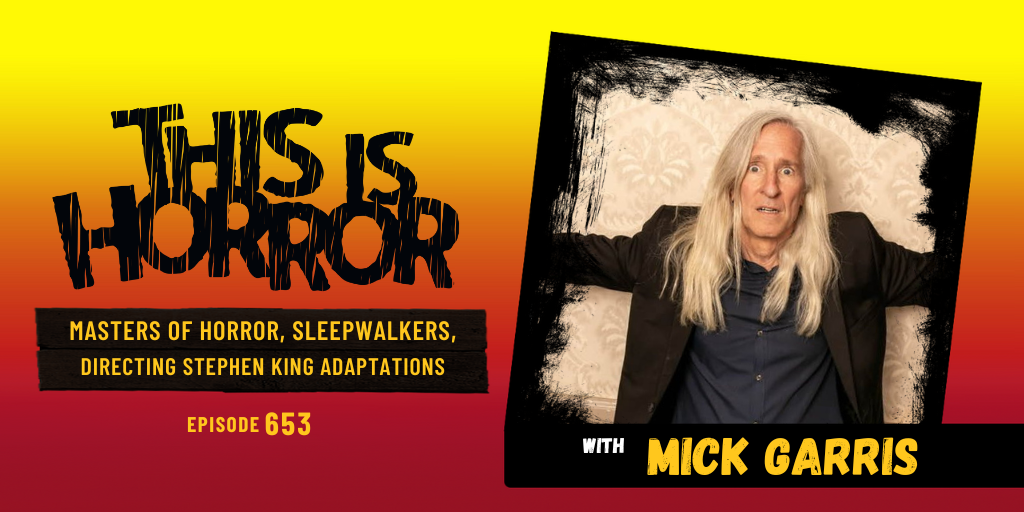
In this podcast, Mick Garris talks about Masters of Horror, Sleepwalkers, directing Stephen King adaptations, and much more.
About Mick Garris
Mick Garris is an American filmmaker, screenwriter and novelist born in Santa Monica, California. He is best known for his work in the horror film genre, as well as making Stephen King adaptations. His work includes Masters of Horror, Sleepwalkers, The Shining, The Stand, and Nightmare Cinema.
Timestamps
Thanks for Listening!
Help out the show:
- Support This Is Horror on Patreon
- Listen to This Is Horror Podcast on iTunes
- Listen to This Is Horror Podcast on Spotify
- Rate and review the This Is Horror Podcast on iTunes
- Share the episode on Facebook and X
- Subscribe to This Is Horror podcast RSS Feed
Let us know how you enjoyed this episode:
- Write a comment below.
- Follow us and get in touch on Instagram @thisishorrorpodcast
- Subscribe and comment on YouTube @thisishorrorpodcast
- Follow us and get in touch on TikTok @thisishorrorpodcast
- Tweet us @thisishorror.
Resources
- Mick Garris
- Watch the video version of This Is Horror Podcast episodes, including our conversation with Chuck Palahniuk on YouTube.
The Girl in the Video by Michael David Wilson, narrated by RJ Bayley
Listen to The Girl in the Video on Audible in the US here and in the UK here.
They’re Watching by Michael David Wilson and Bob Pastorella
Read They’re Watching by Michael David Wilson and Bob Pastorella right now or listen to the They’re Watching audiobook narrated by RJ Bayley.
Michael David Wilson 0:20
Welcome to this is horror, a podcast for readers, writers and creators. I'm Michael David Wilson and every episode, alongside my co host, Bob Pastorella, we chat with the world's best writers about writing, life lessons, creativity and much more. Today, it is an absolute honor to welcome the legendary film director, writer and master of horror, Mick Garris to the podcast. Mick may be best known for his adaptations and collaborations with Stephen King, including sleep walkers, the shining, the stand and desperation. He is also the creator of the legendary masters of horror series with films directed by the likes of Toby Hooper, Takashi Miike, Dario argiento, John Landis and John Carpenter, to name but a few. So as you can imagine, there was a lot to talk about, and I think you're going to enjoy this delightful conversation. But beforehand a quick advert break,
RJ Bayley 1:50
it was as if the video had unzipped my skin, slunk inside my tapered flesh, and become one with me.
Bob Pastorella 1:59
From the creator of this is horror comes a new nightmare for the digital age. The girl in the video by Michael David Wilson, after a teacher receives a weirdly arousing video, his life descends into paranoia and obsession. More videos follow, each containing information no stranger could possibly know, but who's sending them and what do they want? The answers may destroy everything and everyone he loves. The girl in the video is the ring meets fatal attraction from iPhone generation, available now in paperback, ebook and audio from the host of this is horror podcast, comes a dark driller of obsession, paranoia and voyeurism. After relocating to a small coastal town, Brian discovers a hole that gazes into his neighbor's bedroom every night she dances and he peeps same song, same time, same wild and mesmerizing dance. But soon, Brian suspects he's not the only one watching and she's not the only one being watched. Their watching is The Wicker Man meets body double with a splash of Suspiria. Their watching by Michael David Wilson and Bob Pastorella is available from this is horror.co.uk, Amazon and wherever good books are sold.
Michael David Wilson 3:08
Okay, without said, Here it is. It is Mick. Garris on this is horror. Mick, welcome to this
Mick Garris 3:21
is horror. Thank you, Michael and Hello Bob.
Michael David Wilson 3:26
So to begin with, I want to talk about what some of the early life lessons were that you learned growing up in California.
Mick Garris 3:36
Well, I don't think you learned any life lessons growing up in California. Interesting question one that I've never been asked before. So kudos to that. You know, people assume that if you are born and raised in Los Angeles as I was, that you've got connections to the industry, and that you know people who work in it who can give you advice, give you life lessons, that sort of thing, not the case. No one in my family or in my circle of acquaintances was in the business as I was growing up in LA. And basically the life lesson is to not allow yourself to be cowed by impossibility. You know, there was just the idea that I couldn't do it. Didn't stop me from doing it. You know, you write because you have to write. If you're a writer, you write because you can't not write. You put the work into it in the hopes of doing good work, not in the hopes of being successful. And you know, in my case, I was very lucky to have some important people like the work. I did, and want to work with me, and in getting agents and representatives who were interested in handling and thinking they can make money off of me, and thereby making me a good living, but mainly it's to just be naive enough to not realize how impossible this job can be, to be able to make a life in it. You know, it's it's about luck and timing and ability in equal measure. So I don't know if that answers that.
Michael David Wilson 5:35
No, no, I think there's a lot to go off there, and I think naivety helps a lot of us within the creative industry, because if you were really told the reality to begin with, you, you probably wouldn't get into it. But it's a combination of naivety and just absolute love and passion for the genre and for creativity,
Mick Garris 6:03
exactly and passion is what it's all about. Because, you know, for me, I was 33 before I started making my living as a screenwriter, and it was working for Steven Spielberg on amazing stories. So I had been writing, seriously writing, since I was 12 years old. So it only took me 21 years to make a living off and you, you don't do it for free for 21 years unless you just really love it and can't not do it. Doing it to become successful, you're going to give up pretty quick.
Michael David Wilson 6:36
Yeah. I mean, if people do this to get rich, there are quicker ways. There are much quicker ways. And you know that there's such a small percentage of us who do get rich doing it anyway, yeah.
Mick Garris 6:51
And of course, there's the old joke of the would be actress who was so eager to make it that she slept with the screenwriter. Fate.
Michael David Wilson 7:02
Fatal mistake there. I mean, if we look before you were even writing so I mean, you said you started writing at 12 years old, but what were your first experiences with horror films and horror stories? When to use a cliche, were you bitten by that horror bug?
Mick Garris 7:24
I was always the odd ball who loved horror from the time I was a little kid, one of the first movies, the first movie I remember seeing was son of Kong on television, and I was totally captivated by it. Then the whole universal horror package with my local TV station, you know, I discovered monsters, and I ate them up, and then I discovered the monsters who are us, rather than made out of body parts or kaiju creatures, or, you know, Freddy krueger's and the like. The ones that scared me the most were the ones that didn't look like monsters, Norman Bates, as opposed to the Wolf Man, that sort of thing. But I was bitten by it at a very early age that I was probably five or six years old, watching son of Kong, and I was the only one in the family. I had three siblings, my mother and father. None of them were particularly drawn to the genre, but I was the quiet, weird kid who was also class clown and loved monster movies.
Michael David Wilson 8:40
And I mean, if we look at your career, I mean, you said that there's been a lot of luck, but in a way, it all makes sense. It's all almost as if it was meticulously crafted. But then, of course, talking to you and hearing about how things went, I mean, you were working on the reception for Star Wars Corporation when things really started to come into play for you. And you were hosting an interview show fantasy film festival through contacts that you had made. So luck is maybe a little bit disingenuous, because you really were working hard, you were taking advantage of opportunities. You were creating them.
Mick Garris 9:33
Well, that's true, but you still need the luck to come from without, as well as from within, and the opportunity, the fact that they were looking for a receptionist at Star Wars at the time, a friend of mine, a journalist I worked with at the time, said, Yeah, I heard that they need somebody over at Star Wars. You should meet with them. And I went over that day, and they hired me that day, and so that was my entree into. Actually making a living in the film business, not much of a living, a meager living, but a living nonetheless. So luck is a good part of it, but luck also relies upon your ability to make of it what you can. And I don't mean that to I don't mean for that to mean exploiting it, but in seizing on opportunities as they open themselves up to
Michael David Wilson 10:28
and so do you think, even from an early age, you have been someone who has been able to successfully identify when there is an opportunity,
Mick Garris 10:39
sometimes, sometimes not all the time, but you know the opportunity, for example, when I was making the making of the Goonies up in Oregon with I was interviewing Steven Spielberg on the porch of the house location that they were shooting at that day, the very First day of shooting. And Steven said to me, you must do a lot of these things, because he had been on my TV interview show on the z channel, and so he had known me before that a little. And so I said what I never would have said today if I had known was actually, I'm trying to make a go of it as a writer, but it the timing. Third of the pie was that he said to me, Oh, really, we're looking for writers for this new show I've created, I'm creating, called Amazing stories. And so at that time in Los Angeles, one of his readers on the staff of amazing stories read a spec script of mine that my agent had submitted, and wrote wildly positive notes about it, recommending me as a writer for amazing stories. And I found out years later that I was the first screenwriter hired to write for amazing story. And it was because Steven had said that at that moment, I had said that at that moment, and the timing, luck timing, and the ability to fulfill what people were looking for at that time happened to coincide. And it was a very happy accident.
Michael David Wilson 12:20
And around that time as well. I mean, that was when you then, kind of started doing work on psycho four, I believe, which then it
Mick Garris 12:32
was a lot earlier than it was way before psycho four. This was 77 when I was working for Star Wars, and then working on amazing stories. Was 8586 87 and then psycho four was after critter's Two. It was made for the Showtime pay TV network, which was a way distant second to HBO. And the reviews were pretty, pretty, completely awful in 1990 but there were a handful of them that were great. And Stephen King was sent two movies by two directors, myself and another unnamed director. They were both made for television movies, and King had director approval, and so they were very close to hiring me, and they ended up hiring the other director. So that other director started rewriting Stephen King. And when you have a project that you want Stephen King's name in the title, it's a bad idea to rewrite that and go completely elsewhere from another screenwriter's ideas. So they ended up changing horses, and I got a reprieve, and was able to to work with King on sleepwalkers after he had seen psycho four and was very supportive.
Michael David Wilson 13:58
And I mean, sleepwalkers is a bold film. There are things that to understate it. And I mean, even just kind of up front, to have a boy sleeping with his mother, just very casually, and the gore, the violence for the time, just the balls to the wall, nature of it. I mean, how aware of you were you what you had kind of on your hands there when you were making it.
Mick Garris 14:34
Oh, and it was a studio film too, not an independent movie, right? Yeah. When I read the script, I thought, this is going to be fun, but it was so outrageous at the time, the head of the studio said, nobody's going to make a movie here at this studio with a boy having sex with his mother as long as I'm here. Well, halfway through our production, he'd been. Booted out and replaced by another studio. So I knew that we were doing something strong and we were doing something different, but I didn't realize just how convention breaking the film was until after it was done and we test screened it with an audience and the reactions well on opening night, for example, at the Chinese Theater, 1200 seat theater, packed to the gills, and when mother and son are dancing together, and finally, at the end of the dance, he says, Oh, Mother kisses her deeply and carries her up the stairs and into the bedroom and slamming the door in the camera's face, everyone in the audience went and they were so, like, shocked by the whole thing, and I was so delighted I knew that we'd done something people weren't used to see. And to this day, I feel like we made a movie that's not like any other movie is, yeah,
Bob Pastorella 16:02
it's definitely different. The first time I saw it was, I think probably on Showtime, but, uh, I was intrigued because Alice Creek was in it, and I remember her from a ghost story,
Mick Garris 16:15
which is why I cast her, because I loved her so much in ghost story.
Bob Pastorella 16:20
And she is just fantastic. And, and then I'm watching this movie, and it's like, it's wild. I'm like, this, I ain't seen nothing like this. And, and then we have this massive forensic scene with, just like a Hall of Fame, you know, of people, and it's just like, Whoa, there's, there's and there's, holy Matt, Wow. Holy wow. The hell. And it's like, they, they must have just been hanging out partying, and he said, Hey, come on, let's get let's get in the scene. I mean, I have no idea. I've never made a movie, but that was just amazing. And for such a wild show show, wild movie that, I mean, it's a to me, I feel like it's a classic today, even though people might go, but, yeah, it's, it's crazy.
Mick Garris 17:11
Well, I don't know. It's a little too much in the gutter to be a classic, I guess, but I tend to live in that gutter and revel in it. But it was, it was so much fun, and that forensic scene you're talking about, it's all one shot, and you could easily cut that shot out and not affect the storytelling in the slightest. You miss it, except Google gobble those of us, we would miss it because we're the ones who would recognize Stephen King and Clive Barker and Toby Hooper. And that was also one of the great things on opening night at the Chinese Theater hearing the horror gencia in the audience going so it was a blast. And then, of course, John Landis and Joe Dante later,
Michael David Wilson 18:01
yeah, yeah. And, I mean, you mentioned King and Barker and Landis, and I feel that these perhaps three of the most instrumental and important friendships that you've had within your career. So, I mean, what? What was it like initially connecting with each of them, and then, what have you learned from each
Mick Garris 18:30
well, I've learned something from every filmmaker I've ever been around, even doing the post mortem podcast. We did 180 interviews, I think, and every one of them, I genuinely learned something from John Landis. I knew first I was working on Star Wars in the office next door to his office when he was prepping Animal House. And so I learned about I learned about individuality from John. There's nobody like John and the sense of humor, and he's also where I got the idea of putting friends who were filmmakers into cameo roles. Most of his movies, he does the same thing, and it's because directors don't work together, and to be able to be on somebody's set with one of your friends who is either a peer or not a peer, or does the same work as you do at a different level or otherwise. And it's a lot of fun to have moral support from from your friends, and it helps make a very difficult job a little less difficult. You know, you're working a 12 to 15 hour day, and it's it Leavens things slightly. But you know, from Clive, I learned how to be completely uncensored and uninhibited creatively from King, the idea that you know not to hold hold back, because I would always. With my work, I would be too careful, and I learned not to be so careful from these people that don't I think a writer is being the job of being a writer is being very bold. It's being able to lay yourself bare to an audience, use yourself, put yourself in all of your characters and be fearless about representing all of the worst things or most fearful things about your personality, about your experience, about who you are. And those are things that I learned from those people. Toby Hooper is another one of those people who is a ferociously creative individual who you know Texas Chainsaw Massacre shows almost nothing graphically, but you don't feel like it when you watch the movie. You are wrung out and hung up to dry after you watch Texas Chainsaw Massacre. So those things, I'm a very gentle of nature person, but in the work that I do, it touches places that are in me that don't get out very often. So it's the that's what art does for you. And a lot of people would argue that what we do is not art, but I would argue that it is.
Michael David Wilson 21:21
Yeah, I think the vast majority of us, you know, in this game and people listening, would argue adamantly against those people, or maybe we just wouldn't talk to them. It's like, if that's your position, we're not even gonna have that conversation.
Mick Garris 21:39
Yeah, this is this is horror after all, right,
Michael David Wilson 21:43
that's it. And I mean, when we look at something like sleepwalkers, or we look at the stand or desperation, I want to know, how do you approach adapting a story for the screen? And we're really interested in the craft that this is horror, so we'd love to know the steps and the process from reading the initial story to writing the first draft and then turning in the final draft.
Mick Garris 22:14
Well, the good news is that Stephen King wrote those scripts, so that helped a lot, but still making it something physical instead of something that's entirely on a page, and in your mind, is deciding on a style, something that can be consistent with the theme of the movie, of the book. And you know, you're you're trying to satisfy, especially with something like the stand, which was King's best selling novel of all time. You don't want to fuck that up. You want to to satisfy the sense the fans, but not disappoint people who aren't familiar with it. And so it's a very difficult tightrope to walk, but I'm as big a fan as anybody else out there, so I'm making it in the hopes that it's going to be the best thing I can not just make, but that I can watch. You know, I want to see this movie as badly as you do. And then it's deciding on a physical style, what kind of lenses you're going to use? You know, I don't like to use lenses that the eye sees the 35 millimeter lens. I'd rather use a wide angle lens and a long lens so that you're seeing something either in very deep focus, where everything with a wide angle lens, you see the world around you, and that's the best production value you can have. Is a great location that you can show expansively, or a long lens where you've got a shallow depth of field, you've got soft focus in front of and behind. And so those are a couple of technical elements that can help you decide how to build tension and what your visuals are like. You create a color palette, you know, what are you trying to best put across? You know, is it? Is it layers of red that have an emotional content that's very high, or layers of blue or earth tones, or, you know, everything has an emotional tone to it. Every color has an emotional tone. And then it's, what can you afford? Who are the actors? How do they bring it to life in ways unexpected and hoped for at the same time? What are the visual effects going to be? How do you approach them? How can you make them as practical as possible? Something like the stand, we didn't have much in the way of digital opportunities, and the ones we use were very primitive and not very satisfying, but you had to work with what you had. But we had a. Uh, practical makeup effects and other effects that were spectacular that Steve Johnson's X FX did. And so it's it's really starting from page one, getting your production designer, your director of photography, your cast your casting director, all of these people, getting them all together to share the same vision. So that's that's the hope, that's the starting place when I'm writing is different, because, you know, if I'm adapting Stephen King or Clive Barker, I'm trying to be as faithful to that as I can, while knowing I'm working in a different medium. What you read is not the same as what you see, and you can feel things from movies sound and picture that you can't convey in books, and in books you can convey things internal that you can't convey from an external medium like film. So it's again, the tightrope continues,
Michael David Wilson 26:01
and we're jumping all over the place with the topics, but as you're mentioning, you know the difference between the story and the film that can bring us to masters of horror and your short story chocolate, because the story in life in cinema is very well, I was gonna say it's very different. It's obviously tonally and structurally. There are similarities,
Mick Garris 26:33
but, yeah, but it stops halfway through. Well, this is it,
Michael David Wilson 26:37
yeah, so I'd love to know about your approach for that one?
Mick Garris 26:42
Well, originally I was going to turn chocolate into a feature film, and it almost went several times, but the timing was not right. The sexuality, sex in movies was going out of fashion at the time that the story was written, so it was something that wasn't going to happen for that reason. When we did masters of horror, I thought this is a horror story, and a lot of horror fans don't see it as a horror story, because there's no monsters or serial killers or anything. It's more a sexual nightmare that becomes fatal. But I it was originally going to be a 90 minute feature. It was 100 page screenplay, and I decided to crunch it because I knew we had one hour to make our movies, and a lot of the masters of horror episodes were originally conceived as features, but were brought down to the one hour moment. And so I thought, well, let's do a lot of slashing and burning here. And because I wrote the short story and I wrote the original script, I'm not going to piss anybody off by changing anything. I can just root around in there as much as I want, because it's going to be my baby. And so it was a blast adapting it for masses of horror and then actually shooting it with a couple of actors I'd worked with before who became really good friends, Henry Thomas and Matt Frewer. And so that was just a great experience. But, yeah, you're right. It was the ability to take my own material and mess with it however I wanted to. But in season two, I wrote the screenplay for my episode based on a story by Clive Barker, an original story, not a published story that he had given me for the show. And so the story he gave me was so long, we'd still be shooting it if I shot the whole thing 20 years later. But so there was a lot of wiggle room there where I could take it because it was so expansive. And Clive and I are very good friends. And he was really, you know, I would always take him the drafts as I complete them. And Clive here, what do you think he was always very supportive. So that always went really well. And the same with King, you know, he's never told me how I should or shouldn't change any of his work. He's always been very supportive of how it's turned out.
Michael David Wilson 29:23
Yeah, and the Clive Barker story, Valerie on the stairs. I mean, that's such a delightful and disquieting peace. And there's just so much discomfort and paranoia throughout and oh, good that that final act, though, it's like a spinal tap said, that's when you turn it up to 11. It's like, holy shit, we're bringing all the elements together. But it, yeah, it's got to be one of my favorite masters of horror episodes. But. Thank you. You know, even saying that that the standard is so consistently high with every masters of horror,
Mick Garris 30:11
we were very lucky, and we had a great crew. We got great directors who knew how to work on a budget and a schedule, who had great ideas, and we really lucked out. We did two seasons, and there are 26 episodes, and I would, I love them all, you know, for different reasons. And I'm very proud of what we did, and I think we achieved what nobody thought we could. And it turned out great. The show was a big success for Showtime, they just didn't want to pay for it anymore, so it didn't continue. But who knows, you know, but I really appreciate you saying that. But there's some really wonderful episodes, you know, being at a film festival and watching chocolate play a film festival in Italy, watching chocolate play with an audience and Dario Argento standing up at the end with the crowd afterwards. But even more than that, Joe Dante's episode about the Iraq War had a 10 minute standing ovation at this Italian film festival, and it was not a genre festival. It was an artsy, you know, mainstream, artsy Film Festival that attracted the intelligent intelligentsia of cinema rather than the horror Gen Z. So that was unbelievably fulfilling. And Joe was just blown away.
Bob Pastorella 31:42
You know, it's like growing up. I grew up, and so I'm 58 so I saw, you know, the tour horror leisure books, del abyss. When del abyss came out, it was the top notch. And so then masters of horror, to me is the del abyss of films. And that, to me, that's like you can't, in other words, like a whole series dedicated to horror, and every story took, even if it took a familiar trope, it turned it inside out. And that's that's to me, it's like you can't get any higher than that. Delebus in fiction, they revolutionized horror, and masters of horror, I think people are they should be still influenced by that series.
Mick Garris 32:34
Well, thank you. I mean, it's nice when you've got you've got Clive Barker, you've got Toby Hooper, you've got John Carpenter, you've got Stuart Gordon, you've got all of these great people, many of whom have passed and to have been able to have their either their last films, or their nearly their last films, and To show that they could still pull it off was was really honorific,
Michael David Wilson 33:06
yeah, my understanding is that it started because you organized masters of horror dinners. So can you talk us a little bit through how you went from having dinners with these masters of horror to putting out these amazing two seasons.
Mick Garris 33:25
Sure, you know, we would, we filmmakers would run into each other at Directors Guild organizations or meetings or film festivals around the world, and everyone would always say, Oh, we ought to put together all get together for dinner sometime, you know, and it's like, yeah, that'd be great. That'd be great. And I realized nobody's actually going to take the bull by the horns and do it, so I'm going to. And it took me a week to put together the first dinner, to try and get a time that was convenient for everybody to make it. There were 12 people at the first dinner. It was Wes Craven and Toby Hooper and Stuart Gordon and John Carpenter and John Landis and William Malone. And, you know, there were 12 Guillermo del Toro. And we had a really great time. And we were right next to a party celebrating somebody's birthday. And so they stood up and started singing, happy birthday. We all joined in. And at the end, Guillermo del Toro stood up and said, the masters of horror, wish you a happy birthday. So that was where it began, and then, because everybody had such a good time, the next one we put together. I put together was a couple of months later, and it took an hour to arrange it. And so, you know, it's just like any people who have the same job in common. You talk about work, you get. Together for a dinner. It's not all about work. It's just about friendship, fellowship. You know, some of it's about work, some of it's about play, some of it's just about whatever is going on in each other's lives. And one of the things that we talked about was having the ability to be in control of our own creative lives to be able to make what we want to make, not to do the fifth sequel to some franchise that's been hanging rotting on the vine. And so I came up with the idea of doing this anthology series and saying, if you want to buy this, you have to agree to give everybody their heads. Now, obviously, we don't want to do things that are illegal or things that are unsavory to ourselves, but we want the creative freedom to do that. Yeah, you can get John Carpenter and Toby Hooper and Stuart Gordon, but you have to give them their creative heads. So that was our pitch. We pitched to three different companies. The first one was Anchor Bay, and they said, how much and when can we start? And we were off and running, and it was amazing. And they licensed it to showtime. It was never originally going to be a TV show. It was going to be direct to DVD. And then they realized at Anchor Bay that if it were a television series on a network that would be the best commercial for the show itself, that you'd sell a lot of DVDs. So Showtime licensed it for 10% of the cost of the show being made. So they paid so little for it that they couldn't have any creative input. And so that was how that was born. And then we did it for two years, and then Showtime, or Anchor Bay was sold to stars, and stars decided they wanted twice as much money, and they sold it to NBC, which was a commercial network with censorship and all of that. And so that's how fear itself came about. And I was attached at first, but once the creative control and the censorship and all of that became an issue. I left the show, and it went on without me and failed miserably. I'm happy.
Michael David Wilson 37:27
And when it came to those original pitches to Anchor Bay, who was in the room for the pitch and What, did you pitch at the time? I mean, did you have to kind of give them the premise for a number of episodes, or was it as simple as, look, we're talking John Carpenter. We're talking Dario Argento. This is the pitch.
Mick Garris 37:57
That was the pitch. It was me in the room with Anchor Bay saying, Look, we because I wasn't only pitching the directors, I was pitching writers as well, and writers of of material that it would be based on. So you either got it or you didn't. And a lot of these people were horror fans at Anchor Bay in particular, because most of their business was horror movies. And the budget we were working at at that time, 20 years ago, it was $2 million an episode, 10 days of shooting for the most part. And it's a very low budget, not a terrible budget, but at that time, the high end broadcast networks shows were going for about $4 million an episode, so we were working, but we also didn't have a continuing cast who we had to pay more and more and more each time. And we were doing different people every episode, different cast. We had a limit to how much we would pay to bring actors in, and everybody was on an equal basis. You know, if you're coming from LA, you get this much, and no matter how famous you are. So it all, it all worked out to in that regard, but it was an amazing experience.
Michael David Wilson 39:20
And as a big fan with a personal interest in Japanese horror, it was a delight to see Takashi Miike, and then also to have Norio Tsuruta adapting a koji Suzuki story. So I'm very interested as to how both of those came about both Miike and Tsuruta.
Mick Garris 39:44
I was a big fan of audition, and we partnered with kathekawa in doing an episode. We said, you know, we want a Japanese episode, and we the my. Managers at the time who are also producing. They had gotten a list of filmmakers, and they suggested to me Miike San and I said, Are you kidding? If we can get him, that would be phenomenal. And when we did, what's interesting about imprint is that only the lead actress and Billy Drago spoke English. Everybody else in the cast, every single actor, learned their lines phonetically. They none of them spoke English, except for those two actors. So that was and I was on set for most of the shoot, and watching that happen was they were phenomenal, a little hard to understand sometimes. And then when we went to a second well, also Kathe Kathe released imprint theatrically in a 68 minute version. The television version was 60 minutes. And then when we came back to do season two, we went back to kathekaua, and they offered up Norio Tsuruta, and I looked at his films and realized I'd seen some of them before, met with him, and he was great. And so yeah, we we had dream crews shooting in Japan, and that was an amazing experience, being able to be on the set producing movies in Japan is a very other worldly experience.
Michael David Wilson 41:29
Yeah, and I love too, that suruta shows the koji Suzuki story as the episode, because then, of course, you've got the connection to the ring and dark water and all these other rich Japanese horror films.
Mick Garris 41:46
Yeah, it was great. You know, I knew some Japanese horror, particularly the ones you just mentioned. But it also opened the door for a lot of new material for me, which I found fascinating and hope to be able to use in the future.
Michael David Wilson 42:03
Yeah, I think the masters of horror has set the standard, really, for anthology horror series that I just keep hoping for a reprise. We want a third season. But I'm assuming, from what, oh, I don't know, from your, from your, your facial expression area, is there any possibility for a third season for
Mick Garris 42:31
said, I'd rather celebrate the two seasons we had than to to be moan the ones we didn't. But who knows? You know, there may be something I'm not I used to lock myself off to the possibility of there being more in the future, but I'm a little more open, open about it right now, and we'll leave it there,
Michael David Wilson 42:54
that that is the best thing that we've heard so far during this podcast, that is very hopeful. And I mean, kind of talking about collaborations, and I don't know if this will go into something that actually we can't talk about, but I know that previously, you said that you and Clive Barker were working on something, and I think it was originally for shudder, and then that didn't quite work out, but
Mick Garris 43:25
Yeah, unfortunately, we did write a pilot together for an anthology series based on new original stories that would have taken us back to the UK. And it didn't work out. There were political things going on at shutter, who didn't have much money, and this would not have been an inexpensive show. And when you've got Clive Barker and someone so unfiltered as he is, shutter is kind of the only place you can go. And if they decided against doing it, you know, it broke my heart. It broke Clive's heart, but there was no place else for us to go with it. You can't go to NBC with a Clive Barker, balls to the wall. Pilot, we wrote the pilot in full together, and I love it. And it is so fucking nasty, but it's also wonderful. The characters are great. The storyline is great. It is so Clive Barker, and when you're working with Clive, you abandon yourself to his his point of view. And that's a wonderful thing, because he's such a great artist in every sense of the word. He's a brilliant painter as well as a great writer and thinker, so I don't think we're ever going to see that happen, but it would have been nice
Michael David Wilson 44:50
and kind of on that note, how do you deal with setbacks and passes from studios, and when is it time? Them to reimagine and repitch. And when is it time to can a project and say, Okay, well, we can't go forward with this one.
Mick Garris 45:09
Well, you never give up, but you never stay the hamster in the hamster wheel. You know, at a certain point you just go, life's too short. Let's move on. Ideas keep coming to you, if you're a writer, if you're a creative person, you're constantly coming up with new ideas, and you're able to let things go, let them lapse, and sometimes they come running up behind you and bite you in the butt and say, Hey, remember me. Let's do this. And then you you take it out, or someone comes to you and says, I remember this project you had. What became of that? And then they come back to you, so you never know. I mean, I wrote a novel 20 years ago called Salome, not 20 years ago, but 15 years ago. And just last year, we wrote a screenplay for it, and it is going out now as a feature film. It's a NEO Noir. It's not a horror story, but it's something I've been dying to do ever since I wrote the book. But I wrote the book because sometimes things present themselves in a different medium than you expect, and it was more an internal project than I thought it was a film. And I would often write fiction in between television and film projects as a palette cleanser and to just think on another level. And now it seems like one of the most cinematic things I've written, so maybe we'll get the chance to turn it into a feature film. That's the hope. It's just going out. Now, people have been very enthusiastic about the script, so who knows. But that came from a book that I wrote because I didn't think it could be a screenplay, and now it's a screenplay, and we'll see. But you know, the the first thing I wrote that got me attention, that got me hired on amazing stories, was a script called Uncle Willy, and it's a period piece set in the 50s, so it doesn't age. It's never been made. Nobody's ever optioned or bought it, but you never know. I mean, it was 40 years ago, but you never know
Michael David Wilson 47:23
when you're writing something for the screen versus writing something for the page. What are the different challenges? And I mean, how do you approach
Mick Garris 47:35
each well, for film, it requires a little more structure. Fiction is more free wheeling, and it's also more internal. You can write from within, rather than having to write from without. You know when you're writing a movie, you can convey through dialog what you can't necessarily convey through quiet that you can in writing books, and I learned a great lesson from Richard Matheson when we were working on amazing stories together. He said books are internal and film is external. And it was profound at the time, even though it was obvious, but it really is true, and I did an experiment when I did a movie called riding the bullet based on a Stephen King short story. It was only 30 pages long, but it inspired something in me about loss. I'd lost my brother and I'd lost my mom before I read this story, and I also thought that it was set in a time of change. It was set today, or the today of when that Hap was written 1999 King wrote the story. But I set the movie in 1969 because it was all about change and how the world made a choice that might not have been a good one might have might have been a good or bad choice, just like the lead character in the short story and in our movie, had to make a choice, and it was a life and death choice, and I decided to experiment on trying to make King's internal words externalized by having the main character, there be two of them. He would talk to himself, and you'd see two of him played by the same actor on the screen together, having a conversation with one another that you could only put in a book in internal language, and otherwise he'd be in a movie talking to himself, which would just, you know, I or you'd have voice over, which, I think is a real easy cop out, unless you're doing the film noir or something where it's stylistically important. So it was an experiment in how to make the internal external. For a movie, and maybe it worked. Maybe it didn't. That's a movie that's too close to me to be able to judge it closely.
Michael David Wilson 50:09
And I mean on that basis, when an idea presents itself to you, do you know immediately whether this is more an external or an internal, or does it kind of require more exploration?
Mick Garris 50:28
Usually, when I'm inspired to write something, I know the medium it's going to be, you know, it's I'm in a mood to write. No matter what the idea is, I'll know what I'm in the mood to do, and I know that if I'm writing it as a book, it's not going to be a paycheck, because we know that unless you're in the upper echelon, if you're Stephen King or Clive Barker or someone like that, most novel is don't make their living doing that. So for some people, that would be a consideration. I'm going to write whatever I'm most motivated to do at this point in my life, and it's still usually a movie idea, because that's how I've spent most of my life as a writer, is as a screenwriter, and my fiction writing, even though I started at 12 doing fiction, being a published author of fiction didn't happen until way late in in my career.
Michael David Wilson 51:31
And so do you have numerous projects that you're working on simultaneously? I assume you have to just because of the absolute body of work that you have, and also just being in the film and TV business, where you always kind of need to be pitching and coming up with new ideas, but Well,
Mick Garris 51:55
yeah, I mean, I'm not desperate to do it at this point in my career. I've been doing it a long time, and I love doing it, and that's why I do it now, rather than to make a career out of it. You know, I have a career, and I've had a career for decades now, but, yeah, right now I've got three different projects I'm working on one two of them are feature films, and one of them is a television series, and all of them look like they could happen. And, you know, I haven't produced anything I've written, you know, the pilot with Clive, and a lot of things on spec. Because if I, if there's a project I want to write, I'm not going to go out and pitch it. I'm just going to sit down where I am right now. Nice Guy productions world headquarters and and write the script without any interference, and then if they want to buy it, great. If they don't, that's fine as well, but I forget the point I was making. But yeah, having several projects going at the same time, you know, you you learn quickly which ones are drawing the most traction, and you devote more of your energy into the ones that look like they're going to happen. One of the three I just mentioned look like it's most likely to happen. One of them has not gone out yet to be pitched. One of them. We've been trying to connect with movie stars and who have production companies that want to partner with us, and so we'll see. Right now, the TV show looks like it's gaining traction, and if that happens, I'll be very happy. I'll be very happy with any of them, frankly, because I don't have to do things I don't want to do
Michael David Wilson 53:47
anymore, right? Yeah, yeah, no, you've certainly earned that, right?
Mick Garris 53:52
Well, it's just at a at a certain age, you know, you go, do I really want to? I remember when we offered Roger Corman doing an episode of masters of horror. He said, Do I want to be 80 years old and standing in the middle of a rainy Vancouver graveyard at three in the morning? And the answer was no. So, you know, I don't have that same consideration. I'm not there yet. But you know, it's a movie takes a year out of your life. And if it can't be something you can be excited about, it's it's not worth it to you, right?
Michael David Wilson 54:33
And having free projects on the go at once, what does a typical day or a typical week look like I'm wondering how you structure your time? Is it a case of, here's a few hours on this one, a few hours on the next one, or you're having blocks of time within the month? Or what
Mick Garris 54:55
if I'm writing, I'm writing one project at a time, and. Now I'm in a waiting mode on these three projects, so the energy I'm putting into those is packaging things to present to different either studios or networks or actors or production companies or funding sources or whatever. And I'm not someone who likes to work with funding sources. So I usually work with producers who are good at that, because I'm not, but I'm usually working genuinely working on one project at a time. If I'm writing a script, I'm not writing three scripts. But I also writing comes easily to me. It's something I really enjoy. And even after all these years, I love sitting down and starting and typing. And it's something that that I enjoy doing. I get excited about doing, and I'm fairly quick. I enjoy the process, so it's not like work, and it's why I will write on spec rather than pitch and develop. You know, it's like this is the script I want to write, and whether or not this is a script you want to buy is up to you after I'm done, but I don't want your input now. I'll take your input after you read it and decide you're interested or you're not.
Michael David Wilson 56:23
And if you were starting out today and you were looking to break in to screenwriting, God, what would you God, help you? What would you do? Just pray.
Mick Garris 56:37
It's the most difficult thing, particularly as a screenwriter. It's easier, in a way, as a director, because you have the tools to make films on your on your iPad, on your phone, on you know, you can make a really high quality movie on your iPhone and have high quality sound effects, and you can mix a surround sound mix, and all of that you can make a professional looking and sounding film. All you need are terrific actors and a terrific script, and then you have a showpiece that you can show to people. As a screenwriter, it's much more difficult, because it's a matter of writing screenplays and then getting to agents who will see the value of your script, whether they want to make that script or not. It might be a good sample that says, Oh, they're looking for a writer for this project. Here. Let me give you this screenplay, this work by this writer. But to be a screenwriter is to actually sit down and do the work, not to just think about it, not to just talk about it, not to just pitch it, not to come up with stories, but to actually show that you have the ability to write a screenplay that somebody wants to produce, and then it's to get an agent, and that's really difficult, because every agent takes home 30 screenplays every weekend to read, and they might get three pages in and throw it aside. So you have to have something that shows that you can make these people want to turn to the next page and keep turning the page, and keep them captivated and not lose their attention. And that's harder than it's ever been, because they're also checking their messages, their emails, their texts, they got, you know an actor on the line or something. So it's harder than it's ever been, despite the fact that there are more platforms than they've ever been before. But how do you get seen and how do you separate the wheat from the chaff? You know, even as far as looking at streaming movies, you're looking at a page of thumbnails that how do I know what's good and what's bad? Maybe I can tell from Rotten Tomatoes, or maybe people are talking about it online, or maybe Fangoria is talking about it, or there's a screening at a festival that gets it some attention, and all of that sort of thing. So it's a really tough time, but I would venture to say it's even harder to make a go of it as a screenwriter than as a director, because you do have those tools. People would rather watch a movie than read a movie. Yeah.
Michael David Wilson 59:28
And on the note of rotten tomatoes, that can be distinctly unreliable too, because unfortunately, you know, as it is compiled by and is the opinion of human beings. Human beings can be deeply unreliable. So I've kind of got burnt before by seeing it's got a low rating not watching it, and then circumstance has come around it. I have seen the film and thought this is one of the best movies of that particular year. Well.
Mick Garris 1:00:00
That's the thing about it, is it's an average which means somebody liked it, somebody didn't, and it's really word of mouth is the best way to hear or just discovery you see something go, this looks interesting. I haven't heard about this before. I'll give it a try. And I do that a lot. And 10 minutes in, I go, Okay, next, but then you'll find something and just wow, this blew me away.
Bob Pastorella 1:00:26
So I tend to look for things that are extremely polarizing to people, because that made in reaction. And I'm like, Michael, I don't trust people's you know, I think a lot of people are just very irresponsible and unreliable, but if something evoked a reaction, even if you hated it, I'm like, suddenly very interested in seeing it. Yeah, because, because I don't trust you, I don't trust you viewer, and you hated it, so that means I might like it, so that gives it a
Mick Garris 1:01:00
better shot? Well, there's nothing worse than being average. Is there, right?
Bob Pastorella 1:01:05
Exactly? Don't want to be average, yeah.
Michael David Wilson 1:01:09
Well, I think Yeah. With a lot of the decisions you've made and collaborating with people like Clive Barker, there is no danger of being average. People are going to react. For better or worse, they are gonna give you a reaction. And, yeah,
Mick Garris 1:01:27
you see a movie like sleepwalkers, you you either embrace it or you hate it. There's no like, oh, it was okay.
Michael David Wilson 1:01:36
Yeah, is, you know, I re watched it ahead of this conversation, and it really does stand up today, and it is still absolutely bat shit crazy.
Mick Garris 1:01:50
Well, thanks, and, and that's another one that every single review was terrible when it came out. They hated it.
Michael David Wilson 1:01:58
See The reason that I assumed that the reviews for psycho four were good was because of how strongly and positively Stephen King reacted to it. But no, he was the lone voice, apparently.
Mick Garris 1:02:13
Well, certainly in 1990 he was one of the few who reacted well, there were people who liked it, but not many critics who liked it, but it did lead to the most memorable bad review line I've ever received some reviewer, and I forget who it was, maybe by choice, said director Garris is to Hitchcock what Peoria is to Paris. So you may not know, Michael, but Peoria is a crappy small town in Illinois, and Paris is not. So it's a very clever line, but Ouch, yeah.
Michael David Wilson 1:02:54
How did you react to that at the time? I mean, a lot of people say, you know, to to ignore reviews, to try to let them wash over you. Don't pay too much attention to them, either way, however strongly worded,
Mick Garris 1:03:15
if your work is important to you, it's a part of you. And to insult somebody's work is to insult who they are. And if you're going to believe the good reviews, you have to believe some of the bad reviews as well. Reviews can be very painful, they can be instructive, but you also have to put them in the context of this is just somebody who writes about movies. He's never made one. He doesn't know what goes into it. And you shouldn't have to know what goes into it. You should only be judging by the finished film. But a lot of review, you know, it's their opinion, and you have to respect that, whether you agree with it or not. But it's also just as they say, just like an asshole, everybody has an opinion,
Michael David Wilson 1:04:03
I see, yeah, so we touched on before you adapting the shining and I wonder, given that Stephen King had reacted so strongly against the Kubrick movie, Was this perhaps some of the most pressure you have felt for adapting a movie, knowing that it was such a personal project for King himself,
Mick Garris 1:04:30
yes and no, because when I first saw the shining, I had never read a book that I a scary book, I thought was better, and when I saw Kubrick's film a couple days before it was released at a screening at Warner Brothers, I hated it. Now I think it's a great Kubrick film, but a terrible King adaptation, and King is warm, Kubrick's cold, and I think that's the big difference, and it was not the right match to. Of material and filmmaker, unless you haven't read the book, and then, you know it's a master, but King himself wrote the screenplay, so that took a lot of the pressure off. But secondly, it's the most comfortable production I've ever had. I've never had what I felt was to be sufficient budget before this mini series, this was the first and only time I felt like we had enough money to make it the way we hoped to make it. It was enclosed, you know, it had a small cast. There weren't many locations, and I was able to concentrate on the filmmaking and the subtleties of working with the cast, where it was going to go planning. You know, we were on the road for the stand, which was a 460 page screenplay, and it all across America, and we were constantly on the move. And, you know, there were locations that I'd never scouted before that we just this is where you're shooting. Okay? Here we go. Here we built sets. We were occupying the hotel for months on end. We were doing things in a more controlled way that allowed me to exercise whatever tools of filmmaking I had access to. So there was no, none of the creative pressure of No, is this going to piss King off? Because King was there, and it was King's script from his book, and it was great. You know, I've, like I said earlier, I've never had Stephen King tell me what he thought I should do as a filmmaker, but was always there to give me moral support. And working with Stephen King is the greatest collaboration any filmmaker could ever hope for, to actually have him there on the set, which he hasn't done in years, but, you know, it was one of the best shooting experiences of my life. I would say the shining and Master's of horror were probably the two best.
Bob Pastorella 1:07:13
I never really realized that the and I guess I knew in the back of my head, but the stand script was 400 pages long?
Mick Garris 1:07:22
Yeah, 460 Yeah. So, yeah, I came home one day and there's this door stop on my porch, and it's like, how long is this gonna take to read? It took me a day. But, yeah, it was, it was a big fat one.
Bob Pastorella 1:07:43
Yeah, I re watched it last year, and I've seen it golly, probably 10 times. And I will tell you that the first time I saw it was when it was on TV, and I was a young King fan and very, very skeptical. And all I can say is, when those strains of don't fear the Reaper started playing. I knew I was in good hands. Oh, good, oh good. I was like, oh, okay, okay.
Mick Garris 1:08:13
I think there were a lot of doubters, because television did not do well by horror. And, no, not at that time. And the fact was, I horror on TV was mostly made by the same directors who made the rom coms and the sitcoms and the westerns and everything else. They were just directors, not directors who were passionate about the genre. And so I think that made a big difference to the stand, because I was also not somebody who watched a lot of TV at that time. TV is better than movies now, but then there was a big difference. And I wanted to make movies, and I had made movies and had not done a lot of television, and so it was kind of, as Douglas winter said, it was kind of a halfway between movie and television, so I did everything I could to make it as cinematic as possible and not take into consideration the size of the screen, because people watch movies on TV all the time. So what's the difference? I'm making a movie mini series so it may be on the small screen, but so are all the feature films that aired on television at that time also. And everybody loved the book, everybody who worked on the movie, they were fans of the book, and they were excited about the opportunity to do this this way. And I didn't realize what a heavy burden was on my shoulders, directing, being one director for all eight hours of the show. And and King was there for probably half of the show. He was on location, and it was. Just an incredibly great experience, harder work than I've ever done in my life, and ever want to do again, but it was a great, great experience in every way. It wasn't easy, but I learned so much and realized that I could take on some heavy duty, heavy lifting. And I don't want to lift that heavy anymore, but I'm glad I did it then, but that was 100 day shoot. And, you know, normally in mini series, in those days, they would do a different director for each of the two hours, but it was all on my back, and I loved it.
Bob Pastorella 1:10:41
Wow, yeah. And I will say too that going in, and it's like you had, like, you know, Gary sneeze and Ray walls, whoever at watching. But I came out of that thing with a much greater appreciation for Rob Lowe, who I could not stand. And when I saw him in the cast, I'm like, Well, there it is, right there. That's, that's gonna be the one that breaks it, yeah? And he knocked it out of the park. He was great. And he's a huge and, oh, I didn't know that, yeah. I mean, he just, his portrayal of Nick was just, I was like, wow, this is, this is the guy can act. I was I was surprised.
Mick Garris 1:11:22
Yeah, there were a lot of doubters, and he was pitched to play Larry Underwood. And I thought that's so on the nose. If he would be interested in playing Nick, I would really find that more interesting. And when I suggested that, he totally committed to it, right? He was great. But I think a lot of people had this game, same skepticism. You did Rob Lowe and, you know, the Brat Pack, Molly, Molly and Rob Lowe, it's TV, TV, TV. But you know, it came from a different perspective, not from a TV perspective, yeah, yeah,
Bob Pastorella 1:12:03
it's great.
Mick Garris 1:12:04
Yeah, online was brand new. Then AOL, you know, and chat rooms and stuff. And when it was first announced, there were all these doubters, no, no. Stephen King with Marley ring was and Rob Lowe on television, oh, it's gonna be a piece of shit. And then it became the highest rated, most watched mini series of all time.
Michael David Wilson 1:12:27
Well, didn't Rob Lowe commit so much that he volunteered to put things in his ears to actually appear deaf while doing it.
Mick Garris 1:12:37
He's deaf in one ear, and he offered to put a bug in the other ear. That would just be white noise. And I said, that's great, Rob, but how would you hear my direction? So you know, it also reminds me of the the quote from Lawrence Olivier when they were doing Marathon Man and Dustin Hoffman was going on and on and on about how he would approach the role from all of these esoteric artistic standards. And Olivier said, What about acting? Boy? So that's kind of what I jokingly said to rob,
Michael David Wilson 1:13:20
well, you got to appreciate the commitment, if not the practicality of the suggestion.
Mick Garris 1:13:27
At least he was great, and he was a dream to work with.
Michael David Wilson 1:13:30
And, I mean, at that time, when you were putting out, you know, these television series, you also had the movie Quicksilver highway, yeah, which is almost, I mean, well, it is an anthology of a film. Yeah, I do find that a bit of a underrated, a little hidden gem.
Mick Garris 1:13:53
Thank you. I love that little movie. And it originally was going to be a pilot for a series that I was asked to do a pilot for a series of ghost stories. And I said, Well, what if I got a story from Clive Barker and turned that into a one hour pilot? And then once I did that, they said, Can we make it a two hour movie instead, and make it a backdoor pilot? And I said, let me see if I can get a story from Stephen King. And this was right after we did the shining. We went right into production with Quicksilver highway and Fox TV did it, and they did not have a background of doing movies. They did series, but not television movies. So originally it was going to air as well. It did air as a television movie, but the series, people never saw it, never considered it for a series. So it just got lost in the shuffle. But it aired. Were the like the same week as the shining hair, but they were made back to back. We've made the shining out of town in Colorado. And so when we got back to LA, I decided I got together the whole all, most of the same crew that were from LA, and we shot at home. We were able to go home to our own beds, and it was what I like to think of as a recreational horror film. It's just there to tell you a couple of fun stories. It's not got anything heavy on its mind, but it's very playful. And the wraparounds I love, Christopher Lloyd is so weird in it. And it was really fun to write these flowery, purple prose speeches for him, and to actually be the writer, adapting King and Barker myself, and that was a great playground for me as a writer as well.
Michael David Wilson 1:15:55
Yeah, when did you first start working with Christopher Lloyd
Mick Garris 1:16:01
the first time I didn't work with him, but I wrote an episode of amazing stories, and Christopher Lloyd was in that. So that's the first time I ever met him. It was Bob Zemeckis episode. He directed it, but it was something I came up with. The story with Tom McLaughlin, and we wrote the script together, and it was, oh, the classroom. I don't, I can't even remember now, was 1986 so excuse me, 40 years of history. But that was the first time. Then the next time we worked together, where we actually worked together, was Quicksilver highway, and then on masters of horror and Valerie on the stairs, which he's fantastic in. Valerie on the stairs, and again, had some really difficult speeches that I, I wrote for him, but he, he nailed it. But it's funny when you're on a set and somebody's got a difficult speech, you can feel when they're having trouble remembering it. You know, if it's like three pages long, that's not an easy thing to memorize, and you just feel them struggling with it. And Chris, I would feel that in a couple of takes, but by the time it was take three, he was just blasting
Michael David Wilson 1:17:19
through it, yeah, I think in both situations, I mean, you couldn't really imagine someone else playing the roles that Christopher Lloyd did. Yeah, had you or had you written them purposefully for him? Or was it just a happy situation? No, it's
Mick Garris 1:17:38
just a happy situation. After writing Valerie, I thought, wow, Chris Lloyd would be great for this. I wonder if he'll remember me, and I think he did. But you know, I know he wouldn't have remembered me from amazing stories, because we didn't really work together. I was a writer, and I was maybe on the set a couple of days, or parts of a couple of days. But with Quicksilver highway, we had a blast when we're shooting the scene inside the trailer and he's eating those strawberries. He just kept eating strawberries, take after take after, take. Thank God he wasn't allergic.
Michael David Wilson 1:18:18
Yeah, otherwise, it would be a different type of horror that we will be talking about right now.
Mick Garris 1:18:24
Yeah, well, here comes the gurney.
Michael David Wilson 1:18:29
Well, what habits or routines Do you have, or have you had that you think have made you a better writer and creative
Mick Garris 1:18:42
just doing it, you know, not making excuses not to do it.
A writer writes, and whether you're going to sell it or not, the more you write, the better you get at it. The more you shoot, the better you get at it. Unless you start making shortcuts and go, Oh, you know, I did this last time, and it's something I want to use again. That there's nothing wrong with that, but if you just do it because it's easier, and a lot of people do that, and a lot of people, as their careers go for any length of time, often get lazy, and you know, it's hard work directing a film, and it's easy to go, let's do it the easy way, rather than put your balls on the chopping block. And that's a painful thought, but, but you know, as far as writing goes, I always write in the morning. After I get up, I have my breakfast, I read the paper, I'll write like six, six or seven pages before lunch, so that I can come back and only write three or four to do a 10 page day and just do it. I'm not writing at the present, but in. Last year, I've written a couple of specs and the pilot script with Clive that might have been more than a year ago, but, you know, a couple of treatments, and you know, it's just, every muscle you exercise gets stronger, so it's just a matter of doing it and not making excuses, and to to not take the easy way out. I think taking challenges and not to be fearless. You know, like I said before, to be a good writer is to be fearless and to allow yourself to explore what's inside of you, whether it's comfortable or not. And as a filmmaker, you're using different tools, but to achieve the same goal. And I think fearlessness and and this is really important that I learned early on is to not be talked out of an idea, because you think the people talking you out of it have more knowledge and experience than you know when the ideas on the outside are coming because they want to make it easier or because that's how it's been done before, but also know when their ideas are better than yours. To not give up an idea because somebody talks you out of it, but because you genuinely know that idea might not have worked. Trust your instincts unless there's a good reason not to. Don't follow your ego. Follow what's best for the project. You know to to not just say, Well, I know better than you do. You may, but you may not, and it depends on where those suggestions come from. Sometimes they're really good, sometimes not so,
Michael David Wilson 1:21:54
yeah, I think being fearless and also knowing when to trust your own intuition, it can be a little harder early on, you know, especially if you perceive that there's somebody a little bit higher up the ladder. But as you say, looking at well, why are they doing it? If it's for financial or commercial rather than creative considerations, then, yeah,
Mick Garris 1:22:22
somebody's going to make a suggestion based on what's been done before, on what's been successful before. But if your script is one of those 30 that the agent takes home to read, and it's just like, what's gone before, it's going to be in the in the trash pile, you know, it's, it's not going to be the one that makes him well, write a note, okay, contact this guy on Monday. You want to do something that stands out. You want to do something even if it's not going to get made, something that will get attention. Like, whoa. I've never read this before, and with a style, you know, and grammar counts. Spelling and Grammar count. You know, when I'm producing and I'm reading people's material, if it feels like somebody never went to school, you know, I just like it's unprofessional and professionalism counts.
Michael David Wilson 1:23:19
Yeah, I think that I mean when we're talking about these different ways of approaching film and approaching writing and when, when you're looking for, okay, is this something I authentically believe in? How does one know? It's kind of a esoteric question, but how does one know when it's kind of coming from your own soul, and how do you know when you're being kind of set astray by other external forces?
Mick Garris 1:23:58
Well, you can only write what you write. And I think your intuition guides you. I think intuition in an artist is a very important element that, not that people don't give enough attention to, you know, I never sit down and think, Okay, this is my three act structure. I'm I'm going to write. This is Act One, this is act two, this is Act Three. I've never done that in my life, but I could sit down with any script I've written and go, Okay, this is Act One, this is act two, and this is act three, because my intuition took me there. I watch a lot of movies. I don't think about structure, but I'm a storyteller, and so there is a certain structure to cinematic storytelling, you know, and there are people who are great at it, and they're knowing the rules. Allows you to break the rules. If you break the rules on purpose, that's great, you know, if you break the rules because you don't know any better, you. Sometimes it shows and that can also be great too. You know, there are terrific writers who've never read a book on screenwriting or writing of any kind, who just come out of the womb with a good command of the language and a good command of storytelling, and that's great. But there are ways to learn to be better, and one of the ways is to just keep doing it. You know, the more you do, the better you get.
Michael David Wilson 1:25:30
Well, what advice would you give to your 18 year old self?
Mick Garris 1:25:37
Well, kind of to blindly stumble forward the way that I did when I was 18 years old. Because I was 18 and I was singing in a rock and roll band, Prague rock band, all original songs, you know, and we opened for some major acts, we opened for the kinks, and we opened for some other people, and all of that. So I wasn't thinking so much about that. But till after the band broke up, I started thinking about screenwriting, because I love movies, but the best advice is embrace the passion of movies. If, if that's your passion, you're going to be watching all the movies you can and you're going to be doing as much practice as you can. You know, I wrote a bunch of screenplays before anybody ever hired me, but that's what I was doing. I didn't know I would ever make a living doing that. I didn't even know that it was possible to make a living doing that. But I was lucky enough. I was doing publicity for the fog, and I was hired by Hap co embassy to write a screenplay for a project called the Philadelphia Experiment. They made the movie years later, not from my script, and I got no credit on it, which was fine, because they changed it completely. But I was around movies. I got jobs doing specialized publicity in horror movies and science fiction movies and just whatever job I could get working close to the medium I wanted to be working in. I knew I could learn something from and I hired myself to do making of documentaries. And because I was a lot cheaper than the vendors who were doing it for the studios I worked at, and I learned how to put pieces of film together to make sense, to make a narrative in documentary form. And I did the making of the howling, and I did the making of the fog, and I did the making of Goonies and Gremlins and the thing, and I learned about the making movies by watching movie makers make movies.
Michael David Wilson 1:27:51
How did you specifically go about hiring yourself for the making of that's an amazing detail,
Mick Garris 1:28:00
because nobody was going to pay for it at the studio, it would cost $90,000 to do an electronic press kit, and EPK and I had a job doing specialized publicity on the genre films at APCO embassy, and then Later at Universal dealing with the magazines that existed then the Fangoria is and star logs and things like that. There were a bunch of other ones as well. There was no online yet. And I would say, look for $3,000 or $5,000 or $9,000 I will take a camera, hire a camera guy in Vancouver and a sound guy, and we'll go up and shoot the making of the thing. And so that was within the budget to do that, rather than the $90,000 that they weren't going to spend. So they were that Sure go ahead. And I did, and it worked. And, you know, doing Gremlins was like, geez, I'm interviewing Steven Spielberg, I'm interviewing Joe Dante, I'm interviewing Hoyt Axton, and I'm interviewing Chris wayless and all these people, you know, was great,
Michael David Wilson 1:29:16
yeah, suddenly, when you're only charging 10% of what it would cost to bring someone else in. It makes more sense as to why the pitch of hiring yourself exactly. Yeah, and you mentioned your Prague rock band. Great. Name the horse feathers quintet. Well, and I
Mick Garris 1:29:39
called the horse feathers quintet, that somebody put that in an article somewhere, and everybody's called, that's it.
Michael David Wilson 1:29:45
It's not true. Then it's just horse feathers. Why did they had Quentin?
Mick Garris 1:29:51
Because there were five of us, and somebody probably said he was a singer in a band called in a quintet called horse feathers. And so right? It's the horse feathers quintet. It was always just called horse feathers, but somebody somewhere referred to it as the horse feathers quintet. Quintet. Never should have been capitalized, right? But, yeah, anyway, go ahead, now that that's clear.
Michael David Wilson 1:30:17
Well, I want to know, I mean, because I understand that you're inspired by the likes of Emerson Lake and Palmer and so
Mick Garris 1:30:27
gentle giant and yes, and BFM and all of these people. I was a huge Prague rock fan, and the band didn't start out as a Prague rock band. We were kind of a country rock band, but the people in the band were more adventurous musically than that, and started drawing in other inspirations. And our primary composer, a guy named Bill Burney, never listened to any of other music, and he had the most unique musical mind I know. My wife is also a composer, and works in very much the same way and composes in a very quirky, non traditional way. And so the band became more froggy as we went along, even though there was no term such as progressive rock in those days, but that's what we were. We played complicated music, with the exception that where most bands like yes and ELP, not so much ELP, but a lot of other Prague rock bands were very serious. We were very playful. We would play complicated music that was also funny, and I was a bit of a ham on stage and a goofball. And, you know, I'm much better mannered these days. But yeah, it was, it was a great time.
Michael David Wilson 1:31:46
Yeah, is there anywhere that we can hear the horse feathers? That is a quintet, but is not the horse feathers Quentin.
Mick Garris 1:31:57
After decades, after we recorded them. We took a bunch of our best demos from the 70s and did some overlays of new vocals and new instrumentation. And a few years ago, we put out our first ever CD called Symphony for a million mice, and it is streaming on Apple Music, on Spotify, on Google Play. It's on every one of the music sources. So it's the album is Symphony for a million mice by horse failings, and it's out there. So, and it turned out really well. It doesn't sound like it was recorded in the 70s,
Michael David Wilson 1:32:37
and that is going to be streaming right into my ears a few minutes after we finish this conversation.
Mick Garris 1:32:44
Rock fan, and it gets pretty silly as well. Yeah, hopefully in a good way.
Michael David Wilson 1:32:49
No, no, I can't wait. I look forward to it. And so I mean, you alluded to at the start of this conversation that you have a number of future projects coming up? Are there any projects that you have coming up in the future that you can talk about, or you can tell us about?
Mick Garris 1:33:10
Well, none of these projects have been greenlit yet, so it's premature to talk about any of them. One of them is is fairly close, but it's just probably a couple of weeks too early. So we can do an addendum in a couple of weeks if you want. It'll be, Hey, Michael Bob, you know that thing we were talking about? Well, here it is, or it's like, you know that thing we were talking about dead in the water, just like the Clive project. Hopefully not, yeah.
Michael David Wilson 1:33:47
I mean, I've said to other people before because, I mean, at the moment, I've started working in film, particularly trying to get some of my books adapted, but it's such a roller coaster of a kind of experience, because you can have this, what these moments where you're pitching to studios, it's really exciting. You feel like this could happen, and then you get the email, oh, no, they they passed or oh, this has happened. That has
Mick Garris 1:34:19
happened to everybody. It happens to John Carpenter, it happens to happens to, you know, everyone, unless you are the hot guy of the moment Guillermo del Toro is going to make whatever he wants to make. And you know, there are a handful of other people like that, but it's not an easy road to hope. And you know, I haven't shot anything since nightmare cinema several years ago, so you just never know. And that's the lowest budget I've ever worked on. It was like a bunch of people getting together and say, Come on, let's make our own show. And turned out way better than anybody would have told us it would so. Not success, you know, it was not a hit or a financial success, but we made a movie that we are all proud of,
Michael David Wilson 1:35:09
yeah, and, I mean, I think that that makes it a success in itself. You know, it makes it a creative success. I mean, of course, we'd like financial success as well, if possible. But you know that there's something to be said to go into it, yeah, that's it. Yeah. Creative satisfaction is ultimately what you know, when it's all said and done, we want,
Mick Garris 1:35:37
yeah, and everybody does the occasional thing for financial reasons. You know, I've, I've done a couple of things that I probably would not go, oh, this is something I really want to do that for maybe a mixture of right and wrong reasons. But, you know, overall, I can look back on the things I've done so far and be able to say, I have no regrets. I hope I can say that the day before I die,
Michael David Wilson 1:36:05
yeah, yeah. I mean that that's, that's kind of what we all hope for ourselves. Not everyone hopes me Garrison say that before that's a bizarre, universal hope.
Bob Pastorella 1:36:19
I like taking it my whole life. Yeah, anytime.
Michael David Wilson 1:36:28
Well, where can our listeners and viewers connect with you?
Mick Garris 1:36:34
I'm on Facebook under my own name and under post mortem with Mick Pierce. I am on. I'm on everything kind of it's post mortem or post mortem with Mick Garris or Mick Garrett, post mortem, that sort of thing. Even though I don't have post mortem going anymore, that's something that might come back to as a YouTube show. So we'll see. That's something that I did not expect, that somebody came to me about. So we'll see what happens. It would go hand in hand with one of the other projects
Michael David Wilson 1:37:12
I love, that you've hinted at the possibility of masters of horror, if anyone I'm the one who said that, nobody, yeah, and now we've got post mortem. So what a way to start and finish the show and false. I mean, on that note, do you have any final thoughts to leave everyone with?
Mick Garris 1:37:39
Well, just gratefulness. You know, gratitude is something that I experience every day. You know, I've been very lucky in my life, personally and professionally, and it couldn't happen without an audience so well, professionally my personal life could grab gladly happen without an audience. And so I'm just great grateful to the genre and to the fans and to being one of the fans and having the opportunity to tell stories that people want to see.
Michael David Wilson 1:38:19
All right. Well, thank you so much for joining us,
Mick Garris 1:38:23
Gentlemen, thanks for having me. It was great to see you and sit with you.
Michael David Wilson 1:38:30
Thank you so much for listening to Mick Garris on this is horror. Join us again next time when we will be chatting to Stephen Graham Jones, but if you want that and every other episode ahead of the crowd, please become our patron@patreon.com forward slash, this is horror, and support independent horror podcasting as well as get a number of bonuses, Early Bird access to episodes and the ability to submit questions to each and every guest. Coming up later this week, we will be chatting to CJ lead, the author of may fly and American Rapture. So if you have a question for CJ, the place to be is patreon.com, forward slash This is horror. Okay, before I wrap up a quick advert break
Bob Pastorella 1:39:38
from the host of this is horror podcast, comes a dark thriller of obsession, paranoia and voyeurism. After relocating to a small coastal town, Brian discovers a hole that gazes into his neighbor's bedroom every night she dances and he peeps same song, same time, same wild and mesmerizing dance. But soon Brian suspects he's not the only one watching. She's not. The only one being watched. Their watching is The Wicker Man meets body double with a splash of Suspiria. Their watching by Michael David Wilson and Bob Pastorella is available from this is horror.co.uk, Amazon and wherever good books are sold.
RJ Bayley 1:40:16
It was as if the video had unzipped my skin, slunk inside my tapered flesh and become one with me.
Bob Pastorella 1:40:25
From the creator of this is horror, comes a new nightmare for the digital age. The girl in the video, by Michael David Wilson, after a teacher receives a weirdly arousing video, his life descends in a paranoia and obsession. More videos follow, each containing information no stranger could possibly know, but who's sending them and what do they want? The answers may destroy everything and everyone he loves. The girl in the video is the ring meets fatal attraction from iPhone generation, available now in paperback, ebook and audio.
Michael David Wilson 1:40:55
Now, remember another way you can support me is to leave a review for my books over on Goodreads or Amazon, and a way you can support the podcast is to leave a review on your favorite podcast platform, including the apple podcast website and app, and, of course, Spotify. And that doesn't just go for me and this is horror for for all podcasts and for all writers. So if there is a podcast or an author that you love, give some of that love back in the form of a review or a star rating, because, believe you, me, in this tough old game, every review really does matter. Well, that about does it for another episode of This is horror. So until next time the wonderful Stephen Graham Jones in which we will be talking about night of the mannequins and much more, take care of yourself. Be good to one another. Read horror, keep on writing and have a Great, great day.