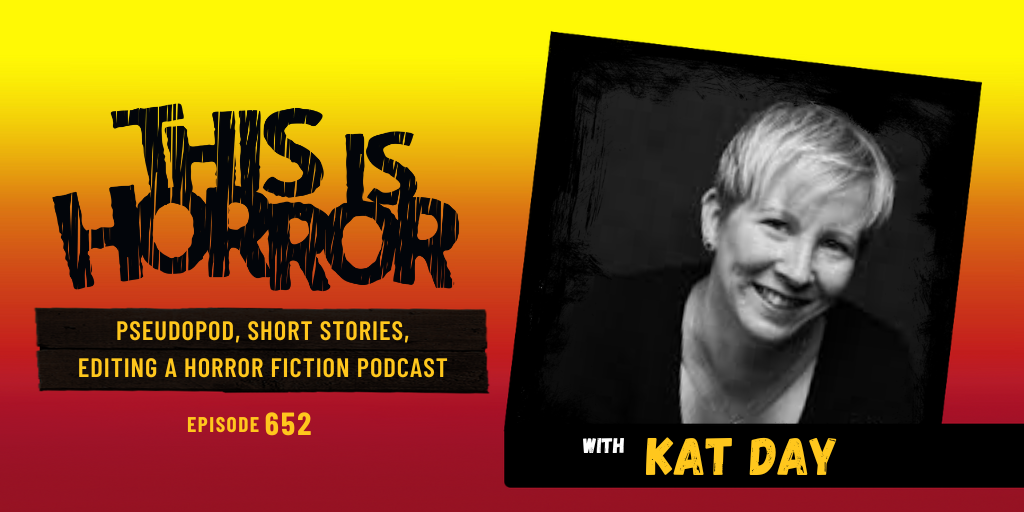
In this podcast, Kat Day talks about PseudoPod, short stories, editing a horror fiction podcast, and much more.
About Kat Day
Kat Day is a PhD chemist who was once a teacher and is now a professional editor and writer. She first entered PseudoPod Towers in 2019, became Assistant Editor in 2021 and Co-Editor in 2025. She lives in Oxfordshire with her ever-patient husband, two amazing daughters and a ginger cat who is not supposed to be in whichever small space he’s managed to sneak into this time.
Timestamps
Thanks for Listening!
Help out the show:
- Support This Is Horror on Patreon
- Listen to This Is Horror Podcast on iTunes
- Listen to This Is Horror Podcast on Spotify
- Rate and review the This Is Horror Podcast on iTunes
- Share the episode on Facebook and X
- Subscribe to This Is Horror podcast RSS Feed
Let us know how you enjoyed this episode:
- Write a comment below.
- Follow us and get in touch on Instagram @thisishorrorpodcast
- Subscribe and comment on YouTube @thisishorrorpodcast
- Follow us and get in touch on TikTok @thisishorrorpodcast
- Tweet us @thisishorror.
Resources
- 570, The Jamcoi, by J.M. McDermott
- 575, Christmas Present, by Ramsey Campbell
- 688, The Tunnel Ahead, by Alice Glaser
- 792, The Rocking-Horse Winner, by D.H. Lawrence
- 931, What He Woke, by Jess Whitecroft
- 940, Jinx, by Carlie St. George
- 785, Closet Dreams, by Lisa Tuttle
- 793: And No Bird Sings, by E. F. Benson
- CatsCast 17: The Absolutely True and Correct Account of the Honorable Mlle. Cassandra von Archambault, Affectionately and Begrudgingly Known to Her Friends and Family as Echo, by Jolie Toomajan
- Watch the video version of This Is Horror Podcast episodes, including our conversation with Chuck Palahniuk on YouTube.
The Girl in the Video by Michael David Wilson, narrated by RJ Bayley
Listen to The Girl in the Video on Audible in the US here and in the UK here.
They’re Watching by Michael David Wilson and Bob Pastorella
Read They’re Watching by Michael David Wilson and Bob Pastorella right now or listen to the They’re Watching audiobook narrated by RJ Bayley.
Michael David Wilson 0:20
Welcome to This is horror, a podcast for readers, writers and creators. I'm Michael David Wilson, and every episode, I chat with the world's best writers about writing, life lessons, creativity and much more. Today I am chatting to Kathe day, the CO editor of pseudopod, after pseudopod recently won the this is horror fiction podcast of the year. So if you want to find out all about pseudo pod short stories, editing and running one of the most successful horror fiction podcasts on the planet, this is the episode for you. Now, for those of you who are not in the know. Here is a little bit about Kat day. Kat Day is a PhD chemist who was once a teacher and is now a professional editor and writer. She first entered pseudopod towers in 2019 became assistant editor in 2021 and CO editor in 2025 she lives in Oxfordshire with her ever patient husband, two amazing daughters and a ginger cat who is not supposed to be in which ever small space is managed to sneak into. This time, the best place to find her is on blue sky, which is chronicle flask, dot Kat day.com, and you can read her regular flash fiction offerings at the fiction file.wordpress.com so Before we get Kat on the podcast a quick advert break, it
RJ Bayley 2:24
was as if the video had unzipped my skin, slunk inside my tapered flesh and become one with me.
Bob Pastorella 2:32
From the creator of this is horror comes a new nightmare for the digital age. The girl in the video, by Michael David Wilson, after a teacher receives a weirdly arousing video his life descends into paranoia and obsession. More videos follow, each containing information no stranger could possibly know, but who's sending them and what do they want? The answers may destroy everything and everyone he loves. The girl in the video is the ring meets fatal attraction for the iPhone generation, available now in paperback, ebook and audio from the host of this is horror podcast, comes a dark thriller of obsession, paranoia and voyeurism. After relocating to a small coastal town, Brian discovers a hole that gazes into his neighbor's bedroom every night she dances and he peeps same song, same time, same wild and mesmerizing dance. But soon Brian suspects he's not the only one watching. She's not the only one being watched. Their watching is The Wicker Man meets body double with a splash of Suspiria. Their watching by Michael David Wilson and Bob Pastorella is available from this is horror.co.uk, Amazon and wherever good books are sold.
Michael David Wilson 3:41
Okay with that said, Here it is. It is Cat Day on this is horror. Kathe. Welcome to This is horror.
Kat Day 3:56
Hello, Hi. Nice to meet you, yeah,
Michael David Wilson 3:59
nice to meet you, too. And to begin with, congratulations to pseudopod for winning the fiction podcast of the year in the this is horror awards.
Kat Day 4:13
I know that is amazing. Thank you so much. Yeah, fantastic news.
Michael David Wilson 4:18
In terms of pseudopod, I mean, you have literally, at the time of recording, released your 1001 episode. So we're now over 1000 episodes of pseudo pod, and next year, it is going to be 20 years of pseudo pod. There are very few podcasts that you can say of than over 1000 episodes and 20 years. And this isn't just in genre. This is in podcast world. This is remarkable territory.
Kat Day 4:54
Yeah, it is amazing. Pseudopod is. There's a bit of a debate whether it is the oldest horror podcast. I would think we could probably say it probably is. There was, there was one other podcast that started in the same year as us, but we're pretty much up there as the oldest short fiction horror podcast. So it is. It is pretty amazing because, yeah, you're going all the way back to 2006 which really was the beginning. I know I personally got into podcasts in 2007 I remember, I remember that. So, yeah, which goodness, how is that 20 years ago? Yeah, I know it's scary. Yeah.
Michael David Wilson 5:42
Do you remember then, what was the first podcast that you listened to?
Kat Day 5:47
Oh, now there's, you know what? Because I live in the UK. It was BBC stuff, because I was always a big radio listener. So I would always have radio four or so. BBC Radio four, which for non English, listen, not non. I shouldn't say that non British listeners is BBC Radio four is voice. Voice radio so it's kind of news. They have short, they have drama, they have a mixture. I guess you'd call it a magazine program. You'd call it a magazine it's like a it's an it's a voice station it, but it's not a call in station. So it's all, it's all interviews and drama and fiction and news and the the kind of the weather forecast and the shipping forecast, very famously. And the arches, I'm a big fan of the arches, which is a the longest running soap in the world. I think so. Radio soap. Soap opera still going today, so I it was definitely a BBC podcast, the one that I remember the best was Mark calm mode and Simon Mayo's film review podcast. I think that might have been so that was called wit attainment. It's not running anymore. I think that might have been the first one, because I probably heard a trailer on the radio, and then that got me listening to it on a podcast.
Michael David Wilson 7:26
Yeah, I find in those early days, because I was, I think I started listening to podcasts maybe about 2007 2008 so a similar time, but what you kind of had was either you had these really polished ones from companies, you know, tangentially related to the BBC, or you just had people who had picked up their Blue Snowball microphone riffing in their garage or wherever It was. And so it was a very different time. And in fact, I remember when I started the this is horror podcast in 2013 I thought, I am coming to this pretty late. You know, this has already been well established. But, you know, I think perhaps because of covid and the situation that we were in, but there was an absolute explosion of podcasts in 2020 so I don't even know if we've reached the peak period and the peak mainstream for podcasts, because, I mean, even now, and particularly in Japan, where I think podcasts are less known, if I mention a podcast, there will be people who are like, Okay, well, what on earth is that? What is a podcast? So it's still growing?
Kat Day 8:53
Yeah, I, I, I'm finding that less these days. There was a point where I would say that, and like, maybe five years ago, before then, and people would still be like, Well, what's a podcast? I feel like now everyone knows what they are, but there are some people that have never listened to one, because I think you have to be that person that likes auditory information, for want of a better word, like if you're not, if you're not that sort of person, then I feel like they don't appeal. If you like listening to stories anyway, and you like listening to people talk in your ear, then podcasting is kind of your natural home, isn't it?
Michael David Wilson 9:37
For me, I think the podcast is just one of the best creations, because it means that this time that was previously dead time for me where like, either I'm commuting or I'm doing some housework, I can now either be being entertained or educated or both at the same time. Depending on the podcast. Yeah.
Kat Day 10:02
I mean, it's true. I mean, I used to, I mean, like, I say I used to have radio four on all the time. But of course, that was just You got what you got was on, like, the, like the old days of television when you just watched what was on. I mean, I would drop when I was driving. I would, I would constantly have tapes and CDs in the car. But then, of course, you've got fiddling around trying to change them and all that kind of stuff. And now, you know, you can queue up eight hours of podcasts, and you don't have to touch anything for, for, for as long as you like, really?
Michael David Wilson 10:36
Yeah, yeah. That is absolutely it. And I mean, to go way back, I want to know what first ignited your interest in genre and in horror fiction.
Kat Day 10:52
So, I mean, actually, so I was a big reader as a child, but before I was a big reader, I was a big you know, I'm just thinking about this now, I was a listener. I had, I had cassette tapes. I had cassette tapes of lots of famous five stories by Enid Blyton, secret seven. I had, I had, I had Spider Man. I had all kinds of things like that. And I just used to listen to those at night. So I suppose I was always listening to stories I start. That's where I started, as some of my earliest memories are falling asleep to stories on tape. And then I did. I read a lot as a child, I read. I did. I did. Read horror. I mean, I think, you know, back in those days, people didn't pay very much attention to what children were reading. I did, I did. I've read. I mean, I read. I read Stephen King. I read James Herbert, which I shouldn't have been reading. I read, I read Jilly Cooper, I read anything I could, just, anything I could, just pick up some of which was, you know, wholly inappropriate, real. But nobody, nobody paid any attention back then. Yeah. I mean, I always like short stories. I like short stories because they get because of the way they get in and they get out. And you can kind of hold the whole story in your head. And you know, if you are listening, you can hear the whole thing very easily in one go. So yeah, I mean, I remember reading over, reading Stephen King's four past midnight. But also, there were science fiction short stories, fantasy short stories. It was all it was mostly all in that ballpark. But, yeah, but I wasn't pure horror. I've never been pure horror, even now, I think because I have to read so many horror short stories. If I pick up a novel, it will probably, I'm afraid, I'm sorry, probably will not be horror, just because I just need to read something else for a bit.
Michael David Wilson 13:10
You know? Yeah, I think as well, having that variety allows us to appreciate the different shades, the different facets of both art and, indeed, life. I mean, if it, if it's all horror, then you might become so consumed that how can you then discern what is and isn't horror, and how can you really appreciate it? I wonder too, though, with what you've said. So does that mean that the pseudo pod job, as it were, has then affected your wider reading habits outside of horror? Or was it always that horror was more short stories and then longer form? Were other genres?
Kat Day 14:00
Um, you know, I I've never been that loyal to any one thing. So I would always just pick up. I would just pick up all kinds of things. I mean, it's an interesting question, isn't it? One of the things I like about horror is, I mean, there are some people I have seen people make the argument that horror is not really a genre, it's an esthetic. And I would not go that far at all, but I sort of see where what they mean in the sense that horror doesn't have the rules and the story structures that some other genres do, that they those story beats certain genres tend to hit or or certain elements that they they sort of have to include. Horror doesn't have those rules. I don't think there's any. All really, for what can and can't be in a horror story, it has to have a horror element. But pinning that definition down for that, I think, is nearly impossible. You know it when you see it, but it's very hard to say this is it. I mean, a horror story doesn't even have to be fiction. Many aren't. I mean, many real life things are genuinely horror. So I think you can, you can find horror wherever you want to find it, and it is that sense of things not being right. Alex will talk about that sense of creeping dread, unease, that sense that something is wrong, and that's where horror lives. But it doesn't have to be monsters. It doesn't have to be ghosts, it doesn't have to be blood and gore. It might have any of those things, but it doesn't. You don't have to have those things. You do have to have that sense of unease and that sense of creep and that sense of disquiet.
Michael David Wilson 16:21
And I think that relates to a very recent story that you had on pseudopod, literally a few days ago. I was listening to it. It was in the Halloween episode with the cats. I mean, if you can write cat horror, you can write anything as horror. I mean, you've taken this this most beloved of animal, although, you know, there's a great debate, is it the dog? Is it the cat? Look, we can love them both. That's okay. And then you put it into this just monstrous story, but creeping dread is right? Because that starts off almost rather lovely and innocent right up until the moment when it is not and then it gets visceral, and then it gets bloody and gory. But I think as well, maybe, you know, in the last 510, years, people are really testing horror and exploring and playing with it and realizing you can do it with the most innocuous things it doesn't have to really play by any of these roles. As you say,
Kat Day 17:37
yeah, yeah, exactly, yes. It has to be like, say, it has to do something, has to unsettle you in some way, but it doesn't have to have any one particular thing. And that I really, I think that's why i i love horror, because it's not one thing. And you know, I will get, I will tell people what to do, and they and they will say, Oh, I don't like horror. And if, and, and, you know, if I feel like pushing it, I will, I will try and get to the bottom of what it is they think they don't like, because usually they have a quite a clear idea of what horror is. And I'm like, that's not what pseudo pod is. I guarantee you, whatever you think horror is, that isn't what we do. Maybe you don't like horror movies, maybe you don't like certain type of horror novel, but you know, I bet I can find you a story that you would enjoy that is not really horror, that you what, as you imagine horror. I mean, I've had people argue with me, actually, that ghost stories are not horror. I mean, yeah, I am serious. I've, I've, in fact, we've even had this argument editorially, where there was a ghost story that I completely loved, and Sean, Sean Garrett, who's just stepped down as CO editor, he was like, well, it's not really a horror story, like Sean, it's a ghost story. How could it not be a horror story? It's like, but it's just not his argument being that it, it, it wasn't creepy. Particularly, there's a ghost, there are ghosts in it, but it wasn't creepy, and I could see his point. I but I was like, I think it still counts. I think if you've got ghosts in there, I think that's fair game, but I could see his point. It wasn't the ghosts weren't the ghosts were not creepy, disturbing, scary ghosts, particularly So, is that, does that make it not horror? I mean, I don't know. It's an argument to have, right?
Michael David Wilson 19:49
I think at the very least, the moment a ghost is introduced, it has to be horror tangential. But I mean, this is horror. We. We encounter these kind of arguments as to what horror is and what it isn't and and for me and for Bob Pastorella, it we have a very, very wide definition of what horror is. And it's interesting actually that Sean was the one arguing against the ghost and it being a horror story, because for me, usually the people who are arguing against it are the people who they've got this preconceived notion as to what horror is, and in their mind, they are not a lover of horror and horror fiction, so they're kind of coming up with these arguments and making a very narrow definition, you know, as as you alluded to earlier, because what they really want to say is, okay, we don't like slasher movies, or we don't like monsters, or we don't like things that are really bloody and gory and and that's completely fine. You know, nobody has to like anything. Nobody has to like everything. But I don't think that means you don't like horror. If you hate the really kind of visceral stuff, then look at the more quiet, I suppose, horror of Shirley Jackson. There's got to be something there. You look at the classic literature of Frankenstein, of Dracula,
Kat Day 21:32
you know that? Well, yeah, yeah. I mean, yeah, there's, there's another case in point, Frankenstein. Is it science fiction? Is it horror?
Michael David Wilson 21:41
The answer could just be Yes, yes, yes.
Kat Day 21:46
It is, yeah. I think historically, it's fallen into the more into the horror category in people's minds. But it is science fiction. It's also literally fiction. You know, you could make an argument for fantasy. So, yeah, there's a there's, there's overlap, and there's, there's layers to this, isn't there, you know, but that's part of why it's so interesting.
Michael David Wilson 22:18
And so at the point where you were reading James Herbert and Stephen King from a young age. By the way, how young are we talking? Let's set the scene here.
Kat Day 22:31
I think, I think not too It wasn't too bad I'm I was a teenager. So I was, I must. I was at least 1314, 15. So not, not too bad, although James Herbert is some of that is like, but I think as well, when, when you're that age, you I mean, to just divert from horror for a minute, I went back to the Hitchhiker's Guide to the Galaxy. Recently, I read those as a teenager, too, and it I felt it's so interesting because I read those as a teenager and just thought they were funny books. I went back to them, I think, or tried to go back to them, maybe in my early 30s, and the humor just didn't work for me at all, and I couldn't get into them at all. And now I've come back to them now, and I'm really seeing, you know, I was like, Oh, I really see what Douglas Adams was trying to say. I see the predictions he was trying to make, some of which are terrifyingly accurate. I mean, mostly harmless. Has even got a little bird that's destroying the world. Like, okay, yeah, you, you were, and this is, look, this is before Twitter appeared on the scene. He managed to write that. So, yeah, which is, you know, because it controls all the probabilities of all the things that can happen, anywhere, anytime, and it just controls reality. And it's rewriting reality to match a book. And just like, Oh, okay. Like, yeah. I mean, there's, there are definitely, there are definite elements of horror there. You know, you I don't think you'd call hitch hiker's Guide to Galaxy horror, but there are moments that are definitely dark. The whole world gets blown up, but that's pretty dark. Sorry, I've completely forgotten what the original
Michael David Wilson 24:35
question was. Well, I'm so interested in talking about Douglas Adams and hitch hiker's Guide to the Galaxy that we'll have to return to the original question after. But that's a really interesting book to bring up, because I do find that depending on the times where I've picked it up, when I've read it, depending on the season in my life, I get something. Completely different from it. And I suppose that kind of speaks to a wider point that we've brought up before on this is horror that you know, much like you never step into the same river twice. You never read the same book twice, because it depends where you are. It depends the point in history, the point in your personal life, and what you're going through. And so I tend to find sometimes, actually, if I read a book that a lot of people have really lauded and praised and I'm just not feeling it, I'll then put it down and I'll read it at a different time, because sometimes it is almost like it's not the book, it's me, or it's where I am, and we need to be at the same level to meet. So yeah, there is great value in rereading as well, because of the layers and the different things that you'll find. I mean, like you said, with Hitchhiker's Guide to begin with, when you read it and you were younger, it was a comedy, then you read it later, and it was a kind of prophetic horror, or a prophetic science fiction with terrifying elements to it. I want to reread it right now. I might, I might have to reread it later today,
Kat Day 26:29
especially kind of the last two, three books. That's where he sort of stopped. It sort of stopped being a story about two guys bouncing around the universe and became about something a bit deeper.
Michael David Wilson 26:44
So, yeah, so going away from Douglas Adams and back to the original question, where we were talking about James Herbert and reading Stephen King and things of that nature related to that, as well as being an editor and a voracious reader, you are, of course, a writer. So I want to know, did the writing of stories, or did even telling stories, or perhaps like art and different ways of expressing yourself, did that come into things at an early age as well, or was the writing and the art something that came later?
Kat Day 27:26
So both I was a writer when I was young, when I was a child at school, I was always writing stories, and my teachers were always very positive about them. I didn't really see it as something I could do as a career, just, I just couldn't see that. I couldn't see a path. And I liked science, so I went down the route of science. And, you know, I mean, don't need the whole CV, but I, I've got a I've got a chemistry degree, I've got a Chemistry PhD. I was a chemistry teacher for a long time. I'm I make the argument that teaching is storytelling, regardless of what subject you're teaching. We teach through stories. They're not stories in the sense of, you know, a fictions, you know, a hero that goes off to do some a big adventure. But they are, they are stories that we tell about the world. We explain the structure of the atom through storytelling ideas. It's all storytelling. You've listened to the very best science communication work. It's storytelling. You read the best journalism. Of course, it's storytelling. Every time humans communicate, they are doing so by relating a narrative. So it's all it's all stories. Teaching is certainly storytelling. In fact, we even, I mean, you get trained as a teacher to break your lessons up into three parts, much the same way as you immediately get told if, when you are writing anything sort of, to break your stories up into three or five parts, right? You need, you need an introduction, you need some middle bits, and you need an end, you know. And lessons are, you're told you must, that's how you must break. You know, it's so deeply ingrained in human the human psyche, this, this kind of structure of, you know, you start here, and something has to change, and then you end for the moment. It just kind of used, see that pattern. Once you start noticing that pattern, you see it everywhere. But anyway, I taught for a long time, but then I had, I had my first child, and that that it just, I. Nothing. I don't do you have children?
Michael David Wilson 30:04
Yeah, yeah. So I have a seven year old daughter, and at the moment, my wife is expecting a son, so in the next month, yeah. Thank you very much. So crazy time right now.
Kat Day 30:25
Yeah, I think nothing prepares you for how much it changes you, yeah, perhaps especially as a woman, just because, I mean, in my case, particularly, perhaps my, the birth of my first daughter, was a little bit touch and go. I had to have an emergency cesarean section. It got, got a bit, got a bit close to the wire, shall we say, I think, and it just, it just changed. It changed me in ways that I couldn't have predicted, I didn't expect, but there's no getting around it. The world becomes much smaller, but also much bigger overnight. You suddenly kind of see your you see your future, in your past, in your children. And it's just something that just rewires your entire thought process. And because of that, I just could not get back into teaching after I did some part time teaching after my first child, but after the second, I just couldn't do it. I just didn't feel like I was a teacher anymore. It didn't, it didn't, it didn't work like my brain that wasn't my brain anymore. And so I was a little bit lucky, because I happened to know somebody and managed to get a job as a which is the editing job that I still have as a working as a medical editor. So so that's good, because that's that pays, pays bills, but yeah, also, I picked up some freelance. I still do some freelance. I've got a few books from DK. You know, I write bits of freelance for them. I've done the occasional short story. Well, actually, I've written hundreds of short stories. I've published a tiny number, and it's, it's mainly because I never submit anything. I'm not, I'm just, I don't have the patience for it. And also, as somebody who reads a lot of submissions. I know, I know what it's like. I sort of, I sort of feel for the poor editors. Oh, you know you don't need to read this. So I am, yeah, I submit very rarely, but I, I do write a lot. So this that I have I've got. I started first with a non fiction blog called The Chronicle flask, which is why my handle in so many places is the Chronicle flask. And then after that, I started a fiction blog called the fiction file with a pH, well fiction with an F file with a pH, because I thought that was very clever, brilliant, and so that. And ever since I started that, I've been very disciplined about writing a flash fiction story every month. And I started it, I think in 2017 so it's, it's, yeah, there's a lot on there now. So, yeah, I mean, I think if you're a writer, you're a writer, and it sort of doesn't matter. It will come out. It will remember, I had a very, had a, you know, I was doing some therapy sessions. And I was talking to the I was talking to the therapist, and she was talking about journaling and and she's like, Well, yeah, but you've only got the one journal. There's at least four, you know, because writers just are constantly putting things on paper, I think, or constantly putting words out somewhere. It does good, yeah, so I think I just can't. I can't not, you know, stories and words bang around in my head and they have to come out somewhere.
Michael David Wilson 35:00
It's really interesting to hear that you've written hundreds of short stories but then publish not so many of them. And I mean, one piece of advice that I give people is, if you can find joy in the pursuit of writing itself, then you win every time, because I feel, you know, a problem that can lead to a lot of unhappiness is when you're writing something but you're already jumping ahead to trying to look at the marketing or the publishing or what's going to happen with it, and that is exactly the wrong mindset to have. You're meant to be in creative mode. You're meant to be in artistic mode. And even better, you're just meant to be in the mode of having fun, of the joy of the story, the purpose of the story is the story itself. And that's something I've been very conscious of recently, because, yeah, there does seem to be a great deal of unhappiness because of perhaps, you know, and I'm speaking generally, like a lot of writers that I've I've spoken to that they feel that they're not quite where they want to be, or this year and last year in particular, there seemed to be less markets. But if we can recapture that, even that childhood joy, or that joy that we had the first time that we wrote a story, you know we weren't thinking about or it being published, or how many good reads we were going to have, or what kind of best seller list it might be in, but it kind of sounds like you might be constantly in that mode, because you are writing stories, then it's finished. Okay, that story's done. Now that was the point. And I don't meet so many people who you know you are really living that the you know, the pursuit of joy, the writing, the story, was the point in and of itself. Yeah.
Kat Day 37:16
I mean, I'm fortunate in that I don't have to make a living from this. This is not my living. This is the writing certainly is. Is something the editing is a different question. But writing is the thing that is I do for fun. And I think, actually that is part of the reason why I am reluctant to submit to go. I don't want the admin. I don't want to have to promote it, right? I'm very, I'm happy with the idea that I have a blog that quite a few people do read. Okay, it's not, it's not huge numbers of people, but I know there are people that come in there and read it every month, right? I've got I share I can share it. I can reach people. I reach a few people. It's not many, but it's a few people, and that that's enough for me. I And I'm like, I say, I'm lucky. I'm privileged that, and I'm aware of that that is a privilege, but I don't have to make money from this thing, so I sort of, I yeah, I don't, I don't. I don't do a lot of, don't do a lot of submissions. I just, yeah, do I just write for fun.
Michael David Wilson 38:34
And then when you said, you know, you enjoy the writing, but you don't really want to market or promote it. Probably over 90% of writers listening are like, yes. Now, you know, irrespective of how much marketing or promoting they do do, a lot of us, we we don't really want to be doing that, or we'd rather we were just writing. And to be honest with my own writing, like I sometimes think if I just spent more hours in the day marketing or trying to publicize it than just working on the next story, then I would be, quote, unquote, more successful as a writer. And all I mean by that is like, there would perhaps be more sales, there will be all these metrics that don't really matter but, but I don't want you to be honest. I want to be writing the next story, because I found that the work days where I didn't write and I just spent the time doing the admin and the marketing. I I felt empathy. It just felt like something was missing. And why am I? Why am I doing this? But the days where I was writing and there was no mark. Thing or admin, that was a happy day.
Kat Day 40:04
So, yeah, I hear you. I hear you. Yeah. I mean, we have got ourselves into this weird, twisted situation where, because self publishing, self publishing is a curse and a blessing, right? It allows, it has taken away some of the gatekeeping, but it has turned writers into something more than storytellers. They have to also market their brand constantly. And I just yeah, that's it. That's not the that's not the fun bit.
Michael David Wilson 40:42
Yeah, yeah. Well, I'm very much always searching for, you know, what is the minimum effective dose with the marketing and publicity? I think I've got the minimum part down, the effective part down. But, you know, I, I do, I do tend to find, you know, to talk about privilege that the fact that I do have this is horror, even if I'm not, you know, talking about my own work, that is, to a point, a kind of way of marketing, or at least people being aware of myself, and I suppose it might be the same with you and pseudopod. I'm sure that a number of people who come to your blog and your work do it via the pseudo pod about page, or just via, you know, hearing you or hearing one of your stories or narrations on pseudo pod, and then, you know, checking out your work, wanting to find out more about you. And, yeah, like, in a way, I fall back on that with this as horror, because, you know, it is something I do that's tangent or to my own writing and and I do get readers that way, yeah, but, I mean, I wonder, because you know, you have hundreds of stories that you don't submit, but occasionally there's a story that you do. What is it that makes you decide, okay, this story actually, I do want to submit it, or I do want to put it out into the world.
Kat Day 42:34
The view I've done, it's just been mostly kind of happy circumstances that there's been, there's been a gap, and I've got a story that I think will fit in that space. So, so really, that's, that's it. Early days, I did have, you know, had a few stories published on pseudopod, because we generally do encourage, actually our associate editors in particular, to submit because anyone that works with the podcast will obviously understand What the podcast likes and what works for us, so they are often the best placed to write for us. I mean, I wouldn't do it now because it'd be silly now, because it'd be my decision, so I'd just be I did, yeah, yeah. But I think, you know, there are some stories aren't there that just that just click. I mean, one of my all time favorites of mine is, was was published in a book that was a that was made to raise money for Grenfell fire victims. It's not horror, it's just literary fiction. But that was one of those stories where I was trying to write something and I couldn't quite get it out, and then it just sort of just sort of fell into this. I saw something, or I heard something, and it just sort of fell into place. And I sent it off, and Kathe Burke, this is my greatest claim to fame. Kathe Burke emailed me and said she loved my story and wanted to put it in the book, which is, I don't know if you know who Kathe Burke is, perhaps you don't
Michael David Wilson 44:38
I do. I do. Yeah. I don't know if all American listeners will, but I do, yeah, yeah.
Kat Day 44:46
She's amazing. She's just got an autobiography out, and I really I'm gonna pick that. I'm not a big autobiography, stroke biography reader, but I think I'll pick hers up, because she's, she's just an. Amazing. So, yeah, I don't know. I think it's just a just a combination of things coming together and finding somewhere that wants a story, and thinking, I've written a story, I've got that story, I'll send it.
Michael David Wilson 45:17
So was Kathe back involved in this? Was she the editor? Was she one of the people who was putting it together? What was her involvement in this anthology?
Kat Day 45:30
Yeah, she was, she was editing. I mean, I think she was editing in the sense of she was selecting the stories. So it was called 24 stories, and it was one story for each floor of the tower. Was the idea of Grenfell tower. So they selected 24 stories. They were all stories of hope, all positive stories, or like stories of hope. There was sad, sadness in some of them, but they were hopeful. Was that was the kind of the remit. And, yeah, that was one of those stories where I just kind of sat down. I had been trying to write something, and it hadn't really been working, and then this story just fell out of my head into my laptop, and I sent it off, and, yeah, Kathe bird emailed me, and kind of, I love this story. So yeah, amazing.
Michael David Wilson 46:31
Yeah, must have been such a surreal moment. But yeah, what? What a wonderful thing to come out of it. And maybe that's another reason why you're not submitting so many stories, because if the standard you have set yourself is when you submit, Kathe Burke personally emails you,
Kat Day 46:54
yes, exactly, yeah, I've peaked too early. Yeah, yeah, exactly, yeah.
Michael David Wilson 47:02
I mean, the good thing with having all these stories as well is, if you choose to in the future, you've got possibilities, you've got things that you could submit, you've got things that you could put together in a collection. I never think any any time writing or any time coming up with a story idea is wasted, even the times where I've written a novel and decided, actually, this isn't quite this. This isn't it. This isn't something that is going to see the light of day. Often. There will be elements of it that I can kind of take and put into other work or or there will have been a lesson learned. So, you know, time writing is time well spent. I think,
Kat Day 47:54
Oh, I agree completely. And I think because you don't learn to write by thinking about it, right? You only learn to write by putting words on a page and also by finishing things, which is why I am disciplined about the blog. And it's the kind of the one story A MONTH RULE, which I have very, very rarely broken. I'm strict with myself because it forces me to write something and finish it. Have to finish it by midnight on the last day of the month. That is my right. I'm really strict with that. And you know, it's interesting to go back through that blog now that goes back over so many years and see I can see that it was awful, you know, I didn't know what I was doing, and to an extent, I still don't know what I'm doing. But you know, I can see that I'm a better writer now that has happened through just constantly writing. It is, it is mostly flash. I write flash mostly. It's a good length for me. I like, I like it short. I like things that are short. I've got a friend who writes novels, and she struggles to write a story that's less than 6000 words, and I'm like, I struggle to write anything longer than 600 words. Just like between us we could, we could probably do something like but we dare. It's funny, some people go long and some people go short, and each person, each of that those types, will find the others position impossible to understand.
Michael David Wilson 49:41
Yeah, your friends. Approach to writing sounds a little bit like John Langan. If John Langan writes a 6000 word story that that was a breezy little micro fiction for him, 10 to 15,000 words, that's a short story. Right? But I don't know, I tend to find too that again, there's different modes, there's different phases of our lives in terms of the type of story that we gravitate towards writing. I mean, when I started out, it was more short stories and then a lung piece would be a novella. But now, the ideas that present themselves to me, they're usually in novel form, so I don't know I'm I'm actually at a place now where I'm like, can I just rewire my brain back into novella writing? Do they have to be so long at the moment? But you know it, it'll come and sometimes, well, it's just that the story tells you how long it has to be. So the idea is that my brain is bringing a novel length ones, but it's going to be some novella ones out there, we almost train ourselves. I think you know because you're writing flash fiction so frequently, that is what you you know the mind operates in when it comes to creative ideas right now. Yeah.
Kat Day 51:18
I mean, I, I, I I find myself I will start somewhere and think, no, no, this is the wrong place to start. And then I will, I will end up shifting to that key element, which you know, is the important bit where you want to get in and get out, and it's, which is what you have to do with flash. And I yeah, I kind of struggle to have the patience to go back and and fill in the initial, the initial thing and then, but, I mean, they are, I mean, I don't want to sort of suggest that Flash is just a cut down section from a story, but the bit the beats are, yeah, you do, you're right. Your brain does get into a way of looking at things. Of, you know, this is, this is how it needs to this is kind of how this is all going to fit together. And I'm, I do tend to sort of settle around sort of 1000 words Max works for me. But, um, yeah, I mean, it has been pointed out to me that maybe what I should do is just write, consider every like each chapter as a flash story I might actually finish like a book then. But um, haven't, haven't quite managed it.
Michael David Wilson 52:44
So are there aspirations for you to want to write a book or to write a novel length piece of work? Is that something you're hoping to do in the future?
Kat Day 52:55
Um, I, I wouldn't say no, I don't know. I don't know. I think, you know, as a as a child, and as someone who read a lot, you sort of always think, oh, maybe I'll write a book, but it's, I'm not sure I'm ever going to spit out a full length novel. But you know, never say never, because you never know. You don't, you never know what's going to happen, right?
Michael David Wilson 53:25
Yeah, yeah. And I think the idea of, you know, if you were just thinking in flash fiction mode as a chapter or as a portrait, I don't know if that was a serious or a kind of flippant remark, but I think it totally would work, and it would mean that that novel would be so concentrated, you know, if your brain is operating in that way, and I mean these days as well, even more. So there is room for experimentation. And there are novels, stories within stories that there's almost like they're a hybrid between. Is this a novel? Is this a short story collection? So I think there's definitely something there. You know, the hardest part is really weaving it all together in some tapestry where it's like, you know, they do go together, they do fit. But there could be something to that,
Kat Day 54:38
maybe one day,
Michael David Wilson 54:41
yeah, the purpose of this conversation is not for you to go away having to write a novel podcast. He's sent me a bloody assignment.
Kat Day 54:57
Oh, well, I didn't. Better get on titles. I do have thoughts about titles I read, because I read so many submissions, hundreds. I mean, actually, with the last submission period we were we had over 1000 submissions in 10 days, which I was expecting, but it is still a lot. I don't read everything, but a lot does pass by me, and title titles. It's one of those things that I think people will say, Oh, I'm just really bad at it. And I will say, get better at it, because it is the first thing is, literally the first thing the submissions editor will see you, you need something you want to catch their interest. We, we used to, we used to say, Oh, we're gonna, one of these days, I'm going to write a story, and it's going to be titled, baby mother pit red blood. Because these are these, so many stories come in titled The Pit mother the baby, read, read something, you know, and not to, not to kind of criticize, because I kind of get it, but also it is so those sorts of things are so Common in in horror submissions, and you need to you really want to get out of that. I one of my sort of top simple rules of thumb is short stories. Short titles for novels, long titles for short stories, right? Go long with your title for your short story. Make it interesting. Pick, if you run out of all other ideas, pick an interesting line from your story and make that your title. Because anything can be a title, right? It always just need to do is capitalize it and there you go. But just make it some inch some make it some interesting lines, some interesting questions, some interesting point. Make it the last line of your story. Make it the first line of your story. Make it something that is going to catch somebody's eye and make them think, Oh, I wonder. Oh, I wonder what that's about, right? Yeah, don't go with one word. Don't, don't, don't just sort of pick that kind of one, that one thing, that's not what you want. You want something, something more, more of a hook. We've changed. We've changed titles before because we've, well, no, that's no, we like the story, but the title is we have, we have done that before. So thinking that we would write off a story based just on the title. Where do you think people need to spend maybe just that little extra half an hour thinking about their titles? I do, because it does feel like sometimes they just sort of slap anything on. And it is really like the first is literally the first thing it'll be that you because as an editor looking at submissions, you will just see a long list of titles, so and author names which aim. But if you don't recognize the author names, they're all kind of, they kind of glaze over. Let it somebody you happen to know recognize the type your title is the thing that you have your one chance to kind of make your story stand out as something different and special. So do Yeah, give that some more thought.
Michael David Wilson 58:56
I'm just glad that the four books I have out are not called Mother, baby red and the pit, yeah, yeah,
Kat Day 59:09
but yeah. With apologies to anybody who has written something with one of those words, you know, but you know, make it you know. Hey, go, go. You know, Poe had this right the Pit and the Pendulum. Add some more to the make it a bit longer.
Michael David Wilson 59:26
See now your next submission window, you're gonna get the pit and whatever you're gonna get so many
Kat Day 59:37
Well, fair enough, yeah, yeah. But yeah, I do. I think people, I hear, a lot of writers, tell me I'm bad at titles, and they always want to say, don't be be better if you really can't come up with a good title, give it to a friend and get them. To come up with a title, find a way, because it is possibly not so much with a novel, because with a novel, you're sending a synopsis. You know, there are other things, but when it's a short story, like I said, that editor is looking at a long list of short stories, and the title is literally the thing that they're going to catch their eye or not.
Michael David Wilson 1:00:22
And like you said, there's a number of stories where the title is a line or is a point of intrigue from the book. So if you're happy with your story, just read through see what is that line that jumps out? And I don't know that it is probably a very easy trick, but I'm so pleased whenever I'm reading a novel and I'm like, Oh, there's the title. That's where it came from. And what dickhead behavior of myself to feel good about myself and noticing but, yeah, there's something fun, like, you know, with a recent Gabino iglesia story, or Gabino Iglesias novel. I think his title was on something like page 112 and it's like, there it is. That's where it came from.
Kat Day 1:01:23
I and I think that that is very normal. I think humans love spotting patterns, you know, and when we when. This is why so often we love it at the end of a story, when the loose ends are tied up, you know, and especially when you know that the the little Ella question that got posed at the start, you've forgotten about for 200 pages, is suddenly clicks into place, and you go, Oh, right, you know, we love that kind of thing, don't we? And you can, yeah, the title is part of that. That's why I said in this short story. Certainly. I mean, it's not uncommon for the title to be the last line of the story, because then that is just so very satisfying to kind of go, oh, oh, and suddenly, then as well, you understand what the title is. Closet dreams by Lisa Tuttle. That was episode pseudopod, Episode 785, that is the perfect title, right? I can't tell you why you have to read the story or hear the story, listen to the story as you prefer, but when you get to the end of that story, you will go, oh, and it is, it is perfect. I mean, it's a really great story, but it also has the type, the perfect title. And it is a it is a compelling, it's an interesting. It was only two words, having said, have a longer title for a shorter story, but it is, but nevertheless, they're two words you don't normally see together.
Michael David Wilson 1:02:57
Yeah, it wasn't red pit.
Kat Day 1:03:02
We mother, baby, red pit, yeah, yeah. Like, brilliant, just brilliant, yeah, anything, anything where it's it's something a little bit different. It's something a little bit unusual. It's something that, it's words that you haven't seen put together before, or like you say, it's literally a sentence from the book that suddenly you go, Oh, I see, you know, and it said tells you something about what's going on in that story.
Michael David Wilson 1:03:33
Yeah, yeah. I mean that example from Lisa Tuttle, that's kind of god level tier, story title mastery, because if you can do something that intrigues you to begin with, to make you want to read the story, but then changes things through having read it and then looked at the title Again, wow, you've absolutely nailed it. Now, you can't do that, presumably, every time, but when you hit upon it, yeah, that's the good stuff.
Kat Day 1:04:11
And yeah, I it is. It is something they know as you are editing and sort of thinking about your final story, is something you should be thinking about. The title is not something to slap on, because I have to have one. The title is something is part of your story, and the shorter your story, the more important the title. So really make the most of it.
Michael David Wilson 1:04:37
And very much related to that is nailing your opening line and your opening paragraph, and to be honest, as a writer, sometimes when I'm sitting down and I'm doing the first draft, that can create some paralysis. It can mean that I'm really staying. Staring at that blank piece of paper, or ordinarily, that blank Word document, for a good while. But I mean, for those who are struggling, I often find for that first draft, just write anything, because actually, it's only once you've completed it, and probably when you've gone through subsequent drafts that you'll realize, no, this is how it has to open. So get it right before you submit it. But don't let it stop you from completing the first draft in the first place.
Kat Day 1:05:36
Yes, it's true. It's kind of muddling up cause and effect, I suppose, yes, you need a good opening line. It need does need to be, it should be a strong opening line. In fact, it's something I particularly noticed because when every time I post the stories on social media, I post the first line from the story, and the first line is all is almost always like something really, you know, it's, it's something that catches your eye, or it's something that leaves you feels a little bit threatening, because obviously it's horror, or it's something that just feels immediately sets your teeth on edge a little bit, you know, it's all, oh, oh, that doesn't, that doesn't sound good in the best way, you know, and so I have really become, I really have become aware of the importance of that. Alex hoflik will talk about the fact that sometimes, you know the first few paragraphs of a story, when reading submissions, the first few paragraphs will be what, what he would describe as the author clearing their throat. In other words, they have sat down to write, and they've written three or four or five paragraphs, which they then should have cut, because the story actually kicks off around about paragraph six. It didn't need any of that other stuff. The writer needed to put it down in order to get to paragraph six, because you need to, like you say, you have got to start somewhere. But they should have in revisions, then they should have cut it. I guess it's not because it's not serving anything. It's just, it's just background, right, which should have stayed in their head. It could have stayed in their head, certainly for a short story. Obviously, if you're writing a novel, you've got more room to to sort of expand on that kind of thing. But yeah, so yeah, you need to make the mark first and then make it good. You need to get some words on the page, and it doesn't matter if they are not perfect words, but you need to get something on the page, and you need to get the shape of it, and you need to finish it in the sense of you feel you can see the shape of it, where it begins, what happens in the middle, and where It ends. And then you can go back and polish and cut bits out and clean it up and sort it. And sometimes, you know, you might realize actually that first line is pretty good, like that first line that you forced yourself to leave alone because you knew you had to just keep going. Sometimes it turns out to not be that bad when you see it as part of the whole. But, yeah, whatever way make the mark first and then polish it up.
Michael David Wilson 1:08:29
Yeah, I tend to find, I mean, it goes back to this idea that there is no such thing as wasted time writing. But perhaps for people starting out, they they kind of feel that like, Oh, if I delete the first five paragraphs, I've wasted my time. But it's like, no, you, you absolutely didn't. I mean, goodness, I've written novels before and then realized, oh, this starts at chapter seven. Oh, well, you know, but that's just the reality. And I think everything we're doing is to write the best story possible, and it is to express something that we want to to do that authentically, and so it doesn't matter how we get there. I mean, if people go to the gym and they warm up, they don't think, oh, that warm up set was a complete waste of time, wasn't it? You know, you've got to do these things. Or if you're for another tenuous and equally bad analogy, if you're learning how to make cakes, and the first dozen or so failed, and you know that wasn't wasted time. It's all towards like, you know, the ultimate cake at the end. And that's what we're doing with writing. We're all doing it towards a greater purpose. Her. So I think we have to dispel any notion that what we delete or what we don't submit is time wasted because it's it's just simply not true.
Kat Day 1:10:13
No, it's just part of the practice, the practice of writing, and every bit of that that you do will make you a better writer, whether it ends up in some final product or not. So yeah, I've just, I've just been reminded of another, like a favorite story of mine, which is episode 904, Jinx by car, Lee St George, the first line of that, I can swear, right?
Michael David Wilson 1:10:42
Because it's got swearing in it, of course, yeah, yeah.
Kat Day 1:10:46
The first line of that story is this, your first date with Jake is perfect. So that's fucking weird.
Michael David Wilson 1:10:55
I love it. I love it, yeah.
Kat Day 1:10:58
And that is a really now again, this is, this is an example where the title is very short. I'm not doing very well here, having said that. But, um, that is a great story. That is such a good story.
Michael David Wilson 1:11:11
Yeah, I don't like, I don't think you're contradicting what you said, though, because you know you it can be short if the word isn't generic or overused, I mean, Jinx, there's something intriguing
Kat Day 1:11:28
it is. I don't, I don't want to spoil that story, because it's it's so much better if you read it and it and it all unfolds in front of you, or you listen to it and it and it unfolds in front of you and you, and the bits click into place. But it's, it's great. It's definitely one of, yeah, so it's up there and caught, sort of one of my top favorites, and that, that is such a great line, because it's, it's like, why is that weird? Why would that be weird? Immediately you want to know what's going on, right? There's a strong voice there. And you know, you've got, you've got, obviously, the swear word in the first line, which tells you something very strong about that character who's speaking and ordinating in this case, because it's written in second person, and that story just, it just unfolds and unravels, and it's at the end of it, you kind of go, oh my god, Yeah. I mean, that's great. That's that's really excellent. When a story just sort of hits all those beats,
Michael David Wilson 1:12:47
yeah, and like you said, it having the strong voice, that's what's really intriguing for me. Like, I love that casual storytelling. That's kind of like someone just telling you something down the pub. So not only have you got, you know, the intrigue, but yeah, being able to imbue the story with such a strong narrator in one line, that's an impressive skill.
Kat Day 1:13:17
Yes, yeah. I mean, I do have a preference for character LED. I just, I do. I find it much easier to get in into the story if I can get on board with the character, whoever they are. But you know, we get, we have our literary fiction as well, where it's a little bit less like that, if the words are, I mean, I read one the other day that's was in the submissions pile that was just very, very literary, but it was written so beautifully. It was like poetry with with corpses, you know, and where it it sort of doesn't matter. Just, you know, yeah, just just do something different. This is why you have to read widely, because you otherwise, you don't know what different is. You have to find that sweet spot where it works, but it is also a little bit different. You know, it's difficult, it's a difficult beat to hit.
Michael David Wilson 1:14:27
So we're talking a lot about submissions and your editorial work. So of course, you said before the after giving birth, you decided, yeah, you didn't want to be a teacher. You quickly got some freelance editing jobs. So I'm wondering, what do you think your time as a teacher taught you that can then be applied to editing and what you do now? Or what do you think some of the transferable lessons and the crossover skills?
Kat Day 1:15:07
Well, the main thing that I think I learned from teaching, maybe this is why I lean towards flash fiction, is not to waffle, because I taught secondary, which is teenagers and you cannot afford to waffle, they will immediately lose lose focus on you. So I think I learned to be succinct and to get ideas across quickly, whether that was instructions or or introductory, you know, whatever that was. But it, it, it taught me to kind of not to, not to, not to go long, I suppose, and to to be very to sort of to be very clear in in both in writing and in speaking, although, you know, obviously, when you're speaking, you get what you get, but when you're writing, when you're creating written instructions, you can edit it down and make it very clear. And I think, I think I you know that comes in now across all my editing work, whether it's in fiction or whether it's in in my day job is I'm always trying to find the clearest way to say something, the least ambiguous way, the most consistent way, in order to get to get those ideas across, it is easier to read a story when the author is very clear about what's happening, where and with whom. I read. I read sometimes I read stories and it's it's kind of it's jumping around. It's jumping from one point of view to another point of view. We're in, we're in one person's thoughts, and we're in another person's thoughts, and it is so much harder work to to keep track of that. You know you're making, you're making people's lives difficult. Maybe that's not always a bad thing, but it depends on your skill level, probably, but, um, yeah. So to go back to your question, having said, I won't waffle, I think it taught me to to be, to keep, keep things as short as I can, which is probably like I say, why I've ended up in writing?
Michael David Wilson 1:17:36
Flash, yeah. I mean, that was the natural conclusion to writing and keeping things as short as you can to literally now specialize in writing, you know, one of the shortest forms of storytelling.
Kat Day 1:17:52
Yeah, probably inevitable. Yeah. And
Michael David Wilson 1:17:55
you joined the pseudo pod team in 2019 so in terms of the timeline. I mean, when did you stop teaching? So I'm wondering how long there was from stopping teaching to joining pseudopod and then linked on from that. How did it come that you joined pseudopod? How did that come about?
Kat Day 1:18:18
I actually can't remember now if I was still teaching when I first joined as an associate editor, I think I might have been. I think I probably was part time. What See, I'd picked up. I'd been writing. I'd, you know, attempted some short stories. I'd joined a few kind of online communities. I got, I was talking to somebody who was connected with podcastle, and I listened to a few episodes of podcastle. And then, because I'd found podcasts, I found the other escape artist podcasts. I found, you know, I listened to some escape pod, and then, obviously, I found pseudopod, and pseudopod very quickly became my favorite, because, and this links back to what we were saying earlier. It didn't. It was so varied. The stories were so very different. From one week to the next, it would go from, you know, splutter punk to something much more, kind of deep and meaningful, if you like, and then it would and then it would head off into something else, completely different, and then every story was different. And if you didn't like, I mean, I'm sure that's true for all the other podcasts, of course, is there's something about because horror is so fluid. You can put horror into, you can build horror into, into kind of any setting. And. And you do get, like, just enormous variety. And I think that was, you know, so I got, I got into that was, it became my favorite, was the one I would listen to, the others I would because you can't listen to every single podcast. You know, you're subscribed. We're all subscribed to far too many podcasts. And, you know, there are only so many hours in the day, so within any one week, you end up like some, some get fall by the wayside, right? But student pod was the one that I would listen to regularly. And then one day, I got talking to Alex online and and he brought me on board as Associate Editor reading submissions, which is somewhere around episode 600 and something. They say 2019, it was six. It was in the six hundreds somewhere. And then I just kind of generally, sort of started making a pest of myself and doing bits. I picked, I did, did picked up quite a lot of social media stuff early on, I would read, I would read, I would write, you know, I wrote a lot of comments in the submission, so the senior editors will see who is leaving all the comments Right, and who and whose comments are, you know, telling them useful stuff about the stories, you know, so that that kind of that. And then I would turn up to the meetings I lucky that just generally, continually made a pest of myself until I ended up as a system is and and then this year, knowing, as we did, that Sean Sean was leaving. I temporarily had this position of Deputy Editor and and now I'm co editor. Sean stepped aside in Episode 1000 Sean has formally stepped out. So, yeah, yeah. I mean, you know anyone, anyone could do it. You just gotta turn up and kind of get, get onto people's feet until they give you a job.
Michael David Wilson 1:22:12
I mean, it's honestly not bad advice for any profession, any industry you know, you said, you know, in a typical British self deprecating way, you know, making a pest of yourself. We could frame it as making yourself useful, being of service would be a much, you know, kind of way of framing it, but, you know, less humorous, so we got to get humor where possible. I wonder, you know now, what does your typical working week or working day look like? Because obviously you've got pseudo pod, you've got the other freelance editing and work that you're doing. So how does this all form together in terms of your life?
Kat Day 1:23:11
Yeah, that's a good question. I don't so some of the, some of the freelance work, I've managed to, I've managed to kind of finish a couple of things, now, and I'm sort of relieved of that, because net, because take now I am formally co editor. There is the work, ladies, heavier for sudapod. So grateful to have just kind of dropped a few other things three days a week, I'm at my desk during the day, doing the day job. The other two days I am. My children are in school, so during the school day, I've got time to kind of pick up other things. So that's that's when a lot of it gets done. Basically, mostly it gets squeezed into Mondays and Tuesdays, but it's, you know, it's surprising how much you can get done if you want to make space for things. It's a question of what, what you want to make time to do. I think,
Michael David Wilson 1:24:20
yeah, this kind of thing has come up before that. It almost to a point seems that they're the more constrained the time we have to do a certain task, the more productive we actually are. You know, if you've got all day and you don't have other things that you have to do. There might be a little bit more procrastination and slowness about it, but if it's like, right, you've you've got these two hours where you have to do the certain thing, well, suddenly they're a very productive two hours, because either you use them or it doesn't get done. So I think there is something to be said for almost having these time limits or having these constraints. So in your situation, it means you're having to pack the vast majority into Monday and Tuesday.
Kat Day 1:25:15
Yeah. I mean, I think it's true. I think, you know, I think we all probably have romantic notions of sitting in a house by the sea, looking out of the window and writing great novels. And I don't think it works, because I think you what you would mostly do is waste a lot of time, whereas, when you've literally got, like you say, you've literally got an hour to get a bunch of stuff done, you get it done in that hour, because you have to, you know, you squeeze some in in the evening, or you you know, you do some at lunchtime. Or you know, you find you find gaps, but to get stuff done. So yeah, now maybe that's it. You should be busy. Maybe writers are best when they're busy. I think, yeah, yeah.
Michael David Wilson 1:26:17
I think there's some truth to that. And I mean, I wanted to ask, and is almost an impossible question, but what do you think makes a good pseudo pod story? And I realized that this is so difficult because, as you've said, well, a pseudo pod story can be anything from splatter punk to highbrow literature.
Kat Day 1:26:44
Totally, totally, yes, it is very hard to pin it down, and if I if I said something specific, I guarantee you, I would read a story tomorrow that was completely the opposite of that. But also would be brilliant. So it is very hard to pin it down. We look like probably every editor ever we're looking for that emotional response. And this is one of those things from a submissions point of view, where this is why you know you should never take a rejection personally, because so much of it is, unfortunately, there is an element of the luck of the draw, right? If you, if you hit the wrong person with the wrong story on the wrong day, they will send it out the door. And that is not necessarily a reflection of the quality of the story, so much as it just didn't hit the right note. With that person, you need to find the one person that loves it. But yeah, we're looking for that emotional response. We're looking for that sense of I mentioned it earlier, unease of creeping dread of something isn't right here. This something, something is, you know, there's a there's a bad note, there's something that's distressing about that, and sometimes that is front and center and very obvious, and sometimes it's much more under the surface, but it will be there. You know, there doesn't have to be a monster. Sometimes there is. We've got a werewolf story coming up soon. There doesn't have to be a villain, but sometimes there is, but there has to be something that you know, gives it that dark edge, of course, then we get into arguments about, is this horror or is it dark fantasy, right? That's a that's a common argument, actually, yeah, you know, because it's a hard line to draw. It's a hard line to draw, we've run the occasional dark fantasy story. I think there's, and there's no reason not to, but I think we would want to be careful about overdoing it on that, because we're not really fantasy. So if it's getting too much into magic, oh, they see. Now I'm gonna upset the fantasy people who will tell me that fantasy isn't just about magic. But you know what I mean, if there, if there are too many, and I hear you, I hear you, I'm with you. But if there are too many, too much of those kind of traditional fantasy elements, that's probably not going to be what enough horror for us. So we, we're kind of looking for it to be focused on the horror. But, yeah, I mean, it's really hard to pin it down. It's really hard to say this is horror. I mean, one of my. I one of my another one of my favorite stories classics, because another thing that I read at school was d h Lawrence, and we ran the rocking horse winner episode 792 I know if I made a note earlier, you know I read that, I did read that. That's another one where I read it at school, and I saw it one way, interpreted it one way, and then as an adult, came back to it and saw many Darker, darker layers to that story. And you could argue that that is not a horror story. You could and I, and I would not necessarily argue with you, because maybe isn't. It's got supernatural elements. It's definitely unsettling. Is it horror? Horror enough? And that'll do. Yeah.
Michael David Wilson 1:30:56
The thing is, if I get into these arguments, I just ask the question, Well, is it a really good story? And if the answer is yes, don't worry about it, then
Kat Day 1:31:12
the rest did yeah. The rest will figure out later, yeah.
Michael David Wilson 1:31:15
I do take the point though, that if you kept using that as the argument, and then it's like, we've just ran dark fantasy for two months. Then, okay, now you're gonna have to at least go every other episode with a dark fantasy but talking about, you know, arguments, you've spoke about having arguments about genre and classification, but I'm wondering what happens when you absolutely love a story, it really spoke to you, it really resonated but then another co editor or associate editor, or whoever absolutely hates it. So you've got these opposite reactions. How do you settle that? I mean, is it a case of like, right? Well, Kathe loves this one and Alex loves this one, so they both go in. Or do you kind of have to have some consensus, and if you can't convince one another, then it doesn't go in at all. What do you do?
Kat Day 1:32:26
I mean that happens. I mean, and this isn't this is, again, to make this point about, you know that the submissions process is that you do sometimes get a story that one person loves and one person hates, right it? It depends a bit on the strength of the feelings. It depends a lot on the strength of the feelings, and also, to to a point, to an extent, there is the reasons why some, particularly the reasons why someone doesn't like a story can be are probably more important. It depends, because it depends. I mean, I don't want to get into there was, there was a particular public domain story that I took against quite strongly, because public domain stories often have elements that you wouldn't have in a modern story of their time. This particular instance was one that I was just like, No, you know, in the Arkham, but it's an, it's a great story. Firstly, I disagree. Second, secondly, I sort of don't care, because it's too it goes too far, and I just don't, I just don't want to run it often, though, if you know it's happened many, many times that I have loved a story, other people have not loved it, and I've just let it go, because that's the way, that's the way it is, like you can't, you know you you cannot run every single story. You've got to make decisions. So there's not a simple answer. It just depends on the story, and it depends on the reasons, and it depends on how strong the respective feelings are, I suppose.
Michael David Wilson 1:34:40
Speaking about running classic stories, I mean, one of the things that makes pseudopod really stand out, one of several things is you've got this combination of running these modern dive. Verse voices, plus absolute, timeless, classic tales. And, you know, a lot of horror fiction podcasts that they'll go one way or the other. It's either original news stories or it's a podcast where we're just reading classics. But pseudopod do both. I mean, recently you had Arthur mackins novel of the white powder very recently as I think it's your latest episode or the one before the latest episode. So, I mean, you've spoken very eloquently and diplomatically about reasons why, you might not include an old classic tale, but what are the reasons as to why, with so many rich public domain horror stories, how on earth do you decide which ones to run?
Kat Day 1:35:58
Well, I mean this, has always been Sean Garrett's project. What? And he will continue on as as a guest editor for public domain work alongside assistant editor Josh Joshua Tuttle, who you know they'll work, who's a horror academic. They So to begin with, it's not as big a bigger project as you might think, because they look for the stories that are coming into public domain this year. So currently, they are looking for stories that will go into the public domain in 2027 January, 2027 they are collecting those together. By the time you have pulled together the stories that are definitely horror and would be appropriate for us. The pool is not as big as you might think, for stories for that year it usually it boils. Sean has sent the document around, I'm not sure. But anyway, we're not talking hundreds. We're talking some number in the 10s, you know? I mean, it's a number to read through, but it's not enormous. It's not an insurmountable then we try see, we try to raise up authors. We try to get well known authors as well as authors that maybe are a little bit less familiar, particularly female authors, because often those are not the names that people necessarily think of. So E F Benson, we've run a few stories by E f Benson, fairly well known name, but I think not one necessarily everyone would have heard of. But the thing that's interesting is that he's a queer writer. But of course, in sort of 1867 to 1940 that wasn't acceptable. So it's, it's very, it's very much under the radar, right? But it's interesting because I read, I remember reading and no bird sings, not really, not knowing anything about E, F Benson, and not knowing, not knowing, not knowing who this author was, not having come across the story before and just going well, There's a lot of queer sub subtext in this story, like, Who is this guy, and writing this and writing this in my comments, right? Yeah. Well, these two, these two are clearly gay, right? And then, and then, kind of figuring out the biography, and kind of going, all right, oh, I see, yes, right. And, but, you know, it comes out, comes out in the writing. And when with, with your sort of, your your modern day sensibilities, you see it, it probably just went over people's, you know, people's heads at the time, but yeah, like, to me, I was like, well, that's, that's obvious, isn't it? So I think, yeah, I don't think you know, good storytelling comes from the soul, right? There's a little bit of, there's a little bit of the writer's soul in every story. And you there are towels in there, you know? And I think that's, I think that's interesting. You can pick up, pick up those things even when they were really well hidden before,
Michael David Wilson 1:39:58
yeah, I think what you're saying. In with E F Benson. It reminds me, it brings to mind this idea that the safest place sometimes to be truly honest is in fiction. We can deliver more truth through fiction than we ever could through non fiction.
Kat Day 1:40:19
Yeah, I think that's true. And you know, that's actually what makes a really good story, when there are those different layers and they work together. When you have that layer of the story on the surface, and then underneath it there's other you can see that there's other stuff going on. So, yeah, definitely.
Michael David Wilson 1:40:42
You know, another element that I really appreciate about pseudopod that I again think makes it stand out from other horror fiction podcasts is Alistair's Post story, commentary and analysis. And I mean, I can't think of another horror fiction podcast that does it in quite the same way and in as much depth. And you know that the nearest that it brings to mind, really, is the new The New Yorker fiction podcast, when they have episodes really critiquing or commenting on a story. But what I love is, you know, with pseudopod, you've got the story, but then you've almost got the unpacking and the look underneath the bonnet courtesy of Alistair. And it kind of makes me think too that Alistair has to love every story that you air, or, if not, he at least respects every story, but because he's always got really smart things to say. And that passion, you know, it's in infused through, I suppose, the earphones in which I'm listening to it on. Yeah.
Kat Day 1:42:03
I mean, Alistair does do a great rant. He is fantastic for that. I've done a few rants myself as well. Yeah. I mean, when we look through submissions, I mean, that is one of the things, it's not the primary concern, obviously, but it is something that is certainly, it's in the back of my mind when I'm looking through submissions, is, will the host have fun talking about this? And then that's a that's a plus point in its favor. If the answer is yes, right? If, if, if I can see, if I can see the references that we're going to be able to pick up on, and the the different layers and the things that are relevant to kind of current events I'm thinking now of what he woke that was written by my friend Jess whitecroft. That is a fantastic story of a corrupt politician getting getting his Carpenter's from a sea monster having polluted, having polluted the water, which is, like, fantastic. Love. It brilliant. You know, that was so much fun. Alistair had a lot of fun ranting about that. That was great. Yeah, I mean, it is I came across, you know, as I came across one the other day about, I mean, without, without saying too much, but it was, you know, the setting was, you know, it's kind of a cool, I can't say too much, but it's got, it's kind of a corporate setting. And I thought, Oh, this would be fun for the for the host to kind of riff off of, you know, whoever it is, they'll, they'll enjoy, they'll enjoy pulling this one to pieces. So, yeah, it is again, like I say it is in the back of our mind, like, what? What will the host have to say about this? On the other hand, I would caution people from going too far. There sometimes things we start to see the same references come up again and again and again, and it's like, okay, we've seen this before, you know, give me something new now, don't, don't, I would suggest don't, don't, kind of aim for that. But it's nice, if you can, it's nice if it's there,
Michael David Wilson 1:44:43
yeah, I I mean, I think always writing the best story you can has to be for any market, for any endeavor that has to be the primary concern. And if you can, kind of. Pick these other boxes, then even better. But yeah, you can't let it overtake the essence of the story to begin with.
Kat Day 1:45:08
Yeah, yeah, exactly, yeah. It's got to be a good story first, and put the other bits in later.
Michael David Wilson 1:45:14
Now, we said at the start of the episode that next year, it will have been 20 years of pseudo pod. So I was gonna kind of relate it to that ask about what plans were for the kind of evolution of the podcast, and going forward,
Kat Day 1:45:34
think for the moment, there's not plans to evolve in any great way we want to keep doing what we do really. Yeah, in particular, the things that we that are really important to us are picking up anthologies and collections we run. We have anthology and collection submissions every year in order to draw attention to anthologies and collections, because we love a short story, we know that those books are often hard to to get out the door, if you like. They can be harder to publicize. They can be harder to kind of promote. So this is our way of, kind of raising that up. And it's something we can do, and it's something that, you know, we have the power to, to put those things into the spotlight. We normally, we have a mixture normally of of we end up with a mixture of stories from quite well known authors who are publishing, either publishing their own collections, or they're published they are in part of and a bigger anthology. And then, quite often, we pick a couple that are from quite small, sort of unknown things, you know, with a goal of, I mean, they're obviously brilliant stories, of course, because that's the main thing. But, you know, the goal is to raise, raise up, to draw attention to these other collections that might otherwise go under people's radar a little bit. So we all carry on doing that, that that is a lot of work anthologies and collections, but it is, is important, and we'll carry on with public domain for sure, and and yeah, then and then it's original fiction and reprints, of course, so I yeah, I don't think we're planning to change anything drastically. It will. Things will shift over time, because tastes shift, fashion times change like nothing stands still, but we'll always be looking for the best stories that we can find. You know, a diverse mixture of stories, a diverse, diverse set of authors. Yeah, always trying to find something new and different. And we because we are right on the edge of things. We are right on the edge of like the newest. This is the sort of place where we're really kind of new stories come first. Takes a while, doesn't it, for things to filter into novels.
Michael David Wilson 1:48:37
And speaking of all these kind of shifts in sensibilities and taste how do you think horror fiction and the publishing landscape has changed since you started working on pseudopod?
Kat Day 1:48:52
Oh, that's since I started. I'm not sure changed so much. I maybe there was, there was more of a push to to explicitly raise up certain voices, and whereas now, I think those voices just coming through naturally in the course of things. So So feels like things have evened out there in in a way that perhaps you know wasn't the case. But apart from that, it's hard. I mean, it's it's hard, it's hard, isn't it, because you are where you are, and you're looking at what you're looking at, and it sort of feels like it's not that different, but possibly it is, but it's hard to see it until you kind of, you'd have to sort of pick back through and go and look at things. But yeah, nothing really jumps out.
Michael David Wilson 1:50:00
Well, as we head towards the end of this conversation, and this might be a little bit much for post 1am for you, because this is a big personal question, but I wonder, what advice would you give to your 18 year old self,
Kat Day 1:50:22
oh, God, I think I would leave her alone, because
everything that happens changes you you can't even things that are difficult and painful and, you know, unpleasant, they make you who you are, and you're still alive after that, and it changes you, but you you learn through that. I don't, I don't, I don't think you can. I don't think this is why time travel is such a problem, isn't it? Like it's a big existential issue. If you could go back and change things, then the future wouldn't will not be the same, and the people in it will not be the same. So you just shouldn't do that. Go back. Leave yourself alone. Leave him alone.
Michael David Wilson 1:51:26
Yeah, I can see that, you know the classic butterfly effect, and if you relatively happy with where you are, you don't want to mess up a piece in the machine, things go desperately wrong.
Kat Day 1:51:41
I Yeah. I mean, yeah, I think you've got to make peace with whether you're happy or not. You've got to find a way to make peace with where you are, haven't you? Yeah? Because yeah, there's a couple of other stories I could I've managed to leave her in most of the ones I wanted to mention, a couple of others to mention I've written down.
Michael David Wilson 1:52:07
Well, I mean, that that question writes itself, then, doesn't it? What are the stories that you want to recommend?
Kat Day 1:52:15
Yeah, I've got, I mean, I meant, like I said, I mentioned a few. I'm gonna, I'm gonna recap the ones I've mentioned so far so I got 792, the rocking horse winner, by D h Lawrence. 931, that's what he woke by Jess whitecroft. 940, Jinx, by car Lee St George. And then I did. I've written down a few others I want. I'm going to give a shout out to Christmas present by Ramsay Campbell. That is a classic bit of cosmic horror, which everyone should listen. You should listen. Everyone should listen to that because Ramsay Campbell. I mean, it's like, you know, horror royalty, right there. But also is a classic. It's a real classic with Thanksgiving coming up, not for me because I'm British, but for the American listeners, I'm going to give a shout out to the jam Koi. By I might I think I've pronounced that correctly. Jam quite, pretty sure that's right. By JM McDermott, that was episode 570 and I remember it was very clearly lodged in my head, as I was not working for sudapod. Then was that it was, it was one of those stories that gets in your head and go, Oh, this is good. Firstly, this is a very good story. Secondly, I can see what it's doing, and I think it's doing it in a very, very clever way. And I just, I just, I love that. I remember it. I was driving in my car, and I was listening to this story and thinking, Oh, this is really clever storytelling. So that's, that's a favorite. And also, 688, the tunnel ahead by Alice Glaser, that that's from 1961 because occasionally we'll get stories because of the way the copyright has worked out. We'll get slightly more recent stories because it depends what the is, what the estate does and doesn't do with the copyright, and that that is, that is really science fiction, probably, but it's dark and it has, it has elements in it that just Feels so, so relevant today about the things people tolerate and don't Well, the thing the things that happen because people tolerate them, and understandably, because people are protecting their own family units and so they are not looking at what else is. They well, they are looking, perhaps they are looking, they are seeing, but they are doing, are doing what they feel they have to do for their own family. I think that's something that just, you know, it's from 1961 but it feels extremely relevant. So that's another one. I mean, I could, I could spend all day listing stories, but I forced myself to stop after I'd done six.
Michael David Wilson 1:55:24
There you go. But I mean, it is remarkable when you discover these stories that were written decades ago, sometimes over a century ago, but the themes are so prescient and relevant to the times that we're living in. And, yeah, that's when you know that you've got a real classic. I think,
Kat Day 1:55:51
yeah, and I I think, what's the saying? History doesn't repeat, but it rhymes. And I think it is the same with stories in that because stories come from the heart, and because humans, regardless of what part of history they're operating in, are still dealing with a lot of the same issues, still dealing with grief, with family, with love. Sorry, my cat is determined to join in. At this point. He's going to come around here in
Michael David Wilson 1:56:33
a bit speaking of love.
Kat Day 1:56:36
Well, no, I think he is glaring at me because the door is shut and he wants
Michael David Wilson 1:56:41
to get into the it's an anger rather than love, yeah.
Kat Day 1:56:46
But again, that's again, you know, the the the emote, because these aspects are the same, like you get the same things in stories, and so they will. They can feel very relevant if it's a good story. Well told.
Michael David Wilson 1:57:04
Well, thank you so much for being so generous with your time and with your knowledge this evening and staying up so bloody late to chat with me and Japan. So I really do appreciate that. And you know, I appreciate all the work that you and the team are doing at pseudo pod, and we're so happy that you won that this is horror award, because it's richly deserved.
Kat Day 1:57:33
So, yeah, thank you again. That's amazing. Yeah, well,
Michael David Wilson 1:57:38
where can our listeners and viewers, connect with you.
Kat Day 1:57:43
Sudapod is on main place to go is blue sky, where we just sudapod.org you can come and find me as well. Chronicle flask, dot Kat day.com, but we are across most of the major social media platforms. We've got a we've got a subreddit. There's a Facebook page. I'm staring at my cat now. He's walked across the table, which he knows he's not allowed to do. He's trying to, trying to get him, trying to get my attention. Yeah, so yeah, blue sky, come to Blue come and find us on blue sky, pseudo pod, org, that's the best place.
Michael David Wilson 1:58:31
All right. Do you have or
Kat Day 1:58:36
better still sign up to our Patreon. Two bonuses to that. Firstly, you get access to our private discord channel so you can come and talk to us. That's lovely. We always those. We have a little group of people that sits and talks about the stories every week. But the other really cool thing about being a Patreon, well, obviously, you get to support the podcast. That's very cool, but in terms of benefits, you the the free podcast feed only goes back about 300 episodes so but if you subscribe to our Patreon, you get there is a feed with pretty much every episode ever in it, and you could just find the one you want, download it, put it on your podcast, put it on your pod catcher, and listen to it whenever you like. So that's brilliant. So come and do that. Come and subscribe to our Patreon, and then that will that will help us pay all of our costs, and you'll get access to 1000 episodes worth of horror stories.
Michael David Wilson 1:59:43
Yeah, I believe as well. With Patreon, not only can you just download the episode through finding it, but you can actually add your Patreon specific RSS feed to your podcast app. So you, you know, once you've got that on your phone, you can just go through all of them that way. So even easier,
Kat Day 2:00:07
yeah, well, that's, that's sort of what I mean, because I think you probably wouldn't listen to 1000 episodes. I mean, I have admiration for anyone who wants to do that, but I feel like you might be there for a while. Like, I don't want to do the calculation, but that's going to take some time to get through. But yeah, yes, you will get a private RSS feed and you can, then you can pick and choose stories at your leisure.
Michael David Wilson 2:00:33
But if anyone wants to do the 1000 episodes of pseudopod in 1000 days, then please and live tweet to live post it. You know, it's day one, yeah.
Kat Day 2:00:50
I mean it would, goodness, I mean it would take you three years.
Michael David Wilson 2:00:53
Yes, the three year challenge, it
Kat Day 2:00:58
would, yeah, oh my god, yeah, if you did one story, that's right, isn't it, it would take you three years. I mean, that's a scary, that's a scary, yeah, I mean, that's a chat. I'm up for anyone who wants to do it, but I feel like that is a big challenge.
Michael David Wilson 2:01:16
It's intimidating, but it's it's doable. It is doable. I always take on these insane challenges and that there's there's part of me and I get caught up in the conversation that just wants to say, look, if, if only, if a minimum of 10 people email me to say that they are up for this challenge, 1000 episodes in 1000 days. Then I will do it. We will do it. We will talk about it. We will be live posting. So there you go. It's down to the listeners. If Danny, you email me, Michael at the sasara.co.uk, pseudo pod, 1000 challenge. Let's do it together. I mean, now
Kat Day 2:02:08
Awesome, yeah, if you get volunteers, I am 100% up for it, yeah.
Michael David Wilson 2:02:15
All right. Well, apart from support you on Patreon and do the 1000 episode, 1000 Day Challenge. Do you have any additional final thoughts to leave everyone with?
Kat Day 2:02:30
Ah, well, I mean, my main one was to make sure I'd got got those stories listed out for you. But yeah, I you know, keep telling your stories. If you are listening to this and you are a writer, keep writing your stories that, because no matter what happens, humans will always want human written stories we haven't got into AI probably goes without saying. Not a huge fan of that whole concept. Stories exist because humans want to communicate with each other and connect with each other. That is the point of them, a machine creating stories is, is not doing that. It's, it's something that looks a bit like a story, but it possibly, maybe, but it's, it's not, it's, it's not doing that fundamental thing of one person putting together some words which emotionally connect with another human. You know, large language models are not doing that. So keep writing your stories. Keep creating your stories. We will always want more stories. All right, I just want to run through thank yous to the crew, because I'm conscious of the fact that I am here kind of talking for the podcast. But obviously it's not my podcast, so I want to, I mean, I've mentioned lots of these names as we've gone through, but just just to sort of go back over near make sure I've, I've thanked everyone. Sean Garrett and Alex hoflich have been co ord co editors for many years. Alex is still co editor. Sean formally stepped down episode 1000 just have, in some both encyclopedic knowledges of horror. Both have an encyclopedic knowledge of horror. You know, there isn't anything that between them that they don't know. It's amazing. Yeah. Um, and then obviously, Alasdair. We've mentioned Alastair, our host, which, and, you know, without whom, many of the podcasts Well, without without his host, you know, his host, commentary does really bring the stories alive. Which is, you know, we've said that already. And then obviously, I've got Scott, Scott Campbell, Assistant Editor. He does a lot of the technical stuff at the back end, looks after the web pages, that kind of thing. Obviously also does a lot of hosting. Joshua Tuttle, fairly new assistant editor, but he's going to be picking up public domain. And then a big, big, big, big, thankout to thank you to our audio team, without whom nothing would ever happen. So Chelsea Davis and Graham Dunlop, who used to work on the on the podcast at sort of a long time ago, and then took a took a break in, and now has come back. So that's great. So they, yeah, they make us all sound, sound fantastic. And then there's a big crew of assistant editors as well. Help us out, you know, with the reading and various, sorry, associate editors who, who, you know, get through, help us get through the, the enormous submissions part. So, yeah, so I think, I think I've managed to and of course, EA owned by Alasdair and his partner, Marguerite. So, yeah, it's all about it's a huge team. It's not nothing that happens in a EA is just sort of one person.
Michael David Wilson 2:06:37
All right. Well, thank you again for chatting with me. Thank you to sudapod for all the amazing work that they have done that you have done over the last two decades.
Kat Day 2:06:53
Yes, fantastic. We're really honored. Thank you Rich.
Michael David Wilson 2:06:56
Congratulations once again on the this is horror award. Thank you, as always, for listening to this is horror and joining me for a wonderful conversation with Kat day of pseudopod. Now next episode, we will be chatting with the legendary master of horror, Miike Garris, but if you want that and every other episode ahead of the crowd, and you want to submit a question for Miike, then please become a patron@patreon.com forward slash, this is horror. There are a multitude of perks, and it is also the best way that you can support the podcast and guarantee that we keep going. It's been 13 years over 600 episodes, but we still need your support, and we still want to get better. So if you are in a position to do that, it's patreon.com, forward slash, this is horror Okay. Before I wrap up a quick advert break
Bob Pastorella 2:08:06
from the host of this is horror podcast, comes a dark driller of obsession, paranoia and voyeurism. After relocating to a small coastal town, Brian discovers a hole that gazes into his neighbor's bedroom every night she dances and he peeps same song, same time, same wild and mesmerizing dance. But soon, Brian suspects he's not the only one watching and she's not the only one being watched. Their watching is The Wicker Man meets body double with a splash of Suspiria. Their watching by Michael David Wilson and Bob Pastorella is available from this is horror.co.uk, Amazon and wherever good books are sold,
RJ Bayley 2:08:45
it was as if the video had unzipped my skin, slunk inside my tapered flesh and become one with me.
Bob Pastorella 2:08:54
From the creator of this is horror comes a new nightmare for the digital age. The girl in the video, by Michael David Wilson, after a teacher receives a weirdly arousing video, his life descends into paranoia and obsession. More videos follow, each containing information no stranger could possibly know, but who's sending them and what do they want? The answers may destroy everything and everyone he loves. The girl in the video is the ring meets fatal attraction for the iPhone generation, available now in paperback, ebook and audio.
Michael David Wilson 2:09:23
Now, before I go, there is a podcast which is exclusive to our patrons, called Story unboxed, a horror podcast on a craft of writing. And it is a show in which Bob Pastorella and I analyze movies. What we do is we dissect them, we analyze them, and we look at story lessons and takeaways that can help you in your own writing. So if there is a movie that you will particularly like us to discuss and dissect. Drop me a line. Michael atlases, horror.co.uk with your suggested movie. Now we also have some advertising slots open for March and April. So if that is something that is of interest to you, it is again. Michael at this is horror.co.uk Well, with that said, I will see you in the next episode with Mick Gary's. But until then, take care of yourselves. Be good to one another. Read horror, keep on writing and have A great, great day.