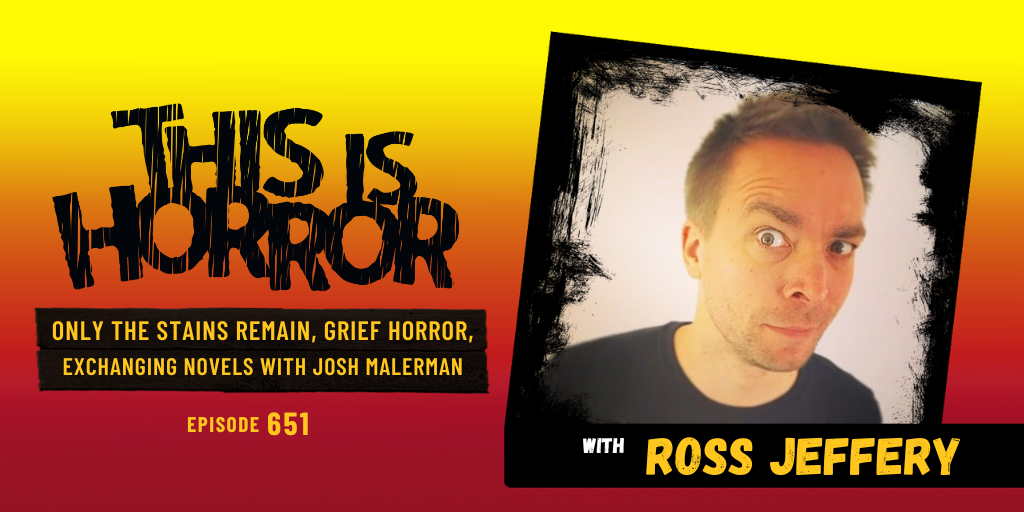
In this podcast, Ross Jeffery talks about Only The Stains Remain, grief horror, exchanging novels with Josh Malerman, and much more.
About Ross Jeffery
Ross Jeffery is the Bram Stoker Award-nominated and 3x Splatterpunk Award-nominated author of Metamorphosis, The Devil’s Pocketbook, I Died Too, But They Haven’t Buried Me Yet, Tome, Juniper, Scorched, Only The Stains Remain, Milk Kisses & Other stories, Beautiful Atrocities & Tethered.
Timestamps
Thanks for Listening!
Help out the show:
- Support This Is Horror on Patreon
- Listen to This Is Horror Podcast on iTunes
- Listen to This Is Horror Podcast on Spotify
- Rate and review the This Is Horror Podcast on iTunes
- Share the episode on Facebook and X
- Subscribe to This Is Horror podcast RSS Feed
Let us know how you enjoyed this episode:
- Write a comment below.
- Follow us and get in touch on Instagram @thisishorrorpodcast
- Subscribe and comment on YouTube @thisishorrorpodcast
- Follow us and get in touch on TikTok @thisishorrorpodcast
- Tweet us @thisishorror.
Resources
- Ross Jeffery Books
- Watch the video version of This Is Horror Podcast episodes, including our conversation with Chuck Palahniuk on YouTube.
The Girl in the Video by Michael David Wilson, narrated by RJ Bayley
Listen to The Girl in the Video on Audible in the US here and in the UK here.
Cosmovorous by R.C. Hausen
The debut from R.C. Hausen, available now. Now also available as an audiobook.
Michael David Wilson 0:20
Welcome to This is horror, a podcast for readers, writers and creators. I'm Michael David Wilson, and every episode I chat with the world's best writers about writing, life lessons, creativity and much more, today is the second part of my conversation with Ross Jeffrey. And in this one, which we recorded a few months back in September, we talk about a writing challenge that we are both doing, a challenge in which every two weeks, we exchange 10,000 words of our current work in progress, and fast forward to now, and we are both well into This, and have currently read and exchanged around 70,000 words of our forthcoming novels. So we are both really deep into this and for Ross, I believe his is gonna weigh around 130,000 words. And for me, maybe about 110,000 so despite being deep into this novel writing process, there is still quite a bit to play for as it were. Now, if you are unfamiliar with Ross, he is the Bram Stoker Award nominated author of a number of books, including The Devil's pocket book, which will be re released by clash. I died too, but they haven't buried me yet. Tome juniper and only the stains remain to name but a few. So before I welcome Ross, back to the podcast, a quick advert break.
RC Hausen 2:17
Cosmovorous, the debut cosmic horror novel by RC housing is now available as an audio experience featuring an original Dark synth wave score. This story will take you to the next level of terror. Come here, the story that readers are calling Barker meets Lovecraft, a Phantasm style cosmic horror adventure and a full bore, unflinching, nihilistic nightmare. Cosmo vorce, the audio book by RC Housen, come listen, if you dare.
RJ Bayley 2:51
It was as if the video had unzipped my skin, slunk inside my tapered flesh and become one with me.
Bob Pastorella 3:00
From the creator of this is horror, comes a new nightmare for the digital age. The girl in the video by Michael David Wilson. After a teacher receives a weirdly arousing video, his life descends into paranoia and obsession. More videos follow, each containing information no stranger could possibly know, but who's sending them and what do they want? The answers may destroy everything and everyone he loves. The girl in the video is the ring meets fatal attraction for the iPhone generation, available now in paperback, ebook and audio.
Michael David Wilson 3:29
Okay, without said, Here it is. It Is Ross Jeffrey on this is horror. You.
So before I mentioned that Josh Malerman has deemed you the Master of grief horror, and I would say from the last few books that you've released that this is not an inaccurate label about being damned. The grief horror writer
Ross Jeffery 4:34
quite blown away, very British, yeah, like it's a it's a genre I kind of fell into.
I don't know why.
I think what pulls me into it is that grief to whomever it happens to i. Completely different and completely unique to that person. So there's many avenues you can go down, and you can still strike a chord with someone. It happens to everybody. At some point, you can suffer loss, which I think connects with readers, helps people process stuff, helps people prepare for what might happen, how they might feel. And I think I try to be as empathetic as possible when I'm writing about grief, because I know it is a challenging and a deeply, kind of deep subject, and I kind of use, like I it's weird. It's being called the master of grief horror, because I have suffered grief, and it has affected me, but I haven't suffered as much as other people, you know, like the end, like I will speak openly at about a bit. So when I was very little, my auntie disappeared. She just vanished one day, and I think I was like, two or three, and I'd never knew her really, like I didn't, I couldn't remember her, but I watched how my mother kind of suffered through that and not knowing where her sister was, and also my uncle, like not knowing where his sister was as well, and, and he was quite young at the time, my uncle, and, like, the I remember growing up that my mum spent ages, kind of talking to, like, Samaritans and like other kind of, like people just trying to find but Just trying to find her. And like, you know, I remember her doing lots of kind of, like sending, like, photos and things like that, what she looked like. And, you know, could they if anyone sees her, all that kind of stuff.
And when I was trying to think about 1516, was
at my parents house, and there was a knock at the door. It was Christmas Day, and there was a knock at the door. We were like, well, we're all here. Like, who's who's that? And my mom went to the door, and I could hear her crying. And then I came around the corner and there was this woman standing on the doorstep, and I didn't know who she was. I was just like, Who the hell is this? And it was my auntie, and she come back to see us and like, we let, let her in, and she, she was like, born in her eyes out. She was a bag of bones, but she was born her eyes out and like, and it was weird, because I then just had this family member back in my life who I didn't know about, and then we spent, like a year, year or so, kind of reconnecting, and she'd come with her partner, who she left with at that point, like back then, she'd left to go to Brighton or somewhere with him, and just completely disconnected from life and didn't want to know our family at that point. And, yeah, we got, got to know her. And I was like, Oh, I've got this Auntie back that I never knew I had. And it's brilliant. It's great. And within, I think it was within two years, she died of a heroin overdose, knowing that, looking back, you could tell that she was an addict at the time when she came back to us, but I didn't know that then. And yeah, basically when she when she went away, she had this partner, and they just spent their life kind of being addicts. And I don't know what happened that made her come back, but she came back and and I was that's the first kind of taste of grief that I ever had, and it stung quite a lot, because I thought that I had this person back in my life that I really wanted to get to know and like, just grow up, grow up with. And because I've got quite a small family anyway, so having someone else come back into it, it was incredible. And then yeah, and she died, and went to the funeral and everything. And it was kind of a weird funeral, because there was lots of look again, looking back at it. There was lots of addicts there. But I just thought they were just kind of like these, friends and whatnot, but it was quite obvious, and yeah, and that's the kind of that's really been the only grief I suffered, until few years back when my granddad, my granddad died, and and that was that, like two. Two, two pieces of grief, and they, yeah, they affected me, and they influenced the writing, because both of them were completely different, and both of them might grieve differently, and that interested me. And I was just, oh, that's, that's a peculiar kind of you think grief would be the same all the time, but it's not. And, and, yeah, and I just find that really interesting, and that's kind of what I just started writing about. And I think the first book in the grief series is only the stains remain. And that was written I work in, kind of previously, I've worked in kind of like social services and schools and things like that. So I've been on lots of kind of panels dealing with kind of child abuse and neglect and things like that. So I've heard first hand of the horrors of it and kind of what happens. And I love writing about not boogey men and kind of like Dracula or mummies and things like that. I like writing about human monsters, and that's what takes center stage in that book, and that that was, again, like, that book has done phenomenally well. Like, that's, I think it's my best seller. It's a novella, and I like juniper. I hold nothing back in that one. I've had to listen and sit in on meetings about things that happen in that book. And I think people should know what goes on in the world. So I wrote about that and and it connected with so many people, but I had one review that came back that was, you know, a survivor of abuse, and they said that once they'd read that book, it actually made them felt like feel seen, because they'd experienced some similar things that happened In the book, and the way I rendered the characters, it was kind of like they were reading about themselves and kind of how they dealt with their trauma and their grief and all that kind of stuff, which is incredible, and to touch someone so deeply like that with my words Like I could have just stopped with that one reader reading it, and just been like, right? That book has done its thing. That's what I wanted it to do. And, yeah, and I just got sucked into it, and I don't know what happened, like all the books I wrote since then. So, yeah, you've got only the stage remain Devil's pocket book, eye D that haven't buried me yet, an unreleased book, but a few vials more deals with grief. Harvesting the nightmare fields has got grief in it. So there's like, I mean, it kind of like, probably, like a six book series of kind of old genre of grief horror. And, yeah, it to be called the master of anything is quite humbling in itself. But like, yeah, the master of grief horror by bloody Josh Malerman, New York Times bestselling author who's not blown smoke up my ass, but actually means it. And like to hear you say that as well, like it's, yeah, can't quite believe it, this little guy sitting in, well now sitting in Wales, but just writing has been able to kind of claim that moniker of of being the master of Greek art is quite weird and wonderful and slightly peculiar, but yeah, it's yeah, it's cool. Not gonna lie
Michael David Wilson 13:49
and say you've given me a dilemma now, because I want to talk about only the stains remain, but I want to talk about, you know, what happened with your auntie too? So I think let's go the auntie route to begin with. So to just set the stage, I mean, how old were you when she disappeared, and then how old were you when she returned?
Ross Jeffery 14:11
So I was, I was probably around about three when she disappeared, and then I was, yeah, fifth, 1516, when she came back into my life. It's quite a developmentally, it's quite a big time. So it was, I felt it, I think, a lot more than I would have if it was later or earlier.
Michael David Wilson 14:32
And so, I mean, with your mother as well, did what did she assume had happened? Were there any signs that she might have just decided to take off on her own,
Ross Jeffery 14:46
from what I've heard. And you know what families are like, from what I've heard, it was just one morning. She just wasn't there, but she'd just gone. And I think she must, she must have been like 18 or 20. So she was an adult, but she just up sticks and left. Just completely disappeared. No forward in address, nothing just, I think my mom had gone to the house where they lived, and there was no one there. And then, because my mum was the older sister, and yeah, and then she was just distraught and and it's and again, like back with this kind of grief thing every year. And you know, my I don't think my mother has cottoned on to this, but myself and my wife have that every year at the same time where we found out that she had died, my mother's mood drops so and it's every single year at the exact same time. But there's been she's she's never kind of come to that conclusion on her own. It's just that we've been like, oh yeah, this is coming up to this. Keep an eye on on her, because it's gonna and it's that kind of stuff, all that kind of, like, passive stuff that's going on in underneath someone's being that is tied to grief. I just find us, like, really interesting to delve into. But yeah, so there was no yeah, no idea why she did it. And I don't think when she came back into our lives, that she ever kind of really expressed why she did it. And I think it was mainly the joy of having her back that made us not ask those questions, or I didn't ask themselves, I don't know, probably playing on computer or something, but I don't think my mum really delved into much of it. The reasoning behind why she left, it was just something that was done. Yeah.
Michael David Wilson 16:51
I mean, this is the thing with real life. There aren't necessarily kind of neat conclusions and neat explanations for things. And of course, in you know, the movie, in the story version, you'd be asking, Why did you, why did you do it? And you'd be expected to to have some sort of resolution or explanation. But real life ain't like that. And God, I mean, what a terrible thing for for all of your family to have gone through. And I I wonder as well, do you think that influenced your decision to work in social care, to help other people in these situations?
Ross Jeffery 17:42
I don't know actually, I just see I could be paid a lot of money to do another job. But there's something about because I've worked for charities. I've worked for, you know, lots of other things, but the current job I do now, as well as I work with homelessness and vulnerable people, and it's just something about being some being there for someone that I just, I just love. And when you get a breakthrough and you help someone, it's just, it's more than what money could pay. And I'm, I'm just thrilled I'm in the position I am that I can help people, and, you know, some of that, like, and you know, like I'm not outside of grief, like I still have pangs of it. So the other day, I had someone messaged me about their son. I was at work, and I had an email, and it was a mother reaching out to say that her son has left home, and she believes he might be in the area where I work, and sent me a picture of him. And was like, you know, if, if he turns up, could you please let me know, and I just need to know that he's safe. And it just brought back, like, those kind of, like, almost like a whiplash of kind of like, oh yeah, that's what my mother was doing when, like, her sister went like, you know, if I could help that person, just know that their son or daughter is okay, then, you know, not giving away, you know, GDPR and all that bullshit. But just to be like, message and be like, I've seen them, they're okay, or I've seen them and they've been fed today, like that's kind of just what a privileged position to be in. But, yeah, I don't know what it is, but yeah, I just love doing the job. It's not for everyone, but, and, yeah, maybe that's been imprinted on me since that moment, I wouldn't be able to tell you, but maybe it is, and I like that.
Michael David Wilson 19:46
I mean, you're talking about the benefits of the job, but I mean, it's got to take a toll as well. There are things that you have to put in place for your own protection, for your own. Mental health and well being you know, because you're dealing with difficult situations every single day,
Ross Jeffery 20:09
yeah, it's yeah, it's challenging. There are avenues I can go that life. If there is a particular thing that happens or something like that. I've got avenues so counseling at work and stuff I can access and things like that. But also my wife's amazing, so I can come home after a bad day and just be like, well, this happened today, and then just kind of unburden on on her, which is great because, you know, she then just reaffirms what I'm doing is good, and that, you know, you can't save everyone, but you can at least try.
And, yeah, it's good,
difficult, but good. You know, I've seen, like, lots of very bad things, like, I've on my first week of work, I because I'd left the job, I was made redundant from a job working in schools and building communities and things like that, and I took this job up at the homelessness day center, and then my first week on the job, I had someone come in and hit Someone with a cup and cut their face open. And then I had another fight in the gut. And I was like, I've come from somewhere that's not like this. And then I was like, there was a fight, and I had to break that up. And then to round the week off, I had someone try and commit suicide in one of our toilets. I say, tried, they did a bloody good job at trying. And like, I opened, like they were calling out for help, and I opened the door, and like, I have never seen so much blood in all my life. Like it was, sorry, this is quite there should be a spoiler about this, but there was, like, blood everywhere. And I was just like, shit. Like, get me some towels. We need to save the person. Like, and yes, fortunately, we saved them. But like, I remember this is so I'm going to dive into this, because it's just yeah, like, he'd cut his wrists from like wrists to elbow on both arms, and it was just everywhere. And then I went in, put towels around them, staunch the blood flow and everything. And then he was just looking at me, like with these vacant eyes. And I was just like, right, I'm gonna be here. I'm staying here. And then, like, he tilted his head to the side, and he'd also slit both sides of his throat, and it was like he had gills, and every time they would just open, and blood would just be poor. And I was just like, oh my goodness, right. But yeah, so, but we like, yeah, he was saved on that day, and, you know, we did a good job. But yeah, like, it's, it's difficult, but, you know, it's that also kind of like most of the stuff, most of the gore and the horribleness that I write and the graphic nature of it comes from things that I've seen, which I think they're horrible to witness and whatnot, but I think it helps the writing come across as authentic, because they're things that I've seen, and I'm not just making out. But yeah, it's a challenging job, challenging kind of experience. And, yeah, someone's got to do it right?
Michael David Wilson 23:47
Do you still have contact with this person who tried to commit suicide? Do you know if they're doing any better, if they got the support that they needed?
Ross Jeffery 23:59
So we, yeah, we had contact with them so they because I didn't know them at the time, because I was brand new into the role, but apparently they had used the Center for years, and one of the colleagues I work with said that they probably did that here because they knew it was to sound it sounds stupid, but because it's a safe place, and they know it that actually they needed help, and they came to us at the time that they were at their lowest, and yeah, so once they left us, went to hospital, found out that They had been well, they've been sectioned. And then we kept up contact with them. Sent one of our workers to go and see them in hospital, and then they were moved to a kind of assisted, kind of care facility afterwards. And then. Think about six years ago, they moved into their own kind of accommodation, and they're doing well. They haven't been back. So for us, they've kind of like sustained their accommodation, and they're doing well. And then we just wait hopefully for one day where they just pop in and just say, I'm doing all right, which quite a lot of them do, once they're housed and homed and fending for themselves, they come back and just thank us for kind of being there when they needed us. Yeah, and that those days are very special, and they make the job worth it, like when you see people coming back after being so low and broken and at the end of their rope, and we've done something that's helped them move on, or, you know, get help, or be able to process things that happened in their lives. That's, yeah, that's something money can't buy, and that's why I did a job.
Michael David Wilson 26:00
Oh, my goodness. I mean, you're living a remarkable life. You know, you have real purpose, and you know your writing is amazing, but this is, this is the real shit. This is what is kind of all about. But you know, you're simultaneously saving people with your day job and through your writing as well. I mean, when you speak about the effect that this had for a survivor with only the stains remain. And I mean, if you look at that book that kicked off the grief horror for you. I mean, goodness, maybe every time you enter a new season, that first book is the most raw, unflinching look, because this one, I mean, this has to be the nearest to Jack Kathe Jim's, the girl next door. And I think in in a sense, it's almost I Spit on Your Grave for survivors of childhood abuse, it's an uncomfortable book, it's an unflinching book, and it never really lets up. And, I mean, I think for that reason, you know, people need to know if that, what this is about, you know, going in, because if, if you're affected by that kind of childhood abuse, if that is something that is gonna, you know, just set you off on your own downward spiral. This might not be the book to read, because it's, it is unflinching, as I said, and it really asks that question, which you you literally put in in the book, you know, how far you're going to go because, you say, to kill a monster, you have to become a monster. So you've, you've got that question almost, of, when should one become a monster? Should one ever become a monster? Who? Who gets to deal out justice? It's such, it's so heavy, not just in the delivery, not just in the content, but thematically and in terms of the questions about humanity and right and wrong that you'll invariably ask yourself,
Ross Jeffery 28:36
yeah, that book is, like you said, like the first book of the new series. Season is unflinching, that one is like, when I wrote it, I was chatting, I was at the time, I was doing podcasts with Keith Harrison and Nat TC Parker. And like, I sent it to them when I'd written it. And I was just like, I've written this book. It's quite dark, but I just need to send it to people that I know and I can trust. And I was just like, could you just read and they both read it and came back to me, and we're just like, bloody hell. That's that's dark, but it's good. And I was like, okay, that's kind of what I needed to know. And then I was just like, right this I'm not one about standing back and letting moments pass. I was like, right. Let's just go with it. This is how it's going to be. And yeah, for anyone listening, it deals with issues of, well, a child abuse that happens, and the child at the time is now a adult and coming to terms with what happened and how to seek revenge and. And I think some of the, quite a lot of the reviews, talk about how, although it's dark and twisty and graphic and horrible, none of the actual abuse happens on the page. I take you there, but I don't like, we don't need to know that. You don't. We don't. That's not something I need to read or write about or get my head into, is the actual physical act of it. So I take the reader there, but I don't show it, which I think, for the book is has been a real positive, because lots of people are like, I'm not going to read that. And then someone will jump in and be like, No, you have to read like, No, you have to read it. It's, it's really blow me on Trump here. But they're like, it's really good. But, you know, none of that stuff happens on the page. So, you know, don't worry, there's no kind of graphic details of the actual acts. And that's what I wanted to do when I was writing it. I was like, I don't, I don't want to glorify that because, you know, like splatterpunk and all that sometimes delves into that aspect. And I was like, it may be nominated for a splatterpunk award, but I'm not. That's not what I want to be, and that's not what I want to write about. And I'm not glorifying the action in any way. I'm kind of glorifying the revenge, and that is on the page for everybody to read. But yeah, it's like said, no holds barred. It is what it is. And yet, readers and reviewers have all said it's kind of like a spit on my grave, kind of Spit on Your Grave. I can't remember what it's called, spit on your
Michael David Wilson 31:40
Spit on Your Grave, on my grave. That's like the horror comedy version.
Ross Jeffery 31:53
But yeah, like it's, it's received really good praise, lots of people. And I'm gonna let you into little secret here. Lots of people have said that that book is catch a mask. I think Eric larocker said it as well. I had not read any Jack Ketchum before I wrote that book. And because lots of people mentioned it, I was like, Oh, I'm gonna, I'm going to read some of his so and obviously I didn't know, because I came to him quite late. I didn't know much about him, so I was just like, I reached out to Josh and just said, What's the best book he's written? And then he came back and was like, Well, the book you've got to read is The Girl Next Door. I was like, okay, and I read that, and I was just like. I was like, wow, that I think that's one of the only books I've ever wanted to reach inside the book and actually help the person in it, like, like, physically, I just had to. And then I was just like, Wow, that's good. But yeah, so I don't want people thinking, Oh, I've just copied Jack Ketchum, because I honestly never read him before, and I've read a few since. Like, I read, is it read? I like that one that was quite good.
Michael David Wilson 33:12
It is, yeah, yeah. I think it's Kathe mask. And you have the same feelings in that it is an uncomfortable read. But saying in terms of the reaction, in terms of the delivery, the similarities, but in you know, in terms of the content, I mean, no one could really say, no one could correctly say that you were copied Kathe and the girl next door. I mean, it's clearly, very distinct. And that's more about, you know, a group of children next door discovering her and, yeah, and that's also based off a real life case as well. Yeah, specific the Sylvia like ins case, whereas you know what you're doing here, it's grounded in reality. It's grounded in real cases. But there's not one specific case. And anyway, if people had an issue with that, it's like, well read, let's go play at the Adams by Mendel Johnson, which was written before the girl next door, which is based off the Sylvia lichen case. And you know what? Both books are good at what they do, you're allowed to have similar books. But I don't know if I mentioned this before, but because you were talking about, actually, you take people right up to the moment. And so for me, that really reminded me of not forever, but for now, by Chuck Palahniuk, because that's exactly what he does. A lot of people said with that book, wow, you know, it was very sexually explicit. And. He's like, actually, that was your mind. Yeah, it wasn't. I just used euphemisms, like having it off. You know, he didn't describe any of that detail. So it's like Chuck did with not forever. But for now, it's pretty similar in terms of what Texas Chainsaw Massacre did, which you mentioned earlier, with the original film. You know, you feel that you've watched this horrendous, gory, graphic thing. No, you've got choice shots, and you've got different cutaways, and so you're almost tricked into thinking you witnessed more than you did, because it's your mind. It's your fucked up little mind that's filled in the details and done that. So don't blame Russ Jeffrey. Blame yourself. You're rungan
Ross Jeffery 35:53
and talking about like this loops back to the kind of your hybrid, kind of the bit we were just talking about, because with that book, only the stains remain. It's set in England. And I was trying to be clever here, because I think there's only one mention of where it's set, and I believe it's the Forest of Dean. I think I'm really stretching my brain here to think, but I think it's the forest Dean. But then and I was just like, this was this kind of segue between the America coming to the UK kind of writing. And quite a lot of the names that I used are almost kind of American, so you've got, like, Jude and Kyle and like Abraham, I think, and Abraham, can't remember, like a few of the others. And I kind of tried to just be like, Okay, I'm going to write right here, but I'm going to hopefully link in with some American American names, just to kind of keep that audience thinking it's like that, because I don't really go into much detail other than that. But then I also kept the language quite like American English and like the spelling's kind of like similar as well, because I was just like, I don't know, I think I was maybe a little nervous about bringing it completely as a kind of like shock to the system for any readers that had read my others work and were carrying on. But yeah, that's and then after that, I was just like, sorry, let's just go with, just go with it being in England. But, but yeah, so that's that was kind of probably the only kind of hybrid that I've done. But I did it sneakily,
Michael David Wilson 37:50
I think, in terms of the hybrid, and it might upset some British people, but I do think that the English language is becoming more fluid and more of a hybrid, even amongst British people and within Britain, I think it's because of probably the influence of American television and American films within the mainstream culture. And so you're seeing, you know, a lot of younger people, they're naming their children essentially American names, or perhaps after American characters. And I mean, even in my novel house of bad memories, you have the Keith sister, to put it in probably not politically correct terms, and one of her children is called Kanye, where you can guess where that came from, but that's exactly her children are called Kanye and Kayden, but that's exactly, you know it fits, or somebody like the sister Jade would have called her children. So I think even you can set a book in the UK, and you can have, particularly a younger character, use some American isms, because it's what happens, you know, if you've got a bunch of mates around, they, yeah, maybe they'll take the piss out of them. Oh, Ross thinks he's a bloody Yank. This is true. That's what I try to do. If I if I have a detailed I think somebody will criticize I've been doing this, particularly with the latest one that I'm writing on. I'll actually call it out in the text, or I'll have a character criticize it, and it's like you see, did it deliberately?
Ross Jeffery 39:46
It's not a mistake.
Michael David Wilson 39:50
Well, I've already said on record in this podcast, every grammatical mistake is a deliberate choice. Is on record. What an arrogant. Thing to say, it's a good catch all, if I have made a mistake, you don't know,
Ross Jeffery 40:07
yeah, and you can just refer people to this episode and then exactly constant loop,
Michael David Wilson 40:12
yeah, which will hopefully help with your book sales. So everybody's happy.
Ross Jeffery 40:16
Everyone is happy.
Michael David Wilson 40:19
But I mean, if we shift forward, I die too, but they haven't buried me yet. This was one where it It took some of the kind of thematic concerns and the the grief, horror feeling, but I feel it put it in a more conventional story form, shall we say. But the the controversy in inverted commas with this one is, of course, the homophobia and transphobia that's throughout the book. You know, when you've got one of your central characters, yeah, you know, you talk about the Eric Larocca School of trying to get canceled. This is it right here? So, I mean, let's talk about the genesis of this book. Let's talk about just your your approach in knowing that you were going to hit upon topics that are extremely uncomfortable and they need to be handled with some care.
Ross Jeffery 41:35
Okay, so this is the book that I thought I was going to be canceled over. Obviously, homophobia is a massive topic, one that I see in my daily work, you know, we have guests that come in that, you know, are either transitioning gay, lesbian, you know, whatever they are, and I see on a daily basis how they are victimized, abused and basically treated like shit by other people that access our center because they're different, and you know, these bigoted idiots that we have don't accept them. So quite a lot of the dialog that is in the book is things that I have heard firsthand through my work where I work. And just a caveat on that is that I don't allow that to happen in my place of work. I rectify it, and I ban people, and I put people straight and tell people to be, you know, accepting of all people. We have to be accepting of you, you bigot. And so the genesis of this story is that I, I just had the title of the book in my head, and it was just one that line, and it had just come to me one night, and I was just like, that is a brilliant line, I don't know. And obviously, because I've been writing grief, I was just like, that fit that could fit so well with something I just need time to work on. And then doing my thing with my journal and my notebook, I started making notes and came up with a story. And then someone called Josh Malerman. I was having a chat with him, and I said, I'm about to write a book. It was a bit of a drunken chat. We'd had a few whiskeys.
Michael David Wilson 43:40
And is this the Josh Malerman or just someone called Josh Malerman? Okay,
Ross Jeffery 43:50
and we we'd had a few drinks, and we were just chatting and been on the phone for a couple of hours and and then I just said to him, I said, I've got an idea for a book. And basically I told him the book from the start to the finish, because I had it all written down in my my journal. I was just like, this is the book. And he was like, fucking hell. He's like, You got to write that. And I didn't know because we were both drunk, so I was like, Okay. And then couple of weeks later, he messaged me and and said, I've got an idea for a book. And and I was like, okay, cool. But he didn't and then I just got the.dot.on the text. And it was just, are we still writing? Like, what's what's he writing? And it came up, and he said, When you thinking of writing it? And I was, I'm gonna start writing in a couple of weeks. And he said, he said, Okay, I'm gonna do it as well. And then this spawned the. Were writing a novel alongside Josh together, where we would send each other every 10,000 words that we wrote, we would send it. This was whilst he was writing instance around the house. So which is absolutely incredible, I had the pleasure of reading it as he wrote it. So it was kind of like serialized, and it was phenomenal. And like, it was just And then, like, he was reading mine, I was reading his every 10,000 words all the way through. And then I was like, because obviously I kind of knew his story. He was telling me bits, but like most of it, I didn't know. And then, as we're drawing to a close, I'm like, I'm almost finished. I was like, I'll send you the 10k before the final 10. And he went, I have got no idea where this is going. And I was like, I told you, like, we had a conversation. I told you the whole story, and he was like, I just don't remember it. And I was just like, well, if you, if I've told you the story and you don't remember it, and I've got you this far, then, like, I know I'm doing something, right? And then, yeah, it was amazing. It was amazing experience. All finished, all done. He loved it. And then we were just discussing, then after the book, I was really concerned at the time with releasing it, because of the subject matter. Obviously, being a white, straight, male, privileged, you know, working class background, but I am privileged in the state of things. And then
I was just like,
I Yes, I've written it, and it's and I believe it's a great book. And then we had many conversations about it, and he was like, Look. He was like, yes, it deals with difficult subject matter, but that's the characters. He was like, Look, anybody that knows who you are would know that these are not your thoughts. These are the thoughts of the characters. It was that sometimes you've just got, like, believe in the book. Is that if you want to try and get some sensitivity readers to read it and see what they think. And I was like, right? Okay, so I reached out to some sensitivity readers. They read it. You know, I had mixed bag. I had some people that said they didn't like it. I had some sensitivity readers that read it and thought it was absolutely brilliant, which didn't really help, because I was hoping that they would all be on the same page. And then I was just like, right, okay, with books, you're gonna, you know, you're never gonna write a book everybody's gonna love. And I was just, I believed in the book. I had people that I'd sent it to as sensitivity readers that believed in it. I was just like, right, okay, and I'd also had sensitivity readers for tone, which deals heavily with racism. And, yeah, like, I know what the score is, because I do scape a very thin line. And like Gabino in gazes, had read tone like as a sensitivity reader, and he also blurbed it so that shows what he believed in it. But then I was like, right, okay, let's go like, you know, I'm not afraid of releasing books, you know. I believe books should be challenging and they shouldn't be censored in in a way that you know, you shouldn't write about that because you're not of that. You know, whatever definition you want to give, whether you know you can't write about racism because you're white and you're writing about black people. I I really struggle with that because, you know, I've had people say to me that I shouldn't write women characters because I'm not a woman. But quite a lot of my protagonists are all women, and I have lots of people say that I write women really well, you know, it's just how it is. But this is the book I was, I was very nervous about, and I was just like, right, let's just, let's just go for it. And I sent it to clash. And, well, I contacted clash, because I was, I'd never worked with them before, didn't, didn't, kind of like really know anybody there, and I sent it to them, and then Christoph, who runs it with Lisa, kind of came back and said, I'd really be interested in to read that if you sent her, like a. Email first, and he said, Oh, because I've, you know, I've read quite a lot of your work, and I really like you, and I've always wanted to work with you. I was crap like this. Then that made me feel good, because I was, like, just sitting here in my house being like, I don't think people know who, because I don't go to convention. I can't afford to go to conventions. I don't really enter into much, kind of like chatter online and starting, you know, I'm cordial and stuff, but I don't, I don't think that people in the know know who I am, and I'm quite humble person. So I just don't bother, kind of like talking that much. But the fact that, like, because I knew who clash were, and I was so, oh yeah, I really, I think this book would fit with them. I spoke to Josh, and Josh was like, yeah, that's kind of that. That'd be right up their street. And then he came back, and he was just like, Yeah, you know, I'd love to kind of read it, because I'd really like to work with you. And then also, okay, cool, I'll send it. And then, literally, it's probably one of the fastest acceptances I've had the book. And he came back and was like, Yeah, I love it. I'm gonna go with it. And I was like, you, are you okay with all this kind of stuff, because it might have a bit of blowback. And he was just like, Yeah. He said, The novel is brilliant. He said, I want it like, we're going to publish it. And and then that kind of gave me the kind of a bit of relief around it, because I was really nervous, and also watching, like, we just discussed Eric just be absolutely assassinated by everyone. And like, yeah, I was just like, and he was, he's, you know, of that community, and he's writing a book. And then he also just got absolutely slayed by that community for writing about characters that you know are dark and twisty. So I was just like, okay, that's given me, like, a bit of confidence. And then it went forwards and sold a lot copies was, you know, the amount of books that it has reached through the reach of clash and like gone into bookstores and Barnes and Nobles, and the numbers that I've been clash have shared with me of how well it's done. I'm blown away by it, because I thought it might end my career. But yeah, and I love the book. I love it. And, you know, I've got a film and TV agent that's shopping it. He loves it. Thinks it's brilliant. And, you know, I'm, I'm just grateful to have. I think it's the point, you know, I'm saying career like, you know, I don't like using that with my writing, because it makes me sound really lofty when I'm not but I always think I was at a point of my writing career where I could take that chance and I felt confident enough in my ability to do it and be like, you know, sod the rules, let's just go with it and see where it leads and and it's doing well, like, you know, some people hate it, some people absolutely love it. And, you know, I get five star reviews. I get one star reviews, I get four star like, it's just all over the place. And I'm just grateful that it's out there and people are connecting with it, even if you don't like it like I think the subject matter is something you should read. And a lot of people, yeah, a lot of people have commented that they don't like the homophobia, what the bigoted view of the protagonist in it, and he's not a likable character. He doesn't have much to himself other than his bigotedness, but that is the character that I wrote. And there are people in this world that are exactly like that character, and to shield yourself from it to be like, Oh, that's unbelievable, because nobody's like that. Then I'm sorry, you are completely mistaken. It's just I write raw words on the page, and you know that is, in my opinion, some of the people that I've met, yeah.
Michael David Wilson 54:16
I mean, it's funny for people to come up to you and say, Oh, I don't like that character. It's like, well, good, you're not, you're not meant to. I, I didn't think well reading it. Oh, fuck me. Ross really wants us to like this guy. What a lad, you know. I, I would imagine the more controversial point will be much like all of your books, you add a little bit of spice at the end. Let's say I'm thinking, how can I say this as broadly as possible? Yes, and I would say it was a decision as to how you delivered that spice. That would be. The controversial point that would be the point that I think would divide people more.
Ross Jeffery 55:06
I think that that has gone down remarkably well from people that I have spoken to, but also it has not gone down well. But, you know, good writing divides opinion. And, well, that's what I believe anyway, so, you know, so I'm doing a good job, like, if people hate that character, good, because that's what I wrote him to be hated. And, yeah, it's just,
yeah. Like,
I, it's a great book, and it's one of the books that I've written that I actually spoke to my children about, like, when I was writing it, because they, because they, they see, they come in sometimes and see me writing. So they were just asking about it, and I, I just gave them the cliff notes to it. I didn't tell them everything about it. And that's the one book I've written that they both say they want to read. And I'm just like, Nah, not yet. Maybe many years down the line, you can never read of it, but not yet.
But yeah, it's, it's
an interesting book, and with that book, as well, like I started to, I've started to, if you're a reader of my fiction, you'll start to see tiny easter eggs in each of my books. So for instance, I wrote when I started basing them all in the UK. I wrote Devil's pocketbook. So not excluding only the stage man, but when I proper cemented, yes, they're going to be in Britain. In the devil's pocketbook, there's a character in it called Eric. In I died too, but they haven't buried me yet. The grief support group talk about Eric going to Paul Perrow, which is the link to Devil's pocketbook. And then in harvesting the nightmare fields, there's a character that pops up to see Abe, who's this farmer, who is one of the characters from the grief support group. And then there's just these little kind of little tokens that I add into each book that link it somewhat to something else, which, which I I really like. I don't know if everybody else likes it, but I like building the Jeffrey verse, as I like to call it, into these little books. Now it's quite entertaining.
Michael David Wilson 57:46
So funny to hear you say that, because so the last time we spoke, I had read only the stains remain, but I hadn't read the devil, Devil's pocket book. But since I started reading the devil's pocket book. And when Paul perro came up, I thought, I swear, you've mentioned Paul pero in a different book before, but it's like, did you just mention it in an interview? You know, it was so specific. Because, you know, during my childhood, I went to Paul Perrow a lot we often had family holidays in the kind of loo Polperro area of Cornwall. So yeah, I know I think you're referencing Paul pero in multiple books here, but yeah, only now through this conversation has that been confirmed. So Paul Perrow is part of the Ross Jeffrey universe.
Ross Jeffery 58:43
Yes, I don't own the place, but yeah, it's in my books,
Michael David Wilson 58:47
not yet. No, you film agent to get you a few of those lucrative deals, and then perhaps the mayor of Paul pero but we are coming up to the time that we have together today. Once again, we could have spoken for even longer, and that's just the way that it goes. But before we end, I want to know what you're working on next, but it's a question where I know the answer, because we're doing something kind, not exactly together, but we got something going on. So what's next for you?
Ross Jeffery 59:31
So we got something cooking. And this came about from our last conversation, and also from kind of what I've shared about the kind of writing exercise that I did with Josh.
So I am in September,
I'm going to be starting a new book, which I've already started sketching in my pad, got my wife to write the title card. So that's all seven. In stone that is going to be the next book, and it's called The Reluctant executioner. And that's kind of, again, it's so I've written a couple of books now. They're a bit sci fi, so this might be my sci fi era, but none of them have come out yet. They are being shocked currently, but I'm entering a bit of a sci fi horror world, and this one's set around the kind of urban legend, myth of the kind of Philadelphia Experiment where a boat vanished, reappeared and follows the kind of story of a sailor that was on that that was then kind of used to carry out some type of assassinations throughout the history the modern World History. It's a very epic sounding book. I'm very excited about it, and if I can pull it off, it'll be brilliant. But I believe I'm bringing somebody else along for the ride, who is also going to start a book in September with me, and we're going to share our progress. I know who that is.
Michael David Wilson 1:01:17
Do you know? Well, I have a feeling that that person might be called Michael David Wilson, is me, for anyone who's listening for the first time and can't remember who the fuck is this guy. So at the moment, I've been kind of maniacally working away on another novel, because I set the aim to finish that by September. And then I thought, Well, I'll start another one. Then, you know this, this is how it goes. There's no kind of stopping. It's like you finish one, you move on to the next. And so then we, when we both saw, okay, we're starting in September. We don't what? Why don't we do something with this? Why don't we document it? And specifically, I was quite inspired, but also just creatively intrigued about this way that when you're planning, you write one to two sentences for each chapter. That's your plan, whereas I write reams of pages, and I thought, Well, why don't I try this method? So yeah, that's exactly what I'm going to be doing. So we're going to be starting that in September. We're going to be exchanging words, we're going to be documenting it in some way. We're still kind of going back and forth on that. So you've got something from your sci fi era, I've got something from my set in Japan era, and we're gonna see what on earth happens. But, yeah, incredibly exciting.
Ross Jeffery 1:02:54
Yeah, I'm really looking forward to it, because I just love trying something different all the time, although I'm gonna be doing the same thing, but like, it's with somebody else, it's different, and it's gonna be a, yeah, I can't wait to see what you look also like doing this with a different writer is also just seeing, like, your process and how it works, and kind of like, because I just love learning stuff from different writers that I admire. And like said, just working with you, and like, being able to be, like, seeing your polished early draft, but being like, oh, okay, that's how he writes, and that's what he does. And like, it just really intrigues me. And also, I get to buy a new vinyl record if I don't have one, which is also another wondrous thing. I need to work out what soundtrack it's going to mean. But, yeah, I'm very excited. And I've already shared with you, obviously, a couple of pictures from my journal of what, what what is in, what we're going to be looking at. But I think this week now, because I've got the up that book out the way, I'm going to start doing my scaffolding two sentence structure and try and seek so I can get ready. So when we're when you finished your book, we can just go right. Let's go and just, yeah. I just want it to be fun and exciting. And I'm pretty sure it's going to
Michael David Wilson 1:04:20
be absolutely well talking about fun and exciting, this has been fun and exciting, but we are all out of time. So before you go, of course, where can listeners and viewers connect with you?
Ross Jeffery 1:04:36
Quite easily. I
type my name into Google. I appear everywhere. Ross Jeffrey author, I am on blue sky and Instagram are the only two social medias that I am on, and that's again. Ross Jeffrey author, I also have a mail chimp thing. Mean, mailing list. I'm so I'm so rubbish at it, I can't even remember what it's called, but I've got one of those. It's called horror slices. It's linked on my website, so you can sign up to that, and I will desperately try to use it more. And maybe when we start doing this project, I can have content to actually put on there, because currently all my content is tied up in being shipped out to places, so I don't really have any to share, so I haven't written anything, but you can find me there. All the previous newsletters were available. And, yeah, that's it. Really find me online,
Michael David Wilson 1:05:37
all right. Well, thank you once again for chatting with me. Thank you very much for having me. Thank you so much for listening to Ross Jeffrey on this is horror. Join us again next time when I will be chatting with Cat Day about all things pseudo pod. But if you would like to get that and every other episode ahead of the crowd, please become our patron@patreon.com forward slash, this is horror. You'll also be able to submit questions for future interviewees, and coming up soon, we will be chatting to Miike Garris CJ lead and Ronald Malfi. So if you have a question for any of them, the place to be is patreon.com, forward slash, this is horror. Okay, before I wrap up a quick advert break,
RJ Bayley 1:06:41
it was as if the video had unzipped my skin, slunk inside my tapered flesh and become one with me.
Bob Pastorella 1:06:49
From the creator of this is horror comes a new nightmare for the digital age. The girl in the video, by Michael David Wilson, after a teacher receives a weirdly arousing video, his life descends in a paranoia and obsession. More videos follow, each containing information no stranger could possibly know, but who's sending them and what do they want? The answers may destroy everything and everyone he loves. The girl in the video is the ring meets fatal attraction for the iPhone generation, available now in paperback, ebook and audio.
RC Hausen 1:07:20
Cosmovirus, the debut cosmic horror novel by RC Housen is now available as an audio experience featuring an original Dark synth wave score. This story will take you to the next level of terror. Come here, the story that readers are calling Barker meets Lovecraft, a Phantasm style cosmic horror adventure and a full bore, unflinching, nihilistic nightmare, cosmovirus, the audio book by RC housing. Come listen if you dare.
Michael David Wilson 1:07:54
Now, another way to support the podcast and to get a little pick me up of inspiration and writing advice is to follow us over on Instagram, Tiktok and YouTube. Now our handle at each of those places is at this is horror podcast, and we post video clips from these very conversations. Now recently, we have shared videos from the likes of Jason Pargin, Chuck Palahniuk, David Dastmalchian, Eric LaRocca, Joe Hill and Delilah S Dawson. So if that sounds like the type of thing that you are into, if you want writing advice, if you want little anecdotes from writers lives head over to at this as horror podcast on Instagram, Tiktok and YouTube, support us and be inspired. Well, that about does it for another episode of This is horror. So until next time with Kat Day, take care of yourselves. Be good to one another. Read horror, keep on writing and have a Great, great day.