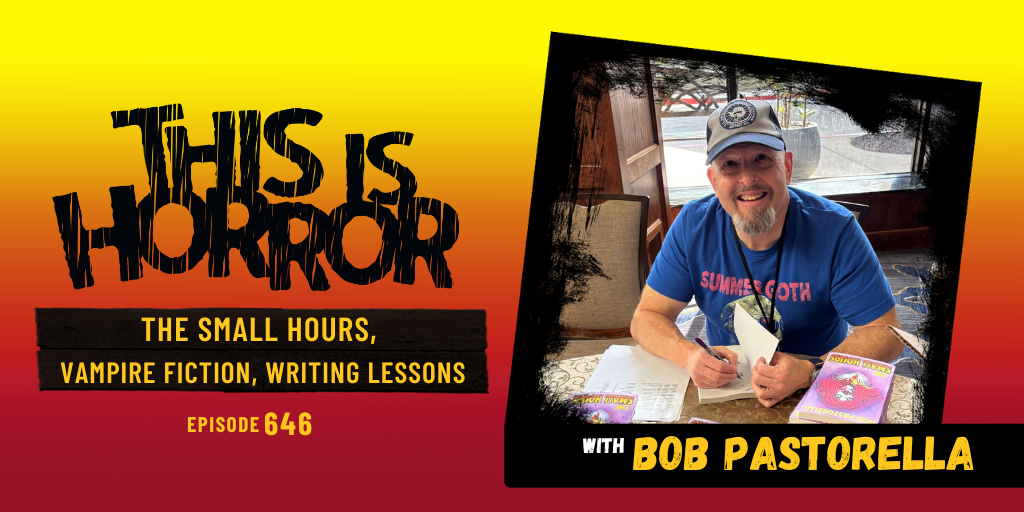
In this podcast, Bob Pastorella talks about his latest book, The Small Hours, vampire fiction, writing lessons, and much more.
About Bob Pastorella
Bob Pastorella is the co-host of the This Is Horror podcast. He is also the author of They’re Watching (with Michael David Wilson), with numerous tales in such publications as Lost Films, Borderlands 6, Warmed & Bound: a Velvet Anthology, and the Booked Anthology. The Small Hours is Bob’s debut solo novel. Bob lives in southeast Texas with his cat, Squeaky, and is currently working on another vampire story.
Timestamps
Thanks for Listening!
Help out the show:
- Support This Is Horror on Patreon
- Listen to This Is Horror Podcast on iTunes
- Listen to This Is Horror Podcast on Spotify
- Rate and review the This Is Horror Podcast on iTunes
- Share the episode on Facebook and Twitter
- Subscribe to This Is Horror podcast RSS Feed
Let us know how you enjoyed this episode:
- Leave us a message on SpeakPipe.
- Write a comment below.
- Tweet us @thisishorror.
Resources
- Bob Pastorella Books
- Watch the video version of This Is Horror Podcast episodes, including our conversation with Chuck Palahniuk on YouTube.
The Girl in the Video by Michael David Wilson, narrated by RJ Bayley
Listen to The Girl in the Video on Audible in the US here and in the UK here.
Cosmovorous by R.C. Hausen
The debut from R.C. Hausen, available now. Now also available as an audiobook.
Michael David Wilson 0:20
Welcome to This is horror, a podcast for readers, writers and creators. I'm Michael David Wilson, and every episode, I chat with the world's best writers about writing, life, lessons, creativity and much more. Now often I am joined by my co host Bob Pastorella, and today is no different, although that is not strictly true, because it is a little different you see this time, rather than being the co host, Bob Pastorella is the guest. Last year, Bob released a brand new novel the small hours, and that is the subject of today's conversation. So prepare for the tables to be turned on. Good old Bob Pastorella, but before that, a quick advert break.
RC Hausen 1:32
Cosmovorous, the debut cosmic horror novel by RC housing, is now available as an audio experience featuring an original Dark synth wave score. This story will take you to the next level of terror. Come hear the story the readers are calling Barker meets Lovecraft, a Phantasm style cosmic horror adventure and a full bore, unflinching, nihilistic nightmare. Cosmo vorce, the audio book by RC housing. Come listen, if you dare,
RJ Bayley 2:06
it was as if the video had unzipped my skin, slunk inside my tapered flesh and become one with me.
Bob Pastorella 2:15
From the creator of this is horror, comes a new nightmare for the digital age. The girl in the video by Michael David Wilson, after a teacher receives a weirdly arousing video, his life descends into paranoia and obsession. More videos follow, each containing information no stranger could possibly know, but who's sending them and what do they want? The answers may destroy everything and everyone he loves. The girl in the video is the ring meets fatal attraction for the iPhone generation, available now in paperback, ebook and audio.
Michael David Wilson 2:44
Okay with that said, Here it is. It is good old Bob Pastorella on this is horror.
So today is a special episode, because the guest is also my usual co host. I got Bob Pastorella Here. Bob, how's it going?
Bob Pastorella 3:11
It's gone pretty good. Michael, how are you doing? Yeah, I'm very well.
Michael David Wilson 3:15
Thank you. And there's almost a paradox here, because in some ways, this might be the longest gap between a guest having been on the show, and then also at the same time you're on the show every week as a co host. But it's actually been 10 years since we had a conversation where I was the one turning the tables and interviewing you, and that was for Mojo rising. So what I want to do is have a look back at the last decade, and I want to know how have you changed, both personally and as a professional writer in that time.
Bob Pastorella 4:03
Wow, that's, that's 10 years, that's, that's a long time. And I never really even thought about it as being 10 years. It just seems like yesterday, that Mojo rising came out, and as of right now, it's actually out of print, which that's that happens is not like, you know, you know, a bad thing, or anything like that. It's just, it's part of the business. It'll come back in some way, shape or form, possibly in a novella collection or something like that, since it is a novella. But and then, of course, the other hand, it's like, Damn, it took you 10 years to write another story. No, I've been I've written a lot of things in the last 10 years, but I've only had just a handful of things published. I did have my story in Lost films, and it got it to be down. Eight track. I had a story in a in a very short lived anthology, because the editor turned out to be a just a flaming pile little short story called chitterings that I really, really like, that will probably see the light of day One day I have completed a novella The killjoys were here, which I had on my Patreon. And maybe we can talk about Patreon later, but it's no longer there, and I can explain why, but I'm hoping to get that edited up and cleaned up and submitted once when I start seeing some novella open calls, and then I have my novel, which will be coming out, my debut solo novel, coming out in about about a week from now. I don't know when this is going to air, so September 30, the small hours, and of course, I just cannot forget the novel that me and Michael wrote called they're watching that's only been out for a few years, and it's, it's still people are still wanting it and still reading it, and it's just a creepy little, little giallo voyeuristic novel, and it's a lot of fun. So that's that's and then I do this podcast called This Is Our maybe you've heard of it. So there you go. Yeah.
Michael David Wilson 6:37
And I mean, with you having so many things that you could potentially release, I wonder, what was it about the small hours that made you decide, okay, this is the next story. This is the one that I want to put out.
Bob Pastorella 6:58
Well, it was I had the idea while I was working on something else, and that that's something that we can maybe kind of dive into. But I find that if I start working on something else, sometimes I get ideas and they latch on and they won't let go. And I don't, I'm compelled to kind of see where they'll go and so. And these are basically projects that come to me fully formed, that I have to write very, very little notes on it. And I'll be honest with you, I would be surprised if I have any notes at all about the small hours, I think that I absolutely have no notes at all about this, this thing that I've written in a notebook, or anything like that. The idea came to me. I was reading a review of a movie that I was really excited about, called the last voyage of the Demeter. And if you're familiar with Dracula, you know that Dracula crossed from Romania to to England in a ship called the Demeter, and he killed everyone on the ship. And it is the scariest part of Dracula. It's the Captain's log. Is the chapter, and you you are taking through this, this voyage on the ship. And I thought, what if they caught him instead of Dracula, killing everyone on the ship and draining them into their blood. What if, after, like the first couple victims, they realized what they had and trapped him and caught him? What would they do in the ships? Were the ship was controlled by Russians. They were the ones who were bringing them over. They were the crew, and what if you set that now? And what if it was the Russians, and specifically the Russian mob, who found out that they had a vampire, very arrogant vampire, on their ship. And they brought him to Texas to hide him and to use him to get rid of their enemies as a singular weapon of destruction. And I could not let that idea go. And I was talking to max booth. We were going back and forth in a chat about something else, and they asked me what I'd been working on. And I told I told them. I said, Hey, I'm doing this, and I've got this going on, and I've got this going on. And they were like, Hey, that all sounds cool. And and then I'm like, Hey, let me, let me drop this idea on you. And so, you know, and when you, when you're talking to friends and things you, especially if they write you, you might spring an idea on them. And they were like, you have to write that. And I felt at that time that one, it'd be perfect for ghoulish. And two, I also knew that if anybody was going to reject it, it was going to be max and so I wrote this story with no notes, I just powered through and I concocted the story and send it over to to ghoulish. And I waited, you know, they had an open call, waited and it got rejected so and they told me why, and they were like, if you're willing to expand this, we'd like to look at it again.
Bob Pastorella 11:18
And I had to figure out how to expand it initially, it's like, when you, when you write a novella, and that's originally, originally what it was, was a novella, and you're kind of set in how you've done the story, and you get a rejection, and it's like, and they suggest something that's almost out of left field that would require, like, work. You're kind of like, Ah, well, fuck this, you know, I'll just send it somewhere else. But then I started thinking, What can I do to expand a story and to make it a fuller, richer, more powerful story? And I took their their concepts to heart. They gave me a lot of room, a ton of room to work with, and I did it the way that I thought it would, it should work, and sent it back, and I sent it back and waited and waited and waited. It was a long wait, and they, they were extremely busy going through a lot of things, doing the festival and and all of that and so And finally, it was the pre, not this past gulus Fest, but the ghoulish fest before that. On the way there, I got an email saying, Hey, let's, let's put this book out. And that was a really, really nice email to get on my way to ghoulish. And so I'm really happy that that they took a chance on it, and I'm excited to put it out into the world. And it's, it's, it's getting, it's, it's gotten some, some early good reviews. So I'm waiting on the bad reviews so I can, so I can mine those and use them for publication, for, you know, for what's it called? What word am I thinking of? Promotional? Yeah, because, uh, I've bought plenty, plenty of books off of one star reviews. So I'm sure there's something I can mind from there just waiting.
Michael David Wilson 13:31
So there you go. If you read it and hate it, please leave Bob your one star reviews. He's hungry for them. Yes, and I
Bob Pastorella 13:41
will twist your words to my profit.
Michael David Wilson 13:45
And so, I mean in terms of the writing process for this one, you said that you had no notes, and then you essentially wrote the first draft. So I'm assuming that was quite a quick process. I mean, how long are we talking to go from just, you know, that first day, to having the complete first draft, and then what did you do after that, before sending it to max and ghoulish? I mean, did you just send the first draft, or did it? Did it go through a variety of iterations?
Bob Pastorella 14:25
I wrote the first draft. I think it took me three months, if I'm if I remember correctly, it took me about three months. And that's writing, you know, after work, I was compelled to finish it. It felt really good every time I went to write, I knew I had something that I was to me, it's like, Hey, do I have something I can finish? And do I have something that's gonna, that's gonna, you know, leave some emotional scars on me and read? And things like that. Am I gonna, you know, is it gonna, is it gonna pull the punches I want it to pull? And so I did a and once I finished the first draft, I sent it to three BETA readers that excuse me, that I've used previously, the world renowned and former This is horror reviewer, Thomas Joyce, who is it's incredible insight. Mackenzie Keith, who is just fabulous writer, fabulous editor, and a writer who I really admire, who's really kind of doing some things and knocking out of the park, is Brendan la Ferro and so and they, all, three of them, loved it. They loved it. The on the thing that amazed me was there are subtle, like, not really a spoiler thing, there are subtle allusions to Dracula within the book. Brennan was the only reader to figure them out, like, quickly, uh, Thomas and Mackenzie, I had to tell them that, you know,
Bob Pastorella 16:32
and to me, there's like to there's like, one part of the book where it it's real quick, but if you put it together, you'll be like, Oh, well, I know what this is. It is basically, it's a sly Southeast Texas retailing the Dracula, except for the what if is Dracula is not, he's not the main star. No, he's he's been stripped of all of that aristocratic persona and just stripped down to, in turn, into a monster that's just another pathetic, living dead vampire. And so he doesn't have center stage. And that was, I think that was important, when I was envisioning this is like, if they, if they capture him, and they, you know, turn basically strip him of everything that made him Dracula, then he could not be the star of the of the story, that he would be almost to, like, push down to like a henchman status, because I wanted other people to be the stars. And so I just got, I got really creative with the names, and Brennan. Brennan figured it out. He figured it out because of Willie's name, which is Wilhelmina. And he figured it out, and it was that, and the unique spelling I had for lucinda's last name, and he sent me an email saying, Hey, this is Dracula, isn't it? And I'm like, I go, No, it's not, it's not Dracula, Dracula, Dracula. But this is a what if. And he's like, okay, okay, got it. Got it, yeah,
Michael David Wilson 18:27
so yeah. And the interesting thing is, I mean, despite it being, in many ways, a retelling of Dracula, this isn't your Bram Stoker vampire novel. This is much more a larger than life action vampire novel. And I think I really distilled my thoughts on it with the blurb that I gave you, which I'm just going to read as a kind of starting off point. So I said the small hours is what would happen if bad taste era Peter Jackson had written a wild over the top vampire romp and brought in Adrian Lynn to sex things up. And I think that is what you're getting. And I mean, did you know early on that this was going to be this larger than life vampire romp, or was that something that more came in after you'd got that rejection, and then you'd expanded it?
Bob Pastorella 19:35
No, I knew going in that the Novello I wanted it to be, to be, I hate the word bombastic, but that's, that's pretty much where I was at with it. I really wanted it. The two driving forces of this thing and it's, it's the it's the comps that make it is. It's frightened. Club meets Suicide Kings. Suicide Kings is kind of a French movie. It's, it's a Christopher Walken film, and it's a great movie. And I'll give you like a, kind of a rundown of it real quickly. It's, it's Christopher Walken plays a mobster, and some, some college kids, they know who he is, they decide to to kidnap him and basically hold him up for ransom, in a nutshell. And so they, they cut off one of his fingers and duct tape him to a to a chair and walking duct taped to a chair, his character turns the tables on these kids and pits them against each other in A battle of psychological warfare that you have to see to believe. And it's just masterful acting. It's just just just Ty walk into a chair. He don't have to do shit. He just and it's just fabulous. And of course, Fright Nights just a fucking classic, and it is one of my favorite vampire movies, and it was to me, vampires are probably my favorite of the monsters, because there's so much you can do with them. There's so many different kinds of vampires culturally around the world, there's all kinds of different vampire tales, and there's a lot of similarities and a lot of differences and things like that. But at the end of the day, you're talking about a creature of the night that is essentially, not really, actually very powerful. They're actually quite vulnerable, if you have to, like, if you looked at like, Universal Monsters, and you wanted to rank the monsters as who's the most powerful, you know, you would have like, basically Frankenstein's creation, probably being at the bottom of the list. And then above that, the Creature from the Black Lagoon. And then you'd have Dracula, and then you'd have the werewolf, and then you'd have Imhotep at the top, the mummy. He was the most powerful of all of the Universal Monsters. And then off to the side, you'd have, you know, what's his name from the Invisible Man, but he was just crazy, so, but that was, you know, that's, to me, the hierarchy, and so Dracula's kind of right there in the middle, you know, like, I'm undead, I can do a lot of things, but at the end of the day, he's just a horny vampire. Just wants blood, you know, and that was the driving force. It's like, these vampires are, they're, they're fucking horny, they and so is. It's, there's a, there's a, I feel like there's a lot of sexual tension in the book, but I didn't want it to be like an erotic horror. I wanted it to be funny, and so and I but I didn't want the humor to be like slapstick or anything like that. I wanted to be situational, to be very dark. But I knew going in as a novella that it was going to be funny. Actually, the part that that when I added to turn the parts I added, to turn it into a novel, were not to make it funny, but to make it more small town horror and to have a more of an emotional impact. And so the original version of the story, there's, there's some, there's some side, a side plot that deals with some missing children, and in an novella, I just, I don't glom over it. I kind of sealed it up, but it wasn't part of the story as much as it is in the novel version. So, and we're like, when I wrote the script, I have a script for the small hours. I kicked that side plot because even though this is a novel, it's a very short novel. Movie. Wise, the script, I think, runs 8788 pages. So it's 88 minutes, which is a perfect length for a Netflix horror film. I kind of worked that out, but I kicked aside. I had to kick the side plot to do it.
Michael David Wilson 24:52
Yeah, and I think when you described your writing as bombastic, that is very apropos. Not. Just for this, but for what you do generally. I mean, particularly with mojo rising, and I think with they're watching to a point as well, there's a playfulness or an almost lightness to it. But, you know, it doesn't mean that you kind of skimp over heavy themes. But just in general, this is fun. Eight is horror. This is over the top horror, and it might be in my mind because of recently speaking to Josh Malerman about watching Evil Dead, but this is almost to Dracula. What Evil Dead two is to Evil Dead This is the over the top, bombastic, as you say, larger than life, ultra violent, ultra sex stuff in full Living Color. Sequel, the retelling, the tribute, even
Bob Pastorella 26:06
well, and I really do appreciate that. Of course, my inspiration is a, you know, Fright Night, which is a, it's Fright Night is Dracula meets rear window and, it was, you know, I didn't, and I didn't want to call they're watching Fright Night meets were window, because it's like, I'm using the comp within the comp.
Michael David Wilson 26:34
But they're small hours.
Bob Pastorella 26:37
Yeah, the small hours. What did I say? You said they're
Michael David Wilson 26:40
watching, which will be very strange.
Bob Pastorella 26:47
There's a vampire and they're watching. No, the small hours. I didn't want to comp it, as you know, Fright Night and, you know, meets rear window, the Suicide Kings part didn't come until I figured out what they were going to do with with Mr. Fields, the quote, unquote, Russian operative of the story. He because I didn't, I pants the whole thing. So I did not know before I wrote the scene what they were going to do. I just knew that I had to get them back into the house. That was the only thing. So I have a character who's tied to a chair who is still pretty formidable when tied to a chair. Let's just say that so. And that was, and once I saw that, I was like, oh, man, that's Suicide Kings, right there. I'm just being influenced by that.
Michael David Wilson 27:57
yeah, and I think, you know one thing that you mentioned, but we actually didn't get into specifics, is that it was initially rejected by ghoulish, but then they asked you to expand it, And you said that they made a left field suggestion. What was the suggestion, or what were the specific notes in the rejection and the things that they wanted you to do?
Bob Pastorella 28:31
They didn't feel that it was small town horror, and it had its setting. Is small town horror. So I mean, if you, if you deliver a project that you're not even calling it small town horror, but it's set in small town horror, and it doesn't feel small town hard. You've got a little bit more work to do. So that's just, that's just calling it, it what it is. They wanted to see more about the kids, about the missing children, they wanted some type of closure on that. They wanted more closure than what I provided. They wanted them to be more into the story. And when you when you write something and you finish it, and you edit it, and you had your beta readers, and you send it, and you get rejected. That's one thing, you get rejected, but you get notes saying, you know, change it then, always, initially, I think it's human reaction to go, I ain't changing the fucking word. You know, that was my initial reaction was not, I'll just submit it somewhere else. No, no hard feelings, none of that. You know, I started thinking about it, and I have nothing else to lose. I might as well try. I have a. Publisher who's willing to look at something again. And here's the thing, I've been I've been rejected by Max more than I've been published by Max. So there are, there are several stories that Max is flat out rejected. So it's like Golly. Everything Bob does is through ghoulish or perpetual know that. But everything I've sent, more than half of it's been rejected. So it's it's not, it's not easy getting in there, and you have to separate that, that relationship of friend and publisher, you know, they're gonna do what's best for the for the company. They're gonna put out what they feel is the best work that represents their authors and their company. And you have to have some thick skin for that and but like I said, it's human nature to go now. I ain't changing shit, you know, I'll just submit it somewhere else. But then I started thinking about it, and said, Okay, what could I do? And I worked it up and sent it back, and I felt like they would reject it again, going, No, you completely went into the wrong direction. And so no, now I don't want to look at it at all so, but fortunately, I did a good enough job on on bringing in those things that they wanted to see into the story in a meaningful in a meaningful way that made sense, that just didn't feel like that. It was patty.
Michael David Wilson 31:40
And so then, when you resubmitted, it, and then it was accepted, what further changes, and what back and forth was there compared to what you submitted, and then what we see today.
Bob Pastorella 31:57
This was the first novel that Mindy edited with ghoulish they have a a assistant editor who has edited ghoulish digest, the latest edition of that that just came out and and then this was the first novel, and Max themselves supervised, so they they saw everything that Mindy was doing, because there was, you Know, Mindy's comments and Max's comments.
Bob Pastorella 32:43
it was really good to have a woman on, on on board to edit this so it didn't sound some of the stuff, especially some of the sexual stuff, did sound misogynistic or anything like that. They call me to task on a couple of things that I had to do fix. But for the most part, it wasn't like, Hey, this is sexist or anything like that. It was just, I don't think this character would react this way. There was some incredible insight into that that I really, really appreciate. And you know, that that was, there was basically, I got edits, I worked through those edits, and then there was very, very little, like, you know, back and forth on that. So it was as it was. It was pretty much as clean as you could get it. But there was, there was edits on every page. So the main it's like it was, it was thorough, but it wasn't just, you know, topic, topographical stuff. It was, you know, actual story and plotting and things like that. So I'm really, I'm really happy that the story came out the way it did, that I didn't really have to worry about the structure. It laid itself out in a way that I liked. It's just, you know, the complications seem natural, the conflict was natural. Nothing, nothing feels forced in it.
Michael David Wilson 34:29
And the way that this one ends, and I'm going to have to be very non specific and vague, but I would say that it is open for a possible sequel or another book within this world, and with some of these characters not going to say which ones, because no spoilers here. Are you interested in writing a sequel or another book within the small hour as well?
Bob Pastorella 35:00
Dog. That was something that I left myself in case I wanted to to make it a little easier. I do. I do like I do like the voice. I will say that if I did something with those remaining characters that I would probably feel a little bit more comfortable switching POVs, a little bit kind of bouncing back and forth. I think that one No spoilers, but one of the characters is mixed race, and I didn't want to write from their POV. And because I always feel like that, if I'm doing that, then I'm kind of like, there's some things in that world I don't know.
Bob Pastorella 36:02
instead of screwing up, instead of pulling a close on Whitehead and fucking it up, I just avoid it, which is probably dumb on my part, but I think that, uh, that I stick to what I know and but I would feel comfortable coming back to those characters and bouncing POVs this time or next time. So, yeah, there could be a sequel. I have no, no ideas. You know, for one, I would probably do something very similar. And so it have to be something that's definitely in public domain, you know, with something else. So we would just have to see,
Michael David Wilson 36:54
just for absolute clarification, so the listeners and viewers don't think you're saying Colson Whitehead fucks up a lot of his writing. His piece of writing advice that you're referring to is, you can write about anything, just don't fuck it up. So I just wanted to bring go back to that, because you said, you know, I don't want to pull a Colson Whitehead and fuck it up.
Bob Pastorella 37:26
Yeah, that is not what I meant. And people who listen should know what I meant, because I quote that a lot, yeah. And new listener be like, Well, what did Colson Whitehead do?
Michael David Wilson 37:40
Any episode can be the first episode, and somebody might just be tuning in. They're not a regular listener of this is horror. They just want to know about your new book. And it's like, whoa. Bob Pastorella Fucking hates Colson Whitehead trying to start some beef here.
Bob Pastorella 37:59
No, I love his writing. It's great, yeah, yeah, that's a great piece of advice.
Michael David Wilson 38:06
It is, it is. And I didn't want that to be misconstrued. But you know, talking about writing and different pieces of advice, so you said much earlier on, that quite often, when you're working on a project, another idea will present itself to you, it will latch on fully formed, and it doesn't want to let go. And so that's kind of what happened with the small hours you were working on something. The small hours showed up you had to put that project to the side. But I mean, how, how often does this happen, and what are the factors as to whether you put the work in progress to one side, or you park the new idea and finish the project. Because, I mean, this happens to so many writers. It is almost an endless dichotomy, and I think we owe it to ourselves to finish story ideas. And this is certainly something again that came up in the new Josh Malerman book. It's something that Chuck Wendig has been saying for years. So where possible, I'll try to just write a few notes on the new idea then finish the existing one as quickly as possible. But what is the balance like there? What is, what are the factors that determine whether you put an existing work aside or whether you parked a new idea.
Bob Pastorella 39:48
So for the small hours, specifically, I was working on a novella called crazy tusk. And crazy tusk is another vampire story. Um. Um, and I was working on a scene that needed to be at the beginning of the story, and was going to structurally change how the beginning was, and I felt like that was a lot of work, and I had been toying around. And you got to keep in mind, this is around the same time that I'd heard some news about this movie coming out, the voyage of the Demeter. And I started thinking about that, and I bought a, bought a graphic novel about the Demeter, and it was, it's really good, and it's a, basically, someone did, like a graphic novel of the chapter in Dracula. And I really, I really enjoyed reading that. And it just got me thinking. And in one day, I'm like, what if they caught him? What if they caught him? What if somebody, what if there was a Van Helsing like person on that ship and said, what we have is a vampa, you know? So and they, they capture him, right? They trick him and capture him. And what? What would they it's like, okay, so now you got Dracula. What do you do with it? You know? What do you do with the vampire? Well, you tame it, you control it. You can't really tame the beast, but you control it enough you figure out how to kill it. And if you figure out how to kill it, then you know how to bring it back, because it's undead. And so that's and that's part, that's a big part of the small hours, so that that kind of thing, it wouldn't let go. I could not stop thinking about it. And I think I was reading about some true crime stuff, or seen some true crime stuff about in this something about a kid who saw something in someone's house and was trying to figure out a way to get in the house just to take a picture of what they believe could have been a crucial piece of evidence in a murder case. And I'm like, that's an interesting premise, and that that actually became the starting point, you know, and when I realized that I could kind of play around with the Dracula mythos in such a way that, one, the story could stand on its own. And two, if you're really, really into it, you can see the connections. But it's not in this. It's not necessary to read it, to understand it, to enjoy it. It's not, it's not. It can stand on its own at that at that point right there, I already had like the layout, and so I was already frustrated with crazy Tusk, and so it was just an easy transition to work on this. The same thing happened recently. I was working on another vampire novel called The dying nothing, and got a little stuck on that, mainly because it was just so fucking bleak, and I wanted to write something that was fun. And we, I think we talked about this last time we talked about fun, and what fun means, if you've got a dark sense of humor, fun doesn't mean funny. It just means, like this is going to be kick ass to write. And I had this idea about home invasions. And I just, I think I'd just finished reading side language book about home invasions, and I was, I was still on, I was on this kind of, like, kick about how scary they are. It's like someone breaking into your fucking house. And I watch funny games, and I'm like, this is, you know, this is, this is kind of like a home invasion on steroids, you know? And I'm like, and I was like, really kind of checking out a bunch of stuff, into the occult and everything. And I'm like, what if, what if you had some people that were serial killers, and they did home invasions, and they've been doing it for 10 years, and they were really good at it and never get caught in it and everything like that. And what if you had and they were just like the basically, from the outside, they look like just a typical American couple, and then you had another typical American couple who everybody thought was really, really nice and everything like that. Who knew that these serial killers were going to pay him a visit and kill them, and they were counting on it. And I'm like, that's some fucked up shit right there. And I kept thinking about and thinking about it, thinking about it, while I was working on the dying nothing. And one day this sentence popped in my head and it said, basically one of the characters really liked. Like, how the other character's house looked. She was like, Jen really liked the Keith in his house. No, take that back. Jen really liked the Hartwell house because it was the hartwells. And I'm like, that's, that's the way in. That's how Jen does the whole Hey, I was noticing you don't have a security system at your house. I was hoping we could schedule a meeting to talk about it, and then the next night, boom, that's their next victims, because they don't have a security system. So, you know, it's just taking all the serial killer knowledge from my head and putting the unit into the story, you know, and then, you know, I couldn't stop. I had to write it so the dying, nothing got kicked to the side because of a woman's voice in my head, which is probably sidelined so many things in my real life, but for offered better usually. So why not? You know, and that's that's pretty much what happened with the small hours too. Is this idea latched on? I was having some general frustration with crazy tests because I was going to have to maneuver scene. And I'm sure that if, if I would have planned it, I would have realized I needed a scene earlier, since I was panting it, I didn't realize it, and it caused some general frustration, because once you realize that you have a scene that works so much better at the beginning that you spent all this time working on, then it's kind of frustrating to go, Okay, I gotta rewrite. It's almost like starting over, because it's so soon. I'd be like, this would be like, really, would work so much better beginning. And that's so much work I don't want to do, but I have to do. I'll do it. I'll do crazy to us. It's on the roster. I haven't, you know, abandoned it. It's just on the back burner.
Michael David Wilson 47:10
So you said that crazy task, much like the small hours, is another vampire story. Do you think, now that you've written the small hours, does that make it easier or harder? Because I'm seeing on one hand, I don't know. Do you want to embrace being the vampire guy? Or on the other hand, are you like, I gotta put some stories between it so that I'm not put into that vampire guy category.
Bob Pastorella 47:44
I mean, I don't feel any pressure that way. And if the ideas come to me and it's a vampire story, then that's fine. The dying nothing is a vampire story. So, you know, I think that if I have to be known for anything, I want to be known as someone who I don't know. And there's not, there's not too, too much of it in, I know there's not. There's very, very little of it in Mojo rising, but there's a little bit of it in the small hours and but, and then there's definitely someone they're watching. There's, there's a little bit of folklore in these stories, whether it's something that is that we've used, that we found, or you know, different different motifs, the fish motif, and they're watching things like that. And so it's like, whether it's something that we made up or something that we found, I feel that I'd like to be known as somebody who can take folklore and in in use it in different ways. There's definitely some folklore in the small hours that gets used in in in rather inventive ways. I feel you know that I that I had never seen before. That was, that was one of the other things too, is because when you're working on a vampire story and you have another vampire idea, you kind of get into the research. And one of the things that I don't see a lot of is is other means of dispatching a vampire there, are, you know, people like, well, you put a wooden stake in his heart. No, that's not exactly how the folklore goes. You kill them with sunlight. No, no. That was Nosferatu, the original, that did that. So you, you know. Know, if you read Dracula, which, you know, based upon the European traditional vampire, I think in Van Halen chapters, he talks about how sunlight only makes Dracula slightly weaker. Sunlight really doesn't affect him. He can walk the streets, you know, not asking people, Do you have any sun block, you know? So it just, I think they I think Francis Ford Coppola showed that quite well in in his version of Dracula. You know, whenever he was in the Demeter. And I think you hear Anthony Hopkins Van Helsing accent talk about how Dracula is only slightly weaker during the day, and he burst through the wooden crates, you know? So I'm like, yeah, he's still a bad ass. You know? That that kind of thing I'd want to be known for, that in, you know, for, for taking little tidbits of information of folklore and folk horror and putting it into stories, because that's vampires are, is, is definitely, you know, there's a lot of folklore in there. And you don't really think of it as folk horror, but you read, read, read, Carmella and tell me, that's not folk horror, you know. So, I mean, it's, there's some this definitely there, yeah.
Michael David Wilson 51:36
And I think for me, I mean, you're also known as seamlessly molding together horror and crime. You know, there's an argument Mojo rising is more the crime book, and small hours is more the horror book, but they're two sides of the same thing. And I think before you know, you've spoke about weird Western as well. And I mean, it's all kind of weird fiction. But again, I keep coming back to through a playful or through a bombastic lens, that is your delivery, that is your mode. And you know, hearing about the plot of things like the killjoys were here, that's exactly what you're doing. It's this fun horror, as you say. It doesn't have to be funny, but there's something you know, just in the same sense that Tarantino and Rodriguez is from dusk till dawn, is a very fun kind of vampire, Action, Horror, crime, novel, not novel. It's a film. I wish there was a novel version too, but, my goodness, that seems to be the kind of box that you're playing in. And you've mentioned crazy Tusk, the dying nothing, the killjoys were here. I know previously you've mentioned the Campbell files. What is it that you're currently working on now, and with so many ideas, how on earth do you decide which one takes center stage?
Bob Pastorella 53:19
So what I'm working on right now is one that I finally landed a title for that I really like, and it's, it's called, what the wicked dread, and so which is from the Bible. It's from Proverbs, and it is a it's a post apocalyptic story of it's it's a road story. America has just had a terrible civil war, and Christian nationalist militia have taken over most of the southern parts of the United States, and magic has become real, and there are people who who can naturally do magic. There's also magic that, when they had the internet, that people were starting to learn how to cast spells and things like that and so and you have, you have your believers, and you have your unbelievers, and then you have Christian nationalist militia who round up supposed mages and string them up and down the electrical utility poles down the highways and so but this particular story deals with a driver who is tat. Asked with taking a mage into enemy territory, and this particular mage is a necromancer. He can speak to the dead, and so they want him to come to this fort fortified compound to perform his miracle. And they believe that that they can use this, this person, to do other miracles, and they do not realize that the person that they're asking for is basically a fucking God. And so it's not going to be like some type of second coming or anything like that. He's not a Jesus figure, but he's, he's, he's powerful, extremely powerful. And there's going to be some humor in it, but it's, it's pretty it's a pretty bleak story. The driver is an older, grizzled professional who doesn't believe in magic. He's just like, I'm doing this because they said they were gonna give me a lot of money, and you have to do a lot of money because money is almost worthless, and so he's going to get money in gold and things like that. And that's what I'm working on now. I have plotted this out, and then I took the plot and I streamlined it even more to where it's just I wanted to take this detailed plan I had and I streamlined it down to where is just just concepts, just concept ideas to kind of get me along. And so where I'm at right now is like they're they're making their way across. But of course, the mage needs a couple of things, one of which is a hand of glory, which has an interesting story. The person who owned the hand of glory wants the hand of glory back, because it's their hand. So it's, it's one of the, one of the funny things, if you know how hand of glory works, that's most people would be like, What? What What the fuck. How in the fuck did that happen? Well, yeah, you got to read the book. So that's what I'm working on now. I have started installed on this thing so many times that, you know, it's, it's just, that's an ongoing process for me. I'm not gonna, I'm not gonna fight it. It's just one happens. I don't, I don't, I don't get it. I'll eventually finish it. It is, it is, I feel like it's my main project, but something else is gonna latch on and I'll be able to finish it. The killjoys we're here is done. It needs to be edited. I need, I like to see some calls. I need to put some feelers out. I may self publish it myself, but I need to go through it and edited the completed project and get it ready for any type of submission, even if I want to self publish it myself. But at that point right there, I would hire an editor and make sure that this thing is is top notch, you know. So I'd spend a little money there. And that's the thing. If you're going to self publish, you need to spend some money. That's just how it goes. If you want the best product out there. And then crazy Tusk could could get done pretty quickly. So, I've got, I've got some things going on and shoot, I've got, I've got other ideas, you know, I have ideas that I want to explore with within science fiction, and not not hard science but not hard science fiction or anything like that. My science fiction is more like Nathan balling route science fiction, which I find just so beautiful, so and so fun. The like modern day Ray Bradbury
Michael David Wilson 59:19
is just, I love it. I tell you what? Not that it was meant to be a pitch for my services, but if you're looking for an editor for the kill joys were here, then of all the stories that you're working on, that is the one that is so kind of in my wheelhouse. And you know that I am very brutal and honest with my editorial process. So keep me in mind. And now that we've had the segment where I tried to sell something to the guest, let us move on from that. And I mean, I have to say, with all. What the wicked dread? Just the way that you've pitched it there, it sounds like it is going to be longer than your typical works. I mean, as it's a post apocalyptic novel with so many levels to it, I can't imagine this one being a slim novel or a novella. It feels like there's something weighty about it.
Bob Pastorella 1:00:23
Yeah, I would say it's, I guess, my definition of what epic would be if Bob Pastorella wrote an epic novel, which means, instead of it being, you know, 42,000 words, it'd be like 45,000 words. But I epic 45 but no, I got a feeling it's probably gonna it feels like an 80,000 word novel, because I don't one. I'm not really big on road trips. I like, I like watching them on, you know, like movies and stuff like that, because they usually, they can, you know, get things going, and you have some camaraderie, and you have some stops along the way, and things like that. That makes things fun. And that's exactly what I'm going to do with the story. But two guys sitting in a car, in a truck driving across the wasteland United States. It's some, someone would be intrigued by that. And I would love to do like a travel monolog of that. It's kind of like, you know, an Anthony bar Dan does the post apocalyptic landscapes of the US. But that would have to be, that's, that's a totally different story. That's not this story. This story, this main character, Lynch. He is not Anthony Bourdain at all. He is very pessimistic. Questions everything. Why are we going to this lady's house again? You know, we need to get on the road and but they're, they're, their drive is hampered by so many obstacles they have, you know, people that they have to fight off, and things like that. So that's going to make it fun. I It feels epic, I think, in that kind of sense that. But I don't want it to be a a slog. Recently saw the long walk, which I loved. It was it was great. It's probably one of the best films I've seen this year. And just a powerful, powerful movie. And if, obviously, you know, I read the book long time ago. I'm reading the book, rereading the book, and it's been years since I've read it, and I enjoyed it then. But what if you're uninitiated, you'd be like, oh, man, I don't want to watch a bunch of guys walking, you know, and it's they've taken the concept of a bunch of men walking until there's only one standing to a level that I have never seen in A film before. Just phenomenal acting, phenomenal editing, phenomenal everything they they knocked it out of the park. Like I said, probably the best film I've seen this year and so and I love what they've done with the post apocalyptic world, and I love the fact that they there's no concrete answers to that. And it's like that stuff doesn't matter. One of the things about doing like a science fiction or post apocalyptic type story or something like that, is you always want to try to find a way to make things realistic within your world. And I think that that can hamper a lot of writers. I know it did to me. I know that I felt like I had to do a lot of research on stuff. But at the same time, I'm also I love the fact that, like, for example, let's and we talked about it, mentioned Josh Malerman earlier about, you know, watching The Evil Dead and everything like that. The Evil Dead on paper doesn't fucking work. It can't it's impossible. It doesn't make any fucking sense. Okay? It's one of the best movie movie franchises out there, but on paper it don't fucking work. Okay? Because there's too many questions, where does the Lord come from? Why does this happen? Why is it that they are recording this. You the movies do not give the characters any time to think about any of that shit. And that's the most important part of the story. It's why you bought the ticket to go see the film, as you didn't go see the film to question everything you. Saw the film to be entertained, and you want to know what happens to these characters. They're caught in a world that they don't understand either, and they don't give a shit about that. They're just trying to survive it. And I think that that's probably the thrust of a lot of the successful science fiction, post apocalyptic fantasy stuff, is that here's a world, here's some characters. You should give a shit about them and let them try to figure out. And you don't have time to sit there and think about anything. Because, promise you, if you start thinking about the Evil Dead, and pretty soon, it doesn't make any sense.
Michael David Wilson 1:05:35
I mean, it pretty much doesn't make any sense from the start. And I mean, I re watched Evil Dead and Evil Dead too recently. And I mean, the first thing is that there's such a limit in terms of dialog, it's almost a silent movie without actually being one. And like you say, there's, I mean, there's so many logic jumps that it's almost a logic launch right up into space and then back again. It doesn't make sense, but you're there for the experience. You're there for the ride. You're there for the outrageous choices that that they make. I mean, it is, it is an artistic experience. But going back to, you know, you talking about what the wicked dread and you were talking about, you know, you don't really want to write a road story as such. For this one, you don't want a load of scenes of just them driving and on the road trip. And actually, in a recent Patreon podcast, you recommend it to me, and you've recommended it before. Refuse to be done by Matt bell. And so I started reading that book. It's a book on writing. It's a book on a specific way that one might go about it, and that actually talks about specifically, I think it mentions even a road novel. And if you think like, oh, I don't want to write all these driving scenes, just write the pivotal scenes. Write the things that you know, write those high points, and that's your first draft. And then once you've got that done, you can decide, okay, do you want to add some of these, I guess, more subdued scenes? Do you want to add more connective tissue? Or do you want to make it almost this raw, collated highlights package? Because, you know, in books and in movies, it's not like an accurate account of life going at that slow pace. It is the highlights. It is the good stuff. And I'm often going back to Elmore Leonard's advice that ties into this, which is, Skip the boring bits. Don't write the boring bits. So I think maybe if you're writing, what the wicker dread and you didn't go, man, now I've got, like, seven hours until they get to the server pivotal moment. And you're not feeling confused about those seven hours. Just jump into the next pivotal moment. You'll probably find what you need to go in between the two chapters in the writing of it, and I have to say, completing my collaborative novel with John Kerin and completing the first draft has been so liberating and freeing and just a really defining moment, I think for me as a writer, because as we were writing it, There were bits in the plan where it's like this. This doesn't work. This doesn't make logical sense. What are we doing here? And me as the meticulous planner, I want to go. I want to fix it, but we just said, and John encouraged me, let's just write this first draft as planned. You know that doesn't mean verbatim, but it means just, you know, you're looking at the plan for inspiration and what comes out of it, comes out of it. And there were so many things that we ironically couldn't have planned for, but if we hadn't decided we're going to fearlessly plow on until the end. It would never have happened. And so now I just feel, and I'm really inspired, that if there's a novel that I want to abandon, I will at least see it through to the end of the first. Draft, because it's only in writing that first draft that I might be able to see what I've really got here. And it this is it almost nearly happened with the one I'm working on at the moment, because I know that in the second half there's a little bit of a logic leap. And I thought, Oh, maybe I need to fix it. But I don't, you know what, actually not fixing it initially with John Kerin and did a world of good. So I'm just going in to that one, and I'll see what happens. And then I think after I'm gonna go to some of the novels that I didn't finish, like together forever, which I wrote 60,000 words of. That's one and a half Bob Pastorella books, and I'm just going to finish the first draft. And so, you know, you've said that you've abandoned a number of projects because they weren't working. And it sounds simplistic advice, but it kind of can be as easy as just, just finish the first draft, even if you're not feeling late, and if there are specific chapters you're not feeling skip them, but get to the end, because there's something liberating, like I said before, writing The story has taught me how to write the story, so I would encourage that
Bob Pastorella 1:11:26
and and to the most part, I agree with that, but at the same time, I have to to at least acknowledge that the small hours would have Never happened if I wouldn't have abandoned or set aside a book, and so there's success in that as well. I'm not saying that's my MO I'm not saying that every time I start something, I come up with a better idea, but I'm not going to feel guilty if I'm working on, you know what the wicker dread and come up with a better idea. I'm not going to feel guilty about it at all. I used to feel guilty about it all the time. I did have some guilt about setting aside crazy Tusk to work on the small hours, and that was, of course, once I got into it and care anymore, so you know, and it's something that there's two pieces of things that that Craig Clevenger has said throughout the years that I really like. He has a take to his keyboard, a little note that he wrote himself, that is basically, this is the last novel you will ever write, and that's how you in other words, it it's not the last. It's, you have to act like it's the last. It's, if there's a kitchen sink moment in this story, you better use it, because you may not never have another chance again. The other thing that I like is that, and he's never, I don't think he's ever talked about this, but I've seen it on social media, is that he is a big fan of starting over and because sometimes it is that initial approach, that if you hit a story at the right angle, there's some there's something about momentum that has worked for me. And so I believe that sometimes I don't know what it is. It's like with mojo rising. We hit the I hit that to hit the ground running on that I knew what the story was. The only groundwork on that was based on, you know, door songs and just stories I saw within the door songs. One of the things too, is that on the small hours, my soundtrack was the the British heavy metal invasion music of the 80s, particularly a group called Holocaust, which has a song called the small hours that Metallica covered on garage days. And there are several versions of Holocaust small hours. The best one is on YouTube. You have to look it up. Is very, very difficult to find. They take it off the page, apparently that there's some rights issues and stuff like that. But it's, I believe it's the 1997 version, or 1996 version of the small hours. That is the superior mix and superior recording of that song, but the set, and that's, it's a song about a seance, but it can also fit for vampires. So if you read the lyrics. It's, it's very creepy, and I've, I've always liked that song, and that's where I got the title from. But it was that whole soundtrack was just, you know, Holocaust and hell, star and Angel, witch and all these bands that, you know, Tigers of, Pan tan, all that, yeah, just, just some, some jam, Old Iron Maiden, you know, Paul Dan, oh, Iron Maiden, so, you know, just to get into that groove, you know. So, yeah, it's definitely an 80s heavy metal story.
Michael David Wilson 1:15:45
Yeah? So unlike me, you are capable of writing with vocals and with lyrics. For me, it just becomes too intrusive, and I'll probably find myself even just listening or singing along, or starting to write the lyrics out, which it's very problematic. There could be a lot of copyright issues there,
Bob Pastorella 1:16:11
yeah, and one of the things like is what the wicker dread, since it is post apocalyptic, and I think I've got it figured out to where there's been enough time that the mage to is being transported from one part of Texas to the other. Has never seen a television. He does not know what TV is. And one of the things that the lynch Lynch, who is basically about 60 years old. No, young protagonist, you know, just that's just so overdone, I'm gonna get some old guy, you know, who's just grizzled, who's an asshole, but he's one of the things is that when they do spend, when they do get out into the open road and have a few minutes of peace that he's able to play music. And so he feels as though he's a music instructor. And so there's going to be some music that gets along the way, you know, but he's also very cynical. He's gonna introduce the kid to, like, Led Zeppelin, and the kid's gonna be like, Wow, that's, this is really kind of cool. And he's like, yeah, it's not, they're not bad for a bunch of guys that ripped other people off. But, yeah, you know. So it's gonna be shit like that. But I'm not sticking with one genre, because he's going to also introduce the kid. He finds a box set of Miles Davis Bitches Brew, and manages to get one of the CDs into the CD player. The others are just, they're just, they won't play. But he finds one that plays and introduces the kid to Miles Davis. And so there's going to be some, some, some cool things there. But the kid doesn't understand any of his references, you know, to movies and things like that, or TV shows. You know. He says so this kid's supposed to be the Walter White of mages, and the kids like, I don't know Walter. I don't know who that is. Who's Walter White, you know? So, but we'll see. We'll see if I can continue with the momentum I have going.
Michael David Wilson 1:18:36
And can we presume that naming the protagonist Lynch is, in fact, a reference to David Lynch. I mean, how can you not hear the name Lynch and think of one of the great free Davids?
Bob Pastorella 1:18:52
Well, yeah, I am infinitely have been influenced by the David's Fincher Kronenberg and Lynch Does, does her that they've, they've massively influenced me. So, yeah, I would, I would say that he's not David Lynch. It's just the name. I like the name Lynch too. It just sounds this. This guy sounds like a Lynch. The major's name is Colin Emerson, and so he goes by Emerson or the kid as as Lynch calls him, get to go. We got to go get the kid, you know. So he's got this kind of gruff thing.
Michael David Wilson 1:19:35
They to be Emerson or the kid, because Colin is a notoriously weak name as a reference to daddy's boy. For anyone,
Bob Pastorella 1:19:51
it's better as a surname like Clive Colin. But yeah right, yeah, Dennis got some punch to it. Yeah? But. The, yeah, there, and there's going to be, there's some stops along the way, for sure. I've got an old buckies that that they've turned into, like a bardello gas station, and it's like the only place that you can really get, like, semi decent diesel, because that's, you know, they're using, like, bio diesel and stuff like that. It's like digital the gas that's out there. It's kind of like Road Warrior gas, you know, they make it. And it's like, you're not really concerned with gas mileage or fuel efficiency. You just want to go from point A to point B. You hear that engine knocking, at least it's running, you know. So that's, that's kind of where they're at. And they, they do have some places that make gas, but they're quickly consumed by paramilitary groups that are like, Oh, look, you're making gas. Great. We're going to kill everybody here and take over this, leave one guy to show us how to work it, you know. And that's pretty much what happens. So I think it's going to be cool too, because there's, like, no guns. Something happened with guns. They don't work anymore. So I think that'd be interesting. We don't need guns anyway. Too many stories with guns. So I want to see the road warrior with swords. That's pretty much what this is. It's like, or more like the road with swords. And that's, that's a big inspiration. Is, you know, Cormac McCarthy's the road?
Michael David Wilson 1:21:34
Yeah, yeah. I mean, immediately, when you were describing it, the two people who came to mind were Ray Bradbury. I mean, how could he not give him the title and then call Mac McCarthy specifically the road
Bob Pastorella 1:21:50
Yeah, I see it as a mix of originally, I was thinking it was going to be the road warrior meets Hellraiser, which is a good comp. But I'm kind of leaning to something a little bit more brutal, and so maybe a little slower paced, not so actiony, more cerebral. And so I was, my comps that came to mind after that was, it's like the road. You know, car McCarthy's The road meets our sheriff night, without all the history and the going back and forth and showing different people's lives, it's just going to be focused on that. And the beginning of our share night is, pretty much is kind of a road story, kind of, in a way, you know, there's, there's some travel involved and, and so, like, I think this is going to be like seeing a coming, coming of age story, but you're not the character who's Coming of age. And I think that having a protagonist who is an older person can maybe find a way to feel like that. They can live again, you know, in in terrible circumstances, and want to be able to show that.
Michael David Wilson 1:23:17
Well, one thing that I wanted to ask before we bring this conversation to a close, is, what did you learn from writing the small hours specifically that you can now apply to your writing going forward?
Bob Pastorella 1:23:35
That is a really, really good question. What did I learn? What what did I I think that something that it took away a fear, some fears that I've had about approaching certain, certain types of scenes. It took away a fear that I had of having multiple people in a scene. And you know what they what they In other words, like, instead of just having two or three people on the scene, I've got scenes where there's seven people in a scene, and I think writing a script help that, because one of the things in script writing is like, when you're doing descriptions, you want to always make sure that you don't forget about the other people in the scene. And so you want to make, you know, occasionally will have to make a reference to remind the director that there's someone else in this screen who may not be talking, but they're there, you know, or who may have only like one line of dialog. But it's very, very important. So it's like to get multiple characters involved. And I've always been a fan of these scenes where. It's like just two people talking, maybe three. But to have, you know, to get everyone involved, I feel like that I did that pretty well. Is it's just, it's hard to juggle all that. And the thing with dialog is this, like it's got, I always feel like it has to be meaningful. It can't just be words on a page. It has to to make sense. It has to be something that people would say when I read a story, and the dialog is just not stuff that people would say in real life. Then that really takes me right out of the story. And so to me, people, there are people who just talk to talk, but you know, for the most part in the story, you know, those are people I find it, end up getting killed pretty quick. Yeah.
Michael David Wilson 1:25:58
So do you think that kind of going forward, that that is going to it has that had an immediate effect on what you're writing? I should say,
Bob Pastorella 1:26:15
I would think so. I know like on what I'm working on right now, there's only two characters. They do come across some other people. That's like, it opens with them watching a group of paramilitary string people up on utility poles, and they're trying to keep their distance so they don't get noticed. And there's going to be, you know, the next, the next stop is so the Emerson can pick up, you know, an object that he needs. So, and then there's, you know, there's going to be things along the way. I've got my main, I guess my main supernatural villain has henchman who he is sent out to retrieve his stolen hand of glory, and one of which is actually a demon. And these demons are kind of interchangeable. They we find out pretty early on that they are legion, because they are basically can just hop from body to body to body. And so when one body just loses its efficiency and effectiveness, they just go to someone else. And they're called split tongues, because usually the first thing that happens is their tongue split. And so we find out very quickly that one of the henchmen, who's human, who is not a demon, has he's on like, his fifth split tongue, and he's like, you know, these motherfuckers don't work out too well, you know. But he he has these terror, these terrifying conversations with split tongues, because the demons are just, they're, they're, they're radical, they're just hell been on destruction. And he's amazed that he's actually still alive being in the presence of such a terrible creature. So there's going to be some some interesting, uh, conversations that come into play. They're going to have multiple people, and I feel confident that I'm gonna be able to pull it off without just having, like, a one on one type of dialog. Yeah.
Michael David Wilson 1:28:35
And I wonder too, if this will translate into screenwriting. I mean, he mentioned writing the screenplay for the small hours. I of course know that you co wrote the screenplay for their watching, seen as I was the other co writer. It would be weird if I didn't know about that. But do you think that you have an appetite now to do more screenwriting. Is that something that you see in your future?
Bob Pastorella 1:29:06
I do see it in my future, but I don't see it in my future right now. I want to, I don't know. It's if I get bored writing prose, I'll go back to to to writing screenplays. I think that I'm just, I'm having a lot of fun in prose right now, and so I want to to explore some avenues there, some of the, some of the past couple months, writing has been tough. It's been really tough thing. It's the weight of the world. There's so many, so many factors work, you know, daily grind, personal matters, and I feel like that every every time that I sit down at the keyboard. I don't want it to feel like a bad. Battle that I'm having to fight just to find some time to write. I want to to be able to find joy in it. I want to lose myself. And last couple of writing sessions, I have lost myself. I've and I love that, that that's my moment of Zen when I'm in the story, I'm in the zone, and I don't care about word count, I don't care about anything. I'm just caring about discovering what these characters are going to bring to the table. And it's been a while since I felt that. And the last time I felt it was really, you know, in, like, in a new project, was the killjoys was, was, you know, the killjoys were here, and, you know, I have, there was another project I tried to get off the ground, which just, it just needs a lot of work. It's still in an ID idea stage. And I thought I had a in on it, but I don't. And what I mean by that, it's like, just a starting point for with some momentum, and it could. I don't think that this one could be a novel. I think it would be another novella. I like writing novellas. They're easy, they're and, plus they're they are easily more adaptable into screenplay. So that's something there too. And this is like, I'm glad that novellas are actually being published when I was coming up in the world, when I was a wee lad, novellas, you had to be Stephen King, are someone of that caliber to put out a novella, and it was usually part of a bigger project. And so now we have publishers, especially small press, who are willing to do novellas. So that's pretty good. I love it.
Michael David Wilson 1:31:52
Oh yeah. I mean, tenebras and ghoulish come to mind, and cemetery gates media. And then, of course, you've got Tor putting out a number of novellas too, and then you see Titan books, and they've put out a few novellas, and then also put out short story collections, leading with novellas. So we certainly seem to be, and have been having for a number of years, a novella moment, and we've often said it's one of the best forms of and for horror fiction. So yeah, I'm all for it. Well, in terms of kind of wrapping up, I wonder where can our listeners connect with you?
Bob Pastorella 1:32:40
Bob, well, the best place to find me is on blue sky. That's where it said it's basically, it's at Bob pastorella.com is my blue sky? If you go to Bob pastorella.com I do have a my my domain now goes to a website that I have to go through ghost. I do have a patreon, and right now, there's no charge to be to follow me on Patreon. I've taken away all the money tears, and I'm not I don't post there very often. As of late, I will probably be posting there a little bit more. I was doing a somewhat a semi regular little journal called obscure journal, just little things. But I've had some work issues that have kept me from, you know, coming come home tired and I don't want to do shit. So, and getting, especially getting on any type of social media lately, has been, like, a fucking chore, and so, and it's like, Holly Bob, I see you on there all the time. It's like, yeah, get on and get off. People. Quit Doom scrolling. You're, you're killing your brain cells. And that's it's it, trust me, I know it's hard to do because I'm caught up in it too, and so I'm just really trying to force myself away from there I am on threads a little bit. The threads is weird. It's threads is weird. You get you get some weird you get some weird cold takes and hot takes on threads. That makes me like, not want to be on threads. But let's just say that so, and I did, I am on Instagram, but, and I still, I figured out how to work it. But, yeah,
Michael David Wilson 1:34:39
I think what you're saying about threads applies to every social media platform. And so in terms of your Patreon, what can people who sign up expect going forward? What are the plans for the Patreon? Um.
Bob Pastorella 1:35:00
Um, I don't know I was, I know this is not a it's not a good answer. It's not the answer to you wanted. I did have the kill Joyce was here at a tier, and what I was doing was I was editing, and so I had the first five chapters up, and I would go in and edit. And so you could see the difference between rough draft and new draft. No one signed up for that at any tier, even when I lowered the price. And that's fine. Things like that happen, and I totally understand it, and I'm not angry at anyone. It was experiment. I tried and it didn't work, and I get it, I don't want to. I wouldn't at the end of the day, I would not pay three bucks a month unless I was really, really interested in the story, to get a chapter at a time. And so at the end of the year, you spent 45 bucks on a book. So yeah, that you could probably get on if I pull if I self published it, you could get it for one shot at 799, so, I mean, I get it, and nobody in money's tight and all that. So I totally understand, and I'm not bitter in any way, shape or form, about that. It's just, it's an experiment I tried and it didn't work, and, golly, I'm not going to waste anyone's time with it. So what you can find on there is, is a several post of obscure journal to where there's some, you know, tidbits into my life and things I'm working on and things like that. There's a couple of essays I think I'm going to use, I'm going to kind of pivot more to my website, because it is, it does have a newsletter associated with it, and so that is at basically Bob pastorella.com if you go there, you can sign up for my newsletter, and I will be putting out a newsletter in October, so, and I'm gonna try to do one every month, but I also it will allow me to do post, you know, without being in a newsletter, like blog post and stuff like that. So I'm really, you know, interested in trying to see how using something like that's going
Michael David Wilson 1:37:28
to work. Yeah, it's the never ending battle of what platforms to post to, how much to post to, everything being fragmented, when really all we want to do is write cool stories. That's essentially how we want to be spending our time. You know, writing stories and podcasting, but we have to do all these writing tangent or writing adjacent things to be able to promote the work, and a lot of us are hoping that at some point there's going to be a platform, much like back in the day there was with Twitter, where it's like, this is the one stop shop. You can essentially just post here. But if it's going to happen. I'm not even sure that that platform exists yet. I don't think it's anything we're using, at least not in the current guys and the current form.
Bob Pastorella 1:38:34
Well, to me, I feel like there's some sort of parallel between our fractured society and our fractured social media. I mean, there has to be which is why things are like they are. And maybe we can maybe social media might be the thing that brings people back together, maybe, maybe not. Maybe it's something else. I feel like that we're kind of, I think we're really kind of approaching a point to where as human beings that we're gonna have to try to come together on some type of common ground, and trust me, I'm the first one in the world that I firmly believe that everyone has the right to their own opinion. But if you're wrong, that means that you're a fucking idiot, and so you know that's I can't get past that in my mind, but we still need to find a way to find some type of common ground for survival. It's just that's the. Way, way the world is right now is just, it's not good.
Bob Pastorella 1:40:07
I want to be able to not have to purposely find joy. I want to naturally experience it, if that makes sense.
Michael David Wilson 1:40:16
I think so. Yeah, and it's enormously complicated topic, and perhaps one that we don't want to open as we're wrapping up. But I mean more so because there isn't a simple answer, if there was an answer, then we could open that topic. You know, I I just, I try to find that love and compassion and kind heartedness and trying to have empathy and understanding is close to the answer. But, you know, I know even saying that for some people, it's going to upset them. But you know, empathy and love. That's as near to an answer as I've ever found
Bob Pastorella 1:41:04
right that and that is what allows us to create the stories that we create, because we have the ability to empathize and to put ourselves in someone else's shoes, and sometimes we wear the shoes of demons who have split tongues, who want to do dastardly things, and then the creatures of the night, the vampires,
Michael David Wilson 1:41:36
and that is why you've got to buy the small hours by Bob Pastorella from ghoulish
Bob Pastorella
September 30,
Michael David Wilson 1:41:46
oh yeah, oh yeah. Do you have any final thoughts? Um,
Bob Pastorella 1:41:55
final thoughts, um, watch watch vampire movies, watch old vampire movies. Watch there's so many different kinds of vampires out there. It's like you almost can't get bored with them. If you feel like that, you're bored with vampires too. There's so many different kinds. I've started kind of peeking in into Keith Rosson coffin Moon, which is a vampire book. This is the year of the vampire folks, and I'm pretty excited about it. And so read, let's, let's do some vampires. Read the small hours. Have fun with it. It's a quick read, and know you're gonna love it.
Michael David Wilson 1:42:41
Let's do some vampires that escalated rapidly. Bob, yes, and on that note, thank you very much for joining me. I'll see you next time when you'll be back in the co host seat.
Bob Pastorella 1:42:55
Yes, yes, looking forward to it.
Michael David Wilson 1:43:01
Thank you so much for listening to the conversation with Bob Pastorella. Join us again next time when Bob will be resuming his duties as co host for our conversation with the incredibly talented clay McLeod Chapman. And if you would like that and every other conversation ahead of the crowd, please become our patreon@patreon.com forward slash This is horror and help me do the this is horror podcast full time. Not only will you get early access to each and every episode, but you can submit questions to every single guest, and next up, we are chatting with Dean Koontz about his new book, the friend of the family. So if you have a question for Dean, the place to be is patreon.com, forward slash, this is horror. Okay, before I wrap up a quick advert break, it
RJ Bayley 1:44:11
was as if the video had unzipped my skin, slunk inside my tapered flesh and become one with me.
Bob Pastorella 1:44:19
From the creator of this is horror, comes a new nightmare for the digital age. The girl in the video by Michael David Wilson, after a teacher receives a weirdly arousing video, his life descends into paranoia and obsession. More videos follow, each containing information no stranger could possibly know, but who's sending them and what do they want? The answers may destroy everything and everyone he loves. The girl in the video is the ring meets fatal attraction from iPhone generation, available now in paperback, ebook and audio.
RC Hausen 1:44:50
Cosmovorous, the debut cosmic horror novel by RC housing, is now available as an audio experience featuring an original Dark synth wave score. This story will. Take you to the next level of terror. Come hear the story the readers are calling Barker meets Lovecraft, a Phantasm style, cosmic horror, adventure and a full bore, unflinching, nihilistic nightmare, Cosmo vorous. The audio book by R c Housen, come listen, if you dare. You i
Michael David Wilson 1:45:24
Now, I said before the break that Patreon is the place to be, but another place to be is the this is horror Instagram, where we are putting up inspirational clips, writing advice and videos from Addison's horror conversations, and it is literally the place to be as over 35,000 of you and counting have viewed our clip with Joe Hill as he rightfully slams the use of AI in creative art and writing. If you would like to see that and many more video clips, then do follow us on Instagram at this is horror podcast. All right. Well, that about does it for another episode of This is horror, but until next time with clay McLeod Yap man, take care of yourselves. Be good to one another. Read horror, keep on writing and have a Great, great day.