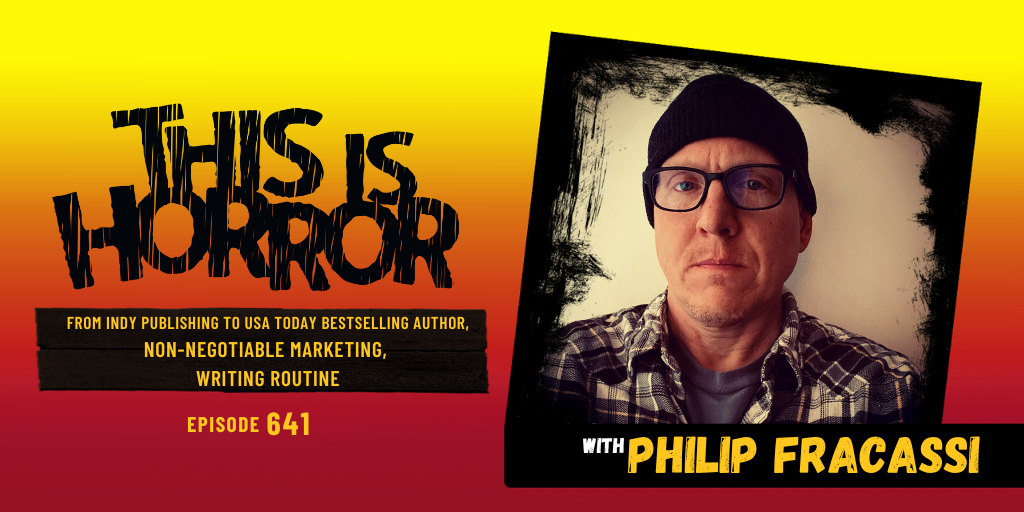
In this podcast, Philip Fracassi talks about his journey from indy publishing to becoming a USA Today bestselling author, non-negotiable marketing practices, his writing routine, and much more.
About Philip Fracassi
Philip Fracassi is the USA Today bestselling, Stoker and British Fantasy-nominated author of the novels Don’t Let Them Get You Down, A Child Alone with Strangers, Gothic, Boys in the Valley, The Third Rule of Time Travel, and The Autumn Springs Retirement Home Massacre. Other work includes the story collections No One Is Safe!, Beneath a Pale Sky (named “Best Collection of the Year” by Rue Morgue Magazine and a finalist for the Bram Stoker award), and Behold the Void (named “Best Collection of the Year” by This Is Horror). He is also the author of several novellas, including Sacculina, Shiloh, Commodore, and D7.
Show notes
Click the timestamps to jump straight to the audio.
Thanks for Listening!
Help out the show:
- Support This Is Horror on Patreon
- Listen to This Is Horror Podcast on iTunes
- Listen to This Is Horror Podcast on Spotify
- Rate and review the This Is Horror Podcast on iTunes
- Share the episode on Facebook and Twitter
- Subscribe to This Is Horror podcast RSS Feed
Let us know how you enjoyed this episode:
- Leave us a message on SpeakPipe.
- Write a comment below.
- Tweet us @thisishorror.
Resources
- Philip Fracassi Books
- Watch the video version of This Is Horror Podcast episodes, including our conversation with Chuck Palahniuk on YouTube.
The Girl in the Video by Michael David Wilson, narrated by RJ Bayley
Listen to The Girl in the Video on Audible in the US here and in the UK here.
They’re Watching by Michael David Wilson and Bob Pastorella
Read They’re Watching by Michael David Wilson and Bob Pastorella right now or listen to the They’re Watching audiobook narrated by RJ Bayley.
Michael David Wilson 0:20
Welcome to this is horror, a podcast for readers, writers and creators. I'm Michael David Wilson, and every episode, alongside my co host, Bob Pastorella, we chat with the world's best writers about writing, life lessons, creativity and much more. Now today, we are chatting with Philip Fracassi For the first time in eight years, and boy, oh boy. What an event. For eight years they have been for Philip, who has gone from indies sensation to the USA Today, best selling author of a number of books, including, don't let them get you down a child alone with strangers, Gothic boys in the valley, the third rule of time travel. And his latest book, which is part of the reason we're talking today, the autumn springs retirement home massacre. And in addition to that, other works include the short story collections, no one is safe beneath a pale sky, and behold the void, which was named best short story collection of the Year by us, this is horror. So let's take a quick advert break, and then we will welcome Philip to the show for his much anticipated return to this is horror.
RJ Bayley 2:06
It was as if the video had unzipped my skin, slunk inside my tapered flesh, and become one with me.
Bob Pastorella 2:16
From the creator of this is horror comes a new nightmare for the digital age, the girl in the video by Michael David Wilson, after a teacher receives a weirdly arousing video, his life descends into paranoia and obsession. More videos follow, each containing information no stranger could possibly know, but who's sending them and what do they want? The answers may destroy everything and everyone he loves. The girl in the video is the ring meets fatal attraction for the iPhone generation available now in paperback, ebook and audio from the host of this is horror podcast, comes a dark thriller of obsession, paranoia and voyeurism. After relocating to a small coastal town, Brian discovers a hole that gazes into his neighbor's bedroom every night she dances and he peeps, same song, same time, same wild and mesmerizing dance. But soon Brian suspects he's not the only one watching and she's not the only one being watched. Their watching is The Wicker Man meets body double with a splash of Suspiria. Their watching by Michael David Wilson and Bob Pastorella is available from this is horror.co.uk, Amazon and wherever good books are sold.
Michael David Wilson 3:25
Okay with that said, Here it is. It is. Philip Fracassi on this is horror, Philip, it has been eight long years. But welcome back to this is horror. Yeah.
Philip Fracassi 3:46
Thank you. Yeah. You know the other thing, eight years ago, you know, we were audio only, and I look at us guys, you got video going, I know.
Michael David Wilson 3:54
I mean, there was a rumor like, do me and Bob actually exist? Or are we kind of AI creation. So we don't we better, especially because, you know, there's a lot of bad shit going on with AI at the moment, we need to dispel the rumor. And here we are. We're real people. Yeah, yeah. I guess the next step as technology gets really good is we'll have to meet up at a convention or something. So you can see in person.
Philip Fracassi 4:23
Yeah, you guys are gonna have to hit meat space. I've been doing a lot of meat space lately, but we can talk about that with my new book. Lot of touring.
Michael David Wilson 4:34
Oh, yeah, definitely. And, I mean, usually when somebody comes back. I would ask what the biggest changes, both personally and professionally, have been in that time, but it does seem an insane question after eight years, but let's throw it out there anyway. Let's see what you give us.
Philip Fracassi 4:58
Yeah, well, like you know. Like we were talking about, I think the when I was on last time, 2017 I only had one story collection. I had a couple chapbooks, mother and alter and and then those were both collected in behold the void. And so yes, since then, I have released six novels, two additional story collections and three novellas, two additional I think sakulina might have been out when we were so, yeah, so a lot of new this new stuff has come out. I think the biggest change for me is because I've had some some success, you know, selling my work to bigger presses. It has allowed me to write, you know, start writing full time. You know, I think when we were last spoke, I was still working in the film industry part time. So now, the last two or three years, I've been writing full time, which has been a blessing, and been able to really focus on getting more work out there and and, yeah, that's been the biggest change, for sure. And just having, now, you know, all these books out there, and growing readership, and having people discover my earlier work, and it's been really fun, and it's been very, very satisfying.
Michael David Wilson 6:19
Yeah, I mean, you say you've had a little bit of success since we last spoke, but as I understand it, you've now got publishing deals, or you've had publishing deals with three out of five of the big five publishers.
Philip Fracassi 6:36
Yeah, I haven't worked with Random House. I don't know who I worked with. I've worked with has shet or via their orbit imprint for my book, their rule of time travel. And also orbit UK, who I believe is under little brown for a few titles, and then yeah, Tor night fire under Macmillan has been, has been great and and I'm going to be, I haven't it hasn't been announced yet, but I just signed a new deal that for a book that's going to come out in 2027 that I'm excited about with an with a new Big Five press. So unfortunately, they haven't announced. They haven't made their announcement yet, so I have to wait, but, um, but, yeah, it's been. It's been, it's been great. It's been, like I said, it's been a real it's been a lot of work, a lot of a lot of things falling in place, you know, a lot of things going my way, a little bit of luck and but, yeah, the work has been getting out there and, and I'm really grateful that these publishers have, you know, you know, put, you know, put themselves behind me and supported the books and, and, and I hope it keeps going. Yeah.
Michael David Wilson 7:57
I mean, last time you had a number of independently published works, and you were working with Jordan crawl. Have done a manor press? Yeah. Now, as I said, you're with these bigger publishers. So I mean, what? What were the first steps if we're to unpack that journey from going from indie to these big mainstream presses,
Philip Fracassi 8:24
yeah, and, you know, and, you know, in fairness, I'm still, I am still publishing with independent presses. I I've published three story collections with Lethe press. My next story collection comes out next September, is gonna be with shortwave, who's doing really nice stuff in the indie space, although they did just sign a deal with Simon and Schuster for distribution, but they've been doing great work. And so yes, I'm still, I kind of still dabble. I still work with a lot of some of those, like boutique Deluxe presses, like earthling and thunderstorm and lavinian and Fantasia press, you know, I've, I've had a lot of, I love, I'm a book collector as well as a reader. So I love when somebody comes to me with the offer of, you know, doing a beautiful edition out of one of my books. I always get excited. I pretty much do it for free, but, you know, but I but that's always a that's always really fun. But to answer your questions, yeah, I think what happened was, you know, I think it all hinges around a ski trip I took. I know you weren't expecting that a ski trip I took in 2022 February of 2022 I had, no I just put out? Or had I even put it out? No, I don't think I'd had any novels released at this point. I think it was just behold the void and and beneath the palace sky. My story collections. I. And my agent was about to start shopping around a novel I had written called the blue butterfly. And in October of 2021, earthling publications put out a deluxe edition of my book, boys in the valley. And that was the first novel that I had ever published in any way, shape or form, as far as like a deluxe or as far as a genre novel or novel with a third party excited self published a book earlier, but so, um, so yeah, so Earthlink put that book out in October 21 and I think they did 250 copies. And my wife and I went skiing in Big Bear here in California, and we were coming down the mountain and going back into cell service, and my phone started blowing up, you know, blowing up, ding, ding, ding, ding, you know, vibrating. The whole thing. I'm like, What is going on? And what happened was, is that a reviewer named Sadie Hartman, also known as Mother horror, had read the deluxe edition of boys in the valley and had posted about it on Twitter and written something very nice about it, and then Stephen King retweeted her tweet and said, I'm gonna buy it. And it kind of blew up. And everyone was like, What is this book? Who is this guy? How do we get hands in the book? And it was like, the best of times and the worst of times because Stephen King was tweeting about my book, but absolutely, but nobody could buy it because the earthling edition had sold out, like in 24 hours. So I have all these people emailing me and texting me and messaging me through Twitter, saying, How do I get this book? And I'm like, you can't, you can't buy it. So what? But what did happen is my agent said, instead of taking out the blue butterfly, let's pivot and let's take out boys in the valley, because now we have all this kind of like excitement going on right now with it, with Stephen King and all these people. And let's play off that. And so we gave, we sent it to Torah night, fire and tour night. Within two weeks, I think within a few days, they had, they had read it and said they wanted to buy it. And I think within two weeks, we had an offer. And and I tell that story because I think that was the moment that changed everything for me, because all of a sudden I went from indie short story guy to Big Five press guy and and I did. I had sold a novel called The child alone with strangers that I don't think it had come out yet. I think child alone with strangers came out in November of 2022 and then got the came out in February 2023 and then boys in the valley came out in July of 2023 I'm pretty sure I got my timeline right there. So I had sold child loan with strangers, but that was to another indie press called, you know, Taylor's press, which is part of sky horse. So, yeah. So that was and that. And then boys in the valley came out, and it and it did very well, and it kind of put me on the map with a lot of readers and and that was really what, that was, the spark. And then from there, I had already written, like, two other novels. And so my agent started, you know, was a two book deal with night fire. And then so we had, I wrote the second book for them. And then I had another novel called third rule of thumb. Rule of time travel that she was able to sell to orbit on its own merit. And so all of a sudden I went from like, having no books out to having, like, four books out within like a year and a half. It was insanity, and it was it was it was it was a lot. You know, it was a lot, because you're, when you put a book out, you're promoting the book, but you're also going through edits of the book with the publisher. And so I was like, editing three books at the same time, and I was promoting multiple books at the same time, and I was trying to tour for boys in the valley and also promote these other releases. And so it was pretty crazy. It was a pretty crazy couple years, but, um, but, yeah, but that, that, honestly, you know, I give that's what that wouldn't luck. Because, you know, I don't, I think if Stephen King had not retweeted Sadie's post, if Sadie hadn't tweeted about it in the first place, who knows if I ever would have gotten a deal for that book, you know, so I think that was the break, as it were, that I received.
Michael David Wilson 14:25
I imagine there must have been so much anxiety alongside the excitement, both for you and and even for tour once they signed the book, because my attention is so fleeting, and you had all these people who they want to buy the book. But if you're not kind of rushing it out, then by the time it comes out that that attention or that interest is potentially gone. So did it mean that tour really had to kind of bring that a game and rush release it?
Philip Fracassi 14:56
Because, yeah, well, yeah, no. I know, I had the same, obviously, I was very, it was very, I had the same thought at the time. I was very anxious about it. And I'm like, you know, but, but, you know, you have to think big picture, which is like, look, I, you know, I the Stephen King thing, basically. I mean, they had to like the book. It wasn't, you know, I don't think they liked, they bought the book just because Stephen King tweeted about it. They'd be but they liked the book. They believed in the book. But yeah, there was that element of like, okay, how do we, like, get it all ramped up again? And there was a lot of me, you know, kind of hysterically, retweeting, like, hey, the book has been sold. It's coming out, you know, in July of 2023 you know, and he just got to wait a year. And people weren't too down with that, but, but I was like, hey, but in the meantime, you know, you can read these other books I have, and people weren't too down with that either. They wanted the book that Stephen King mentioned. But, um, tour, yeah, I think they, I don't think they rushed it. They, you know, like I said, I think it took about a year. It came out like July 23 so from the time they bought it, probably enjoyed probably in July of 22 give or take, maybe was March 2022 somewhere in that range. So took about a year to grow, which is pretty standard. And yeah, it was, it was just but I was very fortunate. You know, the book came out. It was not a lead title for for Tor, meaning it wasn't one of the 1% or one of the hand picked one or two books. Would they say, Okay, this is the book that we're going to put all of our resources behind. So it kind of came out, you know, a little bit. It needed a lot of, put it this way, it needed a lot of pushing for me. And so I, you know, I, luckily, I was getting really good reviews. Word of mouth was excellent. You know, the book didn't come out with a bang, but it, but it, but it was consistently selling. It was had had legs. People were talking about it. Reviews were very, very good, like I said, and, and I, actually, I, like, did a Kickstarter, and I raised like, $10,000 so that I could go on tour for the book. And I paid for, you know, on my own, with my own money and my own, you know, out of the Kickstarter, and then also my own money and and I did, like, a 30 plus city US tour for the book, just to keep just to kind of keep awareness up and make sure these bookstores knew about it, make sure people knew about it, get out there and meet readers. And that was, you know, I think that was a great loss leader for me. Is it from a business perspective, from a career perspective, because that allowed me to kind of really get out there and meet a lot of people, meet a lot of booksellers. And I think it kind of paid off with, like, third rule of time, with the can, you know, subsequent releases of third rule of time, travel and, most recently, Autumn springs, retirement home, massacre and so, yeah. So it was the, you know, it was, it was, it was a debut novel, basically because it was the first real big five, you know, book that I had and but I got out there and I hit the ground, you know, hoping to kind of, like, keep it going. And it's done really well. It's one of those books that people keep talking about. People keep discovering it. And, yeah, it's been a really consistent seller, which has been gratifying.
Michael David Wilson 18:17
And I understand the initial idea came out of a Jason bloom pitch session, or you were preparing to pitch a number of ideas. So, yeah, tell us a little about that. Yeah.
Philip Fracassi 18:31
So, um, around the two, you know, around the 2010 give or take, I was, I was little more focused on screenwriting than I was on fiction writing. And I had written, like a Lifetime movie called Girl missing. I had written a few movies for Disney, and I had an opportunity, kind of fell into this opportunity that I got to go kind of pitch Blumhouse on some screenplay ideas. I basically met Jason. We had a meeting with something completely different. And then he was like, Hey, you should come in and pitch my head of film on some of the stuff you have, you have, you know, going on. So I didn't have, I only had a few ideas at the time that for movies, and so I was, yeah, to your point, I was, you know, I was, like, spending some time read. I was doing a lot of reading. I was doing, as, you know, I was scouring the internet. I was basically idea hunting because I wanted to be, I wanted to go into this meeting with like, you know, eight or nine pitches. I didn't want to go into three pitches. And during that period of scouring, I came across an article on the Internet called boys in the valley, and it was this article about an orphanage, and at the turn of the. A century, and where half the boys had, like disappeared and mysteriously disappeared, kind of like a Roanoke situation, and no one really knows why, and the orphanage was shut down, and some of the boys were sent to factories, and some of the boys, you know, were sent to other orphanages, and the priests were dispersed, and, and, and I was like, well, that's interesting, you know, I wonder what happened, you know, wonder what happened at that orphanage. And that is what became my idea for boys in the valley, which was, well, in my mind, it was, obviously, it was a demon possession took place and and boys turned on boys, and it became like a blood bath, and so that the church, like, swept under the rug, probably. So, yeah, so that was, that was how it came about. And I did actually pitch the idea to Blumhouse. They actually did like the idea, but it never really went anywhere from from there, and I've since had some, some success selling things to for film adaptation and but, but interestingly, boys in the valley still is, still not been picked up for that, even though that was kind of the it had, sort of The early it had a lot of that early energy going. You know, I think, I think the kid on kid violence is a little too much for people when it comes to movies. So, but we'll see. Maybe I'll find a daring filmmaker who and daring studio who's willing to take a shot, take a risk. Yeah.
Michael David Wilson 21:41
I mean, there's an awful lot of appetite for coming of age horror, particularly after the success of Stranger Things, I think has really escalated that. And of course, the IT movies. But yeah, like you say, children as protagonists, good children, beating the shit out of them, brutalizing one another.
Philip Fracassi 22:07
Yeah, that's what it is. It's because I made the same comments, like, come on, Lord of the fly, is it? And they're like, no, no. That like, yeah, to a degree, Lord of the Flies. But we're talking it's not the kids dying, that's a problem. It's the kids killing the other kids. That's the problem you have, you know, eight nine year olds, you know, attacking other eight and nine year olds. And I think that's where a lot of a lot of studios I've met with have been like, yeah, I don't know what else she got. So, yeah, but maybe I hope, I hope that one day I My dream is that Mike Flanagan turns it into an eight, eight episode, mini series at some point. But I don't know if that's gonna happen or not.
Bob Pastorella 22:48
It's like with weapons, they're okay if the if the old kids beat up, you know, someone who's older than them,but yeah, if it's other kids,
Philip Fracassi 22:59
it's specifically the kids hurting other kids, yeah, which I thought was kind of interesting. I never, obviously, I didn't really have a big problem with it, but I was kind of like, No, I'm surprised. I thought, yeah. I mean, it's a horror movie, so, yeah, so we'll see. But I, like, I said, I've got another, I've got a I've got a lot of irons in the fire on that side of things. So, so I'm willing to kind of like wait it out for the right opportunity.
Michael David Wilson 23:23
And of course, the other thing that you've done since we last spoke is you were mostly writing short stories and novellas. But not only are you writing novels, but each of your novels, they're kind of in the four or 500 page realm. So you've completely gone lung form. So what, what was the impetus for that, or, or was it a conscious decision, or was it more that the stories that presented themselves just were longer form,
Philip Fracassi 23:55
um, you know, honestly, um, when I was my when I was with my first agent. So this is probably 20 820-820-1720. Right around the time we last met, 2016 2017 I'd only written short stories, and he said to me, which I'll never forget. He said, You can continue to write short stories and have a very nice hobby, or you can start writing novels and have a very nice career, you know? And I understood what he was getting at, and I said, Well, I love writing short fiction. I don't want to give up writing short fiction, but I, but I also, yeah, let's, let's see. Let's see what I can do in the long form world and even my short fiction. For whatever reason, I have a real hard time writing anything under 9000 words, even if it's a short story, but I'm long winded, is the point? So I. Yeah, so I wrote, I wrote a child known with strangers first. And that was my first crack at a genre novel. And that ended up being 170,000 plus words. And, you know, took us 600 page book. And then, and then, you know, I think it was then boys in the valley. I think blue butterfly was next, which hasn't come out yet. Third rule of time travel, etc, and, but yeah, my so I do focus more on long form, but that said I'm still writing short fiction. I really do love I do really do love it, and it's not something I'll ever give up. I might have three short story collections. I have a four story fourth short story collection coming out next year, also coming out next year. Levidian is putting out a retrospective of my first 10 years of published fiction called decade of darkness, which is going to be like 63 short stories, a lot of which haven't been published in or collected. So I'm still writing a lot of short fiction. I have a I have a novella coming out next year that's been sold but not announced. I have another novella coming out, probably in 2027 it's been sold, but to Big Five, not announced, unfortunately. But, and I still write short fiction from I have a patron, so I write short fiction for my patron, Patreon, and I, I try and write, like seven, eight stories for them a year. But I'm also writing novels. So I'm also writing screenplays, you know, and and I'm writing TV pitches and all this other stuff. But I do try and fit. I kind of try and keep, you know, I try and keep the focus broad. I like to have a lot of irons and the fire, as I kind of said, and I think that's from a career perspective. You want to kind of always be agile, you know, I wrote a comic book for creep show that just came out last week. So, but, but I think if you were to ask me, What's my number one focus, I would definitely agree that it's novels, and because that's what pays that's what pays the bills, is what keeps the lights on, honestly. So, and I enjoy writing novels. I I've gotten I've gotten good at it. You know, I think when I wrote child alone with strangers, I'd already written two, three novels before I wrote child alone with strangers. They were non genre novels or literary novels, but in my 30s, I wrote like, three novels, and I it was hard for me. I don't know how great they were, how good they were. Child born with strangers. Was really fun to write in a and, and I think when I started writing, Oh, boys Nevada and Gothic, I forgot, no, I wrote boys in the valley, and I wrote Gothic and I wrote, I all of a sudden I was like, hey, you know what I'm I'm kind of getting it now. I'm getting to a rhythm with this. I know how to I know what I'm doing now. I know how to sit down and get this done. So that was kind of exciting. And so, yeah, so I enjoy writing novels as well, so I've just kind of worked it into, you know, my day and my schedule. Yeah, I like, I think I have a novel coming out next year, and then a novel already sold for 2027 so I would like to do at least one novel a year, but I would also like to keep doing short stories and other stuff too, so I'm going to try and keep it pretty diversified, if I can. But yeah, the novels are what keep the lights on
Michael David Wilson 28:31
and hearing all of this. I mean, it's no surprise that you've said you're now writing full time, because I can't conceive of how you would fit all of that in if you weren't doing it full time. I mean, it's a little bit difficult to conceive how you're fitting it all in anyway. But yeah, I'm wondering at what moment did you decide to go full time? Was it before or was it after?
Philip Fracassi 28:59
The second I could pull it off, I was like, I'm like, I was so eager. But also, I mean a couple things. One is I'm blessed to be in a situation in my personal life where I could, I could, I could leave my day job, my union, you know, day job in film production and rightful time. What I mean by that is, I have a grown kid who doesn't need, you know, me to take him drive around, or take him to to stuff, or, you know, even, you know, I don't like to, like change his diapers. He's 25 he's he's good. I have a wife who has a full time job, who was a big, you know, supportive, and has insurance for me, you know, you know. And my son's mother has insurance for him, you know. So I that may allow that. Was a huge reason why I was able to do it. But even then, it's like, okay, why still? I need to make enough. I need to know that I'm going to be able to make enough to cover my my nut, as stuff put it and and what happened was, is I made that deal, that two book deal with, with night fire, and and that was when I said, Okay, I'm looking at the math. I think, I think I can, I think I can pull it off. Because, based on some other stuff too, I had, I had a I had a few story I had a few stories option for film and TV. So I was getting option money. So yeah, I kind of, I thought it was a good time to make the leap, and because I knew I had, like, enough buffer where, you know, enough buffer where I could, kind of, like, see how the next year went as it were, and then if the next year went okay, then I could maybe do another year, and like, so that kind of stuff. And and then, and then I was able to, you know, one of my movies was made, which was my story, altar was made into a feature film by a 24 it's coming out next year. And that kind of, like, gave me enough financial freedom to just be like, Okay, I think I'm good now, and I can just start writing full time. So it was, it was, you know, it was all these, like I said, going back to what? Going back to the beginning of our conversation, what if? If, if Sadie had never tweeted about boys in the valley, and King had never retweeted it, and tour didn't like the book or whatever it is like, Could I would? I don't know where I'd be right now. I don't know if I would be doing this, you know, at least not doing it full time. So a lot of things had to go right, and my situation had to be right, my personal situation. So I'm very, very fortunate. I'm very grateful. I'm very aware that I kind of had all this stuff go right for me, but I'm also, you know, I do, I give myself some credit. Know that the books were good enough, the stories were good enough. My work was good enough to to catch with some of these people and to get allow me to make this leap. So, so, yeah, so that was kind of how I got from writing short fiction to, you know, kind of full time writing novels and all this other stuff, a little bit of luck, but also a lot of work. You know, I had to have the novels in order to sell them, you know, I had to have the stories in order to option them. So it's a coming home for the combination, and I had to have the personal situation in order to kind of make that leap. So yeah, kind of a combination of hard work and luck, you know, yeah.
Michael David Wilson 32:53
And you got to think too that with the release of Alter coming that that should bring further attention to you, and hopefully attention from a brand new audience, seeing as you've got all the A 24 crowd, and,
Philip Fracassi 33:10
yeah, I'm curious about that, um, because, um, you know, because I was just talking about this with somebody, and, you know, I have A couple of my short stories have been announced for for film death, my old friend was announced a couple years ago. And I don't know if that's even happening, but, but alter has been made, and then fail safe, my short story fail safe, was is being made by bad robot with, you know, Brie Larson starring, and JT Molnar directing and and I don't know, I think it's like when those movies, like when altar comes out, will people make the connection that that's a short story and my book, behold the void, and when they go seek it out? I think maybe a small percentage of people might, but I'm definitely going to be trying to connect the dots for people, don't get me wrong. And 824 is actually going to be putting out a special edition of the short story The 824 publishing. So I think that'll help. But, um, yeah, but it's like, but it I know that if I were to have one of my novels adapted, I think there'd be, I think there'd be more obvious, you know, connection for people like, oh, that movie equals this book. I'm gonna go read, check out the book, or check out the writer. So hopefully there's some positive blowback, as it were, from when the movie comes out. But I don't, I don't. I'm not really expecting much, but I do, you know, I have a novel that's with the novel I just put out has also been adapted for film and and if that gets made, I think that would be a big boost, because then I think people would, you know. Make the connection more easier, like bird box. Bird box is the movie. Is bird box the book. It's pretty you know, it's more clear cut, so, but yeah, I'm hopeful, and we'll see. I haven't been in this situation before, so I'm kind of curious to see how it plays out.
Michael David Wilson 35:14
And it's interesting too to hear that a 24 will be putting out a special edition of the stories.
Philip Fracassi 35:21
So just the story, just the just the one story, yeah. I mean, yeah, technically it's alter. I mean, it's not gonna be the whole collection. Behold, the void for is what I mean by that is, so they're gonna put out. And I don't know this has been announced either, but whatever it is now, but the they're gonna put an altar and they're gonna put out. I actually wrote a sequel to altar called the fate of Nero that has was never collected in any of my story story collection. So that will also be in the 824, special edition. So that's kind of fun. So there'll be the two stories.
Michael David Wilson 35:59
Is this a limited edition, in terms of how many will be printed, or,
Philip Fracassi 36:06
honestly, Michael, I don't know. I don't think so. I think it's going to be like a trade. I don't know. I haven't, I haven't, they haven told me. So I'm curious. I don't think it's going to be limited. I think it will. I don't know if it's going to be because, you know, I don't know if you've seen the Tim Wagoner novelizations for the x the 3x movies, oh, yeah, Maxine or whatever. So that was 824, publishing. So I don't know if they're going to do something like that, or if it's going to be more like one of their, you know, like their screenplay books, which are like those hard bound, cloth bound editions, hardcover edition. So I don't know what they're planning. I'm kind of curious to see what happens. I just gave them the stories, and we did a slight, we did a little, I did a little minor, some minor touch ups on the stories for them, and yeah, and I'm kind of curious to see what's going to happen. But they should, they should release that that book. My understanding is that book will release pretty much simultaneously with the film, which is hopefully next, hopefully next year. I'm still waiting for them to give me a firm release date, but I do know the movie is done, meaning it's done the edits, editing is done. It's ready to go. So I'm curious to see when, when they're going to announce the release date, and I have not seen it yet. I'm kind of curious to see it too. So they've been keeping it kind of under wraps, and here I am blabbing about it on the podcast, but yeah, they're all trying to look No, yeah, but I know it's done, and I know it's coming. My assumption, everyone's assumption, is it's coming out next year. But you know, I'm source material guy. I'm like, the last person to know anything. I am not a I am not high in the food chain. If there is a totem pole, I am kissing dirt,
Michael David Wilson 38:00
as long as the paychecks are clearing, that is one of the most important things.
Philip Fracassi 38:06
That is, yes, sir, that's the most important thing. It's one of the most important things. Yeah, obviously like the movie to be good. But I'm a big fan of the director and the writer, Igor abramenko, who directed it, also directed a movie called Sputnik, which was a science fiction horror movie, Russian science fiction horror movie that came out of a few that came out a few years back. That's amazing. So this is his follow up to that the writer, Wilson was a writer on Westworld, so I got to work really tightly with those guys, and it was a lot of fun to get into it with them and develop that story. So yeah, so I'm a big believer, and nobody 24 knows what you're doing. So, you know, they put out some good movies. So I'm curious, very curious, to see, and I have seen some footage, because I was on set for a while. So I got to see a lot, you know, I got to see a lot of what they were filming. I got to see the sets. I was given a tour of everything, the props and all that stuff. So I have an idea, but I haven't seen any of the actual final footage, so I'm very curious.
Michael David Wilson 39:05
Well, I am completely curious as well, and I'm hoping, I'm hoping it will come out next year, because
Philip Fracassi 39:13
that's my understanding. Just waiting for my representation people to, yeah, to get the actual release date.
Michael David Wilson 39:23
Yeah, and, you know, literally, very long term anticipated. Because I think even, like last time, we were envisaging, what could a movie of Alter look like, and hoping that that would come to fruition. So they've done it under a decade.
Philip Fracassi 39:44
Yeah, it's fun, yeah, because it's Yeah. I mean, alter, you know, we talked about my progression from short story to novel or part time to full time and all that. But yeah, alter was the story that broke, broke me. I guess that really. That. It was the first time when I published that little chat book with, as you mentioned earlier, Dunham's Manor press. You know, that was the story that kind of put me on the I want to say, put me on the map, but it it got me, it put me out there. People knew. A lot of people were hearing about that story, and all of a sudden, like, Who's this guy? Who's What's the story? Because the story was getting a lot of word of mouth. And to your point, I was, I never, I never thought that story would be adapted for for film. I was really surprised that that of all the stories on books that that was the one that got made it to the finish line first. But yeah, the director had a vision of what he wanted to do. And, yeah, and they did it, and it's, it's pretty cool, what they did and, and the best part is, the story is still intact. You know, they didn't just steal one little part of the story, you know, the story is pretty much all there. And what they did was they just kind of, like, added to it, extended it, so that I'm very they went some places that I were pretty wild. So, so, yeah, I'm very curious to see the movie, and I'm curious to see how it's received.
Michael David Wilson 41:20
And, you know, maybe off the back of that, we can finally see some kid on kid violence, and they'll be like, we're gonna now adapt boys in the valley. That's what, yeah, yeah.
Philip Fracassi 41:35
There's no, fortunately, there's no kid Yeah. I mean, I guess the only kid on kid violence you really see is like, the bullying thing. And they like people. Love the bullying stuff. It's in every and I'm not a fan of the bullying stuff. I just think it's so overdone. But, um, but, yeah, I as far as TV and film, obviously, in real life, it's horrible, and I don't support it. Don't cancel me the but, yeah, I'm, I'm hoping, Man, I'm really hoping. I mean, I just need to find somebody who is like, okay, you know, with a darker material, you know, but it would, I know this, whatever it does, if it ever does get made, it's not going to be for a lot of money, it's not going to be, you know, a big studio movie, I don't think so. But you know, who knows? Maybe we'll find somebody to throw a couple million bucks at it and go shoot in a warehouse somewhere.
Michael David Wilson 42:29
Who knows? Well, fingers crossed. Yeah, fingers crossed. And you mentioned before, of course, changing literary agent, and you're now with Elizabeth cops. So I want to know a little bit about the when and the how of that.
Philip Fracassi 42:47
So my first agent, I kind of first agent, and I just didn't get along, and, you know, he wasn't very nice to me, would be the way I would put it. And I think I had, and at the same time, I was dealing with a publisher that wasn't very nice to me, and being a new writer, new to the scene, newly published, new agent, not knowing, you know, much, if anything, I just kind of made the assumption that that's how it was, that agents were, you know, aggressive and abusive, and the publishers were aggressive and abusive, and that's just how it was. And I didn't, you know, and it got to a point with both of those parties where I said, I don't know if this is how it is or if this is not how it is, but this is not how it's going to be for me. And I cut ties with the agent, and I cut ties with the publisher, and that was I that was a big deal. That was my first agent. And I said enough, you can't talk to me this way. I won't be treated this way, and I won't be disrespected this way. And same with the publisher, it's like, I won't be talked to this way. Can't talk to me like that. And I don't care if it's my only book, you know, I don't care if you're my only, my first agent like, I don't care if I never publish a book again. I'm not going to be treated like this. And so, yeah, so I cut dies, and my book went out of print. Behold, the void went out of print. And I was agentless and I was publisher less. And, you know, I didn't know at that time. I was like, well, maybe that's it. And when I found out over the course of time was that agents aren't that way. You know, they're actually supportive, and they're actually on your side, and they're actually there to help you with your career and to, you know, you know, in a positive way. A constructive way, and and I've dealt with other publishers and who have been, you know, much better and much more writer friendly and much more respectful. So So I only tell I only say that so that people who are listening realize that you don't ever settle and never take, you know, never take shit from somebody just because you don't want your just because you're so scared about not having a career, because you'll find people who will treat you better. And so I went to another agent who, at the time, was Laird Barron's agent. And I was with her for about a year. She was great. She was very helpful. She was on the she was at the tail end of her career. She was kind of like half retired and and so I wasn't just wasn't a great fit. I moved pretty fast, and I'm a pretty aggressive guy when it comes to business and and I expect people who represent me to also to be as driven and as aggressive as I am. And so it just wasn't a good fit. And then Janet Reed, and then, sadly, she passed away a couple years ago, back but, but then, so I, so I, you know, we, we amiably parted ways and, and I'll tell you how I got Elizabeth, because it's a, it's a great story in the sense of, it's the most mundane. It's the most mundane story that I could possibly tell, and therefore I'm going to tell it, because I'm going to this is, this is for people who think it's all some sort of magic or some sort of secret society stuff. I literally Googled literary horror agent, and Elizabeth was the first name that came up, and she was still working for Maria Carpenter's agency in New York City, and she was the first name that came up. And I sent her, I went to her website, I got her email, and I sent her a one page query for a child alone with strangers, which I had written but not not sold at the time. And and then, this is the truth. Swear to god, this is the truth. And then right after I emailed her, I messaged like five or six writer friends of mine, one of whom was Andy Davidson, and I said, Hey, I'm looking for a new agent. You know, would your agent be interested in maybe looking at a query letter from me? Could you get, you know? And Andy replied and said, oh, you should definitely send it to my my agent, Elizabeth. And I said, Dude, I just emailed her, like, 10 minutes ago. This is a true story. And he was like, Oh, my God, let me email her. So whatever. So she emailed back and said, Would love to read the book. And I don't know if that's because of Andy gold starring me, or just because she was loved to query out to ask her, but um. And then she had, and then i She read the book and and actually had interest from a couple agents at that time, because I'd reached out to a couple people and and she loved the book, and she said, let's take it out. I wouldn't change a word. And, and so that was enough for me. And, and, and, yeah. And that was like, so we're talking now. That was probably 2020, 18, right around there. So it's been and I've been with her ever since, and now she has her own agency, and I went with her when she left her agency and started on her own. And I know Andy did as well, and many other now, she assigned a lot of horror writers since then, and she's kind of growing her business, and she's been great and, and what I love about Elizabeth is she works as hard as I do, and I work pretty hard so, so we're good, you know, good team and and I've been very again, going back to that word, just been very fortunate, very lucky. I mean, it took three, three swings of the bat to get the right person, but very happy to with, with my agent and my and now, you know, now I have film reps and managers and lawyers and all this stuff, but, but, yeah, but, but, Elizabeth was the one who got me there. Yeah.
Michael David Wilson 49:21
Is it endeavor that you're currently represented by in terms of the film stuff?
Philip Fracassi 49:27
I am represented by William Morris, yeah? WME, yeah, yeah. And then I'm also my manager is a group called Circle, circle, marketing and promotion, and then our management and promotion, I think another circle I'm in P. I'm not sure what the P stands for, so, yeah, but and then, and the reason, the reason I got my manager is because I had dinner with Brian Duffield, who's a wonderful writer. Director, and he had written the script for my short story, failsafe for Bad Robot. And we were having dinner, and I mentioned that I was looking for, you know, management, representation, and he got me in touch with his guys. And, you know, so again, it's just all like, I don't know, I don't want to say luck, but it's all just like, these things kind of falling in place and in WME coming on board has been amazing. So it's nice now to have to have people helping you, and to have a bit of a team behind you, you know, versus doing it all on your own, like, you know, I'll give you an example. When I optioned, what story was it? I can't remember what story it was. I think it was the wish. I had a story called The wish, and I optioned it, and this time it was just me and Elizabeth, and Elizabeth doesn't know, she doesn't really do the film and TV stuff, and so that's why she she was hugely instrumental in getting me with WME and and I didn't have a lawyer. And so I, and this is, again, this is a for people listening, who are writers, who might run into this. Just know, like, but you have to have, you have to have a lawyer. Look at these option agreements. You have to have to have to have, you can't not do it. And and so I, I hired a lawyer through a friend, a TV director, he got, he connected me with his lawyer, who did me a favor, quote, unquote, and did the option agreement with me and but I ended up spending more on the lawyer than I did, than I received for the option. So I lost money, but it was worth it, right? Because let's see what happens. But that was the situation I was in at the time, and that was just, you just do what you have to do. And I was like, Well, I'm not going to not sign the option. I'm also not going to sign the option unless I have a lawyer. Look at it, because you don't want to lose the rights. You know, you don't want to, you don't want to give things up that you you know, that will end up hurting you. So, yeah, so that was my that was, that was the situation I was in was very stressful because I had this opportunity, and I didn't have representation and on the film side, and, yeah, I just had to bite the bullet. And I lost, I lost money on that deal, but, um, but it's all to ultimately paid out, you know, it's ultimately worked out. So, yeah, it can. It's taken me a long time, you know, over a decade, to get to this point where I have help but, and it's been, it's been an interesting journey, and a lot of things have gone right for me, honestly,
Michael David Wilson 52:40
yeah, yeah. And when you look at the literary side, and you look at the film side, obviously they're all kind of connected and intertwined in terms of the bigger picture, in terms of your career and the trajectory that you find yourself on. So I'm wondering, you know, do you have meetings where, kind of all of you meet up to discuss, like, what is the Philip fricassee plan? What are we doing here going forward? Or is it more that, you know, you have one conversation with Elizabeth, you have another with William Morris, and you're kind of feeding back to one another.
Philip Fracassi 53:20
Um, it's kind of a combination of both. We do have those, like, we do have those meetings. Yeah, we talk about what we're, you know, what's the strategy, what are we focusing on, and the thing about, and then, but then I also have a lot of one on one interaction with WME and my manager. And, I mean, they all kind of do different things. So for example, my manager is really about, and I'm only going through this because I think it might be interesting for writers out there who want to know what the difference is, because I didn't know what the difference was, you know, two years ago. So, you know, my manager is really about more, like, career focused. So they're, I'm doing a lot of general, what to call general, so I'm doing a lot of just general meetings with different studios and producers and writers and directors. I'm just meeting a lot of people, and I'm putting and they're getting me out there. They're like, making people aware of me. They're getting me on people's radar. They're making sure that people know about my work. You know, they're there are they? Are they are dealing with, you know, I wrote a screenplay for I wrote a couple screenplays, for example, and they're kind of out there, sort of shopping the screenplays and getting in front of writers and directors and producers and all that kind of stuff. So they're more big picture on the on kind of the career, whereas William Morris Endeavor, for example, they're, they're, they're all about like, what project they one project. So let's take a project. Let's take autumn springs, retirement home massacre. That's our focus, and we are going to take that out, and that's going to be the project that we're, you know, going to focus. It's not so they're very project oriented. And then my literary manager, of course, is does both of those things. But on the literary side, she's both career focused and also project by project focus. So so that's kind of the difference between the three. So, so depending on what we're talking about, I'm usually interacting with, I'm interacting with at least one of the three every other day, pretty much. And then then there's, yeah, then there's, like, Team emails that go out probably once or once or twice a week with, you know, updates on everything. So everyone's in the loop. Everyone knows what's going on with this project or that project and stuff like that. You want to make sure everyone's aware of what I'm what I'm up to, so that no one's caught off guard, and it's no conflicts and stuff like that. So, yeah, it's been, it's been really, it's been really great, and I'm really and I'm so appreciative of them, because they've been bustling blessing for me. And they've, you know, they've all, they all work hard. They're all been very supportive and, and I'm hoping it's going to start paying off maybe next year, you know, we're going to see a lot of the fruits of those labors. As it were, over the last like, couple years, we've been kind of building up trying to get me, you know, trying to get me more exposed to that world and, and, yeah, so it's been it's been great,
Michael David Wilson 56:24
and we've so many aspects for you to work on, from the writing to the patreon to redrafting to coming up with original material. I want to know a little bit about what your current writing routine looks like. But I also want to look at the kind of bigger picture in terms of the weekly routine or the monthly routine. How are you structuring all of this? Yeah, it's interesting.
Philip Fracassi 56:54
You put it that way, because it, for me, it really is more like a What am I doing this week versus what am I doing today? Yeah, and, you know, and you know, and the other thing is, give everything I just said with the movies and the Big Five, but, you know, I'm still reliant, I'm very, very much reliant on that patreon to pay my monthly bills. I know that sounds insanity, like Insanity, but that's the reality. A lot of this stuff is smoke. It's a lot of like, deals are going to be deals, or could happen, or could be this, or could be that, or, you know, but you're not, you know, it's hard to get, it's a whole nother level to get to a point where you're being, where you're in a comfortably financial situation, like, even with movies getting produced, I'm, you know, you're not talking, you know, it's just I'm still very reliant on things like the Patreon, which was really what, more than anything, allows me to keep writing full time, to be honest. And then you hope that something else big happens, maybe next year, maybe two years, you get another another movie gets made, or you get another big five deal, or whatever it is. But those things aren't happening every week. You know, they're happening every, every, every other year, if you're lucky. So, you know, you get that money's distributed over period of time that you have to, kind of like budget. It's so anyway, I just want to can make it, make it clear on, I was at a I was at a convention once, and somebody came up to me and they said, Hey, are you Philip farkasi? And I said, Yeah. And I said, you wrote boys in the valley. And I said, Yeah, man, I love that book. It's doing really well. And I said, Yeah, you know, Okay, thanks, you know kind of thing. And they're like, so and then we're talking about, like, this is such a stupid story. But then we were talking about, like, the NFL pattern. NFL package, because I'm a big Detroit Lions fan, and they were, like, a big football fan, and I said, Well, I prefer the $99 package because, because it's, you know, I can, it's more affordable. And I had to wait to watch all the games. I can't watch the games until they're over, but I'd rather only had to pay the 100 bucks versus pay the 300 bucks that you have to pay to watch them live. And they're like, What are you talking about, dude? Like, aren't you? Like, aren't you, like, rolling in money because of boys in the valley. And I'm like, What are you talking about? They're like, what the books everywhere? I'm like, No, you have a very, you know, misunderstood, a big, large misunderstanding, of how much authors make on their books and and, you know, it's so, you know, so I know, I thought that was interesting. He's like, Yeah, I thought you were like, a millionaire because you boys in the valley did so well. And I'm first, yeah, no. And boys in the valley didn't do that well, if I'm being honest. But anyway, um, it's kind of funny sometimes to hear for those misconceptions. But, um, but as far as, like, my routine, yeah, I am. So when I was working in the film and TV production, it kind of I had, the way I had to work was I would work on a TV show, like I would work on Star Trek Picard, or why women kill, or yellow jackets, or whatever it was. And I would work, call it four months. I. Give or take, sometimes, longer sometimes, you know, we're between three months and six months, and I couldn't write during that time because I was when you're working in film, TV production, you're working very, very long hours. You're working odd hours, meaning you're getting up at 1am and working till, you know, 4pm you're sleep deprived. You're not writing, is my point. You were in. You're working like, 1516, hour days. So when so my routine would be that I would do a show, I would store that, you know, save that money, and I would say, Okay, how much time can I take off to write? And I'd be like, Okay, I can, I can take off two months, or I can take off three months if I really don't spend any money at all, don't go out to eat or anything, and that was when I would write. That was when I would write. In those two or three months, I would write like, like a fever, just completely throwing myself into it, because I knew I only had a period of time, and then it had to go back to work, and I wouldn't be able to write anymore. So for another three months, or whatever it was, and so that's kind of carried over into my routine. Now, even though I'm a full time writer, I still write like that, meaning, I write. I binge write. So when I start a store, when I start a novel, for example, I will work. It'll, you know, I will work very, very hard and work a lot of hours on that novel until the novel is done, and I will write it as fast and furiously as possible. So I'll write like I wrote boys in the valley, and about the actual writing of the novel, meaning, I had the outline finished. We know, took about four weeks for me to write that book after I, you know, call it another. Call it two or three weeks to do the outline, four weeks to write the book, which is very fast for even for me and then. But you know, so it takes about four months from conception of idea to turning it into a publisher to write a novel. So when I'm writing a novel, so call it for for about two, six to eight weeks, all I'm doing is writing that novel. It's all I'm doing. And I'm working on it like 10, talking about 10 hours a day, six days a week. I always try and take one day off a week. All I'm doing is writing, that's it, and it is like blinders. When I'm not writing a novel like that, I'm doing a lot of different stuff. So my routine is I'm at my desk at 9am give or take, sometimes earlier, sometimes a little later, depending on how late I'm up the night before, you know, and I'm there until six o'clock with a lunch break, but I'm working on everything from it, but a lot of it can be administrative stuff, like I'm returning emails, I'm talking to, you know, agents or editors, or I'm reviewing materials, or I'm doing social media promotion, or I'm blah, blah, blah, administrative, you know, fixing the website. I'm sending Patreon updates. I'm all that kind of stuff. It's, you know, I'm doing. And then I'll be like, Okay, I need to spend an hour or two working on this short story that's due at the end of the month, or whatever. And so I'll tinker with the short story for a couple hours, and that'll be the kind of, like, my daily routine. So you're talking about, if you're talking about, let's call it whatever, 60 hours a week. I would say about 40 of those 60 hours are probably administrative stuff, and maybe 20 of those hours are actually writing when I'm when I'm working full time on a project, on a novel, it's big time. The opposite, it's almost all those hours are almost devoted to just writing with with some administrative stuff, because they do have to keep, you know, so, so, yeah, so my routine is I work every day. I work from nine to six every day at least, and then I usually do a couple hours in the evening, because I do like writing in the evenings and then. And that's kind of my routine. I do that every single day, six days a week. I usually try and take, I usually try and take at least one day off, usually a Sunday or a Saturday, depending where I get away from my computer and get away from my desk. And yeah and so that, but yeah, so that's it. So I'm just like, I can tell you, for example, like, it's November 22 I'm going to be spending the rest of November wrapping up one short story that's been sold, that's due, and then I have to write one more short story that's due. I have to write a pitch for a future anthology, and I have to write a couple, like, introduction things. Nobody gives a shit about my schedule. But point is, I have all these, like, little things I have to do, but my goal is in my head, I'm like, I have to get all that done by the end of November, because starting December 1, I'm. Writing Gothic two. I'm writing my next novel, which is the sequel to Gothic, called Gothic the end, which is coming out in April of 2027 and I have to turn it in by the end of March 2026 so, so that's to give you my just to put you in my headspace. So that's kind of how I'm trying to get all this little stuff off my plate. Because December, it's going to be all about writing this novel. And that's gonna, that's gonna be full time, and now probably full time for December and January, and probably, probably February too, just because the holidays, there'll be some travel and stuff involved. But, um, so, yeah, so that's kind of my routine. I hope that's helpful, and it wasn't completely boring for people to listen to.
Michael David Wilson 1:05:37
I think it's really useful. And I think this is exactly the kind of minutiae that people of this is horror want to hear. And so we've got a lot of detail in terms of the writing. And when you're in writing mode, I'm wondering what happens when you're in publicity and marketing mode. And of course, the complication there is often when you're publicizing one book, you're on deadline to finish another. So I mean, to begin with, what are the minimum non negotiables that you will do when marketing a book?
Philip Fracassi 1:06:19
Well, I mean, I have to do all the social media stuff that's on me, all the graphics that you post, that you see posted all over my socials. That's all me. You know, I do. I'll do like occasional like, I'll write essays for third party websites like I did. I did a couple blog posts for, like, crime reads and things like that, to promote autumn springs, same with boys in the valley. So you're writing these kind of, like, 2000 word essays. The Touring is not so publishers these days are less aren't very focused on touring. They're more focused on like influencers getting advanced copies out to Instagram, people to Tiktok people to bloggers. That's where they focus most of their energy, unless you're a New York Times bestseller, then they're going to spend more money on traditional, more traditional marketing and things of that nature. And then. So I guess for me, the bare minimums to your question is definitely you got to start the social media stuff early. You're talking six months before the book releases. Got to start getting, make people raising awareness for the book newsletter, all that stuff. I run all that myself, obviously. And then start getting, start doing maybe, if you need your PR person with the publisher, they're typically getting you podcast opportunities like this one, or they're getting you articles to go write for third party websites to kind of get your name out there a little bit. And then, and then, yeah, and then hopefully you get all these Instagrammers read your book, and hopefully they like it and they promote it, and they they share it, and they share reviews of it, and bloggers and, you know, and with the with the and then that's when, you know, it's hard to get on those, like, more mainstream national that's the big ones. That's really, really hard to get, get in, break into like, you know, like the variety, or the Paste Magazine, or the USA Today, or the men's health or vulture, or NPR, all these places use those. Those are, those are very hard to break. To get those entities aware of you and aware of your book. And they're, you know. So that's all comes down to PR and how good your PR department is and how how focused they are on your book. Are you a lead title for that publisher, for that slate, for, you know, for their fall, winter slate? Are you a lead title, or are you a tertiary title? You know, I haven't been a lead title yet, so, but you can, you know the lead titles, because they're the ones that are on all those national lists, because the PR guys are getting the book out there, but the bare minimums are. You need the library journal review. Hopefully you get the Publishers Weekly Review. You need the book list review. Hopefully you get some influencers to share your stuff, touring wise. You know, I just did a bit. I just did a five week tour. I learned a lot from it. Group events were the big wins, the, you know, the one on one in, you know, bookstores is cool. It's a lot of. Work and expense to get there for, you know, 20 people that probably would have bought your book anyway. Um, but you do it because you want to meet readers, you want to shake hands, and you want people to be able to spend time face to face with you, and all that stuff pays, pays off, and it's also fun, and it's, you know, it's great to meet people, and great to meet readers and but like for my next book, for example, I'll probably limit my touring to two weeks, just because five weeks was such a it was so strenuous, it was exhausting, and by the end I was done, I was toast. So yeah, so anyway, so I guess to answer your question. I hope I'm answering your question. So yeah, I would think would think you got to get those big trade presses. You try your best to get on those, to get those national awareness. But that's that's up to your publisher. You can't really do much on that on your own. Or if you have a PR company you hire, you can hire a PR company. But even then, it's tricky, and then you hope that people like the book and there's word of mouth. I mean, word of mouth is the biggest thing, in a way, because if people like the book and they talking about the book and they're reposting about the book and all that stuff, that's the gold. That's how boys in the valley has been able to keep chugging along, because people keep talking about it, people like the book and they're talking, you know, they, you know, I just today, I was on Instagram and I was reposting like five or six people who were posting about boys in the valley, but came out 2023, so, so, yeah, so does that answer your question? Michael, like, what I mean when you ask what minimum you do? I mean, you know, I hired a PR agency for this last one because I didn't really, you know, I felt like I needed that extra help based on what I'd gone through with boys in the valley. And, you know, it sort of, it helped. It was a lot of money, so, I don't know, man, it's like we're all trying. And it's funny, you know, I talked to people who have been doing this 20 years, 30 years, I'm talking about established New York Times, best selling writers, and they're just like, Yeah, I don't know, man. Like, I'm trying. Like, what do you do? And I'm like, What are you talking about? What do I do? Know anything. But this is, these are conversations I've had, and it's, funny, there's no there's no answers, no one answer, and there's no right answer. The biggest thing is you've got to have a publisher that believes in you, that believes in your book. And if you, if you get that, that goes a long, long, long way, and then you got to hope the readers like it. I mean, that's it, yeah.
Michael David Wilson 1:12:43
And I think this is hugely useful for people in terms of just dispelling the myth that, you know, you put out a book and it's with a big publisher, and now all the money comes in, you know, like the person who assumed that you're a millionaire, you know, because we're hearing, well, you you're like a lot of us. You're just kind of experimenting. You're trying these things out. You're seeing what sticks, and just because you're with a massive publisher, you're still putting your own money into independently hire a PR agency, because, you know, I mean, goodness, these publishers, they do do a lot, they get you a lot of opportunities, but You've almost got to go that extra mile, because you don't know what it what is the one piece that is then going to go viral. What is the one piece that is going to lead to Mother horror, putting something out? That is going to lead to Stephen King putting something out? And, you know, with with every book, with every bit of marketing, it's like a ticket to the lottery. It's a ticket to success, but you don't know which ticket is the winning one.
Philip Fracassi 1:14:03
Yeah, you have to, yeah. And absolutely you cannot rely on your publisher to promote your book. Absolutely, no, no, no, no. That is a huge mistake, and they're helpful. Hopefully there'll be degrees of there. The you know, you will find that there are degrees of helpful. Like I said, depending on how big of writer you are, for them, how much money are they going to make off you? If they're going to make a lot of money off you, they're going to be a lot more helpful. If they don't think they're going to make a lot of money off you, then they're not going to be very helpful. And you have to do a lot of the heavy lifting yourself, you know, and as far as lucky breaks are concerned, as far as like that, it's like is putting yourself out there, like I remember, I, I mean, I think of off top my head. I remember sa Cosby telling, you know, telling me about how he was discovered because he did a panel at some tiny you. Um Khan. I don't remember what the Khan was, and, um, he tells the story all the time, and he was, and I think he was, like, thrown in at the last minute or something. It was kind of a weird, I don't want to put words. I don't want to I'm paraphrasing, but, but he was on this panel, and somebody was in the audience, and they asked him, they were, like, really impressed with his panel. I think that was sort of led to him getting his first book deal and to some little panel that he did, and Rachel Harrison, who's a New York Times Best Selling writer now, and, you know, she got her book deal by via tweet, Twitter, you know, tweeting pitches. There's a word for it. I don't know, but I know you guys to get when, but when you when there was, like they had this open, you know, open pitch thing, pit dark. Pit dark. Yeah, so that's how Rachel got her deal, first deal for return. And yeah, you had to put yourself out there. And to your point, Sadie reviewing a 250 copy edition of boys in the valley, and Stephen King just happening to see it and just happening to retweet it, like the odds infinitesimal. But yes, I have found, I mean, Nat Cassidy talks about how book talk made his career. He's very open about it. I'm not spilling tea here. Like these are things that people said publicly and, you know. And I would say that for me, boys in the valley, Instagram, and for autumn springs, retirement home massacre, Instagram, those are my that's my biggest platform, as far as promotion for my for whatever reason, for what I don't like, I couldn't begin to tell you why I'm not, you know. I, you know, I, I get a lot of Instagram love for my books, so, but I don't get much love on Tiktok, and I don't get much love on other social media platforms. But for whatever reason, Instagram and I don't, you know, so it's but, yeah, you have to be on every thing you know. You've and you've got to be on social media. You've got to be on social media. Let me say it one more time for those in the back, you've got to be on social media. You have to be, not because you want to be, because you have to be, because the publisher expects you to be. And if you don't have a social media presence, there's a lot of publishers that will hold that against you, who would know, who would maybe not even like I can tell you as a fact that there are publishers who won't sign you if you don't have a strong social media presence, if you don't have a strong following. So it's an, you know, it's, it's, it sucks. I get it. I know that people want to, you know, people don't want to run their own company. They want to create art. So do I, but I also want to create because, because I want to create art, I have to run my own company. You know, it's, it's reality, and it's, I feel bad. I feel bad saying it, but it's, it's sort of, it's sort of true. And I just think that's the day and age we live in. There's so much competition, there's so many writers, there are a million books a year being published, and you've got to find a way to get your voice out there and and if, unless you're cool, look, if you're cool, if you have a job, a day job, that you love, that you're that, that you're that's fulfilling, and you just want to write because you love writing, And it's passionate then, then, and you're not worried about making it a career, then, that's fine, too. That's then, yeah, then, then do your thing. I'm talking about, for those who are looking to make it a full time career, for making a job like I do, yeah, it's a ton of work. It's a ton of work. You know, my wife helps me, you know, we it's a business. We were constantly packing up books. I'm constantly posting. I'm constantly, you know, I'm running the website. I'm, I'm doing stuff that, you know, you know, it's like I said, it's, I'm making graphics. I'm, it's running your own business. And then I and then I write. I squeeze in the writing, you know. And that's just the way it works. That's the way it works for me anyway. I mean, maybe there are other authors who have a better system, but that's the way it's worked. That's the way it works for me. And it's, it's gotten me to it's got me this far, you know. So all I can hope is that if I keep working hard and I keep writing, that I can continue to continue to do this, because it's taken me a long time to get to this point. This has been a lifelong dream for me since I was a little kid looking at the Stephen King's face in the back cover of, you know the talisman, or whatever I want to be a writer.
Michael David Wilson 1:19:50
Thank you so much for listening to part one of our conversation with Philip Fracassi. Join us again next time for the second and final part. And if you want to get that and every other episode ahead of the crowd, become our patron@patreon.com forward slash, this is horror. In a few days, we will be talking to Joe Hill, who recently released the brand new epic novel, King sorrow. So if you want to submit a question for Joe Hill and indeed, everyone else who we talked to on this is horror, patreon.com, forward slash This is horror is the place to be okay before I wrap up a quick advert break
Bob Pastorella 1:20:42
from the host of this is horror podcast, comes a dark driller of obsession, paranoia and voyeurism. After relocating to a small coastal town, Brian discovers a hole that gazes into his neighbor's bedroom every night she dances and he peeps same song, same time, sing wild and mesmerizing dance. But soon Brian suspects he's not the only one watching. She's not the only one being watched. Their watching is The Wicker Man meets body double with a splash of Suspiria. Their watching by Michael David Wilson and Bob Pastorella, is available from this is horror.co.uk, Amazon and wherever good books are sold.
RJ Bayley 1:21:21
It was as if the video had unzipped my skin, slunk inside my tapered flesh and become one with me.
Bob Pastorella 1:21:30
From the creator of this is horror, comes a new nightmare for the digital age. The girl in the video, by Michael David Wilson, after a teacher receives a weirdly arousing video, his life descends in a paranoia and obsession. More videos follow, each containing information no stranger could possibly know, but who's sending them and what do they want? The answers may destroy everything and everyone he loves. The girl in the video is the ring meets fatal attraction from iPhone generation, available now in paperback, ebook and audio.
Michael David Wilson 1:21:59
As this year draws to a close. I want to go on record as saying 2026 will be the biggest year for the podcast so far. And after 13 years, it is time to go big or go home. And I have no intention of going home or, quite frankly, of going back to my day job teaching, if I can help it. So next year, we are going to see the most episodes of this is horror podcast in a single year. And we're also going to be more active with videos, both in terms of full interviews on the YouTube channel and clips on places like Tiktok, YouTube and Instagram. Now I think what sets this as horror podcast apart is that my aim is, and has always been, to help writers become better writers. That is why I am so concerned with writing routines and creative philosophies. I think the inclusion of video clips on social media is going to really help with that. And if you want me to help you personally with your writing through my Editorial Services, email me Michael at this is horror.co.uk, let's see if I'm a good fit for you. So that is about all for another episode of This is horror. Do follow us on the social media platforms that I mentioned earlier for complimentary and inspirational videos. That's youtube.com, forward slash at this is horror podcast. Tiktok at this is horror podcast, and Instagram at this is horror podcast. All right. Well, that does it for another episode of This is horror I'll see you in the next one for part two with Philip Fracassi. But until then, take care of yourselves. Be good to one another. Read horror, keep on writing and have a Great, great day.