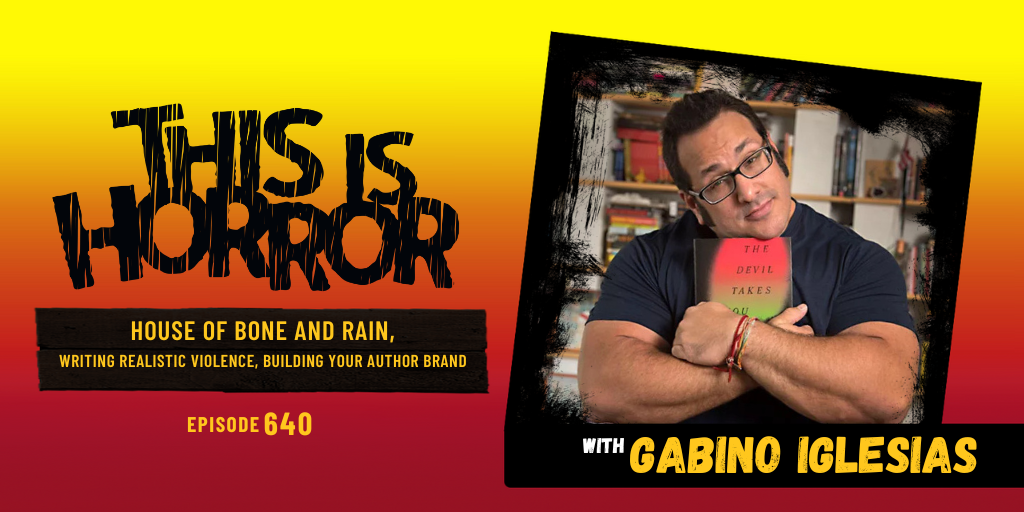
In this podcast, Gabino Iglesias talks about House of Bone and Rain, writing realistic violence, building your author brand, and much more.
About Gabino Iglesias
Gabino Iglesias is a writer, professor, book reviewer, editor, and translator living in Austin, TX. He teaches creative writing at SNHU’s online MFA program and runs a series of low-cost writing workshops.
His novel The Devil Takes You Home was a Guardian Best Crime and Thriller Book of the Year, was shortlisted for the Best Novel Prize at the 2023 Edgar Awards and nominated for a Bram Stoker Award.
His latest novel House of Bone and Rain is published by Titan.
Show notes
Click the timestamps to jump straight to the audio.
Thanks for Listening!
Help out the show:
- Support This Is Horror on Patreon
- Listen to This Is Horror Podcast on iTunes
- Listen to This Is Horror Podcast on Spotify
- Rate and review the This Is Horror Podcast on iTunes
- Share the episode on Facebook and Twitter
- Subscribe to This Is Horror podcast RSS Feed
Let us know how you enjoyed this episode:
- Leave us a message on SpeakPipe.
- Write a comment below.
- Tweet us @thisishorror.
Resources
- Gabino Iglesias Books
- Watch the video version of This Is Horror Podcast episodes, including our conversation with Chuck Palahniuk on YouTube.
Cosmovorous by R.C. Hausen
The debut from R.C. Hausen, available now. Now also available as an audiobook.
They’re Watching by Michael David Wilson and Bob Pastorella
Read They’re Watching by Michael David Wilson and Bob Pastorella right now or listen to the They’re Watching audiobook narrated by RJ Bayley.
Michael David Wilson 0:28
Welcome to This is horror, a podcast for readers, writers and creators. I'm Michael David Wilson and every episode, alongside my co host Bob Pastorella, we chat with the world's best writers about writing, life lessons, creativity and much more. Today, we are welcoming Gabino Iglesias back to the show for the second part of our conversation. Now. Gabino is a writer, Professor, book reviewer, editor and translator, living in Austin. He teaches creative writing SNH use online MFA program and runs a series of low cost writing workshops. His novel The Devil takes you home was a guardian, best crime and thriller book of the year was shortlisted for the best novel at the 2023 Edgar awards, and was nominated for a Bram Stoker award. And his latest novel, house a bone and rain, is published by Titan, although this year he has also re released zero saints and coyote songs. So we are going to take a quick advert break, and then after that, we will be back for part two with Gabi no
RC Hausen 2:18
Cosmo vorous, the debut cosmic horror novel by RC housing is now available as an audio experience featuring an original Dark synth wave score. This story will take you to the next level of terror. Come hear the story the readers are calling Barker meets Lovecraft, a Phantasm style cosmic horror adventure and a full bore, unflinching, nihilistic nightmare. Cosmovirus, the audio book by RC housing. Come listen, if you dare,
Bob Pastorella 2:53
from the host of this is horror podcast, comes a dark driller of obsession, paranoia and voyeurism. After relocating to a small coastal town, Brian discovers a hole that gazes into his neighbor's bedroom every night she dances and he peeps same song, same time, same wild and mesmerizing dance. But soon, Brian suspects he's not the only one watching and she's not the only one being watched. They're watching is The Wicker Man meets body double with a splash of Suspiria. Their watching by Michael David Wilson and Bob Pastorella is available from this is horror.co.uk, Amazon and wherever good books are sold.
Michael David Wilson 3:31
Okay, without said, Here it is. It is part two of the conversation with Gabino Iglesias on this is horror. So you were saying that house of bone and rain was not only really inspired, but based on real life events for you when you were growing up. So can you talk us through that a little bit, and is the group of friends that this is based on? Are you friends with them all still to this day, you still tight?
Gabino Iglesias 4:13
It's with most of them. Yeah, I didn't want to tell a story that was loosely based on all of them without letting them know. So I didn't, I want to sound like a good guy and say that I asked for permission, but I didn't. I just let them know. And I was it was one of those conversations that as soon as you get it over with, you realize none of them read. So it was not, it was not going to be a problem anyway, even if I didn't tell him. But no, I was a, I was a senior in high school, and, you know, one of my friends, his mom, was working security at a club, and there was drive by, and she took two bullets to the face and dropped dead. And we cried and we hugged, and we, you know, we plan, we're gonna avenge your mother, and we're gonna do this, and we're gonna do that, but that's, that's not that's what happens in movies and in novels. You don't really do that. You don't know where to start. You don't you don't have the firepower, you don't know where to ask questions. So we did fuck all. We did absolutely nothing, but that, that stuck with me. And for about 20 years, I thought about that, that novel in which I gave us an opportunity to make things right, and I never thought I had the skills to write it. I think we sometimes have ideas that we don't have the chops for yet, so we wait. But after the devil takes you home, it's a there's this thing about when you get nominated to stuff and when you win awards, the the ego boost, it's not it's it's it's amazing. It's like, if it happens at a point where you're thinking, as always, I'm a hack, I can't do this. And then you get nominated to something the the week after you're running with the fuel of that thing. Like, hey, a couple of people read it and they liked it, and they thought it was, it was good enough to, you know, nominate to something, and then you run with it. So in that way, those, those are fantastic, but the rest of the time you're just maybe not feeling it, and you know that you're, you're not there yet. So it took me 20 years to get that that novel out, to finally think I had the chops, the chops to write it only because the devil did well. So that allowed me to let me tell this story now and give us a different ending, because the whole thing started. How can I give us a happy ending, but immediately became another one of my books. So it's not a happy ending, it's just it's a different ending than the one we really had.
Michael David Wilson 7:11
Yeah, and that also raises a kind of interesting question about self doubt and about like, our own confidence as writers, because, I mean, we've had enough of these discussions that it kind of doesn't matter how much your claim one gets, the self doubt, it doesn't go away. It just perhaps manifests in slightly different forms, or you just keep writing in spite of it being there. So I mean, if we look at things for you now, you obviously had a lot of success with the devil takes you home. I think house of bone and rain has been incredibly well received as well. Where are you in terms of that kind of confidence to pursue ideas that you have, and what are you doing on the days where perhaps it is a little bit waning,
Gabino Iglesias 8:10
there there are no there are no great days, I think there are decent days, and then a Whole bunch of days where you're just, you're struggling. It's I don't think success plays any role for most of the writers that I know. So when I think about successful writers, I think about folks like Paul Tremblay, Steven Graham Jones, Josh Malerman, I think about them, and it's I've been a fan for a very long time, and they're going harder now than ever before, or they're going just as hard and Writing just as much as they did when no one knew their names. So it puts you in this situation where it's like, I don't, I don't compare myself directly to anybody else, but everybody that I kind of look up to is not resting on their laurels, like they've been translated to every country and they have, you know, Hollywood movies and and Best New York Times bestseller status. And when I look at them, they're putting in the work. So it's like, even on days when I'm not I'm not feeling it is just like I'm not doing it for the awards, I'm not doing it for the recognition. I'm not doing it to get invitations to events. I'm doing it because I want to share these stories, and I'm working really, really, really hard at it because I want to be in that crowd. I want to be mentioned with 10 and Arief. Do I want to be mentioned with Stephen Graham Jones? If I can somehow make. Get into that conversation. I don't care about being, you know, the worst seller of the bunch. I don't care about any of that other stuff. I told the story that I wanted to tell, and it worked, and it allowed me to take a little walk amongst, amongst the giants, and that at the end of the day is, you know, it gets me through all of those. I'm a hack. I'm never going to finish this novel. I can't do it. If I finish it, it's going to be unsellable. It's too violent, it's too weird, it's too dark. Those, those are normal days. So I just you use the word write in spite of it. I write in spite of myself. I write in spite of the voices, and I write out of spite. It's like they told me I couldn't and they told me I couldn't create my own genre, and they told me I couldn't use Spanglish. So when everything else fails, I still have spite to get me through the day.
Michael David Wilson 11:04
Yeah, I think a lot of us are writing in our own genres now. I think that's kind of what's going on. You know, if you look at we mentioned Eric larocker before, but I mean, what even is that other than lorock and horror, that's what it is. And, you know, I really like danger. Slater's work, almost a kind of post Vonnegut, a kind of bizarro adjacent dark horror, but it's dangerous later. That's the genre. The obvious example is Joe R Lansdale as well. Joe R Lansdale has been writing the Joe R Lansdale genre forever. He's never given a fuck as to what kind of conventions this fits into. And perhaps there's something about the landscape that we're in now as well that that affords us that possibility and that there are options. You know, if we don't get picked up by a mainstream publisher, there's all sorts of independent presses. If we believe in the story, and we don't get picked up by the independent press, well, we can put it out ourselves, I think, but I'd have to check, but I have a feeling that's how V Castro got her start, just putting it out believing in her work,
Gabino Iglesias 12:29
it's a it's the, it's the Golden Age, for a variety of reasons, and one of those reasons is, I would say the bravest, most boundary pushing works of fiction are currently being published by indie presses, and in many cases, and in many genres, indie presses are leading the charge in terms of the most amazing covers and the most unique layouts. So yeah, there's, there's a lot of good things happening with with indie presses. I think there's a lot more variety and diversity in terms of agents and what agents are looking for now, what they would they're convinced that they can sell. Some of that goes, you know, hand in hand with them being maybe more modern, because I know have friends who have very, very old agents who've been along, you know, for 50 years. And there's new blood in agenting that is doing great things. And then also, readers have turned out. And when you say Sylvia, more is a New York Times best selling author, when you say sa Cosby, you know Best New York Times best selling author, Stephen Graham Jones, Paul Tremblay, you're saying you can sell horror if you don't want to, it's fine, but you can sell horror nowadays, and if none of that works for you, or you're simply very impatient, you can hire a cover artist. Don't use AI bullshit, you hire a cover artist, and in a couple weeks, you have a book, and you can go on on podcasts, and you can send it out to folks on Tiktok. So there's absolutely no reason for us not getting the biggest, the most amazing diversity of voices that we've ever gotten, because you have a way always to get your story out. And that's, I think that's what making horror so magical. Right now you don't have there's no limit to what you can do. You can say this is the cozy body horror thing that I want to mix together. I don't know how it doesn't work. Fuck you. I'll publish it myself. We'll figure out if it works along the way. It's that's what makes it the. Golden Era. We're all here, and there's a space at the table for absolutely everyone
Bob Pastorella 15:05
you said it. I mean, the people, the entities, are putting it out and but, I mean, I'm also seeing the big publishers taking a lot of risk too, and paying off with horror being at basically right now the number one genre. I mean, if you, if you think about it, and you don't even have to think about it, it is. It's the number one genre. That means that people who are not into horror are actually dipping their toes into it. We've already got a smorgasbord across the board of diverse writers from all ages, creeds, races, ethnicity, all of that we have it. The only way you're going to stand out is to be fearless and to push boundaries and to put out the work across genres. That's the only way you're going to get your name out there. And you have to individualize your work, create a brand. It's it's all, this is all so, so, so, very important, and you still have to write a good story, you know, on top of that, and, you know, and I know we were talking before we even started recording. And the thing like right now, that the one thing that keeps pushing me on, and I think this should be everyone's mantra going forward, is there's a very successful video game franchise based off the ludicrous idea that they're demons on Mars. If they can make a billion fucking dollars, then I can, I can make some money, you know, I can get, I can get my work out there, yes.
Michael David Wilson 16:38
And I mean, I wanted to shift back to house of bone and rain, so we spoke a little bit about the setup. So I think that probably serves as an elevator pitch for a number of people who haven't read it. I mean, for me, it's kind of an ultra violent Stand By Me set in Puerto Rico, as if kind of through the lens of Quentin Tarantino. I mean, it's a hard one to to describe, but I mean, specifically with the violence, there's something very interesting, because it's not really stylized, it's not over the top, it's pretty kind of in your face and realistic. So I want to know, you know how conscious is that in terms of your approach to violence and making it realistic? And do you have any tips for people looking to write violence within their fiction.
Gabino Iglesias 17:44
Yeah, violence is one of my favorite subjects. I teach workshops on writing violence. Violence is everywhere. If you're reading The Giving Tree to your children, that is an incredibly fucking violent book about taking and taking greedily and not giving anything in return. It's a book about abuse in many ways. So yeah, look at the literature for children. There's there's a wolf trying to devour you, or trying to devour your grandmother, or you're lost in the woods like violence or the promise of violence is always there. And some of my favorite work, in horror and in crime fiction, doesn't shy away from it. So I grew up knowing that when I wrote my stories, it was, it was not going to be one of those where, you know, like in movies, you know, something's about to happen, and then there's a blackout. And then I didn't want to do that. I understood early on that if you're going for creepy, then you shouldn't be showing the whole monster, and there's a little bit of that in serial sayings, you know, someone gets their fingers cut off and thrown in a bucket. Gay cabino, what's in the bucket? What's in the bucket? I'm not, I'm not gonna tell anybody what's in the bucket. You figure it out. But in other I want clear, cut, straightforward violence that has a message, like, we're gonna chop off a kid's toe in the devil takes you home for a very particular reason, and I'm gonna be talking about religion while we do that, if we beat the crap out of some racists outside of a barbecue joint. Yes, it's violent. Yes, it's fun, but there's a message behind that violence. In house of born rain, there's a lot of vengeance, there's a lot of anger, a lot of macho BS, but there's reasons for all of those things. And then for those of you, you asked about those who are writing, do. Just there's a level of violence that speaks to you, a level of violence that you feel it fits your work. Do that there's there's no too far when it comes to violence. The only fight to use a bad word, the only fight I had with with Josh Kendall, my wonderful editor at Mulholland with housing bond, rain was there's a scene where a guy breaks he stabs a dude in the face until he breaks the blade, and he killed that scene and said, This is too much, and it didn't sit well with me, because I was like, That's he had a good excuse. Sometimes you have reasons to stab someone in the face until you break the knife. And actually, I was I started writing an explanation of why I thought the scene worked, and then I stopped, and I emailed back, and I said, in the previous book that you bought first, we caught off a kid's toe, and the kid can't defend himself. This is standard violence between two consenting adults, and I think that should stay. And I was very scared because I was fighting my big editor, and his answer was, haha, fair enough. And then the scene is in the book. So even if someone tries to cut back on your violence, you can always fight back and leave that violence in there if you're using it well, violence drives the point home, like we mentioned briefly, John Wick before it's like the dude kills 500 people for over four movies, and we're there. We're rooting for him. Do you know how many dozens of dead men ago the puppy died? It doesn't matter. We're in it for the ride, and we're for all the gun foo, and we're in it for all the shots to the face and all the explosions and killing people in very creative ways. And we're not going to feel bad for those people's families or their partners or their children, because 500 people you murder, 500 people, that's a lot of families that you affect. But we don't care, because we like John Wick and the way he does it, it's cool, and also because they fucking killed his puppy, and that still hurts, and so we go along with it. So if it works for John Wick and it worked for Tarantino, and it works for Clive Barker, and it works for sa Cosby, embrace that violence and just do whatever feels right, yeah?
Michael David Wilson 22:42
And to talk about the puppy, I mean, that's the thing. It's like, if you injure me, if you cut off my limb, that's one thing. But you fuck with the dog, that's it. 500 motherfuckers gotta die at this point. Yeah. And, I mean, you said before that sometimes, you know, you worry your book might be too violent, but was the worry specific to your editor, you know, as a result of this conversation, or is the worry to do with the market like, what? What is the specific worry.
Gabino Iglesias 23:21
So when I was doing this as an indie, it was I only had to convince one person, you know, for for serious saints and coyote songs. I only had to convince J David Osborne, who had fantastic taste. He published Stephen Graham Jones. When? By when? Way back then he published Scott Adelberg. Published a lot of amazing books, but I only had to convince him, because that was how Indy worked. It was one dude running the whole show. He likes it, he edits it, he finds you a cover, and you're done now it's, it's, is my agent gonna like it? Because if she doesn't love it, then I know I feel like she's not. She might try to sell it anyway, but I want her to really love it. And then when we find an editor, is this an editor who is alone there, who's gonna struggle the whole way trying to get my book anything, or is one of those instances where my editor loved it and passed it around the office and everybody's in love with the book, which is like, you know, utopia. You live in fear of all those things. So when I'm writing, I'm not thinking about any of that I'm writing. When I'm not writing and I'm thinking, Okay, I had a two book deal, and that's two books done, and now I'm back to square one. At least I have an agent. What's going to happen with my career next? Then I'm thinking. All right, how weird is this novel? Because if the agent loves it, she still has to write a fantastic letter recommending it. And and what else is out there that might work in my favor, like this is a little bit like, but there's nothing right now that compares to it. So if you're trying to be too original, sometimes you're just shooting yourself in the face because people don't know how to deal with it. There's no There's no record of what to do with with a novel like whatever you wrote. I think Bob's a little bit in the in the same boat right now. He's like, you're creating something, and you're like, at the end, I'll edit it, and I'll throw it out there and see what happens, and then maybe people click with it, and maybe, and maybe they don't. But right now, all I have to do is finish it, and there's nothing else that I can control. So it's, do I worry about the violence, not right now, do I worry about the type of violence and the weirdness and the magic, not now, when, when I have to send it, I'll be like, Oh, shit. Did I do it again? Did I write an unsellable novel? We'll figure it out. I don't know. Yeah.
Bob Pastorella 26:19
I mean, I've got this one lingering image in my head for this project that is probably, quite possibly one of the most violent things that I've ever that I'm ever going to attempt to write, and I'm the violent part of it is going to be off, off off camera, but the, I guess, the reveal of it is just as violent as what it took to get there, and I'm gonna do it, and it's, it's one of those to where it's, if, like, it's, it's going, it's, it's going, in the big, the biggest editor in the world, could sit there and try to talk me out of it, and I'd be like, No, it's not coming out, you know. I you know, like with the small hours, is coming after ghoulish, which we know, we know how they are, the more the more crazy the better? Yeah, I've gotten an incredibly violent scene in there, but we don't actually see it. We see the results of it. Vampires will do anything to keep their bodies together. It's like, I'm pretty damaged, but I can make this work. You know, I'm part of the undead now, you know? And it's like, and when I thought of this, I was like, Holy shit, man, they're gonna go, No way. And it's like, it's great. I loved it. Like, Oh, that's such a good feeling, yeah?
Michael David Wilson 27:58
But I mean for Bob and for everyone else. And kind of one of the overarching themes of this conversation is you just got to write what you want to write. You've got to be authentically you, and you're doing the writing, and you'll read as a disservice if you don't like that's why we can't think about commercialism and marketing in the stage of creativity, but I wonder there was something that you said, like, you know, kind of your fear is if you give it to your agent and then she doesn't, not even, doesn't respond to it, but doesn't love it. And so hopefully this is just a hypothetical, but I don't know what the situation is. But if that happens, if you give her a book and she maybe doesn't think she can sell it or is a little bit less infused, what do you think you're going to do in that situation? And let's assume too, that you really do believe in this book. Do you try to kind of figure it out and come to some compromise, or does your contract allow you to then go and kind of pedal that, or put that out independently? Or does it get kind of put on the back burner until there is, like the right opportunity and the rightly infused person for that project that was a that's
Gabino Iglesias 29:27
a great question. Very clearly, if a book doesn't work for her, I can just send the next one and she can work on that one. Now, if I finish the book, if I picked this one idea out of all the other ideas, and I went through the process of writing the book, and then I got her to a point where I was comfortable enough to send it to my agent. She's the agent. That fell in love with a book that other agents would have hated. So I can probably find an editor who loves the book. I can at least try. So I can, I can very well do that without my agent, because I did it for four books without my agent, and then it just becomes, the thing about the agent that changes your life is they have contacts and ways of doing things where they get you paid. Now, if I find a way to publish the other book, will I get paid? I don't have to work at anything else, and I can cover my own insurance paid. Or am I taking a few steps back and just trying to hustle just as hard as always? So I can start seeing some, you know, some some money up front, because I would probably get no advance. And if I end up going with an indie, depending on the indie it may be limited distribution or publish on demand or something else, but the book itself, if I, if I believe in it enough to finish it and leave with it and then read it again and edit that thing and leave it alone for two weeks and pick it back up and not throw the computer against the wall and be like, this is salvageable. And then I write it again until it's somewhat good, and then I send it to her, and she hates it. I'm very lucky. I know a lot of amazing, amazing indie presses, and I'm not saying it's a guarantee, but I think sometimes when you have a record of like, Hey, I did this book that got this nomination, or was translated into X amount of things, or here's my track record. I've been doing this for a while, I think that opens a few doors that not a lot of people have open when we start out. We just know absolutely no one. We're just knocking on doors blindly. After you've been at this for a while, I'm a huge fan of a lot of places that accept manuscripts without an agent, and I would immediately turn to any of them and try to figure something out. The only thing is, the book has to come out. I cannot vanish into oblivion and never again publish. So even if my agent hates the next 12 novels, I will be sad that she does. I would be surprised if we still work together after she hates half a dozen. But let's say it happens and we stay together. I'll go sideways and, you know, with her blessing, try to find a way to get the stories out anyway, even if you can't sell them.
Michael David Wilson 32:49
Yeah, and it's good to hear that there's no kind of exclusivity clause that would mean that you weren't allowed to do that. I mean, that would feel like a red flag if it's like, look, I'm the only one who can sell your work, and if I don't like it, you're screwed. And it's like, well, no, that that's a toxic relationship. That is not a good situation, almost abusive. Yeah, right, yeah, yeah. And I mean talking about shitty situations you mentioned, like your health insurance and that being a consideration. And, you know, sometimes, being from the UK and living in Japan, I forget about how critical that is in the US. And so I'm wondering, I mean, at the moment, do you get your insurance through, you know, the work you're doing at the university, or is there some sort of private insurance company? Like, how does that work out for you? Because I know a number of writers, I mean, the reason that they have their day job is to keep that insurance.
Gabino Iglesias 33:59
Yeah, it totally is. And when you start talking to writers who have kids many years ago, I remember doing a I interviewed Paul Tremblay for the LA Times, and we spent, you know, maybe an hour doing the interview, but we talked on the phone for maybe three hours. And I asked, at this point in your career, why are you coaching basketball and teaching math? And the answer immediately was, I got two kids who, you know, need the coverage, and I need to save my pennies because both of them want to go to college. So there's, there's this, you know, confusing idea of full time riders not having other jobs. And a lot of us it's like, yeah, a low residency program. Basically, you stay at home, and I can write at all hours of the day, but you keep it so for the last two years with with UCR that. Coverage about eight or nine months out of the year, and then I go with Aetna, or whoever's around, and I pay out of pocket the other couple of months of the year that I'm not covered. But the dream, right? The goal, is to have that thing where you're never thinking about it anymore. I think that's that's the rich part. That's when you become rich, when you can stop worrying about those things like, Oh yeah, I have insurance. I only think about it when I'm sick, because then I pull out my card, and then I go and I use it and I get my meds immediately. And I think everyone deserves that freedom of, you know, just not having to think about it all the time. Think about people who have sick kids or sick grandparents, or, you know, it's, it's, it's awful. I think we're an amazing country who should certainly do fucking better when it comes to taking care of people.
Michael David Wilson 35:58
Yeah, this is why a number of you know stories in America just they wouldn't work in Europe, or they wouldn't work in Japan. You know, if you look at Breaking Bad, that is a uniquely American story, because if it happened in the UK, okay, well, I'll go to the NHS and they'll treat me. Yeah, that's the end of the story. It would be most dissatisfying. It's just, it's a very, very middle aged guy, a chemistry teacher who's got cancer.
Bob Pastorella 36:33
Yeah. I mean, it would take the thrust away. I could see how they could still be a story. He could be some ego maniac, the best chemistry teacher in the world. You think your maths good, you ain't seen, yeah, any, any, any just gets caught up in there because of ego. But the whole you know that could work. It works better if you, if you have a totally innocent reason why you want to do this and be and you become the monster, the one who knocks. Yeah, there you go.
Michael David Wilson 37:11
And so with House of bone and rain, this is very much a book of a close knit group of friends of brotherhood. And, I mean, I'm wondering, what do you think is the test as to whether a friend is a true brother, is a true friend, and what are perhaps some moments in your life where you've realized either somebody was or was not actually there for you?
Gabino Iglesias 37:40
It's, I think it happens at a bunch of different points in life. I think it's very, very strange to not be an absolute idiot when you're 1617, in my case, 18 and 19, just being an idiot was the one thing that we were all good at. And when you're an idiot and you don't have to think about anybody else, let's go steal some stuff together. Would you help me with Do you know, would you help me do this thing? Would you take a bullet for me when you're drunk? The answer is always yes. And then some people stay in that life, and then other people, will you call them up and you go, Hey, can you help me bury a body? And they're like, I'm I don't know. I'm with my kids at soccer, like I can't leave my kids alone and go bury a body right now on a Saturday morning. So it's it's not that you grow out of those relationships. It's just that things change. And so you know the bullshit macho stuff that you used to do at 18, at 28 you might doubt it, and then maybe at 38 you're like, wow. And then if you live, you know, I don't know, but folks who live to 48 probably look back and they're like, Damn, that was idiotic. And then if you get to be a grandparent, then, yeah, you get to tell everybody what to do, what not to do, right? So it's, yeah, it's easy to be an idiot when you're young, and to be an idiot for your friends. And then sometimes you're like, No, I'm not giving you my company's car so we can drive to Vegas. Like we're not doing that, dude. So it's not that you love them less. It's just that people outgrow certain things. So I think it comes at different times for every relationship, different points in time.
Michael David Wilson 39:50
And it's interesting that you mentioned the kind of being a soccer practice with your kids as an example, because, I mean, it got me thinking. It's not that your loyalty, or, you know, the loyalty quality as a person, disappears. It's that your loyalty shifts. And it's like, look, you know, if I'm helping somebody, let's say, bury your body at 20, if I get caught or something bad happens largely the consequences affect me, yeah, but if it happens kind of now and like, you know, I've got a seven year old daughter. I got another child on the way, yeah? Well, yeah, now, you know so and I think as well looking at the relationship you have with people, it's like if I let down my 30 or 40 something friend, your goddamn grown ass man, but if daddy goes to prison For 20 years, Yeah, seems a little bit harsh.
Bob Pastorella 41:01
Yeah. It goes back to what I said, every, every person in this planet is 72 hours away from fucking total doom. Just what decision, you know, I was just helping, like, that's it, you're done, yeah?
Michael David Wilson 41:20
Which I think kind of lends into another question. So this is obviously a story that is triggered by revenge and anger. You know, you said this was something obviously, at the time in the real life incident, you kind of thought about doing, and then, actually, no, you didn't, yeah, when is and isn't revenge a good response. Always.
Gabino Iglesias 41:47
It's always a good response. The tricky part is, you, after you've gotten revenge enough times, you learn that it's never as fulfilling as you wanted it. Maybe the moment itself, it's glorious. 10 minutes later, it's already kind of deflating, and you're back to like, Fuck, I'm still angry, right? Like, this didn't undo whatever was done to me. But the thing is that sometimes just driving towards that revenge is what carries you from being completely destroyed and in grief and hurt and feeling guilty, and that might as in as it has happened in 1000 stories, a gazillion stories, if it gives you a reason to get up in the morning, it's the right decision. Go, go get that revenge, and then when it's done, you know, we'll figure it out. But revenge is, is always the the right answer, especially when it comes to fiction. I should probably add that especially when it comes to fiction, revenge is always the best answer, the only answer, the only plausible answer, the most entertaining answer, is go forth and do the worst thing possible. So whatever revenge you can think of, hell yeah, add a little bit more violence. That's always what I suggest think of a bad revenge, and then make it a little bit worse, and then go and make it happen.
Bob Pastorella 43:34
I guess that works until you get old and you're right it you when the times that I can remember when I was able to take revenge on something? It's never it's like you have to, if you're relaying that story to someone else, you actually have to kind of hype it up, because there's points where your friends be like you got pissed off about that. Yeah, what's wrong with you? Why? And so at my age, I enjoy, and I'll probably say it wrong, but I guess it's shot and freight. You know, when people cause their own misfortune and they fucking deserve it, and you're just like going, Oh, look at you, you poor soul. See, I can get more more satisfaction in that. All you have to do is look at it. You don't have to sleep with it
Gabino Iglesias 44:27
or wash it off.
Michael David Wilson 44:31
Whoa, yeah, yeah. So some people might be wondering whether revenge is more big, you know, if it's a good idea because it's more for the fulfillment it will bring yourself, or because the person who you're committing the revenge against should find out the find out part of the fuck around and find out equation. But I feel from what you said, the answer is both. Are important for, for self fulfillment, and for, you know, just not letting motherfuckers get away with wrong things.
Gabino Iglesias 45:08
Exactly, exactly, I think the let's, let's take an example from from the the news somewhat recently, if you're in a room and someone throws up a straight arm salute you. Break that arm, because that ensures that no other arms go up in any similar way. But if you let that slide, suddenly it's two arms or three arms or five arms, and then you're running, because you just realize you're in a room full of Nazis. So you look around and you're like, who else is really pissed at that? And then should we break that person's arm? Everyone who signs up, it's probably a good person. And then whoever is like, no, no, everybody should have the right to be as much of a Nazi as they want, then you know what, what group they belong and then you take action. So yeah, now you do like I said, you do have to accept it's never going to solve anything. It's not going to be as fulfilling as you expected it to be. I like what Bob was saying. Sometimes you just sit back and you're like, all right, you were a horrible person to my friends, and then to me, it's a matter of time before you're nasty to enough people. And then someone will say something online, and then everybody will start talking. And I don't have to do anything. I just lean back and just smile and enjoy the the finding out part of the proceedings.
Michael David Wilson 46:45
Yeah, there's a tendency, you know, we've seen with different people when they'll say something like mildly offensive, let's say but you know, they have much stronger feelings, and no one reacts, and they ignore them, and it's like they keep talking to themselves until finally they get a reaction and blow up their entire career. Yeah, I don't know, maybe they just they got tired of publishing or writing, or whatever it happens to be, because this is not unique to publishing and writing.
Gabino Iglesias 47:19
No, no, we just see it every week, but it happens everywhere.
Michael David Wilson 47:23
Yeah, yeah. Well, what doesn't happen everywhere and what doesn't happen in all books is at about the 40 or 50% mark, and this isn't really a spoiler because of how vague I'm being, but that you just decide, let's add fish people into the mix, yeah, how and when did this come about? Did you know from the start that this was well, in fact, I don't think you knew from the start, because Didn't you say originally this was just going to be a straight crime book. So when, when did you go from this is 100% crime book to surprise, the fish people are here.
Gabino Iglesias 48:05
The the fish people show up in a few other things that I had written before. So they were always in the back of my head. And at some point after, I started thinking about if, it will. This is the summer, because it happened during the summer. It would be ideal if a storm, a bad storm, hits now, because that way we take the authorities out of the equation, like the when the storm comes in, the chaos that follows, the cops just run home and stay hidden away, and then they're not a problem. And in the process of thinking about that, I was like, this is going to be happening in the same place that this other stories take place. So I should probably make that larger, and I'm already going supernatural. So it'd be nice to add that layer, just because I don't feel they're they're feeling this threat enough, so I want them to feel like they're battling themselves. They're battling a very bad drug lord, and now there's creepy stuff coming out of the ocean that's also after them, and that way you can triangulate your anxiety at all moments. It makes it for for a little bit more fun reading.
Michael David Wilson 49:27
Yeah, I think It especially makes it kind of more cinematic for, like a kind of horror movie as well. I could imagine that in the trailer, or, in fact, if you didn't have it in the trailer, you could almost go kill list where you switch genres halfway through, it's like, what are we dealing with here? But, and in fact, since I'm talking about movies, do you have any movie news? I kind of can't believe that none of your stories. Have been made into a movie yet.
Gabino Iglesias 50:03
We're still working on it. The how's that button? Rain is still out there, being read by people. I don't know how that part works. The devil takes you home. Was with Sony for a while. They didn't make it. It came back to us. There was a very interested party, and they acquired it. I don't think I'm at it. I can't say anything yet. It's those weird you have to hold it until we make this announcement. I can say that it's been acquired by someone else, but I've also learned I've been doing this long enough not to have a movie, but to almost have hat movies. So the way that I understand the whole process is someone approaches you, they give you a little bit of money for the for the option, and then nothing else happens. So I'm like, now very curious about so we've had this part happen a bunch of times, and nothing happens. Can we get to the next stage when something actually happens? So just Whenever someone asks, I try to remind myself, I don't think about this, because my job is to just write the books. And if I try to understand how Hollywood works, then I get frustrated, because books are really hard, but they're cheaper to make than movies. So you can just sit at home and write your book long hand, or on your laptop or whatever you want. You can't, you know, do that with a movie. You have to attach a lot of people, and then all those people want a lot of money. So, yeah, I don't know. Knock on wood. Hopefully we'll have news about the devil takes you home before the end of the year, um, and then, yeah, I don't know,
Michael David Wilson 52:07
yeah, I've got to that stage in their film adaptation process too. I'm obviously eager to get beyond that. I also got to the stage where it's like, there's a writer strike. Now we're going to put everything on hold. Oh, okay, we're going to pay right as more. Okay, that's good, but wait for it. We're going to commission far less and cancel 90% of projects. So I know the corporations always win, even when it looks like you've won. As the writer surprise, the big industry actually won. They do. But I mean, I wonder the connection between the murdered Maria and hurricane Maria. Was that just a moment of serendipity, or was that something that was planned
Gabino Iglesias 53:05
so the woman's name was really Maria, and the hurricane in the book, I didn't know what name it was going to have, because I didn't want to Make it that obvious that I was writing about hurricane Maria, but then I realized it would fit the story perfectly, and for the amount of time that they were without power, electricity, or cops on the streets, it worked really well. So I just I let it roll. I thought from time to time, writers are experts at negative thoughts. I always thought, not always, but from time to time, that it was a bit over the top, that it was a bit too much. But then every single time, I would tell myself, Maria's name was Maria and the hurricane name was Maria, so that's not my sister's name is Maria. I have an aunt named Maria. It's not that rare for this part of the world to have all those Maria's around. So I let it roll, and no one ever suggested a change, which I think is good. I never know if it's because they didn't read that carefully, because I don't trust people. Hopefully everyone read it carefully during the editing process, and it didn't bother anyone. So I roll with it. All right.
Michael David Wilson 54:33
Well, we've got a question from Tracy Kenworth via Patreon, and we may have covered this to some point, but she wants to know what advice you might have in terms of building your brand or building your author identity.
Gabino Iglesias 54:55
There's a lot of things that you like that might not. Have a lot to do with each other. Don't hide those things because you feel like they they're not related to your your writing. I am constantly talking about music. It's not about books. It doesn't help me sell books I talk about every movie that I watch. I don't watch that many because I'm busy reading, but I want to let people know my thoughts is like I slept on conclave. Brilliant movie. Go watch it. It's I don't care if, if the stuff that I'm watching lands with every single one of my readers, because it comes and goes for a week, I might be into learning the names and the stories of every debt hiker on Everest, and the week after that, I'm into Japanese tattooing, the history of it. So I'm going to talk about it because I'm a person, and then I feel like a lot of folks are like, I'm a I'm a romance author, I'm a sci fi author. No, you're an individual who happens to do that for a living, or as a hobby or whatever it is. So be a full person online like you shouldn't be talking about politics. Screw that you should be talking about anything that you want to talk about. If you are very politically inclined, talk about politics. If you like to do crochet, if you do little movies with your kids, if you rescue kittens, whatever it is that you do in life, make it part of your social media, because it just lets people know that you're human and that you have other interests. And you make a lot of significant connections that are more important than making you know a reader's list or having people sign up to my newsletter. You make connections, and that's a good thing, and from time to time. Those connections mean that when you have a new book out, there's not 100 people that are going to read it. Now you have 300 friends that might you know check out your book or tell their friends about your book. So just be yourself as much as possible and try to try to stay sane.
Michael David Wilson 57:20
So on that note, what is perhaps a new obsession or recent discovery for you?
Gabino Iglesias 57:29
Oh, obsession. Not the novel that I'm struggling to finish, but the next one has a little bit to do with aliens. So as a fan of Tubi, I've been watching all of those alien abduction documentaries. Some are standard, just what you expected, and some of those, the cheaper they are, the the Wilder they get. So that's that's like a new thing. It felt more not like getting a new thing to think about a new hyper fixation. It felt like it revived an old hyper fixation. Because I remember being, like, eight years old and finding out about cattle mutilation, and that was like, wait, what? They're taking the eyeballs. And so it was like, oh, now I'm a writer. I have an excuse to professionally waste my time reading about cattle mutilation because it counts as research. So that's what I'm doing now.
Bob Pastorella 58:41
That's a, that's a fascination for a lot of people. I remember growing up and, you know, seeing close encounters. And you have this, you know, concept of what an alien abduction is going to be. Then you read communion by Whitley Strieber, and you have this idea of, you know, kind of, well, you know, they can actually come to you. And then, and then you you see fire in the sky, and you're just like, Oh my fucking god, what the fuck you know? And so, and some of those, some of those documentaries, can get downright fucking creepy. I mean, like you're like, looking at the windows, fucking What the fuck was that noise, you know, and then the fourth kind and owls, I'm just, you know that that'll fuck you up too. So you just, man, I think I just creep myself out.
Gabino Iglesias 59:35
Wow, it's a communion. Is a hell of a creepy book. Some of those parts where he's remembering you, you feel that, that anxiety, that thing creeping down the hallway, and the way that it's, it's written, it's not fiction, but you feel that. You feel like, oh shit, there's, there's a thing coming up the stairs or coming down the hallway. You. So yeah, I think I'm gonna, I'm gonna try to capture a little bit of that, like, I'm sure that if I turn around, there's gonna be this long headed thing with a big head right behind me. I just know it, and that's, it's fun. It's fun, especially like at three in the morning when you're you forgot your glasses, your your way to get a glass of water, and then you hear that little sound, or maybe there, the fridge does that little clicking, and my fridge does this little click thing that sounds just like the predator. So, yeah, it's super fun at three in the morning, that's what I'm going for.
Bob Pastorella 1:00:39
Yeah, that's like, have you seen no one will save you, yeah. Have you seen that film yet? Yes, yeah. I don't know if Michael's seen or not. You haven't now? Yeah, it's it, well, it's on Hulu. I don't know where would be in Japan, but it's, it's really good, and there's no dialog. So, yeah, it's really for a movie. It's like, when it put it like this, the main character, she plays Abby in season two of The Last of Us from the game. And when they cast her, I was like, perfect, because I can see, I've seen what she does without uttering a word. I can only imagine what she can do. You know when she has dialog. And so, yeah, you should check it out. No one will save you as great.
Michael David Wilson 1:01:35
Yeah, yeah, I will do well to kind of round out, what is the best writing advice that you've ever been given?
Gabino Iglesias 1:01:47
The best writing advice I've ever been given? Wow, single piece of advice I don't know. I'll go with this. I was the University of Texas at Austin. I met a man named Bill minottaglio. I was getting a PhD in journalism at the time, we became friends. I never took a class with Bill. Bill is a fantastic nonfiction writer, hell of a journalist. Award winner. Has a amazing book called In Search of the blues, where he tracks down old blues artists all across Texas and Louisiana and has conversations with them. Long story short, we were talking one day, and he looked at me and he said, What do you want to do? And I said, I want to write. And he said, go the fuck home and write. And it was the first time that someone had pushed me away from No. Academia is the surefire way to upward social mobility, and you have to have a degree and all this stuff. It was like, no, no. What do you want to do? And don't talk about it. Be about it. So stop telling everyone that you want to be a writer. Go right. And that was, that was the best single piece of advice. Go right. Nothing else matters. Go right. Yeah.
Michael David Wilson 1:03:13
That is absolutely perfect. And seemingly people you know, at the start of their careers, they're inadvertently self sabotaging, or they're having excuses as to why they shouldn't write. But for anyone listening who's on the edge, there's your permission from Gabino iglesia is just write. Turn off the podcast. It's nearly ended now anyway. So yeah, go and write. Well, for those who have not gone to write, where can they connect with you?
Gabino Iglesias 1:03:55
Oh, it's a hellscape out there. I'm on blue sky. I'm still on Instagram, only sharing photos there. I'm still on x because I don't want to leave, because I don't feel I feel like if I leave, I'm just letting the fascists keep all the good things. So I'm staying there. I'm on Facebook whenever I remember, I'm on tick tock, talking about diversity in publishing and trying to be funny to sell a book or two that covers it, that's a lot that covers it.
Michael David Wilson 1:04:27
Yeah. All right. Do you have any final thoughts for our listeners and viewers?
Gabino Iglesias 1:04:36
No, keep supporting your favorite authors. Keep supporting your favorite podcasts, and please keep supporting your local libraries and your local indie bookstores.
Michael David Wilson 1:04:48
All right, thank you again for joining us. Let us not leave it so long until the next one.
Gabino Iglesias 1:04:56
It won't be six years. Man, this is too much fun.
Michael David Wilson 1:05:01
Hi, thank you. Thank you. Well, thank you so much for listening to the conversation with Gabino. Iglesias join us again next time when we will be chatting to Philip for Cassie, but if you would like to get that and every other episode ahead of the crowd, become our patreon@patreon.com forward slash, this is horror. When you become a patreon, you get bonus content. You get to help me do this full time in the future, and you get to submit questions for amazing writers, including Joe Hill, who will be on the show in about a week. Said is, win, win, win, win. Patreon.com, forward slash This is horror. And if you can't afford to become a patreon, there's a free tier. And if you are on the free tier, then I do occasionally put episodes and bonus content up for you as well. So well worth checking out, I think, patreon.com, forward slash This is horror Okay. Before I wrap up, a quick advert break
Bob Pastorella 1:06:34
from the host of this is horror podcast, comes a dark driller of obsession, paranoia and voyeurism. After relocating to a small coastal town, Brian discovers a hole that gazes into his neighbor's bedroom every night she dances and he peeps same song, same time, same wild and mesmerizing dance. But soon, Brian suspects he's not the only one watching and she's not the only one being watched. Their watching is The Wicker Man meets body double, with a splash of Suspiria. Their watching by Michael David Wilson and Bob Pastorella is available from this is horror.co.uk, Amazon, and wherever good books are sold.
RC Hausen 1:07:14
Cosmovirus, the debut cosmic horror novel by RC housing, is now available as an audio experience featuring an original Dark synth wave score. This story will take you to the next level of terror. Come hear the story that readers are calling Barker meets Lovecraft, a Phantasm style cosmic horror adventure and a full bore, unflinching, nihilistic nightmare. Cosmo vorce, the audio book by R c Housen. Come listen, if you dare.
Michael David Wilson 1:07:47
Now, I've said before that if you like, and want to support my fiction personally, one way that you can do that is to leave a review on platforms such as Goodreads and Amazon, and I have recently received a great new Good Reads review for they're watching, the book that I co wrote with Bob Pastorella. So this review is from Jeff Howard. It is a five star, and it reads as follows, a mystery until the end. This is one of those novels that pulls you in immediately. You know, the first time Brian peeps through the hole in his closet at his lovely neighbor, Yuki, this is going to go very wrong for him, but you keep hoping it doesn't, maybe it'll work out early in the book. I was reminded of a line from the first X Men movie when Magneto told a hapless guard, tricked by Mystique, never trust a beautiful woman, especially one interested in you. Throughout I wondered, how will this turn out? Where is this going? Right up to the end, where there was still hope, even then it didn't end the way I thought it might well, Dan, so again, a big thank you to Jeff Howard. Now as a final point of business, about a month ago, I said, if you want to listen to one of my audio books, to email me since saying that my son was born, and all chaos in my personal life, an inbox has erupted, and as such, a number you have requested audiobooks who I haven't got back to yet. Now that is happening, so please be reassured you won't have to wait much longer. Anger. And if you haven't asked for an audio book and you want one, just send me an email. Michael at this is horror.co.uk, let me know the book that you fancy listening to, and I'll help you out free of charge, no strings attached. Well, that does it for another episode of This is horror. So until the next one with Philip Fracassi, take care of yourselves. Be good to one another. Read horror. Keep on writing and have a Great, great day.