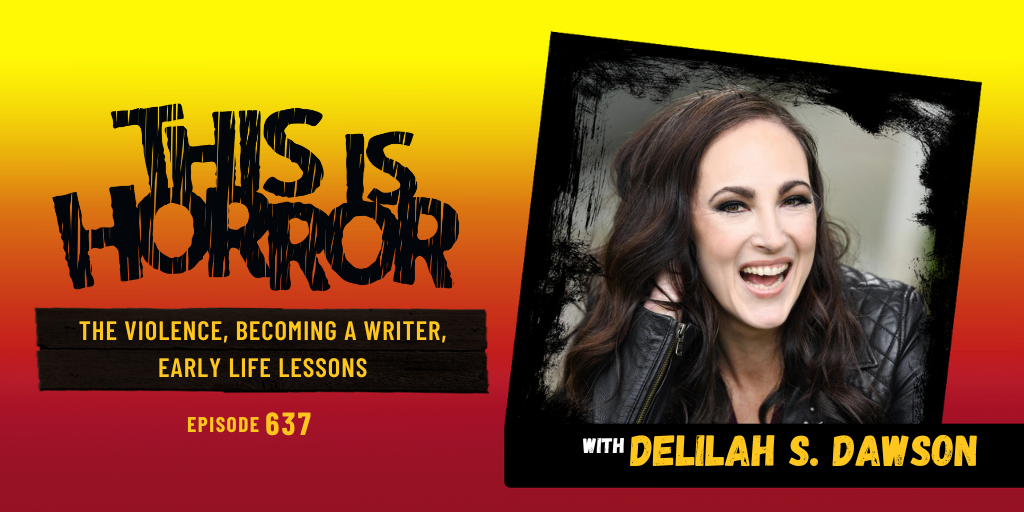
In this podcast, Delilah S. Dawson talks about The Violence, becoming a writer, early life lessons, and much more.
About Delilah S. Dawson
Delilah S. Dawson is the New York Times bestselling writer of Star Wars: Phasma, Galaxy’s Edge: Black Spire, Inquisitor: Rise of the Red Blade, The Secrets of Long Snoot, The Perfect Weapon, and Scorched; Disney Mirrorverse: Pure of Heart, It Will Only Hurt for a Moment, Guillotine, Midnight at the Houdini, Bloom, The Violence, the Blud series, Servants of the Storm, the HIT series, Wake of Vultures and the Shadow series (as Lila Bowen), and a variety of short stories in anthologies such as Death & Honey, Robots vs. Fairies, Hellboy: an Assortment of Horrors, Violent Ends, Carniepunk, Three Slices, and Last Night a Superhero Saved My Life. With Kevin Hearne, she is the co-writer of the Tales of Pell series. Her middle grade works include Mine, Camp Scare, and the Minecraft Mob Squad series.
Show notes
Click the timestamps to jump straight to the audio.
Thanks for Listening!
Help out the show:
- Support This Is Horror on Patreon
- Listen to This Is Horror Podcast on iTunes
- Listen to This Is Horror Podcast on Spotify
- Rate and review the This Is Horror Podcast on iTunes
- Share the episode on Facebook and Twitter
- Subscribe to This Is Horror podcast RSS Feed
Let us know how you enjoyed this episode:
- Leave us a message on SpeakPipe.
- Write a comment below.
- Tweet us @thisishorror.
Resources
- Delilah S. Dawson Books
- Watch the video version of This Is Horror Podcast episodes, including our conversation with Chuck Palahniuk on YouTube.
The Girl in the Video by Michael David Wilson, narrated by RJ Bayley
Listen to The Girl in the Video on Audible in the US here and in the UK here.
Cosmovorous by R.C. Hausen
The debut from R.C. Hausen, available now. Now also available as an audiobook.
Michael David Wilson 0:20
Welcome to This is horror, a podcast for readers, writers and creators. I'm Michael David Wilson and most episodes alongside my co host Bob Pastorella, we'd chat with the world's best writers about writing, life lessons, creativity and much more. Now I say most episodes because today is one that I recorded solo. So unfortunately, Bob Pastorella is not with us, but it is a fantastic conversation, because I am chatting with the wonderful Delilah S Dawson. We get into so much. We talk about her early life lessons, her start as a writer and her fabulous latest novel, House of idol or house viddle, depending on how you pronounce it, which largely comes down to whether you're favoring American pronunciation or British. Now, Delilah S Dawson is the New York Times Best Selling writer of a variety of books and comics in various genres, but for us horror fans, you might be most interested in her horror books that she has released via Titan books such as bloom guillotine and the aforementioned house of idol. As with many of these conversations, this one is a two parter. Today I am presenting the first part to you, and next episode it will be the second. So before we get in to the wonderful conversation, a quick advert break,
RC Hausen 2:23
Cosmovoirus, the debut cosmic horror novel by RC housing, is now available as an audio experience featuring an original Dark synth wave score. This story will take you to the next level of terror. Come hear the story that readers are calling Barker meets Lovecraft, a Phantasm style cosmic horror, adventure and a full bore, unflinching, nihilistic nightmare, cosmovorous the audio book by RC housing, come listen, if you dare.
RJ Bayley 2:57
It was as if the video had unzipped my skin, slunk inside my tapered flesh and become one with me.
Bob Pastorella 3:05
From the creator of this is horror, comes a new nightmare for the digital age. The girl in the video, by Michael David Wilson, after a teacher receives a weirdly arousing video, his life descends into paranoia and obsession. More videos follow, each containing information no stranger could possibly know, but who's sending them and what do they want? The answers may destroy everything and everyone he loves. The girl in the video is the ring meets fatal attraction from iPhone generation, available now in paperback, ebook and audio. Okay?
Michael David Wilson 3:35
With that said, Here it is. It is Delilah S Dawson on this is horror. Delilah, welcome to this is horror.
Delilah S. Dawson 3:49
Hi, glad to be here. Thanks so much for having me.
Michael David Wilson 3:52
So to begin with, I want to go all the way back to the start of your life, because I want to talk about what some of the early life lessons were that you learned during your formative years
Delilah S. Dawson 4:08
in regards to horror or writing or just like in general,
Michael David Wilson 4:11
any lessons that you had, if you want to link it to horror and writing, you can, but whatever comes to Mind, sure,
Delilah S. Dawson 4:21
yeah, I mean, I guess, I guess if we're, if we're coming in hot I am, if anyone has read the violence, that's kind of based on the way that I grew up. So I grew up in house with domestic violence, and kind of my day to day life was pretty scary. So I started finding, you know, comfort and horror pretty early on, you know, I remember reading like ghost cats, and then swiftly moved up into Stephen King. I actually, I started reading my first Stephen King because I was on vacation with my mom, just her and me and some friends. My dad wasn't there, but I was swimming, and I was doing as many flips as I could underwater. And. And I started drowning, and she didn't even look up. She was just, like, reading a book. And I was like, you know, like, 10 years old and drowning, and so like, I get out, I finally, you know, like, get up and, like, drag myself onto the side of the pool, and I look over and I'm like, whatever she is reading must be the best book in the entire world. And it was Pet Cemetery. And I was like, Wow, what's that about? And she's like, you cannot read this. It is very violent, it's very dark. And I was like, Cool. And then when she was done, she put it in the library. I just went and picked it up and read it. And was like, this is the best book I've ever read, which, of course, led me right into it. So I read both of those and in about 10th grade, which was real formative. And I just realized that, you know, reading horror lets you practice fear, lets you see how other people process fear and think about it, because quite often we have a very close point of view, where we're in the mind of the person experiencing horrific things. So you can kind of see the way their mind works, how they move through it, how they choose to move forward, even when things are scary. So that just got me on a tear for scary books. Because, you know, I would read Sweet Valley twins and be like, Well, I'm not a twin and I'm not blonde and I don't have a boyfriend, so why am I reading this? Then I'd read horror and be like, Oh, okay, this is my jam. So yeah, I learned that pretty on and also, you know, horror teaches us that you can fight the monsters, and that sometimes you can't fight the monsters, and you just have to survive the monsters and be the final girl and just, you know, keep crawling forward till morning. So, yeah,
Michael David Wilson 6:32
so many directions that I could go in immediately. But I mean in terms of you acquiring Pet Cemetery in a, let's say, secretive way. I understand that was not your first time taking a book that perhaps you weren't meant to take, because I understand you unofficially took Richard Adams is Watership Down from the library at an early age after you were refused to be able to check it out.
Delilah S. Dawson 7:06
So, yeah, I was in the video store with my dad in second grade, and we I brought him a movie because, you know, back I would find the movie, take my dad and be like, I want this. And he'd be like, you can't have it. It's too scary. And this was a man who, when I was like, seven, thought it was really funny to call me in right when Jaws attacked on the TV, he'd be like, bring me a glass of milk. I'd be like, Here you go. And he'd be like, boop. And I'd be like, so like, for him to say I couldn't watch something that was scary was unusual. So he was like, it's based on a book. It's real scary. And I went to the library and tried to check it out, and they said, You are too young. You have to be in fifth grade to check this out. And back then, there were no, you know, you didn't have to walk through like the metal detectors. So I borrowed it and read it and took very good care of it, and then I returned it. But that's it's still one of my favorite, my favorite books. Like, I mean, I've got a black rabbit tattoo. I've got several different copies of it, including the one that I bought when I was finally allowed to buy it and like openly, like it. But that's horror too. Like wound wart is terrifying that. I mean, those rabbits are living through a hazel and fiber. Final girls, they are living through it, you know, like Cal slips Warren, freaky stuff.
Michael David Wilson 8:16
So do you think then, in many ways, was Watership Down the first horror story that you read.
Delilah S. Dawson 8:26
I'm sure I've read something spooky before then, but I read. I was a constant reader. I was, you know, that kid that would go to the library and come back with a big stack, but this was in the early to mid 80s, and so the world wasn't quite as child centric as it is now. There was no such thing as middle grade I was reading like Dr Doolittle and all creatures great and small, because that was what appealed to me the most. And even that, like James Harriet, like putting a chain on a baby cow and ripping it out of it, there's some freaky stuff there too. I feel like the 80s, we weren't quite as worried about damaging the children. Like recently, we watched a Return to Oz. And you know, you get things like, like Legend, The Last Unicorn, never ending story labyrinth, which was like an awakening for me. Like they're terrifying in some ways, although it was go to heaven, I like, I could just name terrifying things in the 80s for children all day long and be pretty happy about it. So, you know, if the books weren't there then, then the movies were definitely,
Michael David Wilson 9:33
yeah, I definitely think that things were less sanitized in the 80s and in the 90s, and, you know, even the other day. So I have a seven year old daughter, and I thought, I'll introduce her to the original Jumanji. I hadn't seen it for a long time, and I thought this is definitely way more horror and way more out there than. And, of course, the kind of more modern. I mean, it's not really a remake, it's just a modern kind of version and interpretation. But you know, you mentioned return to ours, which is, I mean, that is a horror story, and, you know, our labyrinth that that is just a wonderful experience of music, of magic, of fantasy, of terror. But goodness, yeah, it. You don't seem to get things quite on that level anymore, that that are for children. I mean, but, but I guess it was because these films, they were for everyone, anyone could watch them. And the one that is really, really chilling now in 2025 is Mrs. Doubtfire. If you think about what is going on and the plot, and it's like you couldn't make that today, you've essentially got somebody who's been refused access to their children, and then they are breaking in. They're dressing up in a mask that could be leather face. Oh, my goodness, it's a different world. There's no question attached to that.
Delilah S. Dawson 11:24
Just the 80s were messed up. They were, they were.
Michael David Wilson 11:28
And, I mean, you were speaking about how your book, the violence is kind of, you know, but based on your upbringing. So that came out in 2022 but at that point you'd been publishing books for over a decade. So I mean, goodness, when you sat down to write that, was there a lot of reluctance. Did you know that you wanted to have that as your kind of adult novel, standalone, or what was going on? What was the genesis?
Delilah S. Dawson 12:06
Well, so the way that I was abused growing up was not a thing you hear about a lot, like, my dad would choke us kind of unconscious, like, you know, a sleeper hold was, was how we were controlled, and it doesn't leave any marks if done correctly. Like, you can't tell someone who's been choked unconscious. You so it's very insidious. And if you told people that this happened, they'd be like, Oh, I know him. He's a fine, upstanding pillar of the community. He wouldn't hurt you. And you're like, Cool, man, he does, though. So in my, I think, second or third year of writing, I wrote a YA and gave it to my I'm on my second agent now, and I gave it to my first agent, and she was like, there's some interesting stuff happening here, but you're trying to write a an issues domestic violence book combined with a ghost story combined with a serial killer, and it's just, there's too many there's too many things in the stew. You got to pick one thing. And she was like, and also, this is this kind of violence. Is not realistic. This is not how violence happens. And I was like, oh my god, the whole reason I wrote it was to say, yes, it is. And in the end, after a kind of heated exchange, I think she was like, Okay, maybe I'm wrong, but you didn't make you didn't as the reader, you didn't convince me. So whether or not it's real, it's your job to convince me, the reader, that, yes, this is a natural thing that has occurred. So I kind of got mad and put that away for a while. And I was at Emerald City, and I think 2020 18 or 2019 before, I guess would have been, you know, before the pandemic. And I was on the panel, and we were talking about domestic violence and that sort of thing. And I remember sitting in my hotel room and thinking like, If only there was some kind of loophole where you could fight back against your abuser and not get in trouble, because so often when women do fight back, they get in trouble, or, you know, if not outright killed. And so I had the thought of, oh, well, you know, malaria just comes and goes. What if there was a pandemic that kind of was like malaria, and that it just kind of randomly came and went, and so when you were in the throes of this, they couldn't really legally hold you responsible for it, because, like, you're not there. And that's where that whole book came from. Was just this idea I had in my hotel room in Emerald City while I was in the bathtub. And so we sold it right before the pandemic, and then I was writing it during the pandemic, which was really interesting, because in between the first draft and the second draft, we learned how we respond to a pandemic, and I had to do a lot of revising because I thought we were going to be a lot more responsible. We were not. But, yeah, it was, it was a very interesting book, and and then the the wrestling snuck in through a side door, kind of. And I also really probably couldn't have written that book until my dad was dead for a while, and I'd worked through my feelings about that. And I. Yes, it was, it was, it was, it's a real special book to me. And I, I always, I think, you know, I think it's either in the author's note, probably, but just saying, like, even just seeing very specific kinds of abuse in books that aren't, you know, the go to of a TV show of the, oh, he slapped her where, you know, I didn't know anybody else in the world was ever hurt that way. I thought we were unique. I didn't think anybody else's parents were alcoholics. So especially in my kids books, but also in my adult books, I feel like it's worthwhile just to be like you're not alone. This happens to people, and it's real hard to escape it.
Michael David Wilson 15:37
And when you had your agent say, you know, she wasn't convinced that this thing that had actually happened was happening within the context of the story. I mean, that's almost like a kind of gaslighting. But at the same time, you know, when you're taking that story note from the what was, I think, originally the middle grade book, were there things that you then employed in the violence to try to convince the reader more? I mean, I don't know what you do with a note like that. It's like this thing happened to me. I'm not convinced as a reader. It did. I mean, I've
Delilah S. Dawson 16:19
experienced it with other less painful topics of, you know, like, you know, like a portal fantasy, you really have to take the reader on the journey the person in a portal fantasy generally doesn't arrive where there and be like, oh, cool, I'm in such and such a place. Like, they go through a whole thing. So I think I thought of it like that, where you have to really take the reader there the first book, it was a high school girl and her dad, and you didn't see the violence on the page. You saw her aftermath of it. So, you know, I didn't, I never wanted it to be gratuitous in the violence, not the violence the book, but like I showing this kind of domestic violence. I don't want it to be gratuitous or, you know, in any way titillating at all. I want it to be as terrifying as it was. So, you know, in the violence, which is my biggest book out of, I think 32 now it's my, my longest book. I took a little bit more time to to set up how this violence happens, how it, you know, it gets bad and it slows down, then it's kind of a jagged line. It usually doesn't go from zero to 60. It's usually this kind of more a process as as a guy like that loses his cool. So hopefully it seems to have worked in that but I also just needed to grow my skills. Probably the difference in my writing from 2012 to 2021 is pretty significant.
Michael David Wilson 17:44
Yeah. And I mean, you say it's your biggest book, this is almost 500 pages, whereas, if people have recently read, let's say house of idol and guillotine, these are lean by a technicality, just a novel. They're on that kind of novella. Novel, borderline.
Delilah S. Dawson 18:06
We call them novellas for contract purposes, but don't tell syphila. Well, I
Michael David Wilson 18:13
was interested when, when you know, so I was sent them, and I was told that they were, they were novellas. And I was like, what's the word count? It's like, 50,000 words. And it's like, well, it's a novel, right?
Delilah S. Dawson 18:29
To keep it under 50, but, yeah, that's a I write in so many different genres, I have a lot of non competes in my contracts. And so I got to where I had a contract in every vein. And I went to my agent, was like, I have spare time. I need to write something. What is left? And she was like, nothing. You have every full length thing you can write out there. And I was like, you said full length so I can write less. So we sold them as novellas, but we did offer them to my full length publisher first, and they didn't want them. So it's all on the up and up, but I think they're all like 45,000 ish, so they're little guys,
Michael David Wilson 19:05
yeah, yeah. So let's ignore the fact that I said they were novels, because there is a legal contract. They were definitely novel. Is the point is that the violence was much, longer, and I mean writing about, you know, your own personal not not just trauma, but abuse. This is the very definition of when Jack Kathe was talking about writing from the wound, but in getting yourself into that place and in tackling you, what happened? Did you have to put up any kind of protective barriers for yourself? How did you ensure that you know it wasn't mentally damaging to yourself to even write the. Book.
Delilah S. Dawson 20:00
Well, I'm the the over sharing kind of door divergent where I will just tell anybody, you know, it's basically like, look at it. Look at my heart. There it is. Do you want to talk about it like? I am great with talking with feelings. I will answer pretty much any question. It doesn't, it doesn't really hurt me. I don't take psychic damage from talking about my trauma, so it was actually more cathartic. I think a lot of my horror books, I want them to be cathartic, and that, you know when you read them, a lot of them involve violence inflicted towards women, and so I feel like to balance that out, which is a sensation I have to deal with pretty much every day of my life, I want to give you the satisfaction of something being done about it. You know, if there's a nasty dude in one of my horror books, he's probably not going to live through it, you're probably going to really enjoy him dying. So they've all got that kind of good for her energy. Because, you know, in real life, I am. I'm just a nice little suburban mom. I don't hurt anybody, and I wouldn't want to. And I think we see women as, you know, the soft caretakers most of the time, and we aren't really allowed to lash out or even sometimes show real anger. So I do all of that in my books.
Michael David Wilson 21:12
And I mean, so far, probably with this show being this is horror, we have spoken mostly about horror, but you really do write the gamut in terms of every genre you've written, erotica, you write a lot of fantasy, there's some science fiction, there's a lot of tie ins. If somebody asks you, you know, what genre do you write? Or do you have, like, a kind of primary definition as a writer, or are you just like, I'm a writer. I enjoy writing. I'm not limited by kind of genre definitions. Yeah, I
Delilah S. Dawson 21:53
usually just say I'm a novelist. But, you know, early on in my career, with my first book series, the blood series, which I thought was, you know, dark fantasy, and I was told that I was going to put sex scenes in it. It was going to become urban fantasy and dark romance. And I was like, Okay, well, let's buy a bottle of wine and figure out how to do that. But with that book, my agent and my editor came to me and they're like, Okay, it's time to talk about branding. We need branding for you, like, what's going to be your brand? And I was like, No, I don't. Like, I'm already working on a middle grade adventure book, and then I'm thinking about this other YA horse. I already had things down the line that I knew were going to fit into whatever kind of box they wanted to put me into for marketing purposes. So they're like, Well, you have to come up, like, you have to give us something. And I was like, okay, everything I do is in the spectrum between whimsical and dark. So some things are totally whimsical, that probably be midnight at the Houdini, and some things are like, totally dark, which would be like guillotine. And so everything is on that spectrum. So that's, you know, my first, my first website name was whimsy dark, which is still like, I hold on to that, you know. And have it also as Delilah as Dawson, but that's as close as I can come to, you know, a brand or a genre. But I think every one of my books, whether it's IP or horror or fantasy, I think they all feel like a me book. They all have certain things in common, and even when I write IP, I really only take on jobs that are something that I would write on my own and that really appeal. I've turned down jobs that I've been like that doesn't really sound like me, that doesn't sound like I could really put my stamp on it. So, you know, my Star Wars books are full of, you know, trauma and emotions and darkness. Because when I think about Star Wars. They're wars. All of these people are soldiers with PTSD, and I felt like that was an important thing to talk about. And lots of the Jedi kids were super messed up because they were supposed to be like diplomats and monks, and they got turned into murderers. So, yeah, it all. It All. The horror just kind of gets splattered all over everything, no matter what happens, pretty much,
Michael David Wilson 24:01
yeah, you know, I did wonder what the origin story was with the whimsy, dark website, in fact, but I love that. It's essentially a rejection of being put in a box. It is a rejection of genre label. It's like, I'll give you a genre but within the name is a genre that is all encompassing whimsy, dark. It means anything can happen. It means you can essentially write just a very whimsical tale, or if you choose, you can go full Eric La Rocca, so all bets around to go that dark, but, but you could with the name, yeah. I mean, although probably nobody, apart from Eric La Rocca, should go for Eric Larocca. Yeah, things get dark, yeah, to understate it. They say. Only do Yeah, but I understand that before you were a writer, you were an artist. So I mean, I want to talk about your journey in terms of becoming a writer, but I also want to look at like, okay, so was your artist? Was that? Was that like your first job? Were you being an artist alongside another job? What? What happened after school?
Delilah S. Dawson 25:31
Well, I was a real artsy kid, and my parents both worked for the local recreation center, so I took every art class that they offered. And the day I turned 14, I showed up at the Art Center and was like, will you give me a job? And they were like, yes, we've been telling you that for years. You're here anyway. So I started work there the day I turned 14, pretty much. And I stayed there on and off, you know, all through high school, summers and Christmases, at college after college, until the day I went into labor, pretty much. So that was a really good, informative job. And while I was there, I took every class I could take. I taught a bunch of different classes. I have a studio art degree from college, so I took every thing. So I can do watercolor, acrylic, oil and caustic I can knit, I can crochet, I can weave, I can spin. I can do metal work. I can do jewelry. I can do photography, Clay, hand building. Murals were my specialty. So, like, I've just done a little bit of everything, but I never found my body of work. Like the thing that really, you know, tapped into a vein where I was like, Oh, this is what I was meant to do with my life. Like, I never found it. And it used to, like, I would watch the movie Great Expectations, like the Ethan Hawk, Gwyneth paltrown, and I would cry, because there's this scene where he's painting in this big warehouse on these huge canvases, and the song is building as he's painting. And I was like, I want to feel that way, like my whole life. That's all I want is to feel exactly what that dude is feeling right there. It's like the most just natural, animalistic flow that he is in creatively. And I want to feel it. And I never did, and I was furious about it. And then I started writing, and I was like, I'm supposed to feel like I'm finally feeling that that swoop. And then I didn't paint for like, years because I had started writing when both of my kids were under three, in part because I needed a creative outlet, and pretty much all of the Art Media are poison. Like paint is poison. It's it's all very bad for you. So my husband was, like, you should write a book. So I started writing. Didn't paint for a long time, and, you know, I've recently gotten that recently, but I guess the past couple years, I realized adults can just take whatever classes they want to. So I took a year of flame working. So I have, you know, like, a bowl of 500 glass beads over there that I made. I'm taking a jewelry class now, and I've been doing a lot of projects. Like, I bought this really mangy old dog chewed taxidermy elk, because I collect really old, weird taxidermy, like, I adopt all the musty old mooses out of people's attics. But this elk is just destroyed. His nose is bitten off and his his antlers are a dog ate them. So I'm dying in black to make like the stag from Hannibal. So I'm always doing stuff. I do want to see something really cool. Do we field trip? I do. My daughter is a vampire, and she had this locket made from her blood, and it got stolen. So I am you can see here I am learning how to pour resin so I can make lockets out of her blood. That's what I'm working on today, is I poured the resin last night. It's got dried and also wet blood in it. And we're going to see, once the resin cured, if it actually works. So always doing something artsy.
Michael David Wilson 28:43
So okay, maybe other shows would gloss over this, but I'm not going to see you just said my daughter is a vampire. We're not gonna just brush past that. So first of all, how old is your daughter? Just to get some context and also, what? What does this mean? What does this mean being a vampire.
Delilah S. Dawson 29:05
She's 19, so when I was a kid, my father was very dedicated to being really, really normal. We were not allowed to look weird. I wasn't allowed to dye my hair or wear expressive makeup. I couldn't wear all black. We had to look normal or we got punished. So I was a goth kid, and I wasn't allowed to look goth or act goth. He even like I got into ska, and he made fun of that, so I kind of was forced to be really normal, and I didn't make my kids do that. And my daughter has kind of followed in my footsteps. She dresses in all black and dark red. When she turned 18, she went and had vampire fangs put in so her teeth, she has literal permanent fangs attached to them. She is incredible. She's a great writer. Her style is impeccable. Her makeup is on point. But yeah, they on her college campus, they call her the vampire. She does roller derby. And her name is fantastic, and everybody calls her Fang, and I could not be prouder.
Michael David Wilson 30:04
Yeah, I certainly relate to what you're saying about being a golf kid, but having restrictions, and I'm I remember when I decided I was gonna go and get my tongue pierced, and I told, I told my parents, I'm getting my tongue pierced, and my dad said, I will not speak to you if you do that. And I said, Well, this is happening, so now you know. And he's like, Well, we're not gonna talk. And then I think he kept it up for two weeks. He did not talk to me. He just acted like I wasn't there, but it's like, come on. I mean, I, I'd been honest enough to say this is happening, but, yeah, he, he did not like that. You know, at the time when my hair was cooperative, I had long hair. It would be a very sad state if I tried to grow long hair at this point, and then I was wearing, like, all of the makeup and all of the the golf clothes, but I said, I'm getting my tongue pierced. And he was not happy, but we talked to each other now, as I said, it was only
Delilah S. Dawson 31:20
two weeks getting your tongue pierced didn't somehow make you a bad person.
Michael David Wilson 31:23
I know. I know crazy, yeah, but there's these weird kind of I was gonna say preconceptions is, is ignorance? Ignorance and stupidity, I suppose.
Delilah S. Dawson 31:39
Well, I think parents really want their kids to be a smaller version of them, like they have this expectation of what they want their kid to be instead of who their kid is. That's just heartbreaking. Sometimes I have one super goth vampire kid and I have one real normal jock and and that's, you know, we support his sports as much as we support her going to the vampire rave, and we can just love them as they are. But yeah, no, my dad, I, when I got my first tattoo when I was 18, I hid it from him till I was 22 and then he saw it because I was on vacation with my boyfriend and showed him the pictures. He was like, what's that? And I was like, a bruise. And he was like, No, it's not but yeah. So when he was when he, like, more dad talk, I guess when he was dying, the day he went into hospice for colon cancer. I was there to help him, because my mom, you know, it was too much for her, so I was there, and I was helping him around. And it was his last time sitting in a chair while we were waiting for them to be to bring the hospital bed he was going to die in. And we were sitting there, and he grabbed my hand and he said, If I could have one more day that I could walk, do you know what I would do? And I was like, Go run at the track. And he was because he was a runner, and he was like, No. And I was like, go throw the football. And he was like, No. And I was like, go to the Sizzler for all you can eat steak. And he was like, No, I would put you in my car and take you could do that place and have all your tattoos lasered off and like that. If you're just like, buddy, in two weeks, I'm gonna be wiping your butt while you die. Like, maybe you could back off about the tattoos. But that was like, that was apparently, like, his dying wishes that I wouldn't have tattoos so weird. Like, Dude, we could have been thrown a football in your head.
Michael David Wilson 33:21
I was gonna say I can't believe it, but I kind of can believe it, but I was hoping, because you know, you were saying you were with him while he was dying, that maybe there was gonna be some redemptive arc to this story. But just like, it's like, I'm going out. I'm gonna be dead in a few weeks. But I just wanted to express my disappointment.
Delilah S. Dawson 33:53
That's where this tattoo came from. Was after he told me that I had to go to a bookstore to sign some books. So once we got him settled in the bed, and he was settled in there, I had to go run errands, and I drove by a tattoo place, but and I heard the Johnny Cash version of hurt, and I was just like, crying my eyes out. And so I went and got this that was just like, buddy, this is the hand that's going to be cleaning you up while you die. Like, that's this is who I am.
Michael David Wilson 34:20
I love it. I love it. And I don't know if there's, if there's a song where the original and the cover are just both so perfect in different ways. I mean Nine Inch Nails and Johnny Cash.
Delilah S. Dawson 34:42
Yeah, that. One's pretty special.
Michael David Wilson 34:45
I love the tattoo that you got, and I love, you know, even more so the reasoning behind it, that's brilliant.
Delilah S. Dawson 34:53
Yeah, there's, there's always a real subtle rebellion to me, like, I'll do what you say. But maybe. Not the way you want it.
Michael David Wilson 35:01
So back to the writing, because we somehow moved back into parenting. Yeah, yeah. You said that you started writing when both of your children were under freeze, and then you kind of found that joy that you'd almost been looking for within art. What was the first moment like when you sat down to write, and how quickly did you realize, Wow, this is my thing. This is the creative outlet. Yeah.
Delilah S. Dawson 35:41
So I am, I wrote a lot of poetry in high school. I did. I did not deaf poetry, but I did, like, stand up poetry, you know, poetry slam sort of stuff. And I was in AP Language Arts, and, like, I had a good understanding of writing, and I was a huge reader, so, like, there was, I wasn't going from nothing. But I had tried to write a book once before, and I didn't get past the first paragraph because I couldn't decide on the heroine's eye color, and in my head, everything had to be right the whole time, or the whole book would be flawed, much like when you French braid somebody's hair. If this one starts out too big, this one's too little, you're never going to get up and braid so I just got caught on this one paragraph and never got past the first paragraph. But after my son was born, I kind of changed as a person. I've read that like the blood male like, you know, the blood crosses the female brain barrier, and that it can change your DNA having a son, because you're circulating his blood in there too. But like I am, in some ways, a different person than I was before he was born. I feel like I was the same after my daughter. But, you know, it's one of those fascinating things that I wish I had, like the full scientific understanding of, but I was, you know, that former gifted kid that never wanted to make a mistake and had to be perfect all the time, hence the not getting past the first paragraph. But after that, you know, giving birth, and I was home with these two kids, and just kind of trapped in the house all day, and I was kind of going crazy. I didn't have enough sleep, and I started hallucinating because I wasn't getting enough sleep. And I went to my husband, and I was like, hey, just to let you know, I'm hearing rats talking in the walls. I think that's a problem. And he was like, yeah, that is a problem. You are so sleep deprived, like this is how the US Army tortures people. We need to get you some sleep. We're going to get you on a sleep schedule. And you need a hobby or create. Like you don't do anything creative anymore. All you do is read and watch children. And I was like, yes, because I'm trapped in the house with them for 24 hours a day. And he was like, so write a book. All you need is a laptop and a you know, table like to write on, and you can put a Boppy in your lap and have a sleeping baby there. And I was like, Okay, if you watch the kids, I'll write. And so we developed the system where he would take the kids for like an hour every day, whether it's the playground or to walk around Target or whatever. Sometimes he would watch them at home, and I would go out to Starbucks back when they were not hostile to people sitting there, and I would write. And because I only had like an hour every couple of days, I understood that I couldn't do that thing where you stare at the white page and wait for the book to happen. So all day long, I would be kind of thinking about it and thinking about it. And when I sat down, it was like furious typing, and they made me take a type A keyboarding class in high school. So I'm a very fast typer, and at the time I hated it. Was real resentful, but now I'm super grateful. The first book I it took me a little while to get it started, because I didn't know how to get an idea. And so I asked my husband, because he had read, or he had written several books that I had edited for him, and I was and he was like, Well, you just have an idea. And I was like, great. More instructions would help. And he was like, well, I'll send you an idea every day, and when you find when you like, just write that. So the very first one he sent me was, a woman wins a cruise, and hijinks ensue. And I was immediately like, typing back to him, like, I can't write this. I've never been on a cruise. I don't know what a cruise is like. And he was like, I thought you were creative. Like, you've been on a boat, you've been on a houseboat, you've been on a ferry. It doesn't have to be a cruise. Like, you can choose anything. It wasn't, you know, it's not black and white, like any kind of boat. And I got real mad at that, because it felt like an insult. So I was like, I've been on a ferry. I'm gonna write a book about a fairy. So I wrote this really bad book about this woman who is on a ferry to Greece, and Zeus, in his historical way, pretended he was her husband and slept with her. And once she had slept with Zeus, she started seeing magical, mythical creatures everywhere. So like you would see a regular dog, she sees Cerberus. So I wrote this whole book, and it was kind of chick lit magical realism, and I went through the whole query process, and I queried, I got 57 rejections, and a very nice agent said, you know, this book. Has you have some some decent skills, but the book is fatally flawed. The readers of the genre won't tolerate infidelity, so this book can't exist. So she was like, you know, why don't you write something else and query me again? And as soon as she said it, I was like, like, threw that book away. Started writing the new one, and it was about talking rats in the walls. And from then on, it's just been like this constant flow, and I'm and, like, I enjoy the writing just as much today as I did. Then it's still my little oasis, and I still am just like, oh my god, it's happening. This is the best. So it's, it's, it's so much fun. Like, I've never had that whole writing is drudgery. Woe is me, tortured artist thing. It's always just been like, Dude, this is so awesome. I make stuff up all day.
Michael David Wilson 40:43
Yeah, yeah, no, I totally relate to that. And I mean, at the moment, like, I kind of go between writing most of the time and teaching. And this last summer, I had like, all of like, all of August off and most of July and I was just obsessively writing, and it was so fun, it was so liberating. And it's like, yeah, this is, I need more of this. So now I'm kind of setting up my life to make sure that in the future, that that is going to happen. Because, you know, we're only here for a finite amount of time. We got to make it count, if we can. So, yeah,
Delilah S. Dawson 41:26
I mean, I my kids are I've got one in college and one in high school, so I've got a lot more time than I did back then. But every year I do a writing retreat at the local lake, and it's, you know, a whole week, and someone else does all the cooking, and I get so much done because there's just that's, you're just there, like by the lake, and it's beautiful, and you just write all day, and it's, it's like, man, what must it be like for somebody like the row? Or you just, just do anything,
Michael David Wilson 41:54
yeah, and you know, talking about your initial journey to writing, and you were hallucinating these rats in the walls. I mean, you were literally living an Edgar Allan Poe story. But I wonder, were there other things that you were hallucinating, I mean, or was, was that the constant and how long did it take for you to be hallucinating these things to then raise the issue with your husband?
Delilah S. Dawson 42:28
Well, so my son, my daughter was, I think, around three then, and my son was about nine months, and he did that thing where they totally donk up their sleeping. And I was getting about three and a half hours a night. So we had a, like, a full size mattress on the floor of his room, that it was his bed, and then the door was locked in with a baby gate. So every night, I would go nurse him to sleep, and then when he was asleep, I'd kind of disengage and creep out, and then he'd cry, and I'd come back, and when he wasn't sleeping, well, it was just this constant, Awake, awake, Awake, awake, and I could never get the deep sleep, because I was constantly waiting for him to cry. So it happened while I was in there, kind of nursing him to sleep in this sort of weird lucid area. But, you know, the bed was in the corner by the wall, and so I don't even know, like this was, you know, 2010 and again, three and a half hours of sleep a night. Maybe there was a squirrel in the wall, and I heard scratchings, you know, maybe it was just my mind having oral hallucinations and making sense of it, but yeah, I thought I heard voices in the walls. And, of course, my me being who I am. I was like, yeah, it's definitely rats. But yeah, no, like, the next day, I told my husband, we're a very he's a psychologist. So we do not, we do not sit on psychological issues in this house. We talk them out pretty fast, and I'm glad I did, because it's worked out really well for me.
Michael David Wilson 43:47
And so do you have any beliefs pertaining to the supernatural, or is it all very much like psychology and science?
Delilah S. Dawson 43:56
Oh no. I mean, it's I have been in places, and I'm like, Yeah, this is real haunted, like I've, I've had experiences that I would catalog as as ghosts. We we lived in Tampa for a few years, and we started out with an Airbnb that we rented by the month while we tried to kind of figure out the area. And there was one night that I was asleep, and I felt a presence, and I looked up and there was an old woman standing over me, and she just looked kind of confused, and she kind of just shook her head and walked away. And I didn't feel any like there wasn't like a fear or a terror. I was just like, okay, all right. The next day, I was like to my husband was like, did you see and he was like, the old woman. And I was like, yeah. And he was like, she just looked confused. So I don't think, I don't think it was just me, but yeah, like that that that house, several of us had experiences with the old woman who lived. There. But I do, like I have a very big imagination. When I was a kid, we would go on the highway, I would look into the forest for unicorns, like I, I grew up around Lake Lanier, and I was always looking for, I thought it was Nessie, apparently, you know, Lake Lanier, we have our own, our own monster. And of course, Lake Lanier is its own monster in general. It's like the most haunted Lake ever. It's totally freaky, but I like the feeling of having a rich fantasy life, like I talk to my cats like they're people, and I talk to the birds outside, and I name my car and hasn't really hurt anybody yet. So brother have, like, a fun, rich fantasy life and be like everything is aggressively normal all the time, and so am I,
Michael David Wilson 45:42
which is perhaps what your father was like on the basis of what you said.
Delilah S. Dawson 45:47
He was so unhappy that he had to drink until he blacked out every night inside.
Michael David Wilson 45:54
Yeah, yeah. Do you have many cats? Then you said you you speak to your
Delilah S. Dawson 46:00
cats. We have two cats. We have Dwight, who is a tuxedo he's just a complete idiot. And then we have Pam, who is a the traumatized rescue. But we also have a ball python, my daughter's Ball Python. He's 10 years old now, because she's at college, we've inherited all of her pets. And then we have eight tarantulas in the house. So two are mine. I'm babysitting two for my daughter, and my husband is watching four for her. So it's a, we're a creepy crawly house. And then, like, all of my taxidermy, they all have, they all have names, and we talk about them like, you know, like, oh yeah, Elwood was watching the birds. Like, it's the whole family. It's, it's, it's, it's, like, Over the Garden Wall. We're just all super weird.
Michael David Wilson 46:42
I mean, your house is almost a kind of exhibition. It's a place of interest. You got all sorts of creatures. You've got, you've got taxidermy
Delilah S. Dawson 46:53
cell horse. You can ride on her. She's sturdy. We've got a Hannibal bathroom where we just put all sorts of weird stuff, because we all like Hannibal. So there's, you know, a jar of teeth, there's paintings done in blood. There's a bunch of tax dermied beetles. There's a raccoons face. Like, we just collect weird stuff and put it in there. So, like, if somebody's on a walk and they find a dead bee, they just come put it in a dish there. My son's kind of reluctant to bring his girlfriend home, but you know, the rest of us like it well,
Michael David Wilson 47:29
funnily enough, I was going to mention your son because, you know, I'm remembering you said that, like, he's, like, really into sports, and he's a jock, and so is, is he into all of this stuff too? But is this almost like his secret life? Can't tell
Delilah S. Dawson 47:48
he does. He does not like the creepy stuff. He does not like the taxidermy. He doesn't get the ghosts or the blood or whatever. But, you know, he also like, he likes video games. We all like a lot of the same, TV shows. His sister has introduced him to a lot of, you know, I'll walk upstairs and find them watching Elvira or, I guess recently she saw she showed him Scott Pilgrim versus the world. So, but they're both just really interesting, unique people. And, you know, it's okay, like, there's, there's, there's enough weird stuff in the house to go,
Michael David Wilson 48:26
yeah, no, at least he's into, like, I guess more the media, the video games, he he's good with that. He just doesn't need weird taxidermy when he's well, you know,
Delilah S. Dawson 48:38
we do. We own the torture chair from Captain America, silver. Captain America, Brave New World. My husband and daughter went to the Marvel warehouse auction, and they bought this torture chair. So we all, we call it cherry, and so we all went to see the movie. And like, we're the only people in there. And like the chair. Every time the chair came on screen, we're like, and he was into that too, like he likes cherry. So I guess he may not be into the dead stuff, but he likes the torture chair from the Marvel movie.
Michael David Wilson 49:09
And if it isn't too personal, what is it that your husband does? Like? I'm fascinated to know what his job is. Yeah,
Delilah S. Dawson 49:18
he's an organizational psychologist. I yeah, he's got a PhD. He's also got, I think he's a third degree black belt in Brazilian Jiu Jitsu. And he is really into guitars, and has lots of guitars. But he also is in on the on the taxidermy for one of our anniversaries, he bought me an eight foot long alligator, and he said it, we lived in Florida, so he I didn't know this is happening. He and my son, he asked if they could borrow my car because his wasn't working. Where I'm like, Yeah, whatever. And he comes back and he's like, oh my. He calls me on my phone. He's like, You have to come outside right now. There's an alligator in the yard. And I'm like, I've been waiting for this day my whole life, and I go bolting out there. I'm. Of pajamas, and there's an eight foot alligator in the yard, but it's a tax alligator, and it's for me. So he's a he's he's supportive of the madness, and like I said, he went and bought this torture chair. They, they waited in line seven hours to pay for a torture chair.
Michael David Wilson 50:16
I love it. I love it. You have such an interesting, creative family. And you know, at any given time when somebody arrives home, they could have anything with them.
Delilah S. Dawson 50:29
You never know he also, he collects transformers. So we have a Transformers Museum in the basement. I think we have over 600 including Unicron. And then we have some of the original artwork from the James Roberts comics are kind of the mutual family favorites, like we all love them. So that's another thing that we all kind of have in common, is we just love transformers,
Michael David Wilson 50:47
just brilliant. And I mean, I wanted to ask with the writing, my understanding is that before you started writing Star Wars books, you had never planned a book before, so I guess you were more kind of pantsing. So I want to know these days, when it comes to your original non IP work, what does the planning or lack thereof process look like, what do you have when you sit down to write a new story?
Delilah S. Dawson 51:26
Well, it depends on the genre and what's required for horror. I usually leave a lot more room just because horror is such a it's like climbing down a hole, and I don't really know what I'm going to find on the way down the hole. So, like, you know, for something like guillotine, I have kind of like a list of people, and then I have to kind of figure out as I go for House of Ital, I didn't know much about that. A lot of horror is the fun is in the discovery for me. So horror books, I definitely do not plan out much at all, but in a book like I'm writing the next shanner, a book for Terry Brooks. And so for that one, you know, not only do I have to produce an outline that Terry and his editor double check, but you know, when it's a book that involves very specific places and very specific times, and you have to figure out, you know, how long it takes to get from here to here and from here to here, there's a lot more planning that goes into a fantasy book, or a book with definitive stopping points, trying to think, yeah, I'm writing my fourth horror novella for Titan right now, and it's just kind of, I'm in the stumbling towards or bumbling towards ecstasy phase, where you're just like, every day I'm like, what's gonna happen today? What kind of horrible little seeds can I plant? How can I torture these people? Which is very fun. So, yeah, I guess I've been writing so much horror for the last couple years outside of IP, and that's the most kind of discovery one. But yeah, for all of the IP, you have to have a plan I follow. There's this book called Story genius by Lisa Kron. That's kind of my the thing I proselytize the most of like, if you don't know your writing process, or if you would like to change your process. This book changed my life because it taught me how to plot a book while tying in the third rail of character arc and emotion into it. So you kind of always land the plane, whereas I used to have books that didn't quite make it there, that punked out after 100 pages, or that were fatally flawed. So even if I don't plan out every single mark of the book, I kind of use the story genius method to figure out the characters, their motivations, what they want, what they're doing to get it, what's getting in the way. And so it's kind of like just knowing a couple of stops along the way and having the scaffold for the book. So yeah, I can't imagine writing a book not knowing how it's going to end. I really need to know what I'm aiming for. So anytime I don't know what happens next, I can be like, that's where I'm going. What am I doing to get there? What's getting in the way?
Michael David Wilson 53:59
Okay, so then my understanding for the horror books, then, just to kind of summarize, is it's a lot looser than your fantasy books in terms of the plan, but you have a little bit of scaffolding. You know how it's going to end, but there's a lot of creative license to change things along the way. I'm wondering, in terms of that initial draft, while you're writing and you're in the moment, how much are you then kind of going back and going over things and adding motivations and adding character details, and how much of it is just a kind of mad, glorious rush to the end of that first draft.
Delilah S. Dawson 54:43
Yeah, so I think of first drafts like carrying laundry from the dryer to the bed, where you're holding too much it's piping hot, you're going as fast as you can. And if you drop the sock, if you stop to get the sock, then the pants are going to fall off, and then when you stop to get the pants, the shirt is going to fall off, and suddenly your laundry is on the floor. So I don't pick up the socks. I just run so my my first drafts are done from front to back super fast. No stopping. I don't really edit as I'm doing that. You know, I might, if I have to skip a day of writing, I'll reread the last chapter or whatever. But I just go really fast. Most of my first drafts take around one to three months. I don't think I've ever had one. Take longer than three months. I just first draft really fast, and then, you know, I'll keep a list of things I need to add, like, or I'll put in brackets and be like, emotional scene here, or something bad happens here. And then I immediately like the second, I finish and right the end, I resave it with the new name, and go to the front and start kind of smoothing everything out. I call it making the face match the ass, because when you start the book, you you know some things. By the end of the book, you know everything. You know these people inside and out. And so I have to make the front just as rich as the back, and also make sure I'm, you know, doing the right foreshadowing, dropping the right hints and the right red herrings kind of all along. So that second draft kind of cleans out and straightens out anything I missed or messed up in the first draft. If this is a book that I'm turning into an editor, that's what I give them as the second draft. If it's a book that I am, you know, writing in complete, you know, completely on my own to sell. I'll typically put it away for a while and try to forget about it and do a different project, and then come back to it and then do a third draft after I've forgotten as much as possible, because I kind of, my brain is, it's, it's kind of all brand, no memory. I'm just go, go, go, and it's all based on story. So I will forget everything. If you ask me really in depth questions about, you know, even house of it all right, now I might not be able to answer them, if you like, really drilled down hard. And, you know, sometimes I'll get questions about Phasma, and I'll be like, Oh, buddy. I wrote that 10 years ago. I don't know what the purple button did. So yeah, that third draft I can come into it with, with, you know, very innocent eyes, like I haven't seen the book, and straighten out any further, any further issues. But, yeah, it's, it's, I think, my first couple books before I had an agent, I ended up with like, 13 drafts where I just kept going through them and going through and I'm just chasing one or two words thinking, like, if I just get this right. And now I'm like, Oh no, just, just throw the second or third draft I give to, you know, whoever's on the other end, and then we'll, we'll fix it from there. Yeah.
Michael David Wilson 57:29
And I know what you mean about having a kind of brain that's trying to hold so many things, and then if time passes, you've kind of forgotten great chunks of of your story. And so then, I mean, funnily enough, I had a meeting the other day about a possible film adaptation of one of my books. Oh, nice, yeah, thank you. But because it had been so long, I thought I better, I better quickly read this book, as I had to re read my own book, just so it's like, right? I can be quite sharp in terms of actually discussing plot points, because I I find, if not like, the book that I'm probably obsessed with, in my mind, is the book that I'm writing now, which, you know, is problematic for when you then have interviews about the book that came out, because it's like, well, I don't know, man, that was a year ago. I was writing that one,
Delilah S. Dawson 58:27
but I found it's really helpful for, you know, being a writer, it's, it's a really unusual career in that you, every time you write a book, it's almost like you're interviewing for your own job again with no certainty that the career will continue on in that fashion, each time you try to sell a book, you don't know how much it's going to make or if anybody will want it. So the fact that what I'm writing now means I don't care about the book I wrote six months ago, means that, what if it gets rejected? Like, it doesn't really hurt me. I'm, like, that piece of crap, whatever I'm working on this thing now, this is the new hotness, which I think helped a lot when I was querying too. Like I was always working on the next book when I was querying. So the book that was being queried, you know, somebody rejected. I'm like, Oh, I don't. I don't really care. That thing's old news. So, yeah, like the always looking forward has helped me. You know, there's always going to be pitfalls in a writing career, but they don't hurt as much if you're putting all of your hope in the next basket and putting all of your focus on on moving forward and the excitement of possibility.
Michael David Wilson 59:34
And I think the more books that you have, the more tickets to success, as I like to look at them, as you say, if one of them isn't a winning ticket, oh, well, I've got another one. But if, if you're just like, I'm gonna query this and I'm gonna not write anything, then I don't know. It's a lot of pressure for that. Yeah. Yeah, so and also, like, the querying can take so long, you know, a publisher, an agent, can hold on to a title for what feels like an almost disproportionate amount of time. But yeah,
Delilah S. Dawson 1:00:15
and I think it's a lot worse now than when I was querying. Like, I think it's things have ramped up,
Michael David Wilson 1:00:20
yeah, yeah. And I probably because there are so many fantastic and interesting writers. I mean, there's literally more supply than there is demand from the publisher. I think there's a lot of demand from readers, but, yeah, just who to query, but, but, but, but also, I guess there's a lot more options. There's a lot more acceptance of independent publishing, of small presses. So I think for writers that can at least be a kind of liberating and an optimistic way of looking at it, even though it might take a bit longer to get a response, you have got so many more possibilities and options as to what to do with each story. But you said so when you've when you're writing the first draft, you gave the kind of the laundry analogy, and so I presume then, so if you realized, okay, in chapter one, something, let's say, pretty dramatic happened. Had to happen to a character, but now you're on chapter 11 as you don't go back during that first draft. Does that mean? Okay? From chapter 11 onwards, we're writing the story as if that did happen, and then we're just gonna have to make the other one to 10, yeah, yeah, yeah. I mean,
Delilah S. Dawson 1:01:48
you know, it might depend, like, these days I'm not as as wedded to my my process, you know, I whatever works, works. And if I feel like I need to go look something up and change around, I can. I actually kind of had my my whole process got blown up by this book I had out recently. I'm trying to think, if I've got a copy somewhere around here, oh yeah, it's just out of reach my Marvel Thor and Loki book. It's called Marvel Thor and Loki epic tales from Marvel mythology, but it is a retelling of the Norse myths interspersed with some Marvel stories told as if they were myths. And so it's the book happens in two layers. It's Thor and Loki explaining to the Avengers in real time what's happening, and then they kind of go into the Bardic voice and tell the story. So I started writing this book, and suddenly my process didn't work, because it's not a point A to point B. There is no point A and point B of Norse mythology. There's no There's no timeline. You tell the story that fits at the moment. And so I had, like, a little, looks like my brain had a temper tantrum at first, because I was like, Well, what do I, where do there's no there's no timeline here. So I had to kind of rethink my whole process and turn it into more of a, you know, each day my job is to take one myth and turn that into a chapter, and so I would read three or four different sources, double check it on the wiki, and then, you know, write it. But it was the first time that I've ever had, you know, my process not work, and my brain didn't want to play, and I had like it wasn't writer's block, it was more like I was just mad because it didn't work. But yeah, that kind of was a good reminder that, you know, if your process isn't working, your process can change, and that's okay.
Michael David Wilson 1:03:30
And so presumably there was a moment of panic, you know, after years of of this working, and then suddenly it doesn't. So I mean, how long did it take you to adjust and to find that solution?
Delilah S. Dawson 1:03:48
Well, I I'm a list maker. I've got ADHD and I will forget things, as we've learned. I can mess things up. So I was like, Okay, what do we do and we don't know what to do, we make a list. So it's like we're going to make a list of all of the myths that we want to do. Okay, well now which one might have come first? Okay, well, we know that you have to start with where the world came from. Okay, thank God. Logically, what would happen next? Well, they're going to probably talk about IgG result, and then, so it's like, I had to make this list and then logically, put things into order. And then I realized that I had to let the story flow as Marvel and look as Thor and Loki talked. So it's like, you know, each day I would know which one I was going to write. And as I drew to the close, I had to think of what would come next and figure out what interstitial was, set it up. So, yeah, it was. It was very much a case of when you don't know what to do, make a list, and then the list worked.
Michael David Wilson 1:04:52
I tend to find you know that can apply, that can cross over to a lot of areas of life. Yeah, you know. And certainly for the creative life, writing a list, writing possibilities, and then, you know, kind of seeing what sticks and where you can go from from there.
Delilah S. Dawson 1:05:14
I mean, just laying out, you know, it's like setting out all of your supplies. You're like, let's see what we have to work with, and then maybe something will will stick out at you.
Michael David Wilson 1:05:28
Thank you so much for listening to Delilah S Dawson on this is horror. Join us again next time for the second and final part of the conversation. But if you would like to get that and every episode ahead of the crowd. Become our Patreon, a patreon.com forward slash This is horror. Not only is it the best way to support the podcast, but you get exclusive episodes such as story unbox, the horror podcast on the craft of writing and writing and life lessons for myself and Bob Pastorella, okay, before I wrap up a quick advert break, it
RJ Bayley 1:06:13
was as if the video had unzipped my skin, slunk inside my tapered flesh and become one with me from
Bob Pastorella 1:06:21
the creator of this is horror, comes a new nightmare for the digital age. The girl in the video by Michael David Wilson, after a teacher receives a weirdly arousing video, his life descends into paranoia and obsession. More videos follow, each containing information no stranger could possibly know, but who's sending them and what do they want? The answers may destroy everything and everyone he loves. The girl in the video is the ring meets fatal attraction for the iPhone generation, available now in paperback, ebook and audio.
RC Hausen 1:06:52
Cosmovoirus, the debut cosmic horror novel by RC housing, is now available as an audio experience featuring an original Dark synth wave, score. This story will take you to the next level of terror. Come hear the story the readers are calling Barker meets Lovecraft, a Phantasm style cosmic horror, adventure and a full bore, unflinching, nihilistic nightmare. Cosmo vorce, the audio book by RC housing. Come listen, if you dare
Michael David Wilson 1:07:26
now, there has been a longer gap than usual between this episode and the previous one with JC Morris, and that is mostly because my personal life is getting a little crazy, but in a very good way you see, if you've listened carefully to every episode, you may know that my wife is due to give birth in 27 days from the time of recording. However, we thought our new arrival was going to come early, and spent the last two days in the hospital. We are home now, but it is very likely we'll be back in the hospital again soon, because I don't think they're going to come at a due date. I think they are going to come rather soon indeed. So that is what's going on with me, and if there's a gap between this and the next episode. Now you know why this is also I haven't replied to many emails about the MDW audiobook offer, but I will, I promise. So with that said, I'm going to go and continue to look after my wife, so until next time for part two with Delilah S Dawson, take care of yourselves. Be good to one another. Read horror. Keep on writing and have a great, Great Day.