
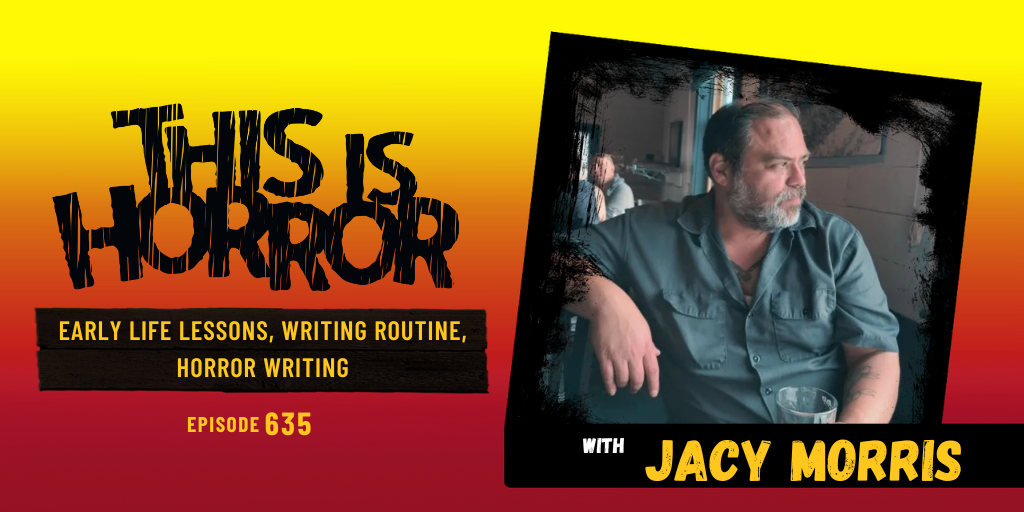
In this podcast, Jacy Morris talks about early life lessons, his current writing routine, horror writing, and much more.
About Jacy Morris
Jacy Morris was born in 1979 in Richmond, Virginia. At the age of ten he was transplanted to Portland, Oregon, where he developed a love for punk rock, horror movies, and writing, all three of which tend to find their way into his writing. Under the pseudonym The Vocabulariast, he was the writer/owner/CEO of the website MovieCynics.com 2007-2014. He graduated from Portland State University with a Masters in Education. He has been an English and social studies teacher in Portland, Oregon since 2005. He has written several books, including the This Rotten World series, The Enemies of our Ancestors series, The Drop, Killing the Cult, The Abbey and The Pied Piper of Hamelin. He is currently working on a new series entitled One Night Stand at the End of the World. The Abbey was his first book under his real name.
Show notes
Click the timestamps to jump straight to the audio.
Thanks for Listening!
Help out the show:
- Support This Is Horror on Patreon
- Listen to This Is Horror Podcast on iTunes
- Listen to This Is Horror Podcast on Spotify
- Rate and review the This Is Horror Podcast on iTunes
- Share the episode on Facebook and Twitter
- Subscribe to This Is Horror podcast RSS Feed
Let us know how you enjoyed this episode:
- Leave us a message on SpeakPipe.
- Write a comment below.
- Tweet us @thisishorror.
Resources
- Jacy Morris Books
- Watch the video version of This Is Horror Podcast episodes, including our conversation with Chuck Palahniuk on YouTube.
The Girl in the Video by Michael David Wilson, narrated by RJ Bayley
Listen to The Girl in the Video on Audible in the US here and in the UK here.
Cosmovorous by R.C. Hausen
The debut from R.C. Hausen, available now. Now also available as an audiobook.
Michael David Wilson 0:20
Welcome to this is horror, a podcast for readers, writers and creators. I'm Michael David Wilson and every episode, alongside my co host, Bob Pastorella, we chat with the world's best writers about writing, life lessons, creativity and much more. Today on this is horror, we are chatting with Jacy Morris. We are talking about his early life lessons, his star as a writer, and, of course, his brand new novel. We like it. Jerry now for those of you who are not in the know, Jacy has written several books, including The this Rotten World Series, the enemies of our ancestors, the drop killing the Colt the Abbey and the Pied Piper of Hamelin. And his latest book, as I mentioned before, is we like it, Jerry and it is out now via tenebrus Press. So get ready for a fascinating conversation with Jacy Morris, but before we get into it, a quick advert break. It was
RJ Bayley 1:56
as if the video had unzipped my skin, slunk inside my tapered flesh and become one with me.
Bob Pastorella 2:04
From the creator of this is horror, comes a new nightmare for the digital age. The girl in the video, by Michael David Wilson, after a teacher receives a weirdly arousing video, his life descends into paranoia and obsession. More videos follow, each containing information no stranger could possibly know, but who's sending them and what do they want? The answers may destroy everything and everyone he loves. The girl in the video is the ring meets fatal attraction for the iPhone generation, available now in paperback, e book and audio from the host of this is horror podcast, comes a dark thriller of obsession, paranoia and voyeurism. After relocating to a small coastal town, Brian discovers a hole that gazes into his neighbor's bedroom every night she dances and he peeps same song, same time, same wild and mesmerizing dance. But soon, Brian suspects he's not the only one watching. She's not the only one being watched. They're watching is The Wicker Man meets body double with a splash of Suspiria. They're watching by Michael David Wilson and Bob Pastorella. Is available from this is horror.co.uk, Amazon and wherever good books are sold.
Michael David Wilson 3:13
Okay, without said, Here it is. It is Jacy Morris on this is horror. Jacy, welcome to this is horror.
Jacy Morris 3:28
Thanks for having me. Yeah.
Michael David Wilson 3:30
So to begin with, I want to know what some of the early life lessons were that you learned growing up.
Jacy Morris 3:38
Early life lessons Island growing up. Well, let's see. I grew up in outside of Washington, DC, sort of northern Virginia area. It was, it was a tough place. So I learned to be tough, which is, you know, it features in my writing a lot. I learned how to stay out of trouble, which was a great, great lesson for me. That's why I'm still here. And then hard work, you know, that's kind of always running in my family, like, you know, you just got to keep things going. My mom, especially, so it's probably why I've been so prolific over over my career is just, you know, I'm always, always grinding, always ready to read or put something down on the page. Yeah, doesn't matter if it's good or bad or whatever, I'm going to put it down.
Michael David Wilson 4:38
And in terms of learning to be tough. What did that specifically look like? And are we talking more kind of at home? Are we talking at school? Are we talking out on the streets? Are we talking all of the above?
Jacy Morris 4:54
Probably not so much at home. I mean, there's some of that, but I. Certainly it was a rough and tumble neighborhood. If you walk down the street or you wind up in the wrong on the wrong block, you know people would be sort of in your face. Who are you out of territoriality? And you know, you can't really back down in those situations, because it's, it's all animal behavior at that point. So, you know, you learn to you learn, learn to fight, learn learn to run, learn to make friends and keep your friends around you. It's a very healthy upbringing. You know, it was good to go through it. I think when I was 10, I got moved out to the West Coast, which is a totally different vibe, and it didn't so much serve me. Well, there those lessons, because that was all talking, right when someone wanted to step to you, and on the West Coast, it was just talk. They just wanted to tear you down with words. And from the East Coast when you started doing that, well, you got pumped, right? If you, if you talk to me like that, you're going to get hit. And so that was a weird that was my first real introduction to sort of cultural variance, right? It's not the same in this pace. It wasn't, wasn't that place. And then, so I had to learn those rules and those ins and outs, and it kind of made me a better observer for new situations, a better observer of human behavior and things like that, which I think really sort of plays into my writing as well.
Michael David Wilson 6:37
Yeah, and if I've done my research correctly, and then I understand that move to Portland is where you developed an interest in what I would term the unholy trifecta of horror movies, punk rock and writing. So talk us through that.
Jacy Morris 6:57
Well, those, those were actually in me from the East Coast. So punk rock. I had a cousin that would listen to punk rock, and he'd have, you know, a record player, and he had a basement, and he would just play this stuff, and I would just kind of soak it in. I was, you know, a fair bit younger than him, but he'd play it for a man, like, I like that. That's cool. And then horror was early on. That was, you know, I remember when VCRs came out, and my dad, you know, we need to go back and rent one, and it was like an event. And you'd go and get all the movies you wanted to watch, and you'd sit there and be a whole night. And I remember watching Dawn of the Dead, 78 probably about five years old. And that just sort of blew my mind when I was like, what is that? That is awesome. I love it. So probably age five, I can totally pinpoint that moment as, yeah, I'm into horror. I like this, probably at that age. And then what else we talked about, punk rock. Oh, writing. I just kind of, I was always a reader. When I was young. I've read, started reading real young, you know, I would, I would be in that library in elementary school every day just getting stuff out, always still horror related stuff, even if I have not a lot of horror books on the elementary school shelves when you're, you know, six or seven or eight, but I would find them, and then the writing was also started elementary school. I didn't do too much of it, but when I did, I went all in on it and had some fun and made sort of what I wanted to make, which maybe wasn't necessarily what the teachers wanted me to make, so those were, those were all there, and they just got sort of augmented in Portland, I think, yeah,
Michael David Wilson 8:47
and it'll be no surprise for people who have read your work that Dawn of the Dead was an early influence. I mean, of course, with the this Rotten World Series. But then again, particularly with we like it. Jerry, if I think of some of the scenes in Dawn of the Dead, and then some of the scenes and we like it. Jerry, I mean, they compliment one another.
Jacy Morris 9:12
Yes, those visceral scenes of just, oh, that's disgusting, but it is, but it feels real, right? And that's, that's the thing that always kind of stood out to me about that movie, is like that feels real, it feels gross. And being able to have the language to describe something like that is, you know, it's one of my gifts for horror.
Michael David Wilson 9:36
So, so you were writing stories from a young age, did you know that this was something you wanted to do professionally from a young age?
Jacy Morris 9:47
No, I hadn't really thought about it. I was, you know, sort of a knucklehead, and I was really more into sports and playing sports, and I. And I thought that's what I was going to be. And if that didn't work out, you know, employee or doctor or something, made a lot of money, it's sort of, you know, those conversations your family put on you they weren't readers, they weren't writers. That was just a me thing. And so, you know, they look at my grades and say, Oh, you got a lot of potential. Wouldn't it be great if you were these things? And I was like, Sure, that would, that would be great. And then I think probably I didn't really consider writing a thing for me. And I think in middle school, I would just kind of space out and get bored of whatever was going on in class, and I would just write my own stories in class, and you know, I'd share them with my friends. I'm like, Oh, cool. That's fun, because they're all kind of silly, just goofy middle school stuff. And then when I got into high school, I really started doing more poetry and learning to say a lot with a little. And that sort of poetry background sort of helped me out as well to develop my style where it's not like I don't need to explain every little thing. I don't want to explain every little thing to you. So, yeah, I guess writing didn't become a real career option for me, I think until after college, because I became a middle school teacher, and that's hard, and it's a lot of work, and it's sort of that retirement plan right early retirement. So that's kind of when I started thinking about it.
Michael David Wilson 11:34
And so I understand that you're teaching English and social studies at the moment. Again, very easy to see how that fits in with we like it. Jerry, I mean, it's perfect. Really. You could only add philosophy to add just one more kind of element. So Is that always what you've taught, or when you're you know, are you a middle school teacher now, or are you teaching in a different environment?
Jacy Morris 12:03
No, I've always, always been a middle school teacher. This is my 21st year. I've taught social studies, maybe a few years, and then mostly it's language arts. I think, you know, at one point I did leave a job because they're like, you're gonna teach social studies next year. I was like, I don't want to. So I just went and changed schools, and my principal sort of know that that's kind of my line in the sand, like you can give me one of those, but I want to, I'm going to teach language arts. I want to teach reading and writing. I want to have fun with kids and make them like reading and writing.
Michael David Wilson 12:36
And so it was kind of at that time that you simultaneously decided to kind of pursue writing, I guess, more seriously, beyond it being fun and something I mean, obviously still fun, but beyond it just being something purely for the joy, purely for sharing with friends.
Jacy Morris 12:57
Yeah, I had done a website where I was doing movie reviews like my friend, it was kind of like, Hey, here's this get rich quick scheme. Let's let's do this. Reviews are hot, right? And so I really cut my teeth on learning to write and setting up routines for myself on that website where I think I wrote a couple 1000 reviews and news articles and release date information, press releases, all this stuff and and that didn't, then get didn't go anywhere. It started to go somewhere, and then something happened, and Amazon count canceled our account, and we couldn't make money off of it. So I was like, Oh man, but I had really gotten into the writing, and it became sort of a part of me at that point. Before it had just been something I play with when I get an idea, and now I needed something to write basically every day, and that's when I got the idea for writing novels and and that's, that's sort of where I started.
Michael David Wilson 13:59
And with that website you were writing under a pseudonym. It was the abbey where you started publishing under your own name. So I want to know both, why did you decide to use a pseudonym initially, and then, what was the impetus for writing under your own name?
Jacy Morris 14:20
The pseudonym for those, those reviews were like, you know, they're, I think, when you're in your 20s and your 30s, you and you're trying to make your way in a very crowded field, like, there's not a ton of review sites around for movies anymore that are like, significant. But back then it was, it was just flooded with review sites. So I had to stand out, and that meant being a little shocking, a little abrasive, a little not politically correct. And I could not, you know, do that under my own name, right? Not as a middle school teacher. I just wouldn't want to, I wouldn't want that blow back from you. So I. And once I that went away, like, wow, why am I still using this thing? It's it's weird, and I'm comfortable with who I am as a writer. I don't, I don't, I don't. I'm not trying to be abrasive. I have things to say that maybe you disagree with, but I'll stand by those things. I'm not doing it for attention or clicks or likes or even reviews. I'm just saying what I got to say. And if you don't like it and you have a problem with it, that's kind of, you know, that's on you, it doesn't bother me.
Michael David Wilson 15:31
Any that makes sense. And I guess too, like when you started writing under your own name, perhaps you could go kind of more public with people. And was there a liberation to that?
Jacy Morris 15:48
I mean, I toiled in anonymity for years, so there was, wasn't really a lot of immediate change, and it didn't really change until I started getting more serious about writing and saying, Well, let's, let's try and publish things through other people besides just myself. But certainly, yeah, I think writing under my own name is fantastic. I love the connections people make with me. I love when people talk to me and they're saying my name and I don't have to be this other person. It's fantastic. I just it was, I don't regret it, and I don't look back on, on, on it is a bad decision. I think it's it's awesome. You know, as I always feel for writers that that have things that they have to do, or things that are troublesome in their in their lives, to where they have to do the pen name, because I think they're missing out on there's like a layer there that disconnects you from from reality when you use a pen name. And that's what I always found with when I was writing under under the vocabularious name.
Michael David Wilson 16:56
So I wonder, in a twist of irony, I mean, something that we talk about is writing authentically and writing fearlessly. I wonder if, in actually removing that pseudonym and writing as yourself, you could write more fearlessly, and you could write in a more true manner, definitely.
Jacy Morris 17:20
I mean, that was, it wasn't just a pen name, it was a pretty was a persona like that was the problem with it, right? That's not really me. I'm not, I'm not gonna, you know, bash, bash an actor for what they look like. But that persona would, that persona was kind of a cocky jerk, right? I'm not really that person. And so I started to feel sort of icked out by it at some point. And I was like, This just has to go, you know, I had grown as a human being, just maturity wise, and, you know, acceptance wise, and kind of being more aware of the world around me and not just my own little sphere of this is what I think, and this is correct and all that. So it was a nice step into becoming the real me. I suppose it's
Bob Pastorella 18:05
kind of like a stepping stone. It's, you know, years ago, I thought I needed to pseudonym so I could be a little bit more abrasive and a little bit more raw. I mean, I'm talking about, like, 1520, years ago, and I don't know, maybe I'm just too egotistical. But I decided that, hey, I'm not going to do that, because I want everything to be under my name. And even then I was, I was kind of grappling with, Hey, how transgressive can I get? And then I see, you know, Arthur's like, you know Chuck Palahniuk and Craig Clevenger that then, you know, and they're, they're, they're going, you know, balls deep into it. And I'm like, Well, shit. I mean, that's their real names. I don't, I don't think that they're, you know, made up the name. Who's gonna make up named Chuck palnik, you know, like, it's, like, out of all the letters in the world, you chose those, yeah, but it's I can get where you're coming from, because we all go through that stage where we want to be more than what we are, not realizing that what we are is probably more than enough, than anyone could ever handle. And it takes maturity to see that, and to, you know, to grow there, but yeah, I I can see how you know shit. I mean, I know that I've gotten trouble for reviews, or I got in trouble for a movie review because they thought that was from England. But yeah, wrong. But you know, Michael knows what I'm talking about, and which is probably why I don't do reviews anymore. But yeah, I get where you're coming from on that for sure.
Jacy Morris 19:47
Yeah, man, I had a thought there, and I lost it all right?
Michael David Wilson 19:53
And that's what happens when Bob talks about his movie review. Trouble is I had a thought too. It's. You, you infected us.
Jacy Morris 20:04
Just wiped my mind right out, and now I'm just sitting here, like, what is the movie? You
Bob Pastorella 20:09
know, that movie was so bad I can't remember the name of it. No, no, no, I'm serious. I don't remember the name. I'd have to look it up. It's still on the website, so I'd have to look it up. But, yeah, it was, it was like, one of my first reviews I ever wrote for this is horror and, and I don't know, I just, I stuck, I stuck by my review. The movie sucked, so, but it's thing, you know, here's the thing too, is like that was at a point where horror was starting to go upward in its trajectory of quality, and so it got harder and harder to write reviews about movies and books, because everything was so good. So you're like looking at words in the thesaurus for good, great, fantastic, epic, you know, all this stuff, and it's like, you know, it's like, man, dude, I'm just, everything is so good. I just want people to buy it. So I couldn't. I found that I was more of a fan than anything, and I wasn't. I was unable to be critical. And I think that there's an art to being critical in reviews, so like I was when I first started,
Michael David Wilson 21:28
yes, see, I had a different journey from Bob with reviewing. I can totally be critical still, but as I became more known for my own writing, in addition to reviewing, it just felt that there was almost a conflict of interest. It's like, Look, if I'm gonna start now slagging off and berating my colleague's work and kind of like pointing out all sorts of criticism, it just felt like a conflict of interest is the best way to put it. So I've backed away from, you know, reviews like, I'll praise books that I think are good, and I'll, of course, put them in front of people, and we'll talk to people on the podcast whose work we've enjoyed. But you know, if there's a work that I didn't enjoy, we we don't need to talk about that publicly. And, I mean, I wonder too, as well, as this is horror gets more known, if there's almost goodness, like a kind of power dynamic where, if I just start slagging off like a new indie offer, if there's some I don't know. There's something very uneasy about that. I don't know if, when you started writing fiction, you also shied away from reviewing for that reason. I mean, obviously there's the complicated factor that what you were doing was playing a bit rather than actually being you. Yeah,
Jacy Morris 23:01
I definitely felt that. Like, I'll still, you know, talk about a movie and what I don't like about it. That's because I'm not in the movie sphere. But when it came to books, I was like, I understand exactly you're talking about with the conflict of interest. It's like, you know, these people are just working. I know how hard it is. I'll champion what I like. I'm not I'm not going to review or say a word about something I don't like. It doesn't exist, but if I like something, I'll definitely put it out there and let people know about it, because that's, that's the name of the game, you know. And it's, for me, it was always different with a movie too, because it's like, you know, it's a couple 100 people making it most times, if not more, and you can't really lay the lay the wreath at one person's feet, you know, it's got to be, it's a kind of a group effort, so you're not really bagging on one person, although I Did a little bit when I was,
Michael David Wilson 24:04
Well, the funny thing is, it's such a group effort making a movie that unless you specifically call out a person, as you did, then you know the actors or the director or the screenwriter can be like, Well, it's obviously not my part of the art that he's got a problem with. And I guess it's such a collective thing that if you've ever seen Ben Affleck give a kind of commentary on movies, there's a famous one where he's essentially slagging off Armageddon in the commentary that he's giving that's included with the DVD. So it's well worth looking up, even if just to find kind of clips of that on YouTube.
Jacy Morris 24:49
So was that on the Criterion Collection one? Do you know?
Michael David Wilson 24:54
I think it might have been, but I'd have to absolutely have
Jacy Morris 24:57
that one. I might have to throw that in later. That sounds good. Yeah, but just
Michael David Wilson 25:01
Ben Affleck taking the piss and just like, What is going on here? Oh, we've got, like, these experts, and just lay, laying every sort of logical i love that they included it though as well. And if you've bought the DVD, you're presumably a big enough fan of the movie to have made that action or somebody gave you an unwanted gift, but yeah, and athlete has given us a gift
Jacy Morris 25:32
to those early days of DVD commentaries were the Wild West, right? Like my favorite was the Conan one, Koja and the barbarian, and it's Schwarzenegger just just mouthing off and being weird and making jokes. If you haven't listened to that one, I recommend that one too. That one's, that one's pretty hilarious. He definitely super PC on there. But it's, it's, it was a fun one. I enjoy a good, honest commentary, which I don't think they do anymore. Everyone kind of sort of knows what they are, and everyone's buttoned down, and the lawyers get involved and say, Oh, we got to edit that out, or we got to say this, or try this again.
Bob Pastorella 26:13
The best one for me is blade two. But you got to get to where you can flip between the two commentaries, because there's multiple commentaries on there. There's one with Wesley Snipes. There's another one with grandma Del Toro. And as you as you get into the movie, you start listening to one with Wesley. And Wesley is going to be talking about how he trained for the scene, how he looks in the scene, how his arms are flexing is and I'm kind of going over the top, just to kind of give you an idea, but if you flip and you hear grandma talk, he's like, oh. And then Wesley was complaining it was hot in this scene. It's very, very hot in this scene, lots of sweat. And then you flip it over. There he goes. And he goes, Look at my arms flexing in that scene. You're just like, Oh, what the fuck are you serious, man, this is like in his I just it kind of ruined me from commentaries. I'm like, all they do is talk about themselves, whatever I don't. I just want to watch the movie.
Michael David Wilson 27:13
It sounds like Blade two kind of missed a trick by not having, you know, as well as the Wesley track and the Guillermo del Toro track, they needed to have one where they just spliced it together, because that seems to be where the gold is, you know, because at the moment, there's an extra step you're having to flip over. At what point do you flip?
Bob Pastorella 27:36
Yeah, that was, and I don't remember, was Norman Reedus part of any of those tracks. I mean, I don't know. I have to look it up and see, but if not, then Norman could have done the third commentary track. Would have probably been leveled between the two, you know, he'd have been like, yeah, Wes. Wesley was in good shape. He complained a lot, and grandma thought it was funny, you know. So, yeah,
Michael David Wilson 27:59
did you, you know, back in the day, Bob, did you used to just listen to every single commentary track? Or did somebody specifically point this out?
Bob Pastorella 28:09
Somebody pointed it out. Figure it out on my own. I should have mentioned that to begin with. Yeah.
Michael David Wilson 28:19
So the thing I wanted to ask Jacy about you having this kind of persona and this character bit almost like a Andy Kathe and Tony Hinchcliffe thing. Did you ever later when you know you were writing under your own name and it was revealed who you'd been before? Did you ever get any backlash about that? Or did you know the people, to the best of your knowledge, either understand what you were doing, or they were so grossly offended, they never contacted you.
Jacy Morris 28:53
It never happened. I mean, I the people that were fans of me from that website, or, you know, generally, still fans of me, the people who have found me new, like I've I've scrubbed it all, took down all the reviews and taken down all the drinking games that went with them, and they're all gone. So I still have them in a file somewhere, but it's like one of those things like, why am I still holding on to this? And that was that, that was the hard thing about the website too, is like, I could have kept kept it going. I could have just kept putting money into it and but at the end, I was like, why am I holding on to this? It doesn't make any sense. And I've seen people like that before. A friend of mine, you know, is running, has ran a website, and you've just spent so much your life doing it, and you're like, why am I still it's not going anywhere. It's not doing anything. Why am I still holding on to it? I'm ready to move on. I'm going to move on, but you're still sort of clinging to it and being like, well, I spent so much of my time doing that, but for me, there was no backlash at all. No one really knew. Know, one day this rotten world said the vocabulary is on it. The next day, it was my name, and it was like, shoot, I'd maybe sold like, 10 copies of that thing when it by the time I changed it so it wasn't even a deal. I wasn't, like, blowing up or anything.
Michael David Wilson 30:15
And so what do you think was the moment that kind of meant that you did blow up, that this rotten world did get on the radar, because that certainly is, yeah, the most successful and the one that I think you're most known for. So was there a moment?
Jacy Morris 30:36
No, that that is literally just hard work and money is all that is, it's, it's marketing. I never got reviews on it. I never said it out. I tried to get one person to publish it, and they were like, it looks like a bunch of short stories. I'm like, well, it's part of a series. You're not there yet. I was like, Well, I'm done with publishing. So
Michael David Wilson 30:58
this is an extra level of rejection. It's like, normally, when someone rejects the story, they just reject. Did they reject it so hard? They quit publishing. They folded their own company.
Jacy Morris 31:12
No, no, I quit. I was I was down with different
Michael David Wilson 31:15
you submitted it somewhere, and then you, you're having a conversation. We don't exist anymore.
Jacy Morris 31:25
They liked it, but they said it was, it's really like a collection of short stories. And I was like, it's, it's the beginning of a zombie apocalypse. There's a lot of characters. Yeah, it probably feels like that, but it is going somewhere, you know, in 12 books later, you know, it's still going somewhere, but yeah, I had the Yeah, that didn't blow up until I started looking into marketing and understanding the business side of publishing. It literally just Lansdale, like it would sell, you know, a copy here, copy there. And then once I figured out, you know, how to run ads, where to run ads at it kind of grew from there, and the word of mouth spread, and it's it's still doing really well.
Jacy Morris 32:12
Yeah, that's just money and ads and a good product,
Michael David Wilson 32:18
yeah, oh yeah, yeah. And I think that marketing is something that a lot of people struggle with, particularly recently, with the kind of implosion of various social media kind of platforms. So what were you doing for marketing? Then, what were kind of the big hits that you were like, Okay, this is actually working. And now, perhaps even more critically, for our listeners, what's working for you now?
Jacy Morris 32:51
Well, I mean, it's funny, you mentioned sort of the blow up of social media, and there's a lot of blow back on that, because it was social media I was using. I tried some money in and some social media is it just didn't work. And the only one that really was working was Facebook, and then that's sort of gone downhill and and it's just not as productive. I've still got ads running on there that finding new people every now and then, but that was probably, if anything, my biggest switch to traditional publishing was seeing the future and knowing that's not going to work and it's not a realistic option anymore. So I'm sort of in this, this limbo where I'm like, Well, I've got to get these books out here and find publishers that want them, because they're going to have more of a reach, more of an audience than I'm gonna than I used to be able to get. And so with, you know, all these social media magnets just sort of going very conservative and shooting themselves in the foot, people don't want to use their things anymore, and so the money you put in doesn't give you the same return. And I sort of sort of start with, I think as soon as Musk bought X, I was like, Oh, this, this is not good. That's going to be dead. And as far as I can tell, it basically is, except for certain groups of people, for the writing, it doesn't seem to do a thing anymore. So I figured the next to fall in line would be Zuckerberg, and he did. And by that point, I had already started, you know, pushing things out to publishers and sending out manuscripts and doing stuff like that. So it was nice while it lasted, but it is.
Michael David Wilson 34:39
It's not going to last. Yeah, the the only kind of guarantee, really, is that nothing lasts forever. And I think things are kind of circular and come around. So at the moment, we're certainly in a fallow period. But hopefully. Fingers crossed, there will be like a social media platform, or there will be a way that makes it easier for indie authors to market their work. But it is not that time. Is not that year, as far as I understand and so, I mean, I think if we look like what like five, five to 10 years ago, a lot of people from traditional publishing were then going into indie publishing because it was absolutely ripe. But now we're seeing people go the other way. So it's interesting to see how that kind of works out. But, God, yeah.
Jacy Morris 35:45
I mean, I enjoyed doing everything myself and being beholden to no one, and, you know, putting my own covers together, or using my artists to put covers together. I enjoyed that aspect of I like the creative bit of it. And so I'm, you know, a little sad to get rid of it, but I've also, I guess, I've had some, some pleasant experiences and some not pleasant experiences in the in the in my short time in the traditional publishing world.
Michael David Wilson 36:15
And I certainly want to talk about some of those experiences. But before we get into that. I want to know a little bit about what your writing routine looks like in terms of a daily or a weekly basis, and then, of course, how that fits in with your teaching, how perhaps that comp they complement one another. Yeah.
Jacy Morris 36:38
So for the last two years I've been half time at teaching because, you know, I've been the writing was doing well, and then it sort of tanked, and I'm like, Oh, wow. I can't wait to go back full time this year and have some more of that money back. While I was half time, my minimum goal was 2000 words every day. And then when I'm done with my 2000 words, revising, editing
Jacy Morris 37:08
social media posts for whatever those are worth, and then I'll usually be done.
Jacy Morris 37:16
I got to the point, I think, this last year, where I was really doing like 4000 words a day because I needed the money, so I started selling short stories, which is not a lot of money, but when you're when things are tight, you know, if you can consistently get the short stories out there that you know helps pay the bills. So I was doing sort of 4000 words a day with the editing, the revising and social media posts and all that stuff during the school year, I'm happy with 2000 words, but I'll definitely go more if I can in the summer. I You think I'd write more, but I don't. I think I'm just more like, I go for a walk or watch something on TV, and I just that time I would use for writing, you know, I knock it out of the park real early, and then I'm just chilling around to two o'clock because I'm on summer vacation and feels good to not do anything because that it's, it's, it's a grind. It's, you know, I don't, I don't know that I'm putting my body through, like the best things out there with the amount of work I do. Because during the school year, it's grading. It's, you know, thinking about school, thinking about problems, problem solving, meetings, parent conferences. There's, I'm doing all that stuff too and still trying to get the writing done. Yeah, during full time school year, I'm, you know, 2000 words and then editing. I don't really juggle multiple projects at the same time. This last year, I've been doing, you know, probably three or four projects at once, as far as books, short stories, other things.
Michael David Wilson 39:07
And do you find on those days where you're teaching, are you doing the writing before your teaching work day starts? Are you doing it after? Are you finding the kind of cracks in between while you're at work, and you know, there's a free period,
Jacy Morris 39:24
it's all of it like, I'm the early bird at school. I'm always there at 730 I'll get my planning done, and then hope to sit down for like 45 minutes before the kids come in and just write some stuff during lunch. I'll typically write during lunch. If I can squeeze in a playing, planning period of writing. I'll do that because I think the goal for me is to come home and not have to write after a long day of teaching, and just be able to live life. But if, if I don't get it done, I will get it done. So sometimes. Times, if it doesn't happen, something comes up. I got a meeting. I'll come home and do it when I get home
Michael David Wilson 40:06
and at the school and the teachers and their students aware of your writing, and if so, what's their reaction?
Jacy Morris 40:18
Teachers are weird. They're not necessarily horror fans. I'm like, the only teacher I know that's just like, yeah, horror man. It's awesome. You guys, I write horror books. Are like, I don't care. They always talk about what they're reading. And I'm like, I got books, you know, but I don't care. They're just like, whatever. Some of them have read them, and they're like, cool. I like it. As far as students, I don't really announce it to them, because they're all, you know, rated are pretty gory, visceral, and they're, you know, just 1112, 13, so I can't really promote it to him. But, like, you should read my book. It's also sort of a conflict of interest and kind of kind of dirty, I think. But they do find it eventually, someone always spills the beans, like, oh, yeah, did you know Mr. Morris is a writer? And they're like, what? And then they start, they start doing hunts. Go online and do hunts for things. One of them will probably see this video, like, I heard you talking about me while I was stalking you, and they need to get a life. I'll just say that, yeah.
Michael David Wilson 41:19
Like, I've had at the schools that I work at, like the teachers often know that I write, but I try to keep it on the down low with the students, because of, you know, not only that conflict of interest, but with them also being like junior high school kids, and it's Like, I'm not sure you should be reading this. But occasionally, you know, the teacher will let because, like, working in a Japanese school is like, sometimes I'll be like, team teaching with a Japanese teacher, and then the Japanese teacher will announce that I'm a writer, and it's like, oh, so, you know, give us the name of some of your books. I don't think I should do that. Like, I don't, you know, I don't think I you should be finding that. It's like, so Can, can we buy them? It's like, yeah, you can order them into stores. You get them on Amazon. But you I'm not giving you any more information than that.
Jacy Morris 42:24
Yeah, same way. I'm like, I'll miss direct and be like, Oh no, that's we were talking about this. Let's get back to this. It's just, it's a weird, it's a weird situation, you know, it would be different or as writing, like, you know, kids books or something. But, yeah, they're all down library check them out, but they're not gonna put my books in the library down there.
Michael David Wilson 42:45
So, yeah, I don't know if I could even write kids books. I could start out, but then I'd probably just add a dick joke, or somebody will get decapitated, and that's the end of that adventure.
Jacy Morris 43:01
Yeah, I've seen horror writers who kind of go into the young adult fiction. And I'm like, weird, I don't get it.
Bob Pastorella 43:09
Yeah, some of that stuff can be pretty brutal. But, you know, I work retail, and I only have like, one, one co worker who reads, and he and he's read my books. And occasionally he'll tell, like, my customers, that that I that I write. And sometimes it's pretty good, because, you know, I'll get a sale out of it, or something like that. It's like, oh man, I love to read what you read. You write horror, you know? And it's like, Oh yeah, yeah, I found my folks, you know. But then sometimes you feel like you, you stepped into, like a Bill Hicks joke. It looks like we got ourselves a writer here. You're like, going, Uh, yeah. Well, I'm right, when you can watch the movie. Yeah, I got you, yeah.
Jacy Morris 43:57
Man, I saw, well, this is like, just a side, but I saw this, this hockey player. I watch hockey, and there's this hockey player who was, like, bragging about the fact that he doesn't read. And I'm just like, that's such a weird thing to brag about. It's like, that does not that's not impressive, man, don't read.
Bob Pastorella 44:16
I'm so cool. I don't read. Yeah, who reads like well, you don't,
Jacy Morris 44:23
yeah, it's quite obvious.
Michael David Wilson 44:27
What situation did that even occur in? Was it Was he being interviewed about hockey? And he was, like, by the way, aside, he's sort
Jacy Morris 44:41
of like a knucklehead. Sort of guy, like, in between the intermissions, he'll be one of the guys at the desk, and someone had brought up reading or books or something, and he's like, Oh, best book I read was, like, Cat in the Hat or something. It was like, and then the people were like, you don't read. It's like, what would I read?
Michael David Wilson 45:10
sounds like the father in roll dolls Matilda might have been based off this guy, his absolute disdain
Jacy Morris 45:19
to read that one, yeah, or seen the movie? Is there a movie? There
Michael David Wilson 45:26
is, there's a couple of movies, yeah, I mean it, it's a, it's a good children's book. And I really enjoyed a lot of Roald Dahl's work when I was younger. I then later found out about Roald Dahl as a person, and that soured the experience somewhat, but his somewhat. But his books are good, I'll say that, you know, kind of like the relationship a lot of people have to HP Lovecraft. It's like something there, story wise, but as a human being, not a good person, yeah. But you said before that, talking about good and not good, that you'd had some good experience with Trad publishing. You've had some bad experiences. So what can you tell us about those? I mean,
Jacy Morris 46:26
I'm gonna keep it real general, the good ones are easy to talk about, right? Because you're like, oh yeah. Like, when you get a publisher like tenebrous press, where they just get you and they understand you, and they want to work together and and know what your vision is for the book that's like the best there is, right? Because they're not, they're not looking me as a product. They're looking at me as another person who has put all this time into the story. And they want to know, you know, they want my input on, on everything you know, from the cover to, you know, the edits, to the marketing to what sort of Who do you want to get to blurb this thing. They did it all. So they're, they're the cream of the crop, as far as I've dealt with, and I'm happy to work with them whenever. And then there's other ones for, you know, I'm like, Did you even read this book? Like they give you, like the edits, and you're like, What are you even talking about? That isn't it doesn't make any sense. Like, I don't think you got it. I don't think you understood, which, you know, might be a byproduct of me, you know, sort of burying the themes in the book, as opposed to just, you know, punching you in the face with them. I much prefer the game of theme versus here's what I'm trying to say. And then there's also, you know, the cultural competency portion of it, which I feel like not everyone has, and I'm, you know, explaining that, you know, certain aspects of culture that are fine for me as an indigenous author, I can do whatever I want to with that, you know, and then the lack of competency or awareness to try and force that into you know, my story is it was, it just blows my mind, because it's happened a few times where I'm just like you, and I have to explain it to him like I don't feel like I should have to explain this to you. But that's, that's a reality, I suppose, that not everyone that's out there, understanding, observing and being aware of other cultures,
Michael David Wilson 48:44
and I guess at that point as well, since you're getting the edits, it's harder to back away from that relationship, at least for that specific story. I don't know, your facial expression says otherwise,
Jacy Morris 48:59
maybe not well when you know, when you're a teacher, you probably get this. There's ways to get what you want that aren't coming out and saying exactly what you want. And I find that with with some publishers, I've had to do that, and that's okay. Is it frustrating for me? Is it time consuming? Yes, but that's the game you play when you're in publishing, it's not yours anymore. Unless you're working with a special press you know someone, people that really get it, or who have been on both sides. If you're working with someone who just doesn't understand or maybe doesn't even care, that can be a brutal process. It's sort of like a like an assembly line. We do this, we do that, we do this. There's no thought to the author and the relationship. And those are certainly, you know, presses I wouldn't work with again, so I don't know why they would be like that. That doesn't seem like a good way to go about business. But that's again, maybe I. Maybe I'm not understanding the the other side of it, the publishing side, right?
Michael David Wilson 50:06
I think that's a very generous reading of the situation. And yeah, that like some of my worst experiences with publishers, and I've published things you know as this is horror. So I guess I've got some insight into both sides. And I was working in publishing before coming to Japan, but some of the most bizarre moments have been where I've kind of pointed something out, like specifically to do with layout, and then I've said, Well, what you're doing, this isn't how people do it, in terms of the professional standards within publishing, this is the wrong way to go about it, and kind of pointing to other other bits of work and books. And then they've just said, Well, no, this is, this is how we do it, so we're gonna keep it like that. And then that contract has had to have been severed, because what the actual fact?
Jacy Morris 51:15
Yeah, yeah, it's weird. There's all sorts of experiences out there. But, you know that's that's the game, the game I'm playing.
Michael David Wilson 51:29
Thank you so much for listening to Jacy Morris on this is horror. Join us again next time when we will be chatting to Jacy once again for part two of the conversation. But if you want that and every episode ahead of the crowd, become our patron@patreon.com forward slash, this is horror. Not only do you get early access to every episode and the ability to submit questions to each of our interviewees. But you keep the show alive, and you support me in my dream to do this full time now. Speaking of interviewees coming up, very soon, we will be chatting with Ronald Malfi, and if you are a patron, you can submit a question for Ronald right now. So again, to make that happen, it is patreon.com, forward slash, this is horror. Okay, before I wrap up, a quick advert break
Bob Pastorella 52:43
from the host of this is horror podcast, comes a dark thriller of obsession, paranoia and voyeurism. After relocating to a small coastal town, Brian discovers a hole that gazes into his neighbor's bedroom every night she dances and he peeps same song, same time, same wild and mesmerizing dance. But soon Brian suspects he's not the only one watching. She's not the only one being watched. They're watching is The Wicker Man meets body double with a splash of Suspiria. They're watching by Michael David Wilson and Bob Pastorella is available from this is horror.co.uk, Amazon, and wherever good books are sold,
RJ Bayley 53:21
it was as if the video had unzipped my skin, slunk inside my tapered flesh and become one with me.
Bob Pastorella 53:29
From the creator of this is horror, comes a new nightmare for the digital age. The girl in the video, by Michael David Wilson, after a teacher receives a weirdly arousing video, his life descends into paranoia and obsession. More videos follow, each containing information no stranger could possibly know, but who's sending them and what do they want? The answers may destroy everything and everyone he loves. The girl in the video is the ring meets fatal attraction for the iPhone generation, available now in paperback, ebook and audio.
Michael David Wilson 54:00
Now another way you can support this is horror is to leave a review on the Apple podcast website. And a way you can personally support me is to leave a review for any of my books on Goodreads and Amazon. And speaking of which, if you would like an audio book of one of my books. Then today is your lucky day. Just email me, Michael at this is horror.co.uk, and let me know which audio book you want to listen to, and I'll send it you could not be easier than that. I have audio books for each of my releases. So that is the girl in the video they're watching, House of bad memories and daddy's boy. All right, that's it for another episode of This is horror, but until next time for part two with Jacy Morris. Take care of yourselves. Be good to one another. Read horror, keep on writing and have a great, great day.





1 comment
Great interview! It was interesting to hear his take on pseudonyms.