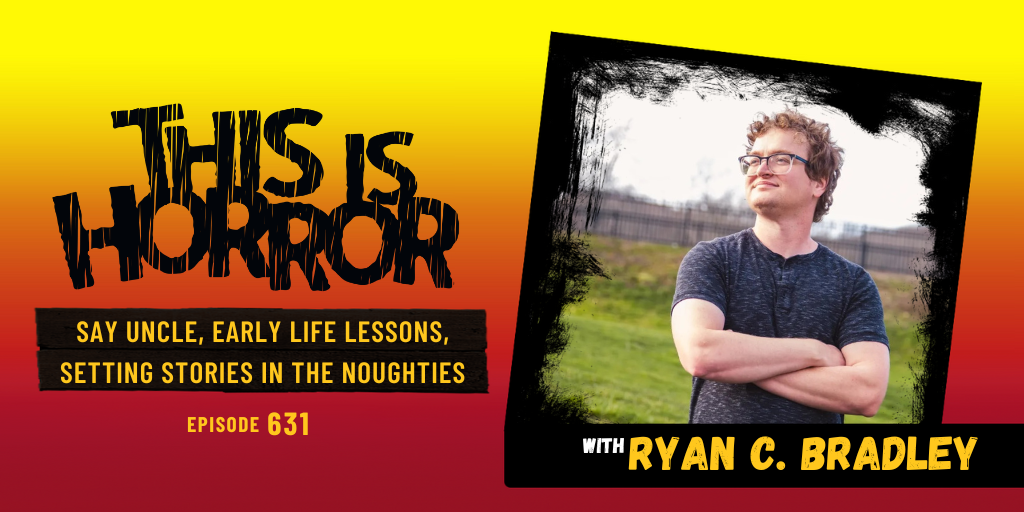
In this podcast, Ryan C. Bradley talks about Say Uncle, early life lessons, setting stories in the noughties, and much more.
About Ryan C. Bradley
Ryan is a musician, podcaster, and the author of the novella Saint’s Blood, Bad Connections: Horror Stories and the brand new novel Say Uncle from Ghoulish Books. His short fiction has appeared in NoSleep, Tales to Terrify, and Dark Moon Digest among other venues.
Show notes
Click the timestamps to jump straight to the audio.
Thanks for Listening!
Help out the show:
- Support This Is Horror on Patreon
- Listen to This Is Horror Podcast on iTunes
- Listen to This Is Horror Podcast on Spotify
- Rate and review the This Is Horror Podcast on iTunes
- Share the episode on Facebook and Twitter
- Subscribe to This Is Horror podcast RSS Feed
Let us know how you enjoyed this episode:
- Leave us a message on SpeakPipe.
- Write a comment below.
- Tweet us @thisishorror.
Resources
- Ryan C. Bradley Books
- Watch the video version of This Is Horror Podcast episodes, including our conversation with Chuck Palahniuk on YouTube.
The Girl in the Video by Michael David Wilson, narrated by RJ Bayley
Listen to The Girl in the Video on Audible in the US here and in the UK here.
They’re Watching by Michael David Wilson and Bob Pastorella
The collaborative novel by Michael David Wilson and Bob Pastorella.
Michael David Wilson 0:20
Welcome to this is horror, a podcast for readers, writers and creators. I'm Michael David Wilson and every episode, alongside my co host, Bob Pastorella, we chat with the world's best writers about writing, life lessons, creativity and much more. Today we are talking to Ryan C Bradley, the author of the recently released say uncle Ryan is a musician, podcaster, and the author of the novella saints, blood, bad connections, horror stories and the aforementioned brand new novel from ghoulish books. Say uncle, his short fiction has appeared in venues such as no sleep, tales to terrify and dark moon digest amongst others. So we had a great time at chatting with Ryan. Oh my goodness. I did not expect to laugh so much and to get so personal in the first few minutes, but we did. So before we get him on the podcast, a quick advert break
Bob Pastorella 1:56
from the host of this is our podcast. Comes a dark driller of obsession, paranoia and voyeurism. After relocating to a small coastal town, Brian discovers a hole that gazes into his neighbor's bedroom every night she dances and he peeps same song, same time, same wild and mesmerizing dance. But soon Brian suspects he's not the only one watching and she's not the only one being watched. They're watching is The Wicker Man meets body double with a splash of Suspiria. They're watching by Michael David Wilson and Bob Pastorella. Is available from this is horror.co.uk, Amazon and wherever good books are sold.
RJ Bayley 2:35
It was as if the video had unzipped my skin, slung inside my tapered flesh and become one with me.
Bob Pastorella 2:42
From the creator of this is horror, comes a new nightmare for the digital age. The girl in the video, by Michael David Wilson, after a teacher receives a weirdly arousing video, his life descends into paranoia and obsession. More videos follow, each containing information no stranger could possibly know, but who's sending them and what do they want? The answers may destroy everything and everyone he loves. The girl in the video is the ring meets fatal attraction for the iPhone generation, available now in paperback, ebook and audio.
Michael David Wilson 3:13
Okay, with that said, Here it is. It is Ryan C Bradley on this is horror. Ryan, welcome to this is horror.
Ryan C. Bradley 3:29
Hey, thanks for having me on I'm excited to be here. Oh,
Michael David Wilson 3:31
we're excited to have you here. And to begin with, as you may anticipate, I want to know what some of the early life lessons were that you learned growing up, early
Ryan C. Bradley 3:45
life lessons growing up a beast on my penis when I was about 12 years old. Don't do that again. So really important early life lesson, don't, don't do that.
Michael David Wilson 3:58
Well, hang on a minute. What were you doing for that? What is, what is the that in the don't do that?
Bob Pastorella 4:08
Can't really just come back and go, Okay,
Ryan C. Bradley 4:12
hand wave that one on. I was, like, 11 or 12 years old, and I came downstairs my my sister was in the room. My brother parents, and my mom's Mexican and she had this, like Mexican rug, and it had this, like multi colored pattern, and there was a yellow stripe, which is going to be important in a second, and Law and Order was on, and there's a sexy lady on the screen. And I was, like, 11 or 12. Did not quite know how to handle myself. Leaned up against the couch, and I thought a spring had come undone, and it kind of skewered me. I took a couple of steps back, and there was a hornet or a wasp. People, whenever I tell this story, get very upset that I don't know the difference. I don't know what kind of bug it was, but I know it was like a. Stinging bee that was yellow and flu, or stinging bug that was yellow and flu, and then, because I was in so much pain, I just like dropped trow in front of my whole family and started screaming, a bee stung my penis, and then my pulled it back up and pull it down, pull it back up, because it hurt so much, and the shame would come back, and I'd pull back up, and I'd pull back down because it was just so stinging. It was incredibly painful. Eventually, my mom said, like, go upstairs, make a baking soda powder. So think early life lesson, don't do that the whole thing, because all of it was bad.
Michael David Wilson 5:37
That is quite the story to begin with. And I think one of the lessons as well is, if your penis is stung by a bee, a wasp or a Hornet, make a baking soda powder.
Ryan C. Bradley 5:51
I mean, any bee sting, baking soda powder will take out the venom if you do it quick enough.
Michael David Wilson 5:56
So, I mean, I can't believe I'm saying this, but you know, let's talk through what happened here. So, as you say, you you come downstairs, Laura, and order is on, yeah, and there's a sexy lady that excited you. So then, like, did you say your mum had, was it, um, was that a mosaic rug? What there was a bit like, yeah, we find out that. So yeah. Then when you see the sexy lady with your sister and your mother in the room, is your reaction to rub yourself against the mosaic rug? Is that? What's going on here? But you didn't rub it against the rug. You rubbed it against the Wasp and either in a reciprocal gesture of friendship or because it was angry, it stung you,
Ryan C. Bradley 6:51
that's pretty accurate to what happened. Yeah, yeah. That's how I would pretty much describe Oh.
Michael David Wilson 6:58
I mean, this is a scene fresh out of one of your stories. Now, I don't know if you've actually put this in a story, but you know the absolute kind of chef's kiss to that story is that you're then revealing your penis, but getting embarrassed, pulling it back up, but then dropping it back like I don't know how long this went on for, and is your mother? What? How are your mother and sister reacting, watching you the penis, reveal the penis, hide the religious getting on with law and order is, is this an unusual occurrence, or, what do you know?
Ryan C. Bradley 7:45
But, I mean, I'll be honest with you, I was in a tremendous amount of pain, and I don't think I was, like, really picking up the reactions of everyone around me. I have told this story at gross out contests, and I have told it's like, it's recorded with me telling it when Max used to do the ghoulish show at Radio, coffee and beer. And this is a true story I've told many, many times, because it always gets a lot of laughs.
Michael David Wilson 8:09
Can I point out for listeners and viewers that this is literally the first five minutes that I have ever spoken to Ryan? We have not spoken even before. This is what's happening we, we asked the questions that this is horror that nobody else asked. So nobody probably ever wanted to be asked. But this is, this is what's going on here. Wow. This is remarkable.
Ryan C. Bradley 8:37
I want to start off with a bang, yeah.
Bob Pastorella 8:41
I think the biggest takeaway here is that when you probably shouldn't watch Law and Order with your family,
Ryan C. Bradley 8:49
I blame Law and Order honestly. Yeah.
Bob Pastorella 8:52
I mean, it's because that that sounds like crucial to the story law and order, attractive woman, there's no telling what can happen.
Michael David Wilson 9:02
It's true. I mean, look, I've watched law and order, I've injured my penis, I've been stung by a wasp, but I've never had all three things combined. This is like original storytelling. We've said before, there's no such thing as truly an original idea, but what you can take is three ideas, combine them together, and this is what you've got. Did you have to go to hospital after or did the baking soda just
Ryan C. Bradley 9:35
sort you out? The baking soda pretty much sorted it out. I don't even think it was like sore, tender the next couple days.
Michael David Wilson 9:44
Oh, thank goodness. And you know we we know that you have a child, so it didn't permanently injure the functionality. So that is
Ryan C. Bradley 9:58
key characteristics. Just got regular human sized eyes, no wings, no Stinger,
Michael David Wilson 10:03
all right. And I think this is so apropos to you know, you write dark comedy. I mean, this is a dark comedy story from your real life. Yeah, the thing that I'm grappling with is like, I often try and do very smooth segues, but what am I what am I meant to say here your penis got stung by a wasp. Did that inform your dark comedy writing
Ryan C. Bradley 10:40
in some ways, yeah, probably, I think it's one of the as an early formative experience, obviously, and realizing you can take something that was like in the moment, absolutely horrible and humiliating, and you can turn it into something that You can use as an anecdote to break the ice with people. I don't know if it's the best way to make friends, but it's a story that bars always gets a lot of laughs, and so you can turn it into something that like, it sucked for like two hours, absolutely awful, but the amount of times I've told it since then probably total like, 50 hours.
Michael David Wilson 11:24
This feels like your equivalent of Chuck Paul, and it's guts short story. And so, I mean, you've said that you've told it a number of times, have you actually formalized it into a short story? And if not, is that something you can I can't believe it's been eight minutes and I haven't moved on from this.
Ryan C. Bradley 11:49
When I was in grad school, I wrote it as a short story, I switched it to third person, and I made like that was the backstory. The story I just told you is the backstory, and the front story was this guy who was unemployed, and his kids were on the way home, and there was a bee outside, and he was too scared to kill it, and that was the back story. He flashed back to and people in grad school loved that backstory. I think they liked the over story, but it never got picked up. I submitted it to literary journals, probably for five years. It just never got picked up and but I think it's the over story was not good. The current day story was just kind of like I was 24 with no kids, imagining what it was like to be 35 and unemployed with two kids. And I don't think I was doing a good enough job with that, which is why I think it never got picked never got picked up. But now I think it's good as, like, a gross out contest story kind of thing, but I don't really want it published, because I think it's better in an oral form than a written form.
Michael David Wilson 12:54
Yeah, I'm trying not to react to oral form and descend this entire conversation.
Bob Pastorella 13:06
Yeah, but I mean, I can see where you're coming from there because it there's a nuance that it takes to tell that type of story in front of a crowd that you can't get when it's presented in on the war in the written words, you know, it would almost have to be a type of story like that. Would almost have to be like a short like, you know, like a comic, or something like that. Yeah, that's how it work, because you could control the flow of the pages, whereas, if you're telling it in front of a group, you can control the flow of the story by, you know, pausing and waiting for reactions and things like that. So yeah, I could see how it would be probably kind of tough to write it as a short story.
Michael David Wilson 13:56
Yeah, well, I'm certainly glad that you opened this episode with this story and talking about stories. What kind of stories were you reading growing up? When did you get into horror?
Ryan C. Bradley 14:13
I read all kinds of stuff growing up. My parents were very restrictive. They're very Catholic, and what we watched, but we were basically given carte blanche to read anything, especially books my dad liked. So, like, I read a couple goosebumps, for sure. Just like I read all kinds of stuff. I was just a really bookish kid. I was reading Jules Verne in like, third grade, and I was very what's the word? Like, praise motivated. So like, I would, like, show adults these big books I was reading, and the more they reacted, the more excited I would get about reading. One of them was, I've heard this is Stephen King's most sexual book since, but it did not seem sexual to me at like nine, but I read fire starter at like nine. It's my first Stephen King. It's my dad. Love Stephen King. So I was allowed to read that for even though we were mostly, like, restricted with what we could could watch. And I went to the the barber with the copy of fire starter, and they were like, Oh, my God, you are nine years old and you're reading Stephen King. I think that really set my path, because I was so excited that, like all these adults were freaked out that I was doing this. I read like a decent amount of Stephen King after that, but I mostly stuck like to the fringes, where I read like his non horror stuff, until I was like 11 or 12, and I read the shining and then it was kind of all bets off. I would just read anything after that, anything he'd written, Edgar, Allen, Poe, all kinds of stuff, yeah,
Michael David Wilson 15:43
and it's interesting how, you know, a lot of parents would kind of censor the movies that we were allowed to watch. But when it came to fiction, you can pick up anything can, you know, often, like, particularly because of the power of the imagination, that the books are far more graphic in terms of what you're actually getting.
Ryan C. Bradley 16:08
Yeah, yeah. I don't think there's been a film that makes things as gross as the stuff in my head. Yeah, I've yet to see it.
Michael David Wilson 16:17
And Did, did you watch many films around that time, you said your parents were restrictive, but just because your parents were restrictive didn't mean
Ryan C. Bradley 16:30
I had I just told this story on a scarred for life, but I had a friend, and we would go down to his basement. His dad had like a bar with a pool table and a TV in the basement, and we were just allowed to kind of hang out down there. We'd flip channels. We were really into dune the David Lynch Dune, like he was really into it. So I was really into it. And one day we just caught, like, have you ever seen Hellraiser three? Oh yeah, yeah. I think there's like, one really scary scene in that movie. We flipped to that out of all the scenes, it's the scene where pinhead makes the speech about how, like the suffering of friends is like the razor blade against wire, hearing your friends cry and all that. And it's a great speech. And we watched that at like, five years old, and then we turned it off, which is the worst thing you can do, is what I've heard, because when you turn off a horror movie, you don't see the hero win, which is almost how most horror movies and, well, Hellraiser movies especially, but you don't see the hero win, so you're just like, stuck with this horrifying image. And I, like, regressed as a child. I couldn't go to the bathroom by myself anymore. I was like, five years old. I was way too young, and that scared the shit out of me, and that got me off horror movies for a long time. Because, I think, like at home, we watched the Matthew Broderick Godzilla for my brother's 13th birthday. It was his first PG 13 movie when he was actually 13, and I was, like 11, and I was pretty restrictive then. And then, I think, like, some stuff changed. We were just allowed to watch stuff, but I was always too scared until college, and in college, I was well, so I auditioned for music school playing guitar when I was 17, and I didn't make it. And I was heartbroken. I was shattered. I felt like my life was over. But I decided at that point I wanted to be a writer, and I'd read a lot of Stephen King, so I was like, let's be a horror writer. At that point, I just started watching shit, even though it scared me. So I watched the thing Nightmare on Elm Street, but I just kept, like, going and going, watching as much as I could, just trying to, like, expose myself as much to the genre as I could, regardless what it did for my ability to sleep at night.
Michael David Wilson 18:38
So you decided at 17 that you wanted to be a horror writer. Had you written any short stories before? Had you kind of dabbled in storytelling?
Ryan C. Bradley 18:50
No, I had so like when I was 13, I started playing guitar, and I was very dedicated to that. I'm saying I wasn't not doing creative stuff, but I was all my creativity was put into music at that point, which I think translated really well, because one of the things my guitar teacher taught me growing up was like, Okay, you like Steve Vai let's say I want you to listen to this Steve vi album and tell me, like, what is Steve I doing that makes him good. And then I want you see you do that on your guitar, just like I was never as good as Steve. I Let's get that out of the way. That guy's fucking incredible. But the the process of, like, looking at a piece of art that's like, something you want to make, and then thinking about, like, what makes this good, and what can I do to make my art as good as this was, like, a such an important lesson as a writer, especially like a lesson to get at, like 15 years old that was hugely formative for me, and I think a huge advantage, and like when I was starting to write, because I would really think about like reading Stephen King, Greg Allen Poe, and what do I learn from this? What do I take away from it beyond like I felt scared,
Michael David Wilson 20:04
and if I've done my research correctly, then right now, your day job is teaching guitar. So yes, it would seem, yeah, that kind of even though at the time, it was absolutely awful, maybe getting rejected from music school was one of the best things that happened, because now you know, it's not like you went from guitar to writing. You've now got both. This is your life, teaching guitar and writing messed up, funny horror stories.
Ryan C. Bradley 20:38
Yeah, it's it's a pretty great life. And I would like be very clear, because I've heard a lot of writers do writers don't acknowledge, like, my spouse sponsors me doing all of this. She is a pediatrician, and, like, that's where our money comes from. So, like, I don't have pressure on me in that way, which is incredible. Yeah, I think failing, not fail, not making it to music school was so important. And I list, like, when I was teaching college classes, that's another job I used to have. I always tell my students, like, you all should, like, go out and fail at stuff that is really important to you. Because, like, I think it's a really important thing for a young person to, like, be 18 and like, have this, like, all your eggs in this basket and just have that basket get thrown out the fucking window, because it shows you, like, how hard you actually have to work. Because I was practicing three hours a day and I thought, like, you can't do more than three hours a day. This is, like, the top. It wasn't the top, though, obviously, where I would have gotten it. And I think it's like, it's very useful in that way, to show you, like, how much pressure the world actually needs for you to do the things you want to do, and to show you. Like, if you fail, it doesn't matter because, like, like you said, Here I am. I play an open mic probably once a week. I teach guitar lessons. It doesn't matter that a gatekeeper said, like, you are not good enough to come to this music school. I'm still playing music, and no one can take that. I mean, I guess you could physically maim me. I couldn't play music anymore, but beyond that, like nothing could really stop me.
Michael David Wilson 22:09
And so when you got the rejection, did you step away from music and guitar for a while? Or was it that you kept going in spite of it.
Ryan C. Bradley 22:21
No, I stopped. I didn't stop. I like, I kept practicing. Because at that point it was like, I mean, I have bad anxiety, and like my teacher said, practice every day. And I think I'm probably one of the only music students ever to actually practice every day. As a teacher, I can tell you, it's not many, but yeah, practice was just part of my daily routine. And like, for me, it's still very like, if I'm upset or if I'm, like, anxious, like I was anxious about this podcast a little bit, so I was just belting out songs before you guys came on, at my guitar, and I was singing and like, it it centers me, it calms me. So it's not something I'd ever fully let go of. But I was doing a lot less of it, and I'd given up for on it as a career path. I'd given up on it as, like, something I could do for my future. Because at that point in life, I thought, and I like, I'm a product of the 90s where everyone was told, like, you go to college and you get a job and the thing you went to college for, and that's how life works, which is not how life works at all, but that's what I believe. So I thought that was, like the end of any chances I'd ever have of being a professional musician. Was that two music schools rejected me, which is when you say it out loud. Now it just sounds so silly, but yeah, I really did think it was like the end of that, even though I would say I'll probably never stop playing. I mean, unless I get arthritis or lose a hand or something,
Michael David Wilson 23:41
was there a moment where you realized, actually, this isn't the end, or was there a moment that brought you back to guitar?
Ryan C. Bradley 23:50
Yeah, so during the pandemic, I was still teaching college classes, and they basically offered me. They were like, you can teach in person and online at the same time. I don't know if you all have taught, but like teaching online and teaching in person are very different jobs, and you have to do two separate preps and you have to do two separate student bases, basically. And I said, Are you going to pay me twice? You want me to do two jobs? Are you going to pay me two times? They said, No. I was like, Okay, well, this isn't going to work out. Gonna work out then. And I wrote for, I shouldn't say the name of the company, signed an NDA. I wrote for a really shitty clickbait place for a little bit. I did think I did, like a month, three months there we were getting like, $5 an article, plus pays for views. And I saw that translated to, like, less than two or $300 per per month, which is a not living money. And I was like, Okay, what else can I do? One of my friends was like, well, don't you play guitar? Why don't you teach guitar lessons? And that was what really brought me back to it, because I started teaching lessons. But I was kind of bad, so I had to, like, really practice, get the metronome out, do my scales every day. Once I started doing that, I got good again, and I started playing out once, like, things started opening up. So it's just like you're putting all this work in, you got to do something with it, other than just teach. But that's really what brought me back, is the I started teaching. I realized, like, I owed it to my students to actually get good again and then to play out, because I can't. You can't teach from a point of, like, Well, I used to do this really well when I was 15. Who wants to learn from that guy? People want to learn from someone who's like, out and playing,
Michael David Wilson 25:35
yeah, you don't want to be the kind of uncle, poorly equivalent of the guitar teacher, which we will get into shortly. That being a reference to your fantastic new book. Say, uncle. But before we do get to that, I mean, was your first short story published in was it around 2014 Is that about right?
Ryan C. Bradley 26:02
I think my first horror story was published in 2014 I think I might have had a literary story in like 2013 I don't remember the years you you did the research. You probably know the years better than I do. But yeah, yeah, 2013 2014 add poems in there too. 2013 would be the first time I got published.
Michael David Wilson 26:26
And so from there, at what point did you realize actually this is something you want to do kind of indefinitely, or this is something that you want to do professionally? Well, so
Ryan C. Bradley 26:39
in 2008 when I graduated from music school, is when I decided that, like I was going to be a writer. Well, I was between psychology and creative writing. In college, I eventually chose creative writing, and it was like a it's a bumpy journey, for sure, to 2013 even. It's like I finished college in 2012 and I was one of the the better writers in my program, I thought that would meant that I would just have, like, a steady career, because I was really fucking stupid at 22 and instead of a really steady career, I was a camp counselor, and then I had a job at a grocery store stocking fruit, which was very rough on my psyche. And then I had like, a year of that, and I got into grad school. The first time for grad school, I got rejected across the board when I applied as a college senior. Then the second time, I got a full ride scholarship applying to the same schools, which is very odd. I still don't know how to explain that, but I had, like, a different life perspective at that point, because I'd been, like, crushed to work in that job after that. Of course, at the end of grad school, I also ended up working retail, but I understood then, like writing was what I was just going to do forever. I think it's like guitar, where even if I didn't publish, I think I would still write, even if I couldn't get published anywhere. I'll just keep chipping away, keep working at it. I think I heard you and Jasper bark talking on one of your most recent podcasts about how both of you want to, like, just keep working to get better for the sake of the craft. And you do that no matter what. And that's kind of how I feel about it, too, where it's like, it's almost as much about the craft as it is about the business side, or maybe more about the craft. I know you have to be like in this day and age, like a writer and a business person separately. But the writer in me will just like, always write. I can't help it.
Bob Pastorella 28:33
Yeah, if there's any consolation to you, when I was going to college, I had the same trajectory creative writing, something in literature or psychology. I chose psychology, and I work in retail.
Yeah, it's just yeah,
Bob Pastorella 28:54
part of life, it's it was, it was really is, yeah, it's like, once real life comes in, it's like, whatever you did in college almost doesn't matter. But I use my degree on the page all the time, yeah. So that's, you know, and I use it in my in my retail work too, you know, you have to, there's a psychology to everything, you know. So, I mean, I use what I learned, and I also can answer some really cool psychiatric trivia questions. So, yeah, absolutely,
Michael David Wilson 29:30
yeah, I relate a lot to that kind of journey, having done an English Literature and Creative Writing degree, and God, it was a three year program, and it was fantastic for the first two years. And then as you're in your third year, you're suddenly realizing, okay, there's an end point. So what? What are we actually doing next? What's what's happening? Because, you know, there. Weren't publishers knocking and trying to give me, like, a massive six figure deal. And so somehow I just started applying for like, various jobs. But you know, because I was only passionate about writing, I guess like when I put out applications to accounting firms. They could be. This has not been anything that you've been interested in in your life, so I just wound up doing a lot of admin jobs for ages. But yeah, like that kind of generation, we were sold this idea that we could be anything, that we're all going to be rock stars and astronauts, and it was very exciting. And then the economic recession happened, which I think, you know, doing the math, would have happened about the time that you started university. So I was like, yeah, great stuff. Yeah, great start for you. And that was pretty much the year that I graduated, and then they're like, Oh yeah, you know that rock star and astronaut thing so that, so that's not gonna happen. So just work for a housing association doing some administrative work. And so I did, yeah,
Ryan C. Bradley 31:20
man, that recession that was, that was a mess.
Michael David Wilson 31:23
It was, it was, and, I mean, goodness, I I just want to jump in to say, uncle, I know that that thing kind of skips a load of steps in terms of your career and the trajectory, but such a wonderful book. And thank you. You know we've we've got you on here to talk about it primarily, and that tagline, Uncle Buck meets Hellraiser. Did this come before or after the writing, was it you? Was it Max? Was it someone else? Where did this come from?
Ryan C. Bradley 32:07
So that came after the writing. I would say that Uncle Polly was partially inspired by being like an evil Uncle Buck. But I don't think I thought of that as like a tagline at the time. So we actually we bounced around. So we had, like, Hellraiser for sure. We had something meets Hellraiser, and we were bouncing around different sitcoms. So for like a minute it was gonna be According to Jim meets Hellraiser. And I'm so glad Max came up with Uncle Buck. And Uncle Buck is like the perfect comp for this story. And I think, like, as an added bonus, it also really resonates with people more than like, I think, I don't think, according to Jim meets uncle Hellraiser would have gotten the same attention that the book got
Michael David Wilson 32:55
well. I mean, to begin with, I'm not entirely sure what According to Jim, is, but I absolutely know what Uncle Buck is. For people from the UK, it's immediately more recognizable.
Ryan C. Bradley 33:10
Yeah, according to Jim, you're not missing out. Was like a Jim Belushi sitcom. He was John Belushi, his brother, and we didn't have because my parents, like I mentioned, they're very restricted. So one of the ways they restricted our wife, restricted our watching stuff was we didn't have cable, but we got, according to Jim, reruns on like channel 17 at 330 in the afternoon every day. So I used to watch it, but it was not great. It would not have been as good a compass
Bob Pastorella 33:36
that's back in the days when shows ran about like nine seasons, because the people who created it were just like giving carte blanche the studio, and somebody, some executives, gonna go, you know, I watched some TV the other night, some of our own shows, and this, according to Jim, sucks, so I canceled it. We're gonna move on from that. Yeah, I know I got an angry voicemail from Jim Belushi. He's out of a job now, so, oh well,
Michael David Wilson 34:09
for a minute, I genuinely thought you did get an angry voice.
Bob Pastorella 34:16
I did did? I don't know, yeah, no, no, no, I gotta get
Michael David Wilson 34:22
to get the penis Wasp story and angry Jim Belushi voicemail in one episode. I mean,
Bob Pastorella 34:32
how? Well? John, sorry.
Michael David Wilson 34:35
Oh, now you're gonna get one. Now it's coming.
Ryan C. Bradley 34:40
Jim, he was great on the new season of Twin Peaks as like the evil casino owner. I liked him. I don't think he's a bad actor. I will not
Bob Pastorella 34:51
defend him too much. I just haven't seen the new season of Twin Peaks.
Michael David Wilson 34:55
So, oh, it's great. So yeah, you said. That hell raiser and Uncle Burt came after the writing. So what was the impetus? What is the origin story of deciding to write say, uncle?
Ryan C. Bradley 35:12
Okay, this is gonna sound really weird, but I was watching the HBO Chernobyl at my cousin's house, and we were at neighbors in Tulsa, and we finished the series. And I was so upset by those scenes in the series, specifically where, like, they were in the tunnels, and they had the Geiger counters, and there was just all the way to 100 and the guys in the lab, the safe guys who were not in danger. We're saying, like, well, it's only at 100 and I was like, well, we can see the thing only goes to 100 and something about that just really upset me, like deeply upset me. And I came home and it was like a five foot walk, because he was our neighbor, basically. And I just started writing, say, uncle, right then, I don't think I knew where it was going. So I don't know how to, like, describe beyond that, like, what with inspirations, but I started writing sample there and another, sorry. Let me pause for a second look. You were to say something,
Michael David Wilson 36:16
no, no. I was just trying to work out, like I'm maybe not missing that. I'm not seeing the connective tissue as you're watching Chernobyl being deeply upset and writing say uncle is like, is there something missing?
Ryan C. Bradley 36:33
It's a weird one. I can fully acknowledge it's a weird connection. I think, for me, when I think back to it, it's this like cone of silence that the people who were in Chernobyl were talking about and in the family and say, uncle, I think you can see a very similar cone of silence where, like, these things are happening, and everyone's saying, Well, no, they're not happening. And if they are happening, it's not a big deal. I think for me, that's like the the actual thing that I saw in the show that really upset me, and like jogged some stuff, started writing the book. Now I
Michael David Wilson 37:09
see the connective tissue. That's what I was looking for. And did you have a fraught childhood? Did you have a crazy uncle? I mean, we know that this is in 2005 and the protagonist, Braden, is 15 years old. We know that in 2005 you were 15 years old,
Ryan C. Bradley 37:36
there's like, I would describe it as, like, fun house mirrors. I would not describe like, My childhood was not what is being portrayed. And say, uncle, there are similarities between the two things, but it's like a fun house mirror. If anything, things that are bad or exaggerated, things that are good are toned down because, like, if Pony Boy has parents, the outsiders isn't a book anymore. So like, like any story about a 15 year old, you need to there needs to be something for the parents to not intervene, which is why most ya has orphans as the protagonists. So it's kind of like that. I would not describe my child as being like that. No people have read the book and thought that, but it's not. There are similarities, and the people who grew up with me will see them, but the people who didn't like it's not an A to
Michael David Wilson 38:26
a thing. And what was it like getting back in to that kind of 2005 headspace, you know, writing it nearly two decades after the fact,
Ryan C. Bradley 38:39
it was fun and a lot. I mean, it was fun and painful in both different ways, because being 15 is like you have all of your emotions fun because I watch, I have a three year old, and I just like watching her emotions kind of turn on, like a new emotion turns on every couple months with a kid that age, by time you're 15, basically everything is on, but you have no control over any of it yet. So you have these, like, super high highs and these super low lows. So it's like you kind of get a little bit of both when you're writing about that period in your life, and writing about 2005 was interesting. So such a weird time period in the US, because 911 had happened, and that's like a little part in the book. But like in the US in 2005 911, was like the the reason everything was happening, TSA was starting the new airport security. I remember, like my mom wouldn't go to that. There's a little baseball team near us, the Bridgeport blue fish, class, double A unaffiliated. Was like for baseball terms. That means they're basically like, they're technically pros, but they probably have day jobs. My mom wouldn't go to those games. She said they could be a terrorist attack at the Blue Fish Games like that was the level of paranoia we were all kind of like living with at that time. Just no one was gonna attack the class double A on the field. Hated blue fish. It's like thinking back to that, and then, like, AOL, instant messenger was so huge for me growing up. And like, writing about that was a lot of fun. Yeah. So, like, it was, like, a mix of, like looking back nostalgically and enjoying it, and then, like, thinking about the stuff that hurt thinking about the stuff that was good.
Bob Pastorella 40:21
So do you had to go all the way back to 2005 and I was looking at something recently because I was thinking about going back to, like, 1988 and so I started looking at like, I went to Wikipedia, and just typed in 1988 and it, it'll list out all kinds of events and everything like that. And then I just happened to be reading something and it said, Hey, if you really want to know what, like the music and the fashion and everything was, if you're writing about it, what you want to do is you don't want to look at that year. You want to go two to three years before that, because it takes a while for things to come around. So if you're trying to set it in 1988 what you really want to do is you want to look at 1986 because you you, you tend to think of things as like a pinpoint of a year, but you're talking about 1986 was 365 days of events. So when you look at it from that perspective, even though, hey, that came out in 1986 it may came out December 20 of 1986 Oh, yeah. So in other words, like that album that everybody is still listening to, you know, the Motley Crue album, or whatever album it is, it's like, Well, that didn't come out in 88 No, it came out in 86 but everybody's still listening to it, because there wasn't an album out in 88 so that that just like, blew my mind. I was like, but, but it's like, it's so logical, it makes sense. It's like, if you want to look at the clothes, go go a couple years before, hell, Go 10 years before, for clothes, because people still wear old shit. It's not like you're going buy clothes every day. You know, I've got shirts that are 20 years old. Don't worry, I haven't.
Ryan C. Bradley 42:11
So I think I have a shirt from 2005 still. I think I don't wear it anymore, like you said, but like, I think I still have a shirt
Bob Pastorella 42:20
from, yeah, is, but I mean, it's like, it's crazy. Whenever you had to do that, was it hard to, like, remember stuff, or did you have to look stuff up?
Ryan C. Bradley 42:34
I got a pretty good memory. Um, the things I most had to look up was, like, like, when did camera phones come out? Because camera phones play a role in the story. And, like, When did people have modems versus when do people have optimum like, the fast dial stuff? There's a lot of stuff like that, because, like, I remember growing up, but I also don't remember, like, When did people have smartphones, like, that kind of stuff. Like, exact years things happen. There's some stuff I had to take out because it was like, Okay, there's no smartphones
Bob Pastorella 43:02
yet, right? Yeah. And it's, it's crazy, and it basically that kind of stuff, shied me away from setting something in 88 and I was like, you know, I'm just not going to do it. It just seemed like it was just too much work. I'll probably do something short within something, maybe a flashback or something like that. But I couldn't set a whole book back then, because I'm just too fucking lazy, you know? I don't want to do the research. The research bogs me down, then I become uninterested, because some I'll find something to be like, well, now the whole thing don't work. Never mind. But, yeah, just it had a very early, 2000s feel to it. It mean, it's very in saying that genuinely It really did.
Michael David Wilson 43:52
Thank you. Well, I think one of the things that really rooted it in the noughties was, you know, you mentioned AOL Instant Messenger, and really embracing that, and having these statuses starting much of the chapters, so that really gave us a sense as to where we were. And, I mean, I wondered what the challenges or advantages of the technology and the lack thereof were for you, and how loyal did you decide to be? Because sometimes we will notice an inconsistency, but we'll think, actually, for the sake of the story and using creative license, we're going to kind of go along with it anyway. So did you have any of those moments?
Ryan C. Bradley 44:47
So to answer your question, the biggest challenge was in 2005 every one of those instant message away messages would have been song lyrics, which are copyrights you can't use. Them. So that was the hardest part of the away messages. I think I tried to be as loyal as I could to the time period. I'm sure someone, somewhere has caught something that I missed. I'm sure they have. I did not intend for it to be there. There's never a point where I decided like, well, no one's gonna know the difference. There was never a point where I decided that there's points. But if anything, it works to your advantage writing a horror story in 2005 because if most people don't have cell phones, because right now, my solution to most problems is to call somebody. So you have to get rid of the cell phones in a modern horror story. If you're in 2005 and you're dealing with three you're dealing with 15 year olds, most kids that age didn't have a cell phone at that time.
Michael David Wilson 45:48
Yeah, I'm kind of casting my mind back. I was a few years older, so I did have a cell phone, but it was very, very basic.
Ryan C. Bradley 45:58
Could you take photos with it. Was it a camera phone,
Michael David Wilson 46:02
the one that I had at the time, you couldn't so, like, you know, I'm, I've, as we've been talking, been picturing the phones that I had. So in 2005 there wasn't, there wasn't a camera feature to it. But then I got one in 2006 that had a camera Eve, to call it a camera would, I mean it sort of took photos. But if I wouldn't be like right in the show notes, take a look at this one. It's like, what? What pixelated and 64 version of a photo is this? They were so grainy, you know, because sometimes then, like, I take them from the phone, where it's on a small screen, put it on the computer, and it's like, wow, this is so pixelated.
Bob Pastorella 46:54
You said that was, what, 2006 2007 something like that,
Michael David Wilson 46:59
2006 but in fact, I did. I did have one in 2005 I took some photos at the Download Festival.
Bob Pastorella 47:08
Yeah, when I was, when in 2012 I was selling, I was selling cars, and I was in the internet department, so we had to take pictures of the used cars. And I went got to work early. Was my turn to get early and take pictures of the used cars to put them on the website. Later on, after lunch and the camera, no one had charged the camera, so I was using my Samsung gravity text to take a picture, and the president of the company was just driving through, and he seen me holding my phone, and I had to I was doing this, and I was taking a picture of a car, and I waved at him, and I could hear his tires just crunch behind me, and he backed up. He goes, You know, this guy has real country. Hey, man, what the hell you? What is that in your hand? I said, Well, that's my phone. He goes, What are you doing? Let's take pictures of the used car. No, no, no. We need quality pictures. I said, Well, they didn't charge the camera last night. I want you to leave early today and go buy a cell phone, but it has a real camera on it so you can use it at your leisure. And I looked at him and I mean, y'all know me. I'm like, pay for it and I'll do it. And he didn't miss a beat. He goes, he goes, Consider it done. You leave early. Go get it. Show me the phone tomorrow, and I'll get you covered. I'm like, All right, so I left early when got me in Samsung Galaxy s2 that's an that's in 2012 and I think that phone had a two megapixel camera on it. So I just got a new phone the other day on a because I got a lot from my trade in that has a 200 megapixel camera. Wow, yeah, yeah. It's like, this thing will shoot pictures of the fucking moon. So, yeah,
Ryan C. Bradley 49:08
it's wild thinking about, like, the cameras we used to use and like, what's his name? Steven Soderbergh is shooting full films, like professional quality films on his iPhone
Bob Pastorella 49:19
now. Oh yeah, 2828 years later, was shot completely on 15 pro maxes. Yeah, that's a Danny boy used. They did not use any cameras at all. He Well, he did. They used 15 pro maxes.
Michael David Wilson 49:33
That's crazy, right? It's absolutely insane, yeah. But you know, 20 years ago, Bob, were your two megapixel camera. You were to talk at the town
Bob Pastorella 49:48
like I'm just thinking that, like even between 2006 and 2012 that they it with six years nothing, nothing happened because the. The camera you probably had 2006 was probably a two megapixel camera. It's like, what? What happened to where they go? You know, we need more megapixels in these cameras. What is this all about? You know, then they're gonna have gigapixels, or whatever it's called. I don't know. I'm just in I just sell the shit.
Michael David Wilson 50:22
Well, from cameras to Uncle Paulie. So this is a larger than life character. He's newly divorced. He's the kind of uncle that you're probably going to love us first, and I think has the cool uncle, but then the more you learn about him, the more you realize he's no good and he's fairly problematic, to understate it, and I think this is exactly the journey that the protagonist, Braden, goes on. So let's talk about the kind of conception of Uncle Paulie?
Ryan C. Bradley 51:05
Yeah, so I met, I used to, I was a Mason's assistant. I helped electricians, I did landscaping, I did a lot of manual labor, and I met a lot of guys who were a lot like Uncle Paulie in that time. And they would always tell you, like, horrible things about women, and when you're 15, it seemed like this. When I was 15, I was stupid. It seemed like they were like, really cool, and they were telling me, like, real facts. And I was going to an all boys school at the time, so I had nothing really to push back against it. Now that I'm 35 I can see like these guys were all like, really sad, almost, because they really needed 15 year old boys to completely adulate them during their divorces, like this was like the main pleasure of their life was just like saying shitty things about women to Teenage boys in a way that made them feel powerful, I guess so. Like uncle Paulie is like an amalgamation of the worst of those guys. But like you said, first he's charming because he needs to be charming, because if he's right off the bat, if he's a monster, and you can tell he's a monster, the story doesn't work, because you can't go on braden's journey, because braden's journey, I mean, I don't want to interpret my own book, but I think braden's journey is about him realizing, like, all this, like misogyny and stuff, is kind of horseshit. I hope that's what other people take away from. Well, we'll see. We'll see. It's not, I can't interpret it for readers, but yeah, he's like an amalgamation of all of those guys who said all of those horrible things. Yeah.
Michael David Wilson 52:50
I mean, this is certainly a biting critique of topsic masculinity. And I think perhaps the point where Brayden is starting to questioning things as he's looking to date this girl, and he's looking to go about it in, you know, a very kind of noble, reasonable way. And Uncle Paulie is giving him all this questionable advice. And like, no, no, you got to ignore her. You've not got to be honest. It's kind of the things that will come out of either the Neo Strauss, kind of the game playful or, for a more modern interpretation, the kind of stuff that you might see Andrew Tate espoused to his followers, and you know, Braden, he realizes that even though some of the advice he's given, he does try out and it works, he it's wrong, he feels uncomfortable. And so we're kind of seeing this young man deal with that, and, you know, I remember being a 15 year old and that kind of time and like, but even in the media, you're kind of like, just, you should pick up girls, and that is the thing to do, and that is almost equated with success. If you can't pick up a guild, and you're a loser, you're a beta, although they weren't using beta and alpha male or so much at the time, you know. And then you just look back and you think, what the hell was everyone thinking? And it's because it's like, it's the dehumanization of women. Essentially, women weren't human beings for for these men, they were just somebody who you picked up without considering the consequences and the human. Behind the person?
Ryan C. Bradley 55:02
Yeah, I want to go back to your question earlier. If I changed anything, the one thing I did change is you sparked my memory at the beginning when they walk in the the uncle Polly's apartment, the very first chapter I did put a date of one of the pickup shows on the TV. Those didn't exist at that time. That was the one place I cheated, and you saying that sparked it. Yeah, that was the one place that I cheated that needed to be there. Because, like, like you said, the book is largely about that. I would say every piece of advice uncle Polly gives Brayden was advice someone did give me in real life at some point, and I had to, like, grow up and be like, Okay, this is awful, especially there was a thing where you'd use a girl as a practice girl. Someone suggested me, I never did this because it sounded awful, right? When I told it to me, what was like, you would practice having sex with her until you got good, and then you would dump her and go after someone you actually wanted. It's just like so tremendously evil that, like someone at 15 was telling me to do that. Yeah?
Michael David Wilson 56:09
Luck, luckily, despite some of my flaws, I had enough empathy to know that having a practice girl was just just wrong. Yeah, you know, because you switch, you switch places where you don't want to be the practice boy
Ryan C. Bradley 56:26
exactly like, it doesn't. It's not even like, a huge empathetic leap to like, Would you want someone to just practice sex with you because they think you're unattractive? Like, no, that doesn't sound something I want someone to do to me at all.
Bob Pastorella 56:39
Some of that stuff sounds like, Have you ever seen that movie swingers with Jon Favreau and Vince Vaughn? Yeah, I watched that a couple years back. Yeah. And it's some of that stuff sounds like the stuff that Vince Vaughn would try to pump into Jon Favreau. Favreau was very, his character was very, you know, empathetic. And it's like, but like, the one thing that Vince was like, here, no, no, no, no. Don't ever, don't, don't come call her right after the date, buddy. No, no. You make the baby. You make the baby. Wait on the on the call, you know? And of course, Favreau calls the girl, but he realizes that he shouldn't have probably, because they just didn't hit it off very well, but it's a pretty it's a pretty funny scene. You'd have to watch it. Yeah, that when he was, you know, when Uncle Polly says some of those things to Braden, it's like, Dude, you watch swingers too many times.
Michael David Wilson 57:36
Like, have you been on the other end of the kind of, like, dating advice equation, because, particularly these days, like, I work with, like, quite a lot of younger men that are in their 20s, and sometimes, for, for some reason, don't judge them too harshly, but they're they'll kind of ask me, like, how do you how do You pick up women? Or like, how do you talk to a woman? It's like, why am I not having success? And then sometimes they'll even try and be like, look, look at these texts between, no, don't show me your private correspondence. And you know what is? What I often say is like, you know you're thinking of women as some sort of creature or some sort of achievement. It's like, how should you talk to women, the way that you're talking to me right now, like a human being, yeah. Why are you thinking of this as a game? Just you talk to people, and if you get unwell, then you see what happens. But you're not only you overthinking it, but you're you're it's almost like if you're trying to write a really commercial book, you're trying to force something that it doesn't want to be, yeah, but it, it is kind of shocking. How, how many people kind of feel like this now and then, sometimes they'll be like, Oh, well, you know, I was reading this thing by Jordan Peterson, and it's like, okay, firstly, so put that down. Stop reading that. Like, you know, I like self improvement in terms of, like, my health, in terms of fitness, in terms of business, but you can't approach every aspect of your life like that.
Ryan C. Bradley 59:37
No, it's at a certain point. Like, you don't want to optimize fun, right? You know, like, the point of fun is to enjoy it. You can't optimize it, because the point of the fun is that you're not optimizing if you I had, I worked with a guy once who's, like, reading all of these books I had, I like, save time. And I was like, but what if you didn't read those books? And he got really mad at me. Me was like, You're spending hours a day reading books on how to optimize your time. What if you use that time doing the thing you want to optimize your time so you have time to do? He did not like that. That was not
Michael David Wilson 1:00:12
well received. It's because people like to come up with bullshit excuses and to procrastinate rather than face the thing that they told themselves that they actually wanted to do. And ultimately, it's like, you know, people looking for like or, How can I write more? It's like, just write more. Just start writing right now. Yeah, to go back to people asking me for advice, though, like, I always feel like there's such a way of responsibility, because you kind of want to say what, what you're doing here is being completely sexist and chauvinistic, and this is like a kind of consequence of toxic masculinity, but you're like, how do I say this in a way that it's really going to be heard? Because if I just say you're a fucking sexist, fuck off. Well then they're gonna double down. They're gonna start reading things about the matrix and how you're being lied to, and then, you know, my response is going to essentially corroborate that in their own kind of twisted logic.
Ryan C. Bradley 1:01:29
So, yeah, I mean, if people come to me for advice, which is very rarely, I try to tell them, at least young men come to me for advice, what I try to tell them is, like, what would you like the other person on the end, the person on the other end to do? And like, can you do that while being yourself? Because I tried to put good dating advice in the book too. It's like Uncle Joel's mom tells Braden at one point, just be yourself on a date. So I think a lot of people, like, think, like, you should be very conservative on your day. It's not conservative, but like, very you should hide who you are and, like, let the freak out slowly. And on some level, I see it, but on the other level, I'm like, don't you want to find someone who, like, likes the same things as you? And when you're being weird, they're just gonna be weird back. Isn't that the goal? Yeah, so you should just, like, do that right off the bat, and don't think of it as like, when you get broken up with like, it's this, like, big loss, but think of it as like, this is like, that person wasn't for me, and now I have, like, a better understanding of what I'm looking for in a relationship,
Michael David Wilson 1:02:44
right? Yeah, exactly. And I mean, I keep making kind of analogies with dating and other kind of aspects, like writing or one's career, but I do kind of see the commonalities, and I think with a lot of people who like coming to me and asking for advice, they feel this bizarre urgency that they need to have a girlfriend or they need to have a partner. And I mean, it's like if you're looking for a job or you're looking for a literary agent, you shouldn't get one for the sake of having it, you should get the right one for you. I suppose a literary agent is a better analogy, because sometimes we do just need a job to pay, yeah, rent. But you know the if, if you're dating someone and you realize, oh, she's not into me, it's like, Great that, you know, we want to talk about optimization and efficiency, great that you've eliminated one, one possibility. So you know that one didn't work. You're one step. You're one person closer to the right person for you. You know the times when I've dated and I've been on dating apps before, I'm so unapologetically me and just openly me from the start, and kind of making jokes and talking about philosophy and just this is who I am. And actually, I would say that that has been great for, you know, my success in terms of dating, because, yeah, the people who are not into that immediately, it's like, you know, unlink, or whatever it is, and that's fine. But then the people who are on that same level, then we have, like, some really good conversations. And, yeah, I just think that is the that really strengthens what you're saying about just be yourself because, because what are you doing if you're looking for someone to date or to. In a long term relationship, then you want the person who, who's ideal for you, who you've got this match, who you're gonna have a connection. You don't want to be stuck in one of those broken relationships where you somehow got together, but you secretly, or sometimes not so secretly, hate each other. Yeah.
Ryan C. Bradley 1:05:22
Yeah, absolutely. One thing I want to comment is you said that young men have a sense of urgency, and I think that's like the byproduct of a toxic masculinity in which we're only allowed to talk about our feelings with a woman. And I think the what they actually want as a therapist, someone who they can talk to about whatever is bothering them, and they feel like relationship is the only place they can get that.
Michael David Wilson 1:05:46
I think you could be on to something there. And I've found too that there are sometimes like rather troublingly and rather Freudian, there are people who they say that they want a girlfriend, but what they seem to want is a mother. Thank you so much for listening to Ryan C Bradley on this is horror join us again next time for the second and final part at a conversation. But if you would like to get that and every other episode ahead of the crowd, become our patron@patreon.com forward slash, this is horror now. We recently released a brand new patrons only video, cast, writing and life lessons in which Bob and I tell you what we've learned recently, so you can take inspiration and apply some of these lessons to your own writing. So if you want to support the podcast and help me do this full time, an interview lots more new to the show, authors such as Ryan C Bradley and get a load of bonuses, including that new video cast writing and life lessons. Then become a patron, patreon.com, forward slash, this is horror. Okay, before I wrap up a quick advert break
Bob Pastorella 1:07:26
from the host of this is horror podcast, comes a dark thriller of obsession, paranoia and voyeurism. After relocating to a small coastal town, Brian discovers a hole that gazes into his neighbor's bedroom every night she dances and he peeps same song, same time, same wild and mesmerizing dance. But soon Brian suspects he's not the only one watching and she's not the only one being watched. They're watching is The Wicker Man meets body double with a splash of Suspiria. They're watching by Michael David Wilson and Bob Pastorella is available from this is horror.co.uk, Amazon and wherever good books are sold,
RJ Bayley 1:08:05
it was as if the video had unzipped my skin, slunk inside my tapered flesh, and become one with me.
Bob Pastorella 1:08:14
From the creator of this is horror, comes a new nightmare for the digital age. The girl in the video, by Michael David Wilson, after a teacher receives a weirdly arousing video, his life descends into paranoia and obsession. More videos follow, each containing information no stranger could possibly know, but who's sending them and what do they want? The answers may destroy everything and everyone he loves. The girl in the video is the ring meets fatal attraction from iPhone generation, available now in paperback, ebook and audio
Michael David Wilson 1:08:43
now, before I go, a huge thank you to all of you who have left reviews for my fiction and for the this is horror podcast, and a big thank you to Mad Bran for this review over on Apple podcasts, this is horror podcast has been my primary resource for the past few years. It has introduced me to so many horror authors and has given me invaluable insight into writing horror. The in depth conversations are sincere and fuels your passion for the horror genre. So another big thank you to Mad Bran. If you enjoy the show, please do also leave a review over on Apple podcast. It'll cost you nothing but your time, but I appreciate that is perhaps the most valuable resource of all. But if you do have some, if you can spare some time, give us a little write up. Apple podcast. Okay, with that said, I will see you in the next episode for part two. With Ryan C Bradley, but until then, take care of yourselves. Be good to one another. Read horror, keep on writing and have a great, great day.