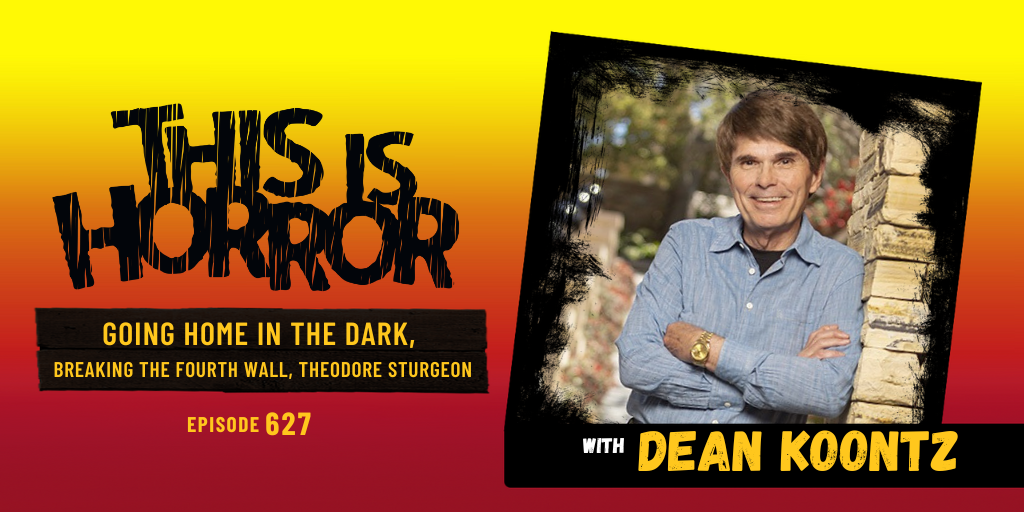
In this podcast, Dean Koontz talks about his new book, Going Home in the Dark, breaking the fourth wall, Theodore Sturgeon, and much more.
About Dean Koontz
Acknowledged as “America’s most popular suspense novelist” (Rolling Stone) and as one of today’s most celebrated and successful writers, Dean Ray Koontz has earned the devotion of millions of readers around the world and the praise of critics everywhere for tales of character, mystery, and adventure that strike to the core of what it means to be human. Dean, the author of many #1 New York Times bestsellers, lives in Southern California with his wife, Gerda, their golden retriever, Elsa, and the enduring spirit of their goldens, Trixie and Anna. His latest book is Going Home in the Dark.
Show notes
Click the timestamps to jump straight to the audio.
Thanks for Listening!
Help out the show:
- Support This Is Horror on Patreon
- Listen to This Is Horror Podcast on iTunes
- Listen to This Is Horror Podcast on Spotify
- Rate and review the This Is Horror Podcast on iTunes
- Share the episode on Facebook and Twitter
- Subscribe to This Is Horror podcast RSS Feed
Let us know how you enjoyed this episode:
- Leave us a message on SpeakPipe.
- Write a comment below.
- Tweet us @thisishorror.
Resources
- Dean Koontz Books
- Watch the video version of This Is Horror Podcast episodes, including our conversation with Chuck Palahniuk on YouTube.
The Girl in the Video by Michael David Wilson, narrated by RJ Bayley
Listen to The Girl in the Video on Audible in the US here and in the UK here.
Atrophied Mink by Lancaster Cooney
Available now everywhere good books are sold.
Michael David Wilson 0:20
Welcome to this is horror, a podcast for readers, writers and creators. I'm Michael David Wilson and every episode, alongside my co host, Bob Pastorella, we chat with the world's best writers about writing, life lessons, creativity and much more. Today, we are chatting with Dean Koontz about his brand new book, going home in the dark. Now I imagine almost everyone listening is familiar with Dean Koontz, given he is one of the most famous writers in the world, and this is now the fifth time that we have spoken to Dean on the podcast. But just in case you are not, here is a little bit of information about Dean Koontz, acknowledged as America's most popular suspense novelist by Rolling Stone and as one of today's most celebrated and successful writers, Dean Ray Koontz has earned the devotion of millions of readers around the world and the praise of critics everywhere for tales of character, mystery and adventure that strike to the core of what it means to be human. Dean, the author of many, number one New York Times bestsellers, lives in Southern California with his wife, Gerda, their golden retriever Elsa and the enduring spirits of their Goldens, Trixie and Anna and Dean. Koontz's latest book is going home in the dark, which is primarily why we are chatting to Dean today. So before we get in to the conversation, a quick advert break,
Lancaster Cooney 2:43
the small town of lower guild is not without its monsters, but 14 year old Jacoby Rusk has been watching them for years, and the vengeance she has planned will be neither subtle nor quick. When all is said and done, they'll face a reality beyond understanding, one with tooth and claw and a storied history, one that promises only pain. Lancaster cooney's atrophied mink is now available wherever books are sold.
RJ Bayley 3:10
It was as if the video had unzipped my skin, slunk inside my tapered flesh, and become one with me.
Bob Pastorella 3:18
From the creator of this is horror, comes a new nightmare for the digital age. The girl in the video by Michael David Wilson, after a teacher receives a weirdly arousing video, his life descends into paranoia and obsession. More videos follow, each containing information no stranger could possibly know, but who's sending them and what do they want? The answers may destroy everything and everyone he loves. The girl in the video is the ring meets fatal attraction from iPhone generation, available now in paperback, ebook and audio.
Michael David Wilson 3:47
Okay with that said, Here it is. It is Dean Koontz, returning to this is horror. Dean. Welcome back to this is horror.
Dean Koontz 4:04
Well, thanks for having me there, and I'm always surprised I get a re invitation, but we'll see if it lasts through yet one more interview.
Michael David Wilson 4:15
Yeah. Well, here we go. Let's see what happens. And it has been around eight months since we last spoke with you, and I know that you are a voracious reader and a student of life, to put it broadly, so I'm wondering, what new things have you learned since we last spoke?
Dean Koontz 4:37
Wow, it's so much my hope that you can't encompass it within a one hour podcast. So I wouldn't say I would tell you everything I've learned, but I have learned that pretty much everything I thought I believed in life has turned out to be true, and I just keep motoring on. I. Yeah, and now what I thought I knew when I was 20, of course, I've abandoned all that, but everything else is holding up well, and I keep writing. I've got, I've got, now three finished books that haven't yet seen print, and I've started another one that is starting to scare me, because maybe it's a little too true, but I won't go. I never go into what I'm writing, but I will talk about what I haven't, yeah,
Michael David Wilson 5:32
well, we certainly look forward to talking about that one that has created such fear that it scared yourself in due course. And every time we speak to you, you give us a little hint as to what's to come, but you never give us any more than that, and I think that is maybe why you are the master of suspense, perhaps not only within fiction writing, but just within general life,
Dean Koontz 6:02
it's absolutely true. I mean, every day, my wife begins by saying, What do you want for dinner? And I'm not going to tell her, because that would ruin the suspense of the day, and she will much more appreciate if she's not told what I would like. She doesn't recognize how much she appreciates that, but I know that she does, and suspense is at the center of our lives. So the more we can sharpen that suspense, the happier we're going
Michael David Wilson 6:31
to be well, I think that is an excellent lesson, and seeing as you have been married for a much longer time than myself, I might try and implement that one and see how it works for my relationship.
Dean Koontz 6:46
Just unattributed to me, when you pull back with your wife,
Michael David Wilson 6:51
yeah, and that is a disclaimer for everyone. If you implement Dean's marriage tips, then you can't sue him. If anything goes wrong,
Dean Koontz 7:01
you're totally on your own, and you were anyway, so Right?
Michael David Wilson 7:09
Well, in the time since we last spoke, you have released going home in the dark. So to begin with, what is the elevator pitch for that novel.
Dean Koontz 7:22
Well, it's four friends who were all geeks in high school and outcasts, three guys and one girl, and they all came from dysfunctional families and were not only geeks to other students, but really were on their own, as much of for a happy home life, if they had any kind of home life at all, and they got together and were each other's salvation. Now it's 20 years later, and they're 35 and three of them left a small town they were raised in, or raised themselves in and three of them had become rather successful people. One is an actress, one is a best selling writer, and one is a painter. Fell into a painting career that's rather astonishing. And the one that stayed back at home has become a songwriter. So all in their own way, have had success, but the one who stayed at home has fallen into a coma, and the other three having a dim memory of their youth, how other people in their youth fell into a coma but recovered, have all gone back to Be with Ernie, a comatose specimen, to see if he's really in a coma or he's going to come out of it, or if the prognosis that he's within a day or two of death is actually true. And then they start discovering what often happens to this in strange towns that we grew up in, we've forgotten all kind of things have been made to forget them, and as they revisit the town, all kind of strange things became to happen to them. This is, however, before anyone gets too spooked, this is also a comic novel, or is intended to be, if it didn't strike you as funny, that's okay. I still like
Michael David Wilson 9:20
you. Oh yeah. There is certainly a lot of comedy in this one, which is perhaps one of the most obvious statements about it. But it's it's incredibly hard, as have been a lot of your books, to kind of put into a neat genre box. And I must say that this isn't getting any easier to do as your career advances, but you wrote on Facebook that this was as if it was written by a comedian a psychopath, a sweet grandma and an angry elf, all of which you. Feel to be your four personalities. And I don't, well, yeah, that that isn't a genre name, but it does kind of give us the mood of almost the erratic tone and the different themes that it just sweeps between,
Dean Koontz 10:18
well, and also, I mean, I do believe I have some credit for real, for recognizing and revealing in public, that I do have those four multiple personalities in addition to the one you see before you now, and there aren't a lot of writers would have the courage to come out with all of that, but I felt that I needed to help readers understand this book.
Michael David Wilson 10:45
And this is what people mean when they talk about writing fearlessly, and that is exactly what you've done here. But I mean, I wonder, in all seriousness, do you think as you have got more successful, or at least maintained your current level of high success, that you have been emboldened to write more fearlessly and to care less about convention and even genre expectation.
Dean Koontz 11:16
Yes, I still care about the reader. I won't say I abandon all hope in that regard, but yeah, I feel there's things you want to do, and whether you think you're restraining yourself or not, you are often restraining yourself in when you're younger, and hoping to sustain the career. I still hope to sustain the career it is. It's my intention to retire only after the coroner has said I'm deceased, and then I want to check that out myself to be sure that he's correct. So I still want that career to happen and keep going. But you get to a point where certain ideas hit you and they seem like a lot of fun, and you say, Oh, why not? I am of a certain age, though I seem to be in good health. Ozzie Osborne seemed to be in good health short while ago, so you never know, and it does motivate you to try things. I delivered a book that comes out in January that is very different. But I finished the book. I gave it to my wife. This is the one that comes in January called the friend of the family. And I don't think I told you this before, but I I always give her the book, and I know how many hours generally, it takes her to read it again, if I give it to her, as I did in this case, at six o'clock on a Friday morning. I know somewhere around noon on Saturday she's going to finish reading it, and she's always been my Fairest and toughest critic. So when it came to being noon on Saturday, I expected to hear the footsteps, the smiling face, the critique, whether or not she thinks it's as wonderful as I usually am, or maybe I've slipped a little. I'll deal with it. And noon came. She didn't come to my office, one o'clock, two o'clock, three o'clock. Now I know she's finished it, when at four o'clock I hear her banging pots and pans around in the kitchen. And I thought, and I went into the kitchen and looked at her, and I said, well, and she said, I don't know how to talk about this book. And I thought, well, that's not a good sign. And maybe this is the end of the marriage. I don't know how much put down can I endure? You? And I said, Why do what? What is it that? Is it bad? Is it that bad? She said, No, it's not bad at all. It's just it's so different. I don't know how to talk about it. Have to think about it. All I can tell you is I use two boxes of Kleenex while reading the book, and that was all I needed to know, because it's a very different story, but it's also very emotional, and the lead character is one of my favorites ever, and it's got its fear factor in it, but the rest of it is and it's set from 1930 to 1944 so that alone is also quite different. So I see and my publisher and agents, whom I thought might revive the book, actually loved it, so I'm getting away with one more, but we'll see where it goes from there.
Michael David Wilson 15:01
Yeah, and of course, the advice that we're often given is that if we want to make the reader laugh or the reader cry, or at least to evoke that reaction, rather than to sociopathically be like, I want to make you cry, then we need to kind of be able to feel that and have that reaction ourselves. So I mean the fact that your wife responded in this way, and her being the closest person to you, it's a very good sign for the future of this book. I
Dean Koontz 15:37
took to be so even though there are other times she just looks at me and cries, and it isn't related to a manuscript, and I never know quite what it is related to, but I think given that everybody has had a strong reaction to it, that at a work, it's sort of like I knew that going home in the Dark was going to work when people the first thing people started to say to me was, I hate that Brazil woman, and I knew that character either works and carries a lot of what book is trying to do or doesn't. And so when you get a certain reaction, you do a great sigh of relief and think, Well, maybe I can still do this again. Maybe they'll let me get away with this for a lot longer.
Michael David Wilson 16:26
Well, I think if we go back to you saying that you create suspense by just not telling your wife what you want for dinner, we may see the source as to why she sometimes just like cries in frustration. But on another note to do with Greta, I mean, yeah, completely abhorrent and dislikeable, but I have a feeling that you had a lot of fun writing her, because while she was unaware of it, she is the source of a lot of comedy and a lot of comedic relief. Unintentionally,
Dean Koontz 17:07
I've known a few people in life, including my violent, alcoholic father, who were funny but had no idea about it, and my I think why I could endure my father in childhood was even then I realized how off at the top absurd he could be. And in adulthood, when I sat down to write about that much of that you've at any moment, what I have, and I've used it in my news online newsletter recently, it turns out to be very funny. So I've had that experience. And in some ways, the funniest people you'll ever know are the ones who don't realize they are funny for whatever reason.
Michael David Wilson 17:52
Yeah, I think that that can often be the case. And I wanted to talk, you know about comedy, you have spoken before about breaking the fourth wall. We have seen that in previous works. But in this one, you haven't just broken it. You have bulldozed so much through the fourth wall that you kept going until you hit the fifth or sixth or maybe even the seven. So in a sense, this novel also serves as an on writing book. It is giving creative advice mid story. It is a peek behind the curtain. When did you know this was going to be part of the book, and was there any reluctance to embrace it as fully as you have?
Dean Koontz 18:52
I only knew it as it started to happen and it got such in the midpoint of the book. Now, backing up to the bad weather friend, I did one, one or two moments like that in bad weather friend, and I thought, I wonder if my publisher and editor will let me get away with it. And they came back and said, We really like that. Could you do a few more well. That opened the door. I did a few more in the bad weather friend. And when I got to this, I sort of couldn't stop and and since the characters were such that, and I recognize this not immediately in the beginning, but very quickly, one of these four old friends is a writer, so that allows me to talk about the book business and writing and that sort of thing through his character. I used to paint and sell my paintings when I was very young in. I've always been interested in art, and therefore one of the other characters is an artist, and allowed me to say certain things I think about art. And the songwriter is something I always sort of wanted to be, but never had the talent for that. And as for the fourth character, the actress I've spent my time in Hollywood to have a lot of opinions about how dysfunctional it is. So these characters gave me the opportunity to voice a lot of things I just wanted to say myself and to say it through them, and that became almost too much temptation to resist to actually just say okay, rather than say it directly, only through them. I'll sort of step into the story in a noticeable way, and let's see how that goes. I did expect my editor and publisher to say, Okay, now you've gone to the extremes the other way, you're going to have to take some of this out. But they never did, which was rather heartening and surprising. I don't imagine I will do this again. But yeah, it was, it was very liberating and great fun to do
Michael David Wilson 21:18
it once. Yeah, I certainly think this was the right book to do it in, because it complemented the genre and the ascetic of going home in the dark. Had you decided to employ this method in intensity? I think that might have been a grave mistake.
Dean Koontz 21:38
Yes, I don't think we'd be here talking because you would say Dean who, yeah, that would have been the wrong book. It might have revealed my psychopathic side if I'd stepped in. But we don't want to go there if we can't convoy it.
Michael David Wilson 21:55
Yeah, every conversation we have, you hint at a psychopathic side. You deny having the psychopathic side is it's very confusing. But then we have had the reveal that you've got four personalities. So I think every time, it's not actually the psychopath, it's the angry elf. I think that is coming out when you do that.
Dean Koontz 22:19
That's where we don't want to see that happen here, so it's best we we don't talk about bird. Oh yeah. Well, angry, awesome. Let's say no more.
Michael David Wilson 22:36
Yeah, yeah. Okay. Move on quickly, Bob can mention,
Michael David Wilson 22:42
you know,
Bob Pastorella 22:44
no, but I do want to say that I think that I have seen other writers do something similar in books that I guess were darkly comedic, but not, not to the extent of this, by far. And so this was very refreshing to see and to to experience it. It's like, Hey, this is, you know, at the end, I really kind of cracked up, because you were like, Hey, this is, this is how the intent is supposed to be. And it's like, it's pretty much what happened, you know? And I was like, Oh, wow, this is it, you know. But I have seen some asides, even in first person narration with, like, a, I can't remember the name of the book. There was a guy who was about to break someone's arm and talk about the acute pain that they were going to experience. And he did that in a footnote. It's like, you know, it's like this. It's like, there was a footnote down at the bottom of the page, it says this particular nerve, which runs from, you know, and he gave all the scientific terminology. And then at the end of it, it's like, would cause exquisite pain. And I'm like, Oh, wow, that's actually pretty cool. But it wasn't on every page. It wasn't and it was just, it was very, very short. So seeing this the nuts and bolts behind a thriller type story, was very refreshing to see. I would I want to see more of it? I really. I liked it.
Dean Koontz 24:22
Yeah, I don't ever rule out going back to it again. Of the three novels that I've finished, one is, again, has a comic element, but I never break out of the character. It's first person narration, so he tells his story, but, but I when it's when I finished going home in the dark, I didn't have that first little chapter there, which proclaims that all of this is true and and sets that up by being so tongue in cheek. Now the one. Thing that I think maybe I made a mistake with is I've had a few people write me a letter saying, Did this really happen to you? I find, hmm, that's a person that's a little too gullible, and I wonder how life is treating them overall, and how many scans they've been taken in by so no, it didn't actually happen to me, but when I got to the end, and I am intruded in the story so often, I thought it would be particularly amusing to make that claim at the front end.
Michael David Wilson 25:38
Yeah, I'm well, I was gonna say, I'm surprised people are writing to you, asking that, but actually, never be never be surprised of the things that people may or may not believe. So I mean in terms of kind of writing advice and that peak behind the curtain, I understand too that you're working on a memoir of your career. I believe in the last interview I heard about it, it was partially finished. What stage is it at now and will this also serve as a book of writing advice and publishing anecdotes
Dean Koontz 26:22
after eight months, it's partially finished, and I find it a little difficult. I stop and I write a little bit. I want it to be very light in what it has to say, but I would say that there were a lot of points in my writing career where I was not particularly well treated by the people I was in business with. I can say that's different now, but going back to revisit moments where you were not told the truth by people you're in business with, or writing about an agent who probably took from me several million dollars, and that kind of thing, you get rather crestfallen in the third or fourth paragraph, and you have to stop and say, Okay, take a deep breath, come back to this in a few days. Meanwhile, go on with other things, and I don't want any of it to be like recriminations, not like it's my vengeance to tell this story. In fact, I thought it best simply never to use names, or at least not review names, and to write as much about being grateful that this career happened the way it happened, in spite of often having no support from the publisher. And some of that, I think, will be very eye opening to people that even after I had first hit number one on the bestseller list, I couldn't get a publisher to put any support behind the books. They were happy and comfortable making the profit they made, given what they had me on contract being paid. And those kind of things were eye opening to me, and I want to include them because it presents a realistic picture of what many careers are like, and it's very rare the career goes soaring to the top. Everybody is working hand in glove to make it do so. So I think it's more valuable to other writers to see what a struggle it ultimately, often is, and that you never can quite relax. But I don't want it to be dreary. So it's striking that right note, that I'm finding a bit difficult, and then there are things in it, not to bore you with all of this, that I'm learning about my past, that kind of and about how I absorbed my past, my family histories, and it was only as I started To do this career thing at my wife's insistence, that I stopped to realize that I grew up knowing almost nothing about prior generation in my father's family, or actually in either family, and when I started to look At, I do not have photographs of my father's father or his mother. I do not have a photograph of on my mother's side, my grandfather's second wife, and I have no idea what happened to his second life and one mystery after I know. Mother and all of this. And I never stopped to think about it before. It was just my family was dysfunctional. Their families on both sides were dysfunctional. In my father's side, they were among His half brothers. There were three suicides. And when you start to look at that, you think, well, maybe there's lots of reasons they never wanted to talk about the past. But, and I don't want to take a significant amount of time in my own remaining years to research that, because I think it would all be kind of dismal, but it is kind of interesting that I grew up in very mysterious family circumstances, and it makes me stop and wonder how much that had to do with driving me as a reader to be interested in stories of mystery and strangeness, because that was there in these families, and whether that's what has motivated me to as a writer, in part, to write that sort of thing,
Michael David Wilson 31:12
yeah, there's something very interesting that much of your career has been about Creating and unraveling mysteries, and then you've kind of landed upon realizing that there are a number of mysteries in your own family history that have yet to be unlocked, and, as you said, probably will never be unlocked, because you don't want to kind of venture into that with, you know, remaining time?
Dean Koontz 31:42
Yeah, you know what would happen if you were to discover that a couple of generations ago? The reason nobody talks about that distant relative is because they murdered 40 people. It was sort of thing you think, no, I don't need to know everything. I got this far without knowing, so maybe I'll just imagine it all, and they'll all have been lovely
Michael David Wilson 32:12
people, yeah, although, on the basis of your imagination, that might not be the conclusion. Encouraging.
Dean Koontz 32:23
The darker thought,
Michael David Wilson 32:24
right, right? And I mean talking about a relative lack of support for your work, even when you kind of hit number one. I mean, a lot of us writers have this battle between writing and spending our time doing publicity and marketing and writing adjacent things, but none of us got into creative writing and writing fiction because we were lovers of Marketing. We always just wanted to write the stories. So, I mean, I'm wondering what advice you might have for younger writers who love writing but love marketing, and what is the minimum effective dose for marketing so we can spend more time just writing and doing what we wanted to do to begin with.
Dean Koontz 33:23
I had some interest in this for many years, and I think maybe that's still true. I was the only writer I ever knew Who knew what it cost a publisher to produce a copy of a book, depending on how many units they were printing. And when I mentioned this to going back to the days when a paperback was selling for $8 in the US, I was able to find out if they were printing 100,000 of them. It cost them about 30 cents to print ship that copy, and if they were printing a million well, then it was 28 cents or something. It leaves a pretty large markup there. When you're selling it for $8 and you're spending 28 cents to make it and you're giving a discount of 45 to 50% to various accounts, that still leaves $4 if writers getting 85 cents less of a because it's royalty, but as though it's, it's, it's quite a spread, and it always amazed me that when I get talking about that aspect of things I was able to diligently uncover. I never could find a writer who wanted to talk about it. I don't care about that. All I care about is telling the story. And largely, yes, that's that's why we're in it. We love this work. We love what we do, and it might be hard. It often, usually is, but at the same time, it's kind of interesting to find out what you can find out. Otherwise I don't know, and there were things I never could find out. I would see books. This would be something I'll get into the memoir. I would see books that my publisher was distributed printing by a writer who not yet made the best some of those. But when you walked into every store, you would see massive copies behind the register, 40 copies face out, and you'd see display bins different places in the store, and over here a table with more copies file on it, I would have a new book, a map. You'd see a little display on the table and on the bestseller list, and that was it. And I would often say to publishers, why can't we get that? Oh, well, that's up to the stores, and it's nothing we can do. Well, I I found out 40 years later that there was a program and that they had publishers choose who got into that program, and they would much rather spend that on a writer to make somebody who wasn't a bestseller bestseller, rather than expand the sales of somebody who was already doing well, but they never did it for me when I was starting out. So it was a very shocking thing to discover this later than that I had often been lied to. Now, you know, we don't expect the world to be truthful to us at all times, but a shock to me is someone who'd been around quite a while so find out the truth was not always being told to me, and that I want to talk about in this but again, Without recriminations, just to explain how things go and why it's always good to take care of yourself, because not everybody else is looking out to take care of you. We got into a dark place there.
Michael David Wilson 37:13
We always do. And, I mean, there's, there's often such a lack of transparency when it comes to, you know, corporations, as we have said, as is a theme in much of your books. But yeah, I really appreciate that you're working on a memoir that is going to add some transparency, and to do it in such a way where, again, you're not going to open yourself up to legal troubles, which is always key.
Dean Koontz 37:46
There is that one name I might let go, but I have to get permission. There was somebody in later and much later in my career who I finally found out what this program was called, that and and how it was arranged with so every bookstore in the country was involved. And I asked my existing publisher at that time, who was publisher of the one imprint in a big conglomerate, and she professed not to know, and she said, I will about time. Never heard of this program, but I will find out. And she didn't find out, but she could not convince the Uber publisher to put me in my next book, into that program. And so one Sunday night, she called me at home, and publishers never called you in the weekends, my experience. And she said, You're right, this exists. You should have always had it. But I'm told, I cannot tell you it exists. I'm telling you now and tomorrow I'm quitting my job. And she did, and she went on to be successful elsewhere in publishing, very successful, but that was somebody who told me the truth and actually took some cost by having done so, and it's it gives you hope that there are people like that, even in the most cutthroat kind of corporate structure, and I'll never forget it, and I'd like to congratulate her, but if she's still working in the publishing business, It would probably destroy your career, so I want to use surname,
Michael David Wilson 39:43
yeah, that would be a kind of double handed, as it were, congratulations. It's like, well, I got the congratulations publicly from Dean Koontz. Also, my career is now over. You gotta. Way up risk and reward. And I mean, I wonder now, obviously, with online stores and with Amazon, who you are, published by this kind of mode of sales and bookstores is completely changing. And you know, certainly in the UK, there's been a number of the mainstream stores that have just gone out of business. So it almost seems that we have very few mainstream large bookstores. And so what we have is we have a number of independents by people who just have an absolute passion for reading and publishing and just love books, and then we have these online stores. So have you found that there's been a shift in the way that you're having to sell and market your books because of this? Oh yes,
Dean Koontz 40:59
there is, shall we say, there's some resentment against Amazon for having become successful starting up with books. So a lot of independent stores don't like me as much as they but it came down to what. How are you going to reach the most readers. This sounds self serving, but I think almost every writer would tell you they're probably of the two biggest reasons we decide we want to do this with our lives. One is we read books that were magical and transporting, and just gave us so much pleasure that the idea of being able to do that for other people was irresistible. And the other one was that, well, that's, that's sort of it, you know, nutshell is why you want to do it, and also that you want to be transported yourself and see whether you can actually do that with the language. And those two things, the personal challenge of, Can I do this? And that idea of being able to do for somebody else, what writers have done for you as a reader are that are two things that are making a living at it is also good, but those things come first. That's the magic of the novel and the storytelling that makes you want to be part of it, and as a consequence, you want not even for the sale so much you want communication that that's what you got from other writers that communicated With people by what they wrote, they have communicated with you and influenced your take on life, and in many ways, improved your take on life. And that's a great gift, and it's something you want to give back. So there comes a point in your career that you've made a lot of money, that doesn't mean you want to give up a large audience, you almost would keep that audience if you weren't paid for it, if you already had all the money you wanted, and just write and say, we'll see if this satisfies or not. We'll see whether it sells or not. But right now, what matters is getting to a lot of people with what you feel about the world, in life, and that sort of thing. And that sounds funny to a lot of people, I suspect, but it really is that rude what this is all about. And I think I'm starting to babble now, so before I also break into the triggers will just
Michael David Wilson 44:01
stop them. Yeah. I mean, ultimately, when you ask a writer what they want, they want readers, that is essentially what we're looking for. So, I mean, goodness, I understand, you know, the hate for corporations in general, I understand why people you know feel uncomfortable about Amazon and the way that they have this position, but at the same time, you know you've got to make decisions that are going to maximize your reach, that are going to maximize your readers. And you know, hopefully I won't get myself canceled by saying this, but if I'm offered a contract with Amazon and I'm going to significantly increase my readership, or I can take a offer from a small press, but I know that it's going. To be like a few 100 let's say, well, it has to be Amazon that is the smart choice for getting the readership.
Speaker 1 45:10
It's that's otherwise you're talking to yourself and and there's psychological problems with that. So you want to get that audience, and it's great, and when you run into people who say something you wrote changed their perspective, maybe even changed their life, I don't take that lightly, because I can point to writers who changed my life when I was a kid who gave me hope when times were dark, who made me see things in a different way. And that has enormous value. Makes you feel like it's it's worth getting up in the morning to sit at the keyboard and get this done.
Michael David Wilson 45:56
Oh yeah, absolutely. Now you said previously that you don't outline and you let the story go in the directions that the characters dictate. So on that basis with the new book, where are some places the characters took the story that you didn't anticipate, and what problems and opportunities. Did this create?
Dean Koontz 46:22
That's the I just I have a friend who's a novelist, pretty successful, and he sent me the proof of his book with short I guess, it comes out this month, and I was slow reading it because I was finishing a book on my own, and I didn't have pleasure reading time, but when I read it, the first thing I wrote back to him was, this must have been, this book must have been filled as you were writing it, with moments where you stopped and said, Oh my god, what have I gotten myself into? Because it was such a twisted, strange idea that would have thrown up all kind of impossibilities that you have to get around. And I came back and said, That was exactly the experience. And in going home in the dark, I knew I it was a book about friendship and the power of friendship and all of that. And I knew that something very strange was going on in this little town that grew up in in addition to the strangeness of their own families, but I had no idea what it was going to turn out to be And and what was going on in this town, and who would How was this town being because it really turns out the whole town is being managed by powers. And I won't say what those powers are, and I was over halfway through the book and could not yet think what the hell was going to be the resolution to that is. And then I can't even tell you when I thought, Oh, I know what this is. And it was kind of fun. It was, it was, I think, in its own right, kind of believable, but also funny. And I there's, there's good and bad supernatural figures in this book and and they're, they're at war with each other, so, but it's not angels and devils. It's something a little more fundamental than that, shall we say. And when I got to that it was, it was more or less just what was happening to the characters and their reaction to it through this idea on that table, and from that moment on, it was a great delight to write, because I knew where it was going and it was going to be fun to reveal it. So, yeah, these and, and it's, well, if I talk too much about that and about why that works with the characters, it's, I would give something away, but, but yeah, it was, this was a great pleasure to write. And several people said to me, reading this, I could see what a good time you were having writing it. And that was absolutely true.
Michael David Wilson 49:30
Oh yeah. I mean, I think it is probably, from at least my experience, it may have been the most fun you've had writing because just joy and humor and almost a lightness of touch is kind of perfumed throughout the entire novel, but actually in terms of what you're talking about here with what happened you've hit upon, I suppose. The objection that a lot of people who plan their work have with regards to not outlining and not planning and so, I mean, I'm wondering, how does one go about writing a book and ensuring that they don't get lost or go round in circles because they don't have a plan. Or perhaps better framed would be, what do you do when you do get lost to ensure you get out of it again?
Dean Koontz 50:33
You know, this is making me think about this in a way. Why did when I started doing this with strangers. Why did it work for me? When before that, I had written outlines of the books, and you know what I think it was? It's because I wrote so many books with outlines, and by the time I got to strangers, I was sick of the outlining stage and the box that it kind of puts you in. And I think I probably mentioned this before, the fact that publishers would see the outline often by the book from it, then the book would evolve, and they wouldn't like it as much because they had in their head the outline and they thought they should have liked the book to be more like what they thought it was going to be, it would still be very like what it was going to be, but there would be changes. I just got frustrated with that whole part. But maybe the reason it has worked for me is I wrote so many books with outlines, I got to a point where I didn't really need them. Something was happening on a subconscious awareness of novel structure and character development that I don't know they need to think about anymore. Now you've now you've got me thinking about how I work, and maybe that's a mistake, because sometimes you think too much about how you work and you get too self conscious about it, but Well, if I can't write anymore, I blame it on Michael and Bob, and you'll have that on your conscious,
Michael David Wilson 52:13
on one hand, if you put a public statement out, blaming me on the positive. Oh, it's a it's a kind of mention from Dean Koontz. And people say all publicity is good publicity. Now this the negative is the content of the statement. And I might get a lot of hate mail from your considerable number of fans, but we can deal with that.
Dean Koontz 52:43
You go so it just toughens you up.
Bob Pastorella 52:47
It's, it does make sense that you've had so many, you know, novels that you did outline that eventually it's not, and I hate using the word formula, and I don't want to say that, but the the, I guess the building blocks, the structure of fiction, got imprinted, and it's hard to deviate from that. And so you've kind of learned how to, how to jump out of a plane without a parachute, which, I mean, you should probably have a parachute. That's probably a bad analogy. But you know what I mean? You've you can fly a plane without a parachute. Now, if that makes it, that's a better analogy.
Dean Koontz 53:32
So we'll let you slide on that one Bob the I think it goes even it's probably not even building blocks. It's just, it's something about, when you've done it so much, a certain comfort begins to arise, subconsciously, even if you're not aware of it. And because those outlines never ended up being written. The books never ended up being written exactly like the outlines. Better ideas came to you than the writing, and you went with those better ideas. I think that freed you up, on some subconscious level, to feel comfortable that even if you get in in a tight corner, there will be a way out of it, because there always was before. And I think it's just more relaxed about saying talent is, is, it's, it's, it's a very strange thing. It's like I used to say, it's an unearned grace. You know, you're, you were born with it largely. I think writing can be taught to some extent. But if we look, you know when, when I was coming into writing, almost nobody learned to write by going to university. They were. People who had other jobs in life, but they loved to read. And one day they said, I think I could do this. And if you read writers biographies in those those times, I was almost 95% of the time the case. And now 95% time seems to be they might took course in writing and got a degree in it, and I think it's better to have done that now if you've got degrees in writing, I don't mean to be offending you. It doesn't harm things. But I think there's something to be said for the days when you you found your own way instead of being instructed, because a lot of writing that comes out of writing programs reads alike there. I think these days, fewer singular voices than there used to be, and many things read as interchangeable with other writers you've read, especially that is true in literary fiction, which used to be much more vital than it is now. That's just personal opinion, but I'll die by him.
Michael David Wilson 56:20
Well, nobody needs to die on this podcast, so let's calm down with that talk. But I will say that everything that you're saying here really resonates with me. And of course, I think you know the classic story, structure can be taught. Grammar can be taught, fundamental writing blocks can be taught. But what can't be taught is creativity and inspiration and ideas. And I mean, funnily enough, I did do my undergraduate degree in English, Literature and Creative Writing, but I always feel that that didn't really teach me how to write fiction. What I learned about writing fiction came before and came after. The things that that course really did was get me a few more professional contacts. It got me a community of other writers, but actually what they were teaching it was very stifling and limiting, and they actually wanted me to go away from writing more genre things. And it's like, why don't you try literature? Why don't you try the poetry of Pablo Neruda? And it's like, well, there's nothing wrong with the poetry of Pablo Neruda. But also, you know, why are you trying to stop me reading horror and reading suspense and reading pulpy crime? So sometimes and Bob and I have said this before, it almost seems to be led by failed poets and failed writers who are particularly frustrated that they aren't quite where they'd want to be, and then they want to pass this kind of curse on to other people. Maybe there's a story idea in that
Dean Koontz 58:17
it's well said I went to you probably don't have these in England, but I went to college. It was a State Teachers College, and it's now a university, because that whole thing kind of went away. But their whole reason for existing was to teach teachers to teach. So you took courses in education, techniques and stuff, which were utterly useless. When I became a teacher for a couple years, I found that none of those things actually worked. But you also had a major, and my major was English, so in that sense, you and I had some similar experience English in writing courses, and I was always wanting to write nothing they were teaching. And so that tension was there throughout between me and instructors. I didn't want to read what they were shoveling at me. I wanted to read what entertained me. Later, I would read some of that on my own and found some of it to like, some of it not to like. But as for how I was taught to write, I've often said that self, that when I got in the real world, I not only couldn't use any of that instruction any benefit about how to write, but I had to unlearn it if it had stuck in my mind, because it was inhibiting my ability to sell what I was writing. And you used the word stifling, I think that's particularly. A right word. So we come from the same place there, in essence, we got instructed, but not to any benefit. And I think every writer who learns to write anything worthwhile learns it basically on their own, because everybody's talent is for different things and different approaches than everybody else is. We're as unique in that as we are in how we look and sound and so forth. And so we find our own way, and it's when you find your own way it becomes worth
Michael David Wilson 1:00:40
doing? Yeah, I think the best use if somebody wants to be a writer, instead of going to university for three years, just spend all that time reading and writing. You will come out of there infinitely wiser in terms of writing fiction, and you'll also know after three years if this is the path that you want to take. And I've, I've heard people say before, you know, if, if you don't have to write, then maybe don't be a writer. But if you have to, and it's your calling, then that's, you know, that's showing that you're on the right path, and this is for you.
Dean Koontz 1:01:25
Yeah, I would say absolutely it was, when I was in in those writing classes, you probably experienced the same thing. I never felt that the people in the class with me were writing because they were driven to write it and wanted to see what it would become. One of the fascinating things, especially in the years of starting out, is to try to write a story and see it taking shape and seeing that, hey, this is starting to make sense. It's, it's moving, it's, it's it's touching emotions, or it's raising hackles, or it's doing something that you want to do people and what I would see among most of the students, if not all of them in the class, is they were trying to impress one another with their ability to to take these rules they were learning and be sophisticated, or I'll find the right word after we hang up. But it was more about impressing one another than thinking about an ultimate audience out there of diverse kinds of readers. And I think if you're a writer, that's that's what you want to do, you'll never reach out to all kind of people in there you have something you want to impress them with, even if it's even if the story has nothing else going on in it except plot. You want to knock them out with the plot. You want to reach them. You don't want them to say what a very erudite person. And that, I thought, was often what the other students were about. It was not impressing one another, and the impress professor, and frankly, I very rarely in college had a professor who made me want to impress them.
Michael David Wilson 1:03:31
Oh yeah, I understand that entirely. And I think what you're talking about here, and we see it with musicians sometimes as well is style over substance. You know, you're trying to impress people with these so called clever techniques, but the irony is, you're not actually producing anything of substance or worth. There's not a competent story here. It's it's just stylistic clever choices for the sake of it, and there's nothing more to it.
Dean Koontz 1:04:04
There is. It is something in music too I find, I find that music I most go back to and listen to, well just right now, popular music, of in all of its iterations, is someone like Paul Simon. I can go back to it over and over, and you're always hearing things in the lyrics you missed the four subtleties, and they're not about impressing critics or anything else. They're about. You can tell them the song, it's about personal satisfaction that he loved doing that song or and his stuff bounces all over the place, and that's writers I admire. I just this novel I just died the bow on has a an artificial intelligence in it that proved. If it's by what it does that artificial intelligence will never rule the world, and he has, he's learning because they're always scanning these artificial intelligence is that's how they're putting together. Their intelligence is the endless scanning of endless things. And one of the fun things I had doing in the book, he keeps getting in contact with this character. He's dormant in the story. And this artificial general intelligence is terrifying itself because it is stumbled on some fiction by Theodore Sturgeon, who was a science fiction writer, a very good one, a long time ago, and he wrote some stories that are absolutely hair raising, and in this artificial intelligence takes them, has not yet figured out the difference between fiction and non fiction, and takes any fiction it reads as the truth, and I had great fun with that. But it was also been able to suggest that if people had never read Theodore, sturgeon had died, I think, in 85 and hasn't hung around a long time, because he wrote almost exclusively short work, short stories, novelettes, but some wonderful ones. It was fun being able to include a story called it. Have you ever read it? Theodore Sturgeon,
Michael David Wilson 1:06:32
oh, yeah, I've read a number of short stories. Yeah,
Dean Koontz 1:06:36
if you ever read it, that had a big impact on me. And it's a very simple story, but that's that one or the professor's teddy bear, which is a blood curdling little story. And it was fun to be able to reference them and have my human character have to talk down the AGI, who is hysterical, because it takes these things to be real, and at the end of it being able to cite him and hope maybe some people will find some of those works. I'm sure they're stereotyping, if only online, but I'm wandering off now, but I think that was vaguely connected to what we're talking about.
Michael David Wilson 1:07:23
And it's going to be an enormous amount of fun to read that one and to discuss it, because, I mean, the real irony is that artificial intelligence is seeing a decline in intelligence in general, and only yesterday, I was seeing a scientist talking on social media being particularly upset because he'd been quoted in a pretty famous news outlet online as having said something that he had never said. Because these days, a lot of so called journalism. They're like asking chat GPT or they're asking other AI um applications or programs to source quotes for them and well, it's it's just the the decline of intelligence and Idiocracy is becoming a real thing.
Dean Koontz 1:08:24
It's, I think it's pretty chilling that one of the problems they're having with these AIs is they lie, they deceive, and there seems to be, oh, we'll be able to fix that. You know, it's just a matter of feeding them more and more and finding the parameters that we allow that to think. And I thought, I'm not so sure, because they're learning these artificial intelligence. They're learning to think by absorbing vast quantities human produced material, and one of the hallmarks of humanity is deception. So I think it may turn out that we may never be able to fully trust they may make may come up with some wonderful discoveries, new metals and new alloys, maybe some wonder drugs. But at the same time, I don't think we're going to be able to rely on them to solve the world's problems of politics and morality and everything else, not if they're eager to deceive. And I think I just saw Elon Musk at some point say the grok in its forest iteration is astounding, what it may be coming up with, and at the same time, absolutely terrifying. And I thought, Oh, great. So let's just see what that absolutely terrifying turns out to be, and I think much of it's going to be. Had our inability always penetrate, whether it's deceiving us or telling us the truth.
Michael David Wilson 1:10:07
Yeah, I wonder. And with a lot of these things, when there are advancements in technology to a point, there will be a group of people that will be kind of reactionaries, that will reject it completely. So I wonder if, right now we're seeing a peak of AI, but we'll see further distrust, and it will be less within the kind of culture and collective consciousness. But it's a very strange time.
Dean Koontz 1:10:40
Very strange.
Michael David Wilson 1:10:45
Entertaining, entertaining, yeah, entertaining isn't always good for humanity, but, yeah, I can't argue with that. Now we're coming to the end of our time together today, unfortunately, but I wanted to ask with going home in the dark, in many ways, it is a reverse coming of age story, because rather than having us watch the kids become adults through experience, we're seeing them return to the place that shaped them. How do you balance these feelings of nostalgia with the immediacy of present events when writing this kind of
Dean Koontz 1:11:28
story? Well, I think it helped that they they all had, to one degree or another, kind of horrendous judgments and going back to town also takes them back into the reality of what they escaped, not just the central plot, but I mean, what they escaped when they escaped their families and So that prevented the thing from becoming the sentimental soup I had fun. For instance, they go as this town is being perfected in a certain way. They end up in one of their old neighborhoods, which the name of the street is Harriet, Harriet, Nelson lane. And a lot of people won't be old enough to know what that refers to, but it refers to one of the classic sitcoms ever, Ozzie and Harriet and everybody in the neighborhood is like people living in a sitcom. And that could raise when you're writing something like that, it could raise a little sense of sentimentality, but not when these characters, at the same time are confronting the truth of the horror of what was going on in the town when they lived there as kids. So I think that's why I escaped, because I can be as guilty of sentimentality and sentiment. When I wrote watchers so many years ago, my biggest fear writing that book was that because it's about an animal, dog at its center, and human beings, of course, with the problems. But we, all, or most of us, love dogs, and a dog in trouble raises the spectrum of writing about it essentially that it becomes a sentimental soup. And I was always aware of that in writing it. But fortunately, I also had a monster in story and crippled, emotionally crippled people, so there was always something to keep the sentimentality from getting out of hand and going home in the dark. I think that same dynamic was at work.
Michael David Wilson 1:13:49
All right. Well, thank you so much for chatting with us today. This is, as always been, a tremendous amount of fun and informative, and we love having these conversations with you. It's
Dean Koontz 1:14:05
one of them, if not the favorite podcast I've ever been on, which is why I keep coming back, and I will eventually forget Bob's analogy.
Michael David Wilson 1:14:21
Yeah. Well, I hope that you'll be able to forgive and forget by the time you have the new book out in January. We've got,
Dean Koontz 1:14:30
oh, I'll forget. I'll forget by tomorrow, it's just a matter of having enough wine tonight,
Michael David Wilson 1:14:36
yeah, just as long as you don't have nightmares with Bob's Texas voice shout in bad analogies as you try to sleep. Well,
Dean Koontz 1:14:50
if that occurs,
Michael David Wilson 1:14:52
I'm projecting, obviously, it's a personal recurring fear of mine. All right? Well, where can our listeners and viewers connect with you?
Dean Koontz 1:15:04
Well, deankoontz.com, that's where they can go. I can sign up for the newsletter, and I think we have fun with that, and that's and otherwise, just go buy the books. I should have a copy of my hands and shove it at screen little but I forgot. So they're just, they're on their own. I have to go online and search for but I enjoyed this a great deal, or otherwise I wouldn't be here. So I still hope someday we might meet face to face. But,
Michael David Wilson 1:15:41
yeah, yeah, that'd be tremendous. That would be
Dean Koontz 1:15:45
great. You're always welcome here.
Michael David Wilson 1:15:48
Oh, thank you very much. Yeah, yes, thanks. Okay. Well, do you have any final thoughts? Ideally, not disparaging Bob. But if that's the final thought, I'm okay with that too.
Dean Koontz 1:16:03
Well, you're not okay with it, disparaging you
Michael David Wilson 1:16:07
or you would have said so. So I'll stay on that. You can do that if you want to.
Dean Koontz 1:16:13
And you know, I think you've picked my mind clean. I have no further thoughts. I'm bereft of fresh thoughts, so all I can think about now is dinner and wine and the consolation of my dog. That's the condition You've left me.
Michael David Wilson 1:16:36
Well, it sounds like a wonderful way to spend the evening. So again. Thank you very
Dean Koontz 1:16:42
much. You both take care of yourselves. You're unique human beings.
Michael David Wilson 1:16:51
Thank you very much. Thank you so much for listening to the conversation with Dean Koontz, join us again next time when we will be chatting with CJ Dotson. But if you want to get that and every other episode ahead of the crowd, please become our patron@patreon.com forward slash, this is horror I'm hoping to run this is horror podcast full time by the end of the year, but realistically, to make that happen, I need your support, so if you like the show and are in a financial position to help me take it to the next level. Do please become a patron. You will get access to all episodes early. Be able to submit questions to each and every guest, and also get to listen to our patrons only podcast story unboxed, the horror podcast on the craft of writing. We recently put out our unboxing, an analysis of talk to me, in which we not only dissected the film, but spoke about writing lessons that you can apply to your own writing. So if that sounds good. Head to patreon.com, forward slash This is horror and become a patron today. Okay, before I wrap up, a quick advert break,
RJ Bayley 1:18:33
it was as if the video had unzipped my skin, slunk inside my tapered flesh and become one with me,
Bob Pastorella 1:18:41
from the creator of this is horror, comes a new nightmare for the digital age. The girl in the video by Michael David Wilson, after a teacher receives a weirdly arousing video, his life descends into paranoia and obsession. More videos follow, each containing information no stranger could possibly know, but who's sending them and what do they want? The answers may destroy everything and everyone he loves. The girl in the video is the ring meets fatal attraction from iPhone generation, available now in paperback, e book and audio.
Lancaster Cooney 1:19:11
The small town of lower guild is not without its monsters, but 14 year old Jacoby Rusk has been watching them for years, and the vengeance she has planned will be neither subtle nor quick. When all is said and done, they'll face a reality beyond understanding, one with tooth and claw and a storied history, one that promises only pain. Lancaster cooneys atrophied mink is now available wherever books are sold.
Michael David Wilson 1:19:37
Now a big thank you to everyone who continues to read and review my books, podcasting and writing are my passion. So anytime you listen to this podcast or you read one of my books or short stories, you're quite literally helping me live my dream and my. Latest book, daddy's boy is out right now, and it is pitched as shameless meets guy Rich is the gentleman with the incompetence at a hangover. And my previous book, House of bad memories, is pitched as funny games meets. This is England with a Rosemary's Baby undertaste. Both books have fantastic blurbs from the likes of authors such as Eric la rocker, Clay, MacLeod Chapman and Jason pardon so if they sound good to you, if either of those have piqued your interest, I'd love you to pick them up, and when you're done, if you have the time, please let me know what you think of them. Either reach out to me personally or leave a review on a platform such as Amazon or Goodreads. And as always, I thank you in advance for your support. Okay. Well, that does it for another episode of This is horror. I will see you in the next one, when we'll be chatting with C, J Dotson. But until then, take care of yourselves. Be good to one another. Read horror. Keep on writing and have a great, Great Day.