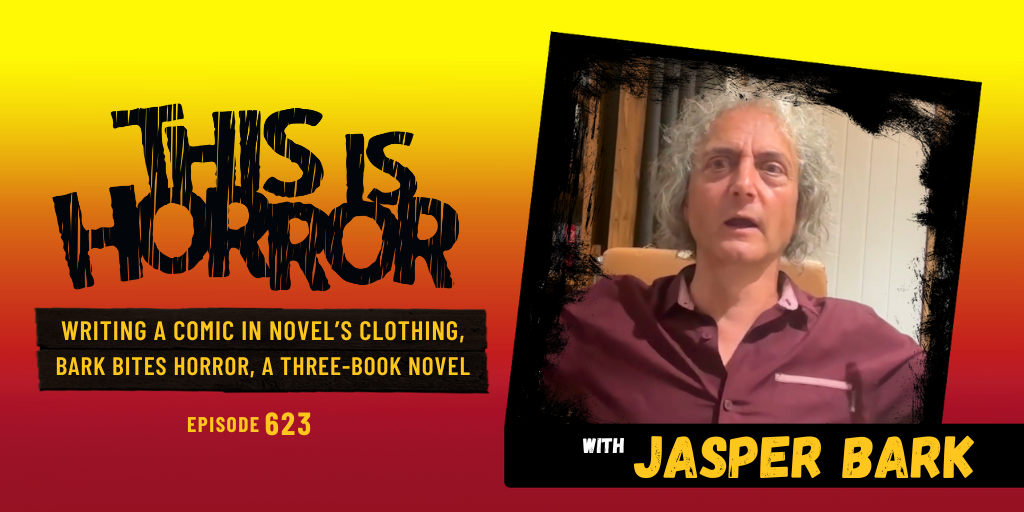
In this podcast, Jasper Bark talks about writing a comic in novel’s clothing Bark Bites Horror, writing a three-book novel, and much more.
About Jasper Bark
Jasper Bark is an award-winning novelist, children’s author and comic book writer. Famed for his imaginative storytelling he’s published four novels, twelve children’s books and countless comics and graphic novels. His work has been translated into nine languages and is used in schools throughout the UK to improve literacy. He regularly performs his work all over the country, on the radio and through regular podcasts.
Show notes
Click the timestamps to jump straight to the audio.
Thanks for Listening!
Help out the show:
- Support This Is Horror on Patreon
- Listen to This Is Horror Podcast on iTunes
- Listen to This Is Horror Podcast on Spotify
- Rate and review the This Is Horror Podcast on iTunes
- Share the episode on Facebook and Twitter
- Subscribe to This Is Horror podcast RSS Feed
Let us know how you enjoyed this episode:
- Leave us a message on SpeakPipe.
- Write a comment below.
- Tweet us @thisishorror.
Resources
- Jasper Bark fiction
- Watch the video version of This Is Horror Podcast episodes, including our conversation with Chuck Palahniuk on YouTube.
The Girl in the Video by Michael David Wilson, narrated by RJ Bayley
Listen to The Girl in the Video on Audible in the US here and in the UK here.
They’re Watching by Michael David Wilson and Bob Pastorella
Read They’re Watching by Michael David Wilson and Bob Pastorella right now or listen to the They’re Watching audiobook narrated by RJ Bayley.
Michael David Wilson 0:20 RJ Bayley 1:47 Bob Pastorella 1:55 Michael David Wilson 3:05 Michael David Wilson 3:56 Jasper Bark 4:24 Michael David Wilson 8:24 Jasper Bark 9:09 Michael David Wilson 10:55 Jasper Bark 11:45 Michael David Wilson 18:00 Jasper Bark 18:21 Bob Pastorella 19:06 Jasper Bark 19:08 Bob Pastorella 19:15 Jasper Bark 20:29 Michael David Wilson 20:38 Jasper Bark 21:37 Michael David Wilson 26:08 Jasper Bark 29:47 Michael David Wilson 32:55 Jasper Bark 33:48 Michael David Wilson 33:50 Jasper Bark 34:06 Michael David Wilson 36:09 Jasper Bark 38:50 Bob Pastorella 40:14 Jasper Bark 41:48 Bob Pastorella 41:51 Jasper Bark 41:59 Bob Pastorella 42:57 Jasper Bark 43:16 Michael David Wilson 44:59 Jasper Bark 45:11 Michael David Wilson 45:56 Jasper Bark 46:47 Michael David Wilson 49:32 Jasper Bark 50:19 Michael David Wilson 54:33 Bob Pastorella 56:23 Jasper Bark 56:59 Michael David Wilson 59:01 Jasper Bark 59:19 Michael David Wilson 59:24 Jasper Bark 1:00:23 Michael David Wilson 1:02:08 Jasper Bark 1:02:30 Bob Pastorella 1:04:21 Jasper Bark 1:05:22 Bob Pastorella 1:06:37 Jasper Bark 1:06:45 Michael David Wilson 1:08:06 Jasper Bark 1:08:18 Michael David Wilson 1:09:09 Jasper Bark 1:10:00 Michael David Wilson 1:12:12 Jasper Bark 1:13:42 Michael David Wilson 1:16:14 Jasper Bark 1:16:47 Michael David Wilson 1:16:53 Jasper Bark 1:17:04 Michael David Wilson 1:17:11 Jasper Bark 1:18:53 Michael David Wilson 1:22:05 Jasper Bark 1:22:38 Michael David Wilson 1:25:01 Jasper Bark 1:25:40 Michael David Wilson 1:25:46 Jasper Bark 1:25:53 Michael David Wilson 1:26:55 Jasper Bark 1:27:06 Michael David Wilson 1:27:52 Jasper Bark 1:28:00
Welcome to This Is Horror, a podcast for readers, writers and creators. I'm Michael David Wilson, and every episode, alongside my co host, Bob Pastorella, we chat with the world's best writers about writing, life lessons, creativity and much more. Today is the second part in our draw you in conversation with Jasper bark. Now for those of you who didn't listen to the first part and who are unfamiliar with Jasper, let me catch you up to speed. Jasper bark is an award winning novelist, children's author and comic book writer. He is famed for his imaginative storytelling and has published four novels, 12 children's books, and countless comics and graphic novels. His work has been translated into nine languages and is used in schools throughout the UK to improve literacy. So with that said, we're going to take a quick advert break and get on with a conversation with Jasper bark.
It was as if the video had unzipped my skin, slunk inside my tapered flesh and become one with me.
From the creator of This Is Horror comes a new nightmare for the digital age. The Girl in the Video by Michael David Wilson, after a teacher receives a weirdly arousing video, his life descends into paranoia and obsession. More videos follow, each containing information no stranger could possibly know, but who's sending them and what do they want? The answers may destroy everything and everyone he loves. The Girl of the video is the ring meets fatal attraction for iPhone generation, available now in paperback, e book and audio from the host of This Is Horror Podcast comes a dark thriller of obsession, paranoia and voyeurism. After relocating to a small coastal town, Brian discovers a hole that gazes into his neighbor's bedroom every night she dances and he peeps same song, same time, same wild and mesmerizing dance. But soon Brian suspects he's not the only one watching. She's not the only one being watched. They're Watching is The Wicker Man meets Body Double with a splash of Suspiria. They're Watching by Michael David Wilson and Bob Pastorella is available from this is horror.co.uk. Amazon and wherever good books are sold.
Okay with that said, Here it is. It is Jasper bark on This Is Horror. You
so draw you in is a free book. So though I believe that it originally was going to be one, so I wonder, at what point did you realize this book was going to be much longer than you'd anticipated? And also, what is the final word count, and how does that break up for each book,
The Final Word Count is just under 300,000 kind of like words, I think it works out of Roughly something about 8585 and then 120k words per book, and it was getting towards the end of the first draft, when it seemed I was going through a period as a writer where in the beginning of my career, I think I mentioned I was a bit of a hack, and I was grinding out the. Uh, comics, and then later on, novels, for shared franchises and for existing franchises, everything from Saturday morning cartoons to video game worlds, and you had to kind of write those absolutely 100% to a word count. And I became very good at doing that. And then when I began to do my own stuff and kind of let my mind expand a little bit and create my own universes and my own franchises, I became increasingly unable to keep to a word count. I thought it was going to be 100 220k That's why I pitched it to my publisher as and when I got to the end of the the first draft, it was kind of getting close to about 170 180k and I also realized it was one of those books that you get into the first draft and you realize all the things that you should have put in the first draft, you've been keeping notes, and you realize actually it's, it's the story is actually way longer even than the first draft that you've got. And at that point, I had to go back to Crystal Lake and say, This book's not only going to be a little bit later than I originally promised you. So could we revise your publishing schedules? But it's not going to be one book. It's going to be three. I wrote at that point to do all the things I needed it to do, and to cover all the ground I needed it to cover. It was going to have to be three books. And because Crystal Lake are such an amazing publisher of such a great people to work for Joe meinhardt, the then editor in chief now, kind of like general head honcho and publisher, was a total sweetheart. They he pulled it from the existing schedules, he revised the schedules, and he gave me, like, an extra year and a bit to to rewrite the whole thing again from scratch as three books. And even gave me a new contract, which is not common in publishing, but they it happened to be very fabulous people to work for. So yeah, at that point, I think it was just one of these stories. It was a bit like in those old hoary 1950s movies where they get like a tiny piece of plankton or a single amoeba, like in a petri dish, and then they irradiate it, and the amoeba just keeps growing and growing and growing. So eventually it takes over the entire city of Washington. And you know, all kind of part of the whole eastern seaboard is now just one giant, massive, unicellular being. I was kind of experiencing that in most of the things that I wrote. Round about that time, I'd sit down to write a 5k short story ended up being a novella, and it just wouldn't stop growing. And this story seems to have been the apotheosis of that moment. I wanted to write one book, and it ended up being three. For those of you who aren't listening at home, I'm holding up all three books to kind of just as a kind of piece of absolutely egregious product placement. In case, at this point, we hadn't worked out. I'm desperate to sell these books and dig my way out of the debt that comes, unfortunately with working full time as a writer. And
I think it's very important to emphasize too, that these are free books, rather than three novels, in the sense that the story is incomplete until you get to the final one. So very much a kind of risky move for traditional book publishing, but also very apropos when you're essentially writing a comic. And I mean, we all know the phrase a wolf in sheep's clothing, but I can't decide, is this a novel in comic clothing, or is this a comic in novels clothing?
It might be slightly the latter, because the works of our old Carver, there is a sentient comic in the in the the the actual storyline itself. And I had to replicate the comic strip page as a as a work of prose. I did that effectively, kind of, by using the concept of a comic script. So certain passages in the novel when we actually deal with what's happening in a comic strip are kind of like a prose adaptation of what comic strip looks like, and it is a way of putting a comic strip on a page without any pictures you. So you provide the pictures so it's not dissimilar. Certain sections of the book could potentially be handed to an imaginative comic artist, and he could draw a thing from it. So I was kind of marrying a lot of different mediums together, and one of those is marrying the very visual medium of a comic script, which isn't that dissimilar in some ways, like to a screenplay, and bringing that to life on a page is a piece of prose. So hopefully, when you're reading in the same way that often, most people visualize the events they're seeing on a page almost as a little movie, which plays in our mind at certain points, though, I want you to kind of see it, either as animatic or directly as a comic strip page. So you'll be reading a piece of prose, but hopefully in your mind, you will have like a comic page or a comic strip running in your mind.
Yeah, and those kind of sentient comics. I mean, there's so much I'm trying to think, how do I actually talk about this without spoiling it? But it is so satisfying to read, because those sentient comics have a great sense of right and wrong, and let's say that characters that you think are completely abhorrent, and you know, you're like some something has to to happen to them. Oh, that that comic will provide so that, I mean, that they're, in many ways, some of the most satisfying passages from the entire three books.
Thank you. Yeah, because each book has a to kind of to go back to the whole one of the ways this developed into the book it was I started like with the kind of Herbert model, as I mentioned in the previous episode. And one of the ways this eventually manifested itself was through the draw you interludes. And this was a technique I borrowed from a writer who's really fallen out of favor now, the comic writer and novelist Neil Gaiman, not making any defensive his actions, but I did borrow a literary conceit he has in many of his stories. He stops the action midway through the story, and has a little short story within the story, which sums up all the themes of the larger story. And effectively, I was doing that with three interludes that draw you interludes, which is where I kind of play with the comic idea. Each one of those also, each one of those stories is an homage to there is a story within a story, and there's a dialog between a kind of like the kind of the exterior story and the interior story. So although this story stops and is a story within a story, there's a story within a story, within the story, and the two have a dialog and eventually end up beating each other, quite literally, this will all make sense when you read the book. And also, as you mentioned, I was addressing social themes, which are very unfortunately prevalent within the world of comics, I mentioned Neil Gaiman for his sexual predatory behavior. This book came out before all this came to light, but actually that was one of the themes that I actually address in the draw you interludes. Unfortunately, there have been a lot of very high profile comic creators, and Neil isn't the only one who have acted very, very poorly in a very sexually predatory manner. And so that was one of the themes I wanted to address. There's also kind of like copyright theft, the way that many of these creatives have created multi billion dollar IPs and profit in no way whatsoever at all, and in some cases, have had these illegally stolen from them on the the most like flimsy of conceits, but because it's one individual who spent their entire life living a hand to mouth exist as A creative up against a multi billion dollar corporation they've never retained or retrieved the rights to these IPs, which are still making billions of dollars to people. That was another issue. And also there was an issue called comics gate, where there were a lot of intensely dislikable individuals who were trolling any female or minority individual who works within comics, these were kind of behaviors I didn't like, so I kind of addressed them as a horror comic would address them. And one thing about the EC horror comics, and in fact, even things like creep show, which, again, was an anthology horror movie based around a horror comic. So that will be another like touchstone for for for draw you in. King did say that creep show comics are moral comics, and there's a big, strong moral contingent, although this big Conti cruel going on, a character does something absolutely horrible and then gets a very satisfying comeuppance at the end of it, and usually so I use those kind of conceits to address those social themes. But also, each one of the stories is is an homage to a classic horror story. There's the Yellow Wallpaper is one. There's the by Charlotte Perkins Gilman. There's the incident Owl Creek Bridge by Ambrose Bierce. And there's also the tell tale heart. This is some of my favorite classic horror stories. And also horror comics have traditionally ripped off either literary or pulp source material and wholesale stolen stories from them, and kind of dusted them off and presented them famously Ray Bradbury, noticing that EC horror comics had actually stolen a couple of his ideas, wrote to them and said, I think you might have overlooked to actually pay me for those stories of mine that you used, and because he did it in a very cool, extremely nice way. They kind of like fessed up and went, Yeah, sorry. And from there on in, they actually paid him a little bit and actually directly said they were borrowing his stories. Years later that somebody, the writer, Bill man low, stole Harley Nelson script for the out limit story, a Demon with a Glass hand. And actually did that exact same story in, I think it was in a either a hawk comic. And again, Harlan Nelson found him up and went, hang on every minute. That's my story. And Jim shoot at the time. Went, Yeah, Holland, it is I'm terribly sorry. Please don't sue us. And Harlan being an absolute sweet I went, No, I won't sue you. I just want you a to every single time that's reprinted from now on in I want you to actually say it's my story that you stole. And B I want you to send me a copy of every single comic that you print for free, which they did for the rest of his life. So there was kind of a history of so I took these stories which were in the public domain, and I don't steal the plot. I actually riff off it as well. In those draw your interludes, which are also the interludes, which, as we mentioned, replicate the comics medium in a prose form. And hopefully, if you're listening to this and you haven't read the book, should be going, this sounds interesting. This has peaked my interest, and I'm somewhat intrigued. Do be intrigued, and do go and check these out, and
in, telling us the reaction from Ray Bradbury. I thought, yeah, that, that sounds about right. But when, when you mentioned Harlan Ellison, I thought, oh, did somebody end up dead? That was a very restrained reaction from at least kind of the the legend and the myth of Harlan Ellison,
he could be a sweetheart as well, apparently. And Jim Shooter, they had him to bang to rights. Unfortunately. Bill mantlow, the writer did, was guilty of plagiarism a few times in his career, and the only reason, apparently, he didn't get the sack was because he had friends kind of higher up in the Marvel hierarchy, Jim Shooter wanted to sack him and never use him again, but he had friends upstairs above Jim shoot his pay grade, who said, No, we're going to keep him. And Harlan was a sweetheart, and Harlan was a big comics fan, which is why he'd found out they'd stolen his story. And the idea of getting free Marvel Comics for the rest of your life
to use it to his advantage. Yeah, I mean, I don't all
of those kind of, like, just in a single year, it's gonna get paid way more than they would have paid him just for a single script. So, yeah,
I mean, and that's, I mean, I think we've all seen the video of, you know, Harlan talking about how they wanted him to do something for the for one of the series of the, you know, thing was Babylon five, or something like that that he wrote on, or something like that. It's like, hey, yeah, we want to do for the DVD data. Can you write up something? And he was like, Yeah, sure, pay me. And they're like, Well, we were hoping you could do it for free. And he's like, for free, fuck you, you know, I'm not doing it for fucking free. I'm a writer. You pay me. You pay you pay the guy who did the shit, right? Yeah, you're gonna pay me, you know? And they're like, Oh, well, you know, we're not gonna do anything. He goes, Yeah. He goes, always get paid. That's what you do, you know. And so. So I'm surprised that you know that he was a sweetheart, but they probably once, he probably called him out on it. They're like, yeah, and then he saw a way that he could go. You know, I can get fucking free comics for life on this. Yeah, you're gonna send me a copy of every single comic that you put out for the rest of my life, I'm gonna put it in the storage bin. I was like, fuck yeah, I'd be in on that shit.
Yeah, I would, too. Not that I want anyone in Marvel comics to rip me off, because I don't think it quite Yeah,
yeah. I think again we said before that, I mean, this can appeal to people who don't really have an interest in the comics world because of how universal These themes are. And possibly the most affecting of these kind of interludes is the one to do with intellectual property, and let's say a company trying to get rights that they meant to have and then realize that they didn't have. And you know, it's shocking, it's corrupt, but it's unfortunately so relatable to nearly any big industry with massive corporations. I mean, yeah, you know what happens is, you know, to use words like abhorrent is really understating it?
Yeah, this is true. And thank you for saying that also people who don't like comics. About half the reviews on Goodreads on Amazon are on lines of people like, well, I don't read graphic novels and I don't read comics. But I was quite surprised to find this was very, very interesting to me. So that historic backdrop is, is there is an historic backdrop. It's something that isn't always covered in fiction. It's a new take, a new little world for you to explore. You don't have to be have like giant, long boxes full of mylar bagged comics in order to enjoy this. But yeah, that particular section as well is was also based on, again, experiences of friends and colleagues who run into trouble, man people who did own the rights to IPs, who did go up against large corporations, and they are prepared to act in terrible ways. This is a horror comic. Well, this is a horror story, excuse me not, horror comic about horror comics. And so I can kind of exaggerate a tiny little bit. People act just a little bit more horrific, I hope, than they would in real life. But yeah, I've heard, if you work in the industry for any length of time, you hear some intense horror stories about people's experience, and it is one of the reasons I actually invent a third in the world of comics. There are, like, American comics, there are two big publishers. There's DC and Marvel, which are now owned by much larger conglomerates. But there's kind of like a binary thing here. But in order to speak about some of these shenanigans without getting in to territory where I could be sued, I invented a third company called Fox comics. Or although I didn't invent them, I invented an alternate history where Fox, which used to be like the big rival to timely, which is, which was what Marvel was before it became Marvel and national periodicals, which is what DC was before it became DC, there was a third company called Fox comics. It was actually founded by the the owner of, rather the the accountant for Jack Leibovitz and Harry Donenfeld, who ran national periodicals, which became DC Comics. And he saw how much money they were making, and he so he went and set up his own comics, published to rip them off. And they were extant until the late 1950s when they went out of business. And in my alternate fictional world, they they carry on and become, like the third underdog, effectively. So there's, there's three big publishers, but that was a way for me to actually write about what it's like working as a creative for these large corporations. And like, one of the things you have to do, which always kind of chase with you is you work on a work for hire basis, so they pay you a big load of money upfront for this, but you sign away all the rights, and you get like contracts, which are like, like, 2030, pages. And you should always read your contracts, even if you don't necessarily know what everything means, and you should be Google. The terms, but at one point you there are several clauses which you can't get out of and can't cross out, where you sign away the moral rights to all of your creations in order to work for this company. And I've signed a lot of these contracts over the course of my career as a as a writer, and there's always, it always feels like an immoral act to sign away my moral rights. It's not something I've done in the last decade or so, but it always stuck in my throat, and the editor would always have to chase me, because I'd always like hover over the pen for about a week before I, you know, first posted back when I was first working as a comics writer, and then eventually scanned and sent it back in the last days of my work for hire in the fiction minds. And I guess some of that moral repugnance that I felt spills over and comes out in these books, you know, because we shouldn't have to do that in order just to kind of make the money to pay my mortgage and keep fitting my kids.
I think there's a real problem with contracts in not only publishing, but in wider industries. And I mean, anytime when you challenge a contract, you run the risk of just the whole deal is off, I mean, so I'll start with publishing, and then I'll get into the English language teaching in Japan industry. Yeah, that's right, all the employers that have been waiting for for 10 years for me to finally dig some dirt, presumably listening to every This is our podcast. That's where we're going. Today is the day. But in in publishing, you know, I've had times where I've nearly got a deal done, and then I've sent it to my lawyer to have a look at. And he's been like, look, you've got to get these clauses removed. Usually it's a clause that says, like, Okay, if anything goes wrong and we have legal action taken against us, you will pay, not only for your own, you know, lawyer, but you will pay for as as well. That's happened a number of times, specifically in AUDIO BOOK contracts. And you know, it's things that, even if it happens and it's out of my control, and it's like, Look, you, you can't sign that. So I've had times where I've lost like, 1000s of pounds because the the audio book just couldn't happen. And they're like, but, but if I sign it and then something happens, and I'm going to be 10s or possibly hundreds of 1000s of pounds in debt. So we know that there's, there's a minor chance of something happening. But you can't predict what somebody could falsely claim is the issue here and then with with the English language teaching industry in Japan, like I've noticed increasingly, that they're adding clauses in that just make me feel a little bit uncomfortable. So one of them is that, like, basically, at any time when you're teaching, the company could video or photograph you and then use that in their own promotional material. Well, kind of as somebody who's gone through a lot of contracts in publishing, it's like, well, hang on a minute. Now this is extra work. So if you're if you're using me to do a promo for your company, I should be paid. I should be paid more. That is an additional duty beyond teaching. But I mean, the reality is, there's enough people that will just sign it. So if I question it and I say, can we remove that there's no job. So if you want the job, you have to sign it anyway, even though you kind of know that what they're doing is completely wrong. And the problem as well, is often these jobs where they have these clauses in, you know, the people taking them, they're not rich enough to be able to take a moral stance. You know, I can't say, oh, I'm not going to do that, and now I have no money, and everyone's starving, and now I'm dead.
Yeah, that's, that's how I mean, I'm talking about, like, wrangling, about signing these work for higher contracts. I signed a lot because the choice was, Do I do something crazy? Creative that's incredibly close to what I want to do with my life and manage to pay on my bills and fulfill my financial responsibilities as a husband and a father. Or do I take a moral stance? And then every time it did stick my thought and I yeah, I occasionally you can question stuff, but sometimes you do need collective action. I've worked on publications like anthology publications where I've reached out to my fellow like creatives and said, there's this clause in our contract. This is wrong. If we all say, No, we can renegotiate that. And some sneaky little shit bag has gone back to the crazy game. He's been saying this behind your back, and then suddenly every single creative, rather than staying with me, is like run for cover. Who knew I wasn't need to do that? I found myself exposed, going well, and they're going well. Nobody else wants to sign it. And what are you doing? Getting in touch with affiliate creative should be bothering them. And I've had other things as well. Sometimes when I've challenged stuff, and the publishers have backed down and gone, oh yeah, sorry, you're right. Such as clause is like saying, well, we can, if we like, put this out, and then we want, and you will have to morally stand up in a court and say so if we call upon you, and I'm going, I can't sign this, don't be stupid. And they got, oh, yeah, sorry. Our lawyer put that in there. He's a little bit too over eager. We'll just take that out when they're questioned and challenged and when I have slightly, you know, better grounds to challenge them on. So, yeah, contracts, difficult, lying, irritating, things. I have to say, the publishers I'm working with at the moment, all the various different publishers, are far more ethical than that. And that's all these difficulties we're talking about. And this is somewhat we're going off on a bit of a tangent, although it did come up, because obviously I addressed these issues a little bit in the in the novels, but this is one of the reasons why, aside from the big tent pole authors that all publishers are chasing, you know, the James Patterson's, the JK Rowling's, the Stephen King's the only other people who are making any real decent money at publishing are the people who are now self publishing, and it's why most professional authors have at the very least a portfolio. They have things they publish themselves. They have things they publish with really good, independent publishers who treat them properly and ethically. And then occasionally, we still go and dance with the devil or the big mainstream where there's a contract full of clauses that you have to argue with if your agent doesn't argue it for you.
Yeah, yeah. And I should say, you know, most publishers, when I have raised things, you know, they don't drop you or withdraw the contract immediately. And I think you know definitely we have a right and almost a responsibility if we think something is wrong or a little bit off to question it, it'll usually be that things break down after like, you know, five or six times of going back and forth. And so sometimes you have to decide, okay, what is there anything that I can compromise here? Because if you raise, let's say, 10 points in the contract, then probably five of them, they'll automatically readjust to begin with, maybe from back and forth, you can get a further free or down, and then it's like, look, these two,
the I'm gonna have to live with.
You know they have, you know they have to stay. So do you want the money and to sign a little bit of your soul away? Or do you not want the money? And you you feel very good until you get ill, because you're male malnourished. And
that's a good tactic, and also it's kind of worthwhile, kind of like saying that there's a degree of compromise in every business. I was having a conversation with another creative early today, actually, a good friend of the friend that I lost. And we were kind of saying that in every job, no matter what you do for a living, all this bollocks about do something you love, you never work a day in your life that does a great deal of dog shit. I mean that, because 60% of every job, no matter what you do, involves drudgery, that we're talking about, you know, publishing and being a professional author. People seem to think that's a dream job where you just sit in some ivory tower and dream all day. There's a vast amount of like Georgia, there's a huge number of stuff, pictures you write which never get written, even. Mail is that you have to do it all the every every single job comes with a vast amount of admin and things you don't want to do because it's a job, because it's making you money. It's not a hobby. Once money gets involved, there's crap. You have to go and sit with your accountant. You know you you have to do project loss, you have to do your tax return. You have to chase people to do things for you. And okay, 40% of your job, that's the bit that actually creates the kind of value that you may or may not enjoy doing that. And if you're doing the creative profession, there's various different degrees of enjoying that, not enjoying that, invariably, you're only doing it because you can't do anything else with your life, because you're that Socially Inadequate. And then there's the 60% of it's a job. And everybody has this. It's a job element of their of whatever profession you go into, and the rich, hence, is why we've kind of sat here for the last however, many minutes, 1012, minutes, bitching about effing contracts on a This Is Horror Podcast and friends listening at home. This is the most horrific thing about writing horror professionally,
yeah, yeah. Really, it is horror. But I thought it was important to bring it back and to clarify that point too, because what I didn't want is for people to hear like, you know, you question things and you lose your contract, whereas the opposite should be, no, do question things, because, as you said before, if enough people do, then suddenly these kind of intolerable clauses would have To, by the nature, be removed. But you know, something you mentioned is, broadly speaking, these days, people seem to make more via independently or self publishing, and it's a very, very difficult one that a lot of people are grappling with at the moment, it's something we've mentioned before on this as horror before, because if you put something independently out, if you self publish it, then you will take a much greater percentage of every sale That is inarguable, but to have, like a massive platform to get the exposure, to get the marketing, you kind of mostly need a bigger publisher anyway. You know, there were exceptions to everything. So this is why, I think the hybrid model where people do a little bit of indie, a little bit of Trad, is increasingly becoming the norm, because to you know, 100% of nothing is still nothing. So I mean, for from for me, I'm a relatively early stage in my career. So I'm kind of doing this dance at the moment where I think if I could land with a bigger publisher, that would be ideal to kind of get that reach at least initially, and then, you know, I could pick and choose what's going to be independent and what's going to be with a mainstream publisher. And you know, you look at when these bigger publishers put something out, quite often, you go to the Goodreads page, the book's not even out yet. It's got hundreds, if not 1000s of reviews. I can't do that as somebody self publishing. I don't have that reach, and I unfortunately don't have that budget.
Unfortunately the Coronavirus that is that sometimes you put things out with a really big publisher, and a year later you go to your Goodreads page and you've got half the number of reviews of somebody who's like, who's self published entirely, just because you're with a mainstream publisher, they have a very limited budget and a very limited like window in their kind of like marketing schedule when they're going To push your book. And once that's done, goodbye and that could be a tiny budget and a tiny amount of time that they'll actually spend trying to promote your book, and then they've got another book coming out next week, and they've got to do all the marketing for that, and there's only two people in that department, and they're massively underfunded anyway. So unless your book is a surprise hit, that's you get a tiny little bit of time to push even if you were the huge f off publisher, because they're only the huge F of publishers are only really putting money into they'll choose, like, one book from a new publisher, new artist, a. Author that they think might do, one that they'd like to promote, and then their tent pole guys, which is where most of their budget is going, and everybody else that they publish, is just a crapshoot that might take off. It might not. Who knows
it's it's really kind of weird, because if you look at like the big publishers and stuff like that, and the things that get noticed. It is, it is a total crap shoot. You could sit there and you could spend, you know, five to six years of your life working on a novel, get, you know, submitting it, getting an agent, getting them to to, you know, find, getting a big four, Big Five publisher to pick it up. They put a marketing plan together, put you on a book tour and everything like that, and then you get nothing. And when you're reading, you're in, you get on social media, and some no talent influencer who talks to snails is getting a movie deal, and you're like, going, what the fuck have I just fucking done with my life? You should be happy that you wrote a book, yeah, and you got it published by Big Five publisher, and you need to be working on the next thing, because there's pot, there's a possibility that there's some guy, there's some person who works in the movies, who read your book that really didn't go anywhere. It's like going I want to make this into a movie. Who do I talk to to make this into a movie? I want to make this into the movie, you know. And it could be somebody big. It could be, I don't know. Ryan Coogler, I don't know. It could be anybody. It could be anyone. And then you're like, next thing, you know, you're like, yes. I mean, think about it. And it took a while for someone to make the ritual into a movie, but they did,
you know, yeah, but, but also
now, you know, Adam Neville is like, you know, yeah, he's got, actually, a couple movies out, yeah,
but you don't actually get, also, it's not often a life changing amount of money. Some, again, it's like some people, right? Well, they get a life changing amount of money for their first advance. The rest of us, you know, get like a six figure or not, sorry, not a six figure. The rest of us get, like about a four figure fee as an advance from a big publisher, and even if it gets picked up or optioned, only money you're going to make is in the option fee. You'll be offered lots of things at the back end, which will never happen. And it isn't a life changing amount of money. It's a nice amount of money. It's an incredibly fabulous holiday. It may be it's a new car, or, you know, you can build an extension on your house, but you're not, unfortunately, going to retire on it. The it's, you know, it's a third of an average annual wage is roughly what most authors get from an option, even from
you got to look at if you get a six figure deal. What a lot of people don't realize is that it's like you're getting a six figure advance. You're not going to get six figures at one time. You know they're going to break that up into multiple payments. Don't quit your day job
because, well, yeah, who whose careers have ended because they've been given a huge advance from a publisher, and the book hasn't done as well as it's thought, and from there on in, in the way, because publishing is a small industry, they become the writer who's who get, got the big advance and did not even, even if it was an didn't earn out, yeah. So that kind of like, sits against on your kind of balance sheet professionally for the rest of your life. And sometimes that's it. No other publisher will go near you because you have that giant liability. You cost this big name publisher way loads of money. And that's, I mean, that's one of the things that happened to you. George R R Martin, it's happened to friends of mine, but I mean, George R Martin, his career effectively stopped after the Armageddon rag, which didn't do anyone else was published, thought. And he had to spend, like, 20 years working in TV before a publisher would pick him up again and start publishing, and luckily, he wrote Game of Thrones, and the rest was history. But for the rest of us that could it could seriously go against your run career, if you don't make back that advance, if it's a recoupable advance, you're an even worse situation, particularly if you spend the money spend the money to say, by recoupable grants. A non recoupable advance means they just give you money and you run off to the bank with it. A recoupable advance means they'll give you the money, but if it doesn't make that back in sales there, they can effectively come back and take their money back off you.
Yeah, and in. The George RR Martin story as well, is a story in persistence and grit and just absolute resolution and pure
luck. And it's when pure luck meets great talent, right? Yeah, he is an amazing writer, and he was just really seriously lucky, which, which is kind of the secret. It's always you kind of go on author panels, and one of the questions that many, many, many people want to ask them is, how did you get this bigger success? And they always come up with, like, all sorts of, well, you know, I just kind of worked really, very, very hard, or I decided to follow my dream. I started to stop messing about, write the things I wanted to write, and it's and actually they're all talking on their backsides, bless them, because what they don't want to say is, I've got no clue. It was sheer absolute massive dumb luck. I wrote three books was tanked, and my fourth book, for some amazing reasons, sold incredibly well.
Yeah. I mean, the only thing I'd add to that is, the harder that you work, the more chance you have of getting lucky. You know, if you stop, if you if you give up, because it didn't work out, well, then it's definitely not going to work out. But if you keep writing, if you keep every time you write a novel, I think of it as a ticket to win the lottery. Yeah. So if you keep writing, if you keep buying these tickets, you might get lucky, but equally, it might never happen. So that's why, you know, I say, if you can find joy in the pursuit of writing itself, you win every time. And I think really, you have to do that, because there's no guaranteed financial success, so you might as well at least have fun doing it.
Yeah, I could not agree more. The reason for writing a book is not to like, retire or make loads of money. It's because you you really desperately wanted to see that story in print or upon a big screen, it haunted you, and you had to get out your system, and you had to do this thing. And this brought you joy that, and if you simply get down the story in the way that you want it in words, that is, that makes you a successful writer, and and that's all that makes sense, right? If you then get that story down in words the way you want it to into print and people begin to read it and discuss it, that's a doubly successful person, even if it's a tiny minority of people. And that should be why you're doing it, because at certain points in your life a particular given story or a book that you read either changed your world or saved your life or just brought so much pleasure to you and enhanced your existence that you want to pay that forward. You want to write that book that for one other person or for a large group of people had that exact self, same effect on them. So they will want to, if they have a literary bent, write their own books. Which will they will then pay forward and that. That's the success around writing, whether or not you make lots of money out of it is, you know, is a matter of luck and business sense. There is an equation which you know, preparation plus opportunity equals luck. So and that that's like the business side of it. But like, how much money you spend or how many books you sell is not necessarily a reflection of how successful you are as a writer in in the kind of like broad scale of things other than you. That means you're successful within the business of publishing. And everybody aspires, I think, who publishes professionally to have some success on that grounds. But that shouldn't be the reason you sit down to write. You sit down to write because you have something to say, you have a need to communicate, and you have a love of fiction in the written word, if you want to be a fiction writer to such a degree that you're compelled to write these things and to connect with other people, and that you want to create work that will connect with other people, irrespective of your audience size.
And so we've spoke quite a lot throughout the course of this conversation about, you know, the business of writing, it's kind of split into the pure joy of writing the story itself, and then the actual practical business parts that may or may not result in some sort of money. So I want to know, what are you doing in terms of the non writing or the writing. In tangental activities. And then how much you have, let's say a given week or a given month is dedicated to that. And how much does it differ based on whether you have or haven't had a book that's just come out? Oh,
yeah, it is about 50, 60% of my time is caught up in things like publicity and marketing, which involves everything from social media to running a newsletter to any online presence that you have, but on top of that, you're also appearing at conventions and other gatherings and sometimes putting your book into people's hands. So it's kind of a lot of being a professional author is a little bit like being one of those people who make artisan goods and have a website and sell them on a website and go to craft fairs and sell them at craft fairs. That's effectively the business model that that most authors follow. So I turn up the conventions and I have, like, you know, the smallest little table that I can effectively afford, and I have to sell X amount of books to pay for my hotel room and the price of ordering the table, and then anything else is hopefully profit, but also it's a profile Raising. I spend time doing a lot of press and interviews like this one, where I am selling a book, subliminally by this book. And on top of that, I'm when I got into publishing about 2025, years ago, the key thing that you needed was a contact book. You need to know people in the profession. It was about, all about who you knew. So your job was to know people. So you network like a like a mother in any possible availability. But it was contacts within the profession, these, that was like your big asset that you could leverage these days. Actually, it's kind of the reverse. It doesn't really matter who you know within the publishing industry. What you need is to demonstrate a certain readership. So you spend a lot of time engaging with people through whatever platform, whether that's meeting them at conventions, whether it's spending a lot of time on whichever social media platforms work for you, writing a blog, updating your website, keeping your mailing list going, doing videos. That's all about engaging with people and building an audience, and that is in that involves engaging with the people who read your work, who might read your work, who've been meaning to read your work for the past three years, and just need one tiny last little prod to get them to go and buy your entire back catalog, so that that kind of is and on top of that, obviously, there's all the business with corresponding with the Various people who publish and sell your work and when I work with independent publishers, or the odd occasions when I take all full control of the process myself and get involved in publishing it myself, then you've got to do all the other business things, from getting an ISBN number to commissioning artwork and a lot of the publishers. Now I have to I, because I've also worked as a professional copywriter. I have to write my own book blurb. I get quite heavily involved in, like the covers and the cover image, working with the artist and blah, blah, blah, blah, blah, all of that. So that involves a vast amount of emails and admin and engagement, talking to other people, which is like, just like a part of anybody else's job. You know, if you were working in retail, you'd be doing that, standing behind the counter, talking to people, and then you'd be doing your invoicing afterwards, and your stock taking, and that's kind of what I have to do that. So, yeah, it is that's like the job element of being doing this is professionally,
yeah, I tend to find that the job is having multiple jobs at once, you know? I mean, if you you look at a lot of other jobs, I mean, if you're an accountant, you are an accountant. That is the job. If you're a lawyer, you're a lawyer. But increasingly, these days, and it depends which publisher your. With. But I mean, if you were just self publishing, then you are, you are the writer, you are the advertiser, you are the marketer, you are the accountant. You might be the lawyer. To some point depends how much you know, experience and money you have as to how much of that you deal with, and as has often been said, even if you're with the most kind of resourceful, richest publisher, you're at a very minimum, as well as the writer, kind of the promoter. You know you're doing the publicity, because the publicity too, that's not like, you know, they can't get a stand in for you. I mean, there's an argument sometimes with political leaders that they do, or their partners have a stand in, not to name anyone, but you know, as the author, you can't get the other Jasper bark, or at least that's what we think one convention we're gonna see. It's John bark. Here he is the identical twin, the crazier brother. You know Jasper was a mad man. You ain't met John yet. Good God, absolutely not.
Reminds me of Gallagher. You know, the comedian Gallagher, the Smash O Matic and all that. You know, he had a brother who did the same thing. Wow, really, yes, he really did. I think it there was, if I remember correctly, and I may be misremembering this part, but I believe that they sued each other. So that's some crazy shit. I think Michael's looking it up right now. Oh, yeah, let me look this up.
Well, that's also kind of quite we're talking about that there is fascinating short story by Jorge Luis Borges, who is an Argentinian literary writer of intense imagination. And he wrote a story about the other Borges, and he keeps reading in the press about this Baucus, and he walks into bookshops and he sees this. Baucus has written books that have his name on them, and effectively he's talking about it's a fascinating examination between the public persona and the actual person, and we will have a strange even ourselves, who are intensely minor public figures. I think if you Google us, it does have public figure next to our name, but we know, as far as public figures goes, we have a very small public but even still, there is a weird relationship between you as your publicly perceived, your public persona. And sometimes, you know, you drop in on threads where people are discussing your work or your activities, and you kind of read, you quietly lurk and read them all, and you think, Who the hell are they talking about? People you've you've never met, heard of, or didn't think you're connected to on any social media, are discussing this character, bark or Jasper. And you think, really a some of the time you sound like a twat. And you really think, I wouldn't want to spend any time with this idiot asshole, Jasper, bark, and other times think, oh, it's quite strange. How amazingly prescient. So we all have a weird relationship between this doppelganger that is our public persona and ourselves, who perhaps might be a lot more spotlight shy than our public facing persona,
and that's why I've retreated to Japan. If I was in kid aminster rugby, the talk of the town couldn't get past anyone. Probably the talk would be like, you've completely disparaged that town in a couple of books, and we now want to kill you, but
dragging the good name of Kitty minster through the dirt at that.
Yeah, it's okay, though, people from Kid and minster don't fly to Japan, so I'm safe here. You know, um, something you mentioned before was how Walt and Louis Simonson, they appear in the novel, and you actually did a round robin for this, and anything they said could then influence the direction of the book. So I wondered if you could speak a little bit more about logistically, what that looks like. Can. How much were they given in advance? Did they read the parts before they showed up? Did they read everything? Were they given a briefing card? And was this round robin, quite literally, in real time? And how did it affect, you know, the course of the book.
It was slightly longer with Walt than it was with Louise. With Louise, it was more like a kind of like an email exchange. We would email it to the backwards and forwards, and then a day or or so later, one of us would respond to the other as the character was talking with her and with Walt as well. Walt actually works for Fox comics, the publisher who in this alternate history of the novel, is still publishing so I actually went back to their golden age, 1940s and 50s characters, and decided that those were IPs. They would have continued to the present day. And Walt and I had a big conversation, given his career and the things he likes to work on, if he was working for Fox comics, which one of their characters would he have worked on, and we kind of went through all their characters, all of whom are in the public domain, and he has, like an artist collection of working on this character which doesn't exist. He never worked on that character, but in this alternate universe, he did. And I told them a little bit about their relationship with Linda, but in order that they actually respond naturally, I didn't tell them very much. This is a friend of yours who does this, and she's been working on this, and she knows you from this, and then we took it off from there. So it wasn't until they actually got the novel in their hands that they worked out why their friend was acting in this rather bizarre and foolish manner.
That's amazing. And is it something now that you've done it with this novel, that you kind of want to do in other novels, or if you scratch that itch for the time being, and you don't need to bring other people in. We're not going to see David Moody show up at some point or Ray clearly stumble in.
It's, it's funny, because we all sort of occasionally, like borrow our friends names to and I've, you know, another run to ground with another short novella that I wrote, I named a lot of the characters after prominent people in the in the in the horror world, just for pure fun. I've certainly people have borrowed my name and met me and their stories as well in the past. But yeah, work bring people into an office. It's interesting. Walt and Louise had a huge fun doing it, and they said, you should get loads of people in to do this. And should we invite so and so and so and so? And I kind of thought that will be logistically very, very hard to start taking my novel in different directions. It was a it was a one of a series of kind of, forgive me, using the word literary for a piece of Pulp Fiction, perhaps with a few literary aspirations, but it was a literary experiment that I tried. It might be fun to try again, but I think it would depend upon the work. This worked with this work because it tied into the themes I was exploring in the wider story. If I go back to that theme and can find another interesting, a new way to do that, then definitely I'll do it. But if I don't, then I probably won't. And also it's one of these things. Now I've done it. I'm sure lots of the people would do it, and as is often the case with these things, I'll have done this. And like, you know, 567, years from now, if somebody else would do it, never we go, Oh my God, what an amazing idea. That person will make vast amounts of money off it. And people believe my work and go, Oh, he's just ripping off that person.
It reminds me of that scene in that Rodney Dangerfield movie Back to school. I don't know if you've ever seen it or not. I haven't actually yet, but, but yeah, it was done when, when Rodney was in his heyday, and one of the the gags that they did was he had to go back to college and but he was a wealthy man, and he hired, he had to write a paper about Kurt Vonnegut, and he hired Vonnegut to write the paper, and that he then he got a C on the paper, which is, and Vonnegut's actually, in the movie, is like he's, you know, because. Is like, he brings the paper to him, you know, it's like, the actual folder, you know? So it's like, yes, hey, you know Rodney day, well, you doing, you know? It's like, it's actually very funny scene. But I always thought it was hilarious that he actually made like a C on the paper. It's like, finally, get wrote the paper and got a C on it. Of course he did.
I have a friend who's a Well, I had a friend, he's passed away quite a few years back, called Adrian Mitchell, who was a well known British poet. He was part of the Mersey beat scene degree as well, and he'd always asked that his work not be used on exams. And it were one of his poems was chosen to be on GCSE, which is like a qualification you get in the UK at age 16, and they chose it, and the papers were printed up. And he found out about this, and he said, Actually, I have actually got a moratorium on that. Please don't use it. And they said, we kind of printed them all up now, and we can't really recall them. Why don't you come and sit the exam? So he sat down, and at that point, is what it was all about. What do you think the poet was trying to say this part? So he sat and wrote exactly what he was saying, and he got an F. He actually failed that exam. So the whole exam was about what he would say when the poet sat there and told them what he was trying to say, his examiners failed him.
You know, folks, sometimes the curtains are blue. I mean, they're just really, they're just blue. That's crazy,
but the thing is funny, good, would probably have gotten a D, yeah. But then also, that also kind of goes back to things like, you know, the death of the author. I remember having a big conversation with Robert Sherman, is fantastic writer and also script writer, and he'd been invited out to this Estonian literary conference because they loved one of his stories. And they were sitting down going, I loved the story. It is all about this. And he's going, No, it's not like, no, no, it is like a heady paper. It is all about and he was like, No, it's not. And he had this stand up row with all these academics who were trying to give him this award for this story, which they loved, because they knew it was about this, and he knew definitely wasn't about that whatsoever at all. And the fact the matter is, is one of the things you learn as a writer is you have no control over how your story will be received and what people will think about it, which is what Bart was talking about in the first place, with the idea of the death of the author. Just because you wrote it doesn't mean you actually necessarily know what it is or what it will mean to everyone as apart from you, you're just the first person who read that story and your take on it, what you perhaps thought you might be doing may not be how it will land with anyone else.
And then it was Kathy Koja who said, early on in her career, she learned just not to correct any take that a reader. Had I
heard that hard there was, she was talking about this reader came to an event she was at, and they discovered this mythical, like predecessor to her story, the cipher, which was she wanted to call the glory hole. And this, this person was saying, you meant this, didn't you? We're talking about this, and she was going, no and looking back now she she thinks she says in the podcast, and I wish I'd been a bit more sympathetic and had understood that my view is not the kind of last final word on my work, which I think we all learn and then discover and that's one of the joys and one of the many burdens you have to carry, as well as an author, yeah,
and the kind of simplified version of this is when Sean Hudson was on the podcast, and he said, you know about the movie adaptation of slugs. He said, Well, if people say it's good, he's like, Yeah, well, of course it's fucking good. I'll write the book. And then if they say like, oh, it's not good, he's like, Yeah, well, it's not the fucking book, is it okay? Thank you, Sean, yeah. Sean, was a trip to have on the podcast. I remember when I asked him what, what the low point of his career had been. And he said, Well, apart from sitting here talking to you, Michael, I.
Well, this, this is definitely the apotheosis of my career coming on here, talking with you two gents about draw you in, which I would like you all to buy. In case you haven't guessed by this point in the podcast, yeah, actually, I have to confess as well. Sean Hudson is like the ultimate kind of guilty pleasure when it comes to kind of reading, kind of like Paul horror, I can't quite I've never really liked guy N Smith, even when I was kind of like 12 years old at first encountering his work. And forgive me, if you do like Guy N Smith, I'm sure there's many of the things we agree upon. But yeah, Sean Hudson, you could say, or any you could level any manner of criticisms against his work. Richard Damon's another author like that, and I'd probably have to agree with you on a but at the same time, I take a tremendous kind of pulpy pleasure, I think, as well, also one of the things, perhaps again, all three of us as authors have in common that we do have some literary aspirations. We do have some understanding the mechanics of literary conceits. We do know how to use them in our work, but at the same time, we love the visceral thrill of absolute pure pulpy goodness, as put up by people like Sean Hudson. And it's It's wonderful if you can write work that spans that entire divide. I don't know if we can successfully. And all too often, you kind of fall between two stools. And when I say the word stools, I'm not talking about things you sit on and plummet into the abyss of kind of pure pretentiousness, because you fail to land on either things. But occasionally it's kind of nice to span that divide, to write something that does have some literary merit, and at the same time has exactly the same visceral thrill as reading slugs or assassins or any number of Sean Hudson books that I tend to hide when my black turtleneck wearing little rods literary friends come around to visit. Oh, I don't know where that got on my shelf.
Yeah, I think you know, it's about kind of with literature as well, knowing the rules and then consciously deciding to break them. You know, I, I know how to structure a piece of literary fiction, but sometimes I just want to write a novel about seven like minded blokes who want to get their dips out on naked attraction. And that's fine, too. And you know, on the note of guilty pleasures, I've been saying for a while now, and probably because the professors at university did put this idea of guilt and shame, and you don't want to be reading that. So my kind of reaction is, there shouldn't be guilty pleasures. It's like I can read something and know that it's not like a meticulously crafted literary novel, but I can still say I enjoyed the hell out of it. Just like with music, there's some kind of hardcore, metal or punk that I'll listen to, and I know that it's not as intricately put together as like, let's say, some prog rock, but I still enjoy the hell out of it. So, you know, we should remove guilt from our pleasures, and then all we're left with is pleasure. And doesn't that make for a wonderful world?
It's like a really good diet includes, on the one end, you can go and have like a three Michelin starred meal at an amazingly great restaurant. Other hands, you can have like a dirty, nasty, greasy pizza or a burger, and everybody and both of those things can bring intense pleasure to you, and I think a well rounded kind of diet should include them all. So you're reading matter. It's great to read, firstly, outside the genre that you write in, to read a variety of things. It's great to read writers who are fabulous technicians and amazing wordsmiths, but it's also great to just read absolutely mindless stuff, which brings you great pleasure. It's the same between you know, people who read like the ft and the economist at the same time, and maybe academic publications like The New York Review of Books will also sit and scroll through pictures of cats on their phone. No difference between doing that reading Jonathan Franzen or Victoria Egan or Dostoevsky or Virginia Woolf to reading a really trashy piece of fiction purely for the pure fun of it and. Um, both my children when they went through university, in order that they didn't stop reading, like many people do the minute they leave college. You look at their bookshelves and they're almost like frozen in aspect. They never read the book again because they've been forced to read books. I did, bought them loads of trashy rubbish to read in order that they remembered that reading was for pleasure. The first thing about a lot of academics is they forget that people actually read as a pure visceral pleasure, because it's fun, because they're reading for their job and they're reading to analyze stuff. So yeah, as my both of my children went through higher education, I kept giving them crappy trash to read that they would just enjoy, and we should all do that, that you should have a mixed and varied diet. It's perfectly fine to read Hello alongside to the lighthouse. Both are totally valid things, and it's perfectly fine to read. On the one hand, House of Leaves, and on the other hand, rats by James Herbert, or the sucking pit by Guy N Smith. If that gives you pleasure,
there you go. You've given me a good marketing idea. And I use the term good very loosely, but I'll just start turning up to graduation, yeah, turning up to graduation ceremonies specifically for undergraduates, and if I don't get arrested, then after they've graduated, I will hand them each a copy of daddy's boy, and then, since you gave me the idea, I'll give them a copy of draw you in, but only Volume One, because then they have to buy the other two.
So this is all part of my marketing scheme. Yeah, get them booked. But you
know, maybe loitering outside the graduation ceremony I might get arrested before I give them the books so.
But again, that could be great publicity, uh, arrested for giving away books at a university.
Yeah. What is this Russia? But, I mean, I yeah, I hope that everybody who has listened to this will go out and read, draw you in, and if for no other reason, then it will be like nothing they have read before. I mean, we said before, it's a very ambitious book. Is impossible to comp, as Bob said, and it's, it's really impossible to put in a genre because, you know, as you said, it jumps from genre to genre and back again, and it's just ambitious in its scope. The fact that you've put out essentially a 300,000 word novel. It works for those interested in comic books. It works for those who want to learn about it. It works for those who have no interest whatsoever. So for goodness sake, I mean, go out and buy the book. Thank you very much. Yes, please do. And you said that this is part of Bach by its horror. Not only did you say it, it slapped in the corner of each of the books. Yes, what is next from Bach by its horror? And then what? What is Bach by its horror? Are there horror books that you could write that would not fit into bark by its horror? Or does this mean any book written by you that is horror is automatically a Bach by its horror?
I think that if I was to write a book that wasn't bark by its horror, it would kind of have to be very either very cliched or very much in like treading the same old ground everyone does effectively bark by its horror, if you've got a jaded palette, if you've read Far too many books about zombie apocalypses or sparkly vampires, and you're fed sick and tired of all the old cliched tropes. A Special Forces person finds himself facing an apocalyptic landscape they have to fight their way across in order to go and save a member of their family, or a couple who have undergone a traumatic experience in their past move to the countryside and buy an old house in order to do it up to overcome their problems and start finding strange supernatural happenings occur to them, all those plots like Time War plots we see time and time and time again. If you're sick and tired. Of those. I want to find out where horror is going, where horror will be in the next 1015, years, then bark bites. Horror is where you go to for those with a jaded palette, who want to see horror 2.0 regened, retooled, reinvented, who want something they've never read before, that's what the series is there for. What's coming next? I there's a a weird Western called Dead scalp, which is, like no other weird Western you've read before, that's coming out in the end of August. A little bit later on, I have a Southern Gothic paranormal thriller called harmed and dangerous coming out at the end of the year. After that, I have a collection of four novellas, a new collection and a new book called The house that haunted trouble hunted. The house that hunted troubled soul was coming out in 2026 so those are the next five publications which are slated, kind of three quarters of those are written. So they're all and certainly obviously dead scalp and harm to dangerous are fully written and awaiting their slot in crystal lakes publication schedule. And yeah, so that's basically what bites horror is. It's the new stuff when you're fed sick and tired of all the old stuff and all the old ground that's been constantly re trod, when you don't necessarily want to see yet another virgin or someone who's just lost their virginity stabbed in the wood by slasher you want a new take. You want to see new horrors. This is why you check out the box bites horror series, and every single one of those novels is introduced by the cartoon version of myself.
All right, what a fantastic slate of forthcoming releases. And I mean, goodness the amount that you've got that are kind of either fully finished or a well on their way. How long, with the obvious exception of draw you in, which is 300,000 words. How long does it typically take for you to write a novel from kind of the initial idea to the ready to send to the publisher?
If I was writing to like the maximum profit yield I'd be working to like an MVP, a minimum viable product, which is kind of like that those who like churn out 30 or 40 novels a year tend to work to I have this unfortunate habit of writing my novel all over again. I get to the first draft, and by that point, I've worked out what novel I should have written. And now go back again and write all over again. So what I can usually aim to write about 1500 to 2000 words a day, roughly five to six days per week that actually does mean I turn out a lot of material by the end of the year, but unfortunately, quite often I have to go back and correct my mistakes and draft and redraft and redraft and redraft until because I'm a bit of a perfectionist, so that kind of works against putting out a minimum viable product, which is something I don't do so I can kind of do, like a novel, tuna fellas, and one or two other side projects, graphic novels and things, probably per year. But also the kind of strange thing is about publishing, you probably both know yourselves. Work tends to bunch you kind of work away on a kind of a steady scale. And some years it'll look like you hardly done anything whatsoever at all, and then other years it looked like you're ridiculously prolific. And that's just the vagaries of publishing and publishing schedules and the competition you have for publishing slots in your publisher's schedule, or whether you want to publish it yourself, and then take on board all the extra work involved with that, really. So, yeah, I am for about 1500 2000 words a day, and that that's works out about 300,000 words a year, which could be three books or other things, it will be a lot more if, yeah, if I wasn't so meticulous and perfectionist about polishing my work endlessly, and that's exactly how I polish it, just like that, I say. The right thing.
Well, I was gonna say that I'm very much the same, and I guess I am, in whatever way we're talking about, very meticulous. Do you like a good polish? And if I didn't, then I might get more work out per year, and people can interpret that however they wish. I And on that note, where can readers connect with you? Maybe I shouldn't ask that question on that note, unrelated. We don't need polishing places. Just where can people interested in your writing connect with me? Well, if
they want to see me polishing things, I do have an only fans page where I polish any number of things
I know, and you're very quick to respond to private messages on there too. You look after your fans.
I do indeed. But if they want to read my work or connect with me, do check me out on Jasper bark.com, I'm on most social media, from Facebook to LinkedIn. Still on zitter. It's now called x. Was Twitter. I haven't, unfortunately migrated there, but I'm not very active. I'm on blue sky. He Instagram threads, most social media. You can probably track me down. Haven't got a tick tock channel, but I do have a YouTube channel, but yeah, probably the best place to start is go and look for me on Jasper bark.com and also, I'm workbook sale on most platforms, from Amazon to Barnes and Noble or Kobo audible,
go check me out. All right. Do you have any final thoughts to leave our listeners and viewers with,
what talking about reviews. It was lovely of you to say my work was uncategorizable. One of the regular comments is that I've never read anything quite like this before, and the other one is, is I started this novel thinking, Oh yes, I know this is going. And within 40 pages, I realized I had no idea where it was going. And if you told me where it was going to end, I would never have guessed that. So again, is, this is work that will surprise you, catch you off guard and take you to places you would never have dreamed, because I've dreamed of them, and I have the complete lack of sanity to prove it, not to mention the gray hairs in places we can't mention
despite your continuous mentioning. And on that note, thank you very much for joining us.
Thank you so much for having me on. It has been a huge, huge pleasure.