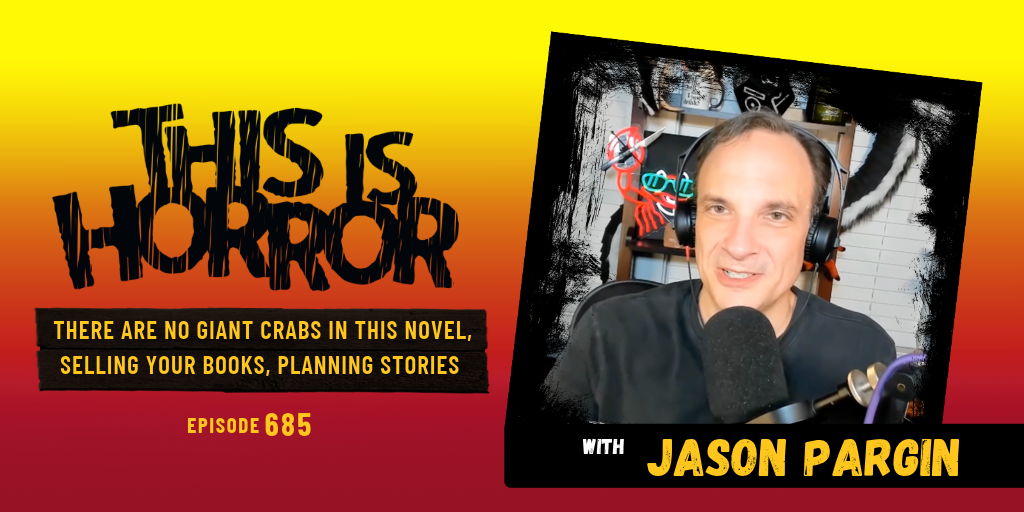
In this podcast, Jason Pargin talks about There Are No Giant Crabs in this Novel, selling your books as an author, planning stories, and much more.
About Jason Pargin
Jason Pargin is the New York Times bestselling author of John Dies at the End and the Zoey Ashe series. He is the former editor of Cracked.com. He’s just released his new book There Are No Giant Crabs in This Novel.
Timestamps
[3:10] Conversation start/There Are No Giant Crabs in this Novel (A Novel of Giant Crabs).
[15:50] Elevator pitch for There Are No Giant Crabs in this Novel.
[17:20] The genesis for the novel.
[21:25] Planning the novel.
[46:50] Jason could never write a book just for the money.
[50:05] What did Jason learn writing There Are No Giant Crabs in this Novel?
[1:01:10] What should authors prioritise putting money into in terms of promotion?
[1:18:40] When you sit down to write, do it because you want to bring a story to life.
[1:22:40] Connect with Jason Pargin on social media.
[1:24:15] Final thoughts.
Thanks for Listening!
Help out the show:
- Support This Is Horror on Patreon
- Listen to This Is Horror Podcast on Apple
- Listen to This Is Horror Podcast on Spotify
- Rate and review the This Is Horror Podcast on Apple Podcasts
- Share the episode on Facebook and X
- Subscribe to This Is Horror podcast RSS Feed
Let us know how you enjoyed this episode:
- Write a comment below.
- Follow us and get in touch on Instagram @thisishorrorpodcast
- Subscribe and comment on YouTube @thisishorrorpodcast
- Follow us and get in touch on TikTok @thisishorrorpodcast
- Tweet us @thisishorror.
Resources
- Jason Pargin
- Watch the video version of This Is Horror Podcast episodes, including our conversation with Chuck Palahniuk on YouTube.
House of Bad Memories by Michael David Wilson
From the author of The Girl in the Video comes a darkly comic thriller with an edge-of-your-seat climax.
Denny just wants to be the world’s best dad to his baby daughter, but things get messy when he starts hallucinating his estranged abusive stepfather, Frank. Then Frank winds up dead and Denny is held hostage by his junkie half-sister who demands he uncovers the cause of her father’s death.
Will Denny defeat his demons or be perpetually tortured for refusing to answer impossible questions?
House of Bad Memories is Funny Games meets This Is England with a Rosemary’s Baby under-taste.
Buy House of Bad Memories from Cemetery Gates Media
Buy the House of Bad Memories audiobook
They’re Watching by Michael David Wilson and Bob Pastorella
From the hosts of This Is Horror Podcast comes a dark thriller of obsession, paranoia, and voyeurism.
After relocating to a small coastal town, Brian discovers a hole that gazes into his neighbour’s bedroom. Every night she dances and he peeps. Same song, same time, same wild and mesmerising dance. But soon Brian suspects he’s not the only one watching and she’s not the only one being watched.
They’re Watching is The Wicker Man meets Body Double with a splash of Suspiria.
Buy They’re Watching in paperback and eBook right now.
Michael David Wilson 0:28
Welcome to This Is Horror, a podcast for readers, writers, and creators. I'm Michael David Wilson, and every episode I chat to the world's best writers about writing, life lessons, creativity, and much more. Today, I am chatting to Jason Pargin for the second part of our conversation about his brand new book. There are no giant crabs in this novel. He is the fifth John Dies at the End book. Now Jason Pargin is a video content creator. He is the New York Times best-selling author of John Dies at the End and a Zoe Ashe series, and he is the former editor of crack.com. And as I said before, he has just released a brand new novel. There are no giant crabs in this novel. A novel of giant crabs. So we will welcome Jason back to the show very shortly. But before that, a quick advert break.
Bob Pastorella 1:38
House of Bad Memories, the debut novel from Michael David Wilson is out now via Cemetery Gates Media. Denny just wants to be the world's best dad to his baby daughter, but things get messy when he starts hallucinating his estranged, abusive stepfather Frank. Then Frank winds up dead, and Denny is held hostage by his junky half sister, who demands he uncovers the cause of her father's death. Will Denny defeat his demons, or be perpetually tortured for refusing to answer impossible questions? Clay McLeod Chapman says, "House of Bad Memories hit so hard you'll spit teeth out once you're done reading it." House of Bad Memories by Michael David Wilson, available now in paperback, ebook, and audio. From the host of This Is Horror Podcast comes a dark thriller of obsession, paranoia, and voyeurism. After relocating to a small coastal town, Brian discovers a hole that gazes into his neighbor's bedroom. Every night she dances and he peeps. Same song, same time, same wild and mesmerizing dance. But soon Brian suspects he's not the only one watching, and she's not the only one being watched. They're Watching is The Wicker Man meets Body Double with a splash of Suspiria. They're Watching by Michael David Wilson and Bob Pastorella is available from Disashora.co.uk, Amazon, and wherever good books are sold.
Michael David Wilson 3:01
Okay, without said. here it is. It is Jason Pargin on This Is Horror. So let's talk about your new novel. There are no giant crabs in this novel. A novel of giant crabs.
Jason Pargin 3:23
So yeah, book five in the John Dies at the End series. That if you are new to the series, you don't have to have read the other four to have read this one. They're all self-contained books. They're all equally confusing. If you read the first one, it you're gonna you're still just gonna be thrown into the middle of a universe without much to to prepare you for it. So if you start with book three and it's like, well, I'm kind of lost. None of this makes sense. What the hell is going on? It would you would feel exactly the same if you read them all in order. So it doesn't it really doesn't matter, but yeah, it book five in theory can be read in any order. In reality, I've been writing these books for if you start when I first came up with the characters, coming up on 30 years, because I the the basic ideas for it are things that I came up with just out of high school back in the olden days of the late '90s, but yeah, and it's the the thing that I'm having I'm being forced to mention is that the audio book and the ebook came out or on november 3, the hardcover got delayed because there's some kind of a nationwide book shortage that has screwed a bunch of authors. It's been delayed to december 8. They hope, but it turns out that there's, I guess, consolidation in the book printing industry, and then due to tariffs on wood pulp coming from Canada. And then high fuel prices, things like that, has disrupted production just enough that they are just behind on everything. It's not just one publisher. Apparently, every publisher is having this problem across the board, and it's a nightmare. So, yeah, the people who pre-ordered the hardcover are being made to wait five more weeks after everybody else has has gotten their copy.
Michael David Wilson 5:26
Yeah, do we know how long this problem might go on for? Or I have
Jason Pargin 5:32
a friend who has his paperback was supposed to come out in January, and he was told we it's not going to be that date. We're pushing it and was not given a new date for it. But if you hang out, if you hang out around authors, anybody who had something coming in November or December, they're they're either the release date was moved or supplies are much more limited than what they thought. Anything that was out, and then there was suddenly a burst of sales, like they got nominated for an award, something like that. They're being told that they're being inundated with fans saying, "I can't find a copy. This is why." That the deliveries, the bookstores are trying to order to do reprints because something goes into another printing when it gets popular. Those second or third printings are getting pushed down the line because the supply chains got disrupted, and as we have found out since the pandemic, supply chains are just inherently fragile. If one single thing goes wrong, if one single company goes out of business, because guess what happened here? There's like one book publisher that shut down, and then all of the orders were shifted to the two or one or two remaining book printers, and they just can't keep up with demand because of of costs. And I guess the costs are what ran the other players out of the industry because of the tariffs. And you know, up till now, you probably thought there were no downsides to the tariffs. It seemed like such a great idea. No, it turns out there's at least one. And same thing with the it's with fuel prices going up again. It just it cuts profit margins for everybody because they can't just say, well, that we'll just jack up the price of the books. Like that's actually they're limited in their ability to do that, so somebody has to eat those costs, or they could just not print them.
Michael David Wilson 7:28
And so, who ultimately decided to put out the ebook and the audio book ahead of the hardcover? And I mean, is this? I was going to say, is it? Is this a good idea? If you made the decision, you presumably
Jason Pargin 7:44
in my in my mind, if the fans who are waiting for the thing, if you tell them, look, the the printing company has supply chains got jacked up; they can't get hold of wood pulp. It's slowed down production. That's one thing. If you're talking about an audio file or an ebook file that can be zapped to their device, and then I decide or the publisher decides, we on our end say, you know what, we're going to hold all of them till december 8. For me, that's telling literally most of your readers, no, we're we're just going to withhold it, I I don't feel right about doing that. They've been waiting because keep in mind I've been promoting this book since January. We've had this release date for 10 and a half months. We've been telling people they've been and people pre-ordered back in January, February, March, like they've been waiting all year. I no I I get it. The thing with the the the hard covers, we can't do anything about that. We can do something about the other ones. The other ones, I told the publisher, I want I want those other ones released when they're on the the original release date. Then the hard covers will get here when they get here. I I don't, I'm not going to make them wait. I think the the publisher's preference would have been to hold them all for the same day because that's just a normal. I I wasn't going to do that.
Michael David Wilson 9:08
Was that a difficult conversation? Was there some pushback, or were they?
Jason Pargin 9:13
They didn't push back, but I also made it very clear that I wasn't. I wasn't going to have a conversation about it, like it, because it's not like I'm. I'm some big power player in the industry, but I am the one who is in charge of promoting this book. I am the, you know. So it's. I do. I feel like I do have some say in how all of that operates. And again, I don't want to make it sound like this is the publisher's fault? They are being screwed across the board. Like they've had to tell all of their authors, you know. Like for some people, like in my case, I'm going to be fine. It's you know, I. But there are other people out there who they had a book that didn't sell a ton of copies, but they sell. Got publicity. They suddenly got to do a big interview. They suddenly got nominated for a big award, and then when all of the readers came to get copies of their book, found they're unavailable. Like those people, and there's some people who don't have an audio or ebook version out there, or they may have ebook, but they may not have. Lots of authors don't have audio versions, so it's like their like their fans genuinely have nowhere else to go, so they like in some cases they like won't recover from this because their window of publicity when they had the buzz has passed, and then two months later the copies finally show up. It's like well in this attention economy, so in in my case, you know, those hardcover is now going to arrive after Grand Theft Auto Six arrives. Bob, as you mentioned, a certain number of people who would have bought my book or would be reading my book or would be talking about my book will be playing that game and talking about that game instead. It's a lot of the same people, and you are you are fighting people for attention. You're fighting people for their time. And what what did they say the budget was on that game? Is it in the billions?
Bob Pastorella 11:12
Yeah, it is. It is probably the in November next to you know Black Friday. It is probably the big event. I can't think of anything that would usurp that, like you know, like that Rockstar's banking on on it being a very very good release for them. If suddenly on November 18, Led Zeppelin said we're doing a new album and it comes out the 19th, that would probably be the only thing that'd be like Rockstar to be like fuck that that's what's going to break this thing, but no, there's still there's too much momentum. It's like all my coworkers are like we've we've taken off the 19th,
Jason Pargin 11:53
yeah. And you would think that as like you wouldn't think that as an author that that would be your competition, but it really is, and I try to tell other authors this: your competition is not other authors. Always lift up other authors. Always don't hesitate to promote another author's book. They're not your competition. All of you are in competition with Netflix and TikTok and Twitch and whatever podcast apps and and video games like those are the things. If you feel like fewer and fewer people are reading every year, it's because they're being pulled away by by those those other things. So yeah, it's I had originally hoped to get the book out before that came along. It'll be fine again. I'll be fine. I'm I'm I'm at a very privileged position compared to a lot of people, but yeah, a lot of people are going to be playing that game, probably including me. There's probably somebody out there who just you know was hoping I would read their book, and instead I'm going to be playing that game. I've pre-ordered it. I feel like I have to because it's it's like everybody. I don't even know if I'm going to enjoy it. I don't. I don't remember playing five that much. I mostly I don't do the missions. I just run around causing chaos and going to jail. And I'll I'll try to like ramp my car off the top of a building into like a swimming pool on a rooftop of another building. I'll spend a few hours trying to do that, like I don't think I ever did. I think I got to the first big heist in five, and failed it a few times. And I just took my, got a motorcycle, and it started ramping it off stuff into the ocean. There was that thing they had like a Santa Monica pier. They had like a Ferris wheel, I think, and you could like ramp it, ramp off that that dock out into the ocean. I would see how far out I could get by jumping a motorcycle off into it. That's how I play those games. Is it worth 70 bucks or whatever? To I don't know.
Bob Pastorella 13:51
Nah, I don't. I don't know either. I just know that at the top of every building, there's there's there's some planks that are that are angled off the building, and so there's a reason for that,
Jason Pargin 14:02
yeah. You know, and you can land in a balcony. The favorite part is you can find you can jump off, and there's there'll be like a balcony you can land your motorcycle in, and there'll be somebody out there sunbathing, and you land your motorcycle on top of them, and then they'll try to fight you.
Bob Pastorella 14:14
Yeah, and it's like golly man, you can't do that in real life. You might as well do it in video game.
Jason Pargin 14:22
I'm sure there's a whole lot of psychology to be studied in the popularity of those games when the whole the whole thing is just doing what you're not allowed to do in real life. Because you see the way people see the way people drive in those games, and it's so funny after driving around in Grand Theft Auto and just driving across the lawns and just smashing into people. The next time I drive in real life, I have like this intrusive thought where you're like stuck in traffic, and you just like, why I could just drive across that park in Grand Theft Auto. I wouldn't be sitting here in traffic. I would just take off and crash through that fence and run over all those children. You can't run over children. The game, but somebody will have a mod that'll let you do that. But yeah, it's it rewires. There's something cathartic about it.
Bob Pastorella 15:09
Until until until in real life you see the blue and lights behind you, and you're not gonna. In Grand Theft Auto, you you keep driving, but in real life you go, well,
Jason Pargin 15:20
they got me. In real life, the cops have radios. Yeah, they also immediately know your address, and they'll just show up at your house later. It's like, no, you're not going to get away. Then I'll get on the landlord. This is the BCPD.
Michael David Wilson 15:36
We're moving away from Grand Theft Auto and back to there are no giant crabs in this novel. To orientate people in the story, what is the elevator pitch?
Jason Pargin 15:49
A giant pile of human limbs turn up in the middle of a parking lot on a snowy morning. There are no tire tracks or anything leading to or away that indicates how they could have gotten there. There are hundreds of limbs just packed together with some sort of greasy muck, and they just spontaneously appeared there in the in the early morning hours. And the cops have called the heroes of the story to say, "Why is there a giant loaf of severed arms and legs in the parking lot when we have no record of anybody dying overnight. Nobody has called to say that their limbs are missing. And when we ran the prints on some of these, there some of them don't seem to have prints at all. What is this? And we start from there. And as as with most of the books in the John Dies at the End series starts with something fairly straightforward, like finding a bunch of limbs in a parking lot, and then when they try to find out what in the world is going on, how do they wind up there? Usually, the answer is so far out of left field from what you would have predicted. If I've done my job well, that you would even at gunpoint, you could not possibly have guessed how they got there, or what's behind it, or or why. And as for whether or not it involves giant crabs, we won't reveal that here.
Michael David Wilson 17:11
And so, dare I ask, what was the initial genesis for this story?
Jason Pargin 17:19
That is a great question because I think this is something that most people who don't write books usually don't understand, which is that there's kind of infinite ways into a story. Like there are authors out there who will just sit down and start writing, and they'll write a scene, and then they will say, "Okay, now, like they'll find themselves, like they'll start with a guy sneaking into an office, and he's trying to find some documents in a safe." But when they write that, they don't know who that guy is or what those documents are. They they discover it, and so it's like I wrote wrote an opening scene, and then I will discover the story as I go. I don't write that way. I outline everything in advance. So the starting point for a story can be anything. It can be a single conversation that comes up between two characters. It can be a character. It can be. Sometimes I start with a monster. the The this book is full of spiders. Started with that. I had read about. There's a type of sea creature. So a type of it's like a sea louse that climbs into the mouth of a fish and eats their tongue and replaces their tongue and lives inside their mouth and like eats intercepts of food the fish tries to eat, so from there I thought, wow, that would be terrible if there was like a one of those that did that to human beings, and then worked backward from from that creature. Here, without spoiling too much of the plot, it is just the idea of how the scariest thing I can imagine is getting caught in somebody else's war, like in a conflict between two parties that you're not a party to, you're not involved at all, but you are caught in the middle of it, and so the idea of how if you had these strange, otherworldly entities fighting over something, how would that present itself to you? How would the signs of that start to appear, and how would that start to affect your life? Because you know when they are not like you are incidental to their conflict, and in the real world, I feel like that's like the scariest things that humans experience through all times and all places is where your village is suddenly overrun, but you don't know why or who did it. You don't know what ideology they're fighting. For you, just know that one day over the mountains, the Mongols came and stampeded through your village, and those people die having not, or die, or are enslaved, or are imprisoned, having never known why this territory was important, or if these people were just on their way somewhere else, and so coming up with a John dies at the end version of that, a very bizarre and Hap hazard and twisty version of, you know, there's something the cosmic horror element of being caught in a conflict that you can't begin to understand, and you're just trying to survive it and navigate it because a lot of the players involved kind of don't care about you at all. They're you're you're not a party to the conflict. You're just there to you're you're part of the the collateral damage, I guess.
Michael David Wilson 21:00
Logistically, what did the planning look like? Because there are so many moving parts to this and timelines to try not to give too much away. So I imagine that it was quite intense and it was quite involved, and maybe even by the end of it, the plan might have looked a little bit like a first draft.
Jason Pargin 21:26
Yeah. So I, and again, most authors do not write this way, and I never want to recommend it because most authors will tell you not to write this way. But I have a giant whiteboard in my room. It's right to in this direction of of the camera, if you're watching me on video, and I, it's a, it's like a flow chart because I'm charting out the stuff that happens in the plot, but also the character arcs because I'm keeping a mental note of like what they have to, how they're going to change in the course of the story, what they're going to learn emotionally, where they, and then I spend months and months and months putting together that that plot, and then I I'm coming up with a very detailed outline. Like it is literally scene by scene. Before I'm before I'm writing, I've got it all charted out. Basically, what happens almost page by page. Again, they they say don't they say not to do it that way, and most authors don't. They'll sit down and just start writing and kind of find it as they go. And they say it's much more organic that way, and it feels more natural. For me, I get my attention span is too short. I get sidetracked too easily. I'll I'll write. I would write plot threads that just hit dead ends because I'll forget why they why these characters were doing that? So for me to have confidence and have the energy to sit down and write it through, I've got to sit down knowing, okay, I'm writing this conversation between these characters. I'm writing this little mini conflict where David is talking to this guy and he's trying to get information, but the guy doesn't want to give up the information, and so he's trying to. I can write that scene because I know where this leads, and I know what he's going to do with that information. I know how that's going to change, and so all of the things that for a lot of people when they give up on a book draft, it's because they get halfway through it, and they discover some flaw with the pacing, or realize, you know, that happened famously with George R. R. Martin. The whole thing where he had he wanted the scene where Danny's dragons were born, but knew like the later plot needs the dragons to be fully grown. So he needed to like kill five years, but he to this day never completely figured out how to do it, where everybody arrives back where they need to be five years later, and so, and like for me, outlining it prevents me from running into those because problems like that reveal themselves in the outline, and you can see it, and you can see in the outline, man, there's a long stretch without any action here, or I've got this character basically learning the same emotional lesson over and over again, where they don't need to. It's like instead of steadily rising stakes and them having an arc, it's just them over and over hitting the same beat. You can see that at the outline stage, and so a lot of the things that would that would kind of kill your momentum when writing it, I've solved that. Now, the coming up with the outline is a torturous process, and it is a lot of thinking. It is a lot of me sitting in a chair. It's a lot of what appears to be me not working at all because I'm trying to think through a puzzle and think through something that you know because these the whole for people who've not actually read any of the John Dice at the end novels, they're ridiculous, but they have extremely complicated plots that the narrator kind of doesn't understand what's going on most of the time. So it's actually difficult to write that because you're trying to. There's a story going on that the the narrator kind of isn't on top of what's happening. He just sees glimpses of it, and so you're kind of often seeing things happen out of his view. And often the way the joke of the John Dice Dan stories is that the narrators and the protagonists are not actually the main characters of what's going on.
Jason Pargin 25:24
It's all being done by other people, and they just kind of see it in passing. And they often are just in the way. They kind of aren't helping the situation in many cases. So, when you see it in in like flowchart form on the whiteboard, it is unbelievably complicated, and if I had to keep that entirely in my head, I would lose track of it immediately. Being able to get it down into a thing outside my brain where it's laid out like a schematic, and then to be able to translate that into an outline that is literally just a list of scenes, that that's what lets me then buckle down, just shoot right through writing writing it because I I have confidence I know where it's going, and then if part way through I decide that okay well what worked in the outline kind of doesn't work on the page, I can tweak the outline, but without and it's and it's okay. But I rarely am getting myself into a situation where I'm having to throw away 30,000 words because I realize that the entire last quarter of the book doesn't work anymore. I never, I never, because that's where people get discouraged is when they're having to delete a bunch of stuff that was weeks and weeks worth of writing. That's what that's what that process prevents. But but yeah, and every book I've ever done, it started from a different place. It started from, but it's when you sit down with that outline, it's like okay. For example, I I never sit down to write a scene where I don't know where a character's like trying to discover something where I myself don't know what they're discovering. Like I, I will have done that work. I know what the twist is. I know what the outcome is. I know what the finale is. I know how it's going to end. Then I will come back and think, okay, what's the most interesting way to bring the reader into this? So, like, what's what's the thing they could discover that's like their first glimpse of the problem? But I do that knowing what the problem is. Most writers don't do that. Most of the time, they will write a character receives a mysterious note from a stranger. When they write that, they themselves don't know who wrote the note, and they discover it. And that's the way most of your favorite books have probably been written that way. Most author brains work that way. For some reason, mine never has.
Michael David Wilson 27:46
And in terms of the tweaking of the outline, how often do you find that you have to do that and you have to make little adjustments along the way?
Jason Pargin 27:58
Once I started writing, it's kind of rare, but it's usually because I've decided I like something better. Because once you write it out, for example, you may start writing a character, and then once you start writing them, once you start actually writing their dialog, you may decide you like them a lot more, or you like what they bring to the story a lot more. So, where in the outline that person was supposed to disappear here. You may start coming back around, saying, "Well, actually, this thing that happens down here that could be that character instead. Like we could bring them back in because you enjoy writing that character, or you, you know." And so it's usually it's you finding ways to make it better and not. This is the thing that I think a lot of a brand new writer. I think the hardest thing for them to do is to undo work because it's like I spent a month on this. I can't. I can't go backward. I can't rewrite this. I can't delete this or I can't drop this plot line. But learning that you can do it all again, like those are not you don't have a finite number of words and ideas in your brain. Like you can always don't be afraid to delete stuff. Don't be afraid to redo it if it's not perfect. So that that's that's a big sticking point for anybody is being is not being precious about what you about undoing work that you've that you've done, but for for me doing the outlines is just an efficiency thing. But you never, I don't want to make it sound like you get locked into it where it's like, well, this is what the outline says, so it's like, no, you wrote the outline, you can you can change it, and that's actually one of the one of the secrets I think doing anything creative. It's like don't be afraid to redo it. Never be afraid. It's it's fine. It's you'll always be you'll always be happier that you did it.
Bob Pastorella 29:55
Is there a lot of time that lapses between doing an outline and actually working on? The prose, and the reason I ask is because in the past, when I'm trying to do outline, I often feel that I have when I go to actually write the prose part of it that I have written the book, and why would I want to revisit that? And so you know what I mean. It's like it's it's like it it's it's like I fulfilled what I needed to do. The outline did it for me, and and I hate that feeling. It it sucks because like you can't publish an outline, and if you can, then I need to know how. You know that that'd be great. You know, here's 30 pages. There you go, but yeah, I mean, what what kind of time frame are we looking at here?
Jason Pargin 30:45
So this is just because of my schedule. Just because, again, I'm not I'm not writing, you know, just for for my own fulfillment. I have a the manuscript has to be in on this date, or else they they sue me because they've paid me in advance, so just the schedule doesn't allow there to be much of a gap. And what I will do is, I'm not, I'm not going back to the beginning. I will find some scene that I'm so eager to write. I will just start there. I will start in the freaking middle of the book because I can, because I know this. I know the scene's going to be there, so if there's some like the first scene I write is never the opening scene. It's always something that in the outline caught my eye because again I have such a short attention span, and I lose interest in things so quickly. I will find there's some conversation. I'm just I think it's going to be so funny and so weird, and I'm just eager. I'll just jump in and start writing that, and I will. I will hop around and then eventually go back and start from the beginning and start writing. But that's the thing, though. I love the writing part. The outline part I find tedious. All of that thought work, all of that. That's the part that I don't necessarily enjoy. The actual writing of the prose and where I challenge myself to make every sentence funny or interesting or something. Where where I make try to make every description a little bit clever. I try like some there's some word choice that I hope will delight the reader in every sentence. That's like my my whole deal. Most writers hate the writing part of writing, like it's very common, like they have to make themselves do that part because they like the imagination part more. That's the creative part of the brain. They like dreaming up the characters and the scenario and the world and all of that. But the actual brick by brick laying of the words down, like famously, sometimes they have to like make themselves do it. Some authors would have to like rent a cabin in the woods so they can be away from all their distractions to make themselves sit down with the typewriter because they find that part of it so laborious and tedious or whatever. And I think it's kind of what you're saying. It's like, well, yeah, but I've already dreamed it. So actually, getting it down into this giant, dense document. That's not the fun part for me. I enjoy the writing part of it, but but again, I think I'm unusual in that in that respect.
Bob Pastorella 33:09
Yeah, I thoroughly do enjoy the writing part of it. I I find that outlines are tedious as well, but sometimes that being a discovery writer means that you're going to lose focus, and sometimes you can meander yourself into a situation where you can't complete the story, or you can meander yourself into a situation that makes the story even great. It's a 50-50 shot, you know, but I feel like some some projects have such a big scope that the only way that you're going to be able to tackle it is to outline it. So I guess maybe I'm I'm trying to to learn a process that I don't like. It's kind of like you know I don't like Brussels sprouts. If I have to eat them, then they're getting eaten first, you know. And I'm going to probably hide the rest of them underneath my plate until we're done. But I just I want to get it over with. If I'm going to take an ass whip and I want it right now, you know. And to to me, doing an outline is almost like an ass whipping. But I love the the the the the the discovery that that to me pounding out key pounding on the keys and getting the words down in the story that's my moment is in I can drift away and I'm in another world and I and I love that that's a high that that you cannot replicate.
Jason Pargin 34:38
How do you do it, Michael?
Michael David Wilson 34:39
I mean, in terms of how I prepare for my novels, I meticulously plan to begin with. So I think my method has more in common with yours than Bob's. But I was I was thinking about that as you were talking because there's a collaboration that I'm working on with another. Orfer, and so we've had to both try and adjust a little bit to one another's styles because I like to meticulously plan. If the plan is not there, then I can almost be paralyzed by these little details and not knowing how we're going to move past it. Whereas this collaborator, he he can just pants for want of better terminology. He can also write out of order, which I can't do. I need to write it sequentially. But in terms of you know, you discover a note, and for a lot of authors, they don't know what's written on this mysterious note. I was thinking, if if that was me and the the collaborator I'm talking about, he would have no problem with that. But I would be paralyzed. I'd be like, no, what what the fuck does the note say? I need to know that to be able to move on. So, yeah, I've I've described my method as as the hybrid because whilst it is mostly planning, I do give myself permission if if in the actual writing I decide actually there's a better way to do this or I can go off plan, then I will do that. I will allow myself that, but I then have to go back to the original plan to plan a new plan or to plan that new route. So, yeah, that that's the way that I've I've done it. I've tried pantsing before, but all that happens is I'm having a great deal of fun for the first 25%, and then I don't know what the fuck is going to happen, and I probably abandon it, or then I have to plan it. But because I've written so much already, it's far harder and far more time-consuming to plan with 25% complete than it would have been to just plan from the start, so yeah, that that is why I plan. The one
Jason Pargin 37:05
thing I've learned over the years, because I've I've read a lot from other authors, famous authors, like about their process, because like everybody, you want to know how do you do it, what how do you make it work, and what I've found over the years is no two authors have the same process, like literally no two, because like Dean Koontz, a famously prolific author, somebody who has written you know sold 10s of millions of books, claims that I think to this day says he writes 70 hours a week, 10 hours a day, every day of the week. Just incredible work ethic. But his process is: I'm writing five completed pages a day, and like in order the next five pages, and I'm revising those pages. I'm rewriting them, rewriting them. Once those five pages are done, that's it. We're moving on. We don't go back. It's a train that goes forward. Whereas I'm hopping all around. I grew. I came up in the word processor era. So the idea of being able to move around the document and easily grab stuff, copy paste, move stuff around, like it's like no, he's writing in a straight line. He's laying down the tracks, and then once it's done, it's done. It goes off to the publisher. Like he won't move on until these five pages are perfect. So he'll do the editing on the fly, whereas I do the thing that I think a lot of writers will do. If there's a part that you don't necessarily know how to make perfect, you just slop it down, get a bargain basement, so you've got the scene, and then you move on, and then you know you'll come back and fix it later. He doesn't do that at all, and then you you hear hear about writers in past who insisted that it had to be written longhand? Won't write. Won't use a typewriter because, like, no, you've got to, you've got to write it. You got to feel the pen in your fingers, and you've got to, you know, you got. It's like H. P. Lovecraft. Everything was written on scrap paper around his apartment, wrote on the back of junk mail and stuff. He had it's just all scrawled. He'll scribble stuff out and rewrite it, and then would go off to the publisher like this. These crawlings of this this mad man. No, no two people do it the same. Because people ask me all the time, how do you do it? What's what's the process? How do you make yourself? Because they're like, I'll get started, but I can't make myself stick with it because it takes years to write a book. If you're just trying to find an hour here and an hour there, it's like how do you keep yourself doing it for a year? It's like that's I can't answer that for you because the first audience for a book is you. You have to come up with an idea and characters and a world that energizes you so much that you want to finish it. If you find yourself getting bored with it, then you've got to come up with a different idea, different characters. You're the first hurdle that the story has to overcome is you've got to engage yourself that you're willing to devote years of your life to bringing this to life and to to rewriting the same sentence over and over to get it just right because the character is not expressing themselves the way you. To making sure that you're choosing just the right words, you're the first person. You have to be so enamored with the story and so excited to tell the story to make yourself see it through those 1000s of hours it takes to write it. How you do that, I don't. I don't know. You've got you've got to find a way that a way to do it that you enjoy, and I've I've had writers tell me the there can be no distractions in the room.
Jason Pargin 40:25
You have to write on a computer that's disconnected from the internet, no TV, no music. It's like, man, that's not me. I've got I'm writing in one window, and I've got tabs open with like a YouTube video playing. I've got I've got a basketball game on in the background. I'll glance up and check the score. You know that's me. Other people may not be able to to do it that way.
Bob Pastorella 40:49
I think the one thing that that every successful writer has in common is like in in their process, there is something. There is something, and you said it. It's they stick with it, and that's probably the most common thing that you can tell someone is to not give up. You know, like I think Craig Clevenger, he he has two two things. One of the things he says is, "This is the last novel. That this is the last book you're ever going to write." And so basically, it's like, hey, don't you know? Put in the kitchen sink. Do whatever you have to do. The other thing that he's famous for saying is he loves. There's nothing wrong with starting over, and sometimes you just got to start over, you know. But the thing is, you stick with it. You don't go back. That's that's something that every successful writer has how you get that from the page, from your mind and your heart and your soul. That's that's all on you.
Jason Pargin 41:49
I know there's people out there saying that. Well, but that doesn't because for me, that's what like people who exercise a lot and are able to stay fit. I'm like, how do you motivate yourself to do it? And they'll say, well, you just got to go out there and do it. It's like okay, but I, I don't feel I don't get anything out of that. I don't feel the the runner's high that you feel. I don't feel the satisfaction. I don't. To me, it's just it's just tedious the whole time. The only way I'm able to exercise is if I'm if I'm listening to something that totally takes my mind off of it. So I'm I'm just able to zone out and then forget what my body is doing. If I can't get myself into that mindset, I just can't do it because I don't enjoy it. I don't get any satisfaction from it. So, for me, I get satisfaction from writing. I like doing it, and like you read, like Stephen King, you know, wrote a whole book about writing. But part of what is very clear is that a lot of the writing he does is not for sale. He's just writing for fun. You know, a lot of stuff he'll just knock out a novella that he knows is not going to. There's no market for the novella. He'll just do it. That's like, nah, why not? I you know, I got I got the novel finished early. That's I hit the deadline for that. I'm just going to go write a novella now, and I'll write a western, and then it'll go in a drawer. It's like, oh, so he's writing because he can't stop writing. He can't. He he would be writing even if he wasn't getting paid to do it. He's just it's something that he does and probably would be doing even if he wasn't, you know, writing hundreds of selling hundreds of millions of copies. He would just be doing it because the stories kind of pour out of them, and for me, I think when I started writing and started giving you know the story away, it was just I don't want to call it like a form of therapy because I don't want people to do this instead of therapy, but it was definitely a way to work through things that I didn't have another outlet for. It felt healthy to me. It's like putting things down on a page, and you have characters having conversations that you can't have in real life, but they can have them with each other. And you find yourself working through things where you will write characters having a conversation, and you started personally agreeing with one character that as they had the argument that you wrote, you came to agree with the other person. Like you worked through the idea by making these two fictional people have this argument in your mind. And I don't know; it's not that you know. Yeah, you can fit all of these themes in there, and all these things you care about, and the characters. When I talk about character arcs, the things they're working through are things you've worked through, or things you've seen friends work through. You know, and if you're writing a character who has an addiction, like you're drawing on your own life, and you've seen somebody struggle with it, and so they're not when they're talking, they're not just talking to fill words on the page, they're expressing things you've seen other people express things that that you somebody is saying things to them that you wish you could have said to somebody maybe while they were still around. There's it's coming from a place of this serves a purpose beyond I have a dead. A book due next year because I, if I never became a successful writer, if I never was able to do it for a living, I would still be writing the stories. I would still be writing books. I would be uploading them to the internet for five readers who stumble across them, maybe, but I would still be writing them. That that part I do it because I have to.
Michael David Wilson 45:20
Yeah, I totally relate to that, and I mean, for a long time when I was starting out, there was paralysis of writing, and I would procrastinate almost doing anything but writing. But now it has reversed, and I write so many hours a day at the expense of nearly anything else, you know. I I like the idea of trying to market things in the way that you do, but I just get so much joy from writing, and so probably I have a much smaller audience because I'm not spending the time marketing the stories, but I genuinely find, even though I might be poorer, I'm just happier on the days where I write for hours. And you know, of course, money and wealth is important to a point, but is the importance is overinflated in our world. And as long as we have our basic needs covered, that's kind of all we really need, and our happiness is so much more important than that. But I'm, I'm trying to find the balance, and I feel whatever happens, I will always procrastinate, and I will always do something to excess. And at the moment that's the writing. But I'd rather be procrastinating through writing than procrastinating and not writing.
Jason Pargin 46:50
And see, I could never write a book just for the money. Like, like for example, I know people who do ghost writing because that's a big thing. If celebrities wants an autobiographer, but they celebrity obviously is not going to write it themselves, so they hire a ghost writer. Their name won't appear anywhere on it, but it's a nice paycheck a lot of times. And so you're writing this total strangers thing, and or you're writing a story that's going to have their name on it, like that that that mr. Beast book that he wrote with James Patterson. I assume they had a ghost writer slapped that together. Probably got paid very, very well. I'm not. If you can get that work, that's great. If you set me down to write a story that I don't care about, and you said it's a million dollars, million dollars will pay you to write whatever this detective novel, something that's not in your genre, something you don't care about. We. It's an. The other author dropped out. We need you to take their idea, their characters, and for a million bucks, you've got a year to write it. I would not. It would be total writer's block. I would look at the blank page. the The money is not enough of a motivation. The money cannot make a story appear in my brain. It just and again, that's that's just me. There are professional writers out there where that is their whole deal. You pay me, you tell me what you want it to be about. I will get you. It's about a dinosaur that solves crimes. I will get you dinosaur detective. I'll have it in six weeks. And those people, that is its own kind of genius because a lot of them can do it and do it well. Like they can, they can put their own spin on it and and get it out there. I can't do that. The money itself would not be enough of a motivator because the creative part of my brain just won't turn on for that. Because I've been in that situation before. People have tried to hire me to write stuff like that before, and I have not been successful at doing it. I am extremely fortunate in that the way I came onto the scene was having written something that I myself edited, had not gone through anybody else. It had not been pitched. I just wrote it out of my own brain and gave it away for free, without having to worry about was it marketable, without having to worry about am I going to get paid? Is going to sell copies? I just wrote it and gave it away for for several years, and then from there got a book deal out of it. If if if they if I had had to come at it from the mindset of okay, what's selling right now? What genre is hot right now? I'll try to write one of those. I would never have done it. My brain just doesn't work that way, and I don't even want to act like I'm some noble anti-capitalist or whatever. I'm just saying that creatively, the money doesn't isn't enough to to get me to get me going. I have to be really excited about what I'm writing about, or else it just won't work. It takes too much energy.
Michael David Wilson 49:40
You said a few questions back that writing, to begin with, at least, was a cathartic experience and was a time where you were processing issues of your own. So I'm wondering, what did you learn about yourself and about writing? In writing, there are no giant crabs in this novel.
Jason Pargin 50:05
Ooh, that's a good question. Without spoiling anything, part of what I try to do in any story is when you've got. I find villains more interesting when it's at least you don't have to agree with them, but when it's at least clear why they're doing what they're doing. So I like writing the scene where the monster is confronted by somebody and has to explain why they're doing what they're doing, explain their worldview. I feel like I always learn something about myself when you write the most unimaginable. Somebody who is as far away from you, personality-wise as possible. Somebody whose worldview is so alien to your own, and then you have to make yourself think through. Okay, but what would they say when confronted? What would they say when asked to justify themselves? What would they say when trying to convince somebody to join them? And then you force yourself to work through it because that you learn a lot about your own worldview and why you think the way you do by putting yourself into the mind of somebody who thinks you're wrong, and in everyday life, most people don't do that. When you're writing fiction, you have to, because you can't. The character will ring hollow. Everybody, every person, no matter how big of a monster they are, loves themselves secretly, even if they say they don't, and think they're right, and they think they're the hero of their own story. So when you have a monster, and it's like, well, Jesus, how did that person get there? How did they? And because most people are not just gleefully evil, they may be indifferent. They may their thinking may be broken in some way, but it's like as a writer, if you're going to put words into their mouth, you've got to understand where they're coming from. You've got to try to think of how they would have gotten there, why they could be so indifferent to suffering, why they could be so indifferent to you know harm that they've brought into the world. Knowing what they what they've done has made life worse for other people or whatever, and you start to think, okay, well, what is it that they believe about the universe that would motivate them to do that? And it always, I feel, I feel like it always leaves me knowing more about myself because it's that's the whole thing. With some people, will read a book and they'll be like, "Well, you wrote like this book is immoral because you it's a you wrote a monster, but you made them sympathetic. Like you human humanized a monster." It's like, well, in real life, all of the monsters are humans. Like they they're all people. They were children at one point, they they have pets and they eat and they drink and they have dreams and hopes and fears and yet they go out and kill millions of people. So how how does that happen? How does that work? And most people, I think, would prefer to kind of just not think about it. But as an author, you're writing a story. You have to. You have no choice. I I hope that it has. The idea is not to convince the reader. It's like, oh, maybe I should also go out and kill millions of people, but rather to to understand how a person can go wrong in that way. Because most of the time, we don't think about it. We don't want to think about it, and it seems their their way of thinking seems so alien to us. I love the challenge of trying to bring it home and and at least leave you understanding that's that that's how they that's how they got there. That's how our person can be this broken. I
Bob Pastorella 53:55
think those kind of things work really well in prose, in film. I mean, I always go back to because you know we always talk about hey, we want to you know people get really kind of upset when you try to humanize a villain and make them sympathetic and things like that. And I say in film, you know, like if you look at Eight Millimeter, for example, the film with Nicolas Cage at the end of the movie when he confronts the the the snuff film killer machine, basically he's like, "Hey, I had a good childhood. My parents were married. I just liked it. That works good in a film because the main character was Nicholas Cage, and his journey through this harrowing thing of of people getting killed, and so the real villain was him facing that reality that the world can be that cold and indifferent in prose. I don't think it works. I think you have to not necessarily get sympathetic, but you do have to to line out why this is happening. And if you can do it in a way that doesn't make the the the villain look like a like a hero, like oh he's actually the hero, then I think that you you've you've created fiction worth while worth worth reading, worth examining, worth looking at, and it's going to give you a a better sense of accomplishment as far as is is is because readers grow as as characters grow, and so I think that you know, as much as I'd want to write a villain who just doesn't is cold and different, I don't think I can. I don't think I have that much passion to put into him. I have. I think. In other words, I think I have a lot more passion for him than that.
Jason Pargin 55:56
But even there, there's complexity to somebody Who just like they just don't feel normal human emotions. They don't feel empathy, and so a lot of what they're doing is almost out of boredom. As a lot of serial killers, the way they describe what they did, it's just they just don't feel anything. They don't feel like they don't feel shock, and and and they don't feel a sense of danger like normal people do. Even that can be fascinating in digging into how you live a life that way. When you just there's no no stimulation does anything for you. You don't feel. You don't find. You don't laugh at jokes. You don't like the. You don't have fun unless there's an element of violation in it. Because I feel like some of those people were like that from birth. They they were psychopaths as kids, and a lot of it is just it is a kind of chronic boredom. Like he, yeah, he says I liked it. Yeah, I enjoyed it. It's the only thing that that I find enjoyable. That also can be there's levels of complexity there, and then trying to step into what would it be like to to be that kind of person where the only entertainment you can feel is if you are doing grievous harm to somebody, or if when you see an animal suffering or or a a woman screaming like that, the sounds of that happening just don't do anything to you. That's that itself is fascinating because again, it's so it's so alien. Most people don't know, can't imagine what it's like to live a life that way.
Michael David Wilson 57:40
Do you find that having this understanding and putting yourself into the position of, I guess, these despicable and these detestable people with this opposing worldview to yourself, does that shape your interaction with people in real life, or change how you might, I suppose, approach or engage somebody who is doing things or has views counter to your own.
Jason Pargin 58:17
I would like to think that it does. In reality, I probably just get angry when I encounter an actual real person. It's easier to be empathetic to somebody who is not real, and to be patient with them when they're on the page. Where in real life, if there's somebody who is being incredibly selfish, and and just being so totally indifferent to the harm they're doing, I probably still just want to start screaming at them rather than rather than thinking, "Well, look, this person, you know, they didn't come out of the womb this way, and if they did, then there's something wrong with them." But they probably they became callous through experiences with the world that burned the empathy out of them, if you saw how they grew up, saw where they grew up, you know, saw how they are raised, the way they're acting probably would would make a lot more sense to you. I would love to think that that exercise has made me a more empathetic person. In reality, if you observe me functioning in Traffic and through various road rage incidents, you probably would find no, Jason. You actually, you actually forget all of that the moment you step out of the into the real world. I don't know, maybe because that's this is always the dream of writers: is the idea is that your this is why fiction exists. That you you let the reader step into their brain of somebody who is not like them, who has not lived their life. They've lived a different life in a different place, and the idea is that it's supposed to expand their worldview just a little bit and make them empathetic toward people who are not like them just a little bit. I feel like books can do that for the world. I feel. Like there are examples through history of books that have done that for the world, where it changed the culture, and all the book did was say, "Imagine this was you, not just the fleeting thought, but where I'm going to take you through chapter after chapter after chapter of you seeing how they live their life and seeing how the world treats them, seeing what they go through day to day, hour by hour, minute by minute, and you you live in that not for the length of a two minute TikTok video, but through 600 pages that spans years of their life, and that you come out of it feeling like okay, I didn't get it until just now, I didn't. I honestly, I had never really, I never internalized what it is like to be an immigrant or pick or a sex worker. Pick your pick your experience of somebody that has actually lived that and then wrote it in the form of a of a story, whether it's fictionalized or not. I feel like books have that power to do that for people, and to some small degree, that's why books exist.
Michael David Wilson 1:01:07
Yeah, yeah, absolutely. And something that you mentioned in a previous podcast, and one of my friends brought it up to me, was that you recently said about spending around $40,000 on marketing, and you know, of course, a lot of writers won't be able to to spend that amount. So, I guess the takeaway is not, of course, that everyone should be looking spending $40,000 on marketing, but in terms of that, what does that look like in terms of like the breakdown, the percentage that you're spending on each area, and you know what would you say are the things that other writers should prioritize putting money into what are the areas that they don't necessarily need to do that.
Jason Pargin 1:02:07
So first of all, the the way I always preface it is that authors don't have the worst of this. If you ask, for example, I was having a conversation with somebody who had he was in a band or was in a producer, like music producer, and he was breaking down how much it cost to tour, and saying that, like, yeah, these guys toured five years ago; they're still paying it back because, like, that's all out of pocket. That people don't realize that. And if you if you're a smaller band that has a music video, the label didn't pay for that video; they paid for the video out of pocket, so spending this much. Where what I'm doing, I'm taking a big chunk of the book advance, and I'm just setting it aside and putting it back in. I'm just reinvesting it into marketing because I have another job that that pays the bills. Like I can, I have the luxury of doing that. Now, in my case, like for a lot of authors, the big expense is going on a book tour, because again, maybe you can get the publisher pay for it. But generally, if you see somebody going online saying, "Hey, the book's coming out next week. I'm hitting Chicago, St. Louis, Madison, New York," da da da da. It's like that's play tickets, that's hotels, that's restaurant meals, that's them and their wife and their kids, that's them taking time off their day job. It's like, yeah, that's their big expense. I don't tour. I don't do readings. I don't hit the road. So all of that expense that would go into that, I put into social media promotions. So like all my books have a trailer that I I shoot. I have I don't shoot them. I have a producer here and where I live in Nashville, who I work with and do a professional-looking trailer. This guy does music videos. He does like commercials, and and it has extras. There's effects. There's props. There's it takes months for us to put these together. I'll pay for that out of pocket, and then the I'm mailing out copies of the book, mailing out preview copies, and I will do like some sort of a funny package. I'll put a bunch of crap in there usually, because I want to give people something to open, especially if they're they're like book talkers or bookstagrammers. They want something to open on camera. There's a bunch of silly packaging in there. They wanted to do an unboxing, so but all of that comes out of pocket. Every box I ship, like the postage alone, is like $22, and then all the stuff is on top of that. And I sent out 75 or 80 copies of giant crabs that way. But the bulk of it is in promoting social media posts, because if I do a post that's a viral post about some really interesting bit of trivia or something, that will travel on its own. That will get a lot of eyeballs. If I do a post that is me holding up the book, saying the book is out today, go get a copy of it, Facebook and Instagram and. Or whatever, it's like yeah, because being a comedian is freaking expensive because it doesn't pay anything. You've got to be able to freaking travel. You've got to be able to do these shows. You got to be able to go to open mics, knowing it might not get on. That's all time. That's money that you got to invest in the same thing. They're trying to get themselves out there on social media. So if they do a special and they're trying to promote it on social media, it's going to be the same thing I run into. They're going to have to have money to get that message out, and that money has to come from somewhere. Most of them have got money coming in from the outside somehow.
Jason Pargin 1:10:31
It's so if you're starting from zero, I literally don't know how you do it without some kind of a huge break where somebody else who does have a platform, somebody else who does have a voice, somebody else who does have resources loves what you're doing, and then they go out and champion you and they beat the drum for you. Some famous podcast host has you on their show, so they're using their platform to lift you up. If you don't have that kind of an in, I don't know how you do it. I don't. I legitimately don't. I don't know where you start.
Bob Pastorella 1:11:07
It's not really a new thing. I mean, I have some friends that were in a band 25, almost yeah, maybe 25 years ago, and they had a CD in every single store in the United States that you could go get, they had what they had pretty much worldwide distribution. I caught up with them at a local club and made a comment to the bass player who I used to to play in a band with way before that. I said, "You made the big time, and he just looked at me and smiled, and he says, "Yeah, I ate mac and cheese for dinner, but let let me get you let me get your free beer because they're giving us free beer tonight." That was the reality, and if I get sunk in, it's like shit. They're not making any money.
Jason Pargin 1:11:58
Ask them today what they're making off Spotify. Ask them what a million streams on Spotify pays. It won't buy them that mac and cheese.
Bob Pastorella 1:12:05
No, it won't. No, I already know that. That's why I don't use Spotify. But yeah,
Jason Pargin 1:12:11
no, I I throw that number around because I I like I'm very blunt about the economics of it because I want people to know it's. I feel like not enough people do that because, for example, there will be like a new a new filmmaker that'll hit the scene. The young guy got his first film deal, and they're like, "Yeah, he got big, but he he made a short short film he released on YouTube." It's like that is great. I love the short film. Also, where did you get the money to make that short film because I'm looking at this and I'm seeing extras and props and actors and crew and equipment rental. Where did you get the money to make that short film? I don't mean that in an accusatory way. I'm saying that the average kid out there, you think about the small town where I grew up, you know, the average kid who dreams to be Quentin Tarantino or whatever Curry Barker, whatever. It's like, okay, he can get his phone out and film something, but to make something that looks like a movie that would that would get him into Hollywood, that would get him in the door to make something five minutes long cost way more than what you think. You've got to find crew. You've got it's makeup, it's props. It's you know, it's reserving locations. It's lights. It's stuff that you don't own. If you don't own it, you've got to rent it. Like the barrier for entry for all of these things. Even like art, somebody like a sculptor. You go to go to an art gallery. Like we just went a couple months ago. It's like some of these pieces look great. Also, I'm seeing $5,000 of materials in this thing. Where did you get that money? It's do you make all your money off off art, or did you have parents that paid that paid your way until you got established? I don't want to sound bitter. It's just I'm trying to make it clear. So many of the successful people you know in the arts and music and stand-up comedy, acting, anything, they had money. They had money from the start. They went to a nice school. They they they had parents who would pay their way until they got until they got started. They they could devote the time to auditioning. They could devote the time to developing these skills because they didn't have to drive for Uber for 12 hours a day. They didn't have to get that job working at the back of a restaurant or bartending. They they were able to devote the reason they had the times is because they had family money. So yeah, I I'm I'm lucky, but I'm lucky because I've been doing it a long time. But I also came along at a time when it wasn't for for writing to do like like the early internet was like this this wonderful little era where you could write and it didn't and it would just get out there in front of people. Now there's like you've got the gatekeepers again, and the gatekeepers in the form of a whole bunch of money you have to spend to get it in front of people, not to write it. You can write it for free if you've got the time, but even that, how many people have the time?
Bob Pastorella 1:15:05
Yeah, the gate gatekeepers are just rich old guys are trying to buy their daughter an island. The most uncreative people on the planet, but you know that's a whole other podcast.
Jason Pargin 1:15:17
Well, yeah, because the streaming, like streaming, has reconfigured everything. The whole middle class of filmmakers. It's the same thing. Once upon a time, if you could get a million dollars together, you could make a direct to DVD horror movie or whatever, and know you're going to make your money back. Well, if that just goes up to on Netflix, it pays like Spotify. It's like no, you're not going to make your money back. The the whole system because they've changed it so that all that money flows into Netflix. It doesn't flow back to you. The same as all that money. Like the the shareholders of Spotify make a ton of money. The band that wrote that song and spent years honing their craft and practicing the money. The money went to the shareholders instead of them. Like they reconfigured it so that the streaming is very convenient, but they've they've created a system that just bypasses the artists. And over time, you create a system where the only people that can make art are the people who are already in a system in a place where they are economically advantaged. And it's the same thing. They say same things happen with like pro athletes. Like you're not seeing kids escape the inner city by playing basketball because now youth basketball is a pay for thing, where you join like these traveling clubs and AAU and all of that, and you have to hire trainers, you have to have equipment, you have access to a court that a kid in the inner city doesn't have. So like that inspirational tale of somebody who escaped poverty by being great at basketball. Even that, you look at who the great players are. It's like no, their their parents were also in the NBA. They, you know, they they had opportunities that the average kid just just wouldn't.
Michael David Wilson 1:16:52
So we are coming up to the time that we have together, and I mean, I think as we've said many times before, really, people who are doing this, who are writing, they should be doing it for the love because this is what they want to do. That should be the primary motivator. And you know, even though we're talking about all these barriers, I mean, we're doing it because we want to give a realistic view on things, but I think you know, in terms of what can people do who don't have money, it's like those 81 podcasts that you went on. Now we're not saying that's not the magic number, but if you can get on a podcast, that is something you can actively do for free, and you know when I promoted my first book, *The Girl in the Video*. I think I know maybe I went on 10 or so podcasts, and from that, the right person listened to it, and then I got interested in a film version for it. So the point is, it's not just who you're talking to; it's who's listening as well. So I think there there are ways that you know you can maximize your chances for having that lucky break, and there are things that you can do for free. So I don't want people to to go away feeling dispirited. If this is your passion, if you love writing, then I would encourage you to write. And at least if you love writing books, there aren't the barriers in terms of having the film equipment, and in terms of needing the music production equipment. So
Jason Pargin 1:18:41
I what I what I try to make clear is when you sit down to write, I don't want you to be writing thinking there's a huge paycheck at the end of this. I want you to write it because you want to bring this to life. You want to tell the story. You want to make you want to bring these characters, make them live, and then even if only one person reads it, or if nobody reads it, that it's okay because the story is its own thing. The way I said that I would be writing, I was writing before I was making money off of it, and I would still be writing even if I stopped making money off it. That's the ideal place to be. Then, if you want to do it as a successful business venture, as your your vocation, you do have to start doing that gross thing where you start thinking about it as a job, and you're you're approaching it from a business perspective where you are thinking terms of okay, here's the time and money I do have to promote. How do I make the most of that? Who who do I know? Who can I reach out to? What's what would make them want to help me? What what's interesting about? And you do have to start thinking about it in terms of the way a cold-hearted business person would think about it a little bit, because honestly, every band you've ever heard of, every. You know, every comedian. If you've heard of them, it's because there's at least a part of their brain, a part of their personality that was thinking, "Okay, we got we have to shift from creative mode, from fun mode into business mode. How do I, how do I get this out there?" You are living in a capitalist economy, things function a certain way. People want to make money off your stuff. How can I convince them that they will make money by selling my book? How can I convince them that their podcast will be better by having me on it? How can I? And it's a it's a thing that most artistic people don't want to do rightfully so? Like you feel disgusting doing it, bitch. If your goal is to have people buy your book and for it to be available, have companies invest money in printing your book and selling your book and putting it on shelves, they're only going to do that if they feel like they have a financial incentive to do it. If they feel like they're going to make money doing it, so you do have to start thinking in terms of what kind of a cover on this book would make people want to buy it. What kind of a title would make people want to buy? You have to. You do have to start thinking in terms of business person mode. If you don't want to have to think like that, that's fine, but also don't don't simultaneously stake your creative satisfaction on making money from it. Don't don't feel like a failure if you're unable to do it as a job. Most of the great writers never were able to do it as a job, or if they did, it's through a lucky break. Something came along. A big movie got made about their book. Like in many cases, they just would have just kind of kept writing the stuff. And if there's an audience of 25 people, then that's fine. It's it's you've touched 25 lives. How many people will do that in their life? Like you have to, you have to be satisfied with doing the work and be satisfied with having brought the work to life and having brought it into the world. That if you want to do it for a living, you've got to do the gross business stuff. You just have to, and that's the same any creative person. Whether you've got a podcast, whether you've got you want to be a painter, doesn't matter. You want to be a performance artist. You have to think in terms of presentation. You have to think in terms of social media engagement. Again, nobody likes it. Nobody is happy about that. That this is the way it works, but it does work that way.
Michael David Wilson 1:22:33
All right. Well, talking about social media engagement, where can our listeners and viewers connect with you.
Jason Pargin 1:22:42
Yeah, I am Jason K. Parchin, J S O N K P A R G I N, all one word on TikTok, Instagram, Facebook, Twitter slash X, Blue Sky Threads, YouTube, probably some others. All the platforms that have short video, I'm I'm on there every day, at least a video a day. I think in the last year I've made 450 videos. Some days I'll make two videos if the first one didn't do very well or I wasn't happy with it, or if I just have two ideas. I put out a lot of stuff. I'm very easy to find. If you just Google my name, you'll find my books and and everything else.
Michael David Wilson 1:23:24
All right, and once again, the new book is "There Are No Giant Crabs in This Novel," a novel of giant crabs, the fifth John dies at the end book. But as you said, you don't have to have read the previous four; it can work as a standalone, so find the
Jason Pargin 1:23:43
cheapest one. Find of the previous one, find the cheapest one and try it. Yeah, if you can find it a used bookstore, a lot of times the Kindle versions are on sale for three bucks. I think as we record this, I saw they were doing a 299 sale. Get the cheapest, make the cheapest investment you can, and see if you like it, and if if you do, you've got five books now you can read, and I hopefully hopefully I've brought some happiness into your life for that.
Michael David Wilson 1:24:09
All right. Well, do you have any final thoughts to leave everyone with?
Jason Pargin 1:24:15
Nope. But again, just to thank you for giving, there are precious few outlets for authors to go on and talk about their books. There are not many. There really aren't. There used to be more, and because this is not, I don't think you guys have gotten wealthy doing this podcast. I think you do it because you love it. You love talking to authors. You love talking about books. There are precious few places that do this that have an audience and that are dedicated to getting a show out every week, what you're doing is a pure good for the world, and you're doing it not for. I don't think you're doing it for selfish reasons. I don't think you're doing it to buy a third Lamborghini. I think you're doing it because you you love talking to people and you love talking about the the art of writing. So thank you if. If you ever decide to stop doing the show, it will be a great loss to the world and to me personally, because most most such shows have they they can't sustain it because there's not for the time that it takes, the trouble that it takes, and for as little money as there is to be had for most people, because you're not doing the big sponsorship deals or whatever, they they can't keep going. You've been doing this for a very long time. That is a miracle, and thank you for doing what you do.
Michael David Wilson 1:25:28
All right, thank you.
Bob Pastorella 1:25:30
Yes, thank you.
Michael David Wilson 1:25:34
Thank you so much for listening to Jason Pargin on this as horror. Do join me again next time when we will be chatting to David Moody about the 20th anniversary edition of his phenomenal book Hater. But if you would like that and every other episode ahead of the crowd, please do become a This Is Horror Podcast patron at Patreon.com forward slash This Is Horror, and there is a new offering for patrons, a new regular offering, hopefully a weekly offering, and it is called On the Phone With, and On the phone with is a brand new audio segment exclusive to Patreon, in which I talk about a specific topic related to writing, horror, and creativity. And oftentimes, those conversations will be with a special guest. These segments will be Roar recordings in which I call up an author, and we talk shop. That means that they will be even more personal and unfiltered than the main This Is Horror Podcast. I expect each episode to run for around 20 to 40 minutes, and on a number of occasions, we will dive deeper on issues or topics that previous listeners' horror conversations have brought up. And you can already listen to my solo on the phone episode, in which, appropriately enough, I muse a little bit further on time spent writing versus time spent doing writing tangential activities, after Jason Pargin revealed in the very conversation you have just listened to that he was making seven to eight hours of video content every day. There is also an on the phone with with good old Bob Pastorella, in which Bob is reflecting on Kilicon 2026, and that particular episode of On the Phone is available to patrons at the free tier, so you don't even have to pay any money for that one. Though, of course, I would love it if you did, because I'm now writing and podcasting full time, so the financial pressure is on. So once again, to support This Is Horror, and to support me with this crazy full time endeavor and become a patron, it is Patreon.com forward slash This Is Horror. Okay, before I wrap up, a quick advert break.
Bob Pastorella 1:28:27
From the host of This Is Horror Podcast comes a dark thriller of obsession, paranoia, and voyeurism. After relocating to a small coastal town, Brian discovers a hole that gazes into his neighbor's bedroom. Every night she dances and he peeps. Same song, same time, same wild and mesmerizing dance. But soon Brian suspects he's not the only one watching, and she's not the only one being watched. They're Watching is The Wicker Man meets Body Double with a splash of Suspiria. They're Watching by Michael David Wilson and Bob Pastorella is available from This Is horror.co.uk Amazon. and wherever good books are sold. House of Bad Memories, the debut novel from Michael David Wilson, is out now via Cemetery Gates Media. Denny just wants to be the world's best dad to his baby daughter, but things get messy when he starts hallucinating his estranged, abusive stepfather Frank. Then Frank winds up dead, and Denny is held hostage by his junky half sister, who demands he uncovers the cause of her father's death. Will Denny defeat his demons, or be perpetually tortured for refusing to answer impossible questions? Clay McLeod Chapman says, "House of Bad Memories hit so hard you'll spit teeth out once you're done reading it." House of Bad Memories by Michael David Wilson, available now in paperback, ebook, and audio.
Michael David Wilson 1:29:48
As is often the case, I would like to end with a clip from a previous This Is Horror episode. Today's clip is from Marcus Kliewer on Embrace. Failure. So here we go.
Marcus Kliewer 1:30:08
Horror writer. That is one of the most important lessons, and it took me to my late 20s, early 30s to kind of get over that fear of perfectionism. And you know, there's that saying that's like allow yourself a shitty draft or whatever. And I was so perfectionist, I always took that. I always added something that was never even on the saying, being like, okay, but the next one better be good. And I say, allow yourself a shitty story. I say, allow yourself multiple shitty stories because nothing's perfect, you know. Like there's not a single writer out there that doesn't have stuff they're embarrassed by. There's stuff in both of my published novels that I look back on. I'm like, ah, damn, that could have been better. Or I wish this. I wish I had done that. And if I never got over that could have, should have, would have thing, then I never would have posted on Reddit, and I would never be here talking to you. So it's embrace failure, especially when it comes to writing. It's such a low risk, such a low overhead, a low overhead career. It's not like you're investing millions of dollars into something. It's like the worst that can happen is you write a story and you enjoy it.
Michael David Wilson 1:31:24
And if you would like to listen to the full conversation with Marcus Kliewer, please do listen or watch the video version of This Is Horror Podcast Episode 681. And if you want more video clips of little nuggets of wisdom and inspiration. Do follow us at This Is Horror Podcast on TikTok and Instagram, and find us on YouTube for full video conversations of our episodes. All right. Well, that does it for another episode of This Is Horror. So, until next time with David Moody. Take care of yourself. Be good to one another. Read horror. Keep on writing, and have a great, great day.