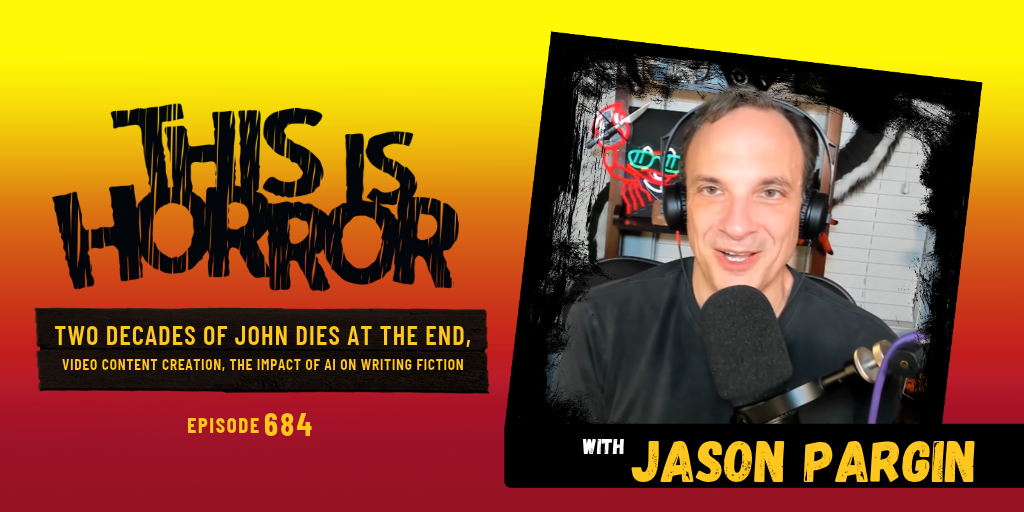
In this podcast, Jason Pargin talks about two decades of John Dies at the End, video content creation, the impact of AI on writing fiction, and much more.
About Jason Pargin
Jason Pargin is the New York Times bestselling author of John Dies at the End and the Zoey Ashe series. He is the former editor of Cracked.com. He’s just released his new book There Are No Giant Crabs in This Novel.
Timestamps
[4:00] Conversation start/recording 81 podcasts to promote I’m Starting to Worry About This Black Box of Doom.
[6:55] Beginning interviews with an interesting fact or anecdote.
[14:00] How much time can we spend reading these days?
[20:35] Has the rise of AI affected how Jason writes stories?
[41:15] How does Jason keep John Dies at the End fresh for himself and readers two decades later?
[48:40] What is Jason doing to promote his books that is a good investment of time and money?
[58:20] Creators on social media Jason admires.
[1:00:50] How long does Jason spend putting together videos for TikTok and other social media platforms?
[1:04:00] How does Jason record videos for TikTok?
[1:05:50] How does writing time fit into Jason’s routine?
[1:10:45] Time spent listening to audio.
Thanks for Listening!
Help out the show:
- Support This Is Horror on Patreon
- Listen to This Is Horror Podcast on Apple
- Listen to This Is Horror Podcast on Spotify
- Rate and review the This Is Horror Podcast on Apple Podcasts
- Share the episode on Facebook and X
- Subscribe to This Is Horror podcast RSS Feed
Let us know how you enjoyed this episode:
- Write a comment below.
- Follow us and get in touch on Instagram @thisishorrorpodcast
- Subscribe and comment on YouTube @thisishorrorpodcast
- Follow us and get in touch on TikTok @thisishorrorpodcast
- Tweet us @thisishorror.
Resources
- Jason Pargin
- Watch the video version of This Is Horror Podcast episodes, including our conversation with Chuck Palahniuk on YouTube.
House of Bad Memories by Michael David Wilson
From the author of The Girl in the Video comes a darkly comic thriller with an edge-of-your-seat climax.
Denny just wants to be the world’s best dad to his baby daughter, but things get messy when he starts hallucinating his estranged abusive stepfather, Frank. Then Frank winds up dead and Denny is held hostage by his junkie half-sister who demands he uncovers the cause of her father’s death.
Will Denny defeat his demons or be perpetually tortured for refusing to answer impossible questions?
House of Bad Memories is Funny Games meets This Is England with a Rosemary’s Baby under-taste.
Buy House of Bad Memories from Cemetery Gates Media
Buy the House of Bad Memories audiobook
They’re Watching by Michael David Wilson and Bob Pastorella
From the hosts of This Is Horror Podcast comes a dark thriller of obsession, paranoia, and voyeurism.
After relocating to a small coastal town, Brian discovers a hole that gazes into his neighbour’s bedroom. Every night she dances and he peeps. Same song, same time, same wild and mesmerising dance. But soon Brian suspects he’s not the only one watching and she’s not the only one being watched.
They’re Watching is The Wicker Man meets Body Double with a splash of Suspiria.
Buy They’re Watching in paperback and eBook right now.
Michael David Wilson 0:29
Welcome to This Is Horror, a podcast for readers, writers, and creators. I'm Michael David Wilson, and every episode, I chat to the world's best writers about writing, life lessons, creativity, and much more. Today, I am chatting with Jason Pardin about his brand new book, the fifth in the John Dies at the End series. There are no giant crabs in this novel, a novel of giant crabs. Now it should be noted that despite this being the fifth book in the series, it can equally be enjoyed as a standalone novel. So if you're curious, and quite frankly you should be, don't feel you need to read the previous four books before jumping in. Now we have spoken with Jason on a number of occasions, but if this is your first time, then here's a little bit about Jason Pardian. Jason Pardian used to write under the pseudonym David Wong. He is the New York Times best-selling author of the John Dies at the End series and the Zoe Ashe novels. He is the former executive editor at Crack.com and now writes fiction full time. Although, as you will find out from this conversation, not only does he write fiction full time, but he creates video content full time, and quite a bit of that forms the bulk of this conversation. This long conversation that came in at nearly three hours, and we have split into two parts. So this is the first part. Next week you are getting the second. So very shortly we will get Jason on the show, but before that, a quick advert break.
Bob Pastorella 2:28
From the host of this Azora podcast comes a dark thriller of obsession, paranoia, and voyeurism. After relocating to a small coastal town, Brian discovers a hole that gazes into his neighbor's bedroom. Every night she dances and he peeps. Same song, same time, same wild and mesmerizing dance. But soon Brian suspects he's not the only one watching, and she's not the only one being watched. Their watching is The Wicker Man meets Body Double with a splash of Suspiria. They're Watching by Michael David Wilson and Bob Pastorella is available from This Is horror.co.uk Amazon and wherever good books are sold. House of Bad Memories, the debut novel from Michael David Wilson, is out now via Cemetery Gates Media. Denny just wants to be the world's best dad to his baby daughter, but things get messy when he starts hallucinating his estranged, abusive stepfather Frank. Then Frank winds up dead, and Denny is held hostage by his junky half sister, who demands he uncovers the cause of her father's death. Will Denny defeat his demons or be perpetually tortured for refusing to answer impossible questions? Clay McLeod Chapman says, "House of Bad Memories hit so hard you'll spit teeth out once you're done reading it. House of Bad Memories by Michael David Wilson, available now in paperback, ebook, and audio.
Michael David Wilson 3:49
Okay, without said, here it is. It is Jason Pardin on This Is Horror. Jason, welcome back to This Is Horror.
Jason Pargin 4:03
Thank you for having me, and thank you for helping keep books alive by talking about them. I'm trying to say that on every show. Just anything, anything you can do to keep people reading books and buying books doesn't have to be my book. Any book. If at the end of this you decide that you never want to read one of my books. If you're listening, this that is totally fine. Buy a book from somebody. Buy one of their books. It's buy a book from buy a terrible book from somebody. I don't even care at this point.
Michael David Wilson 4:34
Yeah, it's a good message to kick off with. And you said that you're starting every podcast, or you're at least saying this in every podcast. And speaking of which, I believe the Black Box of Doom. You did 81 podcasts, so are you are you looking to do another 81 for this one?
Jason Pargin 4:58
If I if I can. Book that many, but a lot of people just still don't get back to me. But I generally take all I can get with that book because there was a little bit more of a current events element to it, and it seemed to be tying into the state of the world and all that. I got a lot more attention from people who normally would not talk to me because the book's not nearly as as weird, so that's what you get for writing the book. That's for the normies. That you get a lot of normie podcasts and political podcast stuff like that, and then you spend the whole time hoping you don't accidentally say something that will trigger a worldwide boycott of you and your publisher and everything else. Because normally I'm talking to people who want to discuss literature or horror, or there's comedy podcast or whatever. There, there's podcast for weirdos. But yeah, that one I I really did. I really talked to a bunch of different people.
Michael David Wilson 5:54
Yeah, what was the most amount of podcasts that you recorded in a day?
Jason Pargin 6:01
I try not to schedule more than one in a day because I found out from that round that I lose my voice because I have a fragile body of somebody who does nothing but this all day. So I tried doing two shows in a day, and the second one I couldn't get through. But then I had one show where we recorded for four hours, and at the end of that one, I also couldn't talk. So this I realize sounds extremely sad to anybody who has a real job, but I have two guys to do one a day, and also because I try to prepare for the podcast I go on, I try to come on knowing the show and knowing what I'm talking about, and trying to create some kind of a positive impression of myself, because for a lot of people, this will be their only encounter with me is me appearing on some somebody else's show.
Michael David Wilson 6:54
You know, talking about preparation, I have listened to a number of podcasts that you've been on, as well as chatting with you on This Is Horror numerous times, and I've noticed that you often open before the interviewer can get a question in. You will throw an interesting fact or a little anecdote, and I feel that there's kind of a lesson in publicity for other writers, there because you are making sure that you're steering the conversation in an interesting or an intriguing direction, and you're also saying to the interviewer, "Look, I can make this easy for you. I'm going to give you things for your listeners right off the bat."
Jason Pargin 7:41
Okay, so now now normally I don't give away my secrets, but I have this thing when I'm on a podcast and they say thank you, Jason, for coming on. I never ever ever reply with thanks for having me. I always have something else stupid to say or something weird. I always launch into it because I just think it's boring to just say thanks for having me. So I always have something ready to go, right off the top. I don't think we've let let Bob speak yet. I feel like I'm being very rude because again, I just steamrolled the whole thing. But
Bob Pastorella 8:16
no, I mean I was I was wondering if you were going to have something like Michael said, you know, to be interesting, and I I find it it's like it keeps us on our toes too because we don't know the numerous times you've been on the show. Sometimes some of the little anecdotes will kind of be like, oh, okay, and then sometimes we're like, where we go from here? Interesting directions, though. You know, it's always cool. But I always want people to feel like I I gave them like a good episode of their show, whatever their whatever their show is. I always want them to feel like I don't because I I you know you you want these people to have you back for the next book, and some of them do. Some I never hear from again. It's
Jason Pargin 9:00
it's, but yeah, especially and if there's any authors out there, if you can get onto the podcast circuit these days, most of my book sales are audio books. Well, that's that's a podcast audience. Those are the people want something to listen to in their car while they're mowing the lawn. It's it's all the same to them. So yeah, I can watch audio book sales jump. But you do a popular podcast, you can see it like that. Like that next day, you see people go out and buy it. So yeah, if you can, if you can pastor podcast host to have you on, then I would highly recommend it.
Michael David Wilson 9:36
Yeah. So in the last year or so since we last spoke, have you changed anything in terms of how you go about marketing and promoting? Because I know that obviously this landscape is vastly changing, and I I see your your videos turn up every day on numerous features. Now, but I know that you're having to evolve in terms of what you're doing. I know that even though some people might see you as the the TikTok video guy, that was never your intention. In fact, you actively were against that, and yet here we are.
Jason Pargin 10:18
Yeah, I'm coming up on 3 million followers across Facebook, Instagram, TikTok, YouTube, and all and all the rest of them combined. I don't. I feel like sometimes I come off poorly when because it sounds like I'm complaining about it. And again, I realize that's an extremely silly thing to complain about. It's just the thing that I'm trying to make clear is that I grew up wanting to be an author. Like that's I, you know, was reading books from the time I was in elementary school, reading full length novels, and thinking like the idea of storytelling and being some a kid who is like in his own head and daydreaming all the time. That's always the thing I wanted to do, and I don't know. I kind of, I'm a little bit discouraged about how short video feels like it's kind of eaten the world. Like everything has lost audience to short video. It's not just fewer people are reading books, but fewer people are playing video games. Fewer people are watching films. Fewer people are watching TV, and they've all gone to. They're all watching Reels. They're Watching TikTok, and I don't know. I try to make videos that are helpful in some way or good for people that have some sort of like nutritional content for your brain. But I still, there's nothing like sitting down and reading a book. There's nothing. There's no equivalent of that. And I, that's as close to like a religious belief that I have that books are sacred and powerful and their ability to like change how you think and the ability just like reprogram your brain in a certain way or to help you escape. I just think there's no like audio books are fine again. Happy that I've got audio book audience out there. Even that's not exactly the same, because a book where it's making you read the words and making you form the pictures in your mind, and you're reading it at your pace. And if you get a sentence you didn't quite get, you can go back over it, and it doesn't leave you behind. I don't know. I just think there's nothing like books, and I'm very concerned about the the idea that reading is dying or going away or going into a lull or whatever. It bothers me. So, if you say, "Well, you're part of the problem," you're you devote most of your time to making short videos, and now that's most of your income and by far most of your audience, but I, I don't know. I'm trying to channel some people into buying my books, not not just as a way to enrich myself. I'm trying to, I'm trying to keep reading alive. I think reading is a special thing. I think humanity changed when mass literacy came along. I think we changed as a species, so I would hate to see it go away.
Michael David Wilson 13:04
Yeah, it's a very difficult one in terms of what one does to combat that problem, particularly when you think about what books are up against, what they're competing against. You know, they're competing against not only social media, but all this on-demand video like Netflix and Amazon, and just everything is attention-seeking, and it's almost like the the book is the opposite to that. You know, you'll have no advert in the middle of your book, or you'll have no other app that will turn up. So I think people just have to make the active choice to decide they're going to read a book, and it's it's not sexy compared to what else you know that they have to choose from.
Jason Pargin 14:00
Do you guys both? Are you still able to read a lot of books, or are you still able to find time to read?
Michael David Wilson 14:06
Yeah, and I, I mean, ironically, like based on what we've been talking about, a lot of a lot of audio books have now come into my life. You know, so I do read a lot of books that way. But you know, every evening I try to at least read like some of a physical book. But it it's tough to be honest. But I think Bob is much better at it than me.
Bob Pastorella 14:35
I I read every night, and I I do okay with audio books. I prefer to read. I read a lot from my Kindle, primarily because I don't have shelving for physical books right now. Like whatever physical books I have are basically kept in bins because I had a shelf, I lost a shelf. Long story, and I don't want a shelf. I don't have space for a shelf right now, so. It's, but I read. I read every every night. I read every night. If I'm off, I'll read multiple times. A lot of times, I'll have multiple books that I'm reading. Fortunately, most of the I would say probably 95% of what I have to read for the podcast is what I consider pleasurable reading. So people's like, "Oh, you got to read for this, don't you?" Read for you. I'm like, I read everything for me, you know. But I, I, I agree that that we do have a literacy problem. It seems to be growing. Our attention spans have become short because of short minute, you know, short length videos and things like that. We have, you know, video games now are typically 13 to 14 hours. Your your big your big games out there. The new Silent Hill, I believe, was only 15 hours long. The one before that was only 15 hours long. They are still making long-form video games. Grand Theft Auto is going to probably take a year to complete story mode. So, and you're going to get a lot of perks out of that. TV shows have gone down from going from 55 minutes on the average to 44 minutes on the average now. If you're an hour-length show, you only get basically you get 40 to 50 minutes worth of content, so everything is getting condensed. Whereas in books, I've noticed that books are getting longer and longer. We have some major door stoppers within the last year: Joe Hills, King Sorrow, Mark Daniel Lisky's Tom's Crossing. We have China Melville's book, the the Rose, or however you say it. That's you know that's 5000 pages long, and so they have these these epic tales that are being told in books, and so that that and that warms my my big doorstopper book heart. But you know, other than that, when it comes to actual like media that the masses consume, it is it has become more and more short form, which sucks for me because I don't really like writing short stories. So,
Jason Pargin 17:18
it's most of the notes I've gotten from my editor for the last couple of books, have the notes have made the book longer? Like they're clearly leaning toward. You should have something where you spend more time with this character. You should have some more backs. Like they're they're clearly directing me to instead of the way you would assume that editing is all about making you cut out all of the indulgent stuff or whatever. Not really. It's almost every note has resulted in the manuscript being longer than before. So there's clearly even on their end, like no, the readers readers don't mind. They don't mind spending time with the the characters. They don't demand that the book abruptly end after the climax. They don't mind having stuff you know where you hang out a little bit after.
Bob Pastorella 18:00
So it seems like to me, and it's like because I'm hearing this from other people as well that we have really become, in in as far as written works go, a character driven narrative is the strongest focus that you have, you know. Because like here's the thing, like maybe if goes back as maybe as far back as 15 years, it was everything. You had to have a good story, but now it's like more and more and more. It's like people the story. It's they want to know about these characters, and so from what what I'm hearing is is that we're going to be able to have more long form prose and and more expansive characters, and I'm all for that. That is, I think that is going to be the way to lean in to where, if we can get more, you know, people reading, it's it's just getting to that point. It begins at such an early age, and it's sad to see what's happening in the U.S. as far as education goes, it's gonna it's it's it's a tough. It's gonna be a lot of work. It's gonna take a lot of fucking work.
Jason Pargin 19:08
Yeah, I guess the the one thing I can say about that is I've definitely seen trends reverse themselves in my lifetime. So not everything that seems to be going one direction necessarily, you know, keeps going keeps going that way. It's just, yeah, there has to be. I'm hoping that books come back into fashion and books written by people, because the thing you said about emphasizing character over plot, the issue is that with the number of books that are being published has exploded thanks to Kindle Unlimited and being able to self-publish and things like that, but a lot of those people that are self-publishing, they're writing a book every two weeks because they're using AI to do it. So there, if you have infinite books available to you, you have every plot, you have every gimmick, you have every combination of tropes. Have all of that, but character is different. Character is is something that's usually that's something that a human brings to the story. They're bringing their own perspective. They're bringing their own upbringing, their own past, their own psychology. That is something I think is harder for a computer to emulate. Where plot is not a plot, the mechanisms of a plot, like every possible twist, every iteration a machine can come up with. So, I think the human side of it is the one thing that, God willing, will be the hardest for the the robots to take over.
Michael David Wilson 20:35
Do you think that the rise of AI has shifted the way in which you approach writing a story?
Jason Pargin 20:44
Not me, not yet. But I do knowing how I came into the business because people don't know my past. I didn't. I didn't come in the traditional way. I didn't come up through like an English department and then query agents and then get a publisher. I wrote on the internet and posted the the first novel that that made my career. John Dyes at the end was just a series of blog posts back in the early 2000s. So it was something that went viral online for free, and then I got it got picked up for it got optioned for film, and then it got a mainstream publisher. Well, today, so so like in the last few years, like that was highly unusual at the time in terms of a way to get a publishing deal. In the last 10 years, of course, that became standard. You had a lot of famous book series that were fanfic, like they were literally adopted from from online fan fiction that they then rewrote to make, and they became big hits because there was now a pipeline for people who did not necessarily have a you know a background in publishing or anything like that to write something online, go directly to the fans, learn how to write through fan feedback, and then get a publishing deal out of that. Today in 2026, that realm of the stuff that the self published stuff is so choked out with AI assisted stuff that you are now competing against an ocean of stuff that that is that you you as a human can't write it as fast as the as the machine, so I'm not as concerned about myself because people at this point people know my name, they know my face, they know my voice because I'm on their freaking screens every day. But I fear for the equivalent of who of who I was back in 1999 as somebody a nobody with no connections to publishing. My parents were not writers. I didn't have an end to the industry, but was able to use the internet to go directly to fans to get my own fan base, my own readers, and kind of slowly build up. I don't know that I would be able to do that if I had been born 20 years later, because that that entry level, that ground floor of coming in and posting something and trying to get eyeballs on it, you're just now in an ocean of stuff, and a lot of people don't mind the AI written books at all. I can sit here and point out that I would never write read a book written by a robot. Easy for me to say that. I can't imagine why anybody would want to read a book written by a robot. I'm telling you right now, many, many, many people are fine with it, and they they don't know. Like it's just something that pops up on their on Kindle Unlimited or whatever. It's or a book that's 99 cents, and they try it because it's a trope that they like. It's a it's a you know it's a specific genre they like it's vampire romance or whatever, and you're reading something where a person basically fed a series of prompts into Chat GPT and it spat out a book, and they can't tell. They they a lot of people cannot tell the difference.
Michael David Wilson 23:55
So I wonder where you're getting this information about people not minding or not being able to tell AI written books, because obviously for me and possibly Bob as well, because I'm so engrossed in this community, I'm surrounded by you know people who absolutely can tell and who are absolutely against AI. I mean, the the people I see who are pro AI more in my everyday actions are using it to query Chat GPT and things about basic problems or or even medical advice, which is a whole other issue. But I I haven't seen a lot of people say you know that that they're up for reading AI written stories. Although I am seeing more and more people use it for I guess art and for album covers, even mainstream bands, even the. The death metal band Day aside, and I believe Kerry King of Slayer was rumored to have used AI. Although I'm not sure if that was or was not confirmed.
Jason Pargin 25:13
You can go on any spaces where you find readers hanging out. Go on Threads. Go on any of the Twitter clones. And one common thing you see is people frustrated to find out that they're three quarters of the way through a book they were enjoying, and the author left the Chat GPT prompt in the story where it says, "Okay, I have rewritten the next part to be more emotional and to emphasize the eroticism of the scene. How's this?" And they forgot to cut that out before pasting it into their doc and uploading it to to their Kindle, and it's not that people are seeking out. They're not like my favorite author is Prose Bot 6000. It's their author is Rose Henderson, and it's the it's a song of something, something romance, and it's just they don't have such a specific ear for prose or for tone or whatever that they can detect that. Because for me, you you read me something written by an AI, I feel like I can hear it. That I've been doing this my whole life. I've been a writer since I was a child. I think people who are looking for an audio book to listen to at work or looking for something to read at the beach. I a lot of people. I'm not trying to denigrate their tastes or say they're too dumb to pick out something that's written by a robot. It's just that it hits all the beats they want to hit. For example, I when I was working the last real job I had, I always had an audio book going while I worked, and I loved detective novels because that's something where you're you're working and you're kind of it's going on. You're like listening to it while you're working. You're doing kind of mindless, repetitive work, and these are perfect because you can kind of zone out for a little bit, but you're you you you get the sense of what's going on. Like there's a you know a mass murder rapist and the guy's trying to track him down, he's going around. He's talking to witnesses. You can get the gist of it. I feel like you could have slipped an AI written one of those into my feed, and the only thing I would have noticed is that some of the prose is a little bit stilted or weird, or maybe something would have seemed off. But I bet the way they work now, like the the ones the versions they have now, I bet you would have gotten it past me if you if you if it had just had the author's name on there. And for people who read a book a week, and they're not like dedicated to one specific author, they just like a genre. They like they like you know they like romancy or whatever. They they're looking for the next something that's inexpensive or whatever. It's just I think it gets harder and harder to tell. But there are writers out there that are making a lot of money. They don't have any one book that's become a mega hit. But what they have done is they've written a book every two weeks. They've written 25 books a year, and each one sells 100 copies. That adds up fast, but that all came at the expense of of somebody who spent two years and poured their heart and soul into their book that's you know that same genre.
Bob Pastorella 28:36
Yeah, I just seen on social media that they had a woman who's written 600 novels over the last year, who's made over a million dollars, and so it's like, how do you know people are reading these books? She didn't buy them herself. Somebody, somebody bought them. Some people just don't care, and it's not that they don't care in a bad way; is they're oblivious to the industry that we are involved in, they don't the the gears of how it works and how we do our art is is not consequential to them. They just want to know what happened to Miss Lacey when she started dating the the the guy and who worked at the farm. That's all they want to know. That's all they care about. They don't care about how much blood, sweat, and tears we put into the work. They just want to read the story,
Jason Pargin 29:30
and so it's it part of the problem is educating these people to go. You you didn't really read a story, you know, and they're like, "Yeah, I did. It was good, you know. So I don't know. And a lot of the AI music that's out there, it's the same thing. It's not that somebody is a fan of a robot pop star. Is that what kids are doing now? Is they will tell the computer, "Give me while I do my homework, give me smooth.". Jazz for the next 10 hours, and it will generate what to their ears sounds like a plausible smooth jazz tune, but it's completely generated by AI on the spot. It can do that for them because it has eaten all a whole bunch of the real smooth jazz written by humans, and it can just remix it because now it knows what it sounds like because it has swallowed up the stuff that people people made.
Michael David Wilson 30:24
If only you could go to Spotify or Apple Music and put smooth jazz playlist in, but unfortunately, that's just not possible. So never mind. You could
Bob Pastorella 30:35
even type in someone's name, like John Coltrane. Wow, there's hours. There's hours.
Michael David Wilson 30:45
Yeah, well, I mean, if you, it's not quite smooth, Jazz. But if you listen to some of the extended cuts of Miles Davis's "Bitches Brew," they're like three or four hours long. So you just put that on repeat, yeah.
Bob Pastorella 31:03
Repeat it
Michael David Wilson 31:04
once, and you've almost got your 10 hours. But yeah, do you
Jason Pargin 31:09
guys use AI for anything?
Bob Pastorella 31:12
No,
Michael David Wilson 31:13
not not really. I mean, although sometimes Google, when when you're searching on it, it will give you the AI mode, you know, automatically. So you, you know, you're almost having accidental AI, and accidental AI is a problem because so many pieces of software, when you download the update, it, it, it's now oh we've added this new AI feature so even if you're actively trying to avoid it, it's it's coming back back into it. But
Jason Pargin 31:50
see, I I've never intentionally used it even once for even for research or anything. But I have so many people that swear by it, and I'm so scared that I'm just getting left behind.
Bob Pastorella 32:00
But I don't think so. What did you do two years before AI became prevalent? And what what did we do two years ago? I can't remember. AI swiped my memory from remembering. We've always had AI. It's always been here. Now I suspect I might use it with my music. Uh, on with my guitar, with my amp. I have an app that will let me like I can do. I can type in Dwayne Allman sound, you know, and it will it will set me a preset that I can save that will change the tone and dynamics of my amp and add reverb and things like that to where I don't have to sit there and twiddle with the dolls, and I suspect there's a little AI involved in that, but it's still me playing the notes. I'm just augmenting the sound, which isn't really too far off from something I could do just by tweaking my app. So you know, which I primarily I'll do it anyway. You know, so that's if you're a musician and you understand where I'm coming from. You know we're always messing with our shit.
Jason Pargin 33:04
That feels different to me because see, I I've got the same thing in my video editing software because there was one video where I had recorded it and somehow I'd wound up with music in the background, but that was going to trigger a copyright thing, as you probably know with video platforms. So on in this video editing software, it has like AI background noise removable, and you click it, and it just stripped out my voice totally untouched. Everything sounded exactly the same, but it could it went through and stripped out that that music from the background, and it used machine learning to know the difference between my voice and the voice of the singer that was playing in the background. That's AI. I have no idea how it works. I have no idea if it had to steal somebody else's art to to do that for me. But what people are using it for is something that I don't. They're using it for research where they're saying, "Well, there's I want to write about this complicated subject, and there's like four books on the subject, so I asked the AI to summarize those four 600 page books and give me like the 12 main ideas from those books. And that to me sounds incredibly dangerous because, like, at that point, you are trusting the AI far beyond I think what even an expert would trust, but it's like yeah, saved me so much time. That saved that would have been months for me reading through and highlighting passages, and the AI just did it in five minutes. It's like yeah, but man, how much do you trust it to to digest all of that and to understand it? Because like I've seen those Google summaries, and they're wrong a shocking amount of time, like most of the time.
Michael David Wilson 34:44
Yeah, no, you're absolutely right there, and you know it can be it it can be wrong an alarming amount of the time, and you know if if you were to tell AI, you know. You got that wrong. I've seen like screenshots of things to do again with like medical things, and it's like, no, this would kill me. And it's like, oh yeah, you're absolutely right. Sorry about that. Sorry about that. I'm I'm already dead. You know, I I think as well for summaries. God, there's so many thoughts now going through my mind. For summaries of books, I mean, there are there are websites, there are articles where you could get that information, and you would at least know that it has been written by a human. I mean, summarizing books was not a new thing that turned up with AI. Spark Notes being one of the most famous examples for students who want to have a bit of an overview. But I, I think, you know, related to in terms of whether there are good and bad uses of AI. I mean, never use it for anything creative. Never use it for anything artistic. I think if people want to use it, low level work is the best way to use it. And you know, in in terms of research, just some something really basic in terms of I I want to buy a new I don't know washing machine. This is my price range. Can you tell me what I can get that meets these certain parameters? And then after you know you check that against actual websites and things, so you could use it as an attempt to save yourself time, but then because you've got to check everything anyway, could just be better to not use it. Yeah,
Bob Pastorella 36:53
I mean it's. I can see it does have some practical applications as far as like the medical field and stuff like that, but there are limitations to what it can do. There, it's just using it as a creative realm. I mean, it's like you can sit there and talk about well all the time that it saves you and everything like that. But then you have writers like Daniel Krause who practically got swallowed by a fucking whale to make a book. I'm joking, but you know, he he. If you told him that he you could have done it on AI, he would have been like, "But, but, but I'm not. I'm actually going to go scuba diving. I don't even know what I'm doing, you know, because that is that that's how he he writes to make it immersive. He had to do it himself, you know. And so it's it's like, why would you not want if you if you had to research something very very tedious. Why wouldn't you try to figure it out yourself? That your character's going to. I mean, damn.
Jason Pargin 37:50
And also, just the process of writing, you discover a lot of times the story while you're writing it. It's in the process of writing the scene that you discover something about the character and about what how how it should be and and something that didn't ring true until you sat down. Actually, it's the process of writing that where you you found it, and I don't know. I don't know. I I think I guess I don't know because I there are some authors who even before the age of AI they could crank out a book shockingly fast because they had a formula, and again, I don't want to denigrate people who wrote what had who are formulaic. I've enjoyed a lot of stuff that's very formulaic. It's you know cop shows, cop procedurals. It's like they they ran for 500 episodes because they've got it plays out a certain way. There's like one twist in there, but in general, they're going to catch the bad guy in the end, and you know they've so there's a little bit of a paint by numbers aspect to it that I guess that can be replicated by a machine, but I don't know. They're so it's so difficult, and has always been difficult to make money as a writer. It's always been difficult to sell enough copies to support yourself as a writer, it's always you've always been swimming upstream from the moment television came along, from the moment all these alternatives came along. So it's already hard enough to to get started to try to get people to even give your book a chance, even if you're giving away for free because you're still asking people for time for effort. So to now have to compete against the the machines, I don't know. It just makes it that much more difficult. I I wouldn't I wouldn't want to be a young writer trying to start out right now. It has to feel like the whole culture and the whole world is against you. Like if you're doing it, you're doing it because you love it. You're doing it because you've always dreamed of it. There are certainly easier ways to make money. It is not a get rich quick scheme. So that's all. But but I I hear myself saying this, and I think okay. But Jason, you came into the world with the internet. Like the reason I had a writing career is because I was blogging. On the ground floor of the internet, and I remember older people at the time who did not understand what the internet was. I remember trying to explain to my family what this hobby I had, and I'm like, "No, I'm writing. I write online. I've got a blog, and it's got a bunch of readers." And they were just like, "Okay, but are you? Do you get paid for it?" I was like, "Well, not really." Like they, they didn't get it, and I, I don't doubt that they felt some. Some of the, the people who you know, older people who were writing for magazines at the time, and suddenly I had a bigger readership than they had. But I'm just writing for free on the internet. They probably saw me as cheating somehow, or using the technology to cheat somehow, or like I was taking a shortcut, so I don't know. I never want to feel like the old, the cranky old guy saying, "Ah, this newfangled technology is ruining ruining everything," because there were old people saying that about the internet when I it was the thing that saved me. Like I would never have had. I had no path to becoming a writer until the internet came along, so I don't know, but I it does it does scare me quite a bit, and it makes me worry for the future of of books quite a bit. But maybe I'm just getting old. I don't know.
Michael David Wilson 41:16
Well, I mean, talking about time passing, it's been 25 years since the first John Dyes at the End was published online, and almost 20 years since it was published by Permuted Press. So, I'm wondering how do you keep the series fresh for both you and readers after two decades,
Jason Pargin 41:43
the big thing is that I'm not trying to like a. We will go. You know, we're only on book. The book that I'm here for mode is only book five in the series and all that time. So I'm not trying to write a book a year. I'm not trying to do. There are authors who could do that. Again, a lot of those detective novels I mentioned those suckers are out every year like clockwork. Every 12 months they've got one out. I could never do that with the same series. I would burn out very quickly. Where if you let several years pass in between, that's long enough for ideas to percolate and for you know some unique angle to come along and for me to kind of develop something, and also I let the characters age in between books. You know, they're never these books never pick up the day after the previous book. It's always been a couple of years. Some time has passed. I've let the characters now they're not my age. Nobody wants to read about an elderly bunch of losers. There's there, but they've gone from being in their early 20s to being 30, and and it's that's in the story. Them them feeling like they're getting older, but they're not doing anything with their lives necessarily, or they're still stuck in the same place, and that just becomes part of it. So that's part of it. Is the demands of you know because I think there are fans who get very frustrated that it can take five years for the next one to come. But it's like these wouldn't be the thing that you love if it was something I had had to turn around in a year. It wouldn't be. I I would run out of ideas. It would start to feel stale to me, I would start to get sick of it, and you would be able to tell. Whereas, if you can go, if you write, that's why having other books, this other book series and writing. I've now I build standalone novels into the book deals. That's a big part of it. Being able to take a break from that and write something else, and then you come back and you, it's like now is time to write the next John and Dave thing, and you can slip into that world a little bit, and and remember who these people are and how they talk and what this town is like, and kind of feel yourself getting back into it. That's that is, I think, makes makes all the difference.
Michael David Wilson 43:57
And I wonder too, are you finding it harder to find the time to write because you're now making the majority of your income through these videos that you're putting out, and it feels like it must be an interesting switch because you started putting the videos out to bring attention to the books, but then you got so much attention that I believe in a previous interview you did with another podcast. You said the books have almost become a vanity project for you. So does it then, ironically, make it harder to justify the time that you're spending writing the novels, even though that's what you ultimately want to do,
Jason Pargin 44:44
yeah. Because again, I never want to discourage people from writing books. It's just that some people will come to me and say, like, "Well, I'm thinking about writing a book, like for some extra money on the side.". And I have to explain right because you have something you want to say, right? Because you you just because it's not a good way to make some money on the side in terms of the amount of time you have to spend promoting, the amount of time you have to, the amount of energy it takes to write the book, and then realizing that you are in charge of of selling the book, the publisher is not going to do that. Like you are the one who has to sell it, and this is what most people don't want to have to do because most people do not enjoy going out and talking about themselves for an hour at a time or posting on social media. Most people are not video people. That's why it's like I wouldn't become a writer if I wanted to be a video person. I'd be doing video. It's like no, that's kind of you. Kind of have to do that almost, unless you're you're already famous in some other way. So I never want to sound like I'm complaining. It's just that I've observed how the economics of it have changed, where the what it pays per hour of work doing video versus trying to write a novel and sell it is vastly different. But in terms of finding time to write, that's always been because when I started writing John Dies at the end, I had a day job. No, when I started writing, I had two day jobs. I was working part time at one office and full time at another, and then writing for my blog on weekends and late at night. And then when I got the job at Cracked in 2007, that was a 70 hour a week job probably. And then I was trying to write the books on the side, and they actually gave me vacation days to. I would spend all my vacations writing. I would take a week off and then would write for 16 hours a day. Sometimes just not moving from my chair and then falling asleep in a chair next to my desk and then waking up and going right back to writing. So that's now it's it's the same thing. Like like the day the videos probably don't seem like they would take very long to make, but they do. That's that is my day job, but for anybody out there who wants to to write, I'm telling you, carving out time to write is always going to be the biggest mountain you have to climb because it's like in my case, I don't have a family, I don't have kids. That's a huge advantage. I'm not constantly not having to wake up and take kids to school, I'm not having to stop to, you know, I'm able to just sequester myself for a long time and work work on my stuff. But that's everybody. That's every author who has ever lived. Either they had a day job or they had other stuff in their life going on, and they have you. You have to make time. You have to carve out time to do it, you have to. That that's if you can't do that, you have no you have no hope. So that's something I. That's a skill that I learned 30 years ago. The art of telling people no, and of making it clear that no, this is not. I'm not doing this for fun. Like this is something. Like even before I was getting paid to do it. It's like no, this something I have to do. This is, this is. Think of this when I tell you I can't go to the thing because I'm writing. Take that the same as if I said I have work that night.
Jason Pargin 48:14
Like like me not writing on the book is is asking me to call in sick to my job, and people don't understand. Like they understand once you have money coming in for it, and once you're, you know, famous for having done it. But when you're starting out, people don't. A lot of people don't accept that as, as a as a thing. And I've always I've had a wife, and I've had family that were very understanding. A lot of people don't have that.
Michael David Wilson 48:42
Yeah. Now I've had this conversation recently with numerous writers about how until there's money coming in, they can't explain to to people how important their writing time is. You know, either friends or partners or people they're intimately close with, and it's it's a struggle for a lot of people. So I have a lot of empathy for anyone listening who's going through that. And I wonder too, because you said you know at this point your your job as well is selling the books, the publishers aren't doing that for you. So, I mean, in terms of the things you're doing that you you would say are resulting in, I suppose, a return on that time investment, or indeed financial investment for people looking to sell their books. What do you think are the number one things to be doing?
Jason Pargin 49:44
God, I don't know because people. It is a very contentious point among if you're in author spaces or in book bookish spaces. It is very contentious to tell young authors you have to be on social media, or that you have to learn how to make. Reels, you have to be because there's always somebody saying, "Well, that's that's not true." That's you know, if you write a great book that resonates with people, there's plenty of examples out there of books that that just succeeded through word of mouth, or they you know they drew attention from they won awards or whatever and got attention that way. It it's true that it's possible to succeed without having a daily presence on social media. It's just you are effectively trying to win the lottery at that point because the books that spontaneously catch the attention of critics and publications and get covered in the New York Times or in the book review sites. They are they're covering one book in 10,000 that comes out. They are there is a book that will catch their attention for some reason. It will it will slip through, but you'll notice that a lot of the ones they're covering, those writers have parents that were writers, or parents in the industry, or they have connections to you know they have friends. They they themselves used to review books, so they've got friends within those publications who will review their book. Like they have some other advantage that if you're trying to reach people and build up a following of readers, if you can do it without social media, if you could do it without Instagram and whatever TikTok, TikTok, all of the rest, Facebook, all the ones that are still out there, tell me how. Tell me how you did it, because you know. And again, if you're able to self-publish on one of the platforms that are still out there, AO three is still out there. Wattpad, I'm sure, is still out there. Any of those those platforms, that's great. If you're able to get people on Reddit to talk about your book or any of those, but it's all coming down the same thing. It's still coming down to engagement. It's coming down to being visible. It's coming down to interacting with fans. It's coming down to doing a lot of stuff other than just writing the story, because if you think, well, if I write a good enough story, then that will take care of everything. It will succeed through word of mouth. I'm telling you, that's just not how it works. It's Moby Dick only sold like 2,500 copies while Herman Melville was alive. It didn't catch the attention of mass audiences until after he was gone. He was working in an office right up until he died because he didn't made no money off Moby Dick. He was he was able to you know he got a small small advance but not enough to live off of. That's most authors through history. That's their story, and and it's like so. Moby Dick wasn't good enough to catch fire through word of mouth until decades later. And you think you think your book is going to in this media environment? I mean, back when Moby Dick was written, people didn't have anything else to do with their lives. People were so bored, and even then, so it's just not. I wish that's the way it worked. Every author wishes that's the way it worked. That if you write a book that's good enough, then that that's all you have to do. The real, in reality, you have to sell it. Your job is selling books, and then your second job is writing the book that you're selling. And again, I, if that sounds gross or or like an ugly way to look at it, nobody is happy about that. Trust me, I nobody wants that to be. I did not grow up dreaming of of having like a popular Reels account. That I that wasn't a thing when I was growing up. I always just wanted to write the books, and I didn't want people to know who I was. I wanted to live in like a cabin, and I wrote the books. And the books, I got checks from the publisher. But the idea I didn't dream of like talking, going on the Tonight Show.
Jason Pargin 53:52
I didn't want to be like Stephen King, like the kind of author where you're on Good Morning America and talking. That wasn't my dream at all. I didn't want, I didn't want to be a celebrity author. I wanted the books to get famous, not me. But in this media environment, especially when a faceless robot can write the books, I think you have to. You have to be on social media, and you have to find a way to be on social media that's not just saying, "Hey, everybody, read the book. Like you've got to have something you can talk about, something that can bring people into your your world and identify with your voice and and your the way you think or whatever. And I just the only thing I can say is just be creative with it and demonstrate your creativity through your online presence, and then hope that channels people into wanting to to look up your book. If there's another way to do it that doesn't involve doing that, and you figure it out, great. And also tell me, email me, tell me how you did it, and I'll do it your way.
Michael David Wilson 55:00
Right, and I think you know a reason that your videos are more successful than a lot of other authors is what you're doing is you're not spending 99% of your videos saying buy my book. You're giving people, I suppose, content for want of better terminology that is tangentially related. You know, there's humor. There's interesting anecdotes. Recently, there seems to be more controversy and polarization. I don't know if that is by design or if that is just happenstance. I mean, I saw recently the video that you made on Kurt Cobain's cardigan and suicide, and that seemed to really divide people. I'm not sure if that was a strategy or if that was just how it kind of was perceived. No, no,
Jason Pargin 55:59
never. It's just if you have any kind of an interesting opinion or unique point of view on something because of the way the internet is, that's just that's the viewpoint through which people consume a lot of stuff. It's like this is something for me to to argue about, and they a lot of people just I don't know. They want to. They want to feel something. They want to to be challenged. They want to. It's not necessarily they want to get mad, but they they like something that has a different perspective than what they had, and they like to come in and tell the author, "No, you're wrong." And even if they secretly don't agree, don't disagree all that much, they they enjoy coming on and and like mixing it up with people. Some people that's, but I don't I don't enjoy doing that kind of content. There's obviously a huge market for just making people mad. I think it's too easy to do that. I don't find it interesting, and I never in my life am going to express an opinion that's false just for the purpose of making people angry, unless it's clearly just me being ridiculous or being silly about something. Like I will do it as a joke, but in terms of like intentionally, the thing that is 70% of social media and podcast content where somebody will just take an extreme position because they know that it's going to make people mad. I don't enjoy that. I don't want. I'm not trying to generate death threats for my family or something. But what people find interesting is somebody who has an opinion that's a little bit different from theirs, and that's a little bit, or it's a perspective to the point that they they're a little bit shocked by it, or they're taken aback by it, or something. But that's because they're looking to feel something. That's why they're on there. They're looking to they're looking to be surprised by you know somebody's opinion, they're looking to you know, and they they may experience it as like a negative emotion or whatever, or this or I disagree or you're wrong or, but in reality, that's why they're on there. They want to hear a different perspective. That's what's interesting about it. It's what's exciting about it.
Michael David Wilson 58:19
And who are some of the creators on social media that you particularly enjoy their videos.
Jason Pargin 58:28
Oh, that's a great question. Because, for example, when I got started, when I before I knew what TikTok was, and I thought it was just a lip-syncing app, everybody kept telling me, "No, you could do Hank Green type stuff because he like he and his brother they do like it's science and it's little short science things, and and what that a lot of that was like YouTubers like Veritasium people would do like science YouTube stuff and they would come and do compressed versions of it for TikTok or whatever to try to give you the two minute version of here's this thing. Here's this thing that's interesting. My friend Alex Schmidt does a lot of videos like that. I like the ones that are anything that's kind of a little bit of. It's just a little bit of science. It's a little bit of history. It's just reminding you that the world is interesting, and it's not the world is falling apart. The world is terrible. I don't like outrage content. I don't like videos of people filming crimes occurring. I don't like doom and gloom. I don't like anything where they're just you know it's it's conflict. It's here's this this brave veteran being cursed out by this awful woman. Can you believe they treat our veterans this way? It's like, no, I don't want. That's not on my business. I don't even think that's real. That what you showed me there. I like the stuff that makes me at least feel like I've discovered something new about the world or has changed how I. Think about something, but gosh, like I try to, I try to have curated my feed to be mostly that, mainly so I don't feel like I have wasted the time I've been on there. And I know that's no substitute for reading a book or getting an actual in-depth education on something, but at least being reminded that the world is an interesting place and it's worth living in, and it's worth preserving, and that you don't, you in your everyday life, don't actually know anything about the world because it's so much more interesting than you think. People are so much more interesting than you think. History is so much more interesting than you think, and just these little reminders kind of keep me. They kind of keep me going.
Michael David Wilson 1:00:49
And so, with your own videos, how long do you typically spend making a video? And do you completely script your videos, and if so, are you reading that script, or do you then have to memorize it, almost as if you're in some sort of rehearsal as part of putting it together? Because I I assume too, the bigger your audience gets, the longer and more time-consuming putting each video together might become.
Jason Pargin 1:01:25
It is a time-consuming process, but it's hard to nail down how long it takes because so much of it is coming up with the idea for that day's video. And so I will have I have just a big pile of notes that I keep. Same for my books. It's just a giant document full of factoids and stuff that I come across that day, and I'll sift through it and have an idea or something that I wanted to walk through, and then I'll start looking up articles and stuff on it. And then a lot of times, two hours into it, it'll fall through. I realize, oh, this actually isn't true, or I've I've fallen for a hoax or or something that you know a fallacy. There's actually not. It's not as interesting as I thought it was, and you have to start over, and then I'll get distracted and have to answer 14 emails from the publisher or my agent or whatever. Then I'll try to come back to it. So it is much of my day. I tried early on completely scripting them and reading them, and it doesn't work. See, I found that this out in college when I was trying to go for broadcasting. I can't read a teleprompter in in any way that sounds natural at all. Like I don't know. There's some people that have that talent where they can read in real time and like put the correct inflection on it and and add personality to it. When I'm reading, I sound like a robot. So these are not scripted at all. I've got notes of the facts I want to hit, and then I've got like like links in my document. I've got like the actual the the numbers, whatever. If I'm covering, but then I'm just phrasing it myself, and then we'll just have to do a bunch of takes. And then the editing is you can see in the edits it's one sentence cut, one sentence cut. That's like as long as I can talk without screwing it up. So it's just record a sentence, stop, read the next thing, make sure I'm I know how to phrase it, record it, stop, record it, stop. And it's just the actual recording and editing is a couple of hours, and that's for a video that's two or three minutes long, and and then you know that's by the time I'm done, like it's it's usually a work day's worth of work, but it's because of the nature of my job, and I'm working at home and balancing a bunch of different projects all at the same time. It's never it's never all in a row. It's not nine to five. I'll I'll put in a couple of hours late the night before for the next day's video, then I'll work work on it a little bit in the morning. Then I'll have to go off and do do a podcast, do you know, do something else that day, and then I'll come back to it and finish it and get it up. And but yeah, it's so I it probably works out to seven or eight hours per video once you add in all the time spent doing research and thinking through it and all that stuff.
Michael David Wilson 1:04:01
And in terms of the actual recording and editing, is that still natively within the TikTok app? I think that's how you were doing it originally.
Jason Pargin 1:04:11
Yes, although now I've learned to use editing software on the computer if I need it, but it's still the whole reason I was able to get into this is because the TikTok app just makes it very easy to edit because it's made for children. Like that was the whole thing. Once upon a time, if you wanted to edit video, you actually needed to know a bunch of terminology, and you needed have to be able to figure out how to have multiple tracks and stuff like that. Whereas TikTok is just here. Use here's a little picture of scissors. You click that, and it cuts the. It's like that's what I need. I don't, don't give me, don't ask me what a ripple cut is, or, or what a J edit is. I don't know what any of the. I've not been to film school. I don't know what any of those words mean. Give me a little like something for toddlers, where it's a little piece of a picture of cartoon scissors, and you. Click it and it cuts. Like yeah, that's what I. That's the level I'm operating at for editing video. So that's why. That's actually why I was able to do it because when I first got onto TikTok in 2022, I actually realized oh, it's all it's all in here in the app. I don't need a setup because I thought that's again what I thought. It's like I don't own a camera. I don't own, I don't own. No, I don't know how to use After Effects. I don't know how to use any of these. It's like no, you don't have to know any of that crap. It's you record it with your phone, you edit it in your phone, and then you post it. That's the whole magic of of TikTok. It's got all of those effects, all the background music, adding another layer of of sound. That's all in the app. They've made it idiot proof, and that's that's actually the only reason I was able to do it because I'm surprisingly bad at using any software, even though this is my job.
Michael David Wilson 1:05:51
So this begs the question too. I mean, you're spending the majority of the day putting these videos together. Do you now have, or do you still have, a regimented writing time? When is that fitting into the puzzle? And then related, when when is spending time with your wife or your family or doing anything not related to work? How does that fit in?
Jason Pargin 1:06:21
No, because when I'm like right now during the book promotion frenzy, I'm not writing on the next book. I've set that aside, but typically I try to set it so that I can do like I did the math, and it like between 607 100 words a day will get me there. That will get me a draft in like nine months or something. I did the math, but that's including writing on Saturday and Sunday. That's not taking a day off, and so generally in a few hours I can hit that if I know what I'm writing. The hardest part is shifting gears in your brain, and because usually I'll reserve the writing for late at night. That's the last thing I'll do in the evening. Is and then I and I'll have a few hours on it. And then, as long as I can, in the one once things get serious, I get closer to a deadline. Then I will devote much more of my day to editing. Much more of my day to trying to get it fixed, getting things edited and ready to go. But that's why you know it does take me two years to write a book right now, and that's that's working at that schedule. That's having the video day job and then trying to write a little bit on the book every evening. But also, I really don't have a social life. I don't have the friends I have there are people that I I text with that I know on the internet. My wife will do something on Saturday, but generally I'll work on Sunday. I don't have kids, so I don't have I don't have family obligations. But between the two, that you know, the day job and writing the books, it's about 70 hours a week, and that's I've been working that schedule for a really long time. It was the same at cracked. That was a lot of long hours. You know, that was a salary position where it's like you just have stuff you have to get done, and the clock kind of doesn't. You can set your own hours, but there's just a lot of stuff that has to get done. So I'm used to it. I guess I've been a workaholic since I was a teenager, but that's also you know that's also part of my the secret of my success. When people ask how do you how do you produce so much stuff, it's like well this is all I do. I don't I like I can't remember the last time I've played all the way through a video game. I do get to read at bedtime, but it's not much. It's I will I will work in a half hour of reading, then I fall asleep halfway through. I don't read nearly as much as I should. I wish, like I wish, I could read 10 times more than I do. But no, it just doesn't leave much for anything else. And I don't I don't even recommend that people do it this way. I don't. This is probably an unhealthy way to live. But a lot of the a lot of the successful people you know, this is how they're doing it. It's all they do is work. It's just that that's it's one of those unfortunate realities that having a work work life balance. If you have the type of job that allows that, you are you have privilege on top of privilege because most of us don't. Like I, if I did only half as much promotion as I do, then I would not have a book writing career. The books would not sell enough to keep getting book deals, they simply wouldn't.
Michael David Wilson 1:09:43
Yeah, no, your life certainly has some parallels with mine, and I was hoping, you know, maybe in answering that I'd lean the magic tip as to this is how you get a social life too. It's like no, no, no, you just. Don't you don't get that? So, yeah, I mean it's it's just the reality. in In terms of you know, you said you wish you could read more than you do. Are you also to return to one of the original topics? Are you also listening to audio books because I find that that is how I'm getting a lot more reading in because I I do make sure that I get at least a walk in every day I have to walk that's a non negotiable for physical exercise and then also if I'm cooking or washing up so that's kind of the time where I'm getting more reading in via audio books.
Jason Pargin 1:10:46
I see. I have a lot of audio time. I'm. It's usually podcasts, and that's because it requires going back to what we were talking about earlier. It requires so much less of your brain because it's just a couple guys talking about some true crime case or whatever. Again, you can zone out. If I'm mowing the lawn, if I'm on the treadmill, I do the treadmill every morning. That is a doctor's orders. That was like I make myself do that, and so I'm always listening to something to make that tolerable because that's always been the hardest part of exercise for me is the the boredom of it. But it's usually it's rare that I do audio books because I find myself fading out, and I don't want to. I hate doing that with the book. Like knowing how hard it is to write a book, I hate when you're listening, and the character is like walking into a room, and you start to think, "Now did I remember to call? Did I remember to call them to cancel that that doctor's appointment, and then your attention returns to the book, and it's like, and then the building exploded behind him, and fire rained out. It's like, whoa, what the hell? Why did the the building has exploded? What what happened? Because you realize you've drifted away, and and a key plot thing happened. So whereas with a podcast, you drift away. It's like who cares what difference? They're they're talking about basketball or whatever, and they're they're talking about the last last weeks of football games. You listen to Bill Simmons talking recapping the Sunday games, and he you missed him talking about Browns, Cowboys. Who gives who gives a crap? It's just something that's on in the background. So I'll admit I'm part of the problem because I could make room in my life for for books. I could, I should, I could make myself listen to them. I could make myself like devote more, carve out more time for reading that I just don't.
Michael David Wilson 1:12:33
Yeah, I think too. I mean, some books are much better as audio books than others, and so if you have something dense like an Adam Neville or a China Miaville book, that is probably not the one that you want to have as an audio book. But actually, with your John Dyes at the End books, because they are very fast-paced and because there is a lot of dialog, and also with Ryan Lowe's recent book Freight, which was very dialog heavy, I tend to find that those translate better to audio. Maybe in a way, it's because they are more like a podcast format. You've got a few people talking, and it's when you have like a lot of yeah dense prose that it becomes harder. It requires more concentration almost.
Jason Pargin 1:13:33
That's really interesting. I'd never thought about that, but it makes perfect sense because if you're listening to somebody recap like a dense history of a situation, and you're having to like map it out in your head. Or if they're if they're going into like a Tolkien thing where he's really describing the landscape, and and he's trying to to create a picture in your brain, you have to do a lot of work to like he's like trying to describe it like well Helms Deep was built into a ridge, and there was this thing that forms an arc, and did this and all that stuff is going to be important later because you're going to need to know that for the battle. But you're also trying to like map it out in your brain while he's saying it, and you almost want to like stop and try to like think it's like okay, so it's it's it's a ridge built into a ravine, and there's like a bowl behind it, and that the where if it's people talking back and forth, it's like listening. Yeah, it's like it's like a podcast. Like you can follow that because your brain is programmed to listen to people talk. Like that's why you have ears. Is like to, and your like the social part of your brain knows how to track a conversation much differently than if he's trying to explain the entire history of a language and and why this river is called what it's called. That's really interesting. I'd never, Bob. Do you listen to audio books or do you like?
Bob Pastorella 1:14:47
I mean, I do. I think I think a lot of it has to do with with how dynamic the the the narrator is too, because I've listened to some audio books that just weren't. Weren't very good, you know, and I'm sorry, but I mean, I have, and then I've listened to some audio books where, and it's not necessarily how dramatic they are or how emphatic they are, how how well they enunciate things or the emphasis that they put on words. It's just their their sense of timing, things like that. Michael C. Hall is really good at doing, especially his you know his narrations for Stephen King books. Titus Williver with the Bosch books when he came in after he became Bosch and narrated some of the Bosch books, that was that was a treat because Titus is is a trained actor, and so he knows you know how to do you know especially and he knows the character he played him you know so but yeah I've read some really droll stuff you know it's like you know if somebody said, "Hey, I want the audio books of Sherlock Holmes," then there's only one person I'm going to recommend that is going to narrate them in audio books, and that's Stephen Fry. And his his yeah his narration of Sherlock Holmes is fucking great. Let's just say because it's it's something that Stephen would do, you know. I mean, but if he got Bob Pastorella doing Sherlock Holmes, and it's probably not going to be very interesting, you know.
Jason Pargin 1:16:30
Yeah, there was I I every time this comes up, I talk about my when I read Lord of the Rings, I didn't read it. It was on audio back book back when I had that job that was very repetitive, and I could actually pay attention to an audio book, and the reader was fantastic. And I can never remember who it was because he liked sang the songs. Because the books people have not read the books, they're full of songs, and it was it was fantastic. But it's shameful that I can't tell you who it was. I just know that, like part of why I love that series is because of of the they had it's and I no don't doubt it was an actor doing it not a reader but an actor it's and there's a world a difference between those two things so yeah that that is any audio book you're kind of at the mercy of whoever they've hired to and and again not every not everybody can hire you know Tom Hanks to to read their book or whatever, but but if they if they can, yeah, it makes a world of difference. People have asked me if I like had you ever considered like reading your own books. It's like you don't want me to read my own books. I like that. I can't do voices. I can't do the any of that stuff. I can't act out the parts. I'm telling you, I I cannot. That would be that would be a nightmare for everyone involved, including the producers who have to try to get clean lines out of me across 145,000 words of of text.
Bob Pastorella 1:17:55
I can't do it either. I mean, I do I do I do readings. You know, when I go to cons and things like that. I always try to do a reading schedule, and the hardest thing for me reading is not getting in front of people and reading it. It's just it's going through what I wrote that's actually going to be published, and and stopping myself sometimes going, "I fucking wrote that. That was terrible. Oh my god!" And it's like I'm I'm going to skip over the next paragraph. I should I didn't even have to tell you all that, you know. I mean, it's like, what the fuck, man? Did I? How did? How did this get published? Damn it! You know, it's like I'm glad it did, but it's still, it's like, man, when you read writers read your stuff out loud before before it goes out. Trust me, trust me on this. It it helps.
Jason Pargin 1:18:40
That's one of my editing steps. If if anybody wants some editing tricks, I have two ways to get fresh eyes on the stuff you've written. Because that's the hardest part of editing is that you've you've read it 500 times, so it's you're blind to the problems with it. So one, if you wrote it on a screen like I do, everything's just in Microsoft Word. I don't have any special writing software? I print it out into and put it in a binder and with a red pen and reading it physically on paper. It resets something in my brain. My brain, instead of being the familiar thing on the screen, it's this new thing I'm seeing on a piece of paper, and flaws jump out at me like stuff that it's like that has that typo been there through all 500 times I read that sentence. It's like yes, it has. It's been there since the first time you wrote it. You've just been blind to it. Suddenly, it's in a new format. It looks strange and alien to you. It's a different. It just looks different than your brain. It switches something in your brain. And the other thing is, one of the very final stages is I will read it out loud, sitting here at my desk, and it's same thing. When you read it out loud, it's like, well, that's that's awful. Why did I? It doesn't even. It sounds. Weird. It's like yeah, because it's it. You were you were saying it in your mind when you were typing it, but it's you read it out loud. And by the way, my dog hates it when I read the books out loud. She cannot figure out what I'm doing because I'm just sitting here talking, and there's nobody here. But I'm talking for hours at a time or mumbling. I'm kind of mumbling my way through it, and she hates that because it's like, are you talking to me? What are you? What are you doing? I sound like a crazy person.
Michael David Wilson 1:20:29
Thank you so much for listening to Jason Pardian on This Is Horror. Join me again next time for the second and final part of the conversation. But if you would like to get that and every other episode ahead of the crowd, please do become a This Is Horror Podcast patron at Patreon.com forward slash This Is Horror. And as of this moment, I am writing, editing, and podcasting full time, and the number of patrons we get will determine just how many episodes we put out every month. So right now we are aiming to put out a podcast every week, and I will put my hands up and admit that it's been a little bit tumultuous as I have transitioned from teaching to writing, editing, podcasting, and looking after my 11-month-old son full time, but I'm endeavoring to get us back on track on that weekly schedule. But when we hit 200 patrons, I will be putting out six episodes a month, and when we hit 300, we go into two episodes a week. So if you want to help shape the podcast, if you want to make that happen, Patreon.com forward slash List As Horror. Not only do you get early access to every single episode, you can submit questions to the interviewee, and very soon there will be a brand new feature called On the Phone with, in which you get rawer audio as I quite literally talk on the phone with an author about a specific topic. So these episodes are going to come in at around 20 to 30 minutes, and they will be exclusive to Patreon, so please support me. Please support independent horror fiction interview podcasting, bit of a mouthful, and help me take this as horror to the next level. Show your support. Patreon.com forward slash this as horror. It has never been more vital than it is now to get your support. So, if you can, please do. Okay, before I wrap up, a quick advert break.
Bob Pastorella 1:22:50
House of Bad Memories, the debut novel from Michael David Wilson, is out now via Cemetery Gates Media. Denny just wants to be the world's best dad to his baby daughter, but things get messy when he starts hallucinating his estranged, abusive stepfather Frank. Then Frank winds up dead, and Denny is held hostage by his junky half sister, who demands he uncovers the cause of her father's death. Will Denny defeat his demons or be perpetually tortured for refusing to answer impossible questions? Clay McLeod Chapman says, "House of Bad Memories hits so hard you'll spit teeth out once you're done reading it. House of Bad Memories by Michael David Wilson, available now in paperback, ebook, and audio. From the host of This Is Horror Podcast comes a dark thriller of obsession, paranoia, and voyeurism. After relocating to a small coastal town, Brian discovers a hole that gazes into his neighbor's bedroom. Every night she dances and he peeps. Same song, same time, same wild and mesmerizing dance. But soon Brian suspects he's not the only one watching, and she's not the only one being watched. Their watching is The Wicker Man meets Body Double with a splash of Suspiria. They're Watching by Michael David Wilson and Bob Pastorella is available from This Is Horror.co.uk, Amazon, and wherever good books are sold.
Michael David Wilson 1:24:13
Now, as is often the case, I like to end some of these episodes with a little clip from a previous This Is Horror Podcast conversation, and today is a clip from me, Michael David Wilson. This is from episode 614, in which I am talking about commercial appeal versus creative considerations when writing a novel. So, here it is. I've just started working on a new project that I'm pitching, and so it's set in Japan. It's kind of funny games meets from dusk till dawn with some of the supernatural. Undertones of the Ring, and initially I thought maybe this one will be a little bit more commercial. I think it's definitely darker, but already only a few chapters in. We got some jokes in there. Even if we're gonna have like a bleak Japanese horror, there have to be jokes. I. It's me. I'm not. I'm not going to self sabotage or or self censor. You know because what? Because I want a big publishing deal. Because I want an agent. Because I want it to be made into a film. Yeah, I want all of those things. But what do I want more? I want to fucking enjoy writing the story, and I want to be honest to me, and I want to write the best story that I can write, and that is true to who I am. Because if I just think, well, we'll write this supernatural horror set in Japan that will sell well or will be commercial. What will we have? We'll have something generic. We'll have something soulless. I have to put my soul into it, and I have to believe in it. So, going forward, everything from me is going to be quirky. It's gonna be dialog heavy, and if you're surprised by that, you probably haven't been paying attention to what I've been doing anyway for the last few years. If you want that full episode with me, Michael David Wilson, that is the Daddy's Boys special. That is episode 614. You can listen to the audio under This Is Horror Podcast feed, or you can watch the full conversation on YouTube. If you want video clips with little nuggets of wisdom and inspiration, do follow us at This Is Horror Podcast on TikTok, Instagram, and YouTube. As well as my commitment to leveling up the podcast and the Patreon, I am trying to put out video clips multiple times every week, and I can say that this week has been a success because I pretty much put up a clip every day. So please follow us on social media. That is something that you can do free of charge, that will help really boost our visibility. And as I said before, financially, this is a critical time for me and for the podcast. So if you can do become a patron at patreon.com forward slash This Is Horror. Okay, well that about does it for another episode of This Is Horror. So until next time for part two with Jason Pargin, take care of yourself, be good to one another, read horror, keep on writing, and have a great, great day.