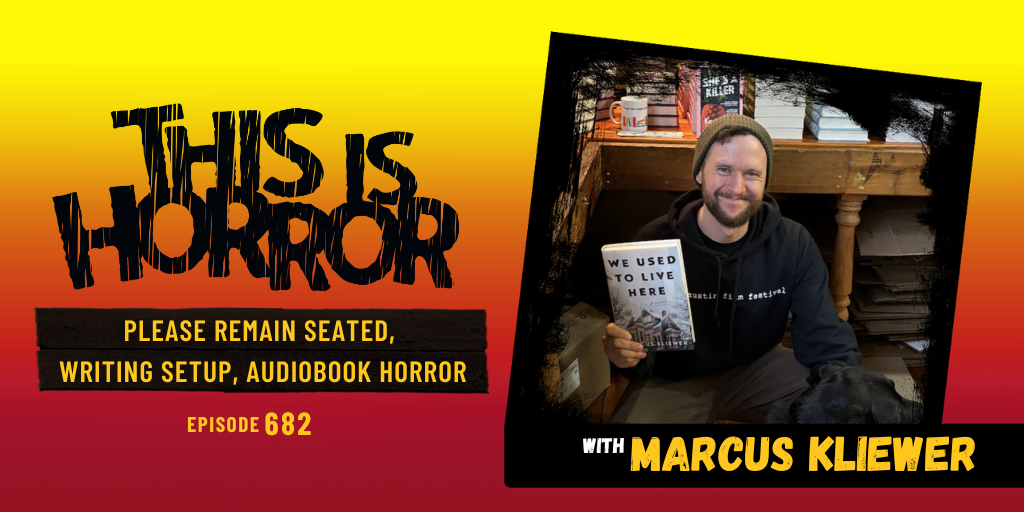
In this podcast, Marcus Kliewer talks about Please Remain Seated, audio horror, and much more.
About Marcus Kliewer
Marcus Kliewer is the New York Times bestseller author of The Caretaker, We Used to Live Here, and his new audiobook short story collection, Please Remain Seated.
Timestamps
Thanks for Listening!
Help out the show:
- Support This Is Horror on Patreon
- Listen to This Is Horror Podcast on Apple
- Listen to This Is Horror Podcast on Spotify
- Rate and review the This Is Horror Podcast on Apple Podcasts
- Share the episode on Facebook and X
- Subscribe to This Is Horror podcast RSS Feed
Let us know how you enjoyed this episode:
- Write a comment below.
- Follow us and get in touch on Instagram @thisishorrorpodcast
- Subscribe and comment on YouTube @thisishorrorpodcast
- Follow us and get in touch on TikTok @thisishorrorpodcast
- Tweet us @thisishorror.
Resources
- Marcus Kliewer
- Watch the video version of This Is Horror Podcast episodes, including our conversation with Chuck Palahniuk on YouTube.
House of Bad Memories by Michael David Wilson
From the author of The Girl in the Video comes a darkly comic thriller with an edge-of-your-seat climax.
Denny just wants to be the world’s best dad to his baby daughter, but things get messy when he starts hallucinating his estranged abusive stepfather, Frank. Then Frank winds up dead and Denny is held hostage by his junkie half-sister who demands he uncovers the cause of her father’s death.
Will Denny defeat his demons or be perpetually tortured for refusing to answer impossible questions?
House of Bad Memories is Funny Games meets This Is England with a Rosemary’s Baby under-taste.
Buy House of Bad Memories from Cemetery Gates Media
Buy the House of Bad Memories audiobook
They’re Watching by Michael David Wilson and Bob Pastorella
From the hosts of This Is Horror Podcast comes a dark thriller of obsession, paranoia, and voyeurism.
After relocating to a small coastal town, Brian discovers a hole that gazes into his neighbour’s bedroom. Every night she dances and he peeps. Same song, same time, same wild and mesmerising dance. But soon Brian suspects he’s not the only one watching and she’s not the only one being watched.
They’re Watching is The Wicker Man meets Body Double with a splash of Suspiria.
Buy They’re Watching in paperback and eBook right now.
Michael David Wilson 0:28
Welcome to This Is Horror, a podcast for readers, writers, and creators. I'm Michael David Wilson, and every episode I chat with the world's best writers about writing, life lessons, creativity, and much more. Today, I am chatting with Marcus Kliewer about his new audio book short story collection. Please remain seated. A bingeable and perfectly unsettling audio collection of three brand new stories, taking listeners all the way from a nightmarish flight through unfriendly skies to a submarine in the darkest depths of the ocean. We're going to talk all about that very shortly, but beforehand, a quick advert break.
Bob Pastorella 1:24
House of Bad Memories, the debut novel from Michael David Wilson, is out now via Cemetery Gates media. Denny just wants to be the world's best dad to his baby daughter, but things get messy when he starts hallucinating his estranged, abusive stepfather, Frank. Then Frank winds up dead, and Denny is held hostage by his junky half sister, who demands he uncovers the cause of her father's death. Will Denny defeat his demons, or be perpetually tortured for refusing to answer impossible questions? Clay McCloud Chapman says, "House of Bad Memories hit so hard you'll spit teeth out once you're done reading it. House of Bad Memories by Michael David Wilson, available now in paperback, ebook, and audio. From the host of this isora podcast comes a dark thriller of obsession, paranoia, and voyeurism. After relocating to a small coastal town, Brian discovers a hole that gazes into his neighbor's bedroom. Every night she dances and he peeps. Same song, same time, same wild and mesmerizing dance. But soon Brian suspects he's not the only one watching, and she's not the only one being watched. Their watching is The Wicker Man meets Body Double with a splash of Suspiria. Their watching by Michael David Wilson and Bob Pastorella is available from This Is Horror.co.uk, Amazon, and wherever good books are sold.
Michael David Wilson 2:46
Okay, without said, here it is. It is Marcus Kliewer on This Is Horror. Marcus, welcome back to This Is Horror. It has been about five days since we left smoke. Good to see
Marcus Kliewer 3:07
you again.
Michael David Wilson 3:07
Yeah, yeah, great to see you. And we've got Bob for this conversation too. Hello, everybody. And so this is the please remain seated portion of our conversation, as well as probably a load of other deviations and interesting topics, because this is This Is Horror. So I want to know to begin with, how did the project come about?
Marcus Kliewer 3:37
Yeah, so please remain seated. Started with the titular short story, which was always like an airplane thriller, and it was something I had written kind of with the intention of capitalizing on the the the short story IP. You know, selling we like we did with we used to live here. We sold a short story, and then with caretaker we did it as a short story, and so please remain was going to kind of be the third version of that, and just for whatever reason, nothing quite manifested at the time, and I just wasn't quite finishing it the way I wanted to, and so it just became this short story sitting in my back burner that I really, I really loved, and I wanted to get it out there because I love the title and I love the concept, and I just wanted to get it out there as soon as possible. So I talked to my agent, my literary agent, Liz Barker, and one of the things she proposed was, "Well, why don't we why don't we pitch it as like an audio thing? And we we sent it over to Simon and Schuster, and they said, "Okay, this is great, but it's too short. What if you expanded it? And I didn't really want to expand it because I'd already done that twice with caretaker and with we used to live here. And I was kind of just done with expanding shorts I'd already written. So I said, "Well, how about I do two other shorts? And we kind of make it all based around travel. So we got land, we got air. And we got C, and so many people listen to audio books while they're traveling. It just kind of seemed like the perfect thing, and and yeah, and and now it's just a super fun medium to explore. And there's things you can't really do in prose that I'm excited about as well. So,
Michael David Wilson 5:16
and just to get a sense of the word count, what is the word count for each individual story.
Marcus Kliewer 5:22
Ooh, I want to say I think it's running about four hours and 15 minutes in total length with all three, and my other books are around nine hours, so it's about half that. And for nine hours, we're looking at 70,000, so I'm thinking we're probably around probably 20,000 for please remain. Probably, probably 8000 for the back roads, and then maybe four or 5000 for the last one. But I could be completely off on that count.
Michael David Wilson 5:52
And I mean, it's really interesting that you decided to pitch it as audio only. So I'm wondering what was the impetus or the idea behind that, and was that a tough sell to the publisher, or were they quite receptive to it?
Marcus Kliewer 6:13
I think because we were pitching to Simon and Schuster's audio specific division, I think they were stoked on it because they're always looking for cool things to to do as audio exclusives, so it wasn't that big of a pitch on their end. And then I think for me, there was kind of like, okay, we could do the print route where we put them all together in collection, or we could do this audio thing and get cool actors involved for each story, which of course you do like in audio book as well, but this is more like traditional movie movie actors and that kind of thing, and then and now adding in sound design elements, which was really cool to play with. And yeah, so it just kind of fell into my lap, and I was like, well, why not? Let's just do that, and there wasn't much thought behind it, unfortunately. I mean, just kind of was like, yeah, this seems like like they want to do it, and this is like the quickest route to get it out there, and just kind of like a why not thing for me.
Michael David Wilson 7:15
And I'm guessing too that this must be separate to presumably the two book deal, or maybe it's a three book deal. I haven't asked you, but the deal that you have with the main books, such as the caretaker, and we used to live here. Yeah, this is separate from
Marcus Kliewer 7:34
that. So that that deal started out as a two book deal, and then it grew into three books when we when we pitch them caretaker, and so this thing is it's still with Simon and Schuster, but it's with audio division specifically, and yeah, so it's kind of its own little side thing.
Michael David Wilson 7:55
Yeah, and they really do do a fantastic job with the audio. I mean, even with the standalone books, there are you know that that aren't from the audio division. There are sound effects. You've got the kind of Morse code that's embedded into you know one of them, and yeah, to really hear the audio division go for it, as it were, it is fantastic, and I think definitely opening with "Please remain seated" was the correct decision because there's almost there's almost a Hollywood movie feel to it combined with I got a kind of old school Stephen King short story vibe to it. It felt like something that wouldn't be out of place in, say, Night Shift.
Marcus Kliewer 8:50
That's a huge compliment. Yeah, I think I've always loved airplane thrillers. Like I think last time we talked about how Red Eye snuck under the radar, and that was one which Wes Craven, which which I found out there. But yeah, Wes Craven directed film, and I I loved that movie. And then I also loved like Flight Plan with Jodie Foster, and even movies like Snakes on a Plane. Like there's just something so fun about that 2000s airplane, just kind of madness that happened, where you get so many these these great little airplane thrillers, and for me it was so fun to explore something a little more over the top because I'm separating it from my. It's in a separate world from we used to live here, and kind of caretaker and all that, and so I don't have to worry so much about being tied down by like head cannon, and I don't have to worry about it being so grounded. I can be a bit more campy, and I can be a bit more over the top, and even a bit comedic in ways that I wouldn't necessarily want to do in. Something that was in the "We Used to Live Here" universe because obviously those there's humor in those books, but it's a different type of humor, and I and I worry about like the tonality of it kind of jarring too much with things I've created. And so with this one, I could really just kind of go wild with it. And yeah, I think like Sam Raimi also like a huge inspiration with the, especially when it gets to the third act. Yeah, it's just so fun. Like I just love this kind of stuff. I love this kind of campy, over the top madness.
Michael David Wilson 10:33
And talking about setting it in different universes, I mean, my my understanding and certainly the way that I reacted to the stories is that please remain seated is in a different universe. It felt like back roads and anomaly are in the same universe as the caretaker and we used to live here. So I wondered, you know, what was behind that decision, and was that was it a difficult one to be like we're going to put the Hollywood story up front, and then we're going to go into this liminal space horror that you have, you know, become known for, as it were.
Marcus Kliewer 11:23
Yeah, I mean, yeah, because backroads and anomaly both do take place in the same world. There's obviously similarities and maybe a few connections there, but I was definitely concerned about. It's just such a dramatic shift in tone of between please remain and then and then back road. Some of the content in that story is incredibly dark, and I think for me, I I love that. Like I love my favorite. I love an album where you get like a crazy death metal song, and then you'll get like a weird chill instrumental jazz fusion song in there, and that's just kind of that's really fun to me. There's a lot of energy in that, and so for me, it was like I want three things that feel they're connected through the travel and that and the horror, but that's about it, you know. And yeah, I don't know if that answers it, but no,
Michael David Wilson 12:23
it does. And so I've had an interesting journey with your fiction because yeah, I've read everything really recently because you were, of course, on my radar before, but then I was sent. Please remain seated, and I thought, yes, I've always wanted to check out Marcus Kliewer's work. Let's see what it's all about, and so I was blown away and absolutely hooked when I read "Please Remain Seated, and then the tonal shift. It it almost confused me to begin with, like what what's going on here? This is so radically different, and I I enjoyed Backroads and Anomaly, but I I then after I I then read The Caretaker, and we used to live here, and then I I returned to back roads and anomaly, and I appreciated them so much more when I had that that setting and that context. So it was a really almost bizarre journey into into your into your work, but I felt like I got the stories so much more and appreciated them on a deeper level once I had, you know, experienced your other work and and I could see some of those connections. So I I don't know what the advice is for for listeners. I I mean, first of all, the advice is read fucking everything that Marcus Kliewer puts out. Yeah, if you want to be a maverick, you could start with "Please remain seated, and then as soon as it gets to the second story, you read the other two novels, and then you you read because almost backroads an anomaly in a way they felt like extended content to use the modern parlance to the care to the caretaker and we used to live here.
Marcus Kliewer 14:34
Yeah, I I think I love that I love world building like I said last time, I love just kind of adding little pieces to a bigger thing, whether they're directly connected or tangentially connected. That's kind of up for the reader to decide, and it's just it's just such a fun thing to explore. And then the other thing. Too is it's kind of like when I do things that are I have you know every writer has their tropes that they love and they have their things that their images that they love and so for me I just have to be cognizant of like okay and if I am gonna do something similar to another story I need it to be intentional because there's been times where I'm like I'm just like oh I just love this kind of trope, and I do it, and then my readers are like, "Oh my goodness, this is connected to that, and then I'm like, "Oh no, I just, I just used a trope I like again, and then I almost have to like posthumously find a way to make that fit, and so it's something that I think starting with caretaker and moving moving now with backroads and anomaly, and then even more now with book three. I'm just so hyper. I'm so hyper aware of tropes I'm using and phrasing I'm using because I know any little thing I do, the the hardcore fans are going to assign some sort of meaning of it. Like there's a phrase that I use. It's like oh the the tick tick ticking of a clock or whatever, and I use it. We used to live here as caretaker, and I just like that. I just like that alliteration. I like the onomatopoeia, and everybody's like, "Oh, this character thought the exact same thing. They must be related or something. And I'm like, "Fuck, they're definitely not. But then I think it's also fun to kind of try to come up with an in universe reason to to so people think I'm a genius and that I'm not just a lazy writer using the same tropes again and again. You know,
Michael David Wilson 16:29
well, I mean, it's like Kathy Koja said: if there is a reader who comes up with an interpretation, but you didn't think of that at all, don't correct them. Just let that become part of the conversation.
Marcus Kliewer 16:45
Totally.
Bob Pastorella 16:46
You know, talking about like shared rules, I dabble in that myself. One of the things that I set up originally was that the physicalities were going to be kind of fluid, and I think that kind of lends itself to to things getting weird. And I've talked to a lot of other people that that that that do the same thing, and they're like, "Yeah, I'm I'm the same way, man. I don't know, I don't, I don't have this thing mapped out. It's all in my head, but I kind of know like the landmarks and stuff like that. But if they if they kind of change how they look, then it kind of gives it a surreal quality. But I want to go back to what Michael said about you know the the stories having a Stephen King feel. I would like to add to that and say yes, yes. Please remain seated. Definitely had a Stephen King feel, but backwoods and anomaly had a Richard Bachman feel to them, so because they were darker and they they you know it's just they they were more serious in tone, which it kind of feel like that's what Bachman was kind of created for was more serious in tone, or some of it got kind of loopy later, but you know, but the just the the the tone and the stories, they're they're they're they're all completely different, and they they all deal with with with crazy dark matter. And I just they were great, but yeah, it was definitely I felt like a Richard Bachman connection, especially when I started reading Backroads. I was like, yeah, this this has a 19. It felt like the 70s, and I was like, this. I like this. This is really yeah.
Marcus Kliewer 18:28
I love that. I love Richard Bachman, and so that's a huge, a huge compliment. And I love, I love like period. I love. It's fun writing in like like 3040, years ago, because there's just so many things you don't have to think about. I just find like modern writing, you're always having to think about cell phones, you're always having to think about the internet, you're always having to think about all these things, and it's just so nice to not have to worry about that. I mean, like even growing up, it's like how many action thrillers have you watched where the entire plot or entire sequences are driven on somebody just trying to get to a payphone? You know, like like running through the city. You got to get to the phone and like that. And it's just like you don't have that in in modern in modern prose anymore. And of course, cell phones can be very fun to toy with. And I I think in Please Remain, there's definitely some cell phone shenanigans in that one, but I do I do love me a good a good period piece, which it scares me to think. What even is back back road set? Is it the '90s or the I can't even remember? But yeah, I guess the '90s are a period piece now. So yeah, that's fun.
Bob Pastorella 19:44
Yeah, they they were 30 years ago, but yeah,
Marcus Kliewer 19:47
yeah,
Bob Pastorella 19:48
doesn't feel like it really doesn't. When you do the math, you are like,
Marcus Kliewer 19:53
yeah,
Bob Pastorella 19:53
makes you feel old.
Michael David Wilson 19:56
But I love that, in spite of including. In cell phones or a cell phone, you have done something which has meant that it's limited in the sense that you are on a plane. It's meant to be switched off. It's meant to be in airplane mode, and yeah, you've definitely used it to your advantage. You know, rather than a hindrance in terms of the story, and you know the the cell phone plays a critical role. I I can I say that without spoiling it? I guess. Yeah, I don't. I
Marcus Kliewer 20:32
think that's not a spoiler. It's it comes up very early. So
Michael David Wilson 20:36
yeah, yeah. I mean, it it is it is fundamental, and it's not a distraction to the story.
Marcus Kliewer 20:44
Yeah, it's funny. The first time I listened to "Please Remain Seated" when they sent me like the early versions of it, I actually was on an airplane, and I listened to it during the safety presentation, and like around the time the the character kind of realizes something about that is the same time. So it's like people that listen to this on an airplane will certainly have a very don't listen to it during the safety presentation. You gotta listen. There's lots of important stuff there, but the people that do do that will definitely have a little bit of a fun, albeit scary experience potentially. Yeah.
Bob Pastorella 21:22
Well, for someone like me who's never flown, you've made it even more difficult for me to get on a plane. So thanks. Yes, I have to get on a plane next year. I'll be like,
Marcus Kliewer 21:31
oh man.
Michael David Wilson 21:34
And so, when did you write? Please remain seated. Is this one that you've written fairly recently, or is this something that you had originally written for Reddit and for No Sleep, and then you adapted and expanded for the audio presentation?
Marcus Kliewer 21:55
So this one I wrote while I was writing the novel version of Caretaker. So that was probably a year and a half to two. Oh man, it's almost like two and a half years ago now, which is crazy because it doesn't feel that long. But yeah, like two. So this story is is like almost three years old, and it's just which is another reason why it's coming out in audio now because I just wanted it out there, and it was just a PDF. It was never. It was never intended to go to Reddit or anything. Like I always kind of viewed it as, um, from like a business perspective. I initially wrote it. It came. I like pitched it to my manager, and he loved it, and was like, "This sounds like this could totally be a movie thing. And so, like, I wrote it with kind of that in mind. I was like, "Oh, I want to do this. I want to try to a third short story, sell it as a movie. And you know, Hollywood kind of there's. I can't really say too much about what happened there, but you know, like now it's an audio thing, and we'll see if it becomes a movie or not, but yeah. So PDF then to audio, but it was initially going to be either a short story compilation or something like that. Like it was going to end up somewhere.
Michael David Wilson 23:14
Yeah, and I certainly hope that it becomes a movie, and I'll be crossing everything that those discussions happen, that those discussions are fruitful, because it just seems an absolute no-brainer to turn this one into a movie, and it feels, you know, like it like it would in many ways be the the easiest one to translate into a movie. I mean, yeah, you know, God, I'd love to see a movie, or perhaps better would be a series for the caretaker. And we used to live here, but these are books that are playing with different mediums. There is a House of Lee leaves feel to them. They are not necessarily the easiest to to faithfully put on screen. You almost have to go in a different direction, but please remain seated. It's it's all fucking there. So snap it up if they have. Yeah, we'll see. We'll
Marcus Kliewer 24:18
see what happens now that it's out in the world. Yeah, yeah, yeah. It it just feels like it's got all the beats and all that kind of stuff. So, and it's very much a love letter to those kind of movies. And I feel like we haven't had a good um a good airplane blockbuster in a minute. There's been some great like kind of smaller films around that, but like I don't know. It just feels like feels like it's time. So, any directors watching this, reach out to reach out to my manager. Make it happen.
Michael David Wilson 24:51
Yeah, yeah, that's it. And you said that you wrote it while you were writing the novel version of The Caretaker. So, to jump onto that, does that mean you were literally writing two stories simultaneously, or was it a case of the caretaker was with your publisher? You're waiting for edits back. I'm wondering, do you write multiple projects at the same time, multiple projects that you know are so involved.
Marcus Kliewer 25:28
I think I'm learning more and more that I need to be a one project guy, like because I this was literally me procrastinating. It wasn't even a scenario of like, oh, I I have caretaker and with the publisher, like I had the publisher breathing down my neck for Caretaker, and then this story just came to me, and I'm like, oh, I gotta write this, and so it was kind of procrastinating on Caretaker. Is is what this was, and I think for me, what happens if I write more than one project is I just start spreading myself too thin, and I don't do anything. And every project, it just becomes an excuse to jump from project to project. Um. So I've been like with my book three now. I'm writing anything could change, but I have I have three different POVs, and that's kind of helped me in the sense where I'm not getting so locked into a single voice, you know, so in that way, I can kind of, if I get sick of one POV, I can jump to another one. But, but yeah, generally, the more I do this, the more I'm realizing I need to be a one project guy, maybe one tiny thing on the side, but anything more than that is just counterproductive.
Michael David Wilson 26:40
This is a realization that I have had personally, relatively recently. And once I finish the three novels and the one, no, the two screenplays that I'm working on, I hope to become a one project guy as well. But I've had that intention for a while now, and just something fucking happens. Probably what happens is my dumb brain brings me an idea, and I'm like, "Yeah, go on then, let's do that. But in my defense, you know, recently my brain did bring me a new idea that was like, "Why don't you have a Gaijin J horror? That's your take on Duon the Grudge, and I said to my brain, "Okay, good idea. Let's fucking pause that. We've got five projects, and I haven't, I haven't started writing it. Did I write some notes down? Yeah. Do I think about it semi regularly? Yes, but the important part is that I'm not writing it, so that's progress in a sense, I suppose.
Marcus Kliewer 27:53
Well, and it's hard. It's hard when something really grabs you, and I think that's kind of what happened with Please Remain. Is it just grabbed me so vividly that I just needed to strike while the iron was hot, kind of thing, because that doesn't happen all the time. And I think the more I think the more I went into it, the more I realized it wasn't just. I'm sure you can relate to this, where you've had it's almost the like, oh, the idea I haven't written is always more alluring than the one I'm working on because it's full of potential. And then once you sit down to actually write it, you're like, okay, well now I need to figure it out. I need to hash it out. And with Please Remain, it was just one of those ones where the more I kept hashing it out, the more it kept grabbing me. So it's like I had to just follow that through, and I'm and I'm glad I did for sure. And I'm even glad I did because I think with Caretaker, that book I needed to take more time on it to, because I was having trouble cracking that story. And so, in the case of like the procrastination, did actually kind of pay off, or at least that's what I can tell myself, because the story would have been very different if I didn't have that extra time to sit with it, you know.
Michael David Wilson 29:01
Yeah, yeah, and I wonder too. Does this mean that you had your publisher hassling you for the caretaker, and then at one point did you email them and you're like, right, bad news, we don't have the caretaker. However, here is a pitch for a new story that I have completed in the time that you've been asking me to finish the yeah,
Marcus Kliewer 29:24
I I think I am protected a lot by my my my publishers are the the sweetest people. They're very patient and they're very that are very generous. But I think there's probably some stuff that goes on that I don't hear about for sure sometimes. And you know it's fair. It is a business at the end of the day, and I I need to deliver these things. But there it is also. I am just I'm learning that I am not a book a year guy, and I think coming into this, I think coming writing off of Reddit, where I was like, you're just you're writing so. Quick, and I think now that I'm in it, I'm like I'm a one book every two years at at most. If if we want to maintain some level of quality, and I just I cannot without keeping my sanity, without keeping the quality, and so I think kind of once I'm done this third book, that's going to kind of be my cadence going forward. It's like one book a year, one book every other year, with maybe a small kind of "Please Remain" type thing in the middle. You know,
Michael David Wilson 30:26
I mean, another story that was brought to mind when I was reading "Please Remain" was the lottery by Shirley Jackson. You know, because of the the concept, and and so I suppose actually to back up, I haven't even asked you what is the elevator pitch for "Please remain seated.
Marcus Kliewer 30:51
I guess I'm so bad at pitching, but I think it's something like a woman shows up on a flight and discovers she's the only passenger, and. and that things just kind of spiral from there into this. Yeah, I mean that that's the pitch, I guess. That that was always the hook for me because, like during COVID, you would hear about that a lot about people showing up, and they're the only. I mean, that happens before COVID, but during COVID, it was especially common, and there was just something so eerie about that image of being the only passenger on an airplane to me, and that was kind of the seed that that sparked it. And the lottery is one of my favorite short stories. Like that was kind of one of the first short stories I read in English class that I was like, oh, this is this is really cool. This is something really special, and yeah, the tradition and all that kind of stuff. I love I love that story.
Michael David Wilson 31:53
Yeah, and as you say, it's just so eerie to be the only passenger. I mean, it's it's so eerie to be the only person anywhere, you know, if you go to a mall and you're the only person, if you go into any building, it's it's that disconnect that you're not meant to be alone, and it it also it has that liminal spaces quality, that quality that you're so fond of, and that back rooms did so well. You know, having the whole plane to yourself, and so I mean, when it when it comes to liminal spaces, how did that play into this, and I suppose I haven't asked. You know, even though we spoke for over two hours before, what were the limo or space stories that first really grabbed your attention?
Marcus Kliewer 32:54
I think when I first got the idea, one of the first things I do whenever I get an idea is I sort of I try to look at what are all the one what are all the stories that have already been done in this genre, and I think a lot of writers are are kind of are can be wary of doing that because they're worried that oh no if I watch these things I'm gonna start copying them and then I'm not gonna be original and it's like you actually kind of have to watch them so you can be original because nine times out of 10 you're gonna find things and they've already done what you've done. Now you don't want to you don't want to go so extreme where you're like oh no it's already been done I can't write it because that's a whole other can of worms that can prevent people from ever doing anything. But I think in my case, not only my watch or reading these other stories or watching those movie, these other movies to gain inspiration, but it's to to see what's been done and try to if I'm going to do it again, try to find a way to reinvent it. So I think is it the Langeliers? Is that the title of the story? The yeah, the Stephen King novella was like a big one. Like I'd obviously heard of it and I knew of it, but it was actually one of his books I had never gotten around to, to like diving into, and so that was a big one. And then the another one that just slipped completely under my radar was the the terror what is it the terror at 20,000 feet the it's the famous Twilight Zone episode with William Shatner and he sees the thing out on the wing and I believe that's Richard Bachman right the am I
Bob Pastorella 34:36
well well that that actually was original Twilight Zone episode I think it was Richard Matheson who wrote it. Maybe Richard Matheson. Yeah,
Marcus Kliewer 34:44
my bad.
Bob Pastorella 34:45
But then it was redone in the Twilight Zone film, and and then redone again in the Twilight Zone series that Jordan Peele did, which had a. A big homage to the original in it, which actually is pretty good. But I don't know. I always joke about I've never flown. I'm I'm either going to be William Shatner or John Lithgow.
Marcus Kliewer 35:11
Yeah,
Bob Pastorella 35:12
God, if I'm John Lithgow, man, they're going to have. I'm never going to fly again. I'll be banned.
Marcus Kliewer 35:18
Totally.
Bob Pastorella 35:19
Yeah, but yeah, that's man. It's like when it comes to airplane fiction, there's really not a whole lot. What else did you find? I'm curious about this now.
Marcus Kliewer 35:28
Yeah, so there was the Richard Matheson one. Just got my names twisted up there, but Richard Matheson one, obviously classic. And then I listened to there was a Stephen King. It's like Flight or Fright, and it's just a compilation of like airplane-based stories, and all the all the names of the stories are slipping my mind at this moment. But there was so much good stuff on there, and and yeah, so kind of watching all this stuff, seeing what's been done, and then seeing how I can reinvent it. And then if I am drawing from something, putting in like a way so that people know, you know, that's kind of my thing. It's like you almost want to put in an Easter egg to that thing as a citation. Like with with with We Use to Live Here, I'm obviously drawing heavily from House of Leaves in the novel version, and so I put in. I think there's literally a character named Davidson in one of the the forums, and like, it's amazing how forgiving people are if you do that. It's like it goes from like, oh, you're ripping this thing off, to like, oh, he's he's paying homage, and I think that's important to do because nothing is original. Everybody's drawing from things, and if you get too hung up on being original, then you just end up writing nothing. I think, like, imagine if if Jordan Peele with Get Out was like, "Oh my goodness, I can't do this because they did it in being John Malkovich with the Mind Things, and it's like, which sounds ridiculous to say, but that's kind of how my mindset would have been when I was in my 20s, where it's just like your brain is almost looking for excuses to not write this project because you're like, oh well, somebody did, oh man, somebody already did a story where there's a guy in a cabin with a knife that stabs somebody. It's like, well, there's 50 billion stories like that, and yeah, so I think there's something like you said, there's something so eerie and liminal about airplanes and airports and all that-that just kind of existing in that world and then watching movies in that world was great. And I even went back and rewatched things like Red Eye and there's this vampire film on an airplane. I can't remember the name of it. It's relatively recent, and it was really good. I got to look that one up. Yeah,
Bob Pastorella 37:46
I know what film you're talking of, and I can't think of the name either. Yeah, that was a good thing, right? Yeah, that was a good movie.
Marcus Kliewer 37:54
Super cool,
Bob Pastorella 37:55
and I think the strain begins with an airplane, right? Yeah, the vampire comes over on airplane and basically kills everybody on board, but you know, yeah, which makes sense. You know, it's like, well, I'm here and I'm a little hungry, so
Marcus Kliewer 38:11
totally
Bob Pastorella 38:12
time for dead, den, yeah.
Michael David Wilson 38:15
So as well as reading and watching a lot of airplane Horror medium books and and movies and episodes was that part of your kind of five to 15 minute writing session that you have where you'll write something from a script or from a story beforehand was that part of getting you in the zone.
Marcus Kliewer 38:43
Yeah, totally. I um, I think Red Eye was actually one of the scripts that I did, which is just a fantastic script for looking at like building building tension and structure. It's it's such a great little screenplay and a great little movie, and so that was definitely one. And I can't remember the other ones I did. I think I did Nightmare at 20,000 Feet as well. And then I found this old story by the author of Sherlock Holmes, who he did like this Lovecraftian story about these like World War One fighter pilots that like encounter these like kind of angelic entities. It's like not at all what you would expect because I don't know much about. I mean, I'm the freaking name of the author is slipping my name, slipping my mind right now. But that was a cool one. That really had like a Richard Matheson vibe to it as well. And it's really cool finding a super old story like that because you know it was like really ahead of its time. I think that's one of the reasons, like Dracula, is so compelling because when that book came out, it was like genuinely shocking to people. And there's something really cool about looking back in time and seeing the earliest versions of these things.
Michael David Wilson 39:55
Yeah, I didn't know that Seraphina Doyle did off craft. Style story, but I'll have to.
Marcus Kliewer 40:03
Yeah, you just Google like airplane Arthur Conan Doyle. There should something should come up.
Michael David Wilson 40:09
Yeah, that sounds fascinating, and I I have tried your your trick, your technique now because I said that I would, you know? Start a writing session, and then write a screenplay that that is already out there. And so, of course, I started with Get Out because I think Jordan Peele is just one of the best screenwriters out there, and I also really admire his minimalist style. You know that's something that I want to incorporate into my own writing. And I mean, I'll say to begin with, first of all, it's it's just a really pleasurable, enjoyable experience, like copying out a screenplay that's already there, and you-you definitely are getting those words into your mind in a way that reading it does not quite do. And I think too, you know, as someone who's relatively new to starting out with screenwriting, I actually did it so I wasn't just writing it out, but I was writing it into final drafts, so I'm really getting to see how many lines it is, what that experience is like, and yeah, I don't know if I'm gonna get some benefit via osmosis, but whatever happens, you know, I'm enjoying it. I'm getting to see, you know, because in a way, like because the screenplay is essentially action and dialog. Sometimes it can be difficult with the action to know. Well, how do I phrase this very similar thing in a different way? So just through experiencing other screenplays, not only reading them but writing material that masters wrote before you, I think, yeah, there's something to it. So I think I'm gonna be doing this going forward.
Marcus Kliewer 42:16
It's just it's such a fun way to just experience stories too. Like it's like not only that, it's like you're just absorbing these stories as well. So yeah, I really for people that didn't watch the last one, we were just talking about basically you take a screenplay or a short story and you open it up and just just unplug your keyboard or put it in a Google Doc and just type it up word for word as you're reading, not really worrying about typos or anything, and yeah, yeah, it's just something that has completely transformed how I write. And yeah, it's just like I used to really struggle with writing, and real, especially prose. I go back and forth all the time, and so nothing has really improved my writing more than that. It's definitely not for everyone, but yeah, it's something I like to preach as much as I can because it really changed how I approach the craft. So,
Michael David Wilson 43:07
yeah, I didn't ask before, but was there somebody who suggested it to you, or when did this light bulb moment happen that you're like, today is the day I'm gonna? Yeah, when
Marcus Kliewer 43:21
I was in um, what's his name? Hunter S. Thompson did it with The Great Gatsby. He did the entirety of The Great Gatsby, and I think the quote was he did it just because he wanted to see what it felt like to write it. And I don't know if he did it as an exercise, um, and did it like daily. So that I think I probably heard that a long time ago, and it just stuck in my head subconsciously, and I never really followed up on it. And then going to going to school and and doing you know like writing one and one classes and all this stuff, um, I just found that like oh like a lot of times I would do instead of transcribing, I would just break down the plot. So I would take a script or a book, and I would just do point form outline of the plot and like the scenes, and that was helpful. And so why don't I just address? Why don't I just expand that to transcribing? So I don't think it was until COVID hit that I really just started doing it as like a ritual kind of thing, and that's the thing, especially for people that were like, if you're working a nine to five or or a part time job or whatever, it's just such a great thing to do for like 30, even just 2030, minutes, even if you don't have the energy to do something creative writing that day, for for people that are learning the craft, yeah, it's um, like I said, you don't you don't fall into the story as much with reading, and so you can focus on the technicality of it more because it's basically just reading while you're typing. That's the only difference is you're adding in typing. But yeah, it's it's was so helpful for me.
Bob Pastorella 44:56
It makes a lot of sense. That that's how I studied in school. Is I would write my notes and I would rewrite them, and I remember we were I was talking with some young writers a long time ago, and they were afraid about you know I said hey you know one thing you could do is kind of suggesting what you're saying is like take take the sentences that you really like the dialogs the way that they do it and write them and just change the names and things like that. Well, I'm gonna be like that writer. You're not. That's the thing. You can try to imitate whoever you want to, and the chances of you actually being able to be successful at imitating them is slim and none. If I said, "Hey, I'm gonna write like you know Elmore Leonard, and I'm gonna copy everything he ever did. Probably the worst thing that's going to happen is I'm going to have a bunch of pages that I copied everything he wrote. But when I come to my own stories, I'm not going to say I'm not going to be like Elmore Leonard unless I'm intentionally trying to copy him. I'm not going to be that way. But it is a great way to learn how to do certain types of techniques. Like you know, one thing that I'm struggling with is always like internal thought. Like he actually including the words he thought or she thought, and trying to get rid of that. And it's like, well, I have to break it apart, have to set it aside, put it in italics or something like that, and you really don't. You just have to tie it to the character, and so you know, I have to go back and reread those passages that I like where they do it right, and then basically try to figure out how to do that in my own story so it makes sense. And that's you know, it's really really good. I'm glad you brought that up because that's something I probably need to to do because I've got some some things I'm struggling with that that I'm gonna probably be able to fix by doing this.
Marcus Kliewer 46:51
Yeah, like for me, then the analogy I always use is like I play I play piano quite poorly, but I play enough to you know play some to improv a little bit, and I notice whenever I learn another song, I start feeling those techniques or a variation on a lick in that song, and that improves my improv. So it's like you're not you're not becoming that other song. You're just learning what another artist has done. Like you wouldn't you wouldn't go into piano without learning other songs, you know, like just starting from scratch, unless you're some kind of god level prodigy. That's just not how the brain works. Like everything is based on on on reading and learning and all that kind of stuff. So, and for anybody that's worried about the style thing, that I don't just draw from different authors. You don't always have to do the same author. You can you can mix it up. I try to do that, but like at the end of the day, you have your own voice, and that's going to come through. And the technique and craft that is universal across any voices, like breaking up sentence length, getting like you said, trying to not say he thought as much as possible, and like all that stuff is that's that is beyond voice. That is going to be just universally improving the craft and the writing. And I think too, it helps me with my voice because now that I've done it so much, I am not thinking as much about the technicality, and I'm able to just kind of let my voice flow because I've just seen so many other people's voices doing it well when they are they are masters of their craft and yeah so it's yeah it's it's great.
Michael David Wilson 48:33
Tell us about the real life inspiration behind back roads.
Marcus Kliewer 48:39
Yeah, so in my early 20s, I was driving home from university out in the the back roads of Western Canada here in the mountains, and got hit by a deer. And it kind of you know rolled up under my hood, pressed into the windshield, the whole windshield like spider webbed, and then it rolled off and took off a side mirror, and then ran off into the woods, and I remember pulling over, being like really shaken up because it was like, man, that thing could have gone through the windshield and you know crushed me. And then after that was the feeling of like this, like guilt almost of like, man, like this this poor this poor thing, I just have permanently ruined its life, like it's probably going off to die a very painful death somewhere. And then I had to drive home with that all hanging over me, and my windshield. I could I could hear the popping sounds of it. Like it felt like it might just shatter in at any moment. In hindsight, I probably should have called a tow truck or something. But I think I was just so kind of in shock by it all, and and that moment just really stuck with me. It's such a vivid memory, and like the whole like how everything slowed down and everything. And then I want to say probably during COVID is as. Well, was when the idea of somebody hitting something, which is obviously a tried and true horror trope, we we see it a lot. But sort of the thing was like, oh, what if this thing started following the person that hit it? And that story existed in many different forms throughout my life, but ultimately kind of landed on the backroads one with the character that we had, and yeah, there's just something about driving down a backroads, especially by yourself at night. It's just a very singular, it's a very, it's a very eerie feeling being like, man, the only thing between me and complete wilderness is this machine that I'm driving in, and if this car just suddenly breaks down and doesn't work anymore, I'm basically in the middle of nowhere, and so there was always a lot of energy in that for me.
Michael David Wilson 50:53
And I think one of the more obvious comparisons that comes to mind, particularly because baked into this is water trauma, and is a almost nightmarish distortion of reality. Is Jacob's Ladder? This really felt like it had something Jacob's Ladder about it.
Marcus Kliewer 51:18
Yeah. So I'm ashamed to admit I haven't actually seen Jacob's Ladder, but I know it's one of those works that is so-it's so influential. Even if you haven't seen it, you're influenced by it. It's like people that say they're not influenced by Stephen King when they're writing horror because they've never read him. It's like, well, you've read somebody that has read him, so obviously not as big as Stephen King, but but totally. And this character of this story is another character that has been with me probably even longer than this, definitely longer than this story, and sort of his backstory and exactly what happens with him has existed in so many different things. I even had a cyberpunk version of this character at one Point and there's a there's a certain reveal with him that has really really stuck with me and and has always been something I wanted to put into a story and it just felt right. This felt like the right story to do it, even if it wasn't a big novel. I just think it felt like the right kind of thing to do, and I can't really talk about it too much more than that without spoiling some of the reveals. But I think too, I find a lot of representation of of PTSD, which I haven't dealt with personally. But I did I've done a ton of research on it, and I find like a lot of research is very, or sorry, a lot of representation around it is very much about the like flashbacks and the like. Oh, like I'm in the thing, and all of a sudden I'm hearing gunshots going off, which definitely happens. But more more often, the thing you hear is is just this kind of constant not being able to turn off your fight and flight thing, where even just an argument about the dishes becomes a life or death thing because you've been existing in this space where a civilian walking up to you on the street could have you know a gun on them, and you don't know that, and like, how does that change your mindset going back to civilian life? I just, I just can't even imagine how, um, how how terrifying that could be, and how how impossible it might be for people to shake that off because it's just, it's just so imprinted into your brain, like it physically alters your brain chemistry, those experiences, and yeah, and so putting some of that in there as well, I thought was important for the story for sure.
Bob Pastorella 53:53
I feel like that being out in the road alone is whether you're in a car or whatnot. Those stories exist because it's primal, because you know you're you're it's it's isolations what it is, and having a character with PTSD that that only amplifies the tension that you already have, which that really makes an effective story because every every ounce every sensation is hyper centralized. You know what I mean? It's like you, you, it just it, and it creates like a you know just something that just keeps basically refiring and refiring and refiring, and finally you're going to just start to to have very surreal experiences, and that's that's you know very conducive to that, but that it's. I think being lost is primal. The the and you know hitting something with the car. I think we. If you drive, you fear that. It's like what was that noise? Holy shit! You know, did I just? What did I run over? You know, around here we. Have to worry about the javelinas. They they will total your car, so they're basically wild boar that get travel near the highway. They have little signs and stuff like that. We've had all that. I'm I'm near I'm near the coast in Texas. Oh yeah, yeah. So I'm like outside of Houston, but we have some waterways and javelinas hang out there, and they they will they have the signs that's basically saying you know watch watch for javelina crossing, and it's best just to stop you know and just let them let them run across because they'll hit your car, and the next thing you know you're in the body shop with a vehicle that they're probably going to total yeah from a 500 pound pig. Yeah, that's crazy shit.
Marcus Kliewer 55:46
Yeah, and like they, they, there's like moose up here too, and those things, like they, those will crush you. Like people get fully just gone because it's just like the entire top half of the car is just gone from those. So it's like, yeah, you can um, but it doesn't. Yeah, even a deer, you know, like even a smaller deer. If it hits the windshield just right and it goes through, like that's that's it. You know, it's it's it's crazy.
Bob Pastorella 56:10
Yeah, I was I was last year old when I realized how big moose were because I've seen some in some interesting video, and I've never I always figured they were just maybe I figured they were larger than a deer, but I didn't know that they were something out of an Adam Neville novel. Just this horrifying image. It's like they're a fucking monster, you know. They're straight up dinosaurs. Yeah, they're
Michael David Wilson 56:35
huge.
Bob Pastorella 56:36
Yeah,
Marcus Kliewer 56:37
yeah,
Bob Pastorella 56:38
crazy. Very
Marcus Kliewer 56:39
very dangerous too. Like they they can be yeah, you don't wanna you don't wanna run into the wrong moose that's for sure.
Michael David Wilson 56:46
And I trust on the basis that you hear that you haven't ran into the wrong moose. You no,
Marcus Kliewer 56:52
I've seen them all from very safe distances. So yeah,
Michael David Wilson 56:56
yeah, yeah. That seems the best way to do it. And I mean the third story is anomalies. So this is your your sea horror and diving story, and this one has so many sub genres and so many nods packed into it. But you know perhaps the most obvious is this idea of the ancient deep and something manifesting beneath the sea. But then there's also, you know, within the story, there's this almost house at the bottom of a Lake Josh Malerman vibe to it too. So this is a trippy story. This is like I'm on some drugs when I'm reading this one. So again, as with the other two, what is the origin story as to how this came to be?
Marcus Kliewer 57:58
So there's actually a story I wrote back during COVID. I believe it's still on my Reddit. U slash Polterkites. If people want to check it out, it's called Old House Underwater, and I think I initially wrote it on writing prompt sub Reddit, and the prompt was basically like it was like something like oh, like the U.S. You you have to write about a submarine crew that is supposed to be protecting the U.S. coastline from like a basically some kind of SCP inspired kind of you know like oh there's like anomalies at the bottom of the sea and then you have to write the submarine crew that encounters these and so in that story it was a military submarine and they come across a house where there's a, it's an old gothic patchwork of a man, like a bunch of mansions kind of patchwork together, and then out from the window, this kind of harpoon chain shoots, and then it latches into the ground, and then the house drags itself slowly forward, and then the chain retracts, and then it shoots again, and then it drags itself forward, and it was very, I think it was like a 1200 word story. Like it was just like they see this house, and then the submarine starts shrinking around them, and that was like it pretty much. It was just like very just inexplicable terror kind of thing, and I didn't even post it on No Sleep because it broke the it broke the rules of that subreddit where you can't have all the main characters die, and you know having the submarine start shrinking, it kind of implies that they're all going to die. And initially, for for Anomaly, I was just going to kind of take that story, you know, polish it up, make it a little bit longer, and just kind of pump that out as the one to put on the short story collection, but then I think the more I started doing research on on military submarines, and I have a friend that I'll sometimes delegate research to her, and she kept sending me stuff back. The more I'm like, man, this is such a complicated and just such a fascinating world that I almost want to save the military submarines. For something else, because like man, that is it. You're underwater for like months at a time, and you don't even know. Most of the people in the submarine don't even know where they are. It's just such a fascinating world. So that kind of just went on the back burner, and instead, it kind of became still an old house underwater, and and yeah, just inspired by the Lovecraftian, like you said, the deep sea. I think also George R. Martin. I'm. I watch a ton of like of Game of Thrones lore videos on YouTube, and they talk so much about his implementation of of Lovecraftian kind of like the deep ones and the fish people, and there's all this stuff that doesn't make it into the show. That is just so fascinating to me, and and yeah, it's just like I just love I love me some some kind of incomprehensible bottom of the sea kind of terror. It's just it's really fun in a fictional setting, not not. I'm sure it's miserable to actually experience, but yeah, it
Bob Pastorella 1:01:06
definitely reminded me of the thing that should not be by Metallica. So because it's just, I don't know, I just kept getting this. It's one of my favorite songs, and it is it is very Lovecraftian and deals with you know the beneath the sea and all that and I was like that this is this is very that's my vibe man
Marcus Kliewer 1:01:30
oh yeah
Bob Pastorella 1:01:31
I can only imagine like I didn't know that I figured like submarines like you you you might have like a you know a little tour like for like a week or so like that, they're they they stay underwater that long.
Marcus Kliewer 1:01:44
So I could be getting my facts mixed up, but I think some of the nuclear submarines will have deployments of like they will maybe maybe they will have a few surface you know just to go to surface and do whatever they need to do. But like these are like very very long. Like it was like at least a few months, from what I mean. Maybe maybe people in the comments will will scream at me. But from what I recall, it's just it was shocking how how long they could be underwater and and it's just it just something too about being in a scenario where you literally could have the end of the world in your hands. It's just so the stakes are so high, and it just didn't feel right to put in a short story. It's like, man, that needs to be that needs to be a novel. Like you, you even hear these stories in the Cold War of captains on these submarines that made decisions that literally stopped nuclear holocaust from happening. Where where there was a scenario where I think it was a Russian captain who basically they were getting depth charged by a U.S. training mission, and it was a complete misunderstanding. The U.S. didn't know they were down there, and the one guy was like basically ready to send the nukes out, and it was either the second in command or somebody else. I should know his name because he basically saved the entire fucking world. But this dude basically was like, "No, I'm not going to go ahead on it. And because of that decision, it stopped a nuclear holocaust from happening. And these are just dudes under the water, you know. Like it's yeah, crazy world. Yeah,
Bob Pastorella 1:03:21
yeah. Write that book. I want to read that. Yeah, highly recommend it. I mean, yeah,
Marcus Kliewer 1:03:26
check it out if you want to write your own stuff in that world too. It's such a cool world. It's so massive, and yeah, it's it's crazy. I also love writing because like I'm not. It's just a world I'm not familiar with at all, and I would never be in that situation. So it can be very fun to write about characters with that type of resolve, and whether or not you agree with what they're doing or not, it's a certain type of person that does that. You know, it's like you need to be a very resilient and intense type of person to be on on one of those submarines. Like it's it's not for the faint-hearted, that's for sure. I wouldn't
Bob Pastorella 1:04:02
be on there.
Marcus Kliewer 1:04:03
I would not. I wouldn't step. I wouldn't have won a tier one, but yeah, it's crazy.
Bob Pastorella 1:04:08
Yeah, that's just too long to be away from the world alone. Totally. Yeah.
Michael David Wilson 1:04:15
So when do you think we might see this novel? I mean, it sounds like the third novel is the one that you're working on at the moment, so presumably this is the the fourth at the earliest.
Marcus Kliewer 1:04:28
Yeah, fourth at the earliest. Third is much more much more domestic conventional horror, more in the vein of of Weezleaf here and Caretaker. But I think it's still quite unique from those books. But yeah, I'd love to do a longer, even even like a I don't know, even a novella would be would be fine. But it's just so, and who knows? Maybe it will connect to anomaly as well and kind of explore that that specific phenomenon a little bit more. But yeah, it's it's such a fascinating world, and it's like man, I did all these research on it, and I got my friend to do so much research on it. So we both are like kind of pseudo experts on this random niche sub genre. So we should probably try to to utilize it in some way. But
Michael David Wilson 1:05:15
I mean, that's what Daniel Kraus does, who has brought a lot of attention to ocean horror, I suppose. You know, totally because of Whalefall, he becomes an absolute expert on topics and then writes a novel. It's, I mean, it's an approach to writing. It's the Kraus approach. I'm not sure if it's quite for me, but it yeah, it sounds like you're getting into it too.
Marcus Kliewer 1:05:45
I think yeah, I think there is some of that. I'm not as hardcore as him. Like I respect the hell out of that. But I think there's something, especially when it is such a lingo and it is such a specific thing, where it's like, man, I really want if somebody did work in this world to to not to be able to put up with the things I get wrong, you know. So it's like there's something about like I feel like there's almost a responsibility when you're doing such a specific thing to like really make sure you're getting it as right as you can. Now, unfortunately, with something that so much of it's top secret, so there's things you just don't you'll never know. So you kind of have to fill in the blanks, but but there's something cool about that for sure.
Michael David Wilson 1:06:26
In terms of the third novel, is there anything you can tell us beyond the fact that it's domesticated horror in the vein of the previous
Marcus Kliewer 1:06:36
two? I still haven't. I literally just sent out last night, the first kind of few chapters of it to my publisher, and my agents are all excited about it. So we'll see if they if they bite on on what it is. But it's the first thing I've written that's actually like scared me while I'm writing it. Like, well, I would say creeped me out. It's not like I'm shaking in my boots while I'm writing it, but it's like it's one of those things where, like, I don't know. Usually, I'm not that. I I generally have a good sense of if a scare is working or not, and it might I might feel a little unsettled. But this one, I go back to it the next day, and I'm kind of like, what's wrong with this guy? Like, who wrote this kind of thing? So I think I would say very inspired by incidents around the house by Josh Malerman and the Bob Adook, which I think is kind of simultaneously. I think it's an underappreciated film. I think I think it definitely is. I think that film doesn't get as much due as it deserves, and then also also it follows, which I think is a that film is very highly rated and deserves that that praise for sure. And I'm really playing with the physicality of entities with this one, so I really think I love me some like ghostly spirits and kind of hallucinatory stuff. But I think, which obviously there's a ton of that, and we used to live here in caretaker. But I think the more I'm writing, kind of entity horror, there's something about really making the monster feel, whatever it is, feel physical and feel like like there's something that can reach out and touch you. Like I think talk to me, the ghosts, and talk to me. They're ghosts, but they feel so physical. Like there's that drowned woman, and she's her eyes looking off over here, and they like they just feel like something that's actually in the room, as opposed to kind of an apparition. And so I real I really want to kind of I want to take a lot of these tropes of the the kind of monster in the closet genre that we all love, and and try to play with them in hopefully ways that feel fresh to people. Who knows? Anything could change at this point. It's still very early, but I'm excited about it. And I'm normally not. I'm normally quite reserved because I don't want to like overhype things, you know. Like, but like I feel like this one, um, it's freaking me out. And generally, if it's freaking me out, it'll freak other people out too. So
Michael David Wilson 1:09:02
now this one sounds fascinating, and all of the touchstones, all of the inspiration of books or movies that I absolutely love. And in terms of the timeline, is there a time that you're hoping this one will be published. I mean, obviously, depends on if you meet the deadlines.
Marcus Kliewer 1:09:25
Yeah,
Michael David Wilson 1:09:26
for instance, I'm hoping.
Marcus Kliewer 1:09:27
I'm hoping late 2027, early 2028 at the most. I, I have no idea. I'm still kind of figuring out the the whole publishing window of everything. But I think if I'm riding the momentum that I'm riding right now, if that just kind of keeps carrying me through to the end of it, then I think that's a very achievable goal, and that hits my one book every two years kind of mandate because I need some kind of deadline. If I don't have like a deadline, then it's just I'm always going to procrastinate, you know. So. Late 2027 is like a 10% shot. The more likely is you're looking at sometime in 2028. Hopefully, the earlier portion of it. Hopefully, Q1. Yeah.
Michael David Wilson 1:10:11
All right. Well, I look forward to our in-depth conversation in 2028. Hell yeah! I'll make sure you guys get
Marcus Kliewer 1:10:18
early copies.
Michael David Wilson 1:10:19
Yeah. Yeah. Now we are coming up to the time that we have together. But one thing that we mentioned off air that I really want to dig into is when you're writing, you don't use a computer. So talk us through your writing setup. How long this has been going on, and what it logistically looks like.
Marcus Kliewer 1:10:47
So this is a relatively recent development that is, I would say, has probably like 10 xed my productivity, and the the main issue I had with laptop was I have horrible ADHD and and just even having all the blocking apps in the world and trying to do I'm going to have a profile that's only for writing. It just never quite. I was never quite able to get it as restrictive as I wanted it to be, where it was just a purely writing device. And the problem when it is whenever I did find a way to do that, then it became I basically have to shut down this laptop for everything now. You know what I mean? Like it's like okay, well, like the only things that really are able to defeat my ADHD are things that completely gut the laptop and turn it into only this thing. And so, well, I also want to use it for research and email and work and all that stuff. And so I had an iPad sitting around, but like I mean, you can do this with any kind of tablet. I think like all these tablets now have like crazy good battery life, and you can do Bluetooth keyboards. And so my setup here, you're gonna see my messy desk a little bit, is basically just that. So I have my keyboard down there, and then I have that my oh my iPad on like a stand there that I got on for like 20 bucks on Amazon, and you can do wireless mouse. And for me, it also helps my neck a lot because I can just look straight up. I'm not looking down, And it's so much easier to lock down an iPad or a tablet than it is to lock down a laptop. So for me, it's just been game changing. And then it's I also find it easier to kind of bring it on an airplane, where I mean you can do that for a laptop as well for sure. But there's just something about sliding a lap. Like I just have a little satchel bag, and I can just slip it in there. So yeah, it's been it's been a game changer for sure. And I think again, it's just that filter of keeping it separate. Just knowing my email is accessible on my like laptop is just like knowing it's there. It just feels like this giant loaded gun pointing at me while I'm trying to write, and having that taken away has really helped. It's like a boundary, you know, keep the world out. And when I'm writing, I'm writing, and that's that's what it's for. I only do writing on there, and that's it. Like everything else is hard locked. So like even now, I'm using my phone for this. You know, like phone is fine for work stuff, but um, I think if if somebody if but the cheap lap cheap tablets, if you have the you have the financial freedom to get a cheap tablet and have a device that is purely just for writing for anybody listening. I would highly recommend doing that, and it doesn't need to be an iPad. It doesn't need to be a new iPad. It's just like any any of these devices. It's crazy how powerful these things are. So yeah.
Michael David Wilson 1:13:54
And when you're having your writing sessions, are you listening to music as well, or do you have any sort of background noise to just create of to to filter out other distractions?
Marcus Kliewer 1:14:10
Yeah, I listen almost exclusively to Johann Johannesburg's prisoners soundtrack from the Dennis Vilniau film, And that's what I've been listening to. I listened to that almost the entirety of writing caretaker and the entirety of We Used to Live Here and now the entirety of my third book. I have recently altered it down to eight songs on there because I find there's eight songs in particular that are very dread building, and they kind of stick in the exact same tonality the whole time, so it almost feels like one big 30-minute ambient drone song. And any time I've stopped doing it, I sometimes I you know for whatever reason it just falls. I forget about it and I don't use it. My writing and my. Productivity goes way down, and my creativity goes way down. So, like that soundtrack, you don't even need to edit it down. Like, just the whole thing is just perfect, which is very rare for a movie soundtrack because usually you kind of get wildly different variants and tone. But that movie is just a very consistent kind of mysterious dread that's very inquisitive. And then sometimes I'll throw underneath that like an ambient rain on a window sound effect because there's something psychologically very motivating about that to me. The idea of being inside while it's raining outside, I just really it's a very cozy feeling, and and yeah, that's kind of the two things I got going for audio,
Michael David Wilson 1:15:43
and that begs the question: What device are you listening to those on?
Marcus Kliewer 1:15:49
The so I do have iTunes allowed on my iPad, like because like that's iTunes actually separates podcasts as well, but like that. So I have the music is on my thing, so I do have a few extra apps like that where I know it's not the type of app that's gonna pull me because it's not like really I don't know I love music but music isn't the kind of thing that's like oh my goodness I'm gonna get like ADHD sidetracked by an album you know it's like I kind of I listen to music when I listen to music and but I'm sure you could just download them and find a work around if if that was a problem for somebody, but yeah.
Bob Pastorella 1:16:24
So you using the iPad in in the writing part? Are are you primarily just writing Word, or are you using Scrivener? I use
Marcus Kliewer 1:16:32
a I use a thing called Dabble, and I was able to basically create. It's a web thing, like it's only on a browser. But I was able to create an app from a Safari thing, so it's like the Safari browser isn't allowed, but that specific window in Safari is allowed. So just Dabble. I really like Dabble because it doesn't. It's not like there's no AI stuff in it, so I don't like. I'm not a fan of like constantly having like use AI that like prompts everywhere, and it's very um, it's very modular. It's very easy to move things around. I should reach out to them because I'm like a huge fan of their program, and I I don't know. I feel like I should get a sponsorship or something because there you go. Yeah, it's a it's a great little program, and I'm like very. It took me a while to find one that really worked for me, and and that one just kind of hits every box I need it to hit.
Bob Pastorella 1:17:27
I'm gonna check that out. Yeah, dabble. I use Scrivener. I mean, I run everything to Word before I send it out.
Marcus Kliewer 1:17:34
Of course,
Bob Pastorella 1:17:35
but I'm just I've gotten used to Scrivener. It's it's crazy because you know, there's the good thing is there's no AI. The second thing is is that you only use maybe 10% of it, and it's like it'll do. There's 90% that most people never discover, and it's like it'll do that too. Wow! Yeah,
Marcus Kliewer 1:17:54
Scrivener is fantastic. I I loved it as well when I used it. I think I just um, I think I might have just gotten my ADHD brain got overwhelmed with too many options, but it's a fantastic program as well. Yeah.
Michael David Wilson 1:18:08
When you get the edits back, are they then track changes and on Microsoft Word, and then do you have to switch to a laptop or a device with Microsoft Word, or no? I mean,
Marcus Kliewer 1:18:22
once we're once we're in like the copy edit stage, then it's kind of that. That's like once it's more finalized, which I don't mind it at that point. But early on, my my editor, she's old school, Emily Bessler. She will, I'll just send her like an export of it as a PDF, and she'll print off that entire thing and mail me an expedited parcel from New York. That's just a big stack of papers with her pen notes on them, and then she'll send her editorial notes in a separate email, like for the more bigger picture notes. But all the line edits, it's just all pen and paper. And then I just go back to Dabble and I put it in there. So it really isn't going to Word until we're really doing the final, you know, like the final copy passes and all whatever whatever the terms are for that. But yeah,
Michael David Wilson 1:19:07
I absolutely love that she's so old school. Yeah, it's great in the mail. Like my only God worry or nervousness with that would be just not trusting the mail, just not just to deliver.
Marcus Kliewer 1:19:22
I gotta ask her. Maybe she has somebody like scan it at the at the place. I'm I'm hoping so, but um, it goes surprisingly fast too because it's like I don't have to do the double window thing. I'm just got the stack of paper and I'm just flipping through it, and so like yeah, it's actually quite efficient.
Michael David Wilson 1:19:39
Yeah, I to be honest, if I have track changes, I often like to have a separate clean document and manually put them in myself because, again, we're getting a theme of my absolute distrust of technology. But yeah, and and I think as well, it kind of goes back to writing. The script out, you know, the the script by other people. It's like if you're physically putting in the change, then you can really feel it. You can really see. Okay, do I agree with this?
Marcus Kliewer 1:20:12
Totally, yeah, yeah. It's great. It's also cool. Like we were saying, you see things that they cut for movies or things that they changed, which in and of itself is like a huge lesson. Because I'm I'm going through the weapons screenplay right now, and it's a polished version, and it's so fascinating because I've seen that movie a few times now. It's so fascinating seeing the things they cut, and sometimes being like, "Oh, I don't see why they cut that, and then other ones being like, oh yeah, that was totally the right decision. It's not even like the things are bad that they're cutting, but it's just like I totally see how me as a writer would have put that same thing in that he did, and then realized later on that, oh, we don't need that, you know. And so it's almost kind of inspiring to be like, okay, good. I'm not even somebody at like Zach Krager's level, who's obviously at the top of his craft is is doing things and realizing later on that hey, we don't need that. And sometimes you kind of you have to write them to get there to realize that you don't need it. So yeah, it's great.
Michael David Wilson 1:21:12
I think over the course of these conversations, you know, people with ADHD are getting a lot of good information to help manage it, and you know to to work creatively with it. And something else that I wanted to bring up is you've said before that you don't use your social media accounts; you have someone else managing that because, again, Absolute distraction, and so, what does that logistically look like, and how did that first come into play for you?
Marcus Kliewer 1:21:51
I think for me, that was another thing where I tried all the blocking apps. I tried like, okay, I'm going to have it where I only have one hour a day at this certain time that I can use it, but then my entire day kind of would circle around getting that access to it because it is the these are the most powerful algorithms algorithms in the world designed by some of the most intelligent people on the planet that are using their intelligence to basically get you to stay on those apps as long as humanly possible. You are fighting forces that the human brain has not evolved to compete with. Like you cannot, like the brain was, the brain did not evolve to scroll down and see 50 billion things and get all these dopamine hits and all this stuff continuously. And these social media companies are very aware of that, and they're doing everything in their power to to keep people on these apps, and so for me, I just realized, man, the only way to win is not to play, and I had to I had to take that step back, and so practically, in my case, I'm lucky enough where I can you know I can pay this person for their time, and she runs it, and then I will just basically send her things through WhatsApp and be like, oh, here's a picture of my cat posted to my story, kind of thing. And or sometimes it's more like, oh, I went to this bookstore and signed some books. Here's a picture and peg the bookstore in it, that kind of thing. And then she does it all because I found, yeah, it's just such a pull. And especially once the the books started coming out, and it was just like, it's the whole spectrum of negativity and positivity, and then constant dopamine drip feed. That was just man. This is like my brain is not equipped to deal with this in a healthy way. So yeah, unfortunately, it's a kind of a necessary evil in this day and age to promote yourself. But I think the less you can be on those apps, the better for sure.
Michael David Wilson 1:23:48
Have you had any difficulties or complications or tough conversations with publishers as a result of this? Because I'm like you say, you know that there's an enormous push for people to be on these apps. There's an enormous push for the writer more and more to be promoting their work and to be actively engaging. And so I think it's something a lot of us deal with. You know, how do we balance getting our work out there and getting interest, but also not absolutely destroying our health and productivity and creativity.
Marcus Kliewer 1:24:30
Yeah, I think I was just talking with Craig Davidson, Nick Cutter about this, and I think his publisher kind of strong armed him a little bit to get onto social media because of this very thing. It's like yeah, it does sell books, and it's like I I totally get that from a business perspective. I think in my case because I still have I'm still posting on there, and you know my person that runs it will still send me photos of things, or like if somebody sends me a DM, I generally don't respond to DMs. It unless it's like oh the specific person is reaching out for a podcast then I'll be like okay give them my email that kind of thing, so I still have quite a bit of a presence on there. It's just kind of filtered through this person that runs it for me. So in that case, I don't think the publisher even has really noticed my lack of absence on there or whatever. But I would say, yeah, it's hard to know because then I would say, oh well, if you're self-published, then you don't have to worry about as much. But no, it's almost more important at that point for for self promotion and everything. So yeah, if somebody if somebody has a person in their life, whether it's like a partner or a close friend, yeah, it's definitely a very, very nice thing to have. But for people that aren't able to have that buffer, I would just say really try to like lock down, get an app that locks it down to a certain hour of the day. There's tons of apps out there that do that, and like will be like you can only use it at this time, because even if you have the willpower to not look at it while you're writing, you're still using willpower to not look at it, and that pull is draining you. And so, just knowing physically, like I couldn't even access it if I wanted to right now, that still helped me. It wasn't ideal in my case, but it was still better than nothing. You know, to be like I, even if I look at my phone, it's only at 5o'clock that I can even access it, yeah. And the other thing I was saying last time was gum. It was a huge for anybody ADHD. Like I've just started chewing gum while I work, and that's like been a weird. I don't know if there's some science behind it, but it definitely has helped me focus a ton. So,
Michael David Wilson 1:26:36
I'm gonna try the gum hack as well. I got I
Marcus Kliewer 1:26:39
got like one of these
Michael David Wilson 1:26:40
pixie
Marcus Kliewer 1:26:41
things here, yeah,
Michael David Wilson 1:26:44
yeah. No, I've I've never really been much of a gum guy, but I'll have to have to try it out and see if that helps with focus as well. But yeah, man, all these technologies, you know, they they were created and growing up we thought maybe our lives should be easier, but there's too much now. We're inundated with things that our brain was never, we were never designed to comprehend all of this, and it's an overwhelm. And of course, I mean now with social media, it's getting worse because video has become such a big thing now. Now it's like no, it's not only writing a tweet or a post. You you know that there's this push to put videos out. I mean, luckily, apart from the occasional video that I specifically make for social media because I have the podcast. I mostly just put clips out from the podcast because also otherwise, like it it feels too inauthentic. You know, I'm I'm not that type of personality. I'm not like, hi guys, look at the new book. Like I feel like an absolute fucking twat, and everyone who knows me knows that that's not that's not me. That's not what I'm about. And yeah, I don't know. Have you have you found there to be a push towards video for for yourself, or are you lucky?
Marcus Kliewer 1:28:22
Yeah, and I love doing podcasts because I think it's that feels authentic because I like talking to people. Even though I am quite introverted, I love talking about horror and I love talking about these things. So that feels fine because I can just be myself. But I think any time I've been asked to like, oh, can you film like a reaction to this thing or something that's just like I cannot. I've just started having to like respectfully propose alternatives to be like I don't know. Can you ask me like I can answer questions if you want like that kind of thing? But just the second you kind of put me in a scenario where it's like okay you're gonna in 321 you're gonna react to the it's like well now it's I'm going to be stiff, and I'm going to be awkward, and I'm going to be uncomfortable, and it just doesn't feel nobody wants to see that. That's not even it's not even good content. So, yeah, I think I'm just kind of gently learning to say no to certain things when it comes to that, because I don't, I don't think it's even helpful for necessarily what it's wanted for, because it's just not who I am, and even just thinking about doing it drains so much of my energy, you know. So
Michael David Wilson 1:29:31
yeah, like if people wanted a reaction video from me, then you'd have to really secretly film it to get a genuine reaction, and also you know, possibly part of being British as well. And I think there's some commonalities with Canadians. It would be such an understated reaction. It's like, oh, my new books here. Yeah, looks so right. Yeah, exactly. That does. Yeah,
Marcus Kliewer 1:30:02
exactly. Great
Michael David Wilson 1:30:03
reaction.
Marcus Kliewer 1:30:04
What even I find, even if I have like a huge internal, like oh, this is really cool, my external reaction will be quite muted, and I cannot fake, I cannot fake that. So yeah,
Michael David Wilson 1:30:14
yeah, yeah. It just feels so put on and so fucking silly. Yeah, it is. Even if I'm reacting positively, it'll probably be in such a monotone that now it sounds like I'm being sarcastic.
Marcus Kliewer 1:30:30
Totally, yeah.
Bob Pastorella 1:30:32
I feel like if I was forced to do something like that, then I I would have me. I'm the exact opposite. There would be a meeting after what's going. They'd be like, "Why, why, why did you ask him to even do it? You know, we can't, we can't air this. We can't air it. You know, it's going to be one of those things where I'm. That would be my intent, but of course, I have bad luck, and so it'd be like, "Hey, we we fucking loved it. We want more, and I'd be like, "No, no, really, you're joking, right? Can I pay you to not do it? I mean, you know, that wasn't the intent at all, you know. But yeah, that's that's life. Yeah.
Michael David Wilson 1:31:19
All right. Well, to finish off, what advice would you give to your 18-year-old self? Ooh,
Marcus Kliewer 1:31:30
aside from transcribing, which I wish I started doing a lot earlier, I would say just I think the the thing I always go back to, and I might have said this last time too, is to just embrace failure, and it's better to write something bad than to never write anything at all. And I think I spent most of my 20s not writing and not posting to Reddit because I had such a fear of it being bad or or cringe or. whatever, all of the above. And it wasn't until I kind of accepted that there's not a single thing out there in the world that doesn't have some. There's things in both my published books that I look back on. I'm like, ah, that's dumb, or that could been better, or whatever. And that's just the rite of passage to to creativity. And even in the cases where you are like, I've seen one-star reviews for Angel Down. You know what I mean? Like it's you can be a Pulitzer Prize-winning masterpiece, and there's still going to be people out there that think it's that think it's trash. They're wrong, but they're still going to be out there. And so, if you go into this mentality wanting everybody to love everything you write and wanting to create something perfect, especially especially in those early stages. But at any stage, it doesn't matter if you've had 15 published books. It doesn't matter if you've never had a published book. The mentality of perfection. Don't let perfect be the enemy of good enough. You know, like sometimes it's just like get it done. Have high standards. Strive for goodness. But the second that aim for perfectionism start starts killing your creativity and starts killing your motivation, then it is a it's a useless tool at that point, and you should drop it. So yeah,
Michael David Wilson 1:33:17
you're right. That is the perfect note to go out on, so thank you very much for joining us.
Marcus Kliewer 1:33:24
Thanks for having me.
Michael David Wilson 1:33:28
Well, thank you very much for listening to Marcus Kliewer on This Is Horror. Do join me again next time when I will be chatting with Santiago Examino about his disturbing new book, Alicia is in the basement, and not only is this with Santiago, but his English translator Alicia L. Alonso is also part of the conversation. And if you would like to get that and every other episode of This Is Horror Podcast ahead of the crowd, please do become a This Is Horror patron at Patreon.com forward slash This Is Horror. Not only will you be able to get early bird access to each and every episode, but you will be able to submit questions to every guest. And shortly, at the end of the month, we will be chatting to Jason Pardian once again for his new novel that's coming out in November, and I have been doing this as horror podcast for 13 years now. This is the way to say thank you. This is the way to say this is a podcast that I want to hear more of. This is something that I want to continue. So, if you want to give me your vote of confidence, if you like what I'm doing, if you like that I'm turning up here every week and putting out each and every episode of This Sasora, it's Patreon.com for. Forward slash. This Is Horror. Okay, before I wrap up, a quick advert break.
Bob Pastorella 1:35:10
From the host of This Is Horror Podcast comes a dark thriller of obsession, paranoia, and voyeurism. After relocating to a small coastal town, Brian discovers a hole that gazes into his neighbor's bedroom every night. She dances and he peeps. Same song, same time, same wild and mesmerizing dance. But soon Brian suspects he's not the only one watching, and she's not the only one being watched. Their watching is The Wicker Man meets Body Double with a splash of Suspiria. They're Watching by Michael David Wilson and Bob Pastorella is available from This Is Horror.co.uk, Amazon, and wherever good books are sold.
RJ Bayley 1:35:49
It was as if the video had unzipped my skin, slunk inside my tapered flesh, and become one with me.
Bob Pastorella 1:35:57
From the creator of This Is Horror comes a new nightmare for the digital age, The Girl in the Video by Michael David Wilson. After a teacher receives a weirdly arousing video, his life descends into paranoia and obsession. More videos follow, each containing information no stranger could possibly know. But who's sending them, and what do they want? The answers may destroy everything and everyone he loves. The Girl in the Video as the ring meets fatal attraction for the iPhone generation, available now in paperback, ebook, and audio.
Michael David Wilson 1:36:27
Now, as is often the case, I would like to end today's episode with a clip from a previous This Is Horror episode, and today we have got a little bit of audio goodness from E. L. Chen talking about the final girl, the hero's journey, and falling in love with slashers. So here we go.
E. L. Chen 1:36:54
So watching all these slashers and realizing, you know, hitting on or sorry, being drawn to the archetype of the final girl, and realizing that you know the final girl is really sort of a variation on the hero's journey, where you've got a character, you know, the sort of innocent, ordinary person who is forced into a situation in which they have to find their inner strength, and so just you know, seeing this pattern repeat itself, I think was just you know very appealing for me, and that's the moment which you know I fell in love with slashers. You know, I also think it's not not a total coincidence that I had, you know, I'd also just gotten divorced. So I think you know the appeal of watching watching a woman you know get through a traumatic experience I think was probably quite appealing to me.
Michael David Wilson 1:37:51
And if you would like to listen to the full conversation with El Chen, please do listen or watch the video version of This Is Horror Podcast episode 672, and if you would like video clips with little nuggets of wisdom and inspiration, do follow us at This Is Horror Podcast on TikTok and Instagram, or find us on YouTube for full video conversations of each and every episode. Okay, well that about does it for another episode of This Is Horror. So until next time with Santiago Eximeno, take care of yourselves, be good to one another, read horror, keep on writing, and have a great, great day.