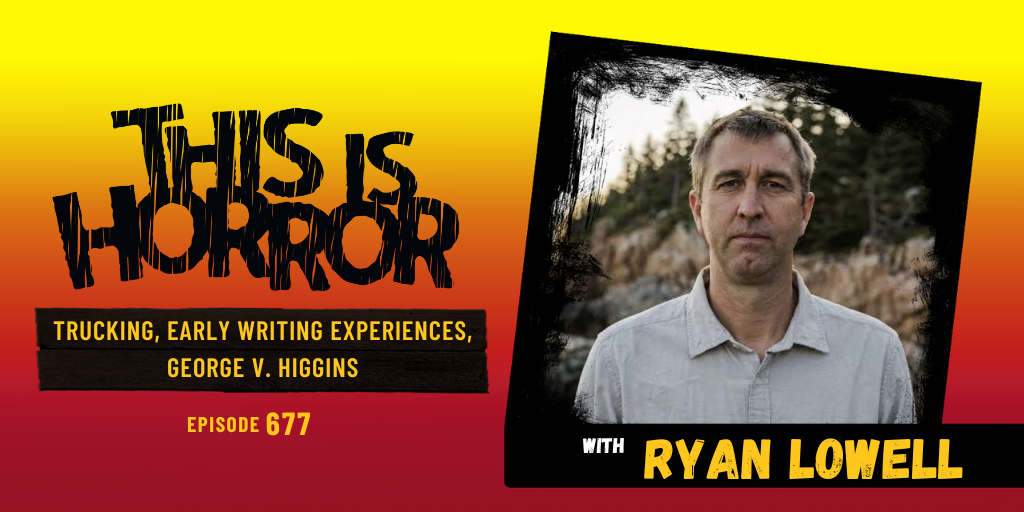
In this podcast, Ryan Lowell talks about trucking, early writing experiences, George V. Higgins, and much more.
About Ryan Lowell
Ryan Lowell’s fiction has appeared in Portland Monthly Magazine, Worker’s Write Journal and other publications. His story “Things Fall Apart” was a Glimmer Train short story award contest finalist. Freight is his first novel. He lives in South Portland, Maine, with his wife and two sons.
Timestamps
Thanks for Listening!
Help out the show:
- Support This Is Horror on Patreon
- Listen to This Is Horror Podcast on Apple
- Listen to This Is Horror Podcast on Spotify
- Rate and review the This Is Horror Podcast on Apple Podcasts
- Share the episode on Facebook and X
- Subscribe to This Is Horror podcast RSS Feed
Let us know how you enjoyed this episode:
- Write a comment below.
- Follow us and get in touch on Instagram @thisishorrorpodcast
- Subscribe and comment on YouTube @thisishorrorpodcast
- Follow us and get in touch on TikTok @thisishorrorpodcast
- Tweet us @thisishorror.
Resources
- Ryan Lowell
- Watch the video version of This Is Horror Podcast episodes, including our conversation with Chuck Palahniuk on YouTube.
House of Bad Memories by Michael David Wilson
From the author of The Girl in the Video comes a darkly comic thriller with an edge-of-your-seat climax.
Denny just wants to be the world’s best dad to his baby daughter, but things get messy when he starts hallucinating his estranged abusive stepfather, Frank. Then Frank winds up dead and Denny is held hostage by his junkie half-sister who demands he uncovers the cause of her father’s death.
Will Denny defeat his demons or be perpetually tortured for refusing to answer impossible questions?
House of Bad Memories is Funny Games meets This Is England with a Rosemary’s Baby under-taste.
Buy House of Bad Memories from Cemetery Gates Media
Buy the House of Bad Memories audiobook
They’re Watching by Michael David Wilson and Bob Pastorella
From the hosts of This Is Horror Podcast comes a dark thriller of obsession, paranoia, and voyeurism.
After relocating to a small coastal town, Brian discovers a hole that gazes into his neighbour’s bedroom. Every night she dances and he peeps. Same song, same time, same wild and mesmerising dance. But soon Brian suspects he’s not the only one watching and she’s not the only one being watched.
They’re Watching is The Wicker Man meets Body Double with a splash of Suspiria.
Buy They’re Watching in paperback and eBook right now.
Michael David Wilson 0:29
Welcome to This Is Horror, a podcast for readers, writers, and creators. I'm Michael David Wilson, and every episode, alongside my co-host Bob Pastorella, I chat with the world's best writers about writing, life lessons, creativity, and much more. Today, I am chatting with Ryan Lowell, the author of Freight, which is described as a thrill ride view of the world of labor, life, and love, a searing portrait of men at work and also at their worst. And Freight is a novel that really flirts between literary fiction and crime fiction. It's not that easy to put in a category, but it is dialog heavy. It is interesting, and it really is a remarkable achievement. So that is Freight by Ryan Lowell. We will be talking to Ryan in a minute, but before that, a quick advert break.
Bob Pastorella 1:39
House of Bad Memories, the debut novel from Michael David Wilson is out now via Cemetery Gates media. Denny just wants to be the world's best dad to his baby daughter, but things get messy when he starts hallucinating his estranged, abusive stepfather Frank. Then Frank winds up dead, and Denny is held hostage by his junky half sister, who demands he uncovers the cause of her father's death, will Denny defeat his demons or be perpetually tortured for refusing to answer impossible questions? Clay McCloud Chapman says, "House of Bad Memories hit so hard you'll spit teeth out once you're done reading it. House of Bad Memories by Michael David Wilson available now in paperback, ebook, and audio. From the host of this isora podcast comes a dark thriller of obsession, paranoia, and voyeurism. After relocating to a small coastal town, Brian discovers a hole that gazes into his neighbor's bedroom. Every night, she dances and he peeps. Same song, same time, same wild and mesmerizing dance, but soon Brian suspects he's not the only one watching, and she's not the only one being watched. Their watching is The Wicker Man meets Body Double with a Splash of Suspiria. Their watching by Michael David Wilson and Bob Pastorella is available from This Is Horror.co.uk, Amazon, and wherever good books are sold.
Michael David Wilson 3:02
Okay, without said, here it is. It is Ryan Lowell on This Is Horror. Ryan, welcome to This Is Horror.
Ryan Lowell 3:15
Hi, thank you very much for having me.
Michael David Wilson 3:18
So to begin with, let's talk about what some of the early life lessons were that you learnt growing up.
Ryan Lowell 3:27
Sure. So, a couple things. One, when I was me and a couple of my buddies were in sixth or seventh grade, we started this thing we called it STP, and it was summer training program. And we were we were all really into basketball, and you know we wanted we thought we could maybe make it to the NBA and things like that. And so we started this program in the summer where we went to the courts in our town and we played the drills early in the morning, and we, you know, leave, come back, and there was a lot of. I'm not really sure I would say a lesson necessarily, but it was very much a kind of laying groundwork with the three of us, me and my two best friends, for a kind of mindset of, you know, this is kind of what we want to do, and this is what we need to do to get there. Even though the NBA thing was ridiculous, and we're all the tallest of us was six four, and you know, and he probably had the best shot, I probably had the worst shot, but but still, it was just kind of laying good groundwork for, you know, we would talk about making it and talk about success and what it was going to take, and we had to get these Hap, you know, practice habits, good habits, and drills, and we'd be running around, you know, the doing suicides and dribbling drills and all this. Stuff that you know, people driving by the courts were probably like, "What are those guys doing? And but anyway, I don't know if there was necessarily one lesson from that, but it was just kind of a big thing. I think that, like I said, laid laid a good groundwork for I think all three of us to to really wanting to try to be successful, you know, at whatever we were doing. And another thing that comes to mind, I'm not again, I'm not sure there's a lesson from this, but me and another group of friends, right around the same time, we were because I'm definitely a believer in the, you know, being cautious about mixing friends, especially at an early age. So another group of my friends, we used to make horror movies, like little slasher movies, in my friend's basement, and we would, you know, we'd have the big camcorder and catch up and dyes and things, and just be, you know, there wouldn't be much of a story to it. But we would make little movies, you know, they were five or 10 minutes long, and and it was a lot of fun, and it was kind of a nice, you know, kind of getting into storytelling. Even though those stories weren't very good, we were just watching, kind of copying stuff from Freddy and Jason movies and stuff like that, but we were working together and it was it was fun and we were kind of you know collaborating in a 12 or 13 year old way and trying to tell these little stories that really only us you know we were going to watch, but it was fun and it was you know a memorable experience.
Michael David Wilson 6:41
So then, was that your first foray into storytelling, or had you been writing? I would say
Ryan Lowell 6:47
so. I really didn't think about that much till recently, but yeah, because I didn't really start writing seriously until, and I'm sure we'll talk about this later. But I didn't really start writing seriously until I was just finishing college, like 22. so yeah.
Michael David Wilson 7:05
And with those films that you were making, I mean, yeah, it really has that B movie feel, and you know, I'm I'm sure that it copycatted things like Evil Dead and some of the kind of almost like splatter punk in movie form, and so
Ryan Lowell 7:26
yeah,
Michael David Wilson 7:26
what what did what did it logistically look like when you were putting these together? I mean, was there any sort of plan, or were all three of you just running in like wild man and seeing what happened.
Ryan Lowell 7:42
Well, there was one the the my friend that actually owned the camcorder. I think that's what we called him, the camcorder. We would, or his parents owned it. He's the one who would be the cameraman, and then the other us, the other two of us would. I mean, there were really basic stories. We'd be down in his basement, and it would just be like, I come down the stairs, and there's a killer in the basement, and I get stabbed, and you know we kind of have the motion of me getting stabbed, you know, right here, and then, and then the next scene is me on the floor with blood all, you know, fake blood all over me, and you know, it really wasn't that deep, but it was it was really just fun to do and to try to make it look as realistic as possible. Yeah, and probably failing pretty badly at that.
Michael David Wilson 8:33
Did you show any other friends your films, or was this top secret? You were like, you know, this is not
Ryan Lowell 8:40
something was secret, but we just we would watch them, and then I'm sure there were other friends of ours that we kind of get looped in. I don't I don't really recall that, but but the most fun. I mean, we would we would get a huge kick out of watching them, just ourselves. But we weren't like bringing it into school and showing people or anything like that. It was really just for for us, and we liked watching them. You know, we would stay up at my buddy's place. We would stay up really late and watch you know cheesy horror movies a lot, and so that was kind of a I don't know if I'd say it out loud. It was just us trying it out, you know, but it was really fun. Yeah,
Michael David Wilson 9:24
and in due course, we'll of course talk about freight, which more naturally fits into the crime genre. So I'm wondering, was crime fiction and crime films were they also part of your early upbringing, your early experiences with stories and movies, or were you actually more in the horror camp? Because what I'm hearing at the moment is a lot of horror influences.
Ryan Lowell 9:51
Yeah, I mean, I was I was really into Stephen King from early on. I'm from a town that's like a half hour from where he's from. So he's obviously a local, you know, huge locally and and everywhere. But but I mean, I read Pet Cemetery, I think, when I was 1413, or 14, and that's pretty intense book when you're that age, and and I thought it was scary as hell, but also great. And you know I read that a few times since. My dad was really into King as well, and you know we always had he always had his hard covers like Tommy Knockers and Misery. I love Misery laying around the house, so you know they I was into King enough that my parents bought me a I think it was called the the Stephen King Companion, which I'm kind of embarrassed to say now. But it was, you know, for the big fans, you know, and and so that was definitely important early on. I mean, I was also into like you know Far Lee Mowat and Gary Paulson, But you know, King was pretty huge, and those just being able to say the things that you know, especially in Pet Cemetery, reading the things that he was talking about, it was like, you know, wow! Like you can actually write this sort of stuff. Not that I was thinking about it from a writing perspective, but you can actually put this stuff on paper and people can read this about you know the the really wild parts of that book. As far as crime books, I mean, I've kind of been all over the place with what I like to read. So there was some some stuff that I was starting to read early. You know, when I was probably around 20 or so, Iceberg Slim, Donald Goines, those were great. Daddy Cool was an excellent book, and yeah, trying to think. But I've I've never really been like you know kind of laser focused towards crime fiction, or really interested in that. I mean, there are certain movies that I gravitate towards and rewatch a lot, like Pulp Fiction and Lock, Stock, and Two Smoking Barrels. It's probably my favorite movie ever. I love that. It's hilarious, but it's great.
Michael David Wilson 12:20
And I mean, if we think about your early life, and you know, you had aspirations to be a basketball player. You were also dabbling with horror movie making. What kind of reaction were you getting from your parents and from family figures? Were they encouraging you to go in either direction? Were they perhaps encouraging you to go away from both aspects and to go towards something else? I'm wondering what that looked like.
Ryan Lowell 12:52
No, they. I mean, they weren't really. You know, I mean, I'm sure they were. They wouldn't. They never came out and said, as far as like basketball, that anything was unrealistic. They were really always very encouraging about whatever me and my I have an older brother. Whatever we were, and he was better than me at basketball. Whatever we were interested in doing, they were really encouraging about it. So, I mean, I think that they were, you know, by getting me that like Stephen that Stephen King companion book, and and always, you know, they knew I liked to read a lot, and my dad did as well, and he's the type I can't do this, but my dad's the type that can read like, you know, wake up at four in the morning, and if he can't sleep, and he can sit there and read for four hours straight, I would fall back to sleep within a half hour, you know, but but yeah, they were just really really encouraging about that kind of academic path more so than the athletic path, which made sense because that wasn't you know, I mean I still like to play basketball, but not in any like really serious way. And I'm 44 now, and so I get it's easy to get injured and and it's harder to recover from anything.
Michael David Wilson 14:23
Yeah, that's the thing they don't tell you. The older you get, the the easier you can get injured, even just from innocuous things. It's like, oh, I I lifted this mildly heavy box at a slightly inoptimal angle, and now you know my leg or my arm. I was
Bob Pastorella 14:43
gonna say, I mean, shit. I'm 59 years old, and but I told people today that I am pulled something getting out of bed old because my back's killing me. So yeah, I understand injuries can just happen. Just for no reason at all. Yeah, yeah,
Ryan Lowell 15:04
yeah. I, I actually, I just pulled my, I did something to my shoulder playing, just shooting around with my five-year-old a couple weeks ago, and I thought it was the sort of thing because I'm still like in denial about, you know, the body recovery time, all that, and I thought it was just a tiny thing that I maybe pulled a muscle or something, and then it was still it's still bothering me like a month later. And my wife was like, "You should just like not do anything with that shoulder for a week and see what happens before you do you know before you call your doctor or do anything like that. Which I would I didn't want to do that anyways, but but anyway, they yeah my my parents were you know I think just encouraging me. I mean I was really into this doesn't really jive with the writing stuff, but I was definitely strongest in in math and you know kind of seeing patterns and numbers more than anything else in school. So I mean, I went to school for engineering when I first started off, and then realized that was too hard, and I switched to economics. But I bought chemistry too. I was like, switch over to economics. But anyway, I think that they were really, you know, they could see that that I was good in that going in that direction, and so I think that's it's where they were most encouraging.
Michael David Wilson 16:32
Yeah, and it's clear already just how many influences you've had and how broad your range of interests are, which I think really lends itself to what we see in freight, and I understand too that another early texts that were recommended by one of your friends. Not sure if it was the friend who you were making horror movies with, but they were 1984, and then The Power of Now by Eckhart Tolle, so two pretty different books. So I'm wondering what kind of effect both of these have had on both your life and perhaps even writing.
Ryan Lowell 17:15
Yeah, well, that friend is actually that's the same one that was the six four friend that was in my summer training group, and we're still best friends. But yeah, like the the power now. I just remember we were like we were like 2021, maybe, and and he just said, you know, we were talking and drinking beers or whatever, and and he was like, read the power now. It'll make you it'll make you smarter. And I was like, okay, will do. And that was that was always headed with that one. And I mean, I've definitely dabbled. You know, I've read quite a few self help, self empowerment. You know, however you want to categorize that and and philosophy sort of books as well, some of which me and him have talked about, and yeah, what was the other one? Oh, 1984. Yeah, around that same time, I got really into Orwell and yeah, 1984 and and a huge book of his essays that I got at the Strand in New York and yeah Orwell I haven't read him in a while but I was really into Orwell like in my early 20s and then goings yeah they're very different. I think I said in that in that that the interesting thing with those three is that they were yeah so different. You know, goings was very gritty and rough. The language was was just real, and you know I could definitely see that in our my hometown. That was it. Is it still is rough, and you know we would hang around some pretty you know pretty crazy people, crazy crowds that you would just see rough stuff in the way people talked and stuff like that. So Goings, it just seemed like the stuff that Goins was writing about was very realistic, raw, and I could understand why I hadn't heard of someone like that before because they're not having you read that in school, but certainly not in my school. And they maybe should, you know, not when you're 14, but. Maybe when you're 18, you know. Also, they're really good stories. But yeah, and the yeah the power now and like you know. I mean, I don't know if you guys have read that, but it's it's very basic. Yeah, yeah, yeah. I mean, it's really just about concentrating on the moment and and a lot of different techniques to get to that point, but I thought it was great, great book, and he really explains, you know, these different kind of techniques well. I have I picked it up not recently, but probably within the past year. I just read a chapter, you know. I do that with a lot of my old books in books that I found influential, like you know, my favorite authors. I'll just grab an old book if I'm kind of looking for some motivation, and just read like a chapter of Raymond Chandler or Faulkner or something, you know, something like that.
Michael David Wilson 21:00
Yeah, I just think it can get you grounded in that space for both reading and writing, and particularly if, like a lot of us, we sometimes go through, I suppose, a drought of of bad reading or of read not even necessarily bad books, but just things that we're not responding to. So then you have to kind of okay let's pick let's dip into the things that really lit us up to begin with so you know whether that's Chandler or I mean in terms of crime I absolutely love Jim Thompson and just how gritty and visceral and how good the dialog is there and you know, you mentioned Stephen King before. I think particularly his early short story collections are a masterclass in how to write good short stories.
Ryan Lowell 21:53
I hope you're talking about trucks or maximum overdrive.
Michael David Wilson 21:56
Yeah, there you go. But that that is thematically relevant for sure.
Ryan Lowell 22:03
It is, yeah. It's not a very good story, but it's a but it's a funny movie. I think a good movie. I've seen it probably 40 times, so I shouldn't say it's bad. But but I know he said it's bad, so or King has so and he made it. So I love how they have the best part is that the movie is the soundtrack is just AC/DC, which also I
Michael David Wilson 22:29
believe is what he was writing to a lot of the time. Like he said on record that he just wrote to bands like AC/DC. So you know, well, if it's good enough for me to write, it was good enough for the soundtrack. Yeah,
Ryan Lowell 22:45
yeah. Like at the beginning of the movie, or maybe it's the credits at the end. It just says music by AC/DC, and it's not like I don't even think it tells you what songs. It's just like music.
Michael David Wilson 22:58
Well, I mean, some could argue that many AC/DC songs are in fact the same song. You know, they've certainly got their their recipe, their formula down, kind of like like Motorhead. But you know, I I love Motorhead. But every song is fairly similar. It's playing the the same literal and metaphorical note.
Ryan Lowell 23:22
Yeah, you mentioned you mentioned. Sorry, I was going to say you mentioned Jim Thompson. That's someone that I've heard and been recommended a ton, or heard about and been recommended many times, and I haven't read any of this stuff when I need to.
Michael David Wilson 23:38
Yeah, I mean, goodness, I'm not even sure where where to start. Maybe the killer inside me is the one that springs to mind. But you could probably pick a book at random, and it would be absolutely killer. I mean, he's so good. He's so unflinching. And actually, when I was reading Flate and I was think Freight and I was thinking about potential influences on you, I did wonder if Thompson was an influence. So, given you haven't read him, I think he'd be in your wheelhouse. I think you know you'd really respond well to
Ryan Lowell 24:19
it. When I first met, and you know started talking to Warren Frazier, who would he's my agent now. But when we first started talking, he was like, "You must have read George V. Higgins, and I was like, "I actually hadn't even heard of him when he told me that. And I and he was like, "Are you serious? And he told he like told me to go out and buy. Oh yeah, the friends of Eddie Coyle. He told me to go that go out and buy that immediately, which I did, and it's really good. And I can see why he was saying that now, but but it was just funny because he was the same kind of thing. Like he was just like, "How have you not?" You were totally reminding me of this dude. You know how how have you not read him before?
Bob Pastorella 25:05
Earlier, you mentioned that you kind of grow up, you know, like in a rough neighborhood, and you know, hearing you talk about that, you you know, you haven't like really been influenced by crime writers. You've been influenced by your life, and it's like I feel like that these these people that you grew up with, that you knew. It's kind of like me. I grew up in in like a you know a poor part of town and and the knock about kids and all about all of that, you know, and you you you remember things that that these idiots did, and and repercussions from that, and how and how life continues on, no no matter what. And that's to me, that's what what when when you said that, it was like that that's this is coming from you, you know, all of this stuff, which I mean, of course it is, but that's where that's where you're mining you're mining your stuff from, and that's I think that's important because that's I think you know we don't recognize you know what influenced you to write this. Well, there's this and this, but it's like no, the people I interacted with are new people, yeah,
Ryan Lowell 26:23
yeah, and I should clarify. I mean, the actual like town. I mean, I'm from like what's a it's a coastal mill town. It's called Bucksport, and it's not you know it's not necessarily like rough. I didn't describe it very good. It's what it's there are. It's kind of a poor or lower middle class kind of on average, you know. And like we were comfortable enough growing up, but there were definitely friends of ours and people we hung around and people we hung out with at camp parties, like out in gravel pits and things like that, where you know it was just there were crazy fights and and you know just people doing crazy shit, you know. But I do think yes, I definitely agree that that was influential. I still think about things that, you know, little scenes here and there. I was just thinking the other day about this this scene at this apartment complex that actually wasn't there for, but my buddy was like just leaving this scene where they were a bunch of kids and they were fighting with like wool mittens on. They were boxing with wool mittens on, and and just beating the hell out of each other. And one of the guys that was that was boxing was like the like stepdad, and he comes in just hammered at noon. This was in the middle of the day, and just gets his face wrecked, and and you know, which is kind of a cool scene. Not cool, but it's a good scene, like an opening scene, you know, for kind of what you're diving into in a story, you know. But that's sort of how it is, you know. It's it's nice, like it's nice in the sense that it's a coastal town. That if you've ever been to Acadia National Park in in Bar Harbor, you have to drive through my town. You won't probably stop, you know, unless you're going to get like an ice cream. But otherwise, is you know, there's there's not much to it. It's a it's a former mill town.
Bob Pastorella 28:42
I'm in the same I'm in the same situation, just the other end of the country. So because I live near Port Arthur, which is you know near Beaumont, which is near Houston, and so you know I'm I'm like you know there's 90 million refineries out here. There's a reason why MD Anderson Cancer Center is in Houston. So that is that is you know where where I live, and I'm in the same situation. You'll you'll you'll go through my town, and it's like oh look, they have a little pecan festival. How cute! They do that once a year, but other than that, it's you blink and you miss it, and you probably should miss it, you know, because there's probably you're gonna you're gonna run across some really really nice good wholesome people, and then you're gonna run across people like you're gonna make sure that you have your keys in your wallet and securely in your pocket. So it's it's that type of it's it's that type of atmosphere, and it's because it's it's a port town. That's just how port towns are.
Ryan Lowell 29:43
Yeah, and very rural, and you know, and you know that there's, you know, there's, you know, on the outskirts of town, there's there's, you know, nice homes mixed in with like a. Trailer that's completely run down and looks like has you know it looks like it's abandoned, but people live there and you know and there's I'm sure some you know domestic violence hiding you know in some of these places you know
Michael David Wilson 30:20
yeah it's like a lot of those places could be called Big Tuna, Texas, just like in Wild at Heart. So I'm wondering if you're living in you know a similar area now as to when you were growing up. Obviously, now you mentioned you have two children. So how is this awareness of all the bad shit that can go down something that impacts or you're mindful of when parenting? I mean, it's a hell of a thing to have to navigate because you want to protect your kids, but then you don't want to shield them to such a point that you fuck them up in a different way. So, how does that play into things?
Ryan Lowell 31:06
Well, we live in so we live about two hours south of where I grew up now, and we're in South Portland, and and we're kind of in a pretty like densely populated area, like right in the middle of town. So we have neighbors like really close by, which I don't mind. Like I'm not the type that I want to necessarily be out in the woods or need to. It doesn't bother me seeing my neighbors. Like I lived in apartments for 12 years out of college in New York and Boston, and I like being close to people, preferably close to people, but yet we don't really talk. You know, I like to I like to have neighbors that we say hi and then we move on. But it's comforting in a way. So it's similar here. Honestly, when it when it when I think about the kid, you know, just having kids and thinking about that relative to my upbringing, I just notice I don't notice this as much here because it's a little more populated. Just seeing kids out and about is on bikes and out, you know, doing stuff. Anyway, not in their bedroom playing games. You know, it's just comforting to me. I think about that more than anything else right now. I might feel differently once they're old enough. You know, a little older and being, you know, pulled in different ways. You know, in maybe junior high or or high school, but you know, they're five and three right now, so it's mostly all good, you know. But I will say, when I go back to Bucksport, it is noticeable how few people or kids are out like we used to do. Like when we we used to ride bikes all over town, walk around, buy penny candy, steal penny candy, walk around and eat it, and you just don't really see it. You know, I was just up there a week ago because both of our parents still live in the area, and so we were up, and you drive around, and you just don't you don't see many kids out getting into shit, you know, doing walking around or you know going around on bikes, getting into trouble, you know, you just don't don't see it as much, which sucks, I think.
Michael David Wilson 33:43
Yeah, yeah. I think definitely the typical childhood experience now is radically different from you know 3040, years ago, maybe even 20 years ago. I don't know. I don't know what it was like for someone being a kid in 2006, but yeah, I I wonder though. I mean, talking about 20 years ago, you said it was in your 20s that you got into writing in in a serious way, or at least that was when this became more of an interest. So I want to know what that looked like for you, and what the first stories were that you were writing.
Ryan Lowell 34:29
The the first story I wrote was, and I still have it kicking around somewhere in a spiral bound notebook. But I so when I graduated college, I was thinking about my two options were move to New York to Brooklyn, and I'd never been to Brooklyn before with my buddy, and or move to Florida, and I was thinking about moving to Florida and just living on a boat. Which is kind of a an idea I got from I went on a family vacation to Key West the year prior, and a bartender at this the hotel we were staying at was just kind of that's what he was doing is living on a boat, bartending and just hanging out, and I was like, that sounds pretty fun. I didn't really have a plan, and I didn't. I had turned down a job at an investment company at Putnam Investments. I interned there for what a year and a half, and like during my senior year, junior and senior year, and they offered me a full-time job, and I just was really dis disillusioned, really, just like kind of disgusted by being in that investment banking world, and you know I saw people get laid off, and I you know they kept me on just because I was only getting paid $20 an hour or whatever it was. So anyway, I just turned that down, and then was thinking about either New York or going to Florida, and so I just wrote a story. It was like I think this is the first thing I wrote, and it was just a story about a kid, you know, a 20-year-old that moves to Florida and single, lives on a boat, Bartends and hooks up with a bunch of women, and you know, any juvenile story. I don't remember if there was any real story to it, but I know that was the gist of it. But from there, I kind of got a little more serious about it. I was writing not really like any. I've never really like like intentionally gone in the direction of crime. It's just petty crime. It was has often been an interest, and and I mean like just well, I guess it is crime, but but I just didn't really think about it in that way. I kind of thought about it more of in a in a economic from an economic perspective. You know, this person needs money, and how are they? You know, I guess specifically behavioral economics. How are we behaving? You know, when we are in need of money, whether it's a lot or a little, just to get by or a little to, you know, get what we want in a in a situation. So right around I was probably 2022, 23, and I read Stephen King's On Writing book, and I've read that a few times since as well. But the he kind of lays out what I think is a pretty good blueprint for if you're you know, ready to be patient and, you know, want to eventually get to the point of of publishing, and which was try to build a kind of a resume of of some short stories in literary magazines, or anyway, small small magazines that pay whatever 20 to $50 a piece, if that, if any, you know, if anything at all. But try to build up a little bit of a resume, and then try to find an agent, and then, or excuse me, write a novel, and then find an agent, or try to find an agent. So that's kind of the course I took. It just took I took a long time, and I wrote for you know I was writing very seriously for years, probably 15 years at least, 1516 years before really even starting freight, I'd written another novel probably about 15 years ago about a heist of a of a painting off an island in Maine, and that was like 80,000 words, and I sent it to one person, a good friend of mine, and she read it in a weekend. I was like, "Brilliant! And I was like, "Cool, but I didn't really think it was ready to go anywhere with it. So all I did is like, all that really did is like give me a boost of confidence just to keep going.
Ryan Lowell 39:38
So I kept writing short stuff and trying to build, you know, and because I don't think I'd actually published anything at that point when I wrote that that novel, and so yeah, and then I I started to get. I got my first publishing was by Dave Labouny at Blue Cubicle Press for the Workers' Right Journal, and that was a story about valet parking, and that I think that's like in 2017. So yeah, I was writing, and I graduated college in 2005. So I was probably writing 12 years before publishing anything at all.
Michael David Wilson 40:29
And I think too, if you look at your journey, I want to know how your career has matched your writing, like so your kind of day job career, because I know that before you got into the trucking industry, which is obviously very relevant to freight, you were working in a corporate job. So I'm wondering what was the transition like, and what was the impetus behind that change, because it's obviously quite a big change in career.
Ryan Lowell 41:06
So I kind of stumble the trucking industry. I really stumbled into it. I was in New York in up till like 2008. It was a recession, and so I lost my job. I was working at a trading company, and I lost my job. Let me backtrack a tiny bit. When I, I the investment company I worked for out of you know finishing college, I got out of that, and and I worked at a parking garage in New York for a little while, but eventually realized that that I'm not. I need more money just to like live here, so that's the reason for getting back into the kind of corporate world. And I wound up at an energy trading company for three or four years, and then when the crash happens or the recession, Great Recession happens, we were actually right across the street from the Lehman Brothers, and you remember how they had the big walkout. Lehman had the big walkout, so that happened like right in front of us, like out the window, and then we kind of knew like we were most of us were going to be gone, and we were within a week or two, and so I stuck around there, lived off of Severance for a little while with my girlfriend at the time, now wife, and and we came back to Maine after about a nine months, nine or 10 months of just kind of kicking around New York, and we came back to the Portland area, and and I just did some weird stuff, like like I were I was a park ranger for a summer at a really low park ranger is a very strong way to put it. I was I just sat in a golf cart and picked up trash, so I was not like, you know, saving people or anything like that. And I sat and on a golf cart read books and got paid $10 an hour, and went walked around the picker and picked up, you know, litter on the on the beach. So that did some other kind of you know temporary stuff, and then we moved to the Bangor area to for my wife to go back to school, and I got it. I was through a temp agency. The first thing they had was this gig in trucking. It was a second shift trucking job dispatching, and I was like, they were just like they kind of warned me. They were the temp agency. They were just like, this is not a corporate sort of environment. I was like, do I have to wear like a shirt and tie? And they're like, no. Wear like a sweatshirt or a t-shirt and jeans, and and yeah, started at second Shift, and it was fun right away. I mean, it was really like you know, I walked into this this huge room, and it was just like probably 2530, dispatchers and and and load planners. You know, like customer service people, and everybody's just this big group. No like cubicle walls. It's all wide open, and it was just loud as hell. Everybody's cursing at each other and on the phone, and guys are holding two phones to their ears, like you know, fucking pick this up, do this, and just yelling at you know, yelling at each other and yelling at drivers, and but in a good-natured sort of way, and it was it was just really entertaining, and like this is great, and like this is in the book, but this really did happen. One of the guys said to me as soon as I walked in, I was like sitting with a bunch of like in between a bunch of dispatchers, and this this guy who'd been. The game for a long time, he he goes, hey, hey, kid, you any good at lying? And I was like, no, and and and he was like, he's like, you're lying or you're full of shit, and and you know everybody burst out laughing, and you know, but it was setting me up for he was being serious because, you know, especially at that at that company I worked at, you had to lie a lot, and it wasn't just to it wasn't even necessarily to drivers to get them to do certain things.
Ryan Lowell 45:34
It was calling stores to tell them we were going to be late, and the reason we were late is not because it wasn't for a good reason. So we'd lie and say we had a tire blow out or we had a accident, you know. And the joke was with drivers is that they would say, "Well, you got to tell us when you're going to lie to these people because if I show up to Costco and they say, 'Hey, you know we heard you had a tire blow out. Everything good, and the driver would be like, "What? No, I just left late because my company sucks or whatever. You know, whatever the real reason was. But we, you know, we get caught in a lie. But yeah, so I started at second shift and then moved to third, and I was kind of the you know I worked like overnight for a while. It was like a five or six month stretch, and so that was really helpful with the book, though. Of course, like I went back to that often with the Curtis character, but it was really interesting and really just the The stories from drivers that you know we had. I had a set of local drivers that would come in at night, and they start at you know 1112, o'clock at night, and they were just going out to drive for like 678, hours around the state, doing you know just a cycle, you know, just a a few stops, and they'd stop in and just tell me stuff. And I was really like new, and so I'd ask a lot of stupid questions. But a lot of it is because I want to just provoke them to talk to me and get like, you know, hey, have you ever picked up a hitchhiker? Hey, have you done this? What's the what's the craziest shit you've ever seen? But you know anything, and they all want to talk. They all even the quieter ones. I found if you asked them and it showed interest in what they did, they love to talk about it, you know, and I, I've found that, and I still work in the industry today, and they most most drive. I'm not going to say all, of course, but most drivers are proud of what they do, and you know, I think it's pretty cool, and they, but they do love to tell stories, and and a part of it is that staggered kind of the way everybody's schedules are so different, and so you have guys that ride at night, you have second shift guys that that come in at noon, and so everybody's on these weird schedules. You know, like a joke in the industry is well to somebody like me nowadays, I work banker hours because I do work kind of a normal shift now. Most people don't, and you know, so you kind of get shit on for working banker hours. But that that staggered kind of schedule, I think because you don't see everybody every day, it's not like you're at a water cooler and you see people and you're like, "Hey, small talk. It's more like you only see certain people every few days or once a week or whatever it is. So when you see people, you catch up. You know, there's stuff to catch up on. Oh, this I this happened over the last week, and I was here, and was in New Jersey and in South Carolina, and this fucked up thing happened, and then I came home. Whatever, you know, but I think that kind of adds to that culture, that storytelling kind of culture,
Michael David Wilson 49:19
and it's interesting, an industry that you just landed in by chance. I mean, it it feels from both reading Freight and from talking to you that it it's almost a love letter to it. You know that there's like shittiness as well, but it it it's your shittiness. It's like something that you know you've responded to so well and found like a kind of kinship and a home there. So it it must be almost a strange feeling to think that this just landed because it was what you know the temp agency had available and he. You are years later.
Ryan Lowell 50:02
Yeah, yeah. I I told someone this recently that around before I started writing freight, there was a time when I wasn't. I really wasn't happy, and this was more with my like the management that I was dealing with at the time, and and I thought about getting out, and I went and interviewed. I was like, I just I could probably get back into like the finance world, and and we I think we had just yeah we just bought a house, and and I went to an interview, and I was in this stuffy office and just like hearing the small talk of people, and I was like, "Holy shit, I can't do this! Like this, I can't get back into this. And I I did the interview just because I was already there, but I was not into it. And just like, okay, I don't, I don't want to leave. You know, I don't want to get back into this, and I don't want to leave the trucking world. And you know, I don't want to say I was consciously thinking like I'm going to get a novel out of this, and this is like, you know, this is going to like be great for me in the long term. But it just is like this isn't the smart move, and it has up till that point, it had got given me a lot of fuel for stories. You know, I've written many or several short stories that were about trucking, or just based on a tiny, you know, just a piece of dialog that I heard someone say, like a driver or someone say that you know, then kind of built a story around that. There was so much stuff that got people would say, guys would say, guys and girls would say that was just hilarious. And I mean, I had a notebook on me, so which was good, especially at night when I was working the third shift, because it was only me in the office, in this huge office, and so the drivers, you know, the drivers would kind of like pop in here and there, but for the most part, it's just by myself, and so I could have a notebook right there and just be, I could write for half hour, and then if I heard someone coming, and or just jotting down like things that guys would say, you know, little stories they tell me, or just like a funny quote. Yeah, I don't know if that answered your question, but
Michael David Wilson 52:33
what what's interesting too is, I mean, it sounds like not only have you had material to write through the interactions, but you logistically had a lot of downtime where you could actually be writing and to facilitate your creativity. I'm going to guess that now you're working a more nine to five or at least more regular hours. There's there's a lot less writing time, possibly a lot less interesting stories as well. Because I don't know. It's like it's the past 11 p.m. when all the good shit comes out.
Ryan Lowell 53:13
Yes, totally. Now nowadays, like I'm more the last few years, I've been more on the management side, so a lot of the stuff that I do is is more like personnel, kind of the less, you know, fun. I still love it. I still like the work and the people very much, but it's not. It's yeah, like you said, it's a lot more fun in a way. Being, you know, working through the night. I mean, working the night shift. I think everybody should do it because it's just a fascinating thing to do. In a way, you, you know, like you're going to work. I mean, sometimes it sucks, especially if you're not good at sleeping at during the day, like if you can't shut it off and darken your room or whatever you need to do to get some sleep, it sucks and it's hard to get used to. And it sucks if you're trying to hang out, like if you're in your 20s and trying to hang out with friends on the weekend, like normal people do, and yet you're sleeping during the you know you sleeping during the day, but but yeah, it's it was more fun you know asking for asking questions and hearing stories than having to deal with the kind of HR aspect of of things, you know, which is kind of what I would do now.
Bob Pastorella 54:47
I think that's the first book I've ever read about trucking, and it which is really kind of weird. I mean, in the industry I'm in, I'm in the telecommunications industry, and I have quite a few customers who are truck. And my job is to make sure that they can use their phones when they're on the road, and so and their and their devices that they have, their tablets and their watches and all that kind of stuff. And one trucker that I that I know in particular, he's pretty blunt, and when his stuff doesn't work, he tells me, "Hey, when when my phone don't work, dude, I don't do my job right, and then shit ends up being late. He goes, "And you'd be surprised how much shit is dependent upon me. And I'm like, "I never think of it like that. We never put it into that perspective. But I hope that people read this book and there be more trucking novels out there because I don't think I've ever read one, and it was fascinating. I loved it, but it because just a total different world that I never, never, never, never expected. I didn't think they had dispatchers. I thought these guys just knew their routes and would just go, you know. I had no idea, but I understand the importance of it because, like he said, hey man, if I don't, if I get my stuff don't work right, dude, my shit's late and you ain't getting it, you know. So there you go. Oh
Ryan Lowell 56:17
yeah, yeah, yeah. I mean, there's It's it's like that. It's one of those things that it's it's everywhere, all around you, and yet you don't. Most people, anyways, they don't think about the fact that everywhere, everything in their possession was moved to them by or to the store where they went and bought it by a truck driver of some sort. You know, I mean, it might have been on a plane at some point. Probably was, or or a ship container. But to get from the container ship to the store, more than likely, it was a truck. You know, tractor trailer.
Bob Pastorella 57:00
Yeah, and people would get mad if they're stuffed on it. It's like, dude, you could there could have been the truck driver could have got killed, could have killed people, could have got killed. Who cares about your shit at that point? That's crazy.
Ryan Lowell 57:13
Yeah, and that's a shitty reality too of the um of just being in that industry. There were, you know, there have been some calls that I've had to take, or situations that are not great. You know, and it makes me think, like that it would. It makes me think it would be really intense to be a 9911 dispatcher because the shit that you would hear on the phone daily would be-I don't know how they do it, but it's impressive to be able to do what do what they do and hear what hear the sort of things they have to hear. You know, I mean, I've found it difficult just dealing with accidents that were pretty grisly, fatality, you know, or just ugly, ugly accidents, and I wasn't even there. And this is just dealing with like the driver that works for my company side of it, you know, and helping them get through it, you know. So, and I can't imagine being involved, you know. There's there there was a guy that when I first started in the in the trucking, there was a driver that he'd been doing it for a long time, like 2030, years, and he was out in New York, and somebody, a drunk driver, was going like 150 on on Interstate 90 out there and tried to cut him off. Anyway, ran into the trucker and and it was a really ugly accident. And like the and it was like two passengers in the car and the driver saw like he got out and he was fine. Got out. He's walking in the median, and he just sees the car, the the the car that the drunk driver was driving was just torn in two, and there were just you know bad bad body parts, you know, like in the media, and he was out after that. Like he was done, and he like that happened, and he had to go through all the legal stuff, and I I think he had to get a lawyer just in dealing with it. And he was just like, I'm out, I'm done, and I think he he got out of the industry after that.
Michael David Wilson 59:39
And I mean, even though you know, it was no fault of the company. You know, it was no accident. But like, I mean, the psychological damage that that would do to the trucker, to any human being. I mean, are there support systems in place for when those kind? That things happen. I mean, what what the hell do they do? How do they move? Not really.
Ryan Lowell 1:00:06
Not not not to not to speak of really, or not that I know of, anyways. And I would, you know, I feel like I would know. I mean, they they yeah yeah. I mean, I think it's kind of the like you can't unsee, you know, just not being able to unsee certain things, and you know, of course, like I mean, that would be part of my job now would be to help guys if they were involved in something, and it is kind of rare, you know, that that you actually are the one dealing with that. It's kind of like it just doesn't happen often, but but it's kind of up to you know a local a local thing. Like the company I work for, we're nationwide company, but we kind of work like a franchise out of Portland. So you know we're our kind of own HR and everything like that. You know we we like have a corporate office that we report to, but other than that, we're kind of off on our own. So in a situation like that, like if we had a driver, and we have had one that that was involved in a bad accident a couple years ago, that he was fine, and the other person was it was a fatality, but they and it was a person that probably would have was like driving erratically and was really old. It was probably going to happen regardless, but our driver was in the wrong you know the wrong place at the wrong time, and it's just it was just a matter of us kind of offering support, but he also wasn't the type that really needed it. You know, I mean, he kind of was a veteran in the in this and knew that he'd done whatever he could do to mitigate the damage. You know, and what what could have been worse could have involved other people, you know. Actually, he was praised in the local newspaper for by the by the police for not for making it less mitigating. You know what could have been a much worse accident.
Michael David Wilson 1:02:20
Thank you so much for listening to Ryan Lowell on This Is Horror. Join us again next time for the second and final part of the conversation. And of course, if you want to listen to that and every other episode ahead of the crowd, please do become a This Is Horror Podcast patron at Patreon.com forward slash This Is Horror. Not only will you get early bird access to each episode, but you will be able to submit questions to each and every guest. And very soon we will be chatting to Max Doty about the house that eats the dead. So if you want to submit a question to Max and indeed every other This Is Horror guest. It's Patreon.com forward slash This Is Horror. Okay, before I wrap up, a quick advert break.
Bob Pastorella 1:03:13
From the host of This Is Horror Podcast comes a dark driller of obsession, paranoia, and voyeurism. After relocating to a small coastal town, Brian discovers a hole that gazes into his neighbor's bedroom. Every night, she dances and he peeps. Same song, same time, same wild and mesmerizing dance. But soon, Brian suspects he's not the only one watching, and she's not the only one being watched. Their watching is The Wicker Man meets Body Double with a splash of Suspiria. Their watching by Michael David Wilson and Bob Pastorella is available from This Is Horror.co.uk, Amazon, and wherever good books are sold. House of Bad Memories, the debut novel from Michael David Wilson, is out now via Cemetery Gates Media. Denny just wants to be the world's best dad to his baby daughter, but things get messy when he starts hallucinating his estranged, abusive stepfather Frank. Then Frank winds up dead, and Denny is held hostage by his junky half sister, who demands he uncovers the cause of her father's death. Will Denny defeat his demons, or be perpetually tortured for refusing to answer impossible questions? Clay McLeod Chapman says, "House of Bad Memories hit so hard you'll spit teeth out once you're done reading it. House of Bad Memories by Michael David Wilson, available now in paperback, ebook, and audio.
Michael David Wilson 1:04:34
Well, as always, I would like to end with a clip from a previous This Is Horror episode, and today's clip is from episode 675 with Raphael Montez, in which he talks about the first short story he wrote. So here we go.
Raphael Montes 1:04:59
My parents that I wanted to be a writer, and they were like, "You are crazy! You can't be a writer. You you you you won't survive as a writer, especially in Brazil. But then, but then I said, "Okay, but I want to do it. So I started writing my stories, and when I was like 1213, years old, the first short story that I wrote another day, I found it in my notebooks, like with my child letter calligraphy. I mean, it was a story called "The Teacher, and it's about a teacher, a really sweet woman that one day she decides to kill herself, but before that, she takes a gun to the school because she wanna take also her favorite students with her. So it's a really strange short story and strong that I wrote when I was like 1213, years old.
Michael David Wilson 1:05:58
If you would like to listen to the full episode with Raphael. You can listen to episode 675 of This Is Horror Podcast, or if you want the video version, it is available on YouTube, youtube.com forward slash at This Is Horror Podcast, and if you want other inspirational clips from past episodes. Please do follow us on TikTok and Instagram at This Is Horror Podcast. Now, before I go, a quick reminder that the second edition of The Girl in the Video is out now. You can buy it from the This Is Horror website or on Amazon in both paperback and ebook format, and for Kindle Unlimited subscribers, it is now available for the very first time on Kindle Unlimited. Whether you experience The Girl in the Video in paperback or ebook or on Kindle Unlimited, it includes a bonus story, tekka teka teka, and an exclusive afterword. The paperback looks wonderful thanks to incredible cover art from Ben Baldwin. So, to be honest, I highly encourage you to buy the paperback. But however you buy The Girl in the video. I appreciate you for supporting me and my little slice of Gaijin J horror. And on that note, that does it for another episode of This Is Horror. So until next time for the second part of our conversation with Ryan Lowell, take care of yourselves. Be good to One another, read horror, keep on writing, and have a great, great day.