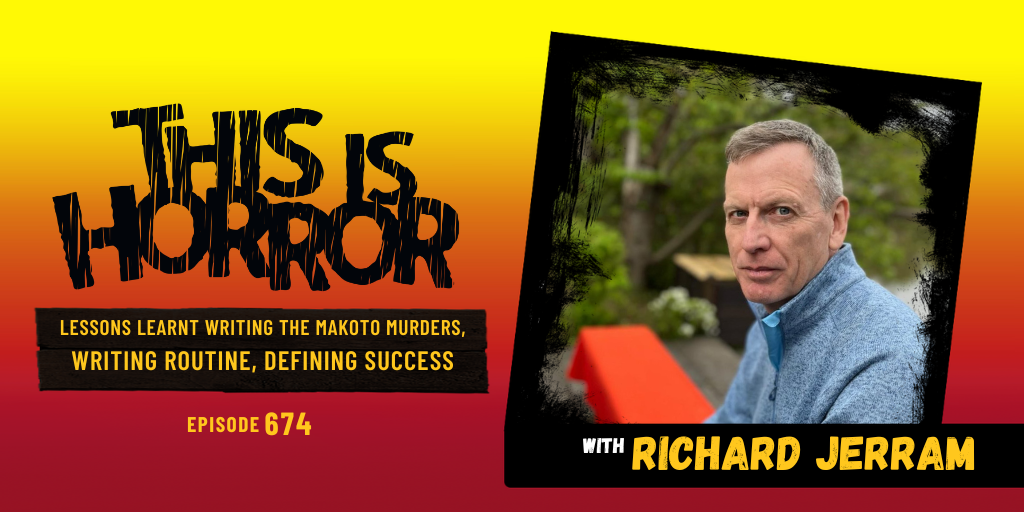
In this podcast, Richard Jerram talks about lessons learnt writing The Makoto Murders, his writing routine, what defines success, and much more.
About Richard Jerram
Richard Jerram was raised in the north, but long ago ventured south in search of education and employment. He lives near a park in London with his wife and, at times, children. Runs slowly. Swims enthusiastically. Plays chess competently. Reads. The fertile soil of the UEA’s crime fiction MA gave rise to The Makoto Murders, Richard’s first novel. A noir thriller, set in Tokyo, it won the Crime Writers’ Association’s Debut Dagger award in 2024.
Timestamps
Thanks for Listening!
Help out the show:
- Support This Is Horror on Patreon
- Listen to This Is Horror Podcast on Apple
- Listen to This Is Horror Podcast on Spotify
- Rate and review the This Is Horror Podcast on Apple Podcasts
- Share the episode on Facebook and X
- Subscribe to This Is Horror podcast RSS Feed
Let us know how you enjoyed this episode:
- Write a comment below.
- Follow us and get in touch on Instagram @thisishorrorpodcast
- Subscribe and comment on YouTube @thisishorrorpodcast
- Follow us and get in touch on TikTok @thisishorrorpodcast
- Tweet us @thisishorror.
Resources
- Richard Jerram
- Watch the video version of This Is Horror Podcast episodes, including our conversation with Chuck Palahniuk on YouTube.
House of Bad Memories by Michael David Wilson
From the author of The Girl in the Video comes a darkly comic thriller with an edge-of-your-seat climax.
Denny just wants to be the world’s best dad to his baby daughter, but things get messy when he starts hallucinating his estranged abusive stepfather, Frank. Then Frank winds up dead and Denny is held hostage by his junkie half-sister who demands he uncovers the cause of her father’s death.
Will Denny defeat his demons or be perpetually tortured for refusing to answer impossible questions?
House of Bad Memories is Funny Games meets This Is England with a Rosemary’s Baby under-taste.
Buy House of Bad Memories from Cemetery Gates Media
Buy the House of Bad Memories audiobook
They’re Watching by Michael David Wilson and Bob Pastorella
From the hosts of This Is Horror Podcast comes a dark thriller of obsession, paranoia, and voyeurism.
After relocating to a small coastal town, Brian discovers a hole that gazes into his neighbour’s bedroom. Every night she dances and he peeps. Same song, same time, same wild and mesmerising dance. But soon Brian suspects he’s not the only one watching and she’s not the only one being watched.
They’re Watching is The Wicker Man meets Body Double with a splash of Suspiria.
Buy They’re Watching in paperback and eBook right now.
Michael David Wilson 0:29
Welcome to This Is Horror, a podcast for readers, writers, and creators. I'm Michael David Wilson, and every episode alongside my co-host Bob Pastorella, I chat with the world's best writers about writing, life lessons, creativity, and much more. Today is the second and final part of our conversation with Richard Jerem, the author of the Makoto murders, and in this part we go really deep into the world of this wonderful Tokyo-based noir crime thriller. But as always, before we get to our chat with Richard, a quick advert break.
Bob Pastorella 1:18
House of Bad Memories, the debut novel from Michael David Wilson is out now via Cemetery Gates media. Denny just wants to be the world's best dad to his baby daughter, but things get messy when he starts hallucinating his estranged, abusive stepfather Frank. Then Frank winds up dead, and Denny is held hostage by his junky half sister, who demands he uncovers the cause of her father's death. Will Denny defeat his demons, or be perpetually tortured for refusing to answer impossible questions? Clay McLeod Chapman says, "House of Bad Memories hit so hard you'll spit teeth out once you're done reading it. House of Bad Memories by Michael David Wilson available now in paperback, ebook, and audio. From the host of this isora podcast comes a dark thriller of obsession, paranoia, and voyeurism. After relocating to a small coastal town, Brian discovers a hole that gazes into his neighbor's bedroom. Every night, she dances and he peeps. Same song, same time, same wild and mesmerizing dance, but soon Brian suspects he's not the only one watching, and she's not the only one being watched. Their watching is The Wicker Man meets Body Double with the Splash of Suspiria. Their watching by Michael David Wilson and Bob Pastorella is available from This Is Horror.co.uk, Amazon, and wherever good books are sold.
Michael David Wilson 2:41
Okay, with that said, here it is. It is Richard Jerem. On This Is Horror. So I want to know what things looked like editorially once Titan had picked up the book. So, how much back and forth was there? What was the extent of the notes, and how similar is the book that you turned in to what we've ultimately got here today?
Richard Jerram 3:13
Well, in some ways, I was lucky because the your final thesis at the UEA is a complete manuscript, so I'd written this book, 70 odd 1000 words already. The tutor hasn't read all of it, but he's read quite a few bits. Your classmates read quite a few bits, so I think it was already fairly well rounded by the time it came out of that course. Then my agent looked at it. Agent suggested a few changes. So by the time Titan got it, it was probably in better shape than most books would be. I would think it's seen form former eyes had been over it by that time. I mean the the one I've just given them, I guess, will take a lot more work. I mean, certainly my agent had a lot more feedback on the second one, put in a lot more changes to get it into shape before we were ready to show it to Titan. So I think the first one, because it had come out of the university program, it was very similar to the one that is actually in the in the bookshops today. Titan didn't have anything structural to say about it. Had a few minor areas of things that needed tightening up, but there wasn't really a lot to do. Second one, I think it's is I'm perfectly open that it's going to be more work because not as many people have looked at it. I've had a couple of beta readers who've kindly given me feedback. My agents worked on it, but that's nothing like the scrutiny that the first one got because the first one had come through the the masters program. So. Again, it felt like quite a painless process. You know, you do hear people who said, "Ah, you know, that character needs to go, or you need a complete new storyline on this part of the book. So you can obviously get huge changes. But I was fairly lucky for that, and even the title. I mean, I think most people's experience is that you go along with your dream title, and the publisher goes, "That title's terrible. I've got a completely different title for you. Whereas, I think in my case, because I won the Dagger Prize with this title, you're sort of locked into the title, and I guess the title, you know, it does what it says on the tin. The Macoto murders is murdering people called Magotto. So it's a fairly uncomplicated title. One of my classmates actually, she she had a book out about three weeks ago, and had the rather misfortunate situation where the title of her book was actually identical to the title of a book that a reasonably famous guy was putting out about three months before her publication date. So they go, "Well, you can't have the same title as this guy because you know people will be confused. So that title went out the window. She got a totally new title, and one of the things you notice when you go to you know writing festivals is that many of the writers on the stage say, "Ah, yeah, my initial title, which I loved, you know, they trashed that one, came up with a new title. Say, and with the benefit of hindsight, the new title is so much better than my original title, and there really seems to be a general appreciation that actually these guys do know what they're doing. They do know you know what sort of things you should call a book in order to show the readers what it's about and give them a bit of a reason to dip into it. So yeah, I think you've got to yeah obviously trust the publishers. I mean, I I think I've got a quite a beneficial viewpoint, and I'm pretty confident that I don't know what I'm doing, and I'm pretty confident they do know what they're doing, and so I'm certainly very ready to bend to their opinion because they've been doing it for years, and I've not been doing it at all. So I lean towards trust in their judgment, and certainly trust in my agent's judgment on these types of things,
Michael David Wilson 7:21
and in terms of that course that you did at UEA, I mean, I loved that there was a practical outcome to have a finished manuscript, and I mean, I I did an undergraduate degree at Warwick in creative writing, which it was a great experience, and I suppose probably because it was undergraduate, it meant that rather than you know you writing an entire novel, you're writing a little bit of everything. So there's a poetry model, there's a life writing module. There was, of course, the fiction module, which was by far my favorite of the lot, but yeah, I couldn't help but feel that they they prepared us a lot creatively, but they didn't prepare us that much practically or for the realities of publishing. But and maybe with your background as an economist as well, this is why you chose that specific MA in crime writing in crime fiction because there is an outcome. There is something that you have at the end which you can then shop around.
Richard Jerram 8:30
Yeah, I mean one of the big selling points of the course is that you come out of it basically with a book, and the book is not necessarily ready to go? You know, some people's books were more rounded than others by the time you finished, but you come out with 60 or 70,000 words. I mean, in contrast, I say I did another MA at City University. You do a lot of different essays and different projects, and as you say, different courses. I think I balked at the poetry, but a lot of other things you write. But your dissertation thesis there is 15,000 words. So in fact, those 15,000 words are the first 15,000 words of my second book. So that's sort of quite comfortable. But you just don't. 15,000 words is, in some ways is nothing. They often say anybody can write 15,000 words. It's taking that initial idea and managing to extend it to be a full, fully rounded, coherent novel, and that's the difficult thing that you don't get far enough down the road if you're just doing 15,000 words, because then you're left your own devices, and finding the next 50 or 60,000 words to finish it off is is pretty hard.
Michael David Wilson 9:53
And it sounds like from the timeline, you not only had the completed novel by the end of it, but perhaps you had it a. It'll be ahead of schedule because did you say you were still a student at UEA at the point where you won the dagger award?
Richard Jerram 10:08
Yeah, I mean to win the debut dagger, you don't need to have a full novel. You're only giving them, I think, 3000 words to make the long list, and then another 3000 to make the short list. So the idea is you you don't have to have something complete. Again, maybe just reflecting my background, I do tend to write fairly quickly. I actually had finished it by by that time, but it wasn't it wasn't necessary. So you you could easily have simply not known where the book was going and won the prize. It's quite feasible that people do that, and I guess in the past some people have done that because there are people who have won the debut dagger that haven't gone on to get a book out. Maybe they just couldn't figure out how to make it how to make it work as possible. So yeah, I was sort of lucky in that I'd been doing the course for a year and a half already, and I'd completed the book, and it obviously needed polishing and needed some rounding and editing and whatever. But the the basis of it was was there already.
Michael David Wilson 11:16
Yeah, and I mean, in terms of you said you're a quick writer, so what does your writing routine look like? Do you have a rigid writing time? Do you write every day? And how many words are you writing in each given session?
Richard Jerram 11:34
Well, I must confess, I don't write every day. They always say, "Oh, you must write every day. You must do this. You must. I think you've basically got to do what works for you. I'm mature enough to understand that. But if I'm if I'm sort of in the groove and if I'm working on something, I'll start writing about eight in the morning, and I'll write till like midday till lunchtime. I'll typically write 1000 words. So I'll usually start by reading through what I've done the previous day, bit of editing, which again they say you're not supposed to do. But I do that, and it gets me in the rhythm. And then I write, and I usually write yeah about 1000 words a day. Of course, if you do that for three months, then you've got a book, basically. So you've got that discipline and that productivity. I mean, I must confess, I don't agonize over whether this word is slightly better than that word, or whether you know. I tend to, I get it down. I go back and I'll, I'll edit it, But to me, I'm I'm fairly productive. I get up early in the morning. That's probably a hangover from working in finance when you're starting work at crazy crazy hours. Work through lunchtime and then rest of the day is myself to you know do other stuff in life. I wouldn't say to enjoy life. I enjoy writing, so I enjoy that part of life as well. And I've got a yeah, I've got a nice room. I can just sit and also got a I've got a big second screen because my eyesight's so bad now. I can't read on the small screen of my computer anymore, so I need a nice big screen that I can I can read on. And I mean, I don't have that sort of thing. I'm not going to get up until I've read written 1000 words, and it's like, well, some days it works better than other days. Some days you can really produce a lot, and other days it's slower. But I think in the end, you just sit there and you, yeah, you you make it happen. I do tend to write sequentially. I know some people will write, you know, a chapter set, you know, three quarters of the way through the book, and then they'll come back and write a different chapter. Again, my mind doesn't really work like that. I think I perhaps forget what people are supposed to have done along the way, maybe. So I do tend to write in a steady timeline through the book, which is perhaps just a reflection of my lack of imagination, maybe, or who knows? But it works. Again, I think it just works. Whatever works for you, you do it. And I think that's one of the slight problems of listening to too much like advice from authors. In that, you know, some people say, "Oh, you've got to write every day. Other people say, "Oh, you have to do this. You have to do that. I think you don't have to do anything. You just got to do what is most effective. As for my trial and error, I guess I can do stuff in the morning. I mean, even when I was working, I could never really do much useful in the afternoon. You'd sit at your desk and you pretend to do stuff that was useful, but most of the useful stuff that happened was probably between seven and midday, and after that, it's like, well, yeah, I'm there and I'll talk to people and click my mouse a little bit. But most of the stuff happened in the morning, and I find when I'm trying to be productive, it's it's still the same. I mean, I'm I mean, I'm in awe of people. I go to conferences, and there'll be people who've had a you know proper nine to five sort of job, and they've got two kids. I say, ah, the only time I could write was between 4o'clock and 6o'clock in the morning, and I used to get up and write, and I wrote my first novel. I'm absolutely in awe of those sort of people that they can have that much commitment to it, that they can find that sort of time in in their lives.
Richard Jerram 15:23
I mean, some of my classmates even they've got three kids. They're you know got a job, and it's like, how on earth do you find the time? And I feel a little spoiled, really. They're like, I sort of get up and I write, and when I've written enough, I stop, and you know that's that's all fine. And I'm sort of yeah fairly privileged, I guess, that I'm in that position. But you know, rules for writers, I'm I'm not a great believer in that type of thing.
Bob Pastorella 15:51
Yeah, they can they can cause a lot more damage than they can good, and I think that you know, I think that you need to kind of know what those rules are, and then allow yourself to break them and not feel guilty about shit. I think I think that's exactly
Richard Jerram 16:07
right. I think it's the guilt, isn't it, that gets you. It's like I I can't possibly get up from my computer because I've only written 200 words today, and it's like oh well, yeah,
Bob Pastorella 16:16
guilt guilt can eat you up and it can ruin your your Creativity, you know. Do do you write to to silence? Do you write to music? And if you do, do you have like playlist, or is it just whatever's on whatever whatever hits Richard's radio?
Richard Jerram 16:33
You know, I usually write to silence. I when I worked in a like a noisy office, I'd have you know wrap around headphones and I'd play all sorts of stuff. I play rock, I play classical, I play all sorts of things, mainly just to kill the the outside noise. These days, I usually don't play anything. If if I do play something, it's usually Beethoven piano concertos, so I find that's not particularly intrusive. It's just fairly gentle in the background. You don't find yourself singing along, for example, because well, there aren't any words to sing along to. But yeah, it's not foot tapping stuff, and so I find it quite gentle in the background. Yeah, sometimes London's a noisy city. There'll be a guy drilling the road outside or something. You got to put some music on, but it tends to be music which isn't yeah isn't distracted.
Bob Pastorella 17:30
Yeah, I know. It's like I I feel like I tend to write to music, but a lot of times I find myself, especially if I know I've had to write a tense scene, that sometimes I need the like nothing. I need that void, and it it helps me get into my own head. And other times I feel like I need the noise. It's not like to push the world out. It's just that I need this noise to kind of temper it down just a tad. And because I mean, we all kind of write to you know our the muse that's in our head, the voice that that the momentum that gets us on the page, and sometimes that fucker's loud, you know. And it's like you got to got to tame it down a little bit with some music. Yeah. So yeah, I get I get where you're coming from.
Richard Jerram 18:19
You know, some days you know if it's not working, if you're not really getting anywhere, yeah, I'll put some music on and just get a slightly different focus, and maybe that works, maybe it doesn't. If it doesn't work, I'll just give up and go for a walk in the park. You know, it's it's it's not as if it's not as you know you're not making automobiles. It's not like you've got a quota that you've got to do every day. So
Bob Pastorella 18:39
exactly, yeah, and it's like we're talking about the the guilt.
Richard Jerram 18:44
Yeah, and I think if you do have that sort of quota every day, there's going to be a lot of stuff that's not very good. You know, just sort of forcing yourself to write. I think for for me at least, the quality's not great. And sometimes you can get that. I'm a bit tired. I was out late last night or something, and it's not really working. I'll just forget it. I'll go to the gym or something. Go for a swim. Go and read a book. You know, it's just I'll come back to it tomorrow. It's not the end of the world if I have a day when I write 100 words.
Michael David Wilson 19:13
And it sounds like I mean doing the maths in terms of when you got your deal, doing the maths in terms of how quickly you write that perhaps you have a few other novels or stories that you haven't mentioned. So I'm wondering, I mean, how many novels are there on your hard drive? How many things are there that are potentially ready to go?
Richard Jerram 19:39
This is actually a bit embarrassing. Now I'm almost reluctant to touch on this. Well, I did write two books before I signed up on the on the UEA course about a foreigner who used to work in finance in Tokyo. Who's now running a bar, and he becomes a sort of a almost a reluctant private detective sort of figure. But I think he just wasn't an interesting enough person, and he was a bit too reacher-like in the sense that he was just wasn't infallible, but his failings were rather too minor, perhaps, to be interesting. I mean, the books that I might be able to go and turn into something better at some point. The difficulty I've had in the past year is that I've written the one which is out. I've written the secret. Well, I've written the second one, and I'm trying to write a third one. But I'm thinking, well, if nobody likes the first one, the second one won't sell. There's no point in writing the third one in the same sort of style. So maybe I need to think about writing something different. So there's been a sort of struggle, not so much motivation, but just in terms of where do I go to next, I suppose, and because the time lines, the time lags are so long, you you can easily finish something off. It needs finishing off well in advance of when it needs to be done. So I'm, I suppose, I'm sort of trying to think of a very different project, and yeah, it doesn't have to be a Japan project. Can be a London project. It can be a anything sort of project. But yeah, so far I'm I suppose focused on trying to get us trying to get a second one out there, and that's the main thing. But you, but you're right. I mean, the maths is is pretty simple. If you write 1000 words a day, you can write a book in three months. And okay, you've got to think about plan it, do some research. So I think you can write a book in six months. You can write two a year if you really wanted to. I'm not sure I've got the ambition to write to a year, or, or people have got the tolerance to read it, even. But some people do. You know, there are writers in the UK that really churn them out. I mean, Kojo Higashino, who's a very famous Japanese crime writer. I can't remember how many he writes. He writes three or four a year. I think it's just phenomenal how many he can he can churn out, and they're pretty good. So I don't know how he he manages to do that. One of my classmates has somehow written a children's book as well, a sort of version of Robin Hood, which is phenomenally impressive. That you can switch your genre from writing crime books to writing a, I wouldn't say it's yeah quite wholesome, heartwarming sort of children's book, and I'm I'm in awe of that type of ability. I think if I started writing a children's book, the you know the teddy bear would be garrotted in page three, and the the kid would go screaming to his mother. So probably not for me.
Michael David Wilson 22:59
Yeah, I think if I tried to write children's books, I might not be able to write books anymore, and I might not be able to have my children anymore. So it's best that I just don't even, you know, attempt that. But
Richard Jerram 23:12
and children's books, I mean, they're they're beautiful if you've got the right rhythm of the language and you've got your whatever five year old just sitting absorbed in it. It's it's a great thing to see. I
Michael David Wilson 23:24
mean, you said that you know, depending upon the success of the Makoto murders and the second book, will determine what you do for the third book. So then, that begs the question, really. I mean, how in this specific instance, will you measure success? Is this in terms of a specific number of sales that you want? Is this in terms of, I guess, review and critical acclaim? What will determine for you whether you have met that metric?
Richard Jerram 24:01
Um, I. I think probably the the key measure, which is perhaps the obvious one, is whether your publisher wants the next one. So, I mean, I don't know how many selling is is a good number. You know, I sort of thought, well, you've got to sell 100,000 to be viable. But my agent say, "Oh, if you sell 5000, you're doing all right. Well, 5000. I think I know 5000 people who buy it. You know, you sell 5000, but so I don't have any real sense of what's a good number to sell. Again, I'm sort of blessed by not really knowing anything about this business, but I figure if we sell a reasonable number, if they want another one, then for me that's a good enough sign of of being successful. I suppose, you know, when I hit the million mark and get a Pulitzer Prize, I mean that's going to be that's going to be fine. But I'm realistic. I mean, we had a guy who came in to talk. Was at City, who'd written a tremendously cerebral novel based on the life of Alan Turing, one of the early computer pioneers, and he'd won this very elegant literary prize. And he came and described the book, and the book was amazing-a really clever, deep novel, imagining this guy's life, and somebody said, "How many have you sold? I can't remember his answer was, but I think it was less than 2000, and there were you know 20 of us in the class, and we'd all bought one of them. So, you know, to me, I suppose you win a prize as a measure of success, but you haven't sold any books, so that's not really a measure of success. It's so difficult that nobody was reading it. So I, I think for me, if I sell enough that the publisher's happy, the agent's happy, then to me that's going to be a sign that it's been successful or not. I don't really have a metric of how many 1000 or how many reviews or how many stars on Goodreads or this sort of thing? I probably just don't know enough about a business to have that ambition. And I think if you start out going, yeah, I'm going to sell this sort of number, you're just setting yourself up for for disappointment because the number, in many ways, is fairly arbitrary anyway. And even I mean, people maybe cynically try to write books that seem to hit the spot in terms of the genre or the style of books. I mean, in crime at the moment, obviously cozy crime in the UK is very popular. So the people in retirement homes getting bludgeoned to death, that sort of thing. I don't find it that interesting, but the market's pretty saturated at the moment. So if you're thinking that's a bandwagon, I'm going to jump on. By the time your book's finished and your book's published, the bandwagon's already left town, so I think you can't really try to jump on a trend. I think you just got to write what you think is fun to write and what you what you'd like to read, and hope that other people you know share your sense of of evil. Really,
Bob Pastorella 27:18
that seems to be a very pure and wholesome way I'm looking at it, especially considering that so many writers put so much emphasis on the content. You know, it's a product. You know, and I and the people who have been listening to me on this podcast for years know exactly where I'm gonna say next, and whether I make another dime writing, I'm still going to write. If I never make another dime, I will put words on paper because it is it's a passion. It is is a compulsion to write out shit that I come up with, whether you're going to read it or not, and so I don't know what it is. I don't know why anybody would ever take a pen to paper to do that, but that's what we do. So I and I love that. I I love that because it's so the opposite. It seems to be, especially with with debut writers, is so they're so I don't know ambitiously driven, and yeah, you should be, but at the same time, there's there needs to be a purity to it, a wholesomeness to it, that and I love that, I do, I really do, and I think realistically, if you're getting into it to make money, well, you know, good good luck to you because most people that are publishing books have got a day job as well. Most people are working, teaching, or they're working in some some form of paid employment and writing in their spare time. I mean, I guess if you're cynical about
Richard Jerram 29:00
it, yeah, I'll write a I'll write a romanticy novel. That seems to be the thing, and I'll have a goblin falling in love with a dragon or whatever this sort of stuff is. But I couldn't bring myself to write that stuff. I never I never read
Michael David Wilson 29:13
it. It's a funny business, really, because whether we sell one copy or 10 million, it's still the same book, so we're putting so much emphasis. If we get into this headspace on something that you know is largely out of our control, of course you can market it. Of course, you can do things in terms of the publicity, but it's the same book. It's the same creative output, so I think that Josh Malerman, who wrote Bird Bobs, has quite a sensible way of viewing it, and he'll say, you know, the making it is making the book, making the art, making the music, because if you. Attach your worth to sales to a New York Times review or bestseller status. It's, I mean, it's so damaging. Is particularly going to be damaging to your mental health. So I'm glad that despite there being a lot of traits from your economist lifestyle-that this is not one where numbers have factored in.
Richard Jerram 30:26
Yeah, I mean, obviously, the more you sell, it's it's good. But as you say, you have no control over it. What you do have control over is writing a good book, and once you've done that, yeah, you can pretend to try to promote it or go to signings and things, but realistically, you've done all you can by the time you've you've written the book, and if it's good enough, you hope that people will enjoy it, and if they enjoy it, they'll hopefully tell their friends, and you know, in the end, you'll you'll sell a few more. But that stuff is-I mean-it's out of your control. So I don't lie in bed worrying about that. I lie in bed worrying if I've, you know, got the right brand of whiskey in chapter seven and this sort of thing. But I'm not a whiskey drinker at all. So it's somehow it seemed good that my character was a whiskey drinker because then he can get blitzed every now and again, but it's not not my drink of choice, so I don't don't know much about it. I must confess. Well, luckily you got those details right, and you know there's a lot of whiskey culture in Japan, particularly linked to to jazz culture as well, which you you are familiar with. Yeah, I know a bit more about jazz than I do about whiskey. I don't know really very much about murdering people either, but you can obviously do quite a lot of research on that on the on the internet. So I'm I'm worried. My my wife's a pharmacist, so she knows far more about murdering people in untraceable ways than than I do. I mean, Japan. Quite a few years ago, there was a case of a woman who made a big pot of curry for the local community and tipped a load of poison in the curry and killed quite a lot of people. That was fairly near where where you live, I think, Michael. Was it was it Nagoya or Saka? I can't remember. So yeah, you do want to be a little bit careful when your wife's a pharmacist because she's going to be able to kill you far quicker than you're going to be able to kill her with your you know crude and violent ways, and she'll probably be far more likely to get away with it as well. So you've really got to be on best behavior.
Michael David Wilson 32:38
Well, I'm glad that you have officially confirmed on the podcast that you don't have much experience murdering people. I mean, much? Does that mean you have a little? Did you assist in a murder? Well, we we can't talk about that. Well, I think I'll edit this
Richard Jerram 32:54
part out.
Michael David Wilson 32:55
Yeah, yeah. Hopefully, when if your wife listens and hears that you've revealed, you know her nature and her skills as a pharmacist, that won't come back to to haunt you. But we'll we'll know where to start the investigation if you mysteriously die. That's right.
Richard Jerram 33:16
I don't know what happened to her previous three fiancés, but you know they were all very unfortunate.
Michael David Wilson 33:22
Yeah. Oh my goodness. Well, we touched on this before, but let's talk a little bit further about your decision to make the protagonist Ken Kato half British and half Japanese. So, what were your main reasons, and what did you find to be challenging as well as advantageous going down this route? Yeah, I mean there were really two reasons for this. I mean, one is that he needs to be a bit of an outsider, and
Richard Jerram 34:00
in Japan, if you're not pure 100% Japanese, you're you're an outsider. It doesn't matter how good your language is or whatever. So he needed to be an outsider partly so that people treated him differently, but also partly so that he didn't feel bound by the rules of Japanese society, and so he felt he he could get away with doing unacceptable things. Obviously, before we get to the murder in itself, so that was part of it. Then another part of it was a more practical sense that I was advised by tutors at UEA that it's quite difficult for a foreigner to write a novel set in a different culture, and there's questions about: Do you have the the right? Do you have the authority to? Basically, write about a completely different culture. I think there was a case in America where a woman had written a novel set in Mexico from the perspective of a native Mexican woman, and she got a lot of criticism for it. I must admit, to me, this seems a bit stupid in that I could write a book about a you know white Glaswegian working class hooligan or something. I know nothing about that at all. I would have no idea how to write that sort of character, and I'm much more comfortable writing about a Japanese journalist photograph. I've got a lot of friends that Japanese journalists. I've got a lot of friends that Japanese photographers. I, you know, I talk to them. I can understand their life, but I was sort of advised you probably need to soften it to avoid that type of criticism. And I think, in general, I find in the artistic world there's probably quite a lot of viewpoints I don't really agree with, but I realize I can't really fight them, and yeah, this is one thing that you can't really fight. So it did, I must say, perhaps cynically, seem a little bit convenient to turn him into a half, half British, half Japanese protagonist. I'm not sure what my son thinks about this being a half, half Japanese, half British guy. Again, I don't think he's out murdering people, but you know, you never you never really know what your kids do at the weekends, do you?
Michael David Wilson 36:36
But at least if he is in Japan, then he can slip under the radar, but if you know being in London, if he's murdering people in Japan over the weekend, then I mean, in a way, maybe he deserves it to do such a
Richard Jerram 36:51
giving him the blueprint of how to get away with it. Anyway,
Michael David Wilson 36:54
yeah, yeah, that's it. Now, I think one of the most important things. I mean, people talk about write what you know, but I think when you flip it, it's like know what you write. I think that's far more important. You know, make sure that you get it right, and I mean, you absolutely have done here. And as you say, it would be absurd, really, if you know there was an expectation or a necessity for you to write about a working class Glaswegian instead of you know a Japanese photojournalist, I mean
Richard Jerram 37:33
you know reducto absurdium. Can I only write about a boring middle class white guy living in London, and like, where do the other characters come from? You can you can distill it down to something which really makes no sense at all. So, I don't know where the boundaries lie or why other people think they have the right to impose those boundaries. But I accept that in the publishing world, again, there are some things that some people deem to be difficult or unacceptable, and I'm not in a position to fight that. But in the end, it was I think it was better to have him as a mixed race guy than as a fully Japanese guy, as I say, because then it it did allow him to feel alienated and it did allow him to push boundaries in a way that might have been more difficult for a guy from completely inside the system.
Bob Pastorella 38:27
Yeah, there seems to be a lot of pushback on cultural appropriatism, as they call it. And I mean, I'm not going to talk about that. What I am going to say is a quote that I often bring up is by Colson Whitehead, and I think it was from a talk he was doing about how he he I believe he likes to cook Korean food, and he basically said you can write about anything you want to write about, just don't fuck it up, and and that is crucial because where you're gonna get the the biggest pushback is if you screw it up, and so any time that I'm taking on a character that may not align with with with what I am, I have to really kind of and do do I know enough about this to to push forward, and man, and if I do, if I'm like confident, like I can do this, then I I know I will. But I know that I'm you know middle aged white guy with no hair, and so I I can write that character pretty damn good. And so I think there's a lot of shit I can get involved in fictionally, and so I think I'm kind of safe there, but I I totally feel that your your character is is 100 valid because I not that it wouldn't work any other way; it just it worked really well the way that you did it.
Richard Jerram 40:00
And there's a difference there, and it's also something he can sort of hide behind when things go wrong. He can sort of say, "Well, you know, you just misunderstood me. I misunderstood you. And it's not that they misunderstand necessarily; it's that he's just a bad guy. But it's a form of excuse, and that that's quite helpful. Yeah, it's very organic and it it works. There's a guy in the UK, Mick Heron, who've written the Slow Horses series, which is quite quite big on TV as well, I guess. And he's written about MI five type of institution. I've seen him, and people say, "How did you get all of this amazing detail of MI five? Did you have like a deep throat that was telling you all about how the system worked? It's all so realistic. It's just so. He says, "I'm glad you think that. He says, "He says I just made it all up. He says, "I didn't have any great knowledge about how it worked, but as long as people think that it's believable as long as you create a world which is credible, then you can make up the details. And I know there are people that get so focused on police procedural and everything's got to be exactly perfect. I'm not a buyer of that. I think as long as the reader thinks, yeah, I can I can believe that this is the way this situation would work? I'm I'm okay with that, and yeah, maybe that's just laziness. But I don't think you have to be, you know, right down to the wire of accuracy on every little detail, and because sometimes the details get in the way of the story as well. So sometimes you've got to blur the edges a little bit to make things work, and I'm I'm I'm all right with that. I know there are people that are not, but I I think as long as it's effective and as long as it's credible, you know you don't have people defying the possibilities of science. But I think there's a bit of flexibility.
Bob Pastorella 41:58
Yeah, it's all. I don't know much about guns, and I'm not going to take the time to be become a gun expert. And I remember writing a story where I had to basically I was forced to possibly go back and count how many bullets I'd fired. And I'm like, you know what? It'd be a lot easier just keep on going. I'm out of bullets, and now I'm just going to use a gun as like a handheld weapon and just bludgeon somebody. And that's exactly what I did. And so it's like, okay, I'm out of bullets. Well, I've still got something I can use. That's the way I see it. So, but you must
Richard Jerram 42:31
be the you must be the only person living in Texas who doesn't know a lot about guns.
Bob Pastorella 42:35
No, I don't like guns, and I tend to not like like any any type of heroic style character, typically that they they don't like guns either. I tend to have them use knives and things like that, or just not even get involved with with someone who has a gun because so many people use it as a crutch. I mean, I just see it in so much. It's like, well, he pulled out his gun. It's like, well, what the fuck if you didn't have a gun? What about if you didn't have one, or you were out of bullets? Stuff costs money. You're a broke criminal. How do you get shit? You know, what do you what do you do?
Richard Jerram 43:14
Yeah, well, it's maybe the chuck off thing. But I mean, talk about knives. My agent, they designed this cover. I think this cover is really great. There's a dagger on the front, dripping blood. I say, yeah, the cover's great. The only drawback is actually nobody gets stabbed in the book. Ah, that doesn't matter. The thing is, you know, we need people to understand it's a crime book. And if you've got a dripping dagger, they're going to understand it's a crime book. I say it does say murders in big black type on the front, so they probably know it's a crime. But maybe the next one will have a gun on it. Just a big big clue there. Have that
Bob Pastorella 43:51
impact, yeah. But yeah,
Michael David Wilson 43:54
I mean, if you'd have made the cover, I guess, more factually accurate and had like a green linen scarf. People would be like, "What? What is this book? That's
Richard Jerram 44:05
right. It's not an obvious murder, but it's not. It's not intimidating, is it? As a as a murder weapon, but a dagger, a dagger. That does tell you.
Bob Pastorella 44:14
I guess he. I just have this image of some guy, like a silhouette of a man with a green ascot on, you know. I was like, I don't even think that would work for the story.
Richard Jerram 44:28
They'll think of some sort of French sophisticate with his cravat or whatever. Yeah.
Michael David Wilson 44:34
Well, I mean, another part of the story that we haven't really mentioned is Ken Katte's obsession with his colleague and former friend Hayashi's wife Makoto. So, I mean, stalking an obsession is obviously another kind of big and widely underreported, swept under the radar issue in Japan. So, how did this? Factor into the book.
Richard Jerram 45:01
Yeah, I mean, this is. I mean, obviously, the Ken Kato. He's a very unreliable narrator, so we know he's obsessed with this woman. He tells us he had a brief affair with her, or perhaps a not brief affair with a lengthy affair with her. Did he ever really have an affair at all? It's it's not clear until the very end whether he he did, and I think it is quite a phenomenon. I guess it's phenomenon everywhere. Stalking, but it's it is quite a big thing in in Japan, and it's one of the more uncomfortable aspects of the book, I think, because you know people don't go around strangling other people to death just for a good photograph, right? That's just silly, right? But people do go around stalking other people and threatening other people and intimidating them, and that is real. That is a bit more frightening. Friend of mine actually did have a stalker in in real life, who rather bizarrely, unusually actually, was a woman stalking a man. And when he was away one summer, she even moved into his house for a month or so without him knowing about it, so it it does it does exist, and it is quite a creepy part of. And you do wonder what is going on in somebody's head who is so obsessed that they are hanging out outside somebody's apartment and following them to work and all this sort of stuff. And what are you, what are you thinking? What what are you doing? And I must say, I can't really understand that idea at all. I can understand possibly the idea you want to murder somebody for your own personal gain, but stalking somebody, there's no gain in that. There's no benefit to anybody really. It's just a weird thing to do, so I found that a bit more uncomfortable to write. I would say,
Michael David Wilson 47:08
yeah, and there's a bizarre thing as well because of the compliance in Japan that there have been cases where somebody is caught either stalking or taking voyeuristic photographs, and then they're kind of caught, and they're marched to the police box, and they just accept it. So it's almost like, I mean, you know, as someone who is not going around stalking, I'm having to take some guesses, but I assume, you know, there's a voyeuristic frill, and they almost want to be caught. That's part of it. That's why you know they're doing it so frequently. But terrifying. Yeah, it's just something
Richard Jerram 47:50
that's I can't understand. I mean, one of the the books that I wrote that's sitting in my drawer has a stalker in it as well. There's a man stalking a police woman, and I did a bit of research on it at the time in terms of most of the stalkers are men, and how long they tend to stalk people for, and the sort of stuff they do, and you're bombarding them with gifts, and so I've got Kato, you know, sort of planning on basically you know bombarding his target Makoto love interest Makoto with flowers and this sort of thing, and I think there's some quite nice creepy stuff in there. He goes into her apartment and he licks a bunch of grapes that are in the in the fruit bowl and puts them back. You know, and you're thinking, oh God, that's gross because you know she's going to come back and she's going to eat those. It's just such a horrible image, and so yeah, some of that's quite quite nasty, and I think nasty in a way that, in some ways, just you know bashing a guy in the head and strangling him is in some ways it's it's more pure to do that. I really don't want anybody psychoanalyzing this conversation. They're going to come up with all sorts of stuff, aren't they?
Michael David Wilson 49:06
Yeah. Well, we we've had many disturbing conversations, and I haven't had any police knock at the door. So I think I think that you're safe. I don't know about Bob, but he keeps his private life quiet. So maybe it's
Richard Jerram 49:22
it's interesting. In some ways, I I think the sort of book that I've written, you know, people get murdered in fairly nasty ways, and there's stalking. There's all sorts of bad stuff going on because it's so obviously, I suppose, ridiculous. Really, It's it's not going to terrify. It shouldn't terrify you. I mean, there's there's a British writer who I think won a different dagger this year called Abigail Dean, who writes these books, and she wrote a book about basically how a couple's life was destroyed by home invasion and a. Sexual assault or the home invasion, tracked it through the years of how it, and that sort of book I found terrifying. I could barely read it because it's so possible, and I guess not even just possible. It really does happen, and she captured the terror and the destruction of this one act incredibly well, and he wasn't murdering people in the way that my guy is murdering people, but far more terrifying, I think, than than what I've done. And what I've done, it's sort of knock about fun in some ways, even though if the body count is reasonably high,
Michael David Wilson 50:44
yeah, I think as well. You know, once once one is murdered, that's the end. You know, there's there's no aftermath for you personally, but when you get into somebody's other area, such as stalking, such as sexual assault, such as you know, invasive voyeurism. I suppose all voyeurism is invasive. Then this is something that you know you you can relate to in that in in that you can imagine being traumatized. It's lingering. It is beyond the act itself.
Richard Jerram 51:21
I mean, there was actually an economist in Tokyo, Japanese guy. It was a very famous economist with one of the very largest Japanese companies, who got caught taking like what they call upskirt shots on the escalators, and I think the police went to his house, and there was a like a chest in his house that was padlocked. And they said to his wife, "You know what's in the chest? She said, "I don't know, because he told me never to open it. It's like, well, yeah. If I said that to my wife, as soon as I was out the door, she'd be, you know, jemmying the thing open. And of course, they opened it up, and it was full of all sorts of filth. Obviously, not all economists are like this. Is the disclaimer? But yeah, there really are people who do this sort of thing in in a fairly open way, and just think the system won't perhaps catch up with them, won't punish them for it. I think his punishment of being caught was he was sent to teach at a a women's junior college, which didn't seem like the ideal punishment for for losing his job for this sort of thing. But anyway, that's all. That's all in the newspapers from I know 20 years back, I guess.
Michael David Wilson 52:36
Yeah. Well, I hope I don't get canceled for this remark, but sounds like for someone of his nature, more a reward, more are they playing at?
Richard Jerram 52:45
It was bizarre.
Bob Pastorella 52:46
That's exactly what I was thinking. It's funny though, because like some of the the most disturbing things that that that happen in this book are to me what Exemplify the the the horror, the the the monstrous the monstrous. I can't even say the word, but basically you're you're dealing with a monster, and you know it's like we we cast a wide net over what what horror is, and crime is a kissing cousin of horror. It's the other side of the coin. It's crimes against man, whereas a lot of horror is crimes of of crimes of against nature, and so there's there's horror and to be found within that, and the you know licking licking grapes is is uh is disturbing, and it's but it's primal, and that's that's when you hit that disturbing level, it's like ugh, shit, man, that's that's what horror is supposed to do. You know, it's like it's I wouldn't want to know that someone I know did that. You know, it would that would be that's an ick factor that I probably couldn't get around. I would tell people he he licks grapes. Yes, I mean I I would tell I'm serious. You know, it was like no, you need to keep your food away from him now. So yeah, it's pretty bad. And
Richard Jerram 54:25
I mean, I hope there's some horror in the book in the sense of if your name is Makoto, when the doorbell rings, you know, you want to be really careful about who you let into your apartment. So it's a reasonably common name, and the idea is that there will be Makoto's that are you know hiding under the bed until the guy's caught.
Michael David Wilson 54:49
Well, my wife's brother is called Makoto, and he lives in Tokyo, so hopefully he won't read this book. Otherwise, you know he's terrified for life. Well, I I wonder what did you learn about writing, and what did you learn about yourself through writing the Macto murders?
Richard Jerram 55:12
Goodness, that's a very difficult one. I think I learnt sort of how much. Perhaps one of the most difficult things was how much exposition. How much does he reveal about? Does he tell us what he's thinking, and how much do we understand what he's thinking from his behavior? So, I think one difficulty for new writers, is you have that sort of Dan Brown effect of you know in came Ken Kato, famed photojournalist, renowned for da da da da da, and and finding a way to give that to the reader without stuffing it down their throat. I think for new writers that's difficult. So even though I've obviously read different genres for years and years, you perhaps haven't absorbed it as a lesson until you see how it's done wrongly, I suppose, or somebody points out that you've done it badly. So I think that was an interesting lesson. I did also try the question of whether you write in the first person or the third person, and my one of my professors said to me it's very difficult to sustain the first person through a whole book. So I did flip some of the chapters into the third person just to see how they might come out, and my observation was it was probably less different than I thought, but I wanted it to be in the first person because then you're you're right inside his head, you're right up against the you know the really sociopathic thoughts that he's coming up with and the actions, and I thought that made it more more sinister, more more dark. I suppose. So I think that was something I took out of it, and also, you know, be be flexible in the planning. You know, having a having an idea where you're going, I think is important, but you don't have to be rigid in terms of knowing every beat of the book. You can suddenly have I've got a great idea. He could, you know, he needs an alibi. We can have a chapter where we just structure an alibi, and I've got this great, really clever idea for an alibi. You know, sometimes you just sitting on the bus or something, and you go, "This is this is what I need to do, and just having that flexibility of just okay, this this is going to work, and I'll just get rid of that idea I had and and change things. So I guess the yeah the other thing is probably being prepared to delete stuff, you know, where you think, oh my goodness! I spent a whole day writing that chapter, and all of a sudden, well, yeah, the chapter doesn't really fit anymore, and so I'll, you know, park it in some other little file somewhere, thinking I might come and use it again one day, but of course, never will. But it's it's hard to delete stuff, and I suppose having that discipline of thinking, yeah, you know, this is pretty good. This is I like this chapter; it's really good, but it actually doesn't have any meaning anymore. So out it goes. That's pretty. I found that pretty painful because yeah, we all sort of take a bit of pride in what we've done. Oh, it's such a lovely chapter. I must find a way to shoehorn it in somewhere in a different. It's like well, you can't just just get rid of it and accept it. So yeah, don't be too don't be too proud. I suppose don't be too stuck with with things. Be prepared to change things. There's some scenes I would show you know my classmates at UEA, and I go, this is such a great scene. They're going to love this scene, and they go, yeah, this didn't really work for me. You know, this wasn't really credible that he would do that. Okay, well, it's not credible. And you know, if if eight people say it's not credible and two say it's okay, it's not. You know, if it's six to four, then you might think, well, actually, it's it's borderline.
Richard Jerram 59:15
Then I'll I'll perhaps ignore the majority advice. But usually, there's no point in arguing. You know, if people say this didn't work, you don't want to say, "Well, it did, because this is what I was trying to do. They'll say it didn't work. It didn't work. You've got to find a different way of of doing something, and don't get yeah, don't get too proud with what you with what you're doing.
Michael David Wilson 59:39
Yeah, no, unfortunately, I found that just deleting passages, deleting chapters is part of the process, and you know, you sometimes you have to go through that just to understand what you can and you can't do with the story, and it's it's painful, but it becomes a necessity. And I tend to find that once I've, you know, written the novel, I can't say, oh well, on the 12th of May that was a total write-off. You know, each day eventually merges into the next one, and I don't know. Maybe if there's a limited hardback edition at some point, maybe much like a movie, you can have the deleted scenes, the deleted chapters, a bit of bonus content, though. I don't know. I
Richard Jerram 1:00:30
think the way it finishes, it's you've got to be happy with the with the final product. I don't think. I maybe if you're a movie director, you spend all that money or whatever. Maybe you do need to have the picture of the plane flying into the mountain, but I don't think for a book you you need that. And to me, it is different because you know as an economist you are very you're trying to convince people that you're right. You're very determined that you're right. I've done this analysis. I've got the theory behind me. Here's all the numbers. This is what I've done with them. This is why I'm right, and this is why I'm telling you that I'm right. Whereas, you know, for writing, it's much more. I've tried this. Does it work? I'm not really sure, and it's it's a very different approach that you need to have. And for me, that was quite a big a big adjustment. You know, I'm sort of used to being right, and accepting that you're wrong a lot is is quite important.
Michael David Wilson 1:01:27
Yeah, a tough life lesson, and I mean, as we kind of come towards the end of this conversation, I wonder. Speaking of life lessons, what advice would you give to your 18-year-old self?
Richard Jerram 1:01:45
Well, I think I give him the advice that yeah, education is good. Get as much of it as you as you can, and I think I've sort of lived by that. I'd probably also say to him, "It's okay to change your mind. It's okay to do something different. You know, I did economics for whatever 30 whatever years. It was interesting. It treated me well. It was a stimulating career to have. But changing focus and reinventing yourself as a writer has been a fabulous thing. And I suppose I people think I retired from my previous career relatively young. A lot of people sticking at it for 10 years past me, but I think just yeah, change what you do. It doesn't matter, especially these days. If I was 18 today, you really do need to have a portfolio career. You really do need to learn different skills and try different things, and and it's a lot of fun to do that as well. You meet, I mean, all the people you meet in finance, they're all pretty much the same. They're all educated middle class people that have tried hard and done well, and you know, been successful. You get into writing. You meet all sorts of people. You meet so many lovely people from so many different backgrounds. It's a wonderful thing to do. And so I think, yeah, just don't be afraid to have some variety in life. I suppose that would perhaps be the key piece of advice.
Michael David Wilson 1:03:16
All right. Well, talking about variety, and this has been a massively varied conversation, and we really do appreciate you taking this time in your incredibly late evening, or I suppose night we can comfortably call it at this point. So thank you so much for joining us.
Richard Jerram 1:03:37
Well, thanks very much. It's been an interesting discussion with lots of questions I've really not given enough thought to, probably in the last few years.
Michael David Wilson 1:03:45
Well, I wonder where can our listeners and viewers connect with you?
Richard Jerram 1:03:50
I'm on Instagram. Does that count? It
Michael David Wilson 1:03:54
does.
Richard Jerram 1:03:56
I'm on Facebook. I'm on LinkedIn. I'm not on the the rather the rather bad one anymore.
Michael David Wilson 1:04:03
Okay,
Richard Jerram 1:04:04
and I don't have a website, even though I'm told that I should do, but I haven't got around to that. But the best thing they can do is to read my book and see if they enjoy it.
Michael David Wilson 1:04:14
Yeah. All right. Well, I'm I'm sure they will. I know that I thoroughly enjoyed it, and high recommendation for everyone to go out and to buy the Maccato murders. So, thank you again.
Richard Jerram 1:04:30
Well, thank you, Michael. Thank you, Bob.
Michael David Wilson 1:04:36
Well, thank you so much for listening to Richard Jerram on This Is Horror. Join us again next time when we will be chatting to Raphael Montes about his wonderful book, *The Secret Dinner* And if you would like to get that conversation and every episode ahead of the crowd, please become a This Is Horror patron. At Patreon.com forward slash This Is Horror. Not only do you get early bird access to each episode, but you can submit questions to each and every guest. So once again, that is Patreon.com forward slash This Is Horror, and another thing that I wanted to make you aware of is that the second edition of The Girl in the Video is coming out in a number of weeks. It's coming out on August the 25th. It comes with brand new cover art from Ben Baldwin, which looks superb. You can see that on Amazon Goodreads, and indeed the This Is Horror website. And it also has an exclusive afterword in which I talk about the behind-the-scenes goings-on of The Girl in the Video, including all the movie news that I have, and additionally there is a bonus short story, another Guideian J horror short story called Teke Teke Teke. So I would love for you to pick up a copy of The Girl in the Video. The brand new edition is out in paperback and ebook on August the 25th, and the audio book-it's still there. It's still available. So if that's how you prefer to consume your books, you can grab that one today. All right. Before I wrap up, a quick advert break.
Bob Pastorella 1:06:37
From the host of This Is Horror Podcast comes a dark driller of obsession, paranoia, and voyeurism. After relocating to a small coastal town, Brian discovers a hole that gazes into his neighbor's bedroom. Every night, she dances and he peeps. Same song, same time, same wild and mesmerizing dance. But soon, Brian suspects he's not the only one watching, and she's not the only one being watched. Their watching is The Wicker Man meets Body Double with the Splash of Suspiria. Their watching by Michael David Wilson and Bob Pastorella is available from This Is Horror.co.uk, Amazon, and wherever good books are sold. House of Bad Memories, the debut novel from Michael David Wilson, is out now via Cemetery Gates media, Denny just wants to be the world's best dad to his baby daughter. But things get messy when he starts hallucinating his estranged, abusive stepfather Frank. Then Frank winds up dead, and Denny is held hostage by his junky half sister, who demands he uncovers the cause of her father's death. Will Denny defeat his demons, or be perpetually tortured for refusing to answer impossible questions. Clay McLeod Chapman says, "House of Bad Memories hit so hard you'll spit teeth out once you're done reading it. House of Bad Memories by Michael David Wilson available now in paperback, ebook, and audio. Well, as always,
Michael David Wilson 1:08:00
I would like to end with a clip from a previous This Is Horror episode, and today's clip is from episode 655 with CJ Lee, in which CJ talks about keeping track of items and continuity in storytelling. So, here we go.
CJ Leede 1:08:27
What was hard, and what I had no idea would be so hard, is the logistics of like clothing items, like a jacket. It's a fucking nightmare. Like there were scenes where it was like, okay, but Sophie's jacket was ripped here. But it's vital that actually in this next scene, it's sitting right here, and it like the keeping track of items was crazy, and and items that would have bodily fluid spatter on them that was also very important. But I storyboard with with characters. I like them each to have their own arc and their own like wants and wounds and fears, and I love doing that for all of them. And so I really enjoy getting to know the characters as much as I can, and really thinking like, okay, but would they do that, or would they take a step forward in this scene, or would they hang back? Or you know, it's it's shuffling. I think the found family aspect and the sort of like communal dynamic. I would love to write another book like that. Actually, I really enjoyed that.
Michael David Wilson 1:09:37
And if you would like to listen to the full episode with CJ, you can listen to episode 655 of This Is Horror Podcast, or if you want the video version, it is available on YouTube, youtube.com forward slash at This Is Horror Podcast, and if you would like other inspirational clips from past episodes. Please do follow us on TikTok and Instagram at This Is Horror Podcast. Okay, well that does it for another episode of This Is Horror. So until next time, with Raphael Montes, take care of yourselves, be good to one another, Read horror. Keep on writing, and have a great, great day.