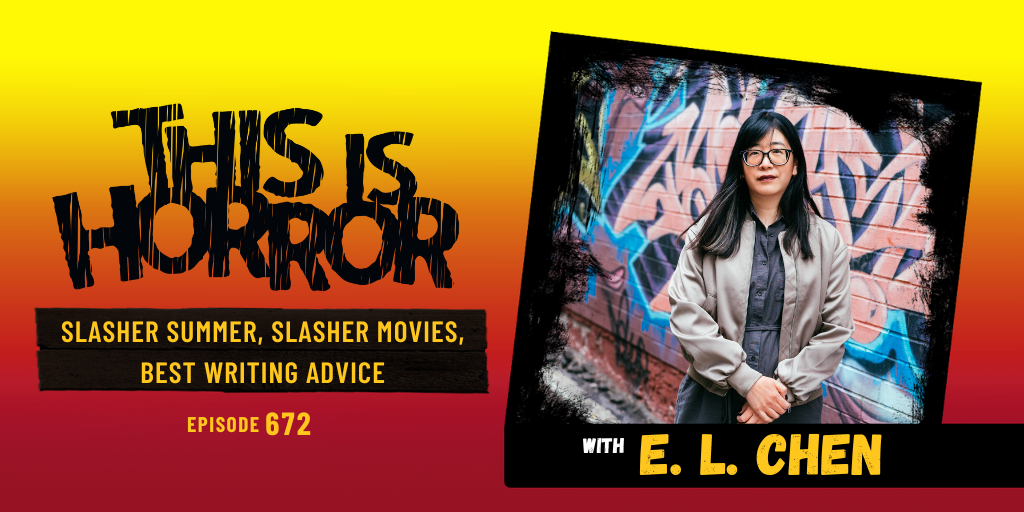
In this podcast, E. L. Chen talks about Slasher Summer, slasher movies, the best writing advice she’s ever heard, and much more.
About E. L. Chen
E. L. Chen is the USA TODAY bestselling author of Sweetside Motel, Slasher Summer, and One of Us Is Already Dead. Her YA fantasy Summerwood/Winterwood was longlisted for the Sunburst and recommended as a Best Book for Kids and Teens by the Canadian Children’s Book Centre, and her short fiction has appeared in venues such as Strange Horizons, On Spec, and The Dark. She lives in Toronto, Canada with her son and a towering TBR pile.
Timestamps
Thanks for Listening!
Help out the show:
- Support This Is Horror on Patreon
- Listen to This Is Horror Podcast on Apple
- Listen to This Is Horror Podcast on Spotify
- Rate and review the This Is Horror Podcast on Apple Podcasts
- Share the episode on Facebook and X
- Subscribe to This Is Horror podcast RSS Feed
Let us know how you enjoyed this episode:
- Write a comment below.
- Follow us and get in touch on Instagram @thisishorrorpodcast
- Subscribe and comment on YouTube @thisishorrorpodcast
- Follow us and get in touch on TikTok @thisishorrorpodcast
- Tweet us @thisishorror.
Resources
- E. L. Chen
- Watch the video version of This Is Horror Podcast episodes, including our conversation with Chuck Palahniuk on YouTube.
House of Bad Memories by Michael David Wilson
From the author of The Girl in the Video comes a darkly comic thriller with an edge-of-your-seat climax.
Denny just wants to be the world’s best dad to his baby daughter, but things get messy when he starts hallucinating his estranged abusive stepfather, Frank. Then Frank winds up dead and Denny is held hostage by his junkie half-sister who demands he uncovers the cause of her father’s death.
Will Denny defeat his demons or be perpetually tortured for refusing to answer impossible questions?
House of Bad Memories is Funny Games meets This Is England with a Rosemary’s Baby under-taste.
Buy House of Bad Memories from Cemetery Gates Media
Buy the House of Bad Memories audiobook
They’re Watching by Michael David Wilson and Bob Pastorella
From the hosts of This Is Horror Podcast comes a dark thriller of obsession, paranoia, and voyeurism.
After relocating to a small coastal town, Brian discovers a hole that gazes into his neighbour’s bedroom. Every night she dances and he peeps. Same song, same time, same wild and mesmerising dance. But soon Brian suspects he’s not the only one watching and she’s not the only one being watched.
They’re Watching is The Wicker Man meets Body Double with a splash of Suspiria.
Buy They’re Watching in paperback and eBook right now.
Michael David Wilson 0:28
Welcome to This Is Horror, a podcast for readers, writers, and creators. I'm Michael David Wilson, and every episode I chat with the world's best writers about writing, life lessons, creativity, and much more. Today I am chatting to E. L. Tian for the second and final part of our conversation. Last week we spoke about Sweetside Motel, E. L. T. N. writing routine, and inverting Gothic novel expectations, and today we are diving deep into her brand new novel Slasher Summer. But before we get to that, a quick advert break.
Bob Pastorella 1:20
House of Bad Memories, the debut novel from Michael David Wilson, is out now via Cemetery Gates Media. Denny just wants to be the world's best dad to his baby daughter, but things get messy when he starts hallucinating his estranged, abusive stepfather Frank. Then Frank winds up dead, and Denny is held hostage by his junky half sister, who demands he uncovers the cause of her father's death. Will Denny defeat his demons, or be perpetually tortured for refusing to answer impossible questions? Clay McCloud Chapman says, "House of Bad Memories hit so hard you'll spit teeth out once you're done reading it. House of Bad Memories by Michael David Wilson available now in paperback, ebook, and audio. From the host of this isorror podcast comes a dark thriller of obsession, paranoia, and voyeurism. After relocating to a small coastal town, Brian discovers a hole that gazes into his neighbor's bedroom. Every night, she dances and he peeps. Same song, same time, same wild and mesmerizing dance. But soon Brian suspects he's not the only one watching, and she's not the only one being watched. Their watching is The Wicker Man meets Body Double with the Splash of Suspiria. Their watching by Michael David Wilson and Bob Pastorella is available from This Is Horror.co.uk, Amazon, and wherever good books are sold.
Michael David Wilson 2:43
Okay, with that said, here it is. It is E L Chen. On This Is Horror. So let's talk about slasher summer, and to begin with, what was your why for writing the book?
E. L. Chen 3:09
You know, this is where I have to confess that I wasn't. It wasn't like I was hit by a bolt of inspiration, and it was like I have to write this book. I have to get it out of me. You know, the origin story is you know was pretty prosaic because I was between projects, and it was my agent who thought I would be interested in writing a slasher because I touched on Final Girl mythology in One of Us Is Already Dead. And at first, I was like, you know, I don't know, I don't know if I have a slasher in me. I'm, you know, I'm not Stephen Graham Jones. I'm not Brian McCallie. But the more I thought about it, and thought about what I would want to see in a slasher, and the kinds of slasher movies I love are the ones that are, you know, self-aware and a little comical, you know, like Scream and The Blackening and Freaky. And so I just make like a whole bunch of notes, and the next thing you know, I had like 20 pages of notes. I was like, okay, I guess, I guess I'm doing this. Yeah. So I mean, that's really how it how it came about, and really sort of my guiding my guiding principle was that, you know, I really just wanted to write a fun slash a movie that I would want to watch. So, and that's like the kind of experience that you know, that that I hope readers have as well as they're reading the book.
Michael David Wilson 4:25
And before we go deep into it, I suppose it would be useful just to give people a quick elevator pitch.
E. L. Chen 4:34
Okay, so slasher summer is. Hang on, clip the book here. Right there, that's the U.S. cover, so slasher summer is basically Breakfast Club meets Scream. So we have seven friends who were once members of their high school horror film club. So they're reuniting at a remote cabin because, of course, it always happens in a remote cabin where a cult slasher movie was. Once filmed, and they find themselves targeted by someone dressing up like the iconic killer from that movie.
Michael David Wilson 5:11
Yeah, and I think because it is so referential to other slashers, I mean, there's something almost scary movie or the cabin in the woods about it, and this book is so self-aware in terms of what it's doing. So I imagine the 20 pages of notes that you made initially might have gone some way into forming this.
E. L. Chen 5:39
A little bit. It was sort of, you know, notes on characters and notes on sort of the world that the book inhabits. But yeah, also notes on you know gags I could do or little references I could sneak in. You know, at some point this has to happen. You know, just because we've seen it in a movie like a million times. But you know, can I subvert it a little way, a little bit, you know, just to make it funny, right? And yeah, so it was, you know, when once I had that all together, it was like, okay, now I have to write this just because it would just be so much fun to write, and hopefully people would have just as much fun reading it.
Michael David Wilson 6:15
And so I want to know too, what was the first slasher movie that you watched, and what was that experience like?
E. L. Chen 6:25
So the first slasher movie I ever saw was Nightmare on Elm Street. I was probably around nine years old. I think I was maybe in grade grade four or five at the time. It was at a classmate's birthday party, and I think she wanted to watch it because that cute guy from 21 Jump Street was in it. You know, I'm kind of you know, as I said, I'm a child of the '80s, so, and it was just for me. It was a shock because my TV watching up to that point had been very, very sheltered. My mom didn't let me watch cartoons except Disney because she thought they were too violent. I mean, I watched them anyway when she wasn't home. But you know, this is the the kind of environment I grew up in. Right? There was no, you know, you know. I hear, you know, I hear and read like so many interviews with horror writers, where they were like, "Oh, you know, my mom took me to the blockbuster and just let me rent anything I wanted. Right? There was none of that for me. It was, you know, it was very, very sheltered. And so, Nightmare on Elm Street, like like the set pieces are just like so, like they're so visceral, they're so shocking, right? The the bed with like the fountain of blood and the girl getting like cut up, and she's like, you know, crawling across the ceiling, like on her back, like it was like that was pretty shocking. Like I had nightmares for weeks after that, you know. And then the very concept of Freddy Krueger, right? Someone who can kill you in your dreams, that was just, you know, absolutely terrifying. And so that that did not make me a slasher movie convert, you know. Again, like so many, you know, I hear and read all these interviews with horror writers who are like, you know, I saw my first slasher and I was nine years old, and it made me a fan for life. You know, for me, it like turned me off slashers for like a good, you know, 20 years, just because it was so shocking and so scary for me. And I only, I only really got back. I got well, not back into, but I got into slashers maybe about eight or nine years ago. So I'm actually quite a recent convert because even though even though I do things you know like things that are spooky in the copper, you know I don't like gore. I actually I still don't like gore. I have to you know cover my eyes during like really graphic and gory parts, and so because of that, for the longest time, I thought I didn't like slashers. But you know, eight or nine years ago, when I realized that you know I probably am a horror author after all, and not not fantasy, I realized that I had to broaden my horror education, and so I started watching more of the classic slashers, and I realized that you know, for me, in order to like slashers, I really needed to watch more of them because I have a kind of brain that loves patterns, loves you know patterns and tropes and archetypes. I read way too much Joseph Campbell when I was younger. You know, Joseph Campbell, hero with 1000 faces, power of myth. You know, these you know these days he's it's acknowledged that he's very much a young man of his time. But back then, it was sort of mind blowing for me because he really validated everything that I'd noticed about you know the stories and fairy tales and folk tales that I was reading that was a kid. Like he validated that everything that I noticed that you know certain stories and character types keep repeating themselves, and so watching all these slashers and.
E. L. Chen 9:58
Realizing, you know, hitting on or sorry, being drawn to the archetype of the final girl, and realizing that you know the final girl is really sort of a variation on the hero's journey, where you've got a character, you know, the sort of innocent ordinary person who is forced into a situation in which they have to find their inner strength, and so just you know, seeing this pattern repeat itself, I think was just you know very appealing for me, and that's the moment which you know I fell in love with slashers. You know, I also think it's not not a total coincidence that I had, you know, I'd also just gotten divorced, so I think, yeah, the appeal of watching watching a woman, you know, get through a traumatic experience, I think was probably quite appealing to me, you know. But it's hard to say whether that's causal or or a correlation, just because you know all of a sudden, you know, all of a sudden, I actually did have time to watch movies that I wanted to watch, so I mean that's sort of I guess that's a story of my sort of love affair with slashers.
Michael David Wilson 11:11
Yeah, there's an enormous amount of directions that I now want to go, but I mean in terms of this ninth birthday party was incredibly young for you know the host to decide. Right, we're watching a nightmare on Elm Street. So was was this go on?
E. L. Chen 11:33
Oh, just because Johnny Depp was in it. And to be honest, like I don't think my my classmates like I don't think they were as shocked or scared as I was. They were you know, I think they were busy talking, and they were more interested in like, you know, the kissing scenes between you know Johnny Depp and and you know and his girlfriend. So I think I was the only one who was like, you know, absolutely horrified by what I was watching.
Michael David Wilson 11:55
And after watching it, did you tell your parents that you'd watched it, or did you think if you do that, you're in trouble? It's like, why didn't you run out of the house? Why? And did did this affect what you watch going forward? I mean, you said you know you were terrified. You didn't love it. You didn't go and seek out more. But I wonder if your parents at least we're like, well, she she can probably watch any cartoon at this point. She's seen a nightmare on Elm Street.
E. L. Chen 12:27
No, I I did not tell them because I guess I don't think it I don't think it really came up. But the other thing too is, you know, this this sort of feeling that if I told them, then they would probably never let me go to another birthday party again, where you know they don't have control over the media that I consume. Yeah, but I mean, you know, even though it was kind of terrifying, like I was still watching, I guess things that were kind of scary and intense on TV, just not things that were so graphic. You know, as a kid around that age, my favorite TV show was Doctor Who, and this is old school Doctor Who we're talking about because again, child of the 80s, and you know, a lot of those old, a lot of those old story arcs, especially with the fourth Doctor, you know, they're almost set up like slasher movies, right? Where where the Doctor and his companion end up on some remote outpost or space station or spaceship where people have been mysteriously dying one by one, and very often there's only like one survivor, other than the Doctor and his companion, and and those you know those shows were pretty scary. Like they were they were very much like you know monster of the week stories, you know the Daleks, like the Daleks are terrifying, but there isn't like a lot of blood. It's not graphic, so I was still kind of exposed to that sort of those sort of very intense stories. I also watched a lot of a lot of Hitchcock movies actually when I was a kid because they were on TV, and you know, I was very much into classic movies. You know, I didn't see I didn't see The Birds or Psycho until I was older. But even just like you know, movies like Vertigo, right? Which Vertigo is actually one of my my my top favorite movie of all time. You know, it is very intense. It is very psychological. So you know, I wouldn't say I wouldn't say the horrors of Nightmare at Elm Street. I think it turned me off the graphic stuff, but I was still sort of interested in the very, you know, that that very sort of intense watching experience.
Michael David Wilson 14:34
I'm glad that you were able to watch sci-fi like Doctor Who and to watch Hitchcock as well, and in many ways, I mean, they have a lot of the fundamental blocks of horror storytelling, but it's just the window dressing, or it's just that the gore isn't quite, you know, there. So it's interesting how as as. Society will often let our kids watch sci-fi, but we won't let them watch horror. And there's a thin line between the two.
E. L. Chen 15:09
Yeah, especially like those old Doctor Who episodes. Yeah, I mean, I think there's one story arc called you know the Robots of Death. I mean, the fact that it's called robots of death, and it's just-I don't know if you've seen it, but like you know, these robots have you know these their blank metallic faces in this very sort of I don't know French courtly style. Like they were they were pretty terrifying. Those like nightmare stuff, but because there isn't like a lot of blood and gore. It's it's still you know PG friendly, I guess.
Michael David Wilson 15:46
Yeah, there's certainly more of a rawness to the older Doctor Who's as opposed to the the more modern iteration, which I suppose started with Christopher Recostan. You know, but you know, still still entertaining none the less. But yeah, the the old Doctor Who, that's the good shit. That's where that's where it's at. And I I wonder too because you mentioned both Brian Mccauley and Stephen Graham Jones. So when did reading them come into your slasher education, and was there anything that you took from either of them, or anything that you bore in mind while writing slasher summer?
E. L. Chen 16:36
Yeah, so so I definitely have read. You know, my heart is a chainsaw. You know, which is you know very you know it's a great book, a brilliant book. But I think what I took away from it is that Stephen Graham Jones knows way more about slashers than I do or ever will. But Brian Mccauley actually, you know, you know, when I started writing slasher summer, I did read a whole bunch of slasher books just to get the idea of okay, like how do I how do I translate something that's a very you know that's very cinematic, a cinematic genre? How do I translate to that to the page? And so one of the books I read was Brian Mccauley's Candy Cane Kills. It was a novella put out by Shortwave, I think, and that for me was, you know, I learned a lot from that book because I realized that, you know, to make a really effective slasher, it all comes down to character. Your characters, even if they're unlikable, they have to want things. They, you know, they need goals, just so that, you know, it makes you know it raises the stakes. You know that even you know in in Candy King kills, like even like the even characters who who don't have a lot of you know page time, who are just sort of minor characters who are just there to get killed, right? In the first chapter, you know, you really get inside their heads and you see that they you know, there are things that they want. There are things that they're hoping. They have hopes and dreams, and then, you know, it all, you know, they end up dying, of course, which makes I think the, you know, makes the stakes higher when, you know, they're running from the killer, and it makes their death, I suppose, a bit more impactful when when they happen. So I really, you know, I really learned a lot from that book and tried to apply what I learned to slasher summer.
Michael David Wilson 18:28
And I imagine too, both from having read it and seen how tightly put together all the elements are, and from just hearing you talk about other aspects of your life, I have to believe this was planned rather than pantsed, and so I'm wondering. Well, first of all, if if I'm right, and secondly, what that planning process looked like.
E. L. Chen 18:54
Yeah. So I'm as a writer, I'm an outliner. You know, I outline within an inch of my life again because I have so little time to write, or I write in like very, very sort of short installments of time. I need to be able to hit the ground running. I need to know what I'm doing when I start writing. So, so yeah, so I need I need an outline. I I can't, you know, I can't really waste a lot of time sort of you know meandering and finding my place within a scene, and yeah. So, in so writing the book, you know, I had an outline, and I ended up being very practical and methodical about it because this is actually the first book I written with multiple POBs, because I wanted to sort of model it on model it on thrillers like you know like Lucy Foley, right? Where they do you do have like sort of multiple POVs telling the story, and you don't really know who, you know, you know everyone has sort of you know ulterior motives, and you don't really know you don't really know. You know who is responsible for the crime, and the story just sort of unfolds within these you know multiple POVs. And so what I ended up doing was putting the outline within a spreadsheet. You know with my scenes with my scenes you know across the bottom and like the characters along the top. And so I just had this timeline of events, and each cell, I just sort of made notes on you know what each character is doing at that moment, even if they're off page. What are they doing? What are they thinking? What are they feeling? And yeah, and that's that's how I handled it.
Michael David Wilson 20:34
Oh my goodness! I don't think many people have told us that they used a spreadsheet for planning. Then I know it's
E. L. Chen 20:42
it's. so banal, but at the same time, it was like so useful and so useful.
Michael David Wilson 20:47
And I mean, did you find that there were logistical challenges from writing from these different POVs, and did that take, I suppose, an extra strain on your mental capacity to, let's say, be in Jen mode as opposed to Freddy, which are very different modalities.
E. L. Chen 21:10
I mean, with if anything, I think having that spreadsheet really helped, just because you know, for each scene, I could see who would be who would be the best point of view to tell that to tell you know the events of that scene, and I think having that you know having those scenes sort of sectioned off. Okay, this is a Freddy scene. This is a Jen scene. This is a Carrie scene. I think that sort of helped me sort of you know switch between the different heads. Does that make sense? You know, had having that structure there beforehand, it was very helpful.
Michael David Wilson 21:45
Yeah, and for people listening who haven't read it and they've heard Freddie, Jen, Carrie, they're probably thinking, "Wait a minute, these are all iconic horror names. So, when did you know during the writing or the planning that you were going to reference so many horror icons, and did the name that you decided to give each character then deliberately kind of inform the personality and some of the decisions that each of those characters made.
E. L. Chen 22:23
I cited early on that they should have, you know, they should all have killer names, except for Tiffany. Tiffany is actually, you know, I just needed sort of a generic like '80s cheerleader name because that's you know the kind of character that she is. Although it's been pointed out to me that Tiffany's actually Chucky's girlfriend, so which I didn't realize. Yeah,
Michael David Wilson 22:42
so you landed on it accidentally then.
E. L. Chen 22:46
But I'd say that that none of the characters are really like their namesakes. The only thing I borrowed was Carrie, right? So Carrie, Carrie has a very religious mother. So you know, obviously that's a reference to you know Stephen King's carry, but otherwise, otherwise I didn't. You know I didn't. You know they they otherwise they weren't like their namesakes. And actually, even in the book, I don't. You know, no one says, "Hey, isn't it funny how we all have names like these iconic killers? I don't mention that in the book either, just because I thought it would be kind of. I think it would kind of pull people out of the story, right? If they sort of, you know, saw it a bit more from a distance, or if they they kind of saw the workings under the hood.
Michael David Wilson 23:33
Yeah, I think it's very early on that you reference Carrie has a religious mother. So when that happened in probably the first 10% of the book. I thought, hang on a minute. Is this actually carry? But then, of course, like as I progressed, it's like okay, no, these are just commonalities. But yeah, that aspect certainly got me and made me really sit up.
E. L. Chen 24:02
Yeah. yeah. But it was it was kind of useful that way because you know because I decided okay you know like Stephen King's carry she should have a very religious mother, but then that you know from there that one little aspect of you know her backstory really sort of helped bring the character to life and give her all sorts of motivations for I guess you know for what happens later in the book, and just the way she interacts with other people and the way other people see her.
Michael David Wilson 24:30
In talking about having backstories, I understand that the cabin had an entire backstory, but ultimately you decided to cut it for matters of pacing. So, is there anything you can tell us about that? Can we get an exclusive on the cabin's backstory?
E. L. Chen 24:52
Not really. I mean, it was just the idea that it had once belonged to you know it once belonged to a local family. The Portnoy family, and actually, in an early draft, I you know I referred to it as the Portnoy Cabin, as opposed to the Slasher Cabin. So I think if you see if you if you see very early marketing copy for slasher summer, I think they still call it the Portnoy Cabin. And so the idea was that yeah, it had belonged to a family, but you know, since the movie was filmed, you know, it attracted all kinds of you know looky loos, and they ended up having to sell the cabin. And I had the idea that maybe, you know, maybe one of the characters was actually related to the family who had owned the cabin, and you know, they could be a suspect, or maybe that could be a motivation for for them, you know, dressing up as a slasher and and targeting these people at the cabin, but yeah, no, it ended up not going anywhere. But maybe I'll save the idea for another day.
Michael David Wilson 25:49
I mean, that's the beauty with ideas; they need not be wasted. They can just be recycled and redistributed in other stories, and I wonder too, what did the editorial process look like? How much editorial input was there, and how closely does the finished book slash your summer resemble what you turned into the publisher?
E. L. Chen 26:19
It's, I'd say I think it's pretty close to what I turned into the publisher. I think they, because I, you know, there are two publishers, the UK and the US. So actually, I had two editors working on the book, but they were, you know, they didn't ask for like many really drastic changes. Although my UK editor actually asked for it to be more gory, so so I did put in you know even more gore. I mean I think most of their feedback was just sort of that little things you know just sort of like bringing some you know small elements forward or maybe putting some small elements back. You know, light edits just for you know clarity. You know, maybe cleaning up some of the language a bit. When I say cleaning up, I mean simplifying. I don't mean like you know cleaning up swearing or anything like that. So I think a lot of their edits were you know none of their edits were like super deep structural edits. So that was yeah. So that was so that was nice because I think with two editors, I was kind of worried. You know, are they going to come back with conflicting opinions as to how this book is going to go? But they ended up being in agreement with a lot of stuff.
Michael David Wilson 27:36
Yeah, well, I'm always interested because it feels like the landscape has shifted in the last five years, where there are more writers getting a different publisher for the UK and the US edition. So, I'm always intrigued as to how that editorial process just logistically works. So, what you're saying is you got two completely different sets of notes. Although, luckily, there was a lot of commonalities. So then, did you have to have three documents open at the same time? So you've got your original, and you're making the changes, and then maybe on the left you've got the US, the right you've got the UK, and then do you have to send each of them? I suppose the master document with the edits, or are there little differences now between the UK and the US version?
E. L. Chen 28:35
There actually aren't. There aren't any differences in the final version, except for, I think at one point, I think in the UK version, someone's wearing trousers, and the US version, someone's wearing pants. Although I tried very hard to not actually, you'll notice that I think a lot of times, you know, someone's pants will be described as like khakis, just because I was trying to avoid the whole trousers pants thing. Because I know you know pants in the UK is very different than than in the US. But like the word trousers, right? In North America, that's not you know it's not very commonly used word. Like people will understand what it is, but it's not something that you know people will say every day, like no one, you know, no one in Canada or the U.S. says, "Oh, I went to the store and I bought some trousers. They say, "I bought some jeans. I bought some pants. So that that is actually the only difference. But yeah, the editorial process going rewinding a little bit. So my UK editor actually looked at it first. So she she gave it a pass, and then I think she she and the American editor I think they conferred, and then he added some more edits to the document, and so I addressed those two. But I think I think like a lot of a lot went on. Behind the scenes, like the two editors talked to each other, so I think in that way I was very lucky that there was very good communication between them, and so I think you know them talking together, and they made sure that I had just like one document to work off of and one sort of you know final set of feedback to address. So that was yeah, I think I was very fortunate that way.
Michael David Wilson 30:22
Yeah, thank goodness for good communication and working together. And as a British person, I can confirm that if you had decided to keep pants in, then I would have, you know, known. Okay, you mean trousers? I wouldn't have thought. Oh, okay. She's describing all of the characters' underwear now. I, I think you know we we see enough American fiction and movies, but yeah, I I kind of love that you put trousers in the UK edition, and that is the only difference. Now, I wonder too. I mean, your publicist said that there are 20-seven slasher movies referenced in slasher summer, which I know. I mean, that's very impressive, but I almost felt like there were more. I mean, there are so many little references, and was was this something that was also tracked with a spreadsheet? And how did you decide when to pepper in each reference?
E. L. Chen 31:38
Yeah, I wouldn't say all of them were slashers, and it wasn't. Yeah, I wasn't really. Yeah, I didn't have a list. I didn't have like a you know things that I wanted to squeeze in. Like I just sort of put things in as they came to me. I think the reason why my publisher has a list because they they actually asked for a list. They actually asked me to make a list of you know every movie that I reference because I think they they had the thought that maybe they make like a letter boxed a list or something yeah and I mean it's pretty much like as they came to me all all the different things you know slashers and then other horror movies you know probably referenced Hitchcock Hitchcock a few times because you know I'm you know give my long history with Hitchcock, yeah. I mean it really just was you know at the moment what does this remind me of, and you know I put the reference in, except for oh except for Wolf Creek, Wolf Creek. I just sort of snuck that in there, just because Wolf Creek is like one of the most terrifying movies I've ever seen. Like I, I slept with the lights on after I watched that movie, so I put in like just like a silly little reference to it. It's it's like you know the name of the cannabis that Freddie has been smoking, you know, just to sort of you know exercise the trauma of having seen that movie.
Michael David Wilson 33:05
So would you say that for you, Wolf Creek is the scariest slasher movie?
E. L. Chen 33:11
Um, I don't know. It's I think it's hard to make a claim like that just because I don't think I've you know I haven't seen you know I've watched a lot of slasher movies, especially in in preparation for this book. But I don't think I've seen them all. Like I said before, I'm not Stephen Graham Jones. There's probably a lot more that I'm missing. But it was personally like terrifying for me, just because it was because it felt so realistic, right? I mean, it is about you know someone in the outback preying on travelers, and I think you know as a woman, especially as a you know woman of color, you know that is like one of my greatest fears is you know being targeted, being in the wrong place at the wrong time, right? With this you know sadistic and being targeted by a sadistic killer that you can't really escape because it's you know again the outback. So really, yeah, terrifying movie. Yeah, I think later. I think later installments. I think that I haven't obviously I haven't you know watched any Wolf Creek movie since, but I think I get the impression that later installments are a bit more campy, but that first one was-I don't know-it just felt very realistic to me. And this is the same reason why I haven't seen Texas Chainsaw Massacre, just because again, it's that same fear of you know traveling through like an isolated place and being targeted because just because you're there,
Michael David Wilson 34:43
yeah. I think Texas Chainsaw Massacre is one of the most effective horror movies that does so much when actually technically showing so little. I mean that's a an all time favorite. And I know that's a a film that you know my co-host Bob would argue is not a slasher movie, and I know it's slasher tangent or whatever it is. It is a very effective and one of the finest movies ever made. But yeah, but I
E. L. Chen 35:21
still won't watch it. I could see
Michael David Wilson 35:23
from your reaction to Wolf Creek that maybe watching Texas Kings or Massacre would not be a good life choice for you.
E. L. Chen 35:34
No, I know that it would. Yeah, I know I would just give me nightmares, not in a good way.
Michael David Wilson 35:39
Yeah, and in terms of that '80s VHS slasher vibe, I mean, it really does extend to the cover as well because the cover for slasher summer, I mean, it is presented as a videotape. I haven't really seen any of the big publishers committing so much to a cover. I mean, it's the kind of thing that I would have expected shortwave, who you mentioned before, the publisher of Brian Mccauley having done. But it's spectacular. How did the cover come about, and was that an element that you had to fight for, or would the publisher all in?
E. L. Chen 36:25
Oh no, it was the publisher's idea. I mean, the you know they told me it's like, oh, we're thinking of doing it as like a retro style movie poster, and I was like, oh my god, that would be so awesome, you know. And then when I saw the initial sketch, like I was actually at the office, and I was like, you know, trying so hard not to scream because it was just like so amazing. So yeah, no, I really lucked out on the cover, and I don't know if you've seen. There's a there's a special Target edition that comes in a slip case. So the slip case looks like it looks like a VHS tape cover, and then inside the actual book itself, the cover looks like a videotape, and it's just yeah. It was just like I totally lucked out on on like the actual book design. It's just yeah, absolutely amazing.
Michael David Wilson 37:12
Yeah, I saw there were about what three to five different editions. I I must confess, I didn't even know the publishers specifically put out. This is the Target edition, or yeah,
E. L. Chen 37:25
I didn't know that either. I mean, like I'd heard about you know some you know maybe some bookstores or bookstore chains getting you know special editions. Maybe they get sprayed edges, but yeah, like I didn't realize that Target, you know, and Target or like Walmart. There's also a Walmart edition that has a bookmark in the back. It's like I I had no idea that Target and Walmart actually did these, you know, special editions for books. But but yeah, they have. It's yeah, it's it's pretty amazing.
Michael David Wilson 37:55
And I haven't actually asked you, but what is your favorite slasher? favorite
E. L. Chen 38:04
slasher movie. So my favorite one is The Final Girls from 2015 with Taissa Farmiga and Malan Ackerman. Have you seen it?
Michael David Wilson 38:16
I haven't. No, I'm I'm familiar with it, but I have. It's a lesser
E. L. Chen 38:21
known one, and I just love it so much because it is like it's this. It's self aware, very funny. So Taysa Farmika plays. She plays like a teenage girl whose mother, played by Malan Ackerman, was a you know was a scream queen. She you know starred in starred in a you know summer camp slasher movie back in the day, and you know she'd since passed away. And then you know Taysa Farms' character and her friends they somehow end up in the world of this movie, this slasher movie, and it's just you know done really well. Like they're in the world of the movie, and you know there there's like text, like three dimensional text, just sitting on the ground that they had to step over because it's like a caption that was like on screen, you know, in the movie itself. And it's just like it's really really funny, but at the same time, it's like it's really really touching because you know she meets her mother, you know her deceased mother playing, you know who's the character in the movie, and so of course you know she doesn't want her mom to die in the movie because she's you know fated to do so because you know it's a slasher, and so it's just yeah it's just like really fun, but at the same time you know, it's got a lot of heart. So, you know, and it's not very gory at all. I think that's that's one of the, you know, a lot of the comments on IMDb. I think on the shutter, it's like people complain that it's not very gory. But you know, I really like that because you know, I actually don't like gore.
Michael David Wilson 39:56
Yeah, no, I'll have to finally, you know, over. Decade later, get get round to watching it. Then, especially with that endorsement, and it sounds like it's a lot smarter than a lot of you know more more. I suppose generic slashers. It sounds very self aware. Well, what is one thing that you learned about writing, and one thing that you learned about yourself through writing slash your summer.
E. L. Chen 40:29
One thing I learned about writing. I guess one thing I learned about writing while writing this book is that you know I told you already about my spreadsheet. I learned that I shouldn't be afraid to be so methodical and and intentional and focus on craft and structure because you know when I was younger, you know, I'd read you know writing craft books and I'd be like, oh, I know all that, and instinctively, you know. I think I was very maybe a bit arrogant as a writer, and I just kind of assumed that I knew how to do things, you know, you know, out of instinct. And so I think writing this book and coming up with yeah this this method of of you know, working on it with you know the spreadsheet and my outline and all that, I think it taught me that you know I can be I can use these very dry and banal and prosaic tools to write this book, but it doesn't affect the quality of the book. It helps like it helps the quality of the book, and it doesn't make the book itself dry and banal. You know, and so I think it's you know the lesson I learned is that you know it's okay. It's okay to focus on craft. It's okay to be analytical. You know, you don't have to be all right brain all the time. And then the second question, which I've forgotten already,
Michael David Wilson 41:59
was something that you learned about yourself from writing slasher summer.
E. L. Chen 42:05
I guess I learned. I suppose I learned like just how much I do love slasher movies. You know, despite the rocky start and you know the gore, but just learning that you know there is something really wonderful about seeing you know more often than not it's you know a female you know it's a heroine in the place of the final girl. I think I just didn't know how much I needed to see you know a woman or someone you know with a marginalized identity in sort of the position of hero. I mean, not just you know being heroic, but it's also you know finding inner strength. But you know, a lot of cases, it's sort of like a coming of rage as well. You know, like there's something really cathartic at seeing you know a woman. You know, at the end, you know, finally, when there's nothing left to lose, just you know, sort of tapping into those sort of primal survival instincts and letting herself be angry and be be violent and you know fight back. I really love the the later Scream movies, the ones with Jenna Ortega and Melissa Barrera, because those those are almost like coming of rage movies, right? At the it's kind of a spoiler, but you know, at the end, you know, the girls, you know, they fight back their their attacker, and you know, she's she's stabbing, you know, the the current ghost face killer, and you know that she's enjoying it, right? And that really is, you know, that's almost sort of a a twist on, I suppose, you know, the the old school sort of final girl when it was, you know, the girl next door, Laurie Strode, just sort of forced in this into this position, and just sort of reacting. But in this case, in you know, in those two screen movies, you have these girls who are, I think, a lot more, a lot more proactive, and they have like a lot more agency, and it isn't just sort of knee jerk survival. And it's very, you know, it's very empowering to to watch things like that.
Michael David Wilson 44:23
Yeah, I think coming of rage might be your sub genre. I feel there is a theme throughout your work, and I I certainly anticipate that will also be the case with one of us is already dead,
E. L. Chen 44:41
possibly. Possibly,
Michael David Wilson 44:43
and is is there much that you can say about that project? I know that you've said before it's Blair Witch Project inspired.
E. L. Chen 44:52
Yeah, so it's inspired by the Blair Witch Project, but as much as it's. It's inspired by the movie, but it's also inspired by the fact that you know Heather Donahue had starred in it, the fact that she, you know, she quit Hollywood. Right? I mean, the the inspiration for the for the book came when you know many years ago I was flipping through a magazine and I saw a little sidebar saying that you know, Heather Danny Hood had written a memoir about quitting Hollywood and starting a cannabis farm of all things, and that really surprised me because I thought you know that movie was such a huge hit, and she was so good in it. But yeah, she just sort of disappeared from Hollywood, and so you know, of course, my writer brain was like, well, what if the events of that movie were actually real, and that's why she got out of acting. So that was the, that was the, that was the seed for the you know the origin of one of us is already dead. I also think of it as my it's my midlife crisis horror novel. Again, I wrote it during the pandemic. You know, you know, I'm in my 40s, right? And you know, my age never really bothered me before, but during the pandemic, when you know, you know, we were all in lockdown, I just sort of started getting this feeling of, you know, this is time that I'm never going to get back, right? So that sort of feeling combined with, you know the idea of you know a found footage movie in which things you know not everything that happened on film was fictional you know that sort of got mashed together and you know that became that book
Michael David Wilson 46:35
and I wonder in terms of the presentation of the book does it mimic a found footage film in the way that slasher summer kind of mimics a slasher film? Is is this an area of concern now, where you're almost writing the literary version of these film subgenres?
E. L. Chen 46:58
Yeah. So the novel itself is actually not, you know it revolves around a found footage movie, but it's not found footage style. You know there are sort of you know flashbacks to what happens during the filming of that film, and then there's sort of a you know it's a current present day timeline, but it's not you know it's not like a found footage style book, like you know episode 13 or or October. October film haunt, right? It is still very much sort of a traditional narrative.
Michael David Wilson 47:28
And I wonder too, as we're talking a lot about movie references and movie structures, do you write for the screen? Do you have aspirations to write for the screen because it it feels like it would be a good match.
E. L. Chen 47:45
I've thought about like I would love to learn screenwriting. I just simply don't have the time right now, and I actually did try ages ago my YA novel Summerwood Winterwood. I actually tried writing a graphic novel script for the first half of that book for Summerwood, and that was just like a really interesting exercise because I think yeah I think it was a lot like writing for the screen, and you realize like how much you can't rely on interiority. Like it was a really interesting exercise in how everything really has to be shown, and you know, and you can't really-it's-it's much much harder to get inside a character's head, and so I think you know, writing for the screen, yeah, like I said, it's something that I would love to do. It sounds like like it would be like a really great challenge, but at the moment I just don't have time.
Michael David Wilson 48:43
Yeah, time is the enemy of a lot of us. We have far more creative aspirations and ideas than we do time. But goodness, I mean, you're maximizing your time, and not just with writing, but also with food preparation again, another interesting thing I found on your website.
E. L. Chen 49:06
Oh man, yeah, I'm the the queen of food prep, I suppose. Is that something
Michael David Wilson 49:11
you're still continuing to do to this day? If if we were to look inside your your freezer, which I'm not saying we should do, it's not that type of podcast, but do you have different pieces of Tupperware labeled with different meals?
E. L. Chen 49:27
Yeah, I still have lots and lots of containers in there. I did stop making my own pasta sauce though, because again, I just ran out of time, and so yeah, I do buy store bought now. But yeah, it's still you know I do still do a lot of batch cooking, throw it in containers, and put it in the freezer because, again, like I, yeah, I don't have a lot of time. It's just, it's just a lot easier to assemble a meal than, you know, go through a great deal of effort to, you know, make something that's incredible. Complex,
Michael David Wilson 50:01
yeah, yeah. Now I find when I'm cooking, I at least listen to an audio book or podcast. So it's like, well, that that the time is not just being wasted on cooking a meal. I mean, even though it's a a delicious meal, it still feels a little bit like dead time if I'm just doing that, so I try to maximize it by combining it with something else.
E. L. Chen 50:27
Yeah, I do listen to a. I do listen to a lot of audio books that way.
Michael David Wilson 50:30
Yeah, yeah. Well, what is the latest audio book that you've listened
E. L. Chen 50:38
to? Oh man, I'm drawing a blank here, but I think the this probably isn't the latest one, but this is the one that I think had the most impact on me. It's a diary, the diary of a provincial lady by E. M. Delafield. I think it's from the 1930 s. Last month in June, I was just so busy with, I guess, you know, finishing up a draft, plus you know, all the slasher summer promo, that I kept starting a lot of books, but then abandoning them, not because they were bad, but just because like my brain just couldn't process them. But I, but I had the audio book from the library for the diary of a provincial lady, and that was really just what I needed, right? Because it was written in the 1930 s, and it's just sort of that very sort of English diary style, right? Like Bridget Jones' diary, from the point of view of, I guess, a lady, excuse me, in the 1930 s, who like lives in the country, and it's just like her day to day life, her interactions with people. You know, later on, she becomes an author. I think it was semi autobiographical. Apparently, installments of it were published in like a women's magazine at the time, and it's just like it's just very draw. It's just very I won't say laugh out loud funny, but it's you know, it's just you know, very dry, very witty. Like I said, that that English diary style, and it's exactly what I needed. It's just you know very low stakes, very cozy, and I enjoyed it quite a lot. And you know, at the same time, I also kind of absorbed that format because I think eventually I would like to write a book that has like a found footage feel that you know uses a diary. So it was also you know research that way as well.
Michael David Wilson 52:31
Yeah. No, I think everything we read in a sense is research, whether directly or indirectly, whether telling us something we want to do or showing us something we absolutely don't want to do,
E. L. Chen 52:46
yeah. And the thing is, like, you never know when when something will be an inspiration. Like, you know, I started this this book thinking, okay, it's just going to be a little distraction, and then later it was like, oh, I could actually sort of, you know, use this voice or borrow this format for something I write in the future,
Michael David Wilson 53:03
and you said about finishing the second book for Orbit. So, is that your latest project then? So, does that mean you're, I guess, two books ahead from what what is forthcoming and what has been published?
E. L. Chen 53:22
I guess that would be one book ahead because one of us is already dead. It is pretty much done; like it's it's been finalized. So I think we're just waiting for the the pub date. So this is, I guess, the second book I have in my contract, and so yeah. I mean, I guess we'll we'll we'll see how it goes. I don't know. I don't want to tell you too much about it, just because you know my my editor has seen like he's seen a synopsis and and the pitch for it, but like I have no idea he's going to like absolutely hate it and it's going to come back and have to make a lot of changes or or write something completely new. But that's that I think will should be my next book that's coming up.
Michael David Wilson 54:01
Well, I'm intrigued to see what you've done with it, and I'm very intrigued about one of us is already dead as well, which is an amazing title. So I wonder what is the best and what is the worst writing advice that you have ever been given,
E. L. Chen 54:22
I'd say that the best and worst advice I've ever received is actually the same advice. It's the old, you know, from Stephen King's on writing: write 500 words a day, right? 500 words a day, and then you know, after certain days, you'll have a novel. That's all you need, you know, which is really great advice, and I mean that's something that I do follow. I usually, when I'm drafting, I do write 500 words a day because I can usually do that in out in an hour, you know, and usually that's that's as much, you know, I usually have at least an hour a day to focus on writing. You know, but at the same time, it's also it's also bad advice because you know it kind of implies that you know you have to be productive, you have to be writing every single day, or else you know you you know what what is your worth as a writer if you can't do this every day? So some years ago, when my son was about three or four years old, he he would not stay asleep in his bed. I need you've got like a little one now, so you you you understand what it's like, right? And so I was so sleep deprived every single day. You know, I had you know my commute time to the office on the subway. You know that was supposed to be my writing time. I just ended up falling asleep instead, and I was really quite anxious about that because it's like I got to write my 500 words a day, and so you know I was just like you know very depressed and very anxious about that because I couldn't, you know, I couldn't write because I was, you know, sleep deprived, and it actually wasn't. It wasn't until sometime later I was talking to David Nichol, who's another fantastic Canadian horror writer who wrote The Geisters and Utopia. You know, I was telling him about how you know I was you know pretty bummed because I couldn't get in my you know daily word count, and he was the one who pointed out to me that you know it's it's usually privileged white men who give this advice that you know you have to write every single day because you know of course, Stephen King can can say this because you know he had his wife to look after his kids, right? He didn't have the sort of you know everyday responsibilities that a lot of us has had, and so I think that that was you know that was very freeing for me. So and and that way, you know, the 500 words words a day was you know you know it's good advice, but also really bad advice. You know, it's advice you have to take with a grain of salt. You know, it's it's something that you know it's you know it's great to be able to squeeze in writing when you can, but you know if you can't, you know don't don't stress out about it because you know we we we don't all have you know partners to help with the family. You know, we don't all have stable home situations. You know, we don't all have you know a secure, a secure, safe, and stable lifestyle that lets us you know have this habit every day. And so, yeah, so like I said, same advice, but both good and bad.
Michael David Wilson 57:44
Yeah, there's a discussion at the moment on social media where people are arguing about how much a full-time author should write a year, like how many books they should write, and people seem to be going back and forth, they're very opinionated and adamant in their opinion, as is the nature of social media. But really, I just think write write what you can. That's it. It's like there is don't don't put a number on it. Don't compare yourself to anyone else, maybe even don't compare yourself to yourself because your situation this year could be radically different from the previous year, and just be beyond everything. You know, enjoy writing, write the story that you want, but it's the moment I've found, at least, when we get caught up in other related to but not writing itself elements, that that we lose track of the writing, and if we're worrying about how often we're doing it, if we're getting into marketing or selling mode at the point of creative mode will-that's the death to creativity in itself. And there's,
E. L. Chen 59:10
and I think people just get go so caught up in the rules, right? They think that they have to meet a certain, you have to meet a certain like batch of criteria, or else you can't call yourself a real writer, you know. And then I think also people are very, you know, they're very biased. It's like, well, I can write 500 words a day, so you should be able to write 500 words a day too. And yeah, I should add like a huge caveat here that the only reason why I can write, you know, 500 words a day is that you know I, you know, I do have a day job. You know, my situation is you know pretty safe and secure, you know. I I'm lucky enough and I'm privileged enough that I can do this. That's there are things I don't have to worry about, you know, my housing or you know my grocery needs and that kind of thing. You know, I'm extremely lucky that way. But you know, and I don't have any chronic mental health issues. So, you know, other people like you can't compare yourself to me. You know, I'm just you know I'm just extremely fortunate to be in a situation where I can have these habits.
Michael David Wilson 1:00:11
So, what advice would you give to your 18 year old self?
E. L. Chen 1:00:16
So, I think this this kind of I guess ties back to I suppose the themes of identity and stuff that we've been talking about, you know, with slasher summer and I guess my own experience. You know, I would tell her that you don't have to try so hard to be the person that other people think you should be right. I think when I was younger, you know, when I was I was younger, and I think you know, part of this might be also a little gendered as well. Part of me was thought that you know, to sort of you know exist in the world, I had to be you know bright and funny and outgoing. You know, I had to be the you know the popular girl in you know the '80s film, you know all the kind of movies that I grew up with as a as a kid, and I think trying to behave that way you know I probably came off as being like totally awkward, right? So I think I would tell my 18 year old self that you know you can just you can just you know turn it down a notch. You can just be yourself. You don't have to. You don't have to smile and giggle so much. You don't have to, you know, be the person that you think you're supposed to be. Yeah, that would be, that would be my advice. Yeah, and it's also it's exhausting. It's exhausting trying to, you know, trying to play you know, this role, trying to trying to be what what you think what you think you should be, how how you think you should present yourself to the world. You know, it's it's it's very exhausting. It's very tiring.
Michael David Wilson 1:01:51
Yeah, I think it's a lesson that a lot of us learn, and a lot of us learn a lot later than we wish we had learned it. So then on on that basis, I mean, when would you say it was that you became or decided to just embrace more who you are and stop pretending or stop trying to please and just be you?
E. L. Chen 1:02:18
It probably wasn't until I was in my 30s, you know, I think it just sort of hit me that you know I was at some you know networking event and I was just talking to people and I was just you know I was just like relaxed. I was relaxed. I was talking to people. I was asking questions. I was just being you know I think a lot more sincere and you know sincere in my curiosity. Like I wasn't, you know, I wasn't saying or doing or, you know, behaving the ways that you know I thought, you know, a friendly person, you know, going out to network, yeah, I wasn't behaving the way that I thought this kind of person would act, and I was really just sort of taking a step back, and yeah, I think just letting sort of my natural curiosity and interest in other people come out.
Michael David Wilson 1:03:05
All right. Well, what is something that frightens you?
E. L. Chen 1:03:11
Oh man. Apart from
Michael David Wilson 1:03:13
Freddy Krueger.
E. L. Chen 1:03:16
Apart from Freddy Krueger. So I think something that scares me very much, and you know, this I explored in Sweet Side Motel, is not knowing who to trust, right? Because I think that book really is about you know the central fear is you know not knowing who to trust, not knowing who's telling the truth? And I think it's just I don't know because I'm I'm very bad at reading people. You know, I've always been very bad at it, and I'm 99.9% sure that I'm on the spectrum. So I think that that's also a big part of that. That I don't, you know, I don't always know when someone's being sincere, and I think that's gotten me into, you know, I think it's gotten me into a lot of bad situations, and yeah, so I think that is like sort of one of my primal fears is that not not knowing who to trust, not knowing if what someone is saying to me is you know is honest or not, I mean I think you know one thing that you know if you ever want to like totally cross me, if you ever want to be like dead to me, is lie to me, right? Like you cannot lie to me because then, you know that's it. You're cut off, right? Because you know how can I ever trust you again? So I think that is, yeah, for me that's like a really big fear, and that's something that you know it's very it's very useful for writing horror, just because you know so many characters. In horror, so many situations, you know, they tend to be very sinister. You know, you have a lot of characters doubting themselves, especially in you know gothic novels when you have the sort the trope of the you know the woman. It's where it's like, is she is she going mad or is she actually seeing the truth? Right. That's something I think that's that would be very, very frightening to me if I ever had to be in that situation.
Michael David Wilson 1:05:25
Yeah, you're making me think a lot about trust and who who can we ultimately trust, and it's difficult to ever answer that. And you know, when you trust someone, you expose yourself to hurt. You expose yourself to vulnerability and stuff because I think I want to trust people, but I also know in trusting people that there's there could be repercussions that it's almost easier not to trust.
E. L. Chen 1:06:02
Yeah, yeah. I mean, when you think about it, I mean, that's that is scarier than any like you know monster under the bed or in the closet. Any sort of you know physical threat. You know that often shows up in in the horror genre.
Michael David Wilson 1:06:17
Yeah, and I think too. You know, when you've been divorced, as both of us have as well, it it completely changes things and changes the way in which you view the world, in which you interact with others, and it makes trusting incredibly difficult, which is lovely note as we come towards the end of the podcast, but perhaps on brand for the Sazhora. Well, I wonder where can our listeners and viewers connect with you?
E. L. Chen 1:06:58
Yeah, so I've mentioned my website before. I'm at elainchain.com. That's my website. There are also links to I think on social media. I'm mostly on Instagram and Blue Sky. I also have like a TikTok account, but I you know I don't check it very often. I just sort of you know if I have a video that I post to Instagram, I'll put on TikTok. But TikTok and Instagram, I am chaotic responsible, and Blue Sky, I'm just ElaineChen.com.
Michael David Wilson 1:07:28
Yeah, in terms of social media and in terms of putting up videos and putting up posts, I mean, how how do you find that balance, and how do you find kind of what to put up? Because I find there's almost this demand now for us, particularly to put up video content. But I, I never want to put up anything that feels inauthentic or forced, and that's why you know 99% of the video content will just be clips from This Is Horror Podcast because at least it's like, well, this is real. This is not putting on a front.
E. L. Chen 1:08:12
Yeah, that is actually something that you know. I think I told the the marketing marketing and publicity team for for slasher summer, right away is that you know I don't I don't do videos like you know I'll make unboxing videos I might you know do the occasional video but I will not make I will not make videos with my face in them at which I'm talking to the camera just because it just feels for me it just feels very fake like talking to someone like I know, I would probably come across as being like incredibly like awkward and inauthentic. Plus, I you know I never know what my face is doing. That being said, like I do actually have a video on there showing on Instagram showing you know different editions of my book, just because it just seems like the you know the most the most appropriate and like quickest way to actually share what the different editions were like, but yeah, like I'm not out there making like you know comedy sketches and and things like that that other writers seem to do, you know, pumping out content. But yeah, as to as to like what yeah, knowing what to post, it's very tricky. I think I'm mostly I'm mostly following other authors and seeing what they're doing, right? And just sort of seeing what I can, you know, is there something that you know I can borrow? Is there you know a lot of times there'll be like visual memes going around, you know, is that something that you know I can also quickly put together in Canva? But it is, yeah, it is time-consuming, you know, yeah, because sometimes you feel like you need to post about something, like, oh, my book is coming out in one week. Okay, I need to come up with this graphic, and then next thing you know, that's, you know, that's like a couple hours taken out of your day, not just putting together the graphic, but you know. The post and writing the alt text for the image, and then actually putting it out there-it is very time-consuming. So I'm trying to I'm trying to sort of pick and choose what what I do.
Michael David Wilson 1:10:12
Yeah, I think as well part of the time-consuming nature is just how does not one dominant social media platform so half the time it's cross posting to every single platform, and then if the platform has hashtags as well, it's like, well, now I've got to slightly alter that as well. I probably shouldn't use writers of Instagram on TikTok, so I think it comes back to what we've been saying throughout, though, and being authentic. And I couldn't do a high energy video like Clay McLeod Chapman, but he could because he's Clay McLeod Chapman, and that is authentically him. But I don't know. It's a personality thing, but I think as well, huge generalization. But I think like British and Canadian people are a little bit less out there than like the American bombastic larger than life videos. Maybe the American accent helps as well. I'm not sure, but yeah, it would feel
E. L. Chen 1:11:26
probably yeah, British Canadian, and plus you know Chinese Canadian. It's like we're very reserved. You know, we're taught to not talk about ourselves and not not make a big fuss. I think that's maybe the part of it. It is.
Michael David Wilson 1:11:39
Yeah, yeah. Well. again, thank you so much for spending the majority of your evening chatting with me. This is
E. L. Chen 1:11:49
very welcome. This has been great. Like I said, like I, you know, I've listened to the podcast and I am a fan. So this is like a yeah, this is a regularly bucket moment for me to to actually be on the podcast. So this is really awesome.
Michael David Wilson 1:12:02
I really appreciate this, and yeah, you've written a great book in Slash Your Summer, and you know I want to do this again for one of us is already dead. So hopefully, yeah, we can make that happen. But before we go, or as we go, do you have any final thoughts?
E. L. Chen 1:12:29
Oh, any final thoughts? No. So maybe one thing that I can say, because people have been asking me if there's going to be a sequel to Slasher Summer. First of all, I don't know. I don't know. That's still kind of up in the air. But I just wanted to sort of give a little teaser that if I were to write a sequel, because I do have ideas for a sequel, I would bring back a character that people think is dead. So that's my that's my little sort of ending teaser.
Michael David Wilson 1:13:04
That is the bombshell to go out on. Thank you very much again.
E. L. Chen 1:13:10
Yeah, you're very welcome, and thank you for having me on.
Michael David Wilson 1:13:17
Thank you so much for listening to El Chen on This Is Horror. Join me again next time when I will be chatting with Richard Jerem about his brand new book, The Macal Murders. Now, if you would like to support the podcast and get to hear every episode ahead of the crowd, please do become a patron at Patreon.com forward slash This Is Horror. Not only will you get early bird access to each episode, but you'll be able to submit questions to each and every guest, including Richard Jerem. So, once again, to be a This Is Horror Podcast patron, it's Patreon.com forward slash This Is Horror. Okay, before I wrap up, a quick advert break.
Bob Pastorella 1:14:11
From the host of This Is Horror Podcast comes a dark driller of obsession, paranoia, and voyeurism. After relocating to a small coastal town, Brian discovers a hole that gazes into his neighbor's bedroom. Every night she dances and he peeps. Same song, same time, same wild and mesmerizing dance. But soon Brian suspects he's not the only one watching, and she's not the only one being watched. They're Watching is The Wicker Man meets Body Double with a splash of Suspiria. They're Watching by Michael David Wilson and Bob Pastorella is available from This Is Horror.co.uk, Amazon, and wherever good books are sold. House of Bad Memories, the debut novel from Michael David Wilson, is out now via Cemetery Gates Media. Denny just wants to be the world's best dad to his baby daughter, but Dan's getting. When he starts hallucinating his estranged, abusive stepfather Frank, then Frank winds up dead, and Denny is held hostage by his junky half sister, who demands he uncovers the cause of her father's death. Will Denny defeat his demons, or be perpetually tortured for refusing to answer impossible questions? Clay McCloud Chapman says, "House of Bad Memories hit so hard you'll spit teeth out once you're done reading it. House of Bad Memories by Michael David Wilson available now in paperback, ebook, and audio.
Michael David Wilson 1:15:32
All right. Well, as always, I would like to end with a clip from a previous This Horror episode, and today's clip is from episode 665 with Jed Shepherd, in which he talks about the best and worst writing advice he ever heard. So, here we go. I
Jed Shepherd 1:15:58
think it was Paul Tremblay when he said, "Just spend three hours a day writing, and then go and do the rest rest of your life stuff, and honestly, that's been really helpful for me because you know I used to be the kind of person that would just sit in front of a blank page all day and just like just absolutely, you know, go crazy trying trying to make write something interesting, but then when I know I only have a short space of time, a small window to write in, it just it just it's so freeing it and it just comes out. And the rest of the time, you can still think about it, and you can oh yeah. So tomorrow I'm going to put this in, put this in. You can sort of make notes, and then the next day you you have like a bunch of notes, you have a bunch of thoughts, and you write that in, and it just becomes a lot more organic and easy to kind of write if you set a certain amount of time. I think so. That's been really, really helpful. Oh, and I think that maybe the worst advice, and there wasn't one person in general, but I feel like especially for screenwriters, some people feel like if you're not using the right software, you're not using Final Draft, then you're not a writer. That's complete. Tosh. Write on anything. Write it in notes. Write it in Word. Write it in Google Docs. Like with Host. Doesn't matter. You know, if the story's good, the story's good. And if someone judges you because you haven't spent 300 quid on on some software, then they're not the person you want to make be making a movie with. I mean, it does look nice in final dress, final draft form. I will say that, but you don't necessarily need it. So yeah, and just other general advice that I would say for myself is just just be nice to everyone. Like, there's notice free, and yeah, you can do it easy. Just just be nice to people, and if you see people doing well, support them. If you see people not doing well, support them, because that could easily be you in either of either of those situations, and you want people to to kind of come around and support you. So just be very supportive to your fellow filmmakers, especially in the UK, because it's really hard, and and yeah, that's it, really.
Michael David Wilson 1:18:09
And if you want to listen to the full episode with Jed, you can listen to episode 660-five of this Sara podcast, or if you want the video version, it is available on YouTube, YouTube.com forward slash at This Is Horror Podcast. And if you want other inspirational clips from past episodes, please do follow us on TikTok and Instagram at This Is Horror Podcast. Okay, well that does it for another episode of This Is Horror. So, until next time with Richard Jerram, take care of yourselves. Be good to one another. Read horror. Keep on writing, and have a great, great day.