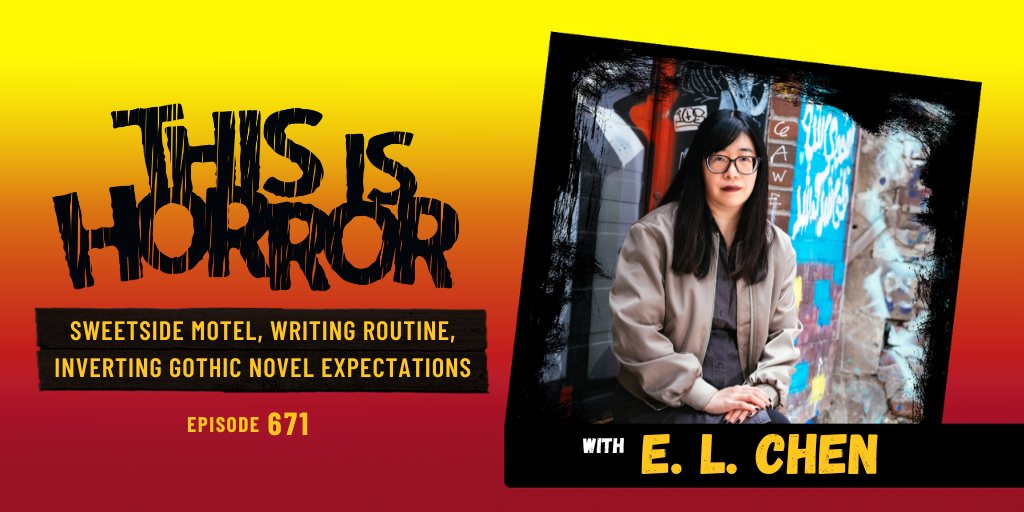
In this podcast, E. L. Chen talks about Sweetside Motel, writing routine, inverting gothic novel expectations, and much more.
About E. L. Chen
E. L. Chen is the USA TODAY bestselling author of Sweetside Motel, Slasher Summer, and One of Us Is Already Dead. Her YA fantasy Summerwood/Winterwood was longlisted for the Sunburst and recommended as a Best Book for Kids and Teens by the Canadian Children’s Book Centre, and her short fiction has appeared in venues such as Strange Horizons, On Spec, and The Dark. She lives in Toronto, Canada with her son and a towering TBR pile.
Timestamps
Thanks for Listening!
Help out the show:
- Support This Is Horror on Patreon
- Listen to This Is Horror Podcast on Apple
- Listen to This Is Horror Podcast on Spotify
- Rate and review the This Is Horror Podcast on Apple Podcasts
- Share the episode on Facebook and X
- Subscribe to This Is Horror podcast RSS Feed
Let us know how you enjoyed this episode:
- Write a comment below.
- Follow us and get in touch on Instagram @thisishorrorpodcast
- Subscribe and comment on YouTube @thisishorrorpodcast
- Follow us and get in touch on TikTok @thisishorrorpodcast
- Tweet us @thisishorror.
Resources
- E. L. Chen
- Watch the video version of This Is Horror Podcast episodes, including our conversation with Chuck Palahniuk on YouTube.
House of Bad Memories by Michael David Wilson
From the author of The Girl in the Video comes a darkly comic thriller with an edge-of-your-seat climax.
Denny just wants to be the world’s best dad to his baby daughter, but things get messy when he starts hallucinating his estranged abusive stepfather, Frank. Then Frank winds up dead and Denny is held hostage by his junkie half-sister who demands he uncovers the cause of her father’s death.
Will Denny defeat his demons or be perpetually tortured for refusing to answer impossible questions?
House of Bad Memories is Funny Games meets This Is England with a Rosemary’s Baby under-taste.
Buy House of Bad Memories from Cemetery Gates Media
Buy the House of Bad Memories audiobook
They’re Watching by Michael David Wilson and Bob Pastorella
From the hosts of This Is Horror Podcast comes a dark thriller of obsession, paranoia, and voyeurism.
After relocating to a small coastal town, Brian discovers a hole that gazes into his neighbour’s bedroom. Every night she dances and he peeps. Same song, same time, same wild and mesmerising dance. But soon Brian suspects he’s not the only one watching and she’s not the only one being watched.
They’re Watching is The Wicker Man meets Body Double with a splash of Suspiria.
Buy They’re Watching in paperback and eBook right now.
Michael David Wilson 0:28
Welcome to This Is Horror, a podcast for readers, writers, and creators. I'm Michael David Wilson, and every episode I piat with the world's best writers about writing, life lessons, creativity, and much more. Today I am piating with E. L. T. N. and E. L. T. N. is the USA Today best-selling author of Sweetside Motel. Motel slasher summer, and one of us is already dead, as well as various short stories. She lives in Toronto, Canada, with her son and a towering T B R pile, and as with a lot of these, this is a two-parter. This is the first time that I have spoken to El Keen, so a lot of this first chat is getting to know her, getting to find out about those early life lessons and her writing start, and then the second part, which we'll be bringing you next time, we get a lot deeper into her fantastic new book, Slasher Summer. So we will get to that imminently, but beforehand, a quick advert break.
Bob Pastorella 1:51
House of Bad Memories, the debut novel from Michael David Wilson, is out now via Cemetery Gates Media. Denny just wants to be the world's best dad to his baby daughter, but things get messy when he starts hallucinating his estranged, abusive stepfather Frank. Then Frank winds up dead, and Denny is held hostage by his junky half sister, who demands he uncovers the cause of her father's death. Will Denny defeat his demons, or be perpetually tortured for refusing to answer impossible questions? Clay McCloud Chapman says, "House of Bad Memories hit so hard you'll spit teeth out once you're done reading it. House of Bad Memories by Michael David Wilson available now in paperback, ebook, and audio. From the host of this Isorra podcast comes a dark driller of obsession, paranoia, and voyeurism. After relocating to a small coastal town, Brian discovers a hole that gazes into his neighbor's bedroom. Every night, she dances and he peeps. Same song, same time, same wild and mesmerizing dance. But soon, Brian suspects he's not the only one watching, and she's not the only one being watched. Their watching is The Wicker Man meets Body Double with a Splash of Suspiria. Their Watching by Michael David Wilson and Bob Pastorella is available from This Is Horror.co.uk, Amazon, and wherever good books are sold.
Michael David Wilson 3:13
Okay, with that said, here it is. It is E L Chen on This Is Horror. Elaine, welcome to This Is Horror.
E. L. Chen 3:27
Oh, thank you so much for having me. This is really great.
Michael David Wilson 3:31
Yeah, to begin with, I want to know what were some of the early life lessons that you learned growing up.
E. L. Chen 3:40
Okay. so the story has two parts to it. So the first part is when I was about four years old, I went to Disney World in Florida with my parents and my sister. You know, we were around the the Magic Kingdom, and there was you know a person dressed in a Tigger costume. You know, and I was I was only only four years old, but I knew that it was actually a person inside a costume. And you know, Tigger has that you know the corkscrew tail that sticks out in the back. And so I was really fascinated by this costume. I was wondering, like, how how did they make that tail stick out like that? Like, how is it made? Is you know is a wire going through the tail is it you know is it hollow and it just has fabric around it so I reached out to try to touch it and then the person in the sticker suit before I could touch it turned around and started messing up my hair and I was so upset because I was so close to touching that tail and trying to you know figuring out how it was made, and my dad actually took photos. So there's actually like before and after shots of me reaching out to try to you know touch Tigger. But for years afterward, my family was like, "Remember that time we went to Disney World and Elaine tried to pull Tigger's tail? Oh. He was so mad when he caught you, and it's like, no, no, that's not what happened. I was not trying to pull his tail. I just wanted to know how it was made, and that was a very early life lesson on how people will willfully misunderstand you because of their preconceived notions of who you are, right? Because I was, you know, I was just a little girl, right? I was four years old. Of course, you know, of course, I just want to pull you know those characters' tail. Yeah, and that was so. That's the first part of the story. The second part is you know some years later, I was in my 20s, and I brought this. You know, I brought up the story with my mom. It's like, hey, remember that time everyone thought I was trying to pull Tigger's tail? You know, I wasn't actually trying to pull it. I just wanted to know how it was made, and my mom had absolutely no recollection of that event, and that was just like another another lesson on how, you know, very often the people who are responsible for your villain origin story have absolutely no idea. Like they have no idea of the consequences of their actions. To them, it was just you know a fleeting moment. But to you, it was something that affected you for you know the rest of your life. And you know, I mean, so many of us were motivated by you know spite or revenge, or we want to prove ourselves or valid or get validation from people, but you know the truth is is that you know people they just don't care. I mean, it's not, or it's not that they don't really care, but it just did not. You know, these kinds of moments, these life altering moments for you are often you know they're not the same on on the flip side to the people who perpetuated them, you know, which sounds kind of depressing. But at the same time, it's it's also it's also very freeing, right? To to realize that you know anything you do, you really should be doing it for yourself and not because you want to prove yourself to somebody else because that, you know, honestly, that person really doesn't care. Anyway, those are my those are my youthful life lessons. Maybe, perhaps a little bit depressing, but I think that you know that they are very truthful.
Michael David Wilson 7:18
Yeah, that's a crazy thing to learn at four years old as well, and you know I wonder as well. Did that then taint the whole experience of being at Disney? Because you never figured out, you know, how this tale was put together. Did you then go looking for Tigger after, or was that the end of it?
E. L. Chen 7:44
No, I think that was just the end of it. Oh yeah, I still don't know how that tail was made. So if anyone listening to the podcast knows how Tigger's tail is made, please, please let me know because I'm really really curious. It's
Michael David Wilson 7:56
got got to be someone out there with that information, and I mean, knowing that you should only do things for yourself-did that shape, you know, your life kind of going forward? Would you say that that was a pivotal moment at 20, or do you think even kind of having that happen so early in your childhood shaped that lesson and the conversation at 20 just solidified
E. L. Chen 8:28
it. Well, I think the conversation at 20 it was-I wouldn't say it was like you know some some sort of like super impactful thing. I think you know leading up to that, it wasn't. You know, I I don't think I've ever been really motivated by what other people think, or you know what people have said to me in the past. You know, I always have just done things because I want to do them. But it was a very you know it was a very good lesson because going forward, you know, whenever, you know, whenever I had moments of, you know, someone telling me, you know, you know, whenever I've had moments in in which, you know, I've thought, well, you know, I'll show them, you know, then I've kind of you know paused a moment and realized, no, actually, you know that really doesn't matter. You know, no matter what I do, I don't think it's not necessarily going to change this person's mind. And in fact, you know that incident has probably just you know flown clear out of their mind, and is not you know is not as consequential to them as it is to me. As for the incident, I guess when I was four years old and realizing that people saw me in a certain way because of you know their preconceived notions of who I was, I think that's something that has stuck with me for the rest of the whole. Pretty much my whole life, right? I think a lot of my books deal with identity, especially lately. I think my earlier my earlier books, my YA fantasy, were more sort of you know coming of age stories and dealing with sort of you know ethnic identity. But now that I'm older, I find myself asking the question of you know who who really gets to be themselves, right? Who who gets to be themselves, and who has to mask, who has to you know bend themselves into different shapes because of the expectations of how they should behave. I mean, especially you know, looking like this for people who can't see the video. You know, I am a middle-aged East Asian woman. You have long black hair and and glasses. You know, I'm from Toronto, Canada, and Canada. Toronto is a you know it's a very large, very multicultural city. So the experience I have, as a second generation Chinese Canadian, you know, it's going to be very different from someone who grew up in a small town. So, you know, because I was always surrounded by other Asians, but at the same time, you still get the same sort of stereotypes applied to you because you are, you know, one of 1000s of people, and so I think that's always something that, you know, I very, you know, I, you know, I've struggled with, you know, how to get people to, you know, see beyond the stereotypes and their, yeah, their idea of what you know, an Asian girl with glasses is really like. I think that answers the question.
Michael David Wilson 11:47
Yeah, and was there a moment during your childhood where you realized, you know, you you had to deal with these stereotypes, and what did you do as a result of that?
E. L. Chen 12:04
I think because you know, again, being very young, so I was the you know I was the I was the special kid because I had I had skipped a grade, and I was in the gifted program, and I got into the fancy private school. And so, I think at a very young age, when I was in in grade school, I did have the reputation as being, you know, the smart kid. When you know, the smart, you know, nerdy kid, and you know, especially you know, being Asian on top of that, that really sort of compounds that reputation, and it's you know, it's it wasn't really an identity that that I enjoyed because everyone always looks at you as well. You know, Ellen's the smart kid, you know, she should know this. She's the smart one, and and so to combat that, I mean, I guess it's not very obvious from the video, but you know, I've got multiple ear piercings. I've got a nose piercing. I've got tattoos. Oh, I guess you can't really see them there. You know, I think I was always trying to do little things to try to make people look at me twice and not discount me as just being oh another you know quiet reserved Asian girl with glasses.
Michael David Wilson 13:39
I love that you you had to kind of put ascetic signposts for people too. It's like, look, we're gonna challenge your expectations right off the bat, and I mean that is something that you particularly do in Slasher Summer, which we'll definitely get into shortly. But I mean beforehand, I want to know what were the first stories that you were reading, and what were the first movies. I know to begin with that, with your writing career, you were writing more in the YA fantasy genre. So I'm wondering if horror has always been a concern, or if that came about a bit later,
E. L. Chen 14:22
horror has. I guess it's always been sort of in the background. I guess I have to, you know, rewind a little bit. You know, I've I guess I've always been drawn to you know the spooky and the macabre. As a kid, I read I read pretty much everything. I read a lot of Nancy Drew, you know the usual sort of you know middle grade and you know middle grade classics: Beverly Clearly, Cleary Brian Dahl, Judy Bloom, etc. But when I got older, so I'm so I'm a child of the '80s, and. You know, YA as a category was not you know the robust category that it is now. So you know, I turned you know 11 or 12, and there wasn't really anything for me to read. Anything anything YA was like you know a teen romance like Sweet Valley High, and so from there, I fell into fantasy. So that's really how I started. How I ended up reading fantasy, you know, like like fat and epic fantasy. You know, like David Eddings, Robert Jordan, Mercedes Lackey, and you know, I did read Stephen King, I guess, when I was you know 12, just like like everyone else, but you know, from there I ended up going into fantasy, and so you know, reading so much of that, I think that's sort of how I ended up, you know, that's how I ended up wanting to write. I mean, when I was young, I always sort of wanted to be a writer, but because I was reading these, you know, fat fantasy books, you know, I really wanted to write more of the same, and so in my early 20s, that was the kind of work that I was interested in writing. But I suppose as I progressed further through my writing career, I've kind of been writing on and off for I guess for the past 20 years, you know, sold a handful of short stories to magazines, you know, mostly you know science fiction and fantasy. I started to suspect that you know I may actually be a horror writer because the subject matter, especially the subject matter of my my YA novels, even though they are sort of YA coming of age stories, there are dark elements to them. The Good Brother deals with ghosts, and Summerwood, Winterwood is sort of like my very dark take on Narnia, and there are kind of you know very sort of visceral, spooky moments in that, and so I started to suspect that. Oh, actually, maybe I'm I'm a horror writer. The other thing too with you know fantasy, as much as I you know loved fantasy when I was younger, you know a lot of fantasy, a lot of secondary world fantasy requires really robust world building, right? I feel like every fantasy writer I know has a PhD in you know medieval history or some like really arcane period of history, and I realized that I am a very lazy, lazy world builder. You know, I was never, I was never very interested in history when I was a kid. It's not something that I nerd out about, and I think most of my settings tend to be very contemporary. So I thought. Oh, actually, I think maybe maybe I'm actually a horror writer, and so I did try to write some horror short stories. I guess maybe like 12, 1215, years ago, and you know, yeah, and I and I you know I failed. I couldn't place them anywhere, and I felt like I felt like I hadn't, you know, I hadn't cracked the code yet as to like what makes a horror story. And it wasn't until I took a course with Gemma Files, yeah, Gemma Files, the you know brilliant Canadian horror writer who wrote experimental film. I took a course with her called "Write What You Fear, and I realized that I had been trying to write what I thought other people would find scary instead of writing what I found scary.
E. L. Chen 18:32
And as soon as I realized that, as soon as I realized that, I had to mine my own fears and anxieties to write horror. I think that's when you know the light bulb moment went off, and I was you know from there was off to the races. That's when I wrote Sweetside Motel, which is my my gothic novella, and then that led to One of Us Is Already Dead and Slasher Summer, and yeah, and then here we are.
Michael David Wilson 18:55
Yeah, so the course with Gemma Files, I mean, it kind of just tied back into your early life lesson, anyway, about embracing yourself, being true to yourself, and ultimately being authentic. I suppose which which is a word that gets bandied around a lot, but I mean, it it is true, and I guess too, if we can't scare ourselves, then how are we going to scare the reader? And I'm I'm so glad that you discovered that.
E. L. Chen 19:29
Yeah, I think once I realized, like, I'm not, I really should be writing for myself first.
Michael David Wilson 19:34
Yeah,
E. L. Chen 19:34
yeah, and not thinking about readers at all.
Michael David Wilson 19:37
Yeah, yeah, and I wonder too. I mean, how encouraging or or discouraging were your parents in terms of your creativity?
E. L. Chen 19:49
No, they they're they're pretty supportive. They're almost too supportive. Like I said, you know, I was the. I was a special kid. I was the baby of the family. Actually, I still am of this generation. You know, and and I have all these you know achievements that look look great on paper. If you're of a if you're Chinese Canadian of a certain generation from Toronto, you know, I was I was probably the kid that your parents compared you to, and I'm really really sorry about that. So I mean, yeah, like they've always been been very supportive, you know, to to a certain extent, right? I mean, I think if I had told them when I was younger, you know, I want to be to write, be an author when I grow up, they would have been like, no, you know, you need you need a real job, you know. Is that something that you do on the side? And you know, even now, like I've got, you know, I do have a day job. You know, I have no plans to to quit that day job, just because I know how precarious you know the life of an author can be. And yeah, I mean, I don't, I'm not sure what else I can say about that, but yeah, no, I have been lucky that they they have been supportive.
Michael David Wilson 21:07
Yeah, and speaking about having a day job, I mean, I want to know what does your writing routine look like? Because I know you have a day job, you have a son, you have your writing. How do all of the puzzle pieces of your life fit together?
E. L. Chen 21:27
Yeah. So, so the secret is that I have no life, and my home is a mess. So, so pretty much, I try to squeeze writing in wherever I can. So usually it's like in the mornings before work. I go into the office now four days a week, but I take the subway. So I will write on my phone during my commute. You know, I will at my lunch hour. I will write during my lunch hour, and again going home, I'll you know write or read some more going home, and then yeah, and then the evenings, weekends. I do. I am someone who does write every day. I mean, I don't think everyone has to, but that's just how it's kind of worked out for me. It it has turned out into it has turned into a regular habit, and what I actually have done is I've I've used my Google Calendar and I actually do put in everything that I need to do during the week, including showering. You know, things like cooking dinner and showering and going to the grocery store, and so that way I can actually identify, you know, where where are the spare hours that I can use for writing? So that's that's how I manage it all. And I should also point out too that, you know, so I am a single parent. You know, I have my son, and I am the primary caregiver. You know, it would be a totally different story if, you know, if I shared custody 5050 with his dad, like oh my god, like that's so much. I would have so much free time. But on the other hand, I think having so little free time has forced me to become so much more deliberate and intentional with my spare time. So I think that's that's really helped a lot in terms of in terms of you know helping me develop this regular habit.
Michael David Wilson 23:28
And it sounds like you can basically adapt to any environment to write. You will write whenever the need arises, you know, out of necessity, really. And I mean, I I imagine perhaps what you're writing or how you're writing is going to differ if you're writing something on your commute as opposed to if you're at home and you've got like a a longer window of time. So, are you writing different things depending on the environment, or are you writing in a different way?
E. L. Chen 24:06
No, I wouldn't say I'm writing in a different way. I find that drafting, just like working on a draft, like a first draft, is the easiest thing to squeeze in here and there, because that's something you know you can sit down for like 20 minutes and just you know word vomit whatever you need to and just think oh future me will take care of that later, and yeah, and at home see at home at home I will get larger stretches of time but at the same time things are much more distracting because you know my kid will be home, and I you know we we live in a two bedroom condo because we we live in Toronto and real estate is like super expensive, so so it's a very small home. It's not like I'm you know in my basement office and you know he's upstairs or and all that. I I have so much envy for people. Who have like you know office sheds in their backyard? It's like that would yeah you know I'm I'm at you know various close quarters with my kid so you know I can hear everything that he's doing, which is mostly playing video games and yelling at the TV, and but I think I've just sort of after a while I've just sort of learned how to tune that out, and so for drafting, yeah, it's it's. I think I've trained myself also with drafting to not really be precious about what I'm writing. You know, it really is just word vomit. Get it out. I will fix it later. You know, the challenge is the challenging part for me. I find is revision because that I do need longer stretches of time and the ability to focus because I think it does use a different part of my brain that gets more. I think that's when you get more left brained as opposed to right brains, like a lot more sort of analytical, and that's when you're looking at craft. You're looking about how everything fits together, and that does require a lot, you know, larger stretches of time. You know, a bit more quiet, bit more focus. But I mean, I just, you know, I just try to do what I can with what I have.
Michael David Wilson 26:14
Yeah, I relate to that completely because, I mean, if I'm commuting, then I can easily plan or first draft or do something where I know it's going to be rough around the edges. But if it's revising or editing mode, then and I can't really do that on a commute. I mean, first of all, if I'm commuting particularly on on the subway, then well, I've not I've not got my laptop out. I'm probably you know jotting it down or writing something into my phone. But for proper editorial things, I obviously need the computer. So most of that is at home, or if I've taken the computer into work, then that can be done in downtime then as well.
E. L. Chen 27:01
Oh no! I've just gotten really used to working on my phone and that small on that small screen. I should add too, with my commute, I intentionally get up a little earlier to get on the subway before rush hour hits, so it is pretty quiet, and I'm not you know crowded in with people. So,
Michael David Wilson 27:20
so then if you're intentionally up early, does that mean that there's also like a little gap between ending your commute and having to start work, where you can, I don't know, write write somewhere else or write at the day job? I'm I'm not sure of the nature of the day job, but maybe they'd be like, no, you're you're out of a job if you do that.
E. L. Chen 27:43
I think they'd be okay with me, you know, you know, writing during my lunch break. But usually, what happens is I go into the office, you know, early, but then I'll leave like a little bit earlier again to avoid rush hour, you know, and then I'll, you know, I'll log in at home and work for like another hour or so, but yeah, that's that's just how I manage it. My day job, by the way, is I'm a web designer, so it's the work is where I work is because I'm like in house at a large company, so it's a little less stressful than if I was working at an agency and had you know had to meet crazy deadlines and had clients and such. So it's you know the pace is I guess a bit more relaxed than than agency work. So it is easier for me to sort of fit writing around that.
Michael David Wilson 28:38
Suddenly reading about the history of your website makes more sense now because, as I'm sure you can anticipate, yeah, I try and find out as much as I can about my guest before talking. But on your website, there is a bit literally talking about how it started off as a GeoCities website. Yeah, I, I don't, I'm not sure how I'm going to really use that information for a conversation on a horror fiction podcast. Although it's it's turned up now that there's not going to be a lot about it or why you chose Geo Cities over I don't know Angel Fire, but there it is.
E. L. Chen 29:22
Yeah, it was just the time. I'm. I mean, yeah, that website elainchen.com because I'll plug it now. I've had that site for a long time, for over 20 years. I think was when the internet started up because you know when I graduated when I graduated university, I actually went to art school. I have a bachelor of fine art, and I just sort of fell into web design because at that time, the late late 90s, right? That's the the time of like the dot coms when you know the internet started becoming more and more of like an everyday thing, and so yeah. Like my website alainechain.com has had this really. There have been so many different versions of it. You know, it's it's changed and I guess evolved over time depending on where where I've been and you know my stage in life. You know, at the beginning it was just a you know it was like a portfolio site to show some of my artwork, and then as I started you know working more with web design, then you know, started showing more of my web design work. But now, now that I've been working as a designer for over 20 years, and then like a lot of the work I do is NDA. It's like I can't really. There's no point in having a portfolio site anymore because anything I can show is like you know 10 years old and very out of date. And I think if I were to get if I were to get another job, I probably you know hope I have enough contacts in the industry that you know I wouldn't have to you know go in and you know show portfolio that people should know should know that I'm you know reliable that I'm a good designer that I can do all the things I say I can do, and so so yeah. So now this is the first time my website has been dedicated solely to my writing, to my to my writing alter ego. So it's it's been been quite a journey.
Michael David Wilson 31:16
Yeah, and it makes sense, really. You know, putting that as the focus because this year, in terms of your fiction, it has absolutely exploded. Because in March you released Sweet Side Motel, now we've just had Slasher Summer come out, and then I think early next year you've got One of Us is already dead. So I, I'm. I'm wondering. I mean, to have such close releases-is this by design? Is this by happy coincidence? How has it all come together?
E. L. Chen 31:54
Yeah, it's just been it's just been a coincidence. I mean, I think yeah, this year this year has just been kind of wild, but it's it's the work of about five years just all of a sudden you know coming to a head. So I I got my agent about three years ago, and I queried her with one of us that's already dead. And actually, the day that I signed with my agent is the day that I got the acceptance for Sweetside Motel. It was it was just quite unlike what what is happening. It was just one of those moments. So I actually did sell Sweetside Motel long before Slasher Summer, and one of us is already dead. And just because you know it's put out by small press and just seller side press, and so their you know their publishing schedules you know it takes a bit longer because they are so small they they are pretty much like a one person outfit, yeah. And then with slasher summer and one of us is already dead. I think I was I was already on sub with one of us is already dead when when my agent, you know, suggested, "Hey, why don't you? Why don't you try writing a slasher? Just because I touched on Final Girl mythology and one of us is already dead, and that I think that that contract was kind of a was kind of a surprise, and I yeah oh yeah, I sold that before one of us, and I think that I think that publisher just wanted to you know put it out very quickly, you know, to try to you know market it for summer wean, and then yeah, and then I guess shortly after that's when I, I, you know, I got the deal for one of us is already dead, and and actually one of us was originally supposed to come out in the fall of this year, but they they ended up changing it, so it was pushed out just a little bit later, just to give you know both books some breathing room, but it has been yeah this this year has just been been quite a trip. It's been quite wild.
Michael David Wilson 34:11
Yeah, I mean it feels maybe for your own sanity that it's good that they push the release date you know thought back a little bit because otherwise you'd have accidentally created this pattern where you're releasing a new book every three months, and I'm not sure if that is sustainable. I don't know how big your back catalog is. Maybe it is sustainable for a while.
E. L. Chen 34:36
No, not sustainable at all. And the thing is, like, I've actually been quite surprised about how much promotion that I have been doing for slasher summer this this past month. I guess in June there was quite a lot of it. You know, I just didn't expect to get so many opportunities, which was which was kind of fun. Because I had also agreed to my my contract with with Orbit with Orbit Run for it was actually for two books and I and I foolishly agreed to deliver a draft of a new book also in June and so I was juggling that on top of all these promotional opportunities so it has been it has been quite interesting, and at least I know now that yeah that promotion actually does suck up quite a lot of your time.
Michael David Wilson 35:31
Oh yeah, yeah. There's too many things really for the writer to have to do. Gone are the days where the writer just wrote. That that's. often 50% of the of the job, or if you're Jason Pardian, it seems to be about 20% of the job. But that he's an outlier. I don't necessarily recommend people take that route, even though it's worked enormously well for him and. I mean to go back to getting your literary agent. I know a lot of people who listen and who watch this as horror. Like they're also interested in the kind of literary agent journey and perhaps acquiring one for themselves. So, what did that process look like, and why and how did you decide to go with the agent you ultimately landed?
E. L. Chen 36:30
Yeah. So, so what happened was so during the pandemic, you know, I wrote Sweet Site Motel, and then I wrote one of us is already dead, and I thought, okay, I'm gonna I'm gonna query with one of us that's already dead. And there was an agent that at the time seems like you know the ideal agent for me because they they represented both adult, adult and YA. Because I thought you know I'd still be writing YA, so I submitted to them, and I just found you know randomly found two other Asians that seemed good. They were open to queries, and I you know sent off you know my manuscript, and you know I think awaited maybe like four to six months. I think I heard back from one from one person. It was a rejection, but the thing I realized is that the manuscript, the original manuscript I sent out, was over 100,000 words. It was like 108,000 words, and I realized that you know these days 100k you know, I think a lot of agents kind of balk at you know a really high word count. So I thought, okay, I better cut down that word count. I cut it down to maybe like 95 the 95k and then I decided that I really needed to be a lot more intentional and methodical with my agent search. So that's when you know I signed up for Query Tracker. I also made a spreadsheet. Basically, I basically use Query Tracker to filter. I think every agent that was open to queries and was interested in horror. You know, put that all in the spreadsheet, and I researched every single one of them. You know, I looked at their manuscript wish lists. I put notes in the spreadsheet about like what they were looking for. You know, checked out their their agency websites, and eventually I narrowed down I narrowed it down to about six people, just because a writer friends of mine have had told me to they told me to do five to do five queries at a time. You know, just in case someone gets back to you with some feedback, then you can implement it. I work a lot on the Pop Tips subreddit, and a lot of people on there are like, no, agents take you know they take like months and months to get back to you. Just like query everyone at once, send out 100 queries at once, and that's like I find that you know quite shocking. But I mean, you know, they do have a point that, you know, I think these days agents are so you know they're so swamped that I don't think you're going to get a lot of personal feedback. But on the other hand, I think you shouldn't shoot your shot all at once because you know, like me, I realized that my manuscript, the word camp, was probably way too long, and it will probably just you know be like an instant rejection for a lot of people. But anyway, so I so I had my my short list of names in my spreadsheet of people I wanted to query, and yeah, and I just sent out my query to these people. I got full requests from two agents. Actually, I got requests for for two calls from them, which was really great. And they were both, you know, both agents were were really fabulous. But my well, the agent that I went with, Dorian, Dorian Mafee from Kimberly Cameron, we just had like a really really good conversation. About you know about horror literature and the kind of you know the kind of the kind of writing I would want to do and the kind of books I like to read and I just felt like that we were on the same page on a lot of things and it also helped that I had a writer friend who was also represented by the same agency so that kind of like tips things in her favor, and yeah, so I ended up going with Dorian, and I was yeah, I was like super super lucky.
E. L. Chen 40:27
You know, it made me realize that you know querying you know this whole journey is you know it is I think 50% writing a strong book, a strong you know marketable saleable book, but the other 50 cent is just like pure dumb luck, right? I I I shudder to think about how you know if Dorian hadn't been open to queries at that moment, or if for some reason I decided to not put her on that short list of you know initial people that I wanted to query, that we would have missed each other, so I mean, I don't know if that's particularly helpful to your listeners, but yeah, I mean, it's fortunately or unfortunately, yeah, a lot of it is just really the luck of timing.
Michael David Wilson 41:17
Yeah, and I certainly am more in your camp with query engagements about kind of five or six at a time rather than the let's query 100 I mean, you know, for for the reasons that you mention in terms of if you get feedback, but also for logistical reasons, like what am I gonna just dedicate months of my life to sending out queries? Does that now become my full-time job? On, I guess above that too. Just it's it's quality rather than quantity. My idea is that if I actually hone in on five who I think would be potentially a good fit for me. Then I'm far more likely to get something positive back.
E. L. Chen 42:09
Yeah, and well, the other thing too is that you know, like if you get an author representation, right, you need to like nudge everyone else that you've queried and let them know. And it's like even with you know the six people that I had that I had queried, even just sending out those other you know when when Doria made her offer, just like even just sending out those like five other emails, like that that took a lot of time. That was very time consuming. So I can't imagine if someone does that for like 50 or 100 people if you're lucky enough to get an offer. But anyway, and yeah, and like I said, I mean, you know, as writers, you know, we should always be, you know, growing and you know working on our craft, and so maybe like six months down the line, you might suddenly realize, wait a minute, you know, that novel I sent out has these like structural flaws, but now it's, you know, now it's too late to change them, or now I have to withdraw like my 100 queries to fix this, and then send them all out again. So, so yeah. So I think my advice would be, you know, start small. You don't have to, yeah, you don't have to blanket query so many agents at once.
Michael David Wilson 43:15
Yeah, and and now that you've been submitting and publishing horror and adult fiction. Do you think is the YA chapter behind you, or is that something you'd like to continue doing as well?
E. L. Chen 43:33
I think it's. I'd still like to write YA. I actually did. I actually did have a few ideas for YA horror novels that I've talked I've talked to my agent about it, but I think at the moment that these these are probably on hold for a bit just because I think my publishing schedule won't allow for it. But yeah, no, I do I do have some ideas, but it is it has been very interesting reading because I guess I've been out of the YA space for I guess the past you know five years or so, so getting sort of caught up with what's being published now, you know, it has been very interesting to read sort of what's out there and realizing that you know with YA novels, I think it does you know it does require, I think, a different skill set just because the stories and the emotions and everything is just sort of dialed up to 11, just in terms of like the feelings and the stakes, and that you know that that that you know sensation that everything's a matter of life and death. I guess all the things that I loved as you know the teenager reading you know fantasy, right? It's and so I think it would be, you know, it would be a wonderful challenge to go back to YA one day and you know write these ideas that I have. But you know, for now, it's humble.
Michael David Wilson 44:55
Well, I mean, there's certainly enough to keep you and your readers. Busy until then, and you mentioned writing, I think, Suite Side Motel and the forthcoming novel from Orbit, both during the pandemic. But with Suite Side Motel, it wasn't just written during it, but it was set during the pandemic. So you were writing it while you were in it. So what did that process look like?
E. L. Chen 45:31
So that was so writing that was very interesting because it was it was actually an idea it had for a while the idea of a woman being stranded somewhere with two brothers who tell her conflicting things about each other, but I could never, I could never come up with a good excuse for stranding her, just because these days, I mean, with cell phones, you know, everyone's connected. Like, there's no reason why, like she can't just call an Uber and get out of there, right? And so when the pandemic happened, it's like, oh, now I've got a really good reason to stick her somewhere to trap her in this situation. And and actually, when I was writing the book again during the pandemic, I actually didn't name the pandemic. I just sort of alluded to a sort of general pandemic that you know that was happening at the moment because you know because because at that at that time writing about COVID just seemed I don't know. I was worried about things getting too dated, or but at the same time too hasty, right? It's like when you pick up a novel and it refers to events that just happened, you know, a couple years ago. You know, that's that's always kind of jarring, and so I actually didn't name it COVID, even though you know, kind of the rules were the same, right? You know, be quarantining for two, quarantining for two months, you know, six feet of distance. You know, this is sort of a, you know, a vocabulary that sort of everyone knows now. And so I had intentionally done that. However, though, when the novella finally went to publication, you know, talking with my editor, she thought that it would be good for me to name that it was happening during COVID times, just so people wouldn't get confused. So that's how that's how it all came about.
Michael David Wilson 47:30
And given that you originally didn't name COVID and then you put COVID in, did you then have to retroactively go back and make sure that parts of the story were consistent with the pandemic, or did you give yourself creative license? So it's like, well, this is Elaine's version of COVID. This isn't necessarily a historical document.
E. L. Chen 47:56
Yeah, it was sort of because it is set during winter, and I remember everything shutting down in March, and so it was sort of this this panicky. Oh wait a minute, do I have my timing right? You know, by by you know November, December, you know next January. Did we have a did we have a vaccine by then? It's like no, okay, phew, we didn't have a vaccine by then. We were still kind of in the throes of you know being in lockdown, and I guess the other thing I had to I had to sort of really work in is the you know the town the town's very strict attitude toward lockdown and quarantine. I really had to sort of give them a really good motivation for for doing that, just because I didn't want to get, I didn't want anyone to get the idea that this is what it was like in Canada during the pandemic. That you know we had this, you know we had people reinforcing quarantines by boarding them into houses. I didn't want anyone to think that. I just wanted to had to make sure that you know this is just like this one-off, very paranoid small town that has been affected by COVID, and so you know their you know their local their local police enforcement is you know extremely strict about about quarantine about enforcing it.
Michael David Wilson 49:15
And you'd mentioned that initially you were reluctant because of it being so close, so of the moment, but I think right now, particularly after Kylie Lee Baker's Bat Eater and other names for Korra Zen, there seems to be more of an acceptance or just an embracing of, I suppose, COVID horror novels. So I think the world, fortunately, is is ready for them. And has that been the case for you with Sweet Side Motel, or have you had any pushback at all?
E. L. Chen 49:55
I know I know of, but I mean Kylie Baker's book, Kylie Lee Baker's book, you. Is one of the reasons why I figured, okay, I guess I can name it, just because I think people are now sort of looking back at that time. It is for a lot of people, it is in the rearview rearview mirror, and you know, like Tyler Lee Baker, you know, the book does process sort of the anti Asian racism at that time. So I think it is sort of a conversation that people are. It's a conversation that people are ready to hear that they're ready to have.
Michael David Wilson 50:27
Yeah, and I mean as well in terms of inverting expectations, which you do enormously in Slash your summer. You've done it here as well because in a gothic novel, which this is, a lot of people expect that Baroque Victorian manor house, but you've put it in a kind of rundown motel. So, talk us through that.
E. L. Chen 50:57
Yeah, so that was that was kind of the challenge I set for myself, in that yeah, because normally in a gothic, you know, we think of you know Victorian setting, the you know the the damask wallpaper, the ornate furniture, and the candlesticks and whatnot. But and for me, the challenge was I wanted to try to make you know stuff from like the 70s and 80s kind of spooky. So there is you know this sort of you know mom and pop motel, and then later she ends up at the brothers, having to go to the brothers' house, and you know the the the inside is you know the outside is you know this big sort of manor, but the inside it's you know again, it's like you know decor from the 70s and 80s, a lot of linoleum, a lot of you know doilies and plastic sheeting on the furniture, that kind of thing. I think I just wanted to do something something a little bit different that was not not the usual sort of you know tropes of you know Victorian Gothic, and the other thing too, because the character is you know second generation young woman Chinese Canadian from Toronto who's very used to you know growing up in a house with you know IKEA furniture right and stuff that that's very modern, and so to her, this sort of you know stuff that's maybe only a generation or too old to her, that's very strange and unsettling. And that was actually kind of inspired by you know a friend of mine who moved during the pandemic, she moved to Nova Scotia, and I just remember in like you know our friend group chat, she mentioned something about having she had a grandfather clock and a bunch of documents that like her grandfather or great grandfather owned, and to me that was just like that just blew my mind that she had all these artifacts from generations ago from her family because you know my own family. You know my parents. You know they came from Hong Kong. You know, and also you know Hong Kong. It's very you know Hong Kong is very urban, very modern. It's not you know it's not some. I guess when people think you know, I think you know an immigrant, they think oh they were living in some you know rustic village, you know in the Chinese countryside. It's like no, like Hong Kong. It's you know it's it's extremely urban. It's very urban, very modern. And so like I don't have these kinds of reminders of the you know I never grew up with these sort of these kinds of reminders of the past. And to me, that's just very you know those sort of artifacts, or the idea of those artifacts. You know, it's very strange. It's very strange and foreign to me.
Michael David Wilson 53:46
So, I mean, speaking about being second generation Chinese American, what are some of, I suppose, the unique challenges or the misconceptions that people might have.
E. L. Chen 54:02
So I think the biggest one is that the you know the Chinese diaspora. I never know if I'm pronouncing that right because it's one of those words that you always read, but you never know. You never say it out loud. Diaspora. You know the Chinese diaspora. You know the Asian diaspora. Like it's it's not it's not a monolith, right? Like I'm you know I'm you know second generation Chinese Canadian from Toronto, so is so is I Jiang, right? The writer I Jiang, but our experiences are are completely different. You know, I think I'm, you know, I'm a bit older than her. My parents are from Hong Kong. You know, her family's from China. I think she came over when she was when she was a child. And so, what I know is like completely different from what she knows. Even the language is different. You know, my parents they speak Cantonese. You know, you know her family. She probably speaks Mandarin, and and the other thing too is that I actually don't speak any Cantonese, which is actually kind of a rarity. Like when I was growing up, everyone else I knew who was second generation they could speak the language, but for some reason it just you know it passed me over. My parents think it's because because I'm the youngest. I have an older sister, and I think when you know when when my when it was just my sister, my parents would speak Cantonese to her. But then when I was born, she would speak English to me. So I sort of missed out on learning the language, and so I guess what people have to to realize is that you know everyone you know the Chinese immigrant experience is going to be like it's it's very different for for everyone, and it isn't always it isn't always the sort of typical you know narrative of you know wanting to make a better life. You know coming from you know the you know poor family, you know from the old country, wanting to make a better life. I mean, my parents did come to Canada because there were more opportunities. But like I said, you know, they're from Hong Kong. You know, they're from like middle class families. The other kind of unusual thing about them is that they they actually met in Toronto. You know, they both came out over separately. I think my dad just came over. I think just like looking for work, and and you know, my mom came over. She came over with her her whole family because her brother was studying medicine in Vancouver, and they actually met. You know, they actually met here. So that you you know the narrative is completely different from what you would read in I don't know, sort of you know your typical sort of you know immigrant narrative literary book, you know, written by Chinese Canadian or Chinese American. So I think that's just something people have to keep in mind: is that you know all of our stories are very very different.
Michael David Wilson 56:57
And so, do you have any families still living in Hong Kong, and have you been to Hong Kong? And if so, do you kind of find that you almost get a a reverse goodness? What's the word? Just just misconception. So then they do expect you to speak Cantonese, and you're like, oh God, no! This is another version of the same problem in a different location.
E. L. Chen 57:28
So, yeah, we do have family still in Hong Kong. A lot of my dad's family still there, but I've only been there once. I think when I was about 12 or 13, and it was just a, you know, it was a bit of a culture shock. Like I, I guess I'm, you know, I'm very Canadian. I'm very Westernized. Again, like I don't speak the language, and it was very, it was very startling to be in the city where everyone looks like me. I mean, in Toronto, like a great deal of people look like me already. So, but in Hong Kong, there are people who look like me, and they're speaking a language that sounds very familiar to me. You know, it's a it's it's a language that I'm comfortable hearing, but I don't understand at all. And just sort of walking among these people, you know, I really felt like, you know, it felt like invasion of the body snatchers. I was kind of walking around afraid that, like, any minute someone was going to point me out as an imposter, like you don't actually belong here. It didn't help that my mom, my mom told us that you know, if we went shopping at like markets and stuff, that we should keep our mouths shut and not let them know that we're actually tourists, because then they'll try to charge us more. So there was this idea of okay, I got it. You know, we have to blend in. You know, we can't speak. You know, you know, you know. I was just like constantly afraid that you know someone would point me out as an imposter. You know, because because I really was, you know, I didn't actually belong there, so it was a it was a really interesting experience. Yeah, and Hong Kong culture is, you know, again, it's it's it's very different, and I I can't say that I know anything about it. I'm not an expert in it, just because it's not, you know, it's not a world that I grew up in.
Michael David Wilson 59:21
I'm just imagining you trying to buy something at the market, and they're trying to assess you, and you just completely silent, and they're like, "Oh, she's good. Okay, we'll lower the price. Wow. Yeah. What a what a strange thing at 12 years old as well to be told you have to do. It's like do not open your mouth, just blend in. It's almost some kind of underground infiltration operation. Well, thank you so much for listening to ELTN on This Is Horror. Next time is the second and final part of the conversation, but if you would like that ahead of the crowd, and if you would like to support This Is Horror Podcast, the best way to do so is become a patron, a Patreon.com forward slash This Is Horror. Not only are you going to get early bird access to each and every episode, but you can submit questions to the interviewee. And very soon we will be bringing back Story Unboxed, but this time, as well as Bob and I analyzing and dissecting all those short stories and movies, we'll be doing it every single episode with a guest. So, on top of the regular story unbox, you'll get extra mini interviews with tips and news from whoever it is that is co-hosting. So, something to look forward to. Patreon.com forward slash This Is Horror. Okay, before I wrap up, a quick advert break.
Bob Pastorella 1:01:10
From the host of This Is Horror Podcast comes a dark thriller of obsession, paranoia, and voyeurism. After relocating to a small coastal town, Brian discovers a hole that gazes into his neighbor's bedroom. Every night she dances and he peeps. Same song, same time, same wild and mesmerizing dance. But soon Brian suspects he's not the only one watching, and she's not the only one being watched. They're Watching is The Wicker Man meets Body Double with a splash of Suspiria. They're Watching by Michael David Wilson and Bob Pastorella is available from This Is Horror.co.uk, Amazon, and wherever good books are sold. House of Bad Memories, the debut novel from Michael David Wilson, is out now via Cemetery Gates Media. Denny just wants to be the world's best dad to his baby daughter, but things get messy when he starts hallucinating his estranged, abusive stepfather Frank. Then Frank winds up dead, and Denny is held hostage by his junky half sister, who demands he uncovers the cause of her father's death. Will Denny defeat his demons, or be perpetually tortured for refusing to answer impossible questions? Clay McCloud Chapman says, "House of Bad Memories hit so hard you'll spit teeth out once you're done reading it. House of Bad Memories by Michael David Wilson available now in paperback, ebook, and audio.
Michael David Wilson 1:02:32
As always, I would like to end with a clip from a previous This Is Horror episode, and today's clip is from episode 650-three with Mick Garris, in which he talks about navigating the pain and power of reviews. So here we go. If
Mick Garris 1:02:56
your work is important to you, it's a part of you, and to insult somebody's work is to insult who they are. And if you're going to believe the good reviews, you have to believe some of the bad reviews as well. Reviews can be very painful. They can be instructive, but you also have to put them in the context of this is just somebody who writes about movies? He's never made one. He doesn't know what goes into it, and you shouldn't have to know what goes into it. You should only be judging by the finished film. But a lot of review, you know, it's their opinion, and you have to respect that, whether you agree with it or not. But it's also just as they say, just like an asshole. Everybody has an opinion.
Michael David Wilson 1:03:48
If you want to listen to the full episode with Mike, you can do so. Listen to episode 650-three of Is This Horror Podcast, or if you want the video version, it is available on YouTube, YouTube.com forward slash at This Is Horror Podcast, and if you want other inspirational clips from past episodes, please do follow us on TikTok and Instagram at This Is Horror Podcast. All right, well that does it for another episode of This Is Horror. So until next time for part two with E. L. Tian, take care of yourselves. Be good to one another. Read horror. Keep on writing, and have a great, great day.