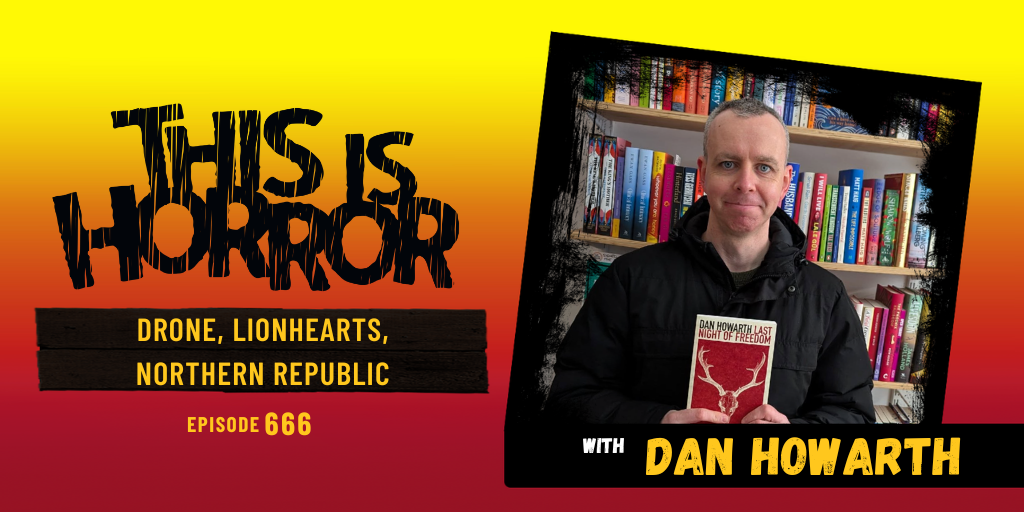
In this podcast, Dan Howarth talks about Drone, Lionhearts, Northern Republic, and much more.
About Dan Howarth
Dan Howarth is a writer from the North of England. His work has been published both in print and online, most notably at The Other Stories podcast, where his stories have been downloaded over 100,000 times. In April 2021, Dan released his debut short story collection Dark Missives through Northern Republic Press. Dan was shortlisted for a British Fantasy Award in 2019 as an editor and shortlisted for a Northern Debut Award from New Writing North in 2021. His latest book is Drone.
Timestamps
Thanks for Listening!
Help out the show:
- Support This Is Horror on Patreon
- Listen to This Is Horror Podcast on Apple
- Listen to This Is Horror Podcast on Spotify
- Rate and review the This Is Horror Podcast on Apple Podcasts
- Share the episode on Facebook and X
- Subscribe to This Is Horror podcast RSS Feed
Let us know how you enjoyed this episode:
- Write a comment below.
- Follow us and get in touch on Instagram @thisishorrorpodcast
- Subscribe and comment on YouTube @thisishorrorpodcast
- Follow us and get in touch on TikTok @thisishorrorpodcast
- Tweet us @thisishorror.
Resources
- Dan Howarth
- Watch the video version of This Is Horror Podcast episodes, including our conversation with Chuck Palahniuk on YouTube.
Cosmovorous by R.C. Hausen
The debut from R.C. Hausen, available now. Now also available as an audiobook.
They’re Watching by Michael David Wilson and Bob Pastorella
From the hosts of This Is Horror Podcast comes a dark thriller of obsession, paranoia, and voyeurism.
After relocating to a small coastal town, Brian discovers a hole that gazes into his neighbour’s bedroom. Every night she dances and he peeps. Same song, same time, same wild and mesmerising dance. But soon Brian suspects he’s not the only one watching and she’s not the only one being watched.
They’re Watching is The Wicker Man meets Body Double with a splash of Suspiria.
Buy They’re Watching in paperback and eBook right now.
Michael David Wilson 0:28
Welcome to This Is Horror, a podcast for readers, writers, and creators. I'm Michael David Wilson, and every episode alongside my co-host Bob Pastorella, I chat with the world's best writers about writing, life lessons, creativity, and much more. Now today is episode 666 a frankly historical landmark episode in any horror podcast, and it may be that you're expecting an episode dripping with evil and satanism, and all of that good horror fodder, but here at this is horror, every day is Halloween, so really it is business as usual, and yet, as luck would have it, our guest today is a very special one to me, because it is Dan Howarth, the original co-host of This Is Horror Podcast, a friend and writer who has had my back since day one. He is somebody I trust with my life, and he is a writer who deserves a lot more attention in the horror crime and thriller field. So, if having Dan Howarth headline episode 666 brings Dan more sales and attention, then it is an episode well done, and when you think of horror, evil, and unease, things don't get much more uncomfortable than in Dan Howarth's weird horror novella drone, a story set on an idyllic island that should be a paradise, but then one day a strange noise can be heard throughout the entire island, a noise that affects all the island's residents, including our unfortunate protagonist, Gallagher, as the community descends into fear and violence. So that is a little bit in terms of what drone is about, and that's just one of the books that we're talking about today with Dan. We're also talking to him about his latest novel, Lionhearts, and additionally we find out what he's been up to lately, which leads to a bizarre discussion on moving house and DIY. Perhaps not what you expect in episode 666 of this is horror, but if nothing else, we are full of surprises. So, before any of that, a quick advert break
Bob Pastorella 3:12
from the host of This Is Horror Podcast comes a dark driller of obsession, paranoia, and voyeurism. After relocating to a small coastal town. Brian discovers a hole that gazes into his neighbor's bedroom every night. She dances, and he peeps. Same song, same time, same wild and mesmerizing dance. But soon Brian suspects he's not the only one watching. She's not the only one being watched. They're Watching is The Wicker Man meets Body Double with a splash of Suspiria, They're Watching by Michael David Wilson and Bob Pastrella, is available from disishora.co.uk Amazon, and wherever good books are sold.
RC Hausen 3:52
Cosmovores, the debut cosmic horror novel by RC Housen, is now available as an audio experience featuring an original dark synth wave score. This story will take you to the next level of terror. Come hear the story that readers are calling Barker meets Lovecraft, a phantasm-style cosmic horror adventure, and a full-bore, unflinching, nihilistic nightmare. Cosmovores: The Audiobook by R.C. Howson. Come listen, if you dare.
Michael David Wilson 4:26
Okay, here it is. It is Dan Howarth on This Is Horror. Dan, welcome back to This Is Horror
Dan Howarth 4:39
Evening. Thanks for having me. It's been a while.
Michael David Wilson 4:42
Yeah, the last time that we spoke was back in February 2025 If we exclude the release of Daddy's Boy, so what have been the biggest changes for you personally and professionally? Since we last spoke,
Dan Howarth 5:02
well, personally we've moved house, which has been a living hell. It's been a horror story in every sense. Turn on a light and a window falls out, or open a door and you know the roof falls in or something, but that's old houses, you know, that's that's what we like. You get the esthetic, but you also get the problems. So last year was a very stressful year, it was fair to say, but yeah, we've come in through it and settled into a new routine. In terms of professionally, couple of books come out since we last spoke, which I'm sure we'll get on to. Bit of an overhaul this year, this calendar year of the writing routine, which seems to be effective. Few other writing things going on, which is great. So, yeah, lots of lots of news, really, and lots of changes, hopefully all for the better.
Michael David Wilson 6:01
What inspired you to move house, apart from just hatred of normality and just wanting to inflict chaos upon yourself?
Dan Howarth 6:12
Yeah, I just.. I just live for drama and tedious legal admin, actually. So, yeah, that was it. Now we.. I think, we just kind of outgrown the old place, and you know, we wanted to move across the town where we live, just to get away from a different building development that was coming up, and try and get ahead of the curve. So, yeah, we just wanted a bit more space, and it's quieter, nicer garden job done, I think. Really, yeah. Apart from the DIY it's caused,
Michael David Wilson 6:45
yeah. There you go. And as we said off air, you've also got some nice territory, and last night of Freedom posters. So not that you'd need to move house for you to get the post. No,
Dan Howarth 6:59
they existed in the old house, they're just a bit more prominent here, so as I was saying, this, this, my office here now, like a dedicated writing space and workspace and stuff to me, ripped out in a few days, totally replastered and everything, that'd be blank canvas to do what I want, so you know, paint the walls black, brick up the windows, you know, it's the perfect horror, right? A sanctuary at that point.
Michael David Wilson 7:27
There you go. We'll just have to invite you back on in a few months, so we can see what you've done.
Dan Howarth 7:33
Yeah, I'll just be pitch black, you see me at all.
Michael David Wilson 7:37
Well, you could wear like some sort of UV or neon clothes, as if you're a cyber goth for a naughty rave.
Dan Howarth 7:46
Yeah, look very Tron, won't it, with all the kind of neon going on.
Michael David Wilson 7:51
Well, because I trust that our listeners and viewers aren't primarily here to listen to some of your weird outfits and mannerisms, I think we should move on to your writing routine, because you said this year you have overhauled it. So, what is it looking like now?
Dan Howarth 8:11
So, previously, as I think we've discussed before, it was like writing at lunchtime at work, and I had a series of jobs unplanned, where I always worked opposite a library for a number of years. In 2024 towards back end of that, I started working remotely, got a different job, so I'm here all the time, which is kind of strange. I'm not sure it was totally conducive to lunchtime writing, so the start of this year, as of the second of January, I think it was, or maybe even the first, can't remember now. Get up for an hour before work, so come downstairs, feed the dog, and get the words done before everybody else gets up, and the school run starts, and all those kind of things get the words out the way, still writing at lunch time, but the pressure's off for that, really, like the day job can be quite busy, and being here all day, I like to get out at lunchtime, just go walk the dog or something, and clear my head a bit, so takes pressure off, really, like getting the words done before the work starts, it's been pretty good. It's took a little while to get used to, but yeah, it's it's getting there. It's productive for me, so like an hour's worth today, 1200 words before I log on for work. Not saying they're 1200 good words, but they are 1200 words are done, so yeah, it's I think I found my groove with it now, kind of three four months into.. so what are we on? May nearly five months now, then going on, yeah, it's working out well, so can't complain.
Michael David Wilson 9:56
So just how early are you getting up? Are you a 5am rise? There, or what's going on?
Dan Howarth 10:01
No, I drew, I drew the line there, so it's only, it's only six, so my wife gets up a bit later than that, and you know, we start the day, and I don't think I could commit to five, it's one of my pet peeves, it's like you can wake up at six and be fresh, I'm not totally convinced of some of these people who say they're up at five, and you know, fully functional. It's just, dunno, it seems, seems a stretch to me. So I made the compromise of not going totally crazy and getting up at five. I think up at six, down at five past job done. I think that's a sane way to approach it. I think anything earlier than that is, is asking for trouble, really.
Bob Pastorella 10:47
Yeah, I think you'll find, as you get older, that six isn't that far-fetched. I mean, I, I used to be one of those people that would sleep till about eight, 830 My job won't allow me to do that for most days, so getting up seven 730 is pretty, pretty early for me, but it feels right getting up at six. I'm still, you know, I'm functional, just need a little bit more, little bit more coffee, but you get me up at 5o'clock in the morning and I can't even produce human sounds, so it's, yeah, it's like it's just that one hour difference just fucks me up so bad, it's like, what the hell,
Dan Howarth 11:33
I'm sure, I'm sure there are people out there who do that, who wake up at five to write, and they're, you know, scowling at me right now, but I am quite skeptical of some of these extreme routines, and for me it was just too much. Like, I thought about trialing it, but yeah, just the thought of getting up at that time, I just.. I just can't see how I would get anything productive done. I'd rather have that one productive hour that I can count on than whittle away some of the time, like warming up, like I'm in a position now where, like, say I'm downstairs at five past, the dog's fed, and I'm here, I'm at this computer, and my brain is totally focused on that writing. I think if I was up any earlier, I'd be scrambling around for consciousness before I was able to do anything, so think I found the sweet spot now, and it's, yeah, it's become a productive time for me, and as the weather's getting better, and we're moving into the summer, it's, you know, it's pretty pleasant experience to get up and have that hour free of work, or, you know, anything else really, to just kind of focus on the words, and it's, you know, there are no emails pinging in from work, you know, there's none of that kind of stuff. The phones upstairs, no other distractions, the internet's off. It's just right now's this time, and it, it feels like I've made the right and deliberate in that portion of the day, which I think makes me more productive, or hope it does anyway.
Michael David Wilson 13:04
Well, this is what I wanted to talk about, whether you'd notice the difference in the quality of the writing, or your focus, or indeed your creative rhythm, because I think sometimes the different times or the different circumstances that we write in can affect the writing that we're actually producing, so I'm wondering how it compares to what you were doing and how focused you were purely just writing on your lunches.
Dan Howarth 13:34
Yeah, I think I think the focus is there, like that's, you know, I've kind of trained myself to have that focus now, whereby you know when I'm here in front of this laptop, I know why I'm here, and it's almost like a, like a Pavlovian response, you know, you open the laptop, it's word time, that that's not a problem, I think it's probably a more like a better flow state, I would say, perhaps, because it's, it's dedicated right in time, whereas when I was going to the library, you know, if it was a time when there was a lot of student exams or something, you didn't know if you get a seat, so it was kind of, there was a lot more rushing involved, and involved time getting there, which only a couple of minutes, you know, crossing the road and running across street and all that kind of stuff, but still losing a bit of time on both ends, and sometimes you can lose time in there, you know, if there's no seats available, all that kind of stuff. So it's a bit less rushed. I don't know if that, you know, is a good or a bad thing, really? Maybe I'm writing in a more considered way at the moment, because I've, I've got that dedicated time, but yeah, I think it's, I think the quality is at least as good as it was, if not better, and yeah, it's I'm finding it beneficial, and it's almost like a bit of a stress reliever. It done early in the day, because now when I log on at eight for work, I know that those emails get my focus, whereas previously I'd get to about 11 o'clock and I'm like, it's nearly right in time, it's nearly right in time, you know, and you're not necessarily as focused on your job as you were, or you should be, so you know, now I can kind of clear that morning and know that the words are done and focus on other things, so when lunchtime does come round, if I can steal half an hour once I walk the dog, or whatever, yeah, that's great. I'll get some extra words, and I think it's it's given me the opportunity to write twice in a day, which you don't always get, so or I certainly wasn't getting before I started waking up, so I think having that second chance when it's not all or nothing makes a difference, because sometimes I'll tack on 500 words at lunchtime, you know, that's that's great, and usually they're pretty good words, because the pressure is off to not hit a target, so they're often the better words of the day are found in terms of quality, if not quantity, so yeah, it's beneficial, the more sessions you can kind of steal for yourself to write in, surely the better your work's going to be,
Michael David Wilson 16:14
and you said that by the time lunch comes around, you've got pressure off from hitting a target, so still to this day, then are you pretty concerned with word count and hitting a minimum word count, and what does that look like when you're in editing mode as opposed to first draft mode?
Dan Howarth 16:38
It's I think that's probably the weakness in my game, in terms of writing, it's like, you know, I am quite numbers-focused in the first draft, 1000 words a day, like, come hell or high water, you know, and it's, it's a rare day that that doesn't happen one way or another on a writing day, you know, it just does happen, whether it's in two, three sessions, if it's, you know, going up to bed after 10, and I owe myself 100 words. Well, they get done before I can go to bed, like that is a firm, firm commitment that is unbroken for a very long time now, and we're talking probably about eight years of when I, when I have a session, it's 1000 words. When it's a writing day, it's 1000 words that can be a drawback to editing, because there can be a time when you look at what you're doing and you think, well, there's nothing tangible that I've done here in terms of a word count, it's not measurable or quantifiable in that way, which I think held me back for quite a while, but I spent a long, well, spent three, four months of this year working on editing a book, and to be honest, it was just a case of quantifying it by the time it was, you know, right, I've got 5550 minutes of quality time here, and I will edit this book as much as I can. Some sections, as we all know, you know, some days you kind of go through two, three pages, and you know, you might take a word out of a sentence, but actually, you know, you're looking at words that are pretty high quality. Other days, you might look at something that needs a bit more structure to it, or the dialogs off, or the pacing is wrong, and you might look back at it and think, actually, only half a page has changed here, but they're important changes, so I think you innately know when enough is enough, but when it comes to editing, it's measured by time, and it's measured by quality rather than numbers. If that makes sense, it
Michael David Wilson 18:47
does make sense. Yeah, and I mean, a follow-on question, because I know you're also getting into screenwriting. What does that look like? Because I mean, I would say that 1000 words of a screenplay is a lot more than 1000 words of prose, so do you give yourself some other rules? There is it more a page count when it comes to a screenplay?
Dan Howarth 19:17
Yeah, five pages as a session, usually, and sometimes they're, you know, action heavy, or whatever, or dialog heavy, and those five pages fly by sometimes. Yeah, it's a bit more of a bit more of a grind, but yeah, five pages is usually the session target, or the daily target, if it's a screenplay that I'm working
Michael David Wilson 19:42
on, all right. Well, we're gonna circle back to screenwriting in a little bit, but for now we got to talk about Lionheart. So, to begin with, what is the elevator pitch for that book?
Dan Howarth 19:57
Jesus, in short. Up, so a man loses his livelihood and part of his family in the gas explosion, a fraudulent gas explosion in his local town, ends up destitute. He gets offered the chance to get out of this destitution, this this life that he's kind of trapped in, and it turns out that the people who are offering to help him out are, you know, not just far-right sympathizers but far right agitators, and the moral heart of the book is, you know, do you want all the things that you want, but are you willing to pay the price of your principles in order to get them, so it's yeah, it's quite a violent moral dilemma book, really. I would, I would say that's how I would sell it. This is England, American History X, you know, those kind of those classic influences that I know we both share, Michael, because we've discussed them both, particularly This Is England at length, but that's it. It's, you know, it's.. it's lifestyle versus principles. And where does the character, and where do we as a society or as individuals draw that line? It's.. I think it's an interesting question.
Michael David Wilson 21:17
Yeah, I think this is the nearest book, or the nearest media in any guise, since this is England, that isn't actually this is England, this is a kind of this is England for the modern generation, and my goodness, I mean it, it's not going to be for everyone, it's a difficult book to stomach, but it's so well done, and it, you know, it makes you think, so think about your own principles and your morality, and when you would and wouldn't step in when you know you're just witnessing atrocities and wrong behavior, and I mean, on that basis, what was your why for writing Lionhearts?
Dan Howarth 22:08
I don't think I sat down to write something that was like a political statement. I just don't feel that, that you know, I'm sure a lot of writers do it, but I'm not totally sure that that's kind of a healthy mindset for writing a good story. If you see what I mean, theme is key to any story, but if you, I feel like if you go in with theme first or a message first, I feel perhaps it can compromise character or story, you know, from from that angle, because you're always trying to meet the end goal of imparting the message, and I'm not totally sure the message is over in Lionhearts. I think it's a message that is also a question, perhaps. So it wasn't that that came first. The thing that really generated it, behind that kind of got me to the keyboard about it, was I'd watch Taxi Driver, and I thought, you know, that is kind of such a jarring piece of art, and I thought, well, Who's writing the Taxi Driver equivalent at the moment, like, what, what genre is it? Is it crime, is it thriller, is it state of the nation? Like, what, where does it sit? I thought, well, where are we at now? So I sat down to write this before the pandemic, and one of the things that kind of inspired me to do it was, you always hear crime writers and they always go, oh, do you know, do you know who gives you the insight into what society is real, like really like? It's police officers, they deal with all levels of society. I was thinking, well, that's kind of true, but I can't remember last time I spoke to a police officer, you know, I'm not sure that's totally true. I class myself as fairly average individual. I've not seen a copper, you know, apart from driving past about 10 years. So thought, well, who does see society on every level? And Amazon delivery drivers basically came to mind, because we all deal with them, you know. You see them on a daily basis, they're going to all levels of society. So I was thinking, well, who might end up there? Who might end up living in the van? What might they see? What might people want them to see? What insights could they gain into our society from that point of view? So I kind of tied that together with Taxi Driver, and then the far right element kind of came out in the extrapolation, really, and at that point the moral questions started being asked, because I was researching heavily and asking myself the question, and I think it's probably a question we all ask ourselves, is like what would we tolerate in terms. Of society in terms of politics, you know, where do we stand as individuals and what do we stand for. So it was kind of a mixture of that, really, and it was inspired by a true event that happened not too far from where I live. So there was a huge explosion. The explosion that opens the book was a real event, and I saw how the town suffered on the back of it, because there was no funding, there was no help, people lost businesses, they lost their homes, they were kind of left at the mercy of the goodwill of the community, rather than the council or the government helping them out, so I thought, well, you know, we've seen some positive examples, but is there something that you know horror writer brain kicks in? Is there, you know, something awful or worse that could come out of this? And then it all kind of tied together, really. So, yeah, there was a, there was a lot of questions I was asking myself. It was written during the pandemic, so it was a strange time for everybody's mental health, I think, and going down some of those rabbit holes probably didn't help in the middle of a global lockdown.
Michael David Wilson 26:12
Yeah, I mean, goodness took about a real mix of emotions for you to be experiencing in a house that you're not allowed to leave, so there's another element of horror right there.
Dan Howarth 26:28
Yeah, exactly.
Michael David Wilson 26:30
And I mean, so I know from our conversations that this book has been on a journey in terms of who to publish it via, and its publication path. So, I wondered if you wanted to talk a little bit about that, the journey that it went on, and then how you ultimately arrived at putting it out via your own imprint.
Dan Howarth 26:58
Yeah, it's. it has had a very long and odd history, it's fair to say. So I wrote it as, say, probably finished it, probably about this time, so May 2020 and entered it into quite a prominent competition, New Writing North Northern Debut Award, which is for unpublished writers, and it got shortlisted for that, which pretty good, like pretty good achievement. Around the same time, it came pretty close with a couple of agents. They took the four manuscripts and ultimately decided against it, which is fair enough. It got accepted for publication by an indie press, which we went through the editing process, and then the press collapsed, and the editor just disappeared off the face of the earth. Thankfully, there was no money owed or anything like that. You know, you hear some horror stories by indie presses. This isn't one of those. It was more of a hard luck story than a bad, you know, a bad story, I guess. We came close to getting out there, and it didn't quite work out, which is fine. So I took it back, did some more work on it, and then at the back end of last year, just before I published it, another agent took the full manuscript, and they said that they really liked it, but because they were a new agent, they didn't feel they had kind of the clout and the influence with editors to be able to sell it, because of the content, really the far right influence is prominent in it, and it's, it's a horrible book, it's not a pleasant read, it's very uncomfortable to read, and at times it's uncomfortable to think about the writing of it, because it's a first person, you know, descent into hatred, it's it's an uncomfortable read. So it came very close, and you know what? In the end, I thought, tired of the admin of sub in this. I'd rather do the admin of publishing it. So, at that point, I thought I'm just going to withdraw it from anything where it is, just, you know, let kind of agency queries, you know, disappear at that point, unprompted and unchaste, and yeah, just decided that it was mine, and for better or worse, I was gonna bring it out under Northern Republic, which is my own label,
Michael David Wilson 29:30
yeah, and a very apt name for the publisher, given the content of this specific book,
Dan Howarth 29:37
yeah, it couldn't have, couldn't worked out any better thing, really, it's a very northern book, a very, it's a very English book. I think it speaks of where this nation is at the moment, and yeah, we're on the precipice of something dreadful. I think if we're not very careful, we do well. Able to learn some of the lessons from our cousins overseas, but whether we will or not, we have a history in this country of learning lessons the hard way, and hope this is not another one, because we've had a very tough lesson through Brexit recently, and it's time to wake up a bit. I'd say,
Bob Pastorella 30:21
yeah, it's it's, you see, it's like just all over the world. I will say that this is probably the least political, political novel I've ever read, and I say that in a good way, and I think it's because we have a main character who is fueled by grief, and he basically, without spoiling anything, anybody can get to a tipping point where you can just give them a little nudge and radicalization occurs, and so I've seen it with my own two eyes from people that I know personally, how, how you can go from one to the other in a matter of days, and it, it's, it hurts because it's like now I've got I've got friends that are no longer friends, so but yeah, the most political, non-political book I've read, and I think it's because your main character just doesn't give a shit about the politics, he's trying to get things right,
Dan Howarth 31:39
yeah, he's trying to, that's, that's exactly what he's trying to do. It's, you know, what he's doing, as abhorrent as it is, is a means to an end, to working his way back to where he was. That's, that's his end goal, and that's all he sees, you know. And the hatred comes along with that, and I tried to keep that as true to some of the kind of real-life stories of online radicalization, and you know, in-person radicalization that read, because ultimately it's it's people who are grieving, it's people who do have empty and resentful lives that are targeted, and as we can see from all stuff swirling around online, it's easily done because people don't see it as hatred in some respects, they see it as a means to leveling out a playing field that they see as unfair, they see it as a means to getting things that they want in their lives, be it money or influence, or whatever it may be, and it's a playbook, you know, it's tried and tested. Psychologists report on it. It's, we see it, you've seen it with people that you, you know, or you knew, Bob, you know, you see it with people that you speak to at the match, or you know, outside the school gates, in some very upsetting circumstances, it digs into people, and quite often it's people who are vulnerable without even realizing that they're vulnerable, and that's that is one thing that I really wanted to address, because doing the research for it, as all writers should, when you're writing about a difficult topic, you know, informing yourself, as unpleasant as it can be to look at, you come out of it a more rounded and informed individual, and even if the book doesn't land for everybody, and it, you know, it will upset people, it is not a book I would pick off the shelf and read again, you know. I might occasionally glance at Last Night of Freedom and laugh at a couple of jokes. There are no jokes in Lionhearts, you know. It's, it's a cautionary tale, and one that was written from a place of upset and worry in my own life, but at the same time, you know, it's, it's accurate, and it was now five years old, in terms of, you know, when it was written, if not more, and it's becoming more accurate, and that's, that's the worry, you know, it's, it's, you're looking up, you're looking in a mirror at this, this society that we're building, and it's cautionary sale, and yeah, it's, it's uncomfortable, yeah, it really is,
Bob Pastorella 34:28
and it's uncomfortably timely. Is that probably, probably real, like a really good way to put it, uncomfortably timely, uncomfortably relevant as, as we go on in time, and like looking at it now, considering that it was written five years ago, it's like I feel like it was written fucking yesterday, you know, like today, because it's it's it's like, have we been. I went through this kind of shit for like the last fucking five six years, unfortunately. Yeah,
Dan Howarth 35:06
yeah, I mean, you know, I'd say in the UK we're 10 years on from the Brexit vote, which is what broke the discourse in this country apart, and I think sitting down to write this at the back end of 2019 was when I started it. I couldn't have foreseen where we're going as a country, you know. It's you as a writer, you sound like a bit of a dick if you say your own work is timely. So that's not a word that I would use. It does upset me that it's become more accurate as time has gone on, because I thought when I wrote it, this is as bad as it can get, but there's more. Oh, good,
Michael David Wilson 35:49
yeah, I don't think we should ever say this is as bad as it can get, because this might look pretty good in 10 years. Unfortunately, that is a pattern that, yeah, you know, doesn't care, but I wonder if, when Bob was talking about this being the most non-political political book, if a lot of this, like Shane Meadows, is because even for people who know you, they will know where you stand, and I'm sure at the end, once they've read the book, that they will also, at least broadly, be in the same position as you. I would hope so after having read it, but you know that there's no overt message. You're never saying you know this is wrong because X Y and Z. You're just almost objectively putting out the facts and the account as to what happens, and you know, leading the reader to decide. Well, what do they think on that issue?
Dan Howarth 37:03
Yeah, effectively, you know, it's.. it's not for me to preach, you know. My, my views are my views, and I strongly believe them. You know, it's almost a badge of honor over here to be called a loony lefty. You know, that that makes me.. that makes me happy. It makes me proud, but I've learned one thing from dealing with people like Bob. I've got people in my life who I don't speak to anymore, and we've fallen out over political issues, and that's very sad. But at the end of the day, you know, I know that they will never change my mind, and I will never change theirs. So, it's not for me to judge, it's not for me to preach. You know, the aim of the story was to tell a good story that hopefully people get to the end of and ask themselves questions about their own views and their own morals. It's not for me to guide them, it's for me to entertain first and foremost, and hopefully that points to shock, but it's also an open question. It's, you know, it's a decision for them to make as a reader as to where they stand. It's almost a challenge to their own views, hopefully, and yeah, I feel that's the most effective way to do so. If I set out to preach to somebody, I would have probably written quite a boring book. And I think Lion Hearts is many things, I think it's a nasty piece of writing, but it's not bland, and it's not preaching, it's helping people make their own choices and their own mind up, and I think that's how it had to be, really, to be honest, to be a successful story in its own right,
Michael David Wilson 38:53
and in the writing and the research, did you change your mind or perspective about anything, or did it help you understand other people's points of view in a way that perhaps you hadn't prior to
Dan Howarth 39:11
it? I think we're all very divided at the moment, and I think it's, it's easy to shut off to the views of the other side, particularly when you look at some of these divisive figures, you know, Trump, Farage, so absolutely cartoonishly obnoxious, it's difficult to take anything that comes out of their mouth seriously, but I think it's important to hear the view, even if you don't agree with it, you know, going through a lot of the research, you find yourself, you know, almost head in hand reading some of this stuff that people believe and people want to spread, and it's, it's horrific, and it's upset, but at the same time it only cements the view that equality. See, diversity, these kind of things are so vital to who we are as a species, and the people trying to shut them down are just wrong. It's cemented my own views. The thing that I found most upsetting about reading into it are some of these stories of people who have been radicalized and fallen into the trap of the far right, is that it's sad, you know. These aren't necessarily people who were born full of hate, quite often they're people born with disadvantages in some ways, and you know, people who've been bereaved as the character in in Lionhearts, and people who have been let down by society in other ways, you know, systems have failed them. You know, it's, it's not, you know, it's not immigrants coming over and taking people's jobs. It's, it's the government letting people hang. It's, it's, you know, it's the council not being able to afford to provide the services that these people need to rely on, it's, you know, all this, all this hatred takes their focus away from what the true issue is, and it also gives them a purpose, as horrendous as it is, rather than trying to fix things for themselves or fix things for others, we're all too focused on breaking things down rather than building them up. I think, and yeah, it left me sad for a lot of the people who you read about, rather than hating them. It led me to pity them, and I felt, felt that maybe is a more human way of looking at it, I don't know, it's yeah, there's some sad stories out there, and some, some truly despicable ones too. Let's not forget, but a lot of these people are being manipulated, and yeah, we're in a bad way, because there's no way to fix the problems that are leaving these people so vulnerable to hate and awful ideologies.
Bob Pastorella 42:04
Yeah, I bet it was kind of.. you probably already knew, but I mean, it feels like it can be a lot of times eye opening to see how much of this stuff is just reverse engineered to sow discord, to, to, to create chaos to allow these things to proliferate, to continue on. It's been happening since the 50s, you know, especially in America. They've, they figured out a long time ago this is not conspiracy theory, but if they can create chaos, then they can control how people vote, and they just know how to tip it, you know. And it's the people who get caught up in this, the real people, those, the radicalized ones. There's, yeah, there's some despicable stuff in there, but, like, you said, it's, it's very sad that they got caught up in that, that they've been manipulated, and, it, you know, we need, we need, you can't, you can't attack that, you have to attack where it's coming from, you have to get to the, the people engineering
Dan Howarth 43:20
it, yeah, agreed, it's it's misdirection away from the true problems of a society, and on a micro level, the true problems of a life, and it could be, as I've said, grief or lack of opportunity, you know, all those kind of things that need to be addressed, depressions, mental health issues in others, you know, it's yeah, a lot of vulnerable people are being taken in by, by hatred, and people who almost certainly do not see themselves as vulnerable for one reason or another, as well. It's, it's frightening, and you know, it's continually done, and it's easily done, and that's the problem.
Michael David Wilson 44:06
Now, it's pretty obvious that writing this was not a pleasant experience for you. You know, you've said that you were left feeling sad, and just, you know, in a place where you were really despairing for the world, kind of understandably, really. So I'm wondering, did you have to kind of put things in place to almost protect, I suppose, your own mental wellbeing, or did you decide right after this I'm gonna watch some comedy or something, just, you know, feel in a better place, and then also, in terms of the project and the book that you wrote after, did you make sure that that was lighted, just so you've got this balance?
Dan Howarth 44:57
Yeah, I wrote straight after. I finished it, like I wrote this draft really quickly, like once I got into it, it was, it was pretty like intense. It was, you know, a very short process, but one that was, you know, extremely focused. So, after that, I started writing kind of a folk horror novel about, you know, a missing kid, and all this kind of stuff, and I was like, I'm too depressed to finish myself something nice. So I wrote a comedy, basically. So I took away, I took, you know, a couple of days off, and then I wrote a book, a comedy book about a man and his father who were trying to save their local non-league football club from going out of business in a kind of Phoenix Nights style series of events, which I never did anything with, but I just wrote it to,
Bob Pastorella 46:00
you know,
Michael David Wilson 46:02
what do you mean? That sounds amazing.
Bob Pastorella 46:06
Yeah,
Michael David Wilson 46:08
that sounds like a good pairing for a double bill with my book, Daddy's Boy.
Dan Howarth 46:12
I need
Michael David Wilson 46:14
to read this.
Dan Howarth 46:16
There are less sausage jokes in,
Michael David Wilson 46:19
but more football references, so
Dan Howarth 46:23
I must admit I wrote it, and I don't think I've looked at it since probably about November 2020 when I finished writing it, so who knows? It could be, it could be amazing, but it could also be just shit that I wrote while I was still, you know, repairing my brain, having read all this horrendous stuff to write a really nasty novel. So, yeah, I wrote a wrote a TV pilot for this kind of more comedy drama, I would say, than sitcom, but there's plenty of jokes in it, but then I just haven't done anything with that either. So, maybe there's a lesson here for me to actually try and, you know, see some of these things through to completion in the future, more ideas than then I know what to do with. Clearly,
Michael David Wilson 47:20
yeah,
Dan Howarth 47:20
I'd forgotten about that book, actually, and so you mentioned that. Yeah, I genuinely had forgotten that that exists.
Michael David Wilson 47:27
I was wondering if some of the reluctance was, you know, and I hate kind of talking about like branding and esthetic and all that kind of boring businessy stuff, but if that played into it, because at the moment you know what you're releasing is firmly within horror, that's kind of horror crime crossover, and you have like, especially with the cover art as well, like just a very obvious this is a Dan Howarth book, but if you put like the Phoenix Knights football comedy. It's a little bit different, so yeah. Is that a reason? Are you gonna have to, if you put that out, do it under another but obvious name? Is it going to be a D Howarf?
Dan Howarth 48:18
Yeah, I think it'd have to be a pen name, it's, it's quite interesting, really, pairing Lionhearts with the rest of the output, because it's like, so I've done some kind of in-person events recently, the most recent one being the Indie Horri chapter event in Liverpool, which was a great day, but I've got, like, the five books are out, so I've got Drone, Last Night of Freedom, Territory, Dark Missives, which are all very obviously horror, and you kind of people say, so what are your books about, and you kind of go horror, horror, horror, horror, and then you go, do you hate Nigel Farage, because this might be the book for you, it's that even that is like a left field pitch at some of those places, so yeah, I think throwing a comedy in there would probably have to be, yeah, definitely under a pen name, and maybe even under a different imprint, I don't know, but we'll cross that bridge when we come to it. I might read it back, and it barely makes sense. Who knows, we're a long way away from that one there, seeing the light of day, I would imagine. Maybe the script will do better. Who knows?
Michael David Wilson 49:25
Well, if you need a reader for that one, if you decide you're looking to seriously consider publishing it, then get in touch, because that is exactly the type of weird comedic into.
Dan Howarth 49:42
Oh yeah. I mean, you know, we'll say Lionhearts is a left turn from some of the other stuff that I'm doing, you know. This is turning left and jumping off a cliff into a whole different sea entirely. I mean, knows where I'm going with that, but yeah, it's.. it was fun to write. Yeah, let's go. Few jokes in it, and tried to make it kind of bit heartwarming, kind of dad and lad, you know, bonding over going to the match, kind of thing. So, yeah, it was very, very different to Lion Hearts in pretty much every way, and I think I needed that, really needed that reset after all that misery.
Michael David Wilson 50:21
Oh, yeah. yeah, and you mentioned with the independent or the small press that went under that you know it was all set for publication, and I understand too that it had gone through an editorial process, so I mean, after you got the rights back to it, how much of those original edits were you then keeping? How much were you going back to your original manuscript, and what did the ultimate process look like in terms of the finished product that we've got today.
Dan Howarth 51:03
The edits were an interesting process, largely because the editor who'd taken it was American, and there were, as I've said, it's a very British, very English, very northern book that's written in first person. So, particularly the dialog, you know, there was a lot of questions whereby somebody says this is shit, or I felt like shit, for example, but then later on he says this is totally shite. Well, an English, a British person understands the difference between where you shit and where you shy in your kind of dialogs, you know. Oh, we're getting into, we're getting into real technical stuff here, aren't we? But I was trying to explain it, and I was, but ultimately it's just one of those things that you know, like there's no, you can't look it up on, you know, in a dictionary, oh, you shit here, you shy there, it's just you either know when you say these words or when you don't, so trying to explain that to somebody who's not familiar with it was quite interesting in and of itself, but I think structurally it did stay the same. I made some late changes before I submitted it to the final agent, who, who nearly took it on, and I made quite a significant plot change to it, which I won't reveal for the purposes of spoiler, but it did, it did make the character work a lot better, perhaps than the previous previous versions, but I did have a 90% proofed and edited version that I was happy with, I did add a couple of little bits back in, so one of the big inspirations for me as a writer, and particularly for this book, is David Peace, and he does a lot of kind of, it's not surreal as such, but you get kind of diversions into people's minds, so there's a couple of scenes whereby almost hallucinatory within Lionhearts, where he's wrestling with his own internal demons that I kind of put back in that I think the editor had taken out, so I just, because I was publishing it myself, I just wanted it to be its, its truest form, really, and so I just took a few of those back, but it was a useful process to trim, trim down for the most part, and go back and forth, and kind of explain the thinking behind certain aspects to somebody else, and it was good prep, hopefully for working with other editors in the future, should opportunities arise. So, yeah, it's always good to collaborate, even if we do have to discuss the ins and outs of British slang and swearing at length.
Michael David Wilson 53:59
Yeah, well, I mean, off air we spoke about some of the editorial suggestions, and I don't know if you do want to go into it, and I would definitely understand if you did not, but there were some suggestions that were almost like, can you make this more racist because we don't think that the terms that are being used are quite racist enough, so then this editor was trying to come up with slurs that people might use for Polish people that are not reality.
Dan Howarth 54:38
Yeah, I think it's.. I think again that was a bit of a cultural kind of breakdown, really. You know, there's, there's a lot of, a lot of people get angry about immigration in this country, but immigration to this country, historically, or certainly, you know, in the early part of this century.
Bob Pastorella 55:00
History, it
Dan Howarth 55:00
wasn't based on race, you know, it wasn't based on differences of skin color and even religion, for the most part. It was based on nationality, you know. You have a lot of people from Eastern Europe coming over to work hard and to do jobs in this country, and that was a source of resentment for, you know, British people, because they felt that immigrants were coming over legally all through the EU, were coming over to take jobs from them, and explaining that to this editor was also quite difficult, because it wasn't a racism that was based on the color of people's skin, and it was something that they didn't truly understand. I don't think so. Yeah, I mean, like in Lionhearts, there are no overtly racist terms used, and I was specific on that, you know. I wanted it to be reflective of the fact that, you know, there are no unspeakable words issued in that book, put it that way, and nor should there be, but the hatred isn't always obvious in words, it's obvious in actions and attitudes, and that's how I wanted to be able to display it, so I felt that some of those suggestions, ridiculous as they were at times, were cheapening the effect of, you know, we see how the character chooses to treat individuals that he does not like, and the hatred is implicit in that, and I don't think we need to come up with ridiculous and sordid names to drop into the dialog to be able to emphasize that readers can pick up on it, and I think there was an element of not trusting the reader, and also going for a bit of sensationalism that I think probably would have cheapened the overall effect. So, yeah, I spent quite a bit of time pushing back on pretty much every suggestion, when it came to that, and yeah, some of them were ludicrous. It was fair to say, with all due respect to the editor, because they may watch this, who knows?
Michael David Wilson 57:14
Oh, yeah, I mean, I, I heard some of the suggestions, and yeah, they were outrageously hilarious. hilarious, just in their incorrectness. Let's put it like that, and I mean it wouldn't just cheapen the book, but for people from the UK who are familiar with what's going on, it would completely throw you out of the story, because I think one of the strengths of Lionhearts is it is grounded in realism, and it is, yeah, unapologetically authentic, you know. It doesn't shy away, so if you added almost these cartoonish terms, then you'd be out,
Dan Howarth 58:02
yeah, and it would lose its effect, you know. It's, it's.. I tried to make it as true to, as true to life as I possibly could, to be in a position where, you know, blokes shouting a bunch of this made-up abuse, you know, it's.. it would have been ridiculous. So, yeah, that was my, that was my battle that I was fighting, really. Not only did I win, I think, before they were going to publish it, you know, a lot of those things were just discarded in the edit, but obviously my version, none of them made it, came out how I wanted it in the end, one way or another,
Bob Pastorella 58:42
I think the racism is probably inherent in America, primarily because when it comes to immigration, people tend to think of it as a racial thing, and especially like where I live, we have to deal with it constantly. I had to, you know, I work with the public, and I have to deal with, with, with customers who are racist, and we have, you know, we do have a pretty high Hispanic population, and so we, we have, you know, bilingual, you know, representatives at work, and occasionally we'll get some, you know, older white - it's a white person, it's always a white person who's white, you know, basically even questioning why they're there, and you know, but we're also, you know, we've hired these people because they're tough and they can handle themselves, and you know, and it's fun to watch. Well, the reason that I'm here is because your phone's broken, you don't know how to make it work right. I do, and it's like, oh, oh, oh, you go, girl. You know, but it's, it's to me, it's sadly, it's grounded in racism, so I can understand how an American editor would go to those kind of extremes, and thankfully, you know, cooler heads prevailed, because, yeah, I don't think it would have had the same impact, I've had to wrestle on my own work, deciding if I want to use one single racial slur, you know, and push back on it, got permission, push back on that, and finally I said, you know what, that's how they would say it, so let's go, and I haven't had a single, you know, never had anybody ever comment about it, but it was, it's a tough decision,
Bob Pastorella 1:00:48
yeah, oh yeah,
Dan Howarth 1:00:49
definitely,
Michael David Wilson 1:00:51
and I mean, because you mentioned David Peace before, I assume that it is no coincidence just how similar your novel covers look to the 1974 and 1977 covers of David Peace, like just that whole esthetic and the framing. I feel he has to have been an influence.
Dan Howarth 1:01:16
Yeah, absolutely. Yeah, that was a look that I wanted to take forward and develop with the cover designer that I work with, because I thought, actually, you know, this is an esthetic that speaks to the books and the way that the press is going as well, hopefully in terms of consistency of output, so all of the novels have the similar framing device, and they'll all have different coloration with a different central image, and yeah, I mean, branding is probably too sophisticated a word for me, going, wouldn't it be good if they all looked a bit similar, but, but, yeah, that's the effect, you know. I think you're in a position where people can recognize one of those novels, certainly when the next one comes out, and it, it fits the fits the bill, fits the criteria, and you know, it helps people get in the right mindset, because they know what they're going to get if they've read Lionhearts or Last Night of Freedom. One day I'll release a novel that doesn't begin with L, and you know they'll pick up the next one that might be green or black or whatever, but they'll know inherently it's one of mine based on the overall look of it, so yeah,
Michael David Wilson 1:02:42
however, your novellas don't have that framing device, but I imagine that there probably is going to be some commonality or some other thought behind the esthetic presentation of the novellas, so what's going on there?
Dan Howarth 1:03:04
Yeah, I mean, the, the novels are pretty straightforward to design, I would imagine. Well, he says there's a man who can barely use Photoshop, but, um, you know, if you've got the framing device, then you know, surely 33% of the way there, and I like the, I like the novels to, sorry, the novellas to have a bit more artistic license to both territory and drone, or something that you know, I, I come up with the cover design, as in the overall idea, and then pitch it to somebody who's more talented than I am in terms of actually making the design work usually involves me sending a picture on my phone of a really terribly drawn version of the cover, which he then goes, do you mean like this, and I go, yes, thank you, that's pretty much exactly how I imagined it, and then we battle over the text, but yeah, I think as long as the novellas reflect the story, I'm happy for those to be a bit more freewheeling in terms of the cover, as long as they're clearly horror. I think using the same cover designer keeps things consistent, even across the four books that Paul Stevenson has designed for me. It's clear it's his art. It's clear it's my story, and I think in terms of the esthetic he gets what I'm doing, and I think that's clear in the covers. I think you know, even though they're branded in the same way as the novels, they're still, you know, identifiably my own books, so yeah, I think we've, we've got a good working relationship on that front.
Michael David Wilson 1:04:50
So let's talk a little bit about
Michael David Wilson 1:04:53
your
Michael David Wilson 1:04:53
new novella drone, and as with Lionhearts, I want
Bob Pastorella 1:04:59
to
Michael David Wilson 1:04:59
open. With two questions, which are what is the elevator pitch, and what was your why for writing the book.
Dan Howarth 1:05:09
So, the elevator pitch is effectively it's about a guy, a farmer, Gallagher, who lives on a remote island off the coast of the British Isles. One day, the kind of residents of this community wake up and they hear a low level humming, buzzing in the background of everything, sometimes they notice it, sometimes they don't, but eventually it starts to drive them to act out to acts of violence, and Gallagher decides that he's had enough of this and wants to find a way to stop hearing this noise before he loses his mind and I think that the question is the is the juice worth the squeeze when it comes to making that choice and the why for writing it like a lot of my stories, really, it was a news article that gave me the idea. So this kind of happened around this time last year to an island off the coast of Scotland. People just woke up and heard this like low rumbling noise, and nobody could find out where it came from, and obviously the horror writer brain kicked in, and so what's the worst thing that could happen to these people, and then I wrote down news that news stories are a big kind of story generator for me. I don't go looking for it, but you know, some days you just read a slightly unusual story in the news and go, I could make something like that, and sooner or later it percolates and becomes a decent story, hopefully.
Michael David Wilson 1:06:50
Oh, yeah, there's a lot of horror within the news, and a lot of bizarre and eccentric things that seem to occur, and
Dan Howarth 1:07:01
yeah, it's usually like local news, you know, like regional news. You tend to get like the older stories, like, yeah, it's see some interesting stuff,
Michael David Wilson 1:07:12
yeah, because there's not enough going on in towns like small town Kidderminster, so they have to, yeah, almost go looking for what's the village weirdo done this week. Let's write a little story about that.
Dan Howarth 1:07:29
Yeah, it's like near where I live, Birkenhead. There's a flat where this guy, like pretty.. I think it's like semi-famous artist has just like installed all these artworks in this flat, I think he's now died, and people are discussing what to do with the flat, and I was like, I know what to do with the flat, I write a story about it, because that's it's weird, and it's taken my attention, so now it must be made into fiction, so yeah, that's just what happens, you know, it's you read the, you know, flick through the local paper, and there it is, new story idea straight away, just jumps off the page. It's great.
Michael David Wilson 1:08:10
Yeah, I don't know if you'll go in this direction, but for me it's like, well, obviously part of his dead body now has to be part of the art installation within the flat,
Dan Howarth 1:08:23
no spoilers. I've not even got a title yet. I'm thinking of calling it the Bone Temple. I don't think that's been done.
Michael David Wilson 1:08:34
God,
Bob Pastorella 1:08:36
yeah.
Michael David Wilson 1:08:37
Well, I mean, writing a book like Drone, where sound is so fundamental to the story. Well, obviously this is for the written page. What did you do to try and make that as successful as possible, and what were kind of the rules that you put in place to create that dread from the sound.
Dan Howarth 1:09:04
I think the real challenge is trying to come up with different ways of describing, you know, the sound itself. You know, you can't just say, you know, a dull hum in the background every single time, so I think kind of the challenge was to see how that man manifests itself really within the main character, because it's a very close third person point of view story, so it's not not first person but describing physically how it is, and I mean, personally, I'm somebody who's quite bothered by like sound, so I'll be working here, and if the windows open, somebody mowing the lawn down the street, or whatever way you're trying to work, you know, some of the benefits of writing early in the morning, nobody's mowing the lawn at six in the morning, but you know how it affects you, you know. Muscles in your neck are tense, your jaw clenched, you know, your shoulders hunched, makes you more irritable, you know. So it's, I think it's not just describing the sound, it's describing the effect that gives it its layers, really. Hopefully, and that's what that's what drives it home, because if you just say, and you know this sound was heard. He heard this sound becomes very repetitive, but hopefully people know that it's ever present by the changing reactions to it of the characters throughout, be that physical or behavioral. In some cases,
Michael David Wilson 1:10:37
do you ordinarily listen to music while writing, and whether you do or don't, did that change for this process, because I could almost imagine while writing something like drone, there might have been the temptation to actually just put the headphones on and have some sort of drone in your ears, or you could put an album on by Sun, who basically, most of their albums are drone anyway.
Dan Howarth 1:11:06
Yeah, I never ever listen to music while I'm writing, never, which probably why I'm so irritable to noise, because the slightest thing I'm hearing all, but yeah, put some white noise on at one point to kind of get in the mindset for this, so it wasn't like a specific droning sound, but just something that was I put it on quite low and just tried to imagine how people would feel if they were listening to that, or you know, the whole time. I know a lot of people put on sleep and it blocks out all the noise, but to me it was quite effective, because you know, I never listen to music or anything while I'm writing, so to put that on, it was, it was distracting, and that was the point, really. I allowed myself to be irritated by it, and hopefully it, it helped make the reactions authentic, because, yeah, it was pissing me off,
Bob Pastorella 1:12:02
I I was gonna say, so if you don't listen to music and you don't listen to white noise when you write, does the natural high-pitch whine that your auditory system makes drive you batty? You know, what I'm talking about, when there's complete silence, your brain will make a sound to make the cilia in your ears move.
Dan Howarth 1:12:29
I've never experienced complete silence. You come down in the morning, there's.. you can hear the dog,
Bob Pastorella 1:12:36
yeah,
Dan Howarth 1:12:37
on the tiles, there's birds singing outside, yeah. I don't think my brain or my ears have ever generated its own noise, Bob, to be honest, and I'm beginning to question what's going on in your mind.
Bob Pastorella 1:12:50
No, it's, it's, it is, it is an actual phenomenon that happens when you have complete silence. After a while, you can hear a high pitch whine, I mean, and it's very, it's very low, it's not uncomfortable, it is just, it is, it's, but it's there,
Dan Howarth 1:13:12
I must admit, because there's always background noise, something going on, but that's my comfort zone, like you know, I kind of need that, I guess. That's
Bob Pastorella 1:13:24
yeah,
Dan Howarth 1:13:25
I wouldn't go to a noisy coffee shop and, and write necessarily, to be honest, that might be too much, but just the noise of it, traffic or whatever it may be, there's always something that's there, and that's that's my comfort zone, I guess. Really,
Bob Pastorella 1:13:42
yeah, it doesn't happen over here very often either, because other an apartment complex, and so I have a neighbor who's dying, and we have people who ride back and forth constantly. Trucks, I'm back here by a gigantic dumpster that they, you know, and the maintenance people. So occasionally when I do hear it, it's like, wow, there's total silence, and it's nice, and then it'll be broken by a cat fart or something, but yeah,
Michael David Wilson 1:14:13
I feel like there's a similar but distinct idea that Bob now has, and you could title it something like the unbearable scream of silence,
Bob Pastorella 1:14:24
just these
Michael David Wilson 1:14:25
people going mad anytime it's completely quiet, so you have to have noise. It's almost like, you know, silence is the enemy,
Dan Howarth 1:14:36
the opposite of a quiet place.
Michael David Wilson 1:14:37
Exactly. Yeah, yeah, this is the inverse, right? right there.
Dan Howarth 1:14:43
Love it,
Michael David Wilson 1:14:45
and
Dan Howarth 1:14:45
right in there, Bob, come on.
Bob Pastorella 1:14:47
No, I mean, the title's already there. I mean, you know, titles are not copyrightable, and so Simon and Garfunkel, you know, the sound of silence. There you go, yeah.
Michael David Wilson 1:14:58
And I mean, this is. Incredibly original idea, so I'm wondering, did you take any inspiration from any films or other stories for drone, and I guess because of the originality here that if you did, they might be quite obscure, or people will be wondering how that linked into the ultimately finished story.
Dan Howarth 1:15:24
I must admit it's not something that I've seen done before, certainly not on the page anyway. And when the trailer dropped for Undertone, the film that I think is just coming out now, it might just be out or coming out. I must admit, I was like, oh shit, like, no, don't, don't be the same idea, and thankfully, obviously, it's not, but yeah, it's, do you know what I, without realizing, I think I'd set myself a bit of a challenge to write it, and it was something that I've really enjoyed doing, it was something a bit unique and a bit different, so yeah, it was only kind of afterwards I thought that was probably more difficult to write than I think I realized at the time. Certainly in the edits I was like, I've got to go get some of this stuff nailed down in terms of the reactions and things like that, but but yes, I'd say maybe as sound being effective, not in the way that is in drone, but not sure I can ever say this right, Bavarian Sound Studio, that film with Toby Jones, I'd seen that couple of years ago, maybe, and that kind of played into it, there's a yeah, there's there's a focus, isn't there, on on sound within that, I guess, maybe subconscious kind of influence on the book, but yeah, an effective if odd film for me.
Michael David Wilson 1:16:54
Yeah, I saw that at Fright Fest many years ago, when far too sleep deprived to be watching such a complex and bizarre film. I think really I need to revisit it, but yeah, it was intimidatingly complex.
Dan Howarth 1:17:14
Yeah, yeah, I must admit I watched it in two goes. I just got to the point where I was like, it got to about, wasn't even that late, but I just thought, I feel like my brain's a bit too tired for this, like, I've got to come back to finish it, finish the second half, like in the light of day, when I can concentrate, but yeah, good film, and yeah, I think it's maybe an idea that kind of planted itself a few years ago and finally came out, you know, I think it would have been an easy thing to do, as like an audio drama or something like that, really, but much more of a challenge to try and communicate on the page anyway,
Michael David Wilson 1:17:53
yeah, yeah, and I mean, having read Drone, and a number of your short stories, they often fall on the side of experimentalism. So, I'm wondering, are you deliberately using your novels for more commercial ideas, and then the novellas for more experimentation?
Dan Howarth 1:18:18
I think so. One of the things that really changed for me was, like, must been three four years ago now, something like that. I read the book, Writing the Uncanny, which is edited by Dan Coxon, and I think it's Richard V. Hurst, I could, I could be wrong, I've not looked at it for a little while, so apologies if that name isn't quite right, and that was like a game changer for me, in terms of I don't know, just reading different essays on craft and writing things that were stranger, and it's in terms of short fiction, I've always quite kind of quite enjoyed that kind of weirder element of weird fiction, of you know, John Wang, and kind of, you know, those kind of stories, and that kind of thing. So, having read that book, I wrote a couple of them in quite a rush that came out in a very different voice to how I'd been writing previously, and a lot of my short stories come out in that way. So, I had Aperture published in Weird Horror magazine, I had a story called Tread published in Cottonic Matter Quarterly, and they were both written at the same time, having read that, and I think what I wanted to do is try and build that voice out into longer form, so I was trying to build that form into a novella. I don't feel like I've been able to write a novel in that voice as yet. I just feel like I can't always sustain it for the word count needed. I've got a couple of ideas that I think would probably lend themselves to it, but I'm just trying
Bob Pastorella 1:19:59
to go.
Dan Howarth 1:20:00
Train myself into sustaining that voice over a longer period. It's, it's not my natural writing voice, it's more of a not put on, but it's a mindset I have to get into. If you see what I mean, my normal writing voice, I can switch into straight away. I know what I'm doing. I could go back and write sections of Last Night of Freedom, or if I had to Lion Hearts, I could get back into that mindset quite easily, I think, but for this shorter work, the voice that's within Drone just requires a bit more mental energy, and to sustain it, I think, at the moment, it's it's just not quite there, so yeah, drone was the first experiment of writing something longer in that voice, and I think it came out pretty well, so yeah, maybe the next novel or long after will be the time that you know quite studiously try and get into that voice for 70,000 words and see where we end up.
Bob Pastorella 1:21:01
I just now realized that droned is in third person, and I didn't even think about that, but also it would probably be extremely difficult to do that story in first person. I think that you need a distance, and maybe that might be why you wrestle with that voice, is because you, you feel an intimacy in first person that you're not getting in third person, but I don't. I tend to look at it more as like I need a distance, I need to distance myself a little bit. That's why it's actually my preferred voice, but I just, I just snapped on that's like, what the hell, that's that's crazy.
Dan Howarth 1:21:42
I think it might have been easier in some respects to write it as first person, because when you're inside somebody's head, maybe it would be you get their kind of when it, when it's close third, you get the physical reaction, and you don't get as much of the internal mechanisms of the character, and maybe it's a stronger piece for that, because otherwise there'd be too many questions, too many thoughts, kind of clogging up the action, clogging up the mystery around it. Maybe, yeah, just never really occurred to me to write it as first person, it just didn't feel like that was the right way to go about it. Normally, when I start something, I'll flick between first person, third person past, and third person present, which is, I think, third person present is probably my go-to. It's fair to say that's what comes easiest to me, but yeah, this one just came out third person past, like they're just very close perspective without the internality of first person, and I think it was the right choice, because there is a little bit of distance, as you say, and I think one of the things I like to think about is how a character reacts rather than necessarily what they're thinking about in a moment, so yeah, like I like to write at that kind of slight remove because I think it makes it more physically effective, bit more dynamic perhaps,
Michael David Wilson 1:23:17
and we've said that there's a change in your writing voice in Drone, obviously one that was very deliberate and necessary, but I'm wondering, are there any permanent changes that you think might have resulted from you writing Drone, or lessons that you would take forward in all your novels now?
Dan Howarth 1:23:40
Yeah, I think one of the things that I tried to try to push for again, it's I think this came from Chuck Paul and Ickx, consider this really is just to always keep characters in motion and always keep, you know, I think it's very easy, and that don't begrudge any writer who does it. Obviously, it's just not how I like to do it. Of people saying, well, he felt this or he saw that, and I always try, and you know this almost like this is what happened, this is what happened, you know, he felt this within him by describing the reaction rather than the emotion that he felt, if you see what I mean, so that physicality of writing is something that I tried to develop in Drone, and something that I was trying to impart a bit of urgency through as well, a bit of dynamism to the story by not necessarily telling you how the character's feeling, but how they're reacting, and then allowing the reader to put the pieces together, if you see what I mean. So, a bit more showing rather than telling, perhaps. Yeah, try and take that dynamism further, and in other books, really, and keep characters in motion, and you know, keep. Keep them reacting and keep them moving, keep them dynamic for the reader, really. So that's where I'm trying to take it.
Michael David Wilson 1:25:08
And I wonder, too, because as I was reading this, I wondered, how on earth is he gonna end this? Where is this gonna ultimately go? So I mean, did you know how it was going to play out from the beginning, did you have your ending in mind from the start, and how difficult was it to land?
Dan Howarth 1:25:32
Normally, I start from the end of a story, if it's longer than a short story, a short story, when I'm setting out to write 5000 words, I'll let myself discover the ending. Anything longer than that, I always want to know it, so I can start to work towards it. Drone started out as a short story, so I didn't know the ending. I didn't know it was going to be a 30,000 word novella when I set out to do it, so no, I didn't know the ending, but about two thirds of the way through I thought I know how to land this now, and it's either going to really make people's perception of this story rise, like it's going to be a kind of twist at the end that people like, or it's one that's going to make them chew the pages out the book in sheer rage. Hopefully it's the former. I think it works, but yeah, it wasn't planned, so that was me thinking on the fly, and yeah, I think by the time it ends, I thought, yeah, that's quite fitting. It felt right to me. So, yeah, it's that's the most recent example I would say of me freewheeling it rather than than planner. But this was just a good creative process for me. I didn't overthink it, you know. This was something that was written while I was on a break from another project, I mean, it was written whilst we're moving house, pretty much, and I was just struggling with self-inflicted pressure of writing a different book that wasn't working, so yeah, went away and wrote something else, got some good advice on that. So, thank you to friend of the show, Gemma Moore, who said to me, "Well, why are you slaughtering yourself over this book? Just you're not under contract for anything. You can write whatever you want, just go and write something else. So I set out to just write a short story, 1000 words a day, five days, 5000 words short story. Wrote this in like two weeks instead, and it was a fully fledged novella, pretty much ready to go, so yeah, worked out well, that was good advice, and yeah, it was just one that was really kind of free, not easy, because writing a book is never easy, but it was something that just evolved as I was writing it, and it was a pleasurable experience writing this one, I would say,
Michael David Wilson 1:28:02
and this novel that you were writing before, that you then set aside. Have you been able to pinpoint why that specific novel was so difficult for you to write, and have you returned to it since?
Dan Howarth 1:28:18
Yeah, so I think I was crumbling under the pressure of moving house, which I don't think I kind of really factored in until I sat there and thought I am actually quite stressed right now. Yeah, I've written this particular book that I was struggling with a couple of times, and I think the issue was it's I tried to make it too much of a crime book, when in reality there's more kind of folklore around it. Yes, there are crimes being committed, as there often are in my books, but I think I was focusing on a who's done it rather than the broader picture of why it's happening, which I have since solved, and that's the book that I'm writing at the moment, so it's called Limited Series, and maybe one day I'll see the light day. Who knows? It deserves to after all the fucking hours I've put into it, but who knows? You know, you can't. There's no guarantees.
Michael David Wilson 1:29:17
Yeah, Limited Series, but hopefully no limitation on release, unlimited
Dan Howarth 1:29:24
worldwide. I'd settle for finishing it,
Michael David Wilson 1:29:28
finished for now.
Dan Howarth 1:29:30
No limits on the word count, something like that. But yeah, let's just get the get the bloody thing done for once in a good form. So
Bob Pastorella 1:29:41
yeah,
Dan Howarth 1:29:42
it's a really cool concept. I'm really happy with it, which is why I keep coming back to it, but yeah, there's there's a muddy, muddy middle that I think I've struggled with, but yeah, I've got, I've got my ducks in a row now, feeling a bit more optimistic about it,
Michael David Wilson 1:29:57
and I mean, now that you've got into. To a great rhythm with Northern Republic, and you're putting out a lot of things independently. Where do you stand in terms of when you will and won't submit books to, you know, the big five presses and literary agents? Is that something you're still interested in, or are you done with that now? What's going on?
Dan Howarth 1:30:25
Yeah, totally open to representation, you know. Never, never say no to that with drone, for example, though. It's 30,000 worth novella, you know, that is a book that fell firmly in the wheelhouse of something I can do myself, and would be happy to do myself with the novels. They usually go through the process of going to lit agents first, and in some cases, you know, some of the bigger presses, if they're, if they're open at the time, but beyond that, yeah, it's it's good to have Northern Republic as a backup, you know. Just because an agent doesn't take the book doesn't mean that it's not good. It might not be a good fit for the bookshelf at Waterstones, particularly at the moment. It might not be on trend, it might not, you know, be a book that, you know, will sell 10s of 1000s, because not every book is, but yeah, I just kind of make that decision. Usually a novel, I'd consider sub into agents first, or bigger presses, and then you know, if I need to bring it out myself, I will. That's no problem, you know. I'm well versed in doing it now, and it's a process that I've grown to admire. It's fair to say, and I think the books look good, you know. I've got a, I've got a printer over here that doesn't distribute, so when I do events, I've got really like good quality copies of the books to sell, and I think even though I'm not getting published by a big press at the moment, yeah, I've still got high production values and a professional content, you know, both inside and out the books, so it's this good thing to do, and I'll, I'll just keep going, because I don't want them to sit on my hard drive forever, you know, we need to get these books out here, so
Michael David Wilson 1:32:17
yeah, well, this is the dilemma, and you know, I was talking to one of the bigger publishers the other day about taking a look at one of my books, and they said, well, they can, but the publication schedule is now full until the end of 2028 so you know, to be submitting your work, and then to know that if they do accept it, it's not going to come out for over two years. I mean, it's a big ask. So the only way that I can really do it is to try and write far more books, you know, than there are years. And then it's like, well, if that one's with a publisher for two or three years, at least. I've got this one that can come out now, because you know, like yourself, I don't ideally want a year to go by where there's no release from me. I want to keep reminding people that this is something I'm doing.
Dan Howarth 1:33:16
Yeah, and I had 2023 when I didn't bring a book out, and that was, yeah, that was just daft, really. That was me chasing agents and not thinking ahead. When, in reality, if I'd have planned it, I could easily have brought a book out that year. And territory, which came out the year before that, had done pretty well. And then I didn't really capitalize on that again until 2024 when last night of freedom came out, so yeah, that was a bit of a missed opportunity, and not something I'm keen to repeat, really. So you know, you need to continue to be productive, which I always have been, anyway. You know, I've got books waiting to be edited and looked at, you know, as we've touched on. I've got others that sat waiting for me to do something with them. There's plenty of material to go around, so it's just making sure that two processes are happening at once. It's, it's going to agents, but it's also being prepped for publication, if, if you know, if it strikes out, as they quite often do, because it's not only a competitive market, it's a shrinking one, it seems, in some respects, in terms of opportunities. So, you know, you just got to keep pushing on and make your own opportunities, and we'll see what happens. You know, last night, Freedom came out, did well. There's a script written for it, you know. We're trying to push that out, see what happens, you know. You make your own look, don't you? And the more doors you knock on, one way or another, more chance of one of them open. It's just keep going. That's just how I am. I don't, don't see anything as a failure, because you learn something along the way, and if an agent doesn't. Take a book that's fine, I can publish it myself, and have a great time going to, you know, local horror events and stuff like that, and you hand sell books to readers. There's not many joys better than that as a writer, I don't think, really. When you have customers coming back for the next one and telling you they enjoyed the ones that they've bought, it's one of the reasons why we do it, isn't it? So, you know, yeah, it'd be great to get that deal, but you know, lots of good things going on in the meantime as well, so no reason to hold back.
Michael David Wilson 1:35:30
All right. Well, we are coming up to the time that we have together, but before you go, I do want to talk just a little bit about the screenwriting, because you've mentioned it a number of times now. I know that it is becoming an increasingly important part of your writing life. So, I'm wondering, how is this fitting in to all the novel and novella writing? And in an ideal situation, what kind of balance would you want between how many scripts you're writing, how many books you're writing. What's the perfect life for you?
Dan Howarth 1:36:08
Then I think the perfect life is, you know, suddenly ending up with a huge amount of money and just being able to write all day. I'd set up for a lottery rent, but you know, it'd be nice to sell something huge, but what I would say is, you know, screenwriting is probably 20% of what I do currently. Some of that is because when you sit down to write a book, you know, you can always bring it out yourself with script. I know I can't make a film, certainly not currently, with my lack of equipment and connections and money, but, um, but ultimately it's, it's a medium that I think is beneficial to write in prose, because it teaches you structure, it teaches you discipline, in terms of, you know, how many words in a sentence, and things like that, it teaches you to be lean. I've got a film that's been shot that I wrote with a director, Stuart Hamilton. So we've got Newstone, which was crowdfunded on a micro budget. It's been shot up near Edinburgh in Scotland. It's currently in post production, and people who are good at the technicalities are working on it. Yeah, I've got scripts written, I've got TV pilots written. Last night, Freedom Script is, you know, on people's desks and in people's mailboxes. Who knows, something could come of that. So, yeah, when the books are done, and when there's some downtime, open up Final draft, and use a different program to torture myself. It's, yeah, it's a nice distraction. I see it as a bit of a sidebar at the moment, but should the right opportunity come along, it be, you know, something that I'd be keen to pursue, because it's almost like, you know, playing a different sport sometimes isn't it? It gives you fresh perspective almost on other things. So, yeah, as you know, Michael, it's good to switch between the two every now and then. I think there's there's lessons to be learned, you know, on towards your writing as a whole by writing in different disciplines, and certainly screenwriting books are some of the most effective writing resources I found in terms of helping with your prose as well. So, yeah, I think they dovetail nicely.
Michael David Wilson 1:38:32
All right. Well, thank you so much for spending all this time chatting with us, for staying up so agonizingly late in the UK, but before you go, where can our listeners and viewers connect with you?
Dan Howarth 1:38:50
So, you can find me online at Dan Howarth writer.com or Northern republic.co.uk You can find me on Blue Sky Instagram, Dan Howarth 20, that's two zero. There is a Twitter account. I don't log on to that shit that I've done anymore. I don't think anybody does, but yeah, you can find all my details on my website. Drop me a line, be good to hear from
Michael David Wilson 1:39:16
you. All right, do you have any final thoughts to leave everyone with? The
Dan Howarth 1:39:22
only thing I would say is don't get up too early. Nobody deserves that. I think we covered that nice and early in the episode, but also just, you know, don't give up, as I said earlier, more doors you knock on, more chance one of them is going to open. So yeah, persevere and just keep writing.
Michael David Wilson 1:39:46
Thank you so much for listening to Dan Howarth on This Is Horror. Now, if you would like to listen to every episode of This Is Horror ahead of the crowd and to support over 13 years of horror fiction podcast interview. Use then become our patreon@patreon.com forward slash this is horror. Not only do you get early bird access to each episode, but you can submit questions to our interviewees. You'll also get video clips from past episodes, occasional bonus episodes and exclusive announcements, so if that all sounds good, head over to patreon.com forward slash this as horror and join us today. And not only can you join us as a paid Patreon, but there's also a free tier option too. Okay, before I wrap up, a quick advert break.
RC Hausen 1:40:46
Cosmovores, a debut cosmic horror novel by RC Housen, is now available as an audio experience featuring an original dark synth wave score. This story will take you to the next level of terror. Come hear the story that readers are calling Barker meets Lovecraft, a phantasm-style cosmic horror adventure, and a full-bore, unflinching, nihilistic nightmare. Cosmovores, the audio book by RC House. Come listen if you dare,
Bob Pastorella 1:41:21
from the host of this Azora podcast comes a dark thriller of obsession, paranoia, and voyeurism. After relocating to a small coastal town, Brian discovers a hole that gazes into his neighbor's bedroom every night. She dances and he peeps, same song, same time, sing wild and mesmerizing dance, but soon Brian suspects he's not the only one watching. She's not the only one being watched. They're Watching is The Wicker Man meets Body Double with a splash of Suspiria. They're Watching by Michael David Wilson and Bob Pastrella is available from This Is horror.co.uk Amazon, and wherever good books are sold.
Michael David Wilson 1:42:00
Alright, well, as always, I would like to end with a clip from a previous This Is Horror episode, and this is taken from This Is Horror Podcast, episode 648 with Clay McLeod Chapman, in which he talks about celebrating small victories. So here we go Out,
Clay McLeod Chapman 1:42:25
and I do think you know you guys are right. Where it's like you have to celebrate every step of the process, because you never know how far into the process you're gonna get, but like if someone options your movie, like takes the film and TV rights, like, that's something to celebrate. If, like, for me, the biggest celebration, beyond like payment, beyond, like, you know, if, if you can announce it, if there's, like, a press release that says this is a thing that is existing presently at this moment with these people like that, to me, is almost, almost, maybe just a little bit more worth, worth it than the money, whatever the paycheck is, because then you can at least say this is real.
Michael David Wilson 1:43:16
If you want to listen to the full episode with Clay, you can listen to episode 648 or if you want the video version, it is available on YouTube, youtube.com forward slash at This Is Horror Podcast, and if you would like other inspirational clips from past episodes, please do follow us on TikTok and Instagram at This Is Horror Podcast. Well, okay, that does it for another episode of This Is Horror. So, until next time, take care of yourselves, be good to one another, read horror, keep on writing, and have a great, great day.