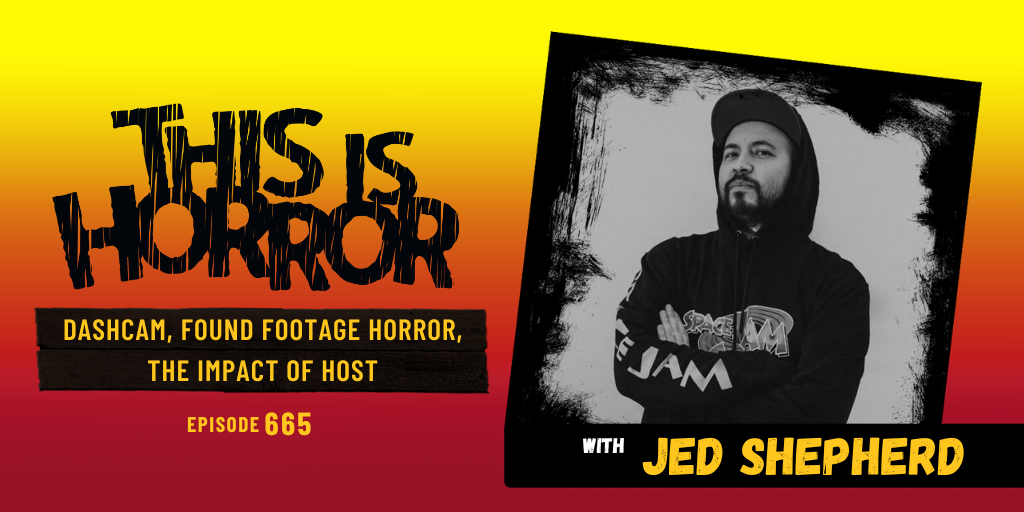
In this podcast, Jed Shepherd talks about Dashcam, found footage horror, the impact of Host, and much more.
About Jed Shepherd
Jed Shepherd is best known for Host, Dashcam, Flashback, and The Blair Witch Documentary.
Timestamps
Thanks for Listening!
Help out the show:
- Support This Is Horror on Patreon
- Listen to This Is Horror Podcast on Apple
- Listen to This Is Horror Podcast on Spotify
- Rate and review the This Is Horror Podcast on Apple Podcasts
- Share the episode on Facebook and X
- Subscribe to This Is Horror podcast RSS Feed
Let us know how you enjoyed this episode:
- Write a comment below.
- Follow us and get in touch on Instagram @thisishorrorpodcast
- Subscribe and comment on YouTube @thisishorrorpodcast
- Follow us and get in touch on TikTok @thisishorrorpodcast
- Tweet us @thisishorror.
Resources
- Jed Shepherd
- Watch the video version of This Is Horror Podcast episodes, including our conversation with Chuck Palahniuk on YouTube.
The Girl in the Video by Michael David Wilson, narrated by RJ Bayley
Listen to The Girl in the Video on Audible in the US here and in the UK here.
They’re Watching by Michael David Wilson and Bob Pastorella
From the hosts of This Is Horror Podcast comes a dark thriller of obsession, paranoia, and voyeurism.
After relocating to a small coastal town, Brian discovers a hole that gazes into his neighbour’s bedroom. Every night she dances and he peeps. Same song, same time, same wild and mesmerising dance. But soon Brian suspects he’s not the only one watching and she’s not the only one being watched.
They’re Watching is The Wicker Man meets Body Double with a splash of Suspiria.
Buy They’re Watching in paperback and eBook right now.
Michael David Wilson 0:20
Welcome to This Is Horror, a podcast for readers, writers, and creators. I'm Michael David Wilson, and every episode I chat with the world's best writers about writing, life lessons, creativity, and much more. Today I am chatting with Jed Shepherd, the filmmaker and writer best known for host and dash cam. Now this is the second part of a two-part conversation, so if you missed part one, you can head back just one episode to 664 but as we've all at ease, you can listen in any order, so by all means listen to this one now and go back to part one when you're done, and today we dive deeper into Jed Shepherd's films, specifically dash cam, as well as get a load of great filmmaking and writing advice. So, if that sounds fun, get ready for an exhilarating one hour conversation. But before any of that, a quick advert break.
RJ Bayley 1:41
It was as if the video had unzipped my skin, slunk inside my tapered flesh, and become one with me.
Bob Pastorella 1:49
From the creator of This Is Horror comes a new nightmare for the digital age, The Girl in the Video by Michael David Wilson. After a teacher receives a weirdly arousing video, his life descends into paranoia and obsession. More videos follow, each containing information no stranger could possibly know, but who's sending them, and what do they want? The answers may destroy everything and everyone he loves. The Girl in the Video is The Ring Meets Fatal Attraction for the iPhone generation, available now in paperback, ebook, and audio. From the host of this Azora podcast comes a dark thriller of obsession, paranoia, and voyeurism. After relocating to a small coastal town, Brian discovers a hole that gazes into his neighbor's bedroom every night. She dances and he peeps, same song, same time, same wild and mesmerizing dance, but soon Brian suspects he's not the only one watching, she's not the only one being watched. Their watching is The Wicker Man meets Body Double with a splash of Suspiria. They're Watching by Michael David Wilson and Bob Pastrella is available from disease horror.co.uk Amazon, and wherever good books are sold.
Michael David Wilson 2:59
Okay, with that said, here it is. It is Jed Shepherd. On this is horror. So, for those who are really familiar with found footage and horror history, they might notice that the Zoom code in host is connected to Ghost Watch, and yeah, I love that Easter egg. I love that you've also got in flashback a return to Oz play, so
Jed Shepherd 3:35
yes,
Michael David Wilson 3:35
you're making repertoire to include at least a few homages, homages, even in all of your films.
Jed Shepherd 3:46
No, I don't think it's intentional. Well, obviously, obviously it is intentional, but I think that's just the kind of stuff I want to do, you know. And, like, I wear my influences on my, on my sleeve, so for, for host, like, there's, there's, you know, we pay homage to a whole bunch of things, but you know, Ghost Watch is a massive, massive influence. I'm on the Ghost Watch documentary on the Blu-ray as well, for Ghost Watch, because I, you know, I love it so much, and knows I know a disproportionate amount about Ghost Watch, and, like, you know I've, I've hung out with Leslie Manning and you know Stephen Volk, the director and the writer, a bunch of times now, and you know they thankfully never get tired of me asking them questions about Ghost Watch, I've interviewed them for things in the past as well, and you know, I'm very obsessed with Ghost Watch, because you know it was very, it's very influential in found footage, and I think a lot of Americans are now starting to, because you know, it was, it was, it was unavailable in America for the longest time, but now the shutter has it, mostly, and you know, people are doing screens of it. It, and you know, obviously, host, like, you know, we have a couple of the camera moves owe a lot to Ghost Watch, so yeah, it's ridiculous, but yeah, it's funny you mentioned the return to us thing in flashback, because a lot of people, because it happened so fast, a lot of people don't realize it, but I thought, you know, because, like, you know, it's a Netflix original, so I thought, okay, like, this is so unnecessary, but Netflix are paying for this, so I'm gonna have one little bit where it flashes back to very briefly to a school play with that was returned to us for some reason, and then all the kids dressed up like Tick Tock and Dorothy and the Wheelers and stuff, and it's funny, and in the front row that was meant to be the parents, then then Netflix execs, like in the audience as well, because they were there on set, and I was just like, you might as well be in it, but yeah, it was really fun, you know. And I have a costume designer and makeup artist I use on absolutely everything, so they did amazing work, you know, on this on these kids. So yeah, but you know, I went my heart, honestly, even, and my references are just out there to see, and they're quite obvious. And we turned to Oz, it was.. it's a real gateway horror, you know. It's one of those things that get people into horror, and I love that movie so much. So, yeah,
Michael David Wilson 6:36
yeah, I mean, when I was younger, I, of course, to begin with, so the Wizard of Oz, but then you know the next step is watch the return to
Mick Garris 6:47
us, and
Michael David Wilson 6:48
holy shit, it like just it excited me in a way, for kind of horror and monsters, and just the surrealness that I don't even think I was aware of at the time, and you know it totally holds up today,
Jed Shepherd 7:06
does it really, really does, and it's still scary, and like the practical effects are so good as well, and and you know Fritz, a bulk as the, as Dorothy is incredible, the pumpkin head, and it's all so good, and the kind of stop motion claymation effects on some of it as well, with the, with the Gnome King, is so good, and you know, to this to this day, like Jenny, it doesn't even need to be anyone else around me, every time I see something green, I touch it and say Oz, like they do in the film, like genuine life, that you'll see me if you see, if you see me walking down the street, there's something green I will touch and say Oz, but it's like out happy now, I just can't help
Michael David Wilson 7:52
it. Yeah, no, I'd love for them to, you know, put it back on the big screen. I want that cinematic experience, you know, I've never seen it at the cinema,
Jed Shepherd 8:02
really. Well, that's the beauty of being in London, because,
Michael David Wilson 8:05
yeah,
Jed Shepherd 8:06
the Prince Charles cinema, like, shows it sometimes.
Michael David Wilson 8:08
The Prince Charles is so good, like, you know, when I was living in London, I would get there as often as possible, because there were so many obscure things, and there were, you know, premieres, or I guess exclusive showings of horror movies, like independent horror movies that you weren't getting anywhere else.
Jed Shepherd 8:28
We had a screen that flashed back out at the Prince Charles Cinema, and they put my name on the marquee outside, and that was that. That was it. Been up there for like a couple of days, and like I hadn't realized, I hadn't checked my social media as well, so on social media, and everyone's asking me into pictures of them with my, my name on the market, and was like, oh my god, why didn't anyone just call me and tell me, because I didn't know they were going to do it, and yeah, so I love Prince Charles. There's another new kind of indie cinema that's opened in London, called The Nickel, and it shows kind of like almost like ground grind housey type movies read obscure, more obscure than the Prince Charles, you know. It's a 50 seater as well. They have like VHS there, the bar downstairs opened, I think, October last year, so it's relatively new. But the nickel in London is really cool as well. You'll see some real obscure horror movies in that place. Love
Michael David Wilson 9:20
it. Yeah, I haven't been back to the UK since it opened, so then yeah, the next time I'm in the UK, whatever's on, I'm gonna go and see.
Jed Shepherd 9:30
Oh yeah, they do really cool double builds as well, of just the most bizarre movers. Great place, great place.
Michael David Wilson 9:36
Yeah, yeah, and I mean going back to Ghost Watch, I mean, I feel we've had some really defining moments in the found footage sub genre, and I mean that would be Ghost Watch in 92 The Blair Witch Project in 99 I think Paranormal Activity in 2007 And now host in 2020
Jed Shepherd 10:03
yeah, I would put, I put wreck in between that as well, I put wreck in between, okay, wreck, and
Michael David Wilson 10:10
I love Lake Mongo, but I recognize that, unfortunately, it's not quite tapped into the overall kind of mainstream, so a
Jed Shepherd 10:20
bit of a slow burn, but it's an incredible movie. Yeah, but yeah,
Michael David Wilson 10:24
so to have host in that conversation and to have been brought up on things like Ghost Watch and The Blair Witch Project. I mean, what is that like for you? And did I mean, I guess from what you were saying before, you probably didn't anticipate that, because you know you were just putting something fun together.
Jed Shepherd 10:49
Yeah, but you know, like Jenny, horror has been horror movies have been, and horror literature has been part of my life since such an early age, and I think you know it's the 10,000 hours thing, if you put that much passion into something, eventually it's going to pay off. I do truly believe it. And you know, I spent so much time, like, like dissecting horror movies. My friends go into horror movies, going to like video shops, and ask them for their list, remember video shops used to have, like, a special list, just go in and go, can I see the list, and they would bring out a list underneath the counter of all, like, the crazy horror movies they had that they've imported from around the world, you know, I just love that stuff, and I mean, it's extremely humbling and unbelievable, really, that you know, hostess in that conversation, and, and you know, I still can't believe it, you know, it's still very recent to me, like, like I still can't believe it, and you know, it's one of the highest rated, not just horror movies, but movies of all time, on Ron Tomatoes, they in December, I think it was, they named it the seventh best horror, seventh best horror movie of all time, and it's, you know, it's every year, it's either first or second and scariest movie of all time, as well, on those lists, and it just absolutely blows my mind, because I didn't, yeah, I didn't expect it, and you don't expect it from, you know, some British guys from, you know, and yeah, we don't have too many movies in that conversation from over here, so yeah, it's crazy, it's hard to describe, I remember it was maybe like a week after host came out, and you know, me and Rob, and the door, the bubbles were open again, because, like, you know, Boris Johnson had let us out for a little while until the next lockdown, but I remember me and Rob lived on the same road, so you know, we would hang out every day, basically, and we went to our local Greasy Spoon Cafe. This is a week after host came out, and we were there eating egg and chips with the TV on, and we looked up, and there's us on ITV Primetime News being interviewed, because there's a delay in they record it in advance, basically by a little bit. So we just done the interview with ITV News, like 6o'clock news. They went to this cafe and sat there just to talk, and then we see ourselves on this big screen, and everyone in the cafe is looking at us like, and we were just like, this is so strange, this is so weird, and then you know we did like interviews for the BBC and stuff, and, and it would just, you know, people came out of the woodwork and were just, oh my god, just saw you in TV, like, what the hell, and you know, in the host letter, everything really, and, and you know, and those films you mentioned, I'm friends with, genuinely friends with most of those people who made those movies. Now, you know, Eduardo Sanchez, who wrote and directed the Play Witch Project. I went to dinner with his family two weeks ago, you know, and I've been to his house, and you know, took a tour of his Star Wars toys, and we've hung out in the woods together, making stick men and stuff, you know, it's crazy, and the same with the Ghostwatch guys, you know, I've had dinner with them multiple times now, and yeah, it's insane, and it really sometimes I forget the influence host has had on on British film, and also just horror in general, because you know, like the Blair Witch Project. After the Blair Witch Project, there were a lot of kind of copycat fan footage films that came out, and host, there's a lot of movies very similar to hosts that came out straight, straight after, and. Still, now, actually, but I kind of enjoy them, because, like, it's flattering. So, yeah, you know, it's very interesting seeing people try and capture what we did with host, and it just proves how difficult it is to, and how well everyone involved did with hosts, especially the cast, because that friendship dynamic cannot be replicated, and people, people have tried, but the thing is, they were real friends, you know. They're so, yeah, it's crazy to me. I don't quite understand what's going on,
Michael David Wilson 15:34
and I mean, I haven't asked, but How did the Bloom House deal come about?
Jed Shepherd 15:41
Host, basically, because you know, blew up straight away, like literally day one, the same day it was released. I remember reading, I think it was bloody disgusting, or George Central, one of them, they posted, this is the scariest movie of the decade, you know, not scariest movie of the year, scarce movie of the decade. We were like our hosts, like, because we, because you know, because we didn't see like that, and we were like, okay, that's interesting. Then all the interviews requests started coming in, like literally 20 a day. We were like, what is going on, and then we know we get all the TV requests, all the radio interview requests, and we were like, this is this is something, and then just universally, just all the reviews started coming in, and they were just like five out of five, five out of five, and you know, the for the longest time we were 100% of Ron Tomatoes, until I think maybe just like last year, and it dropped down to like 99 or wherever it is now, but yeah, it's insane to me, but yeah, sorry for the Blumhouse thing, so because you know they they they're good at what they do, Blumhouse, and they find up and coming filmmakers, so you know we were on their, we were on their radar before host, we'd had a bunch of means with Blumhouse to see if anything clicked for two or three years before host, but because of host, they already knew who we were, so they were like, okay, we want you to come and do some stuff with us, and yeah, that's how it works, that kind of how it works for everyone, you make, you make one film, and then Blumhouse comes call him, basically. If anyone liked the first one, yeah, was simple as that. Really, really simple.
Michael David Wilson 17:30
And so then a year later, you released Dash Cam. So, for those unfamiliar, what is the elevator pitch for Dashcam.
Jed Shepherd 17:43
Dashcam is about a woman who live streams from herself rapping from a car, and she, she does this in LA, but she wants to get away from everything in LA, from, you know, politics and COVID. stuff, so she comes to the UK to see her old bandmate stretch, who they were, who she was in the band with, and she proceeds to make his life a living hell, just being a complete crazy person, and steals his car and picks up a is paid to pick up a woman, and she thinks this is just an Uber lift, Uber ride, but the woman turns out she's possessed, basically. Yeah, and that's basically what it was. And after host, we could pitch anything, and it would get made, really. So, but we had the idea for dash cam before host, and I think we'd already pitched it to Blumhouse, and they passed. I want to say that, and then afterwards they will come back, we will do dash cam, but yeah, like dash cam is so Annie Hardy, who's the leading dash cam, she really does do that in real life. She drives around rapping in her car on livestream, and I've been friends with her for like 10 years at least. Like I said, when I had a.. she was in the band called Giant Drag. They were pretty big, you know? Played Coachella and played all over the place. She was named Enemy, Enemy's top 50 coolest people in the world. You know, a few years back, so I've been friends with her for a while, and you know, I've been in the car, in her car, when she, she always drives me around LA, stayed at her house, you know, and I've been there when she's doing her boundaries. People write suggestions on the chat, and she drives around, she raps to it. These funny rhymes are always like blue. I was like, you know, Annie, I can see this being a movie. So, yeah, I pitched it to Rob. I was like, I got this idea for a horror movie. This lady called Annie Hardy drives around, she picks up a hitchhiker, or she picks up someone that person's possessed. And then she has to deal with that, that's that was kind of the the elevator pitch, and you know, sent sent Rob a whole bunch of Andy's videos, jumped on Zoom, spoke to her, and yeah, we wanted to do the same thing as host, and we wanted it to be, you know, as real as possible, but you know, with absolutely fantastical elements, because we had a much bigger budget, much bigger budget, so we knew we could, you know, throw the kitchen sink at it, and yeah, but we still had it was the second lockdown, so we couldn't go to LA, so we, because the whole thing was going to be set in LA, but we couldn't do that because of lockdown, we weren't allowed in America, so we got Annie to come to the UK, and because that was a lot easier, and yeah, we shot it around Margaret, and you know, parts of parts of Kent and Norwich, so Norfolk, yeah, and we made this crazy movie, and our whole thing was, you know, we wanted it to be almost like the anti-host, an antidote to host, and to try and inject some actual horror back into, into horror movies, and yeah, we, I think we achieved, we achieved making a movie that is unlike anything else that has come out of the UK.
Michael David Wilson 21:26
No, I think that's an accurate statement, and I mean, while Host goes all out in the final 10 minutes, Dashcam is all out within the first 10 minutes, and then it just never stops, and I mean, so it almost feels like they're in the same universe, and dash cam is a continuation of the madness of host.
Jed Shepherd 21:53
Yeah, I mean that that was our first plan. Our first plan was for it to be set genuinely at the same time as host, and I guess it technically is, because it's like, you know, lockdown times. Yeah, there is. There is obviously a crossover, because Gemma's in it, and Gemma's called Gemma in it. And we do, you have to kind of watch with a fine tooth comb, because there are a lot of references to host in it as well, lots of crossovers in the, in the chat, you see people talking about, like, did you hear about those, those girls on Zoom who died, and all that kind of stuff, and so there is, there is like a lot of crossover, a lot of crossover, so especially because, like, sailing from Host is the woman that pays Annie to take the possessed person, so you know that has that crossover as well, and actually Rob put Sailing in Boogeyman as well as a psychic, so you know, I guess that there's even an even more extended universe there, but there is, yeah, you know, it's, it's an absolutely insane movie, and, and I think as time goes on, more and more people are discovering it, and yeah, it fills me with joy to that people have watched this crazy movie, yeah, that we made in the second lockdown,
Michael David Wilson 23:19
yeah, yeah, and much like Host, this was co-written again with Rob Savage and Gemma Hurley. What did the co-writing process look like? And I mean, was it a case of one of you taking an initial pass, or were you writing this in real time? I know that you said that you had the idea to begin with, but I wonder what the logistics looked like.
Jed Shepherd 23:47
Yeah, we were a little bit more professional on this, even though we wrote it literally a month after host came out. We wrote it in like August, September, and hosted come out on July 31 so it was like immediately after host, but I had, I had become friends with the people at Final Draft, and so I think I got Rob Final Draft, and maybe an update for Gemma, but anyway, they had in the new version of Final Draft, they finally fixed their collab collaborative feature, because it's been terrible for years in Final Draft, it like always crashes, but yeah, we use the collaborative feature and final draw, so we basically all had the script in front of us, and we were just like type away suggestions, and then, and you know, just fill it out as we went along, very similar process to host, really a collaborative document, just filling in things, but I would say with dash cam, there was a lot more. It was a much bigger document than the one we had for host, because you know, so much happens, so it was a little bit more planned, and, but still, I would say it took us, I don't know, a week, two weeks maximum, to write it and. Um, and yeah, what you see on screen is pretty much almost exactly what we, what we wrote. So, obviously, Annie, you can't predict sometimes what she's going to say, and there's, there's improv element with any, like with any fan footage film, but you know, it's pretty faithful to what we originally wrote, besides it a couple of things towards the end, but yeah, it's fun to work that way, because, like, we, and again, I think, because it happened so fast, we want to do another fast movie, we didn't really think too much about, you know, doing multiple drafts, like I think I want to say maximum we did like two drafts, three drafts, maybe, and then yeah, and then and then we made it, and then released it the next year, because the post, and that one took a little bit longer, because of all the million VFX and stunts in it, like, and be no crazy, crazy stuff, but again, like it was, it was made up of a lot of the kind of horror set pieces that you know me and Rob had in mind for the longest time, and we wanted to put on film,
Michael David Wilson 26:11
and of course, with Annie Hardy, there's a real energy about her and a certain amount of unpredictability, so what was it like working with her?
Jed Shepherd 26:25
Annie, Annie's awesome. I think she rubs people up the wrong way, and I can understand why, because sometimes she has no filter, and we live in a world where that is not necessarily enjoyed by a lot of people, and I can completely understand that sometimes she is her own worst enemy, but Annie is honestly, she's a lovely person. And so, what we did with Dashcam is we wanted to show people what it would be like if someone who has slightly different views from you is the protagonist of a horror film, you know, the horror audience is very left leaning, so we were like, the real horror here is you're empathizing with a character that doesn't isn't like the normal horror movie protagonist, and I think in general people seem to have a problem with problematic women as protagonists, if it was a man, they would have an Oscar, but because it's a woman, people have a problem with that, and so she got a lot of, well, she got a lot of hate, she gets a lot of love too, but she got a lot of hate for her, because people hated her character, and they think that she's exactly that person, but I promise you, Annie isn't roaming around stealing cars and fighting demons and blowing things up like she's really not doing that. She's in her house, knitting, like genuinely looking after her chickens. So, yeah, no, Annie Annie is awesome to work with, no problems at all.
Michael David Wilson 28:04
Yeah, and while she was playing exaggerated version of herself, obviously, as you've alluded to, some members of the general public or the audience perhaps didn't get that and thought it was a more faithful interpretation of Annie, so I'm wondering, were there any controversies as a result of Annie Hardy and her character, and how did you navigate them?
Jed Shepherd 28:33
I remember when it first premiered at Tiff, so that was like a good seven eight months before it actually came out, so and the audience reaction was really good, but a couple of the journalists from there posted their kind of early TIFF reviews just saying that it was a very controversial movie because of the protagonist, and like, I just didn't understand that I was like, This Is Horror movie, we're meant to be horrified, like, why, why are we living it in a world that's so sterile that we can't tell fact from fiction, and that we were offended by, you know, a horror movie, horror movies are meant to, are meant to offend, it's a horror movie, it's not called the peaceful chill time movie, it's a horror movie, but you know, I think that made a bit more infamous, and that directly led to, I believe, to I think it was Odeon Cinema's band Dashcam, and it was funny, and we only found out because someone on Twitter or Instagram posted their chat with an Odeon staff member, because they were asking, "When's Dashcam coming out? on the on the live chat, and the Odin member, "We will not have that movie at Odeon, we do not believe in movies like this, and like. Like, so, and that got picked up by all the news outlets, and made people go, "Oh, what's this dash cam movie? And so I was like, "Why is this so controversial? And don't forget, a lot of people were called "Controversial, and they hadn't seen it, because it wasn't even out yet, but like the reaction from people, "Oh my god, I can't believe there's a movie where a woman does this, woman does that, and they hadn't seen the movie, so but the funny thing is it premiered at the London Film Festival at Prince Charles Cinema and got the best, the best reaction. Everyone still talks about that screening because people were hooting and hollering and jumping up, and you know, it was insane, and Paul, who runs the Princess Cinema, I remember him running past me halfway through the film, is sorry, I'm gonna puke, like, like, because it see, it seemed, you know, it affects them so much, you have to go puke in the outside, and I love that, especially at the London Film Festival, and it's funny, because, like, the film journalists over here and all over Europe actually absolutely loved it, but I think in America it was too close to home, you know, because we're holding a mirror up to what's going on over there, and they didn't like it, so it's real fun for me to see, because I think every other week, if you go on like the horror subreddit on Reddit, there's a post about dash cam, and and people fight to the death over dash cam. Some people absolutely love it, and then some people absolutely hate it. And for me, that's a successful horror movie, like I love that.
Michael David Wilson 31:41
Yeah, you don't want everyone to have a kind of lukewarm, oh, it was all right reaction, exactly what you want it to be, polarizing, and
Jed Shepherd 31:51
exactly,
Michael David Wilson 31:53
I mean, for Odeon to say, oh, we don't support or we don't screen films like that, I'd be like, well, like, like, what? Yeah, so
Jed Shepherd 32:05
hadn't seen it premiered at the London Film and blew everyone away, but yeah, and then it was, it was like literally on the TV, on the news, like dash cam band, blah blah blah, and we were like, what is going on, like, but like it's like everything we do, we're always just like, what's going on, like this is crazy.
Michael David Wilson 32:25
I mean, in a way, what Odeon did was give you invaluable publicity, because it's so bloody hard to have the equivalent of a video nasty, or to actually get these days. So they gave you a gift,
Jed Shepherd 32:39
they called it a video nasty, as well, like, and you know, like, but things are like, I read about all the video nasties, the most documentaries on them, and about how, you know, at the time, like, Sam Remy had to appear in court for the Evil Dead, because they, some people thought, like, a woman was really being attacked by a tree, and, and being abused and stuff, you know, he had to appear in court for that, and you know, and that's one of the best horror movies of all time, so it happens, but I actually don't blame anyone for not liking a movie or hating the protagonist, because you know, everyone's different, and I think as long as people watch it, and as long as people you know have some kind of feelings for it, like that, that's enough for me. The worst reaction would be, you know, absolute apathy, and, and just a meh response. But I don't think you could ever have a mere response with dash cam. It's either you love it or you hate
Michael David Wilson 33:37
it. Yeah, yeah, and I mean, what you're saying about Sam Raimi, it reminds me of a particularly nasty, visceral film called August Underground.
Jed Shepherd 33:49
Oh, yeah, yeah, those movies are crazy, yeah.
Michael David Wilson 33:52
And I mean, I believe with that there was a story where I think it was either the director or writer, and they, they were kind of being held because they felt like this is a snuff movie, this woman is dead, and she actually had to appear to prove, like, look, it was a film, but
Jed Shepherd 34:14
yeah, some kind of a holocaust, like they had appear in court as well, and brought the woman that was on the spike to say, look, she's alive, she's not dead, but yeah, you know, it's all the stuff wrapped up with interest and horror films. It always has a kind of reaction, and I think it's, you know, quite interesting, the reaction something like dash cam got overseas with, with in America, compared to in Europe, where you know there was literally a, I think it was an independent or Guardian article about dashcam saying that these guys are, you know, generational talents and stuff, and then over in America it's like these guys are warped. Crazy, you know, yeah, since it was like, hey, we're just two guys like in London, you know, it's nuts, but hopefully, hopefully you know that changes, but and I also think, because we're British, people don't expect that kind of be from British people, they expect you know, Kieran Knightley swung and around in a, in a, in a see-through dress, you know, like not flipping Annie Hardy, having to clean up, vomit, and puke, and piss, and shit from a car, and slipping in piss, and you know that's not what they expect from a British movie, so
Michael David Wilson 35:43
yeah, I think the craziest decision from Annie Hardy, the character in that film, is just that she takes the woman into the car to begin with, it's like it's very clear that she is not in a good way, so almost the most unbelievable part, which is ridiculous when you think about all the things that happen, but it's like you,
Jed Shepherd 36:09
yeah, we thought as well, but like I think I remember saying, okay, here, here's where we should say like Annie doesn't, Annie was like, nope, I don't want to do it, and then she gets offered the envelope of money, and then it cuts to her, saying, you know, I'm a really nice person, people call me a really nice person, because, you know, she just did it for the money, you know, there's loads of crazy stuff in there, you know, sometimes I watched Dashcam, and I haven't watched it in quite a while now, but, like, the last time I watched it, I was just like, I can't believe we made this movie, because it's, it's like insane, and like, just the, the audacity of us doing the things we did, like, you could only make that movie coming off the back of something like hosts, because no one else would have let us make, make it, so I'm really happy that we got to make our evil there too, basically.
Michael David Wilson 37:00
Yeah, I mean, when I was talking to Mick Garris, I was talking about how wild sleepwalkers was for the time, and some of the things that they put in there. I mean, I say for the time that would still be pretty fucking wild if it came
Jed Shepherd 37:16
out. Mick's a good friend of mine, like we were like I was just hanging out with him in LA, and he's always in London as well, so I hang out with him every time he's here. But Mick is one of the most incredible filmmakers you'll ever meet, and I know I have listened to the episode you did with him, but like I'm sure he had the best stories, because like every time I'm with Mick, I learn something about filmmaking, about life in general, like he's a wise person, and yeah, just just a real great guy. He's coming back over here soon as well, so I'll get to hang out with him again. I always love me and him. Last time we went to Milt, I took him to Milton Keynes to.. we went to see Inside Number Nine on stage, and Milton Keynes, because yeah, Mick loves Inside Number Nine, and Inside Number Nine guys, so yeah, but crazy times,
Michael David Wilson 38:11
yeah, I mean, Inside Number Nine is one of, if not my favorite anthology series,
Jed Shepherd 38:17
so
Michael David Wilson 38:18
I mean, actually, like, if, if you count Masters of Horror as it, which it is an anthology series, but because each film is made by someone different, it's a bit of a niche. Then, yeah, Masters of Horror and Inside Number Nine would be tied for first place.
Jed Shepherd 38:37
Both, like, Inside Number Nine is incredible, and just the fact I love all those guys, Steve Pemberton, Reese Sheer Smith, you know, and obviously the League of Gentlemen guys was with Jeremy Dyson included, like bringing horror to British TVs is so rare, and they've managed to do it for the longest time, and then they use their skills to transfer it to the to the theater as well, and you know, with Jeremy Dice, the ghost stories, and then dated inside number nine, and like those guys are so amazing as well, and I've got, I've got to know them over the last couple of years as well, and it's, it's been really like awesome, and you know, yeah, I want to see more stuff from them,
Michael David Wilson 39:19
yeah, and of course, not forgetting Psychoville, which was
Jed Shepherd 39:23
Psychoville, yeah, so good, yeah, amazing guys, and hopefully I get to work with them on some stuff soon.
Michael David Wilson 39:34
Wow, that would be really fascinating to see what you know together you all come up with, so
Jed Shepherd 39:42
yeah, it could be sooner than you think, and never know we'll see.
Michael David Wilson 39:45
Fingers crossed, fingers crossed, and I mean Flashback, which came out in 2023 and is a short film on Netflix. This is tonally very different, I. Love, too, that you're setting up that the only thing people can expect is the unexpected, or to not know what you're going to do, because you know, host to dash cam, that was one thing, but it, but there was almost a logical continuation, but
Jed Shepherd 40:19
yeah,
Michael David Wilson 40:19
dash cam to flashback, it's so understated. There's something very poignant and beautiful. There's a reflection on life and death. It's
Jed Shepherd 40:33
of
Michael David Wilson 40:33
course has something very Groundhog Day and Russian Doll about it. So,
Jed Shepherd 40:38
yeah,
Michael David Wilson 40:40
what was the experience working on it, and how did it land with Netflix?
Jed Shepherd 40:47
So, Netflix came to me, they, they approached my manager and said, 'Hey, what's Jed? What's Jed got? And it was got any ideas to work with us, and they wanted, they were like, okay, we do this thing every year, which is called the Immersion Filmmaker of the Year thing, and they wanted me to be the Immersion of Filmmaker of the Year for them, 2023 and I was like, sounds good to me, and then, so basically, they were like, okay, we'll make this little short film, and then we'll see where that goes, so yeah, it was a Netflix original from the start. They came to me wanting to do it, and then you know, I had a bunch of ideas, and you know, I pitched them a whole bunch of things, more some of them more horror, but this, but Flashback, who was just basically a sci-fi film, that's the one that they grabbed onto straight away, and so much so they made me sign the contract for the feature length version, like there and then as well. I had to sign the feature version that you know I'm going to write at some point over to them too, and it was fun because you know had a really good team, and used a lot of the same people I always work with. Gemma's the lead in this again, like, and actually, all the host girls are like, you know, bling and you'll miss it, but all the host girls are in flashback. I just want to do something a bit different as well, like, you know, because people know me for, you know, horror and scares and stuff, and I want to do something that was a little bit more, you know, meaningful and emotional, and one of my favorite movies of all time is, and again, a lot of people may not have seen this, but it's a 1980 Christopher Reeve movie called Somewhere in time, and it's, it's Christopher Reeve, is the lead, and he plays a writer playwright, in fact, and he falls in love with a picture of a woman from the 1920s and he is obsessed with this picture, and so much so that he goes back in time and to find her and make her fall in love with him. And I absolutely love everything to do with that movie, and not enough people have seen it. Amazing soundtrack, and I watch that movie all - it's my comfort movie. I watch it all the time, and yeah, it's pure sci-fi. And Jane Seymour plays the woman he goes back to time to see, and in that film there is no time machine, it's he does it through thought, like he, because he obsessed with us so much, so much, so that you know the space and time isn't anything compared to the love he has for this woman that he's never met before, so like I have that in the back of my mind. Okay, a time travel movie without a machine, that that I kind of like that idea, but then, but then I wanted to tie in like a kid's TV show in a monster, so yeah, so Dr. Bones was born, and I think I had the Dr. Bones theme song in my mind for a long time, I don't know why, like even before, like flashback, and you know, working with Netflix, and you know, I knew that I could do a few things I wouldn't be able to do before, like, you know, you know, Netflix have a bigger budget. I got to meet everyone at Netflix, all the different departments, and I learned a lot from that process, just what all the departments on Netflix do, and really, really interesting, and you know, the VFX in Flashback are like unbelievably good for a short film, the kind of time travel spinny sequence, which you know, like I can go back to that to point to people like this is what I can do if you give me the money, I can do a swirly time travely thing if you want me to, but like yeah, the great thing with flashback that I'll always remember. Is that, you know, obviously it was great working with Netflix, but, but Sam Raimi was my mentor on the whole project as well, so I would, you know, talk to him about the script, and then in production, like he was helping with that too, then in post he helps with my edit and some of the effects and things, so he helped me all the way through it, which was, which was really, really cool, just just to be able to bounce ideas off someone like Sam Raimi, because you know he's experimented with like different genres as well, like he's done sci-fi and superhero and dramas and you know stuff, so yeah, and he was loving it as well, so and I also like, and another thing I wanted to throw, I was like, I really want to do something in a laser quest, so I was just like, oh, Netflix have money, let's, let's go, let's, let's go have a big scene with loads of kids running around with lasers in a laser quest, and yes, so he did it, it was like me playing in, like, a you know, someone else's toy box for a little while, and you know, like made like a Dr. Bones arcade machine, and yeah, it was so cool, and you know, like, because, like, all the host girls were there as well. It was, it was really nice, and yeah, really interesting.
Michael David Wilson 46:20
Yeah, laser quest feels like such a British birthday party event, like so many
Jed Shepherd 46:28
childhood
Michael David Wilson 46:29
memories. Yeah,
Jed Shepherd 46:30
yeah, the scene where you see her birthdays as she kind of gets older until she's like 13 or something, you know, and like the laser quest like changes to kind of to match that it's a yeah you know it's really cool to be able to do in real laser quest one of the actual real laser quest left in London in Enfield in fact we filmed it in, so yeah, it was fun, and you know, Pip's in it. Pip plays Gemma's dad, but little Gemma's dad, and yeah, it's great to work with him on that. And Amma, who was in dash cam, he plays Stretch in Dashcam, he plays Gemma's boyfriend again for the second time in this, I just like working with the same people over and over again. It just makes it easy for me, because I know them, they're my friends, and if I could, I would just cast my friends in it, and everything. It would just make things a lot easier, and Netflix were like, so, so open to me, just, you know, basically doing it my way, and they trusted me, and you know, we, the great thing with Netflix is they show you the stats, you know, of how many people have watched it around the world and stuff, and you know, it exceeded expectations like a lot, and but weird, it did really, really well in Japan, coincidentally, it did. I don't know why. Like, no one can figure out, did really well in Japan, did really well in India, did really well in South America, like above America, above North America in the UK. Insane.
Michael David Wilson 48:17
Yeah, I know that in Japan, host is just simply called Zoom, because I rewatched it ahead of our conversation, and you know it was like, oh, it's called Zoom,
Jed Shepherd 48:30
yeah, it's called Zoom, yeah, and you know, I remember like Emily at Shudder saying, okay, like in different regions, it would work better under different names, and I was like, really, just wanted to be called host, but she was right, you know? I think in Mexico it was called Don't Pick Up the Phone, for some reason it was called that, and then in Russia, weirdly, it was called Astral two, because there was a movie, that horror movie, that's really well over there, called Astral, so they wanted to, so the distributors over there was just like, oh, let's, let's make this a sequel to Astral, so it was called Astral Two, and it did well over there too, so yeah, it was very interesting, though, you know, because it was really my first foray into like releasing something worldwide, so yeah, I learned a lot from from that process.
Michael David Wilson 49:30
I wonder what even the legalities are of just like right, Astro did well, we're gonna call it Astro to like, and can I be like this is the remains of the day to slap it on,
Jed Shepherd 49:44
yeah. Well, I like, I haven't even seen Astral, but like, I'm guessing it was there, was similar in theme, I have no idea, but they were so sure, and they were right, it worked, so yeah, and like you. It's called Zoom in a bunch of places around the world as well, which I wonder, how Zoom feel about that, because then I don't know if there was permission to be to name it after their actual app, but yeah,
Michael David Wilson 50:16
yeah, I imagine that they surely can't have copyright on the word Zoom, because it's too common a word, but you know that the WWF World Wildlife Federation sued the wrestling company, so who knows
Jed Shepherd 50:37
exactly, exactly, but hopefully you know, hopefully in those regions where they saw it under different names, they did a little bit of research and they saw it as host, though I do have the posters of like we're saying Zoom and you know the other regions, I have all those posters because it's quite funny to me.
Michael David Wilson 50:58
Yeah, yeah. Now I wonder, what does a typical working day and a typical working week look like for you? Because obviously you have a number of projects, you're writing, you're pitching, you're going on set. What is a typical day in a typical week,
Jed Shepherd 51:22
you know. I wish there was a typical day in a typical week, but it's, it's always different. Like, I can tell you what I'm doing, like, like Monday, like I've got, I've got a script I need to finish a new draft of. I am on a project, which is coming out on the on BBC One on Halloween, can't say what it is, but you know it's that Ghost Watch slot, that juicy ghost watch slot. So I am really happy about that. So I'm that's being filmed right now, so I'm on, I'm on on call for that, I'm a, I'm a producer on an upcoming movie, it's another found footage movie, but it's with a very, very big director, we're producing it together, and it's been released through a big studio, so that hopefully that's soon. I think we will start sharing that this year. I've got a folk horror film that we are casting right now, so I've just got an update today about the casting on that. Yeah, I'm a producer on a whole bunch of other projects as well, and pitch in a whole bunch of things, but you know, it's you have to have a lot of irons in the fire because you don't know what's gonna spark, you know, you don't really know, so yeah, but that's the thing, creators have to be creative in order to keep doing this stuff.
Michael David Wilson 53:05
And do you have a typical time when you prefer to write, or that you set aside as your writing time?
Jed Shepherd 53:14
Yes. Well, it's actually changed recently, because it used to be 9am to 12 would be solid writing, and I got that from one of your former guests, actually Paul Tremblay, and he got that from Stephen King. So, yeah, because, like, I'm friends with Paul, and you know, I'm always asking questions about writing, but he's asked, he asked me questions about writing them, like, Paul, you're the master, you wrote Headful of Ghosts, one of the greatest horror books of all time, but yeah, he said, like, he writes in the morning, basically, and then stops, and then you know, does his life admin stuff, and spends time with his kids, and stuff, and I think that's really useful to have a set time every single day to do your writing, and then you know, spend your life living rather than procrastinating at a blank screen, so yeah, I always set like a block of time, like three hours a day, but it used to be in the morning, but now I am much more productive in the evening times, so these are right, are right under the cover of darkness now, I put Music on, and it's always a sound, a soundtrack to like what the potential move is going to be. So I put, like, I make a playlist, I play that one writing to get me in the mood. Yeah, I love doing stuff like that.
Michael David Wilson 54:34
It's interesting that you bring up Paul, because I would say, in terms of books that we have, that a head full of ghosts is as close to a found footage book as we've got. Although recently Josh Malamun, with incidents around the house, has given a head full of ghosts a run for its money, in terms of like being the master of found. Footage horror books, but I mean, both for a sense you're reading.
Jed Shepherd 55:03
Oh, yeah, yeah, yeah. And with, you know, and both have been made into a movie right now. Like, I cannot wait to see Head Full of Ghosts, because I speaking to Paul, I know the process he's been through with that film and the adaptation of it. It's been a long road, and you know, obviously I was trying to get in there myself as well. I was like, Paul, you need to let me do this, and it's like, well, you know, these people have the rights, plus laps in some other people, but you know, then you know it's so, so highly sought over. So I believe that the version that's going to be made now is the true version, because previous versions weren't true to the book, but now this version, according to Paul, is closer to what he wrote, and what he wrote was masterful. So I cannot wait.
Michael David Wilson 55:55
Yeah, this happens often, that you know you'll have something that's up for film adaptation, and then for whatever reason the rights are let go of or lapse, but then the second person, or the third, or fourth, or fifth in some cases have a better vision, and so then the film that is ultimately made is the one that you would have wanted to have been made in the first place. I mean, at the moment I'm going through a similar process with one of my books, The Girl in the Video. It was originally with Netflix, and
Jed Shepherd 56:34
yeah,
Michael David Wilson 56:35
they had a script and everything, but it just veered a little bit too far from the original source material, but
Jed Shepherd 56:44
yeah, it was,
Michael David Wilson 56:45
yeah, yeah, but, but right now, you know, there's a new screenwriter on board, we're pitching it at the moment, and it's so just accurate as to what I wanted, so
Jed Shepherd 56:58
nice, that's cool,
Michael David Wilson 56:59
yeah, I think, you know, sometimes a no now is because there's a better yes in the future, right? I think that's a good way to look at things.
Jed Shepherd 57:10
Oh yeah, like positivity breeds positivity, like yeah, I'm always a glass half full person, and you really have to be, and I think you know, when all is said and done, and like I'm at the end of my life, I look back and be like, okay, I was mostly positive, which, which I think helps you more if you're always moaning, because I see a lot of people moaning online about, you know, their projects not being greenlit, and this and that, and I'm like, keep that to yourself, don't, don't we, don't need to broadcast that, you know, keep it to yourself or among your friends, don't spread negativity online, because that negativity will come straight back at you, but you know it's hard, because it's a real hard game, like trying to be creative, so I understand when people, you know, feel the need to vent sometimes.
Michael David Wilson 58:03
Yeah, I get it, but I also just try to get on with things. It's like, well, even if that one hasn't been greenlit, there's a ton of other things that I'm doing at the moment, and I just try and think about any action I take, what will it ultimately achieve? Me getting upset about something being passed on or not greenlit, or whatever it is, is not going to actually benefit me. It's not going to result in a good opportunity. So I think if I'm really upset, it's like, okay, fine, give yourself five minutes to be upset about it,
Jed Shepherd 58:43
yeah.
Michael David Wilson 58:43
And now move on,
Jed Shepherd 58:45
exactly, exactly.
Michael David Wilson 58:48
But I mean, we're coming up to the time that we have together today, yeah. I want, before we go, there is a video game that you have in the works called Ghost, so yeah, I'm a little bit interested to find out about that, but I also want to know about your journey as a gamer, as a fan of horror video games. I mean, is this something that you've been into for a long time? Do you remember the first horror video game that you played,
Jed Shepherd 59:21
yeah. There's actually a documentary coming out while I'm in it. We're talking about this very thing, yeah. I think the first horror video game I played was the original game, I think it was for the C 64 maybe it was the Amiga for Friday the 13th, which I love to this day, I still love how scary that game is, and it's like, you know, eight bit, and it's still scary, and the music's scary, but my video game is a live-action video game, you know, with the host girls, and it's been a long process, but finally it's. It's going to come out, and it's fun, because, like, the thing is, with, like, being a storyteller, you want your stories to reach as many people as possible, and the game industry, the games industry is far bigger than the film industry, like, think five times bigger, so if you want to tell a story, you know, and you wanted to reach as many people as possible. Video games are a real star, and the crossover between video games and films, you know, they're becoming.. it's becoming a paper thing. I just watched Exit Eight. I went to a screen of it a couple of days ago.
Michael David Wilson 1:00:37
I literally watched it a day ago, too.
Jed Shepherd 1:00:39
Yeah, it's so good. I think it's the best video game adaptation I've ever seen, and such a good movie. I love it. And you know, most people won't even know it's a video game, which is great, but the film is great as a standalone. And I think horror filmmakers, especially, should look into video games, because it's becoming easier to make. It's becoming, you know, you can learn how to do some of the stuff yourself, but, like, there is a lot of crossover between the video game audience and the film audience, of course. So, yeah, we're gonna see that a lot, a lot more. I was, I had a meeting last week, I was.. I've been offered.. maybe I shouldn't say this, but I'm gonna say anyway, I've been offered to write and direct a popular video game adaptation, and so that process is happening as we speak. We'll see. I don't know, I don't know if I want to go down that route, but you know I'm letting the process happen organically and sit and see what happens, but it would be, it would be a real interesting one to do, see what my take is on that particular video game.
Michael David Wilson 1:01:53
Well, I'm totally intrigued about that, and I might have to ask you off air we're talking about here, but to kind of finish, I want to know what is the best and what is the worst writing advice that you have ever been given.
Jed Shepherd 1:02:13
I think it was Paul Tremblay when he said just spend three hours a day writing and then go and do the rest of your life stuff, and honestly, that's been really helpful for me, because you know, I used to be the kind of person that would just sit in front of a blank page all day and just, like, just absolutely, you know, go crazy trying to, trying to make write something interesting, but then when I know I only have a short space of time, a small window to write in, it just, it just, it's so free in it, and it just comes out, and the rest of the time you can still think about it, and you can, oh yeah, so tomorrow I'm going to put this in, put this in, you can still make notes, and then the next day you have like a bunch of notes, you have a bunch of thoughts, and you write that in, and it just becomes a lot more organic and easy to kind of write if you set a certain amount of time, I think. So that's been really, really helpful, and I think that maybe the worst advice, and there wasn't one person in general, but I feel like, especially for screenwriters, some people feel that if you're not using the right software, you're not using the final draft, then you're not a writer. That's complete touch. Write on anything, write in notes, write it in Word, write it in Google Docs, like we did with Host. Doesn't matter if the story is good, the story is good, and if someone judges you because you haven't spent 300 quid on some software, then they're not the person you want to make, be making a movie with me. It does look nice, and final dress, final draft format. I will say that, but you don't necessarily need it. So, yeah, and just the other general advice that I would say for myself is just, just be nice to everyone, like there's no, it's free, and yeah, you can do it either, just just be nice to people, and if you see people doing well, support them, if you see people not doing well, support them, because that could easily be you in either of either of those situations, and you want people to kind of come around and support you, so just be very supportive to your fellow filmmakers, especially in the UK, because it's really hard, and, and, yeah, that's it,
Michael David Wilson 1:04:26
really all right. Well, where can listeners and viewers connect with you?
Jed Shepherd 1:04:32
I'm only really on Instagram now, so at Jed Shepherd, J E D S H E P H E R D. I do have a Twitter handle, but I haven't used Twitter in about two years, I think. Now, maybe a year, just because it's crazy on there. So, I really only use Instagram, and I barely even post. I'm gonna try and be that person that isn't on social media, unless I have something to promote, and maybe I will have to be. But yeah, you. Can find me on Instagram, basically, or in real life in London at horror events and screenings. I'm always there.
Michael David Wilson 1:05:08
All right. Well, this has been a tremendous pleasure chatting with you, getting to learn more about your films and your creative process. So, thank you very much.
Jed Shepherd 1:05:19
Thanks, Sam. Do
Michael David Wilson 1:05:20
you have any final thoughts to leave the listeners and viewers with?
Jed Shepherd 1:05:25
My final thoughts are watch the 1984 classic Night of the Comet, and because it's the greatest movie ever made.
Michael David Wilson 1:05:39
Thank you so much for listening to Jed Shepherd on This Is Horror. Join me again next time when I will be chatting with returning guest and former podcast co-host Dan Howarth about his brand new book, Drone. But if you would like that and every other episode ahead of the crowd, please do support the podcast@patreon.com forward slash This Is Horror. Now I would also like to tell you that my first ever limited edition hardcover is now available to pre-order from Thunderstorm books.com Thunderstorm are putting out a very special edition of Daddy's Boy, including bonus content. The new limited edition hardcover will include brand new artwork from Ben Baldwin, and you can see that at Thunder Storm books.com right now. A forward from David Moody, an afterword called Granddad's Boy, and a Daddy's Boy glossary, which is full of obscure references to minor celebrities and British phrases. Now, the print run will be determined by the number of pre-orders, so please, please do preorder in many ways. This is my most important release. It is certainly my most limited, and with a Daddy's Boy movie in the works, this could become a huge collectible in the future. So, again, to preorder the Daddy's Boy limited edition, head over to Thunderstorm bugs.com Okay, before I wrap up, a quick advert break
Bob Pastorella 1:07:31
from the host of this Azora podcast comes a dark driller of obsession, paranoia, and voyeurism. After relocating to a small coastal town, Brian discovers a hole that gazes into his neighbor's bedroom every night, she dances and he peeps, same song, same time, same wild and mesmerizing dance, but soon Brian suspects he's not the only one watching, and she's not the only one being watched, They're Watching is The Wicker Man meets Body Double with a splash of suspiria, They're Watching by Michael David Wilson and Bob Pastrella, is available from This Is horror.co.uk Amazon, and wherever good books are sold.
RJ Bayley 1:08:10
It was as if the video had unzipped my skin, slunk inside my tapered flesh, and become one with me.
Bob Pastorella 1:08:19
From the creator of This is horror. Comes a new nightmare for the digital age. The Girl in the Video by Michael David Wilson. After a teacher receives a weirdly arousing video, his life descends into paranoia and obsession. More videos follow, each containing information no stranger could possibly know, but who's sending them and what do they want? The answers may destroy everything and everyone he loves. The Girl in the video, is the ring meets fatal attraction for an iPhone generation, available now in paperback, ebook, and audio.
Michael David Wilson 1:08:48
As always, I would like to end with a clip from a previous episode, and today's clip is taken from episode 653 in which Mick Garris talks about his first experiences with and interest in horror. So, with that said, here is Mick Garris.
Mick Garris 1:09:14
I was always the oddball who loved horror, from the time I was a little kid. One of the first movies, the first movie I remember seeing was Son of Calm on television, and I was totally captivated by it. Then the whole Universal Horror package with my local TV station, you know, I discovered monsters and I ate them up, and then I discovered the monsters who are us rather than made out of body parts or kaiju creatures, or you know, Freddy Krueger's, and the like. The ones that scared me the most were the ones that didn't look like monsters, you know, Norman Bates, as opposed to the. The wolf man, that sort of thing, but I was bitten by it at a very early age, that I was probably five or six years old watching Son of Kong, and I was the only one in the family. I had three siblings, my mother and father, none of them were particularly drawn to the genre, but I was the quiet, weird kid who was also class clown and loved monster
Michael David Wilson 1:10:33
movie, and if you want to listen to the full episode we'll make, you can listen to episode 653 of This Is Horror Podcast, or if you want the video version, it is available on YouTube, youtube.com forward slash at This Is Horror Podcast, and if you would like other inspirational clips from past episodes. Please do follow us on TikTok and Instagram at This Is Horror Podcast. Well, that about does it for another episode. So, until next time with Dan Howarth, take care of yourself, be good to one another, read horror, keep on writing, and have a great, great day.