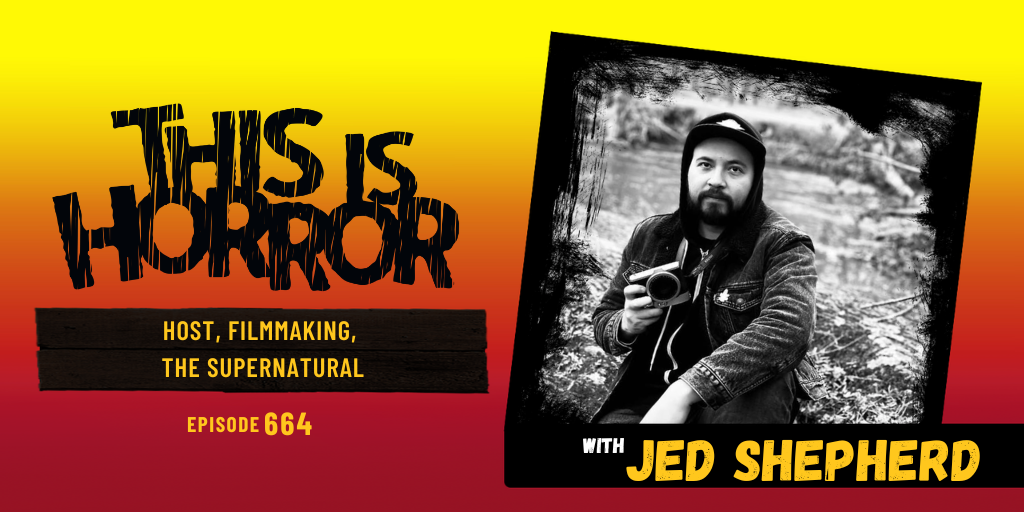
In this podcast, Jed Shepherd talks about Host, filmmaking, the supernatural, and much more.
About Jed Shepherd
Jed Shepherd is best known for Host, Dashcam, Flashback, and The Blair Witch Documentary.
Timestamps
Thanks for Listening!
Help out the show:
- Support This Is Horror on Patreon
- Listen to This Is Horror Podcast on Apple
- Listen to This Is Horror Podcast on Spotify
- Rate and review the This Is Horror Podcast on Apple Podcasts
- Share the episode on Facebook and X
- Subscribe to This Is Horror podcast RSS Feed
Let us know how you enjoyed this episode:
- Write a comment below.
- Follow us and get in touch on Instagram @thisishorrorpodcast
- Subscribe and comment on YouTube @thisishorrorpodcast
- Follow us and get in touch on TikTok @thisishorrorpodcast
- Tweet us @thisishorror.
Resources
- Jed Shepherd
- Watch the video version of This Is Horror Podcast episodes, including our conversation with Chuck Palahniuk on YouTube.
The Girl in the Video by Michael David Wilson, narrated by RJ Bayley
Listen to The Girl in the Video on Audible in the US here and in the UK here.
They’re Watching by Michael David Wilson and Bob Pastorella
From the hosts of This Is Horror Podcast comes a dark thriller of obsession, paranoia, and voyeurism.
After relocating to a small coastal town, Brian discovers a hole that gazes into his neighbour’s bedroom. Every night she dances and he peeps. Same song, same time, same wild and mesmerising dance. But soon Brian suspects he’s not the only one watching and she’s not the only one being watched.
They’re Watching is The Wicker Man meets Body Double with a splash of Suspiria.
Buy They’re Watching in paperback and eBook right now.
Michael David Wilson 0:28
Welcome to This is horror, a podcast for readers, writers and creators. I'm Michael David Wilson, and every episode, I chat to the world's best writers about writing, life lessons, creativity and much more. Now today, I am chatting to Jed Shepherd, the filmmaker and writer best known for host and dash cam. We talk about jeb's beginnings as a filmmaker and early life lessons, as well as diving deep into found footage horror. So an awful lot to enjoy, but before we get to it, a quick advert break
Bob Pastorella 1:19
from the host of this is horror podcast comes a dark thriller of obsession, paranoia and voyeurism. After relocating to a small coastal town, Brian discovers a hole that gazes into his neighbor's bedroom every night she dances and he peeps same song, same time, same wild and mesmerizing dance. But soon Brian suspects he's not the only one watching she's not the only one being watched. Their watching is The Wicker Man meets body double with a splash of Suspiria. Their watching by Michael David Wilson and Bob Pastorella is available from this is horror.co.uk, Amazon and wherever good books are sold.
RJ Bayley 1:58
It was as if the video had unzipped my skin slunk inside my tapered flesh and become one with me.
Bob Pastorella 2:06
From the creator of this is horror comes a new nightmare for the digital age. The girl in the video, by Michael David Wilson, after a teacher receives a weirdly arousing video, his life descends in a paranoia and obsession more videos follow, each containing information no stranger could possibly know, but who's sending them and what do they want? The answers may destroy everything and everyone he loves. The girl in the video is the ring meets fatal attraction from iPhone generation, available now in paperback, ebook and audio.
Michael David Wilson 2:36
Okay? With that said, Here it is. It is Jed Shepherd on this is horror. Jed, welcome to this is horror.
Jed Shepherd 2:50
Thanks, Michael, thanks for asking me to come on.
Michael David Wilson 2:53
Yeah. So I'm really excited to chat about your films, such as host and dash cam and flash back. But to begin with, I want to go all the way back to your early life, because I want to know what was some early life lessons that you learned growing up.
Jed Shepherd 3:16
Oh, wow. Well, you know, I grew up in in London, which is very metropolitan, busy city. And I mean, obviously you're from the UK, so you'll know how the UK works in London. You don't, you don't really look at people in the eye, because if you look at people in the eye, that means you either want to fight them or do something else with them. So you know people Keith to themselves in London, on the most part, if you strike a conversation with a stranger, you're just asking for trouble. And that doesn't line up with the American view of the UK being, you know Harry Potter land. It's actually quite dangerous over here. But you know, we like growing up in London, specifically, it meant that I had lots of opportunities to to, you know, find, like horror films and magazines I were imported over from America and horror books. It was just at my disposal, if I, if I lived in a small, little village somewhere outside in the Midlands or something, I think I would have had a problem, because I wouldn't have been able to scratch that itch. I had to, like, find stuff about out about supernatural deities and creatures and cryptids. So yeah, and I'm half Filipino, and my mum instilled in me the fact that monsters are real and that, you know, she often used to tell me as a kid that she's seen a werewolf. Now, when I try and bring it up with her, like explain the werewolf story again, mum, she. It's a bit nervous and shy about it, but she genuinely believes she's seen a well, I believe that she believes she's seen a werewolf. So, you know, just from a very early age, being into monsters because I thought they were real, because my mum told me they were meant that I was doing research day and night about monsters and creatures, and which led me to horror movies, which led me to horror literature. And even I remember in school, like when people were learning the ABCs, I was, you know, reading going to the school library and reading Jekyll and Hyde and Dracula and things like that, the classics. So, so, yeah. So, you know, horror's always been in me,
Michael David Wilson 5:42
yeah. Well, I can certainly attest that living in London and being in London is the place for both horror and heavy metal. Because, oh, it's funny that you picked the Midlands, because I actually grew up in the Midlands. I grew up in Worcestershire, and
Jed Shepherd 6:00
I know it well, actually, I know Worcester quite well.
Michael David Wilson 6:04
Oh yeah, yeah. I mean, specifically, my parents are living in beaut Lee, which is near Kidderminster. The less we say about Kidderminster the better, quite
Jed Shepherd 6:14
frankly, very, very much. So yeah,
Michael David Wilson 6:17
but I mean, yeah, just, just kind of Post University, like, when it's like, well, I want to get into, you know, these creative fields. It's like, well, get the fuck out of the Midlands to begin, because you're not gonna find a creative job there. I mean, like
Jed Shepherd 6:36
Sabbath, did you know? Yeah, they have to get out and move to America to do creative stuff. But, yeah, no, you're right. The like, I was lucky. I'm very lucky that I was born in London, had had the opportunities to do all the stuff, and, you know, again, to be exposed to other creative people too, in music and film and other stuff.
Michael David Wilson 6:58
Yeah, where about in London? Where you live in, or are you living?
Jed Shepherd 7:04
I'm in South London, and I've moved I've lived all over the place in London, but I'm in Deptford, which is near Greenwich, and yeah, South London feels like the only part of London that's at least semi preserved in terms of the kind of the culture you still, still, a large part of it is, you know, non gentrified. So, I mean, you do get past like, you know, on my high street, there's, like, every other shops, a pop up vegan coffee shop and stuff like that. But there's still, you know, really cool places where you can find, like, VHS, if you scramble around in boxes. They have a really cool market there three times a week where, you know, again, I find, like, weird horror movies and things and in the market. So, yeah, I've always been in South London, and I doubt I'll ever move to anywhere else in London. At least I might, I might move abroad, but at least in London, I can't live anywhere else but
South.
Michael David Wilson 8:11
Yeah, I spent about a year and a half living in Sutton, so right on the kind of edge of London, yeah? So, you know, if you wanted that kind of more rural Surrey area, you could go in one direction, and if you wanted to get the real South London, you could go in the other. So it was a good mix for someone from Worcestershire,
Jed Shepherd 8:39
exactly. But yeah, like, you know, you'd know, like living in London, or very, very near to London, you just have access to so much stuff. And, you know, I do count myself very lucky that I was, you know, brought up in this city, because I don't think I would have even known that making films, or, you know, writing was, was, was a job, until I saw other people doing it around me, and you only really get that in London, in the UK, at least.
Michael David Wilson 9:08
Yeah. So I want to know, since you brought it up, you mentioned your mother having a werewolf story. You mentioned her instill in this belief, or her, or her mention in her belief in monsters from a very early age. So I mean, what are your personal beliefs or lack thereof pertaining to the supernatural?
Jed Shepherd 9:32
Um, so I believe that there are things out there that we don't understand for sure. There's creatures that haven't been discovered. There's, you know, mysteries and Marvels you know happening that we don't understand. And just because we don't understand, it doesn't mean it's supernatural. You know, if he showed a medieval person on iPhone, they'd think it was supernatural. So there's just stuff out there we don't understand. And but I think at some point we will understand, then we'll realize it's not, you know, something crazy. But yeah, I don't really believe in any of those cryptids or ghosts or anything like that, until I see physical evidence. Once I see verifiable evidence in my entire life, I've, you know, I've, I've wanted to see evidence of aliens, of monsters, of ghosts, no one, no one, has been able to find anything. And London specifically is a city that has the most cameras per mile, like anywhere in the world with so much CCTV everywhere, everyone has a camera in their pocket. Why haven't we got one clear photo of any of these things that can be verified to a high level? We don't, therefore, until we do, it doesn't exist. And I think I do, but I do believe that people who believe in those things like I believe that they believe so I'm not saying everyone is wrong, because I don't know. There could be stuff out there that I don't understand. I certainly don't understand, but science hasn't caught up to those phenomenons yet. But yeah, I mean, I think, and I think having that kind of non belief in these things makes it slightly easier for me to write about these things, because I'm not fearful of repercussions of a of the longest monster coming after me, you know, if I expose him. So I think that there's, yeah, there's something to be said for a cynic writing horror. But you know, horror is completely, you know, most good horror films, there is some kind of suspension of disbelief in supernatural stuff, so I'm all for it. And the more people that believe in ghosts and ghouls and goblins, the more that horror movies will affect them. So I'm all for it, really,
Michael David Wilson 12:14
yeah, and this is something we're definitely gonna circle back to, because I think having that viewpoint and making host is an interesting dynamic. But I mean, before we jump ahead, I want to know what were the first horror films and the first horror stories that you experienced.
Jed Shepherd 12:36
I had a friend in primary school, so that's, you know, from the age of, like three till 10, called Raphael. And he was the only person that was into horror films from like that age, like before 10, because he had an older brother who was obsessed with horror films. So Raphael used to sneak away VHS movies for me, and in school playground like, you know, I'd give him, like a copy of match magazine, which is like a football magazine that used to come out weekly. And he would give, he would lend me his brothers, like night man Elm Street and, you know, evil, dead VHS. So I watched all the classics, like, a very, very early age, like, you know, 5678, and and also, like, my parents are very good with me watching, you know, 18 certificate, 15th certificate, movies from a very early age that there wasn't really any censorship there. They kind of trusted me not, you know, not to freak out or anything. So, you know, I watched a lot of those horror movies so, but I think the first one, I mean, if you don't count the gateway horror movies like Gremlins and things like that, it was probably Nightmare on Elm Street. One. I think that's, that's my earliest memory of watching a proper horror movie. And I remember the videotape from Raphael's brother was an ex rental video tape as well, and I was, I was scared to watch it, just because Raphael had already told me the story of Freddy Krueger, because he we had to do a creative writing lesson in primary school, and he just did the storyline of nightmare Elm Street part one as thinking that the teacher wouldn't know what Fred who Freddy Krueger was, obviously the teacher did, and Raphael got in trouble. But I from that, I kind of knew, from a child's point of view, who Freddy Krueger was. And, you know, kids in the playground talked about Freddy Krueger all the time. Not no one had seen the movie except for Raphael. So when I seen it, it was like such a formative movie for me, because, you know, it's one of the most perfect horror films of all time, and you know, it was one of the first ones I watched. So there wasn't any possibility for me to not be a horror fan after watching that classic from a very early age. And I think half. That I want to say it was Evil Dead too, like in that same kind of batch of, like, VHS films. So yeah, and Evil Dead, you know, The Evil Dead franchise is extremely important to me, and Sam Raimi, and all the work he's did made me believe that, you know, anyone can make movies, and if they have, you know, the will and a bunch of gullible friends who are willing to help. So, yeah, you know the absolute classics.
Michael David Wilson 15:31
And it's interesting to bring up Evil Dead early doors, because I think there's quite a parallel between your work, and particularly Evil Dead, and Evil Dead too, because there's an argument to be made that Evil Dead is, in some senses, one of the first found footage horror movies, and kind of host an Evil Dead. There's a kinship, and then just the absolute all out madness of Evil Dead too. And dash cam does another parallel there, 100%
Jed Shepherd 16:06
and so do you mean in Evil Dead, like the kind of, like the force perspective, right of the Yeah, going through the forest, yeah, that is, like point of view, like sound footage, yeah, they even think about that. But you are right. Dash Cam is, you know, very inspired by Evil Dead two. And, yeah, it is our Evil Dead two to host Evil Dead one for sure, and that was very intentional of us too. But I'm sure we'll get on to hosting dash cam in a bit. Oh, yeah, yeah, Evil Dead is extremely important, not just, you know, it's a very obvious answer, and is for a good reason. Is because a lot of filmmakers growing up watching evil, dead, you know, that is one of the movies that inspires them to get into movies, because it looks so, so much fun. And, you know, just watching Sam Ray mean interviews like he is, he inspires you to make stuff. I'm lucky enough to have met him, and, you know, hung out with him, and he mentored me on projects and stuff. So, you know, I got to have all that amazing advice, like straight into my head about, specifically about the stuff that I'm doing so and he has an amazing daughter called Emma as well, who's a filmmaker who I think is going to be as big as her dad, like, she's awesome, she acts as well. But yeah, yeah, all of the, all of those basic, formative horror movies kind of made me who I am. And I'm sure there were, like, there were loads more, but those are, those were the standouts. There was tons of terrible ones, but you don't want to hear about the terrible. About the terrible
Michael David Wilson 17:45
ones. And I mean, was there a moment when you decided you wanted to write and you wanted to work in film?
Jed Shepherd 17:54
I've always been a writer. When I was seven, I actually had a short story published in, like, an anthology book when it was seven years old, and I submitted it to a competition, and, yeah, I won. And so I got into this book, and they asked me to design the front cover of the book as well. I'm a seven year old kid. I didn't really know what was going on, you know? And it was, it was a story that I did was about a dimension hopping guy who goes to all these different worlds. And one of the worlds is a vampire world. One of one of the worlds is like a well full of water and stuff. And I have no idea how I came up with it, but, yeah, it was, like, my little first taste of horror. And, like, the first, you know, short story I wrote was published and went to school libraries, like, around the UK, and I was and, you know, okay, cool. Like, that's interesting. And then, you know, I've always been decent at writing. I did the English Literature degree and did music journalism and film journalism a little bit. So I was always in and around that kind of stuff. And yeah, and I would always, I remember in maths class in secondary school, me and my friend Brian, who I was actually in a band with briefly, we would sit at the back of the math class, and instead of doing the lesson, we would write silly stories about our friends, like in school, and they would always be kind of like parodies of existing movies, but we would just put our friends in and and write, okay, you know, we'd watch safer is on nightmare Elm Street. But what we would do, if we were in nightmare Elm Street, and we would, you know, use our friends and, you know, make fun of them and stuff. And, you know, I think that kind of thing kind of stayed with me, because every time I watched a horror movie, especially in my teenage years, I would think, Oh, I would probably do that a little bit different, or that was really good. I need to remember that, or or this. This movie is terrible, but the central idea is really, really cool. So, you know, all these things are swam out, swam around in my head, but, you know, in the UK, you're not told you can be a filmmaker. You know, you have those school career days, and you know, anything creative doesn't really come up. So I just didn't think it was a possibility. And
then,
you know, then, you know, being in London, you just see other people start to get into that, you know, make short films. I would go to, like, film festivals and see, like, friends of mine, people I know, like, with short films and things like that. And it would always, I would always be like, Wow. Like, How is this even possible? So, yeah, that, you know, that was it. I just, I'm a decent writer. I know horror and, you know, putting the two together just kind of makes sense. But I didn't know how much that would be kind of part of my life until, you know, a bit later,
Michael David Wilson 21:02
you know, talking about how, in the UK, you're never really encouraged to go into filmmaking or creative disciplines. It's reminded me of something that, you know, what I'd forgotten about. But I think when we were 13 or 14, we had to do work experience, and they're asking me, you know what? What do I want to do? So it's all sorts of creative things, but Well, this is what I'm getting. This is ridiculous, because I wanted, you know, anything to do with writing, whether it was journalism, whether it was publishing. And as I said, I'm living in a small town in Worcestershire. So then, like, the Career Advisor person, he comes to me, and he's like, look, we've had a look. We can't find anything that you want. So how about you just go and do some work experience at the Royal Mail and be a person for a few weeks, it's like,
Jed Shepherd 22:01
I will be quite interesting.
Michael David Wilson 22:04
So I did, I mean, it didn't, as you can tell, it didn't mean that. I then thought, right, well, my actual mission in life is to deliver mail now, but I mean, it was good in the sense that, like, I just met interesting people and had interesting conversations while we're going around in the van delivering posts. So yeah, it was an all right experience. Didn't help with my writing, apart from, you know, just meeting people, which is kind of part of the game anyway. But yeah, if you want to do something creatively, you have to go and you have to seek out those opportunities. I mean, even if I think about my English, Literature and Creative Writing degree, it wasn't really what I learned during the course that was helpful. It was the connections that I made. It was learning to network. It was just, you know, being surrounded by other people with interesting ideas.
Jed Shepherd 23:07
Yeah, exactly. I mean, the the uni I went to, there was no one really into horror as well. And, you know, even when we did, you know, horror literature like, because I think this literature as well, even when we did like something that was tangentially horror, like, you know, I would really be the only person that was kind of, like, really, really into it. But yeah, there's no one I want to say from my uni that kind of inspired me. Well, I did one short film in uni. Though I'm not an actor by any stretch of the imagination, but I remember on one on my friend's course, he was doing a short film, and he asked me to be involved. Was like, Cool. I want me to, like, hold the camera, because I knew my way around the camera a little bit. And he was no, no, you have to act in it. So that was my that was the first short film I was ever involved with. What was in uni, did this terrible short film where I was the love interest for this lady. I have no I can't remember what the story was. Wasn't the horror. It was like a romantic type thing. And I was a love interest for some reason. And I must have been so awkward and terrible at it. I hope, I hope that's been deleted now, because I never want to even watch that myself. But yeah, I just remember that was, that was the first short film I was ever involved with. That's crazy. But yeah, like we said, that there is no pathway to get into films, or no normal pathway as well. And and I almost think that the career advisors in school, they're almost doing people a favor saying not mentioned in films, because it's so hard to get films made so so hard and the disappointment. And rejection you get on a daily basis working in film is, is, you know, you need really tough skin. And I've seen it break people. I really have so you really almost need to be delusional in your in your confidence that what you're doing is the right thing to do, in the right path to take, because it is so incredibly difficult. I mean, it's not brain surgery or anything, but, you know, it's still very hard to get a single film. It's very hard to get a short film made, never mind a feature film. But yeah, that's why, like, when people manage to do it like they should be congratulated and and, you know, praised, because it takes everything to make anything like that at the moment.
Michael David Wilson 25:46
Oh, yeah. And, I mean, how did music factor into things? Because you mentioned you're in a band. You mentioned music journalism, Ruby as Pip has popped up in some of your work. So tell me about how music has played a part in your life and career.
Jed Shepherd 26:06
Oh, I think I originally thought I would be in music, either in like, in a band or, you know, working for a record label. All of my mates, all my friends growing up, went into the music industry, either in bands, like some of my best mates are in, like bands right now, or they work for big record labels, or, like, boutique record labels, you know, I have worked for record labels as well, you know. And every now and again, even now, like I'm asked, sometimes record labels ask me to help him with some creative projects. Like, for instance, like, people don't know this, but, like, I did a lot of work with Universal Music and Warner Music on creative projects and real weird stuff, like pre pandemic. I worked on a TV show with Universal Music to kind of promote their bands, and never got that we we filmed three episodes, and it never saw the light of day, but I thought it was really good, and I wrote every single episode. So that was a shame, but yeah, and you know, I produce a lot of podcasts of these record labels. I was producing Cheryl Cole's podcast for a little while, randomly and and some other ones too, for Warner Music and Universal Music, and I helped them build their podcast studios as well. So you know, music is I've always been around music. My friends all around music. I've had a couple of record labels. I did pretty well. Last record label I ran did really well, but no, I gave it up to do film because, you know, I'm only one person, but you know, in the back of my mind, I do think about making another record label, because it's fun finding new bands and becoming obsessed with those bands and and then putting it out to other people. And, you know, and, you know, I think I want to meet. I want to I want to have a music venue one day, maybe half cinema, half music venue. Because, you know, I spent a lot of time in those things.
Michael David Wilson 28:15
So what are your favorite genres, and what was the genre of the band that you were in.
Jed Shepherd 28:22
Oh, let's not talk about my band, okay, terrible indie rock bands, right? Terrible, terrible. But, well, you know, I've always liked, you know, rock music and but I'm quite eclectic as well. And I know people say that, but you know, I do like kind of random things as well. But you know, right now, I'm, all I'm listening to, really, is, you know, kind of like math rock and proggy type rock things. I've always been really into that type of thing. But you know, I'm, I can be quite basic. You know, my favorite band of all time is the Smiths, even though Morrissey is a complete waste of space now. But you know, the Smiths is the band I've always gone back to, like, forever in a day. And you know, then there's like, you know, Bowie. Like, you can't be Bowie, you know, I like Sabbath as well, if you want to get a bit heavier. But, you know, yeah, I've just always been around like I'm there's a band called ash. I don't know if you know ash, but you know, they've been around for 30 years now, and you know, I've been friends with them since I since I was a teenager. And you know, I've done music videos for them and put on massive gigs for them. I put on their 20th anniversary gig myself and multiple other kind of Star Star Wars themed gigs for Ash, which is kind of weird, but, yeah, I've worked with them a lot, and I think I'm going to be doing some more music videos for them for the next album. But yeah, so music is a massive part of. My life. And I do think it affects my film work as well, because, you know, music and film are so closely related, and you know, it makes me like, if you look at like math rock, the way that works, the kind of the kind of like change ups in time signatures and the more interesting kind of chord progressions and arpeggios, to me, a good horror film will have those change ups where it's not you're you're not walking down a well trod path, you're doing something a bit subversive that people don't expect, like, like, you know, a cool math rock band or a cool prog band.
And
and, yeah, and then, you know, there's so many. There's so so many really cool British ones. They've been around for age. Look like, you know, I love 65 days of static a lot. They're great band. And I think they kind of popularized the kind of mathy sound in the UK over the last like 20 years. But yeah, it answers your question. Music is, like, super important, and, yeah, they're my favorite genre. So you said you're, you're a big metal guy,
Michael David Wilson 31:12
yeah. I mean, heavy metal is definitely my first love, but then my music taste is also eclectic. I mean, I think when, when you get really passionate about one genre, then you start looking into others. And so, I mean, I mentioned scroobious Pip. I love all the kind of hip hop of that era, like bee Dolan and sage Francis just because, like, lyrically, it's so smart as well. Yeah, and
Jed Shepherd 31:42
pips the nicest guy in the world as well. That's why you know me and him, are gonna, like, hopefully work together, like, on a whole bunch of things. I've been on this podcast a bunch of times. Yeah, just, just a real nice guy to go for a pint with as well.
Michael David Wilson 31:56
Yeah, I mean that. Yeah, I've never met him, but that's certainly how he comes across and, yeah, just really humble for someone who's achieved, oh,
Jed Shepherd 32:06
yeah,
Michael David Wilson 32:07
so much
Jed Shepherd 32:08
what he is so humble because he wrote a script a couple of years back. He sent it to me, and I was like, I'll read over the next week, you know? And people say that, but like, I'd read the first couple of pages, and I just kept going. So I read it, like, overnight, and I think at like, 4am I text him, and I was like, Pip, this is incredible. Like, so he's, he's written this amazing film, like, genuinely blew me away. And this is thing, like, like, he's having trouble getting it made. And, like, this is one of the best scripts I've ever read. It's so different and strange, and, you know, it's really self deprecating and original. And he's got loads of cool people who want to be in there as well, but he just can't find the funding. It's really hard. So that's the thing. Like, I think if we all lived in America, that film would be made by now, because it's been a 24 movie. So hopefully that film gets me made. I really, really hope so. Because, yeah, I think you'd be great directors as well.
Michael David Wilson 33:13
Yeah, I think it's getting tougher and tougher to make films, to get the funding, to get people on board. At the moment, it's
Jed Shepherd 33:21
almost impossible, especially for horror as well. It's really hard in the UK. Is
Michael David Wilson 33:27
it a horror film? Then that PIP is written.
Jed Shepherd 33:29
I mean, there are horrific element. I wouldn't say it's a horror film. I would say it is a drama, but a very unique meta drama. Again. I don't want to spoil it. In case the film is made. I'm sure it will be at some point, but like, the first half the film is completely different from the second half the film, and it just is so clever. I'm so impressed by it. So, yeah, I want to say Miss, if anyone's listening to this that wants to fund a really cool original movie from the UK with low like, loads of like, like, top level stars as well, who want to be in it? Then, yeah, hit me up.
Michael David Wilson 34:12
Yeah. I mean, that should be everyone who's, you know, in a position to do that. Imagine hearing that pitch and you're like, No, I'm not interested in that.
Jed Shepherd 34:22
Well, the problem with the UK is we, like, there's a lot of snobbery around horror in the UK, because we want to see ourselves British people. We want to see ourselves as, you know, holier than thou, and you know, we were encouraged to watch like these prestige bodice rippers, or, you know, big ensemble costume dramas or or alternatively, these Kitchen Sink poverty porn movies where we can feel good about ourselves that we're not in the. Same product come in as a protagonist. But you know, that's not fun. You know the in the box office, at the box office, that the films that make the most money and have seen the most and give people the most enjoyment are horror movies and action films, but we don't make them in this country, really. So it blows my mind that people who hold the purse strings in this country and whose whole job is to enrich the British film industry, are using public money to make films for niche audiences. They're not making movies that will be popular. They're not making movies that people will want to go and see they make these overblown ensemble movies with the same people in it, again and again and again and on a topic that no one wants to watch and no one does watch it. It does well at the London Film Festival, it does well, you know, maybe I can or whatever, but doesn't equal putting money back into the coffers of the British film industry, and that's the problem we've got now, because we are too snobby in this country to actually take a step back and say, Hmm, what do actually people want to see in this country? What will give people the best escapism and the best entertainment? Maybe we should put our money towards that, but that will never happen this country, because the people who hold the purse strings, who are at the top, do not want to see that, and you know why? It's because they want to win awards. And historically, horror hasn't really won awards, so they only make movies that for them, for their friends and for themselves to win awards so they can put it on their mantelpiece and say, Look, I've done my job, and justify getting paid. But and it won't change until every single one of them is kicked out and replaced by people who actually want to help the British film industry. And it's and it's a shout. This is my soapbox. I'm always on, by the way, but like the people are scared to talk out about the British film industry in general, because they think they'll be black black listed black balls if you see anything about it, or you won't get funding from it. But I think if the more people that put their head in the sand, the more our film industry will be destroyed, because most of the films that get made in this country aren't British movies. They're American movies. They're big studios in American movies. If you go to any big studio in the UK, it's packed out full of American movies, which is a real shame. The original British horror movies just don't really happen, or they happen on such a small scale, like people have to fund it themselves, blow up their credit cards, you know, it's, it's a real shame. But, you know, I think the more people talk about it, and the more people are brave enough to kind of, you know, stand up and talk about it, then I think something will be done.
Michael David Wilson 38:00
Yeah. And I mean, this is presumably too why you know host, which you became really known for, which really kind of helped blow up your profile that was set up, not through any studio, but through a group chat that you had during lockdown. So let's talk a little bit about that.
Jed Shepherd 38:24
Yeah, so, so pre lockdown, me and Rob. Rob Savage, we'd been making short films for about 10 years and making little video projects, and the short films have been going really well. You know, got into festivals, gone to Sundance London Film Festival, the big one. So we'd kind of done all that stuff and but we made a short film called salt, starring Alice Lowe and and Bob Gadsden as her daughter. And that really opened the doors to things, because it was only two minutes long, and it, you know, it made the studios in Hollywood look at us and think, Oh, these guys, they kind of know what they're doing, like they're able to craft a really cool short story in such a short space of time. So we made that, and we got all the, you know, we did the water bottle tour of Hollywood, and had loads of meetings and signed loads of deals in all these studios for films that probably would never be seen. But like one of the one of the kind of things we did was we through Seoul, we met with Sam Raimi and his team at Remy productions, and we, we started battling around ideas. And, you know, I came up with an idea that we were going to make with Sam Raimi, and, you know, so we started developing that. And apparently, was the first time that Sam Raimi has ever green lit a movie in the room based on the pitch in the room, like straight away. And. Which was cool, because it was an idea I'd come up with within 24 hours. And just and like, they were into it. So we were in the middle of that, and then the lockdown hit. And, you know, at first we thought we'd only be a couple of weeks, which started to go longer, somebody realized, oh, that all the momentum has gone from like Soul and other short films, and, you know, the momentum's gone out of the Sam Raimi movie. So we were a little bit down about that. So anyway, we started a group chat called the quarantine movie club to kind of, you know, connect with our friends. So I think all together as maybe, like 1720 people in this group chat, just friends, mostly friends who work in film, who were, you know, we had actors, we had stunt people, a producer, you know, VFX person, you know, writer, Director, you know, we had all that in there. So we started off using that Whatsapp group to schedule watching films on Zoom every night. So we just watched a ton of films, and every morning to wake up and make a poster, you know, because we had nothing to do make a poster for the film that we were going to watch that night and send it around to the group chat. Okay, today we're going to watch this. And it was a time when there was thing called Netflix party, when you could watch a movie and then chat along with a movie with your friends on, like a chat thing. So we did that every single day, sometimes twice a day. And then we did pub quizzes, like on Zoom, like everyone did. It was, it was real fun. But then it got into about a month in, and you know, we've kind of run out of movies to watch now, or want movies we all wanted to watch. So it started to kind of slow down a little bit. And then rob called me and said he's got an idea to prank our friends. And I was like, Cool, okay, show me. And he showed me him. And this is all on Zoom, by the way, he showed me him climbing up a ladder to his attic, going into his attic, and then something jumps out, and then he falls down the ladder and dies. And I was like, this is actually terrible. This is like, no one's gonna fall for this. They're not gonna fall for this. Like, rethink this idea, and you know, so he tried it a few times, and, like, called me up and what about this? It was starting to get better, but I was never going to believe it. So anyway, it was time, time to prank our friends. So we told them, our friends in the quarantine, Movie Club chat, okay, everyone jump on Zoom. And for some reason there was one day that, like, no one was available. So I remember, like, I had to, like, call Gemma about six times. Like, gem, jump, gem, you really should come on to zoom. She was like, why? So I know, like, we're gonna talk about something. And she's, I'm but I'm busy, you know, and I'm just, like, just as a favor, jump, just five minutes. Jump on Zoom. So she was, like, pissed off at me, and then everyone else, like, not everyone from our group chat went in that Zoom, but there were all the cast of host were there, which is why they're in it. And a couple of other friends were there. And Kate Harren, who's the director of Loki and writing the new Sims movie. She was there as well. Obviously she didn't make it into host, but yeah, we did this prank. And just before everyone jumped on Zoom, I said to rob, shall I record this? And he was like, Yeah, okay, so like a press record, you know, I think it was the first time I'd ever recorded something on Zoom. He did the prank, and they fell for a hook, line and sinker, and it was funny as hell, you know. And so we, you know. And we were like, cool, that's it. So I sent the footage, which was about 10 minutes long, to rob, and he edited into a two minute summary of it, basically, and put that on his social media, on Twitter, and within 24 hours, it blown up, and it was on all these news sites, land Bible, all across the world, and it had 18 million views in two days. And we were like, What is going on? Because obviously we'd made short form content before, and this is like, took was zero budget, did it with our friends, did it on Zoom, and it was blown up more than anything we'd ever done. And then we started getting calls from studios and production companies, like, we saw your short film, okay, would you have the feature idea? And obviously, to us, it wasn't the short film. It was a silly video. So, you know. And this is what I say to everyone. If someone asks you if you've got something, you say yes, and then work out the details later. So, you know, Rob was asked you have a feature film idea? And was like, yeah, yeah, we've got one. We've got one. Then he calls me in a panic, okay, Jed, Jed, come up with, because how it works with I would always come up with the. The original idea for all of our shorts, for host dash cam and all that, and then bring it to rob. So it was, like, I can't think of a way we can make this into a feature film, but let me sleep in it. So, you know, it was four o'clock in the morning, or, I think was like 435 in the morning, and I've got, still got the text, and that text is in a bunch of like horror books as well. Now is like, almost like horror history, but I just text them two words, and all it said was, Zoom seance. And then I fell asleep, and then next morning, he was like, Fuck, this is it zoom seance. And that's what we pitched around. We had all these meetings. All we said is, all we know is, it's a zoom seance. We're going to shoot it on Zoom, and we're going to use our friends, and we don't know how long it's going to be. We don't know how short it's going to be, but we want it to be made in lockdown and to come out before lockdown ends. And at the time, Boris Johnson had said that lockdown would end on August 1 so we were like, it has to be out before August 1. But that was at the time, I think that was like 10 weeks away, or eight weeks away or something. So everyone who was very interested, but they wanted to make it after lockdown. But shudder, were the only people who were like, yeah, have the money. You know, have this. I mean, it was a tiny little bit of money, so it was no skin off their nose. They were just like, we're not, we haven't got any movies being made, you know, we'll leave you alone. Just, just make, make the thing. And, yeah, we were pretty much left alone to our own devices, you know. So we made it. We put it out on July 30 or July 31 and, yeah, it blew up straight away. So it was insane, like we we couldn't believe
Michael David Wilson 46:54
it. That's incredible. And who would have thought that bloody Boris Johnson effectively gave you a deadline and made your life harder. But I love that you literally did it a day before. Yeah, we
Jed Shepherd 47:07
only deliver. We only delivered it to shudder, I think, on the 29th of July. So like we only and that was the day that we had our cast and crew screen, which was zoom screen, of course, because we didn't know what we had, because it was chopping and changing, like in the day before that, I was I had to fix Emma's sound, because she had for like, a whole bunch of her filming. For some reason, her mic corrupted, and all the sound files were scattered all over the place. So genuinely, I had to spend 24 hours fixing the sound, because for some reason, no one else wanted to do it. And, you know, Emma was my friend. I brought Emma to the group, so I felt responsible. So, you know, I spent 24 hours, like on the 27th or 28th of July, fixing Emma sound. And, yeah, it worked out. And, you know, and we realized when we watched it the day before it dropped in shutter, oh, this is kind of cool. Like, this is, this is really interesting, like, scarier than I thought. But all we wanted is something that we could point to, to show people like we were being creative and locked down. We didn't know, you know, the incredible roller coaster would take us on.
Michael David Wilson 48:24
So I have a load of things that I have to ask you about now. So I mean,
Jed Shepherd 48:28
please do
Michael David Wilson 48:29
with that initial prank. You said that everyone fell for it, even though you had anticipated they wouldn't. So
Jed Shepherd 48:37
yeah,
Michael David Wilson 48:38
how far did it go? What kind of reactions were you getting, and at what point did you reveal that Rob was, in fact, not dead.
Jed Shepherd 48:48
So the so he said, the prank again, it was he heard he would hear a noise upstairs in his attic. And so he climb up, he climb up the ladder. And everyone was watching. They were like, Rob, don't go up there. Like, why are you going up there? And like, and then he goes up, you know, and he looks around, but he's moving his laptop so we can see, he's like, can you guys see anything? And then something jumps out, which was a carefully installed bit of wreck, the film wreck, like, like it was a seamless transition into wreck, and then back to him falling down the ladder on the floor. And, you know, it's perfectly placed. So you see the camera placed on his head, and it because he didn't move for ages. People like, what's going on? And I remember Gemma's, like, we should call an ambulance. But like, Kate Herron was like, Rob, are you okay, Rob? And you know, I was, I had to, I had to keep going off camera, because I was cracking up so much, because I was like, this is silly. But, you know, they all fall for it. And they were like, scared, and they were, everyone was texting, is this real? Is this real? You. But, you know, that was the that was really the genesis of that group dynamic. You seen host like and how we realized, Oh, we can use our friends, because they would work. Because if they're reacting to this, like this, you know, it would work. Or if even scarier things happened, and they were, you know, they were the protagonists. So, yeah, so. But then after a little after about 10 minutes of Rob lying down, then, you know, he got up and but the reaction wasn't like, oh my god, that was amazing. They were just like, What the hell. Like, you know, they were kind of pissed off. So when we told them we were making a feature film of it, they, I think they just didn't believe it, or they just thought it would be another kind of, like, random thing that would just drop on YouTube. Yeah, because, you know, we didn't know, we didn't know what we're making at this time.
Michael David Wilson 50:51
And then for the writing itself, what did that look like? Because I understand there were three of you writing it, but at the same time. So my, I have to imagine, some of it is a little bit organic. So this is not a normal script,
Jed Shepherd 51:08
yeah, it's what's called scriptment, which is kind of what they did for the Blair Witch Project, in fact, like, we stole a lot of stuff from the Blair Witch Project, in terms of, like, the kind of the structure that the scriptman idea and using their real names and things like that. Yeah, so me, Gemma and Rob, we got to go, actually was me and Rob first, and we basically plotted out all of the kills first, which is kind of a strange way to do things, but we basically went on to the zoom.com website and it had a list of their features. So we were like, okay, Zoom can do this, this, this, this, this, okay, and these are all the kills. And then we just, I think, we just put the the actor's name next to each of the zoom features, and try to figure out a way that that's how they would die. And then, because, you know, all day, every day, mean, Rob would talk about horror movies and kills. So we had an absolute jukebox of kills that we wanted to try and that we hadn't used in our shorts yet. So we had all the kills. We had all the, you know, all the setups for the kills and what we wanted to do. And then we brought on Gemma, who's an amazing writer. Is isn't Gemma more. Gemma Hurley, the writer. Gemma Hurley, and she really added some of the heart to everything. Because, you know, and you know, when you have two horror fanatics like me and Rob, you need someone to rein us in a little bit. You need someone to be the referee a little bit. And she, she did that amazingly. And, you know, we were really good team. We worked really fast. We wrote, I think, you know, it took about a week, and that was it, and at least for the first draft, but we did a lot of research and planning. So we did multiple seances, like real life, Zoom seances with real psychics who had never done zoom. So we kind of invented the Zoom seances, I want to say, because all the psychics we spoke to never done it before. So yeah, we would record those zoom seances with real psychics, and then we would, you know, look at them and plan, okay, this is how this works. This is the terminology that psychic would use. And then what we did is we did some we did a test seance with the cast, and it really informed us of, basically how to write it and and how the group dynamics would work in a seance situation. Because originally we had Gemma and Haley's character swapped around, like Haley was more the kind of mischievous one, and Gemma was the more serious one, because that's kind of how we thought they were in our friendship group. But doing the real seance, we realized it was the other way around. Haley was the more serious one, taking it seriously, and Gemma was the more playful one. So we were like, Okay, this is really, really interesting. And then in that real seance, we did something happened behind Gemma, like something flew off her shelf. And again, as you know, I'm cynic, but we have that on the blu ray actually labels as an extra something flies off, or something falls down behind Gemma, and then she goes crazy. And we were like, I remember texting, Rob, this is gold. This is absolute gold. So we kind of knew that this kind of format would work. And so we for the psychic, we hired an actor, and we told the cast that this was a real psychic. Again, another real psychic. So they never knew she was named, even though she placed doctor who's mum in Doctor Who they didn't know that. So, yeah, we try to keep it as real as possible. And and you know, the girl should really have a writing credit on it as well, because. A lot of the best lines are improvised, like, for sure, like, happy spookiest, which was kind of, like the kind of catchphrase out of it, that was just all Emma. And because I remember watching, like, some of the, some of the kind of dailies, and I was like, Emma, when you say Happy spooky's, and everyone says Happy spooky's, that's really good. And she was like, What's happy spooky is, like, you say it in this one scene where you can a drink. And she's like, No, I don't I'm watching it right now. You say happy spooky's Because the way, like found footage is filmed, like you film a million things and then you pick out the best bits. So she couldn't remember saying happy spooky's And, but, yeah, it worked. It worked out really well. And you know, with with scrimmage, how it works is like you have the whole thing planned out, and you have suggestions for what they do. You have suggest suggestions for certain lines, because you need certain dialog cemented in there, because you need to tell a coherent story as well. But, you know, between those lines, you can, you can improve, you can, you can throw suggestions at them, and they'll come back. And yeah. And you know, with any good movie, like the actual good movies found in the Edit, and we had an amazing editor called Brenner, who, you know, edit it to within an inch of its life, and we have permission from zoom to use the assets as well, which as to the authenticity. And we just asked them, you know, Zoom was new to all of us. And we just said, Hey, we're gonna make a horror movie using Zoom. Is that okay? And they were like, Yeah. And they sent us a file with all the assets, all the grid and and how it all works. And, you know, they're, they're really into it. So, yeah, it's the writing process was very easy because it was with, you know, friends, and we have like, decades of horror in our brain, so it was relatively easy, and it felt very free and right like that as well. And yeah, and we obviously couldn't do it in person, so we wrote over zoom as well, and we actually wrote it. We didn't write in Final Draft, because I think Rob didn't have final draft. So we wrote it in Google Docs. We wrote host in Google Docs because you can have the collaborative feature in it, which is crazy to think of now, but yeah, then obviously we did transfer it to final draft, like once it was done, but originally it was Google Docs.
Michael David Wilson 57:25
Yeah, that's amazing. And I mean in terms of, you know, belief, what was the belief of other people? You know, you said that you're a skeptic, but it'd be interesting to know, you know, Were there a lot of people within the filmmaking process that actually did have beliefs?
Jed Shepherd 57:50
Yeah, all of the cast, at least the women on the cast, they believed. And because, like, spooky, you know, you know. And a lot of people say spooky things happen on set, but genuinely, like things did happen on set. And Emma was Emma specifically was extremely scared of host and the story we were weaving, and she started seeing things in the house for real and genuinely, what would happen is she would finish filming, she would text me like, Jed, I'm really scared something, something happened, like, I'm seeing stuff. And so I would until, like, you know, for a long time I would have to stay up with her. She on the phone until the sun came up, and then she'd be like, I can go to sleep now. So we would just talk about nonsense all night until the sun came up, and then she would feel she was safe because the sun's up. And then she would, she would sleep during, you know, for a little bit during the day, until she had to, like, film the rest of the host. But, yeah, that happened for a while. And then I sent her some sage to kind of sage her house and and things like that. But yeah, weird things will happen to Emma. She would, yeah, she would literally see, like, a scary guy standing in the middle of a room. Yeah, like, she had a lot of technical issues as well. But, I mean, that could just be the technology, but, you know, maybe it's something else you know.
Michael David Wilson 59:18
Do you know, was there a point when she kind of got over that, and things got back to normal. I presume you're not still.
Jed Shepherd 59:29
No, I think she's fine, though. Yes, she's. She is a big believer. But it was, it was, yeah, I think after she kind of, when host blew up. You can kind of see it from a different perspective. Isn't just like a little niche movie that's like cursed it's kind of a global phenomenon, almost. And you know when she's when she was doing interviews on like, you know, on American news channels and American TV shows. Is that made to, kind of, you know, put host in perspective a little bit more like, you know, it's entertainment,
Michael David Wilson 1:00:06
yeah, and in terms of, you know, having that real life seance. I mean, what, what was, how long did it go on for to begin with? And did, was there anyone, I mean, perhaps Emma who was like, I think we should pull out. I think we shouldn't do this. This is too much.
Jed Shepherd 1:00:30
Yeah, though there, there were a couple of the cast who were very, you know, they didn't really want to do the seance. There is actually, yeah, it was Emma. There was a time we and this was after we made host, but it was like, within the week after releasing host, a news publication wanted to do a sales with us, and Emma just knocked out of it, like she appeared on screen for like a minute, and then she could she she was visibly upset. So we were like, I mean, like, you don't have to do this. So, yeah, then so she went off. So that's in the blue array as well. By the way, the blue ray from Second Sight. I think it was a seance we did with bloody disgusting, I want to say. But Emma appears briefly and then just disappears because she didn't want to do any more silence, just because she was really scared. But, yeah, I think in general, they didn't want to, you know, mess with supernatural stuff in general. And, yeah, so, you know, that's, that's something that we obviously saw, and you could see some of the reactions they have on screen, like, some of it is, you know, maybe genuine fear, I don't know. Obviously it's a controlled environment. They know it's fiction, but, you know, you can't help it if, like, spooky things are happening around you, like, and you see your friends, you know, because sometimes we didn't tell them what was going to happen on other people's screens. So they were witnessing some of the things happening, like, behind other people for the first time. So for example, when, when Emma saw Teddy die and get, you know, set on fire. There was, she did not expect him to set on fire at all, because Hap, like, you know, it's a small fan footage from, how can people be set on fire? How can Jenny float up in the air above a pool and crack her neck and fall down, you know? You know, you don't really see that type of thing in, like, low budget, British found version movies. So because we really, and they were, Emma was witnessing that for the first time as well. You know, all that big, long sequence. So her reaction in that is relatively real. Obviously, she knows it's film. Obviously, you know, she had people in her ear, and, you know, she knows no one was dead, but seeing something for the first time that getting that genuine reaction is always really interesting. But there is a fine line in getting the genuine, genuine reaction and actually being, you know, kubrickian like, and using, not, not, not using the actor's actual acting skill, like, just using, like, the natural reactions. But I think we walk that line really well. And Emma's acting in the in the kind of third act is so good, so so good the way, like, she's crying and sniffing, but under her sheets and stuff. Like, it's amazing. But we had to. We had, we did. We took them to horror school, basically, we gave them all of the horror movies they need to watch in order to kind of get the vibe of what we're trying to
do.
Michael David Wilson 1:03:51
Yeah, I was gonna say listening to you talk about it. There had to be a kind of fine line, I suppose, between, you know, trying to get an authentic reaction, but equally wanting to kind of safeguard, wanting to make sure that you're not accidentally traumatizing. Yeah,
Jed Shepherd 1:04:09
and, you know, obviously they're smart, incredible actors as well. So we just had like, you know, we had faith in them to be able to pull this off. And, you know, like I say, they, all of them, should have had a writing credit, producing credits, even, you know, because they did a lot of the things themselves as well, all the stunts they did a lot themselves, makeup, sound, lighting, recording, uploading the audio and the and the video, like afterwards as well. They did a lot of that themselves, set dressing, like, incredible like, so we couldn't have done it without without them.
Michael David Wilson 1:04:52
Thank you so much for listening to Jed Shepherd on this is horror. Join me again next time for the second. And final part of the conversation. But if you would like that and every other episode ahead of the crowd, please support us@patreon.com forward slash This is horror as well as early bird. Access to each episode. You can submit questions to the interviewee and listen to occasional bonus episodes such as story unbox, the horror podcast on the craft of writing. Now I would also like to let you know that a limited thunderstorm books edition of my dark comedy daddy's boy is now available to pre order from thunderstorm books.com It includes a load of bonuses, such as brand new artwork from Ben Baldwin, a forward from David moody, an afterword called granddad's boy and a dad is boy glossary, which is Full of obscure references to minor celebrities and British terminology. For example, here are two entries Enid Blyton, children's writer of books such as Noddy, the Famous Five, the secret seven and eight naked blokes and a bird. One of these books may not actually exist. She was also rumored to enjoy playing naked tennis. Second entry, lunch box, noun, a British humorous term for a man's genitals. Example, Ryan was wearing PVC trousers so tight you could see the silhouette of his entire lunchbox. It was like a banana firmly wrapped in a black bin liner. So if that sounds good to you, head over to thunderstorm books, calm and pre order the hard cover of daddy's boy today. Okay? Before I wrap up, a quick advert break,
RJ Bayley 1:07:08
it was as if the video had unzipped my skin, slunk inside my tapered flesh and become one with me.
Bob Pastorella 1:07:17
From the creator of this is horror, comes a new nightmare for the digital age. The girl in the video by Michael David Wilson, after a teacher receives a weirdly arousing video, his life descends into paranoia and obsession. More videos follow, each containing information no stranger could possibly know, but who's sending them and what do they want? The answers may destroy everything and everyone he loves. The girl in the video is the ring meets fatal attraction for the iPhone generation, available now in paperback, e book and audio from the host of this is horror podcast, comes a dark thriller of obsession, paranoia and voyeurism. After relocating to a small coastal town, Brian discovers a hole that gazes into his neighbor's bedroom every night, she dances and he peeps, same song, same time, same wild and mesmerizing dance. But soon, Brian suspects he's not the only one watching and she's not the only one being watched. Their watching is The Wicker Man meets body double with a splash of Suspiria. Their watching by Michael David Wilson and Bob Pastorella is available from this is horror.co.uk, Amazon and wherever good books are sold.
Michael David Wilson 1:08:26
As always, I would like to end with a clip from a previous episode, and today's is taken from Episode 655 with CJ lead in which she talks about writing and publishing Maeve fly.
CJ Leede 1:08:44
I sold Maeve two years before it came out, and I wrote it, you know, obviously before that. So I wrote it starting in October 2020, I finished it in it was so fast. It was like it just clawed its way out of me. I was so angry at everything, and I probably finished it by January, and then I did an edit round with my agent, and, oh, I got an agent with maeke. That's what it was. So I did edit rounds of my manager. I ended up getting an agent probably in April or May, and then for the first time ever, and may was the third book I had written and completed. And then in the summer, we sold it to night fire, and it was a three book deal. And that day was insane, because I knew we knew leading up to it, it would be a one month thing, and we had a set day, and I woke up in the morning and I had, I didn't know if I'd get any offers. I had had a couple meetings. I knew Kelly, my editor, was the person I really wanted to work with. We just vibed while. Style, and she was the least traditional seeming of all of the publishers. And she was, this was the first horror imprint at a big five. And so that was like my dream, and I woke up in the morning and we, I did get one other offer. It was a lovely offer. It was so nice. It was with a publisher who it would mean that my books would not be in any indie bookstores or Barnes and Nobles, which has kind of always been my dream is just to be able to walk into bookstores and see my books much more than anything else with this job. And so that I was like, but, you know what? But I got an offer like I felt so great. I thought, Okay, this is going to be okay. And then there were, like, six hours left and silence, no other offers, nothing. And I was like, Okay, I think that's what we're doing. That's fine. Like, I'm gonna have a book in the world. It won't look the way I thought it would, but who cares? It's a yes. And then immediately, like I would say, in the last like, 20 minutes of our auction period, we got an offer from night fire. And when I tell you, like, I couldn't, I didn't even open my curtains this day, I was in my sweats. I was like such a mess, pacing, and my boyfriend has a video of me answering the phone and getting the call, and it's just I was just like crying. So that was the greatest thing ever. And that offer was for three books. So the three books ended up being Maeve, then we kind of rebirthed American rapture, and then headlights which is coming next. So it was like total fairy tale after seven years of sending out.
Michael David Wilson 1:11:32
And if you want to listen to the full episode with CJ, you can listen to episode 655 I just says horror podcast. Or if you want the video version, it is available on YouTube, youtube.com, forward slash at this is horror podcast. And if you would like other inspirational clips from past episodes, please do follow us on tick tock and Instagram at this is horror podcast. Well, okay, that does it for another episode of This is horror. So until next time for the final part with Jed Shepherd, take care of yourselves. Be good to one another. Read horror, keep on writing and have a Great, great day.