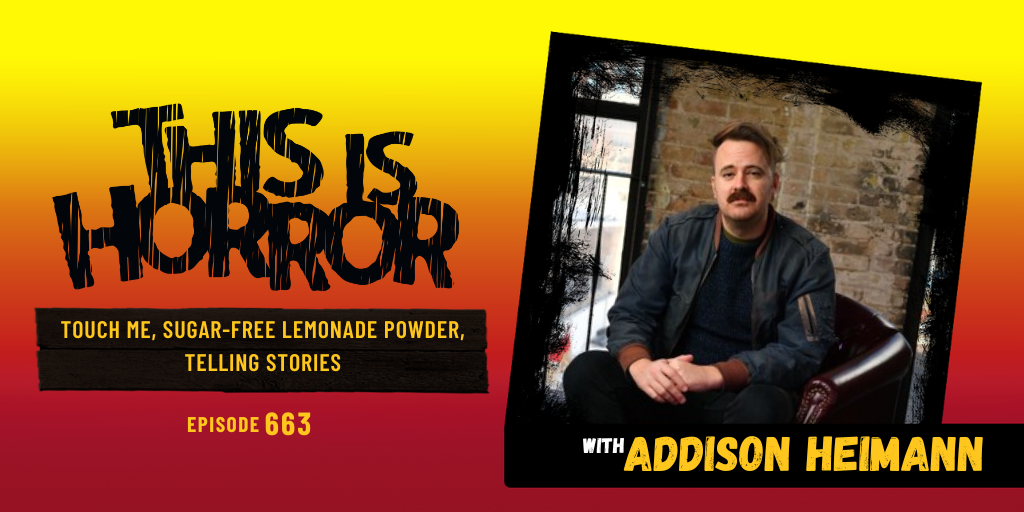
In this podcast, Addison Heimann talks about Touch Me, sugar-free lemonade powder, telling stories, and much more.
About Addison Heimann
Addison Heimann is known for Hypochondriac (2022), Touch Me (2025) and Jeff Drives You (2019).
Timestamps
Thanks for Listening!
Help out the show:
- Support This Is Horror on Patreon
- Listen to This Is Horror Podcast on Apple
- Listen to This Is Horror Podcast on Spotify
- Rate and review the This Is Horror Podcast on Apple Podcasts
- Share the episode on Facebook and X
- Subscribe to This Is Horror podcast RSS Feed
Let us know how you enjoyed this episode:
- Write a comment below.
- Follow us and get in touch on Instagram @thisishorrorpodcast
- Subscribe and comment on YouTube @thisishorrorpodcast
- Follow us and get in touch on TikTok @thisishorrorpodcast
- Tweet us @thisishorror.
Resources
- Addison Heimann
- Watch the video version of This Is Horror Podcast episodes, including our conversation with Chuck Palahniuk on YouTube.
Cosmovorous by R.C. Hausen
The debut from R.C. Hausen, available now. Now also available as an audiobook.
They’re Watching by Michael David Wilson and Bob Pastorella
From the hosts of This Is Horror Podcast comes a dark thriller of obsession, paranoia, and voyeurism.
After relocating to a small coastal town, Brian discovers a hole that gazes into his neighbour’s bedroom. Every night she dances and he peeps. Same song, same time, same wild and mesmerising dance. But soon Brian suspects he’s not the only one watching and she’s not the only one being watched.
They’re Watching is The Wicker Man meets Body Double with a splash of Suspiria.
Buy They’re Watching in paperback and eBook right now.
Michael David Wilson 0:28
Welcome to this is horror, a podcast for readers, writers and creators. I am Michael David Wilson and every episode alongside my co host, Bob Pastorella, we chat with the world's best writers about writing, life, lessons, creativity and much more. Today, we are welcoming back Addison Hyman for the second and final part of our conversation. Now, Addison is a filmmaker best known for hypochondriac touch me and Jeff drives you. If you've listened to part one, you know how enthusiastic, how generous Addison is with his knowledge, you're in for a bit of a treat with this one too. But before we get into it, a quick advert break
Bob Pastorella 1:22
from the host of this is horror podcast, comes a dark driller of obsession, paranoia and voyeurism. After relocating to a small coastal town, Brian discovers a hole that gazes into his neighbor's bedroom every night she dances and he peeps same song, same time, same wild and mesmerizing dance. But soon, Brian suspects he's not the only one watching. She's not the only one being watched. Their watching is The Wicker Man meets body double with a splash of Suspiria. Their watching by Michael David Wilson and Bob Pastorella is available from this is horror.co.uk, Amazon and wherever good books are sold.
RC Hausen 2:02
Cosmovore, cosmovirus, the debut cosmic horror novel by RC housing is now available as an audio experience featuring an original Dark synth wave score. This story will take you to the next level of terror. Come here, the story that readers are calling Barker meets Lovecraft, a Phantasm style cosmic horror adventure and a full bore, unflinching, nihilistic nightmare, cosmovorous. The audio book by RC Housen, come listen if you dare.
Michael David Wilson 2:35
Okay with that said, Here it is. It is Addison Hyman on this is horror. So when did you first know that you wanted to tell stories and to be involved in film professionally, and what was your first professional sale?
Addison Heimann 2:57
What I wanted to get? Okay, what I wanted to get, what I what I first started professionally. Okay, so it was my web series, which is a very interesting, different kind of but also, I guess, kind of similar, only in the sense that, like, it's about a bunch of sorority crime fighters trying to destroy evil frat scum. And it was how I started into film. So basically, I was 20. Let's see, I was 2625 and I was, you know, much like color me shocked that it came out of depression. And I basically was watching Gilmore Girls to Like, four in the morning eating eating, like pizza rolls out of a bucket. And I was around the time of Scream Queens, the Ryan Murphy show. And it was just like a send up of college. And I found it so funny that I kind of used that and combined that with my love of Buffy to create what's called kappa force. And I was doing theater at the time in Chicago, and everybody had their community, and I really felt like not ostracized by any means. Everybody was my friend, but I hadn't found my artistic partners. So with this script, I was like, I want to make this. I want to make this now. I have no idea how, because I didn't go to film school. So what are we going to do here? And so essentially, talked to my one friend, and was like, hey, I want to make this. Can you read this? And then there's a part for you? And they're like, Yes, I know one person. So I met my friend, Hannah Welliver, who's now lifelong friend and future collaborator. Hopefully, one day, we've made two projects together, and we crowdfunded the thing, and then, and then made it. And then I moved to LA because I was in Chicago at the time, and I was like, peace, everybody, I'm gonna be famous. And then I wasn't famous after five minutes. Because, you know, every. We had a web series in LA it was like in Finding Nemo with the seagulls, people were like, I have a web series. I have a web series. And I was like, Oh no. So, so yeah. So basically, I was like, Oh no. And so I started making more short shorts. I made three short sci fi short films in the realm of, like, black mirror, they were like queer in one location. But while that was happening, kappa Force started playing film festivals, which was cool, and it played the now defunct New York Television Festival, which was the, like, big web series festival that anybody can get into it. I'm pretty sure it died the next year or the year after. But it was, like, long, long running. And like, you were like, wow, HBO is here, free forms here. Like, I'm gonna make it. Of course, didn't. But then later, at another film festival in Vermont, this, like, small indie streaming series service, was like, hey, we want to buy your web series. And you know, it wasn't a huge sale. Didn't put me on the map, but it was money, and that was cool. And I was like, we sold it. And of course, like, the streaming surface is now kind of defunct, and it doesn't really exist anymore, and we were pulled to the ringer. So maybe the the the lesson there was like, hey, it's never gonna be as good as you think it is. But that's pessimistic. But it was the thing that I was like, Okay, I'm doing something right? And I think for me, it's like less monetary success, because, you know, while it's like nice to make these movies, I'm not going to pretend like I'm, you know, like getting thrown cash by by the Warner Brothers balloon, but it did give me, what gave me the like strength to keep going was as I kept creating pieces of work, I started collecting the tribe of people I was going to work with. You know, the web series led me to meet some other directors who I wanted to work with. And this was before I was I was a director, I was still just a writer, producer, because I didn't think that I had the gall, the gumption or the chops to do it, but I just kept making things, and I, you know, and the the validation was less monetarily and more, just like film festivals. Just kept giving, get, get, putting us in there, and we weren't getting into like, Sun Dance, or South by Southwest, or, you know, Tiff, but we were getting into, like, good, solid genre film festivals, you know, Fantasia being kind of the biggest and my favorite, and one that I've now played four times, and so it just like that gave me the strength to keep going. And then it was hypochondriac, the first feature, where, after the metal breakdown, I found people who really cared. My pretty, my forever producer, John Humber, and his, his producing partner, Bae, that we, you know, that was kind of like the biggest thing. And then, you know, premiered at South by Southwest, and sold the XYZ, and all of a sudden, boom, I had an actual movie sold that got put in, you know, 10 theaters. But like, you know, we got, like, you know, you get your physical media out of it. It gets put on a streaming service. Like, you feel like, okay. And it also, like, really gotten to prove to my dad that, like, was doing something, you know, even more so with Sundance, because it's like, there's that thing that'll make you feel smaller and more humble, that when you connect with somebody that's not in the film festival world, and you're like, Yeah, so my movie played at a place called Sundance. It's in Park City. Do you know it? And they go, no. And I go, Well, that's great. Um, but yeah, I mean, so that's essentially, like the smallest sale was the first thing, you know, we sold for like 15 grand. We made it for like 50 so it wasn't a big sale. But then, you know, that led, you know, led to be making further projects and continuing down the rabbit hole of deluding myself into thinking I can make this a career.
Michael David Wilson 8:48
Well, I mean, the delusion seems to be going pretty well at the moment. So
Addison Heimann 8:55
you just have to pretend that you're good enough in a way. You just have to, because this stupid industry is so hard. So you're just like, Oh no, I'm gonna, no, it's gonna happen one day, one day. And delude yourself long enough and you just stick around long enough that you find the people who you can find and create meaning with. It's like, no one comes out of like, the like, go for hole and goes like, and, you know, some people do, don't get me wrong. They like, come out of film school, make a feature film, Sundance. All of a sudden you're being, you're directing a star war. But like, it's, it's just like, mostly this, like, long, gradual, kind of hilly, up and down. And then people are just like, wow, first feature premiering, like, you know, made for 20th Century Fox. And like, they've been going around with the script for 15 years. They were someone's assistant. They were working as an ad on set, like slowly forming these connections and building their own artistic artistic visions of how they want to create art. It's just like that is the journey of the artist. It's just completely and utterly entrenching yourself in the art and whenever version you can grasp on to. Then slowly working your way towards what you want to do, and realizing that all the friends you made along the way are willing and want to help you because you helped them. And that's the beauty. There's no like, stealing. There's no I mean, people do, but like, there's no like, there's, I think people find this like, sometimes find this industry very transactional, but I find it the opposite. It's like you're friends with people first. That's the first thing. If I can give any advice to people who like are wanting to break in or playing their first film festival, it's like there's no you're not trying to meet the HBO lady because the HBO lady doesn't care about you, which is a good thing. You're finding the other people who are your peers, who my favorite thing is Fantasia, when my first short film that I wrote and produced, Ava, in the end, premiered there in the international science fiction block, three of us had our feature film premieres at South by three years later, it's like, those are the people that, like, you're gonna collect and connect and grow with, and then you'll and then now it's like that I'm two features in like, I can go to any film festival and feel warmth and and friendship and hang out with people because, like, I've been around, we're all it's a community of artists, especially in the genre world, and it's so, so gratifying when we get to see each other succeed. It's really nice. Doesn't mean there's not jealousy, because, come on, I'm a human but like, it is also really nice to be like, Oh, wow. Like, look at us grow together. And that's what you want, because you don't want to be, like, 5560 years old and you've reached the top of that very scary mountain with the demons, and you're alone because you don't have anybody with the bow and arrow to shoot those demons down. You want a tribe. You want an army of the people that you've grown with to collect, to collect and and and commiserate with and love and and then when you're at that top of the mountain, you can create your little Fortress of Solitude where you murder all the demons, and then you see other people who maybe were a little below you. And then you can help fend off the demons with them, and they can collectively grow your little society that you're building on the top. If that's a good metaphor, but yeah, so that's like, I know I think, like, I forgot the question, but that's okay.
Michael David Wilson 12:12
I think it is a good metaphor, because I was, I was with you throughout, and then when you threw the demons in, I mean that that was the equivalent of the unicorn come that was great. It also connected back to our early part of the conversation. So sometimes, sometimes this brain works. There you go. And I mean, at this is horror, we're really concerned in the nuts and bolts of creativity and writing. So I'm wondering, what does a typical working day or working week look like for you? And typically, how many projects do you have on the go at a single time?
Addison Heimann 12:51
Ooh, that's a good question. I mean, I generally have one that that is my main focus. It doesn't mean that I can't go back and do other things, but I generally focus on one script at a time. And I think for the best way for me, because of my executive dysfunction and my ADHD, is to really and truly take things one step at a time. Doesn't mean that other functions, things work or don't work. This is just what works for me, because I'm a very fast writer, but I have to be very prepared by the time I get to writing, and I lose steam so quickly. So it's all about building up your pace and being consistent. And it starts with very, very simple idea of like that. You know, you just take from The Artist's Way of morning pages. For me when I'm getting into a new project, because I journal sometimes too, especially when I'm in the throes of it in the darkness, because that helps me out. But when I'm creating a project and I like, I like, maybe have a log line, or I have a sense of characters, I know what it to be about. I don't. I don't start putting it in like a Word document. I free write, and the goal of the free write is essentially nothing. But if I can assign a goal to it is to find, or discover one new thing about the script a day and your three pages that you're journaling, and that's all the writing you have to do. You don't have to write for nine hours. You don't need to stare at the screen hitting your head against the wall. You don't need to make up constant excuses for you to get up and, like, eat more gummy bears, which, you know, I've been there, but it's like you don't need to do any of that. You just need to sit down and journal, put your phone away, you know, listen to music, or however you want to focus, and just write three pages in your journal. And then you just start doing that every day. And eventually you're going to get bored, and so you're going to want to want to stick to some structure, and then you'll start creating the things that are required from an outline. I tend to like outlines because I I'm very bad at story, but I'm very good at dialog, so I tend to do the outline all the like shitty kind of work that I hate doing up front. So by the time I get to the script, I can just play and so. So I will just start forming the thing. So I'll start with the log line in the journal, and like you know, journal for three pages, somewhere in there is the log line, or the completed long line. Once I'm done with the log line, I'll go to the synopsis somewhere in the next days, three pages, there'll be the synopsis, and I'll keep it in. I'll keep it in long form. I won't even put it in the outline, in an outline or in a document form. And then I'll get to character descriptions, and I'll write all the character descriptions. And once I have all that, I start outlining, free writing. You know, I don't even need to go, this happens in this happens. This happens. It's like, well, in the span of the first act, these are kind of the things that happen. These are kind of the things that happen. And then once I kind of, like, loosely look into it in these three pages. Remember, this is like over the course, over the course of a month, two months, six months, doesn't matter. You go at your own pace. What only matters is that you're consistent, even if it's just 30 minutes a day and you're journaling for three pages. That's just how I start, because it's very difficult for me to get into the flow of things, and this helps me. And so once I get through the outline, I'll start specifically outlined, but still in long form, a lot along it all the way through, and I'll get to the end, and I'll have my, like, 40 scenes, and my four, you know what they call it a three act structure was really a four act structure, because the second act is 2x but, you know, I'll have the four acts, and then I'll take that, and then I'll go, finally, go to the document that I've been putting off because I'm Lazy, and I'll try to re read my handwriting, and I'll put in my my log line, my synopsis, my character descriptions, and then I'll put in the outline, and that's where. But usually the outline is just like the 40 scenes, and that's where. Finally I'm at the outline, and finally I've got the 40 scenes, I start going into a detailed kind of description of every scene on the computer, and then, boom, you've got a fully outlined thing. And I would bet it's better than you would have if you start on the computer, at least for me, very specifically, because I took my time and I thought about it. And normally what it does to you is like people always think of writing as like the time you spend in your computer. But that's not the case, because usually when your mind wanders, you're taking a walk, you're taking a shit, you're taking a shower, your brain wanders, and that's when the like moments of the light bulb come up, and they come out of nowhere. It's like the opposite of a negative intrusive thought. It's like a positive intrusive thought. And you'll go, Oh my God. And then, you know, like, I would encourage people, whenever they have those ideas, to write them down, because I'm the type of person who goes, I remember it. No, I won't. So it's like, you know, that's the idea, right? Is? It's like, so, so you had these ideas, and you're constantly thinking about it. Now you've created, or you fostered the kind of artistic self to allow itself to just come to you as you're just journaling 30 to 45 minutes a day, and that'll get you to the outline. And then what I do is I take that outline and I send that to very, a very close group of collaborators. I'm in a writer's group right now, so I said to my writers group, and then I send it to my forever producer, John, and then in the case of this new one, I send it to the lead actor, so Olivia, who I'm writing it for, and I got notes based off that outline, and then I retool the outline, and then that said, I won't get any more notes. That's the outline that I have. And then I'll go to pages. And for me, pages take exactly 20 days, because I'm writing two scenes a day. I'm taking the week, and I'm going Monday, Tuesday, Wednesday, Thursday, Friday, and I'm writing exactly two scenes a day. I'm just really, really, really doing it in the Bite Size moment, so it feels so I don't feel overwhelmed and like, you know, and and if it doesn't happen, it doesn't happen, you don't need to shame yourself, even if you write one scene, that's fine, even if you write a sentence, that's fine. But the hope is, by that point, you built yourself up and your momentum, that you're doing it every day, that you'll want to do the two to two scenes. And for me, writing two scenes could take literally 15 minutes and then I'm done for the day, or it could take an hour, just because it's a particularly I find that dialog driven scenes don't take me long at all, but then I get into like, logistical scenes, where a lot of action needs to happen, and that takes me a while to build up into doing it. But the point is, I do them, so by the time, you know, but then you set yourself a goal. It's just two scenes a day. And if you want, you could just do one scene a day and then write five scenes a week, and that'll take you two months to get through the script. I like to do it in one month, just because I put myself up. I mean, I've written, you know, lots of scripts now. So this is the thing that I found that works for me. And then by then, you've probably gotten a much stronger first draft that you can't but you just call it first draft because it's first draft and name. But you've been sitting with the script for a bit. You've really been thinking about the script the whole way through, and then at the very end of it, like you've done so much work, but you've really parsed it out into these bite sized moments that, boom, you've got a script that's a lot more advanced than it would have if you just sat down to free write and and it allows maybe, like, a draft or two, like, maybe draft three, you're now very confident with, and then can go out to, let's, I mean, if you're in, like, the more of the like, where I am in my career, you go to your manager. Have them send it out. Or, you know, like, get smaller. It's like trying to find producers. Or like, maybe you're making a short and now you have the script that you can talk about at film festivals. Or, like, maybe you find it good enough that you could submit to a writing competition. Or, like, whatever it is, but that's tends to be what the journey that I found now as I've written, like, well, I don't know how many scripts I've written, but like, well, there's a bunch of the scripts that I've written, though, and written that will never see the light of day, and then there's, like, the scripts that I'm proud of, but that's that's kind of my process now that I found that works for me,
Michael David Wilson 20:30
and I feel that for almost all writers and creatives, this kind of recurring theme of don't shame, don't self shame is something that we all kind of need to know, because I feel there's always a tendency, if you're not careful, to want to do more, to want to, so called, achieve more, and to almost rush through it, in a sense, so to have deadlines that are self imposed. You know, no one is telling you to write, let's say five scenes a day, but then you might decide, oh, I'm a piece of shit. I only did one scene in the whole day. But
Addison Heimann 21:10
yeah,
Michael David Wilson 21:11
you know a lot of what you're saying. It just it seems there's a lot that we can learn from it. And it's like sometimes to get ahead. You have to slow down. You have to make it more manageable.
Addison Heimann 21:25
Yeah, everybody, everybody writes differently, you know, everybody, like some people, like, I got a buddy of mine who has to spend eight hours a day writing, and it doesn't mean he's writing 50 pages, but, like, he sits down and he's like, this is the time I'm gonna write. I just cannot focus for that long. Just really, but I'm really fast when I focus. That's the thing, right? Is it? So writing is one part of my day, and this would be different. This is when I have no deadlines, right? If somebody tells because I've written a script in a week when I had Joe, when someone's like, or rewrite, really, I've never written a script in a week. Well, that's not true. I wrote a play in a week when I had to. This is the thing you do, what you have to do, but if you've got the time and you want to do it right, and even if it needs to be a shorter timeline, like, you know, it's all about realistic, doable goals that build you into the momentum that allow you to be there for longer and longer. And that's just how I've learned with, like, dealing with my ADHD and my executive dysfunction, is that really, really and you can even, fucking dude, create a create a checklist for yourself, and don't just include writing on it, like, make a whole thing for yourself. Like, you know, you don't even have to, like, make the whole list first. Just start doing tasks, whatever gets you in the momentum. Because writing is sucks. It's so hard Fuck it. It's worst. Everybody wants to have written. No one wants to start and so including me. So it's like, I literally go, wake up, make coffee, check it off, brush teeth, check it off, floss teeth. And I'm starting to do that now. I know I'm an adult. And then wash your face, moisturize your face, you know. Okay, make breakfast. Okay. Now we've got these things. Isn't that great? Do we need to take a shower? Okay, take a shower. Okay. What if we okay? You do Duolingo. I mean, obviously, if you've seen touch me, you know, I do Duolingo. I'm in like, the 2000 streak at this point. You know, do my Duolingo forever. Long. I need to do it and that. Maybe I need to meditate. It's like, oh, do the list. Maybe I need to exercise. And don't even talk about, like, lifting weights for 30 minutes. 30 minutes. Maybe I just want to walk for five, do 30 jumping jacks. Let's make it so simple. And then by the time, like, you kind of built this momentum throughout your day. And this is also including, like, if you, like, our independent contractor, it's like, easier. Like, if you have a nine to five, then it's like, you know, I understand the like. But it also works there too, because it's like, you expend all this energy. It's like, how do we get that momentum back? But like, you don't need to write for eight hours if you don't, like, you know, you could just write for 15 minutes, for 20, for 30. Build yourself up to that hour, and it's like, just take it, and then by the time I find it, I find it really lovely, the physical nature of it, because there's an end game. You're not standing at a white page, you're physically writing. And if you remove the the want to getting something done, the free, right is, like, whatever you want you could write. I hate this, I hate this, I hate this, I hate this. I hate this. For three pages, but, like, it's been, it's been known, it's been proven that eventually you'll stop. Like, you know you could, you'll stop because you get bored. Like, you can only tell yourself you're a piece of shit for so long before you're like, all right, like, let's take a break. Even when you're in the throes of your depression, you're like, I hate myself. I hate myself. I hate myself. Okay, I'm tired of that. Maybe I'll go masturbate. So it's just like, you should have the masturbation. So it's like, eat. Like, we all find our ways, and we do get bored, and then we'll go back to our self loathing. But like, there are moments where, like, you just, you just get bored of yourself, and so that's when you'll start finding the creativity and that, to me, for if someone's having a lot of trouble, that is a person who has a lot of trouble starting, I found that, like, parsing it like that is really helpful.
Bob Pastorella 24:57
Yeah, the whole guilt thing I've been. Dealing with that, I mean, my entire life, but I'm trying to. Over the past couple of months, I've been feeling it a lot, because if we're not I feel like that, if I'm not like, typing like for any amount of time, getting pages out, that I'm worthless, and that's and so I get an idea, I get momentum, I get going on it. Man, I can't do nothing with the idea, because it's just an idea. I haven't played with the idea. I haven't toyed with it. And so, like, if you see behind me on my dresser over here, I've gotten behind that heavy metal magazine. There's three notebooks there. And so lately, what I've been doing is I've been, you know, basically just writing background stories about my characters and things like that, because I don't know where to go with this fucking story. And I'm like, so and then so I'm like, you know, I need another distraction. And so I used to be really good guitar player, and I started playing guitar again. And so now I'm like, so I've got, I got a, got a guitar last basically this week, and starts time in about 15 years, and the muscle memory is coming back. And I feel like that. I'm getting good and I'm like, but I'm getting, I'm getting, like, a healthy form of guilt. It's like, you got that computer over there at that keyboard, and it needs, it needs some love, you know? And I'm like, Yeah, but I'm actually gonna play around with this notebooks when my fingers get sore,
Addison Heimann 26:36
yeah,
Bob Pastorella 26:37
I'm keep going back to this. I'm like, I'm not gonna do this until I'm until I'm bored with this.
Addison Heimann 26:44
Well, it's also, it's also good too, to just, I mean, again, I'm like, pulling from the artists way. It's not like, I I've never fully done the artists way, but like it I've like, No, I know they're like, kind of grand, grand, kind of gestures of it all. And I find that, like, we think, like, not only is it like, writing is so many different things. It's not just, it's not just sitting down in the notebook. It's taking yourself to watch a movie. It's reading a book. It's like, it's sometimes even reading the news, as much as, like, I don't know how much news you want to read these days, but like, it's like, or like reading, like investigative articles or like short stories or nonfiction, or like, you know, any of that kind of stuff that, like, stimulates your brain into artistry, you know, like, touched me. Like, was born because I started watching films from Japan, and also, like, loved the movie, the untamed, like, it just, it all comes from that's thinking, like, good artists steal, right? Or, like, you know, we take all these things and that simulates your brain too. It's like, whatever you can find to stimulate your artistic expression in your brain, you do guitar is wonderful, even if it seems like you're procrastinating. Don't shame yourself. You know, like, there may be a sense, like, where eventually it's like, it turns into avoidance. But like, that's also the thing too, right? And it's the thing that we deal with is, it's like talking about, like, what gets you through depression, I think I forgot to mention, but this is also including writing. Is it's like, usually when I'm afraid somebody hates me, what I do now is I just go back up and talk to them again, and more often than not, like, you'll find that it was all in your head, and you're not telling yourself this for reassurance, because you can't ask them if they hate you. You can't ask them, you know, if you said something wrong before, because that's seeking reassurance. But you can have a different conversation about something else, and you don't go into that conversation looking for context clues. You kind of forget the part of your brain. You let it go and you just have the conversation. So I find the same thing with writing is it's like, are you doing other things because you're avoiding it, or you're doing it because you're stimulating your artistic brain. And as long as you end up going back to the page, even if it's just to write a word, I swear to you, it can be that fucking small, even if you draw a stick figure of one shot. This is all forward momentum, and it's okay if you like you do. You have forward momentum for a while, and then you stop, like, this last script that I was writing, I didn't stick to the Monday through Wednesday, and I was really sad, Monday through Friday. I was really sad about it, because I would hit days where I just got completely lost to myself. And then I was like, I didn't stick to it, fuck. And then I got depressed for two days. And I was like, Okay, well, actually, let's go write a scene, and then I go write the scene. And I was like, All right, I'm back in and it's like, right? It's just like, this, don't shame like, it's just a shame spiral. Like, like, like, no, but nobody hates you as much as yourself, man, nobody is thinking about you as much as you think you hate yourself. Like, if you just allow yourself to be kind and allow yourself the the ability to make mistakes in your process, it'll come a lot easier than you being like, it's the same with it's everything, right? It's a shame spiral with eating. It's a shame spiral of like, well, I'm not going to go to this event, because last time I went to that event, like this person didn't want to talk to me. It's like, Who fucking cares? Like, you have to it's all exposures, it's all avoidance. You have to eventually do. And accept because that's the only way forward. Because I have the I have the issue that if I don't do these exposures, I'm going to end up on my couch that gives me really bad back pain, looking at my phone, like pulling ripping from my nicotine vape, like it's a fucking lollipop, and stay there for years, and it's like, you, is that going to be the option now, I mean, lord knows. I kind of want it to be, but, like, at the But that's only part of my brain. You have to constantly expose yourself to your fears and not that, like, and you build up to it, you don't, you don't like, go skydiving if you're so afraid of heights, but like, it's little baby steps, and like, I'm afraid to write. That's where mine comes from. I'm not speaking for everybody, but I'm afraid to write because, what if it's bad? What if I don't come up with something? What if I get stuck? You know, it's all just that journey of creating these bite sized moments and that forward row momentum that allows you to get out of your own way.
Michael David Wilson 30:56
Yeah, I have all these what if questions as well, but ultimately, to try and motivate myself. You know, it's like, well, what if it sucks? Who fucking cares? Write something else. Yeah, try again.
Addison Heimann 31:10
Plenty of movies suck like they're twisted.
Michael David Wilson 31:15
Yeah? And you know, like, I'll always have this thing where whatever I've written previously, I'll be like, oh, what that was good, but now what I'm writing, no, it's shit, whatever magic I had, it's gone. But then, you know, when that one's done, it's like, oh, well, actually, it's all right, there's something here. So I just have to now try to remember, no, everything you fucking written in the moment. You had these moments where you thought it was shit, or you had self doubt or you were hating. So writing that
Addison Heimann 31:52
we also tend to like only remember it's like the negative bias brain, right? We always tend to remember the negative side of all these experiences, and you forget the triumphs, right? Like you forget the triumphs of your own fucking experience for the favorability of the negative ones we go, where as artists, we go, constantly are oscillating back to thinking we're the most genius writer who ever existed to the worst writer that's ever lived. And it can happen in a day, you know, you could think you're the best, you know, and then, and then, all of a sudden, you get stuck in that negative bias. You know, it's like Edgar Wright loved my movie and posted about it like he came to one of our screenings. And for some reason, a 20 year old from from, you know, Iowa means more to my opinion, than like, no shade to Iowa, great say, but like, it just there. For some reason it's like, why isn't it like, one of my like, you know, like, cinematic director heroes liking my movie? Why is that not as important as like, the negative internet Chatter is sometimes, and so it's like, again, it's the shame spiral. It's getting in your own way. We're trained to think we're pieces of shit, especially if we've been through trauma, and it's just like, you know, like getting out of you, getting out of that way, and learning that you're just not important as important as you think you are. You're not the worst at anything, and you're also probably not the best at anything, just like in the reality, it's like, that's just the form of ego, that's the narcissist brain that like that others preventing you from succeeding, or deluding you into thinking you matter way more than you actually do. But in reality, you are a person. You have so little time on this, on this fucking planet, and you are a speck of sand and the entirety of the universe that where nothing matters. And I don't mean that negatively. I mean that to be freeing because, because, like, you know, and also, you don't need to shame yourself into that either. But it's all that, whatever, whatever helps you get back to the page. Because you're not going to be good until you're bad, unless you're bad first. And like, you're not going to be anything unless there's something there. So it's just like, get yourself to the page. And if the way you get there is for a year, write one word and create and maybe every nine days you create a sentence, fine, like I use that, you know, for, you know, hyperbole, hopefully you're doing more than that, but that's okay. It's all about the journey. And I feel like a lot of film, especially, even like more so than theater, is so product based, because there is literally, at the end of the day, a product that lives for the rest of your life. But we forget. We forget that like the journey is the point. It's always and I'm not, and I'm like, I feel like, right now, I'm just like, look how wise I am. Like, I'm talking to myself too all the time, because I don't run, I don't follow these rules. Every day, I have to remind myself this too, like that's why I've created the system for myself that works, because I'm constantly dealing with the negative chatter of everything that I'm talking to you about right now, the things that you're dealing with is the things that I deal with consistently, to this day, every day, for. The rest of my life, but like I'm trying to remind myself and trying to instill in others the excitement that it is to feel like you've succeeded on the day to day basis, not the entire product, but the day to day basis. My whole goal, when giving feedback, and I hope one day to get to teach, is to make you fucking excited to continue writing that's the goal of the person who's reading your script, unless it's like so offensive and so utterly horseshit, then you have to figure out a way to put them down gently. But I gotta say, that's rarely the case, and even if it is, you can put them down a path. You know, you can exist in this way to give, give somebody the confidence that they feel, that they get to continue. And I'm doing that with myself too. It's just, you know, easy to do it with other people, because like, you don't have to live like they you have to live in their brain, and they don't have to live in mine.
Bob Pastorella 35:49
You're so right, because everything is so content, not and I mean content as in a product. Everything now is so product based, and it doesn't really help me, because I'm in a retail world where, you know, results matter. It's like, you know, well, I've talked to 10 people today. How many sales did you make, you know, right? And so it's like, everything is so content based that we're like, I literally, I thought this the other day. I was like, Damn man, I've really got to get something out. And I'm like, motherfucker. I just had a book come out in September,
Addison Heimann 36:23
yeah.
Bob Pastorella 36:24
What the
fuck I mean, like, fuck dude, you just wrote 30,000 word novella that you don't like, but you fucking wrote it,
Addison Heimann 36:31
yeah,
Bob Pastorella 36:32
you know. And last year, last year, you wrote, you wrote 50,000 word part of a novel that you abandoned. You didn't like it either, but you fucking wrote it, you know. And so now I've got two things that I could sit there and tweak and play with, you know, but it's like, you get caught in this. I got to do something. Now. It's like, fuck, I've been doing things.
Addison Heimann 36:54
Yeah,
Michael David Wilson 36:55
I just
Bob Pastorella 36:56
want to listen to music or listen to a podcast or play guitar, you know, like John millenkamp said, play guitar, you know, yeah,
Addison Heimann 37:05
you can't. You have to people. You have to remember too. You have to live your life. Because where else are you gonna fucking pull from, if not your own life? And I don't just mean like your own personal life, but like your creative self of being, the ability to create, you have to fill up your creative, creative, like magic meter before it can be depleted again. It can't just be a constant, go, go, go. That's why the journey is what it is like, the creating of it, from the script to then, like, trying to, I mean, I'm talking like, specifically write a director, but it could be, you know, put everything in it, but you create the script. You know, you have to find financing which is annoying, to cast, which is annoying. You get into set, which is amazing. You get into post, which makes you want to shoot yourself, and then you wait for the release, which makes you want to shoot yourself. Then you get into a film festival, which makes you high on on the fucking like cocaine. And then you go through the film festival, you don't sell for a while, makes you want to kill yourself. And then you finally sell, and you're like, Okay, feeling a little good. You go through the release, makes you want to kill yourself. You get after the release, you're like, Okay, I did it, and then now I'm through it, and I'm like, fuck, I have to start over again. And then you feel like you can't do it, but I'm just like, you're just at the end of a three year long journey, or two year long journey, or you're it's a huge thing. You need to again, build up your thing. It just depends where you're on the journey. But it's all important. Like, that's the thing with AI, right? It's like, why I feel like, you know, not to bring AI to this, but why, I actually do have a lot of hope, because all AI is, is just product, product, product, product. There's no journey. So in my my hope and my theory is that, like what, what the world has not most people have, does not have connection to or the thing that they can say it, that they've created a piece of art, they spent time doing it and released it and it was viewed that's rare, right? However, you know, my hope is the people who didn't have time to do that, that maybe had office jobs or chose a different path, and, like, left of the creatives to be more of a hobby, which is, like, amazing too. Is that, like, AI is like, Oh, wow. The first time you get to see something parroted back at you that, like, you were essentially the creator for but there's anything I'm stealing this from somebody else, but I really, really believe this. But like, the only thing that that is true about life is like suffering. And I don't mean that in a negative way. I mean, like, you literally have to work through it in order to achieve something. And eventually, when you can just achieve something in five seconds and see it, and it's really cool, you're gonna get bored. It's like calling yourself a piece of shit, you're gonna get bored. And my hope is it's kind of what happened with the younger generation that their obsession with, like physical media now and camcorder's. It's that, like, everybody's gonna realize that, like, the creation of art is important. They no longer want to see something parroted back at them in five seconds. And then they'll start being creative, and we'll all forget this, like this, like visual like generated AI art that made an episode of Mad Men look like The Simpsons as a kind of a gimmick, the way the virtual reality. Is, I could be completely wrong. We are really, truly living in the stupid part of the future. But like, it is, like, it's all you know, like, it's all kind of related to the idea of like, we never, you know, as artists, we never feel like we're doing enough, despite the fact that we are as humans, we never feel like we're doing enough. But for the most part, we are, and it's just, you know, it's that negative bias brain that kicks us in the ass and tells you you don't matter, and it makes us meaner. And it's our and our it's our whole goal in life is to fight against that and exist in a world that we feel content, not happy, but content.
Bob Pastorella 40:34
I love the whole bit where you talk about suffering, because, you know, one of my favorite lines from any film is, you know, from Hellraiser, when pen hit, you know, tells Kirsty not to cry. It's a waste of good suffering. And you know that that line is not just a throwaway line. It's basically, don't, don't cry because you haven't even fucking lived yet. And that's, that's where, that's where I see, that's where pin hit is like, because they're not, you know, their whole the center by His job is to give you, you know, your your desires, pain and pleasure.
Addison Heimann 41:14
Yeah,
Bob Pastorella 41:15
you know. And so the suffering is part of living. And when you if you use AI, you haven't suffered this, that's why it's devoid of life.
Addison Heimann 41:28
Yeah. I mean, that's also the thing too, right? It's like, it's why you grow, it's why your writing gets better. As you've lived,
Bob Pastorella 41:35
like,
Addison Heimann 41:35
when you're in high school and somebody breaks up with you, it's like, the end of the world when I was in fourth grade and, like, got bullied by these kids and sent to the principal's office and lost my all of my friends. It felt lonely and sad when I was in the closet before I came out. I felt alone and sad. That's why it gets better. Hap, and it's like, like, it's not saying that, like, as you know, like, I'm not saying like, Oh, like, some self help thing that, like, it's not like people don't suffer. It's not like people don't take back steps. It's not like the world isn't out there to fuck you. But like, it is, it is funny. It's like you get this perspective as you get older that allows you, if you do it in the like, and you're and you're able to, like, use it in like, the positive sense, like, you become better because you've just lived more. Of course, you could become worse, but you have the potential to become your true self and not let you know certain things bug you because you've been through them and you've learned. Or, like, you know, when you're creating art, it's just like, Yeah, I mean, like, you know, that's the thing, right? Is you experience life, then you turn it into art, and the art becomes more specific because you've written 10 scripts, and maybe none of them got made, but the fact you did it 10 times means you are probably a better writer than you were on script one. And, like, just, it's just the consistency. It's just, it's just willing yourself to finally be able to say, like, Oh no, I'm a writer. Like, the only, the only thing that makes you a writer is if you write, that's, it doesn't matter. Even published. You are a writer. You are a filmmaker, like, you know, you are a writer. And we don't need to you like, you don't need to be aspiring because you've written. So it's just like, get, get down that mindset, nothing, no one's no one's the cavalry. You know, the cavalry isn't coming. You know, like, as you know, as Mark Duplass said, but even now, it's like, well, the industry probably isn't coming either. But that doesn't matter, because art begs to be released and begs to be you know, begs to be consumed. So even if like, like Joe Sony Pictures classic isn't going to buy your film, it doesn't mean you can't find a creative way to get it viewed. And also, if you change one person's life. Boom, you've done your job. Because, Lord knows, there's plenty of art that'll never be seen other than me or like 15 people at a film festival that's changed
Michael David Wilson 43:48
mine. Yeah, that's absolutely it. And just, you know, it's such a simple message that writers write people try to over complicate it, but you don't need to and I mean talking about writing and creating. What are you working on at the moment?
Addison Heimann 44:08
Yes, I've got a couple scripts, one that is like newer, and I'm excited about another one that's been with me for a couple years, and I'm still excited about just, you know, so one is about a gay couple in purgatory who are told that the only way to get to heaven is to go through couples therapy. And it's like a the therapy the Purgatory is like a very Jim Henson style world where there's like a magic mirror that's their therapist, and there's a wise old stump, there's a few puppet musical numbers, and it turns like very sinister and darker. There ends up being like a lot of blood. But I don't want to get too far into the, you know,
Bob Pastorella 44:51
God damn. I want to see into the weeds. And
Addison Heimann 44:54
the other one, which, again, I won't spoil, because this is a podcast, so like, but like, it says, See the. Concept of like nostalgia regression, and about a woman who, after a bunch of things blow up in her life, returns to a World of Warcraft esque game that she played 20 years ago, and as she connects with the people that she used to play with, she starts being haunted by the final boss in the game who tries to seduce her and separate her from her real life. So those are kind of the two things that I'm dealing with right now that I'm excited about. Now. I got another few projects, some stuff that I've rewritten, something that I've not written, but like those are everything's kind of in the sandbox of development. So hopefully soon I'll actually be able to go further towards production. But those are the two original works that I'm currently working on,
Michael David Wilson 45:41
oh, my God, they both sound amazing. I'm not even sure which one I want to see more. I want to see them both, and I want to see them now.
Addison Heimann 45:51
Thank you. I'll take that as validation that I should actually continue writing. Okay.
Michael David Wilson 45:59
Yeah, so do you have any kind of timeline when you might start pitching, or when that might be kind of ready to go?
Addison Heimann 46:07
Yeah? Yeah. Who knows one one is currently in the process of funding, financing. The other one is the video game. One is a first draft, but like I said, like a stronger first draft just because of that in my writers group. So, you know, I'm working on the new draft of that right now, and that's the one that I really, I mean, I love the other one too, but that one's like, you know, whichever one goes first, but, you know, I the they're both ready. And I would make like, I would want to make both. And it just depends on who the fuck says yes, and let's hope that soon, but if not, you know, it's not a failure. You move on and you sit down and you write the next thing, and hopefully that's just as cool.
Michael David Wilson 46:52
Yeah, yeah.
Addison Heimann 46:53
This is what I'm telling myself, because I really want to make
Michael David Wilson 46:56
these. But you know, yeah, yeah. And you know, last time, when we were talking about touch me, you mentioned that the shit shower was based on a real event, but you did not elaborate. Now is the time to elaborate.
Addison Heimann 47:16
So, yeah, so basically, I I live in a house. Unbeknownst to me, a bunch of roots in the trees surrounding my house got into the pipes underneath, causing holes that started making a lake of feces under under the house. So it kept smelling like utter you know, every time I took a shower, and I was like, this is weird. And so I was like, something's wrong. So I took a plunger to the shower drain, and then when I did that, it started overflowing and creating a pool of sewage, and thus is the reason it exists in touch me, sometimes life directly leads to art, and there's just exact copies, because it was a literal overflow of shit through The drain that cost me so much money to fix. But you know, it is what it is,
Bob Pastorella 48:27
man, not not the one better you Oh, I'm sure you can my car,
Addison Heimann 48:35
yeah,
Bob Pastorella 48:35
several years ago, I live in a living apartment. I lived in a different apartment in the same complex we had a winter storm. And I live in Texas, and so having a winter storm is like, Fuck, it's cold, yeah, but it's cold for three weeks.
Addison Heimann 48:50
Yeah,
Bob Pastorella 48:51
right. It's like, this is extremely rare. And so the pipes underneath the apartment complex are from like, the 1700s and so they, apparently they broke and my toilet was the exit point for every faucet in the entire building. There were five apartments in my building,
Addison Heimann 49:14
yeah,
Bob Pastorella 49:16
and so it was funny, because it I can laugh now, but I kid like I left like several voicemails overnight at the management and I am in the morning, I am emptying out my 20th bucket of water to try to save everything. And your manager comes in. I have the front door open, the manager comes in and says, Let me take a look at this little Lee. What the fuck
Addison Heimann 49:48
yeah.
Bob Pastorella 49:49
And I literally look at this guy and go, if you're not here to help, you can get the fuck out. And he goes, What can I do? And I'm like, I go, think of some. Thing. And he was like, Well, I can break your lace. I'm like, You're a fucking moron. Where am I gonna go?
Addison Heimann 50:06
Yeah,
Bob Pastorella 50:07
I said I haven't been apartment hunting until now.
Addison Heimann 50:11
Yeah, just
Bob Pastorella 50:11
a second. He's like, I'm gonna figure out something. I have your number. I'll call you.
Addison Heimann 50:16
And
Bob Pastorella 50:17
so he moved me to another apartment. But dude, I mean, I was knocking on doors. Could you please not shit? Yeah, because it's coming up to my toilet. And they're like, going, What do you mean? I'm like, your shit is in my apartment. Yeah? Like, you're crazy. I'm like, you want to come see actually, one of them come over and walking, and she goes, Oh, dear God, you need to call I'm like, What do you think I've been fucking doing?
Addison Heimann 50:43
Yeah, yeah, oh my god, wow, yeah. You just got to, you just had to literally shovel everybody shit through the one. Oh my god, yeah. Well, great. Listen,
Bob Pastorella 50:55
you're telling this story. And I'm like, going, man, I've been there. I swear to God, I've been there.
Addison Heimann 51:03
You share hyper specific stories. Yeah, you share hyper specific stories. And then people were like, I have something that's really similar. And then you go, Whoa, we're not as we're not as as much of strangers as we think we are. We go through very similar, very specific things. Sometimes together,
Bob Pastorella 51:23
yours, I think yours was a little worse, because you had the foot the bill, I mean, and that's
Addison Heimann 51:27
Oh yeah, oh yeah,
Bob Pastorella 51:29
man, God damn Yeah.
Addison Heimann 51:31
And that's how they go, that's the thing, right? And they go, like, oh, cash only. And you're like, I can't put this on, I can't even put this on a credit card to, like, take a loan, or whatever it is, what it is, but Jesus, yeah, yeah. So, yeah. If you ever buy a house, if you ever, like, live in a house or buy a house that's flipped, know that there will be, there are corners that they cut that you won't see for years, that's just, that's just the lay of the land.
Bob Pastorella 51:58
Oh god.
Michael David Wilson 52:00
Well, if we're going to talk about hyper specific things, it seems really specific how you chose sugar free lemonade powder that could prove fatal to Brian the alien. Is there a story behind why sugar free lemonade powder
Addison Heimann 52:20
only in the sense that it was originally Crystal Light, but they couldn't, they wouldn't give us the rights. And so I turned it to sugar free lemonade powder. Beyond that, it's just for the giggles. The logic behind is, he's essentially allergic to fake sugar, or, like, you know, aspartame, as it were, but you know, it just sometimes I'll just, like, when I'm following the logic of something, I'm like, This is logical. I don't, I mean, I couldn't explain you the science why behind a technical alien would be allergic to fake sugar. But you know, it's not like people are gonna worry about that. And then, of course, people worry about that. But listen, sometimes there's somebody in this world. There are 1000s of planets, the in the in the life of obviously aliens exist like I'm not, it's not even a conspiracy. I'm not saying they found us. Who knows? But you can't say that we're the only life beings on exist somewhere there's going to be a civilization rule like rule 34 I guess what? I think that's if it exists, there's point of it. But like, but like the idea of, like, there is a civilization that is allergic to something so ridiculous that we would find funny. Like, there's probably a civilization that's allergic to farts. Like, I guarantee you somewhere, somewhere, somehow, someone's allergic to our specific farts. And you know what? We're gonna find them one day, and we're gonna be like shit, I guess that weird ass movie was, right?
Michael David Wilson 53:50
It's gonna be the smelliest Apocalypse if that planet attacks us,
Addison Heimann 53:56
yeah, or if we decide to attack them, right? We're gonna, instead of a nuclear bomb. We'll just send, we'll just send, like, everybody fart, okay, everybody fart, send it through the mail. We'll collect them together, and then this is great way to end, by the way. And then we'll shoot off. We'll shoot it off into space and commit, you know, send all those. I don't imagine what they would look like. I just, you know, probably just like weird frogs. Just weird frogs addicted to farts. Maybe this is my next movie. Who knows? I've just come I gotta write this down, right? Like, weird frogs addicted to farts. That is, there's something there, you know,
Bob Pastorella 54:33
they could focus it into, like a laser beam or something,
Addison Heimann 54:36
oh, yeah, a laser beam of just straight methane. We're cooking now. We're cooking now. Yeah, yeah,
Bob Pastorella 54:44
yeah.
Michael David Wilson 54:45
Well, you know, one of my favorite creations is Laura, who, from the off, appears to be more alien than the your alien. Brian, so, I mean, I understand you. Wrote her specifically for Marlene. So yeah,
Addison Heimann 55:03
I did, yeah, yeah. That was less like because, like, she was like Marlene, and more like Marlene has spent her entire career of the past 40 some odd years, like crying over some dead body, you know, or like being playing somebody's Latina auntie. And obviously she's very good at it, don't get me wrong, but it's like, you watch any network show and she's gonna pop up and be crying over some something, you know, and I she was, she played my mother and hypochondriac, and that's how I discovered her. I cast her because she was the only one that could have played the role. But she was also, like, she made every wrong choice in the audition. But that's what I love. Like, I didn't need to see her do it perfectly. I just looked at her credits and looked at her performance and go, this is, this is she's right, which is often what happens with directors. You know, you see and you know, like, you can give them notes, and we can figure it out, especially if you're close between two people. But there's no point in doing like five callbacks unless it's like 800 people have to sign off on it. And so when I came around to this movie, I just wanted to write something fucking fun for her and, and that's kind of the how the creation of Laura happened, you know, happened, you know, she always talks about that. Laura is kind of the rensfield to Dracula to the monster, and that's who she is. And she's the only one in the movie who wins, because she shoves the you know, tentacle up her you know, orifice, and then turns into this person she's always wanted to be, and so that, to me, makes just like Marlene loves to give 110% because she's a theater she's such a theatrical actor. She grew up in theater, and it's just really, I just, she's one of those people I've collected her, if I like, it's funny, right? Because I'm just, like, the first part I'm gonna cast you is like, some version of my mother that, like, exists in the in between the realms of real and not real. And the second one I'm going to give you is somebody just truly psychotic who can swing samurai swords and, you know, like, you know, masturbate to other people having technical sex, and then, just like she murdered it. I just, I love because, and I love, love that I know that she can do both of those things. She contains the duality of womanhood, I guess, or manhood, whatever it is, yeah, yeah,
Michael David Wilson 57:10
yeah. Do you think going forward, then we'll be seeing a lot more films where you're casting Marlene?
Addison Heimann 57:16
That's always the goal. Like, you know, I can't always promise that, like, every movie is going to involve every one of my favorite actors that I've worked with over the over the time. But I, you know, when people say yes to me, it means a lot, especially when this industry always constantly tries to tell you that you're not important enough for anybody famous to read your script. And then, so you have these people on your journey through the filmmaking world, and they say yes to you despite you. Like, when they said yes to me, what is I was an untested first feature director, and then they said that, like, people said yes to me on my second feature and like, I had the South by Southwest stamp, but we didn't have a lot of money to, like, pay everybody to that for what I was asking them to do, but we had enough to be like, Thank you for being here. But like, you know, this isn't going to be, like, a year's worth of rent, but they said yes to me, and that means a lot to me, because these are the people that have said yes because of the art. And I'm not saying the goal isn't to create something in which they can all be supported, because it is. That's the whole idea, and that means a lot to me. So if I can, throughout my career, continue with the people who have been there with me from the very beginning, why wouldn't I like those are the people who I want in my little tower that are killing demons with the bow and arrow. So rise with me. Let's rise together. You know. Let's talk about the bullshit, but also have each other's backs, like, that's art, that's life, and that's really what I want to continue to do, and how I want to move forward in my
Michael David Wilson 58:50
career. I love that philosophy, and I wonder, what was it that you learned making touch me that improved you as a writer or a filmmaker or even as a human being,
Addison Heimann 59:05
the more specific you are with what you want up front is always going to be better because you don't. I was always afraid of the No. I think it was pretty specific with this one, and that is something I've learned to take on with any other thing when someone, when people, somebody, asks a question and you're going to answer it with the wrong answer, just say the wrong answer, because if they're going to say no, they're not meant to be a part of your project. It doesn't mean they're bad people. It doesn't mean they won't work with you again. But don't be afraid of the No, because the moment you say that like you sacrifice your artistic vision in order to get a yes from someone means you've already watered down your project. Now this is, of course, when we're talking about something where somebody else's money is not involved. So if a $20 million you're making a $20 million movie, I'm nowhere near this. So like, I can say this, but like, you know, if you're at the point, you know where, like, where you have. To lie in order to get somebody involved. It just is never going to work well. So be as honest as you can, and at the forefront of you can, and that, to me, is like, life, right? Like, I can't always stick to this, because I'm human, but like, you know, I'm very much of the mind that, like, communication is the key to healthy relationships. I've really been tested with me and my boyfriend have been together for, you know, five and a half years now. And that movie about the couple in Purgatory, it was about a before time when we weren't communicating, and we would listen to the sub, the shadow parts of our brain, and we would let things fester and blow up that like, just the like, like, not like, full blown like, full honesty in the sense that you're trying to hurt somebody's feelings, but like, you're trying to build trust. And trust can only begin and end with the honest form of creative expression. Invite them into your fold if they're exactly who you're looking for, and they're and they're exactly and you're exactly what they're looking for, and then you can grow together and that, but that trust is super necessary for them, and that's like, just what I've learned. So like, the more honest I could be about my art and what I want allows other people to understand what I want and then build on it and make it better.
Michael David Wilson 1:01:16
Yeah, it feels good advice that applies to all areas of life, all facets.
Addison Heimann 1:01:24
I know it's true. I mean, you know, I find there's always something like that, right? It's like, if you're not a writer, but like, you ran a successful something, and you want to be a writer, like, there's so many like things you could learn from that, too. It's like, there's, again, we're so much more alike than we think we are. Everybody thinks we're all so different, but we're not, which is like, good. It's not, it's like, you know, you are unique, but you're also there things about you that are really just not unique. Like, we all like chicken nuggets, unless you're like, the 1.0001% that doesn't like chicken nuggets, but like, that's good. You know, because it means you're human, means that all humans? Most humans like chicken nuggets. I don't know if that metaphor worked, but I tried to do something cool.
Michael David Wilson 1:02:08
What is the best and the worst writing advice that you have ever been given?
Addison Heimann 1:02:19
The best writing advice I was given is to almost always, like, use a lot, use terms that you may use every day in real life, and split them up amongst your characters. Not everybody says, fuck. Not everybody says just. Not everybody says, like, not everybody says any of these things. And you'll find that it makes the make them immediately sound like a lot more like different people. This is annoying thing, but it's fucking save the cat. But everybody, especially smaller characters, have the fucking limp in the eye patch, picks two specific things that they do and stick to it. And you might go too far, right, but you can always walk it back. That's why I always go through and like the I means, and the wells and the justs and the O's remove them you most likely don't need them. I know we talk like that, but it's a little but like everybody says that, they start to sound like the same thing. And the worst advice that I've ever gotten that is a good I think it's the most I think the biggest one is, like, tone it down. Oh, I remember one. I was writing a play about a about, like, there's kind of like a, like, a fake documentary, but it was a play about, like, a gay kid who discovers he can time travel and then die saving the world. And I had somebody who was going to work with me on it, and he said, the one thing you read unrealistic about it is there's just too many gay people in this friend group. There shouldn't be that many gay people. And I wrote, and I went, Oh yeah, sure. And I took it as advice, and I was like, what the point is? Like, tell the story. You're gonna want it you want to tell and don't, don't, like, sacrifice it in the sense for palatability only, like, you know, in the in the specifics of it, because there's something really specific about, you know, like a community that has the people that exist there and don't necessarily remove something just because someone tells you it's not realistic, if It is your lived experience. I guess that makes sense.
Michael David Wilson 1:04:23
Yeah, absolutely. Well, this has been a tremendous pleasure chatting with you for the past two hours. Yeah,
Addison Heimann 1:04:34
it's been so lovely. No, I'm glad we got to do this. This is the longest time I've ever actually been able to talk about art at all, so I know, I mean, I am the guest, so obviously I talked a lot, but it was nice, because, like, I'm like, I've learned so much over the course of my career. Career, I've had two movies, but like, I've learned so much about this movie and I've talked. About it in tidbits over the course of my press. But I just love getting to sit down and really delve into, like, the artistry of it all. And it's been a pleasure. And thank you for giving me the space to actually do that.
Michael David Wilson 1:05:13
Yeah, absolutely. And we'll have to do this for the next one, because
Addison Heimann 1:05:18
Please, yeah, I would love to yeah, I'll see you in two to three years.
Michael David Wilson 1:05:22
Yeah, all right, well, where can our listeners and viewers connect with you?
Addison Heimann 1:05:30
Yeah, so most likely Instagram. I'm Addy bear, A, D, D, y, B, E, A, r5, and then, of course, in America, you can catch touch me right now. You can rent it on iTunes and Amazon. It'll be coming to shutter, I think, in June. And then for those in the UK and Australia, I believe it's May, 4 that it becomes online and streaming. And then they're doing a dual blu ray of both hypochondriac and and touch me with all of the special features from the American blu ray and new special features specific to I do my own commentary on the UK one that's not available on the American blu ray when that comes out. So you can check that out, and then all of my shorts and my web series. So the stuff we talked about here on this podcast, you can watch them as well, all in one beautiful blu ray case that I probably will never see any money from, because that's how distribution works. But no shade, but it is, but, yeah, so that's where you can do that. And then I believe it's out in other countries too. I just am not fully aware of it, because I'm not, but, yeah, those are the places if you liked the movie rated on Letterboxd and IMDb and rotten tomatoes, if you didn't just break your phone and drop it in the toilet, and then maybe somebody else will get that phone and your own shit water as well. But, but, yeah, so that's, that's, that's the end of my pitch for the movie. Right,
Michael David Wilson 1:07:03
do you have any final thoughts to leave everyone with?
Addison Heimann 1:07:09
Yeah, obviously I give my perspective on my thing, but not everything I say will work for everybody else. The beautiful thing about creative, creativity, art life is that you pick what works for you and you discard the rest, and that's the thing that I'm always trying to achieve.
Michael David Wilson 1:07:29
Well, thank you once again for listening to this is horror with Addison Hyman. Next episode, we will be talking to Jed Shepherd about host and dash cam. So if you would like to get that episode ahead of the crowd and every other episode, then please do become a patron, a patreon.com, forward slash, this is horror. It is the best way to support us. It is the best way to support me personally in helping me achieve my goal to do this alongside my writing full time. It's just a little way to give back after 13 years of independent horror fiction podcasting. So if you're in a financial position to do so, if you would like to do so, that is patreon.com, forward slash, this is horror. Okay. Before I wrap up, a quick advert break,
RC Hausen 1:08:28
cosmovirus, the debut cosmic horror novel by RC housing, is now available as an audio experience featuring an original Dark synth wave score. This story will take you to the next level of terror. Come hear the story the readers are calling Barker meets Lovecraft, a Phantasm style cosmic horror, adventure and a full bore, unflinching, nihilistic nightmare. Cosmo vorce, the audio book by R c Housen, come listen, if you dare. You
Bob Pastorella 1:09:03
from the host of this is horror podcast, comes a dark thriller of obsession, paranoia and voyeurism. After relocating to a small coastal town, Brian discovers a hole that gazes into his neighbor's bedroom every night she dances and he peeps same song, same time, same wild and mesmerizing dance. But soon, Brian suspects he's not the only one watching. She's not the only one being watched. Their watching is The Wicker Man meets body double with a splash of Suspiria. Their watching by Michael David Wilson and Bob Pastorella is available from this is horror.co.uk, Amazon and wherever good books are sold.
Michael David Wilson 1:09:42
As always, I would like to end with a clip from a previous episode, and today's clip is taken from Episode 653 in which we spoke to Mick Gary's. So this is a little segment from that. Which he talks about an interesting experience with Steven Spielberg, and what he said that ordinarily you really shouldn't say so he goes,
Mick Garris 1:10:12
but when I was making the making of the Goonies up in Oregon with I was interviewing Steven Spielberg on the porch of the house location that they were shooting at that day, the very first day of shooting. And Steven said to me, you must do a lot of these things, because he had been on my TV interview show on the z channel, and so he had known me before that a little and so I said what I never would have said today if I had known was actually, I'm trying to make a go of it as a writer. But it the timing third of the pie was that he said to me, Oh, really, we're looking for writers for this new show I've created, I'm creating, called Amazing stories. And so at that time in Los Angeles, one of his readers on the staff of amazing stories read a spec script of mine that my agent had submitted and wrote wildly positive notes about it, recommending me as a writer for amazing stories, and I found out years later that I was the first screenwriter hired to write for amazing stories. And it was because Steven had said that at that moment, I had said that at that moment and the timing, luck timing and the ability to fulfill what people were looking for at that time happened to coincide, and it was a very happy accident.
Michael David Wilson 1:11:47
If you would like to listen to the full episode, will meet Gary's. You can listen to episode 653, of this is horror podcast. Or if you prefer video, then it is available in its entirety at youtube.com/thisishorrorpodcast. And if you want other inspirational clips from past episodes, please do follow us on Tiktok and Instagram at this is horror podcast. Well, that does it for another episode of This is horror so until next time with Jed Shepherd, take care of yourselves. Be good to one another. Read horror, keep on writing and have a Great, great day.