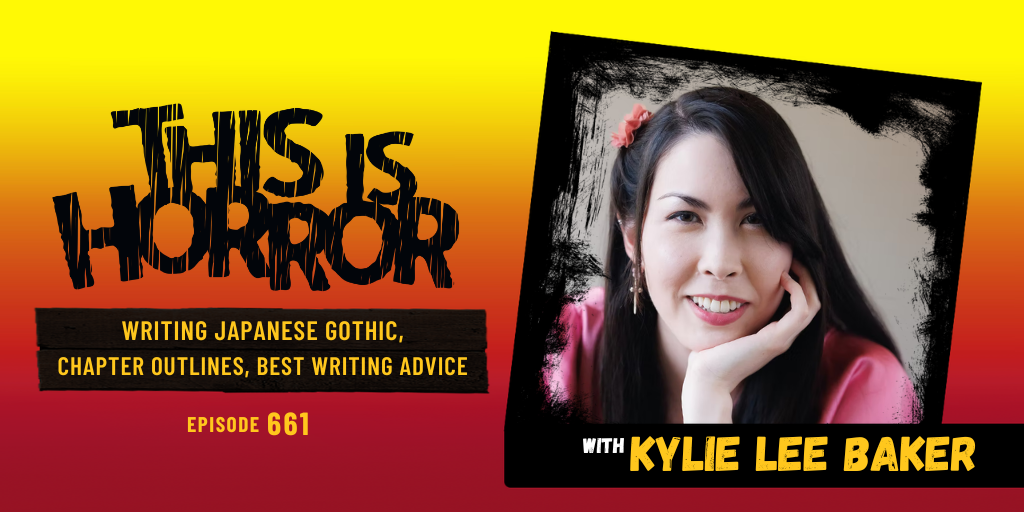
In this podcast, Kylie Lee Baker talks about writing Japanese Gothic, chapter outlines, her best writing advice, and much more.
About Kylie Lee Baker
Kylie Lee Baker is the Sunday Times bestselling author of dark fantasy and horror novels such as The Keeper of Night, The Scarlet Alchemist, Bat Eater and Other Names for Cora Zeng, and Japanese Gothic. She grew up in Boston and has since lived in Atlanta, Salamanca, and Seoul. Her writing is informed by her heritage (Japanese, Chinese, and Irish), as well as her experiences living abroad as both a student and teacher. She has a BA in creative writing and Spanish from Emory University and a MS in library and information science degree from Simmons University.
Timestamps
Thanks for Listening!
Help out the show:
- Support This Is Horror on Patreon
- Listen to This Is Horror Podcast on Apple
- Listen to This Is Horror Podcast on Spotify
- Rate and review the This Is Horror Podcast on Apple Podcasts
- Share the episode on Facebook and X
- Subscribe to This Is Horror podcast RSS Feed
Let us know how you enjoyed this episode:
- Write a comment below.
- Follow us and get in touch on Instagram @thisishorrorpodcast
- Subscribe and comment on YouTube @thisishorrorpodcast
- Follow us and get in touch on TikTok @thisishorrorpodcast
- Tweet us @thisishorror.
Resources
- Kylie Lee Baker fiction
- Watch the video version of This Is Horror Podcast episodes, including our conversation with Chuck Palahniuk on YouTube.
The Girl in the Video by Michael David Wilson, narrated by RJ Bayley
Listen to The Girl in the Video on Audible in the US here and in the UK here.
They’re Watching by Michael David Wilson and Bob Pastorella
From the hosts of This Is Horror Podcast comes a dark thriller of obsession, paranoia, and voyeurism.
After relocating to a small coastal town, Brian discovers a hole that gazes into his neighbour’s bedroom. Every night she dances and he peeps. Same song, same time, same wild and mesmerising dance. But soon Brian suspects he’s not the only one watching and she’s not the only one being watched.
They’re Watching is The Wicker Man meets Body Double with a splash of Suspiria.
Buy They’re Watching in paperback and eBook right now.
Michael David Wilson 0:20
Welcome to this is horror, a podcast for readers, writers and creators. I'm Michael David Wilson, and every episode I chat with the world's best writers about writing, life lessons, creativity and much more. Today is the second part of my conversation with Kylie Lee Baker, in which we talk about her brand new novel, Japanese Gothic as well as Japanese Gothic. Kylie is the author of the keeper of night, the scarlet Alchemist and bat eater and other names for Cora Zeng. As those of you who have already listened to part one will know this is a fantastic conversation with Kylie. She is very generous with both her time and knowledge. And of course, if you haven't listened to the first part, you can listen in any order. So before I get Kylie back on the show, a quick advert break.
RJ Bayley 1:41
It was as if the video had unzipped my skin, slunk inside my tapered flesh and become one with me.
Bob Pastorella 1:49
From the creator of this is horror, comes a new nightmare for the digital age. The girl in the video, by Michael David Wilson, after a teacher receives a weirdly arousing video, his life descends in a paranoia and obsession. More videos follow, each containing information no stranger could possibly know, but who's sending them and what do they want? The answers may destroy everything and everyone he loves. The girl in the video is the ring meets fatal attraction for the iPhone generation, available now in paperback, ebook and audio from the host of this is horror podcast, comes a dark thriller of obsession, paranoia and voyeurism. After relocating to a small coastal town, Brian discovers a hole that gazes into his neighbor's bedroom every night she dances and he peeps same song, same time, same wild and mesmerizing dance. But soon Brian suspects he's not the only one watching. She's not the only one being watched. Their watching is The Wicker Man meets body double with a splash of Suspiria. Their watching by Michael David Wilson and Bob Pastorella is available from this is horror.co.uk, Amazon and wherever good books are sold.
Michael David Wilson 2:59
Okay? With that said, Here it is. It is Kylie Lee Baker on this is horror. I wonder, in terms of the research for Japanese Gothic, what did you draw on? How did you go about it? Because I imagine there were an enormous amount of components. Because not only is this set in Kagoshima, you've got the Kagoshima of today. You've got the 1877 Kagoshima. You've got samurai Japan. Although, as you also mentioned in the afterword. There's kind of some liberties taken there. And then you've also got folklore that you're drawing upon, and these traditional Japanese tales, yeah,
Kylie Lee Baker 3:53
so in terms of kaigoshima, and also any setting where I haven't been, Google Map, Street View is so handy for me, just to get a sense of, you know, the setting around my characters. But in terms of samurai history, which I think is where the largest part of my research had to happen, my first question, of course, was, what is Sen, my Samurai character, doing every day like she wakes up and then what does she do? What is the life of a samurai look like? Because I know what the life of a college kid at his dad's house in Japan could reasonably look like, but I really had no idea for Sen, and so I read a book called hakakure, which is seen in some circles as a guide to being a samurai, which was written by a man who actually was a samurai, but lived in a time of peace, so he was more of a bureaucrat. But it has all these thoughts on, you know, things that samurai should or shouldn't do how they should. Behave what they believe in. Because that was really what mattered to me, is, what are if, if Sen is raised as a samurai, what are her governing beliefs going to be? How is she going to see her own position in the world? Because these are important questions for me as an author to know before I write any scene with her in it. And so I read that book, and I took a lot of notes, and then I, sort of, as I tried to do, zoomed out and, like, read about that book to see sort of how it fits into the history. And at that point is when I got a better sense of how it's really more of a book about struggling with the identity of being a samurai in of being part of a warrior class in a time when there isn't war, because even when it was written, there was no war in Japan, and it was written maybe 100 or so years before Sen's family picks it up. So really, the samurai have not been out there like doing the blue eye samurai sword fighting thing for quite a while, by the time Japanese Gothic starts, but then I thought that was such an interesting way to approach it, because really, I'm more interested in speaking about the dynamics of one family than I am about speaking to what the samurai at large were like. And I think it felt much more personal that way, that this is sort of a world that sends Father desires and has created because he believes in the glory of the Samurai, as opposed to, you know, this is what all samurai believed. And that was also something I learned, is I couldn't find, and never would find, one source about what the samurai were like, because they were prevalent for centuries across all parts of Japan. And so they didn't follow one unified code. And of course, you know, they had many things in common in terms of their beliefs, but there's not one definitive record that I could turn to, and that is why, as you said, I did take some liberties. I did my best to make it more or less, you know, threaded through with the commonalities between many Samurai, but it is a bit asynchronous, in the sense that people were not, as far as we know, behaving the way sens family did in 1877 they were probably not going out and killing people with their katanas. In fact, that would have been very illegal at the time.
Michael David Wilson 7:27
Yeah, and I love, there's a scene as well where Sen is in the modern day world and she wants to take her Katana.
And I mean, that kind of leads into the stepmother, Hina, I believe. And so, I mean, when did you know that Hina was going to be such a crucial element of this story?
Kylie Lee Baker 7:56
Oh, definitely, not until I started doing revisions with my editor without, without giving too much away. I think my original idea for Hina was just that I wanted someone who Lee could, one, talk about Japanese culture with because his father really doesn't know as much as he thinks he does. And two, to have someone who cares about him and who he cares about in the real life, some sort of mother figure when his mother isn't there. And for a while, that was really all that she was. And then as I was doing revisions with my editor, she saw more opportunities to connect things across the timelines, in which case I also gave Sen a similar character in her world which had not originally been there.
Michael David Wilson 8:52
Yeah, and the connective tissue is so seamless, but we probably can't talk any longer about fear of giving things away.
Kylie Lee Baker 9:04
I did also want to mention I just remembered, because you had asked about my research in Japanese folklore, and so I wanted to say a huge part of it is a storybook that my mother read to me when I was a kid. And there are these legends interspersed in the story about the legend of Urashima Taro, which is not something that I created. That is an actual Japanese legend, which I of course reworded and reframed so I'm not like plagiarizing anything. I'm sort of focusing on the parts of it that are relevant to this particular story. But I remember the illustration in that book that my mom showed me when I was a child, and I can't say what it is, because that would be a spoiler, but it was a horrifying picture of what happens at the end of that legend. And so I knew at some point I. Definitely needed to work that into a horror novel, so now I have made it everyone else's problem.
Michael David Wilson 10:05
Yeah, I recall, while reading it like being familiar with the actual legend, and I know, oh, okay, this is intriguing, you know. And I think too though, you know, for people who aren't familiar, they're probably going to now want to go out and read the original
Kylie Lee Baker 10:24
Yeah, probably, if spoilers matter, probably wait until after you've read the book, because I feel like knowing how that legend ends might tell you some things, right?
Michael David Wilson 10:35
Yeah, yeah. And, I mean, of course, Japanese Gothic is also concerned with patriarchal structures and abusive fathers to kind of go hand in hand. I wonder what compelled you to explore this aspect of humanity.
Kylie Lee Baker 10:57
I'm just so interested in exploring family dynamics, like family is so important to me, and I think it's such a universal thing. You know, everyone wants to be loved by their parents, and so that's a very easy way to I think have readers feel invested in characters, is such a relatable desire. And I think these days in particular, I'm also very interested in people who are stuck in the past, and the ways that it can be difficult to connect with them or change their minds just because they don't, they aren't willing to see that the world is different than it was when they were younger, and in fact, has always been different than they perceive it. I personally have a great relationship with my parents, but I know a lot of people who have very complicated ones, because talking to people in different generations can sometimes be like speaking a different language, even if you are speaking the same language. And I think that's very sad, but also from a writing perspective, very interesting, because you have such intense, like primal emotions, you know, wanting to feel parental love, and then it has just such potential to hurt. And so in the real world, that's awful, but in fiction, I think that's a very, very good place to be.
Michael David Wilson 12:26
And so I wonder, because we've spoken a little bit about your relationship with your father, we've spoken about watching the horror movies. We've spoken about going to the Irish pub and singing karaoke. I'm wondering what was, what is the relationship with your mother like, and how does that feed into your creative life?
Kylie Lee Baker 12:51
So my mom is wonderful. She, she's the Asian parent, and she has always been very supportive my creative endeavors, which is very not Asian parent of her, but she herself has a degree in flute performance from a conservatory, so she really can't be throwing stones in a glass house telling me that I need to be a doctor or a lawyer or something when her degree is in flute performance. But yeah, we've always we, she does not watch horror movies with me and my dad. That's not really her thing. But we, we've always bonded over music, because I played the cello growing up, and she plays the flute, as I said, so that's sort of been more of what we lean into. I don't know if music has so much influenced my writing, but I think the biggest influence she's had on my writing life is just encouraging me, like she sent me to all these summer camps that focused on creative writing. When I was a kid in elementary school, it never mattered to her what I wanted to do, but she would whatever it was. She would help me try to succeed at it. So she's been, she's been very great in that sense.
Michael David Wilson 14:07
And to the best of your knowledge, do your parents read your books?
Kylie Lee Baker 14:11
Oh yeah, they tell me about it. I hate when they do it. My dad will be like, Oh, I'm at the part in bat eater. When this happens, I'm like, I don't need a play by play like. I also tell them you don't have to read it like. I don't care, but they they do. Also, my grandmother, my mom, will, like, drive up to visit her, give her one of my books, and then by the time my mom drives home, it's like a three hour drive, my grandmother will email me saying that she's finished the book, has very nice thoughts on it. So my family does all I'll read my books, which definitely influences what I write. I have to think, okay, my mom will read this, so I got to keep that in mind.
Michael David Wilson 14:52
Yeah, does that limit you in some sense? So do you just find it?
Kylie Lee Baker 14:58
Ah. It. I mean, it's not in the ways you might expect, like my my parents know I'm weird. They know I'm, like, morbid. You know, I'm watching horror movies with my dad. That's not a secret. So it's not like I think they're going to be disturbed by anything that I write. I have not up until my most recent book, which is hell to pay. Written a sex scene because I did not want my parents. But I will just say that that has changed in my next book. But I honestly think when I give them their copies, I'm just gonna, like, put a post it over that page and be like, you don't need to read this. Here's a summary of what happens. Please Please don't read it. I don't want to think about you reading it.
Michael David Wilson 15:44
I don't know what your parents are like, but if somebody says that they don't want me to do something that, you know, I'm reading that page first. But I was gonna joke that you need to kind of release a parent's cut version. I mean, maybe literally cut. Just take some scissors and get rid, get rid of that page.
Kylie Lee Baker 16:11
I need to know it's not important. You just forget about it. Don't worry. Yeah, but it's a lot better than if I were like a rom com author, like a romantic see author or something when there would be too much to cut out. I just my parents would not be able to read my books at all. So it they've it's been pretty safe up until now.
Michael David Wilson 16:29
Well, at least it's only a one page section. And I believe that when we were talking to CJ Lee, she said, the next one has like a 25 page
Kylie Lee Baker 16:44
oh my gosh, yeah, that was that would I don't think my parents would be allowed to read my books at
Michael David Wilson 16:48
all if it had that much. I mean, it sounds like a play by play. Yeah, yeah. But goodness, I wonder, what did you learn about yourself and about writing through writing Japanese Gothic
Kylie Lee Baker 17:10
Well, one interesting thing I learned, I don't know if this is exactly what you meant by what I learned about myself, but I actually didn't know until I started researching this book that the samurai clan that Sam belongs to, which I chose purely based on geography of where the Satsuma rebellion would have taken place, is the samurai clan that would have helped colonize the island of Okinawa, which is where my grandmother's family is from. I'm a quarter Okinawan Japanese, and Okinawa was annexed by Japan, so they that samurai clan probably would have colonized my ancestors, which was weird to think about in hindsight. I mean, obviously we're quite a few generations out of that, so I didn't have super strong personal feelings where it was like, No, we must change this to a different samurai clan. But that was interesting. And I suppose it was also interesting to think about what writing a samurai book meant for me as an Okinawan, Japanese American person, just because I think, you know, when a lot of people think about Japan, what they think about is samurai. And I know that, and I know that in some ways, I do feed into the perhaps stereotypical, over consumed image of, you know, samurai are such cool warriors. Doesn't that girl look cool with a katana? She's so strong and bad ass like, I'm aware, I think it's kind of inevitable when you write about samurai in that sense, whereas in reality, at least for my family, it really wasn't that cool. Quite the opposite, in fact. And maybe that's why I sort of someone else said that my portrayal of samurai in this book reads quite critical. They didn't mean it as a criticism. And I think that's a they're correct in saying, Is it? Is it is kind of a critical way of portraying the Samurai, if you if you take sentence family as the samurai overall, which isn't my intention, and I think I do make that clear, though I do understand what that person meant. So I suppose writing this book definitely made me think about my own identity and my own family history, right?
Michael David Wilson 19:35
And as I mentioned previously, you do have a very serious note at the end about your Okinawan heritage and your complicated feelings towards it, to put it mildly, I mean, I wondered, is that something that you might explore in a future novel?
Kylie Lee Baker 19:58
I yeah, I would. Be open to that. I've written short stories that take place in Okinawa, though, to be honest, I think I would need to do a lot more research, and ideally, I would really love to visit Okinawa, because I've never been there. So in some ways, it would feel very inauthentic to me to try to write from that perspective when I don't have a lot of personal experience in it because my grandmother, who is my only living Japanese relative, she grew up in Hawaii, raised by Japanese American parents, and her experience is much more Japanese than it is Okinawan, even though she's 100% Okinawan, and that's because Japan outlawed a lot of traditional Okinawan practices. That's why the language is dying. That's why a lot of things like they had special hand tattoos for women, which were outlawed when Japan annexed Okinawa. So my grandmother then grew up thinking, oh, you can't have tattoos. That's what the Yakuza has like that, which is a very Japanese, not Okinawan way of thinking. So in a lot of ways, I am sort of cut off from that culture, which is not, honestly that different from how I once felt about being Chinese American or Japanese American. It's culture I went out and explored for myself, though I would say it's a bit easier, a bit more accessible, to access Chinese, American and Japanese American culture than it is Okinawan culture. It's a bit it's a bit harder to get that where I live, but yes, I would, I would love to explore that more someday. I'm always a little bit scared when I think about it, because Okinawa is a tropical place, and I grew up in Boston. I am Elsa, the snow princess who needs AC. I hate bugs, I hate humidity. I cannot believe that my ancestors are from Okinawa, whereas I go outside in 60 degree weather and go, it's too dang hot outside. I can't
Michael David Wilson 22:01
live like this. I think on that basis, then the best time for you to visit Okinawa is to kind of go in December, January, when the rest of Japan is what I would think of as freezing, and you'd probably think of as ideal. And then, you know, like Okinawa is kind of mild and quite pleasant and more what I think of as British spring, which sounds perfect, yeah. So exactly what I want. Yeah, I visited Okinawa in either it was, yeah, late December or early January, so and it was not tourist season, which meant that I could just, you know, go about things without other humans, mostly, which is also fine for me.
Kylie Lee Baker 22:50
Yeah? Okay, good. That's a good tip. That's what I should go, for sure, yeah, but
Michael David Wilson 22:55
you said that you're going to be visiting Japan later this year. So where are you planning to go?
Kylie Lee Baker 23:03
To be honest, my mom has planned most of this trip, and I have been so focused on work that whenever she tries to tell me, I'm like, please. I can't think about this right now. It's too stressful. So I have no idea where we're going. I know we're going to be in Tokyo at some point. I think we're going elsewhere from there, but all I know is that we're gonna see Tokyo.
Michael David Wilson 23:25
I mean, it's a long way from Tokyo, but you tempted to try and squeeze kathehima
Kylie Lee Baker 23:30
into the tree? Oh, gosh, I don't want to mess up her plans.
Michael David Wilson 23:36
Maybe in the future. Yeah, no. Fair enough. And I mean So again, if we look at Japanese Gothic and we look at the process you had said before about beginning with a chapter by chapter outline, so I wonder how much detail was in this chapter by chapter outline, because you also said the process was writing it as quick as possible.
Kylie Lee Baker 24:10
Yeah, I'm usually in my chapter outlines. I want to say just a paragraph or so. I'm not someone who writes like a novella for my outline, then goes back and expands on it, though, that probably would have been a better way to do that for this book, but usually just a couple sentences to know how it moves the story along, which, turns out, was not enough. You know, sometimes I try to, like not write everything down, because a lot of it I know is going to change when I actually start writing and feeling out the scene. But I guess there's a balance between, you know too much and not enough. Gonna find where to land in the middle,
Michael David Wilson 24:49
yeah, yeah. And as you said as well, each novel kind of requires a different amount, so it's almost like a lucky guess. When you start
Kylie Lee Baker 25:00
planning, pretty much just see what happens.
Michael David Wilson 25:06
And with regards to inverting tropes, I mean, usually we have a who done it in terms of murders, but you've done with Lee a kind of, how did I do it, or how done it, to say it grammatically and correctly, it sounds better. So how did you go about approaching that?
Kylie Lee Baker 25:35
I don't recall how that specific idea took root, though, I will say, at the time, I was reading a lot of Katrina Ward's books, and she writes incredible psychological horror with unreliable narrators, and towards the end of all of her books, it's like she just yanks the rug out from under you, and you figure out what is actually true, because you're not certain until until the very end. And I think that's what I had in the back of my mind, what I was trying to emulate as I was writing this book. So I think I just thought, you know, what would be the scariest hole to poke in in this particular memory of his? And so I think that's how I ended up deciding he didn't know how he killed his roommate, which is terrifying to think about, if that were to be real, but yeah, I don't know exactly how that started.
Michael David Wilson 26:33
Yeah. I mean, you're also playing with kind of the horror of mental illness, the horror of just unreliability of memory, and even when you know, years pass between you doing something, hopefully for people listening, not as extreme as actually killing a person you know, just Even General, more mundane, day to day, things like whether it actually happened, how you remember it is something that you know with time, unless there's video, which can also be manipulated
Kylie Lee Baker 27:13
exactly because. And I mean, I think you're alluding to this. Whenever you remember something, you're rewriting the whole story in your mind. And the more you remember it, the farther it becomes from what's actually true, which is terrifying. And actually I around the time I'd also finished watching season two of Interview with the Vampire, which I think is phenomenal the way it does it, the way it talks about memory, like they even say in that show, memory is a monster. It's like this recurring saying, and in the beginning you have the whole series through one character's perspective. And then towards the end of the second season, you start revisiting the scenes from season one, and now they're just slightly different, now that the character is sort of confronting, that he was a little bit biased in the way that he was trying to tell the story, and those like subtle differences and those scenes just change everything about the story, and that's so satisfying to me as a viewer, as a reader, when that happens. So that's something I really am trying to go for more in my own writing these days.
Michael David Wilson 28:16
Well, that's great to hear. Then I'll be looking forward to how that might happen in health
Kylie Lee Baker 28:22
day as well. Oh gosh, hopefully I can keep, keep it going. I feel like there's so many, only so many ways you can be like, I forgot I was so traumatized I didn't remember what happened. I feel like you can't do that in every single
Michael David Wilson 28:34
Right, yeah, yeah. Or at least be a little more subtle with it. Now when you call a book Japanese Gothic, it comes with certain weighty expectations. Now, expectations that I would say you wonderfully met. Thank you. But Did you feel any self pressure just in giving the book such a hefty and definitive title.
Kylie Lee Baker 29:07
So to be honest, Japanese Gothic was my working title, just sort of a nickname I gave this project. And the only thought I put into calling it that was, well, I read Mexican Gothic, and that's great. That's a spooky haunted house in Mexico. That's kind of horror, but also literary, and that's what I want this to be. So I'll just call this Japanese Gothic. And then I actually titled it when I sent it to my editor, the house of sword ferns. And then they didn't like that title, and so they went through all these lists of titles, and then I mentioned Japanese Gothic. And they were like, actually, that's good. Do you can we? Can we just use that? And I was like, you actually, you like that. That was just my working title. I didn't think about it at all. What do you mean? You like it? And they were like, no, no, we like it. And I was like, Okay, I trust you on this. So I definitely did not have huge, lofty intent. Mentions when I put zero thought into it whatsoever. But, you know, as the story developed, I do think it fits pretty well, because, you know, when you talk about Gothic literature, I mean, I know traditionally, we think about Western European or American, you know, these crumbling mansions and whatnot, though, you know, what makes those types of stories scary? I feel like is not the specifics of the architecture the you know that is culturally specific to Western Europe. I think it's just this ambience of of dread and fear and this feeling of having lost this home that, you know, I think the haunted house is such an incredible symbol of, you know, just feeling so unmoored from your home. And I think that can be achieved in a house in any country, in any culture, with any kind of architecture. So I think the story sort of grew into the title in some ways.
Michael David Wilson 31:06
I think as well, hopefully you'll find that, because it almost sounds like a genre category, you might get organic traffic through people searching for like, Oh, I'd love to read a Japanese gothic novel, here's hoping
Kylie Lee Baker 31:24
Japanese Gothic certainly is great for that search engine optimization, huh? If you're like gothic novels, and then you find
Michael David Wilson 31:30
Yeah, yeah. And I mean talking about great titles, like, I love the in your face nature of hell to pay. So I want to know, I don't know how much you can talk about, seeing as this is not coming out until next year, but what is the basic premise? Or, if you can't give that just, what can you tell me about hell to pay?
Kylie Lee Baker 31:57
Yeah, so I haven't worked out my elevator pitch for this one yet, though, I will say it's about three roommates in New York City whose apartment gets claimed by a demon, and they try to they try to leave, but they can't afford to break their lease, so they have to just sort of stay there and deal with it. One of the roommates works at a publisher, and she has multiple reflections that whisper to her she should do terrible things. One of them is a line cook who has a shadow man friend who also encourages him to do terrible things. And one of them is a former surgeon who keeps finding disembodied hands and fingers everywhere, and just has to deal with that. So it is a very weird
Michael David Wilson 32:51
I can see quite obviously why it is called hell to pay. I like the numerous levels that that works on, but oh my God, that sounds amazing.
Kylie Lee Baker 33:05
I gotta find a way to, like, pitch that better. It's so hard to convey like, like, Yes, this is a demon possessing your house story. But also it's really
Michael David Wilson 33:14
weird, yeah, but I think, you know, really weird that's that's the kind of flavoring that makes novels these days so special. Yeah, we don't want something generic. We don't want something that just follows the archetypes and the tropes and the same kind of wearily trodden path.
Kylie Lee Baker 33:40
So I'm for sure, there's so many, and I'm not talking about myself here. There's so many new and interesting writers in the horror genre that I think are doing such new and incredible things.
Michael David Wilson 33:55
Well, who are some of your favorites that you've recently discovered?
Kylie Lee Baker 33:59
Gosh, okay, so my favorite, I mean, this is not gonna, these are all, like, very big names. This is not gonna be an under the radar or anything. But Paul tremblay's horror movie where he has a script, like a movie script inside it so cool. And he really used that to make the story more interesting. It wasn't just like this, this fancy peacock flourish, kind of trick like, ooh, look how interesting multimedia it is. Look, he really used it. Also. Grady Hendrix is one of my favorite authors of all time. But, oh, you know, I know someone who's not quite as mainstream. Alex Gonzalez writes such intense, weird and very compelling horror. He wrote a book called wrecked, which was about snuff films. And then he wrote, recently a book called The Man of wind and moss, which is about a forest man who comes to attack a group of people camping in the woods. So it's like a very i. Familiar premise, but it just has such emotional depth to it and is so legitimately scary. You then have authors like Steven Graham Jones and Silvia Moreno Garcia, who are just doing things that are new and risky, and it's paying off. And so that makes me excited for the future of horror.
Michael David Wilson 35:24
Oh, yeah. I mean, there's an enormous amount of reasons to be excited, and you have listed a few of them. In terms of Grady Hendrix, am I right in thinking that he blurbed Japanese Gothic?
Kylie Lee Baker 35:38
Um, I he either blurbed Japanese Gothic or bat eater. I don't recall which one he's definitely blurbed one of them. I should know this. You want to know something funny is he's actually the uncle of one of my childhood friends, which I didn't find out until a few years ago. It's this, this guy, who I've known literally since kindergarten, and he's always mentioned his famous author uncle, but then he didn't actually mention his name until one day when he casually mentioned the southern book clubs guide to vampires. I was like, wait, wait, wait, your uncle that you've talked about all this time is Grady Hendrix. He was like, yeah. And then all these lights went off in my brain because, like, I know his mother, because we went to kindergarten together, and his mother's last name is Hendrix. And I was like, Oh, my God, you know Grady Hendrix. And then he put me in a text group chat with him and Grady Hendrix. And he's very nice. He's an incredibly nice guy that that was one of the most exciting moments of my life.
Michael David Wilson 36:39
So is that the first time that you interacted with Grady Hendrix just being put into Oh, yeah.
Kylie Lee Baker 36:46
So we were actually me and Grady Hendrix and some other authors were on this virtual panel together, purely by chance. I did not engineer this to make this happen. And then my friend, his nephew, was also just watching it, and then I just saw this notification that had John, my friend, and then an unknown number. And it was just, I'm watching now, you guys are doing great. And I texted him separately, and I was like, John is the other person in this group chat. Grady Hendrix said, yes. So that was, that was an exciting moment.
Michael David Wilson 37:20
Wow. Just so, so real
Kylie Lee Baker 37:24
that happened to you. Yeah, I it's, it's great.
Michael David Wilson 37:29
Well, I'm wondering, what is it that frightens you?
Kylie Lee Baker 37:36
Um, so I don't have normal people fears. I think I was just too exposed to horror as a child. So, you know, things like, you know, serial killers and ghosts and everything. I mean, obviously I don't want to be in a situation with a serial killer that doesn't sound desirable to me at all, but I'm not like losing sleep over it. The things, the one thing that gets me the spiders, which is hilarious, because even if it's very small spiders, it's like, I'll go sleep over in a murder house, but I still need someone else to squish a spider for me. So yeah, that's my that's my kryptonite. Is tiny little insects that can do me no harm.
Michael David Wilson 38:21
Yeah, yeah. So maybe that could be an issue visiting okie dower to go back.
Kylie Lee Baker 38:27
Yeah? Oh gosh, yeah. Everywhere it gets hot and humid, the bugs are so big. I know that's honestly a big reason why I've never been to Australia. Like, that's legitimately kind of a big deal breaker.
Michael David Wilson 38:39
I mean, Australia, everything wants to kill you, including the weather.
Kylie Lee Baker 38:44
You see, I feel like, if I lived in Australia, being afraid of spiders would be justified, because they they could actually harm me. None of the spiders in Boston could ever harm me, just to wimp
Michael David Wilson 38:58
Well, what is something that you believe that many other people do not.
Kylie Lee Baker 39:06
Hmm, in terms of like, like, like, spooky stuff, or
Michael David Wilson 39:12
Western genetics, as broadly as you want to
Kylie Lee Baker 39:17
something I believe that other people do not. Can you give me an example? I'm struggling to think, I mean,
Michael David Wilson 39:23
so so as you said, it could be spooky. It could be in terms of philosophies. It could be in terms of ways to live one's life.
Kylie Lee Baker 39:34
Okay, I'm trying to think about what I can say that's gonna offend the smallest group of people not to say that I have, like, super edgy hot takes. But you know, anything I say that, like, confidently, I want to be careful about how I say it. Okay. This is a very this is a very specific to the publishing industry. Can I. Take but I see a lot of authors saying almost like a badge of honor, like I write all day. I spend so much time writing, and I just don't think that's actually possible or good for you. I think it's actually incredibly unhealthy. And I say this as a full time writer, I think it's a terrible idea to do nothing but write all day. I think you need hobbies outside of yourself, or I think your brain is going to start to just devour itself, and your writing will suffer.
Michael David Wilson 40:33
Well. I mean, what is on the topic of writing? What is the best writing advice that you've been given, and what is the worst writing advice that you've been given?
Kylie Lee Baker 40:46
Interesting, okay, worst writing advice. I'll start with that, because I can think of that one. When I was in college, we were in my creative writing classes, we were reading some of the, you know, fiction, 101, types of books, and one thing that they talked about was not writing characters who are too much like you, because you don't want it to become a self insert character, which I understand on some level, and I agree with on some level, but what I think that translated to, for me was that it's amateur if I write like an Asian American female character with my identity, because, you know, that's like, that's too much of a self insert. And so actually, the first book I wrote, which was not ever published, was about a Korean American boy, because I wanted to write an Asian character, but I didn't want to write something that specific, because I thought that was bad. And then, you know, I got more involved in the writing community, and was like, no, actually, it's a good thing to write from your own experiences, though, I do think you should still be careful not to make it too much of a self insert. But I think writing about, you know, your heritage is only ever a good thing, and then the best writing advice I'd ever had. So I've, I've read quite a few craft books, and I I'm trying to think of what, okay, I know. So there's a book called Story genius, which I go back to all the time. It's so helpful for me in beginning to write a book. And essentially the core idea throughout the whole book is that your character's emotional journey, their internal arc matters more than anything else, and you need to figure out what that is before you think about anything external to them. In fact, you need to build the world around your character's emotional arc to support them on their journey, and not the other way around. They shouldn't be going through a world and like seeing what happens the world should be there to support them. And I think a lot of authors do this intuitively, and I think on some level, I did, though once it was once I read it, and actually, like solidified that idea in my mind. It's been so helpful for my writing to consciously make sure I'm doing that in all of the scenes, because I agree with it so much. And now I see it all the time. Books and movies that don't do that, and I understand now why I didn't connect with them as much as I did other books. And so I think so many people would solve so many problems if they in their writing, if they read that book.
Michael David Wilson 43:40
So after you'd read the book, did it dramatically change how you were planning your novels?
Kylie Lee Baker 43:47
Um, yeah. I mean, I think, because I've tried out a few different planning planning methods over the years, so I definitely, I have that whole template saved now, and that's definitely where I start. And if you were to look at the end product of my novels before and after. I don't think anything would look too dramatically different, but I do think, honestly, it's really helped me to focus in on what is important in a story and really streamline the writing process around that central idea. And, you know, catching a few things here and there where I'm like, Oh, actually, the scene is here for no reason. It doesn't advance the character's emotional journey, whereas I might. I mean, I'm sure I do, in some of my first two or three books, have scenes like that that I'm sort of like, I don't know why this is here. I was just sort of vibing when I wrote it, but now I'm a little bit more conscious of that. I think.
Michael David Wilson 44:41
Now you said a question ago that it's not a good idea for writers to spend all their day writing, or at least it's not the healthiest thing to do. Let's say that. And you also said that there comes a point where you get diminishing returns. From your writing. So on that basis, I mean, we've spoken about writing routine, but what does a typical day look like for you? Or if that's too difficult, then what does a typical week look like for you?
Kylie Lee Baker 45:16
That's not too difficult, I'm a creature of habit. I'm very, very structured. So usually, like, I'm at my desk writing at maybe eight o'clock at the latest. I try to get there at like 730 and then I write until like 1211, 3012, or so, doing my, like, most difficult creative work of the day, which is usually drafting, or if I don't have anything to draft at the moment, maybe like developmental editing or something like that. And then at that point is when I either go for a run or go to my group strength class, because that's the only time I can bring myself to exercise after I've done the most important work of the day. I'm like, okay, I get to go outside now and see the sunshine. Then I come back and have a shower, and then I do emails and the work that I need slightly less of my brain on for. And then I'll do things I can turn my brain down another notch for, like, reading or looking at, you know, cover sketches and being like, looks great. Thumbs up, please. Yeah, go with that, and then I'll eat dinner and watch a horror movie or something else terrible. That's, that's usually, usually what I'm up to.
Michael David Wilson 46:34
I mean, it sounds a pretty nice day to be honest.
Kylie Lee Baker 46:39
Great. Yeah, very lucky to be able to do that, because God knows, I would not have time to write and run. If I were still working in the archives from nine to five, I would just perish upon arriving home at the end of the day.
Michael David Wilson 46:56
So when you were working in the archives, when were you getting the opportunity to write?
Kylie Lee Baker 47:03
So I whenever I could. I mean, I was not working full time in the archives. I was working two to three days a week, so I still had a few days where I could write, though there were also times when those other days were taken up by my other job. I was working at a public library while I was working in the archives, or I was doing an internship at a different archive. There was at one point where I was doing like two jobs in internship and full time grad school. But I never really had, ever since I left Korea, a nine to five schedule. It was always like an afternoon shift here and a morning shift here. So there would be some parts during the day where I could fit it and where I had to fit it in if I wanted it to happen at all that and weekends, because I sometimes had to work one weekend day at the library, but not often. So that was when it had to happen, whereas now I try, if at all possible, to take my weekends off, which is lovely.
Michael David Wilson 48:02
And of course, another element of the business of writing, which a lot of writers understandably aren't too keen on, is the marketing and the publicity, and they're just getting the word out about the book. So I mean, what are your non negotiable is, what are the things that you have to do to ensure that you're kind of signal boosting your own work, and then what are perhaps some of the best things that you've done?
Kylie Lee Baker 48:33
Oh, gosh. I mean, I don't know what I have to do. I mean, what I try to do is post major updates on Instagram. That's really the only social media platform I have anymore. So things like, you know, cover reveals, if I get any special type of recognition award, I try to intersperse it with pictures of myself in my normal life. So people remember I'm a human and not just someone who's really bad at making graphics on Canva, I have a newsletters that I send out once a week. That's, I mean, certain, not once a week. Oh, God, I would die once a month, which is sort of a roundup of updates. And also, you know, things going on in my personal life. And then the other main thing I do is just try to do interview and event requests that come through my publicist that they think are good opportunities that would be a good use of my time. I've kind of given up on doing things like Tiktok. I had a whole stage where I was trying to make that work, but it's just not something I enjoy. And honestly, I found, you know, my horror novels have performed very well. I've seen a lot more success and reaching a lot more people with my adult horror compared to my young adult books. Where, with my young adult books, I was doing a lot more marketing on my own. I was making a lot more tiktoks and thinking a lot more about so. Social media. And just for me, I think that was never the path to success. It was never that. For some people, it could be it's what makes their books popular. But for me, it really wasn't. And so it's not something I am trying to put as much time into anymore. I'm just trying to do things like this that I think are fun, because I love yapping about horror. Oh my gosh. So, you know, I just do things that I feel like add to my energy, and that my publicist says I probably should try to make shine for.
Michael David Wilson 50:32
Yeah. I mean, Tiktok in particular is possibly the most volatile platform that exists, and it is almost just throwing things into the mix and seeing what sticks. But the real difficulty is, for anything to stick, you have to throw a lot in whereas, you know, Instagram, which you mentioned, I feel it's just more steady and it's more predictable and it's more reassuring.
Kylie Lee Baker 51:04
Yeah, I think of Instagram more as for reaching mostly people who already follow me and want updates, whereas I think Tiktok was better for finding new people when your tiktoks do well, which mine did not often do.
Michael David Wilson 51:19
Yeah, I think, as well, the algorithm for Tiktok is brutal, like they'll assess within the first five or 10 seconds as to whether your video is going to be a success. And I don't know. I do think that the prevalence of video and it being needed to a point for authors is almost ironic or just a horrible cruelty, because it's like if we wanted to be in front of a camera and to be making these quick viral videos, we wouldn't be spending the best part of a year or half a year on our own, writing novels where you don't need to see our face. You don't need to.
Kylie Lee Baker 52:09
I think John Green said in one of his interviews that people write novels so they can tell you a story without looking you in the eye. Yeah. Yeah. That's how I feel. I yearn for the days of Lemony Snicket, when, like, no one would even know your real name or face.
Michael David Wilson 52:26
Yeah, yeah, things are changing, but there's a hope that, you know, I mean, things become cyclical and but perhaps we will go back to that. I mean, you want to get into it too much, but particularly with, like, you know, this prevalence of deep fake and AI videos and because, because now there is almost an unreliability as to what is and isn't true, Maybe people will just trust text more, because we can no longer trust video.
Kylie Lee Baker 53:05
Oh, gosh. But even you can't trust anything these days. I don't know if you heard about that whole controversy with the AI book. Oh, gosh, oh, I well.
Michael David Wilson 53:15
I mean, I, I heard of it. I didn't read into it too. I mean, because the headlines seem to kind of tell me all I needed to know. I didn't need to deep dive. I mean, I don't know what to say. Don't use AI to write a book, because that isn't writing a book.
Kylie Lee Baker 53:35
Yeah, it's a scary, scary times we're living in.
Michael David Wilson 53:39
Yeah, yeah. Yeah. I mean, Chuck Palahniuk, when he was talking about AI and writing, he was saying that he thinks, what makes you know writing to be beautiful and artistic is the imperfection. It's having those errors. It's having those flaws and yeah, and that kind of soul and that emotion and that imperfection that is something that AI can't replicate.
Kylie Lee Baker 54:07
Yeah, definitely,
Michael David Wilson 54:09
not yet, yeah. But I think as long as you're writing original, weird stories, then that you know you're gonna get by and you just gotta keep
Kylie Lee Baker 54:20
getting weirder and weirder. I can do that.
Michael David Wilson 54:24
It sounds like you're doing that as the highest compliment, yeah. Well, apart from just keep getting weirder, what advice would you give to your 18 year old self?
Kylie Lee Baker 54:40
Oh, my gosh. Um, you know, I don't know if there's anything I feel like she, she would figure it out. You know, she, I think everything, all the this is very cliche of me to say, but you know, all the mistakes you make along the way, they all. Make you who you are. And so I feel like 18 year old Kylie was fine, and the things I could tell her wouldn't, wouldn't make a difference. Like, I'd be like, stop being so dramatic about boys. None of it matters. But like, you couldn't tell that to an 18 year old, like, I wouldn't go, oh yeah, okay, you're right. You're right. Like, I would just be like, I don't believe you screw you, like, I'm gonna do what I want. So I think everything she's got it I trust 18 year old Kylie.
Michael David Wilson 55:29
Well, I'm sure she'd appreciate your faith in her. And yeah, I suppose that is the flaw in the question that you can tell an 18 year old anything, but they're rarely going to actually listen Yeah, but something people should listen to is, why should they pre order Japanese Gothic,
Kylie Lee Baker 55:53
oh, gosh, if you like to be sucker punched by plot twists, by unreliable narrators, if you want to find out which of the timelines between 1877 samurai girl and 2026 guy who killed his college roommate but doesn't remember how, which one is a ghost, which one isn't real, there's only one way to find out, and it's to read Japanese Gothic.
Michael David Wilson 56:20
There you go. Everybody in pre order, right there, perfect. Well, where can our listeners and viewers connect with you?
Kylie Lee Baker 56:35
Kylie Lee Baker, on Instagram. My website's Kylie Lee baker.com, everywhere I am is Kylie Lee Baker, so I'm, I'm really easy to find.
Michael David Wilson 56:44
All right. Well, do you have any final thoughts?
Kylie Lee Baker 56:47
No, just thank you so much for chatting with me. I love talking about horror. You're, you've been a wonderful host.
Michael David Wilson 56:55
Yeah? Thank you very much. This has been an absolute pleasure.
Kylie Lee Baker 56:59
Yeah, for me too.
Michael David Wilson 57:05
Thank you so much for listening to Kylie Lee Baker on this is horror. Join me again next episode, when I will be chatting with Addison Hyman about touch me and hypochondriac. But if you would like to get that ahead of the crowd, and if you would like to support over 13 years of horror fiction podcast interviews, then become our patron@patreon.com forward slash, this is horror. Not only do you get early bird access to each episode, but you can submit questions to our interviewees, and soon we will be chatting to Jed Shepherd, the writer of the movie's host and dash cam. So if you have a question for Dad, the place to go is patreon.com, forward slash This is horror. Okay, before I wrap up a quick advert break
Bob Pastorella 58:14
from the host of this is horror podcast, comes a dark driller of obsession, paranoia and voyeurism after relocating to a small coastal town, Brian discovers a hole that gazes into his neighbor's bedroom every night she dances and he peeps same song, same time, same wild and mesmerizing dance. But soon, Brian suspects he's not the only one watching and she's not the only one being watched. They're watching is The Wicker Man meets body double with a splash of Suspiria. Their watching by Michael David Wilson and Bob Pastorella is available from this is horror.co.uk, Amazon and wherever good books are sold.
RJ Bayley 58:53
It was as if the video had unzipped my skin, slunk inside my tapered flesh, and become one with me.
Bob Pastorella 59:01
From the creator of this is horror, comes a new nightmare for the digital age. The girl in the video, by Michael David Wilson, after a teacher receives a weirdly arousing video, his life descends into paranoia and obsession. More videos follow, each containing information no stranger could possibly know, but who's sending them and what do they want? The answers may destroy everything and everyone he loves. The girl in the video is the ring meets fatal attraction for the iPhone generation, available now in paperback, ebook and audio.
Michael David Wilson 59:31
Well, as always, I would like to end with a clip from a previous This is horror episode, and this is taken from Episode 593 with David DAST melchian, in which he talks about acting iconic horror voices and mastering vocal work. So here we go.
David Dastmalchian 59:57
This is horror. Well. As an actor, all the tools that you're given, obviously, your voice is one of the most important of all the tools. And I've spent a lifetime listening to everyone from Basil Rathbone to Vincent Price, you know, and you think about all the different amazing people that you want to emulate with your vocal work, contemporary actors too. You know, I think Benedict, Benedict Cumberbatch, has got such an incredible facility with his vocal just range and strength. But yeah, I always wanted to be someone that could be doing the voices of horror trailers, Halloween records, spooky stories for children. I just read a chapter, The Lost chapter, the doc, the doctor, I believe it's called the doctor's guest from Bram Stoker's Dracula. I read it the other day at the library. For the public library, they had like a Halloween event, and I just but you have the perfect name for a podcast.
Michael David Wilson 1:01:15
If you want to listen to the full episode with David das melchian, you can listen to episode 593 of this is horror podcast. Or if you want to watch the video version, it is available on YouTube, youtube.com, forward slash at this is horror podcast. And if you would like other inspirational clips from past episodes, please do follow us on Tiktok and Instagram at this is horror podcast. Well, that does it for another episode of This is horror so until next time with Addison Heimann, take care of yourselves. Be good to one another. Read horror, keep on writing and have a Great, great day.