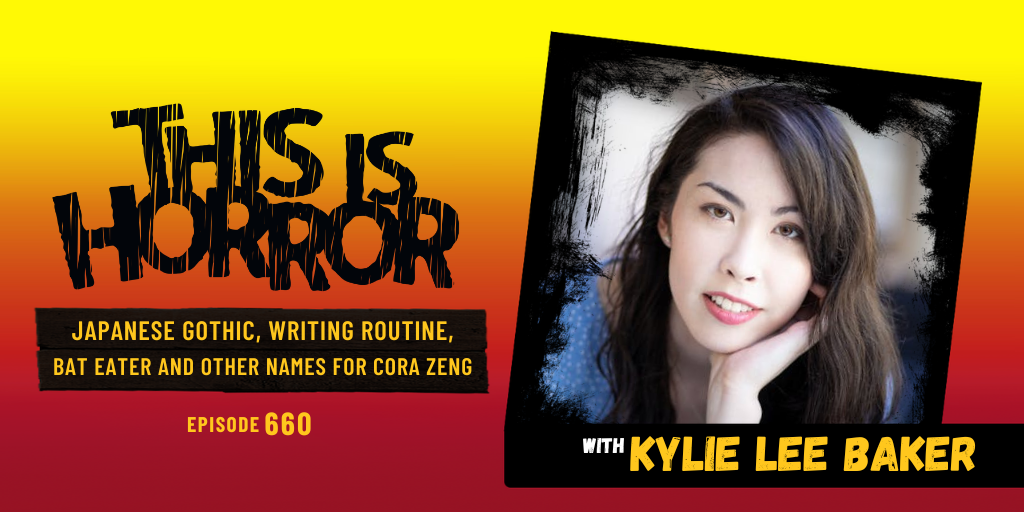
In this podcast, Kylie Lee Baker talks about Japanese Gothic, Bat Eater and Other Names for Cora Zeng, her writing routine, and much more.
About Kylie Lee Baker
Kylie Lee Baker is the Sunday Times bestselling author of dark fantasy and horror novels such as The Keeper of Night, The Scarlet Alchemist, Bat Eater and Other Names for Cora Zeng, and Japanese Gothic. She grew up in Boston and has since lived in Atlanta, Salamanca, and Seoul. Her writing is informed by her heritage (Japanese, Chinese, and Irish), as well as her experiences living abroad as both a student and teacher. She has a BA in creative writing and Spanish from Emory University and a MS in library and information science degree from Simmons University.
Timestamps
Thanks for Listening!
Help out the show:
- Support This Is Horror on Patreon
- Listen to This Is Horror Podcast on Apple
- Listen to This Is Horror Podcast on Spotify
- Rate and review the This Is Horror Podcast on Apple Podcasts
- Share the episode on Facebook and X
- Subscribe to This Is Horror podcast RSS Feed
Let us know how you enjoyed this episode:
- Write a comment below.
- Follow us and get in touch on Instagram @thisishorrorpodcast
- Subscribe and comment on YouTube @thisishorrorpodcast
- Follow us and get in touch on TikTok @thisishorrorpodcast
- Tweet us @thisishorror.
Resources
- Kylie Lee Baker fiction
- Watch the video version of This Is Horror Podcast episodes, including our conversation with Chuck Palahniuk on YouTube.
The Girl in the Video by Michael David Wilson, narrated by RJ Bayley
Listen to The Girl in the Video on Audible in the US here and in the UK here.
They’re Watching by Michael David Wilson and Bob Pastorella
From the hosts of This Is Horror Podcast comes a dark thriller of obsession, paranoia, and voyeurism.
After relocating to a small coastal town, Brian discovers a hole that gazes into his neighbour’s bedroom. Every night she dances and he peeps. Same song, same time, same wild and mesmerising dance. But soon Brian suspects he’s not the only one watching and she’s not the only one being watched.
They’re Watching is The Wicker Man meets Body Double with a splash of Suspiria.
Buy They’re Watching in paperback and eBook right now.
Michael David Wilson 0:20
Welcome to this is horror, a podcast for readers, writers and creators. I'm Michael David Wilson, and every episode I chat with the world's best writers about writing, life lessons, creativity and much more. Today I am talking to Kylie Lee Baker about her forthcoming novel, Japanese Gothic. Now, for those of you not in the know, Kylie Lee Baker is the Sunday Times best selling author of dark fantasy and horror novels such as the keeper of night, the scarlet Alchemist, bat eater and other names for Cora Zeng and the aforementioned Japanese Gothic. Kiley grew up in Boston and has since lived in Atlanta, Salamanca and Seoul. Her writing is informed by her heritage Japanese, Chinese and Irish, as well as her experiences living abroad, both as a student and a teacher. She has a BA in creative writing and Spanish from Emory University, and an MS in Library and Information Science degree from Simmons University. So that is Kylie Lee Baker, but before I get her on the show, a quick advert break.
RJ Bayley 2:16
It was as if the video had unzipped my skin, slunk inside my tapered flesh and become one with me.
Bob Pastorella 2:24
From the creator of this is horror, comes a new nightmare for the digital age. The girl in the video, by Michael David Wilson, after a teacher receives a weirdly arousing video, his life descends in a paranoia and obsession more videos follow, each containing information no stranger could possibly know. But who's sending them and what do they want? The answers may destroy everything and everyone he loves. The girl in the video is the ring meets fatal attraction for the iPhone generation, available now in paperback, ebook and audio from the host of this is horror podcast, comes a dark thriller of obsession, paranoia and voyeurism. After relocating to a small coastal town, Brian discovers a hole that gazes into his neighbor's bedroom every night she dances and he peeps same song, same time, same wild and mesmerizing dance. But soon Brian suspects he's not the only one watching and she's not the only one being watched. They're watching is The Wicker Man meets body double with a splash of Suspiria. Their watching by Michael David Wilson and Bob Pastorella is available from this is horror.co.uk, Amazon, and wherever good books
Michael David Wilson 3:33
are sold. Okay? With that said, Here it is. It is Kylie Lee Baker on this is horror. Kylie, welcome to this is horror.
Kylie Lee Baker 3:49
Hi. Thank you so much for
Michael David Wilson 3:50
having me. So to begin with, I want to know what were some of the early life lessons that you learned growing up in Boston, oh
Kylie Lee Baker 4:03
my gosh, specifically, growing up in Boston. I mean, I'd say the biggest one for any Bostonian is, mind your own business. In the Northeast here, we're really big on not getting into other people's problems. We're not friendly here at all. At least compared to the south, you don't smile at anyone on the street. You just get where you need to go and do it efficiently. Also that Dunkin Donuts is the most important store in the world. I learned that at a very early age coming from Boston.
Michael David Wilson 4:35
Yeah, it sounds like the kind of contrast with a lot of countries, just between the city and the country, and the more built up the city is, the more it's like, yeah, don't look at other people. Don't try and communicate with them.
Kylie Lee Baker 4:49
What? Exactly, exactly, don't talk to anyone here. And people will think it's strange, yeah.
Michael David Wilson 4:57
And I mean, I wonder, as when. Well. So I mean, when you were growing up, I want to talk specifically about your interest in horror and in reading and writing. So to begin with, I understand that you were watching a lot of horror movies from a very early age, and is perhaps your father's influence?
Kylie Lee Baker 5:23
Oh, it definitely is his influence. Yes, I fully blame him for that. We watched one just the other day, so we're we're still going with the tradition.
Michael David Wilson 5:31
So what were some of the early horror movies that you were watching?
Kylie Lee Baker 5:37
The first one I remember is the silence of the lambs. And I didn't realize until I got to college, and we studied it in my screenwriting class, and then I got deja vu, and I was like, I remember seeing this when I was in elementary school. Why did I watch that so young? And then after that, would be the US remake of The Grudge, and then the ring, I was definitely too young to be watching the grudge, because I remember just being in my grandmother's house, just terrified of getting up to go to the bathroom at night. That one really scared me. But you know, it's, it's all for the best, because I feel like now nothing scares me, sort of like when you're a kid and you get sick all the time, and then as an adult, you don't get sick anymore, because your immune system is just so well developed. I feel like I've been, you know, vaccinated against fear, essentially. So now, now nothing scares me except spiders.
Michael David Wilson 6:24
Oh, my goodness. So, I mean, as an elementary school student, you were watching the grudge ring and Silence of the Lambs.
Kylie Lee Baker 6:34
Yeah, it explains a lot about me as a person when I tell people that they go, Oh, that makes sense.
Michael David Wilson 6:40
And I mean, was there a film or a moment where it confirmed that horror was one of the genres for you, or were you more just passively taking these in and developing, um,
Kylie Lee Baker 6:54
maybe it was more passive. You know, there was, there wasn't any one particular moment, but I always just really enjoyed it, I think, especially as I started getting into middle school and then high school, just because I was such a cynical child, for no reason. But I really enjoyed watching horror movies because I knew I wouldn't have to think about romance and I wouldn't have to see a happy ending and be like, Oh, that's not realistic. The world doesn't work that way because I was so cynical for no reason at all, so I sort of liked having that sort of safe space where I'm not going to encounter anything that's that close to my real life in horror, just fun and scares and blood and whatnot.
Michael David Wilson 7:35
Yeah, yeah. And when did you watch the original fashions of the grad Jian
Kylie Lee Baker 7:42
ring not until I was an adult. I don't know exactly when, but it had been long enough that the special effects felt very outdated to me by the time I saw them, maybe in the last few years or so. So, I mean, I don't feel like I can judge them fairly because, of course, what scares me as a 10 year old is very different from what scares me as like a 25
Michael David Wilson 8:05
year old, yeah, yeah. No, I think that's reasonable and normal. I should hope, yeah. And in terms of the reading component, what were some of the first stories that you were reading?
Kylie Lee Baker 8:21
So I remember going to my local public library, and I would just clear the shelves of all these mass market paperback horror books in the young adult section, just like 10 of them at a time. I read so many and so quickly that I honestly don't even remember the names of a lot of them, like I could tell you what happens in a lot of them, there was one book about this girl who, like, finds out she has a secret twin who's trying to kill her. Like I remember the plots very vividly, but not the stories themselves. And then once I finished that section, I moved on to the adult horror section, where I started clearing the shelves of all the Stephen King books. And I remember reading like the girl who loved Tom Gordon and Carrie. And I read as many as I could until I started, I got through most of the books that he had written at the time that had female protagonists and also children, which I think might only be or the girl who loved Tom Gordon is the most salient one in my mind now. But many of his books, as you probably know, are about 50 year old widowers on an island in Maine, which, you know, is totally fine, but as an Asian teenage girl, it wasn't the most relatable perspective for me personally. So that was I had reached the upper limits of my library at that point.
Michael David Wilson 9:42
Yeah. And I mean, did were you also writing stories from a young age? Did you know that you wanted to be a writer from a young age?
Kylie Lee Baker 9:53
Yes, I always loved writing. I remember just sitting on my bed writing on these sheets of. Printer paper, not even lined paper, so it looked horrible. It would go like diagonally across the page, just writing all these stories when I was a kid, and I was very fortunate, because I had teachers that were very non traditional, I suppose, in elementary school, teachers who would do things like have us put on a play for like, the last quarter of the year, instead of studying for a final exam, and like they really encouraged us to be creative. So I got to write all the time when I was a kid, I never thought it would end up being my job one day, but I always knew it would be something that I would enjoy and hope to continue throughout my life.
Michael David Wilson 10:40
So it's interesting that you said that you didn't realize it would be your job, because there must have been some optimism or some hope, because you then went on at university to take a BA in creative writing.
Kylie Lee Baker 10:56
Yeah. So what happened with that was, I started college thinking, Okay, I'm going to be a un translator in Spanish and Chinese. And then I found out that you need to be really, really, really fluent in your second language in order to do that. And I speak Spanish pretty well, like that could be doable for me, but I was not anywhere near good enough at Chinese. And in America, just speaking Spanish and English is really not, in and of itself, that rare anymore. And for to work for the UN, you also need to speak French, which I didn't speak at all. So it's like, Okay, how many years is it then going to take me to be qualified for this? So I, as I think many college students do, had a mental breakdown and was like, What am I doing with my life? I need to change my major immediately to something that can actually help build my future. And I decided that I would have one practical major and one fun major. And so my practical major was Spanish and my fun major was creative writing, which now is pretty funny to me, because I have not made a single cent from speaking Spanish. I only continue to lose money speaking Spanish because I pay to take Spanish lessons so I can keep speaking it, whereas I've made a living off of my creative writing degree somehow. So that's definitely not what I expected.
Michael David Wilson 12:19
I mean, that's probably not on any creative writing graduates. Big go card, is it really? No. I also did a BA in creative writing, so I have seen that like you know, the vast majority, unfortunately, of people who did that undergrad course are not really doing creative writing at the moment, but it was a hell of a lot of fun. Yeah, exactly.
Kylie Lee Baker 12:49
And I feel like that's what most people do, but that's what I was doing it for, yeah, you know, I just need to pursue something that makes me excited to be alive, you
Michael David Wilson 12:56
know, right, right? Yeah. I mean, that is the objective in general, I think, regardless of what stage of life you're at, and I wonder too, I mean, how did your Japanese, Chinese and Irish heritage inform or impact your upbringing?
Kylie Lee Baker 13:19
So I had an interesting upbringing as a biracial child. I grew up just outside of Boston, which is a pretty diverse city by most American standards. Though, in the particular suburb that I grew up in, there were not many Chinese people and there were no Japanese people, so there were some, we have a pretty sizable Vietnamese community where I'm from. But in my graduating class, there were maybe 10 or so Asian students out of, like, the 300 that were there. So we all knew each other very well. I was very much, you know, quote, unquote, one of the Asians in my school. I identified very strongly with being Asian American. And then when I went to college, Emory University has a comparatively huge Asian population. It's something like 30% of the student body is Asian, some of that being Asian American students, and some of that being international students. They have a large population of Chinese and Korean international students, and then all of a sudden, I was not really that Asian anymore. Like I met a lot of people there who had who were from China or Korea, and the first time they met me, often in the capacity of an ESL tutor, because I helped tutor a lot of international students. A lot of them didn't realize I was Asian at all. And so it was maybe the first time I started to realize how much my identity changes depending on who's perceiving me. And then, of course, after college, I had moved to Korea, where I was really, really not considered an Asian person there. So I've had all sorts of experiences in terms. Of you know how my race informs how I view the world, but just, I suppose to get back to your question in terms of actually growing up in Boston, I think, you know, Boston is certainly not the most diverse place in the world, especially for Asian people, compared to like on the west coast. But you know, we do still have a lot of culture here, like we do have a Chinatown, we do have a Japanese school, and so I definitely had what I would consider a very fun and standard Asian American experience with my friends here. So I definitely felt connected to that particular identity growing up, and then also, Boston is a very Irish city, so that was also definitely a big part of my upbringing. Like I remember going to this Irish pub with my dad when I was a kid, and just like dancing around, just like drinking orange juice, sitting at the bar, and I didn't learn until I was in high school that you're actually not supposed to let children sit at the bar. That's actually illegal here. And I was like, What do you mean? I did that all the time when I was a kid, but apparently that's just an Irish Pub thing. That's not actually something you're supposed to do. So that's that's also, you know, culturally, a huge part of who I am, though I would say, overall I've I'm definitely American, you know, unfortunately, I say these days. But you know, my family, on both sides, has been in America for quite a few generations now. So as much as I identify with Irish, American, Asian American, you know, I think American is, like, the biggest word there. Like, I'm very I can't live without air conditioning. Whenever I go to the UK, I feel like such an American princess. I'm like, Oh, I can't. There's no AC or how do people live? I can't. I can't do this. So, you know, that is probably the most prominent part of my identity, for better or worse.
Michael David Wilson 17:00
Well, I mean, we're not gonna sidetrack for too long on ACS, but I will say, having now lived in Japan for a number of years, I am so used to the AC. So when I come back to the UK, right, what is going on here? And I feel it's because, you know, during, like, let's say, 20 or 30 years ago, the weather was just not as hot in the UK. So there wasn't really a requirement, and, you know, for there to be an AC beyond kind of commercial offices. But now with a thing called global warming,
Kylie Lee Baker 17:41
yes, also small sidetrack. Here I was in London on the hottest day of the year in 2024 I was cat sitting, and I reached this person's apartment. It was on the fifth floor of an apartment building. It's like a 90 degree day. No AC, of course, but also because of her cat, I couldn't open the windows because the cat would try to jump out from the fifth floor. So I remember just lying in bed and thinking, I'm not going to survive this. I'm too I'm too spoiled and American to live this way.
Michael David Wilson 18:17
Yeah, I understand that. And you know, during my childhood, there would be one or two hot days of the year, so you'd only have one or two that you had to suffer. But, you know, talking about it now, I'm getting these vague flashbacks. And you know, basically everyone would just be walking around the house with, like, fans circulating everywhere. So just circulating hot, muggy air. Everyone's sweating, everyone's angry. No one can sleep properly. It's not a good time. No do anything. Fans. Just circulate air and circulate irritation, if anything, they're exacerbating they make
Kylie Lee Baker 19:05
you feel like you're doing something to fight the heat, but you're not.
Michael David Wilson 19:08
Yeah, but away from ACS and back to your Chinese heritage, specifically, because you mentioned about your Spanish being very good, but your Chinese wasn't quite there. So I'm wondering, you know, when did the Chinese language factor in to your life? How did it factor in?
Kylie Lee Baker 19:32
Yeah, so when I was growing up, I wasn't around anyone in my family who could fluently speak Chinese or Japanese, unfortunately, and I think that's just a byproduct of how many generations we've been in the United States, though, there is a pretty sizable Cantonese population where I'm from. My the few Chinese friends I had were Cantonese. So I studied Cantonese a bit when I was in middle school and high school. People, though, it's a pretty difficult dialect to pick up if you're not a native speaker, like, I don't know how familiar you are with Chinese, but in Mandarin, there's different kinds of tones, like there's a rising tone and a falling tone, and it changes the meaning of the words. In Cantonese, it's like there's a rising tone and then there's a tone that rises slightly more, and you need to differentiate them somehow. And I just don't understand how you do that if you're if you don't grow up speaking it, since you're a baby. So that was difficult. But then when I got to college, I started formally studying Mandarin, and I got reasonably good at it, just by merit of how much time I spent studying it, and I also had many friends who were Chinese international students. And I made more friends who were Chinese American and spoke Mandarin at home rather than Cantonese. So it was very easy to practice with them. I remember going to like karaoke and singing Chinese songs like, there's this, there's this one Chinese song called fairy tale that is like the typical karaoke song for Chinese speakers, I can remember every single word of that in Chinese, even though I've forgotten so much of my Chinese at that point, I just I could sing that like at the drop of a hat. So that was definitely my peak Chinese language era. I got conned into doing like a Chinese language speaking contest at one point at my college. It was, it was a whole thing. I was okay at it. I understood a reasonable amount, and then I sort of lost it over the years as I well. First I got off the schedule for the Chinese courses I was going to take because I studied abroad in Spain for a semester, and then I missed the the next level of the class, and then I never really got back into it. And then I moved to Korea, and then Korean obliterated any Chinese left in my brain, because there are a lot of similarities. And it was, it was too confusing for me to try to hold on to Chinese at the same time. And you know, I would love to get back to it one day, but it's also an issue of, you know, there's not a lot of opportunity to speak it in my daily life, unfortunately.
Michael David Wilson 22:11
And seeing as you mentioned going and living in Korea, why of older countries did you decide Korea?
Kylie Lee Baker 22:20
Well, I looked at a lot of different programs for teaching English abroad, and Korea, to be perfectly honest, pays the best out of the East Asian countries I was looking at. And, you know, I also thought in some ways it would be easier, because I wouldn't, it wouldn't be like an identity issue for me. Like I wouldn't be walking around Japan or China thinking, oh, man, this, this could have been my life, or I, you know, I should be able to speak more because, you know, this is my heritage. I would just, you know, totally new place, totally new culture. And, you know, I just, I was excited to go anywhere after college. I was a bit tired of academia, so I just wanted to explore, and that seemed like a good place to start.
Michael David Wilson 23:06
And so how long were you living in Korea for? And what were some of your favorite aspects, and perhaps some of your least favorite aspects?
Kylie Lee Baker 23:16
I was there for two years. I think my favorite part of being there was the food, because it's so good and so cheap, like people asked me for restaurant recommendations in Korea, and I'm like, I don't, I don't know. I never like looked the way I do in America. I never would like look up restaurants and read the reviews first. I would just walk into any restaurant and find something good and very inexpensive. And also the public transportation there puts everything in America to shame. I could go anywhere I wanted. It didn't make sense to me why people had cars when they lived in that city. It was so convenient, so easy. Probably the worst thing was the air quality. And this is perhaps ignorant of me, but I had no idea that there were air quality problems in Korea. I of course, have heard of the air quality issues in China, and then what I didn't know is a lot of that then blows over to Korea. So that was an unpleasant surprise. I got used to very hazy looking skies most of the time, and like my skin breaking out terribly, you know, checking the air quality forecast every day to see if I need to wear a mask to work. So that was, that was not my favorite part of living there.
Michael David Wilson 24:29
Well, I mean, talking about wearing a mask, obviously, during and post covid, that has become something that is very well known within the West. But I remember when I first came to Japan in 2014 like this was the first experience I'd had with wearing a mask, or other people wearing masks. I mean, to begin with, I was a bit worried, is everyone okay? And then I found out, actually. Often the people wearing the mask are wearing it so that they don't become ill. They're not the people who are sick.
Kylie Lee Baker 25:07
Yeah, it's such a different perception. And you know, people in Korea will just wear it to be fashionable sometimes too, or feel like I didn't put on makeup. Today, I'm going to put on a mask. And it's funny because I watch reality TV shows, Korean shows with some of my friends, and they were watching the show that was shot pre pandemic, and they were saying, It's so confusing to me that all these Kpop idols are wearing masks, and it's like, 2018 I'm like, Yeah, they've been wearing them. That's that was not a hard transition for them.
Michael David Wilson 25:36
And then, since we're going to talk a little bit later about Japanese Gothic Have you visited Japan? Did you visit Japan while you were in Korea, just because of how near they are? I did, yeah,
Kylie Lee Baker 25:51
I spent a couple of weeks in Japan towards my second year in Korea. I didn't spend a lot of time there because I didn't have that much money. I mean, so when I say that in Korea, they paid the best out of the Asian countries, it was like it I wasn't becoming a millionaire. So, you know, in hindsight, I definitely wish I'd traveled more. But yes, I did get to visit Japan. When I was there, I went to Kyoto, which was beautiful.
Michael David Wilson 26:18
Yeah, no, I'm aware of the ESL industry and pay and, you know, it's something that unfortunately, like, the longer time has gone on, the worse it's got. I think the best time to have gone would have been the 1980s and I'm not old enough to have been able to do that. I mean in terms of your time in Japan. So have you since visited after
Kylie Lee Baker 26:49
I haven't, I'm going back in a few months. Actually, for the first time, it's been a while, but I'm excited.
Michael David Wilson 26:57
Are you going back? Is it related to Japanese Gothic, or
Kylie Lee Baker 27:00
is it? No, I wish I really should try harder to plan trips that I can then write off as business expenses related to my books. But no, this is, this is really just a family vacation.
Michael David Wilson 27:13
I mean, it depends how good your accountant is. Can you not be like, Look, this, this country's called Japan. Always got Japanese in the title.
Kylie Lee Baker 27:23
I bet I totally could expense it. I just could not get enough brain cells to rub together to start the fire that I would need to plan a trip at this
Michael David Wilson 27:33
moment, right? Yeah, yeah. And I mean, what? What was the moment, or what was the book where you became a full time writer?
Kylie Lee Baker 27:45
I decided to go full time, I think shortly after I sold bat eater. So I want to say that was oh gosh, 2023 around that I might might be off by a year or two. But yeah, when I sold my fifth book, more or less, because at that point I had my master's degree, I was working part time at the Harvard Law School archives, which I really enjoyed. But at that point, I was just making more money writing than I was working in archives, even though that took up like half of my work week. So I when my contract came up for renewal at the library, I thought, Okay, I think now is a good time for me to take the jump and see what happens, and that's what I've been doing since then,
Michael David Wilson 28:32
and to get a sense of the timeline. So at what point were you given the deal, and at what point did you not renew your contract,
Kylie Lee Baker 28:42
that's a good question. Okay, so I sold bat eater, I want to say, about two years before it came out, because we had to push it a little bit, because I had another, a young adult book coming out in the season we wanted to publish it. So bat eater came out in 2025 24 So, okay, so, yeah, I think I probably sold it around fall, summer, fall of 2023, I think.
Michael David Wilson 29:07
And so, I mean, what did that process look like? Were you using the same agent that had been selling things for your young adult series and your young adult books? And was it a difficult pitch to be, you know, presenting something quite different and and not just something different, but something that was very prescient, and also might have made some publishers nervous, because this is possibly the most authentic covid horror novel that exists?
Kylie Lee Baker 29:43
Yes. Oh, absolutely. So yes, I was still with my same literary agent. Her name is Mary. She has very eclectic taste. She's always been down for whatever I want to write. So she was very excited about this one. And yes. There definitely was some hesitation on the part of publishers. A lot of them were very afraid to publish a covid book. They thought, nobody wants to go back to the pandemic. This is never going to sell. And so we were a little bit hesitant in our submission strategy, just to see if we got a lot of overwhelming feedback that was like No covid books, and then we'd see what we could do about it. But there definitely was some interest from editors. Early on, it was more of an issue, I think, of getting the sales team on board, I was very fortunate to find my editor, Leah, who is excited about the project, and so was the whole team at Mira. Now I'm at Hanover Square, at the same publisher, but I heard from other authors who are much more famous and successful than I will ever be, who told me they had tried to write covid into their books around the same time, and their publisher said no. And I think part of that is because in their stories, you could take out covid and still have a story. It wasn't a book about covid. Whereas you really can't take covid out of bat eater, you don't have a story anymore. So I think when the publishers had an option to be like, let's just play it on the safe side, I think that's what they decided to do. So So there's, there's definitely been a lot of hesitation, and also on the reader side, too, I've seen, you know, as bad eater was chosen for different like special editions and book boxes and things like that. I would see the comments people, people were writing under the announcements, and a lot of people would say, Oh, I don't, I don't want to read a book about covid That's too traumatic. Thankfully, now, a lot of the comments I get or the reviews that I'm tagged in say I didn't want to read a book about covid, but I'm actually really glad that I read this one. I don't know if they expect it to just be like gratuitous misery through the whole I mean, I guess you could say that. But, you know, I think people appreciate that. It's a perspective that they might not have considered. It's not one they had personal experience with during the pandemic, so it's easier to distance themselves from it a bit. So I mean, in short, it was a very risky book to publish, but I think it paid off,
Michael David Wilson 32:21
yeah, and I think for people listening, if they haven't read bat eater, you know, even though I'm saying this is an authentic covid horror novel, this isn't just a book about covid. A lot of this is deeply rooted in grief, and this is certainly a grief horror novel. It's also about, you know, friendships and family, and it's it's about redemption. It's about what happens when you lose everything you know, including your entire faith, in the world, in other people. And I mean, I suppose to begin with, could you give the listeners the elevator pitch for bat eater?
Kylie Lee Baker 33:11
Yeah, okay, oh, gosh, I'm moving into Japanese Gothic promo. So let's see if I still have the have the pitch up my sleeve from a year ago. So bat Eater is about a crime scene cleaner named Cora Zhang, whose sister is killed in an anti Asian hate crime. That's not a spoiler. It happens in the first 10 pages, and then as she starts, as she continues cleaning crime scenes, she starts to suspect that her sister's killer is still out there and is coming for her. And also that her sister's ghost is also following her during the Chinese folkloric month of hungry ghosts. So that was a bit all over the place, but I think I got the main points, yeah.
Michael David Wilson 33:54
And I think you know, in terms of ghosts, what I feel you've done with both bat eater, and possibly even more, with Japanese Gothic has taken this idea of the traditional ghost and then just inverted it and added a kind of new layer to it. So, I mean, I'm wondering, well, first of all, what are your own beliefs pertaining to the supernatural or lack thereof?
Kylie Lee Baker 34:25
Interesting question. So I respect that other people may believe in ghosts and but I don't believe that I will ever see a ghost because I think I'm just too much of a hater. I feel like ghosts just see me roll into a haunted house, and they're just like, What a bitch. I don't want to entertain her at all. For for example, I stayed over at a haunted house for my 30th birthday, and when I say haunted house, I don't mean like an amusement. Park where there's actors, I mean, a house that is actually haunted, and they rent it out as a bed and breakfast. It's the site of a an ax murder, like the oldest photograph, the oldest photograph murder in American history. It's like from the time of Jack the Ripper. This is where I chose to have my birthday. And it did not scare me at all. It terrified my poor friends who were who were good sports and went along with me. But I just knew, you know, the ghosts are not going to mess with me if they're there, because they know it would satisfy me too much. But you know, I also think, you know, even though I'm a skeptic, I think it would be very hard to say that, you know, because I have never seen something, that means it isn't real, like, I don't like what that logic implies. So I, you know, I respect other people. I'm jealous of other people who can see ghosts. I wish I could see ghosts. Sadly, not yet.
Michael David Wilson 35:59
Is that part of why you had your 30th birthday in a haunted hotel because you wanted to see a ghost. Is there a genuine desire? I mean,
Kylie Lee Baker 36:11
I didn't think I would see a ghost. I just thought it would be a fun spooky time, like I wanted to turn off the lights and play hide and seek with my friends and, like, tell ghost stories and stuff like that. It's like the same feeling as watching horror movies, you know, or being on a roller coaster or something like that, and it was the one time I felt like I could make my friends
Michael David Wilson 36:29
do it with me. Did any of your friends have an experience while they're
Kylie Lee Baker 36:34
no though they said they were scared, but none of them said they actually saw a ghost. There was an instance where a picture frame kept repeatedly falling flat on the counter, even when no one was near it. But we kind of suspect that the people who set up the bed and breakfast did that intentionally, like unbalanced it just so people will be like, oh, there's a ghost. But no, I didn't. There wasn't anything too remarkable to report.
Michael David Wilson 37:00
Sadly, yeah, I think that's the thing. If you are operating a so called haunted hotel, then there's certain expectations. So just making the fittings a little bit looser, yeah, it's really creaky.
Kylie Lee Baker 37:16
They have it all decorated like the 1800s and it was actually the second time I'd been there. So I was going around, were we just arrived, and I'm giving my friends like the mini tour, because we don't have the official tour yet. And one change that they had implemented since the previous time, which I did not know about, was they put mannequins in the positions where the people were murdered, just like fully dressed and covered in blood. I didn't know this when I walked in. So imagine I'm just going around the side of the bed, and I'm like, so this is where the mother died, and then there's just a bloody corpse on the floor that was definitely not there the last time. So that was the one jump scare I had when I but then I then slept in that room on the side where the corpse was so clearly didn't faze me
Michael David Wilson 38:00
too much. That means if you get up in the middle of the night, you have to kind of maneuver over, oh yeah,
Kylie Lee Baker 38:06
I gently slid the mannequin away because I didn't want to step on her.
Michael David Wilson 38:14
So back to grief, horror. What are your own experiences with grief and what informed the writing of the grief element of bat eater.
Kylie Lee Baker 38:27
You know, I have been fortunate enough to not have had really any significant personal experience with grief as of yet in my life. I know I will, everyone will. I mean, I think maybe I write about death a lot because it comes from anticipatory grief, like I've always I'm an only child, and I've always been very close to my parents, who are a bit older. I think they had me at an older age. So I've always been aware, like, compared to my friends. You know, my parents are a bit older, so it's even when I was a kid, I thought a lot about, you know, what am I going to do when my parents die? So I think maybe that's part of why I write about it. And I'm there was a second part to your question, and I'm blanking on it. I'm sorry, could you remind me?
Michael David Wilson 39:17
So, I mean, I was asking about what informed the writing of the novel specifically to do with the grief horror,
Kylie Lee Baker 39:28
I think, for me, or for Cora, rather, it is an extension of, I think, the sense of loss that you mentioned earlier in The pandemic, just the you know, losing faith in society, losing faith in your government, and losing faith in other people. And I just really like to write about family relationships, like sister relationships. And so that seems like a very devastating extension of what I think a lot of us. Experienced. So maybe that's why I gravitated towards that particular darkness in this book.
Michael David Wilson 40:07
And so you've said before in numerous interviews that the heart of horror is justice and catharsis.
Kylie Lee Baker 40:15
So no, you've seen many of my interviews where I repeat myself
Michael David Wilson 40:20
all the time. They're very good interviews, and you know that, but this seems to be almost your mission statement as it pertains to horror fiction. So I wonder when did this truth first become apparent to you, and you know, talking about and hearing you talk about covid was some of the writing of bat eater, almost a way to combat and to, I don't know, get your own justice for the atrocities that happened.
Kylie Lee Baker 40:59
Oh, absolutely, yeah. I mean, for, for obvious reasons, anti Asian hate crimes and and anti Asian sentiment was very top of mind for me during the pandemic. I think I wrote this book around like 2021, so still relatively early into that time. And you know, there's nothing scarier than the real world, and we were living and are still living in such unprecedented times. And I just think horror is a perfect vehicle for confronting, you know, your worst fears, everything you're afraid of, everything that breaks your heart. And in terms of, I think when I first came to understand this, it was definitely after I started writing horror and reading horror as an adult, and got a much better sense of what I believe is to be good horror, or the kind of horror that moves me, because obviously, as a child, I consumed a lot of horror, but I didn't have particularly well developed thoughts about it. It was just, you know, oh, this was fun. I liked this, whereas now as an adult, it's much more it's much clearer to me when I read a book or I watch a horror film. It's very obvious to me when it's written by someone who does not understand or respect horror, and that just ruins it for me. But it's so easy to tell because they think, you know, we can there's just all this violence, and that's what people want. And it's like, well, maybe, maybe in some like, extreme horror, like, sure, you know, I'm not going to Yuck, anybody's Yum, but most of the time, you know, the violence is there to show you something. It doesn't exist in and of itself. It's every good horror story still has a point to it, and it's almost so insulting to me when people don't get that, and then their movies still, like, end up on Netflix, and I'm like, how did you, how did you get all this money? I could have done this better, because I love horror. You don't love horror. And it makes me so frustrated, because, you know, there's the potential for it to be so powerful, and people just throw it all away because they don't respect horror as a genre. And that I could rant all day about that, but obviously, obviously, that's that was not a thought I had as a child. No, I
Michael David Wilson 43:15
mean, I completely agree with you there. And I mean, sometimes we see amateur filmmakers, or people starting out in filmmaking deciding, oh, I'm gonna make a horror film to begin with, because it's easy, and as you say, it's like, well, that proves that you don't understand horror, and also you're part of the problem as to Why, in some circles, quite a few circles. Unfortunately, horror has a bad name and a bad application, yes, but I mean, when you look at the best horror, the best horror cinema and the best horror literature, you can remove horror because it is the best cinema, it is the best literature. Yes, absolutely. And I mean, as someone who is now writing horror, what do you think are the do's and don'ts of writing a good horror story?
Kylie Lee Baker 44:16
I mean, I think a lot of it is the same thing that you would say for any genre, which is why it's it's wild to me that some people think it just doesn't apply because they just don't respect horror. But you know, you would be amazed how many books and movies in the horror genre don't do this, which is that there needs to be a character arc, and there needs to be a point like you need to be able to say, Why am I telling this story? What am I trying to say? What do I want people to take away from this? Other than Ew, there was a lot of blood like and so many horror movies don't accomplish those very simple two things. So that's definitely important. But I guess in terms of, if we go. One step up from that and assume that, you know, we're at a baseline level of what I consider to be good horror. Then I guess the moment of I feel like I shouldn't say catharsis. Now I need to, like, take a shot every time I say catharsis, since I've said it in so many interviews, I'm
Michael David Wilson 45:16
sorry I shouldn't have said that. I've now made you self conscious.
Kylie Lee Baker 45:22
I mean, it's, it's true. I just, I just love saying it, it's my it's my mission. It's like, good word as well. For me, I think the most powerful moment in any horror book or movie is the moment when you finally confront the monster, head on, the monster that either literally is or represents the internal problem the character is trying to face, and they finally get to confront it. And that, to me, is the most important moment in horror. And they don't even necessarily have to win, but they need to, you know, face it finally, if they've been trying not to face it the whole time. So I think if you have those components, those are like the bones of what I find to be the most satisfying kind of horror story. And if you have that, I feel like there's so many different things you can do. Like someone asked me recently about my favorite horror sub genres, and I was like, all of them, every horror element. I am not picky. All I care about is that there is some sort of emotional arc in there. And then if you have that, I'm down for the ride. I'm down for all the blood and guts and viscera, as long as there is something that makes me care about it, because I don't care about blood and guts, if it belongs to a stranger, like if I have an emotional connection, then you can sell me anything, right?
Michael David Wilson 46:36
And if we talk about, you know, the different elements and the things that you care about. What was the first element of Japanese Gothic that you had? And can you talk us through the evolution from that initial idea to the first draft?
Kylie Lee Baker 46:56
Yes, so I Japanese Gothic began because I really wanted to write a Japanese haunted house book, and I had, for a very long time, actually, ever since I saw the US remake of The Grudge as a kid, that idea had been sort of brewing in the back of my mind, because as I got older and thought more about the movie, and re watched it, I started to think, oh, there are certain things I would probably do a little bit differently with this movie. Not to say that, you know, I'm a better filmmaker, but just things like, you know, in the US remake, it's this innocent blonde American woman who is just inexplicably in Japan and then gets tormented by these mean Japanese ghosts who, you know, have no mercy and isn't, aren't Japanese people scary in the dark with their long black hair, you know, some parts of it. As an adult, I was like, I don't know if I, if I like the way this was presented. I think this could have been presented with a little bit more nuance that does not exoticize Japanese people and culture quite as much, even though it is a good movie. As an adult, I was like, I don't know about this, so I really wanted to do my take on a Japanese haunted house story. And then from there, I started thinking about, well, how can I make this different? Because, of course, there's so many haunted house stories out there, and I always try to think, How can I turn horror tropes on their heads. So I became really obsessed with this idea of a mutual haunting, like you start out like a very standard, formulaic haunted house book, but then in the second timeline, you see that she's actually being haunted too by the person in the other timeline, and then which one of them is the ghost. And so I was trying to figure out how to make that idea work for a long time. And then I read the book of accidents by Chuck Wendig, which is an incredible book, and it's, it's not a dual timeline book, the way that this is, but it is about alternate universes, alternate versions of the same life, the same boy, in different circumstances, and there's this recurring theme of doors that you go through that one character is making in the book that lead you to these different worlds. And that's how the book finishes, with just one more door. And I thought that was such a powerful ending. It just really stuck with me. And I was like, Man, I love doors. Doors are so creepy. It's such a loaded image. How can I write a book of doors? And so, and then I thought about, you know, in a Japanese haunted house, they have those sliding doors where you can see a shadow behind. It isn't that scary. And so those are how those are all the different pieces. I think I started with that, then had to sort of pull together into Japanese Gothic.
Michael David Wilson 49:41
And this is exactly what I was touching on in terms of this inverting the haunted and the haunting trope, because you've got Lee who killed his college roommate in 2026 again, not, not a spoiler. No, it's not. That is very much up front. And then you've got Sen, a samurai in 1877 and you know, these are not flashbacks. These are literally occurring at the same time. And the moment as a reader that you realize this is like, wow, mind blown. And I wonder what things did you put in place to ensure that you did this so successfully, like
Kylie Lee Baker 50:33
you mean balancing both timelines, right?
Michael David Wilson 50:36
Yeah, yeah, and to kind of distinguish between them, not being flashbacks, but actually simultaneously occurring and affecting each period.
Kylie Lee Baker 50:50
Well, I think the main thing is that at least in the beginning, I tried to set a very solid foundation of juxtaposing, like different versions of the same scene at once. So it's like, here's Lee meet Lee's family, see what Lee is doing. Here's Sen meet Sen's family. And then they even when they have flashbacks, it's like, here's a flashback to when Lee was a child with his mom. Here's a flashback to when Sen was a child with her dad. So I don't follow this completely throughout the book, but I tried to be as parallel as possible, because I think it's a really interesting comparison between the two. A lot of it. I know this is an incredibly unhelpful answer, but people ask me this a lot like, how did you do this? I'm like, it's just kind of intuitive for me how I juggle the two timelines. And I did it really badly. The first time around, I had to revise so much of this book when I read it and I went, huh, Lee is so interesting. I somehow didn't give Sen a character arc at all. Let me spend two months revising this because I should have outlined this much better the first time around. So let me go and fix it. Let me get feedback from my friends, and then go and fix it. So I did it very in a very unorganized manner that was very inefficient and was sort of pulled together at the last minute.
Michael David Wilson 52:11
So then it sounds like for at least this book, I don't know about for all of your books, but you had an outline that you were following. So at this is horror, we're very interested in writing process and the minutiae. So I wonder, firstly, what does your daily writing routine look like? And then secondly, what did the routine from outline to finished book look like, you know, how many drafts did it go through?
Kylie Lee Baker 52:45
So my writing process changes so much from book to book. I mean, I can, I can say, right now, the way I write is, generally I wake up, but it's one of the first things I do, because I feel like I have the most mental energy. My battery has not been totally drained yet. I try to just go right into it and not stop until I hit a wall, maybe, like 90 minutes later or so, I can write very quickly when I do it this way, not all the words are good, but I can write like I think right now, I've been doing like 3000 words in like an hour and a half or so when I'm really in the zone. And I try to also do a little bit of reverse outlining in this new app that Fonda Lee recommended, called a on timeline, which is so handy for organizing my timeline. So I try to keep that updated as I go along, because I know that will help me with the revision process. But normally what I try to do is I outline up to a chapter level, and then I write the first, like two or three chapters and try to really polish them. Because if I have no confidence that the book is any good, it makes it really hard for me to keep writing. So I try to have like, a good beginning and then fast draft the rest of it. That's my like, 3000 words in 90 minutes. This draft can never see the light of day until I revise it. I just need to get to the end of it, and then I can go back and fix it. I try to do that, but I guess what I'm finding is that that only works for certain books. I don't think that's what I should have done for Japanese Gothic because it was my first dual timeline, dual POV book, and I learned very quickly that I should have planned it a lot more before I started fast drafting, because I wasted a lot of time and a lot of words. But I guess to answer your second question, that's how I began this book is I wrote it all as fast as humanly possible, and then went, Okay, now I'll go back and polish it. And then as I was polishing it, I went, This doesn't make any sense. I need to go not just do a line edit pass. I need to completely rewrite a lot of these. Chapters, because I have no idea how these are supposed to fit into the story. So I did, I don't even know. Quite a few revision passes with this one. One of them involved sending it to beta readers, which I don't do for all of my books, if they've already sold, which this one had. But I was just not confident at all in whether or not what I was doing was working, because up until then, I'd only ever written books in one POV, much less dual timeline, dual POV. So I was like, oh gosh, is this working at all? And so I waited like a month for feedback from some of my author friends, then did a few more vision passes, and then I sent it to my editor, because I try not to throw burning piles of garbage at my editors whenever possible. I feel like it's just more efficient for them to edit something that doesn't make me want to cry and hide my face in shame. So that's that was the long and tortuous process of writing Japanese Gothic though, I think, you know, it varies a lot depending on what books I'm doing. Like for a lot of my young adult books, I find that the plots are much more linear than my adult horror novels, because I'm just getting more and more experimental with those like hell to pay which is my next horror novel, which comes out in 2027 has three POV characters and is very weird. So for that kind of book, I knew from my mistakes in writing Japanese Gothic that I really needed to plot it a lot more if I didn't want to waste my time drafting it, whereas right now, I'm writing another young adult book that is very linear, and so I feel a bit more comfortable going in and fast drafting. And even then, sometimes I notice like, oh, I need to develop this plot line a bit more, and I'll make a note of it. But I don't feel like I'm pouring my time directly into a dumpster the way I would if I were, if I were trying to fast draft a more complicated books. So I'm trying not to take a one size fits all approach to my books. It just really depends on the needs of that particular story.
Michael David Wilson 57:10
And so then, at the moment, in terms of your publishing schedule, are you roughly publishing one horror novel a year and one YA book a year?
Kylie Lee Baker 57:20
That's the goal. Yeah, it's gotten a little bit off because we ended up shifting both of my books to the spring. So I think next year i What year is it? Oh, gosh, this is 2026, right? This year is only Japanese Gothic, but next year I will have a young adult book and an adult book coming out both in the spring, and the plan is to continue doing that for the foreseeable future, unless one of my publishers, just for some reason, feels like giving me a million dollars for my next book, in which case, you know, I would be content to write one book a year. I do feel a little bit like my hair is on fire trying to do two books at once. I'm on like four deadlines right now across my different books, so that's a that's been a challenge. But, you know, we do what we got to do, and I'm very lucky to have this job, as I remind myself every time I'm tired.
Michael David Wilson 58:19
Okay, so the publishers have heard it here, a million dollars is the price per year. So you know, send all of your offers in starting at a million. That is the minimum. So please, probably want to shift it up a bit. Oh, yes. But if you're writing two books a year on average, I'm wondering, do you work on one project at a time? So are you kind of spending a number of months doing, say, a draft of your adult book, and then you're shifting to doing a draft of the ya, what does this logistically look like?
Kylie Lee Baker 59:05
So it depends on what stage of writing I'm at. I personally find it very difficult to draft two books at the same time, but I can be at the very early stages of drafting one book and then do more detailed line edits on another book, because I feel like those use different parts of my brain, so I'm not just completely depleting my brain battery in the morning when I do my drafting. So that is is pretty doable to me most of the time. I think it'd be really tricky to do the same thing all day, because writing, and I don't mean to be like, Oh, I have the hardest job in the world, because, you know, I've, I've worked quote, unquote normal jobs before, like, I've done the nine to five I've done, I've, I've been a real person in the world. And to me, I think. Writing is a different kind of work in some ways, in the sense that I need to have my brain 100% on and locked in in order to produce good writing, whereas when I worked as an archivist, I definitely did not need to have my brain on at 100% for the entire eight hours I was there during the day, as I feel like is the case for most jobs, which isn't to say that you can't, you know, do hard work, but most people are not completely locked in from nine to five. You know, you have like, meetings, you have downtime, you have some work that you don't need to be totally, completely focused on. Writing is very tiring for my brain, and I don't think I could spend eight hours a day writing. Well, the way that I could work eight hours in archives, the way that I did work eight hours a day in archives, I could sit down and put my butt in the chair and try to write for eight hours, but I just I think I would get diminishing returns after a while. So I think it's better to not be too overbooked whenever possible.
Michael David Wilson 1:01:09
Yeah, I find that, and I found that a lot of other writers seem to have diminishing returns as well when it comes to writing. And I think, you know, that's why a lot of writers, they kind of set up the day that they will begin with the creative work and with writing fiction, and then after it's all that kind of writing adjacent work that they will exactly, exactly.
Kylie Lee Baker 1:01:35
I don't need as much of my brain to answer emails for writing, which I think I've really been pushing the limits. I feel like people are getting more and more terse emails for me these days, just fewer words, less emotion, not as many smiley faces to make sure they know I'm happy about it. I just if they get a response from me, I'm like, you should you should be happy with this. And then if I get a reply back, I'm like, No, don't email me. I just cleared my inbox. Leave me alone.
Michael David Wilson 1:02:04
Yeah, yeah, oh, no. I mean when I get a reply, oh, look as well. Is there a specific question? If not, we can press that archive button. Yes. Thank you so much for listening to Kylie Lee Baker on this is horror. Join me again next time for the second and final part of our conversation. But if you would like to listen to that ahead of the crowd and support over 13 years of horror fiction podcast interviews, then become our patron, patreon.com forward slash, this is horror. Not only do you get early bird access to each episode, but you can submit questions to our interviewees, and soon we will be chatting once again to CJ lead about a brand new book, headlights. So if you have a question for CJ, the place to go is patreon.com, forward slash, this is horror. Okay? Before I wrap up a quick advert break
Bob Pastorella 1:03:27
from the host of this is horror podcast, comes a dark driller of obsession, paranoia and voyeurism. After relocating to a small coastal town, Brian discovers a hole that gazes into his neighbor's bedroom every night, she dances and he peeps, same song, same time, same wild and mesmerizing dance. But soon, Brian suspects he's not the only one watching and she's not the only one being watched. Their watching is The Wicker Man meets body double with a splash of Suspiria. Their watching by Michael David Wilson and Bob Pastorella is available from this is horror.co.uk, Amazon and wherever good books
RJ Bayley 1:04:05
are sold, it was as if the video had unzipped my skin, slunk inside my tapered flesh and become one with me.
Bob Pastorella 1:04:15
From the creator of this is horror, comes a new nightmare for the digital age. The girl in the video by Michael David Wilson, after a teacher receives a weirdly arousing video, his life descends in a paranoia and obsession. More videos follow, each containing information no stranger could possibly know, but who's sending them and what do they want? The answers may destroy everything and everyone he loves. The girl in the video is the ring meets fatal attraction for the iPhone generation, available now in paperback, ebook and audio. Now, my
Michael David Wilson 1:04:44
life has been incredibly busy since becoming a father again five months ago, and I wanted to apologize to anyone who has emailed me, and I have yet to get back to them just before becoming. And a father, I said I would send out audiobooks and my work to anyone who emailed in. And while I have sent out a number of audiobooks to many of you, I know there are still emails in my inbox waiting for my attention. So if your email is amongst them, hold fire, because I will be getting back to you. And don't be afraid to send me another email. Michael at this is horror.co.uk If you think I have inadvertently forgotten you. Okay. Well, as always, I would like to end with a clip from a previous this horror episode, and this is taken from Episode 643 with Joe Hill, which he talks about how he got his start with 20th century ghosts. So here goes the book of
Joe Hill 1:05:55
short stories 20th century ghosts that was also turned down by all the major publishers, but it wound up in front of a terrific horror and fantasy writer named Peter Crowther. Peter has a collection of his own called the longest single note. That's a wonderful compilation of his best stories and highly recommended, really, just terrific genre wanderer. You know, he writes fantasy, Light Fantasy, you know, horror, suspense, science fiction. I love Pete's stuff. But anyway, Pete had a small press of his own called PS publishing, and he read a few of my stories. And on the strength of pop art, almost completely on pop art, he really liked best new horror and the title story, 20th century ghost as well. On the strength of those three stories, he decided to do a limited run of my collection, and that's how I broke through. That's how I finally got a book that was in 2005
Michael David Wilson 1:06:53
if you would like to listen to the full episode with Joe Hill, you can listen to episode 643 of this is horror podcast. Or if you want the video version, it is available on YouTube, youtube.com, forward slash at this is horror podcast. And if you would like other inspirational clips from past episodes, please do follow us on tick tock and Instagram at this is horror podcast, all right. Well, that about does it for another episode of This is horror so until next time for part two with Kylie Lee Baker, take care of yourselves. Be good to one another. Read horror, keep on writing and have a Great, great day.