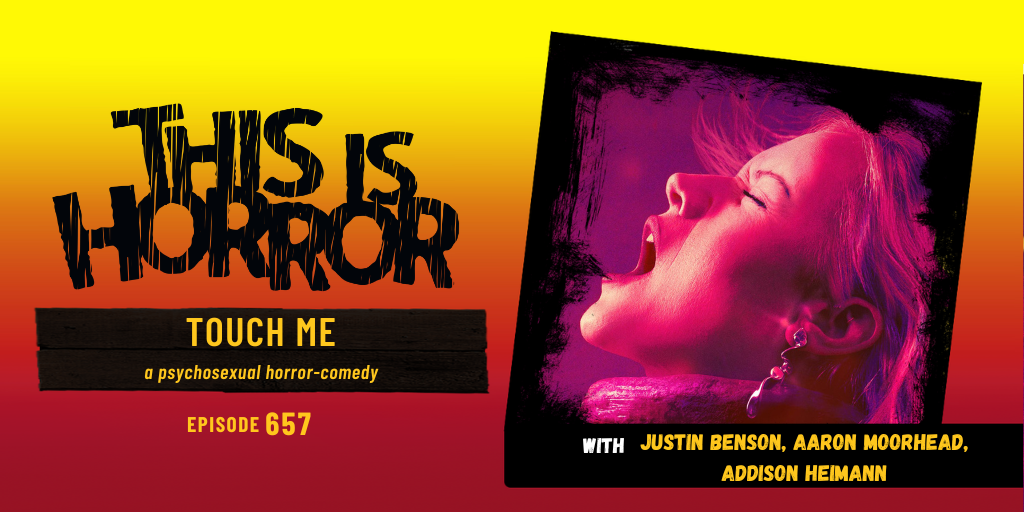
In this podcast, Justin Benson, Aaron Moorhead, and Addison Heimann talk about Touch Me, and much more.
About Touch Me
Two codependent best friends become addicted to the heroin-like touch of an alien narcissist who may or may not be trying to take over the world.
About Justin Benson
Justin Benson was born on 9 June 1983 in San Diego, California, USA. He is a producer and director, known for The Endless (2017), Spring (2014) and Synchronic (2019).
About Aaron Moorhead
Aaron Moorhead was born on 17 December 1987. He is a producer and cinematographer, known for The Endless (2017), Spring (2014) and Synchronic (2019).
About Addison Heimann
Addison Heimann is known for Hypochondriac (2022), Touch Me (2025) and Jeff Drives You (2019).
Timestamps
Thanks for Listening!
Help out the show:
- Support This Is Horror on Patreon
- Listen to This Is Horror Podcast on Apple
- Listen to This Is Horror Podcast on Spotify
- Rate and review the This Is Horror Podcast on Apple Podcasts
- Share the episode on Facebook and X
- Subscribe to This Is Horror podcast RSS Feed
Let us know how you enjoyed this episode:
- Write a comment below.
- Follow us and get in touch on Instagram @thisishorrorpodcast
- Subscribe and comment on YouTube @thisishorrorpodcast
- Follow us and get in touch on TikTok @thisishorrorpodcast
- Tweet us @thisishorror.
Resources
- Touch Me
- Watch the video version of This Is Horror Podcast episodes, including our conversation with Chuck Palahniuk on YouTube.
The Girl in the Video by Michael David Wilson, narrated by RJ Bayley
Listen to The Girl in the Video on Audible in the US here and in the UK here.
They’re Watching by Michael David Wilson and Bob Pastorella
Read They’re Watching by Michael David Wilson and Bob Pastorella right now or listen to the They’re Watching audiobook narrated by RJ Bayley.
Michael David Wilson 0:20
Welcome to This is horror, a podcast for readers, writers and creators. I'm Michael David Wilson, and every episode, alongside my co host, Bob Pastorella, we chat with the world's best writers about writing, life lessons, creativity and much more. Now today's episode is a little bit different, because instead of chatting with one person, we are chatting to three people. And instead of chatting about a range of topics, we are focusing mostly on one movie, touch me, a psychosexual horror comedy about the nature of CO dependent friendships and how far we are willing to go for a slice of happiness. Now, today's guests are Justin Benson and Aaron Morehead, whose production company, rustic films put out touch me, and a wonderful writer and director of touch me. Addison Hyman, I always believe my job as an interviewer is to step back and let the person I am talking to shine and let them do as much of the talking as possible. Never has that been more apparent than in this conversation. Indeed, the chemistry between Justin Aaron and Addison is so uniquely special that often I didn't even have to say anything, and they would just spiral off one another. So get ready for a real treat of an episode. But before any of that, a quick advert break.
RJ Bayley 2:16
It was as if the video had unzipped my skin, slunk inside my tapered flesh and become one with me.
Bob Pastorella 2:24
From the creator of this is horror, comes a new nightmare for the digital age. The girl in the video, by Michael David Wilson, after a teacher receives a weirdly arousing video, his life descends into paranoia and obsession. More videos follow, each containing information no stranger could possibly know, but who's sending them and what do they want? The answers may destroy everything and everyone he loves. The girl in the video is the ring meets fatal attraction for the iPhone generation, available now in paperback, ebook and audio from the host of this is horror podcast comes a dark thriller of obsession, paranoia and voyeurism. After relocating to a small coastal town, Brian discovers a hole that gazes into his neighbor's bedroom every night she dances and he peeps same song, same time, same wild and mesmerizing dance. But soon, Brian suspects he's not the only one watching and she's not the only one being watched. They're watching is The Wicker Man meets body double with a splash of Suspiria. Their watching by Michael David Wilson and Bob Pastorella is available from this horror.co.uk. Amazon and wherever good books are sold. Okay?
Michael David Wilson 3:34
With that said, Here it is. It is Justin Benson, Aaron Morehead and Addison Hyman on this is horror. Justin Aaron Addison, welcome to this is horror.
Justin, Aaron, Addison 3:54
Hello, glad to be here. Thank you for having us. Yeah, thank you
Michael David Wilson 4:00
so to begin with, I want to know what were your first experiences with stories, and when did you know this was the industry that you wanted to work in?
Aaron Moorhead 4:14
Oh, I've actually never been asked, What's your experience? What's your early experiences with stories? But weirdly, I have an answer that leaps to mind. My dad legend would make up stories to tell me to, you know, put me and my sister to sleep. And they were, they were very big, fanciful sci fi stories. It only happened like five times, but they were, they were like, You should write them down, kind of like, as if he had the whole thing planned out. They are in depth stories, not just like, made up nursery rhyme kind of stuff. You know, we were probably old enough to that that would not have been fun, or, like, eight, 910, something like that. And he made up a story about a guy who learned how to travel through the electrical circuits, through the electrical current he gave it. Made a great. Time travel story. He made a really good one about a chubby kid who, you know, learned to believe in himself, which was obviously aimed towards myself as a child. And and it was just like really, really cool stuff. And I just realized, I bet that's exactly where the penchant for storytelling comes from.
Justin Benson 5:17
Did you know your father kind of fused? Shocker by Wes Craven Back to the Future and kind of stand by me.
Aaron Moorhead 5:25
I can't imagine. I can't imagine. These are entirely original ideas, probably like a lot of HG Wells that I hadn't read yet. You know,
Addison Heimann 5:36
ask you go next, oh yeah, oh yeah. Let's just do like, 123, like you two, answer, then I'll answer, although I do always want to interrupt because I have ADHD, but mine's like, the fucking, like, normal gay kid shit. Like, I watched Buffy the Vampire Slayer, and I was just like, yeah, I want to go to there. I wish it was, like, more original, like, I wish I found this, like, niche, like underground movie, but it was like, it was like, Danny Darko and, you know, Buffy and X Files. And, you know, I always kind of wanted to do that. And then when I was in playwriting school, I kept writing movies where they're like, dragons, and then in theater, they're like, you know, you can't do dragons, right? And I'm this was like, before, you know, they did dragons on stage, you know, pre Dragon, as it were. And I was like, Oh, shit, I should make movies. And that's, that's kind of my, like, storytelling stuff, because I never allowed myself to be a writer, because my dad was a lawyer and my mom, my mom was an engineer, and they're like, you do this? And I was like, yeah. And then I realized I didn't want to, because I wasn't smart in that way. I'm very dumb, but also very smart in certain ways. But you know, I couldn't, like, put together a chip like my mom could. So that's kind of how I
Justin Benson 6:53
discovered it. Madison, I think you would put together chips really well.
Addison Heimann 6:57
And listen now with now with Google, not chat GPT, because I don't want to waste any more water than we have to, but, but yeah, through, it's like a sweet little YouTube video. You know, I spent, if I spent hours, maybe
Justin Benson 7:12
my story is, it's pretty good one. It won't be as good as Addison's or Aaron's, but never is so so, so So my my mother, who's no longer with us, she had her first child when she was, like 15 years old, and it was the 60s, and so back then, you know this whole thing, she was sent away for, like a home for unwed mothers. She gave the child up for adoption. But that's but that child is my brother, who's 11 years older than me, and we have the same mother and father and I, he came and he contacted us, and I met him when I was when I was seven and he was 18 years old, and he showed up with a stack of Stephen King books, and like and like gave them to me, and it changed by like I would not be sitting here now had we not been raised in different families, and he had not shown up meeting my brother when he's 18, and I'm seven with a stack of Stephen King books.
Aaron Moorhead 8:10
I that's, you know what? It's so weird. I don't obviously that one has a lot more emotion behind it, but I I just remembered when I was in Tennessee on vacation in the mountains, and my cousin was describing to my mom the story of the gunslinger. And I was like, that sounds so cool. And he's like, You are way too young to read this. And it just stuck with me. And I was like, I want to read that so bad. And then got to and it's one of the best stories ever told.
Addison Heimann 8:36
Yeah, what was your What was your first Stephen King novel? Because mine was strange, because it was dream catcher, and I don't know, the alien like shit shitting out of the butthole.
Justin Benson 8:47
Yeah, my, that stack my brother brought the gunslinger was among them that remains his favorite of all of them. But he also gave me Salem's Lot. And there was a, like, basically, like a book of novellas. Is it called Four past midnight, something like that. It's a It's, I know, and black and the Black Dog and needful things.
Aaron Moorhead 9:09
Has got to be standalone, because the book is like, this thick, isn't it? But no, no, but there's one. Maybe I'm wrong. I know maybe I'm wrong.
Justin Benson 9:15
I'm probably mixing it up. But it was, it was one of the anthologies, and it was also skeleton crew, another anthology is the other one night shift. It was basically all the anthologies up to that point, Salem's Lot Gunslinger, and it was the one that had that the paint, the beautiful paintings in the Yeah, the illustrations and that within the text,
Aaron Moorhead 9:36
yeah, Roland like holding the rose sunset? Yeah? Yeah. That was a good question. Guy, I love that. What's our first experience with storytelling? It's great,
Michael David Wilson 9:47
yeah, and just this idea of, you're seven years old and you're being presented with a stack of Stephen King books like, I kind of wish that happened to all of us. I mean, what an. Initiation into story. Yeah, it was a
Justin Benson 10:02
stack of steam and Keene books. And it was a, it was a mix tape, cassette tape that had, like, a lot of like, like, what they would play, like alternative rock stations at the time. Like, it was like, everything from social distortion to Pet Shop Boys to Pesh mode to the cure to Peter Murphy. Says, like all that, like radio play, kind of good alternative rock, some mixed tape follow. So I was just listening that tape, reading a lot of Stephen King. It's this day when I hear Duran Duran, I think, I think it's,
Aaron Moorhead 10:36
I mean, it's a straight line. I don't know what it is. Duran Duran is the Stephen King of the music world? Like, kind of, is there? Yeah.
Michael David Wilson 10:46
I mean, you didn't just get a kind of long lost brother. You got an education.
Justin Benson 10:52
Yeah? Yeah, it's he. He actually, he came to see Aaron and I speak at Comic Con in 2017 around the time the endless was coming out. We're on this panel. Apparently, they asked me on the panel, like my first horror movie was or something. And he's like, You lied up there. And I was like, lies, like, I don't totally remember, but he had the truth was, was it he had rented me The Exorcist and Evil Dead too. And I was so afraid of Evil Dead too, I couldn't watch anything else. And he's like, that's and it was like, oh, cuz you didn't. I didn't. I was so young, I didn't, didn't even understand it was comedy, you know, like, I just thought, yeah, I thought evil, dead two was terrifying, yeah, yeah, nice. He doesn't like, this is, like, the best physical comedy ever done cinema.
Michael David Wilson 11:28
And so, I mean, all of this begs the question, these were the first stories that you heard. But what was the first story that you wrote,
Unknown Speaker 11:38
first? Yeah, yeah.
Addison Heimann 11:40
I mean, it was, it was the dress, like I, I wasn't writing when I was a kid, you know, oh, I mean, unless we count, I remember being in fifth grade, and this actually is probably better than me actually telling the story about how I wrote the play about dragons. I was in fifth grade, and there was, like, I don't know if everybody to do this, but they gave you, like, basically a blank picture book, and you had to flip and then you had to write your own story, and then draw the pictures in the picture book. And this guy, this elementary school kid, wrote, like, won the prize for like best thing, but like wrote a story about, like, people, like kids on an island that, you know, had to, you know, survive a supernatural source. I think we had just read Lord of the Flies, you know. And so, of course, I did the same thing, but he was like, A, he was like, one of those kids that are like, you know, is a drawer, or like, you know, or his, like, mom did it, who knows. But he like, he was a drawer and I was not so we had similar stories, kind of based off of that I wrote. I wrote kind of the same thing, same vibes, and he won the prize, and everybody told me that I sucked, and especially my drawing sucked. And that was my first, you know, experience with critics. And I was like, and I got through it, and I was like, if I can get through the pain of this, then I can deal with Twitter and so that, that kind of thinking, you know, all the way back, I was prepared. But yeah, that was, yeah, I still, to this day, only drastic figures my for touch me, and also all the movies I make, all my storyboards are literal stick figures, because I am very bad about that. But funnily enough, they help. They do help convey it regardless. So good for me,
Justin Benson 13:27
dude, you should generally be proud of that, because I literally can't even use stick figures to draw a storyboard. Like I'm literally incapable of expressing an idea as a storyboard. Aaron's good at it. Aaron's good at bad drawing.
Aaron Moorhead 13:43
No, what I what I can do, what I'm good at is I draw it live in front of you, and I say, this is a head, right? Okay, these are shoulders. This is the horizon. But if I don't do that, it's just like, What the hell is this?
Addison Heimann 13:55
Literally, I like, I feel like I drew a nose bleeding, and no one could understand what that was. And I was like to me, I was like, it's a nose. And they're like, You have to understand that that does not look like a nose. It kind of looks like, you know, a chest with very strange nipples. And I was like, no, but they're bleeding. Like, this is like, it's a nose, you know? So, yeah, if it's any indication to how bad these are,
Aaron Moorhead 14:20
I just remembered. I couldn't tell you what the first story I wrote was, but the earliest one that I can remember that can make an interesting story is there was this writing competition in sixth grade called Florida rights, where I'm from, of course, and and the the question that you were supposed to answer was, what is Florida without citrus? I think it was probably sponsored by Sun Kist or something, you know. And I made up this story where I won the competition. I made up this story about, do you guys remember the med fly crisis? So I remember I made up this story about med flies mating with another type of fly that then the. Hybrid fly would plant its eggs in the oranges, and it made the oranges hallucinogenic, and thus oranges became illegal. And I spent half the essay setting up this, like sci fi idea, and then the other half talking about, like, what Florida then looked like without citrus. And I don't know, I didn't, you know, obviously care that much about whether or not Florida had citrus. I was just really wanting to get this med fly idea out.
Justin Benson 15:27
If you told me, that's what upstream colors about. You know what I mean, like, it's like, pretty sophisticated,
Aaron Moorhead 15:34
yeah, thank you. No, I was, I was proud of it. I think that's why it won. I think they were like, well, that's not the question we asked, but that was pretty cool.
Addison Heimann 15:42
What you're saying is, I wrote a shitty Stephen King, like, rip off and then in sixth grade you won a contest for how good your writing is. So you're saying, Yeah,
Aaron Moorhead 15:51
I'm still, I've still been trotting that out. Every time anyone asked me, yeah, I trot that out and just bring it back out. Then right in that Florida, right? I just want some of the oranges. That sounds Yeah, yeah. It was like, it was like, I remember the opening sentence was something like, Florida, oranges are delicious, sweet, dot, dot, dot, and illegal.
Addison Heimann 16:15
Honestly, if that was the first line of a book, I would go, Well, now I have to read the rest exactly you hold me, yeah,
Bob Pastorella 16:23
I'm turning the pages. Yeah.
Justin Benson 16:26
I you know, what's funny is like, I was like, thinking back, and I was like, oh, and in in high school, in the very occasional time I would put any effort in. Do you remember I wrote something that a teacher told one of my parents about that. They're just like, they're like, oh, he might, like, he might have a talent at something, you know, despite, despite, you know, barely passing his class, he might be able, like, a little thing here, that might be a little grain of something. I'm sure it wasn't great, but the got to college, and I got really into it, but I, but I will say, like, I don't even, I think I blocked it out because I think everything I wrote was like a chuck plot, like a bad Chuck Palahniuk rip off. Oh, we all went through that. Okay. Yeah, that's okay. Addison, you had a Chuck Palahniuk
Addison Heimann 17:12
rip off phase? Yeah, I know who that is.
Aaron Moorhead 17:15
I remember loving, like, thinking up a, like, a really pithy societal, a pithy societal observation, and repeating it every once in a while, and being like, that's pretty cool.
Justin Benson 17:28
That's how you write red survivor. And was like, I could do that.
Aaron Moorhead 17:31
It was just like, parking is the gasoline of the new millennium.
Michael David Wilson 17:39
And then to kind of fast forward to when you all met. Well, not all of you, because Aaron and Justin met way before, but as I understand it, Addison's film hypochondriac and then something in the dirt were playing a lot of the same festivals. So is that how you met, or did something perceive that
Justin Benson 18:03
we actually met way before that? Addison probably doesn't remember we met at cuckolor.
It's remember, I remember years before we met at cuckor.
Addison Heimann 18:13
Yeah, years before, yeah, we totally, we totally met, and I, yeah, I'm the one who forgot. But then we got to the fun thing is, yeah, we were lucky enough to have the same distributor and have movies the same year. Theirs was at Sundance. Mine was at South by and we, we, like, got to know each other. In Switzerland, of all places, there's this, like, beautiful festival called New Chatel, that's a genre festival that, like, is in the mountain, a mountain town, like, right in front of a lake. And, you know, we had the same distributor, so we all got put in a room, and they were shooting Loki, I believe, at the time, so got to pop over for the weekend, and just like, it was dope, like I got to see their movie, they got to see mine. And, you know, I known their producer, Dave Rosson, a bit like maybe them at three or four months ago. But like, you know, they were just, you know, Justin and Aaron have this thing, you know, it's like, make movies with friends. Like they talk it, they have stickers. You can find them in LA everywhere, you know. And like, we became friends, and that's how it started. And then it wasn't until, like, a year later, I just sent them a script. I sent them the script to just get notes. Because I was like, like, I don't know, not even thinking that this would be like anything that they would jive with. Because, like, it was, yes it had aliens, and yes they had tentacles in spring, my favorite part of the movie. But like, you know, and their notes were just so strong and smart and interesting when I, like, started going out with it, like, I, you know, messaged them, and I was, I remember, I was washing dishes, and like, you know, I had met with Dave just to talk about it. It's like, Listen, I'm your friends. Like, there's no big deal. Like, I just, like, think, like, you know, potentially this could be something we could work on together. And then I didn't think much of it, because, like, you know, only so many movies can get made. And then I got accosted by them via phone call while I was washing dishes. All of a sudden, Dave calls me. He's like, Oh, by the way, you're on, you're on, you're on the call with with Justin and Aaron, and I was and I was like, Oh, great. Just like a very, very lovely little like, moment of like, not realizing that I was essentially being interviewed, but like, I was also trying to focus on washing dishes. I could have stopped washing dishes. That was never something that needed to happen. But they basically were like, okay, like, why do you want to work with us? And I was just like, because I, like you guys, I probably was a little more somewhat intelligent in that sense. But the real honesty was just like, I really respect the things that they do, and I really, you know, love the work that they put out. And while this is like a little bit more like odd ball weird than than, than that, I think I given how, how specific they are in crafting story. I was like, this, I think can make sense. And I think, like, together, we could craft something really cool. And they're like, Okay, cool. And then they hung up, and I was like, Huh? And then, like, it was so casual. Then like, Dave was like, All right, we're gonna make a movie. And I was like, what? And then that just kind of all kind of kept going from there. So it was, it's funny, you go, you go to these festivals, and you have goals of making friends, and you don't really think about the aftermath of it, because I find that that's like the least helpful thing to do, because then you're just anxious all the time. But making genuine connections tends to move and move, not career, but like, it ends up you find your people. And I always talk about, like, finding my freaks, because, you know, while I never think my movies are weird. Other people do. And so I think, like, you know, when you find people who actually, like, believe in you and get your your message and trust you, it like, that's kind of, it made perfect sense for me, on my side, to like, be involved with these two and based off their immense, like, just like generosity, on helping other artists, and also, just because they're, you know, cool dudes who know sci fi,
Justin Benson 22:05
there's a there's something really special about reading a script and finding it to be electric and funny and all of that. And also immediately realizing two pages in that you're like, Oh, we could never, we can never do that. This is singular. This is a point of view we could never have. And and also it's like, I think when it comes to things that are more lean, more like horror comedy, it's things we're fans of, but we never endeavor to do ourselves really, since we was really special to get to participate in any way. And from page one, that script, like, really leaps off the page, like, it's, it truly is like, it's like you can feel, it's like you can feel the energy of him creating it. Yeah, yeah, very much. So yeah. And that's very rare in the motion picture industry, usually by the time you read something anything singular or bold or like going
Aaron Moorhead 22:57
through the cheese grater, yeah, yeah, yeah. And you know, our production company with Dave Lawson is called rustic films and and one of the things that we do at rustic is that we don't work with filmmakers that really actually need our help. We it's if they want some help and they feel like, you know, we can, we can fill in the gaps. But it's not like, Hey, let us Shepherd you. We know how to fix your story. We know how to do all that. Really, for us, it's really like, nuts and bolts. Like, Hey, do you have a sound mixer? Okay, we know a good sound mixer that can make this work. You know, Hey, is your ballot? Is your budget balanced? We can figure out where the fat might be and make that work out. It's really boots on the ground. And of course, we give notes and we offer our opinions, the filmmaker always has final cut at rustic. But the and it's, it's also just a bandwidth thing is like, we just, that's we. We are filmmakers ourselves. Dave is a filmmaker himself. We just for us. It's like, we just need a project that doesn't need our help in order to be good. It just needs our help in order to be made, you know, and and so with Addison as a personality and his script with touch me, it was just like, oh yeah, if we can help this get birthed, then, you know, lucky, all of us.
Addison Heimann 24:17
Yeah, I was gonna make an alien joke, but, you know, now, now it's past, because I've told you about it, and so now, now I feel like I'm just gonna, maybe I'll make it later, and like, act like I just made it up. But, yeah, go ahead, Michael.
Michael David Wilson 24:31
No, I like that, because now you know there's gonna be a tension throughout. It's like the tick ticking time clock. But in fact, it is the ticking alien joke. So we don't even know when it's gonna turn up, but sure as hell is yes,
Aaron Moorhead 24:47
yeah, this is the Hitchcockian alien joke under the table. Kind of
Addison Heimann 24:51
check off checkouts gun, you know,
Michael David Wilson 24:57
it won't be a gun, if I've you. Know, having watched your films might resemble again, in some ways. I mean, I had wondered, in fact, what creative decisions Aaron and Justin you were involved in, but it sounds like, as you said, it was fairly hands off. But were there any kind of notes or moments of back and forth that you were particularly instrumental in Addison?
Addison Heimann 25:28
I can answer that because I remember one thing that Aaron said to me, which I think is what they do in their movies so well, is, I think, originally in the script, you know, you're right. The thing about horror is like, it's, it's hard to surprise people in horror, because there is an expectation that the things will go wrong, right? It's like a slasher people will die. Supernatural monster people will die. Things, you know, things go wrong. So it's like, when something starts happy, it's like you're never going to be able to convince somebody that something is not going to go wrong. So I remember, in the original script, the two characters, once they find out that that something is wrong, I wrote, okay, we need to go. But Aaron's note was, subvert our expectations. And that's the beautiful thing I think about. Like, you can't, you can lead, you can lead people down a certain path. But like, when you can we, can you really Institute those surprises, that's when scripts really sing. So my, the biggest note that I did there, like, through wicker, you know, through Aaron's help, was, like, subvert that expectation. So create a, create a world in which I don't know how spoiler I want to be here. So I'm like, trying to, like, talk a little.
Aaron Moorhead 26:46
I think what you're talking about can be, can can be said. I think you can almost get it from the trailer. So go ahead.
Addison Heimann 26:51
Yeah, you're so right. So they're basically like, they're addicted to the alien fucking right? And they're so addicted by the time that he they find out that he's killing people. They're like, Oh no, we should stay. And they both want to stay, like, rather than leave, because they're so addicted to it, and they're also kind of in love with them. And like, what that change? I think unlocked so much, because so often, for me, my biggest trouble is right after the halfway point. Obviously, usually something big happens, and that's, you know, potential, like when the reveal happens, and it's like, how do you sustain that until you get to the final confrontation. And then once, I was just like, oh, they want to stay because they want to fuck them because they're so addicted, it's like, heroin. I was like, boom, done. And that was, you know that. And also, like, they were there, and both Justin and Aaron, like, gave very, very like, specific and specific notes in post as well. Obviously, also Aaron was our VFX person, so there was that then. But like, I feel like, before we made the movie, like notes, note, notes are great. Like, we went off and made the movie, they left, they left me alone, or left us alone. And then in post, they were so helpful and integral into like, forming with like, with like, not like this movie's bad. It's more like, if you just unlock it like this, then it'll sing and like, you know, doing those notes and watching the story unlock was, like, was quite helpful there.
Justin Benson 28:11
Yeah, the only other thing I can think about, like, my own contribution, something we haven't talked about a whole lot, but, you know, obviously Lou Taylor Pucci is in the film. Oh, of course, yes. When you first gave Lou the role, Lou's like, Okay, I'm gonna have to, you know, kind of dance funny and and and have tentacles and such. We know what this is, right? And I know that for him, that was very forgive the pun, alien to him. So he basically came in, he lived with me, and he shadowed me for several months to learn that character, the dancing, I think all came from. The dancing was all me. The haircut was me. You trained
Aaron Moorhead 28:48
him physically too. I did. That's what, how he got his abs. Yeah, and they're just looking at you like you're serious. This is
Addison Heimann 28:57
telling me I'm like, waiting for the for, for, for, like, when if I should jump in, or if we should just, like, screw or, but, like, because it started real, because you said, Lou Taylor, Puccio, it was like, Oh yeah, Justin and Aaron, like, sent him the script and basically accosted him at a party where he thought he was going to hang out with them, and said, You should do this movie. So that was definitely very helpful. And then they so they teed me up. And then Lou was like, I need to you to answer very specifically all the Sci Fi questions, because I think he was used to working with Justin and Aaron, who knew everything. And fortunately, I was able to be like, Oh, well, this is how it works. The funny thing is, like he didn't ask me about the dancing. He didn't ask me about looking like, you know, looking ripped, because I never asked him to. But he was just like, No, no. I need to know. Like, when he goes in the pot and they're gestating, like, what? How long it is? Just like, how do these things work? How do the mechanics work? And, like, I was like, Oh, this is how it works. And, you know? But, yeah, it was all it was also Olivia Taylor Dudley, like they, because they worked with her as well, you know, our, so, our, two of our main leads came from the rustic family. Way, which is wonderful.
Aaron Moorhead 30:01
Yeah, there's actually one thing that I think is kind of fun. This isn't really contribution, but it was just watching the film evolve, and it was just between the roughly for what we saw the first and second cut. And it was interesting, where one way to describe the first cut is like, like Lou in particular, but everyone but, but Lou is making a very strong performance choice. You know, he is transforming and excusing the Shakespearean language. He's, you know, it's, it's a, it's a risky gamble that is not naturalism, you know, it's, it's easier to just play a version of yourself in some ways, that he is. Louis playing, you know, dyed black hair, and, you know, just a different guy, and the first cut, for whatever reason, it did not work. The choices were, were were not selling. They just didn't they were transparent. And that's, by the way, that's the risk that any actor takes with any movie, that the Edit, that the edit at some point, doesn't honor what you're up to. And then there were, obviously, everyone knew this was a very early cut. This was like, here's like, the movie beginning to end, and that's it. And then, and then there was a tonal shift that was made that I think you can describe better in terms of the horror versus comedy stuff, but, but there's a tonal shift that just that that was made in the whole edit, not just around Lou, but the whole edit that kind of says, Here's what this movie is. And suddenly Lou completely clicked into place without actually changing what he was doing. You know, it was more saying to the audience, like, this is just a comedy, don't you know, there's, there's not like a moment where you're supposed to be like, genuinely, deeply unsettled and afraid. It's more like tension, of course, but, but and horror elements and stuff, but it's, but it's pure fun. And I feel like once you, once you telegraph to the audience, that's what the movie was. Lou, all started to make sense for me. And I thought that was really cool.
Addison Heimann 32:02
Yeah, you're so right. And I remember, I remember that note, because I think, like, you know, whenever you like, include the word horror. You're like, there has to be scares. And the reality was, like, you know, we were having these, like, long hallway tension filled, like, what's gonna happen, but the payoff was a joke, or, like, you know, or some semblance of that. So it's like, once we're like, let's just, like, kind of remove the horror vocabulary from the editing point of view, and like, go back in and really, like, announce ourselves as a comedy, right? It just sang. And that was, yeah, that was one of those things that you guys really directly contributed to do
Justin Benson 32:35
that really helped. I actually we learned working with you on that could have anticipated this, but we actually did learn that in the realm of horror comedy, the assembly cut is especially going to be wildly different than where you land,
Addison Heimann 32:54
oh yeah, you want to cry when you see that assembly cut,
Justin Benson 32:58
yeah, Whereas like, Oh, if you know, if you're doing something that that, I like, look, I fucking love hereditary. I bet the assembly cut to hereditary. I bet a lot of it's still scary, because, you know, just, you know, it's a lot of air, but, but it works to build tension. But in horror comedy, you're just kind of like, I know what's happening. Why is it not funny?
Addison Heimann 33:23
Yeah, yeah, yeah, absolutely,
Justin Benson 33:30
Lou. Let's love on. Lou Taylor, Pucci, a little bit.
Aaron Moorhead 33:34
Yeah, yeah. He's, I mean, he's, he's one of the reasons we have a career. And we obviously keep casting him and stuff. We put him in Daredevil and, and, you know, and we're able to get, I don't want to say we put him in touch me. Addison put him in touch me. But, and we, but really, all came back to spring, and was really funny is he was put in front of us by XYZ. I believe, right, yeah.
Justin Benson 34:02
I think so. We were, I think we were fans of thumb sucker. We had recently seen thumb sucker, which is great, and then it came to us be, it was, like, one of those things where you're, like, if you cast this guy for sales value, you can make her movie for for $500,000 or whatever it is. But, um, I used to go do is laugh pretty well, yeah. And that's something about Lee Taylor Pucci is, like, he does all these serious roles, but like, he's, like, a total goofball, yeah,
Addison Heimann 34:28
yeah, like that, right? You just did an Elmo laugh, by the way. Yeah, that's that's loose, like, if, yeah, Emo. Like, it's like, if Elmo was, like, laughing at Rocco, that's what it sounds Jack.
Aaron Moorhead 34:44
It's also I find Lou. I'm gonna say something that sounds funny is like, I find him difficult to direct because he's always good, and so you don't want to change what he's doing, because the choice is so thoughtful and good. Yeah. And you really, really like, meaning he, like, keeps you really honest as a director, because you better stay on top of what your what your target is, because what he's going to give you will on the monitor be seductively great,
Addison Heimann 35:11
you know, yeah, I just remember it was very funny, because the thing, because, like, like, he's, I think he's like, one of the most natural actors that exists, which is funny that I asked him to play like an alien monster who speaks really ridiculously, but like that really secured, like, the ground in this of them. But obviously, like their Part Three had to be really ridiculous. And I was like, go over the top, and he's like, it's gonna be too much. But like his over the top is like adding like, five or 10% more, and he's like, that was too much. And I'm like, trust me when I say that's exactly where it's just like, the guy Jordan, who plays Craig, if I asked him to go over the top, all of a sudden, like, every limb would be flailing, and he would be just, like, doing a worm on the ground to try to be ridiculous. Like, it's like, the differences and like, working with working with Lewis, like he was, like, that was just too much, like, you know, and it just never was. And I think it like, it was great, because it's one of those things where it's like, I'm being like, by the way, like, we're going to shoot in three aspect ratios, all the alien stuff is going to be on set. Like, you have to do a bunch of hip hop dancing. We're going to do all practical effects, homage to, like, 60s and 70s Japanese cinema, you know, like, and also, I need you to be a little grounded, because we're not trying to be pure camp. Let the filmmaking take that. And he was like, Okay. And so it's like, you know, it's like realizing that. And then he saw the Edit, and he was like, I understand this whole connection now, but like, there was a lot of trust that we built up front that even if he didn't quite, like, you know, like, fully, that's all the all the actors, I mean everybody. It's like, I mean, something that I've been learning as a director, right, is it's just like, you have it in your head, but you have to be able to, like, you know, create and and explain certain things and really get into the reasons of as to why and like, over the course of this movie, it was like, Well, I just, it makes perfect sense to me. I think this is basically just, it's like I was thinking that I was essentially making, like any old movie. Like, it could have been like, I wish I could find this. I need to find a specific one, just for this, for this kind of stuff. But it's like I was making, you know, you know, Hap net, or whatever. That's topical, but, but like, I just like, that's the way my brain works. But it's like, oh, I have to, like, introduce you to my brain, because it definitely does not work in a regular way to like, to come out, to come out the way it is. And as the actors, just actors, just, like, really bonded so easily and sunk in. And so when we got on set, like, Lou was just everybody was just, like, so connected and on their stuff that, like, I saw what they were doing was exactly what I wanted. And then I just had to reiterate to them being like, this is, this is, like, the thing that we're making. And once they were able to see a cut, they were like, I understand everything put together. Like I could understand the moving pieces. But like, it is showing them that, like, not the first cut. I showed them the second cut because the first cut needed some work. But like, that was it? We were able to, like, really get specific, and that was really enjoyable as a process.
Aaron Moorhead 38:05
Addison, can I? Can I take us down a country road that I promise everyone wants to hear about? Can you talk about
Addison Heimann 38:13
working with the alien puppets? Sure, we worked with Russell effects, who are incredible, Josh and Sierra, they, you know, they've done projects with Justin and Aaron. They've done, you know, they did the most recent Hellraiser, boot, like, reboot and like, they're like, they're like, both, like, do, like, huge projects and low projects. And they also, like me, like, are into tentacles and aliens and stuff. So when we were like, can you do this for this money? They're like, Oh, yes, we can. And speaking of my stick figures, I'll say I'm really proud of this, but it really was them, but they asked me to draw the alien. And I was like, you guys, I'm not. And I drew the alien. I basically drew like, like, you know, teeth, like this, like jetting out, like head, tentacles and feet. And I was like, something like this, and then, like, they designed it. And it was like, Oh, my God, you designed exactly what was in my head from this really stupid drawing. And so, you know, sometimes it works, but I think they're just that good that they kind of were able to very easily build upon and create, like, such a cool thing. But like, everything is practical in the movie, from the head explosions to the tentacles to seeing the final monster. It's just a two foot tall, you know, alien puppet that we submerged in water to get the flowing effects. Sometimes it's not when we did the close ups, but like, everything is like we exploded the alien, you know, all the goo and the blood and all of it was practical with, with, with Justin, sorry, not not, not Justin. Justin, you're lovely, but you didn't do the VFX Aaron, like, coming in and kind of adding it. So it's like, it's like, a beautiful, like, cool, tangible world we wanted to live in. And like, it's like. Your favorite days on set, because even if things go wrong, it's just so fun to see happen. Or, like, I just remember when we were exploding Noah's head, my friend. JJ, like, they're like, All right, we got one. Like, we only got one, because we only got one head. It happens, and then we call action. It explodes immediately. And you're like, All right, that's it, Kathe. And I was like, but it was perfect. And you're just like, and that's what it's like working with Josh and Sierra, because they are, they, you know, love the movie as much as I did. And I found through Justin and Aaron like, and Dave like, you know, started, like, collecting these, like, beautiful people who are into the weird and down to get scrappy, because, like, we didn't have a lot of money, but like, for the vision that I was trying to create, which was like a tangible homage to the practical nature of filmmaking, like we were able to create exactly what we wanted to make. And it was all because everybody was, like, all on the same page. It's why I don't think filmmaking. I hate the film by credit. It's like a film by us. And like every Everybody brought their A game and and especially Josh and Sierra, like, just murdering it with every time I would, you know, it's like, ooh, we're opening a body today. Ooh, we're sticking a worm up or something, you know, ooh, like, you know, like we're gonna deal with, like, hands being ripped off and blood gags, and my entire car got covered in blood and then kind of totaled it. But that's no big deal. It was worth it for the art. And, yeah, just such a really great, wonderful thing to do.
Justin Benson 41:25
Addison. I don't know if I've ever actually got to tell you this, but on this topic of all these makeup effects gags and just the scope, the scale of the movie in general, how big the movie looks, and how well executed all of that makeup effects and puppetry and all of that stuff. And it's, again, it's a collaboration, man. But there's very few people who pull off what you did like to with the resources, really, the resources you had to get something that's that big on screen with that many practical effects is, um, it's just really impressive, man, you should be extremely proud of yourself. I hope
Addison Heimann 41:59
you are. Thank you. No, I really, I am. I really am proud of proud of this, and proud of everybody who worked on it. And I, I do think one thing, I guess I can toot my own horn for a second, is that, like, I think visions are cool, but not if you can't execute them in a way with a with your budgetary constraints. So it's like I was always ready and willing. And actually, this is where other people became extremely useful, where it's just like, All right, well, we can't do this. What can we do that's cooler, you're like, or what can we do that? Like, will, like, create, like, a similar effect, or a same type of, type of, you know, type of effect, rather than just, like, trying to do like, you know, to create an actual eight foot tall pup alien, where a person's in the costume is going to cost $100,000 we cannot do that because we do not have that money. And it's like those creative ways, I think, unlock filmmaking that ends up being stronger and more more unique, because the smaller the sandbox, the more creative you can be.
Michael David Wilson 42:58
And there's so many amazing moments that it's almost difficult to know even, where do we go from here? But I mean, you alluded to the hip hop dancing and just the tone that that creates, and it kind of just really divides the film up so you know exactly what you're going for, and it's absolutely iconic. I've got the dancing in my head right now. So, I mean, I want to know, when did you know this was going to be part of the film, and then logistically, how did you go about choreographing that?
Addison Heimann 43:39
Yeah, yeah. We had an amazing choreograph, choreograph, choreographer, choreographer Meredith, who, along with Lou like, created the dance, and it was absolutely wonderful in terms of where it started. It's so funny because I remember being in South Korea at B fan, which is just a wonderful festival, and had the most thoughtful questions asked. They were like, what's the metaphor for the alien serum? And they're like, oh, what's the metaphor for this? And a lot of it like, I like, I'd be remiss if I just didn't say like, I just thought things were funny. But like, so it's like, that's essentially what happens with it's like, it's why they're in track suits. It's like, why there was a hip hop Dan saying, it's like, why there's all the Duolingo jokes. Because I do Duolingo, and my streaks almost to 2000 at this point. So it's like, but it also, it's funny, because, like, you know, to take it maybe a little deeper, is that it's all kind of a collective part of you know, we talk about how fun it is. We talk about the comedic nature of it, and like, I kind of formed the script and the tone essentially to recreate what it's like to live in my brain, I have obsessive compulsive disorder, which makes for a very fun time. It doesn't i. But like it is, but like going through therapy with it, doing something called ERP exposure and Response Prevention therapy, which essentially makes you face your fears without engaging in the negative thought spiral in which you encounter as like a person with logical brain. Basically, you're like, I think there's a problem, and I'm just going to examine it from every angle until I feel better that actually the problem is not a problem, but OCD. People with OCD or generalized anxiety can't do that because you just get stuck. So something you do in ERP is you expose yourself to it, and one of the main ways that you can do it is by taking the idea and then putting it in an absurd situation. So I usually give the example where it's like, if I think, if I'm convinced my boyfriend's going to break up with me. While he's breaking up with me, there are unicorns in the background having a full orgy. And every time he tries to say that a bad thing about me, a unicorn comes and makes a really loud neighing sound. So it's like you write this little short story that nobody will ever see, but then as you start having these thoughts about, like, Oh, my boyfriend's gonna break up with me, all I can think about is a unicorn coming, which is so much better than feeling completely anxious about something that could inevitably come. And that is essentially what touched me is as a movie. So you, you know, like you get, you have these ridiculous moments, and then all of a sudden you also really have this like kind of undercurrent, metaphor about, like, addiction and mental illness, and, you know, trying to find the quick way out, because trying to solve it is just too damn hard, while you have like, three people dancing and, you know, heads explodings And like, you know, like evil Laura with her samurai sword, you know, lying all the way through. It's like that to me, is like, kind of an entire world of what it's like to live within my brain. And that is just that. That is kind of what the tone is. It's like, really funny at one time. It's really terrible at another time. But then it goes right back to funny, because, like, sometimes you get such a terrible thought or image in your head and then, like, like, literally, like, you know, the next thing that pops into your head is the most ridiculous, aka unicorn fucking so it's like, you know that, and that that change happens on a dime within your brain. And that, to me, like that, to me, was how I kind of came up with everything. There's all these giggles and all these jokes and, you know, all my homages, because, like, I'm, you know, a huge Japanese cinephile and had wanted to do all this, like, kind of theatrical storytelling, a lot like missing my life in four chapters, or, like, you know, female prisoner, or, you know, how Sue, which is obviously one of the big inspirations. Like, there's a litany of whatever, but like, you know, doing it through that frame made the most sense to me, because it's like, I'm theatrically retelling a story of what it's like to live in my own mind.
Aaron Moorhead 47:58
Weirdly, I wonder, I just, I just saw synecdoche New York for the first time, and I just now kind of drew the connection between between touch me and Synecdoche, just in terms of an exploration of what it feels like to be, to be the creator.
Addison Heimann 48:12
Yeah, yeah.
Justin Benson 48:14
We've spent, you know, rightfully so, a lot of time talking about how impressive the practical effects are in touch me, and how impressive it is that Addison pulled it off with the schedule. He had the resources. But this talk of this group love making by unicorns, that is good use of AI.
Aaron Moorhead 48:33
Yeah, we should fire up the AI engine truly like
Addison Heimann 48:37
no no, no more. No more wasted water bottles, please. No, we No, no, no.
Aaron Moorhead 48:42
Can't stop me. I'm going right now.
Addison Heimann 48:48
Here's the thing, it's gonna be more more gratifying if I drew it with stick figures, because I think you'll actually understand a little bit more than the AI. It'll feel more real and more
Aaron Moorhead 49:00
tangible, yeah, you'll be able to give it nuance in the shape of,
Addison Heimann 49:04
definitely, with, yeah, oh yeah, definitely nuanced, especially if I draw, like, a little thought bubble to, like, see what they're saying. You know what I mean? There's, like, so many things that, like, you know, just give me a give me, like, a day or two, and I'll, I'll send it to you for your enjoyment.
Justin Benson 49:16
This is why we're good collaborators.
Aaron Moorhead 49:18
You stop us ruining the world with water bottle guzzling AI, and we encourage you to embrace your artistic talent. Yes, absolutely, yeah. You guys are like, Please, can we get this back on the rails?
Michael David Wilson 49:37
I mean, any interview where unicorn fucking is mentioned, it's like, well, we're having a good day here. I mean, talking about kind of unique things. Because you may be shocked that unicorn fucking does not come up a lot in this is horror. Yeah, this. Might be the only film to include Keith juice in the dialog. So, yes, there's another unique part to it.
Addison Heimann 50:08
Yes, yes, yes, of course, my millennial isms like, just making like the it is funny, because Craig and Craig and Joey, you know, Jordan and Olivia like that to me are like, they're like, kind of two stories of two swords, two sides of my same psyche, of like, kind of the worst inclinations of who I am as a person. You know, obviously you'll see a lot of similarities between Jordan and me, or Craig and me. Just in my humor, I swear I'm not that. I'm not that terrible, but in my brain, sometimes I think I am and so like, that was just like, that thing of, like, what would it be like? You know, if my worst self, or at least my most damaged self, like, went through this journey, and what would I really do if put in this situation, if I was promised paradise, and what, what, what would I give up and sacrifice? And how morally can I be compromised in order to get it when it's literally the promise of paradise? And of course, that has to include the use of grief juice and any other you know, chunk is he things that I love to love to include when talking about the worst iterations of myself.
Aaron Moorhead 51:22
This was called the horniest movie at Sundance and and I think you can wear that with with pride, because no joke, I do think, you know, there's, there's, there's, of course, a shying away of exactly how to depict and talk about sexuality and film at least, there's at least a lot of think pieces talking about it, and it feels like, like a romp is a good way to go about it, you know, whereas also, though, this is talking about some weirdly heavy stuff with a real in a really light hearted way,
Addison Heimann 51:53
yeah, yeah, absolutely, yeah. Intimacy, such an interesting thing in film, especially when you're, you know, it's like, it's funny, because, you know, we think about hentai, right, which literally translates in Japanese to English. It translates to pervert. It's literally what hentai means. And a lot of people are like, a lot of people the internet, you know, the worst parts of the Internet are like, Well, we know, we know the director's kink. And I was like, you know, hey, one token shame, two, you know, it is like a very, you know, I find the, like, the storytelling behind the creation of hentai very fascinating. Obviously, there's, like, you know, the old, the old painting, the Fisherman's Wife getting, you know, eaten out by an octopus. But there's this movie, very blasphemous. I really do not recommend watching it, called rotsuka doji. That is the first iteration of hentai, like in in anime. And it was, it was created around to get to get around the sensors in Japan, because you couldn't show anything below the waist. You had to blur it. But tentacles are, you know, they're arms, they're not penises. So that creation of that kind of like completely set for like, a very like, you know, wave of like, you know. So like, through the repressed society, became the more kind of niche, niche interests to pop up. The irony is, like in the 60s and 70s, the some of the biggest companies in Japan were producing a large swath of the pink films that we see today, like, you know, like Toby, they were doing these like he crazy, wild, colorful, theatrical, looking films that were filled with sex and comedy and revenge and blood and and that there's kind of something so cool to see like that, kind of counter culture being created by the It can't even know if it's a counter culture, but it's like that that can directly lead to, like, the furthering of, like, the explorations of kinks and everything. But they're big budget and they're good storytelling, especially the ones with the lower bands. Of course, there are some that are too blasphemous or too much for me to watch in terms of, like, what I can think of, but like that, to me, that kind of like world is so juicy, and they, you know, telling stories where they're not shying away from the fact that they're telling it on sets. They're telling stories. That's what we're doing as filmmakers. We're telling stories. So for this, it's like, this is a story. We're telling it as a story, and we're not pretending that we're not in a movie. We're telling it like, like they did in the 60s and 70s, where it didn't matter if something was like, beautifully the effects, it's actually more real in a way, because you see the actors react to it as if it was real. And obviously, who doesn't love seeing real tentacles and real head explosions, you know, and everything like that. I think I got off topic, but, like, I am really love with what I said. So, you know, it's okay. I.
Aaron Moorhead 55:00
I also just realized there's something we're not embracing in the marketing campaign that we need to get on no joke, which is, I've heard that Japanese pornography has censored, censored, censorship of the private parts, and I feel like we don't lean into that at all in the in our in our like trailer materials and stuff like that. I feel like we've got to give that a shot,
Addison Heimann 55:22
yeah, yeah. We'll look into that, yeah. We'll text our people. Thank you. all the people, yeah, yeah, yeah.
Michael David Wilson 55:32
And that censorship, it's still here today. I mean, if you go on a Japanese website, an adult website, they will have blurred out the private parts, as you put it, yeah, and you know, even the same, if you go on social media and they can tell you're looking from Japan. Now, I think it will be more interesting if they replace them with a tentacle, rather than blurring them out. Unfortunately, that has not happened yet. Michael, are you in Japan? I am in Japan, yeah.
Addison Heimann 56:03
Oh, you're in Japan, yeah. But, yeah, it is fascinating, like, you know, kind of relegating to, like, the creation of social media, and how certain, like, huge companies have made certain things illegal, like to say and through the illegality of it comes new new new terms, new definitions and new forms of expression. So, like, the act of banning something immediately will cause a new thing to emerge. Like, very simply, it's like, can't say, you know, kill yourself, so you have to say unalive. Like all of these, like, types of words that we create, what people will find a way around it to convey the same thing. And that's essentially how hentai was created. And I find that fascinating, because it's like trying to control something that already exists. It's like, the same with this movie, right? Is, it's just like, you know, like, it goes back to like this, you know, the, I forget, they're called like, the scary, you know, back in the UK, when they were banning all the horror films and they had sensors, you know, it's like, the more you try to, like, like, remove things that, like, maybe grander society includes, then like, the the weirder things that will come up, which is both good and bad, because you get more underground Art, and you also get, you know, the dark web, but, yeah,
Michael David Wilson 57:24
all right, well, this has been an absolute pleasure chatting with you all. And I mean, touch me. It's such a thought provoking, it's such a funny it is a film that is brilliant on so many levels. So I really do encourage people to go out and to watch it. I mean, there's so many things we haven't even spoken about. We haven't spoken about sugar free lemonade powder. We haven't spoken about shit coming from the shower. So does
Addison Heimann 57:59
that really happened in real life. So that's where, that's where that came from, yeah,
Michael David Wilson 58:03
but yeah, I mean, I'd love to do something like this again, to talk about some of your other films. But for now, thank you so much for joining us.
Justin, Aaron 58:14
Thank you guys. Really appreciate you. Thank you guys,
Addison Heimann 58:17
thank you so much for having us. Yeah, and I'm totally, I'm, yeah, I'm totally down whenever, you know, if you if you want to do an extended whatever about this stuff, because I can talk about this movie forever. So you know whatever you know, Lord knows, it's been in my brain for years. So finally, get to, getting to yell about it has been, you know, very cathartic, in a way, all thanks to Justin and Aaron and rustic and my crew and my cast and everybody who worked on the movie, and to Sundance for giving it some semblance of a of a lift in South by Southwest, and all the other festivals that have programmed us. So I'm grateful and optimistic and hope that the freaks will find this and they'll be My people.
Michael David Wilson 58:59
All right, thank you again.
Michael David Wilson 59:07
Thank you so much for listening to Justin Benson, Aaron Morehead and Addison Hyman on this is horror. Join us again next time when we will be resuming interviewing just one person and we will be welcoming back Eric larocker to talk about his wonderful new book, wretch. But if you would like to get that and every other episode ahead of the crowd, please become a patron@patreon.com forward slash, this is horror. In addition to hearing all episodes of this is horror, first, you can submit questions to each and every guest, and if you are listening to this at the time of release, you still have until Saturday afternoon to submit a question for Eric. A rocker. Now, becoming a patron is also the best way to support me and to keep this as horror podcast going. So plainly, if you like this is horror, and if you want more this is horror, become a patreon@patreon.com forward slash This is horror. Okay. Before I wrap up a quick advert break
Bob Pastorella 1:00:30
from the host of this is horror podcast, comes a dark driller of obsession, paranoia and voyeurism. After relocating to a small coastal town, Brian discovers a hole that gazes into his neighbor's bedroom every night she dances and he peeps same song, same time, same wild and mesmerizing dance. But soon, Brian suspects he's not the only one watching. She's not the only one being watched. Their watching is The Wicker Man meets body double with a splash of Suspiria. Their watching by Michael David Wilson and Bob Pastorella. Is available from this horror.co.uk, Amazon and wherever good books are sold.
RJ Bayley 1:01:09
It was as if the video had unzipped my skin, slunk inside my tapered flesh, and become one with me.
Bob Pastorella 1:01:17
From the creator of this is horror, comes a new nightmare for the digital age, the girl in the video by Michael David Wilson, after a teacher receives a weirdly arousing video, his life descends into paranoia and obsession. More videos follow, each containing information no stranger could possibly know, but who's sending them and what do they want? The answers may destroy everything and everyone he loves. The girl in the video is the ring meets fatal attraction for the iPhone generation, available now in paperback, ebook and audio.
Michael David Wilson 1:01:47
Well, to end the episode, I would like to finish with a quote. And this is from Tennessee Williams, who I know is particularly dear to our next guest, Eric La Rocca, so here we go. I think no more than a week after I started writing, I ran into the first block. It's hard to describe it in a way that will be understandable to anyone who is not neurotic. I will try all my life, I have been haunted by the obsession that to desire a thing or love a thing intensely is to place yourself in a vulnerable position to be a possible, if not a probable, loser of what you most want. Let's leave it like that, that block has always been there and always will be, and my chance of getting or achieving anything that I long for will always be gravely reduced by the interminable existence of that block. Powerful quote from Tennessee Williams, and certainly something to ponder. And with that said, that does it for another episode of This is horror. So until next time with Eric larocker, take care of yourself. Be good to one another. Read horror, keep on writing and have a Great, great day.