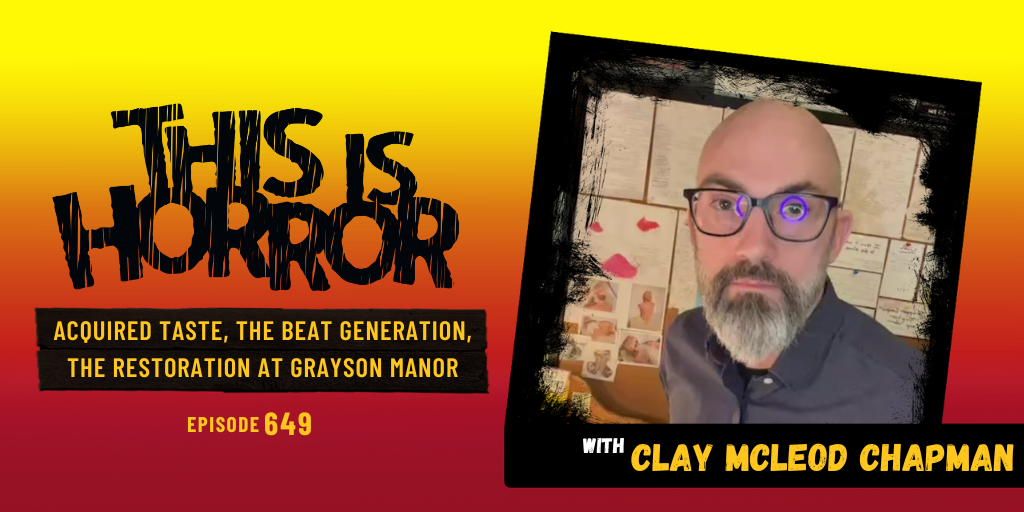
In this podcast, Clay McLeod Chapman talks about Acquired Taste, the Beat Generation, The Restoration at Grayson Manor, and much more.
About Clay McLeod Chapman
Clay McLeod Chapman is the author of the novels What Kind of Mother, Ghost Eaters, Whisper Down the Lane, The Remaking, and Miss Corpus.
Timestamps
Thanks for Listening!
Help out the show:
- Support This Is Horror on Patreon
- Listen to This Is Horror Podcast on iTunes
- Listen to This Is Horror Podcast on Spotify
- Rate and review the This Is Horror Podcast on iTunes
- Share the episode on Facebook and Twitter
- Subscribe to This Is Horror podcast RSS Feed
Let us know how you enjoyed this episode:
- Write a comment below.
- Follow us and get in touch on Instagram @thisishorrorpodcast
- Subscribe and comment on YouTube @thisishorrorpodcast
- Follow us and get in touch on TikTok @thisishorrorpodcast
- Tweet us @thisishorror.
Resources
- Clay McLeod Chapman Books
- Watch the video version of This Is Horror Podcast episodes, including our conversation with Chuck Palahniuk on YouTube.
The Girl in the Video by Michael David Wilson, narrated by RJ Bayley
Listen to The Girl in the Video on Audible in the US here and in the UK here.
They’re Watching by Michael David Wilson and Bob Pastorella
Read They’re Watching by Michael David Wilson and Bob Pastorella right now or listen to the They’re Watching audiobook narrated by RJ Bayley.
Michael David Wilson 0:20
Welcome to This is horror, a podcast for readers, writers and creators. I am Michael David Wilson, and every episode I chat with the world's best writers about writing, life lessons, creativity and much more. Today is the second and final part of the conversation with clay McLeod Chapman, and in today's episode, we talk a little bit about his latest short story collection, a quiet taste now. Thank you to everyone who's listened to part one and for the kind words regarding that episode. A lot of that conversation is me, my co host, Bob Pastorella and clay talking very candidly about the highs and lows of the writing life. We talk about self doubt, imposter syndrome, live readings and performances, among other topics. And if you haven't listened to it, while you can listen to these in any order, you are free, of course, to go back one episode to 648 and then come back here when you're done. Alright? Well before we get on with the conversation, a quick advert break. It was
RJ Bayley 1:55
as if the video had unzipped my skin, slunk inside my tapered flesh and become one with me.
Bob Pastorella 2:03
From the creator of this is horror, comes a new nightmare for the digital age. The girl in the video, by Michael David Wilson, after a teacher receives a weirdly arousing video, his life descends in a paranoia and obsession more videos follow, each containing information no stranger could possibly know, but who's sending them and what do they want? The answers may destroy everything and everyone he loves. The girl in the video is the ring meets fatal attraction for the iPhone generation, available now in paperback, ebook and audio from the host of this is horror podcast, comes a dark thriller of obsession, paranoia and voyeurism after relocating to a small coastal town, Brian discovers a hole that gazes into his neighbor's bedroom every night she dances and he peeps same song, same time, same wild and mesmerizing dance. But soon, Brian suspects he's not the only one watching and she's not the only one being watched. Their watching is The Wicker Man meets body double with a splash of Suspiria. Their watching by Michael David Wilson and Bob Pastorella is available from this is horror.co.uk, Amazon and wherever good books are sold.
Michael David Wilson 3:12
Okay with that said, Here it is. It is clay McLeod Chapman on this is horror. You so we have been talking for an hour, but what we haven't actually mentioned is one of the reasons that we are chatting today. It's because kill your darling won novella OF THE YEAR horror award. So, I mean, firstly, congratulations on that.
Clay McLeod Chapman 3:45
Oh, man. So we can officially talk about it like it's, it's in the open as of now, on this recording,
Michael David Wilson 3:53
on this recording, yes, in this reality, we are going to announce it this week.
Clay McLeod Chapman 4:00
That's wild man. That's the coolest feeling. Thank you guys. I don't do you talk about the decision making process. I don't know. You know, I don't want to ask too many questions if that's inappropriate. But like, like, like, I've never won it before.
Michael David Wilson 4:23
So, you know, I've always been very transparent about the way that things work with the this is horror awards. And when I put them together to begin with, I really wanted a kind of redirect, curated horror awards. And so the way that it works to begin with, there is a period for people to send in their nominations, the public nominations, so anyone can send in anything to be considered. And so then from that long list, you. And it usually is a very long list. We'll have a look at, okay, you know what? What has come in, and how many people have kind of nominated each work. And then we really have the excruciating process of whittling it down to five to five books. So there's a podcast category to five entries in each category, and that will be obviously looking at the quality and looking at the amount of people who you know what want this book to be considered. And then from there, we announced the short list, and then that is completely voted upon by the general public. So the winner, in this case, you kill your darling, that is of the five. That is the one that received the most votes from the public. And you know, this is what, what I what I said I wanted, of course, is for this to be as read, a curated as possible. And this seems to be the way. I mean, you know, you can never, you can never make a perfect system. We We know that in in in all facets of life, but this is as good as we've kind of got it down for. Just really, these are the five that we believe as a community are the best of the best, and now we're just putting it to the public to vote for which one is the winner for you.
Clay McLeod Chapman 6:41
Yeah, man, that's wild. It. I mean, like, just it, I don't know, like, just thinking of, like, people being able to vote for what they want, and just I don't know, like, I'm, I'm a little speechless, like I don't know. So it's a, it's a wild feeling. I'm excited. I, you know, like that, that book in particular, it's such a small book, and, you know, the ability to get it into people's hands is hard because I think of the subject matter, because it's, you know, on this independent press, because it's like, I almost feel like there are all these different things that are kind of making it hard for people to find that book. So knowing that there are people who are advocating for it and celebrating it, it just means the world to me. Because, like, it's just a small it's just like a small story. Yeah, I don't know. Thank you guys.
Michael David Wilson 7:46
Yeah, and it's such an effective story, too. But I'm, I'm conscious of the fact that actually the last time that we spoke to you, we did speak at length about kill your darling. So, you know, I wanted to give everyone who won an award the opportunity to return to the podcast and to, you know, kind of mark that occasion. But then we've got this almost bizarre situation where quite a few people it's like, but we did actually talk about your book on a previous episode. So it's like, Hey, you won. Yeah, we're gonna talk about a book that maybe it will win something in the future. Maybe it won't that. Okay, that's kind of how, how we've done it. And so, I mean, we did speak to you, as I said seven months ago. Yeah, I'd usually open the first hour with this, but we turned it into the Josh Malerman retrospective. Retrospective. Does that make it sound like he passed away? He's not dead. He's still very much reversed. He's still going. But, yeah, what have been the biggest changes for you in those seven months, both personally and professionally?
Clay McLeod Chapman 9:17
Oh, wow. Um, you know, it's been, it's it's been a it's been a year.
Um, you know, the January started off with, wake up and open your eyes. I had a graphic novel that came out in June called seance and the asylum with Dark Horse. And that's that was a fun one acquired taste with Titan books came out in September. I am a week, almost like less than two weeks, away from releasing a YA novel called shiny happy people, which is a kind of ya sci fi horror novel. I. And I'm writing for younger readers, which is really exciting. I had a movie, you know, like, every so often I get to, like, work in film and TV stuff, you know, it's for everything we were talking about before. It's amazing how you can have a kind of parallel career writing and developing stuff for Hollywood, and it just never, ever will see the light of day. And I occasionally get to do that. Like, it's not a consistent kind of thread, but it's there enough that, like, you know, once a year I'll like work on something like either pitching it, developing it, writing it. And this, this script that I had written years and years ago finally got greenlit and, you know, as a micro thing, it was really small, independent, all the way financed through Europe, and like all this, like all of these different production companies overseas, but they filmed it in 2024 in Ireland, and it had its premiere in September at a Fantastic Fest, which is this wonderful, amazing genre festival in Texas and in Austin. And I got to go and see the world premiere. It was called the it is called the restoration at Grayson Manor. It was a very gothic, queer killer hand movie, and it's since played sithes the siches Film Festival in Spain. It was just this weekend in Italy at another film festival that I want to say it's called the Trieste Film Festival, but I might be wrong, so forgive me, but yeah, I don't know what distribution plans are for that, but that's hopefully in the works. They never tell me much of anything, like I'll find out when the ink dries. But creatively, like, Life has been good. It's been fruitful working on the next book, and, you know, like trying to keep family healthy, happy, safe, you know, do that thing of like raising kids in this crazy world we are living in. I don't know. Like things are good, everybody's okay, and I just want to keep it that way. That's all. I just want to keep alive.
Michael David Wilson 12:53
Yeah, that is a good target. And let's start with the restoration at Grayson Manor. So you said that you wrote the script years ago. So I mean, firstly, how many years are we talking and then, you know, it got greenlit. So I'd love to know the process from it getting greenlit to having this amazing film filmed in Ireland.
Clay McLeod Chapman 13:26
It's a it's a real long, circuitous route. And not every film has to be this way, but it was for this one in particular, I know I met a filmmaker, Glen McQuade. He's a wonderful, lovely, beautiful man from Dublin. Lives in the state. He kind of alternates between the states and Dublin, but he was one of the contributors for the original VHS horror anthology. He did a he was one of the directors of one of the segments for that. He did a feature called I sell the dead. He co created a radio play series called Tales from beyond the pale with an East Coast horror independent production company called glass eye picks. And that's how I met him, because I was one of the contributors for that radio play series. And like, like, wait, I'm it's either 2011 or 2013 but like, Glenn and I really hit it off in the working on these radio plays, these horror like Tales from the Crip style EC comic style radio shows. And. And Glen and I really hit it off. He really liked my segments, and he was like, I have this idea for a robotic hand story. And he was interested to see if I wanted to write it. And, you know, like 2013 like this is like over 10 years ago, of like, spitballing to then starting to script, you know, the outline, it like we were drafting, like a decade ago, and, you know, at a certain point like it, you know every you know, you just need one person to believe in a project long enough for it to kind of see fruition. And Glenn, God bless him, like, I think every like he carried that torch for this script for years and years and years. And like, in 2017 it looked like there would be a little like an opportunity, and that didn't pan out. 2018 1920, and then nothing happened in covid times. And then like, but like, the way it works is that, like, we would get a little bit of money here from a company in Ireland and then, but it wasn't enough to make the movie. So now that we had this little chunk, we had to find another chunk, and we would find another chunk in England, and then we would find another chunk in France, and we would find another chunk in Brussels, and, you know, if we did the special effects over here, then we would get a rebate, you know, like a tax incentive. So that means, like, so like, it was quite literally, like, once we found a producer, which we found in 2017 it, it allowed them to, kind of like cobble together this BRIC a BRAC of financing, so that you know, it wasn't a studio movie. It wasn't like Warner Brothers took this. It was quite literally, like 200,000 here, 500,000 here, a million there. Like, however it broke down, and all of it coming together until it was enough to actually make this movie. And, you know, I only think, you know, we're talking like 5, $6 million like, it's not a huge, big budgeted film. But it, you know, it's a chunk, it's a chunk of change. And it, it stars Chris Colfer. Like Chris Colfer from this, there's this amazing TV series called Glee, and he was one of the leads in that, when he came on, it like, really solidified the kind of like, like, Okay, this is real, and this is really happening. Because, like, you know what we were talking about before, in terms of our conversation of like, when is when is a film project real? If you get to casting, it's real. Like, you can get a director, you can get a script, you can get, like, all these things, but until there's an actor behind it, it doesn't feel real. It's not as real as when you have a star. And Chris Colfer was ours, and, oh, my god, Alice Krieger, this amazing actress who has been in everything that you love. But for me, what I love her in the most is she was in the adaptation, the feature film adaptation of ghost story, ghost story, and she played the phantasmal supernatural character whose name I'm completely blanking on at the moment. And I remember watching that as a kid and just being highly enamored by her and repulsed by her at the same time. And here she is, kind of starring in this movie I helped write. And yeah, total dream come true. That was a long way of answering your question.
Michael David Wilson 19:24
And so you went to the premier era Fantastic Fest. Is that right?
Clay McLeod Chapman 19:31
Yeah, I, you know, I was able to go to production too, like I was on set last year and watch them make it. And it's, you know, making movies is it, I find it to be highly amazing. I love it. I just love filmmaking in general. I am the most unnecessary entity by the time you're in. Production. So, like, I just get in the way. But being able to kind of visit set, see the actors, introduce myself, and then disappear, was probably a good idea. And then I see them at, you know, the world premiere in Texas, at the Fantastic Fest. And it was beautiful. It was a Fantastic Fest is there is a chain of movie theaters here in the States called Alamo Drafthouse, and it's kind of their premier Film Festival. And they pick beautiful like bonkers genre films. So it's not strictly horror, but there's a lot of horror, and there's like, a lot of like other kind of, like, several other genres. But they premiered black phone two there, which was amazing to see that world premiere. Yeah, they have to. So it was just like a lovely, lovely, lovely experience. No sleep that whole week.
Michael David Wilson 21:08
Oh, yeah, I can imagine. And, you know, I guess for you to sit down and for you to watch it with members of the public watching it for the first time. I mean, one would assume that that is both exciting and a little bit terrifying, because you're you're waiting to see you're getting a real reaction. You're getting a reaction in real time.
Clay McLeod Chapman 21:36
Yeah, yeah. And nothing prepares you for it. Like, I mean, what's great about hitting the film festival circuit up first before, like a theatrical release, is, at least with the film festival, there is a, there is nothing but goodwill going into that experience. Like people genuinely want to be there a movie. Could totally shit the bed and be awful, but you're never going to get a kinder, more warm hearted and excited audience, as you are at a film festival, particularly Fantastic Fest, because I don't know, like, I've been lucky to go to, like, Sundance and South by Southwest, and they're all like, cool and hip, like film festivals and like, people are feeling very much like, you know, this is where it's at, but fantastic is just this, like, bonkers kind of, like, you know, I don't know. It's just, it's a lot of fun. It's just so much fun. And they were very kind to our film, which is very, it's a very weird film, and is to not everybody's tastes. But you know, for those who get behind it, it's just like, it's it's just, yeah, it's magical.
Michael David Wilson 23:01
Well, I'm so glad that you had that experience, and he is hoping that there will be a lot more like that in the future.
Clay McLeod Chapman 23:11
Yeah, fingers crossed. I mean, I don't know like you, like it's everything we were talking about before, where it's like you, you you just never know. And, like, honestly, 10 years plus of just, like, is this going to happen? Is this not going to happen? Like, you know, I personally, kind of, like, you know, as the writer, you write these things for film, and you have to kind of assume that they're not going to get made. It's the only way to protect yourself, because otherwise you're gonna get cynical, which you mentioned, and it's true. Like I like the people who I know working in on different levels in Hollywood, they like it's it's never a given that the work, the output of their material, like it just, it might not go anywhere. No one will know that it even exists, and it's just so I cannot fathom being solely in an industry, working solely in that film, feature film industry where, like, you put so much of yourself out there, and like, maybe it gets made, maybe it won't. But like that, like, you know, at least, at least with publishing, like, you know, the book, hope, like, it'll get to the shelf, whether people read it or not. Like, like that, you know, who knows, but like, at least it'll exist. You could be in Hollywood and like, write stuff and like, it'll never exist. Nobody will know about it kills me.
Michael David Wilson 24:51
Yeah, yeah, no, I get that. And you know, it is great to talk to people such as yourself. Of who kind of you have one foot in publishing and another in that film, Hollywood world. And I mean, I've, I've written a couple of scripts just to kind of learn, really, the mechanics of screenwriting. One of them being alongside Bob Pastorella, we wrote a script for our novel they're watching. And you know, it is such for me, it's a very exciting medium to write in. I had a tremendous lot of fun doing it. And I mean, a lot of my books are dialog heavy anyway, so I think I took to it quite naturally. But you know, a big reason as to why I'm not like all in or just like forgetting the book side is exactly what you said. I mean, if I write a book that can definitely see the light of day that can be in the public world. Now, it might not necessarily be with a big press, but I could independently put it out there. So if I so wish that is definitely going to have an audience or have a public reaction, but with films so often, particularly starting out on spec or, you know, you're commissioned to write something. You're paid to write it, you do write it, and then nothing happens with it, you know. So it's like, I've written a lot of films. It's just and I was paid, but you can't see them. And what a bizarre thing to explain to people who are not in that industry. It's like, so you wrote it, you got paid, but we can't see it. Yeah, that's what it is.
Clay McLeod Chapman 27:01
I mean, I guess, like, you know, the check, the check does clear, and that, in of itself, has to be the personal victory. But yeah, there's no obligation for them to make it like they own it. They can do it with a they want, with your script and or at least for a finite period of time, like we'll take that option for 18 months, and we'll either make it or not and maybe we'll renew the option like it. It's maddening because like it, it is almost so counter intuitive creatively to what what we believe, like you know, as storytellers, like you want to believe like we're telling these stories to an audience like you know, whoever they are, however many there are, but that's just not the case with filmmaking. It's just not a given that it will that that story will see the light of day and, like, that's hard, that's really hard to, like, accept. So yeah,
Bob Pastorella 28:12
they have scripts that studios have bought specifically so other studios don't make the film, they have, like, literally no intention of making it, or the stars haven't aligned properly to where they can make it, but they it's not a it's not a thing. It's like, we own that you can't make that. Yeah, when are you going to do something about it? Doesn't matter. So to me, it's almost like, you know, it's like what William Goldman said, you know, no one knows exactly what they're doing, but it there's another level to it too. No one knows what they're doing in Hollywood, and they're all seventh graders. Yeah, it's mine. It's mine.
Clay McLeod Chapman 28:56
Well, God, he said that in like, what this like late 60s, 70s, yeah, and nothing's changed. It's actually gotten worse, much, much worse. I'm eating my Halloween candy in front of you now.
Michael David Wilson 29:12
This is the level of enjoying Halloween candy that it's got to and this is the level of comfort on this is horror. So to begin with, you're eating candy free first hour. But now you're like, Look, if people have made it 90 minutes into this conversation, I need my sugar. Get in the Halloween candy.
Clay 29:39
Get the Halloween candy, man, you got your coffee. I got my sugar boost,
Michael David Wilson 29:44
yeah, and I bet that you have great Halloween candy in America, because, you know, in the UK and particularly in Japan, Halloween isn't such a big thing. But you remember. Americans, you take Halloween so fucking seriously you do? Yeah? So I don't know if this is interesting for the predominantly American listenership, but it's interesting for me, and I'm the host. So what is the candy like that you've got? What are some of the craziest and the most satisfying Halloween sweets and confectionery that you have?
Clay McLeod Chapman 30:30
I mean, I'm, I'm a sucker for peanut butter. So like, I'll always err on the side of Reese's Peanut Butter Cups. But I do want to sidebar and say, in the UK, there is a particular kind of candy bar. I think it might be called crunch, but it's like, it's essentially like, Honeycomb.
Michael David Wilson 30:53
Yes, it's a crunchy I love crunchy America.
Clay McLeod Chapman 30:58
I mean, maybe, but like, it has, it comes from the UK, right? Like, we, I die for crunchies every time I go to London, or, you know, Dublin, or you like, you can only you can find it here, sure. But like, it's, it's yours. And, like, at some point, if I'm in Europe, like, it's necessary to get a crunchy, if not 10 crunchies.
Michael David Wilson 31:29
So do you come back with a lot of crunchies in your luggage? Is this, like, a specific thing, or
Clay McLeod Chapman 31:36
they don't make it across the pond? Like, I'm eating them, like, as, like, I might have ambitions of taking them back, but they're not going to last the flight. Yeah, frankly, they're too good, too good. Give me a crunchy.
Michael David Wilson 31:51
I want one now. Yeah, so you've never had a crunchy then Bob,
Bob Pastorella 31:57
no, no, but I mean, my for Halloween. I mean, like, yeah, Snickers, you know the Reese's one thing too that I do have to kind of lead in with to my mom used to work for Hershey, and so there was always candy. And so you you can't get burned out on candy. Now, we'll tell you that my favorite thing for Halloween, though, and I haven't had in a long time, but I love, this is caramel apples. I love a good caramel apple. Yeah, it's not good for your teeth. It's not good for your life, but that's, that's some, that's some like, that's some healthy crack right there. That's what I call that. That's some good stuff. I want to say, though, I do have to, I do have to add that I know for Easter candy is a big thing for Easter as well. And of course, I'm pretty confident that the Cadbury egg came from England, but that was recently bought out by an American company a couple years ago. And one of the things that we learned is Cadbury now has 18 ingredients, whereas when it was produced in England, it only had four or five. And so those ingredients for the Cadbury give it a basically, are designed to give it a 90 day shelf life, because you have pre Easter, Easter, and then clearance. And clearance can go all the way into, like, the beginning of summer. And so it's like, you're still buying this candy that should be thrown away. But, you know, because of modern science and the other, you know, the other 13 ingredients, they, which are preservatives, they, they, they've extended that shelf life. And I'm like, Something's just not fucking right with that. You know, it's just, it's just not right.
Michael David Wilson 34:07
So this is what's happened clay, just innocuously eating sanitized piece of candy. You stand this into, this is chocolate and candy podcast, and
Michael David Wilson 34:25
And you know, when I was younger, like the Cadbury's cream egg was one of my favorite chocolates. And of course, back in those days, you could only buy it during the Easter period, but its popularity soared so much that it did become available. I'm not sure if it was all year, but it was certainly well past Easter at one point. And yeah, if I, if I saw a Cadbury's cream egg, I had to buy it that those were the rules. Maybe, maybe. Much like clay McLeod Chapman's crunchy rose.
Clay McLeod Chapman 35:04
I love, I love Cadbury cremax. Now I want a Cadbury cream. We have to wait till what April for? Cadbury Crew Max now,
Bob Pastorella 35:10
yeah, I don't even think they're available. Yeah, I don't think you can get them.
Michael David Wilson 35:15
But what I was gonna say so I haven't had one for a while, but I did see some people complaining online. Of course, I was shocked. Wow, complaining online, that doesn't happen a lot, but it did happen on that day you know about these added ingredients, and they were saying that it doesn't taste as good as it did. So if Cadbury's are listening, I'm very happy for you to send me both the original and the new recipe, and I will be able to give an opinion on that, but God, I I hope that they haven't ruined this most Sacred of childhood treats by changing the recipe, or at least if they have it's like you got to bring back the original as well, if only for Easter,
Clay
if only for us.
Michael David Wilson 36:18
to pivot away from chocolate and candy and to pivot towards acquired taste. So as which a Cadbury's cream egg and a crunchy may well be an acquired taste. But your short story collection, as you said, it came out via Titan books a couple of months ago at the start of September. So to begin with, how did this collection come about? Did you approach Titan? Did they approach you? Did you have the specific short story collection formulated as we see it now? Or did they say they wanted a collection and you went through a process to decide what goes into it.
Clay McLeod Chapman 37:05
Yeah, it's, it's interesting, you know, I had, my first book was a collection of short stories. I've been lucky that I had had two previous collections come out, and the first one had like 20 stories, the second one had like 40 stories. And then Titan, there's this great editor over there, Daniel carpenter. And Daniel and I had been kind of working like Titan was always the UK publisher for a lot of my quirk books. So like they did, wake up and open your eyes they did. What kind of mother and Daniel and I just really hit it off. And we kind of had been having these like conversations about, like, what what we could do, what would be something that we could work on together, and I had been really eager to do a collection of short stories, because the last one I had came out in 2017 and this was like, like 2021 2223 and we're so we're just, like, talking about, Like, that's like five years of short stories that, you know, I've been really fortunate to get, you know, stories published in either, like, anthologies or, you know, literary journals, magazines, and had kind of been sitting on or kind of gathering, collecting, like, a bunch of stories that had been out there in The world, but just didn't have a like hadn't kind of existed together. And I, I been wanting to do a collection for a while, and, like, I pitched it to him, and he was like, show me what you got. And so, I mean, I literally just kind of like, dumped, you know, however many stories, X amount of stories, and it was probably upwards to like, I can't remember now, maybe like 40, like, God could have been 50 stories more like 40. And through the kind of discussion with Daniel, we whittled it down to 25 and we were, we kind of talked a lot about what we wanted the sequence to be, even though the stories themselves, like 24 out of 25 of those stories that are in acquired Taste had been published elsewhere, but Dan wasn't going to just let that. He wasn't going to leave good enough alone, like he wanted to kind of dig into them and, like, develop, like, work on them more. So he offered some pretty extensive feedback, not on every story, but on a lot of them. And I kind of went back in. And and revised a lot of them. And so like, Daniel was honestly, like, he was very hands on and very like this. This is something that we're going to work on together and kind of make it what it is today, what what is on the shelf. And, um, you know, for me, maybe there had been a moment where it's like, Ah, I get to sit back. These stories are done. They've been published elsewhere. So, like, I'll just put them together. We'll figure out the sequence, and that'll be that. But no, like, they were, they were quite, you know, Daniel was like, let's work on these. Let's make them better. So we did.
Michael David Wilson 40:44
You said that 24 out of the 25 have been published elsewhere, which obviously lends itself to the question, which is the one that was original to this collection?
Clay McLeod Chapman 40:59
You know, it's funny because, like, it's not it's it's kind of incidentally original, like the poster board, the story poster board was lined up to be an in in an anthology, but the anthologies never came to fruition. Like it was, like it was accepted, like it was in the midst, and then the, I guess, the anthology just collapsed, which happens like it. You know, not every collection gets, you know, anthology gets made because of whatever circumstances. So, but by that point, the train was already leaving the station so, and I think Titan kind of wanted to say, like, like, oh, there's an exclusive story in the midst. So that became the kind of previously unreleased track for the album.
Michael David Wilson 41:55
Although, you know, having said it, there's an argument that they were all unreleased, because you said that you and Daniel went through them all. So these versions are presumably a little different, at least some of them to the original. Totally.
Clay McLeod Chapman 42:14
Yeah, you know, some he was pretty like, stay on the line, which is like a little novelette in the midst that one, I think remains in its entirety, like, sorry, like that. That is what it was. But other stories, like psychic Santa in particular, he raked me over the coals with that one, like he would not leave it alone. Like he like, I don't think he wanted it in the collection, but I was like, Oh, I really like this one. And he's like, Well, then you're gonna have to work for it. So he was definitely, you know, he was a tough cookie that Daniel Carpenter, tough editor. I'm just imagine, like, I'm just imagining Daniel listening to this, and I don't know if he will, maybe I'm not gonna tell him to but like, if he's listening, and he's getting to this moment right now, I'm going to tell you Daniel Carpenter was a slave driver, and he worked me so hard he wasn't going to leave these stories alone. So there you have it. There's your exclusive.
Michael David Wilson 43:33
Yeah, that's in the episode title. Now, Carpenter's a slave driver. I think he definitely listen. If it was literally the episode, my editor, the tyrant, yeah,
Bob Pastorella 43:49
yeah, got a lot more patience than me. I mean, if you come back, well, I say that. I don't know how many times he came back at you on that story, but if it had been like more than five, you know? And then even said, Why do you wouldn't want it in there? And my answer would have been, I don't want it in there any longer. Thanks, you know, why? Why? Well, because you're being an ass, that's why.
Clay McLeod Chapman 44:14
No, I'm being cheeky. He was, he was absolutely lovely through it all. But he was, he was like, let's like, he's like, this is an opportunity. We can make these stories even better. So, like, you know, there were a few you need, you know, Bob, you mentioned this before where it's like, you're very kind to say that the stories feel like they have singular voices, even though they're all first person narratives. And Daniel was like, these stories are all first person nerves. We got to, we got to mix it up a little bit. We got to make this thing feel, you know, that it flows and it's not redundant or repetitive. So certain stories we kind of shifted into like, second person, like, there's like. Are some that are in the kind of like all encompassing we, which is weird. I think poster boards is actually one of them. And that wasn't originally the case. That was a first person story. And there's a story called cyan, magenta, yellow and key, and I think that is in third person. And that one was originally in first person, and then there was another one called Sisterhood of the salamander, and that was in first person, but he changed that one to second person, or like a, like a weird, I don't even know what you call we, if you say we is there? I'm totally blanking. Like, if a story is narratively, we is that just multiple first person? Like, is there?
Bob Pastorella 45:51
Yeah, thanks. So I think it's still first person. Okay, so I guess years ago that we said that Stephen Graham Jones had come up with the fourth person, but he he refused to define what it was. So typical, Steven, yeah, there you go.
Clay McLeod Chapman 46:10
But yeah, it's all to say Daniel was, was super hands on, and he wouldn't let me be lazy.
Michael David Wilson 46:16
Yeah, we is between first and second. So Is that like the one point, fifth person,
Clay McLeod Chapman 46:24
the one and a half. Yeah, yeah, half person.
Bob Pastorella 46:28
I mean, regardless, all the stories feel lived in, and that's, that's what you want, you know, the short story you got to attack early. I mean, it's like, you can't, you got no time to dick around, you know, and they all feel lived in. And that's, to me, that's, that's like, one of the defining factors of a good short story is that it, you know, it's not, you're not trying to build a world. It's like, you've got a, you've got a world that people are settled in
Clay McLeod Chapman 46:57
pretty well, totally. Yeah. Like, stories are, they're kind of tough because, um, and I think what first person narrative does is allow you to cut to the chase, like there's a there is an immediacy to it, because it's like, I'm here, like, I'm the narrator of the story. Like, let's get going. Like, I'm gonna, I have to spin a yarn, like, I'm gonna talk to you, and you as the reader are kind of dragged into that. You're brought into the process, because you as the reader are the one being addressed by the narrator. And that makes you complicit. That makes you either a wit, like an unwilling accomplice, or like a just like a shoulder to cry on. You're the confessional booth for these, these protagonists.
Michael David Wilson 47:53
I want to know more about the psychic Santa debate between you and Daniel, because also you said, before you sent him about 40 or so stories. So obviously psychic Santa got into the 25 Yeah, but then he was trying to push it out. So, I mean, did did he dislike these other 15 even more? Like, what was going on there? Or did you love psychic Santa that you contractually were like, No, this is actually going into the small print. This has to be included.
Clay McLeod Chapman 48:32
I definitely advocated for psychic Santa. I think, I think you know a lot, of the pieces that didn't get into the mix, if I'm remembering correctly, they were just like, like, thematically, like with, with this collection in particular, you can definitely see the kind of commonalities like these are the things like, when someone says, like, this is what I'm obsessed with. Presently, I'm obsessed with X, Y and Z, and you can kind of see that you're you can be made aware of that just by what like, what overlap there is in stories. So, like a lot of these stories are like, about parenthood, the fear of parenthood, politics, so many different things, body parts, food, olfactory, like just nibbling on stuff, since sensory experiences, baby carrots, like, these are, like my pet obsessions, and like they're, they're all playing out in these stories. And so one of Daniel's kind of ideas. Concepts was, well, these stories feel as if they belong together because they all share, like, common obsessions, or common kind of like the things here feel like they link together. So there would be certain stories that didn't have that certain stories would just feel kind of like, almost like outliers, like obsessive outliers, and so they they would stick out more like a sore thumb, and then some of them just sucked, and others were just not as good. And I think, psychic Santa. It's funny because, like, psychic Santa was in an anthology called Play dead, I think, and it was a collection of, like, holiday themed ghost stories. And the one I had in it was like the psychic, that version of psychic Santa, I think, was just not structured in a way that Daniel got and he was like this, feel like this structure feels weird. So that story in particular, we broke it apart and re sequenced it in such a way that it made better sense to Daniel, and kind of made it a better story. And I think he was, I mean, like, I wasn't opposed to it, like, I didn't, like, disagree with him in any way. And it's kind of a relief, because that he kind of rode me, like he was like, I don't think psychic Santa is working right now. And I was like, Oh, but I really like psychic Santa, and he's like, Well, if you want to keep it, we got to work on it. And so I was like, Okay, fine, we can work on it. And and I and I really appreciate it, because what ends up happening is that, like, you know, in Goodreads reviews or people's responses to me, like, I, like a lot of people really like psychic Santa, and I think that has a lot to do with what Daniel mandated, like, He was great about, like, supporting my obsessions, but also pushing me to kind of make the stories better. And yeah, so now, if you're into deep cuts, you can get the anthology and read the the original version, and then have acquired taste and read the the I don't know if you would call it the director's cut, but it's like the editor's cut, like the the newly revisioned, envisioned version of it,
Michael David Wilson 52:57
Daniel Carpenter's remastered edition. But it was interesting that early on that you mentioned the influence of the beat poets, and specifically Alan Ginsberg and William Burris, because I had a note about your kind of different modes as a writer. And you have some of the stories here, I suppose, are more traditional, and others, they were almost poems or portraits that just evoked a feeling that is not dissimilar from the beat generation of poets. So I hadn't quite put it together, but as soon as you said it, it's like, well, of course you would love Ginsburg and Burroughs because kind of their imprint is all over some of these. Yeah.
Clay McLeod Chapman 53:59
I mean, I, I grew up wanting to be William Burroughs, like, I had a circle of friends and, like, our cosplay of the day growing up was basically like, you're gonna be Allen Ginsberg and you get to be Jack Keith and I get to be burrows and like, that was, that was the kind of way that we went about, yeah, just like imagining our ourselves like we wanted to be that, yeah, it was, it was beautiful. I loved. I never got to see burrows, but I did see Ginsburg, and Keith walk was long gone before I got around, but I did get to see Ginsburg, which was really super cool here in New York when I was like a freshman in college, and it was such a transformative experience. And seeing him read William Blake poems in a church on 120/5 Street at Columbia University. And just like he had a harmonium in his lap, and like just squeezing the squeeze box with his knees singing, you know, the Nurse's Song with this, like, whole, like, like, the place was just packed, and it was just, like, such a holy experience for me. I loved it. I loved it. I don't I can't remember what your question was, but that's my answer.
Michael David Wilson 55:36
Well, there was no question as such. So what? What a fortunate time to have an answer to a question that was not posed, that is the level of competency when you come on the podcast, but wow? What? What experience and privilege to be able to say that you saw Allen Ginsberg perform live. Unbelievable.
Clay McLeod Chapman 56:04
I mean, it was beautiful. It was just fucking beautiful. It was like, I mean, you know, when you're a kid, you find these like, it's like, what we're kind of talking about with Chuck Palahniuk, where it's like, you, you find these writers and they like, inspire you in a way that, like, you kind of have this B, C, A, D, experience where it's like, this is my understanding of writing before I read Allen Ginsberg, and now this is my understanding of writing after reading Allen Ginsberg. And you know, it does go to that thing of like, you know, there is the words on the page, but then there is the ability to see him live and see him quote, unquote, perform. And it just it. You know, there's just so few writers that like, I mean, like, I do feel like there was something holy to it. I am not a religious person, but like, I feel as if seeing him kind of evoke these emotions and these feelings and this power with words and song, like it was just, I don't know, it's been a while since I've thought about that. I mean, because this was like 9619 90 6000s, and 1000s of years ago, when I was in college. And, yeah, that was that was it. That was enough for me. I was in,
Michael David Wilson 57:40
you know, and if we're to talk about wonderful writers and wonderful, underrated or unknown writers, given the complete mastery of the language and the craft, and That brings us back to Nathan valing red and your you know final story in the collection Nathan balling Red's haunting horror. Rex. Wow. What an experience. And really caught me off guard that we have this love letter to Nathan balling read, though I was very happy, of course, I was when you mentioned wounds, and you're like, of course, if you knew Nathan balling red, you would know that that was the visible filth published in 2015, fuck yeah, you Would.
Clay McLeod Chapman 58:40
How would you know that? Where would that come from? Yeah, I, I'm so sheepish about that whole story, because, like, I've never actually spoken to Mr. Bell, and we've, eaten we've exchanged emails. I've never met him in person, I don't think, and I'm like, so sheepish about it, because, like, when you read, when you learn that he lives in Asheville, and you learn that he does have this job, or had this job, I don't know if he's I'm sure, I think he still has it, but like he works at a bookstore in Asheville, North Carolina, and me, as someone who does immensely appreciate his writing, loves it like I did, have that stoner epiphany of just being like, Huh? I wonder what it would be like to just get in the car and just drive down there and see him at his place of work and be like, Hi, like, like, like, I don't know if anyone's ever done it. I have to believe someone has. Done it at some point, maybe not to the effect that in this story, but like that, like someone has to be like, Oh, you're Nathan balling good. And he's like, yeah, how can I help you? Like, like, just the cognitive dissonance of like, someone that I can kind of personally hold up in such high regard and put on this pedestal and that like he's almost a target for obnoxious fans such as myself, and that like were any one of us, you know, compelled to kind of make the sojourn, we could corner him and just be like, you're Nathan balling road and he had, he would have to be like, Yes, I am. How can I help you?
Michael David Wilson 1:00:45
Because I had wondered if Nathan had been aware of you writing the story previously, or if you'd contacted him beforehand, but I kind of love that you just went for it.
Clay McLeod Chapman 1:00:58
Well, okay, in my defense, I did ask for permission. There was a anthology, like a fundraiser anthology that shortwave books published. It was called shadows on the stacks and all the books, all the stories, had to be about, like, banned books or, like, had to have this, like, this feeling of, like, books in peril. So I wrote about Mr. Bang good. And as I was writing it, I was basically like, Oh my God. Like, if I just do this and I don't have his approval, if he doesn't give me his blessing, and he reads it and is put off by it, by any stretch, I'm going to feel really bad and that that's going to feel, that's going to be a bad look. So I knew that he had worked with someone else at another publisher. I had asked if I if, if he would be so inclined to forward an email from me to him, and then, you know, in that email was like, hello, Mr. Brown, good. I'm a big fan. I have this opportunity to write this story. This is my idea. Are you okay with that? Do I have your blessing? And he was very, you know, he was like, go for it. You know, it wasn't like a long exchange, and there haven't been like many exchanges since, but it's it's definitely been like, now that it's done and it's out there, I think certain people have been like, like, it just feels very Beavis and Butthead to me, where I think people are just like, like, hey, Nathan bellingrode, you've got this story. Like, I just, I don't think he gets it a lot, but I hope if and when someone comes up to him and says, Have you read this story, that he's not regretful of having given me permission to have written it,
Michael David Wilson 1:03:02
well, I'm sure he won't be I'm sure that he's delighted. And, you know, I wonder too, did you deliberately end on this because then it's kind of your final recommendation to the reader, and also, if you put it in the middle of the story, what was in the middle of the collection? What was there the real risk that it's like, oh shit, they're gonna put it down and read Nathan balling red, because if they haven't read him, you've hyped him up so much. Like, well, we got to read him now.
Clay McLeod Chapman 1:03:38
Yeah, he's the best I love. He's someone who strikes me as having confidence in his writing, like we were talking way at the beginning of this. Like I I feel like every word is chosen with authority, and that's the difference. Like, I think when I read his stuff, his stories, I'm aware of the craftsmanship, the architecture, the like, like they are assured, stable, like they like they are buildings, and I think I, as a reader, probably come to Him knowing that I'm going to be in capable hands. And it's not even a sense of safety, but it is a sense of like being in a place that, like there is there is control, and I'm saying that while also acknowledging that that is not something that I give my readers, that I have less control over the words, but it is that instability and chaos. Is that makes this particular type of writing volatile and hopefully engaging, but that is, that is almost the antithesis of what I feel like Nathan Ballen grude and John Langan and Laird bear, like there's certain other authors that I feel like, you know, you feel this like the control of the author, and you probably come to want that with with their work,
Bob Pastorella 1:05:30
yeah, it's definitely inspired me on on doing things like reading the strange, yeah, and just, You know, realizing that this is like, you know, my first, my first read, my first adult read was Ray Bradbury. So it was very, you know, nice to read something that, that Nathan had written set, you know, Omar's in this, in this kind of retro futuristic setting. And then to turn around, and now he's doing these lunar, Gothic stories, yeah, and it's like there's a level of mastery there that I just want to tap into. I just want a little bit of it. You know, I struggle with the fact that I'm writing something post apocalyptic, and I feel like it might not be realistic, and it's like, it's fucking fiction. Yeah. So he's like, you have to you get that. You get that mindset. You get caught up in it. The only thing that drives me is knowing that Nathan Ballard bridge has done some crazy stuff and did it, and it's like, people love it. And there's an entire multi billion dollar franchise called Doom that's based off the concept that demons are on Mars. So, I mean, it's like, Fuck if they can do that shit, like Michael said, Why not me?
Clay McLeod Chapman 1:06:50
Yeah, yeah. Is that what Doom is really about? The video game Doom is about demons on Mars. Yeah. Did I know that. I don't know if I knew that
Bob Pastorella 1:07:02
it's pretty much what it's about.
Clay McLeod Chapman 1:07:05
I think I saw the movie with Dwayne The Rock Johnson, and I don't know if I ever realized it was about demons on Mars. Yeah, did they ever say in that movie?
Bob Pastorella 1:07:16
I don't even think I mean, but that's like the basic premise, I mean. And if you, if you really, if you really think about it, the, you know, deep space did it better, Dead Space did it better. I mean, Dead Space did it, did it well enough that Brian Evenson actually wrote Dead Space books. So, you know, that's, that's pretty cool.
Clay McLeod Chapman 1:07:38
Yeah, he's another one that like the kind of assuredness of the author.
Michael David Wilson 1:07:43
Oh yeah, I'd put Brian Evenson and Nathan balling road in the same genre, the same category, whatever that category is, I suppose, dark literary fiction, dark literary fiction with elements of of horror and sci fi and weirdness and goodness is so good stuff, yeah. And you know, I think you were talking about what you do and what Nathan does, and it being a slightly different way of operating and doing things. And I think we, we all get that, you know, when we we shouldn't, but of course, we do, even if it's subconsciously. We start comparing our work to other people's work, and looking, where does it kind of fit in, in this rich tapestry of of horror and dark fiction, and I think is fine to categorize, but the mistake that we mustn't make is to say like, oh, you know, because let's say that he's scrutinizing every single word, that that somehow makes it superior to what We're doing, where maybe we're not scrutinizing it to that level, because it's just a different mode. You know, that would be like in heavy metal, trying to say whether fresh metal or technical death metal is better. They're just different ways of doing it, different modes of operating. And you know that there's a tendency for the human being in general, we compare ourselves to others, and we'll we'll put them on a pedestal, and we'll put us very much below, like we're on the ground. Maybe we've burrowed beneath the ground, but then we're almost not seeing the good and the joy and the value in what we've done. So it can be, can be a dangerous thing. But you know, Nathan balling, road stories are great. Clay McLeod Chapman stories are great. Josh Malerman, Jack Ketchum, Kathe. Young, and you're all born, it's all good, and they're all just, you know, a max booth third story, or a Brian Evenson or a mark Daniel lewski. They're all different, but they're all valid. You know, it's not to say who's better? They're all bloody brilliant at what they do. Yeah, it's good to remember. Yeah. Oh, yeah. Well, in this has been tremendous, as it always is, chatting with you. We love chatting with you. We could chat all the time. We could yeah every week, but then we'd have to rebrand the podcast, and
Clay McLeod Chapman 1:10:45
it can be the Josh Malerman podcast anymore. It would be, yeah, yeah.
Michael David Wilson 1:10:50
I mean, that's that, and having to commission more artwork is the reason, those are the reasons why we're not doing it, unfortunately. But you know, do you have any final thoughts or anything that you want to leave the listeners and viewers with?
Clay McLeod Chapman 1:11:12
Oh, man, embrace the chaos, embrace the uncertainty. Um, I think, I mean, you said it best like that, like, you know, all of these different authors are kind of doing it their own way, and there's no one way to do it. And I guess maybe it's just a matter of you finding the way that you do it best that you're the happiest with. And, yeah, you can't beat that, right?
Michael David Wilson 1:11:43
All right. Thank you so much again for joining us.
Clay McLeod Chapman 1:11:47
Thanks for having me, guys, and thank you for the award. Really means a lot that you gave the support to kill your darling. Thank you,
Michael David Wilson 1:11:55
well richly deserved, and many thanks to all the people who emailed in and cast their votes in the awards, because it's the people, it's the community, who are keeping it alive, who are keeping this going.
Clay McLeod Chapman 1:12:11
Thank goodness for them.
Michael David Wilson 1:12:16
Thank you so much for listening to clay McLeod Chapman on this is horror, join us again next time when we will be welcoming back. Ross Jeffrey, but if you would like that and every other episode ahead of the crowd, please do become our patreon@patreon.com forward slash This is horror in addition to getting early episodes, you will be able to submit questions to each and every guest, as well as getting occasional bonus Patreon episodes such as story unbox, the horror podcast on the craft of writing and writing and life lessons with myself and Bob Pastorella, okay, before I wrap up a quick advert break
Bob Pastorella 1:13:09
from the host of this is horror podcast, comes a dark driller of obsession, paranoia and voyeurism. After relocating to a small coastal town, Brian discovers a hole that gazes into his neighbor's bedroom every night she dances and he peeps same song, same time, same wild and mesmerizing dance. But soon, Brian suspects he's not the only one watching and she's not the only one being watched. Their watching is The Wicker Man meets body double with a splash of Suspiria. Their watching by Michael David Wilson and Bob Pastorella is available from this horror.co.uk, Amazon and wherever good books are sold.
RJ Bayley 1:13:48
It was as if the video had unzipped my skin, slunk inside my tapered flesh and become one with me.
Bob Pastorella 1:13:56
From the creator of this is horror, comes a new nightmare for the digital age. The girl in the video by Michael David Wilson, after a teacher receives a weirdly arousing video, his life descends in a paranoia and obsession. More videos follow, each containing information no stranger could possibly know, but who's sending them and what do they want? The answers may destroy everything and everyone he loves. The girl in the video is the ring meets fatal attraction for the iPhone generation, available now in paperback, ebook and audio.
Michael David Wilson 1:14:26
Well, that almost does it for another episode of This is horror. But here is something a little different. You see, whenever I am writing fiction, I'm usually listening to music, primarily instrumental music without vocals. And here are a few recommendations that I have depending on the genre that you're into. So if you are looking for metal, check out Russian circles or pelican. Man for atmospheric break beats and a chill Hip Hop vibe, try DJ crush. And that is crush with a k. Now, some of his tracks do have lyrics, but there are a number of albums that are almost entirely instrumental, if it is jazz that you are after, it has to be miles Davis's classic Bitches Brew. If Bob Pastorella is listening to the outro, he knew I was gonna say that, and he might know what I'm gonna say for the next one. Because if you're looking for dark jazz with an almost Twin Peaks vibe. Check out the Kilimanjaro dark Jazz Ensemble. Well, let me know how you get on with each or any of those. And if you like my music to write two recommendations I can provide more of these in the future. Okay, well, that does it for another episode of This is horror. So until next time with Ross Jeffrey, take care of yourself. Be good to one another. Read horror. Keep on writing and have a great Great Day.