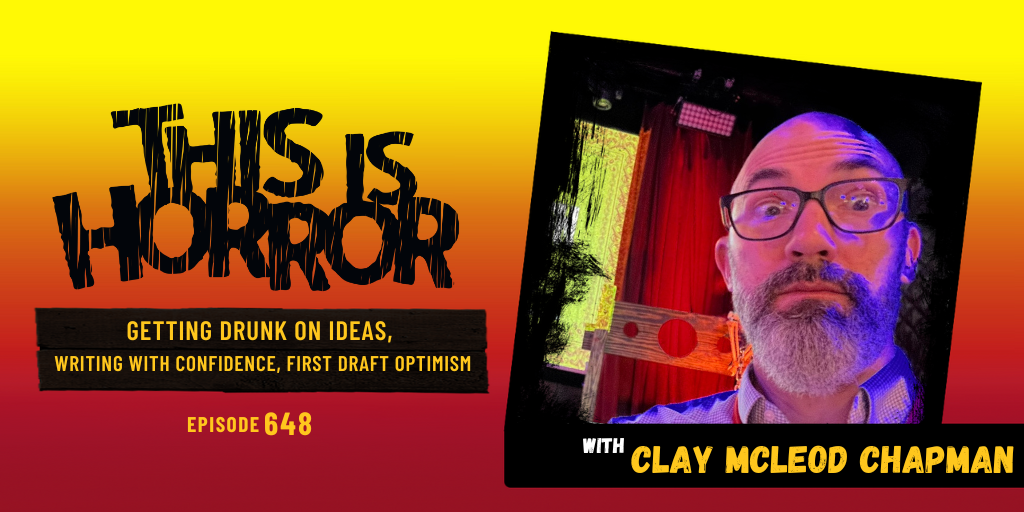
In this podcast, Clay McLeod Chapman talks about getting drunk on ideas, writing and performing with confidence, getting through the first draft, and much more.
About Clay McLeod Chapman
Clay McLeod Chapman is the author of the novels What Kind of Mother, Ghost Eaters, Whisper Down the Lane, The Remaking, and Miss Corpus.
Timestamps
Thanks for Listening!
Help out the show:
- Support This Is Horror on Patreon
- Listen to This Is Horror Podcast on iTunes
- Listen to This Is Horror Podcast on Spotify
- Rate and review the This Is Horror Podcast on iTunes
- Share the episode on Facebook and Twitter
- Subscribe to This Is Horror podcast RSS Feed
Let us know how you enjoyed this episode:
- Write a comment below.
- Follow us and get in touch on Instagram @thisishorrorpodcast
- Subscribe and comment on YouTube @thisishorrorpodcast
- Follow us and get in touch on TikTok @thisishorrorpodcast
- Tweet us @thisishorror.
Resources
- Clay McLeod Chapman Books
- Watch the video version of This Is Horror Podcast episodes, including our conversation with Chuck Palahniuk on YouTube.
The Girl in the Video by Michael David Wilson, narrated by RJ Bayley
Listen to The Girl in the Video on Audible in the US here and in the UK here.
They’re Watching by Michael David Wilson and Bob Pastorella
Read They’re Watching by Michael David Wilson and Bob Pastorella right now or listen to the They’re Watching audiobook narrated by RJ Bayley.
Michael David Wilson 0:20
Welcome to This is horror, a podcast for readers, writers and creators. I'm Michael David Wilson and every episode, alongside my co host, Bob Pastorella, I chat with the world's best writers about writing, life lessons, creativity and much more. Today, we are welcoming back clay McLeod Yap man after his novella kill your darling won the 2024 this is horror novella of the year. Though a lot of this conversation is centered around his latest short story collection, acquired taste. And if that wasn't enough variety for you, then the first 10 or so minutes is an unofficial Josh Malerman appreciation podcast, and the final 10 minutes in the next episode is a Nathan ballingrad appreciation podcast. So a lot of things to talk about with clay. And as always, he does bring that joyful, creative and addictive energy, but before any of that a quick advert break,
RJ Bayley 1:48
it was as if the video had unzipped my skin, slunk inside my tapered flesh, and become one with me.
Bob Pastorella 1:57
From the creator of this is horror, comes a new nightmare for the digital age, the girl in the video by Michael David Wilson, after a teacher receives a weirdly arousing video, his life descends into paranoia and obsession. More videos follow, each containing information no stranger could possibly know, but who's sending them and what do they want? The answers may destroy everything and everyone he loves. The girl in the video is the ring meets fatal attraction from iPhone generation, available now in paperback, ebook and audio from the host of this is horror podcast, comes a dark thriller of obsession, paranoia and voyeurism. After relocating to a small coastal town, Brian discovers a hole that gazes into his neighbor's bedroom every night, she dances and he peeps same song, same time, same wild and mesmerizing dance. But soon, Brian suspects he's not the only one watching and she's not the only one being watched. Their watching is The Wicker Man meets body double with a splash of Suspiria. Their watching by Michael David Wilson and Bob Pastorella is available from this is horror.co.uk, Amazon, and wherever good books are sold.
Michael David Wilson 3:07
Okay with that said, Here it is. It is clay. McLeod Chapman on this is horror, Clay. Welcome back to this is horror.
Clay McLeod Chapman 3:23
Oh, my God, it's it's insane, it's wild. This is like I want to I wonder who gets co host status at a certain point, like, which guest gets on? Who have you had on the most? Because this is, what, third, my third time, 4/3, third, third time. I think, I
Michael David Wilson 3:45
think it is the third. But you know, at this point, we're, we're just so comfortable chatting with you that we're not even keeping count at the moment.
Clay McLeod Chapman 3:56
But who, who's been on the most? Josh, well,
Michael David Wilson 4:01
if, yeah, if we look in terms of episode appearance, so I know that Josh Malerman, in terms of episodes, has been on 20 episodes of this is horror. Now, it doesn't mean 20 conversations, because some of them have been three hour conversations. So that's three episodes, but yeah, the only reason that I know with such precision is because, a few days ago, for the this is horror newsletter, I just put links to every single Josh Malerman conversation, because we've got a decade of experience of friendship, watching the evolution of connection and professional development. Let's Let's link. Let's see how many there are. There are 20 now I think, I think. Three of those episodes, kind of bonus episodes, because we had two of them where it was people giving writing advice, and so it's a compendium with different authors, and then another one. He was there for the launch of they're watching, which me and Bob wrote together. It was Josh Malerman and Laurel Hightower. But yeah, even if you take those three away, I'm not Paul Tremblay, but I can tell you that makes it 17, and that's still quite a lot of episodes. That's wild.
Clay McLeod Chapman 5:37
You mentioned that you kind of sense this, like, professional development. But like, how much has he changed over the course of 10 years? Like, do you remember what he was like when he was just like, Joshy, like, little Josh young, a young, strapping young lad.
Michael David Wilson 5:56
Oh yeah, I do. This is like, I'm his father or something. It's like, Oh, yeah. I remember when Josh was just a little nipper. Yeah, that, I mean, I mean, the first time we spoke to him, and I think, I mean, I do see parallels with you and Josh quite a lot, because he's always had this creative energy, and he's so infused with, you know, what he does, that I think just listening to him speak and the same with you, it just inspires you. It makes you want to create. It makes you want to write. But if I think about how many books he has published now, now I don't have those stats. I don't have every horror stat in front of me right now, but I I think it must be something like 13 or 14 books at this point. But when I first spoke to him, it was bird box, and it was a a very slender ebook called Gasol and Yule. So he had two publications the first time that I spoke to him, and now he's, you know, had the Netflix adaptation of bird box, which, at the time was record breaking in terms of the views that it had. It was the most streamed movie on Netflix, and he's now done almost what very few people do. You're known for, for one book as the absolute standout. But then he was like, well, hold my pen and tumblr of whiskey, because here comes incidents around the house, which, I mean, if you look at bird box and incidents, they're almost head to head in terms of which one he's going to be most known for, I think, in terms of how long it's been out, and the The sales have eclipsed bird box as to where bird box would have been in that point of the cycle. And they're looking at making that into a movie. I mean, they're not just looking at it. They have shot it. Yeah, this is happening. So, yeah, this is bizarrely, the first five minutes have turned into people thought they were getting a conversation with clay McLeod Chapman, but what this is, is, this is a Josh malerman's Life told to clay McLeod Chapman,
Clay McLeod Chapman 8:34
no, but it's, I think it's infinitely More interesting frankly, because you're, you're kind of like you, and this, this podcast, and maybe just as readers in general, like you kind of, you start with an author and you follow them through, if you're a fan, if you're if you're kind of a devotee. And I think it's safe to say that we're all devotees of Josh Malerman, like, we're, we're fans, and I don't know, like, it just kind of blows my mind to think of, like, who, who he is. And like, being able to kind of say, Oh, you were there from the ground floor, like, before, you know, before, like, pre, Netflix, pre, you know, you know, all the hula Ballou, and just kind of seeing him grow, getting, like, a little gray on the sides, and, like, you know, like, just being able to see that kind of growth, I don't know that's, it's a rare opportunity. And if you've done 20 episodes with him, I feel like you're in the privileged position of being able to say, like, look at our little boy, go.
Michael David Wilson 9:49
The funny thing is, in the first episode, so that that was so back in the early this is horror days, that Bob Pastorella Wasn't the co host that was
Bob Pastorella 9:59
I wasn't. Been born yet.
Michael David Wilson 10:09
And so as part of the episode, I think probably it would be in part two or Part Three, me dan Howarth and Josh Malerman, just we just we just start riffing on what our ideal film adaptation of bird box would look like. We're just throwing out ideas. We're even, I think, we get into some really bizarre ideas of having, like people literally being blindfolded in a cinema. It gets pretty weird. There's parts that we'd shoot in black and white. So to just think this was before anyone had even been cast, I think at that point, he'd had meetings, there'd been conversations about the film, but nothing had been filmed, and I think was set in stone, and you just have this, this conversation. So with with Josh as well, and I think with you, it doesn't matter if I have drank nothing, I have taken nothing. I am technically sober, but I become intoxicated on possibility, on creativity. And so we're all in this almost drunken stone stage of creative euphoria in
Clay McLeod Chapman 11:31
the inebriation of Josh, the Malerman intoxication effect.
Michael David Wilson 11:37
But don't you get this too, not specifically with Josh, but just with creativity and with art and with ideas. Sometimes I think we get drunk on an idea.
Clay McLeod Chapman 11:50
Oh, absolutely, absolutely. And I think that's the kind of key difference of like, like I I want to say that being able to kind of do any version of this life of kind of telling stories, writing for, you know, publication like it, like you have to be kind of enamored with the the kind of art of it, the craft of it, Because otherwise, like, I don't know, like it, I as a very sober minded individual, you know, the kind of energy and frenetic, kind of kinetic quality to writing and storytelling in general, like this is, this is all I've got. You know, so few vices in my life, zero vices, just other than by ice cream, as Bob and I were talking about before we started. I, you know, this is all I want to do. I don't I, you know me personally, like I, you know, this is my 12 step program. Is basically just like, write stories and get them out there into the world,
Michael David Wilson 13:01
did you used to have vices, and now you don't. I'm just wondering. You know, sometimes there's like an origin story,
Clay McLeod Chapman 13:11
no, I mean, like I'm, I'll be frank in it, like I'm a pretty boring individual. I was never, I was never one to indulge. I, you know, it's funny because, like, I grew up in a household where I was kind of made intensely aware of the addictions of family members like, you know, I don't know how interesting long story this is, but like my I've never met my biological father. He left before he was even made aware of the fact that I was in the picture. But from the narrative that I've heard from other people. He was an addict. He was someone who, kind of, like, had his own kind of like issues and struggles, and that was something that that kind of followed him throughout the course of his life. He's passed away since, but I never met him, and I think having that narrative kind of like, been exposed to, like, you know, who my father was and what, who he was, within the kind of like construct of my life. I think it was just intensely aware of it, and so like, it just kind of pushed me away from it, alcoholism, addiction, it's, it's, there have been members of my family, both present and not, who have had struggles with that, and we've, you know, as a family, kind of been exposed to it and had to support. Those, those members of the family, and it just, like, it, I don't know, like, it made it easy for me to say I don't want this in my life. And I am such a bundle of nerves. Like, I'm a really high strung, kind of tight, like, I'm clenching my sphincter right now, like, I'm just like, like, very kind of anal. And because of that, it the the notion of alcoholism and drugs that like the relenting of control, the Relenting, like the loosening of that sphincter, is just so impossible for me, like I just don't, I just don't like losing control. So I'm gonna hold on to it for as long as possible, until my body collapses.
Bob Pastorella 15:45
That allows you to lose control on the page, though, yeah, right, because it's like, if you compare you and Josh, it's like the, you know, and there's, there's a slew of writers that are doing this right now, and I love it when you come up with an idea for story, you put your whole fucking chest into it, you know what I mean? And it's like, I come up with some wild ideas, and I still don't have, I had, I don't have the confidence to put my whole chest into it, and I only put like, you know, like a peck into it, you know, I don't, I don't, but it's like, it's like, reading, reading one of your stories, is like, I'm gonna go down this path, and I'm charging down this path and this I'm gonna make you like it. And it's like, I'm gonna, I'm gonna make you give a damn about these characters. I'm gonna make these people compelling and things like that, and that is intoxicating. Lee, influential and inspiring. And so you, you found a way to channel all that nervous tightness and let it cut loose on the page. And that's I bottle it and sell it. Let me do some of it, man, please. You know,
Clay McLeod Chapman 17:03
I would, I would love to, but I'm curious. Like, I want to counter because, like, I want to ask, like, does it come off as confidence? Because it to me, it's like, it's almost like a Relenting, like, a lack of, like, knowing what I'm doing and letting the story be a little more chaotic, like that, kind of like, all Peck all, you know, like going in chest first. Like, you know, to me, it is there a version of that where it's not a confident version, but more of like, a like, a like, here we go. Like, it's like, like, I don't know. Like, diving in head first, to me, isn't like, in my mind, I think of it as less about like, I know what I'm doing and I'm in control, but more of like, I don't know what I'm doing and I'm not in control. And the chaos that kind of unfurls is equally a surprise to me as it may be to you or anyone out there. So and that's the difference of like, like, something feeling fresh or novel, versus not. I don't know. I'm throwing that out there because I you say confident, and I'm just like, I have no fucking confidence, like I have the desire, I have the need to do it, and that, like pushes, there's a lot of motivation, and kind of, there's a motor to that. But it's not like, I know, I know what I'm doing, right?
Bob Pastorella 18:43
It's, and I think it's, it's more exuberant enthusiasm than confidence, to be honest with you. And that's that says a lot, though, because here's the thing, is, like you have an ability to throw caution to the wind, and it's probably because, if I'm and I may be wrong on this, but you probably finish every story that you start.
Bob Pastorella 19:07
and so you don't, you don't have too many stranded orphans out there. And or if you do, you come back to them and finish them later.
Clay McLeod Chapman 19:14
But maybe. But I mean, I like you like, I will say, like, I've there are a lot of stories that, like, will never see the light of day, because I'll finish them, and I'll be like, Oh, wow, that one sucks. And it'll be like, Well, you got it out of the system, you know? And like, maybe there'll be a return to it, but, like, it's more about getting it out of me instead of like having it linger. But I'm sorry I interrupted. You were you were about to bring up another point, right?
Bob Pastorella 19:51
It's the whole, the whole concept of, you know, hey, do I write with confidence? I should write with confidence, and then you can't, because. Is you it's like, I'm gonna be, you know, it's like being right handed at 58 years old and going, I'm gonna be left handed. Now. I'm just gonna do it. We're gonna, y'all are gonna have to deal with it on the handwritten stuff and all of that. But we're just, we're gonna make it happen. You can't use your right hand. I can, but I'm not okay. Yeah, you will fail miserably at that, because you're just not ready to do that unless you know I would, I would fail at it. So confidence, you know, I don't, you can't, you can't think about it. So in other words, like you're thinking about everything else. Yeah, and that's what brings the story to the page. Yeah, it's, it's like, trying to explain the mystery, you can't really explain the mystery because then there's no mystery. Yeah, you know, like, that's, you know, it's like, what I always say, The Evil Dead, doesn't work on paper. It really doesn't. As soon as you start writing it down, go this. This is bullshit. It doesn't fucking work, you know, but you put it in a film, you put it in 88 minutes, and it's perfect, you know,
Clay McLeod Chapman 21:07
I want to believe that, uh, you know, it's so funny, like just hearing you talk about confidence, and that idea of, like, who writes from a place of confidence? Like, I want to believe like, Does John Langan write from a place of confidence. He has to write from a place of confidence. Does? Does Nathan ballengrud write from a place of confidence? Like, they have to write from a place of confidence, right? Like, like, who would not believe John Langan? Like he seemed, he strikes me as just the most confident person I don't know, like I I want to believe that there are people who know what they're doing, because if nobody knows what they're doing, then what the hell are we doing? That's my my wild point for the night. What are we doing?
Michael David Wilson 21:56
Well, we will definitely be getting on to Nathan bellingride later, so do not worry about that, especially after the way that a quiet taste wraps up. But goodness, we're having this conversation, and you're asking, you know, do you come across as chaotic? Do you come across as confident, and there's two, there's two kind of levels to that. Because one, there's the level of of you as a person, and then there's the level of your writing. So in terms of you as a person, and particularly when you know, I see these kind of clips and videos from your live events. I mean, a lot of it reminds me of when, when I'm teaching that is a performance. I'm putting on a show, I'm putting on an act. So because I'm coming from that place of experience, I know that I can be having the worst day, or I'm not feeling good, or just there's a lot of bad things going on in my head, but when I enter that classroom, it is show time, and so I can definitely see with your readings and your energy that you are putting on a performance and you are you are doing it in a both chaotic and portraying confidence mode, shall we say? But I know that just because you outwardly portray it, it doesn't mean that inwardly that is happening. So I think what's going on with your readings and your performances is masterful. It's perfect. It's exactly what we want. Now I know from talking to you personally that, you know, sometimes there's a bit of a disconnect between the, I suppose, put on confidence and the reality. But you know, I know that it does come as well to a point where, when we're writing for so long, we we at least we know more than we do than we started out. We know story mechanics. We know how to put a story together. We know how to write at least a semi competent sentence, but the doubt that always comes in for us is like, okay, but is this? Is this creatively going to work? Is the magic? We can't say that because that part of the equation is almost from the reader, from the response from the audience. Yeah, so that. So that's a little bit about, I suppose you and is this turning into a therapy session? It's like, oh, so here's my here's my analysis of you. Then when you look at the writing, you. There is a chaotic confidence. And something that is particularly wonderful about reading a short story collection is it means that in a relatively short space of time, I've just read about 20 stories of yours, and so you get to spot patterns. You get to see okay, there are different modes as to what a clay McLeod Chapman story is. And one thing that really stood out is how much you love a repeated chorus, whether it's baby carrots, baby carrots, baby carrots, or whatever it is, you love to repeat things, and they get inside your head as an almost ear worm. And it's something that also Chuck Pauline, it does very successfully. But I think it's something that if you're going to do it with your writing, you have to fully commit. Yeah, you can't do oh, here's a little repeated chorus. You've got to go all in. And that is exactly what you do. So I think with some people, that that's going to be a huge success, as it is with you, with other people, if you're not owning it, then it's not gonna work. You know, it's almost like a kind of over the top suit. Anyone can wear it, as long as they wear it with confidence, but if you don't feel it, it's not gonna work.
Clay McLeod Chapman 26:39
Yeah, it's interesting that you bring up Chuck Palahniuk, because, I mean, I remember when I first read Fight Club, it was before the movie, which I feel like, there's a rare like, it's so rare for anyone to be like, Oh, I Read the book before I saw that movie nowadays. But I think, like, I do remember the kind of imprimatur that his kind of narrative style had on me, for sure, but even, like, going back further, like Allen Ginsberg, or, like, I love the beat poets and like, you know, like doing, doing the things that Keith walk and Ginsburg and William S Burroughs was definitely my favorite. But like looking at text as this some as something that kind of can exist on the page, absolutely for sure, but that there's something that kind of manifests itself, either lyrically, orally, like, like, there's something to be said about the kind of, like, the activating of text. And I think Chuck Palahniuk does that amazingly well. And you know, it's, it's something that so few people do outside of, like, I don't know, performance poetry, or like, you know, like, or the oral tradition and but you can, there's certain books, novels, stories, whatever you want to say, but like, you read them off the page. And you know, if you were to read it out loud, it would activate in this way that feels different. You know, it's meant to be read off the page. It's like, like the text is there, but like, there's some summoning, or some kind of manifestation, or some sort of kind of, like, you know, evocation that if you were to just read it, and I think, like, incidents around the house too, like you, if you read that out loud, like it has this, like, this cadence, this rhythm to it, that, like, just feels so alive. I mean, I know there's an audio book to that, that book, and I haven't listened to it, but like, I have to imagine, it's like, it's almost this, like Sonic litany, because it always kind of comes back to this, like, just that kind of rhythm, that cadence, yeah, certain, certain narrative styles lend themselves to that. And it's just a different way of reading, and it's not for everybody. Like, I like you guys are being really kind to me. There are plenty of people who cannot abide by that kind of lyrical nature that you're highlighting, because they it comes off as repetitive to them, it comes off as kind of redundant. Like, ugh, you've said this a million times already. Like, baby carrots, baby care. It's like, get, get, you know, like, the story could be two pages long if you just cut out all the friggin baby carrots.
Bob Pastorella 29:54
You know, it's and I just realized this too in reading the collection, not only. Be have like the cadence, but you do quite a few stories in first person. Every single voice is distinctive and different. There's a performance there, yeah, and I can, I can imagine these stories being read in, you know, here, watching a video of you read is one thing. And I would, I would, I would love one day to actually be present, to see you read. Because that's to me that that would be like going to a concert, you know, yeah. And because, yeah, the videos are amazing, but it's like, there's, there's a character, and you embody this character, and that is, is, I guess, that that's a form of confidence, because you're, you're, you're putting yourself into the character, but at the same time, it's, it's, it's a performance. And so you have to have a level of confidence to do that. So yeah, we keep, we keep coming back to that. It's unavoidable.
Clay McLeod Chapman 31:10
It's unavoidable. But you're gonna hate me because, like I, I'm gonna say, and I genuinely feel this, if I was more confident in the writing itself, I would not do any of that performance stuff. Like, like, for me, I feel if I were a better writer, I would stand back, stand down, and just let the re like the writing kind of do, like, speak for itself, like I'm like, I, most days I feel like I'm kind of like throwing all these bells and whistles on purely out of the kind of like, the innate need to like draw attention my way, just in order To kind of like do this thing. And, you know, for me, the performative aspects to the stories or the things that you like, you know going to see a reading becomes its own kind of show. And it's fun for me. And I really enjoy it. I love it because I that's just something that I naturally it is my choice to do it. But if I was like, the story's good, I would just, I don't know, like I feel like, I would just let it. I would, I would probably not do it as much, or go full tilt. And I think it's because I'm overcompensating for what I feel the story lacks, and that it needs some sort of like, kind of like, more, more of a thing to kind of make it feel alive, or just like, I don't know the thing I hear in my head versus the thing that people read like, I'm disconnecting there. And so I'm trying to, like, bring that to the forefront by doing these, you know, off off the wall readings. But Cormac McCarthy probably didn't do that, you know, David Foster Wallace probably didn't do that. Like, like, you know, Barbara Kingsolver, I don't know, does she do that like, I feel like, like, you know, Toni Morrison would, would she like? Like, for those writers who are like, No, I'm good. I'm just gonna let the story like, I'll read from an excerpt, but like the story does the heavy lift. I don't need to do that.
Bob Pastorella 33:50
I think, I think your stories do that. I mean, I think, I don't think you need to do the readings. You should only do them if you enjoy them. People do enjoy them, but it's not the it's not the thing. It's not like, Hey, did you, did you read his book? No, but I saw him live. It's not like that. No. I mean, you have to read the book. I mean, that's to me, that's that's the ultimate, because that voice is in my head at that point, and so I get to, I get to hear that character through my head. Does that make sense? I think, yeah, I hope I'm not losing anybody, but, yeah, but it's like, it's, you're enhancing it when you do the performance.
Clay McLeod Chapman 34:31
Yeah. I guess my fear is I'm thinking of, like, kiss maybe, like, do people listen to kiss albums? Or do they like, want to go see the live show? And, I mean, kiss on a on a record is kind of like, okay, you get like, it's like, sure, you know, like, you can hum along to these songs. But like, you want to go to the you want to go see the show, because it's about the live show. Um. Um, I want to make sure that the albums are good. That's that is my goal, and that should remain my goal. The Touring, the live shows, the readings, like those events, like they they enhance the experience. But for me, like, I have to make sure it always goes back to the story. Because if it doesn't go back to the story, then it's just all smoke and mirrors and you know, me and makeup.
Michael David Wilson 35:26
Oh, my goodness, there's so many different facets and areas that I now want to take this so first of all, to open, I think pretty much every writer, no matter how talented, if I go to see them reading and they put on a performance that makes it a better reading, that makes it a more interesting evening. I think if Cormac McCarthy threw in maybe some pyrotechnics animations, it would make it better, because it doesn't matter how good the book is, when you go to the live experience, the live reading, this is a different medium now, yeah, and so, you know, I don't see it as over compensating. I see it as a smart move to know what the medium is and what we're doing here, and it doesn't make the book lesser. In fact, I think it does, as you've both said, it enhances the book, but that doesn't mean that it needed enhancing to begin with, but it just means now maybe when you reread it, you've got those memories. If I listen to a studio album, but I've seen that band live, I can kind of picture that, and it takes it to the next level. But if I watch somebody just doing a kind of straight reading, and I don't know if this is blasphemy to say, you know, after what, like, 13 years of doing this as horror podcast, but it is a little bit boring, if it's just a straight reading, yeah,
Clay McLeod Chapman 37:17
writers don't want to do them anymore, like I've Been doing, like events, you know, all year long. And like, there's when you do like a book event, there's the option of, like, do you guys want to do a reading like, nine times out of 10? Nine times like, 10 times out of 10? They'll just be like, No. People just don't like to read from their books. And I mean, like, readings can be pretty dry. They can be pretty boring. But like, I don't know, like, I don't think anybody wants to do it. It's weird.
Michael David Wilson 37:50
I think you know, the greatest way to experience reading is reading is sitting down and reading that book to yourself, that is the way in which it was intended. So, yeah, I mean, I think we're all admitting that if you if you're just reading it aloud, especially if it was a bit monotone, that's not fun. That's not good. That's why, you know, when we've got the audio book, we have professional narrators. Because you you know, probably with the exception of a few people like Stephen King, but God, he's the exception to everything in every arena, it's not that captivating to hear someone just reading their book. So I get the authors not wanting to do it, because I think you've got to bring something a little bit performative. So, I mean, when I'm doing a reading, you know, it's not the level of you or Josh Malerman or Chuck Palahniuk, but I'll at least, like, you know, try and distinguish the accents a bit like I had a scene where, like, I'm ripping off my tie and removing elements of clothing it. You know, you didn't have to go as far as now. Subscribe to my only fans. We didn't remove that amount of clothes. But just like making it a little bit more action packed and visceral, and now I don't think at all that means that the writing is bad or it's overcompensating it is trying to make the reading itself interesting. And I tend to find, if I've got to do a reading that the most difficult bit, particularly if it's to promote a novel, is, what on earth do I read? Because the novel, The intention was never like, Oh, here's a 10 minute section of it. The point of the art is that it. Just the whole piece, yeah, so then either I have to find, okay, well, what's, what's one of the most dramatic bits, or what's a story within the story, or writing another solution. And I think this is absolutely fine. Some people do it is to be like, right? So this is the novel I'm not reading from that, even though we're promoting it. Here is a short story. Here is a complete piece. Yeah, and if you like this, you may also like the novel that I'm promoting. So I think it's very much looking at the time constraints of what you're doing, and you know, I've had bits as well, where, when me and Bob did a reading from their watching for the live podcast, I took the text and I made it almost more like a screenplay. So I cut some of the exposition and made it more dialog heavy, because that's what you want for that performance. So this is all to say, you know, I, I would love you to be confident about your own writing, but, you know, it's difficult. You know, as writers, is completely difficult. But what, what I don't want is for your confidence to be so high that you stop doing the live performative pieces. So rather than it be that you're never confident about your work, hopefully on this podcast, and it's quite ambitious to achieve this in a podcast, but we can rewire your brain to understand that actually the live performances and readings are complimentary, and you are doing what needs to be done for maximum enjoyment, and not even just entertainment though, that as well, but just for really doing it justice in that medium, yeah,
Clay McLeod Chapman 42:03
you know. Well, thank you. Thank you. Like, honestly, like, you don't have to rewire my brain. Like, it's, it's the wiring, is there it? I guess the difference is that, like, Well, I mean, like, you know, we could kid about this being therapy, but like, I'm being like, I want to come from this place of radical honesty, where it's just like, you know, I have gotten to a place where I don't, I realize that I don't have many answers other than just like, I'm trying to figure it out for myself. And so that idea of being confident enough, but not being confident too much, like I've realized for myself, the moments where I have felt the most confident or the most kind of assured of myself, like I know what I'm doing, like, those are the moments where I get lazy, I slacken, like, like, I lose a certain kind of control over that chaos. And it it's there out of, like, a place of, like, ego, or like, you know, it's something, it's just like, it undermines the actual creativity, where, like, if I'm feeling good or confident enough, like, the work itself starts to suffer, which is fucked up, like, Jesus Christ, like, like, there's no winning, but like that, like that, and of itself, like that, acknowledgement of like, okay, like, if that's if, like, like, I'm just gonna let go of that. Like, I'm not like, this is not about me being in control or having like, a sense of kind of self assuredness to lord over my creativity. It's just like, I don't know. I have no control. I feel pretty, like, uncertain most of the time, all the time, and but it leads to like a discovery, like a creative epiphany that is like, better than, or greater than anything that I could plan or like, like, I'm setting out to do this like I this is my goal, and I'm confident enough that I can achieve that goal like the tools of the craft are in my possession, and therefore I will implement them and succeed at whatever that that kind of mission statement is for me. I'm just like Hap, like I have a story I want to tell. I there is an A, there is a B, I don't know how I'm going to get there. Let's, let's, let's jam. And you know if all of the stars are aligned, and if I'm cooking with gas, and if you know. Muses, hit, like, like, all of the IFS like, make, that is the alchemy of like, oh, this is a really, this is good, but it's not good because I was like, I know what I'm doing. It's good because I don't know what I'm doing, and that's, that's messed up, but it is. That's the That's my process now. So I'm just running, rolling with it until something else happens.
Bob Pastorella 45:23
Yeah, everything's like on a sliding scale. You have this this area where you're at and you know how to make your story. The other end of the spectrum is you can be like James Elroy, who is almost a character of himself and doesn't even do readings anymore. He shows up and tells everybody that he's James Elroy, just the best fucking book I've ever wrote. I'm signing at the table over there. I'll see you in a minute, and that's pretty much what he does. And it's like, Would you ever go see James Elroy? I'm like, No, I can buy one of his signed books. I mean, he's not going to do anything other than sit there and sign books, and that to me, when you have that level of confidence, the quality can possibly begin to diminish, which is why I probably haven't read the last three Elroy books. I think he needs to get back and capture some of that Black Dahlia Mojo he had going on. But you know, that's me.
Clay McLeod Chapman 46:22
You know, you bring up a really good point, though, people who go to events like go out to see events that is so cool, and if, if anyone goes to, like, see, see me do something or like something that I'm involved in, like that Hap, like, you have to give them, like, 110% because I think live events, in person, events, things that are that like, you have to leave Your home and go to it like they're so rare and like, unless you're like, unless you're like, James Ellroy, you know, like, you know, the rest of us have to hustle like, we have to, like, earn our audience. And you know, if I get five people, 10 people, 20 people, 3050, like, whatever the number is, like, those people came out because they wanted to be there, and no one's making them go. There's no extra credit for going to see me live. But like, There's something so cool about and exciting about, like, those people making the effort, and damn, right, it's going to be a shit. Let's let it. Let's do something fun. Let's do something that feels rare and feels like we could only do this together tonight, and no other no other event, nowhere else is going to be quite like tonight. And that's because the kind of composition of who's there, it's like you're there tonight. You're not going to be there tomorrow. It's going to be someone else tomorrow, and like that. I don't know there's, there's value to the the that alchemy of just the kind of singularness of what makes in person, live events special, and that's people. People make it special no matter how many there are.
Michael David Wilson 48:21
Yeah, I think too, that, you know, we're talking about confidence, and it's making me think about the and the differences between confidence and optimism. So I find that I'm a very optimistic person, and I kind of have the approach rather than, Oh, well, why would it be me? Why wouldn't it be me? Has to be someone. Why not me? But if I think about confidence, you know you were talking about not being confident in the writing. But sometimes that is the weird alchemy that makes it special. And I've noticed recently that when I am first drafting a story, in the vast majority of cases, I am not confident at all. I'm feeling like, oh, this is rubbish. I've absolutely lost whatever kind of touch I may or may not have had before. Whatever happened when I wrote the girl in the video that's gone now. But then after that first draft, when I look at it again, and it's like, this isn't so bad, actually. This is something I can work with. And then, you know, you start molding it and adding things, and it's like, okay, it's cooking now. So I, I know different, different writers feel different at the. Different stages. Some people hate the editing, but I kind of love the editing and the redrafting, because now I've got something that I can actually turn into something, you know, hopefully pretty good. Yeah, I said I'm an optimist, so I think, yeah, I think it's okay. I don't know if the readers will, that's up to them, but, you know, at least it's some inquiry I can think, you know, I gave it a good go, but is so weird that first draft, yeah, it's not there. And actually, recently, I found myself getting like into these situations where I'm I'm a little bit stuck, and so I'm just trying things out, not knowing if they will work, but because it's worked before, I trust the muse, or whatever it is, that gave me this bat she idea that I've no idea Well, What would happen after that? No, let's take the ride. Kind of works.
Clay McLeod Chapman 51:07
So it's interesting, because what you're saying is you have to have the optimism to get through the first draft, and then you discover the story, or find the kind of thing in the story that works for you, in the revising, in the second draft, and in does that? Is that where the confidence comes in? Or is the confidence? Is it? Is it just nothing but optimism? I'll find the story. I know it's in there somewhere. Goodness.
Michael David Wilson 51:35
It's difficult to because these are things that are fundamentally about what it is to be a creative, to a point, what it is to be a human. Yeah, I know that I'm a very optimistic person because, you know, we've mentioned before about what, five years ago now, me going through the worst time of my life, you know, my personal life, and even though it was very dark, I believed that there was a light. I believed that there was going to be some good, that there was a reason for me to keep going, to stick around. And I think having that experience, and almost like the worst experience I could possibly have like, of course, it wasn't a good thing, but that's now transferable to any time that there's any darkness or any doubt in anything, it's like, well, well, you know that things can get better. So that's kind of where the optimism is coming from. I mean, I've said before. I may have even said it in conversations with you, that with that specific situation in a bizarre way, I sometimes think, well, thank goodness it was me who went through that, because I I think a lot of people, if that had happened, they they wouldn't have they wouldn't be here. They'd have just tapped out. They'd have been like, No, this is this is hopeless. And but I didn't I. I kept going. And so, you know, I apply that to to all areas of my life. And at the moment, I'm, I don't know I am simultaneously having a slight creative wobble and creative moment of doubt, but I'm also optimistic enough to be like No, keep pushing through. So there is a paradox within my mind. I you know, I don't invite anyone to go into my mind it's a weird, weird place to be, but just every time there's a win, it's like you've got to hold on to that. And in fact, I was saying to rush Jeffrey the other day. So I mean, there's something going on with one of my books at the moment, to do with a a possible movie. And it's really, really exciting. There's really good things happening now, with that book before, there were a lot of good things happening right up until the moment, it was like, no that that's gone. Now, that's canceled, that's over. It's like, okay, so that's that. But now we're, we're we're back again at a point where it's like, no, this is good. And it's so weird to live the creative life, because you have these moments where it's like, if this actually happens, this is going to change my life. This is going to change my creative trajectory. This is going to mean that I've kind of made it quote, unquote, yeah, but at any moment, somebody could say, oh, we're just stopping the ride that. That opportunities. We just decided we're not going to go forward anymore. I think this happens more in the film, film world than the publishing world. It's not really in the creative world that you know Dale Ray are like, you've got a book deal, and then six months later they're like, just kidding, that's gone. If you get good publishing news that usually follows through, not always, but most of the time. Let's hope so.
Clay McLeod Chapman 55:30
Let's knock on wood. Yeah, the publishing industry doesn't follow the way of Hollywood in the film industry, yeah? But hey, man, congratulations. Bury the lead. Like, do you're like, this is, this is good news, yeah, news that you can't share. I'm assuming, like, this is not, it's like, gestationally, like, it's baby stepping,
Michael David Wilson 55:52
yeah, it, it's interesting, because so with the, with the first, the first deal, there were NDAs and things in place, but at the moment, you know nothing has been said where, wherever it can or cannot be shared. But I think you know convention is, it's like, well, you can't, you can't give too many details until, yeah, you know have been consulted. But they're a very exciting things happening, and I am more collaboratively involved than I was the first time around. It's it's been very, very exciting and and actually, you know my approach when something bad happens, it's like, well, this bad thing has happened because something even better is going to happen around the corner. You don't know what that is yet. Yeah, and actually, with my life, that has largely always been the case. You know, something really bad happens, but something even better is going to happen later. There's a reason for it and and so what's going on at the moment with the movie? It's like, well, this is so much more aligned with my vision for a movie anyway, yeah. And this is so God, I have a really good feeling about it, the people I'm working with couldn't be better. Almost like ideal for, for, for, you know what, what I would like to make, you know, but, but you, you've got to have this optimism grounded with realism. This is so difficult to explain to people. What is the creative mindset? It's a mindset. It's a life that maybe if you can avoid it, you should avoid it, but, you know, be optimistic enough to take chances, to make the work to put yourself out there, but be realistic enough to know but it, but it might not happen, and only celebrate the stage of the process that you are at. It's like kind of and it sounds cynical saying it like this, but I mean it optimistically. It's like, prepare for the worst, but hope for the best.
Clay McLeod Chapman 58:28
Yeah, yeah, especially with film and TV development for publishing projects, I feel like it's like, the cardinal sin with film is that you, the second you start getting your hopes up, like, you're you've got that much farther to fall. So it's like, the as soon as you're like, oh, this could really happen. Like, all of a sudden you're just, like, levitating just a little bit more. And like, it's like, the more buoyant you become, the higher your hopes get. Like, you know, it's, it's rough to say, but you know, more often than not, like, those film projects go away, they disappear, and then you just fall and like, I It's happened to me a dozen times, like it's just, it's inevitable. You you start to get your hopes up. It's like, oh my god. Like we're closer than we've ever been. And then someone in some office, somewhere far, far away, says, Nah, we're not going to do that thing. And he just, like, all that hope just goes so you have to manage your expectations, but that optimism gets you through the day, right?
Bob Pastorella 59:49
I think it's, it's, to me, it's, it just rattles my nerves that you could get a whole team, you know, together behind a project. Deck to make it into a film. They start, you know, building up and getting ideas and getting notes and things like Dan and getting a package and taking it to, you know, and working it and everything like that. And they take it and hey, you know, we're about to get a green light and all that. And, like you said, there's some guy sitting in office going, Yeah, I read that book. I thought it fucking sucked. No, you Yeah. And you're like, Okay, well, yeah. And I'm like,
Bob Pastorella 1:00:27
you know, to me, I don't know. It's like, don't, don't. I'm I'd like to be optimistic, but if somebody said, Hey, we're gonna take the small hours and making it to a movie, I'm not gonna probably celebrate until I can walk, go to a theater and see it. Because I'm just, like, I'm just, I don't like disappointment. I really don't, yeah, and I'm in, you know, it's kind of like, it's, but I'll always have the book, you know? And it's, it's like, when they interview car McCarthy about the road. And they're like, how do you feel about the changes that they made to the story? And karmic goes, the book didn't change. It's right there at the store. You can get it if you want. They made some changes for a film, because you can't make a book into a movie. And I was like, That's profoundly wise. You'll always have the book
Clay McLeod Chapman 1:01:25
totally and I do think you know you guys are right where it's like, you have to celebrate every step of the process, because you never know how far into the process you're going to get. But like, if someone options your movie, like, takes the film and TV rights, like, that's something to celebrate. If, like, for me, the biggest celebration beyond like payment, beyond like, you know, if, if you can announce it, if there's like, a press release that says this is a thing that is existing presently, at this moment, with these people like that, to me, is almost, almost, maybe just a little bit more worth, worth it than the money, whatever the paycheck is, because then you can at least say this is real, like it might not happen, they might not make it, but like it's real right now. And that's pretty cool. You just want to be loved. And Hollywood is such a fickle they're kind of fickle about what what they love and when they love it. So, yeah, take the love where you can get it.
Michael David Wilson 1:02:35
Yeah, yeah. That's exactly how I feel. And I mean, if I think about the first time that this adaptation was doing the rounds, and all the things that happened, you know, I'm just hugely appreciative of that experience, the people who took a chance, the people who engaged with the book, the people who believed in it. And, you know, I mean financially, like I said this on a podcast with Josh Malerman, of course I did, because he's been on 20 of them, hasn't he? You know, with the first time that it was commissioned for adaptation like financially, that literally helped me get through the worst time in my life, that helped me fund my custody battle and divorce. There's a possibility, as insane as it is, that I might not see my daughter if that hadn't happened and now so that 2020 was such a bizarre time, and 2020 to 2022 because, on one hand, I'm going through the worst things personally, but on the other I have, I had my first book published. I have that kind of film adaptation news as well, so people can read between the lines, or what book could it have been, and then, like, you know, I'm meeting all these amazing people. It was also the first year that we had a conversation with Chuck Palahniuk, who's one of my personal literary heroes. So it you know life is rarely, is your life good or is your life bad? At the moment, that's not good or good, and there's the good bits and the and the bad bits. But you know that that just, it was a life changing experience, and and now, like, you know, it's kind of happening again, just, and just creatively, I'm so appreciative, like, specifically for for somebody who's now. All kind of working on it with me, and just just for having met them, and we're both very realistic about things. And it's like, you know, we we know that it might not work out. That is the nature of the game. But as I said, maybe it will. And even if it doesn't, it's like I've got this new professional connection. We're having a good time. We're creating something special. If this doesn't work, maybe something does in the future. Even if it doesn't, maybe we can just celebrate the fact that we are creating something, and we are experiencing joy right now. And there's too many people that I see that something falls through, and I understand it, but they turn to resentment and hatred and cynicism and ah, fucking hell this has happened again, but it's Yeah, it sucks. It's not fun to find that this thing that you're excited about isn't going to happen, but maybe we should celebrate the good moments that did happen and be optimistic about what might happen in the future. As we said, a no now could be a greater yes in the future, you're too close to no during that initial no moment, yeah, it's
Clay McLeod Chapman 1:06:32
got to stay on that hamster wheel.
Michael David Wilson 1:06:38
Thank you so much for listening to clay McLeod Chapman on this is horror. Join us again next time for the second and final part. But if you would like that and every other episode ahead of the crowd, please become our patron@patreon.com forward slash This is horror. And in becoming a patron, you will also be supporting me, as I endeavor to write and bring you this wonderful podcast full time, every single Patreon this year is a vote for more. This is horror in the future. It is our 13th year, and the most important one yet I'm giving it my all, but your voice and your support really does matter. So if you would like to give your support, if you are financially able to do so, the place to be is patreon.com, forward slash, this is horror Okay? Before I wrap up a quick advert break
Bob Pastorella 1:07:47
from the host of this is horror podcast, comes a dark driller of obsession, paranoia and voyeurism. After relocating to a small coastal town, Brian discovers a hole that gazes into his neighbor's bedroom every night, she dances and he peeps, same song, same time, same wild and mesmerizing dance. But soon, Brian suspects he's not the only one watching and she's not the only one being watched. Their watching is The Wicker Man meets body double with a splash of Suspiria. Their watching by Michael David Wilson and Bob Pastorella is available from this is horror.co.uk, Amazon and wherever good books are sold.
RJ Bayley 1:08:26
It was as if the video had unzipped my skin, slunk inside my tapered flesh and become one with me.
Bob Pastorella 1:08:35
From the creator of this is horror, comes a new nightmare for the digital age. The girl in the video, by Michael David Wilson, after a teacher receives a weirdly arousing video, his life descends into paranoia and obsession. More videos follow, each containing information no stranger could possibly know, but who's sending them and what do they want? The answers may destroy everything and everyone he loves. The girl in the video is the ring meets fatal attraction for the iPhone generation, available now in paperback, ebook and audio.
Michael David Wilson 1:09:04
Now a lot of you know that in addition to this is horror, I am, of course, a writer, and my latest book is The dark comedy, daddy's boy. It is the most fun I've ever had writing a book, and for those who vibe with it, I think it will be a pure delight reading it too. Now, one person who certainly got daddy's boy was Gillian, who left a five star review over on Goodreads, and it goes as follows, I blasted through this in a day. It's fun and engaging. A niche thing I love in horror is stumbling upon metal easter eggs. So when I clock the hilarious references to watane Cannibal Corpse and Ozzy, my rating soared to six out of five. And now I kinda want to rewind and scrub through and see if I missed any others well, Gillian, thank you so much for reading daddy's boy. Thank you for continuing to listen to and comment on Addis as horror podcast conversations, especially on YouTube and thank you, perhaps most importantly, for being the first reader to publicly acknowledge my referencing waiting in a book. Now, if any other readers have noticed metal and pop culture references in my fiction, by all means, get in touch and tell me your favorites, or, better yet, tell the entire world with a review on Goodreads or Amazon, if you got the time to review the podcast, I'd love that on Apple podcast, or throw a few stars Our way on Spotify. Okay, that does it for another episode of This is horror, but until next time for part two with clay McLeod Chapman, take care of yourselves. Be good to one another. Read horror. Keep on writing and have a Great, great day.