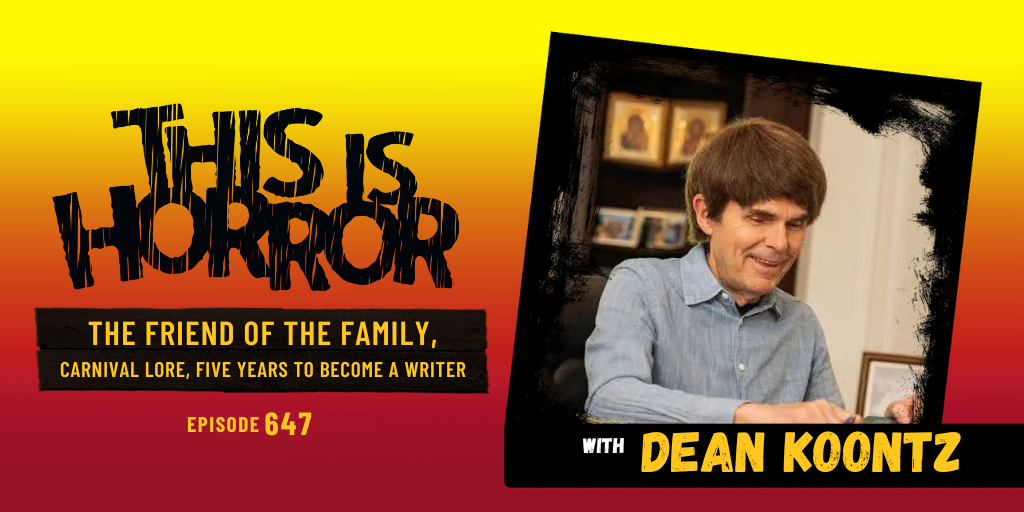
In this podcast, Dean Koontz talks about his forthcoming book, The Friend of the Family, carnival lore, being given five years to become a writer, and much more.
About Dean Koontz
Acknowledged as “America’s most popular suspense novelist” (Rolling Stone) and as one of today’s most celebrated and successful writers, Dean Ray Koontz has earned the devotion of millions of readers around the world and the praise of critics everywhere for tales of character, mystery, and adventure that strike to the core of what it means to be human. Dean, the author of many #1 New York Times bestsellers, lives in Southern California with his wife, Gerda, their golden retriever, Elsa, and the enduring spirit of their goldens, Trixie and Anna.
Timestamps
Thanks for Listening!
Help out the show:
- Support This Is Horror on Patreon
- Listen to This Is Horror Podcast on iTunes
- Listen to This Is Horror Podcast on Spotify
- Rate and review the This Is Horror Podcast on iTunes
- Share the episode on Facebook and Twitter
- Subscribe to This Is Horror podcast RSS Feed
Let us know how you enjoyed this episode:
- Write a comment below.
- Follow us and get in touch on Instagram @thisishorrorpodcast
- Subscribe and comment on YouTube @thisishorrorpodcast
- Follow us and get in touch on TikTok @thisishorrorpodcast
- Tweet us @thisishorror.
Resources
- Dean Koontz Books
- Watch the video version of This Is Horror Podcast episodes, including our conversation with Chuck Palahniuk on YouTube.
The Girl in the Video by Michael David Wilson, narrated by RJ Bayley
Listen to The Girl in the Video on Audible in the US here and in the UK here.
They’re Watching by Michael David Wilson and Bob Pastorella
Read They’re Watching by Michael David Wilson and Bob Pastorella right now or listen to the They’re Watching audiobook narrated by RJ Bayley.
Michael David Wilson 0:20
Welcome to this is horror, a podcast for readers, writers and creators. I'm Michael David Wilson and every episode alongside my co host, Bob Pastorella, I chat with the world's best writers about writing, life lessons, creativity and much more. Today, we are welcoming back Dean Koontz to talk about his forthcoming novel, the friend of the family. Dean Koontz is one of the most famous writers in the world, and he has been on this as horror several times. So I find it difficult to believe you do not know who Dean is, none the less, for those of you who are new to the show and new to Dean Koontz, here is a little bit from his bio, acknowledged by Rolling Stone as America's most popular suspense novelist and as one of today's most celebrated and successful writers. Dean Ray Koonce has earned the devotion of millions of readers around the world, and the praise of critics everywhere for tales of character, mystery and adventure that strike to the core of what it means to be human. Dean, the author of many number one New York Times bestsellers, lives in Southern California with his wife, Gerda, their golden retriever, Elsa and the enduring spirits of their Goldens, Trixie And Anna. And as I said before, his latest novel is the friend of the family, his perhaps most overtly horror novel is intensity, and the series that he might well be best known for is Odd Thomas. So if you pick up all three of those, the friend of the family, Odd Thomas and intensity, then that would serve as a really excellent introduction to Dean Koontz for any of you unfamiliar. Well, okay, before we get Dean on the show, a quick advert break.
RJ Bayley 2:53
It was as if the video had unzipped my skin, slunk inside my tapered flesh and become one with me from
Bob Pastorella 3:02
the creator of this is horror comes a new nightmare for the digital age, the girl in the video by Michael David Wilson. After a teacher receives a weirdly arousing video, his life descends into paranoia and obsession. More videos follow, each containing information no stranger could possibly know, but who's sending them and what do they want? The answers may destroy everything and everyone he loves. The girl in the video is the ring meets fatal attraction for the iPhone generation, available now in paperback, ebook and audio from the host of this is horror podcast, comes a dark thriller of obsession, paranoia and voyeurism. After relocating to a small coastal town, Brian discovers a hole that gazes into his neighbor's bedroom every night she dances and he peeps same song, same time, same wild and mesmerizing dance. But soon, Brian suspects he's not the only one watching and she's not the only one being watched. They're watching is The Wicker Man meets body double with a splash of Suspiria. Their watching by Michael David Wilson and Bob Pastorella is available from this is horror.co.uk, Amazon and wherever good books are sold.
Michael David Wilson 4:11
All right, with that said, Here it is. It is Dean Koontz on this is horror. You Dan Dean, welcome back to this is horror.
Dean Koontz 4:27
Well, thanks for having me there again. I think your show is actually misnamed. I find it a very disconcerting show, but I've never found it horrifying,
Michael David Wilson 4:38
so then we might have to rebrand to this is disconcerting, but I'm not sure that it would kind of get the readers that we want into the show. It's a much larger niche, or a much smaller niche.
Dean Koontz 4:54
Actually, I think probably, I think a large part of the world is disconcerted, almost continued. Really, but I get your point about genre, audience. So we'll stay with this. I will stay with it. I'll allow it to be stayed with
Michael David Wilson 5:09
so we are recording this at the start of the year in 2026 so I'm wondering, do you make, or have you ever made New Year's resolutions?
Dean Koontz 5:24
I just, I was just asked that, and I said that I was going to resolve, how did I put this? I was going to resolve to enter the new year with less concern about events and with the kind of goofy optimism. And I've so far failed to do that. But it's, I, unfortunately watch the news, and so it's, it's hard to be gooffully optimistic when you do,
Michael David Wilson 5:55
yeah, I mean that the news doesn't typically bring with it optimism. It's never really this is the good news. It's this is doom and gloom. These are all the bad things that have been happening in the world.
Dean Koontz 6:10
Well, of course, the media always has admitted, if it bleeds, it leads. So I think that's they, long ago, determined that more negative. It is more people are interested in it, which I don't know what that says about our species, but actually, I do know what that says, but I don't want to contemplate it.
Michael David Wilson 6:32
Yeah, yeah. And I think in terms of the kind of depravity and the morbid nature of our species that leads us quite nicely in to the friend of the family, your brand new book. And so I want to know what was the story Genesis, and what was your why behind writing this novel.
Dean Koontz 6:59
This is one of those that the character popped into my head with no story whatsoever at the start. And that happened with Odd Thomas, which ended up in eight book series. This will not I'm 80 years old, so I don't foresee eight more books related to the story, but, but when the character came to me as somebody who it's this young woman, we meet her when she's 17, and she spent her whole life since she can remember, as a very young child in a carnival freak show. The book is set in the 30s and until 1944, and it she came to me, I've always been interested in carnivals, and I was once quite interested in the concept of freak shows. I used to actually get a magazine that was published in Canada that was where people qualifying for that term to get work in what were called 10 and ones in the carnival business, 10 humanalities in each tent. They were brand advertisements in a Canadian magazine published for that purpose. And I had a subscription to it for a while. And it was rather, I guess, disconcerting to look at who some of the people were looking for that word. So that's always been in my background. And you don't know when something you fed into this strange mind of yours suddenly brings forth something. But this character came to me, and I thought about this story of somebody who at the age of 17, a life of deep humiliation, has suddenly is rescued from it, and has the opportunity to lead not only a normal life, but a normal, amazing life in a family with considerable resources. And after that, the story just sort of started shaping itself. When I delivered it, I wasn't sure what my agents and my publisher would say, but my publisher came back and just loved the book. Thought it was quote, unquote beautifully written. I don't think they're snowing me. I think they actually believe that, and as a consequence, it's that's about all I can say. The story told itself as it went, not that I didn't have to write it down, not that it wasn't as hard as it always is, but it wasn't anything I had to say. Now, what happens with this person? Just was one of those that phone.
Michael David Wilson 9:42
Yeah, once again, you have written a book that is enormously difficult to classify, but I think I would say this is perhaps your most emotional and tender book. And of course, there is horror. Within it, there's certainly horror of circumstance. There's a little bit of comedy as well. I think that is always going to occur in your books, but at its core, it is a very moving and poignant piece. It is a piece about humanity, about families, both those that we're born into, and the families that we create or seek out. So I'm wondering, how did you strike the balance with this one when you were writing such a tender book, but also getting in those moments of suspense and horror?
Dean Koontz 10:38
It's as I've often said when somebody says to me, why do you write suspense novels, and why do you write this little scary factor in them? And I I'm sure I've said to you too, because suspense is one of the key elements of human existence. We don't know what's happening to us tomorrow or an hour from now, or, in fact, right here on this program, we're at different places, but rather, so you can't attack me, but it could be a verbal attack. So I never know what's about to happen, and neither does anyone else. And that was sort of how I kept the balance. It was I did concern myself that, you know, I didn't want it to become a sentimental book in the sense that it found me in that regard, there's so much in the way of human suffering that I don't think it can go there, but it was something that concerned me. And then I don't think I told you this before, maybe I did when I was on before. My wife is my first reader, always, and she's the best and toughest critic I've ever had. So she doesn't read manuscript and then come into the office and tell me how brilliant I am, or at least that's not all that she told me, and I know how long it takes her to read a book. So I gave her this manuscript at six o'clock on a Friday morning, and figured she'd finish it by noon on Saturday. And noon came, and she didn't show up in my office, and it was one o'clock, two o'clock, three o'clock, four o'clock, and I began to sweat because I knew the book was somewhat different. And then I heard pots and pans banging around the kitchen, and I went out. She was beginning to think about preparing dinner, and I looked at her, I said, Well, what? What about the book? And she said, for the first time in all these years, I don't have a talk about it, and that didn't sound good to me. And I said, What? What is wrong with it? And she said, Well, I needed two box of Kleenexes to read this novel. And I thought, yes, that is part of the reaction I want you to have. So it turned out, we did end up talking about it. We didn't get divorced. So it's, it's yet another triumph in my career,
Michael David Wilson 13:11
although it seems that she also was exhibiting suspense by delaying giving you that reaction,
Dean Koontz 13:20
and she knows well how to create suspense, yes, yeah.
Michael David Wilson 13:25
And I mean goodness in terms of the emotional core and that reaction from your wife. I mean, as with a lot of Dean Koontz books, it seems like it might be going in one direction. You're seeing a leader being rescued by the fair child family, only to find actually expectations have been inverted, because it may well be that a leader is the one who is there to rescue them. So when did you know this would form part of the story
Dean Koontz 14:05
only as it happened? Yes, it's sort of always that way, but in this one, very much. So I don't want to give away any spoilers, but I just all I know is that, aside from just to fill in the audience here a little bit. This family that encounters her. It's the 1930 prohibition is underway, and that that people find her, a couple find are very successful. Relatively young people made their money in silent films, and we're now coming into the sound age in film just around this time, and they're looking for a new background to make a movie in, and they think of speakeasies as being. Very interesting background they haven't dealt with before. And they go to the speakeasy in San Diego that was one of the upper crust speakeasies. There were speakeasies that were very upper scale nightclubs with orchestras and novelty acts and all of that. And people showed up in tuxedos and whatnot. And this couple goes in expecting, not quite knowing what to expect, but but in part thinking it's simply this, but this carnival man who runs this 10 in one in which Elida is only the exhibits, and she's normal, from the neck up, but from the neck down, everything is very different. And he has found a secondary source of income. When the carnival goes into its off season, he moves her around to a series of very up in upscale speakeasies. And it's at one of these in San Diego, that this couple walks in and sits down expecting one thing, and when this act, opening act, this girl in this guy, they become incensed, and they go backstage afterward to confront him, and they end up buying her, and She's not quite sure what this is going to mean, but as it turns out, that means they want to take her in as another of their own children. And that's and that not done with the awful man who has done this to her, as you might expect. It's he's too villainous to let go. I had to bring him in to the story later on. But now I'm not sure I answered your question, but that won't be the first time.
Michael David Wilson 16:49
Well, I mean, as long as you give an interesting response, that's how these things go. And I mean in terms of it, taking part at a carnival, or at least to begin with, taking part in that carnival environment. Have you had a lot of experiences going to carnivores? Were there particular carnivores that came to mind, and indeed, with the villainous Captain Farnham, what kind of influences were there and inspirations on his character.
Dean Koontz 17:24
Well, I grew up across the highway from the county fairgrounds, and as I've spoken of before, I had a very difficult childhood with a violent, alcoholic father, pretty deep poverty and the carnival that came right across the highway every usually it was August and it would come for a week, and that was This colorful, different world altogether. And because I lived so close to the fairground, I knew all the ways to break into the fairground where the holes in the fence were the fairground backed up to a forest. There were all kind of places you could climb a tree and jump over the fence. So I spent the week on the Midway and hanging around and looking things, and became very fascinated with carnival. And I'm very full of Carnival lore now, a little bit of which I have used, I think, in this book, but I've written about carnivals before. I wrote a book called Twilight eyes. I did a novelization early in my career, carnival story called The Fun House. And when I was boy at a certain age, I dreamed of running away with the carnival. And in those days, you probably could have done it. Carnivals were very much still at that time, outside the normal channels of the law, the local law, but always get paid by the people in the carnival to allow the who she could she shows, be more than they would have been allowed otherwise. And many of the game shows, the game concessions were rigged so they weren't fake gambling actually probably pretty close to Las Vegas today, and so some of that had to be bought away. And so I think you probably could have gotten away with disappearing into the carnival, but I would have broken my mother's heart. So that would have never happened, and but I was fascinated with the Carnival is they were all outcasts, and I always felt of myself as an outcast. But when they got together within the carnival world, this community of outcasts were not outcasts to one another. They belonged. In this world, and they got their own traditions, their own way of doing things. And I found all that very fascinating, and it has fascinated me to this day. So I got, I'll write another novel set in the carnival, but I wanted to do one more. And I always knew, I didn't know what, but I knew that the character of Alida was going to prove to be something more than just freakish, that she was going to be something she didn't even know she was, and that is where all I knew of her, and the way it developed was always a little bit of a surprise to me, as for Captain Farnham, there's someone my father and captain is full of stories about his past and her past, but probably nothing you would ever hear from Farnham would be the truth.
Michael David Wilson 21:01
And despite that being some of your father and family history in there, there was no mention of outhouses, which, while I was looking at your blog in preparation for this, you started, I'm not even sure how you do this, but with your blog, you start talking about one thing, and then it's like so you could buy my book. And how did we even arrive here? But I was, I was very entertained to hear that your grandfather, I believe, had built two toilets outside, even nobody ever used two and this idea that like the richer you were, meant there were more toilets, even though it will become functionally less useless. I'm not sure why I've brought this up, other than you brought it up in your blog. So I don't we're going here in the conversation.
Dean Koontz 22:02
Now, first of all, let me back up and say that monthly newsletters, my publisher that I've been with now for 12 books wanted me to write. Well, actually, what they said is, we don't. Authors aren't required to write their own newsletters. We can do that for you? And I said, No, I don't want anyone else writing something that thinks and then it goes out there and everybody thinks I wrote it. I said, first of all, I think many of my readers know me well enough to identify the fake newsletter like that, and so I will write this, even though that's something of a little bit of a chore, and I've changed it as it's gone on. I made it amusing. I always said, also, I'm not a hard sell kind of guy. I wrote one that was a joke hard sell several months ago, but I said, I'm not quite sure what I'll write about, but the selling book will always come very late in the newsletter, and at some point it started to be about biography and telling little stories of family events that I find particularly amusing, which is almost everything I have said before, the stuff That was terrible to manure sometimes and that was embarrassing, or whatever, if you get enough time to pass it all was pretty funny. You just didn't recognize it at the time, and I didn't know how whatever's gone right next to I sat down, I thought, I'll start out writing about the fact we didn't have indoor plumbing till I was 11. And it was true that the outhouse my grandfather built to go along with this house was that outhouses are basically shacks that sit in the backyard and but it had two holes in the city, and I was always fascinated that, because I thought, and I say in the newsletter, what I said to my grandfather, why did you do this? Now it was true that my grandfather fancied himself a home builder, but if you'd ever seen the homes he built, you know that he was delusional. They did stand up, but that was just about all that he really required of them. He was a very sweet man. He was, just like a lot of people in my family, there was something a little off about him, and that was one of the things that he thought he could build houses. And as I say, in the thing, I think he took pride in the fact that he put two seat holes in it. And when I asked him, he said, Well, it was for emergencies, which fortunately the family. Ever had such an emergencies where we had to share the outhouse together and but it was I was very happy when we got an indoor bathroom. I was 11 years old. And prior to that, it was something you get used to, but the freezing in the winter and the spiders in the summer, we're not conducive to getting the function that you're looking for to work right. That's the best way I can say it.
Michael David Wilson 25:35
Can you confirm whether you have built a little outhouse on your property as a tribute to your grandfather.
Dean Koontz 25:43
I haven't, I haven't done that. And you know, Michael, I can think of no one else I know who would even suggest it, but you and so that's why I come back on this program.
Michael David Wilson 25:56
I did think, as the question materialized in my mind, am I really going to ask Dean Koontz this? And I know, yeah, I am. This is, you know, we get, or I say we like, I'm making Bob an accomplice in this. I get to the root of these important questions. So I'm glad everyone can rest easy, because it is a vast property that you live on. So, you know, maybe there is a secret outhouse, but you've confirmed there is not.
Dean Koontz 26:31
I suppose if I build it, I could hang his picture in it as a tribute. I could even name it after him above the door. I don't know, I'll take this under advisement with my wife, and we'll see how that goes.
Michael David Wilson 26:46
Okay, that seems like a sensible idea, and you know from past conversations, I think your wife typically reins in some of the more absurd ideas. So it's probably for the best the marriage is working out so far.
Dean Koontz 27:06
Yes, 59 years, I'm not sure I'd call them absurd ideas, as I think of her colorful but I just delivered the text for the newsletter for this month, and it tells the story of how, you know, fire that was threatening our neighborhood, I went on our roof to water it and fell off. It's quite an interesting story on its own, so you probably will not look into that, and you'll probably try to encourage me to climb back on a roof again, if I know you, but that won't work if you're having fallen off a fairly high room.
Michael David Wilson 27:46
Yeah, I imagine most people who interview you, you know normally to promote your books, don't go to the level of reading your blogs and then framing a question around it. But again, this is the treatment that you're gonna get here. And so to move back to the book, there's not a much bigger contrast than having the carnival world to then show beers and movie making. So was that part of the appeal of writing about the fair childs and having them have this kind of exuberant life,
Dean Koontz 28:28
I wanted to put her in a place so different from where she'd been that it would bring out all the best in her and and raise The stakes so high for the reader that you worry, oh, my god, she just survived 17 years of this. Now it's, is this a false promise? Is it going to slip out from under her? And there are many readers who will think of that, and that adds that suspense quality to it. Furthermore, it's the fish out of water. Thing is always an interesting thing to read in that character is, how will she negotiate this? And how will they negotiate having her in their life? That always adds a level of texture to a story like this that has always appealed to me as a reader, and then as I knew that there was something about her that was going to bring us into that sort of magical territory, because I consider this book really a book of magic or realism, as sometimes called, then I wanted To see how that would play out in the lives of other people. So it was also I felt that period of time in America was a very interesting time, the 30s to the to 19 to 4040, prohibition to. Music was changing. The movies were new, but were already changing. War was coming. War had just ended, and it added so much, many elements to think about and write about, that I felt it was a story about I could do stuff I hadn't done before, and I loved having to research so much. I mean, early in the book, somebody plucks a Kleenex out of the box box, and I had to come to a screeching halt mid sentence and say to myself with a Kleenex in 1930 and then I go to Linda and drop all this research stuff on her, and she goes online. But yes, there were 1927 but that added an element that I enjoyed. It was thinking through keeping it consistent with the time. And then that brought me to the point of thinking, Oh, I could occasionally bring in a character, a real life character here from the movie business, and have a moment with them. So I was able to bring in Groucho Marx in a couple of moments and speak of other people whom I sort of I've had a lot of experience in Hollywood, so I have had the desire to admire the Hollywood types burnt out of me forever, but I know enough about some of the ones from that period. They were rather admirable and interesting people, and grocery marks was certainly one of them. So it was fun being able to do that as well.
Bob Pastorella 31:46
I'll say that whenever I started reading it, I'm like, okay, she's going from rags to riches, but we are reading a Dean Koontz novel. So What? What? Nefarious plans do the Fairchilds have? That was my initial thought. I was like, these people are going to be devious. They're going to be worse than she's going to beg to go back into the carnival. That's what this book is going to be about. And I was wrong. I was I'm kind of glad I was wrong, because the story was not as I anticipated, and it became something that was very emotional and tender and quite quite entertaining.
Dean Koontz 32:29
Well, it's Thank you, and the that that's her first thought in the car, as she's allowed herself to be given to these people, she has a moment where she's wondering, what is their motive here, besides what seems to be? Because what seems to be seems impossible. But I realized, even though I didn't know where the story was going, is that was what a lot of people would expect, and therefore it couldn't be what really happened in the story. So I'll leave it there. I won't spoil my own story.
Bob Pastorella 33:11
It reminded me of reading accounts, and of course, seeing the film of Joseph Miike and the elephant man, and he how the doctor, you know, there's some parallels there. Alita had probably a little bit better life than Derrick had, but the humanity of both these, people, Merrick and Alita, is what the stories is ultimately about. It's about, you know, not not appearances, but what's inside your spirit and, you know, your intellect and your heart.
Dean Koontz 33:55
Yeah, I that was the intention here is because I think I've said I talked about publicly, we have worked for 35 years or more with this group called Canine Companions for Independence that provides assistance dogs for people with severe disabilities. And I can remember, years ago, I we went, I think probably 3334 years ago, when we were first working with them, and we went to a full weekend where it was all canine companions events. Then in San Diego at that time, and we met probably 200 people with severe disabilities, including children and adults, children in these big, difficult wheelchairs that are totally powered because they have very little use in their hands. And what took me, I was also head of. A writer's group at that time, and all I was hearing was complaints from the members of the organization. And we escaped, and we went to this place where all these people had these really serious problems, and I never heard from any of them, one complaint, one line of negativity about their lives. They were all geared up to make more of their lives and to do what they could to get better, and there was much laughter and Beaulieu through this weekend. Then I came home, and there were 49 complaints on my answering machine at that time from writers who are members of this group, whining about what their agents had done and what their publishers had done. And I listened to all of these with growing dismay, and when I got to the end, I said to Jerry, there's not one complaint that anyone has made here that I haven't had happen to me in my work with agents and publishers. None of this is unusual. None of this is life changing. And I quit as president of the organization because I said, Okay, I found nothing Yes. And then when I quit, I was doing the newsletter. I didn't put my out Hap stories seemed inappropriate, but I said, Look, I love you. You're all wonderful, but get a grip. Here's where I was on the weekend. Here's the kind of paper I saw, the problems we had, not one complaint. And here you are complaining about some little thing your agent has done, or some thing your publisher has done that they do all the time to everybody, and it's just the way the world works. So, you know, just don't let all these little things bother you, because you destroy your own life. Get a sense of humor about it, and just plug forward and put that in the newsletter and send it out. I have to say it, much to my dismay, I got numerous responses saying that my problem with my agent is just as bad as that person who had no legs. And I've had to say, no, actually, that's not true. Having no legs is a lot worse than having a problem with your agent. So that was, that was my time on that. So I wanted to, I thought about that often over the years, and I wanted to really write a novel about what I had seen in working with this group, and that is that it's in the dedication of the book, actually, that every life has meaning, because Every life, if lived properly, can uplift others. And that's sort of what that was attempting to do in this book. Because they uplift her, but she uplifts them. That was where the kernel, the seed of the story became the desire to write a story that way, that was about that.
Michael David Wilson 38:25
No, no, not at all. And there does seem to be a tendency, almost, that the more comfortable someone's life is, the more that they complain about just the petty and the the mundane and the things that, in the grand scheme of things, don't matter. But when you have real, you know, almost life threatening or life altering trouble, there's almost no time to complain. And you have to find the light. You have to find that little semblance of joy, because that's kind of what's keeping you going, that's kind of what's keeping you alive. And I mean that there's, there's quite a bit of that, particularly right at the start of the book, with a leader and the humiliation that she's enduring, and eventually that that hint towards suicidal ideation. Now she doesn't act upon it, but we do get a hint that in her darkest moments, that's kind of where she's going.
Dean Koontz 39:32
Yes, I would not allow her to do that, but well now I won't give anything away. Let's just say it all evolves in a way that I wasn't quite fully anticipating, but was the only way I could evolve. I want to say one thing, though, for anybody who may be squeamish on the idea of a book narrated by somebody who was human out of the amarthritic show and. She is the narrator's first person. We never dwell on what her problem, her physical problems, are. I knew that I didn't want to do that. And when we get to the end, you get just enough of an idea, but it isn't about them, and it's not necessary that you know. You just have to know that it was so severe that it made her the star of the Carnival thing. But if anybody thinks I don't want to read something like this, let me assure you I'm not going to rub your face. It's not that kind of story.
Michael David Wilson 40:39
Well, I did think, as I was reading it, it did have that Texas Chainsaw Massacre effect that it's like, actually what we're doing is we're hinting at the extremity, but when we're not revealing it. And so sometimes you've got that less is more, because in not saying what it is, then actually the human mind can come up with something even more grotesque than the actual reality.
Dean Koontz 41:06
Yes, that's, that's one of the, one of the traits of our species. We we can always go for the most grotesque, more than nature itself would come up with.
Michael David Wilson 41:17
Now, I wonder, as a dog lover, and I suspect that the fate of Raphael, and I'm trying to think, how do we how do we say this subtly, but some of the things that that happens, or something specific that happens, I imagine that might have been harder for you to write about than you know, violence or suffering towards human characters. So I mean, what do you do in those situations where you realize something unfortunate is going to befall a dog?
Dean Koontz 41:59
I just thought the implication here isn't that I must say this, but at least I'm not an animal abuser.
Michael David Wilson 42:08
Those are your words. I didn't say that.
Dean Koontz 42:13
Okay, all right. I just wanted to clarify.
Michael David Wilson 42:17
Yeah, you've clarified in every single conversation that you're not a sociopath, and I think that's a little bit too much clarification for someone who isn't. So let's let the listeners decide.
Dean Koontz 42:31
I was going to open our conversation by assuring you that I still haven't murdered anyone. But now I think it's probably not necessary to say it. And yeah, well, remember when I'm writing a scene with a dog, and it could go very south. My dog is right here, and I think her political and intelligence is higher than any scientist familiar with canines would tell us. It is the case because she's much smarter in many ways than I ever imagined. So I think she would know if what I was doing to that animal, and then our relationship would suffer. So that also guides me. But yeah, there are, there are moments when writing a novel that are harder than others, and some of them can, can be just as emotional for me as it can be for the reader.
Michael David Wilson 43:30
And talking about those difficult moments, what would you say that through writing the friend of the family, you learned about writing, or what did you learn about yourself through writing this?
Dean Koontz 43:47
I've learned this in stages, that if an idea comes to me for something, that I should write, but that I'm not sure how it's going to be received, but by agents, publishers, and ultimately, audiences. I used to spend more time dwelling on that, and I think what I learned in this one was I stopped caring. I have to feel that I'm doing what is at the moment, the thing I can do most effectively, and that I can do the best, and then go with it. And it seems odd to have taken a long life to have gotten over entirely that feeling of, oh, I don't want to disappoint people. Well, I don't want to disappoint people, but I think what I learned in this book, because it got it has received a wonderful reaction from publishers and everything. Now it still is the public to tell me whether they like it or not, but I think I finally. Got to that point of saying, you know, I should have maybe even earlier than I have stopped worrying about that and just say, Do the best you can and free yourself from all concerned about it, and the book will write more easily than it does when you're concerned too much about what people are going to think of it, because this book wrote very, very smoothly for me, as I said, using the language well is always very difficult, and you're always catching yourself in Moments of failure. But this one was never a book that I wondered if it was working, and often I do wonder whether it's working. So I gained a little extra self confidence in writing this book, I would say, and that paid off in the one that followed it. I hope it pays off in the one I'm working on now.
Michael David Wilson 46:02
Yeah, I think something that's greatly admirable is, even if you have had moments of self doubt, even if you've kind of anticipated, oh, goodness, how are people going to react to this? You've, throughout your career and throughout your life, always advocated for yourself. I mean, I think it was when you were 25 that your agent at the time said, Oh, well, I think you're going to only be a middle list orphan. I'm sure he didn't phrase it quite as bluntly as that, although maybe he did. But you said, Well, I disagree with that, and we're gonna have to part ways. And you've also had moments where publishers have tried to put you in certain genre boxes, they've tried to market you in different ways, and you know, you've rejected it, and you've always stood up for who you are and what you're writing. And so I think there's a tremendous amount that people can learn and can take away from that.
Dean Koontz 47:10
Yeah, well, thank you. And that agent, whom I remain friendly with for until he just passed away a couple of years ago, that he was that one. He said, You're trying to be more of a success than you can be. You're always going to be a middle list writer. It struck me as impossible to be 25 years old and being told what the rest of your life would be like that you had to take some risk, and he wasn't a bad person. He was actually a very sweet person. I liked him very much, but we had to part, and we stayed in touch. And he was, to his credit, he was very pleased that I went on to be more successful than he had ever thought and that he lost out on 10 or 15% of that he didn't care. He was just happy. He was a good person, but yeah, my publisher on this says in the little note she put in the front of the advanced proof, she said the book surprised. She's always used to being surprised at what I deliver, but this was sort of the last thing she expected to receive. But that's that's good in a way. Now I think when you stop surprising people, it's probably because you're dead, and I don't intend to retire until the coroner tells convinces me I'm dead. So I still have a few books in me, I think, and I hope to continue to surprise myself.
Michael David Wilson 48:53
Yeah, and another thing from kind of back in the day was, I remember you telling us that your wife essentially gave you five years to become a writer and said, right, if you can't make it in five years, then essentially you can't make it. And so you did make it, and here you are. But I'm wondering, because we haven't quite gone into the detail on this. What was it that you did during those five years, and what if you were to do it now, or what if someone were to do it now, would you advise they do because I think perhaps the climate has changed quite drastically that what you did might not necessarily be what you would recommend someone does now, if they have a five year deadline to make it as a writer,
Dean Koontz 49:49
the whole publishing world has changed so dramatically, and not for the better, it's when she. That made that offer to me, I'll support you for five years, and if you can't make it in five, you'll not make it. I wrote I made mistakes. I didn't have the confidence to immediately break out into something more ambitious. I started writing short science fiction novels, because that was mostly what I was reading as a kid around exclusively what I was reading up to a certain age, and as a consequence, that's what I started writing, and I was able to sell it, and then it wasn't making enough money, so I got into some level of panic in that situation. And so then I started writing. I had a publisher who was publishing my science fiction paperback say, you know, you ought to write these women's Gothic romances, because they really settle, and we need a whole bunch of this. And I wrote a few of those, and I watered down what I could have been doing out of kind of desperation to be sure we would stay afloat and I might be able to make those that's five years with a viable career. If I had it to go over again, I would have focused on more ambitious things earlier on and realized I was I was making the mistake of writing like Pope. Writers said, written back in the day that I would have changed, and I would have done it much differently. But on the other hand, I The struggle was something that when I saw what life would be like if I wrote only those paperback originals in strict genre formats, I realized that it took me a couple of years, but I realized this was a dead end, and I had to start upping my Game, and so I spent those years trying to learn how to do that. And when you come from a background like mine, you don't necessarily have the self confidence to say, Oh, I'm going to write the next great American novel. And as a consequence, you're always just up in your game in little increments. If somebody was trying to do what I did now, it wouldn't work. The mass market paperback is now completely gone. I just saw a news story the distribution of mass market is done. It's not going to be distributed anymore. Now that ruined the publishing business, because so many readers came in at that price point and they could afford to pay well, early on $5 early on 50 cents for a paperback, eventually was eight and $10 when I was there, but publishers were now, they say it was distributors who killed the mass market, but I had two different very major publishers tell me in very no argumentative terms, Almost gloating, that we're going to kill the mass market paperback because the price point isn't satisfying, and we're going to force people into a 1516, $17 price point by putting them all into trade paperbacks. I know that was publishing intention, and they did it, but it didn't actually work. Some people came along to buy the trade paperbacks, but many didn't, because it was too big a leap. And ebooks made up for some of that, but not nearly for all of it. And the one thing about the mass markets not to get into inside baseball kind of stuff, but one thing about the mass market paperbacks were that they were so cheap to produce that when I started out and they were selling it like 595, at My early days. And in those days, it cost 20 cents to print and ship a paper back at that time, and even by the time they had gotten up to selling for eight and $10 it was only 35 cents because processes of production had improved. And so when you're selling a 10 lover item that's costing 35% to 35 cents to print and ship, you've got a very huge margin there. And I think they all should have been happy with that. Now is the selling writer got a 15. Percent. So at the $10 price point, I got the dollar and a half they were paying, let's be generous and say 50 cents to apprenticeship. There's $2 they gave a 45% discount to most accounts. So that left out of it all about $3.03 and a half of profit, or profit prior to office expense and all that. That is amazing. When you're selling hundreds of millions of paper bucks a year, we're being sold. And it was, I think, a key mistake in that industry. So now, but what was great, I'm wondering little What was great was the investment in a new writer that they brought in and paperback wasn't that big. So if you screwed up and you wrote some books that didn't sell because you were fumbling and learning that was okay, they would buy another one, and they bring you along. But now they don't bring you along. You have a few opportunities to succeed, and if that doesn't work, you're out the door, or you have to publish forever under a pen then, or and the other downside of this, you'll see somebody in self publishes onto Kindle, and some influencer somewhere that hasn't a lot of policy or followers comes in and starts pushing the Hap heck out of this, and the book starts selling. Then New York publishers come along and buy those books that were self published and put them out with all this promotion, but don't even edit them or copy edit them. I bought some of these and been astonished to see them full of errors of syntax and grammar. And I said to my agent, what is this? And they said, Well, it's a lot easier to buy books that are already finished and selling and just repackage them different covers and reach out to an audience. Well, that's not good publishing either. So I don't know what to say to get young writers trying to come up. It's a tougher world than it was then.
Michael David Wilson 57:25
Yeah, I've seen a lot of writers get a so called lucky break from independent and self publishing being picked up by these bigger publishers. But as you say, the lucky break was only when they went viral, because some influencer or somebody put this out into their collective consciousness, and so everyone was aware of it. But if they'd have taken a chance and took in that, taken that to the publisher with kind of no real audience or sales, and they just said, No, we're not gonna take a touch, take a chance on it. So I feel in in many ways, and it is obviously speaking in generalization, so not exclusively, but a lot of publishers have become safer. They don't want to take chances, they don't want to take a risk. They're just putting out what they feel to be a guarantee or something that's along the lines of a formula that has proven itself beforehand. So it's a bit of a problem for creativity and experimentalism.
Dean Koontz 58:42
Well, let's just hope that artificial intelligence doesn't replace writers.
Michael David Wilson 58:50
I it's a big topic at the moment, and there's a lot of fear surrounding it, but I, I don't think that it will. I mean simply because what AI, by definition, lacks is that soul and that heart and that human experience. I think AI is a threat to a number of industries and to a number of jobs, but in terms of just pure creative fiction. I think what a lot of us read as a rafter is that human connection and that human experience. I think one problem I'm seeing very recently, like literally this last week or so people talking about it, is beforehand you would find somebody, perhaps you're down the pub, and there's this guy is like, Oh, I've got an idea for a story. He's like, but I don't have any time to write it. But now AI is allowing these people to put a prompt into it, and then they have a story. It's not a very good story. But then. It's, I don't know. It's creating this, this group of false writers, all these people who they believe they're a writer, but they haven't put any work into it to become a writer to begin with.
Dean Koontz 1:00:16
It's, you just said something, I said somebody I haven't interviewed not very long though, the subject AI or AGI particularly came up. And I said, for all that it might one day do and everything else, the one thing it lacks is soul. And you borrow that from the music business. Music Works if it has soul. I even think that AI could potentially be more successful in music than in producing fiction, because I've heard songs in which AI wrote music and with guidance, generated the words and can do the voice, but I think that is much more simplified than than a novel and it can't sustain. I don't believe it can stay. I may be whistling in the dark, but I don't believe it can sustain novel length in any way that would not sooner than later in the course of reading it. Alert you to the fact that some sort of stupid machine is writing this that thinks it's smarter than it is, right?
Michael David Wilson 1:01:33
And when we were talking to Chuck paulahnik, he was saying one of the things with writing fiction, one of the good points is that human error, and that's something that AI can't replicate. You know, having human error, that there's something, you know, attractive about, that there's perfection within the imperfection.
Dean Koontz 1:02:00
Yeah, it's and I just think there's two the machine can read about it, can scan. It, can scan and store enormous amounts of information. And there is a certain amount of what we might call learning involved there. But, but as to move from that to coming up with circumstances and situations that are fresh and interesting, I think is almost impossible for that kind of thinking. It's, for instance, I read this book. I mentioned it in my blogger newsletter called The award and written by Matthew Pearl, and I was sent a copy. And I just loved the book, because it's so true about the literary community, what it has to say, and it's not terribly flattering. And as a consequence, I don't think unless I have never seen anyone write about the subject of literary words and publishing quite as he did in this book. And until an AI could scan that book, it couldn't write that book, and then it can only write a different version of that book. So I don't know. We'll see. We'll unfortunately old enough that AI I may one day have an AI doctor who posts a plug on me, but I don't think that AI writer will undo my career.
Michael David Wilson 1:03:45
Oh, my goodness. I hope it doesn't get to the point where, where our lives are literally in the hands of AI like I mean medical services, the money going into them, it's not what it once was, but I really hope we're not going to outsource. Here's your AI doctor. I think I'll take my chances on this one. I'm just not going to go to that doctor.
Dean Koontz 1:04:11
I've seen that a number of doctors are using AI to explain to their patients, and I've heard where the doctor sits there and starts the computer up, and they both sit in the computer. I probably would find another doctor after that, because I think I go back to Stephen Hawking, because I'm pretty sure it was Stephen Hawking who said the reason where you've been listening for decades for other life in the universe, and don't hear any, is because at certain point, all civilizations create AI and it destroys them. So I hope he was wrong about that, but you do have to wonder,
Michael David Wilson 1:04:56
yeah, yeah, certainly. And. And I saw you recommending a course the award by Matthew pearl. And you know, not only did you recommend it, but it's the first time you have recommended a book in your newsletter. So I will certainly be picking that one up. And I mean, what an endorsement to almost break your own rule of not recommending I don't know if it was a literal rule that you had, but you've been doing the newsletter for a fair amount of time, so there has to be something good in the award for you to suddenly recommend it.
Dean Koontz 1:05:36
I was taken by surprise, but it's very hard when you've read literally 1000s of books and you've written many side of it's hard to pick up something and find something new in it. And I certainly do, and this, it's a very cheeky book, and I like that quite a lot.
Michael David Wilson 1:05:59
Well, we are coming up to the time that we have together. But something that you mentioned a number of episodes back, and I can't believe that I didn't ask anything further on it, but when you were talking about being signed by Amazon, you said that every other publisher either didn't have a marketing plan for you, or it was one or two pages, but Amazon had a 40 page marketing plan. Can you give us any insight as to what was in this marketing plan?
Dean Koontz 1:06:34
It was they really know how to use the internet and social media. And so it's not just, you know, we'll go to book Bub and or we'll go here. It's just dozens of things that they plan to do and and core interesting. It's very difficult to explain, except to say that they they go everything from a page in the New York Times Book Review to almost it, they saturate the social media platforms and and come up with clever new things to do. And of course, they have you do before them or with them, and it was sometimes it's a little more involving than I want, but on the other hand, it has worked, and it's been interesting because you you almost have to start opening yourself to The social media, even whether it's what you want to do or not, because other other ways of promoting books have slowly disappeared. There used to be lots of newspapers that reviewed fiction. They're very few now, and you used to be able to go on different television shows that would have authors on as well as Hollywood people, but that's withered away too. So it's you may say, Well, I don't want to sit around writing social media posts and I don't want to do that, but once you start doing it and I write my Instagram posts and stuff myself, it's a little challenge. It's interesting to try to write something succinct and amusing or informative. And I think in one way, I got used to it by saying in a way that sharpens your writing ability and makes you more succinct, so that there's a plus to it, but I'd have to show you the marketing plan to explain it, and I'm not going to do that.
Michael David Wilson 1:08:55
There you go. There's a NDA, perhaps, or perhaps it's just like, No, I have my limits. And yeah, you're not getting to see it. You get published by Amazon. If you want to see the marketing plan.
Dean Koontz 1:09:08
Basically it comes down to this, Michael, as much as I like you and Bob, get your own damn marketing plan.
Michael David Wilson 1:09:17
There you go. That is the sound bite. And if you could only be on one social media platform, which one would you go for? And equally, if you were recommending to new writers the social media platform for them to invest their most of their time into, which would it
Dean Koontz 1:09:41
be you're asking the wrong guy. I just write the post. I give them to them, and they do with it all what they know I have no idea. I never go online myself. Except technically, we're sort of online now by. Doing podcasts, but it's I don't, I don't surf the web, and I let Linda do all that I know myself just to being, I would just get I'm gonna be sucking to it. I'm, I'm that kind of person, and so it's why I don't gamble. It's why I only drink wine. I don't tempt myself to fall away into anything else but my nice, tight little life that I keep control of.
Michael David Wilson 1:10:34
And can you confirm if you only drink wine, as in, literally, that's your only drink, or if you meant the only outcome,
Dean Koontz 1:10:40
don't drink water. Actually,
Michael David Wilson 1:10:44
you just survive on wine.
Dean Koontz 1:10:47
I said that you bathe in water and you flush the toilet with it, so it isn't something to drink. And so I drink wine, and so does anything flavored. Flavored water, that's a whole different but water without flavoring is repellent. So now I'm telling revealing too many things about myself people will find odd, although I imagine people already find a great deal odd
Michael David Wilson 1:11:15
about me. Well, we best wrap up before I get you to divulge too many secrets. So thank you again for a wonderful conversation and for writing a remarkable book that I really think is going to appeal to so many readers, both within horror and genre and beyond
Dean Koontz 1:11:40
we will see. And I'm not intending any self harm if it doesn't work, and I'm sure that
Michael David Wilson 1:11:51
Well, I mean, after the allusions to suicidal ideation in the book, this is a massive relief for you to confirm after one hour that you won't personally be indulging in such behaviors. Wanted you to sleep well, yeah, I appreciate that. Well, do you have any final thoughts to leave our listeners and viewers with?
Dean Koontz 1:12:16
At my age, final thoughts is too ominous phrase. So I would just say, be happy. Don't worry, have a good life.
Michael David Wilson 1:12:30
Well as always. Thank you so much for listening to this is horror podcast with Dean Koontz. Join us again next time when we will be chatting to clay McLeod Chapman, after he recently won novella of the year in the this is horror awards, if you would like to get that conversation with clay and every other episode ahead of the crowd, please do support us on patreon.com, forward slash this as horror. You'll also have the opportunity to submit questions to each and every guest and listen to and watch bonus Patreon episodes. Now I've been doing this as horror podcast for almost 13 years now, and this is a make or break year for me as I turn 40 years old, and every career decision that I've made up to this point, every job that I've taken has been to facilitate my writing and this podcast. By the end of 2026 I want to be writing and podcasting full time to show myself and my family that my belief in myself and my commitment to the creative life has been worth it. So this year, more than ever, I am looking for that big payoff, and believe you, me, I am doing everything I can to get there as a writer and a podcaster, but if you want to support me and help increase the chances of making this a reality. The best way to do so is unquestionably, to become a patron, patreon.com, forward slash This is horror. So vote for horror fiction. Vote for this is horror and become a patron. Okay, before I wrap up a quick advert break
Bob Pastorella 1:14:28
from the host of this is horror podcast, comes a dark driller of obsession, paranoia and voyeurism. After relocating to a small coastal town, Brian discovers a hole that gazes into his neighbor's bedroom every night, she dances and he peeps, same song, same time, same wild and mesmerizing dance. But soon, Brian suspects he's not the only one watching and she's not the only one being watched. Their watching is The Wicker Man meets body double with a splash of Suspiria they're watching by Michael David Wilson and Bob Pastorella. Is available from this is horror.co.uk, Amazon and wherever good books are sold.
RJ Bayley 1:15:06
It was as if the video had unzipped my skin, slunk inside my tapered flesh and become one with me.
Bob Pastorella 1:15:15
From the creator of this is horror, comes a new nightmare for the digital age. The girl in the video, by Michael David Wilson, after a teacher receives a weirdly arousing video, his life descends into paranoia and obsession. More videos follow, each containing information no stranger could possibly know, but who's sending them and what do they want? The answers may destroy everything and everyone he loves. The girl in the video is the ring meets fatal attraction from iPhone generation, available now in paperback, ebook and audio.
Michael David Wilson 1:15:45
Now I spoke about the Patreon before the advert break. But another area of this is horror I've been growing is the video content, particularly those short video clips on Instagram. Now the this is horror. Instagram is our fastest growing social media account. In the last 28 days alone, we have gained over 400 followers and had almost 100,000 views. My aim is for our Instagram to be our biggest social media account by the end of the year, and despite that meaning that we would have to grow it by another almost 7000 followers, because the Instagram has been neglected for a number of years, I think we're going to make it happen, if you want to see what all the fuss is about and why we've nearly had over 100,000 views in the last month. Remarkable. Really. Head on over to Instagram, at this is horror podcast, if you like what you see, give us a follow and enjoy all those great inspirational video clips and help up your own writing game, all right. Well, that does it for another episode of This is horror. So until next time with the always excellent, always entertaining and always generous of spirit and time. Clay, McLeod, yap man, take care of yourselves. Be good to one another. Read horror, keep on writing and have a Great, great day.