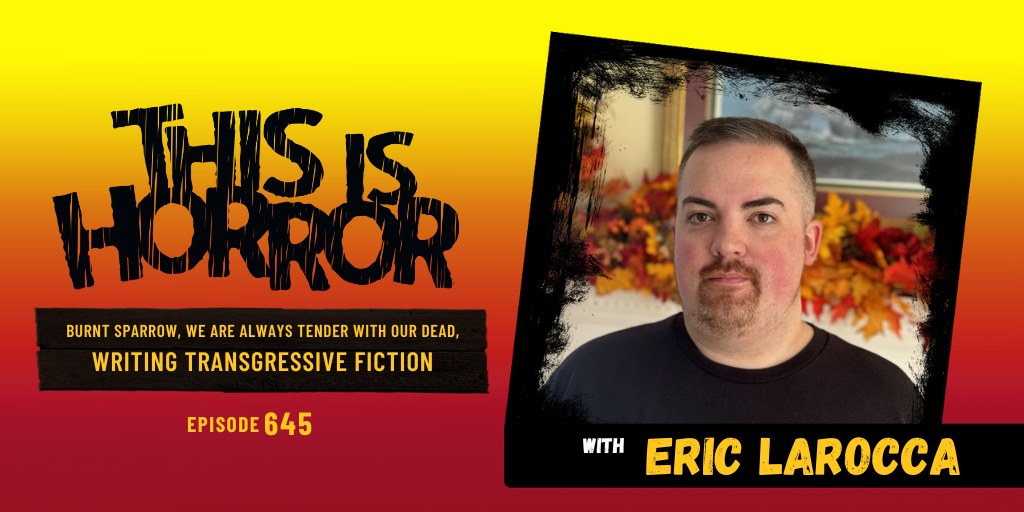
In this podcast, Eric LaRocca talks about Burnt Sparrow, We Are Always Tender with Our Dead, writing messed up transgressive fiction, and much more.
About Eric LaRocca
Eric LaRocca is a 2x Bram Stoker Award finalist and Splatterpunk Award winner. Named by Esquire as one of the “Writers Shaping Horror’s Next Golden Age” and praised by Locus as “one of the strongest and most unique voices in contemporary horror fiction,” LaRocca’s notable works include Things Have Gotten Worse Since We Last Spoke, Everything the Darkness Eats, The Trees Grew Because I Bled There: Collected Stories, and You’ve Lost a Lot of Blood. His latest novels are At Dark, I Become Loathsome, which has already been optioned for film by The Walking Dead star Norman Reedus, and Burnt Sparrow – We Are Always Tender with Our Dead.
Timestamps
Thanks for Listening!
Help out the show:
- Support This Is Horror on Patreon
- Listen to This Is Horror Podcast on iTunes
- Listen to This Is Horror Podcast on Spotify
- Rate and review the This Is Horror Podcast on iTunes
- Share the episode on Facebook and Twitter
- Subscribe to This Is Horror podcast RSS Feed
Let us know how you enjoyed this episode:
- Leave us a message on SpeakPipe.
- Write a comment below.
- Tweet us @thisishorror.
Resources
- Eric LaRocca Books
- Watch the video version of This Is Horror Podcast episodes, including our conversation with Chuck Palahniuk on YouTube.
The Girl in the Video by Michael David Wilson, narrated by RJ Bayley
Listen to The Girl in the Video on Audible in the US here and in the UK here.
They’re Watching by Michael David Wilson and Bob Pastorella
Read They’re Watching by Michael David Wilson and Bob Pastorella right now or listen to the They’re Watching audiobook narrated by RJ Bayley.
Michael David Wilson 0:20
Welcome to This is horror, a podcast for readers, writers and creators. I'm Michael David Wilson, and every episode I chat with the world's best writers about writing, life lessons, creativity and much more, today is the second part of my conversation with Eric larocker, in which we talk about His latest book, The first in the burnt Sparrow trilogy. We are always tender with our dead. Now, for those of you who are unfamiliar with Eric, His notable works include, things have gotten worse since we last spoke, everything the darkness eats the trees grew because I bled there, and you've lost a lot of blood. And his 2025, novels are at dark, I become loathsome, which has already been optioned for film. But a walking dead star Norman read us and burnt Sparrow, we are always tender with our dead, which forms the bulk of today's conversation. So before I get Eric on the show, a quick advert break.
RJ Bayley 1:51
It was as if the video had unzipped my skin, slunk inside my tapered flesh and become one with me.
Bob Pastorella 1:58
From the creator of this is horror, comes a new nightmare for the digital age. The girl in the video by Michael David Wilson. After a teacher receives a weirdly arousing video, his life descends into paranoia and obsession. More videos follow, each containing information no stranger could possibly know, but who's sending them and what do they want? The answers may destroy everything and everyone he loves. The girl in the video is the ring meets fatal attraction for the iPhone generation, available now in paperback, ebook and audio from the host of this is horror podcast, comes a dark thriller of obsession, paranoia and voyeurism. After relocating to a small coastal town, Brian discovers a hole that gazes into his neighbor's bedroom every night she dances and he peeps same song, same time, same wild and mesmerizing dance. But soon Brian suspects he's not the only one watching and she's not the only one being watched. They're watching is The Wicker Man meets body double with a splash of Suspiria. They're watching by Michael David Wilson and Bob Pastorella is available from this is horror.co.uk, Amazon and wherever good books are sold. Okay?
Michael David Wilson 3:10
With that said, Here it is. It is Eric La Rocca on this is horror.
So we were talking before about releasing this as free separate books, but obviously it's a continuous story. I'm wondering though, as it's being released as free books, and some people, for whatever reason they like to read out of order. Was that ever a consideration? Do you try to make book two and book three something that could be read as a standalone or could be enjoyed in that mode? Or do you not consider that at all? And you're like, look, this is a series. Why would you do that?
Eric LaRocca 4:07
Yeah, I mean, people, readers, are going to approach this however they're going to approach it. And I respect whatever choice they make, how they however they want to engage with this kind of art. That being said, I would obviously prefer them to read the books in order, one book one, Book Two, Book Three. That being said. I mean, there are people that will probably read book one, they might not come back for book two. And then there are people that will probably like come in to the series A bit like late and may they might even mistakenly buy Book Two without having read book one, personally, the way I've structured it, the way I've like built this, this narrative. From my vantage point, I feel like any book of the series could be enjoyed as an individual. Installment. So without getting into too much of like spoiler territory, Book Two takes place 10 years later after the events that occur in 2003 and 2004 in the first book. And then Book Three takes place 10 years on from the second book. So it's not like we're going directly from one event in one book to the other. There is, like, a lot of space between these narratives, and there's a lot of like, breathing room. So that being said, I feel like if someone were not familiar with the first book. If they did pick up the second book, I feel like they would absolutely be able to kind of glean things that occurred in the first book from reading what I've created in this in the second installment. And there might be some folks out there who maybe are hesitant to read the first book and the second book until the third book comes out, and maybe they want to read all together the series, like, as just this one giant, mammoth book. And I respect that too. I'm really excited, just like switching topics a little bit like, just because I'm really excited, I saw the cover art for Book Two the other day, and it looks so stunning, and it really captures the vibe of the second book, obviously, so so well, and really kind of leans into that, like Almost Edward Gorey type, like esthetic that the first book cover had, and just plays with like similar like shapes and patterns and colors, and it's just really striking. So I'm really, really excited about that. I'm excited for the whole series to be out so that, you know, all of the covers and all of like, everything just look looks so cohesive. Because I feel like one of the big things is, like, one of the big criticisms of the first book is, like, none of this makes sense, like none of it, like, kind of is tying together yet. And I just, I get that, I understand the frustration, but I also like, Y'all need to just let me cook, and like, let me create. And, you know, let me do my thing. And I promise it will be worth it will be well worth the wait once the entire series, like, once everything comes together.
Michael David Wilson 7:37
So I wonder, in fact, with you saying that, you know, for some people, it's not quite making sense, or they're feeling frustration. Was that another motivator, or at least another bonus in including nested stories within the story? Yeah.
Eric LaRocca 7:57
I mean, absolutely. I really wanted this book to, like, bewilder people. I wanted it to be perplexing and maybe even, like, a little off putting, I mean, because I'm discussing really unpleasant, unsavory sort of subjects. So I wanted it to be all of those things. I wanted it to be something that, like, maybe you recoil a little bit when you first encounter it, maybe you kind of wince when you think about like picking it back up. That being said, the stories that are nested inside the main narrative, some of them do come back in later installments, and there's a reason that they're in there. I mean, especially the one that Rupert's mother tells him over the tape recorder. I mean, that story is kind of like the heart and soul of the whole series, if I'm being perfectly honest, without getting into too spoilery territory, you know, the whole book is really about thresholds and how life is like a series of thresholds, where once you cross over, once you cross the line and do something, step over into this other, you know, plane of whatever existence, whatever you want to call it, there's no going back. There's no going back from some of the things that people do in this town and these books. So the book is really about, like, limits. And what are your limits? What are you capable of doing? What are you What is in your heart to motivate you? What's a threshold that maybe you wouldn't cross, but maybe you would if you were in like certain circumstances. I really wanted to like hammer home the the notion of like thresholds and how how fundamental they are to like humanity and especially like transgressive fiction. I. Like, transgressive fiction is really about crossing thresholds and going beyond the limits of what is like acceptable, but in a weird way, when we go beyond those limits, and when we, like, take readers along with us for the journey, in some way, in some like perverted way, we kind of like mutate the line of like respectability, of how we perceive certain things. Like Samuel R Delany said that about transgressive fiction, especially like it moves the line of respectability. He wrote a really controversial book called hog many, many years ago, and he argued that transgressive fiction, kind of like puts people, moves, moves the needle when it comes to, like, what is acceptable, what is permissible in, like, printed fiction, you know, if you're willing to, if you're willing to accept this, maybe you can go a little further and then go further from there, and then go further from there. So it's really fascinating to listen to him, and I definitely agree with with what he's saying.
Michael David Wilson 11:22
I said at the start that this may be your most taboo of all your books, and I think it's almost as if with each release, you do try to push that threshold a little bit further. So it's not even just within this single book, but this is kind of the trajectory of your career. Now, Titan books are not known for releasing this type of fiction. I mean, they they release phenomenal fiction. They always release very good and thoughtful stories. But in terms of transgressive fiction that pushes taboo, that smashes through boundaries. I mean, we obviously, we mentioned the brothers. We've got themes of imprisonment. We've got a Christmas Day Massacre. Forbidden Love is peppered throughout not only this book, but the vast majority of what it is you do. Was there any pushback I mean it. It almost seems crazy for an editor to push back against a transgressive author being transgressive, but at the same time, you're pushing pretty hard against these limits. So I mean, were there any things where the editors were like, This is too much, we need to tone it down. As I'm saying that I'm I'm reminded of in the acknowledgements, you mentioned a couple of authors, if I'm getting it right, I think it might have been Rachel Harrison and clay McLeod Chapman who actually encouraged you to go further. So I want to talk about everything within that area, the areas of knowing when to go further, when to perhaps, reign it in, how the editors felt, how clay and Rachel felt and how you felt,
Eric LaRocca 13:33
yeah, absolutely. I mean, the editing process for the first book in the trilogy was seamless, but in a in a way, it was a little bit fraught, because there were elements that were pushing those boundaries and breaking taboos and pushing past certain thresholds. So there's one scene in particular in the book that my editor, or both of my editors, rather, because Kathe and George were working on the first book together, they really were quite hesitant about one scene in particular, and I don't want to spoil it for anyone, but it's probably the scene you can imagine involving the bathtub. And they were really hesitant about that scene, and they really wanted to make it more like implied as opposed to so explicit that being said, I read their notes, and I thought about it for a little while, and it's so funny, you brought up Jack Ketchum earlier because I referenced jack in Jack Ketchum Is work in my letter to them, when I responded about how I wanted to keep the scene as is, and I wanted this graphic brutality on full display because of books that inspired me, like off season, like the girl next door and. Hmm, and it's so funny because a very prominent YouTube reviewer that I really appreciate and love watching his material thought that the book burnt Sparrow, Book One reminded him so much of the girl next door and the lottery by Shirley Jackson, he was like, it's like a combo of both of those those stories. But that being said, you know, I approached my editor, I said, I really want to keep the brutality, the carnage, the unpleasantness, on full display. And I kind of laid out my case and how I wanted to approach it. And there were things that I did pull away from a little bit like, you know, some things that I did accentuate. I don't want to get into too spoiler territory, but there were certain compromises that I made that in that scene that are now in the final book that I felt comfortable making those compromises as long as I could keep like the emphasis and the heart and soul of why I wanted that scene to remain in there. And it's such an important scene in the book of what Rupert witnesses happening in his own home. So it was, it was difficult to convince them at first, but once I once I kind of laid out my my argument and articulated my, my thoughts eloquently, as eloquently as I could, they agreed that it was the best thing to keep the scene in and to maybe take out, like a few little few words here and there, a few sentences, but, yeah, the editing, the editing process was relatively easy, despite that one little blip, but it really was like Rachel and clay, who read early drafts of the book and really encouraged me to be, like, more unhinged and kind of lean into my my strengths as a writer, which is writing about human cruelty and human barbarity. And I think that's what's really important, is to like, have people in your corner that are not necessarily yes men, like I don't consider Rachel and clay to be like yes men, but they know what my strengths are as a writer. They know what brings me joy when I'm creating and like a story, and they want to see me flourish, and they want to see me thrive. So it was, it was, you know, such a special honor to have them read early, early copies of the book and give me their their honest feedback. And it was helpful having that sort of feedback go into my editor and say, Well, you know, this is what Rachel and clay thought of this scene. It's funny because there were elements in the second book that I submitted, like a draft. I submitted a draft a while ago, and obviously we don't have to talk too in depth about this, because I'm sure, like I said, I'll be back for the second book. But there were elements in the second book that were just like, too graphic and too obscene to be published, and I definitely had to, like, scale back and rethink how I wanted to present the story. So I find myself kind of going into, like a certain direction as I keep going into as I keep moving forward in the trilogy and in the series of books, I find myself going to like darker and more unpleasant places. And I find Kathe and George kind of pulling me out of that, not in a bad way, but in a way of, like, once you have a character commit a certain act and do a certain thing, you lose all sympathy for them. And I don't necessarily need my characters to be sympathetic, so maybe sympathy is the right isn't the right word, but you lose like all interest in reading about this character if they commit something so egregious. So that's really what I care about when I'm writing fiction, like I want the character to be compelling. I don't care if he's he or she is likable. I really, I don't really care about whether or not like a reader, likes a character, because most people are just like insufferable anyway. So I feel like characters, you know, a flawed character is more compelling and more interesting to me. Me than someone who has everything and has their whole life together and is like a decent, upstanding person. I'm I'm much more interested in, like flawed, maybe even like a little problematic characters. I mean, I grew up reading theater plays written by like Tennessee Williams and Edward Albee. I mean, these are like very, very flawed characters. I mean, Blanche in A Streetcar Named Desire is, for all intents and purposes, a pedophile. You know, she's not a good moral doesn't really have a good moral center in her, and that play is like so beloved and so respected and cherished, so all that to say, I I found the editing process for this book in particular we are always tender with our Dead. It was a rewarding process, but it was like, an arduous process. In a lot of ways. It was easy to navigate, but it did. It did take a little bit to, like, get it right. And the second book has, like, the same sort of, the same sort of, not issues, but the same sort of process has happened with going back and forth. Like, is this too much? Is it crossing a line? And you explained it before, like, you know, Titan really isn't known for putting out deeply unapologetically transgressive work. They're more, I feel like they're more lately. They're more interested in publishing, like Gothic sort of fiction. They're really interested in in like, obviously queer voices, especially marginalized voices. But I see a lot of like Gothic, overtly gothic fiction coming out from them. So it's interesting to to be one of the the few authors in their and on their roster that's like publishing extreme, transgressive sort of queer fiction, yeah.
Michael David Wilson 22:20
And I think it's interesting to hear that perhaps while writing book one that you did hold back a little bit particularly knowing with you know, the book that you put out with clash everything the darkness eats, that you had a moment where you regretted not going far enough, and then you re released the version that was truer to what you wanted to achieve. So, I mean, I'm wondering, and it might even be impossible to know, really, but can you pinpoint why it was that you initially held back. I mean, have we kind of answered the question, is it because Titans simply are not known for this, and so there was reluctance on that part, until they gave you the permission to be unapologetically you?
Eric LaRocca 23:19
I think because it was the first book in what would be a series, I found myself second guessing myself quite a bit, and I didn't want to go right out of the gate with all of this, like, depravity and brutality and everything so explicit, and then I didn't want to, like, start at like, 11 and have nowhere to go from there, even though, like, a lot of the material I cover in this book, like you've said, like, it's very taboo, and it's very much like some of the most, like, unpleasant material I've written about In my in my career so far that being said, like I didn't want to start at like 100 and have nowhere to like progress to. So I did find myself like easing back and not not going as full throttle as maybe I wanted to initially. And I think that served me well a little bit with this first book, because I probably, knowing me, I probably could have gone, like, even further. And that says a lot, because I feel like the book does go go to some very unsavory places and just really awful, awful places. But that leads me to, like, the second book, which went completely off the rails with just like the level of like depravity and horribleness that I was writing about, to the point where it was like the editors coming to me and saying, like, we really need to, like, rein this in, because people are going to lose all interest in. In this series, if you have a character doing one of like, doing these acts to another character, and it becomes like a it becomes like an interesting dance, like between editor and author. And you know, what is a line that you can cross? What can't you cross? I don't know. I think I do second guess myself quite a bit when it comes to, like, putting out this sort of transgressive material, because in a lot of ways, like I started my writing career in the indie space, where we're not thinking much about like Barnes and Noble and water stones. Are they going to stock this book? But now I'm thinking about like the bigger corporations. And I'm thinking about like Penguin, Random House, them distributing the book. I'm thinking about with retch, Simon and Schuster distributing the book. And I don't want to say that it's stifled my creativity when it comes to like writing disturbing, transgressive material, but it has made me be more reflective and had it's made me be more thoughtful about what I write, about how I convey certain ideas, certain things, and I ask myself, like, Is this necessary? Is this totally necessary for what I want to articulate in this scene, in this story? It's, it's kind of, it's made me slow down my my writing process, and really forced me to kind of ask myself, how, how do I want to convey this, and how do I want others to perceive the story that I'm trying to tell?
Michael David Wilson 26:57
And for those who really enjoy just the utter fearlessness and the extremity. I mean, throughout this conversation, you have been really previewing and psyching people up for Book Two, because it's like, Look, if you think Book One is extreme, you ain't seen nothing yet. So I'm very excited to see where you go, and then to, you know, having had this conversation to as I'm reading, kind of guess where are the places that you initially went forever and had to have to kind of reign it in.
Eric LaRocca 27:39
Yeah, that first draft of the second book was it's, it'll never see the light of day, just because it was so much. And I was thinking about it the other day, like my editors were totally right. Like, once you have a character commit a certain act, I mean, it's the most unforgivable act a person can do you. I mean, the listeners can probably imagine what I'm referencing, what I'm talking about. And there are many things to pick from, but it's one thing in particular that I that I was writing about. You just you can't come back from that, and you can't Hap, you can't expect a reader to really care or be interested in in a certain character after they've committed something so just vile. And it's a it's a delicate balance between shocking and then, like, it's a delicate balance between, like, challenging a reader and just like completely and utterly, like obliterating them and like violating them in a weird, weird way. Um, it's, it's definitely a it's, it's difficult to write this kind of material and have it resonate with people and but do so like in a in an effective way, but also like cater to the the larger corporations that are like, stocking the book in the bookstores like it's Hap it's made me like restructure My whole thinking of how I approach my art, which I don't know it's, on one hand, like maybe it is a detriment, but on the other hand, like, this is my livelihood now, and this is how I make a living. So I definitely don't want people to think I'm like, a sellout or anything, because I am writing like very raw and transgressive fiction. I think, I think I am at least but I think it's important. I think, honestly, when I do, when I reflect on it, I do think it's important to have people in your corner that aren't just yesing you to death, and aren't just saying like, this is. Amazing, put it out, see how people react to it, shock people, challenge people you know, violate, you know, your readers. And with this kind of depraved material, I think it's an it's important to have editors in your corner who do ask you to rein it in and to to cut back on some of the more extravagantly grotesque elements in the in the story, I think maybe it makes you like a little bit more marketable. I think maybe that's my problem. Is just I'm not writing like very marketable fiction. And it's just, it's a it's a point when it's like, there's friction between the idea of like art and like commerce and putting out material that, like you're expecting people to actually buy. I think the two can coexist, but it is like, it's difficult to to navigate that dichotomy, you know,
Michael David Wilson 31:08
yeah, I mean, this is a conversation that we've had before, and this is a topic that I think about an awful lot. You know, art versus commerce. And you know, for for me at the moment, because, you know, the the Commerce on a mainstream level is not quite there yet. I think when, when you're not at that level in terms of like massive publishers, then you might as well just 100% commit to the art and to your authenticity, because I think that's probably how you initially find the audience. Then when you've got the big marketing forces, then you can look at right, what's the balance to have both both of these coexist to be completely authentic, but almost market what should be the unmarketable. But I guess my fear and from watching however people kind of approach you, I think if you start to rein it in before you've got the commerce, you might never get the commerce, because the way that you will be noticed and respected and get your audience is through being authentically yourself, you know to to begin with, which, of course, is not to say that You're not then not authentically yourself. It's just a different mode. But if you're if you're self censoring before you've got the big publisher or you've got the agent or the marketer, well now you're second guessing. So it's like you actually need this other person to tell you you can't be the one inventing, someone telling you who doesn't exist, right?
Eric LaRocca 33:04
Yeah, I mean, it's, it's like I said, it's difficult to navigate that, but I think, I don't know it's, I think it's important for authors to obviously be authentic, and because readers can tell when you're you're phoning something in, or when you're not being completely you if you are in the indie space and you're not, you know, with a big publisher, I feel like that's the perfect opportunity to really go hard and be totally who you are. And then once you get the bigger publisher, you're able to like, refine it more. You're able to like distill your vision. You're able to edit to hopefully self edit yourself, and reach a point where you're creating art, but you're also like shaking hands with that, that idea of like, commerce, art and commerce, existing together. And I shouldn't. I shouldn't say it like I feel like I'm not creating authentic. I feel like this is coming across like, I think I'm not being authentic to myself anymore, which I don't believe that at all like I think burnt Sparrow Book One is very much rooted in my soul, and it's the book that I wanted to write. I think what happens is so much of my short fiction was obviously very depraved and debauched, but when I started graduating to larger like more lengthier works, the editing process became different, because I was already such, like a master of working on short fiction and short novellas, the editing like working with. Editors was so easy because there wasn't that much work to be done on the projects anyway. But now that I'm working on like 70,000 plus word novels, the editing like there's more to edit, there's more to do, there's a much bigger conversation to be had. So I think it just, I don't know it's, it's, it's, I'm glad, I'm glad that I put this book out the way that I did. Because honestly, I feel like the changes, the edits that I made, the everything I did to like, make it the best book that I could. I feel like Kathe and George did everything they could to really help me and to honor the vision. And same for Book Two and what eventually will be Book Three. I'm sure the same will happen with Book Three. It just, it's a process, like it's such a process. And once you have, like a bigger publisher, it becomes you have to consider other variables. It's not just you and like one person running like a micro press in wherever it's you. And then you have, like a whole marketing, marketing team. You have, like publicity to think about. You have a sales department to think about, and there are just so many more variables at play. So it's a much more collaborative process. It's not just me sitting in my room writing and then going on Ingram Spark and releasing the book as a self published book, which is totally valid. I think, you know, self publishing is so valid and so important, but it's just a different process than than self publishing you don't have, you know, there's, there's other things to consider when you're working with, like a larger publisher, but that being said, you do get more support and more you just, you just get a different machine working on the book than you do with, like a smaller indie press, or even like self publishing. When you're self publishing or working with like a small press, it's like you're doing everything yourself, pretty much so when a big publisher takes a risk on you and and gives you an advance and wants to send you on tour and do events for you, like you really do have to collaborate with them and be somewhat agreeable to the changes they suggest.
Michael David Wilson 37:42
And as you know by now, I mean, at this is horror, we're very interested in writing process and story mechanics. So I mean, I'm wondering, pre draft one, what did the planning process look like, and how much did you have mapped out before you started writing? And I mean, this is a unique situation, because normally I'd be talking about, you know, the specific book, but I know, actually, you know, you had three books. This was one volume, and now it's been split into three. So how meticulously was this planned going in and kind of linked to that? I mean, when you have the moments of depravity and transgression, for one of better phrasing, how much of that is planned out and how much is kind of intuitive in the moment creation,
Eric LaRocca 38:48
I'm glad you said intuitive, because I feel like a lot of my artistic process is a lot of like intuition. And I know like one of my favorite filmmakers was David Lynch, and he operated a lot with intuition. I remember watching, like, a lot of interviews with him, where he was talking about, like, an artist's intuition is their greatest gift, their greatest strength, because it's like that sort of feeling of knowing what's going to work and what's not going to work. And I feel like I kind of operate with that same I'm not saying I'm like on David Lynch's level, but I definitely operate with that same sort of thinking like it is intuition based, and it is like a vibe, an esthetic, whatever I Want it to be. It's sitting down and like curating those moments and creating them and also honoring the way that they like come out of you, the way they like pour out of you. You know, I'm a very I'm a very quick writer, and for me, like. Books really do, just like, in a lot of ways, when, when I'm cooking, when I'm really cooking well, like they pour out of me. A draft is pretty quick, like a first draft is pretty, pretty simple for me to, like, write, but then it comes back to like editing and like revision, rewriting, like with my editors, but so much of that first draft is intuition based, and it is like, what's the vibe of the scene, what's going to work on the page, what is a reader going to like, expect, what's going to surprise them. What's going to shock them? That's what's exciting to me as like a creator, as an artist, is creating and like curating those really palpable, rich moments. So starting the series, beginning with this first book, I had, obviously, everything mapped out. I had a full outline. I had a full like proposal that I sent to Titan that I still have somewhere, like on my hard drive of my computer. But because of all of the kind of detours I took along the way, and especially the detours I took in Book Two, and how things sort of threaded together. I mean, the proposal I sent, the outline I worked on, is very different from what is going to be published, and I think it's important to have that outline. I think it's important to have that proposal in written form. So like, you have a compass, you know where you want to go, but you can go off trail, and you can go off path if you if you want to, if you need to. And I needed to like, I felt like I really desperately needed to just go off into like uncharted territory and see what I could find, and I could always come back to the path if I really wanted to, because I had that blueprint with me all along. But I feel like the outline, like almost gives you the confidence, at least it gives me the confidence to be intuitive and to have those organic moments of like, well, what if I did this instead? What if I went down this path instead? It just gives me more of those opportunities to like, surprise myself, which is so important, I feel like you know when the when you're you're writing something, and it's just, like, very formulaic, and it's just like you're going through the motions. It's just not exciting for you as an author, and it's definitely not going to be exciting for you as a for the reader. But when you're able to, like, surprise yourself and take a change in the direction of whatever, whatever narrative you're telling, and you surprise yourself, you shock your system. I feel like that's when you're that's when you're like, really cooking with gas. I feel like that's when you're like, really leaning into, like, your storytelling, like your chops, you know, like what you're capable of doing, what you're capable of of, how you're able to, like perform. Because all of this really is like a performance you know, writing really is like a kind of performance art, and it can be unexpected and it can be messy and, like, problematic, but for me, it's really important to have that blueprint early on, so that way I just have, like, it to kind of clutch if I take a turn and it's the wrong Turn and I'm met with like a dead end. It's important for me to have those that back up plan, just in case. But like I said, the proposal, the outline for this series, is so vastly different than what is going to be published, and I'm really glad that it's different, because it's so much better, I think.
Michael David Wilson 44:24
And it's an interesting situation to be in, because you presumably sold the book, the free books on the basis of the proposal, but then what you turned in is vastly different. Now, I believe that in the publishing and the fiction book world that there is certainly a lot more flexibility than, let's say, in filmmaking. I think if you had your treatment and then the script was vastly different, there could be a problem. Um, but what? What was the response from Titan? You know, you you've sold it on the proposal, then you've turned something in. It's different. Was there any concern or or comment, or because the vision was better realized? Was it just, well, this is a great story.
Eric LaRocca 45:24
Yeah, it definitely was like, I think it maybe was surprising for my editors when they got the first draft of, like, the first book and then the second book, especially because it really deviated in the second book. But they were totally game, and they were so, like, appreciative and supportive of the changes, the edits that I made to the story, the actual narrative. And I think that's what it comes down to, is like, if you're telling a compelling, dynamic narrative, you can kind of get away with really anything. And I think I've built like, a level of trust, and, you know, closeness with my editors at Titan that they really do trust me, and they do think like, okay, Eric's like, we know Eric is good for this. Like, we know he's going to deliver something that's going to be like, of quality. We know it's going to be interesting. It's definitely going to be like, depraved and weird and messed up. So yeah, there was never any like, there was never any pushback on like, Oh, this is so different than the outline. There was more pushback on, like, certain scenes and certain acts performed by certain characters. And just like, do we really need to go there? And also, they made valid points where it's like, if you start like I said before, if you start at like 11, you have nowhere else to go. It's just impossible for you to keep momentum building and building and building. If you start at the utmost depraved thing you can think of, it's important to have the pressure building slowly, and I think I laid the groundwork for at least, I hope I did in the in the first book of this, of this trilogy.
Michael David Wilson 47:26
And I believe that you've said before that your boyfriend, Ali, reads these books. He reads all of your books. Firstly, is that right? Yes. Okay, so I'm wondering, I mean, as your career has perhaps stretched into further and further depths of depravity, I mean, what kind of initial reaction are you getting from Ali and I wonder, just purely as a curiosity and out of fun, which book or which story is Ali's favorite?
Eric LaRocca 48:04
Oh, that's a good question. You know, I'm not sure what his favorite is. I think he really liked. I honestly think he really liked we were always tender with our dead the one that we're talking about. He really did like it. He really liked at dark eye become loathsome. He thought that was like, very depressing, though, and very bleak, which it is. And so, as we were always tender with our dead, he read wretch recently, and really loved that. Yeah, it's difficult for him because he's not really interested in horror. And, uh, he finds a lot of like, horror films that I watch, that I make him watch. Uh, he finds it. He finds them, like, sad in a lot of ways, like, he finds them like, um, like, people hurting one another. He gets really, like, emotional about that. And it's not that he can't separate, that it's fiction. It's just It affects him differently. So that, with that in mind, like I do try to watch a lot of the films that I like to watch, like, when he's at work, or when he's like, out of the house, just because, like, I don't want to like, upset him too much. But it's interesting, because my work, I feel like, has gotten darker over the years, and like more nihilistic and more like, just bleaker. It's gotten so much more bleak. And it's so fascinating, because my like, private life has gotten so much more like brighter and so much more like lovelier and more wonderful as we've, like, navigated our relationship and live together now in Boston. Austin and just enjoy each other's company and have like, really quiet days together and spend our our mornings or evenings, just like reading our separate books or watching, you know, movies that we both agree on, or watching TV shows that we both like. It's just interesting to me now that I really think about it, now that I've said it out loud that my work has gotten so much more overtly, explicit and overtly like unpleasant, despite the fact that like, my life at home is so like, like, banal, but banal is not the right word, like, it's just like pleasant, you know, it's just like a pleasant sort of life. And I love that,
Michael David Wilson 50:48
yeah, I find that sometimes there's a contrast between my fiction and my private life. I mean, not always, but quite often. So when I was going through, you know, the worst period of my life with the divorce and the custody battle and being separated from my daughter for a number of years. I then wrote daddy's boy, the dark comedy, which is the most fun, and I would say, the lightest thing I've ever done. So it Yeah, and then, you know, it's equally gone the other way. When things are really pleasant, I just write the most fucked up, you know, messed up fiction. And I
Eric LaRocca 51:32
feel like it gives us, like, the freedom to be as dark and as grotesque as we want to be, like that level, like having like a solid home base, and having like your shit together really empowers you to write, like, messy, complicated, problematic, weird stuff. I feel like if I didn't have my life together, I mean, I mean, I feel like it's not completely together, but, you know, that's neither here nor there. I feel like, if I didn't have such a solid home base with like a Lee and like my parents, I feel like if I didn't have all that, it would be really difficult for me to write the material that I do write, I'm sure I would still do it, because I'm very driven and I'm very motivated to create, but it's just it's nicer when, like, the circumstances surrounding you are just like so much more pleasant than what you're writing about, right?
Michael David Wilson 52:40
And I mentioned this off air, and so that this will definitely be the first time it's been mentioned in a podcast, because this is the first podcast I've recorded since my son was born. So I mean, he was literally born nine days ago. So some people are probably thinking, What the fuck are you doing recording a podcast? But look, this is how it goes. Sleep deprivation, overwork or not, here I am, but I was, of course, reading we are always tender with our dead. Yeah, just as he had been born, and there was such a juxtaposition, and almost I felt like a wrongness, or I'm doing something forbidden here, because, as people who are familiar with your work will not be shocked to hear there are themes of child abuse. There are very messed up things happening to toddlers and such. And it was, he was such a wild contrast. It's like I'm looking after a newborn and I'm reading this.
Eric LaRocca 53:59
You're reading a book by Eric Laurent,
Michael David Wilson 54:01
I feel, I feel like, I feel like I shouldn't be doing this. But yet, these, these two elements of my life, are co existing, and I don't know it was just fascinating that the timing worked out that he's been born and I'm reading burn Sparrow. And those things were never meant to happen. I mean, I said to you, he, he was born just under a month earlier. So the schedule was, I burn Sparrow was meant to have been read, yeah. And then he was born later. And, you know life, life is unexpected, delivers gifts like reading burnt Sparrow while tending to a newborn.
Eric LaRocca 54:53
That's like the perfect way to experience the book. Probably, yeah, yeah.
Michael David Wilson 54:58
And actually. Lee, you know, I said before that you never read the same book twice. It depends on the seasons in your life and where you're at and and to be experiencing moments of it because it, because I started it before he was born, and then, you know, finished it during but to to be exposed to such raw material in this sleep deprived, almost hallucinatory state, sometimes reading with the soundtrack of an actual newborn crying was such a unique and jarring experience. And of course, there's there's no real question attached to that, because what the fuck am I gonna say when you were writing this? Did you expect people to be looking after a newborn? How did you pack that into the writing process? No, it didn't work out that way. Yeah, just what? What a treat. And so that the way it will work with with your next one wretch is, I suppose that I'll have, what a kind of four or five month old one for that. So we'll see how reading retch with a four month old, your facial expression is saying, oh boy,
Eric LaRocca 56:30
yeah, there's some stuff in there that's really that's about that age group. I don't know. I don't know how that's gonna go. Right?
Michael David Wilson 56:42
I mean, we, you know, we've mentioned, we've alluded to rich and of course, we did say at the start of the conversation, Chuck paulahnik giving you a blurb for it, you said that throughout your career, a lot of it has been trying to get Chuck's attention? Well, that begs the question, how did this get into Chuck's hands? How did you finally get his attention?
Eric LaRocca 57:11
My Chuck and I have the same editor at Simon and Schuster, so that's how he works with Tim, who is my editor at saga. And I told Tim, like, you know, man, I am just like the biggest fan of Chuck Palahniuk, like, I would love to get a book to him, like, especially wretch, because I feel like I was really thinking about him a lot during, like, the writing process of the book, I was thinking a lot about him. I was thinking a lot about Clive Barker, and I was really thinking a lot about like Dennis Cooper while writing retch. So Tim, very graciously, sent a copy to chuck, and it just worked out that we caught him at the right moment, the right timeframe, and he was able to read it and give a really stellar endorsement for it. But, you know, like I said earlier, I'm just like, so, so grateful and so appreciative for Chuck. I mean, he's kind of known for being this, like, very generous, warm person, and I've never met him, but I imagine he's all those things and also like so much more.
Michael David Wilson 58:26
And at this point, you've had interactions with and blurbs from a number of people who you know you greatly admire, and you were reading even before you were really writing. And you know what influences from such a formative age and a formative period in your creative career? Well, that begs the question at this point, who is it that you'd most like to get a blurb from or get their attention. Who? Who's next on the Eric La Rocca hit list?
Eric LaRocca 59:06
I mean, I feel like you already know it's Clive Barker. Yeah. And you go, No, Clive Barker is number one for me. I just, I love him so much, and I I've read so many of his books. I've read so many, so much, so many of his short stories. And his writing really shaped me in a lot of ways, and defined me and defined my like imagination and how I wanted to like, communicate my my own darkness with the world, and I think about him daily, like it's unhealthy the amount of times I think about him, but I just look at him like a beacon of light and of hope. His fiction just means the world to me. But. That being said, like, I don't I was kind of joking when I was saying, like, you know, like, I've spent my whole career trying to get this person's attention. Like, I spend my career like, writing and creating and hoping that it resonates with with readers, and that's what I want most of all. But it is very rewarding. And it is very gratifying when, like a legend like Chuck Palahniuk or maybe Clive Barker, one day when they interact with something that you've written, some of the art that you've created, and they're like, oh, this speaks to me too, like it's it's just that special moment between two creators that's just like it's so rewarding when you pass your art that was inspired by this one person, and they kind of validate it for you, there's nothing quite like it.
Michael David Wilson 1:01:00
Well, we are coming to the end of our time together, but I mean, the next time we get together, it will probably be to discuss reg. So on that basis, I'd love it if you could almost give our listeners and viewers a bit of a teaser in terms of what to expect. And you know, you can take that as broadly as you like if you want to talk about, well, here's a text that it's in conversation with if you want to tell us you know which of your other books it might be most for fans of or if you just simply want to give us a few lines. But what can you tell us to whet our appetite for retch and to ensure that people pre order it as soon as that is available,
Eric LaRocca 1:01:53
retch, for me, feels in a lot of ways like a rebirth and like a reset. I am obviously kind of well known for like the transgressive and like the extreme and the depravity and the brutality, but wretch operates kind of in a different space. When Chuck Palahniuk read the book, he mentioned a literary novel called a single man by Isherwood, and it's a very famous queer novel about a man who loses his husband and his decision to commit suicide and his life over the course of 24 hours, like the book sort of Chronicles that. So it's a very it's a literary novel. It's not a horror novel at all. And Chuck the book wretch like really reminded him of this book called The single man. And we're really hoping that the release of wretch is not only embraced by horror readers, but is embraced by literary readers as well as the horror fans that I've kind of accumulated over the past few years. It's a much more like somber, reflective book. It's much more introspective. It's one it's a first person narrative following this one man very closely and his descent into this nether world of suffering and pain and loneliness. And I actually dedicated the book to Clive Barker, because, like I said, you know, Clive has shaped my my whole being in a lot of ways, and made it made me feel empowered and capable of writing horror fiction when I felt so insecure about it, when I felt like it was a dirty word, when I felt like it wasn't something that I should commit my whole existence to. He made it he made everything seem possible. So I really wanted to dedicate the book to him, but there are obviously very graphic body horror elements in the book, but it is a slower story. It's a very slow burn. I kind of like to describe it as like an A 24 movie, because it has that vibe. It has that vibe of like, it only comes at night. I think that's the title of the film. It comes, yeah, something like that. It was like from 2017 that film. It has the vibe of like the witch, a little bit just those, like really bleak, somber films this. This book kind of has that same sort of esthetic and that same sort of like narrative drive, but it's, it does feel like a reset for me in a lot of ways, because it's not as it's not as like vicious and graphic as my other published works are. It feels a little bit more in line with, if you liked the trees grew because I bled there, that short, short story that that short story collection, if you really enjoyed those stories, this feels like it's much more in conversation with with that sort of book. And then as far as, like outside books that it might be similar to, I mean, there's so many I could think of, so many I could list. I mean, obviously, like Clive Barker's works, like especially his books of blood series, those books the dumb house, by John Burnside, which is a really excellent, just disturbing novel, The Devil's footprints, also by John Burnside, yeah, no, it just, It's a very like, calculated and slow, agonizingly slow descent into one man suffering. And I'm just, I'm really excited for readers to pick it up and and see what it's what it's all about.
Michael David Wilson 1:06:33
Well, I certainly think that the cover art and just that the cover presentation in general, it really captures, as you said, that a 24 horror vibe like this part of me that wants to say it looks like the thinking man's horror book. But then there's obviously reluctance, because then that sounds disparaging to what. What are we saying? That of a horror, isn't it? But there is something provocative. There's something you know, in the films that you mentioned, also, like, I would think, hereditary, that kind of vibe to it. Just, yeah, a slow burn, almost philosophical horror, to a point.
Eric LaRocca 1:07:20
It is very philosophical, yeah.
Michael David Wilson 1:07:24
So I yeah, I can't wait to read that one. And, well, I won't have to rate wait much longer.
Eric LaRocca 1:07:31
Anyway. Yeah, it's coming up very soon. So March 24 2026, so definitely check it out. If you're looking for like, interesting, weird horror,
Michael David Wilson 1:07:46
all right. Well, where can This is horror listeners and viewers connect with you?
Eric LaRocca 1:07:52
Yeah. So I'm on blue sky and Instagram and Facebook. My Instagram is Eric underscore, lauraca and blue skies. Eric Larocca, dot, B Sky dot, social, and then I'm on Facebook, of course. So yeah, people can connect with me there and follow my my transgressions.
Michael David Wilson 1:08:18
All right. Do you have any final thoughts?
Eric LaRocca 1:08:23
Final thoughts? Well, I mean, it's been such a pleasure to chat with you and to talk about another book. It feels like it feels like just yesterday we were talking about a dark I've become loathsome. So it's really special to be able to to chat with you and to share my my writing with with with the world, and, yeah, it's just, it's, it's wonderful. I feel really lucky to be able to do this and to have this platform. And I I'm so, so deeply grateful. And I'm always moved. Whenever I chat with you, I always feel like I see things a little differently after we talk and I think about my work differently, and I think of myself a little bit more kindly when I, whenever I talk to you, so it's, it's always such a joy.
Michael David Wilson 1:09:11
Well, that is a tremendous compliment. So I thank you so much for that. And, yeah, I always look forward to these conversations. I look forward to your books. I know you know whatever happens. I know that your book is going to be thought provoking. I know it's going to move me in some way. I know it's going to challenge me. It's probably going to mess me up at some point during the journey, but that's kind of part of the fun and the pleasure, and that's these feelings of being scared or being uncomfortable for me, and I think for the vast majority, that's why we got into horror in the. First place. So you are doing so many things right, and it's been such a joy to experience your rise from, you know, independent publishing and now to Simon and Schuster and just seeing people embrace this messed up vision of yours. I love it, and I thank you so thank you for doing what you do, and thank you for chatting with me.
Eric LaRocca 1:10:30
Thank you so much.
Michael David Wilson 1:10:35
Thank you so much for listening to Eric larocker on this is horror. Join me again next time when I will be chatting with the man who is ordinarily my co host, Bob Pastorella, to dive deep into his brand new vampire novel the small hours. Now, if you would like that, and every other episode ahead of the crowd and you want to help me make 2026 the biggest year for this is horror podcast yet. Please become a podcast patron@patreon.com forward slash This is horror you will also be able to submit questions for each and every guest, speaking of which the first guest for 2026 is Dean Koonce as he returns to the show to talk about his forthcoming book, the friend of the family. All right, before I wrap up, a quick advert break
Bob Pastorella 1:11:41
from the host of this is horror podcast comes a dark driller of obsession, paranoia and voyeurism. After relocating to a small coastal town, Brian discovers a hole that gazes into his neighbor's bedroom every night she dances and he peeps same song, same time, sing wild and mesmerizing dance. But soon Brian suspects he's not the only one watching. She's not the only one being watched. Their watching is The Wicker Man meets body double with a splash of Suspiria. Their watching by Michael David Wilson and Bob Pastorella is available from this is horror.co.uk, Amazon and wherever good books are sold.
RJ Bayley 1:12:20
It was as if the video had unzipped my skin, slunk inside my tapered flesh and become one with me.
Bob Pastorella 1:12:29
From the creator of this is horror, comes a new nightmare for the digital age. The girl in the video, by Michael David Wilson, after a teacher receives a weirdly arousing video, his life descends in a paranoia and obsession. More videos follow, each containing information no stranger could possibly know, but who's sending them and what do they want? The answers may destroy everything and everyone he loves. The girl in the video is the ring meets fatal attraction for the iPhone generation, available now in paperback, ebook and audio.
Michael David Wilson 1:12:58
Well, this is the last episode of 2025 for this is horror podcast. I think we really went out on a high not only is it always great to chat to Eric larocker, but we put out six episodes of the podcast in December, although every month for 2026 we will be putting out more. Because going forward into the next year, we're putting out two episodes every single week, and we are increasing our presence on Instagram, tick tock and YouTube, with a lot more video content. So if you want to get videos with writing tips and quick bursts of inspiration, you've got to follow us at this as horror podcast on Instagram, tick tock and YouTube. I usually put the videos up on tick tock first, but Instagram is our fastest growing social media platform, and YouTube is the only place to see the entire video version of the podcast. So really, what I am saying is there are reasons to follow us on each of those platforms, at this is horror podcast. And if you like what you see and want to guarantee I do this full time going forward, then support the podcast on patreon@patreon.com, forward slash, this is horror. Now, as I've mentioned in previous episodes, or at least alluded to, I am taking off the majority of 2026 from teaching as I look after my newborn son, among other things. Now this has also presented me with an amazing opportunity to go even harder on this is horror podcast. If by the time my year of leave is up, I have. Have enough support on Patreon, then I won't be returning to teaching, and I'll be making this as horror podcast my main job. So when I say I would love your support on Patreon, I truly do mean that, because my fate and the fate of the podcast is in many ways in your hands. So if you like what I've been doing for goodness, nearly 13 years now, and if you are financially able to do so, that being a pretty key caveat, then do go over to patreon.com, forward slash This is horror and give us some support. All right. On that note, I will see you next time next year for a conversation about the small hours with good old Bob Pastorella. But until then, take care of yourselves. Be good to one another. Read horror. Keep on writing and have a Great, great day.