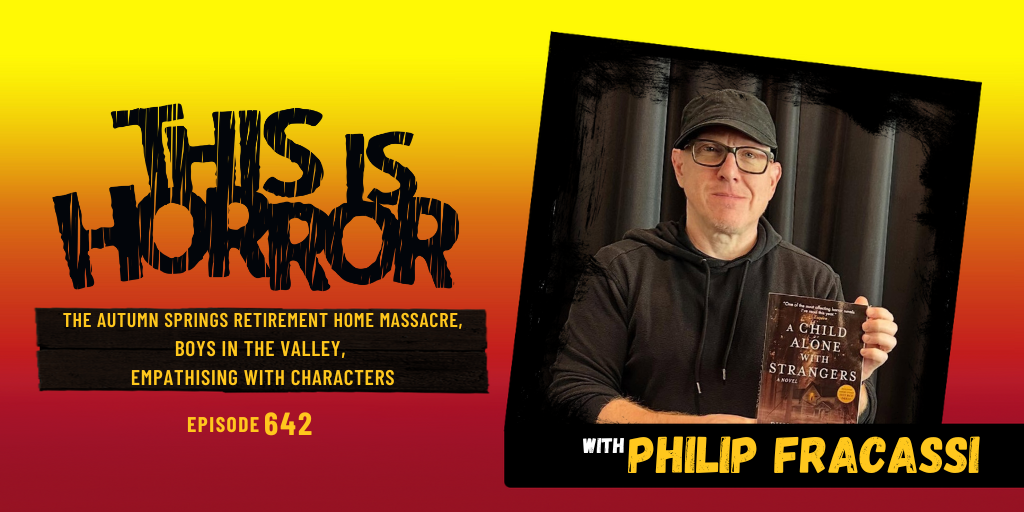
In this podcast, Philip Fracassi talks about The Autumn Springs Retirement Home Massacre, Boys in the Valley, how to make readers empathise with characters, and much more.
About Philip Fracassi
Philip Fracassi is the USA Today bestselling, Stoker and British Fantasy-nominated author of the novels Don’t Let Them Get You Down, A Child Alone with Strangers, Gothic, Boys in the Valley, The Third Rule of Time Travel, and The Autumn Springs Retirement Home Massacre. Other work includes the story collections No One Is Safe!, Beneath a Pale Sky (named “Best Collection of the Year” by Rue Morgue Magazine and a finalist for the Bram Stoker award), and Behold the Void (named “Best Collection of the Year” by This Is Horror). He is also the author of several novellas, including Sacculina, Shiloh, Commodore, and D7.
Timestamps
Thanks for Listening!
Help out the show:
- Support This Is Horror on Patreon
- Listen to This Is Horror Podcast on iTunes
- Listen to This Is Horror Podcast on Spotify
- Rate and review the This Is Horror Podcast on iTunes
- Share the episode on Facebook and Twitter
- Subscribe to This Is Horror podcast RSS Feed
Let us know how you enjoyed this episode:
- Leave us a message on SpeakPipe.
- Write a comment below.
- Tweet us @thisishorror.
Resources
- Philip Fracassi Books
- Watch the video version of This Is Horror Podcast episodes, including our conversation with Chuck Palahniuk on YouTube.
The Girl in the Video by Michael David Wilson, narrated by RJ Bayley
Listen to The Girl in the Video on Audible in the US here and in the UK here.
They’re Watching by Michael David Wilson and Bob Pastorella
Read They’re Watching by Michael David Wilson and Bob Pastorella right now or listen to the They’re Watching audiobook narrated by RJ Bayley.
Michael David Wilson 0:20
Welcome to This is horror, a podcast for readers, writers and creators. I'm Michael David Wilson, and every episode, alongside my co host, Bob Pastorella, we chat with the world's best writers about writing, life lessons, creativity and much more. Today is the second part of our conversation with Philip Fracassi. Now last episode, we spoke about Philip's writing routine, his journey from indeed a traditionally published author, and some of his marketing non negotiables. This time around, we are talking about a variety of matters, including his latest novel, The autumn springs, retirement home massacre, and some of the things that he has planned for the future. So get ready for another wonderful and inspiring conversation with Philip Fracassi, but beforehand a quick advert break.
RJ Bayley 1:43
It was as if the video had unzipped my skin, slunk inside my tapered flesh and become one with me.
Bob Pastorella 1:52
From the creator of this is horror, comes a new nightmare for the digital age. The girl in the video, by Michael David Wilson, after a teacher receives a weirdly arousing video, his life descends into paranoia and obsession. More videos follow, each containing information no stranger could possibly know, but who's sending them and what do they want? The answers may destroy everything and everyone he loves. The girl in the video is the ring meets fatal attraction from iPhone generation, available now in paperback, ebook and audio. From the host of this is horror podcast, comes a dark thriller of obsession, paranoia and voyeurism. After relocating to a small coastal town, Brian discovers a hole that gazes into his neighbor's bedroom every night she dances and he peeps same song, same time, same wild and mesmerizing dance. But soon, Brian suspects he's not the only one watching and she's not the only one being watched. Their watching is The Wicker Man meets body double with a splash of Suspiria. Their watching by Michael David Wilson and Bob Pastorella is available from this is horror.co.uk, Amazon and wherever good books are sold.
Michael David Wilson 3:02
With that said, Here it is. It is Philip Fracassi on this is horror. So one of the reasons that we are talking today is because you recently released a brand new novel, The autumn springs, retirement home massacre. Firstly, incredible title, yeah, I want to know, how did this one come about? How did you conceive of such an amazing and an original idea that, for some reason, just nobody thought to combine a slasher with a retirement home, but it absolutely works.
Philip Fracassi 3:51
I think nobody was callous, callous enough to suggest such a thing. But here I am. Yeah, the story is, actually, do remember the inflection point for this is that my, my wife, and I were touring for boys in the valley in 2023 and we were staying at a hotel in Virginia, and it was this Marriott, and it was at the top of this hill, the beautiful green country. And at the top of this hill was like these old historical like Civil War era buildings, and they turned it into a Marriott Hotel. But it's almost like a compound. It's like three or four buildings and and and beautiful landscaping, you know, green hills as far as the eye could see, just gorgeous location. And we were going for a sunset stroll, and I just casually mentioned, I said, um, you know, This place feels more like a retirement home than a you. Hotel. And then that part of the horror writer's brain that we all have kicked in and said, Oh, that's interesting. What if we said a horror story in a retirement home? What would that look like? And then I was like, Oh, what if there was like, a serial killer in a retirement home that would be interesting, and what would that look like, and how would people respond to that, and how would the residents react, and how could they react physically and emotionally and psychologically? And all of a sudden, it just became this, this runaway train in my brain and my my wife, God bless her, and I were just like talking about in different ways. You know, elderly people could die and, and kind of funny, different, quirky ways and, and it just took root. And I went back to my hotel room, and I opened my laptop, and I opened a Word document, and I typed the words, the autumn springs retirement home massacre. And I wrote a couple paragraphs about, just like the residents of autumn springs have a good life, and they have this, and there's this and this and this, but then until, it's not until this happened, and it was just like two pair. It was like a spilling of my brain. And I sent that to my agent, and I went to dinner. And the next morning, I opened my email, my agent had replied and said, Holy shit, you've got to write this book. And so I started thinking about it more. And then a few days, I had a I was in New York City for a book event. And I had drinks with my editor at Tor before the event, and I said, Hey, by the way, I had this kind of a weird idea for a book. I said, as you know, called the autumn springs retirement home massacre, and it's a bottle serial killer and a retirement home. And she was like, oh my god, I love it. And away we went. And then I was like, Okay, this is my next book and, but that was, that was the start, that was the impetus, that was the, you know, that was the catalyst. Was just walking around this weird Marriott and just having that thought, you know, with, I'm, you know, when it comes to, like, the whole how, you know, where do you get your ideas thing, the other, you know, it's all about that, what if worm, you know, in our, in our brains, and we just lean dark, like I, we were talking about altar earlier, and people have asked me about altar, how I thought of Alter, and I was like, you know, I was laying beside a pool. It was a beautiful, sunny day. I was by myself. There were birds chirping in the trees, this most Placid, you know, afternoon you could think of. And I was staring at that pool, and I thought, what would happen if a sinkhole opened up underneath that pool? And what would happen if that pool was filled with children, and that was alter, you know, other things came, you know, grew. Other things, you know, made it into the story expanded, but, um, but, yeah, it's just that. It was just a what if, and then the way, and then away the break. And though, if, I'll tell you if my if I have an idea like that, a thought like that, and it won't go away, and I can't stop thinking about it, and all sudden, characters are popping up and talking and walking around doing stuff. If I can start seeing the settings and start seeing scenes, specific scenes of action, that's what I know. I've got an idea that's sticky, and it's an idea that I'm excited about, and those are the ideas I I tend to write it.
Michael David Wilson 9:05
And speaking of seeing scenes, I mean, I understand what made the composition of this one a little bit distinct from others, is it's the only book that you haven't fully planned before going in and actually writing it. So I'm wondering what kind of challenges were there in approaching it differently? What perhaps advantages were there? And did you find that you ever had to backtrack a little bit and modify things if you're essentially, I suppose, pantsing it, or doing it in a more hybrid way, rather than the strict, meticulous planning that you've done previously. Yeah?
Philip Fracassi 9:53
So yeah, most of my books are, are to your point, heavily outlined. Uh, my novels for sure, um, and, yeah, it was the weirdest thing. For whatever reason, Autumn springs refused to be outlined. And I don't to this day. I don't know why, but I have a, I have a going back to process. My process with a novel is, once I have the idea, I open a Word document, and I for some reason that I can't explain, I go in all caps and I just write the idea. I vomit out the book. This happens, this happens, this happens, this happens, this happens, this happens, this happens, this happens. And it's just like a raw, you know, like a raw data spill. And then I open up a Scrivener program, and I start meticulously going through chapter by chapter by chapter. Here's how, here's what happens, here's what happens. And I usually have, like, a couple scenes like, Okay, this scene's in Act Three. This scene's in act two. But this is, this is, but by time I'm done, it's a chapter by chapter, breakdown of every single chapter, what happens in the chapter, who the characters are, what information I'm giving, who the conflict is like. It's very, very almost, you know, creepily detail. And I do all that before I start writing the book, because I don't want to start writing the book. I don't want to be, ever be writing a book and be going like, Gee, I wonder what happens next, or what am I going to do after this chapter? What am I going to do next? Or how am I going to get this person from point A to point B? So I'm from an outliner. So to your point, though, yeah, I cannot outline this book. And I had the characters, I had a few scenes. But that was it. I didn't know how it was going to end. I didn't know who was going to survive. I didn't know who the killer was and but I was like, man, I've got to start writing like I'm after, you know, beating my head against the desk for a couple of weeks. I was finally, like, I just got to start writing this thing. Because I, you know, I sold it. I got a deadline, and so, yeah, so I just started writing and and it was, it was so I pants the whole thing. I didn't know who the killer was until, like, three quarters of the way through the book. I didn't know how the book was going to end until I wrote the last chapter and But to answer your question, it was, it was a very, very educational process. It was, it was very interesting to me. It was, I learned a lot writing this book, more so than I probably learned since I wrote child alone with strangers, which is my first book. And yeah, I, I've learned. I, I would say that it was fun to I get why people do it. I understand the element of surprise. I understand the element of discovery as the writer, and I get why it's why that's exciting, and I get why it's enticing for writers. For me, while it was while I enjoyed having those moments, I was so anxious about the rest of the book that I I, you know, it's not something I would want to do again, if I could help it. I like knowing where the story is going. I don't mind. I'm not going to get bored if I know how it ends. I like writing so much that I don't I'm I'm, I enjoy the I enjoy writing, literally writing. So I don't need the story to be the impetus for why I'm excited to be at the keyboard, so I just want the story to be done so I can write like it's kind of, I'm kind of the other way around, in a way. I want to focus on the prose. I want to focus on the characterizations. I want to focus on dialog. And again, like I said, I don't want to think about what happens next. I want to know what's going to know what's gonna happen next. And also, when you're writing a mystery thriller like next is a really who done it mystery? You know, there's there's there's your there's red herrings, your your seating information, your misdirection and all that stuff's got to be baked into, preferably an outline. So when, when I wrote autumn springs, I did have to go back and kind of redo a lot of stuff that I would have never, probably would not have done in a in one of my other novels, most of the time, like, take whatever Gothic for example I would write the book. I would do a second pass, which I'm basically sweetening the pros. I'm cleaning stuff up. I'm making sure everything is nice and tidy. And then I'll do make one more polish, and then that's pretty much what I turn in with autumn springs. I did a pretty major. A overhaul after I finished the book, and then did another pass where I sweeten it all up into that, what I call the sweetening draft, and then, and then a polish, and then I turned it in. And then my editor said, you know, there's this element that you have throughout the entire book that we feel is giving away too much information. We want you to take that out. And it was like a certain POV, and I was like, Well, no, the book doesn't work without the tone of the book doesn't work without that. And and so we had a back and forth about it, and I ultimately ended up agreeing with them and understood their perspective. And so I changed it, but that, like, that's something I would have never had. I think if I had, I outlined it ahead of time, I probably would not have run into that problem. So it was, it was, it was very interesting. It was very educational. Like I said, I learned a ton. I still prefer outlining, but I think for this book, it ended up working out. I mean, there's so much like, if I were looking back on it, I don't know how I did it, because there's 30 characters, 80 characters in this book. There's 80 residents at autumn springs. There's, you meet a lot of them as a reader. There's detectives, there's administrators, there's staff, there's there's a lot of weird stuff going on, and and to have it all tied together at the end was, was, was maxing out my my brain power, to have it all tied together at the end. And, and, you know, when you're outlining, you can kind of do all that construction work ahead of time, and you can kind of piecemeal it. And I think when you're writing the you're looking at the whole looking at the whole project at once, and you're kind of trying to see, you know, you're like, you're like, 38,000 feet, you know, your bird's eye, you're trying to see the whole thing and be like, Okay, what doesn't work? Where do I got to make an adjustment or make a tweak to so that was a different way of approaching it. But, um, yeah, ultimately, it worked out. I think people seem to be, you know, no complaints, not a lot of complaints, anyway. So, yeah, it was cool. I just never want to have to do it again.
Bob Pastorella 17:10
Do you think that the momentum that you had with the idea was what made it like internal momentum, the momentum to get it out. Like you said, Hey, I got to start writing this thing. Do you think that that was what made it outline resistant, was the actual, you know, hey, there was a drive there that you had that kind of took
Philip Fracassi 17:33
over, you know, maybe. But I kind of feel like I'm that way about all my novels. I am because I like outlining. I like, I like to construct. I like the I like building the framework. You know, for me it's fun. And I mean, that's really when you're constructing the story, and then the writing is the writing. But no, I don't know why. I, believe me, I've noodled over it, and I don't, I don't know why, but for whatever reason. I think, I think the book, what this book, is so tonally, all over the place, you know. So, for example, if you take boys in the valley, boys in the valley is very much a one note tonally, a one note book. It's, it's it's stoic, it's dark, and it's, um, you know, it's kind of, it's just, there's no color, there's no fun, there's no quirkiness. It's, it's like, like, this is a, this is like a straight down the middle horror novel with autumn springs. There was so much color, there was so much vibrancy. There were so many colorful, interesting, quirky characters. There was so much personality to that I think it was almost maybe too much for me to structure in that way. I think I had to, kind of just like, I think I just had to, like, drive up to the entrance and get out of my car and and walk in and sort of just experience this, this place and these people and and I don't, I think that's what it was. I think it was there was too much to there was too much to nail down in a in a beat by beat story outline. There was too many influencers to two could, you know, change things on the fly? So I think if you've read the book, you'll know how many characters there are in this book and how they're all so unique, and they all kind of influence the story a little bit, depending on how they respond to things. So I think it was just for maybe it was just too much, and I just had to get there and just hope that the characters would guide me to the right, you know, to the right beats. And I think that's ultimately what ended up happening. I was following rose Du Bois around, you know, waiting to see what she was going to do do next, probably with about as much anticipation and mystery as people were reading. The book I you know, and so I think that was just ended up being really character driven versus plot driven, and I think that's part of the reason why I couldn't outline
Michael David Wilson 20:12
it, right? I think you said in a previous interview that rose Du Bois appeared fully formed and almost more fully formed than a lot of your characters have previously. So it sounds like, you know, there's a crossover there with it being difficult to outline because you've got this character who she's almost got autonomy and agency. And it's like, well, you can outline if you want, but I'm gonna do what I'm gonna do.
Philip Fracassi 20:43
Yeah, I agree with that. I mean, Rose, like, Yeah, you 100% I mentioned in the afterward too. Like, she's, she right, fully formed. She's a very powerful character. She's very driven woman. She knows what she wants. She's She's whip smart. And, yeah, I think, like I said, I think there probably was an element of like, I'm just gonna follow rose around and see what happens, and see what she does, for sure. And I think that you could say the same for and then I think throwing in like, you know, like I said, some of these other characters. And, you know, like the three sisters and Igor and Stan and Miike and Gopi and Miller and all these guys. And like, how are they all gonna, you know, Maureen Stapleton, even, like all these different characters, like, they're all gonna have these, they're all going to have an effect on what happens and and I don't know what that effect is going to be until I get there. So I think that's kind of the difference. Like, we're, like, I said, like with boys in the valley, which is which has got, like, the characters, very real characters in that book and very complex characters in that book. It's not when I say characterization, I'm not suggesting I'm not giving enough depth to the characters. But I mean, by characterization, or characters overtaking the story, is that the characters are almost the they're driving the story. I mean, I guess that's, I guess that's true of everything. I'm trying to wish I could say it better, but I feel like they were kind of in charge. Just put it that way, whereas boys in the valley, you know, I was kind of, you know, I was still God, you know, I was still putting them into positions and seeing how they would react. But I think with autumn springs, I was much more like on Earth, one of the fellow residents, just trying to see how it was all going to shake out. So it was, it was cool and it was fun. That's why that's, you know, that's one of the things that's great about writing, is you're never really 100% sure what kind of experience you're going to have with a story, or how you're going to interact with that story. I remember I mentioned blue butterfly a couple times, and that book is coming out, but just hasn't been announced yet. But, you know, I outlined that book meticulously because that also is a who. It's not a who done it, but it's a mystery. It's a mystery thriller. And, and I think I was right about, I think I was like, right around the third act, head of the third act, and my character, my main character, um, I was writing the scene, and she did something completely different than what I had planned, and it was very frustrating for me. It made me very upset, and it changed the rest of the book, and I had to go go back to my outline and sort of like, refigure it all so, um, so sometimes you don't, you know, sometimes you don't know how it's gonna all work out, but I, you know, you kind of let you got him, you know, I'm in I am in service to the story, and everything that I do is in service to the story. Every character, every description, every scene, is in service to the story. So the way I write, the tone of the story, you know all is in service to the story. So I think every story is different, because everything's going to have a different way of being told.
Michael David Wilson 24:09
And it's interesting to learn that you didn't know exactly how it was going to end until essentially ended. You didn't know what the final page was going to be, what the final line was going to be, no and yet, after a novel of absolute chaos and despair, particularly, you know that kind of final act, in that final line, you just give us this gift that I didn't even see coming, because you give us hope. And it's the perfect Ender. It's the perfect final line. Like I felt killed when when I finished it, it was so satisfying. It's such a good line. And I like that. I've been vague enough that he hasn't spoiled it at all. For anyone, but it was perfect.
Philip Fracassi 25:03
Oh, thank you. I mean, yeah, so I'll give you an example. When I was writing the last chapter of this is no spoiler, guys. For those listening, when I wrote the final chapter of that book, I had in my head, I have one more chapter, and I knew what that next chapter was, that last chapter was that last chapter was going to be and it was going to be a pretty important chapter. And then I wrote what is now the last chapter, and when I finished it, I was like, like a dealer at the blackjack table. I was like, hands up, dusting him off. That's it. That's the end. And, and I changed, you know, it ended up changing a big part of the book, because, like I said, I had something else in mind. So, yeah, so it was, it was, it was interesting to write that way, and it was really satisfying, especially because the book worked, not trying to blow smoke up my own ass, but the book worked, and, and, and so it's satisfying because it was written in a It was sort of chaos when I was writing it, but I, but I enjoyed writing it. I had so much fun writing it. I had so much fun writing those characters, and it was very cathartic to write that story. So it was, it was a really, it was a really wonderful experience. And I'm glad that I was, I'm glad that I
Michael David Wilson 26:35
that I had it. And I think it should be obvious for people listening, but when we talk about it being a slasher, I mean, this isn't your typical slasher. This isn't your Hollywood I suppose, more surface level slasher. This is much more along the lines of the literary slasher that you might see someone like Stephen Graham Jones Right? And, I mean, a lot of it is because of that emotional depth and the core that you give this book and the characters. Now I understand, and I believe this was mentioned in the afterword as well, that during the writing of it, you know, both for your parents passed away, and then you know, not only is that obviously going to change your life, but it changed the book. And so initially it was a little bit more light hearted. It was more a kind of dark comedy. And there are, of course, still comedic moments in it, but I don't know, did this moment in your life it? It changed the way that you approached the book, like sometimes there are moments in in the world and the universe, or I feel it gives us kind of what is required, even if we don't know it at the time. So that's kind of why you couldn't plan it, because you were going to be fundamentally changed during the writing process. Yeah.
Philip Fracassi 28:13
I mean, it was definitely going back to tone, which is a big thing for me, the two things I decide before I write anything are, what's the tone and and how do I want to write it? Meaning, am I going to write it fast? Am I going to write it slow? Is it going to be pulpy? Is it going to be, you know, you know, third rule of time, travel is written with very sparse, quick prose. My upcoming novel Serafina is written much more densely because it's again going back to the surface of the story. I wanted Serafina to feel richer. I wanted time travel to be more of a thriller. Anyway, I get sidetracked so easily. Yeah, regarding the but yeah, the book was originally when I pitched it to my editor in that bar in New York City. Yeah, I told her, it's a dark comedy. I even riffed on a couple scenes, and they're still in the book. And there's some, yeah, there's some. There's some quirky, fun stuff in in the story, and and then there's some really dark, emotionally, you know, rot moments in the story. And I think what happened, you know, yes, my, you know, my father, right in the middle of writing the book, yeah, I had to go take care of my go back to Bo home and take care of my father, who was suffering from dementia, and basically was like home hospice care for him for for a few months. And, um. Yeah, and, and, you know, you can't go through something like that and not rethink a lot of things, especially when it comes to like end of life care or the elderly or even death or the disease of dementia, or the awfulness of it. And, and my mom, who, you know, passed away sometime after, you know, when my father passed away, we, you know, she and I were having a lot of conversations, along with my other siblings, of course, but like, who's gonna take care of me? How am I gonna live? How am I who's gonna feed me? You know, she was, she was an invalid, basically, and in a wheelchair. And, you know, how am I going to pay for stuff? You know, all the things that are being taken away from us right now, which I won't go into, but so all that went into the book. And I think what happened between that, and also just when I got into the book, I just started realizing that there was a lot more depth to the story that I had originally anticipated. And I really found myself wanting to address a lot of the issues around ageism and around end of life care and around the elderly and how they're thought of, and how they're treated, and how they're represented in media, and how they're represented in real life, and how they're treated in real life, and and all that stuff ended up becoming important to Me. I think because I met these characters, I was kind of like, you know, I kind of fell in love with them, you know. I was like, you know, you guys, you know, I don't know. I wanted to tell their stories. And I tell people, you mentioned the slasher thing, you know, I tell people this, you know, this story is about rose. This is Rose's story. You know, this is Rose's arc. And the slasher stuff is basically the, you know, the the stage or the, however you want to call it the tool that I use to tell her story and to know her. She her, discovering things about herself and changing as a person because of what's happening around her, is that's the point of this, of the novel, and and that became the, quickly became the point of the novel. And I think that's but I also have all the fun, entertaining slash stuff in there too, but, um, but, yeah, just for all these reasons, it became a different book. And even, even stuff that I thought of, you know, early on that in my head, I was like, Oh, this is going to be really funny when I when I tell this, when I do this chapter, it's going to be really funny. People are going to, like, laugh, and they're going to have, they're going to really get a kick out of this chapter. And then when I was writing the chapter, I was like, in tears, because it was so horrible. And I was like, this isn't working out the way I thought it would. This is becoming something much different. And, and so, yeah. So things like, just, yeah, I don't know how it just, it was im, you know, I got him so immersed in this world, and I got so immersed with the characters, and so connected to these characters. And then obviously, everything that was going on with me in my life, yeah, it all just, it just made the story that much more meaningful. And it, you know, it may have been that way, whether you know, whether or not what was going on in my personal life had happened or not. I may have just entered this world and gotten to know these characters and wanted to tell their stories differently, but, um, but I think it all contributed to the way the story was told, and to into, you know, into what the novel ended up being, which, to your point, from the, you know, was it much more than just like a slasher. It's, it's really, it's got, you know, it's got a lot of heart. It's got a lot of my heart in it, and a lot of and a lot of, really, I think, thematically deep issues, but, but, you know, my goal was to make sure that, again, going back to my mantra, everything is in service to the story. You know, I even if I knew that I wanted to address some of these issues, I had no point. Did I want them taking precedent over the storytelling? So they're all in service to the story, meaning I'm not bogging stuff down. I'm not standing on a soapbox and preaching. But I do think that those elements are interwoven throughout the plot, and I think, add some interesting texture to what happens in the book.
Michael David Wilson 34:46
Yeah, there were a number of elements that really reminded me of a coming of age story. Now, of course, you can't call it a coming of age because of the age of the protagonist, but I. Think this is kind of a coming of experience, a coming of realizations. Because, yeah, as we've all good storytelling, you know, the protagonist that we see at the beginning is not the protagonist that we see at the end through everything that she has experienced, both externally and internally, in terms of those realizations. And so, I mean, to that point, there are perhaps a lot more parallels with boys in the valley than one might imagine. You know, you think they're they're polar opposites. You've got one where you know the protagonists and their main characters are 80 plus, and then you've got over the kind of six to 16 year old boys, but that there is a lot of commonality, as I say,
Philip Fracassi 35:59
yeah, for sure, 100% very much I would, I would be disingenuous to not agree with you. No, there's, it's, I mean, to the point where there's a line in, there's a line in autumn springs, where Rose is having lunch with her daughter, where, I think it's her daughter who call it, who refers to autumn Springs is a octogenarian orphanage, and that is very much a nod to boys in the valley, a very purposeful nod to boys in the valley. Because, yeah, you're talking about, I'm taking x amount of characters, I'm isolating them in an environment, and I'm throwing in a Tasmanian devil. And, you know, putting, I'm putting a fox in the hen house, and the door, you know, the hen house doors are locked. So, yeah, very similar setup. Different, obviously, story, but, yeah, but you're talking about concentrating a group of people in an isolated environment, throwing in this whirling, you know, this, this, you know, Devil representative, and seeing how they react, and seeing how they get out of it, and seeing how they escape, if there is escape, You know. So, yeah, no, very much. I love the I'm glad that these were the two books I did with night fire, because I do fit. I do feel like they're sort of a pair. I yin and yang, in a way, to your point. And so I'm, it makes me happy that they're, they were my, those were my two night fire books, because I do like them, sort of being, like, kind of a set in a way, whereas, when you take, like, you know, my other novels that are coming out, you know, next year and beyond, I think are, you know, very different, but, but, yeah, and it's almost to the point where I remember having the, you know, I've had the conversation with my agent being like, Yeah, I basically just, I'm basically, basically just telling, retelling boys in the valley, but with elderly people instead of kids. That's a joke. It's not retelling, but, but, yeah, but there's definitely that, that parallel there, and that kind of and it was interesting. What's interesting about comparing and contrasting the two stories is that, like I said earlier, is tonally, how different they are. You know, Autumn Springs is funny, it's quirky, it's super dark, it's super thoughtful. There's, there's definitely elements emotional, you know, moments and whereas boys, I think, was very much one note so, but yeah, they're, they're an interesting, interesting pair. You know? Yeah, I'm happy with the way they both turned out, and I'm and hopefully, and hopefully readers enjoy both, both of them.
Bob Pastorella 38:52
I didn't realize it until Michael said it, but it does have a coming of age feel the main thing. And I mean this completely complimentary. I think Mike already knows where I'm going with this, because we talked about, it's a slasher and everything like that. I think you've written a giallo. And here's why we have we have a central location. We have characters that we give a damn about. And typically, especially in modern slashers. When we watch, you know the characters, the victims, we have to figure out who the final girl is. With this we know who the final girl is already. We know it's going to be rose. And so as I'm reading this book, I'm starting to see, like in my mind, I'm an imagining if this thing was a movie adaptation. I don't know why I'm bringing it up like it could be in the 80s. It was going to be like a Dario Argento, John Carpenter collaboration. And believe it or not, I would have someone like Joan Collins, play, play rose. It gets. Cast against type, okay? Because normally she played, you know, the vamp and all that. So cast against type, and you'd have this music and all that. And it would like, do, you could set this in the 80s, man, but I just feel like, in a totally complimentary that you've written a giallo and it, but it's it with, with thriller and coming of age elements that I hate using the word elevated, but it elevates it above a slasher. It's, it's, it was so good and and especially when you were talking about how it's like you felt that it was a little bit more colorful. And that's, you know, Gialos are vibrant, whereas, like, slashers are just, basically, they're just, they're bloody. And so, you know, to me, it's like, if you have a vibrant world, it kind of leads to being a giallo.
Philip Fracassi 40:59
Yeah, it's basically a rom com.
Bob Pastorella 41:02
That's, yeah, that too 100% Yeah. It's many things at once.
Philip Fracassi 41:07
There's a romance element, yeah, there's a will, they want. They element, yeah, no, I appreciate that. Yeah. It's, I mean, it's, yeah. I think one of the things that makes this book unique is it that it is so you could describe it in so many different ways, and it's so hard to categorize, and you know, even to the point that when, you know, when night fire was, you know, putting it out, I said, No, you know, I really wanted them to publish it under The category of a thriller versus horror, because I thought that was much more in line with what it was. But, you know, they're, they're horror imprint. So horror it is, but it does have some, you know, some, there's a little supernatural, and there's some horror in there, for sure, but, but, yeah, so it's it the the categorization has been interesting, and it's actually been, you know, I don't read my thing with reviews is I read reviews before a book comes out or before a book is released, and I don't read reviews after a book is released, unless it's by a trade press, but because I want to know how a book is being received. But I'm also not a masochist, so, but it was interesting, we know early on, because the because, I think what happened was, I think night fire was sending the book out to a lot of horror reviewers. And the horror reviewers were kind of like, you know, it's more of a mystery thriller, but there's some, there's also some, some horror elements, but it's not like horror, traditional horror, and they're almost like you were saying, like it was a little bit like, you know, water down horror or whatever, mainstream horror or whatever. But, but then what was interesting was in Mick McMillan audio sent out the audio book advances to mystery readers, and so all of a sudden I was getting this flood of seeing, this flood of reviews from people who were getting the audio book who were like, yo. I thought this was like a cozy mystery. I don't need to know what somebody's insides look like when they're cut open. You know what I mean, and and it was funny to see the how the horror writers were coming at it from one direction, and the cozy mystery folks were coming at it from another direction. They all kind of like had that meet in the middle. Was very gratifying for me, because I was just, I was having kind of a good time reading a lot of those reviews, because it was funny to see how hard it is, you know, when you can't categorize something and and how see how people kind of like, respond to that, and how they kind of have to sort of like, oh, wait a minute. This is not what I expected. And it was similar with, you know, when I published third rule of time travel, which is a science fiction novel. And a lot of my horror readers were a little thrown by that, because they were like, Well, wait a minute, this is there's some scary stuff, but it's basically a science fiction thriller, sci fi psychological thriller, which it is and but it's always interesting to me how things are categorized, or, you know, labeled, and I'm such a big believer in not doing that, you know, I love to tell a good story. My stuff does lean dark, but I think you could classify a lot of my novels as horror or thrillers, you know, and you'd be right, or even mysteries, and you still be you'd still be right. So I think there are some extreme examples, like Gothic is definitely a horror novel, but you know, Autumn Springs is is really more of a mystery, you know? So it also. It also points to just how broad horror has become, and how people are trying to fit stuff into that category, versus trying to fit horror stuff into mystery category. There's been interesting change over the last handful of years as horror becomes more prevalent and more popular.
Michael David Wilson 45:20
And I think one of the challenges of having a slasher framework, and I think Bob alluded to this, is how you make readers care for and empathize for characters in such a short period of time before brutally killing them. So I think that's something you really mastered. But I mean, what tips could you give people, or how did you approach this challenge yourself? Yeah, it's something
Philip Fracassi 45:54
so try not to make it a long answer, but, but so basically, before I but, it's okay. So I was writing literary fiction, and I use that term loosely for those rolling their eyes, non genre fiction. For my whole life, I wasn't writing really horror fiction until 2015 but I'd written three novels and probably 100 short stories that I would classify as not genre, character based fiction where I was exploring the dark, psychological aspects of characters and blah, blah, blah. And then when I started writing horror in 2015 I was basically combining all of that experience of characterization and character built and character driven stories with horror frame, you know, horror frameworks or horror tropes or whatever. And it was kind of combining those two things was, I think sort of gave, what is what I think sort of gave my gives, my work a little bit of a unique voice and, and I think it surprises people a lot to read a horror novel, and they find themselves, you Know, the characters being fully fleshed out or or being, find themselves empathizing with characters, you know. And if you take again, going back to alter as an example, my story alter, which is a short story, is 11,000 words. And I think the first 4000 words of that story, the first quarter of that story is basically me, just you, just as a reader, you're just meeting these kids who are going to a community, community swimming pool on a Saturday afternoon. And the horror doesn't really start till halfway, if not more than halfway, through the story. So it's all a lot of, I don't want to call it setup, but it's world building, and it's also character building, and it's also like, you know, investing, but, but to answer your question, so I think about that a lot, I guess is the point. And I always my, my, my thing is always that in order for horror to be effective, you have to make the reader care about the characters. Because if the readers don't care about the characters, then it's Friday, the 13th part, nine, and nobody gives a shit if they die or don't. Die, and all they want to know is, like, how fun is the kill? How creative is the kill? That's what they care about. They're not, you know, you're not, you're not crying during Friday, the Friday the 13th Part Four or whatever. I've never seen a Friday the 13th movie. So out of now, there's like, nine of them, 10 of them. I don't know, but, um, so for me, it's very important that the horror be fixed in reality, be grounded. The characters feel very grounded and very real, so that when things do happen to them, the reader is emotionally impacted. As far as techniques for doing that. There are, there are ways. The best way to do it is to give the character traits that are relatable. So give them a memory, have them tell a story about something they did that happened to them, that a reader could probably relate to. You could do that in a paragraph. How you build the character. Let's take Angela in autumn springs, retirement home massacre. Should we meet Angela in chapter one? Right? And in chapter two, Angela meets the killer. So why do you care about Angela? Well, for one thing, you know that Angela is in a relationship, or a budding relationship. Yep, she's holding hands with a man beneath the seats during a movie. She you get a few lines of dialog with her where she comes off as likable and quirky. I describe her in ways where she wears a puffy white jacket and looks sort of like a marshmallow with legs. She has oversized glasses that make her eyes large and blue, and she says excitable things, and she's you know you. So those are all little ways for me to introduce you to Angela and make you like her. And then Angela has an interaction with the the killer. And this is not a spoiler focus. This is chapter one, and is like the first 10 pages, so it's a little bit of a spoiler, but I guess. But that's like one example. I think backstory limited facts, limited, relatable, quickly told, anecdotal. Backstory is big. It's very helpful, and it gets the reader to connect and empathize very quickly with the character, how you describe the character, and also the character's personality. So I can make a character very unlikable right away, or I can make them very likable right away. When people meet Tyson in Gothic, he's not likable, you know? I don't I didn't write him to be likable. I wrote him in a way that he would kind of rub folks the wrong way, and kind of like, you're kind of like, Who is this guy? No, and not in a good way, because that was sort of the point. And so, yeah, so it's just, so those are the, those are those would be, I guess, the the tools that are in the toolbox when you want to develop a writer, a character quickly. The things that you can mess around with is, like I said, description, personality, how they talk and and, yeah, and give them, give them a little give them a little anecdote that makes the reader like them. You know, there's the whole save the cat thing in movie screenwriting, and which is that you you know, a character will save a cat in the opening scene, so the reader so that the viewer instantly likes them. And there's actually a movie, guards, man, what's the with the English guys? And they're all like, James Bond guys, the Kings men. Kings men. There's actually such a scene in the early on in the first Kings movie where the main character literally saves a cat. And I'm like, You got to be kidding me, because I know there are screenwriters all around the world laughing their asses off, and it was definitely intentional anyway. So, yeah, so, so those are the things that I would employ if I needed to make a character likable very quickly. You know, I think later in the story, there's you get to meet Owen Duffield, and I think you get to meet Owen for about three pages. And I think those three pages are him reminiscing about a waterfall that he used to jump off when he was a kid. And then he kind of philosophizes a bit about memories. So you're instantly, like, connected to Owen. And I really, he really hasn't done anything except lay there and think about something he did as a kid. So those are the I guess that's a couple examples of maybe some things that I do to get the reader to buy in right before I drop the hammer, so to speak.
Michael David Wilson 53:56
Now, because you mentioned Gothic and you mentioned a sequel coming next year. I'm wondering, of all your books, why did you decide this is the one to return to for the sequel?
Philip Fracassi 54:13
Yeah, not a super smart decision by me, financially. It's probably my least popular book. It's my independently published. It's not a big five book. It's been out of print for like, a year. There's so many reasons not to have returned to this world, but I always had an idea for a sequel and with two things. One is, you know, one Gothic is, by no, you know, in no way shape or form my most popular book, but what I've interacted with a lot of readers over the over the years, and while boys in the valley, and maybe now autumn springs and even third rule. Of time travel are probably my most popular books in the sense that they're the most mainstream, or they sell the most copies. Gothic and a child alone with strangers are the books that people are most passionate about. When I go to a convention, I can't tell you how many people come up to me and talk about Gothic, so I know people have a connection with that book and and it's a really fun world. It's a it's, it's, it's the one world I created where anything go, where I can anything goes. What I mean by anything goes means I don't have to, like, the the the handcuffs are off, like, I am swinging and and I'm having a lot of fun, and there's, like, a lot of crazy moments, and it's like, it's like, it's like, evil, dead two on steroids, right? It's Sam. It's my Sam Raimi late night Bee Movie. You know, we're just gonna, we're gonna, we're gonna have some fun with this. And, you know, leave all your thematic elements at the door, and let's go. So, um, so it's so on one hand, I wanted to return to that world because I liked, I had so much fun writing that book, and I wanted to, and I wanted to write this sequel that I had, and, but then I had, like, all these other projects and, and what's going to, you know, not to be crass, but what's going to pay the bills, and what's you know, and, but what happened was clash, my friends at Clash books, Gothic went out of print with cemetery. I pulled, pulled it from cemetery dance, who was the original publisher, and clash said that, we know they would, they would publish the book of the reprint, but they would want a sequel. And I kind of said, well, you know what? It just so happens that I have a sequel that I'm really keen to write and and that was really, that was it. That was the decision. So, so they're gonna put, God, they just put Gothic out last week, a couple weeks ago, November 11, and gothic two is coming out in April of 2027 and in between, they're also publishing my novel Serafina, which is coming out in April of 2026 so so I did a three book deal with clash, one of which was a sequel to Gothic. So yeah. So my decision to write it was kind of twofold. Creatively, I kind of wanted to write. I kind of wanted to just to write something for the love, the pure love of writing. Again, I just kind of wanted to not think about parameters or justifications or political correctness or what's the editor going to think of this. You know, am I going to get away with this kind of stuff? And I just wanted to have fun again, and I thought this would be really fun vehicle for that. And then secondarily, you know, it's also because of this deal I made with this publisher. So for those two reasons, Gothic two is coming out.
Michael David Wilson 57:59
yeah, and we spoke before about the marketing and publicity, but I'm wondering what is it looks like to return to, you know, kind of publicizing a book that was out previously, but now, because it's been re released, you obviously Need to get attention on that. And, yeah, I mean in that vein, how much when you're publicizing, are you concentrating on the new release or the most current work, and then how much are you trying to give attention to other work? Because this is one of the dilemmas that we have as well, because books don't have a sale by date. It's not like once it's been out a number of years that that's it. There's no point reading it. But for whatever reason, you know, a lot of people and publications in the media, they favor wanting to only talk about the new thing.
Philip Fracassi 59:05
Yeah, it was difficult because I had, I was promoting autumn springs, and at the same time I had a paperback reissue of a child and only strangers coming out. Came out October 28 and then I had Kathe coming out November 11, and I couldn't promote them all. It was impossible. So I just focused on child. I'm sorry, I focused on Autumn springs, even I can't remember the three titles. And then did what I could to promote these other books being released.
And the reality is you got to, you know, you got to pick, what can I spend my time on, and where can I focus? So I focused on Autumn springs, knowing that Gothic and trial the Dart he had there. Sort of like they'd already been out before people knew what they were. So I did some social media stuff. I put them in the newsletters, but I didn't make a big push for them, you know, I couldn't So, and I've run into that before. You know, where I had, like I mentioned I had childhood almost strangers come out in November 22 Gothic, February 23 boys in the valley, July 23 you know, you can't promote everything. It's exhausting. You need run away. So that's why you try and separate these things, like six months apart, or a year apart, if you can. And I'm kind of at a point now where I've sort of caught up, where all my books are out now they're back in print. I won't have to worry about autumn springs again until a year from now, when the paperback comes out. But I have Serafina to promote in April. I have another story collection to promote September. So you just got to like, do what you can and like for this book, it's getting X, Y and Z. This book's only gonna get Z, you know, this book's only gonna get y, because you just can't do everything. So you just gotta, sort of like, categorize it and pick and choose and do what you can without killing yourself, because otherwise, you know, there's only so many hours in the day, and also, there's only so much that people want to hear about. Like, you know, nobody wants to see my constant, you know, 16 posts a day about six different books. They won't even know what's happening. So it's hard, and you try to avoid these kind of situations. This was a situation where it just so happened that I had these two other books coming out while autumn Springs was in full flow, and I just did what I could, you know, but I'm hoping that next year, Seraphina sort of has its own pocket of release traps inspectors, which is my story collection, will have its own sort of pocket that'll come right around the heels of the autumn springs paperback release, somebody thinking ahead this next September. So I'll figure that all out, you know, and I'll do what I can. But not everything gets the full Monty, you know. Sometimes you just kind of pick. You just gotta take up. I won't, I want to elaborate on that metaphor, but, but sometimes you just got to pick and choose and that and do the best you can. It's a good problem to have, you know, but it's it is a problem.
Michael David Wilson 1:02:30
Yeah, yeah. And speaking of problems, I mean, what do you think is your biggest writing and creative struggle right now.
Philip Fracassi 1:02:41
In what sense do you mean, like my like, Project wise, or generally speaking,
Michael David Wilson 1:02:48
so I mean, at the moment, you know you've achieved so much, and you know you're now with these massive publishers, and you know, from the outsiders perspective, which we spoke about before, it's not always strictly syncing up with reality. Things look, you know, really great. But if we look at kind of, I suppose, not, not just struggles, but what are the aspirations? What is it that you are kind of focused on achieving, creatively and in terms of your writing life?
Philip Fracassi 1:03:30
Um, I mean, I think it's a good question. I yeah, I will say to address one thing you mentioned is like it's not. Everything is not what it seems. And I think you, you know the, you know, there was a moment earlier this year where I was having conversations with my agent, saying, What am I going to do? Like I'm done, because all these publishers were turning their backs on Me and and it was, it was scary, you know, and this is 10 years in. This is after I'd done deals with the orbits and the night fires. And, you know, I found myself without a place to put my work, and I've since resolved that issue. But there was a period of, you know, where it was, it was a little touch and go, you know, to the point where we were talking about pivoting away from horror. Maybe I, maybe I write, ya, maybe I focus on science fiction like so there's never a point I shouldn't for me, there's never been a point in my career where I've been comfortable, where I've been like, okay, I can sit back now. I can put my hands behind my head. I can kick my feet up in my desk, and I can eat my laurels for breakfast, lunch and dinner, because. Is the reality is the second you stop working, the second you go down and you've got to keep driving, keep pushing, keep fighting, keep getting, you know, keep writing, keep No, I can't tell you how, how hard I've had to work to keep things going in a positive direction, even this year. So my goals is, my goal is very simple. My goal is just to keep, you know, my goal is to keep doing enough so that I can keep doing what I'm doing for a living, and and that means writing new material. That means coming up with new story ideas. That means finding publishers that want to work with me. It also means, like I mentioned this, right? You know, at the beginning of our chat, diversifying the workload. I know writers who are wildly popular, writers who are struggling to find homes for work because of the environment, you know, because, because things are evolving and changing, and not everyone knows exactly what they want and and so like being able to, you know, being able to work on comic books, being able to work on movie scripts. Being like, I spent this past week working on a TV pitch, you know. So that had nothing to do with, you know, fiction and, you know, I wrote, you know, I'm trying to get, trying to get more comic work, because I did the creep show, and I've been meeting with comic publishers. I'm on the phone and emailing my film reps and my lawyer and my literary agent, saying, Where are we with this? Where are we with this? Where can else can we do? What else can we do? What else can I do?
I'm constantly pushing.
I mean, I mean, it's to the point where I'm sure I drive a lot of these guys, you know, nuts, because I'm constantly like, where are we? Where are we? What else can we do? You know, I don't, and I'm writing, you know, and I know that I've got to get a book finished before the end of no whatever I said, you know, February, whatever it's due. And I know that I have another book that I need to write next summer, because I need to have something for 2028 so it's not there's no rest period, there's no recess, there's no i There's no sitting back and, like I said, you know, looking at the garden grow. I don't foresee, ever foresee that happening. I mean, I'm sure there are writers who have reached a certain amount of success and maybe have had some enough financial stability where they can think that way, but I feel constantly behind the eight ball. I wake up every day in a borderline, I don't want to say in a borderline panic, but I would say wake up every day anxious to get to work and to see what and to get and to find out, like what I have to do that day to push things forward, even if it's an infinitesimal degree. So my focus is always making the donuts so that I have work to sell, and then, and then beating the bushes on what's out there. What else can I be doing? What else can my representatives be doing? Constant, constant, constant follow up and and then hoping things, you know, and other than hoping good things happen, I mean, I, I made a, you know, I, I'm in the process of signing a new publishing deal, and the only thing I'm thinking about is, what am I going to do after this deal? That's the only thing I'm thinking about this deal is for this deal will get me through 2027 okay, what's happening in 2028 that's the way my mind works. So I'm right now. I'm everything I'm doing right now, except for this novel that I have to finish that's coming out in April 2027 everything I'm doing right now is very much focused on 2028, and beyond so and also, you know, everything that's happening right now with with, you know, whether it be film adaptations or options, or comic book or TV pitches or new stories to keep the Patreon going, or writing new books so that my agent has stuff to shop, you know, to shop. So that's a long winded answer, but that. That's, that's what I'm that's what my focus is, and that's what I think about every day, as far as like so that I can get to the next day and and and keep doing what I love to do, and it's a day by day struggle. So I don't know that's the way, that's the way it is for me anyway,
Michael David Wilson 1:10:23
and I think it's so useful in a sobering insight into the reality of the full time writer and what's needed to sustain, or to attempt to sustain that. Because, you know, as we've alluded to. I mean, even you can put just the most work into it, and there's no guarantees in this business, you can try to maximize your chances by working bloody hard and working harder than everyone else and so called, hustling and following up and looking for opportunities. But all of that can increase your chances of so called success, but it doesn't guarantee it.
Philip Fracassi 1:11:09
Yeah, I mean, it's, you know, it helps, you know, you can help your own odds for sure, you know. And but again, to your point, nothing is guaranteed, and even when something like, we talked earlier about the marketing stuff and Big Five, and that's why I almost like, you know, I almost interrupted, because I was kind of like, when you were talking about, oh, well, when you know, you still have to promote your own work, even if you have a big five deal, it's like, Oh my God. It's not even a question mark. Like, yeah, you're you, yeah. The sobering reality is that writing for a living is an is a lot of work, and it's a lot of hours, and it's a lot of
it's, it's, it's
gotta hate being this guy, but it's a lot of, you receive a lot of negativity, you receive a lot of rejection, yes, and you just have to, you just have to love it what you do, and you have to be willing to work really hard to continue to do what you Do. But there is no, there is no magic. Solution. There is no you know. There is no you know, bubble that you step into and float away like you know Glenda, you know you it's, it's constantly battling, constantly fighting, constantly working to so that you can continue to do what you do. And you know, like autumn springs, retirement home massacre was a USA Today bestseller. What does that mean? It means that a lot of people found the book. Does it mean that I can does it mean that somebody just wrote me a big check, you know, and I'm gonna go to Tahiti for a couple weeks? No, I haven't seen a check, you know. And when I do see check, it's not going to be enough to go to Tahiti. I can tell you that. So, um, no, it's, it's a, you know, it's for the love of the game, as it were, but, um, but, you know, and, but I never want to come up. I try not to come off as cynical or negative, because it's a lot. It's because this is, you know, it's um, it is fun, and it is, and it is like what you love. Then it's, then it's, there's nothing better, you know, it's like, nothing better in the world than finishing a story or finishing a novel. I mean that feeling of writing a scene where you're like, God damn, I nailed it, you know. Or, or you're surprised by the way it goes, or you're adrenalized because something happened that you never foresaw happening and it it's the coolest thing ever, and that's what makes it all worth it. And I think you can have some success in this business, and I think, but I think that you have to think of it as that of success being the ability to continue to do it. And for me, that's what success is. It's the ability to continue to do to do it, no more, no less. And there's a lot of ways to skin that cat, but, but, yeah, the best way to do it is to create, you know, to better your own odds by putting in the work and in creating the stories and diversifying the type of work that you do, those are all going to increase your odds at being successful.
Michael David Wilson 1:14:51
All right. Well, thank you so much for chatting with us this evening. It's been a tremendous amount of fun. It's. Been hugely informative, and we absolutely cannot leave it eight years until the next one.
Philip Fracassi 1:15:08
No, please. I, I feel like we didn't even get to talk about the other six books that have come out. Yeah, between the last time we spoke in 2017 but, um, but yeah, no, I'd love to come back on and anytime you guys would have me and and yeah, and talk about writing and all that good stuff. It's, it's a lot of fun for me. So thank you for having me.
Michael David Wilson 1:15:31
All right, an absolute pleasure. Now, where can our listeners and viewers connect with you?
Philip Fracassi 1:15:41
I'm everywhere. Man, I'm on my website is P for kathe.com I'm on Facebook, Instagram, blue sky to a limited extent, threads to a limited extent. But best places are Facebook and Instagram. And then if you want to go by website, that's where you can that's the main information hub for all of my stuff, books and stories and newsletter, and you can email me there and all that good stuff.
Michael David Wilson 1:16:11
Okay, well, do you have any final thoughts for our listeners?
Philip Fracassi 1:16:19
No, I just I appreciate being here. And you know, somebody very wise once told me early on that the greatest virtue for any successful writer is perseverance, and that's something I always want to pass along to writers, is persevere.
Believe in your voice, and you'll find and you'll find success.
Michael David Wilson 1:16:46
All right, thank you again for joining us. Thank you so much for listening to the conversation with Philip fricassee. Join us again next time when we will be talking to one of my favorite writers, Joe Hill, but if you would like to get that and every other episode ahead of the crowd, become our patron@patreon.com forward slash, this Is horror. This is the ultimate way to support me and this is horror as I take the podcast to the next level in 2026 but instead of saying vague things like, take the podcast to the next level, let me get specific. As of right now, there will be two this is horror podcast episodes a week. The first will land on Monday night in the US, and the second will land on Thursday night. In addition to the podcast, you are going to get video versions of the full conversation on youtube.com, forward slash at this as horror podcast, and you're going to get inspirational short video clips posted throughout the week from both recent and archival podcast episodes at this as Horror podcast on both tick tock and Instagram. So if you're not following us on YouTube, Tiktok and Instagram, now is the time to do so. And the handle for all of those is at this is horror podcast. Now I want to do the this is horror podcast full time. I'm putting in the work to do it full time, and I hope you're going to really notice that. You know, we're what, 13 years into it, but we're still leveling up. We're still getting better and better. And if you like this is horror, and you want to support me, and you want to help me do this full time, and you want even more. This is horror, the place to do so, the place to support the show. You know what I'm gonna say because I say every week, and also because I said it a few minutes ago, and you presumably don't have a memory problem. But just in case, patreon.com, forward slash, this is horror Okay, before I wrap up a quick advert break
Bob Pastorella 1:19:30
from the host of this is horror podcast, comes a dark driller of obsession, paranoia and voyeurism. After relocating to a small coastal town, Brian discovers a hole that gazes into his neighbor's bedroom every night she dances and he peeps same song, same time, same wild and mesmerizing dance. But soon, Brian suspects he's not the only one watching and she's not the only one being watched. They're watching is The Wicker Man meets body double with a splash of Suspiria the. Are watching by Michael David Wilson and Bob Pastorella. Is available from this is horror.co.uk, Amazon and wherever good books are sold.
RJ Bayley 1:20:09
It was as if the video had unzipped my skin, slunk inside my tapered flesh, and become one with me.
Bob Pastorella 1:20:18
From the creator of this is horror, comes a new nightmare for the digital age. The girl in the video by Michael David Wilson, after a teacher receives a weirdly arousing video, his life descends into paranoia and obsession. More videos follow, each containing information no stranger could possibly know, but who's sending them and what do they want? The answers may destroy everything and everyone he loves. The girl in the video as the ring meets fatal attraction for the iPhone generation, available now in paperback, ebook and audio.
Michael David Wilson 1:20:47
Now I would be remiss if I ended the episode without plugging my own work. An award season is up on us, and my dark comedy daddy's boy was released this year, so it's only fitting I remind you of that when you're considering what to nominate for an award. Though, what award dad is boy would be up for? I don't know, award for book with most sausages in it, most dick jokes and euphemisms, the best book of the year to involve someone taking a cat for a walk. Be honest, I don't know of a better book. Is that arrogant for me to say Not, not in general, but a better book that came out this year involving someone taking a cat for a walk. Now, some might argue not incorrectly. I don't know of any other books where people take a cat for a walk that came out this year, or, actually, any year, but that is beside the point. Other things it might be up for the best book of the year, based in Kidderminster, England. The book to reference the UK television show, naked attraction the most times, if any of that resonates with you, then, firstly, fair play, you have a quirky taste. And secondly, do consider picking up a copy of my dark comedy, daddy's boy. It has been praised by talented writers such as Jason pargen, Eric La Rocca, David moody, danger, Slater and Max booth, among others. It's no doubt, been panned by talented writers too, but I don't have names as such, writers have yet to share these feelings, but nonetheless, my ask of you is that you buy daddy's boy, eat some sausages, get nostalgic for 90s British references, and maybe have a laugh along the way too. Daddy's boy by Michael David Wilson, so with that said, I'll see you next Thursday for the conversation with Joe Hill, but until then, take care of yourselves. Be good to one another. Read horror. Keep on writing and have a great, Great day.