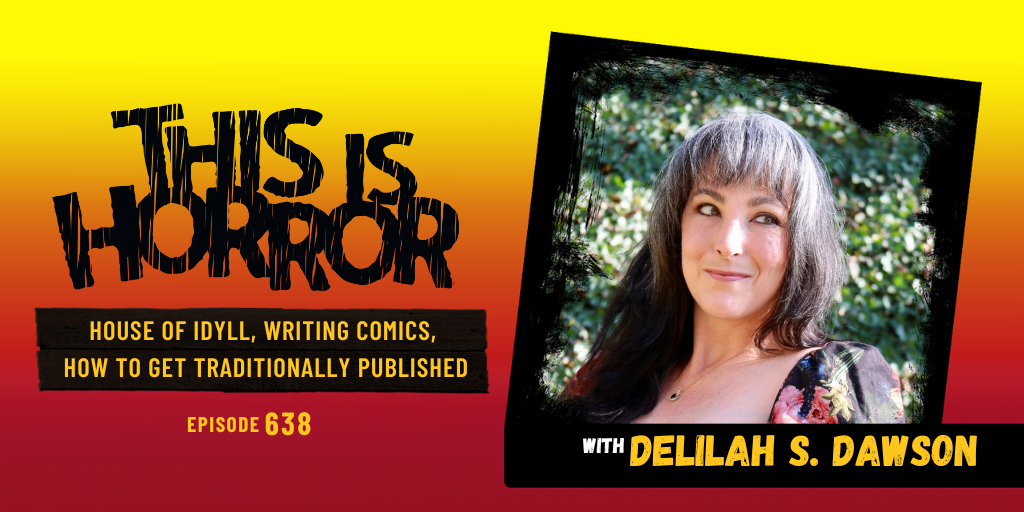
In this podcast, Delilah S. Dawson talks about House of Idyll, writing comics, how to get traditionally published, and much more.
About Delilah S. Dawson
Delilah S. Dawson is the New York Times bestselling writer of Star Wars: Phasma, Galaxy’s Edge: Black Spire, Inquisitor: Rise of the Red Blade, The Secrets of Long Snoot, The Perfect Weapon, and Scorched; Disney Mirrorverse: Pure of Heart, It Will Only Hurt for a Moment, Guillotine, Midnight at the Houdini, Bloom, The Violence, the Blud series, Servants of the Storm, the HIT series, Wake of Vultures and the Shadow series (as Lila Bowen), and a variety of short stories in anthologies such as Death & Honey, Robots vs. Fairies, Hellboy: an Assortment of Horrors, Violent Ends, Carniepunk, Three Slices, and Last Night a Superhero Saved My Life. With Kevin Hearne, she is the co-writer of the Tales of Pell series. Her middle grade works include Mine, Camp Scare, and the Minecraft Mob Squad series.
Show notes
Click the timestamps to jump straight to the audio.
Thanks for Listening!
Help out the show:
- Support This Is Horror on Patreon
- Listen to This Is Horror Podcast on iTunes
- Listen to This Is Horror Podcast on Spotify
- Rate and review the This Is Horror Podcast on iTunes
- Share the episode on Facebook and Twitter
- Subscribe to This Is Horror podcast RSS Feed
Let us know how you enjoyed this episode:
- Leave us a message on SpeakPipe.
- Write a comment below.
- Tweet us @thisishorror.
Resources
- Delilah S. Dawson Books
- Watch the video version of This Is Horror Podcast episodes, including our conversation with Chuck Palahniuk on YouTube.
The Girl in the Video by Michael David Wilson, narrated by RJ Bayley
Listen to The Girl in the Video on Audible in the US here and in the UK here.
They’re Watching by Michael David Wilson and Bob Pastorella
Read They’re Watching by Michael David Wilson and Bob Pastorella right now or listen to the They’re Watching audiobook narrated by RJ Bayley.
Michael David Wilson 0:20
Welcome to This is horror, a podcast for readers, writers and creators. I'm Michael David Wilson, and every episode, I chat with the world's best writers about writing, life, lessons, creativity and much more. Today, I am chatting to Delilah S Dawson for the second part of our conversation, in which we dive deeper into her new Titan book house of idol, as well as cover a slew of other creative and writing topics. Now for those unfamiliar, Delilah S Dawson is the New York Times Best Selling writer of so many incredible books and comics in various genres. For us horror fiction fans, you may be most interested in her horror books such as bloom guillotine and the previously mentioned house of idol, this is a fantastic conversation with Delilah. As I said, this is the second part. The previous episode was part one, but you really can listen in any order, so we will get to that shortly. But beforehand a quick advert break. It
RJ Bayley 1:56
was as if the video had unzipped my skin, slunk inside my tapered flesh and become one with me.
Bob Pastorella 2:03
From the creator of this is horror, comes a new nightmare for the digital age. The girl in the video, by Michael David Wilson, after a teacher receives a weirdly arousing video, his life descends into paranoia and obsession. More videos follow, each containing information no stranger could possibly know, but who's sending them and what do they want? The answers may destroy everything and everyone he loves. The girl in the video is the ring meets fatal attraction for the iPhone generation, available now in paperback, ebook and audio from the host of this is horror podcast, comes a dark thriller of obsession, paranoia and voyeurism. After relocating to a small coastal town, Brian discovers a hole that gazes into his neighbor's bedroom every night she dances and he peeps same song, same time, same wild and mesmerizing dance. But soon Brian suspects he's not the only one watching and she's not the only one being watched. Their watching is The Wicker Man meets body double with a splash of Suspiria. Their watching by Michael David Wilson and Bob Pastorella is available from this is horror.co.uk, Amazon and wherever good books are sold.
Michael David Wilson 3:14
Okay. Here it is. It is Delilah S Dawson on this is horror.
Michael David Wilson 3:27
So I think it is fair to say that you are a prolific writer. I mean, we've spoken about the pace that it takes you to write the first draft being roughly between one and three months, we've seen that you've written goodness over 30 books in what, just over a decade. So certainly prolific. But I mean how many books, and indeed, stories, because you're also writing graphic novels. There are short stories. What would you say is your output in a typical year?
Delilah S. Dawson 4:10
I would say three or four books a year. And then, if comics come my way, I had a period of time where I was writing majority comics. I think that was maybe 2019 so I didn't have any books out in 2020 any books out in 2020 that was my only year I didn't have a book out which you're gonna have a year without a book. It might as well be that one. But I got my tax return from my year of just like I was writing Spider Man, I was writing Firefly I was writing bit like I wrote all these amazing comics and some of my very favorite worlds. And I got my tax return. And like, that entire year writing comics had paid less than my cheapest book I've ever sold. And I was like, I don't know if I need to do comments, because I'd like to pay the bills. Oh my gosh. Comics are hard, but they're fun, so I do kind of miss them. But yeah, it's, I mean, I can write a you know? Normal comic is 2022, issues. So I write one of those in two or three days, pretty much. But yeah, no, I My whole job, basically is to write a chapter day if I'm working on a book. So if that's a kid book, it's, you know, maybe 2000 up to 3000 for an adult book. And if, as long as I do that or edit 50 pages, I'm pretty satisfied with my life.
Michael David Wilson 5:20
And so do you work on only one book at a time, or do you have one book that you're writing and one book that you're editing simultaneously, and then if an issue for a comic comes in, do you take a quick break? Because, as you said, it's only two or three days, so it would probably not make sense to be like, let me finish this entire novel. Yeah.
Delilah S. Dawson 5:47
I mean, in an ideal world, I would only you know, when I was first drafting a book, I wouldn't do anything else. But this is not an ideal world, and there's a lot going on, and I've also kind of, you know, grown my muscles to the point where, you know, in my first couple years, it would have been really hard for me to put down the hot laundry of a first draft and then come back a day or two later, whereas now I'm just used to it. So it's like, right now I'm writing a horror novella and then I'm revising a book for my agent to take out. And so while normally I would go ahead and finish the first draft, I'd really like to sell this book. So I'm going to try to power through the edit, you know, in a couple of days. But lots of times I can write, I prefer to edit in the morning, because you need a lot of brain for editing. So I'll try to edit 50 pages in the morning, and then, you know, do my workouts or my art project or whatever I'm doing, and then in the afternoon or evening, my brain feels very fluid and good at storytelling. And then I'll try to, you know, get my chapter out. And on a good day, I can do them both, but, yeah, in an ideal world, I wouldn't let anything stop me first drafting. But man, this book has had to put up with. I did a little mini tour when house of Ital came out, and I've got this revision I'm working on. I've got a comic I wrote that hasn't been announced yet. So things happen,
Michael David Wilson 7:15
and I understand on top of that, you've written a number of screenplays. But what I'm not so clear about is when you wrote them and how they fit into the picture. So I'm not sure if this is something you did before and you're not actively doing so I'd love to know a little bit about that part too. Yeah,
Delilah S. Dawson 7:36
that's a weird one. I had an idea, so I wrote this short story called Cat call that I really enjoyed. I believe it was for Uncanny Magazine, and then Gary witta invited me to put it in his resist anthology, at which point Hugh Howie read it and thought that it would make a good movie, and hooked me up with his Hollywood agents. We had a lot of phone calls. They were very encouraging, kind. They really wanted me to write some scripts. So I wrote an original script that I was super excited about, and they didn't like it, and I looked at their notes. And, you know, when the first time I ever got notes on a book, I was like, oh my god, this is a cheat sheet, like, I'm going to level up. This is the keys to the planet. I can do this now, and it, you know, I mean, okay, granted. The first time I get notes, I go through a day of grief, but once I go over the grieving process, I'm just like, this magical person has given me a cheat sheet, but I got their notes on my scripts. And I was like, I think that this is wrong, but I don't know enough to fight it, and it makes me not want to write any more scripts. So I have written two scripts, and they didn't like either of them, and I just kind of slowly gave up. But you know, I also like, if you run the odds of whether or not I can sell a book that I've written, they're pretty good odds. I can do that from home. I have an agent in place who is eager to sell my books, whereas a script I am unknown. You know, there's all these other things in place. So I would love to write scripts in the future. I feel like I was pretty good at it, but I still kick around the idea of turning that script into a book, because it's like, okay, if somebody doesn't want the script, but I also don't know what else to do with the script. You know, if these agents don't like it, then who else do I take it to and I don't really have the time to learn, you know, a third industry I know. I know publishing, and I know comics, it's like, you know, maybe it'd be cool to look into scripts too, but as long as I've got a full plate of stuff to do, I just haven't really put any more eggs into that basket. But, yeah, I was like, Okay, I've got this script. It's misery meets Heathers. And they're like, Well, no, you have to pick one. And I was like, pretty sure that's not how log lines work. You pick two and you cross them. That's what a log line is.
Michael David Wilson 9:50
Oh, man, Misery meets heifers is a compelling pitch to me. What are they talking about?
Delilah S. Dawson 9:58
I don't know. So. Yeah, if anybody hears this news, mystery meets others, script and take it to Hollywood. We've parted ways since then, and I'm available.
Michael David Wilson 10:09
There you go. Now somebody, somebody needs to do that, that you've you've sold, you've sold me on it. If only I was somebody who selling it to meant a damn thing. But, you know, we've got a number of people in the industry who do listen. So you know who to contact. And I mean that the British horror writer, Adam Neville, he's written a lot of screenplays, and I know that some of the ones that he didn't sell, He then wrote the novel version. So a number of his more recent novels in the last 10 or so years have originally been screenplays that he then fleshed out. So I mean, if you talk about a road map and having a plan. If you take your screenplay and then you turn that into a novel, I think that is, it's a viable way of doing it. And then maybe, because one would assume that the book would be quite cinematic, perhaps you've now enhanced your chances of that being adapted into a film. Or, you know, they could take the script that already exists, that you've written.
Delilah S. Dawson 11:24
Yeah, I've, you know, it's like, I'll get to a place where I it's pretty rare that I get to a place where I don't know what I'm writing next. But every now and they'll be like, Oh, I could do anything. What'll I'll do? And I very rarely think I should go back to that thing I already did. So I haven't, you know, thought to turn I haven't had the I mean, I had the idea, but not like the impetus to turn the screenplay into the book. But also, I brought it up to my agent recently, because I'm getting to that place where I'm running out of things to write that aren't under contract, and she wants me to write ya. And I was like, I've got a great story. It's misery meets Heather's and she was like, why a contemporary horror is not selling? And I was like, okay, so publishing is weird,
Michael David Wilson 12:07
right now, yeah, and it seems like as well, but I guess, like, this is only an issue because of your prolificism and because you've got so many books, but you're then kind of having these conflicts of contracts. You're then having to work out, right, what can I am I actually able to, I mean, not, not to write, because you can technically write anything. But what can I write that can then be allowed to write, right? Yeah, yeah. So which is
Delilah S. Dawson 12:42
how the novel is came about, because they're not considered full length works,
Michael David Wilson 12:46
yeah, yeah. I don't know what happens. Kind of next? I mean, goodness, you're doing novels, you're doing novellas, you're doing comics, but you're still quicker than the contracts allow
Delilah S. Dawson 13:01
one time a publisher was like, you know, we would like Delilah to slow down and write less. And I was like, then you're going to have to pay me more, because that's how that works.
Michael David Wilson 13:09
That's it. Yeah, yeah. I don't know have have you serialized novels? Is that? I mean, I'm trying to think, what's the gap? What have you not done yet? Can you go old
Delilah S. Dawson 13:22
school? I mean, I could do chapter books or picture books. I could, I could go down. I have some friends who are doing the writing on cookbooks, because they're putting out a lot of, you know, like the the Stardew Valley cookbook and the Wednesday cookbook, which my friend Mary wrote word you know, it's like, that could be, you know, maybe a thing that I could ask to do, but right now, I have one and a half books and two short stories and a comic to write before Christmas. So like, I'm good,
Michael David Wilson 13:52
yeah, and if you were writing cookbooks, I understand that might also incorporate another passion. I believe you're a fan of the show Bake Off.
Delilah S. Dawson 14:04
Oh, yeah. Oh, I just finished the episode this week's episode today. Yeah, I can't eat gluten, so I have had to become a pretty decent Baker. And so watching Great British baking show is kind of like the most exquisite torture, like you can't have it. And even if you could have it, you can't have it. Like, there's a couple years ago, Howard was cooking with a lot of gluten free flour, and that was very exciting, but for the most part, it's Oliver Bowden.
Michael David Wilson 14:30
I completely relate. I haven't eaten gluten for about nearly two decades now, and so like to begin with, like, if I was looking at recipes, I'd look for gluten free. But recently, and it's probably happened with you too, I've become so kind of adept in terms of how to adapt these recipes. It's like, right? Find the original because that's normally the good stuff. And then, like, let's just make our own substitution. So there's a lot of like using rice flour or possibly almond flour, or any kind of alternative gluten free flour, but I do tend to find rice flour is better than almond flour, just because it's a more neutral taste.
Delilah S. Dawson 15:19
Well, I mean, over here, the gluten free flours have gotten so good, you know, they already they have kind of like a mixture that gives you a little bit of chew and then the stickiness, and they've already got the xanthan gum in there. So, you know, I have my two preferred brands, and I just buy whichever one is cheaper at the time that I need to buy flour, because almond flour just adds a lot of calories. So, yeah, I think I use one for one, and King Arthur. And it's like, that's fine. And over the years, we've developed, you know, we have, like, a recipe box where we have found our favorite, like, you try the different recipes, and then you get when you're like, Oh, this is it. This is the best one we've ever done. And that one goes in the recipe box. You don't have to go online and sift through them. But it was like, gluten free brownies is the hardest one, because brownies you need that, that kind of toothsome chew, and it's really hard to get. So once you find a gluten free brownie recipe, you're like, no other this is it.
Michael David Wilson 16:14
Yeah, I think the flour that like if I want to buy an all purpose one, and people listening you're like, hang on, what the fuck I don't this was a horror
Delilah S. Dawson 16:24
show. Okay, so Michael Bloom is very baking adjacent, yeah, yeah.
Michael David Wilson 16:32
But the flour brand, for me, I think, I think it's called something like Bob's old meal or something like that. That's not the
Delilah S. Dawson 16:40
chickpea one, but the regular flower one is pretty good, right? Yeah, you're like, I don't want to eat a bean cake. Yeah,
Michael David Wilson 16:47
you don't want something where the flavor is, is too distinctive. But talking about distinctive, we're back to your writing, because you have such a distinctive voice, and I want to talk a little bit about House of idol and guillotine, both of which I really see as companion pieces. And for people watching the video, they are they are behind you. They are in view. And I mean, thematically, they're both very much about about power, about abuse of power, about wealth, of longing for fame or artistic success, and, of course, about manipulation. So let's start with House of idol, because that is the latest one. What was the origin story and the Genesis when it came to writing this book?
Delilah S. Dawson 17:48
Well, that is another thing it has in common with guillotine, is that they both came from BuzzFeed articles. So yeah, for House of it all, there was a Buzzfeed article that just had a picture of Jared Leto wearing like, white Jesus robes and aviator sunglasses, with his hair billowing in the breeze, walking along the beach, followed by like, 30 people wearing white where? And it was like, Is Jared Leto starting a cult? And I was like, I don't know, is he, you know, just thinking about it, where you're like, that's Jordan Catalano that I used to watch in my soul called life. And then he was in Fight Club, and then he got an Oscar and a Grammy, and then he went platinum. And now he sells out stadiums, and now he runs a cult. And so without digging too deep, I just kind of extrapolated from that. You know, how, how would someone get that many accolades and that many good breaks and that much luck. And then I came to my own conclusions about, you know, how insane wealth is garnered,
Michael David Wilson 18:49
yeah, and in terms of the musical influence, I mean, that is, of course, very present throughout, particularly because, I mean, you've got liner notes that, I believe, start every chapter different albums that seem to be different seasons of the band. So we're again, we're visually getting that now so that, this is why you gotta, you gotta watch the video version. Tell, yeah, yeah. But I mean, were you listening to music whilst writing? Do you listen to music whilst writing? And if so, is that to evoke a mood, or is that? Is it just anything goes
Delilah S. Dawson 19:40
well when I first started out, like I said, I had to kind of immediately get into the mood to write the second I had a chance to write, because I had very limited time. So I would condition myself through playlists. I would make a playlist. It felt like the book. And when I was driving the kids around or cleaning the kitchen, I'd be listening to it and thinking about whatever scene was happening. Next that when I sat down, I could dive right in. And when I heard that song, I was like, Yep, here. Click where we're going. I don't really have to do that anymore, because I have, you know, as much time as I need. But on Spotify, I'm Delilah S Dawson, and there are book playlists going all the way back to wicked as they come, that are named after the books that they're named after. There's one for House of Ital, that are songs that feel like House of Ital, just because it seemed like the right thing to do, to put in songs that felt like the book. But, yeah, this one is really cool, like so Titan, they bought the book bloom, that I wrote for my daughter. That's my girl, Hannibal. And you know, others don't always get a ton of input into their covers, but I had a real idea for what I wanted, so I made a piece of artwork and I put it up on my Instagram, and I tagged my editor, and was like, if I could have whatever cover I wanted, it would look like this. And so the cover they did was based on my piece of artwork, but vastly improved, because Julia Lloyd is amazing. So bloom was just the prettiest book I'd ever had made, like it's got the end papers and the cover, it's so beautiful. And then they did guillotine too, and it's so pretty. And then I stopped in London on my way to a French Star Wars convention, and went and met my publishing team at Titan. And I got to meet Julia, the cover artist, and meet my editor, and I had grown enough familiarity with them that when this book was being written, where I was like, Hey, I've got liner notes. What if we did a little CD thing? And, like, but, you know, I've, I've written out all the different albums, because they go through little phases, like, they start and they're kind of, you know, punk, pop phase, and then they move into kind of EMO, and then they have, like, their kind of spiritual phase, and they get into their more theatrical phase. So there's the different album names and the different songs. I was like, what if we did the liner notes, like, you don't have to do a whole stuff, but just maybe, like, a different little piece of artwork, and they were totally on board for it. So I feel really grateful that I had the experience of they were so open to my artistic thoughts previously that I felt comfortable asking for that. Because it's, you know, it takes that kind of relationship, I think, sometimes, to have the idea and the audacity to do these kind of weird things with books that you've never done before. Like, I've never written song lyrics before, but actually, my husband has turned one of those songs into a song you can listen to. So the book is very music themed from front to back.
Michael David Wilson 22:24
Is that something we can listen to online? Is that available?
Delilah S. Dawson 22:29
It is, pretty much anytime I put house of Ital on my Instagram, it's it's used in the video, it's in the official trailer for House of Ital. So I can post that again if people want to hear it. But yeah, I am my husband plays guitar and piano and studies music theory. He's written his own musical. So he was like, pick a song you like, write out the whole lyrics, and if you can, like, hum something for me. And so I hummed it for him, and he made it into a song which is just so freaking cool. So, yeah, it's in the official trailer. Yeah, played it. We did. I did a quick little, a quick little book tour, and I stopped at the twisted spine in Brooklyn, which is the most amazing horror book shop, if you're ever near Brooklyn. They are incredible, and they we like. We played it there for the audience. That was really fun.
Michael David Wilson 23:19
This is becoming clear just how multifaceted and talented your husband is like every every question, there seems to be a new talent that I discover about him. So I'm not only learning about you, but I'm learning all about him and his various
Delilah S. Dawson 23:36
skills. Since we met, we met my freshman year of college, and we had one kind of year off of temper tantruming that we've been together since then. Yeah, nah,
Michael David Wilson 23:47
that's amazing. And, I mean, one must assume then he's, he's into similar music to you, to have, you know, written the song for your book as well, but it sounds like your music taste is fairly varied. Anyway,
Delilah S. Dawson 24:03
it is. I think when I was younger, I was much more attracted to sad music, and I think I used it to help, you know, get my feelings out. Now, most days, walking around, I'm like, an eight or a nine out of 10 on the happiness scale. I'm just a happy I'm just a happy little guy and, like, unless something really terrible happens, I'm in a good mood. So I mostly listen to happy music. I've been into K Pop lately. I listen to BTS and stray kids. Weezers, one of my favorite bands of all times, ghost, My Chemical Romance, the cure. I just, and yeah, the cure, there's some of their sad stuff still gets me and they're on all my playlists. But yeah, I just, I like being happy these days, so I don't dwell as much kind of in the darkness as I used to. But if you listen to the house of Italy soundtrack, there's a lot of darkness in it, if not necessarily sad, like the Death tones feel like every deaf tone songs, to me, feels like you're just hurtling through space amidst the stars. You know that kind of feel to it.
Michael David Wilson 24:55
And I wonder, is there anything that you attribute your Hap? Happiness too? Or was there a pivotal moment when you know you went from being rather sad and you know like very understandably, given what we've learned about you through this conversation and from your childhood? But was there a turning point where you became happier.
Delilah S. Dawson 25:22
There's a couple of signpost moments. I was pretty unhappy as a kid. A lot of my poetry was very sad. So I had a suicide attempt in high school, and I lived through it. And I remember the that day just sitting outside and being like, you know, the wind on my skin feels really nice, and like the sand in my toes feels really nice, and this is the best meal I've ever eaten. It's like they say in Fight Club, like tomorrow, today will be the best day of Raymond K hessels life. Like everything after that, I was like, this is pretty good. I like writing with the pen. I like looking at fish. And I was just a much happier person because I realized in that moment I really didn't want to die. So since then, I've had a much happier Outlook. I'm also like a very sensitive person, what they call it, like a hypersensitive person, where, like, noise physically pains me. If I'm too hot, I can't function. If there's a tag in my shirt, I can't think of anything else. So all through college, everybody just thought that I was a really complainy bitch. It turns out I was just super sensitive and did not have a way to communicate it. So it's like, as I got older and learned to better anticipate my life's needs and not put myself into bad situations, I was less and less unhappy because I wasn't doing stupid things that made me really unhappy. And then after having kids, something else broke in me, like I said, my brain just changed where I was much more easy going, because suddenly, instead of me worrying about my needs, I have to keep these two people alive. And so at each of those points, it was like, you know, you make the decision where you're like, Well, I can be a real miserable jerk, or I could just kind of be happy. So now I'm very happy. Go lucky and have I call it, oh well, where it's like, something bad happens. You're like, Oh well, I'm gonna keep going. Like, you can't really stop me. It's just gonna keep happening. So it's been a lot of changes. People who knew me, you know in high school, I'm a different person in a lot of ways, and a lot less miserable, but I also wasn't aware how much sensory input really upset me. And as I've watched my daughter grow up with something very similar, except she's free to express it, whereas I wasn't. My dad just thought that I was complainer who did nothing but complain. And whereas with her, we were like, Oh, you're in physical pain. Let's help you with that. You know, and helping her understand herself. I've understood myself better and understood, you know, I'm on the spectrum, and I have ADHD, and my brain is real weird and not normal. So that's all these, these kind of little epiphanies that lead the way to where you're like, oh, you know, I just doing all right. Now,
Michael David Wilson 27:58
when did you discover that you had ADHD, and what do you think were some of the kind of realizations or pivotal moments that then helped you live a better life? Note knowing that about yourself?
Delilah S. Dawson 28:17
Well, it started with, I have synesthesia, and it became an issue in kindergarten, because I would constantly correct my teacher. Every day they would put a letter on the wall and it was always the wrong color. And so I would be like, This is wrong. W is not yellow, W is pink. And she'd be like, No, this is the color pink. And I'd be like, yeah, dummy, I know what pink is, and that's the wrong color. And so I would get letters sent home saying that I was argumentative and that I didn't understand my colors. And really I was trying to explain that, like, no, a should be red, not green, like, you've got this very wrong. So I didn't know what any of this was, and my mom didn't understand what I was saying either. And I just thought that all numbers and letters were colorful for everyone all the time, and we had all agreed on this, and yet the teachers were jerks about it. So when I was about 17, I found out, if it's, found out that synesthesia was a thing that existed, and it was like, Oh my God. This whole time, I thought everybody did that. I did not know I was weird at all. It just, it was startling. So that was kind of the first time I realized that, you know, there was something that was going on and that I had felt like an alien my whole life, and there was kind of at least this one small reason, but I was, like a very high achiever. I was the high school valedictorian. I graduated college with honors. I was just that kind of person, and then didn't think about it for a long time, because you know, when you grow up in a kind of oppressive household where your needs are kind of shoved down, you just find processes that allow you to function so that you don't inconvenience the adults that will pop. An issue if you make them mad, whereas my parents would be like, we are going to feed you a milkshake and then put you in the back of a car with no air conditioning and driving on the highway. Why are you always sick? You're always sick. Stop being sick. Maybe don't give a kid a milkshake in 90 degree weather on the highway. But they never thought that. They just thought that I was annoying. Anyway, when my son was in elementary school, he had a really bad time, and we pulled him out of school, and I started homeschooling him, and within a couple days, I was like, Oh, dude, you got ad. But you know, I didn't know this, because he did most of his learning at school, and I just saw him as a really energetic kid, and I had to help him get his energy out in specific ways. And it was just like me as a kid, where I was like, You need help. I will help you process it. This is fine. If I need to hit you with pillows every night until you can go to sleep, that's fine. But then I realized that there was actually something going on, so we went and got him his full diagnosis, and immediately, kind of doors started unlocking where it's like we could help him, and we could help teachers understand him, and we could go to the school and say, Hey, give us your nicest, sweetest teacher. Don't give us a mean old battle ax. Don't put him in honors classes. Just be nice to him. And it changed everything, because he went from a kid who hated school to a kid who didn't mind it. And then my daughter started having some things too, and so we got her diagnosed, and we found out that she was autistic and had ADHD, and the first, the first diagnosing doctor didn't catch the autism. And my daughter was super mad. She was like, You did this because you told her I was normal. And I was like, You are normal. And she was like, No, all that stuff is weird, but you do it too, so you don't know what normal is. You think it's normal to line up your my little color ponies in color order. And I was like, That is normal. And she was like, No, it's not normal. People don't eat their Skittles in color order. And I was like, what do they do? Just eat them out of the bag like a monster. And she was like, Yes. And I was like, that's disgusting. So after we got her diagnosed, she was like, buddy, I've got some news for you. And then we got mine, and I was like, that my whole life, I thought I was an alien and that I didn't understand people at all. And the first time I went on a date with my husband, I called my mom and said, I don't know what I am, but I found another one. And so it was like, this whole beautiful situation where we just all found out we're just weird as hell. And we were like, oh, that's what's happening. And it was just really lovely and comforting and amusing, and it just answered a lot of questions. And then I you trace it back to like, you know, my grandmother who couldn't touch soft things, and my grandfather who only cared about tomatoes and the law, and my great grandfather who could build a building without drawing plans, and could just knew how where to cut the wood. You're just like, oh, we were this went way back, but nobody ever thought, you know, oh, Jewel is autistic. They're like, Man, that guy can build a house. So it's, it's a it's, it's been wonderful.
Michael David Wilson 33:12
And so for people who are listening, who either have children with ADHD, or they teach children with ADHD, what would you kind of advise in terms of things to do and things not to do? What could be helpful in kind of making their lives easier?
Delilah S. Dawson 33:37
Well, kids who have ADHD, especially boys, hear like 10 times more criticism than regular kids. It's just this constant marriage of sit still, be quiet, sit down. Study harder. You're not doing this. Stop doing that. Stop fidgeting. Their whole lives. This is just what they hear. The biggest change for my son was we put him in a private school, and we said to the teachers, if you make him sit in a chair and not move. You're going to hate each other if you just let him move around the room. It's great. He just wants to be in constant motion, and he will listen to you, and He will do fine. And he did. So, you know, when something isn't working, I think the biggest understanding was he would act out, and we thought, Oh, he's being manipulative. Or, you know, he's trying to get what he wants. Yeah, what he wants is to not be in pain. And for kids whose brains work in a different way, sitting still is pain. Not being able to ask a teacher questions without getting in trouble is pain. It hurts them, and they are trying to escape that. So just letting him be himself and learn in his specific way was a life changer. We found a wonderful therapist who had ADHD and was on the same kind of vibe as him that he could just talk to, which helped a lot. And just being told like you're okay, this way, we love you, this is all right, like your teacher was a jerk. You. No one ever said that to me when I was a kid. They said, Well, if the teacher didn't like you, then you must be doing something wrong. And I was like, I hate that woman. Mrs. O'Connor is a jerk. She's a bad person. She made you an innocent child feel bad for being yourself. That's not how to be an adult. I will, I will take my dislike of that woman to the grave. But yeah, it's understanding and just unconditional love. And you know, it's like I understood with him that every day we had to throw the football or go for a walk or kick the soccer ball or play basketball, that there had to be this physical component to get the energy out so that he could relax to what the rest of us consider normal, and so that's what we did. We had games where we would hit each other with pillows, or I would throw stuffed animals at him, but it was like there had to be this physical, kinetic exchange of energy, and then that's what made it okay. Whereas my daughter needed to be alone in a cold, dark room and not be touched, complete opposite of that. So just figuring out what someone needs and helping them obtain it in a way that works for everyone.
Michael David Wilson 36:05
I think the theme of today's conversation is just empathy and understanding and listening to people, let people be weird. Yeah, yeah. And you know, to go back to how survival because, because this is also the theme of of the conversation, just jumping wildly from topic. Yeah, there you go. And it is certainly on brand for this as horror as well. That is kind of how I do things. And I mean, in a sense, this is a twisted love story. And I mean, what one of the moments where it's like, wow, the kind of the jesperide or the antagonist, I suppose he doesn't operate by normal rules, is when he's done something shitty to the protagonist, Angelina, and his response is to write a full on song as an apology. So where did that moment come from.
Delilah S. Dawson 37:22
I mean, I feel like it came from. Say anything, you know, the moment where Lloyd Doppler holds up the boom box. Everybody swooned as a kid and as an adult. I'm like, Oh, my God, he's such a bad boyfriend, like girl run away from him. Oh, the difference in how you see that movie from from a, you know, 14 year old to an adult, but that idea that there's this kind of little boy that just thinks, if I make a grand gesture, I can keep being crappy, and I don't have to apologize or change it all. But because that, I mean for most of us, if you took the lead singer of our favorite band who is beautiful and interested in us, if he wrote us if he wrote us a personal song, most of us would just kind of black out and be like, Oh my God, he's amazing.
Michael David Wilson 38:08
So yeah, and this is the dichotomy that the protagonist, Angelina, is constantly up against, because on one hand, she's been invited to this luxurious compound for this kind of half retreat, half cult, this thriving community. But and you know, she's loving it at points, and particularly as you say, she's got the affection of this man who she has idolized, who she has looked up to, but then she'll have other moments where it's like, wait a minute, there is something deeply wrong going on. But then because of who Jasper is, and this is whole the kind of power dynamic and the abuse of power, she will allow these things to slide. So you've got this back and forth, which obviously creates great dramatic tension for the reader and the story throughout.
Delilah S. Dawson 39:16
Yeah, part of part of writing horror is that your main character has to, they have to have some reason to ignore the red flags, because if they saw the red flags, there wouldn't be a story, you know, like if the family and the poltergeist walked in the house and felt the vibe and turn around and walk back out, we wouldn't have poltergeist. So Angelina, kind of, you know, starts with nothing on the worst day where she has the choice, but each time there has to be a reason for her to, you know, willfully ignore the red flags, or be able to write away the red flags. So in. If you haven't read house of Ital, it's about someone who is invited, a singer songwriter, who is invited into the kind of all expenses paid luxury artistic Think Tank compound that's sponsored by her favorite band growing up. You can imagine, like the biggest band in the world, we all wish that billionaires would use their money for good. And this one is they have this place where they are nurturing the next generation of artists paying for your tiny house and your food and your electricity. So instead of, you know, struggling to hold down a job, you can just focus on your art, which sounds great. And I think it's also kind of like, you know, Angelina is having one experience the other artists that have been invited into the house of Ital, the luxury compound. They're having a different experience, in the same way that if you have a field full of sheep, all of the sheep are having a pretty good time, except the one that gets chosen to go into the back of the barn. For all of the other sheep, they're like, this is great. There's grass, there's no predators. I'm having the best day. But for that one sheep, they're like, oh, wait, I don't this doesn't feel good to me, but we just happen to be following that sheep instead of the ones that are having a good time. So from one point of view, the band is doing a a mitzvah. They're doing a good thing, and they're helping the next generation. It's just that someone has to pay the price for that, because such things are not, are not communally free.
Michael David Wilson 41:21
Yeah, the two things that I've watched relatively recently that I don't were kind of in the same genre as both House of idol and guillotine. Are the movie the menu, which I then saw, was actually one of your comparison pieces for for guillotine. And then
Delilah S. Dawson 41:43
after guillotine was written, and I was like, Oh, God, this is really close. Yeah.
Michael David Wilson 41:49
So I, as I was reading it, I was thinking, I think you would really like the menu. I feel this is a kind of similar piece. And then the other thing that it reminded me of to some point was there was a Netflix TV series with Nicole Kidman called the perfect couple, and I think particularly because, because of the whole power and wealth and and the signing of NDAs, That was kind of what sealed it for me. But, yeah, it's just this marvelous sub genre of well of exploitation, which now sounds problematic to call it mark, but it is. It is marvelous for storytelling. Certainly, it's so ripe for possibilities. Yeah, it's
Delilah S. Dawson 42:45
I also have, it'll only hurt for a moment, which is set at an artist's retreat, but because I've started going to this writer's retreat. Now, you know, I've got this sense of under the right circumstances, a retreat is such a gift. You get to go away from your life to this place where things are taken care of, and you can focus on on your art or relax. But you know, in doing so, you are vulnerable in a different way. And if there is a power dynamic caused by a wealth disparity, things get really weird. It's very fun to play with, and it's very fun to take the expectation of, oh, this will be a very nice time, and then be like, but what if it wasn't,
Michael David Wilson 43:30
yeah, it sounds like you are not done playing in this particular arena. And you know, there's something so fast paced and compulsive about your style as well, which is very attractive and appealing. Because, I mean, when we start a story by you, we are thrown in to the moment. There's no messing about, you know, we know who the characters are. We know what the stakes are, and we are put into what usually becomes one of the worst moments of their life.
Delilah S. Dawson 44:10
Yeah, I you know, you have a book like the violence just a big chunker, and it's almost like killing somebody with toenail clippers just clipping at them forever. And a short story is kind of like being stabbed in the gut. And these novellas, you only have half a novel, so you've kind of got to get in there and get out pretty fast. So they do have to ramp up pretty quickly, or at least have some creeping dread injected pretty early.
Michael David Wilson 44:34
And so when you're writing each chapter, particularly because it sounds like not every chapter is meticulously planned. When you know that the chapter is about to end, are you almost having impulsively, if there's nothing planned, having to make a snap decision. It's like, right? What bad thing is going to end this moment? Yeah,
Delilah S. Dawson 44:57
you always have to end the chapter on some. Reason to make people turn the page. When I teach writing classes, you know, I always use the example of like, you can say, you know, and then she fell asleep happily in her bed. You can end it that way. And then the person reading the book is like, cool. She's safe. I can put this book down and get on with my life. But if you say, and then she fell asleep in her bed until she woke up to screaming suddenly, they have to turn the page to find out why they're screaming. So, you know, it's always fun to to kind of torture people and draw them through the book in that way. But it is also really fun in that because horror books for me are such an exploration and an adventure. Sometimes I get to the end and I don't know what's going to happen next. And you know, that's I think that happened at one point in this where I was like, Oh, what if she just hears horses screaming, and then, you know, the next day, I had to figure out why the horses were screaming. I didn't know. We figured it out.
Michael David Wilson 45:50
Yeah, I mean, you achieved the idea of keeping people turning the page. You just created a new problem for yourself.
Delilah S. Dawson 46:00
But it's also like, it's challenging, it's fun. I mean, it's like, every day I wake up and I start the day by doing a whole series of puzzles with connection, strands, Wordle, door actor, Lee Squirtle, blossom like, I want, I love that kind of improv level of, okay, now you have to do the thing like, I really thrive in that. I think that's why, you know, I do a lot of panels at Comic Cons, more so than I would do say a keynote speech, because I feel like I'm better in that improv position. Of this is happening right now, and now we have to perform as compared to at home, me coming up with a speech, I don't enjoy that nearly as much as being on spot.
Michael David Wilson 46:37
And so, of course, as well. This kind of dramatic writing is incredibly cinematic. So we mentioned you writing two screenplays. But do you have any film or TV adaptation, news or possibilities in the future? Because it seems insane to imagine a world where these are not made into movies or television series.
Delilah S. Dawson 47:09
I feel that way every day, like I have so many friends who have things in the works, and I don't know why my work doesn't get into those same hands, we sold the rights to Lady Castle, my comic. Briefly, we got all the way to a great script, Jennifer Hutchinson, and then Disney ate new line, cinema or whatever. Whoever had owned whatever, it ate them, and they killed every project. And then the violence was also in the works. Frida Pinto's company had bought that, and we were really excitedly moving forward, and then that company got eaten by another company. So that is my dream. Like every time my email Bings, I think maybe this time I'll get to see something of mine on the screen, but it hasn't happened yet. But God, I want it too. Well.
Michael David Wilson 47:56
Fingers crossed and you're right. In enough exciting stories that come on, there's, there's over 30 of them somebody's got to pull the plug on.
Delilah S. Dawson 48:07
Would be so fun and, like, it's very Interview with the Vampire season three. Like, we're about to have the vampire rock star Lestat, like, why not?
Michael David Wilson 48:15
Yeah, yeah. I mean if, if any of them were tailor made for that kind of TV. Mini Series is house of idle, right there? Well,
Delilah S. Dawson 48:27
and then guillotine would be very fast and fun, and bloom would be super easy, like all you need to film bloom. Or it's like two houses in North Georgia, like it is not hard.
Michael David Wilson 48:38
Yeah, there you go. So we're hoping now that film executives are listening so that they can make that happen, but it is the feel in terms of the film rights is that something that your literary agent is also kind of connected and involved in, or is there a separate media rights agent? How does that work?
Delilah S. Dawson 49:01
Yeah, I have a media rights agent with ICM. I have she sells, like, I share an agent with several of my friends, and she's able to sell stuff for them. So I don't know why my stuff. It seems like, if you have one project that gets, you know, up into that orbit and gets people talking, they tend to buy more and more of your stuff, but it's like you have to reach a level of crucial mass and an excitement around one project before they buy the next ones. But I don't know why my work doesn't get there.
Michael David Wilson 49:31
Well, hopefully it is more a case of when, rather than if. So as I say, I'll be keeping my fingers crossed. Anyway, me too. And so we have mentioned you writing for comics, but what I'm interested in is, how did that happen? How did you get your start?
Delilah S. Dawson 49:54
This is a fun story. Okay, so I was trying to break into comics. Comics. You know, as soon as I started giving novels published, but I can tell you how to get a novel traditionally published. I can't tell anyone how to get a comics published. There is no one way to do it. Everybody who came to it came to it sideways. So I managed to get into the monkey brain press boo anthology. It was a free Halloween anthology. I did not get. I think I might have gotten, like, $6 or something. Anyway, it was like, it was a $6 a six page comic. They hook you up with an artist. I got to write three of those. I was so grateful for it, but that's all I could do. I couldn't get any anything else. So I was at Gen Con in 2015 and the person running the literary track, came and said, Hey, do you write comics? And I was like, Good god, I'm trying to, but I'm having trouble. And he was like, oh, I need someone for a panel called How to write comics for women, because we just realized it's all white guys. So I was like, Sure, I can do that. So I got put on this panel with teeny Howard, Chris Roberson, Gene Hap and Jim zub and the moderator was so aggressive that The Mary Sue did like a two day expose on it. People were real mad about it. It was just a misogynistic, bigoted on the side of the moderator. All of the panelists were lovely, and we're trying really hard to steer this in the right direction. But it was a mess. And I ended up at one point saying, like, I can't break into comics. I can't get my foot in the door. I don't know why I have, you know, these books out, I have a good reputation. I don't know if it's related to being a woman, but boy, am I having a hard time. And apparently a editor at boom press read The Mary Sue article and read my quote about that, and emailed me and said, you know, if you'd like to pitch me, I'd love to hear it. And so I pitched him comics, and he chose lady castle, and that was my first comic. So you know, the worst panel of my life became my key to comics. And of course, when I sold the comic, I had never written a comic, and so I had to learn very fast. And my first script was such a mess. There was so much I didn't understand. It was like three times longer than it should be. I had like, 40 speech balloons on every page. It was just I got my edit letter while I was at a hotel, and at the hotel, they were having a Santa convention. And so I was having a nervous breakdown at the breakfast buffet, surrounded by guys dressed to Santa, going like, Oh, it's okay, little girl. And I was like, I can't write a comic. I'm so bad at this. I'm not used to being bad at things. So it was just the whole experience was surreal. But I, you know, leveled up, got the comic done, and then I got my next break in comics, because I was, at the time, the only female writer who could write comics and who had read the script for The Last Jedi, and they needed someone to write a rose Tico comic, and I was the only intersection of the three things that they needed. So I got to write my first Star Wars adventures comics. So it's all like, you nobody can replicate that. Like, I can't say, like, Oh, if you'd like to be in comics, be on a real bad panel, and, you know, then be the only person that's been flown to San Francisco to read a script. Like, it's so weird and
Michael David Wilson 53:15
random. Yeah, I don't think anyone wants to attempt to, you know, replicate it, because then it requires finding the misogynist to put on the panel to begin with, by this dude. Yeah, yeah, I presume, and I hope that after that happened and the expose that that guy is now gone from the industry.
Delilah S. Dawson 53:43
I have not looked him up in a while, but I also haven't seen him at a con, so I'm sure he's just still raking in from whatever he'd done before, but I have not had any further contact with him. Yeah, yeah.
Michael David Wilson 54:00
And I mean, you said, you know, well, you couldn't tell people how to break in to comics, but you could tell people how to get a novel traditionally published. I know that my listeners will be angry with me if I don't follow up on that. So for those who are looking to get traditionally published. What advice could you give them?
Delilah S. Dawson 54:26
Well, if you don't know the method, the quick version is, you have to have a fully written, well edited, copy edited book. You don't have to pay anybody to do that. You can do it yourself. But you have to have a complete book. You can't sell an idea, you learn how to write a query letter, which I would suggest doing that by reading the query shark blog, which is where agent Janet Reed tears apart queries in real time and tells people exactly what she's thinking and how to fix them. There's over 300 on that site, and if you've read them all, you are going to be in a very good position and better. And 90% of querying writers. Then you use query tracker and Agent query, and I think even ms, WL these days, but there are these sites that help you find agents, where you can search, where you can say, Okay, well, I I want to, I'm writing a middle grade book, and I'm looking for, you know, an agent who's open to submissions, and it'll hook you up with them, then you send them your query letter and keep a spreadsheet of who you've queried and who you haven't. I used to send out three queries at a time. If I sent out five queries and got all flat rejections, I would rewrite the query from the ground up, because I told me that the query wasn't working. Once I started getting some nibbles, I would keep that query and if the first pages got rejected, I realized I had to fix my first pages. Don't use diarrhea on the first page. I did that for a while. It was real bad. They don't like that. So, yeah, it's, it's, if you're going to be looking into getting published, look at Writer's Digest. Has classes and information. Be sure to look at writer beware, which will tell you about the names of fake agents and vanity publishers and general people that will prey on you, because there are lots. There's lots of money to be made off of new writers who haven't done all of their research. But yeah. Basically, the query process is you just keep sending out query letters. If you run out of agents to query, without getting an agent, you write a new book. I would say, like we said earlier, just start writing the new book while you're querying the first time around to take your mind off of it. But yeah, like, that's the process. You can query infinite books like nobody's counting, nobody is keeping track of that. You can query as many books as you want, and every book that you write, every word that you write, helps you level up and get the skills to, you know, hopefully get the help of an agent, and that's how you get traditionally published, which is how I wanted to go from the start, because I don't want to be in charge. I don't want to choose my covers and do my own marketing and find a distributor and figure out how to do an ISBN just sounds like a lot of work.
Michael David Wilson 57:00
And so I wonder, since becoming traditionally published, does that alter at all what you write in terms of either stylistically or the content or creative decisions that you make, or are you just, you are writing whatever story comes to mind, whatever character decisions present themselves to you. I'm just wondering if, if there's a difference in approach now that you're published.
Delilah S. Dawson 57:36
Um, I mean, I've, I always wanted to be published, so I always wrote from the position of, you know, I want to write things that will get traditionally published. So I wasn't, you know, writing a Amish erotica slasher. I was always, you know, trying to hit that vein and tap into it. So I do think about, you know, sellability and what's going on, but at the same time, when I get an idea that really, really gets me excited. There's been several times that my I've run the idea past my agent, and my agent has said it's not really selling. I've been like, don't care doing it anyway. The main one of which was Wake of Vultures, my agent at the time was like, please don't write that. I can't sell a weird West and I was like, don't care. Writing it anyway. I already got the tattoo we're doing this, and that that book sold, and it's, it's earned out, and it's gotten, you know, multiple stars from things, and it won two awards. And so sometimes, when your heart tells you something is strong enough, you know, that will find, you know, ready, soil in readers hearts as well. Other times I have done that same thing. Been like, don't care, writing it anyway, and then it didn't sell. And I was like, you were right. I'll do something else, but you just have to be ready. So much of being a traditionally published writer is rolling the dice, and sometimes the dice are not going to come up the way you want.
Michael David Wilson 59:02
So I'm wondering, what is it that frightens you? I mean,
Delilah S. Dawson 59:09
it's like these days, it's just the main thing that frightens me would be like something happening to the people that I love is kind of, you know, the big one, but that's not a very fun one, like, that's not even what I want to feel around in books I don't even know if I could read. If I could read pet cemetery now because I have had a little blonde son that would dart into traffic. But I do really enjoy exploring in books the moments when liminal spaces become frightening. You know, places that should feel safe and okay under the right circumstances are suddenly the Scariest Places on Earth. I really enjoy those moments. And let's see here. Let's get like. It's I like I'm writing. I'm revising one horror book and writing one right now. And the one that I'm revising has, I have that one on the mind, and I'm thinking of, like, lots of the things that I included in there that are mundane but are scary. Like, the thing that I think about every time I'm home alone is, what if I choked right now and there's, like, no one here, and you can't call someone and say I'm choking, you know, it's the little stuff like that that scares me. Or the other day, I was just walking down the steps and I missed a step, and you're like, if I fell down these steps at night, like I would just die. So, you know, the things that scare me aren't fun, whereas the things that I like to play with, I think are pretty fun. Yeah, I'm trying to think of more fun things that scare me, but it's more getting playful with things than than tapping into my my actual real fears. Like, it's not fun to be like, I could get dementia. Like, that's not fun for us to talk about, but it's terrifying. You know, I getting older is not for the faint of heart. Yeah,
Michael David Wilson 1:01:01
I think about the choking thing quite a lot as well. I'm not sure, I'm not sure if that is normal, but I do think about it a lot, and particularly in Japan, they have these pickled plums that have disproportionately big stones. And I think just, you know, one time, what if it's like, right? Well, that's gone down. I mean, what? What a silly way to go. As well as, like Michael David Wilson, he died because he he swallowed a plum stone and it got stuck eating pickled plums. Yeah?
Delilah S. Dawson 1:01:39
Well, you know. So when I was a kid, like I told you, my dad liked to scare me, and it wasn't in a fun way. It was in a mean way, but he had this mask that really freaked me out. I don't do well with real, not real, like in authenticity bugs me a lot. So he had this mask that looked like a big man's face, but it really scared me as a kid. So he would just pull it out and scare me randomly throughout the year. So one day, I was just at the kitchen table eating my green beans in, like April. It wasn't even near Halloween. There was no, you know, ambience of spookiness. And he walked in with the mask on and an ax in his hand, and I went, and I sucked in a green bean and I choked. And so I was there, and I we moved out of that house when I was seven, so I was pretty young, probably five or six, and I remember like he picked me up by the leg, holding, you know, like he threw down the ax. We still had the mask on, and he was hitting me to try to get me to UN choke. And it's like, Jesus Christ, like, no wonder I have trouble, like, no wonder I have CPTSD. Like, that's so messed up, but like, that was, you know, I choked while being frightened by my father in a mask.
Michael David Wilson 1:02:52
Oh, my God, was your mother supportive of you? Because there's a lot of there's a lot of bad things to understand that your dad did, like, you know,
Delilah S. Dawson 1:03:11
she is my biggest fan. She thinks I am the most wonderful person, perfect, amazing person that has ever lived. But, and I think this is a theme that I tried to work through in the violence, she was not strong enough to protect me, and she was not strong enough to leave, and I have a lot of resentment around the things that I had to suffer because, you know, she she chose to stay in a situation that wasn't going to improve. And, I mean, I remember as a kid being like, Please divorce him. Like, I This isn't one of like, don't stay together for me. Like, let's leave this. And she was like, Oh, if we leave, he'll kill us. And I was like, Okay, I'm nine. This is weird. Should we be talking about this? But she has always been super supportive, and I have really high self esteem, because she always taught, like, no matter what he told me, she was like, You are incredible. You are amazing. You are the best. Like, if kids don't be your friends, that's their fault. They don't know what they're missing. And I was like, yeah, she's right.
Michael David Wilson 1:04:15
So it's like, you got, you know what a lot of your positive attributes from your mother then, and you got a lot of trauma and issues to work through from your father by the sounds of things. And did you ever later as an adult, did you try to bring up the topic with either of them and to talk about it? And I suppose, to just have that conversation or to attempt closure, not that, I think, based on what you've said, your father would have been particularly open to it. Yeah, I
Delilah S. Dawson 1:04:51
mean, my mom and I have discussed it many times over the years. He died in 2016 but with. Him, he what ended up happening was, like I said, he would he would drink a lot, and then he would choke us, and then, kind of, the older I got, the worse it got. And my senior year of high school, he hit her for the first time, and that was the first time he'd hit the wall many times, and he'd broken things and windows and pictures, but he'd never hit her or me before, and so we hit her for the first time. And so I'd had a go bag packed in my car for a while, and so I got up and left, and at the last moment, she followed me out, and we left, and we lived apart from him for a while, and it was very, very things that I don't I didn't know now that I would be questioning about now, but we had a little apartment, you know, basically, we're, like, sleeping on mattresses on the floor, like, we didn't have anything in there, but we talked to a psychologist or psychiatrist. Now, was the first person. I was like, do you understand that this is abuse? Like, do you know you're being abused? And we're like, No, he just, he doesn't know what he's he's just, she's a silly guy, and she was like, No, baby, this is abuse. But she said that if he wanted to see us again in a re established relationship, that he had to go to a Narcotics Anonymous meeting, that his his drinking was so out of hand that Alcoholics Anonymous wasn't enough for him. He needed to go to Narcotics Anonymous and see you know what an addict looked like. And so he went to one meeting, and what he saw and heard there, he never drank again. So from my understanding, he never drank after that day in 1995 at my wedding, he didn't have champagne. He never drank again. And so it was almost like there was an agreement, and that in not drinking, he we would never bring it up again. And if someone tried to, he would say, you know, that's you're lying. That never happened. I never did that. That wasn't me, because he was blackout drunk during it. So he, the best we could understand is that he firmly believed that he had never done any of these things at all, and no one could convince him otherwise, and he thought that they were lies. So it was, it was definitely one of those things that was like, we finally got to a situation where this man doesn't get mad and hurt us. Do we really need to be in a situation to make him mad enough to hurt us again, just to remind him that he used to get mad and hurt us? Or should we all just pretend that it didn't exist and didn't exist and maybe not get hit? So it was a very strange relationship. Like he was a great grandfather. He was so kind to my kids. He was never mean to them. Just completely different person, the person they knew, was so different from the one that I grew up with that it was just stunning. And it was like, I would like them to have a nice relationship with him, so I just don't need to get into this. So, yeah, we ignored it. It was kind of wild. Oh, and then towards the end, he got real Christian and decided that God had forgiven
Michael David Wilson 1:07:51
him wild. Maybe that's why he mentioned the tattoos. At the end, he was getting a little bit too confident.
Delilah S. Dawson 1:08:00
No, he always hated the tattoos like that was always, that was always a sticking point. He did not enjoy any of them. Or when I dyed my hair weird colors, just did not like weird things.
Michael David Wilson 1:08:13
I just think, you know, given what he had done, whether he did or didn't acknowledge it. I mean, he didn't. We've established that. Yeah, it is just incredible levels to be like. But I'm still gonna criticize your tattoos. I mean, yeah, it's not as if you know they morph off your body and start attacking people, although, you know some people,
Delilah S. Dawson 1:08:44
he called me fat. Every time he saw me, he would call me round boy or Bobby Hill or chunky. I would I showed up for my first dance like my my first dance was the the ninth grade dance, and I walked downstairs like with my hair done, and I make my dress, and he went, Oh, you're wearing that. Like he just wasn't. I don't, he just didn't like me, apparently, which, like, it's fine. But no, there was no, there was, there was a very weird level of like, what if I just make this person feel bad all the time? And you're like, why? What's to gain? This is feel good to you.
Michael David Wilson 1:09:21
Oh, bizarre. Yeah, it's kind of a different topic, but slightly related. But when I was talking to Josh Malerman, and he was talking about people who had criticized him, he was saying, you know, often what people how people treat you is how they treat everyone, or it's like this is kind of in, you know, there's a lot of internalized issues. There's a lot going on. So, I mean, just the way that he was, it seems, it kind of seems more a him problem than a you problem. Problem. Even though him doing it, you've made it your problem.
Delilah S. Dawson 1:10:04
His dad was a very, very strict. He was a state judge, so he was very emphatic on education, and he did not value sports at all. So basically, my dad was what his father hated, and so his father hated on him, and then I was again, the intellectual, educated don't like sports, and so it's, I think he was taken out, you know, it was like he was recapitulating what his dad did to him, to me, because I was the only child and I was supposed to be a boy. I was born in the days before ultrasounds, they were determined I was going to be a boy. They bought all blue things. My name was going to be bubba. I was going to be a track star and play football and basketball and baseball. And then I came out a girl, and they were just like, what do we do with this? Like, we don't want this. And they told me this, like, constantly, it was wild. It's so weird how different parenting has changed over the years, where it's like, the thought of a parent now being like, you're the wrong gender, and you're like, basically parents these days, just like you're this, just don't be the other gender.
Michael David Wilson 1:11:31
I feel, every time you tell me something a little bit redemptive about your father, we find, you know, another kind of counter argument. It's like, well, he stopped his physical abuse, but then he almost just transferred it to mental abuse. And yeah, my mom, but at least he was a good grandfather. We can say that your
Delilah S. Dawson 1:11:58
grandfather, yeah, no, he would if he could see my son, it would be the best thing in his entire life, because my son is everything I was supposed to be like, he's a boy and a track star. It's what he wanted, and he just didn't live long to see it. So that is everybody's reminder to eat some fiber, because all my dad ate was steak and mashed potatoes. That's literally all he ate, and he died of colon cancer. So, you know, I started getting colonoscopies. I God, before 40 but, yeah, big fan of colonoscopies and fiber.
Michael David Wilson 1:12:29
There you go. There's the takeaway for the episode, get a colonoscopy. Eat fiber. I mean, steak and mashed potatoes. It's nice, but you just can't have it every single meal. No, you shouldn't, well, apart from eat fiber and get a colonoscopy. What advice would you give to your 18 year old self?
Delilah S. Dawson 1:12:57
I mean, like, at that point, it's just, like, if you can just hold out a little bit longer, like you can be you can be free of this, like you're so close, you're so close. Yeah, I mean, I'm one of those people that, you know, everything that happened to me made me who I am. And so much of my writing comes from having experienced things. And, you know, having bad experiences and having good experiences and times that I was scared, and,
Delilah S. Dawson 1:13:32
so many of my books have to do with with female rage and punishing the people that would inflict pain on female bodies. And I mean that all that all comes from from experience. So I wouldn't, I wouldn't change that much. And going back, I would just want to show myself like, one day you're going to be so happy, like you're going to have such a good life, and you're going to wake up every day and be so happy, and every night when you're going to sleep, when you go to sleep, you won't be thinking, oh god, oh god. What if, and putting a chair under the doorknob, you will be going tomorrow you have to wake up and have coffee and write a book. This is amazing. Like, I never would have dreamed that I could have been this happy because my parents weren't this happy. I didn't know adults could just be happy. Weirdos living in a house full of cool stuff. And you know, I'm I take whatever classes I want to. I go walk by the river with my friends. If I want to eat something, I bake it or cook it like I have this wonderful life that I never could have dreamed of. And my kids are so cool too, like they just, if you're not a jerk to your kids, they're just these wonderful people that live life alongside you. There's so much fun
Michael David Wilson 1:14:41
I know who would have ever thought just treat your children well, and they'll be happy and they'll reciprocate.
Delilah S. Dawson 1:14:51
They can't be happy all the time. Divergent ones go through their moments, but they know that they're loved and they can always come. Home.
Michael David Wilson 1:15:00
That's it. Well, what is the best writing advice that you've ever been given?
Delilah S. Dawson 1:15:08
I mean, I would, I don't think I could codify it into writing advice, but just the book story genius was the biggest epiphany of my writing life, and it changed a lot of things for me, for the better, and I can't stop talking about how helpful that book is. If you don't read it like you're skimming through a Reader's Digest on the toilet, but you treat it like a workbook that you are working through, and you're like, This is the book I am going to, you know, I have an idea. I'm going to use this book and turn it into, you know, a story. And it really has been very valuable for me. And you know, also, I would say I was a lonely kid, and I had a really hard time making friends or keeping friends or understanding people. And then when I started writing, and I met other writers, I found some of my best friends, and sometimes it can be very tempting to, you know, approach the Big Shot in the room, or to, you know, try to get in the good graces of people who have what You want. But the best relationship I have with writers came from the people that were at my level, and we kind of came up together. And when things were hard, we encouraged each other, and those are my best friends now. So I would say, you know, instead of focusing on networking and building your brand making genuine, authentic friends who are going through the same experience you are normal people walking down the street. Do not understand how harrowing it is trying to get a book published, and once you do all of the work that goes into it, but other writers do. So I'm really grateful for you know, all of the people that I've gotten to meet through having and editors and agents like publishing people are just really neat people, and most of us are pretty weird.
Michael David Wilson 1:17:02
Yeah, absolutely. And so what is next for you?
Delilah S. Dawson 1:17:10
Well, I've got four books out next year, and hopefully two comics. First book I have out next year is this witchy romance called books and be witch minutes under a pen name Isla jewel, all of my pen names sound like my first name. So you know, Wake of Vultures is Lila Bowen, and then this is Isla jewel, because if you just say Isla or Delilah or Lila, I'll look up pretty much. So that is a cozy mountain witch romance that is out in February. Then I have a secret book that you can't know about. Then I have the next Shannara book with Terry Brooks, which we haven't announced the title yet, but the book is written and he likes it, and that's what's important. And then I have my next Titan novella, which I don't think we've told the name for that one, but that'll be a horror one that'll be out around Halloween. So that's that's everything next year. But I am Delilah S Dawson everywhere online. So that's blue sky threads, Instagram and Spotify if you want to see some playlists for different various books. And then my website is Delilah S dawson.com I'm real bad at keeping up with it, but I'm that person. If you talk to me on social media, like, if you have an actual question, I'll just answer it. Like, that's the best way to talk to me. I find emails kind of intimidating, but social media, I just it's just talking to people.
Michael David Wilson 1:18:31
All right. Well, do you have any final thoughts to leave the listeners and viewers with?
Delilah S. Dawson 1:18:41
Oh, man, just keep reading. And gosh, there's so much good horror out now. I feel like there's just this amazing wealth of books and things happening in horror bookstores and everybody in horror is just so nice going to conventions and meeting people and seeing readers at book events, it feels like it's all finally kind of coming back to normal after covid. So just if you are a reader, thank you. And if you're thinking about reading any of my books, thank you. And if you're writing horror, good luck. All
Michael David Wilson 1:19:21
right. Well, it's been a tremendous pleasure chatting with you and getting to learn so much about you and your writing process. And I absolutely love your books. I love what you're doing with the novella line with Titan. So thank you.
Delilah S. Dawson 1:19:40
Thank you. I really appreciate you having me on the show and getting to talk about all of these deep things.
Michael David Wilson 1:19:50
Thank you so much for listening to Delilah S Dawson on this is horror. What an amazing writer and guest and I. Certainly an instant read for me going forward. And I certainly hope that we get to have Delilah on the show again in the not too distant future. I'm speaking of things in the future, in the very close future, indeed, you can join us next time when we will be chatting to Gabino Iglesias. But if you want to hear that and every other episode ahead of the crowd, become our patron@patreon.com forward slash, this is horror. Not only are you gonna get early bird access to each and every episode, but you will get exclusive Patreon only podcasts such as story unbox, the horror podcast on the craft of writing and writing and life lessons with myself and Bob Pastorella, you will also be able to submit questions to each and every guest, and coming up soon, we will be chatting with Philip frucassie and Joe Hill, so if you Have a question for either of them, you know what to do. You've got to become a this is horror patron@patreon.com forward slash This is horror. Okay with that said, it is time for an advert break, after which I'll be back to conclude the show and tell you about my personal news
Bob Pastorella 1:21:47
from the host of this is horror podcast comes a dark driller of obsession, paranoia and voyeurism. After relocating to a small coastal town, Brian discovers a hole that gazes into his neighbor's bedroom every night she dances and he peeps same song, same time, same wild and mesmerizing dance. But soon Brian suspects he's not the only one watching and she's not the only one being watched. Their watching is The Wicker Man meets body double with a splash of Suspiria. Their watching by Michael David Wilson and Bob Pastorella is available from this is horror.co.uk, Amazon and wherever good books are sold,
RJ Bayley 1:22:25
it was as if the video had unzipped my skin, slunk inside my tapered flesh, and become one with me.
Bob Pastorella 1:22:34
From the creator of this is horror, comes a new nightmare for the digital age. The girl in the video, by Michael David Wilson, after a teacher receives a weirdly arousing video, his life descends into paranoia and obsession. More videos follow, each containing information no stranger could possibly know, but who's sending them and what do they want? The answers may destroy everything and everyone he loves. The girl in the video is the ring meets fatal attraction for the iPhone generation, available now in paperback, ebook and audio.
Michael David Wilson 1:23:04
Well, that almost does it for another episode of This is horror, but I would be remiss to not tell you about a new development in my personal life, and this is completely unscripted. This is just me telling you how it is. So I've got some tremendously happy news. You know, ever since the calamity really in my personal life, around 2021 and 2022 with the custody battle and the separation from my daughter for a number of years, things have been a little bit tumultuous, but around nine days ago, me and my wife welcomed my son into The world, so I have become a father once again, and this time, promises to be the family that I have always wanted. So so bloody happy. It is something that is just incredible to have happened after such a testing number of years. So as I'm recording this, I'm nine days into that journey. Sleep deprived. I am tired, but my heart is full of joy and happiness and gratitude. So if you wonder why, in next few months, there are a few less podcasts being recorded, or if the release schedule is such that there are fewer episodes, sometimes that is why, because I am in. A thick of new fatherhood and new experiences and this wonderful new season of my life. And that's it, everyone. And you know, I hope that your life is going well, and if it's not, you just got to kind of cling to that light that things will get better. That's what I did, and here we are. Indeed has got better, something good to look forward to. Here's one of these tenuous segues as next episode this is horror could be no Iglesias. So until then, take care of yourselves. Be good to one another. Read horror, keep on writing and have a Great, great day.