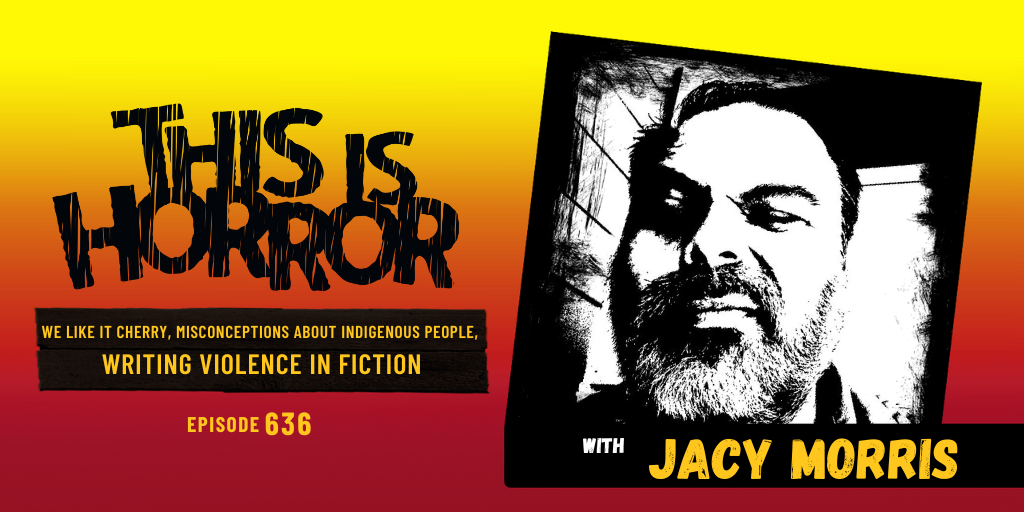
In this podcast, Jacy Morris talks about We Like It Cherry, misconceptions about indigenous people, writing violence in fiction, and much more.
About Jacy Morris
Jacy Morris was born in 1979 in Richmond, Virginia. At the age of ten he was transplanted to Portland, Oregon, where he developed a love for punk rock, horror movies, and writing, all three of which tend to find their way into his writing. Under the pseudonym The Vocabulariast, he was the writer/owner/CEO of the website MovieCynics.com 2007-2014. He graduated from Portland State University with a Masters in Education. He has been an English and social studies teacher in Portland, Oregon since 2005. He has written several books, including the This Rotten World series, The Enemies of our Ancestors series, The Drop, Killing the Cult, The Abbey and The Pied Piper of Hamelin. He is currently working on a new series entitled One Night Stand at the End of the World. The Abbey was his first book under his real name.
Show notes
Click the timestamps to jump straight to the audio.
Thanks for Listening!
Help out the show:
- Support This Is Horror on Patreon
- Listen to This Is Horror Podcast on iTunes
- Listen to This Is Horror Podcast on Spotify
- Rate and review the This Is Horror Podcast on iTunes
- Share the episode on Facebook and Twitter
- Subscribe to This Is Horror podcast RSS Feed
Let us know how you enjoyed this episode:
- Leave us a message on SpeakPipe.
- Write a comment below.
- Tweet us @thisishorror.
Resources
- Jacy Morris Books
- Watch the video version of This Is Horror Podcast episodes, including our conversation with Chuck Palahniuk on YouTube.
The Girl in the Video by Michael David Wilson, narrated by RJ Bayley
Listen to The Girl in the Video on Audible in the US here and in the UK here.
They’re Watching by Michael David Wilson and Bob Pastorella
The collaborative novel by Michael David Wilson and Bob Pastorella.
Michael David Wilson 0:20
Welcome to This is horror, a podcast for readers, writers and creators. I'm Michael David Wilson and every episode, alongside my co host, Bob Pastorella, we chat with the world's best writers about writing, life lessons, creativity and much more. Today, we are chatting to Jacy Morris for the second part of our conversation. And in this one, we dig even deeper into his brand new novel. We like it sherry. And if you are unfamiliar with Jacy Morris, then he has written several books, including The this Rotten World Series, the enemies of our ancestors. Series, the drop killing the Colt the Abbey and the Pied Piper of Hamelin. He is currently working on a new series entitled one night stand at the end of the world and the abbey was his first book published under his real name. And in addition to all of that, of course, as mentioned before, his latest book is we like it theory, and it is available right now from tenebrous press. So we will get on to the conversation with Jacy Morris very shortly. But before that, a quick advert break
Bob Pastorella 2:12
from the host of this is horror podcast comes a dark driller of obsession, paranoia and voyeurism. After relocating to a small coastal town, Brian discovers a hole that gazes into his neighbor's bedroom every night she dances and he peeps same song, same time, same wild and mesmerizing dance. But soon, Brian suspects he's not the only one watching and she's not the only one being watched. They're watching is The Wicker Man meets body double with a splash of Suspiria. Their watching by Michael David Wilson and Bob Pastorella is available from this is horror.co.uk, Amazon and wherever good books are sold,
RJ Bayley 2:51
it was as if the video had unzipped my skin, slunk inside my tapered flesh and become one with me.
Bob Pastorella 2:59
From the creator of this is horror, comes a new nightmare for the digital age. The girl in the video by Michael David Wilson, after a teacher receives a weirdly arousing video, his life descends in a paranoia and obsession. More videos follow, each containing information no stranger could possibly know. But who's sending them and what do they want? The answers may destroy everything and everyone he loves. The girl in the video is the ring meets fatal attraction for the iPhone generation, available now in paperback, ebook and audio.
Michael David Wilson 3:28
Okay with that said, Here it is. It is JC Morris on this is horror. So talking about working with good presses, how did you come to meet and to work with tenebrous press?
Jacy Morris 3:50
Well, let's see. I think I had been sending them novellas that you know, where they sort of requested the full manuscript, but it was still a rejection. And then they were, we live in the same area, so I saw they were having a danger Slater and Carson winner were, you know, sitting outside with Matt, and they were gonna sell some books sort of down the road from me, like a 510 minute drive. So I just like, hey, you know, I like books. I'll go pick up some books and sort of meet these guys, which was really sort of my first interaction with other writers. Because I'm sort of, you know, I've sort of been a shut in just doing my own thing. I don't really care about community or anything at that point. You it was, it was just really fun to talk them and talk to them about writing at that point, this was a couple years ago. It wasn't like that long ago. At that point, I was sort of getting into writing short stories because I was trying to do some some writing coaching with some clients, and there. Like, well, I want to do this short story thing. I was like, I couldn't really tell you about short stories. I never wrote them, and so I was sort of figuring out that process and the ins and outs of, how the heck do you write a short story? I'm writing novels I have all the space I can need in the world now. I've got to kind of sandwich it down into, you know, 10 pages or so. And so we talked there. I think there was another project they were interested in that was going to go there, but another press sort of got to it first, and then, so when I had we, like, at Cherry all ready to go. I was like, Oh, this is this is awesome. I love this book. I think this will really work for them. I sent it their way, and I just made sure it was just just to them, because I wanted to work with them, because they're nice people. And it worked out. And so that's where we're at, and we've been doing all the promotion and all the fun stuff of getting a book ready to go, and it's been a wonderful process. So if you're, you can get in with tenebrous press. I would, I would do it. They're, they're awesome, and they have a good eye for stuff that's good, which I appreciate. They're not just, you know, taking anything and throwing it at the wall and seeing what sticks there. There's definitely some scrutiny and a definite what do they call it? They know what they want, you know.
Michael David Wilson 6:35
So, yeah, yeah, and to have met Carson winter and Dan just later, as your kind of introduction to, I suppose, the horror fiction community. What two awesome Stand Up Guys. I mean, two of my favorites right there. And God to this day I am thinking about soft targets by Carson winter. What a brutal, philosophical, incredible book. And everyone knows how I feel about Dan just later on, this is horror. He's the modern day Vonnegut. Yeah.
Jacy Morris 7:14
He's awesome, yeah. So I think I got, I got soft targets and House of rot from from them. So it's two of my favorite books, so definitely worth going out.
Bob Pastorella 7:28
Yeah, I've had the Met danger. I've met Matt at a ghoulish fest a couple of times. I've had Matt on panels that I moderated about the different types of writing. And I like that. Matt has a it doesn't take much to get him wound up. Our philosophies align perfectly. And that's I can it was. I remember one panel we were on and I got him wound up about something, and he's, like, he is, nope, I'm not gonna do it. He goes, You know what? Fuck it. I am, like, I like this guy so much. He is so cool. And then last year at ghoulish, Alex was there, so that was kind of like a highlight. Could you get, you know, you got the team, you know? And just getting to to chat with with her, was like, you know, just, like, Wow. Just, and then the two of them together is, you can, you can see how they, how they would work together.
Jacy Morris 8:33
It's, yeah, they're such a great team. Yeah,
Michael David Wilson 8:35
yeah, 100% and so we've, we like it, Sherry, there's a lot that I want to talk about, a lot that I want to say, but I just wanted to begin with ask you what the elevator pitch is, and that'll also give me a sense of what we might and might not say in terms of potential spoilers, because a lot that happens in that fourth act is an absolute understatement.
Jacy Morris 9:03
Yeah, my elevator pitch. It's like, you know, there's, it's a documentary crew going to the Arctic to film a ritual that has never been seen before from a remote tribe that really, people don't know a lot about or even care about, and that's, that's kind of the point I get to, right? It's just like, up to the ritual. I don't want to spoil anything else, beyond the fact that they've gotten there, because it's, it really is. You know, there's some nice surprises there? Well, I guess they're not nice. Depends on what you like.
Michael David Wilson 9:46
I think it was delightful as a reader and would be, I mean, how? What word do you even use for disastrous as as a participant that. That's kind of how I feel. Then, I mean, my journey with the book to begin with. You know, it's almost slow burn with a lot of social commentary, and you're in, you're enjoying it, you're enjoying the environment and the discussions, particularly the philosophical discussions. Then there's a turn where it almost shifts. Well, I'd say it does shift genre. It is not a slow burn anymore. Is the the most spoiler free thing I can say. And then the final message is just so beautiful and poignant and poetic. And just when I finished the book, it's like, wow, this is the this is what it was about all along. God, that's such a general way of putting it. But because You've spoilt so little, but you, you really take us on a journey. And I think what the book becomes is probably not what you thought the book was initially. And that's incredible. Yeah,
Jacy Morris 11:11
I think a lot of reviewers have been like, I thought this is going to be like, Cannibal Holocaust. And I'm like, I didn't have that in my mind when I was writing or anything. If it wasn't, I don't really have it. Wasn't. I don't really have anything in mind. I try and do my own thing when I'm writing. And I was like, well, it's not that's not even class and that, that it's funny, the the expectations of like, the zeitgeist, and then when you get a story that just veers sharply from that, because there is that veer where it's just like, oh, this is becoming something completely different than what I was expecting. I think that's, that's, that's a key point to the story and why it works. It's, it's not, it's, it's just, I don't, I don't like to be predictable, and I didn't. I think even the things that you would predict, you're like, Oh, this is definitely gonna happen. It happens in a way that you wouldn't expect. And that's sort of the key for why I think people will dig it.
Michael David Wilson 12:09
Yeah, I know when I was talking to Bob during the reading of it, I was saying, this book is not what I expected it to be, but like, in a kind of refreshing. Oh, okay, as you said, it's kind of even the plot points or the things that it hits upon. Is the delivery system is completely different to any expectations.
Bob Pastorella 12:38
One of the things that really kind of stood out to me in I'm gonna, I'm gonna kind of use a couple of comps, like a real comp that came to mind, believe it or not, was mid summer, especially considering cultural or ethnic norms that people have, and then A real event that happened a couple years ago where there was a missionary who repeatedly tried to go to a island that he was the tribes people there had repeatedly warned this person, and people in surrounding areas have said, Do not go there. And this man was convinced by the word of God that he needed to go there, and they killed him, and because he trespassed on their land. And there, there was an outcry. And it's like they're not going to do anything. They can't. It's not, it's a totally different country. You can't, you just can't go there and do that. And so I felt that. But this is also a book without spoiling anything. If you're listening to this and you're on the fence, this is a very visceral book, the words, the language that once it doesn't take you long to get into it, even though Michael said it's a slow burn, it's extremely interesting. And when the tide turns and you it becomes a matter of survival and I could literally feel the ice creeping into my feet. Is tactile. There's not a word visceral and tactile. Those are the words that come to mind. There's probably, I probably would have to make up a word to explain how cold I felt reading this book, not like cold, like, like cold hearted, but actual cold. I had to get underneath my covers. It is very, very visceral. I never want to visit this area, and I never want to see this. Tribe. But I love this book so fucking good.
Jacy Morris 15:06
Yeah, I mean, that was, I was definitely taking advantage of the cold and the descriptions to sort of create that feeling in the reader, like that was, you know, that's by design. It's got it doesn't work without it, right? Unless you get someone out of their comfort zone and make them feel something with that, the plot, the gore, the things that are happening aren't they don't feel right. So I was very cognizant of cognizant of making sure that that coldness was in there. It reminds you of I once back in the day, I sort of worked with Disney on Ice, and I was in Fargo, North Dakota in the winter, and I went to see this movie called a simple plan. I don't know if you ever seen it. Awesome movie, really great movie, Bill Paxton, Billy, Bob Thornton, but that movie made me cold as hell, and in a place where I just did not want to be cold, like the movie theater, temperature was fine, but just the visuals and feels of it just froze me. And that's kind of something that I wanted to recreate with we like it cherry, just that feeling of just being miserably cold.
Bob Pastorella 16:26
And the only other thing I'll bring up, and it's, it's kind of a humorous thing, is that before I realized what we like at Cherry means, I remember telling Michael that I thought it was an indigenous word, and they were hearing wrong. And so I actually looked up different combinations of the word it as phonetics, and I found nothing. And I'm like, oh, it's something deep, you know, and it is, think it is, but it's in not the way that I expected. And once I got there, I did not, I did not feel I did not feel let down. I felt exuberant that it actually means something else. And I was just like this, yes, but, but I was slightly, slightly disappointed that I wasn't right. That was the only disappointment like because I was like, I go, it's not, I remember telling Michael, it's not we, like a cherry. It's like, it's probably like, some word, like we, like a child, or something like that. He's like, I know Michael's probably looking at me like, You're crazy, but you might be on something that's but, uh, man, what? Yeah. It's very, very, very visceral, very visceral. Well, thank you,
Michael David Wilson 17:46
fair play. To admit in that Bob, I was gonna keep that between us, but no secrets here. And I mean, I wonder talking about kind of confusion and because it's so apropos to the text. I mean, what do you think of some of the wide misconceptions about indigenous people?
Jacy Morris 18:13
I mean, I suppose the biggest one is like that. It's one, one culture, right? It's really not. It's like, not 1000 different cultures, so many different languages, so many variations of those languages. You know, the portrayals that we get in media, for the most part, are, you know, certain tribes, and they don't represent all tribes, but that's what we have like, you know, we've got that the dream catcher culture, which is not a thing for most tribes. You know, I'm a, I'm a city, city Indian, right? I'm not, you know, I've been around a horse maybe once in my life, and I didn't care for it. I'm not an, I'm not a nature person. I'm just not what I when I write and things are in nature, I have to go look stuff up because I'm like, you know, I'm used to buildings and stuff like that. So there's all these sort of mystical, spiritual things that are attributed to us that, you know, some people have, some people don't. I'm not necessarily a spiritual person. I'm more of a, you know, a self conscious, consciousness person, and trying to be the best person for myself and my own happiness and that, that's kind of where my spirituality is. There's, there's a ton of stuff out there, and I, I like playing with those things when I can't, because I think, I think it's important to sort of break apart those stereotypes as one of the reasons why I chose to make Ezra a gay character, versus originally. It had been, it was just a dream I had. This whole story was a dream that I had, and it was me and my wife going up there. And I was like, Ah, I don't really feel like doing violence to us, so I need a different character. And I was like, ah, and that was, that was my way into it. And I had been reading a friend's book, The White Harbor trilogy by Carlos I Rivera. And, you know, he's a queer author, and he had some characters in there that I was like, I really connect to these characters. I think that for me, not only am I interested in the challenge of, can I write gay characters, but also being a person who, you know, considers myself an ally, but I don't have a ton of gay characters in my books, it felt important to me to do that and being an indigenous author and really understanding that I don't just write for myself as an indigenous author. I write for indigenous people, indigenous, you know, all indigenous people, I felt like it was important to have that representation in there, and that was definitely one of the stereotypes that I wanted to to challenge, right? So that's why the relationship between Ezra and Stu is in the book, and it really became the central theme of the book as well, which was cool.
Michael David Wilson 21:31
And what were some of the challenges in writing about a gay couple, a gay protagonist, and what kind of things did you have to kind of put in place to make sure that you got it right? Well, I had to, I
Jacy Morris 21:49
had to read and sort of put myself into the space and understanding from other queer authors, and sort of understand it from a way that isn't stereotypical, that isn't just me imagining what it's like. It's, it's my built upon my understanding of the people in my life that are gay or queer, and the authors themselves, and sort of putting that together to create my own people, because they're, you know, they're living, you know, in my head, they're living, breathing people, and they're, they have a background, and they're realistic, and I can predict every little thing about them and how they're going to react in certain situations. So I had to do that, and then I made sure, you know, when I had it done, I asked, I asked people that I trusted, that, you know, that know my heart's in the right place. I asked them to read it, and please, you know, let me know if it works or not and if there's anything I need to change. And they all sort of gave me the thumbs up on it. So that was, I wouldn't say satisfying. I would say I felt good about being able to portray them in a way that felt realistic and not like a straight person writing a gay person.
Bob Pastorella 23:05
I mean, Carson Whitehead always says is that you can write about anything that you want to write about, just don't fuck it up. And it's like you had the permission, but people are going to know if you do it from any place other than being authentic and genuine, and they're
Jacy Morris 23:28
going to be pissed off, right exactly, because I have I get the flip side of it when I read non Indigenous writers writing indigenous characters, I'm like, Ooh, yeah, I'm gonna either hate this or like it, and it's a weird game, right? I'm ready to be outraged, you know. And so I know people that you know, understand that you know, I'm a straight author. These are prayer characters. They may find themselves in that space, and I just hope you know, for them that I did at justice, but we'll see.
Bob Pastorella 24:05
Yeah, it's tough because, I mean, I noticed in, like, in some of my own projects, I've actually gone through my characters and have come to the realization, even with, like, a current work in progress, now that I have. I've got, like, a whole, it's just white, and it's because, because that's, that's who I am, you know, and so, and I have to, I'm gonna have to cast against type. I'm gonna have to to do these things when I'm also have to do it the right way. And I don't I've written from like, a woman's perspective to write, you know, from that, like a gay person's perspective, I would have to do the exact same thing you did. I'd have to do a ton of research, and I would want to make sure that I got it absolutely fucking right. Yeah.
Jacy Morris 25:00
To challenge. I mean, you don't want to mess it up. It's like you're trying to be an ally, not some, you know, stereotype. What do they call that? You know? Yeah,
Michael David Wilson 25:10
think of the word like a kind of caricature. Yeah,
Jacy Morris 25:13
I care, yeah, because that's easy, that's lazy. We can, we can. We all know the stereotypes. You know how to write that and right? And I'm not. I don't play in caricature for my serious books. Sometimes I'll play with it for my non serious books, but
Bob Pastorella 25:31
I just, I don't know. I like to cast against type. I like to present. I love seeing an image of someone and they're not as we think they are when we first see them, you know, you got the honorary old guy who's walking around and got a cane and everything like that, and he's spitting tobacco, and you're thinking, this is the old country boy. And then he is a, you know, used to be a philosophy professor, you know. And so it's the, that's just one example I love casting against type. I'm gonna give you a visual, and then I'm gonna fuck with your head about it, you know. And it's just when you when you're writing characters that aren't like yourself, there's some care involved if you want to do it, you know, authentically,
Michael David Wilson 26:19
definitely. Now you said that the idea came to you in a dream. We were also talking before about just how unpredictable it is, that it doesn't go where we think it's going to go. So I want to know how fully formed did this idea in the dream come to you, and how much did you know what was going to happen before you started writing, had you fully planned the book out? Or do you kind of pants it, or give yourself some, I suppose, creative license to go in different directions.
Jacy Morris 27:01
Well, for the first question, the the dream was basically up until the turning point. That's when I that's when I woke up, because I was that main character, and that turning point happened to me. Woke up just sweating and like, whoa. What the heck was that? And I rolled over, off my bed, and I just scribbled down some ideas in a notebook, and it's, it's literally, like, three or four lines, and then I went, went back to bed. But it was fully formed. It was, I was at like, a writing convention, and someone invited me. They're like, Oh, you got to come check this out. We went up there. They gave us a place to rest, and then the turning point happened. And so from there, I had to sort of build it out, because it had the dream. Had weird, fantastical elements, like there were these fantastic mechanical, like ice sculptures on top of the on top of the glacier, and they're just spinning, and they're like, weird art installations. And I took a sub to get up underneath the water, and I was like, none of that's gonna work. It's not, it's too it's too weird. Everyone's gonna be like, What the heck are these people doing? Doesn't make any sense. I had to strip it down to the basics of the opening bits. And then, then I just, I think I just wrote it. I didn't have nowhere was going. I'm I'm a, usually I'm a pantser in the middle, but I'll have the beginning and the end figured out. But I didn't have the end of this figured out, and I didn't know where it was going or what was going to happen. So luckily, I had found my characters and who they were going to be, and I was able to take them through there, and they sort of guide the story, because they're going to do this in this particular situation, and that helps move it through. And then, what was the second question?
Michael David Wilson 28:57
So, I mean, I wanted to know, like, how much creative license you had to deviate from the plan, but it sounds like a lot. If you know that the middle you're not entirely sure where it's going to go, yeah,
Jacy Morris 29:11
yeah, it would definitely. It's all up to the turning point was pretty, pretty much the dream. The title was in the dream, when, when the turning point happened, the guy stuck his face through and said, We like it charity. And I was like, What the heck is? And so that title was, like, it was perfect, and I understood it, but I didn't know what it meant. And so the entire time I'm writing this thing, I'm like, How do I make this title relevant to this thing. And so the ideas that I came up in the book really had to be created from that title, which I def like. Those words stuck in my head. I was just like, the whole day, the whole next day. I'm just like, we like it. Cherry, what the heck, dude, what's going on? So. I think it worked out. I like it.
Michael David Wilson 30:03
You didn't cool. Bob Pastorella kind
Bob Pastorella 30:09
of been a bad idea. It's such an intriguing title, though it's like, it grabs you when, like, especially like, if someone says, Hey, you know, I follow, I follow a lot of stuff on social media that has to do with horror, and that's, that's how I got wind of it, you know. And in seeing, I think I want to say it was Laura Hightower. I may have been wrong, but somebody seeing praises of it before I even read it. And I was just like, What the fuck does that mean? You know? And it's like that that is, and I'm like, just, it sticks in your head, because it's just so off the wall, you know? It reminds me of my of my own writings, like I'll come up and find, like, digging around and looking for something in my files and my folders my computer, and come up with a folder that I created months or years ago with some weird name, and it's like, What the fuck does that mean? And there's nothing in it. It's just a folder that I made probably at three o'clock in the morning, doing, I'm gonna write this. It was from a dream or something like that. So it's just a very striking title. It's and I was sitting there thinking about the book, and it made my feet hurt. So just, it's the survival aspects.
Michael David Wilson 31:33
Yeah, I want to know if you get a lot of story ideas, or the kind of gem of a story idea from dreams. And I also want to know, Do you often when you wake up from a dream, write the ideas down, because I went through a period of doing that, and when I did my dream recall got so much better. It's like I was primed to do it. But I feel also there was an increase in dreams to such a point that it was affecting my sleep. So I have to be careful. Probably also, my wife would be like, What the bloody hell is he doing? He's writing again. Go to sleep.
Jacy Morris 32:17
No, I have for wheel like a chair. That's the only one I've ever I've ever written down. There's a couple stories that I had that were that were dreams that I turned into things. Had a novella do the route, sings the black and blues, which is about this punk rock guy, and this is all in my dream, but he's basically like a Gigi Allen type punk rocker who gets voted in to do like the NBA All Star game, and he just starts cutting himself up in the middle of the NBA thing, and his name was dude la rude. And like, I woke up and I was like, Dude la rude. What an amazing name. And I couldn't stop thinking of the name. So I wrote that story, and I sort of fleshed it out and made it a little wackier and crazier, and then I think the abbey was the only other one that was a dream, and that was a weird a weird one. I think it was probably four or five years between that dream and when I actually wrote it. But yeah, so not a lot. I don't write down my dreams. They just that that one stuck with me, and a couple of others just stuck with me. So it's not, it's not part of my process. Usually, I'm just, I don't know where my ideas come from. You. I'm just walking around making things up. Even if I go out for a walk, I'll come up with things, or if I'm watching something on TV, I might have like a, like a spark in my brain. And I'm like, I usually throw it in my notes, which is a terrible thing to do. If I throw it in my notes on my phone, it just goes there to die. And then usually I'll have some idea that I've been tinkering with in the back of my head for a month or two before I ever start writing it.
Michael David Wilson 33:59
So I don't know if this will be a game changer for you, but I often write things in my notes on my phone too, and so for a long time, they just got lost. But now I have it all ordered by folder, so then there's actually a chance that, you know, we might actually keep this one or like, if you it does mean that, you know, the other disadvantage could be, if you had so many folders now, it would be redundant, but, yeah, that's worked quite well for me, particularly because you could order it by theme, or you could order it by location or sub genre, or whatever It is that kind of means that it won't get lost. So, yeah, yeah, using folders on your notes app could be, could be a game changer, because I use notes for everything. If there weren't folders, then story ideas on my shopping list would be in the same section only.
Jacy Morris 35:00
Have, like, eight notes. One's like, a list of story ideas. One is like, when I work out, what are the weights and the times that I do?
Michael David Wilson 35:08
I got that one too. Yeah,
Jacy Morris 35:11
songs. I could sing it karaoke, and then the other ones are just gibberish. So I thought up one day, and there's, like, three or four of those. So I don't have to search through it. I just click on it and it's there, but I never think to click on it. I guess I always have an idea going, you know, those ones, they literally just go there to die. I suppose one day I might run out of things to write, and then they'll be useful.
Michael David Wilson 35:36
Why do you have a list of songs that you can sing at karaoke? Are you regularly given impromptu karaoke sessions? And you kind of panic, and you can't think, what can I sing? So you look at that,
Jacy Morris 35:50
well, I have a very slim taste in music that is, like punk and Scott and when I go into a karaoke place, it's like, oh, who want to sing? Abba, no, I don't know the song. I don't know any of these songs, so I have to have these are the ones that they have. Is the ones that I could do. You know, I'll throw I'll get on my comfort zone on a couple. But there's, there's not a lot for me at a karaoke bar. Most times,
Michael David Wilson 36:18
what's your favorite song to sing at karaoke.
Jacy Morris 36:21
Oh, geez. Kind of like dirty old town by the Pogues. That's just a fun one to sing. Sam, it's it's fun to try and sound like Shane McGowan,
Michael David Wilson 36:36
I thought that Bob was gonna jump in before I derailed with karaoke, but maybe your thought is now gone.
Bob Pastorella 36:44
No, it's my, my, my notes list looks like what you said would be, Michael. It's like Bell tied to grave, lettuce, eggs, bread, cheese, ham, it's just, and they're two separate notes, and then, and then, yeah, and then there's a, there's like, a long paragraph. And I was reading that, and I was like, Man, that's actually pretty good. And I'm like, That's the story. That's the 20 minute story challenge I did killer Con last year. I need to probably work on that.
Jacy Morris 37:26
But you just found a story in your notes.
Bob Pastorella 37:28
Yeah, just found a story that I had in my notes, you know, and I still have that phone. It's just I went from iPhone to Android and and so I need a good notes app now, because, I mean, I just made this move and, and I, but I, you know, because they, all they have is, like, I'll find one. It's not gonna be
Michael David Wilson 37:53
check out Evernote, yeah, I
Bob Pastorella 37:55
was thinking about that. Because that's even with their even they're free, is like pretty robust.
Michael David Wilson 38:02
So there you go. This is horror, giving karaoke, karaoke suggestions. No apps. We got it all,
Jacy Morris 38:13
and this will help you everyone as a writer,
Michael David Wilson 38:16
right? Yeah, I wonder. Talking about planning, as you say, it sounds like fairly loose in that you've got the beginning, you've got the kind of premise you've got generally the end with the this Rotten World Series, because it is such an epic series, because there are so many moving parts. Does that mean that you have to plan out each book in a little bit more detail than you would for, say, a standalone novel?
Jacy Morris 38:48
No. So when you look at the this Rotten World Series, there's there's 11 books, and then 12 is the end of what I call the second cycle. The first cycle was books one through five. I knew the beginning and I knew the ending, and it took me five books to do it. The second cycle, I was like, I hope it's five books that would be nice and symmetrical. But I knew the beginning, I know the ending, and it's, it's taken me seven books to do it. So it's, it's, and for that, the only notes I have is, I have a list of characters, their names, and then I put a strike through when I kill them off. And that's really all it is. There's so many characters. It's for books that big. There's like, I think the second cycle is about a biker gang in the zombie apocalypse. And there's like, you know, 20 characters. They're always getting new people. Other people are dying, but the story is always moving through. So it's, I have to just know their names and then cross them off and they're dead. I don't want magical resurrections that I have to patch later. Yeah.
Michael David Wilson 39:59
Yeah. Yeah, and I mean, I think it's fair to say, if we look at your writing output, and perhaps you've said so yourself, I mean, you are a prolific writer, and I wonder if having this looser approach to planning is kind of part of it, and part of how you get so much done that and hard work and discipline? Of course,
Jacy Morris 40:25
yeah, I think it's the discipline is probably number one. It's like, sit down, do it, otherwise it doesn't happen. But then the lack of planning is my joy in, in finding the story like I enjoy it, like I get, I get a high off creating and finding new twists and being like, Oh, this is going to happen here, man, that's messed up. And it's, it really is, like a drug. So, I mean, planning is just not for me. It really is, you know, there's the runner's high, and then I'm getting, like, a writer's high when I'm just making this stuff up.
Bob Pastorella 41:06
Yeah, you're a discovery writer, yeah? And that's pretty much how I've spent like, my entire writing career. I recently just got done with with, like, working on notes and out basically in a plan for an epic series that I'm conjuring up in my head. And I've got that sitting on the dresser back here, and I'll, I probably won't look at it again, because I, because if I, if I go in there and I start tinkering with it, then I'm going to feel like I wrote it and I wrote it in such a way that it didn't feel like writing that it's, it's, you know, in real short sentences, nothing, nothing actual prose, like at all. It's just all description, like they do this. They went here, they did this, you know? And so, because anytime I start to do something like that, and it feels like writing, then I felt like I've write, I've written it already. Why would I want to go back and rewrite this again? When I should be thinking, I should actually go back and rewrite this again? But, you know, it's like, it's, it's, it's hard to explain to high that you get when you're a discovery writer, and you out there and you, and you, you your characters take a left turn into the coolest shit that you've ever written in your entire life. And it's just like, Fuck yes, let's go. You know, it's hard to to explain that I'm glad that you get it. You know, it's like, you're like, my blood brother, yes, yeah. Because a lot of people, they don't get it at all. I don't, I don't, I guess they get it. They get a high, a different way. I don't know. I've tried
Jacy Morris 42:59
planning it, and I'm like, this is like, work. This is awful. This is it's just so far away from my process, and I donated, I don't enjoy it at all. I hate that I the closest I've ever gotten is like, putting stuff on note cards. And even then, it's just like, it's like, what you said, this happens. This happens. This happens. It's not writing. It's just like, these are the beats. And I can, I can use those if I want to. And they, you know, they don't frequently go along with those. Anyways, once I start writing, right?
Bob Pastorella 43:27
Matt Bell wrote a really good book called, uh, I'm forgetting the name of refuse to be done. And what he talks about is that he writes draft and then he outlines, and then he uses the outline to build his rewrite. And so I kind of like that aspect of it. And so it goes through like three drafts. He goes, that's how you get your three drafts. You might not need three, you might need four, you might need two, but that's, that's how you get there. He goes, but his writing style is like ours. It's all, you know, it's basically discovery writing and that is not congruent to plotting. Well, you're going to have a lot of shit you have to fix, but that's what rewriting is for.
Jacy Morris 44:20
Yeah, that's, that's the whole point. Yeah,
Michael David Wilson 44:23
you mentioned before that you'll get quite a lot of your ideas when you're going for a walk. And that always seems to be the way. If I'm, I don't use the term blocked, because whatever happens I write, but if there's something I can't quite figure out then. So often, if I just leave the house and go for a walk, all these ideas will come to me, and that seems to be kind of my best tip, really, for people who are looking for ideas, is like, just get out the house, get away from the computer or notepad or. Whatever it is, and just walk and these ideas, they come to you, and these solutions. And actually recently, so I've been working on a collaborative novel with my friend John krennan, and sometimes we will leave each other just like voice notes, talking about a problem and the story, and quite often, we'll start talking, and we're not entirely sure what it is that we're going to say or suggest, and something within the talking will unlock a solution, so maybe inefficient for the other person listening to the voice note, although we could record a second and be like, right? These are the main bullet points. But in terms of just creatively unlocking things, it's really been a game changer, so much so that I'm wondering, if you know next time I'm trying to work out a story idea, instead of just going for a walk, as long as I make it obvious that I'm recording and I'm not like the local Nutter just walking around talking to himself, it might work to just be recording me talking about the story, even though it's not for an audience, it's literally for me, and to kind of untangle that creative problem. Yeah.
Jacy Morris 46:22
I mean, I've, I've talked out problems before. That works too. Usually I'm just, like, alone during the day, so the walk works more, yeah, yeah.
Michael David Wilson 46:33
And I mean equally, to kind of give strength to that idea I found before, like, if I've spoken to another writer about the problem, well, by the time I've explained the problem, I've already told them the solution is, is, like, one of these therapy sessions where you talk and talk and talk, the therapist doesn't say anything, and you're like, well, thank you for your time has been great.
Jacy Morris 46:58
Yeah, yeah. I think it's getting out of your own head, right, right? It's terrible in there,
Michael David Wilson 47:07
yeah, yeah. Now a big thematic concern, if we like it, Jerry, and I think again, because I'm talking rather vaguely. It isn't a spoiler, but it's this idea between the tribes or the groups that we're born into and then those that we choose. And so when did you know that that was going to become like a key aspect to this story? And how did you approach writing it?
Jacy Morris 47:43
Well, it, I don't think that it was ever conscious. It was never like a choice to do it. It just sort of came out through the characters. And as always, writing it, it wasn't planned. I knew basically who Stu and Ezra were at the beginning, a little bit about the backgrounds, and I know they loved each other, and I didn't know how that would play in the story, the whole the whole turning point where, you know, there's survival and there's choices that are made, and there's decisions that these characters have to face that's all made up on the spot, and so then it's just sort of dragging that out. I've always sort of been able to work my themes in without, without knowing it, almost, which is, I don't know. I guess it's, I guess it's sort of a gift. But that wasn't planned. It was just like, I got to the end, and I was like, How do I tie this, how do I tie that bow on the end of this thing? And is it going to be happier? Is it going to be sad, and or is it going to be real? And so I had to figure out that combination of things. And that was hard. The last page of this book was hard. And that's sort of where, whereas I think I didn't write the Epilog until I was done with the second draft, and that's that last page. And I read through it, noticing my own themes, that things that I had, my subconscious had planted in there, which it frequently does. And I was like, oh, okay, okay, let me try and wrap that up here with an Epilog, because it didn't have the Epilog in the first draft, which, if you ever read the book, you'll, you'll understand what I'm talking about.
Bob Pastorella 49:47
Yeah, you don't want to write to theme. It's it to me, that's like, you know, that's, that's something that stuffy literature writers do. It's like, they think of a theme and they build a story around. That. And you can, you can tell, you can smell it, and it's, it's it, you know, it'll come off as preachy or something like that. I think the best way, the only way I can really describe it is that, is that you know upon subsequent drafts that you did, when you do see the theme, that you kind of tease it out a little bit.
Jacy Morris 50:23
Yeah, you got to drop the bread crumbs there so everyone else can get along with it, right?
Bob Pastorella 50:28
But you don't want to. You know, the opposite of that is shoehorning it in. It's like, oh, well, I forgot to put the theme. Well, golly, let me go ahead and just get it out of the bottle here, and we'll put it like it don't work that way.
Jacy Morris 50:41
Yeah, yeah. Theme is a weird thing because it's just like, generally, sometimes it's probably more short stories, but even then, I don't know where it's going. So I might have a vague idea of what the story is about, but then I don't know how it's gonna play out, but, and it's in some subsequent drafts where I strengthen them and make them clear and smooth them out if they are too preachy, if they are just too in your face,
Michael David Wilson 51:08
yeah. And I think another important aspect, which you make fairly clear from the beginning is that you know, you've got Ezra documenting reality, but he's hiding from his own. And, you know, there are so many questions of honesty and authenticity. And I think kind of, when you're looking at these different cultures like it really just highlights the absurdity and the contradictions within our own culture, within so called Modern, so called Western kind of society.
Jacy Morris 51:54
Yeah, I think for me, it sort of, it's, it's that disconnect in that, that feeling of just being out of sorts when you go on vacation or you you're in a different culture, and you're just things are different, and it feels different. And you start thinking about, Oh, this is how I do it. This is how they're doing it is their way better or not. And you start questioning and thinking about, I mean, going to other places and experiencing other cultures, even within America doesn't have to be, you know, a completely different country. It could be, you know, if you're from the city, you go to the country, and you just get that disconnect. You start understanding and thinking and questioning and philosophizing about what is reality, and what are these rules, and are they actually good for me, or are they things I can let go? And I think those, those feelings that I have about being in a different culture came through through those characters in that way. And so I think that really helped me find who they were in sort of a roundabout fashion,
Michael David Wilson 53:02
yeah, so I mean in terms of when you were writing kind of each character, so we've spoken about the plan, the plot. How much did you know about each character? Was that also part of discovery.
Jacy Morris 53:23
Yeah, so I knew general backgrounds. I didn't know there's Scott the producer and Jonesy the sound guy. I didn't know anything about them. They were basically made up on the spot. When I was like, I can't just have two people. It's weird. I uh, and in my dream, my best friend was there, so I was like, oh, okay, I'll throw this, this guy in there, and I need someone that I just kind of will enjoy, maybe killing a bit. And so I threw another guy in there, just to sort of Pat out the body count, right? Like I just needed that. Or else it because, yeah, there's some elements of true horror that are associated with those deaths that I wanted to get to, those those scenes, all the bloody scenes were in my head before I started writing, I knew there were those things I was going to sprinkle in there that would just be sort of shocking and gross and and pretty brutal. But I didn't know anything about those supporting characters, but I knew the main characters of Stu and Ezra up to that point, but there are, there are some background scenes in there that were kind of thrown in where I was like, oh, maybe you had this experience, and this is a flashback to that.
Michael David Wilson 54:43
So yeah, and we mentioned right at the start of their conversation just how visceral the violence is, and it's really clear that, you know, you had fun writing it, and I wonder. What tips do you have, or what are the kind of do's and don'ts for writing this kind of visceral in your face, no holds barred, violence.
Jacy Morris 55:11
Effectively, my tips for writing the gore scene is to keep it moving. I don't I don't like to do long bits of description. I like to sprinkle it in with action and things happening. So it doesn't feel like, Oh, this guy's just getting off and writing Gore that's not genuine to me as a horror writer. Some people do it. There's some very good writers out there who who have fun doing it. It's not necessarily my bag, and I don't I find I like my way better. So sprinkling in the descriptions with action and then balancing it with the reaction is key, right? Because we're living through the character's eyes, I need to know what they're feeling and thinking as these things are happening, because that's going that's the key into the reader's mind, right? I can describe this thing all you want. You're like, Oh, gross. But if you're not getting the emotional part of it, it doesn't really matter, and it doesn't hit the same so that it's that balancing act of tight descriptions, action and the characters reaction. That's that would be my advice, balance those things and keep it moving, because no one wants to be bogged down by a page worth of grossness. It doesn't really work.
Bob Pastorella 56:38
Yeah, that's the same with I don't want to spoil anything, so I'm going to be very, extremely vague, but someone trying to escape. And there was a the action was kicking. There was not a lot of description of what was happening. There was just enough the action gave you description. And because you, once you once you have that image in your head, then you realize that this, this person, is doing literally everything they can, just to get out and just to find a way to get out. And if you could, you have to, you get to wear, you get to wear their shoes. Yeah, and it's, but there was, there was very little Gore in that. It was all action. And so if you, if you're looking, how do I do it? Read, read this book, because it's, it's a master class and how to do it.
Michael David Wilson 57:43
Thank you. I think too. I mean, you say there was very little goal, but it's kind of this, less is more effect, where, when you're in the moment, you feel it's gorier than it actually is, if you then kind of step back and analyze it. And it's the same thing with Texas Chainsaw Massacre. It's the same thing with a lot of Chuck Paul Linux writing, you know, you you trick us into thinking, you know, what we've read is the grossest, most fucked up description, but it's kind of our brain filling it in between the lines.
Jacy Morris 58:22
Yeah, I equate it to like, you know the when you, if you've ever driven down the highway and you've seen something awful and like, how that's burned into your mind, it's, it's not, it's not a lot of stuff. It doesn't take a lot to burn something in someone's mind. It just takes key details that stand out, that are weird, that that pop out, and that's all it takes to get that that seer in someone's mind. I think
Michael David Wilson 58:53
even using words like pop and see, you know, even then, just those, those choice cuts of words and Freddie at your drafting. How many drafts did it go through before you sent it to tenebrous? And then, what did the editorial process with tenebrous look like,
Jacy Morris 59:22
well, it was three drafts. I typically do three drafts. The first one is just creating. Second one is, you know, let's fix these plot holes and patch these things up. And then the third one is getting very finely detailed on everything and and then that's it. I did send this one off to an editor who I've worked with before, and because I was I just I knew I had something with the story, and I wanted it to get the best footing possible. I don't normally send off my manuscripts to an editor, but this one was like, you know this what this one needs? It. Or anything I can do to make this, make this work is going to be worth it. So I paid her. She did fantastic editing, and then I shot it off to them, and I think by the time they got it, it was really just little stuff. There was no big it was just yo comma here. Watch this wording. You keep saying this thing, and that was it. There was, I think there was one note that was like, about the Epilog where they were like, Yo, we could cut this if we wanted to. And I was like, Ah, no, I'm gonna keep it. And they were cool with that. It was like, you know, if you ever have a spoiler edition of this show, I'd love to talk about the Epilog, but, yeah, it was that. I knew that was always going to be the sticking point, too. I knew it was an artistic choice, you know, not, I'm not really here to hold your hand, and that's, that's how the Epilog works, you know, yeah.
Michael David Wilson 1:01:00
I mean, I can see how the story would have still worked without the Epilog. But at the same time, I think that the Epilog is the proverbial cherry on top of the story.
Jacy Morris 1:01:14
Nice, nice.
Michael David Wilson 1:01:18
But like, I like it better for it, and it made me, you know, that was what really just cemented the themes and really hit things home. And, you know, it did it in a way, without it being overbearing. So yeah, it almost served as a initial portion of relief, and then just, oh my god, a moment of awe as it ended. Yeah, that's, that's the goal. And I think that's as near as we can get to mentioning the Epilog without spoiling the whole thing. It's like they did so well, and then around the two hour mark, they just spoiled the whole damn story. We're not gonna do that. So people need to pick up. We like it. Jerry, that'll be great. What are you currently working on, and what is next for you?
Jacy Morris 1:02:21
Well, I've got, I think I've got, six manuscripts, my agents, shopping, shopping, two of them. I just sent one his way, and then he can't keep up with me, so he's giving me permission to sort of sell these other four on my own, so I'll be taking those around. I'm going to give 10 of brisk their their shot at it first, because they're my favorites, and they're awesome, and I love working with those those guys. Let's see what we got in there. I've also got my two series that I'll be working on. So this rotten world, and then one night stand at the end of the world, I'll be writing the next chapters in those probably in August. I've got a collection in there of just short stories. Since I've been trying to make this extra cash for short stories, a fair amount of rejections that are just good stories that'll make a nice collection. And that's 85,000 words. There is a Halloween themed horror story that I've I don't know. I've just been slow playing it for for years now that I've just had, I thought I wanted to publish it myself. Now I'm thinking, I want someone else to publish it. So I'm going to see what I can do with that one. And then there is a sequel to my dude la root story. I enjoyed the character so much, and the name gets stuck in my head and all the time that I made it the world's first ska horror story. I don't know if you guys listen to ska at all, but I made this, and I'm gonna, I'm gonna show it to 10 of Rosson see what they think. They are notoriously against Scott? We're not Matt. Alex is Alex is definitely anti Scott. So I want her to read that just, just to be a little sicko, and we'll see if they like it. If not, I'll take it somewhere else. And then, oh, then I've got my first fantasy series that I've written, that I'm playing with, which is just very dark and weird and bizarre. And we'll see, see if they're into that as well, and then we'll take it from there. So lots of things I've got. One Shot is coming out from toward waters in November. Toward toward waters is a Crystal Lake publishing. And this is sort of my version of a bizarre road trip, indigenous horror as well. And it's just, it's a trip for sure. And so that's I got a lot going on. You know?
Michael David Wilson 1:05:00
Yeah, it would have been quicker to ask, what have you not? Got going on? You're not writing in, and we'll have to get Alex on the show at some point to ask you, did she have, like, a bad experience with a trombone growing up? Is that an early life lesson? Why does she she didn't
Jacy Morris 1:05:19
know what it was until just a few months ago. I think she was hanging out here before ghoulish, and I was talking about the book. Then she's like, What is ska? I don't know what sky is. And Matt played it for her on the ride home from we were hanging out, and she did not care for it. I don't know what Matt played. Might have played some awful ska. Might have played some trying to think of awful Scott bands. I'm not gonna say off. I'm not gonna ruin those bands names, but they're out there.
Bob Pastorella 1:05:47
Yeah, man, yeah. It's pretty eclectic in his musical taste. Yeah. And go from Scott to blood incantation and so
Michael David Wilson 1:05:57
definitely blood incantation regularly switch genres from track to track, well within track, so they might throw some scar in on their next album. I wouldn't put it past them, yeah, but you know, one of the interesting things you said was, you have six books at the moment, kind of ready to sell. Four of them, you're kind of independently looking to sell your agent is taking two of them. How did you and your agent decide which of the books he was taking and which you were taking?
Jacy Morris 1:06:38
Well, it was, it was, it was sort of a point of contention. I was like, you know, I need money. I can sell things. I'm pretty good. I won't get as much as what the agent will get. And so I said, he's not necessarily into some of my more experimental things. He's more into like, the horror. He's more into like, we like it cherry or one shot, which is just indigenous horror, right? But I don't always write indigenous horror. Sometimes I write weirdo stuff, and it's experimental and it's fun and it's It's wacky. And so I was like, Listen, I got to make some money. Would it be okay if I took some of these things and sold them? And he was he was like, Sure. And I was like, here's what I'll do. I'm gonna write a query letter for each one of these. I'm gonna send, send you each one of those query letters. You tell me which ones you're interested in selling or working with, and then I'll take the other ones and shop those around. And so that's, that's kind of how it went, which, you know, I don't think a lot of agents would would do it like, you know, a lot of them are like, No, you only through me or nothing at all. But I like, I like work with my agent. He's cool guy, and I know he's working hard on a couple of these manuscripts that are as equally bad ass as we like at Cherry. So, yeah. I
Michael David Wilson 1:08:00
mean, I understand the agents, obviously wanting to sell things, but I also understand you wanting money quickly. And it's like, well, you can sell all six of them, if you can sell all six of them rather efficiently. And yeah, I can see how you're writing, your prolific rate, it's a lot. It's a lot for people to keep up with. And unless he can sell one of your books on a kind of six figure deal or or, hell, turn it up to seven, then it's gonna be a lot harder to Yeah, justify having those things essentially just being on your hard drive. Yeah,
Jacy Morris 1:08:47
yeah. And like they're they take up headspace in the back of my head, and I just need them out and away somewhere. Like, even if I shop them around and no one cares, I'll self publish them. It doesn't matter to me. I just want them cleared out of my head, you know, because they they live until they're published back there. So then I can move on.
Michael David Wilson 1:09:10
Yeah, oh yeah, I get that. And I wanted to ask about writing. We like it, Jerry, so you wrote that I believe in 2023 so just as the world had kind of come out of this covid situation, so, you know, there'd been a lot of isolation and quarantine. So as that is also, particularly the Arctic isolation thematic to we like it. Jerry, do you think writing it in a post covid World affected the mentality and the writing?
Jacy Morris 1:09:51
Um, I don't think so. I didn't. I felt, I felt pretty, pretty made whole by the time I was writing it. I felt like the things. Gotten back to normal for me and my own personal life. And so there wasn't, it wasn't really a thing. And I try, and I try and stay away from the covid and the consequences in my writing, because I think it dates it and, no, it's just, it's I when a story is good, I want it to be good for a long time, and I don't want it to create that disconnect in the reader's mind. So I'm very cognizant of keeping that specific time period out of my writing, because it is so specific. And yeah, it was all it was a nightmare for all of us. But it also, you know, 20 years down the road, it's not, it's not gonna be a thing for the next generation. Hopefully, you know, we don't know with what they got going on these days, and then in the health department,
Michael David Wilson 1:10:49
Oh, yeah. I mean, I meant purely for your mindset. I wasn't suggesting, like Ezra should have said to you, oh, this is getting even worse than that time where we quarantine for covid? 19,
Jacy Morris 1:11:02
no, I don't. I don't know that my mindset has changed at all. I mean, I'm pretty resilient. I mean, I've been through much worse things than that time period. So it was just, that's just a we'll get through this eventually, type deal for me and my family, which all made it through, which is great, but, yeah, it's a weird time, for sure, but I don't, I don't think it traumatized me or leaked into my writing at all. I think my writing was probably more of a safe space to just be normal
Michael David Wilson 1:11:40
at that time, all right, well, I wonder, what advice would you give to your 18 year old self,
Jacy Morris 1:11:51
my 18 year old self, I don't know. I don't think I would have given any advice to me. I think my 18 year old self did a pretty good job of of living, living his wacky little life and making his wacky little mistakes and and not going to jail. So I think that's great. That's really all you can ask for at 18. Come on writing advice. I don't think that 18 year old ever would have been able to write anything good, and so I'm glad he got to live. And I guess my advice is just keep living till you feel the urge to write. You know, that's
Michael David Wilson 1:12:29
good advice. And even when you feel the urge to write, don't stop living.
Jacy Morris 1:12:37
Oh, you got to stop sometime.
Michael David Wilson 1:12:42
All right. Well, this has been a tremendous pleasure. So thank you so much for spending the vast majority your evening chatting with us.
Jacy Morris 1:12:53
Thank you. Thanks for having me on. Glad you guys enjoyed the book. Let me know when you want to do the spoiler version of we like it, cherry, oh yeah, yeah, we'll really get into
Michael David Wilson 1:13:04
it, yeah. Well, where can our listeners and viewers connect with you?
Jacy Morris 1:13:10
I'm on Facebook under my name, if you just search, JC Morris, author, that's probably my most the one I use most often, Instagram, Twitter, no, I don't use that anymore. Instagram, blue sky, and I have my own website where you can find my email if you if you so wish, where you can bug me about things.
Michael David Wilson 1:13:35
All right, do you have any final thoughts?
Jacy Morris 1:13:40
I i my final thought is, I hate the question, do you have any final thoughts? It just puts me on the spot. And I never have any final thoughts. I'm like, What? What do you want me to say? I don't I guess I need a compilation of people that have final thoughts so I can just know what to say at that moment. I it really throws me for a loop every time someone asks it, even in the email, I'm like, no,
Michael David Wilson 1:14:04
there you go. I mean, we said off air at the start of the show that the new format would be the guest actually denigrating and calling out the interviewer, and your final kind of moment is to do exactly that. So that's how we end the conversation. Thank you for joining us. Thank you. Thank you once again for listening to another episode of This is horror. Join us again next time when we will be chatting with Delilah S Dawson, but if you would like that in every episode, ahead of the crowd, become our patron@patreon.com forward, slash, this is horror. It's the best way to support me and to keep the show going, and it is the best way if you are so. Inclined to finally help me escape English teaching in Japan and concentrate full time on this is horror podcast and my fiction writing. But beyond that, and less selfishly of me, you get a load of bonuses, including the ability to submit questions to each and every guest, Early Bird episodes of each episode, and exclusive podcasts such as story unbox the horror podcast on the craft of writing and writing and life lessons with myself and Bob Pastorella, and talking about our focus on writing, I am currently considering either on the this is horror podcast Patreon, or the Michael David Wilson Patreon starting a writers group next year, and I'm not sure if that will be at the paid tier, if that will be at the free tier. So I would advise you to become a patreon, even if it is a non paying Patreon, a free tier Patreon, because even though we put things up less frequently, there's still some good stuff. And if this idea of joining a virtual writing group somewhere where we can share writing, you can critique writing, you can get a bit of support. If that's of interest to you, do feel free to let me know. Michael at this is horror.co.uk, or just message or mention me on social media. Most of the handles are at this as horror, or at this is horror podcast, and at this stage, I'm just looking for people to register their interest and to gage how popular a writing group might be. And do feel free to give a little bit of detail in terms of what you would most be looking for from a writing group and how that might be of benefit to you. Okay, before I wrap up a quick advert break,
RJ Bayley 1:17:15
it was as if the video had unzipped my skin, slunk inside my tapered flesh and become one with me.
Bob Pastorella 1:17:24
From the creator of this is horror, comes a new nightmare for the digital age. The girl in the video, by Michael David Wilson, after a teacher receives a weirdly arousing video, his life descends into paranoia and obsession. More videos follow, each containing information no stranger could possibly know, but who's sending them and what do they want? The answers may destroy everything and everyone he loves. The girl in the video is the ring meets fatal attraction for the iPhone generation, available now in paperback, ebook and audio from the host of this is horror podcast, comes a dark thriller of obsession, paranoia and voyeurism. After relocating to a small coastal town, Brian discovers a hole that gazes into his neighbor's bedroom every night she dances and he peeps same song, same time, same wild and mesmerizing dance. But soon, Brian suspects he's not the only one watching and she's not the only one being watched. They're watching is The Wicker Man meets body double with a splash of Suspiria. Their watching by Michael David Wilson and Bob Pastorella is available from this is horror.co.uk. Amazon and wherever good books are sold.
Michael David Wilson 1:18:34
Now, talking about emails, thank you to everyone who has emailed requesting an audio book of one of my books, I've had a lot of emails, and I'm working through them. So if I haven't answered yours yet, please do watch this space and I will get to it. Though, if I do take longer than 10 days, by all means, feel free to follow up and send me another message. And for those of you who didn't listen to the outro in the last episode and don't know what I'm talking about. I said that anyone who emailed me, Michael at this is horror.co.uk, and requested an audio book on one of my releases, they could get one. Simple as that, all you need to do is specify which audio book you want. It could be the girl in the video they're watching, which I co wrote with Bob Pastorella, House of bad memories, or my dark comedy daddy's boy. And that offer is still open now, so by all means, send me an email. Michael at this is horror.co.uk, let me know the audio book you want, and I'll sort that out for you. Well, that about does it for another episode of This is horror. So join us again next time for my exciting. Conversation with Delilah S Dawson, but until then, take care of yourselves. Be good to one another. Read horror, keep on writing and have a Great, great day.