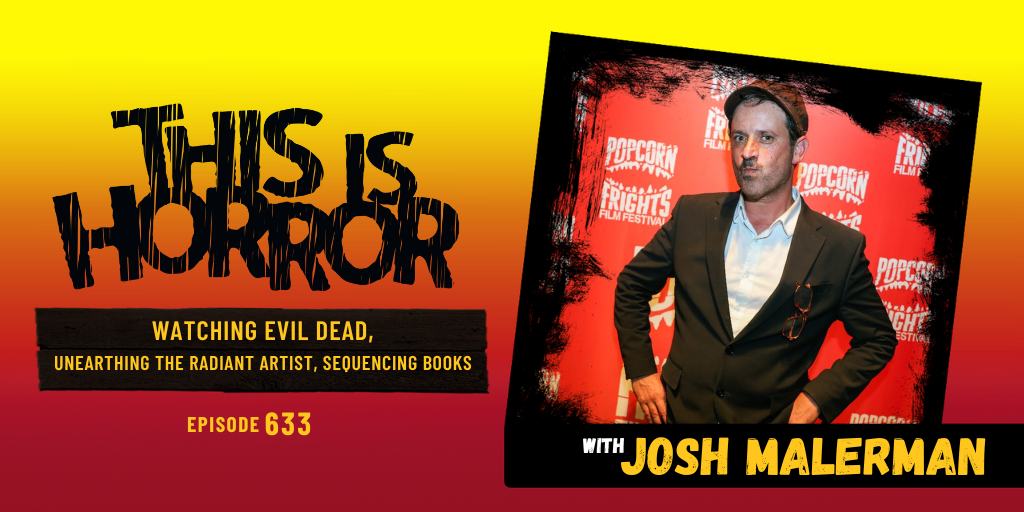
In this podcast, Josh Malerman talks about his brand new book, Watching Evil Dead, unearthing the radiant artist within, sequencing book order like an album, and much more.
About Josh Malerman
Josh Malerman is an American novelist, short story writer, film producer, and one of two singer/songwriters for the rock band The High Strung. He is best known for writing horror and his post-apocalyptic novel, Bird Box, which was the inspiration of the Netflix film Bird Box. His latest book is Watching Evil Dead.
Show notes
Click the timestamps to jump straight to the audio.
Thanks for Listening!
Help out the show:
- Support This Is Horror on Patreon
- Listen to This Is Horror Podcast on iTunes
- Listen to This Is Horror Podcast on Spotify
- Rate and review the This Is Horror Podcast on iTunes
- Share the episode on Facebook and Twitter
- Subscribe to This Is Horror podcast RSS Feed
Let us know how you enjoyed this episode:
- Leave us a message on SpeakPipe.
- Write a comment below.
- Tweet us @thisishorror.
Resources
- Ryan C. Bradley Books
- Watch the video version of This Is Horror Podcast episodes, including our conversation with Chuck Palahniuk on YouTube.
The Girl in the Video by Michael David Wilson, narrated by RJ Bayley
Listen to The Girl in the Video on Audible in the US here and in the UK here.
They’re Watching by Michael David Wilson and Bob Pastorella
The collaborative novel by Michael David Wilson and Bob Pastorella.
Michael David Wilson 0:20
Welcome to This is horror, a podcast for readers, writers and creators. I'm Michael David Wilson, and every episode, alongside my co host, Bob Pastorella, we chat with the world's best writers about writing, life, lessons, creativity and much more. Today on this is horror, I am talking to Josh Malerman a relatively frequent guest on this is horror podcast, and fast becoming a legend of horror fiction in general, a master of horror, you might say. So I don't think that Josh really needs an introduction, but it would be most uncharacteristic if I were to not at least say a few words sir. Josh Malerman, he is the author, the New York Times best selling author, the award winning author of an array of books, perhaps most famously, bird box, which became a hit sensation, a hit movie, one of the best viewed movies on Netflix, a movie starring Sandra Bullock, amongst many others. And as of last year, he released the genre defining and defying book incidents around the house. He's also released many other titles, including the novella originally published by this is horror, a house at the bottom of a lake Daphne, the short story collection spin a black yarn, Goblin Carpenter's farm, and many, many more. I am also fortunate to count Josh amongst my closest friends within the genre. He is somebody who has been pivotal in my own career, and I think when you listen to the conversation, you are going to get some of that energy and that camaraderie when you hear the two of us talking, and I have to say, his new book, watching Evil Dead, which is a non fiction book, was so Inspiring, like all of these conversations. When I came away from reading that book I wanted to create, I was inspired. I felt like I wanted to be my own authentic self. Every time I sat down to write or stood up to write, however I'm writing, I want to be my authentic self and reading Josh's book, it just, it really hammers home the importance. It really, I just inspires you, and I say some words about it during the conversation and and that's the good stuff, that's what you want to hear. So instead of hearing me now, let's have a quick advert break, and after that, we are going to get to the main event, the conversation with Josh Malerman.
RJ Bayley 3:56
It was as if the video had unzipped my skin, slunk inside my tapered flesh and become one with me.
Bob Pastorella 4:05
From the creator of this is horror, comes a new nightmare for the digital age. The girl in the video, by Michael David Wilson, after a teacher receives a weirdly arousing video, his life descends into paranoia and obsession. More videos follow, each containing information no stranger could possibly know, but who's sending them and what do they want? The answers may destroy everything and everyone he loves. The girl in the video is the ring meets fatal attraction for the iPhone generation, available now in paperback, e book and audio from the host of this is horror podcast, comes a dark thriller of obsession, paranoia and voyeurism. After relocating to a small coastal town, Brian discovers a hole that gazes into his neighbor's bedroom every night she dances and he peeps same song, same time, same wild and mesmerizing dance. But soon Brian suspects he's not the only one watching and she's not the only one being watched. But they're watching is The Wicker Man meets body double with a splash of Suspiria. They're watching by Michael David Wilson and Bob Pastorella is available from this is horror.co.uk. Amazon and wherever good books are
Michael David Wilson 5:13
sold. Okay? With that said, Here it is. Master of horror himself, Josh Malerman, returning to this is horror. Josh, welcome back to this is horror. Hello.
Josh Malerman 5:34
This is exciting as can be. We have a different, different kind of book this time. Man, this is exciting. Like, you know, usually I get um pretty nervous about talking about a book at first, like, when inspection came out, because I don't really know the sometimes what the themes are in bird box or inspection, you know, like, when you're writing it, you're just like, this is a fun story. And then over time, you kind of see it as like, oh, this kind of, you know, maybe this was not a statement, but maybe you were saying this, right? This is non fiction. This is like you knew exactly what you were saying. And so talking about this one, I mean, I feel like I've already begun talking the way that the book is written. So it's like, I'm already like, yeah, we, if you and I were just hanging out, not recording, we would talk about what's in this book. So, yeah, I feel, I feel different. Feel sort of liberated by that,
Michael David Wilson 6:28
yeah, and goodness, there's so much to talk about. I almost found, find myself kind of paralyzed with indecision, where, where do we even go? Because this is a book that you've been talking about, and you've been talking about the story at least, I think, for the what 10 years or so that we've known each other, because this has been such a pivotal night in your life in so many ways you know, not just creatively, but romantically and just, you know, even while I was reading it, I'm kind of getting epiphanies about my own life, and it's kind of sparking this creativity, but, but beyond that, it was almost as if, like, I read it completely sober, but I felt drunk and intoxicated on the energy and on the ideas that you were putting
Josh Malerman 7:25
forward. That's, that is incredible, man. That's, I think I probably brought it up the very first time we ever met, you know, like, because I've, you know, for listeners, it's a, it's a non fiction account of the night where Allison see watches the movie The evil dad for the first time, and me and her cousin and her cousin's girlfriend at the time, we make up the Quartet that watched the movie together. So this is not film analysis. This is not film theory, it's mostly those kind of moments. Are mostly like, whoa. This scene rules, you know, I can't recite the credits. I don't know all the dates and names and all that. I know a lot of it, you know, like we all do. But this is not an expert. This is what it feels like to show someone Well, I hope this is what it is, what it feels like to show someone a movie that you love, and and on this particular night, there were a lot of lot of big themes in the room with us. And the morning after the night, I said to Allison, man, I could write a whole book about last night. And, you know? And then 12 years later, I did, yeah.
Michael David Wilson 8:37
And the funny thing is, as well, I mean, last time we were speaking, it was about a year ago, and you were deciding, like, which book should you write next? What should you follow up incidents around the house with? And you asked me and Bob, you told us some of the options you had. We did say to go for this one. Yeah, I didn't realize because obviously I hadn't read it. I don't even know if it had been written at that point, but I didn't realize how perfect it would be. Because, I mean, what you did with incidents around the house, I think in many ways, you created a new genre, or you added such a genre, kind of defining twist to it. I mean, it is almost found footage on the page. But then what you've done with the Evil Dead book, watching Evil Dead is you've again, kind of defied genre, because, yes, it is a non fiction piece, but there are bits where you're going into your storytelling mode, you've got dialog from each of the characters. So this is not a regular non fiction book. It's got. Dialog. It's got kind of overarching themes. It's it's also stream of consciousness at times as well. I mean, this is a a mad book, but in the most delightful way possible.
Josh Malerman 10:16
Yeah, it was at first, and you can imagine this for sure. At first it kind of felt like, Wait a minute. Wait What voice like? Because I've never, I've written an afterword, I think it was for ghoul in the cape that was somewhat sizable, you know, and then, but I've never written something like this size of like your own voice. And early on, I'm like, oh, man, wait a minute. Is that? What would I say that? Would I do this? Would I do that? Like, there was just some uncertainty or something, but then once you found it, like, once, I guess I'm saying this anyway, that would try the same thing. Once you find it, it's like, oh, and then it just boom, like, just like you just, you just literally felt like you were just talking again. There was something liberating about it. I definitely want to do more books, not, not like watching the shining, you know, not like that, but some other, some other non fiction thing or whatever, but, but not for a while. You know what I mean? Like, now it's like, okay, let's write it. Let's write a few novels and stuff, and then we'll come back to this. And it almost feels like, like having discovered, like, an amazing vacation spot for myself. Like, hey, there's that cabin that you can just go and be yourself, you know, yeah, watching evil dad, man, it's Yeah. And then real fast as you can imagine, sending it to my agent was a little freaky too, right? Because I'm like, oh my god, what is Chris gonna think of this? You know? Like, this is, what is this even, you know? And then, but after I sent it to her, I said to myself, but Kristen loves books, so why? Why wouldn't she like this? She might like this book, you know. And then she called me, and she did, and then she warned me we're going to Del Rey by tempering your expectations that this might they might be like, What is this? Same thing I was thinking about with her. We sent it to Del Rey, and the same thought crossed my mind, which was, but they are book people. They might really like this. And then here we are. So I give us a sort of like a shout out to Del Rey. Like this is unlike this book is unlike them to put out. And I think that's like, I think it's pretty bad ass for them to have been like, Yeah, let's, let's do this. And so I even wrote them like a message the other day and saying as much when it came out,
Michael David Wilson 12:33
yeah. And I'm, I'm guessing as well. You know from their reaction that there was, there wasn't even any hesitation. It was just, yeah, we we like the book. We like what you're doing. Let's, let's go for it. Yeah.
Josh Malerman 12:49
There was talk later on about, like, how the hell is this thing? Like, where? Like, where do you put it in the bookstore, right? Is this memoirs? Is this nonfiction? Is this? The film section is this? The horror section is this, you know? And personally, I think you could put it next to incidents and Goblin and all like, why not? Right? And but that, you know, led to what should the cover be? And that led to them coming up with the subtitle on the cover, the unearthing the radiant artist, because they wanted to, like, let people know this isn't just like film analysis, like, my idea was watching it with that, and it was just a photo of like a trashed living room with like, a bunch of broken bottles and stuff, you know, like a, like, a, like, gross sort of living room. And they were like, we like that, but that feels almost too memoir, because whether I want to admit it or not, there is some writer's guide in here, there is some of that. And so they wanted that to be evident, like in the cover as well. So there was eventually some discussion of, okay, wait, what do we have here? What are we going to do with this? But yeah, from the beginning, it was like, All right, let's do it.
Michael David Wilson 14:01
Yeah, I think having that subtitle, you've immediately expanded your audience, because I think anyone in the horror scene is Josh Malerman. So we're kind of in for the ride anyway, but adding unearthing the radiant artist within that is so a kind of Julia Cameron or just a kind of writing advice, a writing guide book, and then, yeah, the cover that they've gone for as well it it's got to be the Brightest cover, the most light cover for a book on a seminal horror movie.
Josh Malerman 14:45
100 100% it's like, the only Yeah, I 100% agree. It's um, I, I understand why they wanted to do this, though, and and so, like, when they sent me a bunch of cover ideas, I'm like, why is my title so? Little and the subtitle so big, you know? But I was like, No, I understand what. There's what they're saying, though, because if it just said watching evil dad or the trash living room, you might literally think that this is either film analysis or found footage or, like, really stark horror, probably, and it's not that. And so they're and then, so they're writing that in a weird way that might have been lying to someone. Now that you know what it's about, now that cover would work for you, but before you know what it's about, that cover kind of we could, we couldn't mislead someone, or, as you said, someone who would be interested in is, I don't want to call it a writer's guide, but there is, because it's not like, do the follow the steps. I mean, that's ridiculous, that's, that's, that's sillier than me doing research. So, but there is, I hope, like, writer like, like, um, I hope that a writer would read this and feel like, okay, okay, okay, I'm getting to work on my project. It's more like, I I hope that it comes off as more of a shot in the arm, rather than like advice
Michael David Wilson 16:04
it, it absolutely does. And I mean, I felt as well because, because we've had so many conversations now over the years, both on air and off air. And I thought, wow, you're kind of in this really slim volume distilling almost like the greatest hits of your wisdom and just what you have learned about the craft and learn about creativity. But I but I do think you know talking about it as being a shot in the arm, that's absolutely right, because you're not prescriptively saying this is the way to do it, but you are inspiring people. It's not even that you're saying this is how to be inspired. You are showing rather than telling. In reading the book, one will get inspired like I said, I felt drunk reading it. It was that kind of infectious optimism and creativity and so many things, whether you did or you didn't explicitly say them, kind of came back to me. It's like, look, well, someone, someone has to be a success. Why not me? And you know this overarching idea of every time you sit down to write, if you can find joy in the pursuit of writing itself, then you win every time. Yeah, it's that overarching question of, what does the artist deserve? And because this isn't, you know, this isn't a linear story. I don't think is a spoiler to be like, Oh well, this is what the writer deserves. It's like, oh no, well, I can't read the book. Then I was waiting for that punchline. No, but you know that this is what it is as an artist you deserve to create the art that's as simple as it is, but it's also, you know, just profound. And I think as well, like some people, you know they're gonna see like right now you ha, you are a very successful you're possibly the most successful modern horror writer, you know, in the business, so like relatively new writer, if we say, the last few decades. But people have to remember you were doing this when you were living out of your van. You wrote like, what, 20 novels without even sending them anywhere. So you are living this idea of the joy is in the act of writing itself.
Josh Malerman 18:51
Yeah, 100% they're they're like, right now I'm working on a new book. I know the book that is coming out next year, and I have a sense of like, the one or two that I would love to have follow, that I'm writing a book right now. Why? What is it? What am I doing? What's the way? When is this thing coming out? I don't know. There's a there's a here. I can show you. There are two crates right there full of what let's see. So that's 41 minus 14 is 27 more rough drafts, and I'm gonna add a 28th to that, and it's like, what is what is this for? I mean, there's no strategy, there's no end goal for it. There's just like, I mean, you could argue that it's um, I guess you could argue that it's like, staying sharp, staying in shape, staying in writing shape, that kind of thing. And there is that is something to think about, right? You don't want to go like, you don't want to turn around in like, two years past and you didn't like write anything, although that'd be okay if someone did. But you don't want too much time to go by and then you're like, oh. Man, like, and you sit down and write, and you're like, Yeah, B, E, you know, you want to be like, sort of fluid, right? But okay, a whole novel, like, 500 pages of just to, kind of, like, stay in shape and like, that sounds Wow. Where are you at if you're, if you're writing 500 pages just to stay sharp. So for me, what does that mean? That tells me that everything on top of the experience of writing is something to be grateful for. It's something to be it makes you feel really good, makes you feel warm, but none of it compares to the actual act of writing, and absolutely nothing compares to finishing like a new novel. Nothing, nothing I have. I just went to Ireland to be on set for incidents around the house. That was unbelievable, by the way, I never been to Western Europe before. Ireland blew our freaking minds. It was absolutely magical. Um, and I met Jessica Chastain. I hung out a couple times, and the director was amazing, and the producers were incredible. That experience was out of this world. And it can't even touch what it feels like to finish writing a novel. It can't touch. Nothing can it's like, and it's not chasing adrenaline. It's not like addicted to drugs, because it's a very clean feeling that I believe is also a source of like identity, right? So you're at a different stage. I'm, you know, and I'm a different age than when I started writing, and I have an idea for a book, and I sit down to do it, and then I finish it, I just prove to myself that I'm the kind of person that does what he sets out to do that gets excited about working and etc, etc. So to me, there's more than just, you know, Tally up another one in the pile, you know, I mean, which I do? Kind of like the numbers of it, though I do, but there's so much more than that. It's like, there's identity there. Like, hopefully, if I finish writing this one, I will be talking to a friend at the bar, and I'll be like, Oh yeah, no, I finished one, you know, like, a couple weeks ago, and that will feel so good. And I'll be like, talking about the next one. So for me, and this book hopefully embodies what I'm saying you right now is you're just you're not going to top this feeling and and anyone listening who has finished a book, No, you know what I'm talking about. There's no There's dude. There's nothing like it, dude and so, and anyone listening knows that feeling, to any writer who's like, Oh man, I know exactly. I mean that moment of just complete peace. And also, sometimes the book can be followed by a little hollowness of like, like, now what, you know what I mean, only like, like, the rides over and now you're getting off the roller coaster. But hold on, that was really fun, you know? Yeah. So again, it all comes back to the writing of the book,
Michael David Wilson 23:00
yeah, and God, it just really reaffirmed so many things for me, because I just a few weeks ago, finished writing this collaborative novel with my friend John crinn, 167,000 words. We have never written anything that long before it is this glorious, messy, chaotic first draft. And there were points when where I was writing it, and I was seeing that word count go up, and I was thinking, what, what am I doing here? Because this is, this is going to be very difficult to sell, but you can't get into that mode. It's like, No, this is about the art. This is about the experience. So there were points where I almost wanted to cut it back, and it's like, no way you do what the story deserves. You do what the story wants, and to have finished it, because we had a plan as well. And there were points where I was like, I don't, I don't know if this makes story logic sense. And it's like, well, re watch Evil Dead, which I did for the you know, for this is like, there are bits that do not make story logic sense, arguably most of the movie, but it's just a wonderful experience. And now God, having finished it, you know, I have that exhilaration, but now that I've got 167,000 words of it, it's like there are so many possibilities as to where I could go from here. And just like thinking about, how am I going to craft it? How are we going to shape this? You know, I, I, I often plan, as I've said before, but this has actually got me a little bit excited for just not planning things, because I felt, wow, now that I've written the book, I. Have a better idea how to write the book. You know, after 167,000 words, it might seem insane, but now it's like, right now I can write it.
Josh Malerman 25:11
I was just about to say that same thing, that there, once you cross, like, the 100 plateau, there's sort of like, Ooh, wow. It almost feels like you're like, out in, like, there's not as many homes out over, out here, and like the grass is, like, maybe hasn't been mowed. Once you get to, like, past 120 you're like, I'm in, like, the wilderness man, like, I'm like, where am I? Where is how, like, do I live anywhere anymore? And I've only, um, crossed 160 twice. Once was ghoul in the cape, which is 300 I mean, you can imagine what 240 felt like. And there was still bird box length to go right. And the other one is the book that I actually wrote right after bird box called Bring me the map and that. But that one I did in two installments of like 80. So I've only stepped out there really once where all in one artistic experience, I like, went that far out and you start to feel like you're like, Oh, so this is where Pluto is, you know, I never had interesting. It is really just a ball of ice out here. You know, like, the thought that crosses your mind, though, is you're like, oh, man, this could be anything now, because now I know it so well. It could be trimmed. It can be expanded. It could be a short there could be a short story that takes place in this world and hints at this idea. It could be a series of novellas. It could be, I mean, because you got so much to play with it, dude, it's, it's fun. And also, then I understand why guys like Dan Simmons and Stephen King and even Anne Rice, after a while, like, why their books were so huge. Like, I get it when you do like, one or two like that, you know, I've only got a couple that are, like, you know, door stops, but it's a good feeling. So when you guys did it, is it split down the middle? Like, would you say, You know what? I mean, like, to get 160 when you said collaborative, do you mean you wrote it together? Oh, we,
Michael David Wilson 27:06
yeah, we very much. Wrote it together. It's like, you know, I'd write a number of pages. I'd send them back to him, he'd go over them. It was kind of like me and Bob did with their watching in that by the time the reader gets it, I would imagine that nobody can tell who wrote which bit. I mean, we can't even remember who started writing each bit, because both of our writers, voice and our imprint is over every page. You know, we're questioning everything. We're going over word choice. We're going over character decision. We we are just going through the lot. So, yeah, I know a number of collaborators, when they work on something, it's more like, this is your chapter. That's my chapter. I've never done that. I've never really been into that. If we collaborate, and I see it much more as we are a band. We are jamming, you know, we're doing all of this together and that, you know, that's the way that all of that went, not just in the kind of Word document with the track changes and the comments and the back and forth, but we were leaving each other voice notes. We were jumping on calls for hours. We were properly in the trenches together with this one.
Josh Malerman 28:29
So I have not done that before. What I have done, I talked to Ross Jeffrey the other day, and he mentioned that you two are like, like you're sharing as you're going, or going to do something like that? Right, right? Yeah, yeah. I did that with him, with incidents. I had never even done that before, and then you, because of what you just did, you definitely already have experienced this, but that was my first time. I almost felt like I was performing for him, because, like every I knew, every 10,000 words I was sending to him. And so it was like, I almost wanted, like, that 10,000 to end at an interesting moment for him. You know what? I mean, it was almost like I saw serializing incidents around the house for one human being, you know, and like, that was amazing. And that we didn't write together, he sent me every 10,000 of his book. And so, like, the same, that was an awesome experience, man. Because, like, it's still just you and your office, but, but somehow you changed, like, what it means to reach each landmark, 10,020, 3040, you like change that. That was awesome. So have you already started doing that, or you're going to do that with him.
Michael David Wilson 29:41
We've literally just started, but we're talking a few days ago, but I know Ross has already got over 10,000 words, but what he doesn't know, and I didn't tell him, because I didn't want to, like, put the steam out of his momentum. I've got to. For 20,000 I just thought I am gonna start this in just a mad, chaotic way. I was already kind of just feeding off, kind of your book and feeding off the fact that I just created this 167,000 word book. I thought we'd just go in for it, because it because once you get past like, the first 10 or 20,000 words, then you're in it. So I just thought, I want to do this as quickly and as madly as possible. But you know, something that I've been kind of back and forth with over the last year, and, like, it's a kind of terrible thing really, but we always have this dilemma between creativity and commerce and marketability. And whatever I do, I always go back to Okay, being authentic and being creative and just being who I want to be, but I know that what I do is not that marketable. It's not that easy to kind of say, right? This is the genre box that it fits into. And there's always, like, a lot of dark comedy. It's always very dialog heavy. And before reading your book, I was like, Can Can I just can I tone down the comedy and and, like I tried, but then, as soon as I started writing it, it's like, no, there's comedy. This is me, you know, I got to embrace that radiant artist within and, you know, he's a funny fucker. He needs to add humor. That's part of me. So I I've just decided, you know, that's who I am, that's what I'm doing. If I write a story without humor, then then fine, but that's because it'll come out organically. It's never, never force it. Just do whatever you want to do.
Josh Malerman 32:02
And I know the feeling in a similar way, where there are certain books of mine that feel like, what's the right phrase? I don't wanna say lighter, but like, like incidents was, it was like felt heavy and dark while I was writing it, and maybe bird box did too. It felt more like propulsive or something. But there's, there have been some that, like goblin felt more colorful, right? Even, even if it's like horror stories happening, it just felt more like colorful. And I've had time so, because after you write enough, right, you have seen this side of yourself and this side of yourself and dadada. And it might be easy for someone like me to say, oh, incidents has done is doing really, really well for you, man, do another like, ice cold, scary book, or bird box was a really cold, you know, like, you know, propulsive, like, do another this. But just like you just said, when you sit down to write and you're like, Yeah, but no, this one's asking for it's, I'm sorry. It's in your case, it was asking for me to be funny. In my case, it's like, no, this isn't as dark as that. And that doesn't make it any less horror to me. It it's just this is different. Like the Coen Brothers movies don't all feel the same man, you know, like Fargo is darker than Barton Fink, you know what I mean. And like and so on and so on and like, and for you, what you were talking about, the marketability thing. I'm just one of the firm believers in like that whatever is hip or whatever that's like a wheel that's constantly spinning, and it spins kind of slow, but it does spin. And like, you know, body horrors in for a while, and then, or like, kind of take center stage for a minute. Everything's always in. But, like, body horror kind of takes center stage, and then, like, hauntings kind of takes centers that, whatever it is. So what are we gonna do, like, aim for that if we wrote, you know, like, I'm writing this book right now. I have no idea when this is coming out. I have no idea what's gonna be in when this comes out. So, like, it's like, you know what they say, and trying to hit, like, a moving target, right? So just any of that just is just who cares gone, not to mention, and another thing, not to mention that there's the whole, like, adding to your bag of tricks. Like, it's fun to add something new, and be like, Oh, I I can do this now. And like, I'm looking at them. They're on the shelf here, like Google in the cave is nothing Jesus, nothing like watching you, but that which is nothing like spin a black iron, which is nothing like incidents around the house. Well, those two actually do have one little link. And then on Mary Carol, whoa, Goblin, bird box. And so you start to look at that and feel like that's a bag that's a bunch of different sides of yourself that you could, you know, if you were like a musician, right? Like, hey, we can do a heavy rocker, or we can do like, a beautiful, sweet song, or we can do a simple acoustic guitar, or we can do a full orchestra. And that's a really good feeling. So there's also that to. Just letting the book or the writing thing, like you said, because I like that example, this I want to be it's, no, I'm a funny dude. I'm going to be funny, right? And then it's like, yeah, let that happen. And then, and also, there's going to be different ways that you're funny. It's not all going to be like, the same, you know? It's like, you have one stick or something that you do in every book you get what I'm saying. So that's another reason to, like, listen to that you your Eunice, hello, your units. Like, that's like, another reason to listen God, your unit sounds like dirty like, I know, yeah, I don't think we should be talking about your units on this
Michael David Wilson 35:37
early. You might wait for the second hour for that.
Josh Malerman 35:43
You know, I saw your units from across the bar. I decided, so, yeah, he was sticking out. So, so, yeah, there's that too, is like again. And this comes back to identity in a sense, too, right? The body of work is like, hopefully eventually, if you get to write as much as you want and express yourself in full, the body of work should include many different moods, because you have many different moods, and you've had really, like, messed up periods and really amazing periods we all have. And so like, yeah, in the end, I kind of want that all to be represented there.
Michael David Wilson 36:23
Man, yeah, yeah. And I think this is coming back to the idea that, you know, we spoke about before, and you've mentioned in the book about having different seasons. And so not only do you have different seasons of your life and your romantic life, but there's different seasons of creativity. There's different seasons as a writer. Each book is a different season, and it's just like, kind of embracing it, because, you know, in reality, when it's autumn, we're not like, No, I'm not going to embrace that. I'm going to dress for the beach. It's like, well, you could, but you know, you're fighting you're fighting reality. You're fighting the season that you're in. And so, you know, don't fight it. And as you say, with the market and things, I mean, that the market is volatile, and, you know, whatever we're writing, we've no idea when it's gonna come out. I mean, I've got a book that's ready to go now. I've got 167,000 word book. So, so what I'm writing now, who knows? It could be many years until it comes out, and I mean, I, I'm, I'm just constantly writing, so you know, I'm hopefully gonna get into the situation that, of course, you found yourself in with bird box, where there's so many pieces, there's so many to choose from, that it's like, All right, well, here's the spread. What would you like? What do you want to have today, I am
Josh Malerman 38:06
feeling that way about, um, like, the whatever come like, again, I know the book for next year, and I am feeling what you're describing right now, for the for the beyond that, because there is this side of me that's like, okay, okay, hold on. What do we have here? Like, because I there's often I'm talking to friends, I'll tell them, like two of my favorite stuff written they haven't come out yet. And one of them was written in, Geez, 2010 and the other one is more recent, but not that much more, like 2015 or something. So those two have been in like, the crates for this entire career, and there literally might be my two favorites of mine. And I'm like, okay, so then why shouldn't these be the next two? Well, maybe, probably. But then there's also, like, if you're writing two books a year, there's gonna be four more by the time you know, or at least two more by the time that that decision is made, or data. So part of it, for once you have the spread, is not to be wholly seduced just by what you're working on now, because and but that doesn't mean that what you're working on now isn't, shouldn't be next or or isn't the best thing you've done, or whatever. That's because I hate those, or I don't hate but those like blanket statements where they're like, Oh, the author thinks, you know, their best book is their newest one. Well, maybe it is. Maybe it actually freaking is. So I don't want to rule that out either, but I'm just feeling a little bit of a sense of like, okay, okay, we've let me count 1110, geez, wow. 12345, my last six books were all, like, the most recently written thing at the time, you know, I mean, and so, man, there's this whole but, like, what about, what about the book I wrote right after bird box? Where's What am I? What am I doing with that one? You know, I'm. Mean, was I in a great place? I haven't even opened it? Was I in a great place at that point? Like, shouldn't I open it? Like, so I am having a moment of, let's, let's spread out the spread and actually, like, think about this, which ones come, come after because, Geez, how nice and you have the same situation. How nice to have something to choose from. And not not in terms of the market, but in terms of, like, the body of work, the career arc, what did you just put out? So watching him with that comes out, I know the book for next year. What's the right song like, more like sequencing an album, like, what's the right song to come after? Watching you with that, what's the right song to come after? You know, like that,
Michael David Wilson 40:42
yeah. And I think now, now that I've got four books out, and I've got, you know, just as many ready to go, I am thinking a lot more about sequencing. And so the last one that I put out was daddy's boy, which is like my dark comedy, my just going absolutely full humor. So then thinking about the sequencing, my hope, and discussing it with other people is that I'm probably going to put out a book that is a little bit more serious. It's a little bit more fast paced, and it's actually the closest thing to the girl in the video that I've done in terms of tone. And a big reason for sequencing it like that is, well, yeah, there are gonna be moments of outrageous comedy, but I want to show people, you know, I haven't pivoted towards that. That's now not my only thing. That's just part of the repertoire, right?
Josh Malerman 41:45
Exactly and exactly, Paul Thomas Anderson movies are like that. Yeah, like you can start to see like, I do think more of like a filmmaker in that way, like all of our heroes, Dr Strangelove is way goofier than 2001 and like, that's the same director, and we love him for both and and Barry Lyndon is way, way slower than the shining and data, you know, or A Clockwork Orange. And so I do think it's more or I think it's beneficial for us writers to sometimes think of once you've written a few books, to think of it in terms of, like a filmography, because all your heroes again, the Coen Brothers, like, it's not the same tone every time. And there are certain authors that, okay, that's what they do. They find like sort of a thing, and that's their thing, and that's fine, and some of them are brilliant at it. So it's not that's not even a knock, like they're okay, you're brilliant at this, you know. But for the most part, I think most of us have, like, a wide variety of moods, things to say, tones, phases of life. We're going through data and so, all right, all right, let's, let's have this reflect that, I guess,
Michael David Wilson 43:01
and it's interesting too, as we talk about this, and I've never thought about it in these terms, but actually, our approach as the artist, as the writer is, we want to show that we've got a variety. But probably, you know, the publisher's concern is, like, you know, ideally they're like, No, stick in the same box, keep writing these similar things, because then you're easier to market. So there's almost a kind of contradiction or or a conflict, I should say, between writer and publisher, because what you want to do as a creative is not necessarily you know what the publisher wants you to do, but then you know if you've got a good enough track record, I mean, we've seen with your publishing situation, and we see with Eric larocker as well, that with time the publisher, they build trust. They see that, okay, well, you're writing a good story, you've got good reputations and you've got a fan base who are going to follow you no matter what you do. So I think
Josh Malerman 44:11
I've always, I've always thought that it's sort of a transcendent moment once reviewers start comparing your books to your other books. Like, once they start comparing you to yourself versus when you first come out, it's like, oh, this is like, Dean Koontz. This is like Anne Rice. This is, you know, like your first one will get like, things like that, and then the second book, maybe there's something like that too. But if you establish what you are saying, you're almost sort of breaking the ceiling where you're not it's no longer like, oh, he writes like Anne Rice, or he writes like Stephen King, no, no. Now you're comparing book three to book two of his, because it's different. And you're like, whereas the last one was, you know, somber, this one is like, actually, really hilarious. And dadada, what is he going to do next? And again, that. Back to filmography, the same thing and like, that's really exciting too, but there has to be some sort of trust in yourself that you're going to be eventually, like, working through, like, a body of work for for what we're talking about to exist, if you have only one novel in you, and we've talked about this before, there may be a tendency to feel like you have to express it all in one novel. And maybe, maybe there is, maybe you write like, a giant, 1000 page novel that covers all like, oh, it turns it's funny, it's serious, God, it's really like, dark at moments. It's this kind of horror night. It's got everything, okay, well, maybe you did that, but in it in a more what's the right word, not traditional sense, but a more common thing to be would you're going, you're building a body of work, and you're beginning to see phases. You're beginning to see differences between this these couple, wow, you were in that way with those two, and then this one, and then this one. And I think that the audience there's also, like, the trust in the audience, like they don't need the book. The audience doesn't need me to write, like, where every book starts with a number. Do you know what I mean? Like, one, Ugly Duckling. Two, mean men, you know what I mean? Three, you know what I mean, they don't need that. You know I mean, okay, if somebody is doing that good for I'm not, I'm not ripping on anyone. But like, they don't need that uniformity. And I think that part of you, varying yourself is almost like empowering to the reader, because you're saying, like, I don't have to play dumb. I don't have to play this down for you. I don't have to stay in this, like, silly. I don't have to always put on the same top hat or the same sing this, use the same guitar when I play a song for you. Because you reader are varied enough, and your tastes are very enough, varied enough that you're gonna like you might
Michael David Wilson 47:01
like this too. Yeah, and you've not just been doing that in terms of the content and the theme, but also in terms of just the kind of delivery and the length of the book. I mean, if we look at bird box, then I think, I think the next thing you put out was gasoline yield, just like this slim kind of short story. And then there was black mad wheel. And then we put out a house at the bottom of a lake. So, you know, you're doing this kind of novel, short story, novel, novella. So you you're almost it's a good thing as an artist to set the expectation, to not have an expectation.
Josh Malerman 47:47
I really, I agree, I agree. And again, it's, there's again, there's part of that is, like, your identity, man, like, like, you are going to change. And if you, gosh, that would be freaky. If I turn around and I was stuck in, like, oh boy, I'm on book 14, and I gotta, like, okay, so, uh, 14 gray mice, you know, it's like, it's like, no, lose my mind. I think, you know, and like, so, like, there's that, but also there is the freaking trust of the reader. There is that's not just like a normal, noble outlook, like, like, hey man, I trust that someone who liked incidents around the house is going to get watching Evil Dead. Why? I don't know why, but I do. I just trust that that they're like because people are into more than one thing. That's why. Like, I don't write like Eric, I don't write like Gabino. I don't write like Rachel Harrison, I don't know. So if they like all four of us, well, what if Eric does a book that's a little similar to one of mine? And what if I do one that's a little similar to gabinos? It's like they like just there alone is like quadrants of variety that proves that readers are in the numerous different things. So why do you feel like you have to stay Why would you feel like you have to stay in that one? And I think it's also just thrilling, like, so the new one I'm writing right now almost feels like a Geez. It almost feels a little like Miller is crossing from the Coen Brothers, like, like an Irish mob story. It almost feels like, and I'm like, where, what is this man? But there's some, like, real scary stuff in it. And I'm like, I'm like, I I'm whatever this is. I've never done anything like this at all. Does it end up ever coming out? I have no idea. But it adds to the bag of tricks, man, and then it stretches you. It's great. It's a great fucking feeling. It stretches your
Michael David Wilson 49:42
It does, yeah, yeah. You don't want to stretch your newness too quickly, or he might be in trouble. Guy in the
Josh Malerman 49:52
hospital was was stretching the unit, yeah, yeah.
Michael David Wilson 49:59
But in. In watching Evil Dead. I mean, one of the things that you say that really connected with me, one of many things, is that the biggest failure, or the only kind of failure that you can have, is not finishing the story, or is not seeing through, not completing the story ideas. So, like we said that the story, it doesn't have to necessarily mean that draft or that iteration. We know that with Malorie, you wrote a version and then it came back to like, oh, writing the book. Taught me how to write the book. Yeah. But if you don't complete these ideas, if you don't finish the story, then that, yeah, that is, I don't even know failure is the right word, but it's just a tragedy. There's just you should. You owe it to the story. And you know that there have been times with many stories where I've thought, I'm not sure that this is, I don't know if this is coming together. I have a plan, but it's gone off, off the tracks. What am I doing here? But, you know, reading your book, re watching Evil Dead and see it, seeing how nuts it is. It's like you just gotta finish it. And so, you know, I'm working on this new one at the moment, which I'm sharing with Ross Jeffrey. But there are two or three ideas, and one of them, I wrote 60,000 words of it, and was like, Oh, I just, I don't know This is No, I have to finish it. So you, you
Josh Malerman 51:40
definitely have to finish at 60,000 words. It's ridiculous. I have one. I had three, but I finished two of them. I have one that is still sort of haunting. It's like, I think, hold on. I just want to make sure I have this right. I think it's 23,000 words. And I'm like, dude, 23 that's a start, man. And I love the idea. I love the idea, okay, like, I think the reason why I think that way, that the only failure is not finishing is because once it's done, you can fix it. And also, and this is the biggest thing, by finishing it, you're gonna, like, discover things about it that you just wouldn't have that that will turn you on later when you go to rewrite it. In other words, like, Oh God, I don't know what I'm doing, but maybe I'll tell, like, more of his backstory. And then so you tell this backstory, and then you're like, oh shit, man, that's good, and the only reason you did it is because you're Hap, and I'm finishing this idea. So somebody could argue like, Hey, man, if it's not working for you, scrap it, right? But I'm the kind of guy who says the reason that you're starting this to begin with is because you saw something worthy in the idea that concede itself, like, find that space, find that and that excitement, that you're like, a book about this, oh my god, a book about this, right? And then don't ever lose that, even if you're 300 pages in and you're like, Oh man, this is the worst thing I've ever done, don't lose the fact that might be true. Don't lose that, that gasp that you had at the original idea. Finish what you have. You have that adoration for the original idea. Now go back into the rewrite with that now you're going to make what you have better, and you're going to discover along the way, like, a lot of what you're doing was cooler than you thought. And so that to me, like, so that's what I mean when I say, you know, it doesn't matter if it's good or bad, right or wrong, because we're going to fix it. You know? I mean, there's those legendary cases of, like, a rough draft. Like, I think Flowers in the Attic is a rough draft, I think, which is like mind bending. Go read that. We probably talked about this before. And like, so there's like, these legendary, random out of the millions of books, there's like, a couple times when we heard that story. In other words, you're gonna fix the hell out of this, whether you think you're doing it right or wrong, so just do it. And with watching Evil Dead, i There were definitely times where I'm like, Wait, am I just like, meandering right now? Am I just like, where am I like, Wait, are we still, you know, but at the same time, the characters are drunk in stone the whole time. And so it's like, it almost felt like there was a license there. Like, yeah, no, he can just start philosophizing. He's sitting on a couch watching a movie, and he's got these big, lofty ideas going on and, like, it's okay if they come back, you know? So while I was writing it, I was like, Oh, am I, like, meandering? And then when I went back to rewrite it, I'm like, no, no, that this works?
Michael David Wilson 54:40
Yeah, that there was one bit I can't remember specifically, but like, one of the characters asked a question, then I think it was your protagonist just starts talking about something completely not to do with it at all. But then maybe a page or two later, then you return to the. Question and Answer it and and for me, that was really satisfying, not just as a reader, but, you know, as a writer, that we don't have to present something so neat, because life isn't neat. It is messy. We go on these tangents. And, you know, I think sometimes when in that kind of second draft mode, I'm like, Oh, well, if I don't answer that question, now, is the reader gonna be confused? Well, no, because they're not a fucking idiot. They can follow what's happening here. And yeah, I think, as you say, you know that the characters, the characters, it's literally you, your wife, your friends, but they're drunk and stoned throughout. So wouldn't it be really weird if it was neat and there weren't tangents that you went off? It's like, wow, these are the most put together intoxicated people I've ever experienced,
Josh Malerman 56:04
yes, 100% and like again, while writing it, though, because we all experience this, no matter how cool you are, you experience that moment of like you feel out to see you're like, What am I doing? It's not necessarily this is genius. I'm terrible, but it is. It does go from feeling really good to being like, oh, man, do I know what I'm doing. I know what I'm doing shit. And then that's like a dark night that you have where you feel a little weird, like Allison senses, what's up, you know, Dad and I your friends, and then I go back to rewrite, and I'm like, Dude, that totally made sense, man. And in Goblin, I don't know if you remember this, but there's a section called the hedges where this guy, Wayne Sherman, built this hedge maze. And then it goes and talks about his wife, who passed away. And it was like flashing back to his wife. And I remember, like, sludging through those scenes when I was writing them. I'm like, Oh, God, why am I writing this, like, love story, shit. Let's get back to, like, the hedges and the girl in the maze, you know, and then when I went back to reread that, I'm like, this is that's the best stuff, man. It doesn't always work that way, but sometimes it does, and if it does ever, that's reason enough that, when you feel weird, to keep going. And, you know, I would like, I would love to sort of, because I'm sure, I'm sure there's someone out there, you know that's like, no, if it's not working, I move on and like, and okay, but I would love to actually sit and discuss that with someone and hear why they think that's right. Because to me, what you lose there is, again, that adoration for the original conceit, like there's a reason it you've had a million ideas in your life, but you have now written like,
Michael David Wilson 57:44
eight books. Yeah, yeah. I mean it at least, yeah.
Josh Malerman 57:50
So you've had a million ideas, but you've written eight books. Why? Well, those eight ideas were like, I'm going to do this. So that means something to me, the fact that I'm like, I'm gonna do this like I that is behind glass that has to go behind glass so that no matter how terrible I feel, I can turn and there it is in the museum. The idea is still here, untouched, unfazed by how weird I feel. And that will get you through. Okay, all right. All right, fine. You finish, then you can take it out of the glass. You have the the idea you love. Now let's rewrite it, and there we are. So, yeah, so, jeez, watching Evil Dead was behind glass for 12 years. Yeah, museum for 12 years, man. And I wonder, had I written it the next day, it would maybe be more accurate in terms of dialog from like the other two parties, because Allison and mine, I was talking to her through the writing of it like so here you would have said this, and I think you brought up this and but I didn't consult like the other two characters, right? So obviously they there's no quote. Well, there are actually some quotes of theirs, but so that might have been a little bit better for the book to have written it the next day, but, dude, I wouldn't have quite had the perspective of standing at the head of a career in horror if I wrote it the next day, rather than 12 years later when I did
Michael David Wilson 59:19
Right and some of the most interesting bits are the little asides where you're like, little did I know that 10 years later, this would happen, so, like, you can piece it all together. It's like, if you'd have written it the next day, then as ridiculous as it might sound to something that is literally lifted from your real life, but you were too close to the story you were doing the moment you needed time. So I it
Josh Malerman 59:48
would be more like, last night was so wild, you know, versus like, yeah, like, sort of like, let me tell you about this. Like, profound night that Alice and I had 1 million, you know, where, where we were just following. In love we had, and I just gotten a book deal a couple months after that. And then she tells me she's never seen the Evil Dead. And we had sort of a failure night where I or I showed her Raising Arizona. I was so excited. And she she's like, this is fun. This is this funny. I don't know is this funny, you know? And I'm like, oh shit, you know, 1000 not like Raising Arizona. And there was another one that happened that she loved, that I saw him. Like, wait, she likes this. This is weird, man, you know. And then so there was some sense of, like, she gonna, like, the evil dad, you know. So, like, you know, like, there's that. And then when her cousin heard that she hadn't seen it, he was like, oh my god, man, I have, you know, I have it on DVD. You got to come over and that. Then so begins the book, really. And I guess, I don't know. I guess there is, I don't
Josh Malerman 1:00:45
want to call it distance, but like experience, that's the word I'm looking for. There's like experience since then that I can look at that and be like, holy shit, man, you were. I was scared, like, about, you know, going to MOMA to pitch or to talk about bird box to everyone where this all was leading. And I was hoping that, not, not that it would be some huge success like evil dad, but I was hoping that bird box would lead to a life in horror, as Sam Raimi is, you know, evil dad led, led that for him. I know he's gone many places with with movies that are not but there were those, like, concrete hopes at the time, and there's and they're still here, but 12 years later, I'm able to say, Okay, this is yes, this, this is what is happening. This is what you hoped
Michael David Wilson 1:01:35
for, right? And if you'd have written it, as we say, like, you know, within that year, you could have said it was a good night, but you couldn't say it was a pivotal or a life defining or a life changing night, because you need more life to live to be able to make that judgment. You just described
Josh Malerman 1:01:55
it better than I've been describing it the whole time. What you just said is exactly it, and I'm going to use that in any interview I do going forward is that, had you written it, you could say it was a good night, but you couldn't have said it was a pivotal you couldn't have known it was a pivotal night. I mean that that that explains that, that expresses it better than what I've been trying
Michael David Wilson 1:02:18
to say. Oh my goodness. I hope that that has left you feeling inspired. I hope that you're lunging for more, because if you are lunging for more, you're not gonna have to wait long, because the next episode is part two of the conversation with Josh Malerman. If you want that ahead of the crowd, and you want every This is horror podcast episode ahead of the crowd, become our patron@patreon.com forward slash This is horror. If this episode inspired you, if you felt you learned something about creativity, then you're gonna love being a patron, because we've got a couple of exclusive podcasts. We've got writing and life lessons with myself, Michael David Wilson and my use your co host, Bob Pastorella, who unfortunately couldn't make it today. And we've also got story unboxed, the horror podcast on the craft of writing. And in that podcast, what we ordinarily do is we analyze a film or a short story, and not only are we dissecting it and looking at how that story has been constructed and put together, but our aim is to come up with actionable writing advice and takeaways that you can apply to your own writing. So some excellent reasons to become a patron. Another is that you are simply supporting the show. You've given us a vote of confidence, and you're helping me in my dream to make this this is horror podcast, a full time reality. I'm hoping to be doing that next year, but to hit that goal, to realize that dream, I do need some more patrons, so go to patreon.com, forward slash This is horror, have a little look at what we're offering, and if it's a good fit for you, then pledge and I will see you there. Okay, before I wrap up, a quick advert break
Bob Pastorella 1:04:36
from the host of this is horror podcast, comes a dark driller of obsession, paranoia and voyeurism. After relocating to a small coastal town, Brian discovers a hole that gazes into his neighbor's bedroom every night she dances and he peeps same song, same time, same wild and mesmerizing dance. But soon Brian suspects he's not the only one watching and she's not the only one being. Watched. Their watching is The Wicker Man meets body double with a splash of Suspiria. They're watching by Michael David Wilson and Bob Pastorella. Is available from this is horror.co.uk, Amazon and wherever good books are sold.
RJ Bayley 1:05:15
It was as if the video had unzipped my skin, slunk inside my tapered flesh and become one with me.
Bob Pastorella 1:05:24
From the creator of this is horror, comes a new nightmare for the digital age. The girl in the video, by Michael David Wilson, after a teacher receives a weirdly arousing video, his life descends into paranoia and obsession. More videos follow, each containing information no stranger could possibly know, but who's sending them and what do they want? The answers may destroy everything and everyone he loves. The girl in the video is the ring meets fatal attraction for the iPhone generation, available now in paperback, ebook and audio.
Michael David Wilson 1:05:53
Now as long term, listeners of the show are no doubt aware. In addition to hosting this is horror. I am an author, and I have a number of books that are out, one of which the girl in the video has recently received a rather splendid review from Jeff Howard, a very passionate review, in fact, and that is a great way to support me personally, to leave a review for one of my books, and I would like to read this to you now says five stars, and the title is psycho killer action. I thoroughly enjoyed this novella after hearing about it on the author's podcast, this is horror. It's definitely a horror story suited for our times of mask killers striking without warning, I read it all in one sitting because I couldn't put it down and wanted to know how it ended right away. I really liked the writing style, and after hearing Michael David Wilson's voice on the podcast, I could only imagine his voice when reading the words. It was highly entertaining and funny throughout. Great job. Now here's the it's the funny bit. Oh my goodness, is there. That's kind of the review. And then Jeff takes it to the next level. He writes, What I don't understand is how anyone could give this story a one or two star review. What's up with that? If someone does that, they should have to explain why or not be allowed to rate that low. Anyone who can put together a readable story with minimal typos deserves a free minimum just saying. Jeff, boom, I love that. Look, look, Jeff, thank you so much for the love. But anyone you know reviewing my books, can you can tell me whatever you think, you can be honest, if it's a two, if it's a one star, I just thank you for taking the time to read it. And you know that story won't be for you, but it doesn't mean that other stories of mine aren't for you. So goodness, I'm just appreciative of anyone who takes the time out of their day to read my book firstly and then to leave a review that is magic, that is amazing. But Jeff, love the passion. I love that you're enjoying the podcast, and I love that you enjoyed the girl in the video. If you haven't read my other books, I can't wait to hear how you get on with them. And if you don't like them, Jeff, you can leave a one or two star review. We can still be friends, and that applies to everyone. So on that note, until the next time for part two, with Josh Malerman, take care of yourselves. Be good to one another. Read horror. Keep on writing and have a great, great day.