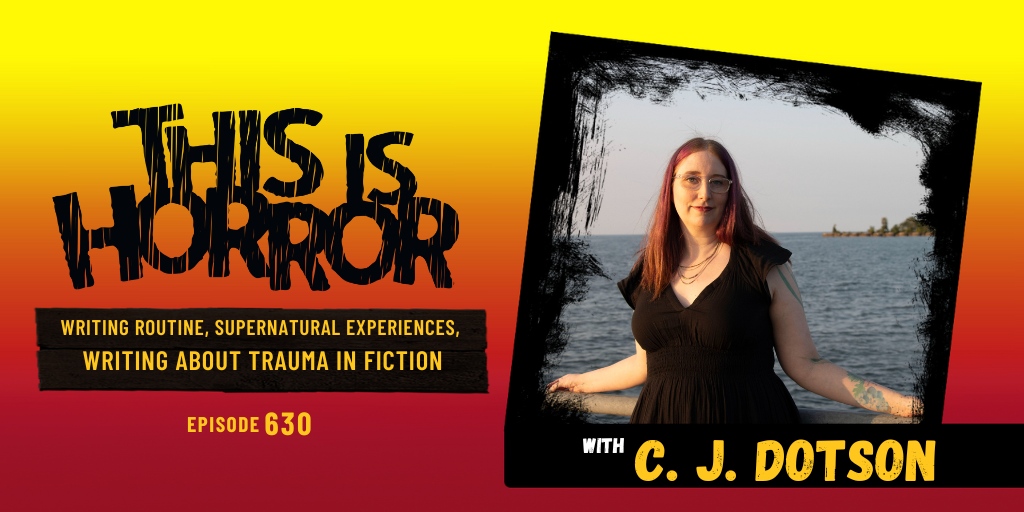
In this podcast, C. J. Dotson talks about her writing routine, strange supernatural experiences, writing about trauma in fiction, and much more.
About C. J. Dotson
C. J. Dotson is a Northeast Ohio native who now lives with her family upstate New York. She studied English with a creative writing focus at Cleveland State University and now daydreams about having the time and resources to go back to school to study history and mythology instead.
Show notes
Click the timestamps to jump straight to the audio.
Thanks for Listening!
Help out the show:
- Support This Is Horror on Patreon
- Listen to This Is Horror Podcast on iTunes
- Listen to This Is Horror Podcast on Spotify
- Rate and review the This Is Horror Podcast on iTunes
- Share the episode on Facebook and Twitter
- Subscribe to This Is Horror podcast RSS Feed
Let us know how you enjoyed this episode:
- Leave us a message on SpeakPipe.
- Write a comment below.
- Tweet us @thisishorror.
Resources
- C. J. Dotson Books
- Watch the video version of This Is Horror Podcast episodes, including our conversation with Chuck Palahniuk on YouTube.
The Girl in the Video by Michael David Wilson, narrated by RJ Bayley
Listen to The Girl in the Video on Audible in the US here and in the UK here.
They’re Watching by Michael David Wilson and Bob Pastorella
The collaborative novel by Michael David Wilson and Bob Pastorella.
Michael David Wilson 0:20
Welcome to This is horror, a podcast for readers, writers and creators. I'm Michael David Wilson, and every episode, alongside my co host, Bob Pastorella, we chat with the world's best writers about writing, life lessons, creativity and much more. Today, we are chatting to CJ Dotson for the second part of our conversation. The first part of the conversation was in the previous episode 629 but as with all of these, you can listen in any order. So by all means, listen to this one, and then when you're done, go back to part one. Now in this one, we are talking further about C J's brand new novel, the cut, and we hear some real life supernatural occurrences that sent genuine shivers down my spine. So a lot to look forward to. But before any of that, a quick advert break.
RJ Bayley 1:41
It was as if the video had unzipped my skin, slunk inside my tapered flesh and become one with me.
Bob Pastorella 1:49
From the creator of this is horror, comes a new nightmare for the digital age. The girl in the video, by Michael David Wilson, after a teacher receives a weirdly arousing video, his life descends into paranoia and obsession. More videos follow, each containing information no stranger could possibly know, but who's sending them and what do they want? The answers may destroy everything and everyone he loves. The girl in the video is the ring meets fatal attraction for the iPhone generation, available now in paperback, e book and audio from the host of this is horror podcast, comes a dark thriller of obsession, paranoia and voyeurism. After relocating to a small coastal town, Brian discovers a hole that gazes into his neighbor's bedroom every night she dances and he peeps same song, same time, same wild and mesmerizing dance. But soon Brian suspects he's not the only one watching. She's not the only one being watched. They're watching is The Wicker Man meets body double with a splash of Suspiria. They're watching by Michael David Wilson and Bob Pastorella is available from this is horror.co.uk. Amazon and wherever good books are sold.
Michael David Wilson 2:58
Okay. Here it is. It is CJ Dotson on this is horror. So you were talking about your planning for the writing, so I want to get a sense, because we have a lot of writers that listen to the show of your writing routine. So I assume during covid, it was probably a little different to how it might be now. But what does a typical working week look like? And then how long do you spend on the planning as opposed to the writing itself.
C. J. Dotson 3:43
My day job is at a is at a school, so my typical working week looks a little different right now that it's summer break than it does during the rest of the year. Most of the time. What I will all the time, what I do is get up at 415 in the morning, because I've got a six year old and a 10 year old and six cats and a dog. So I get up at 415, in the morning, before anyone else is awake, and I make my coffee, and I come in here, and then I give myself about half an hour, 45 minutes, to let my brain really, like, wake up. So that's when I'll, like, catch up a little bit on online stuff, usually problems these days. And then I write until during the school year. I then write until six, and then that's when I get up and start getting my kids ready for school and myself ready for work, and then my daughter is on the bus. She gets the later bus. She's on the bus by 815 and then I come back in and I've got about two more hours before I have to go to work. So I spend those two hours writing, and then if I. Have the if I don't have, you know, pressing chores or errands after work, if I have time before the kids get home from school, then I get a little bit more writing done at that time. On weekends and over summer break, I get up at 415 and I give myself a little bit more time to mess around online, and then I write until my whichever child wakes up last wakes up, and then that's when I get up and make breakfast. And then so in the mornings, it's much easier to hit my flow and keep going on weekends or over summer break, because I don't have to stop at six and get everything going. I can go until my like today, my daughter didn't wake up until 10. It was beautiful. But then during the rest of the day, when they're home and restless, and I've got, like, not as much structure to my own day, during the rest of the day, I find I'm a little bit less productive, but that chunk in the morning is so great. So I'm up at 415 every day to write.
Michael David Wilson 6:07
So then, in terms of getting up at 4am and getting the writing done every day, what over the course of a year does that look like in terms of the amount of books that you can finish? Because you said you're just about to start a new one. I know you wrote free during the pandemic, so I don't know what, what book are we up to at this point?
C. J. Dotson 6:35
Um, I didn't write all, all three of the horror manuscripts that I've had out during 2020 I write before, before I got my my book deal, I was writing about a book a year, and then Adjusting to the pace of publishing and having like this, having this endeavor that's been pretty solitary and entirely personal, suddenly become much less solitary and personal, and you have to, like, divorce yourself, kind of from some of the personal parts of it, because now other people are reading it and having feelings about it and adjusting to that kind of slowed me down for a little while there, and I'm I've been hitting my stride again the last few months. So I write with that schedule. I write I can write under ideal circumstances about a book a year, and that's about where I would like to be. So I think it's working out well, especially now that I'm getting my groove back. Yeah,
Michael David Wilson 7:47
I feel a book a year is a comfortable pace for the publishing industry and for the market in general. And you know, it's remarkable, because I mean growing up, I always wanted to be a writer, and like a number of people, I had the naive idea that, Oh, maybe that could be my only job. It's like, well, there's bad news for you, but I do like that. You know, a lot of us, if we make the time for the writing, we can have the day job and put out a book a year. So, yeah, yeah,
C. J. Dotson 8:27
yeah. It's finding the time, and it's, you know, it's challenging, especially when you've also got a family. There was a period of time after my I was when I found out I was pregnant with my daughter, I had this two year long period of writer's block, and when I, like, clawed my way back from it, part of how I did that was just 10 minutes. I set myself a 10 minutes a day writing goal, and from that, I was able to build it all back up again. But you just gotta find a way to carve the time out wherever you can. I At that time, I think I was those 10 minutes I would be, like, writing on my phone while, like, nursing my baby back to sleep and stuff like, just very like, whenever, wherever I could get it. Yeah, you just gotta find a way to get the time. It could be hard, but it can be done.
Michael David Wilson 9:24
Yeah, for the first 18 months of my daughter's life, I was the main child carer, so that there were times where I was wearing the kind of wearable, and her head is there, and I'm trying to type but, but as you know, I'm also completely exhausted as well. So there's coffee, there's the baby, there's the keyboard. You know, things came out, but my goodness, it is a challenge. And I think you know that challenge of of soul power. Parenting, of course, leads us back to the cut and leads us to Sadie's awful situation. And you know, one of the moments where I felt pretty uncomfortable early doors was when Sadie gets to the hotel for her interview, and then she gets the offer from Gertie, this permanent resident, this elderly woman, to look after her child during the interview. But you know, a lot of people, myself included, were very, very protective. Rightfully so of our children is like, No, I don't want to give you to her. Please, let her come into the interview, but at the same time you want to make that positive impression. So yeah, that was a tense moment to read.
C. J. Dotson 10:55
There was a lot of of poor Sadie having to to, like, balance between what is the best and safest option versus what is going to allow them long, like, long term survival. And it was, it was, she didn't always make the best decisions, but some I didn't give her a lot of good choices.
Michael David Wilson 11:19
Yeah, a lot of the choices that you gave her, it was like, Do you want to make this bad decision or this even worse decision? That was effectively what she got throughout
C. J. Dotson 11:30
Sadie was dealt a rough hand. I wonder who would do such a thing to her?
Michael David Wilson 11:35
Absolutely despicable, you know, really compelling, really realistic reading. And this is what horror is all about. This is what good storytelling is all about. It's that conflict, it's that tension, it's that uncomfortableness. You know, you you want to read something imbued with realism, at least I do.
C. J. Dotson 12:04
Oh, yeah, and it was, it was, it was, at once, like, kind of a challenge to write that, and at the other, on the other hand, kind of easy to write it, because my daughter was a toddler at that time. So a lot of is, like mannerisms and self, I just was able to lift like straight from my child. And I've never been in all of the city. I mean, obviously I've never been in all of the situations that Sadie finds herself in in this book. But, but you find yourself like out in public, and your kid is starting to have a tantrum, and you can hold the line and be firm with your kid and say like, no, and then the tantrum might escalate, and then everybody's looking at you and it's very uncomfortable, or you can give in, and that's the wrong decision, but then you're maintaining the peace out in public. So I think every parent, even if they've never been in terrible situations, can relate to sometimes making the wrong decision with their child because it's easier or feels safer or more comfortable. So it wasn't it was hard sometimes to write some of those moments from like an emotional perspective, but the actual, like moments themselves, in the writing of it came easily. Oh
Michael David Wilson 13:29
my goodness, just being out in public with your child, there's there's judgment from all angles. And you know, you kind of just want to tell everyone to fuck off, which would also bring a lot of judgment, especially if your child is right next to you at the time. But you know, even just talking about that situation where your child is throwing a bit of a tantrum and they want something, well, if you give in, there'll be some people who will judge you and be like, oh, what. What a pushover. No, you shouldn't do that. They don't deserve it. And then if you don't, there'll be the the other end, there's people who are like, Oh, you could do that. And then the child will be quiet, so you absolutely can't win. And, yeah, it's infuriating. You know, when I see parents in that situation, I I don't know, I just kind of want to give them a hug or something. It's like, oh, this. This is difficult. I really feel for them. That's how I react to that situation.
C. J. Dotson 14:37
And I think it's easy for passerby to forget that they're witnessing one moment in a whole lifetime of interactions between a parent and their child. So that definitely adds to like, the weight of it all also,
Michael David Wilson 14:55
and I feel because we're talking about kind of the judgment. From others, and we're talking about misconceptions. This leads us into something that you've said in previous interviews when discussing the cut that part of the reason for writing this was a response to this very flawed idea, and saying what doesn't kill you makes you stronger. So that phrase, yeah, rightfully so. So, could you tell us a little bit about that? Yeah,
C. J. Dotson 15:35
I feel like when someone says What doesn't kill you makes you stronger. They never mean it this way, but it takes the agency away from the person who has survived a difficult period of time or a difficult situation, and so especially in the case of domestic abuse, particularly because that's what the cut deals with what doesn't kill you, doesn't, it didn't. It didn't make Sadie stronger. It doesn't make abuse survivors stronger. To have been abused, the ability to endure that and get out of it was already in abuse survivors, they already had. They already had what they needed inside them and and to say what doesn't kill you makes you stronger is is to give credit for your resilience to your abuser in a way. And I've always hated that, that idea Sadie had the strength to get out of that situation on her own. Someone convinced her that she didn't for a long time, and then she found it again, and she got out. And I feel like people who have been in abusive situations and have gotten their way out of it. Those people had that strength inside of them all the time. People who are enduring abusive situations and can't get out yet, they have that strength in them all of the time. Already, your abuser does not give you anything in terms of finding your power again, your abuser disempowers you. And Sadie spends the entire book not just trying to recover from her abusive situation, but also trying to rediscover and really believe in that strength herself, and she backslides sometimes, and she doubts herself, and she makes decisions that she's not proud of, like there's a scene where something spooks her, and she grabs her daughter and runs and leaves another person behind, and she feels terrible about these things, but she does find her power again, and that didn't come from Sam and the strength of survivors who have escaped an abusive situation or a long illness or a car crash, or whatever else it is that you've survived, that strength comes from you and you deserve to own it. What doesn't kill you makes you stronger is, is a terrible is a terrible phrase, in my opinion,
Michael David Wilson 18:36
yeah, I think you're kind of reframing of it. And putting that empowerment back to you, know that the victim is like you have made yourself stronger. Yes, the abuser did nothing, nothing good for you. And I mean, I'm wondering, in terms of writing something so heavy and traumatic and occupying that mental space for, you know, around a year, how did that take a toll on your own health? And did you put things in place to protect your mental health and well being. You know, in occupying such subject matter for an extended period of time, I
C. J. Dotson 19:30
am not very good at self care, but what I am very good at is compartmentalizing. I have, I have it's kind of a problem sometimes, but I have a very, like, loosey goosey relationship with object permanence, out of sight, out of mind, is a very real thing for me, and this kind of goes with me for like, emotions too, when I'm not when I'm not writing, and when I'm not actively. Like thinking about my stories, because they do. It's writing stuff is like all I think about, and like all I talk about, and I annoy everybody around me only wanting to talk about writing stuff, but when I'm, when I'm thinking about it as my story, it's really easy for me to engage with it with that level of remove when I'm actively writing the scenes, when I'm when I'm living in it, in that moment I have, I have, on occasion, made myself cry Well, while writing my books, but in the moments when I'm not thinking about it as like my story, my art, and so there's that remove. And in the moments when I'm not actively writing it, so I'm in it. I'm pretty good at putting something well out of my head, and I, you know, never know where my car keys are, but I also don't deal myself too much trauma.
Michael David Wilson 20:55
That was not the ending to that field I expected, but, you know, talking about endings that were unexpected. So here's a segue for you. We we hinted at it earlier, and Bob mentioned the kind of cronenbergian level that the cut goes to. This is incredibly hard to talk about without spoilers. But, I mean, did you know from the start, from the inception of this idea, that you were going to essentially change genres, change sub genres, or at least reveal surprise. It's been about this as well. You know, fairly late into the game,
C. J. Dotson 21:50
yes and no. One of the one of the aspects of writing that I sometimes find myself struggling with is pacing, and so I have been working on on fixing that a little bit. But part of how that manifests in the cut is that the first half or two thirds of the cut do read a lot closer to like a a suspense novel. There's, there's a slow but steady, tight build up and underlying dread. And it was really fun to get to the final third and just smash that wide open and come in with what I had been building towards and hinting at and leading to, all along with the slow beginning.
Michael David Wilson 22:48
Yeah, Bob and I are massive fans of kind of horror books, or indeed, any book where there's a kind of genre twist. I mean, I love that with films as well, like Ben Wheatley skill list is one that comes to mind. But just wait where you think you're going in one direction, and then it's like, actually, this is what's happening. And yeah, particularly for a finale, because it just, it just makes it absolutely mad, and I Yeah, again, like, I'm struggling with, what do I say here that doesn't, it's,
Bob Pastorella 23:27
it's kind of, it's, it's very tough territory, like kill this, if you haven't seen it, it's, it starts off as a typical kind of crime story that very abruptly but also logically. So it falls into what I call logical yet unpredictable. Goes into folk are so let's just leave it at that. It's just that. It's just one of those things that when it flips, it's like, What the fuck? And you're like, oh, here we go. We're getting into some totally different territory now. And I didn't feel I didn't feel that with the cut because you you parched. I think your pacing was good. Now that's something that you had to work on for a long time. It does show thank you. What, I like about it is that the initial times that Sadie does experience something, there's almost this in ambiguous ness to it. There's an ambiguity there that that I like, because it's like, hey, no one else saw this but me, and they're giving me that, you know, they give me the side eye when I tell them, hey, there's, there's something in the sink, you know, or something like that, you know. And it's like, and then knowing her history and knowing how she you know, Sam is basically, you know, he's an abuser, so he. You know, he's using, you know, gaslighting and all the, all the tactics that they use. It makes sense in a way that, yeah, of course, these people don't believe me, because, you know, and it's like, it's almost like a defeating type thing, and it's only when other people start to to see, that's when it starts going, Hey, there's, there's something going on. But, you know, it's like, you it's like Michael said, it's really hard without spoiling anything, it's really hard to talk about, because you're going to give something away. There is, there is a genre shift, but it the pieces are there. You just have to, you have to read the book, read the book, buy the book.
Michael David Wilson 25:53
And, I mean, we've got a question from Tracy via Patreon, and she wants to know, what advice do you have for marketing debut fiction, and do you have a publicist, or what are the team doing at your publishers? And what are you doing?
C. J. Dotson 26:18
I am not going to be super helpful with this one, because I am, I just feel like I'm floundering on like, social media all the time. I don't know how to be, like, super interesting and engaging on socials. I I don't have, like, my own personal publicist, but there is a publicist at St Martin's Press, who works with me, and she's wonderful and and so she's the one who, for the most part, she's the one who facilitates stuff like this, like getting on this podcast and hanging out and talking with you guys, which I've really enjoyed, by the way, but you also just have to be kind of on the lookout for opportunities to present themselves. I said earlier, it like the idea that really carried me through querying was that luck can only strike you if you make the opportunities for it too. But the other thing is just to be nice, just I, I really love engaging with the writing community. I love my writing friends. I love meeting new people and talking to them. And I have found that through genuinely befriending people, like, it's, I don't I'm not saying like, go out there and like ruthlessly cultivate friendships for for gain, but I have found that by genuinely befriending people and by being enthusiastic about knowing people and building community and having these bonds, you find opportunities present themselves because they're available and because you know somebody who also is genuinely fond of you, and then they want to help with your thing. You want to help with their thing. Just the best thing I think, that you can do, especially if, like me, you're not good at social media stuff, and you don't have the budget for an ad campaign of your own or publicist of your own, is to get out there and meet people and be nice and Be genuine and make friends and and and and be enthusiastic about them and their work and and don't go into it with expectations and and opportunities often will follow. And that shouldn't be the reason that you do these things, but it's definitely a nice side effect. So there have been times that I've been able to go to my publicist and be like, Hey, I made friends with this person, and this person runs this podcast that's pretty, pretty cool, and they want to have me on, and can we, like, facilitate that? And so there's, there's been times that I've had opportunities come my way because of friendships that I've made, and it's the friendships that wind up being the more valuable of those things in the long run, either way, the the the marketing stuff, the publicity stuff is a great, a great fun thing to try to do for your book, but the Real Thing is the friendships that you it's the friendships we made along the way. But that's really true. It really is,
Michael David Wilson 29:47
yeah, and I mean, speaking about friendships and kind of events and connections, I know that you've done a number of events with different authors for. Public for publicizing the curtain. I know that in a few days you've got one coming up with Cynthia paleo.
C. J. Dotson 30:10
She is so nice. I am so so looking forward to hanging out with her on on Friday, just under a week she was one of the authors who blurbed the cut and and I love her books, and I got to meet her very briefly at Stoker con a couple of weeks ago. But that is an extremely overwhelming environment and and it did not lend itself much to long conversations when everyone's kind of running around trying to get to the next panel or do the next thing, or there's a million people around who also want to have a conversation. But she's super cool. I'm really looking forward to hanging out with her on Friday.
Michael David Wilson 30:55
Yeah, she's always been very kind, very supportive and just very enthusiastic any time we've, you know, spoken to her on the podcast. And I love that, and yeah, and any sort of correspondence with her. And, you know, with Cynthia in particular, it's been great to kind of watch her rise within, you know, the scene. And I think she is one of the best writers writing today. You know, full stop, no qualifiers, no genre qualifiers, just in general.
C. J. Dotson 31:34
Yeah, she's great. And, I mean, what are you vanishing? I'm reading vanishing daughters right now, and I'm just so like sucked into it. I am. It's hard for me to put it down and go do other things. Well,
Michael David Wilson 31:49
we're glad you at least put it down to have this conversation. Oh
C. J. Dotson 31:53
my, this has been really nice. Oh, thank you. Thank you.
Michael David Wilson 31:58
And I wonder, with these events like, what, what does the typical format look like? And when you're doing a reading, do you, how do you kind of select which part you're going to read, particularly with a book as expansive as the cat,
C. J. Dotson 32:17
um, I like to read the scene. When I like to read the scene in the shower, that's because it gives it gives the reader, or gives the audience, I guess that in that context, it gives them an idea of of what's going on and maybe an idea of what's at stake, but not enough of an idea to to to spoil anything, hopefully enough to whet the appetite. And it's a fun scene to read. It's a little bit gross, but it's not too gross for public consumption at an event, so it's fun.
Michael David Wilson 32:56
Yeah, it's definitely a scene that, if you know this was a movie trailer, it would be kind of the centerpiece. I think that would be fun.
Michael David Wilson 33:07
And I mean, we spoke a little bit about disquieting things happening, you know, both on the page and off the page, I wonder what are your personal beliefs regarding the supernatural, and then what is the strangest thing in that vein that has happened in your life? So
C. J. Dotson 33:35
I believe that things happen that we can't explain, but I also believe very strongly in cause and effect and and I also believe that almost everybody in the world has a camera in their pocket all the time. And if there was a lot of supernatural stuff really happening, I think there would be some evidence for it. And I know that's not like the fun answer, but that having been said, well, backtrack just a little bit. I also believe that human memory is incredibly fallible. I don't remember when I learned this, but I learned that when you remember something, you're not actually remembering the event itself. You're remembering the last time you remembered it and and all you got to do is think about the game telephone right to know that you can't really trust your own memories as well as you want to feel like you can. And that I could get off on a whole tangent about that, and what that says about like continuity of consciousness and likes of self and if but but, um, so that being said, I don't, I don't. I'm open to the idea of believing in the supernatural because I think it would be fun to, you know, and because I don't want to, I don't want to think that like this, is it like God? How God? I don't want to think that this is. It. I want to go to Narnia or, like, I mean, I've joked that, um, that if I found myself in T Kingfisher's, the hollow places, I would go through that whole eyes open. I would, I would, I would be like, this is a bad idea, and I am doing it. I would like, out of the world sometimes, you know, but, but I don't think, I really think that any of that is real. But that being said, I'm gonna, I'm gonna sound so silly. Now, I have had some weird experiences that I cannot explain, the most recent of which is, there is a, and I've told this story before, but there is a small grocery store near my home, and my husband and I don't go there often enough to be regulars, but it's right near our pharmacy. So when we have to pick something up, we pop over to this grocery store. And the last time that we were there together, we split up, and when he came to the aisle where I was, he came around the corner, and he had for a moment this kind of perturbed look on his face, and then he sort of shrugged it off, and we kept shopping, and I popped around to the next aisle to grab something, and came back to meet him where he was, where he had just met me, and when I came around the corner, I did not recognize him at all, at all. I've been married to this man for 10 years. We've been together for 13 years. I did not know him at all. And then it passed, and he he didn't change. It was his same face. It was him. It was just him, um. And I said, Oh, the weirdest thing just happened to me. And he gave me this kind of sharpish look. And it was like, when I came around the corner just now, I didn't and he stopped me. He goes, Wait, you didn't recognize me, did you? And I was like, No. And he said that when he had come around to meet me in that same aisle, the reason that he had looked kind of perturbed was because the exact same thing had just happened to him. He came into that aisle and he did not recognize me, and then it passed. And the weird thing is that that happened two more times, once more to each of us while we were in the store that day, and then we were on our way out, and it's one of those little grocery stores that shares a building with, like a bank and a liquor store, so it's got a central hallway to get out to the parking lot. And as we're on our way out, there's this old guy who is wearing the like, uniform of the grocery store, who's like, walking towards us, and he's got this particular, like, fast shuffling footstep gate, and he's coming towards us fast as we're leaving the store. Something about him kind of made me feel a little bit like uncomfortable, maybe just how fast he was coming at us. So we're leaving the store, and my husband's a little bit ahead. Little bit ahead with the cart, and I'm a little bit behind, and he keeps checking over his shoulder, so I'm thinking like he's keeping an eye on this guy who's following us, because his footsteps are still following us out through this shared hallway. And we get out, and we go to the car, and we're loading the groceries in the car, and I look out and I see this old man leave the building. And then the next time I look up, I can't see this old guy at all. I have no beat on him. And I said, Matt, where'd that old guy go? And my husband goes, what old guy? And I said, the old guy who was behind us. And my husband said, CJ, there was nobody behind us. And the reason that he had been checking over his shoulder is because he could hear the old man's footsteps too, and he was going to look over his shoulder to ask the guy to back off, because it sounded like this person was way too close to us. But when he looked, he couldn't see anybody there. And and, you know, real life spooky stories kind of don't have a tidy ending. I don't have a good ending for that. I've been back to that grocery store since, and nothing spooky has happened like that again. But I don't know how to explain that I didn't know my husband and he didn't know me, and that that happened to both of us without discussing it, and then it happened again. I don't know how to explain where that old guy went after he came out of the door, and I don't know how to explain why my husband couldn't see him following us, but I don't believe in ghosts.
Michael David Wilson 39:30
Yeah, it's such a disquieting encounter that you had an experience. And you know, it can be similarly to you, like, you know, I believe in science. I believe in cause and effect. And sometimes things happen and there is an explanation we just don't know. Yes, what it is, and yeah. Seems to be the case with this. But you know, I'm not even sure which bit is more disturbing, is it? The fact, probably the bit that is more disturbing is that you didn't recognize your husband for a moment. It
C. J. Dotson 40:19
was a very strange feeling, because he didn't look any different, but it just, it wasn't, it was someone I just didn't know. And it,
Michael David Wilson 40:28
you know, of course, like people can get things like dementia and Alzheimer's, and it feels like almost a terrifying preview as to what that could be like, the unreliability of the human mind. But you know, the bit tying it all together, which makes it totally like a ghost story, is that you both simultaneously had the same experience, which is why, by the way, I'm not on this is horror trying to diagnose. Surprise, you've got Alzheimer's. No, that's not what I think at all.
Bob Pastorella 41:08
They said it on this is horror,
Michael David Wilson 41:14
we have said before, but do not, do not take anything you hear on this show as medical advice. If it sounds like medical advice, probably do the opposite. But also don't now sue me and do that. Also, look, you can't sue us for anything we say. I'm not sure that that sound illegal. System works that it's like, no, listen to this episode. I said, you can't sue me. That's the loop,
Bob Pastorella 41:44
protected forever. I do feel that we could probably give better medical advice than or if K Jr, but that's just me.
Michael David Wilson 41:54
That's just me. I had a feeling you might know, Bob, we're not even going
Bob Pastorella 42:02
maybe, let me see if I can do a good impersonation of it. Maybe, maybe when y'all were in the store that you passed through a brain worm portal, that could have possibly been what happened to you.
Michael David Wilson 42:18
I don't even know if Is that him on the show? Is that you
Bob Pastorella 42:24
definitely him?
Michael David Wilson 42:28
Oh, my goodness, the old, the old man as well, that you saw it wasn't, it wasn't Robert Kennedy. Was it? No, I
C. J. Dotson 42:38
would have, I would have, I think I would have recognized that.
Michael David Wilson 42:41
Yeah, he's running after you. That is true horror. Anyway. Yeah, has, has anything happened since at that store? Or was it only those kind of free incidents in that one crazy visit?
C. J. Dotson 43:01
Nothing spooky. You know, nothing spooky. I was there. I was there recently, and I asked the guy checking me out, the guy ringing me out, like, how was How was your day? And he answered and and I took a breath to respond, and I didn't realize that at the end of his answer, he was going to heave this long sigh, and I took a breath just as he sighed. And I like breathed in all of his exhalation, accidentally. I like, and he like, and I like breathed his breath, and I got real wigged out by that. But nothing like spooky, just uncomfortable.
Michael David Wilson 43:41
I mean, that's just absolutely disgusting, although it does have a supernatural kind of in, like a horror story, he's like, giving you the demon or something
C. J. Dotson 44:01
that was secretly on purpose, yeah,
Bob Pastorella 44:06
we've said, we've all seen too many horror movies that that's how, that's how the shit goes down.
Michael David Wilson 44:13
It is and talking about hauntings, I mean, I don't know what you can say about the forthcoming book these familiar wolves, but I I'm pretty sure that it kind of originated from your fear or a fear of mirrors. So what can you give us about this one? Because having read the cut and the little bits that I've heard about next year's book, I'm so ready for it.
C. J. Dotson 44:48
Mirrors are scary. They are bad. That's Oh, you know what? I have another really good ghost story that. Is Yes, true to the best of my flawed human memory that tangentially relates to members are bad right when I was, when I was in my late teens or early 20s, my I lived with my dad and my sisters lived with my mom, and my sisters had this next door neighbor who I didn't really like, but her boyfriend was cool and his cousin was cool. And one day, I was visiting my mom and my sisters, and they wanted to go for a walk to the hill behind the parking lot of the church that was behind my mom's condo, and they didn't tell me anything about why they wanted to go on this walk or anything. They just wanted to go for this walk. They wanted me. They really badly wanted me to come on this walk with them, right? So we go out the back door and cut across the drainage ditch to the church parking lot, and we're going up onto the hill, and it's not a natural hill, it's like leftover dirt from the construction of the church and the parking lot. So it's sort of a squarish shaped Hill with the parking lot on one side and trees bordering it right and flat on top. And it's a little bit steep. Before you get to the flat part, we go up the hill, and up at the top, I am struck with this dread. And there's a like the corner just opposite to the right, because it's kind of a squarish Hill. The trees there, they've got this there's pines there, and so the shadows are deeper there. And it's not that I could see or hear anything that shouldn't have been there. It's that I had this powerful sense that I should have been able to see or hear something there, and couldn't. And it was very unsettling. And I was, I was eyeing that location, and I said, I will not go over there. And so we kind of, they, they, like, kind of exchanged a glance, you know, my sister and her friend and her friend's boyfriend kind of exchanged a glance. We're sort of wandering around, and all of a sudden, this, this fear seizes me, and I said, we need to leave now. And we get halfway down the hill, and I've that crawling on the back of your neck, you know, like that, watched feeling, but instead of wanting to turn and look, I had a deep aversion to turning and looking. And I said, I said, don't look back. We're halfway across the parking lot, right? And, and I don't remember what even prompted me, but I said, all the lights are about to turn off, and then every one of the parking lot lights turned off. We get back to my mom's condo and they confess that they took me there on purpose because they had gone, like, just on a walk, I think, my my my sister's friend's boyfriend wanted to smoke or something, and they didn't want to get caught, so they had gone back there, you know, on a walk and and every single thing that I had said, the boyfriend had said on their previous walk. So they get up onto the top of this hill, and he notices the same spooky corner, and he says, I will not go over there. And then after a couple of minutes, he says, We need to leave now and then partway down the hill. He says, Don't look back. And then partway across the parking lot. He says, the lights are all going to turn off, and they do. And so I was like, and you guys didn't tell me, and they were like, well, we wanted to see what would happen. So naturally, I got my best friend at the time and did the same thing to her, and I took her to this hill, and she didn't say the same things, but I was watching her closely. And we get up onto the hill, and she walks in on that corner. She is staring at it and breathing hard, she won't move. And after a couple minutes, she says, We need to leave now. And then we go and then, and then part way down the hill, she says, Don't look back. And then partway across the parking lot, she just grabs my arm and the lights turn off. And so my sister's friend's boyfriend was like into amateur ghost hunting. And so he gets a tape recorder, and he lays out the rules right during the recording, never whisper, because you might hear yourself whisper later and think it's an EVP, an electronic voice phenomenon. If you are going to talk to the entity or whatever, you should introduce yourself to be polite. And in hindsight, I think I don't agree with that one. I think we shouldn't have given it our names, but Hindsight is 2020, and I didn't get cursed so that I know of and he says, if you ask a question, pause before you ask your next question, so that if there's an answer, you don't talk over it. And these are the rules, and we added. Digital camera, and we had the voice recorder. And so that time, it was just me, my sister, and the friend's boyfriend. We go back and and he introduces himself. Well, no, the first thing we get up onto the hill, and the first thing that happens is that the battery in the digital camera dies. He turns on the voice recorder, he introduces himself and and he starts asking questions. And he says, if you're here, can you give us a sign? And this gust of wind springs up from that spooky corner and sweeps around in both directions, around the hill, and then stops. And so he introduces himself, we introduce ourselves. He's asking questions. And then I say, can I ask a few questions? And I don't even remember now what I asked, but I probably, like very cliche stuff, like, is there a reason that you're still here? Is there anything we can do to help you move on? Probably, like very cliche like, late teens, early 20s, questions, and then we go back to my mom's house, and we as soon as we are down the hill, the digital cameras batteries come back halfway across the parking lot, the lights go off. We get back to my mom's house, and we're sitting in like a huddle in my room, and we are listening to the tape recorder and and in the tape recorder, I speak first, and I'm asking my questions in the tape recorder. And it's not like, it's not like a faulty recording where, like, your voice gets really squeaky. I still sounded normal, but there were no pauses between my questions. It was just boom, boom, boom. And then it cuts straight to the boyfriend, saying, Can you give us a sign? And and then you hear the rush of wind, and under it, you hear a voice, and it was not a language that any of us knew. And then you could hear the boyfriend asking his questions, and and we had a terrible falling out a few years later, me and and and the friend and the boyfriend, I have no idea if he still even has the recording, but we were so freaked out by this, by this recording that we decided we're going to steak and shake like right now we cannot sit in this house across from this parking lot any longer. And on the way out of my mom's foyer, she had this big mirror hung by the door, and the boyfriend pulls his like jacket up like this, like hiding his face when he goes past the mirror. And he says that every time that he tried to do amateur ghost hunting, anytime he ever got results, mirrors were weird around him after that. And I said, What do you mean? And he tells me specifically about a time that he had done like, like, one of his first ghost hunts. He had tried to get EVPs in a basement, and then later that night, he had leaned close to the mirror to take his contacts out, and His Reflection did this, like, pulled back really fast, and like, like, pulled its arms back. And I didn't see that happen. He could have been lying through his teeth, but he seemed genuinely freaked out by the mirror. And I had already, like, been, like, uncomfortable around mirrors and and so between my natural discomfort of mirrors and their deep, dark secrets and this guy's spooky story, after already having been so thoroughly creeped out, I just find mirrors deeply unsettling in general. And now I'm sitting here talking to you guys, and it's dark out, and I'm looking at the windows in my room and how they're reflecting the Roomba, and you've got a mirror behind you, yeah, and there's a lot of bad mirror stuff in the next book,
Michael David Wilson 53:55
I got a mirror to the left of me. I don't even want to look to the left right now, but oh my goodness, you were talking about, you know that kind of spine tingling, you know that, that kind of whisper, that shiver that you get on the back of your neck. I getting it through half of that story that was, oh my goodness,
Bob Pastorella 54:19
wow. You know, the thing that's creeped me out the most was the fact that it was that one corner, and you don't even know what it was, but there was something there that was affecting you. It was spooky. It was scary. You know, that reminds me of like watching, you know, the Blair Witch. You never see the witch. It's, you know, and it's, it's kind of like when you write project. You never seen it. It's, it's pretty creepy
C. J. Dotson 54:50
one. And I love found footage. I just, for some reason, I've just never seen that one.
Michael David Wilson 54:57
I watched it a few years back. Then still stood up. So I think if you were to watch it, yeah, remedy My lack.
Bob Pastorella 55:07
Yeah, you should, you should, you should seek it out. It's, it's pretty effective in what it does. It's, it's, it's definitely a less is more. And it's one of those things too, that always say that if you can scare you can't, you can't scare your reader, you can scare your characters, and then your reader will get scared. And so that's, you know, the main thing. So if you have characters that you that that aren't scared by what you think is scary, then you need to make them scared. Yeah. Yeah.
Michael David Wilson 55:43
Well, I mean, where every time that you returned and you know, the new person was freaking out at the corner in each subsequent visit, were you as freaked out as the first time, or and Did Did you also feel the lights are gonna go off, or was it, you know, only the original time that you're kind of getting that intensity and fear,
C. J. Dotson 56:12
I it was much diminished the times that I went back. And I don't know if that's because I was expecting it, or if that's because I was so focused on the other people's reactions, or, like the trying to get the EVP, like I had something else to focus on, or if it's because I was expecting it, or both, but it was, it was never as intense again as It was that first time
Michael David Wilson 56:41
I wonder too. I mean, I don't obviously understand the full geography of the place, but obviously there's a corner where it's emanating from. Did any of you ever consider like, can we drive down to that? Can we can we see it from another angle? Can we investigate this specific area.
C. J. Dotson 57:03
It was there was like the main road and the church, and then there was a road that went into the development where my mom's condo was, and then that had, like, parking lot, parking lot, parking lot. So her condo was, like, here, so there wasn't a road or anything here. It was just the drainage ditch, and then we could have probably walked around from like the other side. But during the day, it just didn't seem as fun to try. And at night, we were too scared.
Michael David Wilson 57:38
Yeah, it really feels like all of you were in a kind of coming of age. Stephen King story, it's totally what was happening. And you know, when I hear things like this, it like I said, I think there are things that happen that have an explanation that we don't have yet, but, but moments like this really put that to the test.
C. J. Dotson 58:04
Oh, yeah, I feel like your listeners are gonna make fun of me. Like CJ Dotson doesn't believe in ghosts, but like all that stuff happened to her,
Michael David Wilson 58:10
yeah, it's kind of a terrifying thing where it's like, I don't believe in ghosts, but they seem to believe in me.
C. J. Dotson 58:20
Well, they could give it a rest.
Michael David Wilson 58:23
Yeah. I mean, sometimes people talk about different people being receptive to these experiences, whatever, whatever we define them as it would seem. You know, I don't know if it's good or bad news. You are one of them. CJ, who's definitely, yeah, they're honing in.
C. J. Dotson 58:46
I mean, it makes life interesting,
Michael David Wilson 58:48
yeah, particularly as a horror writer,
C. J. Dotson 58:52
I guess the ghosts knew that I was gonna seek out this profession at some point, even if I didn't think horror was my jam back then,
Michael David Wilson 58:59
that's what it was they would that was the message they were trying to give you. Yeah, but goodness, the the boyfriend and, you know, trying to take his contact out, and then, like, imagine your your own reflection, starts moving and doing something different. Oh,
C. J. Dotson 59:18
it's one of my big, big, big fears. Yeah, I'm
Michael David Wilson 59:21
I'm just glad that I can take my contacts out without looking anywhere, right into the eye,
Bob Pastorella 59:29
yeah, that just reminds me of poltergeist in the guy in the mirror. I don't know if you've ever seen the original Poltergeist, yeah, but he, you know, the they, when the research team comes, he goes into the bathroom, and they've already had a couple of experiences, yeah, and then he sees something in his face, and of course, he starts doing something in every. Things fine, but he, you know, he's like, he's checking out after dad, he's like, I'm fuck out of here,
C. J. Dotson 1:00:06
as any reasonable person would do.
Bob Pastorella 1:00:08
Yeah, yeah. Be like, did just slip anything in my drink? No, no. LSD, no psilocybin. I'm gone. Have a great day. I mean, if the
C. J. Dotson 1:00:19
answer was yes, they had done that, I would still leave. Because those aren't people you want to hang around. To hang around with. This is true.
Bob Pastorella 1:00:26
You know we were going to tell you, but it was funnier to watch you really, yeah, I'm going to leave when I can. I would at that point right there, but like, well, I can't drive, but now you got to deal with me right. Be the worst baby sitting that they've ever had. Then he got on the roof.
Michael David Wilson 1:00:47
You know, it just occurs to me that I asked you what you could tell us about the forthcoming book, and we just got a mirror ghost story instead. So I I don't know if there is anything you can tell us, or if that was deliberate, but to be honest, if that story was the marketing, then I mean, anyway, that was absolutely fascinating and scary.
C. J. Dotson 1:01:12
No, I can tell you what the next book is about. The next book coming out is, like I said, it's the first horror book I ever wrote and but I'm not, like, as polished about talking about it yet as I am about talking about the cut, so like, forgive me if I stumble over my words a bit. So in 1998 pre teen, Amber, at the beginning of summer vacation, meets a new kid on the block, and she's really excited, because Amber is very lonely, and this new kid moving into town at the beginning of summer gives her a chance to make good friends with somebody before school starts, and he can find out what a total loser she is. And so she completely ignores the misgivings of her family, especially her younger sister Hannah, who tell her like this kid is is bad news. He's trouble, and she befriends the troubled new kid on in the neighborhood, and their turbulent friendship creates lasting consequences. It's a brief friendship, but 22 years later, in January of 2020, this boy, Nathan and an accomplice resurface and murder Amber's parents in her childhood home, and Nathan is, in turn killed by his accomplice in the house. His dying words are, you'll regret this. He's killed in the house, and the accomplice flees and is never caught, and then five months later, because it's the middle of the pandemic, Amber now an adult and her husband and two kids have been living in a small condo. The schools are closed, the parks and playgrounds are closed. She moves her family into this she inherits the house and moves her family into this house where her parents were murdered, and almost immediately, strange voices are whispering from the shadows and mirrors aren't quite acting right, and she's plagued by nightmares and Amber must come to terms, she must admit to herself This isn't in her head, that there is a menacing presence haunting her family, and she has to figure out what it is, why it's there, and resolve her part in a lifetime of strained relationships and tragedy, or she'll lose everything to this thing in her house. And it's a dual timeline book, so it jumps back and forth between the 1998 storyline of amber befriending this boy, and the 2020 storyline of this boy has murdered her family and been killed in the house, and now there's a ghost haunting her in her childhood home.
Michael David Wilson 1:04:04
Oh my goodness, I love the way that your mind works. I love that your stories, they kind of have the perfect blend of, I guess, real life, horror and tragedy with the kind of supernatural or supernatural adjacent and then kind of tied into all that, the kind of very real, fraught family and friendship dynamics. This is the horror that I love to read.
Bob Pastorella 1:04:38
Yeah, so much. It's like mixing Mike Flanagan and Anaya al barn together, and it's just like, that's the that's, that's the shit, right there. Thank you. I got my credit card ready,
Michael David Wilson 1:04:54
man, 2026 is it early? 2026 at least? How low? Do we have to wait for this? April 14? Okay, less than a year. Yeah, less than a year. Yeah? Well, as soon as it's ready, I am hopeful that your publicist will be sending me an email in I'll
C. J. Dotson 1:05:18
give her a nudge. Yeah,
Michael David Wilson 1:05:22
yeah, does the even you talking about it like I was gripped. It's like, keep going, keep telling me, No, you can't tell the whole story on the podcast, but wow, well, I wonder to kind of shift gears as we wrap up. What advice would you give to your 18 year old self?
C. J. Dotson 1:05:46
Ooh, stop mooning over that boy. Mostly, mostly, it would be something along those lines. No, I would. I would tell her that it gets better, that things, things look hard right now, and some stuff, some stuff gets worse, but most, most of the stuff gets better.
Michael David Wilson 1:06:08
Yeah, I think that's, you know, good for young people to hear, and possibly good for anyone to hear going through a rough time. I mean,
C. J. Dotson 1:06:18
yeah, well, and you just have to, you just have to hang on long enough to give it a chance to get better, you know. And I guess maybe that can sound naive, you know. But okay, that's not sorry. I heard a weird noise outside the window.
Michael David Wilson 1:06:35
No, no, it's happening again.
C. J. Dotson 1:06:42
But yeah, but yeah, my 18 year old self, I didn't know who I was or what I wanted to do or be. I mean, I knew that I wanted to write, but I was also exploring a lot of different, you know, putting on different hats and trying on different identities and feeling like I didn't fit in. And when you're 18, the things feel so important and dire and immediate, and it's not always going to feel like that. It gets better.
Michael David Wilson 1:07:16
Yeah, I think identity can be something that we can almost battle with to some extent, even throughout our entire life, and like shifting identity and how to even convey that to the world, and what parts you do and don't want to convey is some minefield, and It's
C. J. Dotson 1:07:40
going to get harder and harder and harder for young people to decide what parts they do and don't want to convey to the world, because, like privacy is is a concept that they're not even really going to understand. We got for my for my son's birthday. We got him a big TV for his room, and my husband, before we let my son get on it. My husband bricked it, so the TV talks to the hand me down Xbox. He's got that, and the Xbox goes on the internet, but that one doesn't have we're it's pretty I'm pretty sure that it's, it's pretty well understood that the Xboxes are not like the phones and the laptops and the TV is that listen to everything you say? So I was, I was telling my son, like, yeah, my you know your dad, your Dad fixed up your TV so I can't listen to you like your your room is one of the few rooms in the house that has devices and real privacy. And, you know, partially because he's 10, but partially because he's growing up in this world. He has no concept of, of, of of what that really means, or what it would have meant to be, you know, to be home in the 90s or even the early 2000s and to be completely unobserved because you were in your own house and nothing was watching you or listening to you. And now, now kids these days don't have that, and they're not going to have that and and young people these days are have less, less freedom than ever to decide which parts of themselves goes out into the world to be observed and interpreted and and thrown back at them, or, or, or Maybe understood. Yeah,
Michael David Wilson 1:09:19
it's kind of terrifying. How many devices are listening to what we say, even if we're very careful with the permissions that we do and we don't allow because I've had advertisement show up at certain points and it's like, No, I definitely didn't search for anything to do with this, but I did have a conversation with my wife when the phone was in the room with me. Yes, and you know, of course, you know, we talk about explaining things, not that this is like a big supernatural mystery. It's a bloody device. I ain't got on you. But of course, that there can sometimes be advertisements and it's like, okay, well, that was serendipitous. But sometimes it's like, no, this is like, this is too accurate. You know? It's like, like, I remember what 510, years ago now, on Facebook, they kept advertising really oddly specific T shirts. It would be like, you're a man in your 30s who eats a paleo diet, writes horror books and has a PlayStation. Silent Hill is your favorite game. It's like, no, that's you. You're tapping into some things. Also, why would I want to buy that T shirt I like Silent Hill and paleo?
C. J. Dotson 1:10:47
The thing that made me like certain the thing that convinced me that the devices listen even when they say they're not, aside from the fact that I don't trust these like, we can check the permissions, like, don't listen to me. That requires trusting the companies, but my husband is a big King of the Hill fan, and I've never really cared one way or the other about King of the Hill much, and somehow he was reminded of an episode of The of king of the hill where Bobby takes a women's self defense class, and so he learns to defend himself, but he also learns to scream, that's my purse every time he is defending himself. And my husband mentioned this a couple times to me, and I've never watched King of the Hill much. I mean, like I've seen it when I've caught it on, like an Idly, you know, half watching it, but I don't watch it. I don't look up anything related to it. I don't talk about it, but my husband mentioned that specific episode a few times to me, and Facebook started advertising me. Bobby Hill, that's my purse shirts. That's not something I ever looked
Bob Pastorella 1:11:54
up, damn it. Bobby for me, it was coat hangers. I got on the I was Googling coat hangers. I wanted to buy in bulk. I wanted to buy 100 coat hangers, and I wanted to find somebody locally you had them. So I googled coat hangers. I found what I needed to find, and I went to Facebook hours later, and all the ads were for coat hangers.
C. J. Dotson 1:12:23
So Facebook was spying on your Google. Yeah, that
Bob Pastorella 1:12:26
that that started me on, why is this happening? And so, and I tested it with other innocuous things, garbage bags. And sure enough, within a day I was having, I was like, and I was already on the fence about Facebook. Anyway. It was like, turning into hate book. And I was like, now I'm just gonna get off this damn thing. And so I did.
C. J. Dotson 1:12:54
You mentioned very briefly the topic of video games. Have either of you guys played Claire, obscure expedition, 33 I have
Michael David Wilson 1:13:05
not, yeah,
Bob Pastorella 1:13:06
no, I've heard about it, but I haven't played it.
C. J. Dotson 1:13:09
It's not a horror game. But, like, I would say that, that some of the implications are very horrifying. I'm not going to say and it's, it's, it's a beautifully made game by a team from, mostly from France, I believe, and it's a JRPG, and the soundtrack is gorgeous, and that's all I'm going to tell you about it. Other than that, it has one of the best stories I've ever experienced, and just based on some of the stuff you guys have said throughout the interview, I think, I think that you would like it. It's, it's called Clear, obscure expedition 33 and it's incredible. I highly recommend
Bob Pastorella 1:13:58
it now. It's turn based, right? It's not, yeah,
C. J. Dotson 1:14:03
turn based combat dodging is really important, right? I'll have
Bob Pastorella 1:14:08
to look into it, because I've been wanting to get into some turn based games. I'm not a big fan of them. I like to kind of do the action myself.
C. J. Dotson 1:14:15
Don't get spoilers. When you say you have to look into it, don't. Don't get spoilers. Don't, don't look too much about it up. Don't get spoilers. It's a wild ride. Don't get spoilers.
Bob Pastorella 1:14:28
Okay,
Michael David Wilson 1:14:33
add to cart, yeah. Well, I wonder what has been the biggest light bulb moment in your writing life thus far, or what habits or routines have made you a better writer
C. J. Dotson 1:14:54
reading a lot, I know I. I know everybody says it, but reading widely is just the the most important thing, in my opinion, for for seeing, particularly seeing like something that someone else is doing so well, and it just lights a fire in you. You're like, oh my god, like my friend Hester Steele has a book coming out next month, called the faceless thing we adore. And Hester's descriptive writing is, I mean, all of Hester's writing is is incredible. The book is phenomenal. I absolutely recommend it. But Hester's descriptive writing, i beta read that book, an early draft of it, and it made me it just, it lit me up. Her descriptive writing, it made me want to be a better writer. And I felt like I felt like the cut benefited so much from me having read the faceless thing we adore. They're not similar settings or descriptions at all, but just having read the faceless thing we adore, and read the descriptive language and the prose there, and had that that like, wow, moment I feel, made me a better writer in that regard. Um, I read when the wolf comes home by NAT Cassidy, and I was like, I can be grosser. Yes, there's just, I mean, everything that Cassidy did with When the wolf comes home is, is something, something incredible. But the there was one line about, like, flesh drooling off a bone. And I was like, yes, yes, which is maybe a weird reaction to that particular line, but, but yeah, when where I find myself seeing the ways to improve and feeling that like burning excitement about it, it's always when I'm reading something incredible that someone else
Michael David Wilson 1:17:01
has written. I'm checking out this Hester steel book right now. And I mean, we spoke about how good the cover is for the cut, and this is really good, albeit for like, you know, a different way. So it's almost like part of a graphic novel piece of art, I would describe it as and kind of the tagline seems to be, Eat, Pray, Lovecraft.
C. J. Dotson 1:17:28
It's a really good book, yeah,
Michael David Wilson 1:17:33
oh, my goodness, like a kind of sexed up cosmic horror is kind of what I'm getting from it. But I wasn't even aware of this book.
C. J. Dotson 1:17:45
It's great. It's a really good one. And Hester is just she's one of the nicest people I know, too. So that's, you know, love, love knowing her.
Michael David Wilson 1:17:57
Yeah, it's always a bonus when you know, the people creating good art are also good people.
C. J. Dotson 1:18:04
Yes, I love that. I feel like that happens so much in the horror community. That was one of the really fun things about stokercon is, um, is you see it online, like the horror community is, like, so positive and and and kind and good. And then at stokercon, there was this one moment that there was, there was a bunch of tables set up with with individually wrapped like sandwiches and salads and stuff for people to buy for lunches. And guy who worked for the hotel was sort of surveying his tables. And I was looking over them, looking for something to to grab for my husband. And the guy turned to me, and he was like, How is everything looking? And I was I said, this all looks great. And he he grinned, and he said, I did not believe it when they said that you all were here for horror stuff. You have all been so nice, like, just and I heard that from a couple different people that, like hotel staff, mentioning, like, how shocked they were that we were there for a horror convention because we were, like, the nicest convention they had ever had, and like, the most polite and like, the like, you know, remembering the tip at the hotel restaurant and stuff. Like, just, I heard from, I heard from multiple people that they had heard from multiple members of the the people at the hotel that they were shocked that the horror community was was this kind. But it's been my experience, through and through with this community. It's been great.
Bob Pastorella 1:19:29
What did what did they expect in a hotel? I mean, it's like they expected people to be because I've been to some comments, and it's like, what did they expect? Hey, I need all the curtains in my room change to black and and I do I want those, I want those candles I asked for today. Or am I getting? Am I getting them? Fuck, fucking today. Okay, because I need them by tonight.
Michael David Wilson 1:19:54
I think like that, there is, like, a wide misconception. But. Because we're so deeply in the horror community, and we know how kind people are it, you can sometimes forget that actually there is that, you know, misconception outside. And I've said a number of times on this podcast that kind of my theory, is that we get out the anger and the violence and the fucked up, this on the pain, and then when you've exercised all of that, well, all that is left is joy and light. And it's a similar experience that I've had with the heavy metal community, too. It's like, you know, we're getting metal
C. J. Dotson 1:20:38
heads I've known have been great, yeah, that
Michael David Wilson 1:20:41
visceral anger, it's in the music. But, you know, you go to an R and B or a dance night, oh, look out, because, you know, they haven't got the riffs and the guttural roars in their music. If they had, they might chill out a little bit more.
C. J. Dotson 1:20:59
Every Metal Head I know is weak for kittens. It's, it's hilarious.
Michael David Wilson 1:21:06
Yeah, there's, I was gonna say there's a disproportionate amount of horror writers that own kittens. But is there a disproportionate amount? Can there ever be too many? Right?
C. J. Dotson 1:21:19
No, as someone with six cats, though,
Michael David Wilson 1:21:23
there you go. We've answered it here. No, they can't. And on that note, you know, we could probably talk to you all evening, but as you have other things to do, I think it is important that we be respectful of your time, and so I mean on that note, where can our listeners and viewers connect with you?
C. J. Dotson 1:21:47
I am on mostly blue sky and Instagram. And like I've said, I'm really not as good at social media as I should be. I'm trying, but I get distracted. I am on blue sky. It's at cjhyphen, Dotson, dot B sky, dot social, and I am on Instagram. CJ, underscore, dots I have a monthly newsletter. CJ, Dotson, dreadful dispatch on substack, and that's about the only places you can really find me.
Michael David Wilson 1:22:24
All right. Do you have any final thoughts?
C. J. Dotson 1:22:29
Um, just that, it's been really fun talking to you guys. Thank you so much for having me on the show. I've really enjoyed this conversation a
Michael David Wilson 1:22:36
lot. Oh yeah, it's been an absolute blast, and we do appreciate you taking all this time, and yeah, we can't wait to read the next one. So thank you very much, and all the best of luck for the
C. J. Dotson 1:22:53
cat. Thank you so much.
Michael David Wilson 1:22:59
Thank you so much for listening to CJ Dotson on this is horror. Join us again next time when we will be chatting to Ryan C Bradley about his latest book, say uncle and let me tell you, if you like the podcast that we've done with the likes of Max booth third and danger Slater, then you are going to love this one with Ryan, because the opening answer to early life lessons is wild, and it is certainly something that I followed up on for potentially longer than necessary. But if you're into those more comedic conversations, then the opening to the conversation with Ryan will do that. But do stick around if you're not into that, because there's a lot on story and the writing process too. Now if you would like to hear that episode ahead of the crowd, please become our patron@patreon.com forward slash, this is horror. You'll also get access to story unboxed, the horror podcast on the craft of writing, in which we analyze stories and films providing you with writing and story lessons that you can apply to your own work to become a better writer and storyteller. So if that sounds good, and you want to support me to take this is horror to the next level, and to do this full time, and if you are financially able to do so, then please go over to patreon.com forward slash This is horror and consider supporting us all right, before I wrap up a quick ad. Vert break
Bob Pastorella 1:25:02
from the host of this is horror podcast, comes a dark thriller of obsession, paranoia and voyeurism. After relocating to a small coastal town, Brian discovers a hole that gazes into his neighbor's bedroom every night she dances and he peeps same song, same time, same wild and mesmerizing dance. But soon Brian suspects he's not the only one watching. She's not the only one being watched. They're watching is The Wicker Man meets body double with a splash of Suspiria. They're watching by Michael David Wilson and Bob Pastorella is available from this is horror.co.uk, Amazon and wherever good books are sold.
RJ Bayley 1:25:41
It was as if the video had unzipped my skin, slunk inside my tapered flesh and become one with me.
Bob Pastorella 1:25:49
From the creator of this is horror, comes a new nightmare for the digital age. The girl in the video, by Michael David Wilson, after a teacher receives a weirdly arousing video, his life descends into paranoia and obsession. More videos follow, each containing information no stranger could possibly know, but who's sending them and what do they want? The answers may destroy everything and everyone he loves. The girl in the video is the ring meets fatal attraction for the iPhone generation, available now in paperback, ebook and audio.
Michael David Wilson 1:26:19
Well, that about does it for another episode of This is horror. Now, ordinarily, this might be the part where I would plug one of my books or remind you of other ventures that I'm involved in, but today, I want to plug the forthcoming book from my co host, Bob Pastorella, the small hours. Now the small hours comes out on September 30, but if you pre order from ghoulish dot rip before September 8, then the pre order will be signed and personalized by the man himself. My co host, good old Bob Pastorella. Now here is the back of a blurb after small hours to see if Bob's book is the right book for you. Jay is convinced his creepy next door neighbor had something to do with his friends, brutal murder, Mr. Fields, with his mobster tattoos keeping odd hours, visitors arriving yet never seen, leaving, then Jay gets a lucky break after spotting a piece of evidence that could nail fields for good and give Jay and his friends closure. All they need to do is break into fields as backyard shed and discover the den of horrors waiting beyond the metal door, horrors thirsty for blood. So that is the small hours by Bob Pastorella. It's out September 30. You can pre order it now. You can get a signed copy via ghoulish dot rip. Well, that about does it for another episode of This is horror. So until next time with Ryan C Bradley, take care of yourselves. Be good to one another. Read horror, keep on writing and have a Great, great day.