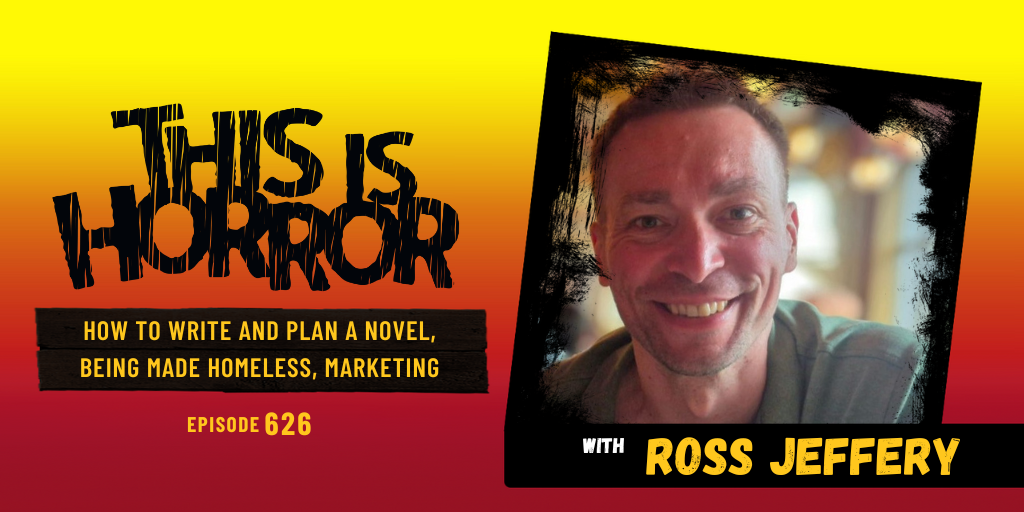

In this podcast, Ross Jeffery talks about how to write and plan a novel, being made homeless, marketing, and much more.
About Ross Jeffery
Ross Jeffery is the Bram Stoker Award-nominated and 3x Splatterpunk Award-nominated author of Metamorphosis, The Devil’s Pocketbook, I Died Too, But They Haven’t Buried Me Yet, Tome, Juniper, Scorched, Only The Stains Remain, Milk Kisses & Other stories, Beautiful Atrocities & Tethered.
Show notes
Click the timestamps to jump straight to the audio.
Thanks for Listening!
Help out the show:
- Support This Is Horror on Patreon
- Listen to This Is Horror Podcast on iTunes
- Listen to This Is Horror Podcast on Spotify
- Rate and review the This Is Horror Podcast on iTunes
- Share the episode on Facebook and Twitter
- Subscribe to This Is Horror podcast RSS Feed
Let us know how you enjoyed this episode:
- Leave us a message on SpeakPipe.
- Write a comment below.
- Tweet us @thisishorror.
Resources
- Ross Jeffery Books
- Watch the video version of This Is Horror Podcast episodes, including our conversation with Chuck Palahniuk on YouTube.
The Girl in the Video by Michael David Wilson, narrated by RJ Bayley
Listen to The Girl in the Video on Audible in the US here and in the UK here.
Cosmovorous by R.C. Hausen
The debut from R.C. Hausen, available now. Now also available as an audiobook.
Michael David Wilson 0:20
Welcome to This is horror, a podcast for readers, writers and creators. I'm Michael David Wilson, and every episode, alongside my co host, Bob Pastorella, we chat with the world's best writers about writing, life lessons, creativity and much more. Today we are talking to Ross Jeffrey, the Bram Stoker Award nominated author of a variety of books, including tome Juniper only the stains remain and tethered. Now, this is a two part conversation. This is the second part. But as with all this as horror episodes. You can listen in any order. So by all means, listen to this one now and then. When you're done, go back and listen to part one. This is a fascinating one, but before we get into it, a quick advert break.
Cosmovorous the debut cosmic horror novel by RC housing, is now available as an audio experience featuring an original Dark synth wave score. This story will take you to the next level of terror. Come hear the story that readers are calling Barker meets Lovecraft, a Phantasm style cosmic horror adventure and a full bore, unflinching, nihilistic nightmare. Cosmovore is the audio book by RC housing. Come listen, if you dare.
RJ Bayley 2:13
It was as if the video had unzipped my skin, slung inside my tapered flesh, and become one with me. From
Bob Pastorella 2:22
the creator of this is horror, comes a new nightmare for the digital age. The girl in the video by Michael David Wilson, after a teacher receives a weirdly arousing video, his life descends into paranoia and obsession. More videos follow, each containing information no stranger could possibly know, but who's sending them and what do they want? The answers may destroy everything and everyone he loves. The girl in the video is the ring meets fatal attraction from iPhone generation, available now in paperback, ebook and
Michael David Wilson 2:50
audio. Okay, without said, Here it is. It is part two with Ross Jeffrey on this is horror. So in terms of the initial planning stage, I mean, you were talking about your writing into notebooks, and I believe that you actually have the notebooks with you right now. So,
Ross Jeffery 3:21
yeah, yeah. So I use kind of like moleskin, kind of, they're quite thin, and a little kind of like thing I got going when I started this is I get my wife to because she's got very nice handwriting, so I get her to write the title page of each book in there, and then I carry on afterwards. So the devil's pocket book was originally called hostage, but we changed that. I can't remember why, but we changed it. But I'm going to talk about, I died too, but they haven't buried me yet, which is here, because it's it's quite cool. So I have, so it's all kind of written out. So this is the first kind of bit I start afterwards. Is characters. So then I work through my character list of all the characters that kind of turn up. So that has their ages, kind of how old they are, when, if they're a friend, all this kind of stuff. And because I died too, but haven't bear me, it feels a little bit possession. I went off on a little, kind of like just planning thing. So on this side here, I've got seance written in the middle, and then I went around and kind of thought about the possession element and elements and tropes that happen. So, like I just did, like a bullet list of everything, kind of like speaking in another language, lies, deception, salt, acting as a kind of way to confine spirits, like lots of other kind of things, like changing a person's character, foul breath, all this kind of stuff. And. Yeah, and then I've got down the bottom here is just kind of like some words that will sentences I thought worked quite well, which just came to me. So I just jot them down so I don't forget them. Research that I did, so I read a lot of possession books before writing my possession book. So I've got down here exorcist road by Jonathan Jans, which is amazing, and it needs to be re released. Exorcist falls. The Exorcist Legion. The body will follow. Coffin. Shadows incarnate come closer. Goddess of filth, the things we cannot say, amateur horror, the outsider, my best friend's exorcism, last days of Jack sparks, boys in the valley. And then, kind of like, just like films that I'd watched that were possession based. And then we get onto the five act structure. So then I kind of work out my how many chapters are going to be in each act. And then I just kind of like work my way through it, and they're quite short. So obviously this first chapter here, I just write the big kind of like, because if I'm just copying all my notes out of the notebook, it loses the part of the creativity, part of it, because I'm just transcribing what I've already written. So what I tend to do is just write. So chapter one for I die to the home, bury me. All I've written in my notebook is opening scene, establish environment and main protagonist, Henry, and then it just says that he packs up to heads off, heads off to Josh's past and troubles. And then that's all that's there. So I write the beginning bit and the ending of the chapter, and then they'll have the fun part of creating in the middle. So I just, I know where, I know where I start and I need to get to, and then I just make up that middle bit, which is the joy of writing. And then, yes, I just basically work all the way through. The red bits are kind of like, once I've written it, if, as I'm writing, I'll be like, Oh, actually, let me put something else in that chapter, and then I'll just add little red notes, just so I don't forget. And then, yeah, I'll just work my way through it. Some of them I sometimes include I forgotten in here might be in this one, but sometimes I will have cut out some things that I want to add. I tend to like do little doodles in there, just images that come to mind that I think are quite iconic. I have got something. Where is it? So, like Devil's pocketbook, because it's set in a real place that I went to, Paul Perez. So I've cut out kind of like things of the town, like certain elements. This is the chapel pool that's in it, just so I can kind of get the geography right, and it's always there. So I can quickly, like, turn to the page and find out, kind of if I think they've turned left down a road and they haven't, and end up somewhere else. But yeah, it's kind of how it works. And like, sometimes I get a bit carried away. So with my Western I started off writing short chapters like but then they gradually got because I was so excited about this book, they gradually got longer. So I ended up writing more of the book and ended up transcribing it. I don't know whether that was because of this one I was typing on a typewriter. So I was like, if I write a bit more, I can carry on writing. But, but, yeah, that's the kind of process that I work with. And you know, I'm happy to kind of share images of those with you guys, if you want to use them on your Patreon or whatever. Just I can show you a book from start to finish in the planning stages, and then people can kind of see how well the technique I use, but it might help. But, yeah, that's kind of the the Ross Jeffrey School of writing book.
Michael David Wilson 9:07
Yeah. Well, I I definitely think that our patrons will be interested to see one of these from start to finish. But one of the things that I noticed immediately is just how ordered and neat it is, considering that you're doing this, you know, by hand. I mean, when I'm planning, as Bob knows, because we worked a book to wrote a book together like I'm pretty meticulous with the planning stage. But you know, there's bits that like I delete, I add in, I like the plan. I can't just sit down and seamlessly write it in the way that you have, because I find that there's almost discovery within the plan. So there'd be so many colors on kind of my way of doing. Doing it. So it makes me believe that probably there's an awful lot of kind of sitting down and thinking before you're committing ink to paper,
Ross Jeffery 10:13
yeah, kind of like, but sometimes when that, when that plan is down, like, there'll be some times when I'm writing, and I'll, you know, I may combine to even though it's down in in the chapters, I may combine two chapters into one when I'm when I'm writing, because I'll be like, Oh, actually, that works better if it just flows into the same chapter. And then I'll possibly come up with a if I'm, if I'm, if I'm locked in and having five chapters per act. Sometimes I've changed, but like, I'm like, because I like the kind of steady progress and, you know, 555, so I may come up with another chapter to add in, or I may not, but normally, I tend to try and keep, if I'm doing the act, structure as I want it. I try and keep the number the same, just for the pacing, but, but yeah. And then sometimes I'll completely, I'll completely delete a chapter that I I'm like, Oh, actually, that doesn't work. So I I will just write a new chapter and just replace it. But I don't change my notebook. I just put, I'll just put across through that chapter, and then I'll just write, write a fresh one. But, yeah, it's, it's interesting, it's a it's great, like, I love doing it. And then also, like, so I'll write it all, do all that, and then just working with, like, my editor, there'll be some additional kind of stuff that comes out of that as well. So I will. I'm fortunate enough that I've worked with quite a few great editors, but I currently work with his social tag is Austrian Spencer. Is Andy Spencer, like he is absolutely phenomenal. Like, the the, I think it's three books we've worked on, like, It's true they say, like, if you want to be a great writer, get yourself a great editor. And like, he has taught me. So he's taught me more in the last kind of three books that we've worked on together, then my entire schooling in English, like, just how to use punctuation correctly, like just things that I should know that I don't and like, he goes on deep dives with his editing. And, like, there's bits where I've written something and he's gone, I think, with the Western in particular I'd written saying, like the horse is walking along and it went, went for went, went for a piss as it was walking. And he was like, I've looked into this, and horses can't piss while they're walking. They can only defecate. And I was like, Oh, didn't know that. He was like, so you might want to change that, because that's not going to work. And I was like, okay, like he is proper, deep in his in his editing, and it just brings out the novel in what it should be and, like, how I want it to become. But also, there's bits where he's just like, that's not gonna work. I'm like, Okay. And then, but then, like, you know, he'll give me a flourish of some something that he kind of thinks as he's reading it like that will work in this section. I'm like, Yeah, okay, that's great. And it's that kind of like compromise that didn't have before, because, like, the first few books, I just wrote an editor and edited them myself and or I got someone to do it for me. It was like a friend and but I think writing and like with these notebooks, that's my kind of first kind of this is how it's going to be. And then it moves on from that to the editor, and then the editor comes back, and then I'm like, okay, yeah, I'll change that. But he's brilliant. Like, I absolutely like, if I could work with him as an editor forever, I would like, it's, he's great, and that's something to be cherished, because there's not. There are great editors out there, and you know, it takes time to find one that I worked with the editor once who said that I they said, I think they said something along the lines of, I will edit it for you for free, but I'd want 10% of your royalties from the book. And I was like, that's not gonna happen, but there's people out there that would fall for that, so don't fall for that. And, yeah, it's just a strange business, and I'm only fresh in it. I'm not like, long in the tooth about it, but, like, I've worked with some great ones, and Andy's brilliant. And, yeah, it's just part of the process and and for someone that didn't get English at school, like I've learned so much and it and then each book is different, because each book I've worked with him, I've got better, and I can see that I've got better because of his editing. So there's less red. 10 on his returns, which is good,
Michael David Wilson 15:03
yeah, what you're saying about editors asking for royalties? No, that is not how it's done. You know, I offer freelance editing. I have a per word rate. That's it. There's no, oh, I'll do it for free if you give me 10% of the royalties, well, I don't know what to tell you, but that's definitely not free. That is, you know, depending on the sales, potentially you are going to be way overpaying for what the per word rate would be. So, yeah, absolutely ridiculous. But I mean, in terms of Austria and Spencer editing your work, is that just for the things that you're putting out independently, or are you sending him things even before you send it to publishers and your agent? Like, what? What are the stages again? What are the pieces here? Because that, you know, sometimes you're putting stuff out indies, sometimes you're with other presses. Now, you know, relatively recently, you've got an agent, so you finish the book after doing the Lansdale method. Do you show it to somebody immediately? Do you give it another pass? What's going on?
Ross Jeffery 16:28
Yeah, sorry. My writing is quite complicated, isn't it? So I basically from from now on, what I do is I'll write a book. I'll Lansdale it, and then doesn't matter what's going to happen to the book in the future, I will use Andy to make it the best book is going to be and I will send it to him. He'll edit it. And then once I get that back and the manuscript is crisp, I will then decide, like, what am I going to do with that? So So he, he edited harvesting the nightmare fields for me before I submitted it to cemetery gates media and then sent it to them. And then they were like, yep, we'll take it. He edited, I keep wanting to say the glass womb, but it's now changed, the cradle of glass. He because I, yes, I have got an agent now. And that was a big, kind of, like, step for me. Like I, I was kind of like wanting to do it on my own. And I was like, I've reached the kind of limit of what I can do. So I had this idea cradle of grass glass, which is one of my favorite books, and I was just like, I want this to be the best it can be. So I sent it to Andy and the editors it sent it back to me, and it was like, I was I was really happy with it. And I was like, Okay, this is the one, this is the one Ross, that I'm going to send to an agent. And I wanted it to be the best it could be, because you only get that first opportunity to kind of really sell yourself. And I was like, it needs to be the best. So, yeah, worked on it. He sent it back to me. I'd then do some revisions of what he'd said. I'd send it back to him again. He'd double check what I'd input it and made sure it was great, and then send it back to me. And then, yeah, submit that to Elizabeth cops, of cops, literary agency. And then she got back to me pretty quickly, and was like, Yeah, they'd like to represent you. We had a lovely conversation and and then from that, she then kind of came back to me and was like, I've got a few notes on the book. And then basically she gave me the notes. I then shared those notes with Andy, because he was part of the process. And then I was just like, right, I'm going to start working on them, and then I'm going to send it back to I'm going to send it back to you to check, and then we'll send it back to so that's kind of how it works. That's and, you know, that's all cost on me. Like, you know, these publishers that I'm approaching now, you know, have their own in house editors or whoever, but like, they will obviously make changes themselves, but I I want to put because also, look, I keep talking about my childhood, but all lack of education, but I was just like, I want it to be as as best it's going to be before somebody else reads it, because I don't want them to think that I'm stupid. So yeah, and that's why I use them, and I will continue to do so at my own cost, even though I know it's going to get edited again, I'd rather it be in that position. And also, like some of the stuff like that comes out of that editing process, makes the manuscript even stronger than I thought it was going to be. So there's some times where Andy. I don't think this whole chapter works. And I'm like, Okay. And he's like, You could do this, or you could do that, like, have a go, and then send it back to men, and I'll do that. And then would work. And then sometimes I write a chapter, and it'd be like, actually, no, it does work. Let's go back to the other one. And then it's just, it's that kind of relationship. It's, it's also not thinking you're better than, like, what you've written is going to be the best thing, because somebody else can just add one little line of dialog or change something that's going to completely make you think, Oh, actually, yeah, shit. Why didn't I think of that? That's that's a great idea, and it's just yeah, not being too precious on it. There are some times where I'm like, he'll recommend a change, and I'll be like, no, like, that line is staying because I wrote it, I writ it, I wrote it and I love it, so it's gonna stay. It's just picking your battles of what's gonna what's good for the manuscript, but what's also kind of getting rid of your voice in the piece.
Bob Pastorella 21:00
Yeah, me and Michael went through that with their watching like multiple times. I was steadfast on certain things that weren't going to happen. And then Michael was, he was bound and determined, and we flip flopped on a couple of things. And then, I don't know, it's like, when we'd have these revelations and be like, reading the email back, going, that's exactly what I said last week. I'm so glad you came aboard. It was like, well, now I see the light, you know, yeah, but that's, there's some things it's like, I was like, No, we're not. That's not gonna happen, you know? And you have to put your foot down. So, yeah, I get, I get that. I feel that. I feel that for you.
Michael David Wilson 21:52
And I mean, a lot of what we're talking about, it links into this question that we've got from Tracy via Patreon, who wants to know you know, you've both been independently and traditionally published in the sense of being with another press. So why do you choose to go each path and kind of going forward? What do you see, the kind of route that you'll be taking, or what would make you think, Okay, this is the book for a Trad publisher. This is a book to independently put out.
Ross Jeffery 22:35
I think,
Ross Jeffery 22:37
I think what I love about indie publishing is quite a lot of the time, the swiftness of it. And as I was, as I was kind of releasing my first books and things like that, like being able to kind of and self publish in indie publish, I was just like being the fact I could just finish a book, push, push a button, and it was out like was, was what blew my mind. I didn't know it existed, but I was just like, Yeah, this is, this is great. Like, I can write a book and do that, and it's out in the world and, and I, you know, I do love indie publishing. There are, you know, I've had some burns with some publishers and stuff like that. But, like, I just love the process, and I love how kind of gritty and kind of pulpy it is, and like it. Just like some of some of the best horror books I've read have been independently published, so it's not something I want to give up. I think it's just like weighing the subject matter the scope of the book. And I think as well, like, for me personally, I think I can, I can feel, like, in my gut, like, what is an indie book, and what is a book I want to hold on to, and kind of be like, actually, that's, that's, that's a book I could get a bigger readership with. And, you know, I, when I signed with Elizabeth, we kind of discussed, kind of how it works, like, because I, you know, agents, just, you know, I've got a film and TV agent and I've got a literary agent, and I'm just like, What the hell is going on? And I don't, are they connected? As in, like
Michael David Wilson 24:21
the film and TV plus the literary agent. Are they all under the same umbrella, or are they separate? No,
Ross Jeffery 24:28
so I've got Alec Frankel, who works for IAG, international artist group that was something that was set up through, well, I had the connection when I was with dark lip press, who we won't talk about because they stole a lot of royalties from a lot of authors and then disappeared. But that was kind of the only kind of positive that has come out of that, like he may contact me because he read my book from there, and was like, Yeah, I'd like to represent you. We had a lovely conversation, and I. That's, that's great. And then obviously, my literary agents from Elizabeth cops, from cops, literary agency, but they, like, they've already started working together, like discussing things behind the scenes, like with my stuff that's going on. So, yeah, when I was talking to Elizabeth, when we were having a conversation about, you know, what, what my what literary agents do? Because I had no idea. I was like, how does this work? Like, what do we do? Because it was, like, it was out of the blue, like, I, like, I sent that manuscript thinking, oh yeah, that's the good manuscript. And then she came back, and I was, Oh crap. Like, what I do now? And then we just had the conversation. Like, because I, you know, I'd done my research on her, like she was the only person I sent that manuscript to, because she was the only person I wanted to work with, because I'd done some research. I'd spoken to Tyler Jones and Philip for Cassie that she represents them and and I looked at her back catalog, and she represents Gwendolyn kiss as well, and, like, other people. And I was like, okay, she seems like she's got a finger on the pulse. And then, yeah, like, had the meeting. She's absolutely lovely, brilliant. It's got a great kind of scope for what she wants for me and the books and and we just had the discussion of, like, I was like, Do you do you want, like, everything I write, do you want to, like, see it before I do anything with it? And she was, like, it depends. Like, you know, I can either just work for you on your novels, or I could work with you on your novels and novellas. Or, you know, if you've got short stories, I could do that as well, she said, but also, if you wanted to just write a book and send it to an indie she said, You could do that as well. But, you know, always use me as a sound board. And she's been brilliant. Like, in one of the reasons I wanted to get an agent was to hopefully free up all that time of, you know, Chuck, like, sending off manuscripts to kind of all that kind of leg work. And I was just like, Oh, that'd be really cool, like, because then I can just focus on writing the books, which is what I want to do. And yeah, she's been, she's been great, like, she's got, there's two books out for currently, out for submission, and she's able to reach places that I've never been able I would never be able to. So she's focusing on big five and then working her way down from them as we go, or if we hear back kind of passes, let me say, rejections passes. And yeah, so that's kind of like she's just dealing with all of that, and then just keeps me updated. And that's great. But I think like, because I love, like Philip for Cassie and like Josh Malerman, like, they seem to have a really great balance of like indie, like Trad, indie, Trad, like, kind of like how they're working. And I quite like that. I like the not being tied down to a particular publisher and just being able to, like, I've got a few books out with thunderstorm like being able to do that. I love working with thunderstorm books and and thankfully, they like working with me. So it's quite nice just to be able to do that. And, you know, that's, you know, I work a job. I'm not making mega bucks, like, they're like, getting one of my books as a thunderstorm books gives me, like, money in the bank. And that's, you know, I don't do it for the money, but it always helps. And thunderstorm books and beautiful books, but, yeah, like, I'll continue to do that. I think just working with indies, I love working with cemetery gates media, they it's just so straightforward. Royalties arrive on time, like you, you just, yeah, they're just so easy to work with. And, yeah, yeah. It's just, it's just trying to find relationships at work. And you know, like, I'd love to be published by band, bad hand books at some point. I love what they're doing, shortwave publishing. I love what they're doing. So yeah, I love being a kid that didn't love books. I love books now. I bloody love them. So I just, yeah, I want to work with everyone and
Michael David Wilson 29:25
just see how it goes. And so I mean, what does the marketing aspect to look like? What do you do once you've got a book coming out? How much do you do? How much does the publisher do? Obviously, that's going to vary a little bit depending on the press. But, I mean, you're certainly prolific in your writing. But as you say, in terms of the response, you've had some books like only the stains remain where it seems to be absolutely everywhere, and then you said there's been. Others like harvesting the nightmare fields, where, for whatever reason, it hasn't quite got that traction. Yeah, I think so.
Ross Jeffery 30:09
The kind of advertising, kind of publicity side of stuff, like it gets me down a little bit, because obviously, I don't know, obviously, with a bigger publisher, kind of, like how that works, because I've not had one yet,
Ross Jeffery 30:28
but kind of, I think, like, the only kind of, well,
Ross Jeffery 30:34
I think a lot of it is down to you with indie and indie publishing. Like, yes, all the publishers I've worked with, they do the ad campaign comes out when it like, you know, if you're lucky, you get a publisher, marketplace announcement, you can use that. And then it's just, but, like, I think quite a lot of creating the content and keeping the content going falls on the on the author. I made a I don't know whether this could it could be related, but I made a conscious effort last year to come off of certain social medias because I had Facebook, tick tock, Instagram, Twitter, blue sky, some other thing. I can't remember where it was, like, like, I had like, six, like YouTube, like, all these kind of things. And I was, like, I was getting burnt out by just updating each one. And I know there's probably a app or something that you can just upload once, and it uploads everything. But I'm old, I don't understand these things. And like, I was just like, No, like that. That is not sustainable. So I came off of Facebook, came off of Tiktok. I think the only things I'm on now are Instagram and blue sky like, that's only places where you can find me, mainly because I didn't like what I was seeing so on, like, loads of my social medias, it just got, for some reason, I don't know what it was, but for some reason, it just got in flux with violence, loads of, like, derogatory kind of, like, stuff, like everywhere and like, the amount, sheer amount of people that I was Following, like, I just never saw anything that interested me so much so that I then reduced my amount of followers on every single platform, Instagram and blue sky, like, I reduced the amount of people I follow. Because I was just like, there's if people want to follow me, that's great. Like, I appreciate it. I love it, but I can't follow everybody and still use those as a platform that I need, because I just it just gets bogged down. I want to see the things that I want to see, not everything else. And I think maybe that might have affected, like, sales. Probably like, on Twitter, I had quite a high follower count, so I'd like release something and then like, but I'd rather have less sales than be crippled by keeping up with social media and social trends and all that bollocks.
Ross Jeffery 33:11
But I
Ross Jeffery 33:13
think, yeah, but then, like, so for me, like, I'll create like assets. So like, if I get quotes of praise and stuff. I'll make a little nice image share that do that. I think quite a lot indie publishers you like release a lot of books just to stay relevant. So once they release one, the next one's already kind of in the pipeline. So you get, like, I don't know, say, two months worth of kind of like, yes, a couple of posts, and then it's just on with the next book. And then, unless you're keeping it updated, it just falls in, in the background. And then, yeah, the last six months, I've not I've been like, yeah, made homeless, kicked out of our house that we were living in, and then I didn't do anything for six months, and I think that's when harvesting was released, and, like, metamorphosis was released. So it was kind of like this. I didn't do anything because I wasn't in the headspace. I wasn't even writing at that point, like I was just, like, trying to survive. So that also could probably lead to the downward sales. But I'm hoping, you know, the book gets with a big publisher, that there's a big ad campaign, marketing campaign, like I could go on do talk shows and all that kind of stuff, talk shows, podcasts, all that kind of stuff. But Oprah, if you're listening, I'll come on there and have a little chat.
Michael David Wilson 34:39
But he is a regular listener to this is our podcast. Yeah, right, yeah, goodness. I mean in terms of being made homeless, is that something you want to talk about? I mean, I know that you've mentioned it publicly. So what would aside? Circumstances leading up to that, and how on earth did you get through it? I mean, life gives us these tests at times. And my God, was that something?
Ross Jeffery 35:14
Yeah, so it's quite ironic, really, that I work for a homelessness charity, and I was made homeless. But yeah. So it was kind of say November last year. That was before then, that was November our landlord, because we were like, every year because we rented, and every year our landlord would put our rent up. So we're like, okay, that's fine, like normally in January. So we're like, and it's normally about 100 pounds, so it's not, not too much. And so we were like, okay, that's fine. And we were gearing ourselves up for, oh, it's November. He's probably gonna put our rent up in a minute. Let's see what comes through. And and we got a letter in in November. No, sorry, I'm getting confused. I had a phone call and it was our letting agent, and I was so that's weird, why they calling me? So I picked the phone up, and I was at my desktop on my computer, and I picked my phone up and I was like, hello. And they were like, Oh, hello, Mr. Jeffrey, yeah. We just calling you because I've sent you an email and because I had my screen open. I was just like, oh, yeah, I've just got it Yeah, hang on. And she was like, Oh, I just wanted to say, and I'd already read the email, and our landlord had decided to put our rent up by 1000 pounds a month. So we were already paying 1500 pounds a month for our house, and he wanted 2500 pounds a month, which is more than I get paid, and that's not including bills or anything, or council tax, all this other kind of stuff.
Ross Jeffery 36:50
And I was just like, What the fuck. And
Ross Jeffery 36:53
I immediately burst out crying, because I was just like, How on earth am I going to provide for my family. Like, I was like, I've got two young children. And at that point, my wife was not very well, so I was just like, and my wife's not well, like, how do I survive this? And then I was just basically sobbing in my office on the phone. I still had them on the phone, and I was just sobbing, and they were just like, Oh, we're really sorry, but we don't have a say in it. The landlord has decided, so we've got to, like, follow through. And I was just like, I can't pay it. I was like, I physically can't pay that money, because I don't earn that much money a month. And they were like, Oh, well, we're really sorry, but that's what he wants. So I was like, Okay, well, I need to go because I need, if I said, Have you sent this to my wife? And they were like, yes. And I was like, Well, I'm gonna have to go because I need to make sure she's alright, because she's gonna pick this up and she's at home alone, and I need to make so then I immediately left work, and then, like, got home and my wife wasn't there. And I was just like, oh shit. Like, where is she? Like, as she read it and gone out somewhere, and then, like, she came back in the car, and I was just, she was like, what you doing home? And I was like, you seen an email? She was like, No. And then I was able to break it to her. So we were both born in our eyes out. I didn't know what to do, so went to drove down to the office, spoke to them, and said, Look what? Like, we can't pay this. What's to do? And they were, like, they were being really friendly, like, oh, you know, yeah, it's really bad, but he's not listening to us. And so we thought they were on our side and they were going to be helpful, but then a couple of weeks later, like, they said, I'll make him an offer and then see how that goes. And then when we got home, I was just like, I don't want to make him an offer because we're paying more than enough already, and I don't want to, like, what do we say, like, 100 pound more? Do we go, like, and then it was just like, we were just like, I don't know what to do. So we went back and just said we're willing to pay the amount that we're paying, and we will look for somewhere else to rent in the meantime so we can, we'll pay that, and we will pay what we're currently paying, and we'll try and get out as soon as we can. If you can agree to that, that will try and get out. And then about three weeks later, we got a eviction notice to basically say you've got two months to move out the house or you'll get kicked out and we'll get bailiffs to remove you. And then that ruined our Christmas. And then, like basically, my kids opened their presents on Christmas day and then packed them all up into a cardboard box and didn't open them until we moved into this house that we're in now, because I'm not homeless anymore, I'm in the house and and then my wife was just like, well, we didn't know what to do. And like, we're both like, in our 40s, and we've. Rented pretty much since we left university. So we have no savings, because basically, we used all the money that we made to live, and we lived in London, and then we moved to Bristol, and it's just really expensive to rent in this country. And so we thought getting a mortgage was past us. And then we my wife was like, Look, why don't we just try one more time, speak to a mortgage advisor, see if we can get a mortgage? So we're like, okay, let's do that. And then that spoke to mortgage advisor, and he was like, Look, there is one kind of mortgage provider that would give it to you based on your kind of so many years of great renting. This is how much you able to get. So, okay, that's great. And all this time, like the deadline is looming of when we have to move out. And I was just like, Okay, right? Let's, let's try and find somewhere. And the amount that we could borrow, because of my being in my 40s, the length of the mortgage is much less. So I was just like, right, okay, so that this is how much we can lend you, and we could not find any, like, we could find a crack house in Bristol to live in with no toilet and like, graffiti on the walls, but, and it was in like, a really shit area. And I was just like, No, you
Michael David Wilson 41:22
like Chuck, Paul and Nick. So that seems Fight Club to interject a serious situation with a ridiculous comment. I
Ross Jeffery 41:33
love it, but that's kind of like you think of Fight Club, where their house was, that was the kind of place we could buy in Bristol. And then, so we then, like, looked further afield. And so we looked at Newport in Wales, which is about 45 minutes from Bristol, and like, just basically started looking, found an amazing house that was within our budget. And then we looked at a couple of like, dodgy. There was one place we went into, I swear the person died in their bedroom. Like, there was like sheets on the bed with like a body stain in them. It was just like, No and yes. We found a really nice house. Put an offer in is accepted. People like, oh, great, that's brilliant. But then we were kind of like, at the end of the time we were allowed as someone that works for homelessness, I was just like, well, we could just stay where we are, because that's what I would tell my guests that we have in like, if they've been evicted, I was like, don't leave the property. I said, stay there as long as you can, and then you can then, like, speak to the council to get you moved and all this kind of stuff, but that is kind of classified as squatting. And then I was just like, I don't know if we can do that if we're going for a mortgage, because that might show up on something down the line, and it would mean that we couldn't get a mortgage. So then, like, enter stage right. My wife's got a friend, and she was just like, Look. I spoke to my dad. He lives in Bristol, and, like, I told him that you need some help. And he said he was recently widowed, and he basically, he said that you can come and stay with him for as long as you need whilst this gets set up. And that was like, like, if it wasn't for him, we would literally have been moving around every week to different hotels. Like, being like, presenting as homeless. So he was like, Look, come and live with me for as long as you want. Like, so we, so all four of us, just rocked up to his house. We had to put everything into storage. So everything we owned went into storage. And, like, we just took, like, four suitcases with us. Like, then that was all we had. And then literally stayed there for, I think it was about five months, and it was, it was amazing that he, this guy who didn't owe us any favor, was just like, look, I want to help you guys. And like, he wouldn't take any money from us. I was like, Look, we'll pay you rent. He was like, No, you'll need that for when you move in. I don't want anything. And I was like, Okay, well, we'll pay utility bills. And he was like, No, I don't want anything. He was like, you keep all the money you need, because you'll need it later on. I was so, wow. Like, I was just like, Okay. He's like, the only thing, like, if you want to, he said, The only thing that I would take as payment is if you just, like, cook me a meal in the evening. And we were just like, well, cooking for four, what's like, five? Like, yeah, that's fine. And yeah, so we did that, but like, for that whole time, like, five, well, since November to, like, May, I was not in the headspace to do any writing. Like, Well, I've been writing a book all the way up to then, and I was about 65 65k into it, and then just as soon as I got that news, I was just like, my priorities switched completely. I was like, yep, like, writing is done. We need to survive this. And it was been challenging. Like, you know, it's been really difficult, but from the kindness of people. It showed me that, like, you know, no matter what is going on, you can get used to it, like, even if it's really difficult and strange and weird, and, you know, sleeping on, sleeping in a room you've never slept in before, and, you know, just wondering what's going to happen. Like, things happen and things move on, and you change and adapt. And it's weird because I didn't do anything creative in that time. But in that time, I've probably got five novels in my head from that time of just that kind of fallow period of not doing anything like it was, I think my brain's way of kind of coping, because I missed writing and I loved it and I'd love it and like, I missed having my books around me, and I missed having my like records and everything that I'd kind of discovered that I loved was just stripped away, and I couldn't I couldn't focus on anything. It was just like, I need to make sure my wife is okay. I need to make sure my children,
Ross Jeffery 46:28
because, like
Ross Jeffery 46:30
my youngest daughter, because we lived in that home, that the landlord was a bastard. So we lived in that home for seven years, and it's the only home my daughter, my youngest daughter, knew, and to for it to be living in that home for seven years, and then, like, one night, we just go, yeah, we're we have to move out because the landlord's kicking us out. Like it was all the roots that she had in that place were just like, stripped, and it was just like, it's taken them months to kind of, like, get over the trauma of having to leave that home, but the fact now that we own our own property and that it can't be taken away, and that we can, like, paint a wall without having to ask if we can paint a wall, or, you know, like, just having my office set up and my books and my posters and all that kind of stuff like, it's just amazing, but it has been one hell of a hell of a ride. I've been tired for like, which feels like years, but also now like, and it's making like, those sacrifices as well that you don't realize you're gonna have to make like. So my daughters are going into years six and 11, so that's like last year of primary school, last year of secondary school. So GCSE year, and we're
Ross Jeffery 47:53
deciding to keep them in school in Bristol. So doing the commute in the morning get them to Bristol, and then commuting back every evening, just because we want it to be as safe for them as possible when everything else is changing. But like, for me, like, I have to get up at, like, well, you know, Michael, because sometimes we converse in the early hours of the morning. But like, I'm getting up at like, 420 in the morning to get to work, and then, like, to make the travel and do everything. And then, like, I get home at like, six in the evening, and then go to bed at 10, and then back up at foot. Like, it's just, and then I still get my Friday, so I still do my writing on a Friday, but like, it's just that sacrifice we have to make to make it work. And, and I wouldn't change it. And, like, we've only been here, like, since May, but like, I'd never go back. Like, it's, it's wonderful, yeah, yeah.
Michael David Wilson 48:53
I hate so much that this happened to you, that this is that this is even allowed to happen. And I mean, I know that the UK, particularly the property market, particularly the rental market, is in absolute shambles. I've heard of things like this happen before. But like it, it feels like, how can that be legal? You know, if I hear my rents going up, what I expect, 50 quid, maybe, you know, maybe in London, 100 pounds. But you know, 1000 in dollars, that's $1,400 and then, you know, looking at it as as a percentage, you know, I've seen other writers go through things like this as well. But how, how can you do that? And also, how can a landlord one day, just. Side, oh, I need this amount more that it has to be greed, like there's no way that their costs went up so much, and you know, to to have not even accepted your your offer of, look, let us pay this rent that we've been paying for for seven years, and we will do our best to move out as soon as we can, like, what? Because
Ross Jeffery 50:29
we even said to me, went back to him, and we're like, I think this has been actually gave us two months notice or whatever. And then so I was just like, so we found the house really quickly. And then so we went back to him, like, I think, within a month, and just said, Look, we found a place we are moving out. Could like, we'll carry on paying the same amount of rent, and we'll just like, We will be leaving, like we will be leaving, but could you just give us that bit of time? And I think it was on like, the 20/23, of December. So just before Christmas, he then messaged back and was like, No, I want you out by the time I've said I was just like, What bastard like you just but anyway,
Ross Jeffery 51:13
yeah, I wish you the best.
Michael David Wilson 51:16
You're a kinder man than I am. But, yeah, you contrast that with this other gentleman who just allowed you into his home wouldn't accept anything you know. You've you've literally seen in in the space of a month, the best and the worst of humanity, you know, greed and absolute selflessness. And I mean, you know, I've publicly spoke about having gone through quite a lot these past few years with a divorce, a custody battle, not seeing my at the time, three year old daughter for nearly two years. And, I mean, at any time I have a struggle, I kind of turn to, like, a version of Jonathan. Jan says it's good, because I wouldn't go as far as to say, you know, not seeing my daughter for two years was good. But what I'm doing is I'm looking for, like, what, what? How can I find some light in this situation? But I guess more than that, I kind of trust that if I put kindness into the world, then eventually it will pay me back in kind. And so anytime something bad happens. I say, Okay, I'm going through a rough period now, but we're going to see later how this kind of manifested into being a good thing overall for my life, and you know, for people such as yourself, you, you would perhaps talk about it being like God's plan. I know that. Yeah, you're a Christian, and you've at least twice used in your fiction, the Lord will fight for you. You need only to be still. I think you might have said you've got a tattoo of that, in fact, and we're getting visual confirmation for the video. Yeah, but it's, it's so rough being in those moments. But, um, I'm happy that what's come out of this is you finding a home, you know, you being on the property ladder, yeah? But yeah, the rent prices in the UK. They're one of the reasons why, you know, I'm in Japan, and I've decided to to be here permanently, or as permanently as anyone can say, there, anywhere, because, you know, I can rent somewhere at an affordable price and not fear for my death because of the area that I'm now living in, so, but, but, yeah, good, good job on getting somewhere in Wales. And you were saying it's so much more affordable there. I mean, what? What as a percentage are we looking at to to kind of highlight the, I suppose, the Welsh versus the English property market.
Ross Jeffery 54:25
When we looked in Bristol, you couldn't find anything. Well, basically, let me break it down. So we were paying 1500
Ross Jeffery 54:37
pound rent,
Ross Jeffery 54:39
which he wanted 2500 I think we might have been paying under on the market anyway. So I'd say, like, say we're paying 1700 rent for our mortgage here, so we literally can get to own our house. We're paying 1000 so. Like, so we're already quids in just by paying a mortgage, which is crazy, because I think quite a lot of rentals is, like, double or triple what you'd be paying in a mortgage if you could get a mortgage. So yeah, it's mad and like, yeah, like, I said, like, we've moved into like, a Victorian terrace house here, and we couldn't even afford, like, a crack house in Bristol. It's just and like, it's beautifully laid out. It's lovely, like, we haven't had to do anything to the property. And, yeah, it's just different. And like, people are nice and friendly, which is something I've not really found, like, people say hello and like, someone dropped apples at our door from their garden the other day. I've never even spoken to them, but they were just like, oh, there's some apples from our garden. I was like, Yeah, but, um, but yeah, lovely.
Michael David Wilson 55:58
You don't get that in London, where's the free Apple service? No, exactly, yeah. I mean, I think it's the same in a lot of countries, that the more rural areas, there's like a bit more bounce and friendliness to them. I mean, like I lived near Tokyo before, but now I'm in a more rural area in central Japan, and, you know, sometimes, like, I I'm going for my daily walk, and I'll pass the House, and there's, like, someone growing some vegetables, and they're like, Oh, hang on a minute. Let me get your bag of potatoes. All right, you know any even if you like, I think Japanese and British people, there's a lot of commonalities. Like, there's a dance of politeness. It's like, no no no. You don't need to, like, no no, no. Well, we're gonna throw onions in now. Oh my goodness. What is going on here? When
Ross Jeffery 57:01
someone bumps into you, you normally just say, Oh, I'm sorry, even if it's not your fault.
Michael David Wilson 57:05
Yeah, yeah,
Bob Pastorella 57:08
that's how it goes. It's a little different in the States, especially where I'm at. I mean, it's you, you get like, some nice, like, what I call countryside areas, where they have nice houses and they keep their yards up and things like that. And then we have some parts around me that you know you're driving if you drive through, like, say, nine to 10 o'clock in the morning, they got some guy standing out on his porch and tighty, Whitey, he's drinking a beer, and you're like, going, well, we need to lock the doors. Let's just keep on going. I think we've, I think we've hit the end of the road here, and it's just like, What the hell? And then you you count your blessings. But shit, if somebody, if they raise my rent over here that much money, my landlords live in Austin, but the the Yelp, and the the, I guess, the the the power of social media would probably, because it's an apartment, would probably, you know, stop that, especially if they went up that kind of money, you know, the water part of the rent has gone up dramatically In the last couple months. It's doubled, and so we've recently had inspectors coming through to to make sure that there's no like leaking and the toilets or the tubs or anything like that, of any type of running water. So that tells me that somebody complained in such a way that the landlord was convinced that it was probably a good idea that they hire someone to come out and do an inspection, and because they're going to probably they fear that this person is going to take it further, which means that the water company didn't go up on the Water. The landlord went up on the part of the water ran, yeah, because of greed. And that's just, you know, when you get caught, well, hopefully we'll see it come down and they'll say, Oh, you're Lee. We found some leaks. No, we found some greed, and you got exposed.
Michael David Wilson 59:20
You know, originally, when we planned this podcast, we were going to talk about the Juniper trilogy, but then I also read I died too, but they haven't buried me yet, and only the stains remain. So I've got to talk about those, but we've had in this last two hours, it's been about writing process. It's been about you. It's been about life lessons and life in general. So I think, and we kind of hinted about potentially doing this when we first started talking. But rather than in the space of 10 minutes, be like, Okay, let's cover five books. Fast round, let's go. We should just get another date in the diary. And this, these two episodes are the Meet Ross Jeffrey and then we'll have the read Ross Jeffrey portion. So if you're, if you're up for that, let's, let's schedule for another conversation this month. In fact, if you're free, yeah, no, that should be good. Okay, so then continuing with the like, we'll wrap up soon. I know it's very, very late for you. We mentioned before that you're Christian. I know too that you said that one of the first films you saw was the exorcist. I want to know, have you always been a Christian? And if well, whether you have or haven't, when did that come into play? Does that affect your writing or your approach to writing?
Ross Jeffery 1:01:14
So I grew up in a house where Christianity was spoken about. My dad was an orphan. And this is really convoluted, but so my my dad was an orphan. He was raised in a Catholic orphanage with his brother by what was called the Sisters of Mercy. They weren't very merciful, and lots of like stuff, bad stuff happened when he was there, but he was kind of brought up a Catholic, so he's always been a Catholic. Apparently, when if you're born a Catholic, you're raised a Catholic, you are a Catholic. And so it was always kind of like, spoken about, but he didn't go to church. My mum didn't go to church, or anything like that. So I brought up just kind of like, as I said, like no filter, like, whatever you like, do what you like. Like, my mum constantly refers to her influence on me being a writer, because she was reading pet cemetery when she was pregnant with me and Amityville Horror. I think it was, I was like, it doesn't work like that mum, but I let her believe it. And so, yeah, I just used to kind of like, do what I wanted to do. Like I was just, like, I would just get movies on VHS and stuff and just watch them in my I had a TV in my room, like, when I was quite young, as another VHS player. So I just watch, like, get them out of the video shop, or buy them in the street or whatever. And I watched everything, like, just, just absolutely absorbed everything that was horror, like, so yes, a kind of God was kind of like a thing that was around, but I didn't really pay much attention to it. And then, kind of like when I all the way up to like, like in my 20s, just, I was just doing my own thing. And then, like, I met my wife, and then she was a Christian, and then we talking about it. And like, spent months just kind of chatting. And like, she was just, I was quite, I was curious. I was just like, so just tell me about this, and like, what you believe in. And then she gave me the Bible. So I was kind of like, reading that and and then I kind of made a decision that I was just like, actually, this makes a lot of sense to me. A lot of it didn't make sense. And if you've read the Bible, there are certain parts that are horrific. And I was just like, right, okay, yeah, this. Like, I get this, and I really like it, and I like this, and I believe this, and I made a decision, and then I think I got baptized on my wedding day, and, yeah, became a, what's classified as a born again Christian, and then, yeah, I've just been, kind of been a Christian since I got married in 2007 and it has kind of like influenced my writing, in a way, because I know, Like in my kind of how my faith is like, there are other kind of spiritual realms that are going on and, you know, like good and bad and good versus evil and all that kind of stuff. I don't ram it down anyone's throat, because I think anyone's allowed to believe whatever they want to believe. It's not my place to judge. And if you. Have a faith or no faith, you're as equal as anybody else. I, you know, we've gone through some stuff recently that's kind of got my wife questioning stuff, but that's, I'm not going to talk about that, which has then got me kind of thinking likewise.
Ross Jeffery 1:05:21
So it is,
Ross Jeffery 1:05:23
my faith is strong. Like, I, you know, I talk to, talk to God all the time, and I try to, I try to use, because I don't like writing stuff, like, that's not real in, like, in the sense of sorry to break anyone's illusions, but like vampires and werewolves and zombies and things like that, like that, stuff doesn't scare me, um, because I know it's not real. But like, for instance, like possession or something like that, someone losing their agency really scares me. Like the fact that I could wake up tomorrow and not be who I am today, like that is something that's like, terrifies me, but also kind of like, just like spiritual stuff is kind of like that scares me as well. And, you know, like, so watching The Exorcist when I was a kid and then becoming a Christian, I was like, bloody hell. Like this, this, make sure we don't end up that way. And then I was just like, yeah, so I tried to, I tried to kind of put a bit of faith in, I don't want to ram it down anyone's necks, but, like, there is some good stuff in the Bible and some good teachings and some good like parables and things like that. So I sometimes like to link that into the into my work, because, you know, people have faith, whether that's a faith in their own ability, or the faith the Bible or the faith in crystals or whatever like that. So I like to talk about faith because faith is such a wide scope of things that people believe in, and I'm not going to rubbish anybody's faith. But, like, I love the fact that some, sometimes that can be used in a book as a like a as a weapon or as a crutch or as a weakness. Like, I quite like that aspect of it. And, you know, I love biblical passages, so sometimes I'll put incorporate those into my writing as well. But like the the Lord will fight for you, you need only to be still. That phrase comes up a lot because it's got quite a lot sentimental value. Well, it means a lot to us. So when my wife was pregnant with our second child, Sophie, she, she, my wife, has said that you have placenta previa, which means basically the placenta is low and it's covering where the baby is going to come out. So if you had a natural birth, it would rupture the placenta and then you'd bleed out and die. So what we do, we'll get you in for cesarean. So we were like, Okay, that's great. So booked in for cesarean, went to the pre op meeting, and they did another scan, and they were like, Oh, we've done a scan, and we've realized that the placenta has moved so you can actually have a natural birth, if you like. But if you go for a cesarean, it will be an elected cesarean. So we were like, right, okay. And they, like, go away and think about it, and then come back to us. So we went outside and we didn't know what to do. Like, we were like, well, you know, Cesareans quite cool, because we've got a date a time it's all ready to go. Like, if you went naturally, we might not know when it comes. So, so. And then we were just like, Yeah, but like, we could just go natural, saves you being cut open all this kind of stuff. So then we just prayed about it, and then we just sat there for, like, on a bus stop, just like, just waiting and just praying and just like, Okay, right? Because we didn't know what to do. So we were just like, asking God, what should we do? So we just sat there for a bit, and then we're like, right, okay, we're going to go for this is it? Cesarean. So then we went back in and said, Look, we're going to go for the Cesarean, because that's what we think is the right thing to do. He was okay, that's fine. We'll mark it down. It's going to be a an elective cesarean to Okay. And then went back, had the Cesarean, and my wife, kind of, like, bled out, and then she had to have a blood transfusion on the table and all this kind of stuff, and then got all stitched up. And my door was born, everything's fine. Went into the room, and then we were wait. The doctor who saw us originally, who said, like, have a natural birth, came around and was like, Well, it's a good job you went for the Cesarean, because if you had a natural birth, you would have both died. I
Ross Jeffery 1:09:43
was just like, What the hell? Like, what you like you
Ross Jeffery 1:09:48
were telling us to have that. Yeah, the placenta was, was still in the wrong place. And you know, when we did the Cesarean, obviously it ruptured and we lost like loads of blood. And I was just like, this is. Madness, and then that's kind of like, the verse that came to me is from Exodus, and it was just that verse, and I was just like, that's we didn't know what to do, so we just sat in silence and let God move. And that's kind of basically saved my family.
Ross Jeffery 1:10:17
But, yeah, it's, it's
Ross Jeffery 1:10:19
great. Like, I love talking about it. I love kind of and what I love as well is that I, you know, I've reached out a couple of times to some authors because I know they've been having a bad time, and just said, Look, if you need me to pray about anything, just let me know. And, you know, I don't know if you have a faith or not, just let me know if there's anything you need me to pray about. And then, you know, and authors have been really kind and gracious, and come back and been like, Yeah, could you pray about this? And I've gone and done that, and then some have come back and said, Yeah, I'm a Christian as well, but I don't talk about it. And it's, yeah, it's cool. It's something I love to talk about. And I've written an article for can't remember who it was, but I wrote an article about faith in horror and stuff, which I think is linked on my website, but
Michael David Wilson 1:11:05
I think it's on lit reactor, yes,
Ross Jeffery 1:11:07
lit reactor, that's it. But yeah, so like, I love it, and I love kind of religious horror like that is like, oh yes. And like, I remember, like, I remember watching, like, The Exorcist was my favorite film forever. And then, like, like, end of days. I know it's got Arnold Schwarzenegger in it, but it was really good. And then, like, stigmata and like possession stuff, like all of that, just, oh yeah, it's good,
Michael David Wilson 1:11:34
wow. Just kind of like, what happened with the landlord. I'm almost rendered speechless from what happened with your wife giving birth, and for the doctor to casually say, well, good job you did the Cesarean is like, hang on a minute. You were the one saying not to yeah, nice, you know, it's terrifying the risk of pregnancy, you know, now to this day, because I think sometimes we we take it for granted that it will be safe, you know, in 2025 or in the 2010s as it was, but yeah, oh my goodness. Well, I'm glad that it all worked out anyway, much like the the landlord situation, that's the only response you can really you can really give um, but, yeah, I've, I've had an interesting relationship with religion and with God and with spirituality, and like to, I don't even know at this point what I do and don't believe. I was raised in a Christian household. Then when I went to university, I went more into atheism and almost anti theism. You know, there's a lot of problems with the organized aspect of religion, yes, and I don't know, since the bad things that I went through, as I mentioned five years ago, like I kind of trust in the universe to look after me and ask for for guidance, and I don't know what is and isn't true. I think my mother's happy that I asked the universe for guidance more, guess she's like, Yeah,
Ross Jeffery 1:13:41
I think it's less than having a religion. It's more. I would say I have a faith as in that I believe in something that I believe in. And, you know, you can call that Christian, because, yeah, you know, Jesus and God and stuff like that. But like, my faith is quite a simple faith compared to, like the churches that I've been a part of and like things like that, like I believe the things I believe in, and I'm kind of classified as a Christian, but like some of the kind of churches out there that call themselves Christians are just the complete opposite in Their doctrine and what they like preach and do and say and and I'm just like, yeah, you can have your Christianity, but this is my faith, and this is what I believe. And you know, I'm happy believing what I believe. Yeah, it's strange world. But you know who anybody? We just do what you gotta do.
Michael David Wilson 1:14:45
All right? Well, in terms of what we have to do now, we have to wrap up, but we are gonna get you back on the show in a few weeks to talk in depth about some of the wonderful. Oops that you've written, but this has been an enormous pleasure, really getting to know you and to get an insight into both your life and your writing method. So I'm excited to talk again, because, I mean, we've barely even touched on I died too, but they haven't buried me yet. And there's a whole kind of story behind the story, writing that in sync with Josh Malerman writing incidents around the house. So there's a lot of good stuff for people to look forward to. Yeah, better
Ross Jeffery 1:15:36
tune in to that one. It's gonna be a cracker. Oh, yeah.
Michael David Wilson 1:15:41
Well, in the interim, where can listeners connect with you, and listeners that have been listening closely, they may already know because you mentioned the social media platforms that you're on and not on,
Ross Jeffery 1:15:55
yeah? So you can follow me on two social media platforms, Instagram and blue sky. And I think both of them are Ross Jeffrey author. I also have a website, if you just type Ross Jeffrey author, and it'll come up. And, yeah, I think that is about it. Obviously, I'm on Goodreads and Amazon and stuff like that, but they're the places that I frequent off well, not often when I'm feel like it, I'll go on there.
Michael David Wilson 1:16:30
All right. Do you have any final thoughts for our listeners and viewers?
Ross Jeffery 1:16:36
Um, I knew you were gonna ask this. Um, my final thoughts would be, don't be a dick,
Ross Jeffery 1:16:47
which I think is always good. And then also just, I think, believing in yourself. I think, you know, if there's anybody out there that has struggled with writing, or, you know, feels creative, just for any creative really, that has either been shat on or told they're not good enough, or is doubting that they belong, like, just ignore that noise and just do what you want to Do and write the books you want to write, create the art you want to write, and don't let somebody else dictate what that's going to be, because I believe everybody is capable of creating something, whatever that is. And you know, might be outside of creative like the creative field. Like, you know, you might be great at creating an amazing home life for your children, or being able to, you know, plant a garden or something like that. Like, I just believe that everybody can do what they put their mind to, and they shouldn't let outside noise or interference or jealousy or whatever get in the way of that, and from what I have gone through, you know, if I was a weaker person than I am, or a younger person than I was, when I've got that rejection stuff about Juniper, I probably would have given up, like, it would have been like, because, you know, that person was a published author, an academic, and they were just reiterating to me all the failings that I thought I had as a child. And it was just I felt like I hadn't gone anywhere, but I had the I was older. I had this, you know, the confidence to believe in myself, and, you know, I had a amazing wife and friends that said, Actually, no, this is good carry on. I think if people just continue to believe in themselves and surround themselves with people that they can kind of talk to and connect with and share with, but yeah, just keep on, because it gets easier.
Michael David Wilson 1:19:04
All right, that is a fantastic note to go out on. And thank you again for joining us.
Ross Jeffery 1:19:12
Thank you for having me. I've been a fan of the show for years, so it's lovely to talk to you face to face.
Michael David Wilson 1:19:19
Oh, yeah, definitely. Thank you so much for listening to this is horror. Join us again next time when we will be chatting with the legendary Dean Koontz for his fifth appearance on this is horror. But if you want to get that and every other episode ahead of the crowd, please support the podcast@patreon.com forward slash, this is horror. Not only do you get early bird access, but you can submit questions to each and every interviewee. TV, and right now you could be watching the video version or listening to the audio version of our story unboxed episode on the Australian horror sensation, talk to me. Story unboxed is our Patreon exclusive podcast in which we analyze, dissect and unbox short stories and movies and we come up with writing takeaways and lessons that will help you improve your writing. So if that sounds good, you got to become a patreon. And on that note, I'm hoping to do this is horror podcast full time by the end of the year. I've been doing this as horror for 12 years now, and I really want to take it to the next level. I want to do this full time, but to make it happen, I need your support on Patreon that will make it a reality. So our promise to you is to put up monthly episodes and the exclusive story, unboxed podcast, as well as bringing you these great, great conversations. So if you want to support us? If you can afford to support us, patreon.com, forward slash, this is horror now, we've already recorded a number of brilliant episodes with people such as Ryan C Bradley, CJ Dotson, Gabino, Iglesias and j, c Morris, so plenty of good things coming your way very, very soon. Okay, before I wrap up a quick advert break,
RJ Bayley 1:21:55
it was as if the video had unzipped my skin, slunk inside my tapered flesh and become one with me. From
Bob Pastorella 1:22:04
the creator of this is horror, comes a new nightmare for the digital age. The girl in the video, by Michael David Wilson, after a teacher receives a weirdly arousing video, his life descends into paranoia and obsession. More videos follow, each containing information no stranger could possibly know, but who's sending them and what do they want? The answers may destroy everything and everyone he loves. The girl in the video is the ring meets fatal attraction from iPhone generation, available now in paperback, ebook and audio.
Cosmovorous, the debut cosmic horror novel by RC housing, is now available as an audio experience featuring an original Dark synth wave score, this story will take you to the next level of terror. Come hear the story that readers are calling Barker meets Lovecraft, a Phantasm style, cosmic horror adventure and a full bore, unflinching, nihilistic nightmare. Cosmovores, the audio book by RC housing. Come listen, if you dare.
Michael David Wilson 1:23:08
Well, that almost does it for another episode of This is horror. But I would be remiss if I were not to give a shout out and a thank you to Aaron McQuiston. He recently read and left a review for my dark comedy daddy's boy. And I have never felt so seen when reading a review. Not only did he enjoy daddy's boy, but he's been listening to this as horror podcast for years, and he knows exactly the type of fiction I like, and he knows my sense of humor. So reading Aaron's review was a very gratifying and surreal experience. And I hope others are going to read the review too, because it's a ringing endorsement of both this is horror podcast and daddy's boy. I'm just going to give you the concluding paragraph to a frankly incredible review. I enjoyed daddy's boy because I enjoy Michael David Wilson sense of humor. The story is absolutely ridiculous, and I can only imagine how much he enjoyed writing it. This will not be for everyone, but if you are someone who likes the greasy strangler, this is a must read, I hope that this will also steer more people toward the this is horror podcast, because it is really a treat for readers and writers alike. Well, Aaron, that review was a beautiful treat for my eyes and now for my ears. In. Having read it aloud. So thank you very much, Aaron, thank you to all who have bought daddy's boy, who have read daddy's boy, who have reviewed daddy's boy, and thank you to you dear listener, for listening to this as horror podcast. So I will see you alongside my co host Bob Pastorella for the next episode with the legendary Dean Koontz. But until then, take care of yourselves. Be good to one another. Read horror. Keep on writing and have a great, Great great day.
Michael David Wilson 0:20
Welcome to This is horror, a podcast for readers, writers and creators. I'm Michael David Wilson, and every episode, alongside my co host, Bob Pastorella, we chat with the world's best writers about writing, life lessons, creativity and much more. Today we are talking to Ross Jeffrey, the Bram Stoker Award nominated author of a variety of books, including tome Juniper only the stains remain and tethered. Now, this is a two part conversation. This is the second part. But as with all this as horror episodes. You can listen in any order. So by all means, listen to this one now and then. When you're done, go back and listen to part one. This is a fascinating one, but before we get into it, a quick advert break.
Cosmovorous the debut cosmic horror novel by RC housing, is now available as an audio experience featuring an original Dark synth wave score. This story will take you to the next level of terror. Come hear the story that readers are calling Barker meets Lovecraft, a Phantasm style cosmic horror adventure and a full bore, unflinching, nihilistic nightmare. Cosmovore is the audio book by RC housing. Come listen, if you dare.
RJ Bayley 2:13
It was as if the video had unzipped my skin, slung inside my tapered flesh, and become one with me. From
Bob Pastorella 2:22
the creator of this is horror, comes a new nightmare for the digital age. The girl in the video by Michael David Wilson, after a teacher receives a weirdly arousing video, his life descends into paranoia and obsession. More videos follow, each containing information no stranger could possibly know, but who's sending them and what do they want? The answers may destroy everything and everyone he loves. The girl in the video is the ring meets fatal attraction from iPhone generation, available now in paperback, ebook and
Michael David Wilson 2:50
audio. Okay, without said, Here it is. It is part two with Ross Jeffrey on this is horror. So in terms of the initial planning stage, I mean, you were talking about your writing into notebooks, and I believe that you actually have the notebooks with you right now. So,
Ross Jeffery 3:21
yeah, yeah. So I use kind of like moleskin, kind of, they're quite thin, and a little kind of like thing I got going when I started this is I get my wife to because she's got very nice handwriting, so I get her to write the title page of each book in there, and then I carry on afterwards. So the devil's pocket book was originally called hostage, but we changed that. I can't remember why, but we changed it. But I'm going to talk about, I died too, but they haven't buried me yet, which is here, because it's it's quite cool. So I have, so it's all kind of written out. So this is the first kind of bit I start afterwards. Is characters. So then I work through my character list of all the characters that kind of turn up. So that has their ages, kind of how old they are, when, if they're a friend, all this kind of stuff. And because I died too, but haven't bear me, it feels a little bit possession. I went off on a little, kind of like just planning thing. So on this side here, I've got seance written in the middle, and then I went around and kind of thought about the possession element and elements and tropes that happen. So, like I just did, like a bullet list of everything, kind of like speaking in another language, lies, deception, salt, acting as a kind of way to confine spirits, like lots of other kind of things, like changing a person's character, foul breath, all this kind of stuff. And. Yeah, and then I've got down the bottom here is just kind of like some words that will sentences I thought worked quite well, which just came to me. So I just jot them down so I don't forget them. Research that I did, so I read a lot of possession books before writing my possession book. So I've got down here exorcist road by Jonathan Jans, which is amazing, and it needs to be re released. Exorcist falls. The Exorcist Legion. The body will follow. Coffin. Shadows incarnate come closer. Goddess of filth, the things we cannot say, amateur horror, the outsider, my best friend's exorcism, last days of Jack sparks, boys in the valley. And then, kind of like, just like films that I'd watched that were possession based. And then we get onto the five act structure. So then I kind of work out my how many chapters are going to be in each act. And then I just kind of like work my way through it, and they're quite short. So obviously this first chapter here, I just write the big kind of like, because if I'm just copying all my notes out of the notebook, it loses the part of the creativity, part of it, because I'm just transcribing what I've already written. So what I tend to do is just write. So chapter one for I die to the home, bury me. All I've written in my notebook is opening scene, establish environment and main protagonist, Henry, and then it just says that he packs up to heads off, heads off to Josh's past and troubles. And then that's all that's there. So I write the beginning bit and the ending of the chapter, and then they'll have the fun part of creating in the middle. So I just, I know where, I know where I start and I need to get to, and then I just make up that middle bit, which is the joy of writing. And then, yes, I just basically work all the way through. The red bits are kind of like, once I've written it, if, as I'm writing, I'll be like, Oh, actually, let me put something else in that chapter, and then I'll just add little red notes, just so I don't forget. And then, yeah, I'll just work my way through it. Some of them I sometimes include I forgotten in here might be in this one, but sometimes I will have cut out some things that I want to add. I tend to like do little doodles in there, just images that come to mind that I think are quite iconic. I have got something. Where is it? So, like Devil's pocketbook, because it's set in a real place that I went to, Paul Perez. So I've cut out kind of like things of the town, like certain elements. This is the chapel pool that's in it, just so I can kind of get the geography right, and it's always there. So I can quickly, like, turn to the page and find out, kind of if I think they've turned left down a road and they haven't, and end up somewhere else. But yeah, it's kind of how it works. And like, sometimes I get a bit carried away. So with my Western I started off writing short chapters like but then they gradually got because I was so excited about this book, they gradually got longer. So I ended up writing more of the book and ended up transcribing it. I don't know whether that was because of this one I was typing on a typewriter. So I was like, if I write a bit more, I can carry on writing. But, but, yeah, that's the kind of process that I work with. And you know, I'm happy to kind of share images of those with you guys, if you want to use them on your Patreon or whatever. Just I can show you a book from start to finish in the planning stages, and then people can kind of see how well the technique I use, but it might help. But, yeah, that's kind of the the Ross Jeffrey School of writing book.
Michael David Wilson 9:07
Yeah. Well, I I definitely think that our patrons will be interested to see one of these from start to finish. But one of the things that I noticed immediately is just how ordered and neat it is, considering that you're doing this, you know, by hand. I mean, when I'm planning, as Bob knows, because we worked a book to wrote a book together like I'm pretty meticulous with the planning stage. But you know, there's bits that like I delete, I add in, I like the plan. I can't just sit down and seamlessly write it in the way that you have, because I find that there's almost discovery within the plan. So there'd be so many colors on kind of my way of doing. Doing it. So it makes me believe that probably there's an awful lot of kind of sitting down and thinking before you're committing ink to paper,
Ross Jeffery 10:13
yeah, kind of like, but sometimes when that, when that plan is down, like, there'll be some times when I'm writing, and I'll, you know, I may combine to even though it's down in in the chapters, I may combine two chapters into one when I'm when I'm writing, because I'll be like, Oh, actually, that works better if it just flows into the same chapter. And then I'll possibly come up with a if I'm, if I'm, if I'm locked in and having five chapters per act. Sometimes I've changed, but like, I'm like, because I like the kind of steady progress and, you know, 555, so I may come up with another chapter to add in, or I may not, but normally, I tend to try and keep, if I'm doing the act, structure as I want it. I try and keep the number the same, just for the pacing, but, but yeah. And then sometimes I'll completely, I'll completely delete a chapter that I I'm like, Oh, actually, that doesn't work. So I I will just write a new chapter and just replace it. But I don't change my notebook. I just put, I'll just put across through that chapter, and then I'll just write, write a fresh one. But, yeah, it's, it's interesting, it's a it's great, like, I love doing it. And then also, like, so I'll write it all, do all that, and then just working with, like, my editor, there'll be some additional kind of stuff that comes out of that as well. So I will. I'm fortunate enough that I've worked with quite a few great editors, but I currently work with his social tag is Austrian Spencer. Is Andy Spencer, like he is absolutely phenomenal. Like, the the, I think it's three books we've worked on, like, It's true they say, like, if you want to be a great writer, get yourself a great editor. And like, he has taught me. So he's taught me more in the last kind of three books that we've worked on together, then my entire schooling in English, like, just how to use punctuation correctly, like just things that I should know that I don't and like, he goes on deep dives with his editing. And, like, there's bits where I've written something and he's gone, I think, with the Western in particular I'd written saying, like the horse is walking along and it went, went for went, went for a piss as it was walking. And he was like, I've looked into this, and horses can't piss while they're walking. They can only defecate. And I was like, Oh, didn't know that. He was like, so you might want to change that, because that's not going to work. And I was like, okay, like he is proper, deep in his in his editing, and it just brings out the novel in what it should be and, like, how I want it to become. But also, there's bits where he's just like, that's not gonna work. I'm like, Okay. And then, but then, like, you know, he'll give me a flourish of some something that he kind of thinks as he's reading it like that will work in this section. I'm like, Yeah, okay, that's great. And it's that kind of like compromise that didn't have before, because, like, the first few books, I just wrote an editor and edited them myself and or I got someone to do it for me. It was like a friend and but I think writing and like with these notebooks, that's my kind of first kind of this is how it's going to be. And then it moves on from that to the editor, and then the editor comes back, and then I'm like, okay, yeah, I'll change that. But he's brilliant. Like, I absolutely like, if I could work with him as an editor forever, I would like, it's, he's great, and that's something to be cherished, because there's not. There are great editors out there, and you know, it takes time to find one that I worked with the editor once who said that I they said, I think they said something along the lines of, I will edit it for you for free, but I'd want 10% of your royalties from the book. And I was like, that's not gonna happen, but there's people out there that would fall for that, so don't fall for that. And, yeah, it's just a strange business, and I'm only fresh in it. I'm not like, long in the tooth about it, but, like, I've worked with some great ones, and Andy's brilliant. And, yeah, it's just part of the process and and for someone that didn't get English at school, like I've learned so much and it and then each book is different, because each book I've worked with him, I've got better, and I can see that I've got better because of his editing. So there's less red. 10 on his returns, which is good,
Michael David Wilson 15:03
yeah, what you're saying about editors asking for royalties? No, that is not how it's done. You know, I offer freelance editing. I have a per word rate. That's it. There's no, oh, I'll do it for free if you give me 10% of the royalties, well, I don't know what to tell you, but that's definitely not free. That is, you know, depending on the sales, potentially you are going to be way overpaying for what the per word rate would be. So, yeah, absolutely ridiculous. But I mean, in terms of Austria and Spencer editing your work, is that just for the things that you're putting out independently, or are you sending him things even before you send it to publishers and your agent? Like, what? What are the stages again? What are the pieces here? Because that, you know, sometimes you're putting stuff out indies, sometimes you're with other presses. Now, you know, relatively recently, you've got an agent, so you finish the book after doing the Lansdale method. Do you show it to somebody immediately? Do you give it another pass? What's going on?
Ross Jeffery 16:28
Yeah, sorry. My writing is quite complicated, isn't it? So I basically from from now on, what I do is I'll write a book. I'll Lansdale it, and then doesn't matter what's going to happen to the book in the future, I will use Andy to make it the best book is going to be and I will send it to him. He'll edit it. And then once I get that back and the manuscript is crisp, I will then decide, like, what am I going to do with that? So So he, he edited harvesting the nightmare fields for me before I submitted it to cemetery gates media and then sent it to them. And then they were like, yep, we'll take it. He edited, I keep wanting to say the glass womb, but it's now changed, the cradle of glass. He because I, yes, I have got an agent now. And that was a big, kind of, like, step for me. Like I, I was kind of like wanting to do it on my own. And I was like, I've reached the kind of limit of what I can do. So I had this idea cradle of grass glass, which is one of my favorite books, and I was just like, I want this to be the best it can be. So I sent it to Andy and the editors it sent it back to me, and it was like, I was I was really happy with it. And I was like, Okay, this is the one, this is the one Ross, that I'm going to send to an agent. And I wanted it to be the best it could be, because you only get that first opportunity to kind of really sell yourself. And I was like, it needs to be the best. So, yeah, worked on it. He sent it back to me. I'd then do some revisions of what he'd said. I'd send it back to him again. He'd double check what I'd input it and made sure it was great, and then send it back to me. And then, yeah, submit that to Elizabeth cops, of cops, literary agency. And then she got back to me pretty quickly, and was like, Yeah, they'd like to represent you. We had a lovely conversation and and then from that, she then kind of came back to me and was like, I've got a few notes on the book. And then basically she gave me the notes. I then shared those notes with Andy, because he was part of the process. And then I was just like, right, I'm going to start working on them, and then I'm going to send it back to I'm going to send it back to you to check, and then we'll send it back to so that's kind of how it works. That's and, you know, that's all cost on me. Like, you know, these publishers that I'm approaching now, you know, have their own in house editors or whoever, but like, they will obviously make changes themselves, but I I want to put because also, look, I keep talking about my childhood, but all lack of education, but I was just like, I want it to be as as best it's going to be before somebody else reads it, because I don't want them to think that I'm stupid. So yeah, and that's why I use them, and I will continue to do so at my own cost, even though I know it's going to get edited again, I'd rather it be in that position. And also, like some of the stuff like that comes out of that editing process, makes the manuscript even stronger than I thought it was going to be. So there's some times where Andy. I don't think this whole chapter works. And I'm like, Okay. And he's like, You could do this, or you could do that, like, have a go, and then send it back to men, and I'll do that. And then would work. And then sometimes I write a chapter, and it'd be like, actually, no, it does work. Let's go back to the other one. And then it's just, it's that kind of relationship. It's, it's also not thinking you're better than, like, what you've written is going to be the best thing, because somebody else can just add one little line of dialog or change something that's going to completely make you think, Oh, actually, yeah, shit. Why didn't I think of that? That's that's a great idea, and it's just yeah, not being too precious on it. There are some times where I'm like, he'll recommend a change, and I'll be like, no, like, that line is staying because I wrote it, I writ it, I wrote it and I love it, so it's gonna stay. It's just picking your battles of what's gonna what's good for the manuscript, but what's also kind of getting rid of your voice in the piece.
Bob Pastorella 21:00
Yeah, me and Michael went through that with their watching like multiple times. I was steadfast on certain things that weren't going to happen. And then Michael was, he was bound and determined, and we flip flopped on a couple of things. And then, I don't know, it's like, when we'd have these revelations and be like, reading the email back, going, that's exactly what I said last week. I'm so glad you came aboard. It was like, well, now I see the light, you know, yeah, but that's, there's some things it's like, I was like, No, we're not. That's not gonna happen, you know? And you have to put your foot down. So, yeah, I get, I get that. I feel that. I feel that for you.
Michael David Wilson 21:52
And I mean, a lot of what we're talking about, it links into this question that we've got from Tracy via Patreon, who wants to know you know, you've both been independently and traditionally published in the sense of being with another press. So why do you choose to go each path and kind of going forward? What do you see, the kind of route that you'll be taking, or what would make you think, Okay, this is the book for a Trad publisher. This is a book to independently put out.
Ross Jeffery 22:35
I think,
Ross Jeffery 22:37
I think what I love about indie publishing is quite a lot of the time, the swiftness of it. And as I was, as I was kind of releasing my first books and things like that, like being able to kind of and self publish in indie publish, I was just like being the fact I could just finish a book, push, push a button, and it was out like was, was what blew my mind. I didn't know it existed, but I was just like, Yeah, this is, this is great. Like, I can write a book and do that, and it's out in the world and, and I, you know, I do love indie publishing. There are, you know, I've had some burns with some publishers and stuff like that. But, like, I just love the process, and I love how kind of gritty and kind of pulpy it is, and like it. Just like some of some of the best horror books I've read have been independently published, so it's not something I want to give up. I think it's just like weighing the subject matter the scope of the book. And I think as well, like, for me personally, I think I can, I can feel, like, in my gut, like, what is an indie book, and what is a book I want to hold on to, and kind of be like, actually, that's, that's, that's a book I could get a bigger readership with. And, you know, I, when I signed with Elizabeth, we kind of discussed, kind of how it works, like, because I, you know, agents, just, you know, I've got a film and TV agent and I've got a literary agent, and I'm just like, What the hell is going on? And I don't, are they connected? As in, like
Michael David Wilson 24:21
the film and TV plus the literary agent. Are they all under the same umbrella, or are they separate? No,
Ross Jeffery 24:28
so I've got Alec Frankel, who works for IAG, international artist group that was something that was set up through, well, I had the connection when I was with dark lip press, who we won't talk about because they stole a lot of royalties from a lot of authors and then disappeared. But that was kind of the only kind of positive that has come out of that, like he may contact me because he read my book from there, and was like, Yeah, I'd like to represent you. We had a lovely conversation, and I. That's, that's great. And then obviously, my literary agents from Elizabeth cops, from cops, literary agency, but they, like, they've already started working together, like discussing things behind the scenes, like with my stuff that's going on. So, yeah, when I was talking to Elizabeth, when we were having a conversation about, you know, what, what my what literary agents do? Because I had no idea. I was like, how does this work? Like, what do we do? Because it was, like, it was out of the blue, like, I, like, I sent that manuscript thinking, oh yeah, that's the good manuscript. And then she came back, and I was, Oh crap. Like, what I do now? And then we just had the conversation. Like, because I, you know, I'd done my research on her, like she was the only person I sent that manuscript to, because she was the only person I wanted to work with, because I'd done some research. I'd spoken to Tyler Jones and Philip for Cassie that she represents them and and I looked at her back catalog, and she represents Gwendolyn kiss as well, and, like, other people. And I was like, okay, she seems like she's got a finger on the pulse. And then, yeah, like, had the meeting. She's absolutely lovely, brilliant. It's got a great kind of scope for what she wants for me and the books and and we just had the discussion of, like, I was like, Do you do you want, like, everything I write, do you want to, like, see it before I do anything with it? And she was, like, it depends. Like, you know, I can either just work for you on your novels, or I could work with you on your novels and novellas. Or, you know, if you've got short stories, I could do that as well, she said, but also, if you wanted to just write a book and send it to an indie she said, You could do that as well. But, you know, always use me as a sound board. And she's been brilliant. Like, in one of the reasons I wanted to get an agent was to hopefully free up all that time of, you know, Chuck, like, sending off manuscripts to kind of all that kind of leg work. And I was just like, Oh, that'd be really cool, like, because then I can just focus on writing the books, which is what I want to do. And yeah, she's been, she's been great, like, she's got, there's two books out for currently, out for submission, and she's able to reach places that I've never been able I would never be able to. So she's focusing on big five and then working her way down from them as we go, or if we hear back kind of passes, let me say, rejections passes. And yeah, so that's kind of like she's just dealing with all of that, and then just keeps me updated. And that's great. But I think like, because I love, like Philip for Cassie and like Josh Malerman, like, they seem to have a really great balance of like indie, like Trad, indie, Trad, like, kind of like how they're working. And I quite like that. I like the not being tied down to a particular publisher and just being able to, like, I've got a few books out with thunderstorm like being able to do that. I love working with thunderstorm books and and thankfully, they like working with me. So it's quite nice just to be able to do that. And, you know, that's, you know, I work a job. I'm not making mega bucks, like, they're like, getting one of my books as a thunderstorm books gives me, like, money in the bank. And that's, you know, I don't do it for the money, but it always helps. And thunderstorm books and beautiful books, but, yeah, like, I'll continue to do that. I think just working with indies, I love working with cemetery gates media, they it's just so straightforward. Royalties arrive on time, like you, you just, yeah, they're just so easy to work with. And, yeah, yeah. It's just, it's just trying to find relationships at work. And you know, like, I'd love to be published by band, bad hand books at some point. I love what they're doing, shortwave publishing. I love what they're doing. So yeah, I love being a kid that didn't love books. I love books now. I bloody love them. So I just, yeah, I want to work with everyone and
Michael David Wilson 29:25
just see how it goes. And so I mean, what does the marketing aspect to look like? What do you do once you've got a book coming out? How much do you do? How much does the publisher do? Obviously, that's going to vary a little bit depending on the press. But, I mean, you're certainly prolific in your writing. But as you say, in terms of the response, you've had some books like only the stains remain where it seems to be absolutely everywhere, and then you said there's been. Others like harvesting the nightmare fields, where, for whatever reason, it hasn't quite got that traction. Yeah, I think so.
Ross Jeffery 30:09
The kind of advertising, kind of publicity side of stuff, like it gets me down a little bit, because obviously, I don't know, obviously, with a bigger publisher, kind of, like how that works, because I've not had one yet,
Ross Jeffery 30:28
but kind of, I think, like, the only kind of, well,
Ross Jeffery 30:34
I think a lot of it is down to you with indie and indie publishing. Like, yes, all the publishers I've worked with, they do the ad campaign comes out when it like, you know, if you're lucky, you get a publisher, marketplace announcement, you can use that. And then it's just, but, like, I think quite a lot of creating the content and keeping the content going falls on the on the author. I made a I don't know whether this could it could be related, but I made a conscious effort last year to come off of certain social medias because I had Facebook, tick tock, Instagram, Twitter, blue sky, some other thing. I can't remember where it was, like, like, I had like, six, like YouTube, like, all these kind of things. And I was, like, I was getting burnt out by just updating each one. And I know there's probably a app or something that you can just upload once, and it uploads everything. But I'm old, I don't understand these things. And like, I was just like, No, like that. That is not sustainable. So I came off of Facebook, came off of Tiktok. I think the only things I'm on now are Instagram and blue sky like, that's only places where you can find me, mainly because I didn't like what I was seeing so on, like, loads of my social medias, it just got, for some reason, I don't know what it was, but for some reason, it just got in flux with violence, loads of, like, derogatory kind of, like, stuff, like everywhere and like, the amount, sheer amount of people that I was Following, like, I just never saw anything that interested me so much so that I then reduced my amount of followers on every single platform, Instagram and blue sky, like, I reduced the amount of people I follow. Because I was just like, there's if people want to follow me, that's great. Like, I appreciate it. I love it, but I can't follow everybody and still use those as a platform that I need, because I just it just gets bogged down. I want to see the things that I want to see, not everything else. And I think maybe that might have affected, like, sales. Probably like, on Twitter, I had quite a high follower count, so I'd like release something and then like, but I'd rather have less sales than be crippled by keeping up with social media and social trends and all that bollocks.
Ross Jeffery 33:11
But I
Ross Jeffery 33:13
think, yeah, but then, like, so for me, like, I'll create like assets. So like, if I get quotes of praise and stuff. I'll make a little nice image share that do that. I think quite a lot indie publishers you like release a lot of books just to stay relevant. So once they release one, the next one's already kind of in the pipeline. So you get, like, I don't know, say, two months worth of kind of like, yes, a couple of posts, and then it's just on with the next book. And then, unless you're keeping it updated, it just falls in, in the background. And then, yeah, the last six months, I've not I've been like, yeah, made homeless, kicked out of our house that we were living in, and then I didn't do anything for six months, and I think that's when harvesting was released, and, like, metamorphosis was released. So it was kind of like this. I didn't do anything because I wasn't in the headspace. I wasn't even writing at that point, like I was just, like, trying to survive. So that also could probably lead to the downward sales. But I'm hoping, you know, the book gets with a big publisher, that there's a big ad campaign, marketing campaign, like I could go on do talk shows and all that kind of stuff, talk shows, podcasts, all that kind of stuff. But Oprah, if you're listening, I'll come on there and have a little chat.
Michael David Wilson 34:39
But he is a regular listener to this is our podcast. Yeah, right, yeah, goodness. I mean in terms of being made homeless, is that something you want to talk about? I mean, I know that you've mentioned it publicly. So what would aside? Circumstances leading up to that, and how on earth did you get through it? I mean, life gives us these tests at times. And my God, was that something?
Ross Jeffery 35:14
Yeah, so it's quite ironic, really, that I work for a homelessness charity, and I was made homeless. But yeah. So it was kind of say November last year. That was before then, that was November our landlord, because we were like, every year because we rented, and every year our landlord would put our rent up. So we're like, okay, that's fine, like normally in January. So we're like, and it's normally about 100 pounds, so it's not, not too much. And so we were like, okay, that's fine. And we were gearing ourselves up for, oh, it's November. He's probably gonna put our rent up in a minute. Let's see what comes through. And and we got a letter in in November. No, sorry, I'm getting confused. I had a phone call and it was our letting agent, and I was so that's weird, why they calling me? So I picked the phone up, and I was at my desktop on my computer, and I picked my phone up and I was like, hello. And they were like, Oh, hello, Mr. Jeffrey, yeah. We just calling you because I've sent you an email and because I had my screen open. I was just like, oh, yeah, I've just got it Yeah, hang on. And she was like, Oh, I just wanted to say, and I'd already read the email, and our landlord had decided to put our rent up by 1000 pounds a month. So we were already paying 1500 pounds a month for our house, and he wanted 2500 pounds a month, which is more than I get paid, and that's not including bills or anything, or council tax, all this other kind of stuff.
Ross Jeffery 36:50
And I was just like, What the fuck. And
Ross Jeffery 36:53
I immediately burst out crying, because I was just like, How on earth am I going to provide for my family. Like, I was like, I've got two young children. And at that point, my wife was not very well, so I was just like, and my wife's not well, like, how do I survive this? And then I was just basically sobbing in my office on the phone. I still had them on the phone, and I was just sobbing, and they were just like, Oh, we're really sorry, but we don't have a say in it. The landlord has decided, so we've got to, like, follow through. And I was just like, I can't pay it. I was like, I physically can't pay that money, because I don't earn that much money a month. And they were like, Oh, well, we're really sorry, but that's what he wants. So I was like, Okay, well, I need to go because I need, if I said, Have you sent this to my wife? And they were like, yes. And I was like, Well, I'm gonna have to go because I need to make sure she's alright, because she's gonna pick this up and she's at home alone, and I need to make so then I immediately left work, and then, like, got home and my wife wasn't there. And I was just like, oh shit. Like, where is she? Like, as she read it and gone out somewhere, and then, like, she came back in the car, and I was just, she was like, what you doing home? And I was like, you seen an email? She was like, No. And then I was able to break it to her. So we were both born in our eyes out. I didn't know what to do, so went to drove down to the office, spoke to them, and said, Look what? Like, we can't pay this. What's to do? And they were, like, they were being really friendly, like, oh, you know, yeah, it's really bad, but he's not listening to us. And so we thought they were on our side and they were going to be helpful, but then a couple of weeks later, like, they said, I'll make him an offer and then see how that goes. And then when we got home, I was just like, I don't want to make him an offer because we're paying more than enough already, and I don't want to, like, what do we say, like, 100 pound more? Do we go, like, and then it was just like, we were just like, I don't know what to do. So we went back and just said we're willing to pay the amount that we're paying, and we will look for somewhere else to rent in the meantime so we can, we'll pay that, and we will pay what we're currently paying, and we'll try and get out as soon as we can. If you can agree to that, that will try and get out. And then about three weeks later, we got a eviction notice to basically say you've got two months to move out the house or you'll get kicked out and we'll get bailiffs to remove you. And then that ruined our Christmas. And then, like basically, my kids opened their presents on Christmas day and then packed them all up into a cardboard box and didn't open them until we moved into this house that we're in now, because I'm not homeless anymore, I'm in the house and and then my wife was just like, well, we didn't know what to do. And like, we're both like, in our 40s, and we've. Rented pretty much since we left university. So we have no savings, because basically, we used all the money that we made to live, and we lived in London, and then we moved to Bristol, and it's just really expensive to rent in this country. And so we thought getting a mortgage was past us. And then we my wife was like, Look, why don't we just try one more time, speak to a mortgage advisor, see if we can get a mortgage? So we're like, okay, let's do that. And then that spoke to mortgage advisor, and he was like, Look, there is one kind of mortgage provider that would give it to you based on your kind of so many years of great renting. This is how much you able to get. So, okay, that's great. And all this time, like the deadline is looming of when we have to move out. And I was just like, Okay, right? Let's, let's try and find somewhere. And the amount that we could borrow, because of my being in my 40s, the length of the mortgage is much less. So I was just like, right, okay, so that this is how much we can lend you, and we could not find any, like, we could find a crack house in Bristol to live in with no toilet and like, graffiti on the walls, but, and it was in like, a really shit area. And I was just like, No, you
Michael David Wilson 41:22
like Chuck, Paul and Nick. So that seems Fight Club to interject a serious situation with a ridiculous comment. I
Ross Jeffery 41:33
love it, but that's kind of like you think of Fight Club, where their house was, that was the kind of place we could buy in Bristol. And then, so we then, like, looked further afield. And so we looked at Newport in Wales, which is about 45 minutes from Bristol, and like, just basically started looking, found an amazing house that was within our budget. And then we looked at a couple of like, dodgy. There was one place we went into, I swear the person died in their bedroom. Like, there was like sheets on the bed with like a body stain in them. It was just like, No and yes. We found a really nice house. Put an offer in is accepted. People like, oh, great, that's brilliant. But then we were kind of like, at the end of the time we were allowed as someone that works for homelessness, I was just like, well, we could just stay where we are, because that's what I would tell my guests that we have in like, if they've been evicted, I was like, don't leave the property. I said, stay there as long as you can, and then you can then, like, speak to the council to get you moved and all this kind of stuff, but that is kind of classified as squatting. And then I was just like, I don't know if we can do that if we're going for a mortgage, because that might show up on something down the line, and it would mean that we couldn't get a mortgage. So then, like, enter stage right. My wife's got a friend, and she was just like, Look. I spoke to my dad. He lives in Bristol, and, like, I told him that you need some help. And he said he was recently widowed, and he basically, he said that you can come and stay with him for as long as you need whilst this gets set up. And that was like, like, if it wasn't for him, we would literally have been moving around every week to different hotels. Like, being like, presenting as homeless. So he was like, Look, come and live with me for as long as you want. Like, so we, so all four of us, just rocked up to his house. We had to put everything into storage. So everything we owned went into storage. And, like, we just took, like, four suitcases with us. Like, then that was all we had. And then literally stayed there for, I think it was about five months, and it was, it was amazing that he, this guy who didn't owe us any favor, was just like, look, I want to help you guys. And like, he wouldn't take any money from us. I was like, Look, we'll pay you rent. He was like, No, you'll need that for when you move in. I don't want anything. And I was like, Okay, well, we'll pay utility bills. And he was like, No, I don't want anything. He was like, you keep all the money you need, because you'll need it later on. I was so, wow. Like, I was just like, Okay. He's like, the only thing, like, if you want to, he said, The only thing that I would take as payment is if you just, like, cook me a meal in the evening. And we were just like, well, cooking for four, what's like, five? Like, yeah, that's fine. And yeah, so we did that, but like, for that whole time, like, five, well, since November to, like, May, I was not in the headspace to do any writing. Like, Well, I've been writing a book all the way up to then, and I was about 65 65k into it, and then just as soon as I got that news, I was just like, my priorities switched completely. I was like, yep, like, writing is done. We need to survive this. And it was been challenging. Like, you know, it's been really difficult, but from the kindness of people. It showed me that, like, you know, no matter what is going on, you can get used to it, like, even if it's really difficult and strange and weird, and, you know, sleeping on, sleeping in a room you've never slept in before, and, you know, just wondering what's going to happen. Like, things happen and things move on, and you change and adapt. And it's weird because I didn't do anything creative in that time. But in that time, I've probably got five novels in my head from that time of just that kind of fallow period of not doing anything like it was, I think my brain's way of kind of coping, because I missed writing and I loved it and I'd love it and like, I missed having my books around me, and I missed having my like records and everything that I'd kind of discovered that I loved was just stripped away, and I couldn't I couldn't focus on anything. It was just like, I need to make sure my wife is okay. I need to make sure my children,
Ross Jeffery 46:28
because, like
Ross Jeffery 46:30
my youngest daughter, because we lived in that home, that the landlord was a bastard. So we lived in that home for seven years, and it's the only home my daughter, my youngest daughter, knew, and to for it to be living in that home for seven years, and then, like, one night, we just go, yeah, we're we have to move out because the landlord's kicking us out. Like it was all the roots that she had in that place were just like, stripped, and it was just like, it's taken them months to kind of, like, get over the trauma of having to leave that home, but the fact now that we own our own property and that it can't be taken away, and that we can, like, paint a wall without having to ask if we can paint a wall, or, you know, like, just having my office set up and my books and my posters and all that kind of stuff like, it's just amazing, but it has been one hell of a hell of a ride. I've been tired for like, which feels like years, but also now like, and it's making like, those sacrifices as well that you don't realize you're gonna have to make like. So my daughters are going into years six and 11, so that's like last year of primary school, last year of secondary school. So GCSE year, and we're
Ross Jeffery 47:53
deciding to keep them in school in Bristol. So doing the commute in the morning get them to Bristol, and then commuting back every evening, just because we want it to be as safe for them as possible when everything else is changing. But like, for me, like, I have to get up at, like, well, you know, Michael, because sometimes we converse in the early hours of the morning. But like, I'm getting up at like, 420 in the morning to get to work, and then, like, to make the travel and do everything. And then, like, I get home at like, six in the evening, and then go to bed at 10, and then back up at foot. Like, it's just, and then I still get my Friday, so I still do my writing on a Friday, but like, it's just that sacrifice we have to make to make it work. And, and I wouldn't change it. And, like, we've only been here, like, since May, but like, I'd never go back. Like, it's, it's wonderful, yeah, yeah.
Michael David Wilson 48:53
I hate so much that this happened to you, that this is that this is even allowed to happen. And I mean, I know that the UK, particularly the property market, particularly the rental market, is in absolute shambles. I've heard of things like this happen before. But like it, it feels like, how can that be legal? You know, if I hear my rents going up, what I expect, 50 quid, maybe, you know, maybe in London, 100 pounds. But you know, 1000 in dollars, that's $1,400 and then, you know, looking at it as as a percentage, you know, I've seen other writers go through things like this as well. But how, how can you do that? And also, how can a landlord one day, just. Side, oh, I need this amount more that it has to be greed, like there's no way that their costs went up so much, and you know, to to have not even accepted your your offer of, look, let us pay this rent that we've been paying for for seven years, and we will do our best to move out as soon as we can, like, what? Because
Ross Jeffery 50:29
we even said to me, went back to him, and we're like, I think this has been actually gave us two months notice or whatever. And then so I was just like, so we found the house really quickly. And then so we went back to him, like, I think, within a month, and just said, Look, we found a place we are moving out. Could like, we'll carry on paying the same amount of rent, and we'll just like, We will be leaving, like we will be leaving, but could you just give us that bit of time? And I think it was on like, the 20/23, of December. So just before Christmas, he then messaged back and was like, No, I want you out by the time I've said I was just like, What bastard like you just but anyway,
Ross Jeffery 51:13
yeah, I wish you the best.
Michael David Wilson 51:16
You're a kinder man than I am. But, yeah, you contrast that with this other gentleman who just allowed you into his home wouldn't accept anything you know. You've you've literally seen in in the space of a month, the best and the worst of humanity, you know, greed and absolute selflessness. And I mean, you know, I've publicly spoke about having gone through quite a lot these past few years with a divorce, a custody battle, not seeing my at the time, three year old daughter for nearly two years. And, I mean, at any time I have a struggle, I kind of turn to, like, a version of Jonathan. Jan says it's good, because I wouldn't go as far as to say, you know, not seeing my daughter for two years was good. But what I'm doing is I'm looking for, like, what, what? How can I find some light in this situation? But I guess more than that, I kind of trust that if I put kindness into the world, then eventually it will pay me back in kind. And so anytime something bad happens. I say, Okay, I'm going through a rough period now, but we're going to see later how this kind of manifested into being a good thing overall for my life, and you know, for people such as yourself, you, you would perhaps talk about it being like God's plan. I know that. Yeah, you're a Christian, and you've at least twice used in your fiction, the Lord will fight for you. You need only to be still. I think you might have said you've got a tattoo of that, in fact, and we're getting visual confirmation for the video. Yeah, but it's, it's so rough being in those moments. But, um, I'm happy that what's come out of this is you finding a home, you know, you being on the property ladder, yeah? But yeah, the rent prices in the UK. They're one of the reasons why, you know, I'm in Japan, and I've decided to to be here permanently, or as permanently as anyone can say, there, anywhere, because, you know, I can rent somewhere at an affordable price and not fear for my death because of the area that I'm now living in, so, but, but, yeah, good, good job on getting somewhere in Wales. And you were saying it's so much more affordable there. I mean, what? What as a percentage are we looking at to to kind of highlight the, I suppose, the Welsh versus the English property market.
Ross Jeffery 54:25
When we looked in Bristol, you couldn't find anything. Well, basically, let me break it down. So we were paying 1500
Ross Jeffery 54:37
pound rent,
Ross Jeffery 54:39
which he wanted 2500 I think we might have been paying under on the market anyway. So I'd say, like, say we're paying 1700 rent for our mortgage here, so we literally can get to own our house. We're paying 1000 so. Like, so we're already quids in just by paying a mortgage, which is crazy, because I think quite a lot of rentals is, like, double or triple what you'd be paying in a mortgage if you could get a mortgage. So yeah, it's mad and like, yeah, like, I said, like, we've moved into like, a Victorian terrace house here, and we couldn't even afford, like, a crack house in Bristol. It's just and like, it's beautifully laid out. It's lovely, like, we haven't had to do anything to the property. And, yeah, it's just different. And like, people are nice and friendly, which is something I've not really found, like, people say hello and like, someone dropped apples at our door from their garden the other day. I've never even spoken to them, but they were just like, oh, there's some apples from our garden. I was like, Yeah, but, um, but yeah, lovely.
Michael David Wilson 55:58
You don't get that in London, where's the free Apple service? No, exactly, yeah. I mean, I think it's the same in a lot of countries, that the more rural areas, there's like a bit more bounce and friendliness to them. I mean, like I lived near Tokyo before, but now I'm in a more rural area in central Japan, and, you know, sometimes, like, I I'm going for my daily walk, and I'll pass the House, and there's, like, someone growing some vegetables, and they're like, Oh, hang on a minute. Let me get your bag of potatoes. All right, you know any even if you like, I think Japanese and British people, there's a lot of commonalities. Like, there's a dance of politeness. It's like, no no no. You don't need to, like, no no, no. Well, we're gonna throw onions in now. Oh my goodness. What is going on here? When
Ross Jeffery 57:01
someone bumps into you, you normally just say, Oh, I'm sorry, even if it's not your fault.
Michael David Wilson 57:05
Yeah, yeah,
Bob Pastorella 57:08
that's how it goes. It's a little different in the States, especially where I'm at. I mean, it's you, you get like, some nice, like, what I call countryside areas, where they have nice houses and they keep their yards up and things like that. And then we have some parts around me that you know you're driving if you drive through, like, say, nine to 10 o'clock in the morning, they got some guy standing out on his porch and tighty, Whitey, he's drinking a beer, and you're like, going, well, we need to lock the doors. Let's just keep on going. I think we've, I think we've hit the end of the road here, and it's just like, What the hell? And then you you count your blessings. But shit, if somebody, if they raise my rent over here that much money, my landlords live in Austin, but the the Yelp, and the the, I guess, the the the power of social media would probably, because it's an apartment, would probably, you know, stop that, especially if they went up that kind of money, you know, the water part of the rent has gone up dramatically In the last couple months. It's doubled, and so we've recently had inspectors coming through to to make sure that there's no like leaking and the toilets or the tubs or anything like that, of any type of running water. So that tells me that somebody complained in such a way that the landlord was convinced that it was probably a good idea that they hire someone to come out and do an inspection, and because they're going to probably they fear that this person is going to take it further, which means that the water company didn't go up on the Water. The landlord went up on the part of the water ran, yeah, because of greed. And that's just, you know, when you get caught, well, hopefully we'll see it come down and they'll say, Oh, you're Lee. We found some leaks. No, we found some greed, and you got exposed.
Michael David Wilson 59:20
You know, originally, when we planned this podcast, we were going to talk about the Juniper trilogy, but then I also read I died too, but they haven't buried me yet, and only the stains remain. So I've got to talk about those, but we've had in this last two hours, it's been about writing process. It's been about you. It's been about life lessons and life in general. So I think, and we kind of hinted about potentially doing this when we first started talking. But rather than in the space of 10 minutes, be like, Okay, let's cover five books. Fast round, let's go. We should just get another date in the diary. And this, these two episodes are the Meet Ross Jeffrey and then we'll have the read Ross Jeffrey portion. So if you're, if you're up for that, let's, let's schedule for another conversation this month. In fact, if you're free, yeah, no, that should be good. Okay, so then continuing with the like, we'll wrap up soon. I know it's very, very late for you. We mentioned before that you're Christian. I know too that you said that one of the first films you saw was the exorcist. I want to know, have you always been a Christian? And if well, whether you have or haven't, when did that come into play? Does that affect your writing or your approach to writing?
Ross Jeffery 1:01:14
So I grew up in a house where Christianity was spoken about. My dad was an orphan. And this is really convoluted, but so my my dad was an orphan. He was raised in a Catholic orphanage with his brother by what was called the Sisters of Mercy. They weren't very merciful, and lots of like stuff, bad stuff happened when he was there, but he was kind of brought up a Catholic, so he's always been a Catholic. Apparently, when if you're born a Catholic, you're raised a Catholic, you are a Catholic. And so it was always kind of like, spoken about, but he didn't go to church. My mum didn't go to church, or anything like that. So I brought up just kind of like, as I said, like no filter, like, whatever you like, do what you like. Like, my mum constantly refers to her influence on me being a writer, because she was reading pet cemetery when she was pregnant with me and Amityville Horror. I think it was, I was like, it doesn't work like that mum, but I let her believe it. And so, yeah, I just used to kind of like, do what I wanted to do. Like I was just, like, I would just get movies on VHS and stuff and just watch them in my I had a TV in my room, like, when I was quite young, as another VHS player. So I just watch, like, get them out of the video shop, or buy them in the street or whatever. And I watched everything, like, just, just absolutely absorbed everything that was horror, like, so yes, a kind of God was kind of like a thing that was around, but I didn't really pay much attention to it. And then, kind of like when I all the way up to like, like in my 20s, just, I was just doing my own thing. And then, like, I met my wife, and then she was a Christian, and then we talking about it. And like, spent months just kind of chatting. And like, she was just, I was quite, I was curious. I was just like, so just tell me about this, and like, what you believe in. And then she gave me the Bible. So I was kind of like, reading that and and then I kind of made a decision that I was just like, actually, this makes a lot of sense to me. A lot of it didn't make sense. And if you've read the Bible, there are certain parts that are horrific. And I was just like, right, okay, yeah, this. Like, I get this, and I really like it, and I like this, and I believe this, and I made a decision, and then I think I got baptized on my wedding day, and, yeah, became a, what's classified as a born again Christian, and then, yeah, I've just been, kind of been a Christian since I got married in 2007 and it has kind of like influenced my writing, in a way, because I know, Like in my kind of how my faith is like, there are other kind of spiritual realms that are going on and, you know, like good and bad and good versus evil and all that kind of stuff. I don't ram it down anyone's throat, because I think anyone's allowed to believe whatever they want to believe. It's not my place to judge. And if you. Have a faith or no faith, you're as equal as anybody else. I, you know, we've gone through some stuff recently that's kind of got my wife questioning stuff, but that's, I'm not going to talk about that, which has then got me kind of thinking likewise.
Ross Jeffery 1:05:21
So it is,
Ross Jeffery 1:05:23
my faith is strong. Like, I, you know, I talk to, talk to God all the time, and I try to, I try to use, because I don't like writing stuff, like, that's not real in, like, in the sense of sorry to break anyone's illusions, but like vampires and werewolves and zombies and things like that, like that, stuff doesn't scare me, um, because I know it's not real. But like, for instance, like possession or something like that, someone losing their agency really scares me. Like the fact that I could wake up tomorrow and not be who I am today, like that is something that's like, terrifies me, but also kind of like, just like spiritual stuff is kind of like that scares me as well. And, you know, like, so watching The Exorcist when I was a kid and then becoming a Christian, I was like, bloody hell. Like this, this, make sure we don't end up that way. And then I was just like, yeah, so I tried to, I tried to kind of put a bit of faith in, I don't want to ram it down anyone's necks, but, like, there is some good stuff in the Bible and some good teachings and some good like parables and things like that. So I sometimes like to link that into the into my work, because, you know, people have faith, whether that's a faith in their own ability, or the faith the Bible or the faith in crystals or whatever like that. So I like to talk about faith because faith is such a wide scope of things that people believe in, and I'm not going to rubbish anybody's faith. But, like, I love the fact that some, sometimes that can be used in a book as a like a as a weapon or as a crutch or as a weakness. Like, I quite like that aspect of it. And, you know, I love biblical passages, so sometimes I'll put incorporate those into my writing as well. But like the the Lord will fight for you, you need only to be still. That phrase comes up a lot because it's got quite a lot sentimental value. Well, it means a lot to us. So when my wife was pregnant with our second child, Sophie, she, she, my wife, has said that you have placenta previa, which means basically the placenta is low and it's covering where the baby is going to come out. So if you had a natural birth, it would rupture the placenta and then you'd bleed out and die. So what we do, we'll get you in for cesarean. So we were like, Okay, that's great. So booked in for cesarean, went to the pre op meeting, and they did another scan, and they were like, Oh, we've done a scan, and we've realized that the placenta has moved so you can actually have a natural birth, if you like. But if you go for a cesarean, it will be an elected cesarean. So we were like, right, okay. And they, like, go away and think about it, and then come back to us. So we went outside and we didn't know what to do. Like, we were like, well, you know, Cesareans quite cool, because we've got a date a time it's all ready to go. Like, if you went naturally, we might not know when it comes. So, so. And then we were just like, Yeah, but like, we could just go natural, saves you being cut open all this kind of stuff. So then we just prayed about it, and then we just sat there for, like, on a bus stop, just like, just waiting and just praying and just like, Okay, right? Because we didn't know what to do. So we were just like, asking God, what should we do? So we just sat there for a bit, and then we're like, right, okay, we're going to go for this is it? Cesarean. So then we went back in and said, Look, we're going to go for the Cesarean, because that's what we think is the right thing to do. He was okay, that's fine. We'll mark it down. It's going to be a an elective cesarean to Okay. And then went back, had the Cesarean, and my wife, kind of, like, bled out, and then she had to have a blood transfusion on the table and all this kind of stuff, and then got all stitched up. And my door was born, everything's fine. Went into the room, and then we were wait. The doctor who saw us originally, who said, like, have a natural birth, came around and was like, Well, it's a good job you went for the Cesarean, because if you had a natural birth, you would have both died. I
Ross Jeffery 1:09:43
was just like, What the hell? Like, what you like you
Ross Jeffery 1:09:48
were telling us to have that. Yeah, the placenta was, was still in the wrong place. And you know, when we did the Cesarean, obviously it ruptured and we lost like loads of blood. And I was just like, this is. Madness, and then that's kind of like, the verse that came to me is from Exodus, and it was just that verse, and I was just like, that's we didn't know what to do, so we just sat in silence and let God move. And that's kind of basically saved my family.
Ross Jeffery 1:10:17
But, yeah, it's, it's
Ross Jeffery 1:10:19
great. Like, I love talking about it. I love kind of and what I love as well is that I, you know, I've reached out a couple of times to some authors because I know they've been having a bad time, and just said, Look, if you need me to pray about anything, just let me know. And, you know, I don't know if you have a faith or not, just let me know if there's anything you need me to pray about. And then, you know, and authors have been really kind and gracious, and come back and been like, Yeah, could you pray about this? And I've gone and done that, and then some have come back and said, Yeah, I'm a Christian as well, but I don't talk about it. And it's, yeah, it's cool. It's something I love to talk about. And I've written an article for can't remember who it was, but I wrote an article about faith in horror and stuff, which I think is linked on my website, but
Michael David Wilson 1:11:05
I think it's on lit reactor, yes,
Ross Jeffery 1:11:07
lit reactor, that's it. But yeah, so like, I love it, and I love kind of religious horror like that is like, oh yes. And like, I remember, like, I remember watching, like, The Exorcist was my favorite film forever. And then, like, like, end of days. I know it's got Arnold Schwarzenegger in it, but it was really good. And then, like, stigmata and like possession stuff, like all of that, just, oh yeah, it's good,
Michael David Wilson 1:11:34
wow. Just kind of like, what happened with the landlord. I'm almost rendered speechless from what happened with your wife giving birth, and for the doctor to casually say, well, good job you did the Cesarean is like, hang on a minute. You were the one saying not to yeah, nice, you know, it's terrifying the risk of pregnancy, you know, now to this day, because I think sometimes we we take it for granted that it will be safe, you know, in 2025 or in the 2010s as it was, but yeah, oh my goodness. Well, I'm glad that it all worked out anyway, much like the the landlord situation, that's the only response you can really you can really give um, but, yeah, I've, I've had an interesting relationship with religion and with God and with spirituality, and like to, I don't even know at this point what I do and don't believe. I was raised in a Christian household. Then when I went to university, I went more into atheism and almost anti theism. You know, there's a lot of problems with the organized aspect of religion, yes, and I don't know, since the bad things that I went through, as I mentioned five years ago, like I kind of trust in the universe to look after me and ask for for guidance, and I don't know what is and isn't true. I think my mother's happy that I asked the universe for guidance more, guess she's like, Yeah,
Ross Jeffery 1:13:41
I think it's less than having a religion. It's more. I would say I have a faith as in that I believe in something that I believe in. And, you know, you can call that Christian, because, yeah, you know, Jesus and God and stuff like that. But like, my faith is quite a simple faith compared to, like the churches that I've been a part of and like things like that, like I believe the things I believe in, and I'm kind of classified as a Christian, but like some of the kind of churches out there that call themselves Christians are just the complete opposite in Their doctrine and what they like preach and do and say and and I'm just like, yeah, you can have your Christianity, but this is my faith, and this is what I believe. And you know, I'm happy believing what I believe. Yeah, it's strange world. But you know who anybody? We just do what you gotta do.
Michael David Wilson 1:14:45
All right? Well, in terms of what we have to do now, we have to wrap up, but we are gonna get you back on the show in a few weeks to talk in depth about some of the wonderful. Oops that you've written, but this has been an enormous pleasure, really getting to know you and to get an insight into both your life and your writing method. So I'm excited to talk again, because, I mean, we've barely even touched on I died too, but they haven't buried me yet. And there's a whole kind of story behind the story, writing that in sync with Josh Malerman writing incidents around the house. So there's a lot of good stuff for people to look forward to. Yeah, better
Ross Jeffery 1:15:36
tune in to that one. It's gonna be a cracker. Oh, yeah.
Michael David Wilson 1:15:41
Well, in the interim, where can listeners connect with you, and listeners that have been listening closely, they may already know because you mentioned the social media platforms that you're on and not on,
Ross Jeffery 1:15:55
yeah? So you can follow me on two social media platforms, Instagram and blue sky. And I think both of them are Ross Jeffrey author. I also have a website, if you just type Ross Jeffrey author, and it'll come up. And, yeah, I think that is about it. Obviously, I'm on Goodreads and Amazon and stuff like that, but they're the places that I frequent off well, not often when I'm feel like it, I'll go on there.
Michael David Wilson 1:16:30
All right. Do you have any final thoughts for our listeners and viewers?
Ross Jeffery 1:16:36
Um, I knew you were gonna ask this. Um, my final thoughts would be, don't be a dick,
Ross Jeffery 1:16:47
which I think is always good. And then also just, I think, believing in yourself. I think, you know, if there's anybody out there that has struggled with writing, or, you know, feels creative, just for any creative really, that has either been shat on or told they're not good enough, or is doubting that they belong, like, just ignore that noise and just do what you want to Do and write the books you want to write, create the art you want to write, and don't let somebody else dictate what that's going to be, because I believe everybody is capable of creating something, whatever that is. And you know, might be outside of creative like the creative field. Like, you know, you might be great at creating an amazing home life for your children, or being able to, you know, plant a garden or something like that. Like, I just believe that everybody can do what they put their mind to, and they shouldn't let outside noise or interference or jealousy or whatever get in the way of that, and from what I have gone through, you know, if I was a weaker person than I am, or a younger person than I was, when I've got that rejection stuff about Juniper, I probably would have given up, like, it would have been like, because, you know, that person was a published author, an academic, and they were just reiterating to me all the failings that I thought I had as a child. And it was just I felt like I hadn't gone anywhere, but I had the I was older. I had this, you know, the confidence to believe in myself, and, you know, I had a amazing wife and friends that said, Actually, no, this is good carry on. I think if people just continue to believe in themselves and surround themselves with people that they can kind of talk to and connect with and share with, but yeah, just keep on, because it gets easier.
Michael David Wilson 1:19:04
All right, that is a fantastic note to go out on. And thank you again for joining us.
Ross Jeffery 1:19:12
Thank you for having me. I've been a fan of the show for years, so it's lovely to talk to you face to face.
Michael David Wilson 1:19:19
Oh, yeah, definitely. Thank you so much for listening to this is horror. Join us again next time when we will be chatting with the legendary Dean Koontz for his fifth appearance on this is horror. But if you want to get that and every other episode ahead of the crowd, please support the podcast@patreon.com forward slash, this is horror. Not only do you get early bird access, but you can submit questions to each and every interviewee. TV, and right now you could be watching the video version or listening to the audio version of our story unboxed episode on the Australian horror sensation, talk to me. Story unboxed is our Patreon exclusive podcast in which we analyze, dissect and unbox short stories and movies and we come up with writing takeaways and lessons that will help you improve your writing. So if that sounds good, you got to become a patreon. And on that note, I'm hoping to do this is horror podcast full time by the end of the year. I've been doing this as horror for 12 years now, and I really want to take it to the next level. I want to do this full time, but to make it happen, I need your support on Patreon that will make it a reality. So our promise to you is to put up monthly episodes and the exclusive story, unboxed podcast, as well as bringing you these great, great conversations. So if you want to support us? If you can afford to support us, patreon.com, forward slash, this is horror now, we've already recorded a number of brilliant episodes with people such as Ryan C Bradley, CJ Dotson, Gabino, Iglesias and j, c Morris, so plenty of good things coming your way very, very soon. Okay, before I wrap up a quick advert break,
RJ Bayley 1:21:55
it was as if the video had unzipped my skin, slunk inside my tapered flesh and become one with me. From
Bob Pastorella 1:22:04
the creator of this is horror, comes a new nightmare for the digital age. The girl in the video, by Michael David Wilson, after a teacher receives a weirdly arousing video, his life descends into paranoia and obsession. More videos follow, each containing information no stranger could possibly know, but who's sending them and what do they want? The answers may destroy everything and everyone he loves. The girl in the video is the ring meets fatal attraction from iPhone generation, available now in paperback, ebook and audio.
Cosmovorous, the debut cosmic horror novel by RC housing, is now available as an audio experience featuring an original Dark synth wave score, this story will take you to the next level of terror. Come hear the story that readers are calling Barker meets Lovecraft, a Phantasm style, cosmic horror adventure and a full bore, unflinching, nihilistic nightmare. Cosmovores, the audio book by RC housing. Come listen, if you dare.
Michael David Wilson 1:23:08
Well, that almost does it for another episode of This is horror. But I would be remiss if I were not to give a shout out and a thank you to Aaron McQuiston. He recently read and left a review for my dark comedy daddy's boy. And I have never felt so seen when reading a review. Not only did he enjoy daddy's boy, but he's been listening to this as horror podcast for years, and he knows exactly the type of fiction I like, and he knows my sense of humor. So reading Aaron's review was a very gratifying and surreal experience. And I hope others are going to read the review too, because it's a ringing endorsement of both this is horror podcast and daddy's boy. I'm just going to give you the concluding paragraph to a frankly incredible review. I enjoyed daddy's boy because I enjoy Michael David Wilson sense of humor. The story is absolutely ridiculous, and I can only imagine how much he enjoyed writing it. This will not be for everyone, but if you are someone who likes the greasy strangler, this is a must read, I hope that this will also steer more people toward the this is horror podcast, because it is really a treat for readers and writers alike. Well, Aaron, that review was a beautiful treat for my eyes and now for my ears. In. Having read it aloud. So thank you very much, Aaron, thank you to all who have bought daddy's boy, who have read daddy's boy, who have reviewed daddy's boy, and thank you to you dear listener, for listening to this as horror podcast. So I will see you alongside my co host Bob Pastorella for the next episode with the legendary Dean Koontz. But until then, take care of yourselves. Be good to one another. Read horror. Keep on writing and have a great, Great great day.