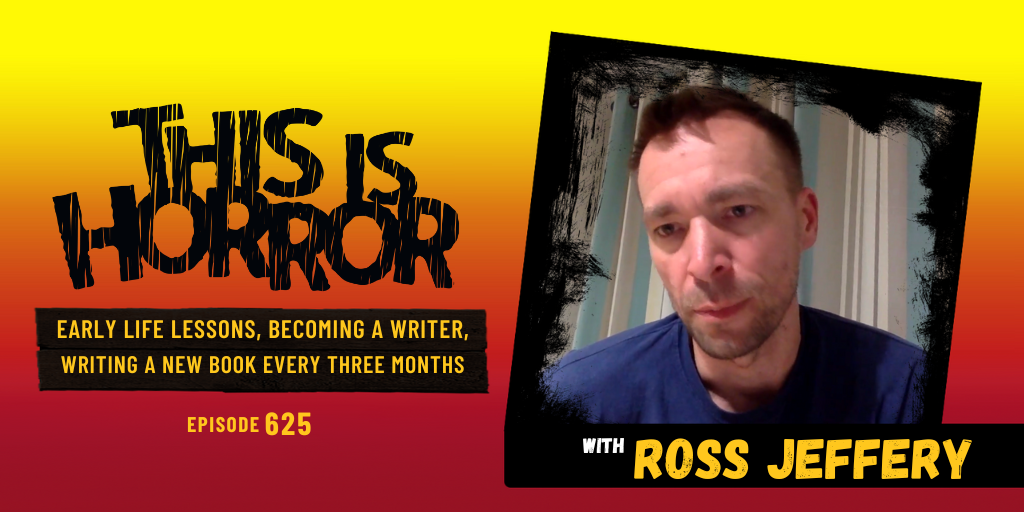

In this podcast, Ross Jeffery talks about early life lessons, becoming a writer, writing a new book every three months, and much more.
About Ross Jeffery
Ross Jeffery is the Bram Stoker Award-nominated and 3x Splatterpunk Award-nominated author of Metamorphosis, The Devil’s Pocketbook, I Died Too, But They Haven’t Buried Me Yet, Tome, Juniper, Scorched, Only The Stains Remain, Milk Kisses & Other stories, Beautiful Atrocities & Tethered.
Show notes
Click the timestamps to jump straight to the audio.
Thanks for Listening!
Help out the show:
- Support This Is Horror on Patreon
- Listen to This Is Horror Podcast on iTunes
- Listen to This Is Horror Podcast on Spotify
- Rate and review the This Is Horror Podcast on iTunes
- Share the episode on Facebook and Twitter
- Subscribe to This Is Horror podcast RSS Feed
Let us know how you enjoyed this episode:
- Leave us a message on SpeakPipe.
- Write a comment below.
- Tweet us @thisishorror.
Resources
- Ross Jeffery Books
- Watch the video version of This Is Horror Podcast episodes, including our conversation with Chuck Palahniuk on YouTube.
The Girl in the Video by Michael David Wilson, narrated by RJ Bayley
Listen to The Girl in the Video on Audible in the US here and in the UK here.
They’re Watching by Michael David Wilson and Bob Pastorella
Read They’re Watching by Michael David Wilson and Bob Pastorella right now or listen to the They’re Watching audiobook narrated by RJ Bayley.
Michael David Wilson 0:20 RJ Bayley 2:05 Bob Pastorella 2:14 Michael David Wilson 3:23 Ross Jeffery 3:38 Michael David Wilson 3:41 Ross Jeffery 4:10 Michael David Wilson 7:07 Ross Jeffery 7:11 Michael David Wilson 8:35 Ross Jeffery 9:15 Bob Pastorella 11:25 Ross Jeffery 11:30 Michael David Wilson 13:06 Ross Jeffery 13:53 Michael David Wilson 17:55 Bob Pastorella 18:30 Ross Jeffery 20:16 Michael David Wilson 20:30 Ross Jeffery 22:07 Michael David Wilson 28:06 Ross Jeffery 28:20 Michael David Wilson 33:09 Ross Jeffery 35:30 Michael David Wilson 37:57 Ross Jeffery 38:31 Michael David Wilson 45:14 Ross Jeffery 46:23 Michael David Wilson 46:29 Ross Jeffery 46:36 Ross Jeffery 48:53 Bob Pastorella 49:02 Ross Jeffery 49:13 Bob Pastorella 49:46 Ross Jeffery 49:50 Bob Pastorella 50:24 Ross Jeffery 51:48 Bob Pastorella 51:49 Michael David Wilson 52:37 Ross Jeffery 54:17 Michael David Wilson 54:24 Ross Jeffery 55:41 Ross Jeffery 55:49 Michael David Wilson 57:28 Ross Jeffery 59:42 Michael David Wilson 1:01:03 Ross Jeffery 1:01:39 Michael David Wilson 1:01:59 Ross Jeffery 1:02:57 Michael David Wilson 1:08:19 Bob Pastorella 1:09:20 RJ Bayley 1:09:59 Bob Pastorella 1:10:08 Michael David Wilson 1:10:36
Welcome to This is horror, a podcast for readers, writers and creators. I'm Michael David Wilson, and every episode, alongside my co host, Bob Pastorella, we chat with the world's best writers about writing, life lessons, creativity and much more. Today we are talking to Ross Jeffrey for the first in a two part conversation. Ross Jeffrey is the Bram Stoker Award nominated author of a variety of books including tome Juniper only the stains remain and tethered, although this conversation focuses less on the books and more on Ross's early life and the nuts and bolts of writing. So if you're looking for writing lessons and takeaways and looking at how you might be inspired and you might be able to improve your own writing. This is the episode for you, and it personally left me feeling really invigorated and energized to write. And I love it when that happens. So I can't wait for all of you to hear this one, but before we get into it, a quick advert break.
It was as if the video had unzipped my skin, slunk inside my tapered flesh and become one with me.
From the creator of this is horror comes a new nightmare for the digital age. The girl in the video by Michael David Wilson, after a teacher receives a weirdly arousing video, his life descends into paranoia and obsession. More videos follow, each containing information no stranger could possibly know, but who's sending them and what do they want? The answers may destroy everything and everyone he loves. The girl in the video is the ring meets fatal attraction from iPhone generation, available now in paperback, e book and audio from the host of this is horror podcast, comes a dark thriller of obsession, paranoia and voyeurism. After relocating to a small coastal town, Brian discovers a hole that gazes into his neighbor's bedroom every night she dances and he peeps same song, same time, same wild and mesmerizing dance. But soon Brian suspects he's not the only one watching. She's not the only one being watched. They're watching is The Wicker Man meets body double with a splash of Suspiria. They're watching by Michael David Wilson and Bob Pastorella is available from this is horror.co.uk, Amazon and wherever good books are sold.
Okay, here it is. It is Ross Jeffrey on this is horror. Ross, welcome to this is horror.
Thank you very much for having me. It's a pleasure.
Yeah, it's been a long time coming. And goodness, you've written so many amazing books that the most difficult part about this conversation will be kind of where to even go with this journey. But in terms of the starting point, we're starting where we always do. I want to know what were some of the early life lessons that you learned growing up? Well,
some of the early life lessons from my dear father were to work very hard. If someone hit you, you hit them back harder, lots of lots of toxic masculinity going on in my household when I was younger. But I think one of the things I learned, I learned the hard way, is that writing and reading didn't really come easy for me in my kind of early childhood, and I would kind of like as a lesson. Like, if anyone is listening to this and finds it difficult to write or read, or, you know, find pleasure in books, is that you can persevere past that, and you can discover the love for it that I have. And. Mean, like when I was at school, I always found it so challenging. But I think I'm undiagnosed kind of dyslexic, because when I was at school, they didn't bother check in. They just let you just struggle. So it's always been something. And then I always thought I was lazy because I didn't quite understand grammar and spelling and all that kind of stuff. And then I got to secondary school, struggled all the way through it, and I had an English teacher that put me off reading, like forever, like for a really, really long time. And it's all because, I don't know if they do it in America, Bob, but like in England, when you're doing your GCSEs, they make you read aloud in the class, and everybody does it, like a little bit of it, and it goes around. And I absolutely hated it, because when I whenever I talk, when I'm reading or reading out loud, like I stutter and I stumble over words, and every time I did it, my teacher was just like, right? You need to start again and I was stuck. And then I try and read again, and I get worse and worse and worse. And then the teacher was just like, oh, just move on to the next person. And then I just, I just gave up reading, and I didn't read for pleasure, like, I read comics. Comics were my happy place, but, like, books just didn't interest me at all. And I just Yeah, if I didn't read for pleasure, until I got married in like, 2007 so like, the whole time, I was just like, not reading books at all. And then my wife was like, I never see you reading. And I was just like, No, I don't really want to read. They're not finding anything interesting to read. And she was like, You need to find one book. And if you find that one book, it will just unlock everything. And I believe there is a book out there for everybody who doesn't like reading. There is a book that will turn you on so and, yeah, my book was that I read that made me fall in love with reading. Again, was James Fry's a million little pieces, which just blew my mind when I read it, because it's all written in, like, I don't know if you guys have read
it. Have you read it? I've not read it now. It's
like, obviously there was a whole Oprah issue around it, because when he wrote it, his publisher said to him, it was a fiction book, and then he's published it. Oh, this would work really well as a memoir. And he was like, okay, like, I just wrote a book, but if you want to classify as and then he got in trouble for Oprah, because it was a memoir and stuff in it didn't really happen and, but the book was written in such a, like, different way, like it unlocked in my mind, like, just, oh, actually, you can write and make it look how you want it, like, it's really short sentences, like, like, one word on a line, and then the next lines got, like, three and back to one word. And I was just like, oh, wow, you can have fun with writing. I didn't know that was like, a thing, but yeah, like, that was amazing. And, like, he's blurbed a book for me now, and I'm just like, that's like, mind blowing. But the other kind of lessons, I never had a filter either. So, like, I was, like, diving into loads of horror very young, like horror films. So not having a filter is quite good, although my children have a filter because it's damaging, but, but, yeah, there's some of the lessons, and that's a bricklay as well, but that's a story for another day.
Well, I mean, these are long podcasts, so it might be a story that we get back to but as this is not the this is brick laying podcast, we'll put that on hold for now. I wonder, with the James Frey book, a million little pieces you said that was the one that really unlocked it for you, what made you pick up that specific book and where there were a number of books beforehand that had been false starts. So did you kind of luck out with your first attempt in 2007 to get back on the reading train? It
was recommended to me by my wife, so she was a heavy reader, and she was just like, I think knowing kind of what I was like, because I've been dabbling in writing before then. And like I used to write quite, quite a lot of really, my stuff's dark, but like before, I used to write really dark stuff, to name, just short stories, but I wrote them to offend people, because I thought offending people was cool. Turns out to not so. But I, yeah, I used to write some really dark stuff, just to like, I used to write really grizzly things that I was just like, yeah, that's gonna make people feel really sick. That's really cool. And my wife had read those, and she was just like, you've got a real talent. But she's like, some of this stuff. I'm just like, not, not checking in with. And she was just like, read this book. I think this book would be good for you, like, because it's about like a guy who goes to, like, he's an addict, goes to a drug facility to kind of kind of detox, and it's kind of like the stories that he has there, the people that he meets. It's kind of like a more of a kind of like recovery story that's almost a little bit like one full Over the Cuckoo's Nest, but kind of separate. And then he, like, meets his friends there, like Les guy called Leonard. And then the second book, James, who I wrote, was called my friend Leonard. So then I read that afterwards as well. There were a couple of books I tried to read like I thought, if I wanted to read, I should probably read some classics. So I attempted Dracula, found it really boring. And then I have gone back and read that since, though, and it was better than I first thought it was. And portrait of Dorian Gray. I kind of read that and thought it was okay, but I still didn't have the bug. I was just like, No. And then I read a Shirley Jackson book as well. I can't remember which one it was not. What's the one about the poison? I
can't remember that one's called, we've always lived in the castle that one.
So I started, I started reading that one, but I think I started and stopped that one about three or four times. And then I discovered James fry, and I was like, and then soon after the hymn, I then discovered Chuck Palahniuk, who's a friend of the show only, and he blew my mind as well. And I was just like, right? This is kind of the stuff I want to read like. And then just, kind of just carried on reading like when I was really, well I say really little. When I was about 11, I read Stephen King's It, but it took me like forever to read it. And then I went to secondary school, and then she ruined reading for me. But yeah, so then, yeah, James fry got me into it again. And then yeah, Chuck Palahniuk, and then lots of like, Richard Thomas. And then I kind of, like, just started, kind of just because I love horror, like, I'm such a fan of it, just like, and I was like, just, I was like, picking up, like, authors I've not heard of, like, quite a lot of indie stuff. I didn't know what indie was. Then I was just like, oh, this person's got a good book, and pick that one up. And and yeah. And then just the kind of love affair with books carried on, and now I just can't stop reading, which is the life turned a corner, like I just read everything now. And like I love supporting writers and recommending books to like my colleagues at work and stuff like that. So yeah, it's great, but I love it.
So this is such a non linear and unconventional journey, and so there's so many points on that journey that I want to touch on, but something that I find quite interesting is so as a child, you were not a big reader at all, but for some reason, you decided to read it by Stephen King. So one of the biggest kind of meatiest homes that you could find. So I mean, where on earth did that come from you? You had Carrie a few, a few books down as a much slimmer volume. Why did you go from not reading anything to picking up the biggest book in the store?
Because I, I grew up in a house like my dad is a voracious reader, like he reads like everything. And when I was growing up, we had this, like, big cabinet in our lounge, was quite a huge thing, and it had those, like, you know, the VHS is that looked like books. So it was kind of like that, like, all the way across one one level, and then below that was my dad's kind of hardback collection. And so my mum used to buy him hard back, Stephen first edition, Stephen King, every time it came out. So he had them all. And they're all lined up, like all the old, cool first edition UK covers and stuff like that. And I was, and I used to, and then he had those. He had the exorcist first editions, like every, every kind of like horror, like Sean Hudson, like he loved him. He had all these books as well. And then, like, James Herbert, like I learned kind of just by looking at these covers that and then their names, like, just on the spines. I was just like, in armored with it, and I was just like, Oh, what's this? And I pulled the covers out, and the one that used to scare the shit out. Me was the old misery cover, because it had her, like, kind of screaming on the cover and then the shining as well. But the the it one was the kind of the the UK covers got the kind of house on the cover, and it's like, bent and the clown and and it just, it just intrigued me. I was just like, oh, that's quite cool. And then when I read the back bit, I was just like, oh, yeah, this sounds like my cup of tea, because by that point, I'd already, like, watched The Exorcist and stuff, so I kind of, like, had piqued my kind of interest in horror. So I was just like, oh, let's give let's give this a go. And it literally took me. It must have taken me, like, a year to read it, because I wasn't the fastest reader. And also at that point, I still kind of didn't really love reading. I was just kind of, I think I was reading it just to get through it and, like, complete a book. But yeah, like, some of the stuff that happened in that, like, has stayed with me a long time, and I reread it recently as well. I think it was around the time the films were coming out, so I thought, I'll go back and reread it. And I when I was reading it, I could still remember myself, like laying on my floor in my bedroom, like with the book laid out in front of me, like it just had, like, not pure nostalgia for me, like going back and reading it, but yeah, I think before that, like, the only kind of book I'd read was, like a picture book called not now Bernard, so it was a big step up. But yeah, it's great. Like, and, and then the crazy thing about this story as well is that I went when I went to university, I went to university to study film, and I went to university, and then finished university, met my wife, got married, and then I said to my dad, oh, Have you still got your Stephen King books? Can I have them if you're not gonna and he was like, No, I got rid of them. And I was like, what all the first editions you had? And he was like, yeah, he said, I took him down to the charity shop. They seemed very happy about it. I was just like, What are you doing? And he just got rid, basically, he got rid of all of his first editions, like exorcists, like all the James Herbert's, like every single first edition hardback he got rid of. And I was just absolutely devastated. And I was like, what? And so now I've had to, like, just troll the internet and try and find them all again, not his ones, obviously, but like, just have to buy them all. So I've got them all and and now I have, but it's just, I was just like, you just cost me loads of money. That's like, what's going on? But, yeah, but, like, yeah. So, because he got a Kindle, he thought it was cool to, like, then just buy all the books he had already on a Kindle. And I was just like, What are you playing at? He's trying to be cool. He's trying to be hip, trying to be down with the kids. And I was just like, Dad, you've just got rid of a lot of good books.
I mean, it's absolutely fine to read books on Kindle and then to have the physical artifact in you know, you don't have to choose. It's not like, when you get the Kindle, there's terms and conditions, or although maybe there are, because everyone clicks accept, and we don't read, and it's like, right? You've now got to get rid of your physical books, but, oh my goodness, all that money he might as well have taken a wheelbarrow of money to a bonfire, because that's what happened. This is true.
Yeah, I've, I've lost books that were like, I considered collector's items and, you know, and I bought them when they were new, you know. And so they were relatively inexpensive, and I took really good care of them, and I lost them in a storm. We had a terrible hurricane, and it they got water damaged. And so it's like, you just basically throw them away. And so it's like, I've slowly been picking them up, you know, and spending a lot more fucking money than what I originally spent. It's like, I remember, I mean, shit. I think for, like, all, all six volumes of the books of blood, oh, I probably in the original little paperbacks, I probably spent, like, what, 25 bucks on them. Okay, I spent 25 bucks on one book, so, but I mean, some good things have came out of that. I've got, uh, three of the British covers that they accidentally sent, and in one of the books is actually signed, which I didn't. Oh, wow, we did. Yeah, we didn't realize. They didn't know either. Apparently they never opened it up. But the guy who I was getting it from my, my book dealer, he was, like, this one son too. I'm like, No shit, really, wow, you know. And we, we matched the signature. And, yeah, it's, it's. It's pretty much spot on. So got that for like, 15 bucks. And I was like, average price for that book was probably about 75 bucks. Long story short, your dad like, what the fuck man? Like, damn.
And it's funny, because now he now he messages me like, quite often when he's in a charity shop and he's like, Oh, do you need this hard back? I was like, No, I've got it now. I've re bought it.
There's another side to the story, and maybe in the future, we will get the guest on the show. But there's somebody who they walked into a charity shop and they're like, there's loads of first edition Stephen King's, and they're like, a pound. So, you know, this is your tragedy, but I guess, like, somebody's tragedy is an another person's joy in that sort of, yeah, going on here. But I mean, you were saying before, so yeah, as I weave together this puzzle of your writing and creative career, so even though you weren't reading a lot, you were still writing pieces. You were writing pieces primarily to offend people, which I think at that kind of like late teenage, early 20s, age, a lot of us have done because we're pushing boundaries. We're seeing like, you know what? What can we do? And we're pro with any reaction at that point is a good reaction. Later, we're like, we have to be maybe a bit more discerning as to the type of reaction we want. But were you at that point interested in kind of pursuing a creative career? Was studying film at university to go into filmmaking or screenwriting? What? What did the levels look like, in terms of you arriving at becoming a writer.
So I've always loved even though I didn't love reading, I've always loved telling stories. And that was like as a kid, like my dad worked a lot, my mum worked a lot, and I was kind of like, and my sister just kind of put up with me. So then, like, I kind of spent a lot of time by myself. So I used to, like, just play with my toys, like loads and just like, really long games that I'd play, like, the whole day long and stuff like that. And they were really kind of in depth. And I just used to play for hours and then, and then, when I was at secondary school, I started doing media studies. And, like, I just, like, part of growing up, I used to watch westerns, like, all the time, and my dad, like, on a weekend, that was kind of like what we did, like, we'd sit down, put a Western on, watch it. And then when I went to when I went to secondary school, yeah, they did Media Studies later on. So I, I started doing that. And like, one of the first kind of films that we studied was The Magnificent Seven, which I watched, like about 500 times. By then, I was, Oh, yes, I know loads about this. And and then it was just kind of like learning about, kind of like films and the, you know, the big five, and like, how it all was, like, the whole kind of film industry, which I loved, because I was a matt, like, I, I'm a bit of a film nerd. I've, kind of, I've kind of, like, taken the books now and, like, left the film. But I, like, for many years, I was massive film that. And, like, I just used to love it. And then I thought, Oh, actually, I could. Because I love creating stuff. And I love, like, visually, I love kind of, like, picking things apart and things like that. So I was like, Oh, actually, I could do some of this. And like, in our media studies class that we had to make, like, little short films and like, like, move the camera from one end of the room to the other, and like, use all these different like, cross fades and cuts and cuts and things and try and make as interesting as possible. So did all of that loved it. And then we got to do, like, script writing as well in it. So then I started doing script writing. And then towards the end of my A levels, I was just like, I don't really know what I want to do at university. I love film. I love watching films. So I went to university to do media arts and video production at Thames Valley University, which is next to Ealing studios. So I went there and did, yeah, media arts as my kind of major, and video production as my minor. And then yeah, just made films for three years. Just absolutely loved it. Learned kind of all the ins and outs of like how to edit cut film, all that kind of stuff. And then, unfortunately, by the time we finished university, most of what we'd learned was rubbish, because Danny Boyle would a. It released 28 days later, using digital camera. And then the whole world changed, and no one really used film anymore. So that was fun. And then, like I did a little bit afterwards, like me and a couple of friends set up like a little production company, like we just did a couple of, like, small shorts and independently funded stuff. And then kind of it was just a it was really hard industry to get into. Like, I did a few runner jobs, and kind of it was just, I was just like, I can't, I can't do this. Like, it was just like, I can't work for free, living in London and and and then I kind of just stopped, stopped that kind of like film side of it. I did it as a little bit like, kind of like making films as just for fun. But then I carried on because I loved the kind of script writing side of stuff. I was just like, oh, actually, let me try some short stories. And then I just thought, let's offend people. And then, like, I just used to just write little short stories. And at that point, I didn't know, I didn't know much about kind of the writing world, so I didn't know you could submit short stories to places, and I just kept them all as kind of like, and then I'd give them to friends, and they'd read them, and then we just discuss them and and then a couple of them, we turned into, like, little shorts, like film wise, but yeah, and that was something I just kept doing for years, just writing little short stories. And then, and then set up a storge magazine with two of my other friends. So we set that up. Well, they set it up, and then I joined it. And then we used to kind of do a little bit where we'd say the three of us would just randomly come up with a word, like coaster, and then we'd send it to each other, and then each of us would have a week to just write a short story, and that's the title coaster. And then we'd all come back and then read our stories to each other, and all be completely different. And that's kind of, I kept that going. We kept that going for years. So we had loads of different stories, all the same title, but completely different. And and then, yeah, and then, I don't know how far you want me to go in this to writing, but we carried on going. And then I think covid struck. And then I was, I'm I was working, so I work at a homeless day center. I manage a homeless day center in bris, in Bristol, and then covid struck, and I had loads more time on my hand, because we could only open a certain amount of hours. So then I thought to myself, I'll just, let's just try and write something a little bit longer than a short story. And then I wrote the novella juniper. And then, yeah, that's kind of brings it up to where we are
and the amount of books that you now have out. It's incredible to think that your long form fiction started with covid, essentially, yeah,
I was writing down my books earlier, because I sometimes forget which order they were in, so I was just writing them down. And I was just like, I turned around to my wife, and I was like, I've written like, 14 books in five years. She was just like, Yeah, but yeah, it's, it's crazy. Like, I think, I don't know whether it was all the years that I had just been because I had loads of sketchbooks with like, ideas down in and things like that, like, I love, like, sketching out ideas and just having them there and then choose one that comes, like, rises to the top. I don't know, yeah, whether it was years of just suppressed kind of, like storytelling that's just been in there. But I think, yeah, when I wrote Juniper, I was just like, Oh, I like that. That was quite good. And then I then sat as soon as I'd kind of written it. So I'd written that book initially to be published through storji, because they were starting to, we were starting to publish some books. And I'd initially said I didn't want them to publish it, because I didn't want it to be a vanity press. I was just like, if I'm going to release it, I'd like to kind of see if I can get anybody to, like, an independent publisher, to publish it. And they said that we're not about vanity but like, we really like your work. We'd like to publish it, but we want to kind of get an outside view on it to see whether we're just being friends and liking it or not. So I was like, okay, that's fine by me, yeah, if you want to do that, that's fine, but there's no pressure from me. Like, if you decide it's not for you, that's fine. I'll take it elsewhere and. Um, and they sent it to a kind of well known author at the time who was a creative writing lecturer at the University of London. And I know of this person. I've read that work, and sent it off. And I was like, oh, that's quite exciting. Like, you know, they can read it, see what it's like. And then I received back a, I think it was three page document telling me how awful it was, how I should put it on the shelf and never pick it up again, that I had no talent, that my grammar and and everything else was off. How in anybody's right mind would anybody eat cats, lots of other kind of, like, horrible derogatory stuff that was very, very personal. And I was just It brought back all those kind of, like, inadequacies of when I was younger, and, like, English and and I was just like, oh shit. Like, this is bad. Like, what am I even doing? And then, like, I spoke to my wife, and I said, like, because she'd read it, and I said to her, Look, I've just got this back. Like, can you read this email? Just let me know? Like, if I'm actually if it's right, or if I'm right, I'd say I don't mind. Like, if it's true, let me know. And she read it, and she was just like, she was like, to me, it just sounds like jealousy. She was like, lots of it is not, doesn't this really personal. It's not about the work is about it seems like it's about you. And I was just like, okay, so luckily I didn't listen to that prick, and I went on and released it myself, and he did quite well, and I still have his email printed out in my desk, so I sometimes put out to look at for inspiration to be like, fuck you. And also I was just like, I was like, This guy is in charge of people who have gone to this university to learn how to write, and it seems like he doesn't like any writing that's not like his own. I was just like, You are a very toxic individual. I've never named this person. I will never do that. But I was just like, I can't believe you're in in a position of power over quite like, you know, like kids, basically, who have gone to university to write, and you're going to basically cripple them before they even start. Luckily, I don't give a shit what people think. So I just went on and did it myself. And then as soon as like, yeah, I got did that, got that email, released the book, and then I was just like, right, I'm going to write a novel. And then I wrote a Bram Stoker nominated novel tone. And I was just like, yeah, sod you, but, but, yeah, that's a long, long winded answer to how I got to where I am now. Yeah,
goodness, what happened with that? You know, lecturer at the University, I mean, it is a classic in how not to talk to your students, and just not even to do with students, but just being a kind of good person, and just how you frame something, you know you're allowed to be sent a piece and you don't respond to it. You don't like the topic. Obviously, the whole kind of cat eating thing is going to it's going to be a divisive issue. It's kind of funny. You even mentioned it for people who haven't read the book, they're like, hang on, what? But that, that little detail might sell it to them. They're like, Okay, what? What's going on there? But yeah, like, I think even just saying, You know what, I read it. I'm not the audience for this. I think you need to send it to someone to critique, who's, you know, more into dark fiction and horror. That is a much more reasonable way of approaching things. But you know, sadly, your your story, your experience with this professor, is is not like an uncommon one. It's kind of, you know, I've heard versions of this again and again. I've had personal encounters with professors who have tried to steer me away from horror, and it's just this snobbery and this argument that we, you know, occasionally talk about on the podcast, where there is a sect of people who kind of denigrate horror, and they think of it as lesser. And, you know, Frankenstein, Dracula, Shirley Jackson. This is all horror and literature. These are classic so goodness, what an awful experience. But I'm I'm glad and somewhat surprised that you managed to take that and to to just kind of continue, and I suppose maybe getting that perspective from your wife was something that contributed to you understanding, okay, this isn't a me problem. This is a him problem.
Yeah, I think it's because I, you know, I've, I bounce ideas off my wife and like, she's kind of like a first reader for quite a lot of my stuff. She hasn't read the last few books because I keep writing too many for her to read. But like, she's read them. Like, I think she's read up to Devil's pocketbook, I think, and then the rest she hasn't read. But like, she's always someone that I can kind of like, give the book to and be like, can you have a look and read it and let me know what you think. And my horror is not her bag. Like she doesn't read horror. I forced her to read bird box, and she absolutely loved it, but I was just like, yeah. Like, I trust her. She's so well read that she can point out if something's not white or not working right, or it's gonna, like, offend people. I'm not about offending people anymore, but she'll be able to, like, be my kind of like, voice of reason as well. Like, and there was been a time where I was writing a novel and I'd lost, I thought auto save was on, and I was writing, I think it was scorched, and I was writing for absolutely ages one day, and then thought it was auto saving, and didn't save, and I lost like, 20,000 words. And I was just like, I was having a meltdown. And she was just like, look, it doesn't matter, like you wrote it the first time. She was like, I know it's really bad, but you need to pull yourself together. You've written it once. You kind of know the gist, so when you sit down to write it again, you'll write it better. And then I was just like, Okay, I needed to hear that, because I just thought I'd lost the whole book. But yeah, like, she's great, she's amazing, yeah, and very, it's very encouraging. And I also think, like, maybe that letter and that kind of feedback I had, although it was hard to take at first. And, you know, I rubbish it as it's his issue, not mine, but I think it is also, it also fueled me on to not that I don't, not that I'm proving myself to him, but I'm proving that I'm, I can write and, you know, it's not a fluke or, you know, my, my kind of slice of horror is a bit different than others. Like, it's a bit wordy. I think people use purple prose, but like, I just love writing the way I write, and if people like reading it, then I'll carry on. And if yes, they don't, I'll just carry on. But yeah,
yeah. And coming back to writing 14 books in five years. So I want to know, and I'm sure listeners want to know too. I mean, what, what does a typical routine look like at the moment? And then, how many of those 14 books did you write during the covid period? Because I think that that is an important caveat, because kind of different rules applied at that point. So yeah, both covid and then now what it typically looks like.
So during covid, so I would, I would finish work, so I only work four days a week. So I do all my I do full time hours in four days. So I have a Friday off, and that became my writing day, and that still is now, even though my work have said or would like to open on this day, I was just like, I said, I'm really sorry, but my writing is has taken off, and that's the day I spend writing, and I'm doing all my hours during the week. And they were like, okay, that's fine. We respect that. We want you to have that. So that's fine. So yeah, so Fridays are my kind of writing day during covid. So I'd go to work at eight o'clock, finish at 12, and then I'd get back home and, like, do a bit of, like, Homeschooling with the kids. And then I'd write from about about three o'clock till eight o'clock each night, and then it and then, because I it was just something to do, and I was just like, that was like, ingrained every day I get back and I'd write, you know, some nights I'd write, like, 1000 words. Some nights I'd write five like, it just depended on, on how it went. And then during covid, I probably wrote, so, 12345, books during covid, like, that's like. Uh, yeah, over like two years, I think, and then the rest just kind of in the time after that, which seems like a lot when I'm looking at it, but yeah, so, like, kind of my routine is Fridays, is my day. Like, I protect that. Like, I know people have an issue with JK Rowling, but she said something that was, like to be a writer, you need to find you need to find the time that you want to write. You need to protect it as much as you can. So Fridays is my day for writing. My kids are at school. My wife works on a Friday, so I'm basically in the house. No other like people will message me and be like, Oh, Ross, you wanna come out for coffee? I'm like, No, I'm writing. I might seem quite boring to them, but I was like, No, I'm writing. It's my day. So yeah, I'd get up, have some breakfast, sit down at about about 10 o'clock in the morning, and then I'd write until about three when my kids came home, and that's been the routine pretty much all the way up till now. There were two exceptions. One was the devil's pocketbook, because I kind of told someone that I'd written more of it than I had, and they seemed very interested in it for particular reasons, which I can't really talk about. So then I needed to, because they said, how long would it take you to write it, seeing as you've done 30,000 words of it already, and I'd only just had the idea. So I was just like, a typical book normally takes me about two months, if I'm sitting down and concentrating on they were like, okay, and then they took that date as the date. And I was just like, oh shit. So then, like, every day I was coming over from work, and I'd work all day, and then, like, I said to my wife, like I said, Look, I did a bit of a boo boo. Told someone that I was gonna like, I'm head, I'm not so I need to sit down. So then every day I was getting home from work, I'd work all day, get home at like five, eat, sit with my kids for a little bit, and then I go up and like, from six till nine every day in the evening, I'd be pounding keys, getting it all written. And then I'd have my full day on a Friday to write, and so I did all that. That was good. And then the other book, which isn't, which isn't released yet, it's on kind of submission at the minute, is my Western a few vials more, which, because I love Western, as I just I've said previously, it's always been something I've wanted to write, and I had an amazing idea for it. So I was like, that's what I'm going to do when the time is right. And then a couple of years ago, I was like, Yeah, sounds right. Let's do it. And I decided to use an old fashioned typewriter to type the whole manuscript. And I just basically every time, every moment I got I just sat because I loved the tactileness of it and moving the paper and the dinging and the bell and all that. So I was just loving life. Although my wife kept on telling me I looked like Angela Lansbury, because it kept on like she was like, just look like you're on, like the thing where she froze the paper. I can't remember what it's called TV shows you did about murder. But I was just like, okay, yeah, I get it. It's funny joke. But yeah, I would just spend, like, as much time as I could on it, and I loved it. But generally, all my books are written on a Friday, and again, like, and the kind of development of how I have written them has changed a lot, because I used to just write the whole book from start to finish, I think mainly just to get it out of my head, because I was it's just too busy sometimes with all the ideas I've got, so I just like just write all the way through, not worry about spelling errors, just get to the end. And then, I think after about three books, I was just like, bloody hell, this editing is taking forever. So then I started to do, I think it's called, like the Lansdale technique, where you kind of read back the last bit you wrote, and you edit it, and then you fresh to go in the next so I started doing that, and it is an absolute lifesaver. I love it. It always gets me back in the zone as well. So I'm just fresh to write. And yeah, it just makes the manuscript so much easier to work with, like afterwards, because I was spending, I'd probably say I spent more time re editing my earlier books than I did writing them, because it was just, I've already said my spelling and punctuation is awful, but like, just, it was just too much, and I was just like, I'd rather, I'd rather spend my time writing than doing this, so I'm just going to make sure I do it right the first time. And. And I've kind of kept that technique going through the rest of, kind of the books from Devil's pocketbook onwards, and it's, yes, saved me so much time, and also getting a good editor has also saved me so much time.
Okay, so I've taken some notes, because there's a lot to kind of get to here, but kind of the quick version seems to be so you've written about nine books in the last three years, so we'll say about three per year. You take about two months to write it, two months after his editing, however, and this is the bit that's probably gonna blow most people's minds. You're primarily only writing on Fridays, between 9am till 3pm is and the method that you're kind of now using going forward is what you've termed the Lansdale or technique where you read like a page or a chapter before, to orientate yourself, to edit the previous day's work or the previous weeks in in your instance, and and that's kind of it, that is your way. You know you're essentially writing on Fridays. And with that discipline, you can, you can finish free books every year.
Yeah, it's when, when you put it like that, it sounds quite weird, but
I don't know weird, it sounds bloody phenomenal and impressive. It it's incredible,
yeah, it's um, yeah. It shocks me sometimes. Like my wife also says, she said, like, you never sit down to write and you never, like, have writer's block. Like, it just doesn't seem to be a thing for you. Like she said, Every time I see you basically open the laptop and you are straight in there just writing, and I'm just like, yeah, it's just my kind of, I think I have a really, like, I think it's from all the films I watched as a kid, and, like, my love of film that I when I'm writing, I visualized, I'm pretty sure everybody does, but, like, I visualized the whole thing as I'm writing. And I always, when I'm writing, I always kind of, yeah, like, visual storytelling, but I kind of see the whole scene in front of me. It's quite, quite strange when I think about it. But like, I can I kind of what I kind of, I kind of imagine that I'm watching my film of the book, and I'm just right writing, kind of what I'm seeing on the screen. So cinematic, yeah. So, like, some, like, of my writing, kind of, like, a few people that have read my stuff are like, Oh, that bit where it does that's just, like a cut in a film and, like, it's just next scene, and it just comes out of nowhere, like, and that's kind of how I see it when I'm writing, is just this, just the film in my head that I'm putting on the paper, which makes it like, I can just sit down below, yeah, I paused it at that point. Like, let's crack on and like, but yeah, like, I'm very fortunate. I don't I haven't ever suffered from writer's block. Like, a lot of that is, I do a lot of planning beforehand. So I've got like notebooks that are quite detailed about so I have like characters, my act structure scaffolding, kind of like how I want to get to where sometimes illustrations of characters and things like that. So that helps, kind of keep me centered and and I never ever finish writing mid chapter. I always get to the end of a chat, like, even if I have to work, like, right later, or if I'm, you know, it's not three o'clock yet. It's like, two o'clock. I'm like, Oh, if I write another chapter, I'm not, I won't write. I'll just hold it.
But yeah, and I think that just helps fuel it. But yes, a lot of books and not, not a lot of time,
so you don't when, like, when you do your session, and you actually stop at the end of a chapter, and you will not start the next chapter, if until the next session.
Yeah, if I don't have time to if I think it's gonna be, like, a long chapter I got you, I won't start it until I think like, I've got enough time to finish it, but I will. I've written like, you know, some days I'll sit down and I'll write my general kind of a good day is around five to 7000 words, but I've sat down before and written like 25 I think 22 actually was when I was writing with Josh, when we did our little write together,
that's like, Stephen Graham Jones level, like, I wrote 22k
off the bat, and I was just like, Oh, wow. Like, I really needed to get out. Well, that was just like, one day I just sat down nine to nine to three, and I wrote 20. UK. And I was like, Yeah, cool. But then that's like, a rarity. Like, I don't like that much often in one day, but yeah, I'd say between five and five and seven is the sweet spot, really. And then I and if I had time, like, if I finished that and I get that done, I'll start my Lansdale on the kind of same day, like, I'll go back to what I've just written and just kind of scan it,
yeah, I can't, I can't go, I can't end in a Chapter, and then go back to the writing session, even if I Lansdale it as we're saying, and, you know, and go back and reread and edit and things like that. Then, then I pull up, you know, and I write in Scrivener now, so I pull up another document, basically in my folder, and get the Parameter Set for it, and all that. And then I stare at the cursor for fucking hour, because it's like, because I didn't set myself up, and it's just, I guess everybody's a little different, but I have to set myself up. So if I end the chapter, I have to go into the next chapter. I have to write a sentence, a paragraph, something, and so and strike while the iron is hot. And so it's like, because a lot of times like, Okay, I want this chapter struck right here, so I want to put it into the meat of what, what they're about to do, or a different decision has happened. So I just find it fascinating that you can end on a chapter and then go right back into it and it's like, I guess it's just because I've just trained myself to always kind of give myself a hook that way, when I go back to the next day, I was like, Oh, I'm not staring at the blank, you know, a flashing cursor, just, you know, taunting me
that's at the blank page.
Yes, yes. And it's funny, too. You mentioned about having to write a book and, like, really, really quick, because you kind of bit off more than you can chew, because, and then we talk about Lansdale, and Lansdale did that years ago with the screenplay. This guy was local, and he read, he had written a book or story or something. Can you do a script, you know, and Lance house? Well, yeah, I can do a script, you know, like he goes, I can get to you pretty damn quick, you know, the guy was at his house the next day, you know, you know, Hey, man, you got that script. And he's like, Oh, you need it now. Well, now give me, give me a little bit. I need a little time, you know? I was like, Yeah, you got to be careful. Exactly
this, exactly what, you know, when Rosson was talking about it brought to mind for me. But you know, to be honest, ever since hearing that from Lansdale, I do that a little bit myself, because I think, you know, if I'm talking to somebody important and there's a potential opportunity, it's like, look, the book might not be written, but if they want the book to have been written, and this is going to be the difference between me getting a deal or not, the book is written. Oh, can you send it? Give me a week to just polish it up. So, yeah, I mean, goodness, we've got to advocate for ourselves. We've got to create these opportunities. And, you know, I think like yourself, that's why I don't really have writer's block in the traditional sense. Of course, sometimes there'll be like doubt, or there'll be worries, but I just keep writing. And you know, a lot of it comes back to mute your friend Josh Malerman, because he's kind of like, well, well, so what, you know, what? If it kind of fails in your kind of arbitrary definition, it doesn't matter. There's another book, there's one after that, there's one after that. And, you know, he'll reframe it, rather than it being like, what if it fails, it's like, Yeah, but what if it doesn't? And instead of, why would it be me? You know, why wouldn't it be me? Yeah, seems to have worked out fairly well for him thus far.
Thus far, yes, he's a very positive man. A lot of people can learn a lot.
And you know, I mean, this isn't the Josh Malerman show, although it could, it can, at any point, turn into it. But one thing that I find particularly remarkable at the moment is, you know, he had the standout success of bird box that just absolutely blew everyone away. Then he got the film deal. And you know, you normally get one moment like that in your career, but then right now, he's having it again with incidents around the house. And you know, if ever there was a. Proof that you just have to keep going. I mean, it's not like his other books were, were not a success, but just to to have kind of, probably, that's about 14 books later. There's a lot of books in between bird box and incidents. So, I mean, with me, I think at the moment, the girl in the video has been my most popular in terms of sales. But, you know, it almost doesn't matter. It's like, because the next one that might, that might exceed it, and eventually, I'm pretty damn certain that there's going to be a book that's going to do a lot better than the girl in the video. So we just keep writing for those moments,
yeah, I think as well, like, when I was, like, starting out writing, I think I kind of who I spoke to,
but they, because I released Juniper, like, independently, they were like, I was just like, oh, yeah, sales aren't doing that great. Like, they soared originally, and they dropped off, and I don't really know what to do. Like, how do I do this? And I think, I think it was sort publishing, actually, like I was, I bit through my storge kind of days, I was, like, friends with quite a lot of publishers and stuff, and they said that, don't worry about it. Don't sweat it. Like, you know, write more books, release more books, and then you'll see the sales go up because you'll have more for people to read. And I was just like, oh, yeah, that makes so much sense. Like, why didn't I even think of that? Like, I was like, okay, yeah, not that that's driven me to write loads of books. But I was just And then, like, now, like, having, like, quite a large catalog of books that are out there. Like, yeah, they do riff off each other. And you know, some of the books I've written that I love, like, you know, harvesting nightmare fields that came out. Like, I was kind of like, yeah, I love this, but this book's brilliant, but the sales haven't been very good. Like, but then I'm like, and I look at another book I wrote, like, last year or the year before, and, like, that's got loads of sales. And understand, oh, yeah, okay, maybe, like, it's just that you just have to have the material when people will find it which, which is great if you're a prolific but also encouragement for those that you know are only had one book or two books that you know keep writing and you know other readers will find them as and when. And, yeah, no book is ever dead as they say, as they say, like someone said that before. But,
I mean, I would say it, you've said it here. So between us, they have said it. There you go. And, and, I mean, yeah, I heard people say, before you know, the best marketing is writing the next book, which I think there's some truth to it. I mean, it depends how damn good your marketing campaigns are, but even if you're really good at marketing, or maybe the second best marketing is writing the next book. And like we have said, like it is widely said, No book is ever dead we we don't know what it is that will make it take off. You know, there might be a film adaptation. There might be that some massive writer or celebrity discovers that book, they put a post out about it on social media, and then suddenly, you know, it's the next big thing. So, yeah, I truly believe that no book is ever dead. And something that I've kind of been saying a lot recently, which I it's kind of so bizarre, but also understandable. Like a lot of us, falsely, we try to equate our success or the value of our art and our book to the Commerce and the sales, and we're tempted to say, if it doesn't sell, well, oh well, that book was a failure. But the ridiculous thing is, you know, when I finished a book, when I've put it out, whether it sells one copy or millions of copies, it's the same fucking book. So is absurd to say, you know, that the value changes based on the demand, like so, yeah, all of my books I'm tremendously proud of. Of course, I'd like all of them to sell more, wouldn't we all, but you know, to suggest that it's suddenly better written, because, you know, a million people now go out and buy it. It's just not true.
I think it's a it's a dangerous game to like, fall into like, if like, because I love every single book I've released. And I also find it quite difficult sometimes when people say, Oh, what's your favorite book you've written? Because they're all my favorites. But I think, yeah. Can get dangerous when you start comparing, because, like, you know, only the stains remain. I released that. It's so well to start with. But then, like, I think, last year or the year before, it just skyrocketed. I don't know where, what happened, who said it? It might have been an influence, influencer online, but then that was selling, like, 1000s of copies. And I was just like, why someone said something. I don't know. I don't I'm not really on, like, tick tock or anything anymore, but, like, I don't know if it was from there or something, but it just like, the sales just rocketed. And I was like, Oh, maybe I should stop promoting this book more can I was selling. And I was that, no, don't do that, because it's like, You're cheating on your other books. Ross, I was just like, Yeah, let's just keep it going, like, I just, I try and promote all my books the same. And, you know, quite a lot of them with indies, so there's a lot of kind of leg work in promoting them. But I don't, yeah, like you said, like, if it sells one copy, I'm a happy man, because it's a book I've written and it sold a copy, but if it sells 1000 million, yeah, it's good as well, but same it's as good as the last book.
Yeah, and I would say that I did ask you, what is your favorite book? Is like, well, I'm being, I'm being called out here. But I mean, for me, like, I do have, like, one that I would say is my personal favorite of the ones that I've written. So I think we're allowed to have favorites. There are things that I like about all of them. So yeah, I wasn't meaning to put you on the spot in a kind of like, choose your favorite child, because we've seen how those films play out, yeah? Or it gets pretty bad, yeah. I
just know it's not like, I'm offended by it, but it's just like, a like, I really struggle because, and also, like, some days I like another book, different than when you've asked me, like, I'll be like, Oh yeah, I really like that book. And then like, two days later, I'm like, Oh yeah, but that book, yeah, it's just Yeah, it's crazy. And
so I want to kind of talk a little bit about the planning and the editing, because we've glossed over those elements a little bit. So first of all, I mean, you were telling us you plan quite a lot beforehand. So people who, again, they've been doing the maths in terms of this free books per year, it's like, well, how much of a plan do you have? And then, well, how long does that take? Is that one Friday to plan an entire book? Or do you allow yourself to plan not on Fridays because, you know it's right. I guess it's writing tangent only you. Are you doing that between kind of social work? If you got a lunch break, you plan an idea down. Try not to confuse, like the case worker notes with your story plan. It's like, well, no, give that one back. That's not what you want to read.
I think so the planning wise. So basically, I won't start writing a book until I've written, until I know the complete story for the book I'm going to write. Sometimes I'll it's quite because my head is a very busy place. So normally, when I'm writing a book, I'll have like, three books in my head that aren't written, that are just kind of like floating around each fighting each other and just having a little war. And then one will eventually kind of like, just keep on coming into my book, like my thinking and during the day, or something like that. So then that will be the book that I will then start thinking about planning whilst I'm writing a book I may like. Towards the end of the book, I may start planning the next book just in my downtime, like I use my phone quite a lot for notes, and then, because normally it comes to me, either when I'm on my way to work or when I just get up in the morning, I'm like, oh yeah. That's Oh yeah. That unlocks that bit. Okay, that's great. And then I put all my notes in my phone, I think, like, with the last three books, I've had notes on my phone that basically would go from the beginning of the book to the end. And then I because I don't know why I did it, because it's on my phone, but I'll write it all up in my little journal, in my little notebook, so it's all written down. And that kind of planning side normally takes around about could be anyone. Like, I died too, but they haven't buried me yet. Like, I literally wrote that plan outline for that book in two weeks, and that was just through notes on my phone, and then having the two Fridays. Other books might take a bit longer. So cradle of glass that I just finished writing, that I planned that one for quite a while. It was a. Book I was writing the story I love so much. I was like, I'm going to write this one to submit it to an agent. So I was, I need to spend a bit more time in the planning of it. So that took, I'd say, probably about three months to plan that one. But generally, it's quite quick, like I what I tend to do. So I use kind of like a five act structure. Mostly. I change that quite a bit, but and then what I do is I say I got a five act structure. The first act I want to have four chapters. So then each other act will have four chapters. So then I know how many chapters in the whole book. I'll then jot down chapter one, and then I will put down, kind of like, normally, it said, normally, my notes say something like killer first line, and then I'll be like, killer first line, and then, like, I want to get to and then I'll put down the kind of like end bit of the chapter, and then I'll make up the rest when I actually write. And then, like, chapter two, and I'll go all the way up, and I'll have like, inciting incident turning screw, like conclusion or whatever, and I'll just work my way through it and jot down every single chapter, how I'm going to get there. And then I'll do a like, I'll spend a few hours working on characters, names, ages, what they look like, how, like what they do for jobs. Like, I go really deep dive, like, you know, what their hobbies are and all that. Even if it doesn't come up, I've got it written down. And then, yeah, I sometimes I might pull some images off the internet just to kind of look like landscapes or things, or like things I'm not quite sure about. I did a lot of that with the Western because I it's set in Nebraska. So, like, I that that is the book that I spent the most time researching. It took I must have researched for about six months. I like, when I joined the Nebraskan Historical Society, because that's set in Nebraska. Like, they sent me like maps of the time that I was writing in. They sent me town layouts, all the towns that I kind of like picked that they were going to go on this journey to. They sent me like the maps. Like, I didn't even know they existed at that point, but it was like every single building in the town was written down, like, like, which ones are water, like, how all these as I had all of that. So, like, that's, like, it was crazy, the amount of research that went on in that one. But I wanted it to, it was my kind of, like, this is the book. Ross, like, the book, and, yeah. So I just spent, I spent, yeah, I spent about six months planning that one. But, yeah, that's kind of it really like, I tried to research a bit, but and more so on books that I do in America because, like, or American, like, kind of language and things like, because I want to make sure it's right, and not me just guessing, like animals that are in a certain place in America, I don't know, but I try to do like, in a minute when I'm writing in America, I try to do a lot more research, just so I get it right. The one sitting like England, I'm just like, Yeah, I know. I know that. Like, I tried to write from places that I know as well. So when I'm writing them, I'm kind of like, I've been there. I know what that landscape like. It's like this.
Thank you so much for listening to Ross Jeffrey on this is horror to support the show and to hear the next episode ahead of the crowd. Become a patreon@patreon.com forward slash This is horror. I'm hoping to do this is horror full time by the end of the year, and the best way for you to help me make that a reality is to join Patreon, and in a matter of days, you will get to hear our story unboxed episode in which we analyze The Australian horror talk to me and deliver writing lessons to help you make your stories better. So if that sounds good, do join us@patreon.com forward slash This is horror. Okay, before I wrap up, a quick advert break
from the host of this is horror podcast, comes a dark thriller of obsession, paranoia and voyeurism. After relocating to a small coastal town, Brian discovers a hole that gazes into his neighbor's bedroom every night she dances and he peeps same song, same time, same wild and mesmerizing dance. But soon Brian suspects he's not the only one watching. She's not the only one being watched. They're watching is The Wicker Man meets body double with a splash of Suspiria. They're watching by Michael David Wilson and Bob Pastorella is available from this is horror.co.uk, Amazon and wherever good books are sold. It
was. As if the video had unzipped my skin, slunk inside my tapered flesh and become one with me.
From the creator of this is horror, comes a new nightmare for the digital age. The girl in the video, by Michael David Wilson, after a teacher receives a weirdly arousing video, his life descends into paranoia and obsession. More videos follow each containing information no stranger could possibly know, but who's sending them and what do they want? The answers may destroy everything and everyone he loves. The girl in the video is the ring meets fatal attraction from iPhone generation, available now in paperback, e book and audio.
Now, I just wanted to thank everyone who has read daddy's boy. And I also wanted to thank those of you who have left a review, the audio book, narrated by Josh Curran, is now available on all platforms, including audible. So do pick it up with your audible credit if you can. And speaking of support and reviews. Thank you to Curtis, who left a five star review for daddy's boy and had this to say over on Goodreads, that book was totally unhinged. It felt like Jeff strand if he really got in to British comedy. I will never forget my adventures with shit a brick Rick. Thank you so much, Curtis, and hopefully there will be more adventures with the likes of shit a brick Rick in the future. If enough people buy daddy's boy, then I can deliver a daddy's boy too, if that is what the people want. So vote with your wallet and show your support on platforms such as Goodreads. That about does it for another episode of This is horror. So until next time for part two with Ross Jeffrey, take care of yourselves. Be good to one another. Read horror, keep on writing and have a Great, great day.