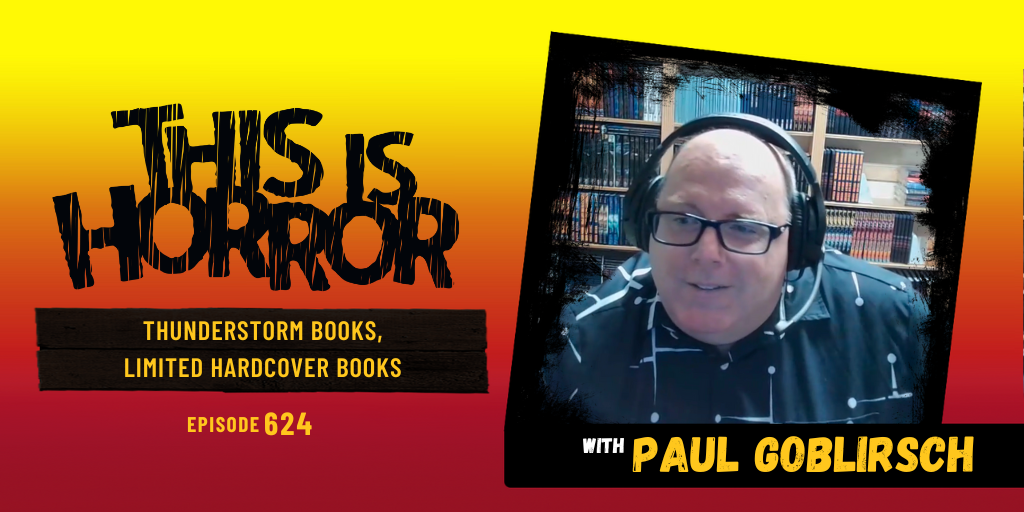

In this podcast, Paul Goblirsch talks about Thunderstorm Books, limited hardcover books, and much more.
About Paul Goblirsch
Paul Goblirsch established Thunderstorm Books in 2008. Specializing in collectible signed limited edition hardcover books, our goal is to showcase authors’ works in beautiful limited editions. From both new, up-and-coming authors to veterans of the genre, we publish some of the best in the field including: Brian Keene, Joe Lansdale, Christopher Golden, Philip Fracassi, Tyler Jones, Ross Jeffery, Chad Lutzke, Cynthia Pelayo, Jeff Strand, Hailey Piper, Paul Tremblay, Edward Lee, Kealan Patrick Burke, Jonathan Janz, Samantha Kolesnik, Gabino Iglesias, Adam Cesare, Kristopher Triana, Richard Chizmar, Gwendolyn Kiste, Wrath James White, and Ronald Kelly. With approximately 40 titles released per year, we fulfill the desires of both hardcore book collectors and those who want to pick up the occasional special edition.
Show notes
Click the timestamps to jump straight to the audio.
Thanks for Listening!
Help out the show:
- Support This Is Horror on Patreon
- Listen to This Is Horror Podcast on iTunes
- Listen to This Is Horror Podcast on Spotify
- Rate and review the This Is Horror Podcast on iTunes
- Share the episode on Facebook and Twitter
- Subscribe to This Is Horror podcast RSS Feed
Let us know how you enjoyed this episode:
- Leave us a message on SpeakPipe.
- Write a comment below.
- Tweet us @thisishorror.
Resources
- Thunderstorm Books
- Watch the video version of This Is Horror Podcast episodes, including our conversation with Chuck Palahniuk on YouTube.
The Girl in the Video by Michael David Wilson, narrated by RJ Bayley
Listen to The Girl in the Video on Audible in the US here and in the UK here.
They’re Watching by Michael David Wilson and Bob Pastorella
Read They’re Watching by Michael David Wilson and Bob Pastorella right now or listen to the They’re Watching audiobook narrated by RJ Bayley.
Michael David Wilson 0:20 RJ Bayley 2:36 Bob Pastorella 2:44 Michael David Wilson 3:53 Paul Goblirsch 4:05 Michael David Wilson 4:09 Paul Goblirsch 4:29 Bob Pastorella 5:56 Paul Goblirsch 6:13 Michael David Wilson 7:56 Paul Goblirsch 8:18 Michael David Wilson 10:36 Paul Goblirsch 11:36 Michael David Wilson 12:38 Paul Goblirsch 12:57 Michael David Wilson 16:28 Paul Goblirsch 16:50 Michael David Wilson 18:11 Paul Goblirsch 18:39 Michael David Wilson 23:07 Paul Goblirsch 23:50 Michael David Wilson 28:47 Paul Goblirsch 29:19 Michael David Wilson 30:06 Paul Goblirsch 30:10 Michael David Wilson 31:31 Paul Goblirsch 32:29 Michael David Wilson 38:25 Paul Goblirsch 39:46 Michael David Wilson 42:03 Paul Goblirsch 42:31 Michael David Wilson 44:43 Paul Goblirsch 46:18 Michael David Wilson 51:05 Paul Goblirsch 51:33 Michael David Wilson 56:51 Paul Goblirsch 58:53 Bob Pastorella 1:02:58 Paul Goblirsch 1:04:19 Michael David Wilson 1:04:42 Paul Goblirsch 1:05:03 Michael David Wilson 1:08:21 Paul Goblirsch 1:09:06 Michael David Wilson 1:12:50 Paul Goblirsch 1:13:56 Michael David Wilson 1:14:52 Paul Goblirsch 1:15:06 Paul Goblirsch 1:15:23 Bob Pastorella 1:16:07 Paul Goblirsch 1:16:11 Michael David Wilson 1:16:20 Paul Goblirsch 1:16:41 Michael David Wilson 1:17:39 Bob Pastorella 1:19:34 RJ Bayley 1:20:13 Bob Pastorella 1:20:22 Michael David Wilson 1:20:52
Welcome to This Is Horror, a podcast for readers, writers and creators. I'm Michael David Wilson, and every episode, alongside my co host, Bob Pastorella, we chat with the world's best writers about writing, life lessons, creativity and much more. Today we are chatting with Paul goblish of thunderstorm books. Now for those of you unfamiliar with Paul, he established thunderstorm books in 2008 It specializes in collectible, signed, limited edition hardcover books, and their goal is to showcase authors works in beautiful, limited editions. And boy oh boy. If you've ever seen a thunderstorm books, you know that they deliver probably the best Limited Edition books on the planet. And those books that they have, they are from a real range of offers, from both new and upcoming authors to veterans of the genre. They've published authors such as Brian Keene, Joe R Lansdale, Christopher golden, Philip for a Cassie Tyler, Jones, Ross, Jeffrey chadlutsky, Cynthia paleo. I could go on and on. A lot of the guests we've had on This Is Horror, at some point have had a thunderstorm book, and if they haven't, they probably will in the future. So a very exciting press to get to talk to, and a press who are doing something unique and a little bit different. So a lot of interesting and unique things came up in the conversation with Paul goblish. But before we get to it, a quick advert break. It was
as if the video had unzipped my skin, slunk inside my tapered flesh and become one with me.
From the creator of This Is Horror comes a new nightmare for the digital age. The Girl in the Video by Michael David Wilson, after a teacher receives a weirdly arousing video, his life descends into paranoia and obsession. More videos follow, each containing information no stranger could possibly know, but who's sending them and what do they want? The answers may destroy everything and everyone he loves. The Girl in the Video is the ring meets fatal attraction for the iPhone generation, available now in paperback, e book and audio from the host of This Is Horror Podcast. Comes a dark thriller of obsession, paranoia and voyeurism. After relocating to a small coastal town, Brian discovers a hole that gazes into his neighbor's bedroom every night she dances and he peeps same song, same time, same wild and mesmerizing dance. But soon Brian suspects he's not the only one watching. She's not the only one being watched. They're Watching is The Wicker Man meets Body Double with a splash of Suspiria. They're Watching by Michael David Wilson and Bob Pastorella is available from this is horror.co.uk. Amazon and wherever good books are sold.
Okay. Here it is. It is Paul goblish on. This Is Horror. You Paul, welcome to This Is Horror.
Well, thank you so much for having me. Yeah, it's
been a long time coming. We have been fans of thunderstorm book for a good while now, and I know to begin with, let's talk a little bit. Go all the way back to your early life. I want to know what were some of the life lessons that you learned growing up?
Oh, okay, this is, this is a new question for me, because they usually starts either when I started getting into books or when I started the press. I grew up in a rural Minnesota, like nobody around, just some farms, that sort of thing. And, and my dad was a civil engineer, and and he worked for the government, so we moved. Around a lot, but Minnesota is kind of we ended up staying there for good period of time. So my early elementary school years, I went there. So I basically got into books when I was a kid. I broke my leg playing football, and it was, it was a really bad break. I had to have a couple surgeries. I was in a cast for nine months, so I kind of got into books and reading in around fourth grade. And so I spent a lot of time reading, you know, choose your own adventures, and the three investigators and those sort of things, Hardy Boys, that sort of stuff. So then I got into, you know, you know, starting to buy those type of things. I was kind of even collecting them for a little bit. And that's kind of how I got into reading originally,
it sounds like you did like a Tom Passmore, you know, from mystery, Peter Trump's mystery broke your leg, laid up for nine, nine months. You're gonna read, or you're gonna you're gonna get become friends with your neighbor, who happens to be the shadow. So, right?
Yeah, cuz we the TV had three stations on it, you know. And there's not a lot during the day, you know? So, yeah, so that's, that's how it started, and that's that got me into reading. And then I kind of drifted away from it after I started, like, high school and stuff like that. And then when I was in college, I was mostly reading for school, so that reading for pleasure type thing kind of went away for a while. And what happened is I was in a line at a supermarket, and I was, I think it was mid to late 20s, so, I mean, you know, and Stephen King's The Green Mile part one, the two dead girls came out, if you remember, they originally came out once a month, and they were like, one through six. And I saw that number one on it and that green cover, and I just picked it up on a whim, because, like I said, it just reminded me of, you know, the books I read as a kid. You kind of just the way it looked. I'm like, Oh, they're numbered and this and that. And so I just picked a complete whim, and it was just, you know, I was in the line, I saw it, and I popped it in the cart, and then that, that really got me on the road to where I am today, because then I'm loved it, and then I'm reading all this stuff, and then I'm, you know, started buying this hard covers, and then starting going after first editions. And then I got introduced to the small press stuff, and it just kept growing and growing and growing
from there. So The Green Mile was the first book that really got you into horror, it sounds like, but I mean in terms of really, I suppose opening your appetite to collecting books and limited editions. Was there a particular title that got you into that?
Yeah, so what happened was, like, I said I was reading Stephen King, and I was kind of going backwards. So I was like, you know, going through the 90s, and I'm going into the 80s. I was, I was working way made backwards, because I was kind of, you know, buying, trying to buy first editions, and as as you go back, they got more expensive. So there was a gentleman that I worked with who is a huge Stephen King fan. And so every time I was reading one, I would talk to him about it, and he knew the characters. He knew it's like he read them all multiple times, type person. And he tells me, hey, you know who Stephen King's favorite author is? I have no idea, right? And he goes, it's a guy named Jack Ketchum, and he wrote this book called The girl next door. And he goes, I will lend you my copy of the girl next door, but it was the small press lettered edition of it is the one he had. And I'm like, at the time my daughters were toddlers, you know, or my oldest daughter was a toddler, and I'm like, No way. I don't want to, I don't want to borrow something like that. Let me kind of just check it out and I'll look into it. So I went online and looked around in it, and the first limited edition I ever bought was Jack ketson's The lost that was put out by cemetery dance. So that was my first ever limited edition. And I read that book, and I loved that book, and then, I mean, then I started buying more and more limited editions. And that, you know, started buying the early Edward Lee stuff. And Jack ketchup. I bought all his stuff, and that really got the ball rolling in in the specialty press market. And then eventually I went and bought my own copy of the girl next door. And that was good too. I like that book. Well, like is a hard word to use. It's a very good book, but it's hard to quote, unquote, like it, but that those early you kind of discover something, and you want to keep going, and then you want to buy this next one or his previous one, and it kind of just grew from there,
yeah, to go from Stephen King to Jack Ketchum and then to jump to Edward Lee. I mean, it's a hell of a kind of horror education. Then I think all of us who have read The Girl Next Door, we remember our first time, because boy, oh boy. I mean it, it messes you up. It was the Yes, I think it was the first book where I really just felt this palpable dread and wanting to reach into the book and help you know the titular girl, but you can't do anything. Can then in your reading, you're almost becoming complicity. You're becoming part of it. And wow, what. What a harrowing experience, as you say, to say you like it, it's difficult, but to say it's one of the most effective books. Absolutely,
I was like, I don't I. After I was done reading it, I was numb for like, a week. I mean, I really would. I didn't want to read anything for a good solid week. And it was like, it's just this numbing effect on you, and I've only read it once. I don't know if I'll ever go back and read it. I don't know it's but, yeah, definitely. And then when you mentioned Edward Lee's when I read city infernal, was the first Edward Lee I ever read. And when I read that, I'm like, um, and it ended up not being true, but when I read it, I'm like, I'll never find something like this in a bookstore. I mean, it was so out there and different than the stuff you know you that you see on the Barnes and Noble shelves. So I was like, wow, you know, there's another world where the writing is has a lot less limits to it. Put it that way. So,
and what was the step, or the impetus from you to go from being a voracious book collector to deciding, actually, I want to establish my own press putting out limited editions with thunderstorm books.
Yeah, so that's that's kind of interesting. So what happened was I was buying a lot of limited editions. I mean, like I was a I was addicted to him. I mean, I was just anything new coming out. I was not anything. But, you know, I was a serious book collector for several years. And there was a company down in Australia. I don't know if you guys remember this, but this is early 2000s maybe mid 2000s anyway, there's a company down in Australia called wild roses press, and they were doing a six book Women edition of up and coming at the time, up and coming authors, and they were all illustrated by Keith minion, and they just looked fabulous. So I went out and the first two books were released. I went out and bought the first two, which was, excuse me, rage, by Steve gerlock and the last motel by Brett mcmeen, and I paid, I mean, I paid a, probably double or triple, you know, price for them, but, you know, I had to have them. And then I pre ordered book six, which was just announced back on the shock lines days, if you guys remember those days, and book five was supposed to be the wicked by James Newman. And I read somewhere where he's like, Well, maybe this isn't gonna come and, you know, I was like, How is this not gonna come out? I need this, you know? And I was like, it really bummed me out. And I was like, and the wicked cover was just magnificent. And I was standing in my bathroom, and I was looking at the mirror, and I don't generally talk to myself in the mirror, but this morning I go, why couldn't I put it out? What? And then I kind of thought, thought about it like, what would, what would be stopping me from trying this out? And I didn't immediately hop on the you know, I didn't go email James and I didn't go, what I did is I really started researching, you know, the book publishers that were publishing them that day, what worked, what didn't work. From my own experiences, I was taking a lot of notes. I was, you know, kind of going old school research on it, like, what do I need to do to set this up and be a publisher? And one of the people that helped me out the most when I was first starting was was Don Kosh, who was necessary evil press, and he was the one that ended up publishing the wicked James Newman, by the way. So that had already occurred, but he helped me out a lot with some of the the numbers and the and you know what to expect, some of the downfalls, that sort of thing. And kind of set me up for what I wanted to do and what I wanted to bring to the table. And it kind of got me to this, to the level where I thought, okay, I can, I can make this work. I had enough information at that time. I thought, Okay, this is something I
think I can pursue. And so I mean, prior to your conversation with Don, did you have any kind of background in publishing or books from your professional life, I'm wondering if there was an overlap between what must have been the day job at the time and then venturing into thunderstorm books,
right? And that's, that's an excellent question, because I've, actually, I've had a day job of some sort since the beginning of doing this so but at the time when I was considering doing it, I was a I was a mid level manager at a manufacturing site. So a lot of what goes into a book, especially the hardcover type books, is basic project management that I had used in my professional life. It was just, you know, the application was a little bit different, that's basically it. But basic project management is the exact same thing. Because I didn't, I didn't have a book background other than being a book collector. So I had a book collector background. I had project management background. I was pretty good at business. I took business courses in high school and some in college. I ended up getting a degree in mathematics, but so the numbers always made sense to me, but like from a pure book. I'm, you know, editor, that sort of background. I was, No, I was a
fish out of water. And so then when you made the jump and you decided, okay, this is what you're doing, what kind of things did you put in place or set up for yourself? Did you have a number of books that you wanted at the time to put out per year? Did you have some rules in terms of, okay, I absolutely won't do this. What went into those early years? Uh,
that's, yeah, that's another excellent question. The first thing I did was I sat down and thought about the reasons I wanted to do this and what was important for me. And I don't know if a lot of people actually really do that and have an honest conversation with their own you probably think I'm a guy who talks to mirrors and talks to himself a lot. He's probably a psycho. But, you know, it's, it's, you have to, if you're in I'm in it. I was in it to make extra money. It was a an additional income source was the reason I was getting into it. So, um, so that aspect was very important. But the other thing that I really thought about is, how am I going to land this plane? If I take off in this plane tomorrow, how am I going to land in it? So there were a few rules I made for myself. Is I'm not gonna screw anybody else out of money. If this fails, it's 100% on me. And you know, it comes out of whatever money I have that I'm not and that one was very important to me. I. Um, I wanted to, if I ever stopped, or wanted to stop, I wanted to stop and go out, go out in style, go out on top. I don't know what you want to call it. I didn't want to do something terribly stupid. And then, you know, fail, I didn't want to fail. Put it that way, so having those things in my head when I started made a lot of my decision making process in the early years, a lot more focused so that I wouldn't make some mistakes that I saw other presses making, and one of the big ones, especially at the time. I don't know if you guys remember the early 2000s but presses were booming in the early 2000s so much so that there were presses were buying up all these books and then never publishing them. You know, they would, they would buy up their queue for two years worth of publications and then struggle to come out with a book. And the reason for that is, is getting the initial contract and even getting the artwork and some of that initial stuff started isn't the most expensive part of the process. It's those printer bills. It's those binding bills that are just, that is the that's the biggest part of the of the pie, so to speak. So unless you're prepared for that. It's kind of, I don't want to say easier, but it's like, oh, not ready for this one to go to print. I'm gonna go, you know, sign another author. And then I don't know. So I tried to limit myself. And I said I set myself up as a limit as to I was going to start with, I'll start with two, and I'm not gonna take on anymore, and in I broke my own rule and ended up with three. So I started with my first initial contact was with Brian Smith with House of blood, and then I was with Brett McBean, and we were going back and forth between the mother and his short story collection that we ended up doing, tales of sin and madness. And then I brought in and did Nate southern chap book just like hell, after I started going down the road on those, on those two and then, thankfully, I would have even broke it, probably more. But the fourth author I was thinking about said, No, so I'm like, that was probably a blessing in disguise. I won't, I won't mention names. I'm like, that's probably a good thing, because I was starting this, you know, go down the road that, that I said I wasn't going to, but after just like hell came out. Then Then things started to go a lot smoother
and occur slowly or not, not even that slowly. Over the years, you have built up so that you're now putting out about 40 titles per year. And I mean, I wonder what would be perhaps some of the moments or the milestones that meant that, okay, we can scale it a bit. We can scale it a bit. How did you decide? Let's take it to the next level, you know, without, I suppose, going out in a bad way, as it were. How did you make a calculated risk, but make sure that it was one that you could handle?
Yeah, and that's that's very important. And when you mentioned early on, I didn't have these goals of, I'm going to do X amount a year, like 2008 I only did one book. Then that was just like hell, and that was a chapbook, and I'm known for hard covers, and it actually first came on as a paperback chapbook. And so then in 2009 I did five, and then in 2010 I did 10. And then when it when I 2010 Brian Keene and I did the first Maelstrom set, and that was a huge turning point for me, because that was the first time I took money from the press and applied it to stuff in my personal life. Because everything else I was just reinvesting. I just reinvesting in the end of the business and so, so 2011 I spent. I made the a large jump between 10, which was still kind of a lot. I mean, it's not nothing. 10. 10 up to 20 ish, and that that jump, or that expansion that took a lot, kind of, I don't want to say a lot out of me, but it kind of put me into the thing of like, okay, this is going to be everyday life. Now your these numbers are going to be where you're really doing this. And I kind of felt comfortable in that one of the I don't want to see a trick, but one of the things that what worked for me, and then maybe it's different than other publishers, I think it is, is I was taking very, very small print runs, very small print runs, making a little bit of money on them, and then doing that on a lot of books. So, you know, there's some advantages to that. One is, is I get to work with a wide range of authors, new authors, authors that haven't had limited editions, where the expectations aren't so high that there's either pressure on me or them that might not be attainable. So and then I was able to do that kind of over and over and over again. I don't want to say a template, but I kind of did have this, the setup of this is how many copies will do, and then I just repeated that the next month with the, you know, the next worth. So it kind of allowed me to experience a lot of different different authors, a lot of different artists. And it felt my speed. It felt where I was most comfortable now that was in the, you know, that was in the mid well, by then, it's 2011 12, 1314, 1516, were kind of really structured years where it was kind of, I was making the same amount of money per year I was, I wasn't getting rich, don't get going, me wrong, but I was success, successful enough. It was a little bit extra money every month, that sort of thing. And then in 2017 I was a just a great year for me. And I'm like, wow, you know, I don't, I don't sit here talking to you. I don't really know how I got to 40. All of a sudden, I'm in the mid 20s, maybe cracking 30, and now, now I'm up towards 40. And it was weird, because I was just talking to my wife, and I don't want to jump way ahead. But I was talking to my wife today, and I'm like, I I'm getting older. I don't know. I don't know if I have the standard stanima for doing this many anymore. I might have to seriously think about, you know, it's, it's, uh, it's tougher than it looks. I guess I should say, put it that way. But um, mixing in your day job with your it's I used to be able to come home from my day job. For instance, I worked a 10 hour shift. I could put four hours into books, easy, easy, like four or five hours a night, no problem. And now I worked a 10 hour shift, and it's like, Man, I'm exhausted. I do most of my publishing stuff now on the weekend. So anyway, I'm sorry I jumped way ahead, but, um, yeah, but the basic answer to that question was, make a little bit of money on a lot of different books. That kind of was my formula, and it worked for so long, it was like, I didn't want to change it, you know? I mean, why change? Why fix what's not broken? So,
yeah, and on, This Is Horror. We're always jumping ahead, jumping back, jumping in a direction that we didn't expect. So don't you worry about that. And I mean, it is interesting actually, to jump all the way ahead because, I mean, from the way you're talking as well, so you still have a day job, and you're putting out about 40 books per year. This is incredible insanity.
Yeah, yeah, I've gone to various conventions and whatnot. When I'm when I'm talking to, I really enjoy talking to other publishers, because it's just like talking to someone who's you couldn't, you know, has the same experiences, and a lot of us are sleep deprived, I don't know, but I actually picked up a couple tips when I was at was one of the scares that cares the apex publisher, I think she's co publisher, Leslie. I. Man, I'm gonna, should know the name Connor, common man, maybe I
know exactly who you mean, yeah, yeah.
She mentioned that at their press. They don't. They don't work on in December, like they will. It's like a time of, hey, you know, we're back in January, type thing. And I always thought that was an awesome idea. I've tried it a couple of times, and then I end up, but it's in my head to try to actually, you know, scale back. And I do, actually, I do scale back in December. December's are really tough bus for me anyway, so, and then, you know, just just that balance of just remembering to what's important, right? I mean, families are important, spending time other hobbies. I mean, if I love books, but if you don't have other things going on, it's, it can be a little bit overwhelming, too much of a good thing even. I mean, it's, and then just having that, that balance has been pretty important, I think so that's words of wisdom. If anybody wants to get into this sort of thing, it's just, just remember, it's not a race, you know? I mean, you know, it's, it's, it's, it's okay to to take your time and do things right, and make sure you have everything set.
And I think it would be interesting too to talk a little bit about what it looks like from commissioning a book, deciding, okay, you're going to put the limited edition out, to it then actually being available and on the shelves, what are all the processes from commissioning the cover art to anything in terms of Marketing or editorially? I mean, I'm wondering too just logistically, how are you doing all these things to put out 40 books per year? But I understand too that because these editions that have previously been published most of the time, then it's going to vary a little bit. It's going to be different to say what a kind of more traditional or a paperback only publisher would be doing,
right? And that's, that's a very good, very good point. When I first started, it was hard covers first. Hard covers are, I don't want to say the word most important, but hard covers first. Paperbacks came later. And in that that switched, and for the most part, paperbacks actually come out first. Now, I mean, I would say maybe 90% of the time, that's That's true. So so for your for for the for that example, or for capture question starting off, it's like, okay, there isn't going to be a ton of editorial things, right? If the paperback already exists and the paperback is already successful, I'm not going to go in and say, Hey, change this character to make him do this instead of this, because then it's not the same book. So on that front, it's a little lot easier. And I wouldn't even say that's not really my forte. Anyway, I There are. There have been books that I have been, you know, had input in, and we've made changes, and some of them more drastic and others, but in those occurrences, they were originals, so they weren't, they weren't the paperback first. So in a way, that makes it a little bit easier. Then, you know, I have a really good bunch of editors that really help me out a lot, and so I trust them. I trust them with what they what they think, with books, too. So it's not just me deciding everything. It's kind of a team effort. So what I look for is, you know, you know, what's the concepts, how popular it is, I even look at what other publishers are, you know, what's the paperback company that publishes it? There are certain ones that I like, a lot of their stuff. So it's more, you know, I pay attention that I pay attention to. You know, how the authors are online, how they're interacting with people, how their book sales look like they're going and I know I'm an outsider looking in, but those are the kind of things that I'm looking at. When somebody announces something, or they, you know, are putting a word out about a book, how, how are people reacting? Collecting. And then I also bring in my collector experience type thing of like, Hey, would, as a collector, do, I think people would be interested in, you know, this book, and whatever book I'm, you know, thinking about, and it does, and I, I don't, you know, I'm not trying to separate. I think there's a ton of great publishers out there, but it does allow for at least thunderstorm. It allows for getting new voices in in the mix, where it's not just the, you know, the top 10, you know, authors in the world, and then if you're in number 11, you know, we don't have room that. So I do have, you know, that's one of the things that may be most proud of. And then so say, so say, I, we decide, hey, this is a good book to consider. Let's, you know, let's see. So I'll reach out to the author and say, Hey, hopefully they know a little bit about things, you know. They know all about the print runs and, you know, the hard covers and you know they're expensive. I mean, you know, it's kind of a different world for from someone who hasn't been in there hasn't been in the small press hardcover scene, so to speak. But, anyway, so then, if you know, I can come to terms with with the author of the expectations. And I generally will ask the author straight up, who are your favorite artists, who who are Who do you like to work with? What do you want to see on the cover? And in a lot of, a lot of times I, you know, I trust the author, complete with artists. Sometimes they'll introduce me to an artist I haven't known, they're like, Oh, I really like this guy. And I'm like, Okay, if you like him, I'm pretty sure I'll be good with it. So I give a lot of cover, cover ideas right into the author's hands. Of, hey, this is what I want to see certain authors kind of have have. And then once you do this process, once, if you come back and we do another book, it's, it's, I don't want to say easier, but once you go on through the process, once you kind of know what I'm gonna say. I know what they're gonna say. And so it's, it's a the process is a little bit quicker, a little bit easier, but then once the cover arts done, we, you know, lay it out, do some copy edits, put it up for sale. Mark, you've mentioned the marketing part. That's, man, that's a little bit tough, but used to be, social media was such a huge influence on that and, man, I mean, I don't know. I mean, I think a lot of people have gone back to the news, just straight up newsletters, is what, where they're getting their information from, as far as is that, because I've noticed my newsletters have grown a lot, and in my social in it media interaction is, you know, it's like it's dropped some so it's that's, I was one of those things that changes over time. You can just kind of kind of figure out the best way to get the word out there, and kind of hope for the best.
So I mean, I think what you're saying about social media is absolutely right, and particularly this year, a lot of people, especially in the independence and the small press, really have felt the effect of social media being so disparate and there not being a platform that people have universally agreed upon as the dominant one to use. So I think, like you say, people are going back to the old ways and going back to newsletters and even like forums or discords or blogs like sub stacks. So it's just kind of a case of great uncertainty, but also of experimentation. And for people listening, it's it's rough, but I think you know we have to persevere, and we have to know that better times are coming, because things are cyclical, and we've seen that before, with the horror boom and then the fallout, when we kind of went back to to uncertainty, but I hope that we're gonna have a horror Renaissance soon.
Yeah, you're absolutely right. Um, it is a cyclical environment, and with the things going on in social media, even it seems like it's brand new, and it's right in everybody's face, and it's so different than it's ever been. But we've gone through these before. We've gone through message board implosions and blog implosions and that sort of thing where it seems like that was the only way to get the word out, and something new came along and took its place. Hopefully, there's something new coming out that, you know, kind of gets the community back, everybody back into one group. But I would love to see something like that again. But in the meantime, we just got to everybody. Just got to keep doing what they're doing. If that means using newsletters, if that means, you know, using different various social media, and just realizing the reach isn't just on one it's on multiple ones. And I'm not really great at that, but, you know, just keep plugging along and things, things, something will come along, and we'll all hop on board on that for a while. One that I would really recommend, especially if you're your author, you're new in conventions, because anything you see online, from a social media standpoint, is 100 times better in person. And I'm I'm not a I'm introverted, I'm not naturally a person who likes large groups, but I just love going to horror convention. I mean, it's just, if you, if you have the means and the ways to get to get to one or two a year, I highly recommend that. And people are so welcoming. You would think, Oh, I'm I'm new, or, you know what, if people don't like me, and it's just not that way, you'll make connections that will last a lifetime. So I know I went a little bit off topic, but that's, that's my that's my recommendation for social media going down the dumps.
And have you found that what's happened with the marketing and social media? Has that directly impacted your business? Have you had to make any changes in terms of the number of titles, in terms of the number per print run, or has it been because, you know, you've been going since 2008 that you luckily have all these other channels so that the impact has been lesser?
Yeah, that's a that's a very good question. And one of the things that that I think has kind of kept me going all all these years, is being able to make minor adjustments as I'm going. I never, I try to never put myself in a position where I'm locked into a certain methodology or a certain way to do things for an extended period of time. Because if you get, if you get locked in and in things in the market change, or things in the, you know, just books in general, change, you can be stuck. It can be tough to change course without disappointing a lot of people, if, especially if you're contractually obliged to to meet certain requirements. So I think that's that's an important factor is just being able to change, you know, weather, the storms when they come up, so to speak. That being said, 2025 and it's actually been a really good year for me. I it's kind of surprising. I don't know if this is a self fulfilling prophecy or not, but over the last several years, even, even years are not good, and odd years are very good. So it's like an even year I kind of Wade water, and odd years I'm swimming, I don't, I've always been I gotta break this. I thought I was gonna break it last year, and I kind of did. I mean, last year was a good year too, but it seems like I do better on odd years. I don't know why. It's just one of those things that happened. I guess it's almost like a superstition at this point. But, um, I hope that answers that question. But I think 2025, there are, there are certain writings on the wall that it's gonna, it's, it's towards the end of the year. It might be a little bit more difficult, but I think, I think what people will I think you use the right word persevere. You know,
we'll get through it. Yeah. And I think something that we should make sure that people are absolutely aware of with thunderstorm is that you publish a huge variety of horror so when we were talking about the beginnings, you. People could have, perhaps fairly assumed that, okay, it's mostly extreme horror, it's mostly splatter punk, it's mostly pulp. These were the kind of authors that we're talking about. But actually, you know, you really do publish the gamut of horror literature. And you know, you've recently put out things by V Castro. You've also got different lines now. You've got Jeff strands gleefully macabre. You've got Mary San Giovanni's Tempest line. So you couldn't really say that you're in a particular sub genre, because you really do go throughout all modes of horror. So I mean in terms of when you're looking to put something out, what kind of ratio would you say you have of you selecting things that you gravitate towards, and what is other authors kind of coming to you? And then, how do the people who are running these different lines then get to curate their own so I know that's an awful lot of questions kind of packed into one,
no, no, that's no, that's, that's, that's, you're absolutely right. I do do a lot of different lines. I do a lot of different sub genres of horror, and you're right towards it. In the beginning it was a lot of it was directed more to extreme. I kind of agree with that. To start, when I started, I'm sorry, and then, yeah, as far as your other we can, we can definitely go into each individual, individual lines, if you want to have discussions over what goes into what, when it started, when this was, remember, when I said you used to be kind of hard cover First, then paperback, and then that switched. And I'm not even quite sure the exact year, but I noticed that a lot of authors were going towards, and this carries on today, but a lot of authors were going towards, even if they were established with paperback publishing houses. They were doing it on their own. So one of the first author directed lines that I came out with was Brian Smith's bitter ale. And the idea behind that, from my perspective, was, hey, I'm a huge Brian Smith fan. I publish a ton of Brian Smith work. He's now going to be publishing his own work under his own umbrella. Wouldn't it be? I mean, for lack of a better word, easier on my end, if I said, Okay, Brian Smith, I trust you with what you're going to put out. You're putting your own name on it, and you're, I'm already a fan. What if we had a line of books dedicated to that sort of thing? So it started there, and it kind of, you know, it kind of expanded. You mentioned Jeff strand. Well, I've done with, I did a Jonathan Jan's line of 11 titles, Jeff Gonzalez line of books. And again, we can go into specifics if you'd like, but I started doing that with various authors that I've already published or had an interest in publishing. Sort of give them their own, their own leeway, where it was less deadline approach less me like, Hey, where's my book? They can kind of go at their own pace. When the book comes out, I'll do a thunderstorm type edition with it. And it just, it kind of just made things a lot. It made of things a lot smoother, and it gave them the option to, you know, try new things and go in new directions, and that sort of thing. And I guess it kind of happened as well with Brian Smith, or, I mean, Brian Keene Maelstrom line was kind of at the start of that, and then Brian Smith, bitter ale was more, more specific. But I went down that road to kind of open up different channels of ways of, oh, let's have books that look a little bit different than everything else. I don't like everything that looked the exact same, or the be the exact same and some of those have ended, and, you know, they ran their course. And even if I'm still publishing those specific authors, it might not be under those specific lines. So that was kind of the initiation process of you. Of that, and I've kind of adopted things that I learned from those experiences with those author driven lines. I've adopted them into regular by regular daily operations. Now, as far as how titles get selected and get put into each one, that's it's kind of just case by case. Sometimes it's just what feels right, you know, because there's some books that probably could fit in various and sometimes it's, you know, I'll work with the author. Hey, what do you think of this idea? I'm a huge art fan. I love, I love the artists that put out these awesome cover art so I tend to like books with dust jackets on them. Some people don't, but I find those to be more interest, more interesting, just on a personal level. So those are the ones that I'm kind of, I don't want to say pushing for, but those are the ones that I might was on the lookout for.
You were talking about, we could get into some specifics if, if we want. And I mean, you were saying that you learned some different things from working on various lines that you then applied to, I guess, for one of better phrasing, the regular line, or the regular way of doing things with thunderstorm. So what were some of those specific lessons?
One of the specifics, and for the most part, this has worked out great. Occasionally, it'll burn me, but I run a deadline free press. There is no absolute deadline for any book, and I realize that I do a lot of reprints, so maybe that isn't as important now. But still if, if, if, even if they're even if, if it's a reprint, there's things like, maybe the author has other books coming out certain times of the year, and they really want to push it in September and not in October or whatever, right? I'm very flexible in that sort of way of if there's a time that works well for the author based on their other work and other, you know, commitments, I'm going to do my best to make that happen. So that wasn't really when it first started. It's like, hey, I really need this by February 1. You know, I got all this stuff lined up for this. If it doesn't work out, then I'm behind and that sort of thing. And I've come to realize that it's on a personal level, it's just, it's, it's a lot less stress for me. So I'm assuming it would be for for the other creatives, the you know, or the creatives, I'm not the creative, but the artists and authors to work like that. That doesn't mean it's unlimited, but it's like, hey, if it needs to be in this month or this time of the year or this I can definitely kind of have a flexible schedule. Another thing I've learned is that when the whole the whole timing thing of it feels like when you're when you're when you're first starting, or even when you've done 100 books, it feels like, from a scheduling standpoint, any blips in it feel like they're huge, earth shattering things, and it it really isn't. If you have good backup plans, good uh, other techniques, other ways to make things happen. And a lot of that stuff goes on behind the scenes. It's not out in the public because I generally don't announce things until they're close to release and or if I'm doing a pre order type thing. I mean, there's kind of two different variations, but so that's another one like, Hey, wait till it's wait till the book is ready before you release it. That relieves all the pressure, right? If I told you tomorrow, hey, I got a book announcement. This book is coming out in two weeks or three weeks, and I delivered it in two weeks. Book buyers, the public. Everybody's gonna think, hey, that that was smooth. That was quick as easy. There was no issues with that. It could have been sitting on my desk for six months. It could have been sitting on my desk for three months. It could have been a smoothest book I've ever made, no issues at all. Or it could have had. Had bumps along the road the entire way and until I said, hey, it comes out in three weeks. So doing things like that, where you wait, you don't have to, you don't have to go out there and announce everything right away, that that kind of helps along the lines. And enter some math along that too. I've always said, and this may be more towards other publishers or people interested in publishing, but 90% of what you do should go fairly smoothly. I'm not saying there won't be challenges. I'm saying it should be enjoyable. All the parties should be happy with how it's going, how it happened. The end result, 90% of your your time should be well spent towards that. The remaining 10% 90% of that remaining you're going to have to learn how to deal with issues, how to mend bridges, oh, I screwed up. Apologize. Figure out ways. This wasn't a smooth process, but the end result, hopefully you're still there, and then that leaves 1% left, right? You got 90% great. 90% you're overcoming things, and then you can have 1% left. And this one's a hard one for people to deal with, where you just screw up so badly that apologies aren't going to fix it. It's just you messed up, and you have to be able to get over that or do what you can to rectify it as much as possible in order to, you know, keep going, you know, and do the next one, the ones that are tough, learn from those mistakes, you know, that sort of thing.
No, I think it's very useful advice that I think is going to be applicable just not, not just to other publishers, but kind of to life in general. I mean, it kind of is similar to this idea of under promising and over delivering. If you kind of do that, then you're gonna do okay. But it, it's when, yeah, when you kind of over promise and then under deliver, that's when you're gonna upset people. And you know a lot of well, maybe not a lot, but a number of people, what they'll do is they'll take pre orders very, very far in advance when they haven't really got anything beyond the contract signed. They probably don't even have the manuscript, and they're playing a dangerous game, because they're essentially looking at the pre orders to some point funding the endeavor that is very, very risky, and this is why we see, unfortunately, a not inconsiderable amount a number of presses folding and owing a lot of people money, because they took money to fund things. They fucked up. They didn't have a backup plan. It's exactly the opposite of what you've said you do and what I try to do, which is to say, look, whatever I'm putting into the publishing, this is my money. This is my bet. It is a little bit like a bet, but you can be calculated with it, but at the end of the day, if I lose it, then I lose. But if you're saying, if it loses, then actually the customers and the authors, oh no, no, do not do that. Yeah,
no, and yeah, you're absolutely right. The money aspect to the to the business, because it is a business, is to just treat it as a business. You can have drinks with authors, you can be friends with authors. You can but, I mean, at the end of the day, people get upset when they don't get paid. I mean, that's just, that's life. I mean, I get upset when I don't get paid. I mean, so having the money just, you know, keeping that on the forefront, and you got to put your you also have to put yourself in their position, right? I mean, you can't just shrug your shoulders. It's, you know, I mean, people count on money. If I tell somebody I'm going to pay them on the first and I don't, and then, now the rent is late, and they're having a deal with a landlord thing. And then, you know, it's just, it's, it can. I don't know. I try to be a nice guy and but it's just like those sort of. If issues that you just described will irritate me, because I really dislike it when, when you know, when I hear about presses that aren't paying they shouldn't, they should know better. So and there's, there's tips and ways to to do that, because if you're right, if you put up something too early for pre order, you kind of got to remember or keep it in a separate account of, hey, this is this goes towards this. People have already paid for this book, so now you're on the hook for the printing bill of it, right? So if that gets too far out in advance and you need to put up another book to pay that last books printing bill, it spirals pretty quick. I don't know if you guys have seen the movie margin call where the guy figures out the calculators about the housing crisis, basically, but he goes, Yeah, once, once we get on the wrong end of this, it's gonna go bad. That was kind of the whole premise of the movie. So I kind of that's what happens if it doesn't take a lot, once you're on the wrong side of it, it's, it's really, really hard to catch up. One of the other things that I meant you're talking about just finances and in general, is, don't even guess how a movie called, I think it was called War Dogs or something like that, basically, is about these arms dealers, right? And so they figure out that they can save millions of dollars if they package their bullets in plastic rather than on wood. So they go and do this thing, and they gonna save millions of dollars, but this is kind of a legal activity, though, right? They're gonna save millions of dollars, and then they don't pay the people that put the bullets in the plastic, and the guy gets upset because he didn't get paid, and he just saved the millions, and it brought down the whole thing. And it's just like, that's some of the stuff I see. It's the same thing. I don't know. It's a little bit aggravating. It's just, just pay people, I don't know. I feel really, really bad. I've had it happen, just on accident, pure accident that I you know, someone says, Hey, are you gonna, you know, I'm waiting for my payment. I'm like, wait, what? Huh? And then I'll go back in my computer, and I'm like, I'll be looking for it. And I'm like, Oh my gosh, I am so sorry. I just flew over my head. Totally stupid. So it's like when it happens, I feel terrible. So I can't imagine going through life and it's happening all the time. You have people knocking on your door for payment. I couldn't live like that. I don't know how other people do, really don't
that's the thing that scares me more than anything else, when you've seen on social media, there's two things that will bug the shit out of me, and as a writer, who's someone who you know does does this, if you if you got money problems and you can't pay your authors, or you say something stupid. And then when I and you could sit there and you can, if you if you say something stupid and you don't have a good reason for saying something stupid or and, or you don't apologize for it, if you're in the wrong, chances are there's probably some money problems there too. And so it's like, you know you want to nuke, you want to nuke your publishing company from orbit? You know, right? People talk. People say things. They talk behind their backs. When, when you, when you don't pay, people find out, and it's sad, but you'll be eventually, be like, Well, I used to be a book publisher, but now I just, I'm a prison guard. You're just doing something now. Now I'm something else. You know, I don't even, I'm not even involved in the post publishing anything. I don't even have a Facebook anymore, because somebody might actually find me. But, yeah, that's, that's some scary shit.
No, that's, that's a very, very good point. And the other one is, if something goes awry or something just just like you said, say, Hey, man, I fucked up. This is how I plan on fixing it. That's all you have to do. You don't have to come up with a sob story about your entire life I fucked up. This is how I'm gonna fix it. There you go. That's it.
So, I mean, we've been talking about numbers and logistics, so I'm wondering, how do you choose the print run number for each title, and what is the most that a print run has ever been? And what is. The least that it has ever been.
That's a very good question. So for determining print runs for either newer authors or authors that may not have a huge collectible following, I just kind of take an average of of where the market is, and it's kind of what it is. And look, I think it's low. I mean, I want to sell more books, but sometimes the market dictates how many you can sell. Now that's currently probably around between 40 and 50 somewhere in there. But now remember, and it seems like, oh, that's tiny. And it is tiny. So again, $100 book. So if you're newer, just entering the collecting scene, that's, that's, that's a good accomplishment. And hopefully fans and book buyers like it. I always like to say I'd like to provide something to offers that they can show off to their families or put on their bookshelves. It's a little bit different than just, you know, showing something on a Kindle. So that's kind of where we're at now, as far as, like, the kind of the base I do, sometimes I'll do numbers based on pre order. So if I think a book is going to do well, I want to get as many orders as possible. I'll extend out and do let's see how many sell pre orders currently, like Philip precautions for to die for is on a pre order. I'm gonna base the print run on that. So that's kind of a good technique that doesn't that I seem to use well, and it kind of helps the company out. So I I've done that in the past. So my highest selling book would be, I think the Joe R Lansdale horror drive in anthology that Brian Keene and Christopher golden, put together was 350 that might be my highest I know Maelstrom four was 333 I did a couple miles from around 300 I think four to die for by Philip for cost you that That's probably it might hit 300 as well. So somewhere around in the 300 range, as far as the smallest print run, I've done a couple, you know, variations like I've done a lettered variation of a limited which would be like 1015 copies, but just to stand alone on its own. When I came up with JF Gonzales's dark worlds line, I think the first one was fetish. I think I did 18 copies of fetish. We were trying some new techniques, and we had a bunch of plans for that. So that kind of, I don't want to say, was unfinished, but it was, it was supposed to be something, it was going to grow into something different, but maybe 1518, I've done a couple like that. I kind of intermix them. Do small print runs, do larger print runs, kind of a little bit of each.
And in terms of the for Cassie book, for to die for, that is a collection of novellas, no prizes for guessing, how many given the title, but I mean that is something that is almost a sweet spot for hard book, hardcover, limited edition books, because you can put novellas together, so you've got this, like brand new collectible that it's never been put together in this way. So I mean, what do you think is the balance between putting out, like standalone novels and then putting out these collections of shorter works.
Yeah, I like doing. I like doing what my one of my favorites is the four novella collection, I mean, and Stephen King has had several of those over his career. You know, the different seasons and forecast sunset, that sort of thing. I personally love those. And there's for a couple of reasons. One is, you get four different things, you know, for, you know, four parts. And so even if one isn't to your taste, maybe the other three are. And then having them all grouped as one is, is, you know, then you get this nice, thick, regular size. I call it regular size, but a regular size horror book of 900 or 90,000 words, something like that, 80,000 words. So I love them. And the fergassi one is going to have a new one in it, new novella he just wrote, and in three reprints. So that's another, you know, helpful marketing tip. And the other nice thing about this, for custody, this is gonna be my 500th book. That's gonna be number 500 for the course of the press, which is, I never imagined I'd be here 500 books in. So that's kind of awesome, too. So I really like those. I really like normal size novels too, or even thick novels or larger novels. And then, of course, I've done like series of books too, that maybe the whole story is, is longer than the, you know, the just one novel like, one of my favorite all time things is Brian Keene lost level. I mean, I that I was so proud to publish that book, because I think that expanded his career. I mean, we were talking about, you know, extreme, and then now you got all these other sub genres, whenever, when he came out with that, was like, wow, because it's more of an adventure than, you know, anything. But so the size that's, I like all different variational sizes, but when you get to the smaller ones, like just a standalone novella or even a standalone chapbook, if it's in hardcover, it's weird. It's it's kind of counter intuitive that those things are just as, pretty close as expensive to make as a regular size book. And the reason is is on a paperback, the majority of the cost is based on the number of pages, right? Because you got pages on the cover and glue, right? So the number of pages is going to be a huge factor in the price. But on hard covers, that's not necessarily true, because you have the type of materials, the type of end sheets, the stamping mechanisms in the end, all these variations, so the page count doesn't have the same impact. So 100 page novella is not that much cheaper to print than a 300 page novel. There is a difference. There is a difference in price. I'm not saying there doesn't exist. I'm saying it's it's a lot less. So I would prefer to put four novellas together and sell it that way than an individual novella. But I've done them. I mean, I did Edward Lee and Mary San Giovanni's strange stones. That one was a little bit shorter, but I did it same oversized, because the Vincent Chaum artwork was just, well, I have to do this as a regular sized book. So there's always exceptions to every rule, I mean, and that's kind of the fun part of it. But I've also done little chapbooks too. Of you know, it's a little five by eight chapbook, 100 pages. Sometimes those are cool too.
Yeah. Vincent Young is probably my favorite cover artist. And I mean, when I'm putting out my own books, whether independently or with another press. I really try to get involved in the art, or at least to say this is the artist that I want to work with. And I guess this kind of comes back to, you know, making decisions in terms of, when you're an indie, as to what you are prepared to compromise and what you're not prepared to compromise on. But I mean, for for me, the cover art always has to look amazing. That is a non negotiable. And I've said, If I'm going to put something out with a small press, when you have it on your bookshelf, it has to look identical to traditional press, or, in some cases, even better, because I wouldn't want you to think, Okay, this is kind of lesser. That's, yeah, that's a non negotiable for me. So yeah, Vincent young,
yeah, you're absolutely right, because your name is going on it and my company name is going on it. Why wouldn't you want to put out the best product you possibly can? And so, you know, sometimes it's, sometimes things happen and just hit or miss. You know, it's kind of weird, if I was, I look back through my gallery and it's like, oh, man, I love 99.9 but some of them, I was like, What was I thinking? That doesn't and then other ones, though, is like, kind of like, Oh, that's okay. And then I look back on it, and I go, man, that really speaks to me now it's it speaks to me more than when I actually did it so but you're absolutely right from the get go. You want to try to put that effort in, because your name's on it, and if you're working with a publisher, their names on it, and so why not put in that extra effort?
Well, thank you so much for joining us this evening to talk about all things horror and pub. Listening. I wonder where can our readers and listeners?
Well, thank you so much for having me. It's been a it's been a pleasure. I've really enjoyed this evening talking to both of you is it's been great. You can find me if you want to order any books. Go to www.thunderstormbooks.com
so it's, that's my website, social media wise, I'm pretty much kind of on blue sky. It's kind of my the one I'm kind of hanging out on Now, technically, I still have a Twitter account, but I really don't go there often. So the Direct Website is probably the best spot to catch me, and then I'll be on the lookout for the next big thing. And whatever that is, what are you gonna call it, social media, or whatever? We'll see what happens, right? But for now, that's those are the two best spots of find me and at the end at horror conventions. Hopefully I get to see a lot of you guys in person. Bob, I'm gonna probably see you in about six weeks, right at killer con.
Yes, sir, yes, sir. I'll be at killer con. We're gonna have a good time.
So anybody out there, it's gonna go to killer con. I'm very approachable, especially if there's a beer involved.
All right. Well, do you have any final thoughts for our listeners? And this could be final thoughts in general. This could be about horror. This could be for people looking to put out their first hardback book. So whatever is on your mind,
yeah, I mean, if you're if you're out there, if you're just starting writing, or you're starting down this road, just remember to enjoy the experience. Sometimes we're faced with obstacles that we didn't expect. But if, if you take time to enjoy it, and it's, you know, life is a is a great thing when you take the time to just just look around and be grateful for for all the good things too. We The Internet is full of all the trash and everything bad that's going on. And there's no denying there's a bunch of garbage going on. But just remember to to stop and smell the roses too, because there's a lot of good stuff out there. So that's my and that's horror books, that's book collecting, that's small press horror, but that's life in general as well. I think those are my final words.
All right, thank you again. Thank you so much for joining us. Thank you so much for joining us for the conversation with Paul goblish Next time we will be chatting with Ross Jeffrey for a really inspiring conversation about writing and his routine, as well as his early life lessons. The conversation with Ross is one that personally inspired me, and I felt so energized after talking to him in much the way that I have done when we've spoken to people like Josh Malerman. So it is an exciting one for you to look forward to. But if you want to get it ahead of the crowd and you want to help me do this as horror podcast full time, which is my aim, by the end of this year, then support us. Patreon.com forward slash, This Is Horror. Whether or not I can do this full time is largely dependent on that Patreon support. So if you like the show and want to see even more of it, pledging on Patreon is the best way to guarantee that you can think of it a little bit like giving a tip, but at the same time, you're getting something for that, because you will get exclusive perks, including story unbox, the horror podcast on the craft of writing, which is coming back this month with an episode on talk to me. So Bob and I are really looking forward to analyzing that. So again, patreon.com, forward slash. This Is Horror. Okay, before I wrap up, a quick advert break
from the host of This Is Horror Podcast comes a dark thriller of obsession, paranoia and voyeurism, after relocating to a small coastal town, Brian discovers a hole that gazes into his neighbor's bedroom every night she dances and he peeps same song, same time, same wild and mesmerizing dance. But soon Brian suspects he's not the only one watching. She's not the only one being watched. They're Watching. Is The Wicker Man meets Body Double with a splash of Suspiria. They're Watching by Michael David Wilson and Bob Pastorella is available from this is horror.co.uk Amazon and wherever good books are sold.
It was as if the video had unzipped my skin, slung inside my tapered flesh, and become one with me
from the creator of This Is Horror comes a new nightmare for the digital age. The Girl in the Video by Michael David Wilson, after a teacher receives a weirdly arousing video, his life descends into paranoia and obsession. More videos follow, each containing information no stranger could possibly know, but who's sending them and what do they want? The answers may destroy everything and everyone he loves. The Girl in the Video is the ring meets fatal attraction from iPhone generation, available now in paperback, ebook and audio.
Now I'd like to thank those of you who have left a review for This Is Horror on Apple podcasts. We recently got a review from Clegg 14, which was also hugely complimentary of my latest book, daddy's boy. So I would like to read that to you now. The review not daddy's boy, which would obviously take too long. So here it is, all the horror lit. This is the perfect show to learn about your favorite horror authors and get fantastic recommendations for your always growing TBR list. I'm also gonna pump Michael David Wilson's latest novel, daddy's boy, which I picked up a few days ago after hearing some of the guests share their appreciation. Those guests are not wrong. Daddy's boy is a wonderful genre mishmash that is so fun you don't want to put it down. I'll be tracking down m, d, w, s, other works as well as co host Bob pastor Ellis. I like how these guys think and feel confident that I'll like the way they write too. Oh my god. Clegg 14, that is tremendous. Thank you so much. And you know, do stay in touch. Do let me know how you get on with both my books and Bob's, and Bob has a new one the small hours coming out in September from ghoulish books. So that is definitely one for everyone to look forward to, and for everyone to pre order. And with that said, that is it for another episode of This Is Horror. I'll see you in the next one with Ross Jeffrey. But until then, take care of yourselves. Be good to one another. Read horror. Keep on writing and have a great, Great day.