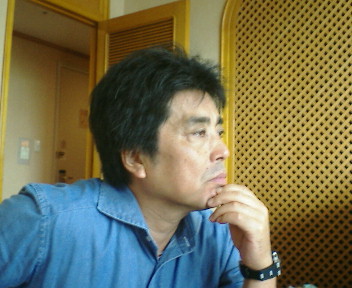
I woke today to the news that one of my favourite authors, Ryu Murakami, had passed away. I’ve not been hit so hard with the news of a writer’s passing since my literary hero, Dallas Mayr, also known as Jack Ketchum, left this world in 2018. Given that I write for a living it is remarkable how paralysed with incompetence I find myself when writing about the death of someone I greatly admired—struggling to come up with the right words. See, that’s the thing, there are no words that will adequately encompass just how much Ryu Murakami’s works meant to be and how much he inspired me in my journey as a creative. The best words we have are the gifts that Murakami-san left us with—these dark treasures in the form of his stories. I do not re-read many books but Piercing, In the Miso Soup, and Audition are books I have read again-and-again because not only are they greatly enjoyable in their exploration of some of the most unflinching and darkest analyses of the human condition, but they are master classes in how to create suspense, tension, and fast-paced dialogue.
Back in 2015, I wrote a column for LitReactor titled ‘One Month of Reading Ryu Murakami: A Primer’. Not the catchiest title but the idea was to spend a month reading (or rereading as was the case with some of these) a number of his books with the hopes of introducing the books to a wider audience. I have shared and at points re-edited some of that article below—with a focus on two of my favourite Ryu Murakami books, Piercing and In the Miso Soup—in the hope that if you have not read Murakami-san’s work, you may be inspired to do so. So, with that said, I’ll hand over to the Michael David Wilson of 2015 with a few insights and additions from the MDW of 2026…
You might be familiar with Ryu Murakami even if you don’t think you are, thanks in part to the popularity of Takashi Miike’s Audition. Whenever Japanese horror films are mentioned, Audition is at the centre of the discussion alongside the likes of Ju-On (known in the West as The Grudge), Ringu, and Dark Water. If you’ve been fortunate enough to see Audition, you’ve had a glimpse into the mind of Ryu Murakami— a beautiful, twisted mind that is nuanced, unfiltered, and at times depraved. Murakami-san presents to us real characters, with real, albeit unusual, problems. You’ll encounter no archetypes or generic characters here, but rather you’ll be presented with deeply troubled and flawed individuals, painted with a palette of greys. Murakami-san punctuates his fiction with jet black humour, and whilst his stories may on the surface follow conventional narrative structure, they are only ever snapshots of a wider tale, containing provocative commentary on society and the world as a whole.
Who was Ryu Murakami?
Ryu Murakami was born in Sasebo, Nagasaki on 19 February 1952. He was a novelist, essayist, and filmmaker. Sometimes dubbed the ‘renaissance man for the modern age’, his Japan-based stories explored themes of disillusionment, drug use, surrealism, murder, and war. Murakami’s success transcended the page. A fan and lifelong advocate of Cuban music, he introduced it to Japan and even established his own record label: Murakami’s in Sony Music.
Ryu Murakami penned over thirty novels, several of which have been translated into English, mostly by Ralph McCarthy who has also translated some of Murakami-san’s short stories. One hopes that more English translations are to follow.
Piercing
Originally published in 1994.
English translation by Ralph F. McCarthy, published in 2007.
My introduction to Ryu Murakami was loud, sharp, and anything but subtle. You could say it was like being stabbed with an ice pick, which brings us to the story. Piercing begins with our protagonist, Kawashima Masayuki, watching his infant child sleep. He retrieves an ice pick from his pocket and assures himself he won’t stab his baby. This is the tenth night he’s performed this ritual, watching over his sleeping child, ice pick in-hand, while his wife sleeps peacefully, oblivious.
“Gripping the ice pick lightly to minimise trembling, he placed the point of it next to the baby’s cheek… It really is all right, I’m not going to stab the baby.”
Kawashima has suffered from life-long anxiety. He found temporary escape from it when he previously stabbed an ex-lover. But as the novel opens, his anxiety is intensifying and he desperately needs to control it. He keeps telling us—and himself—that he won’t bludgeon his own child. It’s not the proper course of action… but he must do something. He comes up with a solution, to stab a prostitute. He plans the details meticulously, weighing up the different types of hotels, the location, and even the clothes he’ll wear. He wants to disguise himself in some way to make him unrecognisable but also notes he can’t stand out too much for fear of becoming memorable. Having seemingly considered every eventuality, Piercing ramps up the intrigue when we’re introduced to the prostitute in question, Sanada Chiaki. It turns out that Sanada has a more complex past than Kawashima, coloured by abuse, tragedy and mental health issues… Which as you can imagine, is when things get really interesting and the tension amplifies.
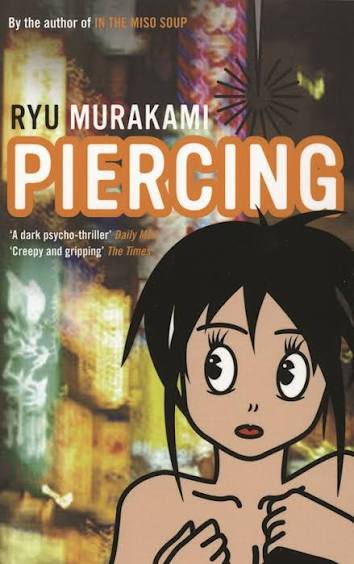
There’s a lot to love about Piercing, and many elements that make this an essential read. Murakami’s decision to concentrate, almost exclusively, on just two characters, with a timespan of little more than twenty-four hours, makes Piercing an intimate and punchy read. The fast-pace and constant intrigue will no doubt see most readers consume Piercing in just one or two sittings. Amongst the graphic violence—which always serves the story and is never gratuitous—and the edgy humour are mundane details of everyday life. The smell of homemade cooking and freshly baked bread that wafts around Kawashima’s humble abode, thanks to his wife’s bakery classes, contrasts perfectly with the explosive violence and simmering anger. Piercing is one of the best books I’ve read, and I unreservedly recommend you read it, too.
In the Miso Soup
Originally published in 1997.
English translation by Ralph F. McCarthy, published in 2007.
Piercing is a tough act to follow, but if any book could match it, it was In the Miso Soup. It won the Japanese literary award, the Yomiuri Prize, in 1997 and is easily the most talked about Murakami novel in the western world. It’s enjoyed a plethora of rave reviews from major newspapers and magazines in both the UK and the USA, and is considered by many a cult classic and standout example of Japanese genre fiction. Much like Piercing, it’s a slender read at just ov er two-hundred pages, and the subject matter is satisfyingly dark.
“It was murder with all the drama of picking up a fallen hat and replacing it on a rack.”
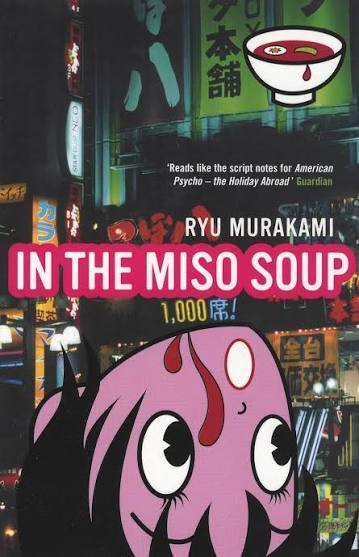
In the Miso Soup is written at the same frenetic pace and in the same compulsive style as Piercing. It is a book that is as quick to devour, though in knowing less about Frank and his intentions the tension and fear is all the more real. Having seen how Piercing pit two troubled characters against one another, I was wary Kenji might turn out to be an unreliable narrator and was mindful not to take anything at face value. The conclusion to In the Miso Soup is stark, shocking, abrupt, and will stay with you long after you close the book … At least that’s the case for me. Over a decade later and I’m still feeling the aftershocks of my time with Frank, coated in a grimy filth that cannot be fully washed.
Other Novels in English Translation by Ryu Murakami
Almost Transparent Blue
“A Japanese mix of A Clockwork Orange and L’Etranger.”—Newsweek
Originally published in 1976.
English translation by Nancy Andrew, published in 1977.
Coin Locker Babies
“It was my bible.”—Hideo Kojima
Originally published in 1980.
English translation by Stephen Snyder, published in 1995.
69
“A far cry from the nihilistic fairytale of Coin Locker Babies or the dirty, self-destructive realism of Almost Transparent Blue, this is a light-hearted, fast-paced trip through the lazy hazy days of the summer of 1969.”—Zack Davisson
Originally published in 1987.
English translation by Ralph F. McCarthy, published in 2013.
Popular Hits of the Showa Era: A Novel
“One of the funniest and strangest gang wars in recent literature.”—Booklist
Originally published in 1994.
English translation by Ralph F. McCarthy, published in 2013.
Audition
“The prose in these passages is elegiac and affecting, but it has the sharp, visceral feel of the butcher’s knife or surgeons scalpel, a highly compulsive, one-sitting read, and Audition should add to the Renaissance Man’s growing fanbase in the English speaking world.”—Irvine Welsh
Originally published in 1997.
English translation by Ralph F. McCarthy, published in 2009.
From the Fatherland, with Love
“A troubled meditation on the soul of modern Japan… Alarmingly pertinent in light of current British politics… A morbidly funny comedy… Above all, it is a phenomenal feat of storytelling: 700 pages, dozens of characters and scores of ideas woven into one gripping whole.”—Metro
Originally published in 2005.
English translation by Ralph F. McCarthy, Charles De Wolf, and Ginny Tapley Takemori, published in 2013.
MICHAEL DAVID WILSON